Isaiah 23:9

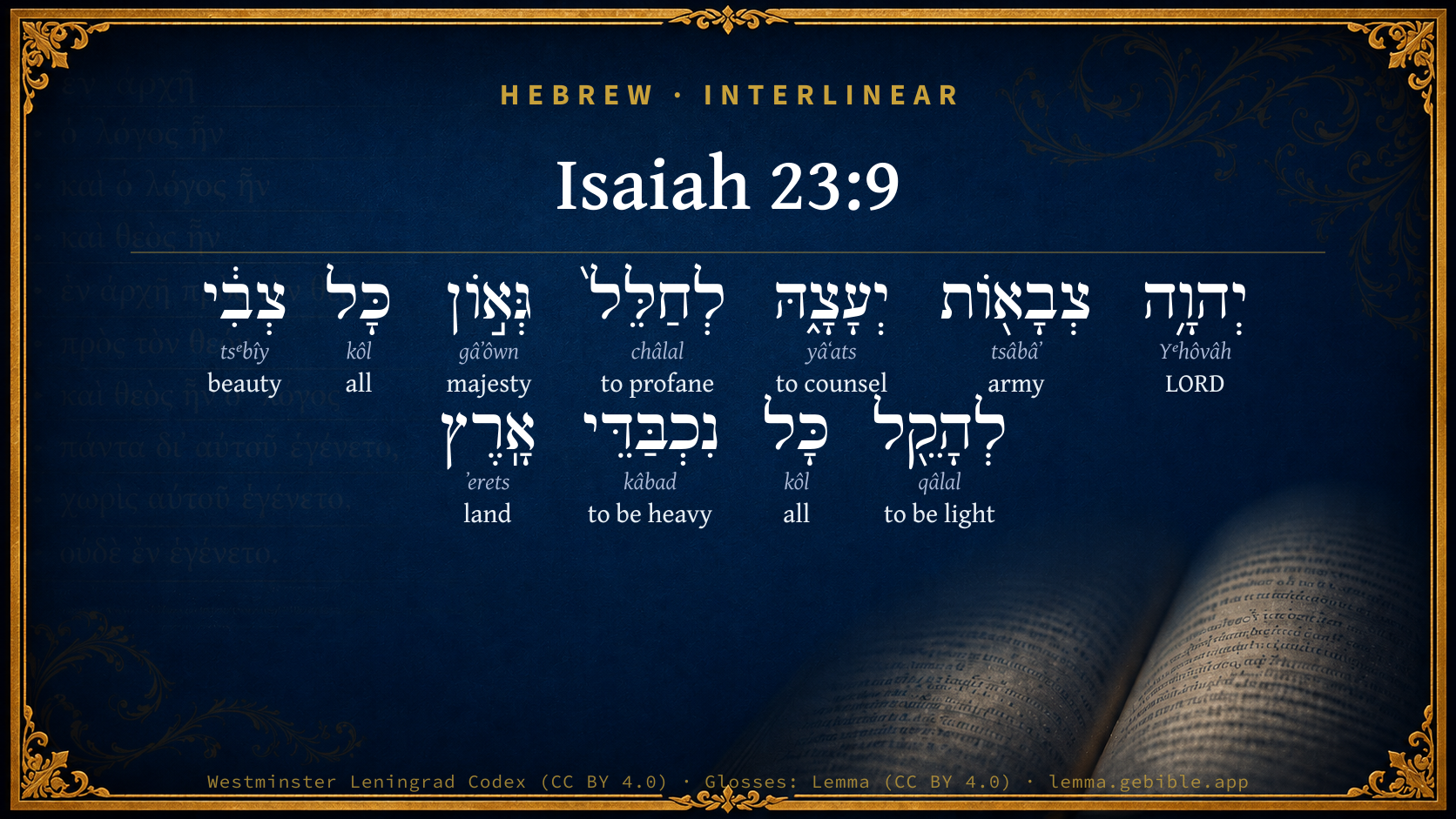
Hebrew (Westminster Leningrad Codex) Isaiah 23:9 appears in the Hebrew Old Testament. The text above is from the Westminster Leningrad Codex. Each word links to its Strong’s number, a concise gloss, and parsing drawn from the Open Scriptures Hebrew Bible morphology. Click any word for its full Brown-Driver-Briggs (BDB) entry.
Download image
Cite this verse

Isaiah 23:9 (World English Bible). Public Domain. Lemma interlinear Bible study tool, https://lemma.gebible.app/v/isaiah/23/9.

Show BibTeX & RIS
BibTeX
RIS
English Translation
Yahweh of hosts has purposed it, to stain the pride of all glory, to bring into contempt all the honorable of the earth.
World English Bible · Public Domain
Download a study sheet

One document with this verse’s original text, its word-by-word gloss line, the meaning frame, cross-references with their text, attributed commentary, and full source and license credits — printable, and it pastes into notes with its structure intact.

This verse Autodidact and up

Study sheet (.html) Plain text (.txt)

A passage Seminary Student

Up to 50 verses in one chapter. A passage sheet keeps up to 6 commentary sources and 12 cross-references per verse, in the order this page ranks them, and says so on the sheet whenever that leaves anything out. Ask for a single verse and you get the Autodidact verse sheet above.

Everything on this page stays free to read, with no account — the sheet is a download of what is already on screen, not access to it.

Want to remove ads? Support Godless Engineer
Compare translations 3

The same verse in 3 English versions, stacked beneath the original-language interlinear above. Click any original word for its lexicon entry.

Each is an independent rendering of the whole verse — the interlinear is not word-aligned to these translations.

Highlighted words mark where these versions differ — a whole-verse word diff, not a word-by-word alignment.

  • World English Bible Public Domain
    Yahweh of hosts has purposed it, to stain the pride of all glory, to bring into contempt all the honorable of the earth.
  • King James Version Public Domain
    The LORD of hosts hath purposed it, to stain the pride of all glory, and to bring into contempt all the honourable of the earth.
  • unfoldingWord Literal Text CC BY-SA 4.0
    Yahweh of Armies determined it, to profane the pride of all of the splendor, to make light all of the honored ones of the earth.

unfoldingWord Literal Text — © unfoldingWord, licensed CC BY-SA 4.0. Word-aligned USFM3 via Door43 (git.door43.org/unfoldingWord/en_ult).

Versions to compare (up to 4)

3 of 4 selected

Show all 18 translations

Every available English version of this verse, each an independent rendering of the whole verse.

  • World English Bible Public Domain
    Yahweh of hosts has purposed it, to stain the pride of all glory, to bring into contempt all the honorable of the earth.
  • Berean Standard Bible Public Domain
    The LORD of Hosts planned it, to defile all its glorious beauty, to disgrace all the renowned of the earth.
  • Majority Standard Bible Public Domain
    The LORD of Hosts planned it, to defile all its glorious beauty, to disgrace all the renowned of the earth.
  • King James Version Public Domain
    The LORD of hosts hath purposed it, to stain the pride of all glory, and to bring into contempt all the honourable of the earth.
  • American Standard Version (1901) Public Domain
    Jehovah of hosts hath purposed it, to stain the pride of all glory, to bring into contempt all the honorable of the earth.
  • Revised Version (1885) Public Domain
    The LORD of hosts hath purposed it, to stain the pride of all glory, to bring into contempt all the honourable of the earth.
  • Geneva Bible (1599) Public Domain
    The Lord of hostes hath decreed this, to staine the pride of all glorie, and to bring to contempt all them that be glorious in the earth.
  • Douay-Rheims (1899) Public Domain
    The Lord of hosts hath designed it, to pull down the pride of all glory, and bring to disgrace all the glorious ones of the earth.
  • Young's Literal Translation Public Domain
    Jehovah of Hosts hath counselled it, To pollute the excellency of all beauty, To make light all the honoured of earth.
  • Literal Standard Version CC BY-SA 4.0
    YHWH of Hosts has counseled it, || To defile the excellence of all beauty, || To make light all the honored of earth.
  • Unlocked Literal Bible CC BY-SA 4.0
    Yahweh of hosts has planned it to dishonor her pride and all her glory, to shame all her honored ones of the earth.
  • unfoldingWord Literal Text CC BY-SA 4.0
    Yahweh of Armies determined it, to profane the pride of all of the splendor, to make light all of the honored ones of the earth.
  • Darby Bible Public Domain
    Jehovah of hosts hath purposed it, to profane the pride of all glory, to bring to nought all the honourable of the earth.
  • World Messianic Bible Public Domain
    The LORD of Hosts has planned it, to stain the pride of all glory, to bring into contempt all the honorable of the earth.
  • Webster's Bible Public Domain
    The LORD of hosts hath purposed it, to stain the pride of all glory, and to bring into contempt all the honorable of the earth.
  • Free Bible Version CC BY-SA 4.0
    The Lord Almighty planned it, to humble its pride in all its glory, and to bring down all who receive worldly honor.
  • Bible in Basic English Public Domain
    It was the purpose of the Lord of armies to put pride to shame, to make sport of the glory of those who are honoured in the earth.
  • JPS Tanakh (1917) Public Domain
    The LORD of hosts hath devised it, to pollute the pride of all glory, to bring into contempt all the honourable of the earth.

Literal Standard Version (2020), Covenant Press — licensed CC BY-SA 4.0. Text via the HelloAO Bible API (eBible.org). Unlocked Literal Bible (unfoldingWord) — licensed CC BY-SA 4.0. Text via the HelloAO Bible API (eBible.org). unfoldingWord Literal Text — © unfoldingWord, licensed CC BY-SA 4.0. Word-aligned USFM3 via Door43 (git.door43.org/unfoldingWord/en_ult). Free Bible Version, Dr. Jonathan Gallagher — licensed CC BY-SA 4.0. Text via the HelloAO Bible API (eBible.org).

Word by word

More ways to search: Search by grammar → Find every occurrence → Compare this word →

Practice this passage: Drill this verse → Learn its vocabulary →

צְבִ֔י
tsᵉbîy
H6643
“beauty”
Noun, Common, Masculine, Singular, Absolute
Part of Speech
Noun
Type
Common
Gender
Masculine
Number
Singular
State
Absolute
Full BDB Definition

Origin: from H6638 in the sense of prominence

TWOT: 1869a , 1870a

beauty, glory, honour - beauty, decoration - honour - roebuck, gazelle - perhaps an extinct animal, exact meaning unknown
  1. יְהוָ֥ה Yᵉhôvâh H3068 “LORD” Noun, Proper
  2. צְבָא֖וֹת tsâbâʼ H6635 “armies” Noun, Common, Both, Plural, Absolute
  3. יְעָצָ֑הּ yâʻats H3289 “to counsel · her” Verb, Qal, Perfect, 3rd Person, Masculine, Singular + Suffix, Personal, 3rd Person, Feminine, Singular
  4. לְחַלֵּל֙ châlal H2490 “to profane” Preposition + Verb, Piel, Infinitive Construct
  5. גְּא֣וֹן gâʼôwn H1347 “majesty of” Noun, Common, Masculine, Singular, Construct
  6. כָּל kôl H3605 “all of” Noun, Common, Masculine, Singular, Construct
  7. לְהָקֵ֖ל qâlal H7043 “to be light” Preposition + Verb, Hiphil, Infinitive Construct
  8. כָּל kôl H3605 “all of” Noun, Common, Masculine, Singular, Construct
  9. נִכְבַּדֵּי kâbad H3513 “being heavy” Verb, Niphal, Participle Active, Masculine, Plural, Construct
  10. אָֽרֶץ ʼerets H776 “land” Noun, Common, Both, Singular, Absolute

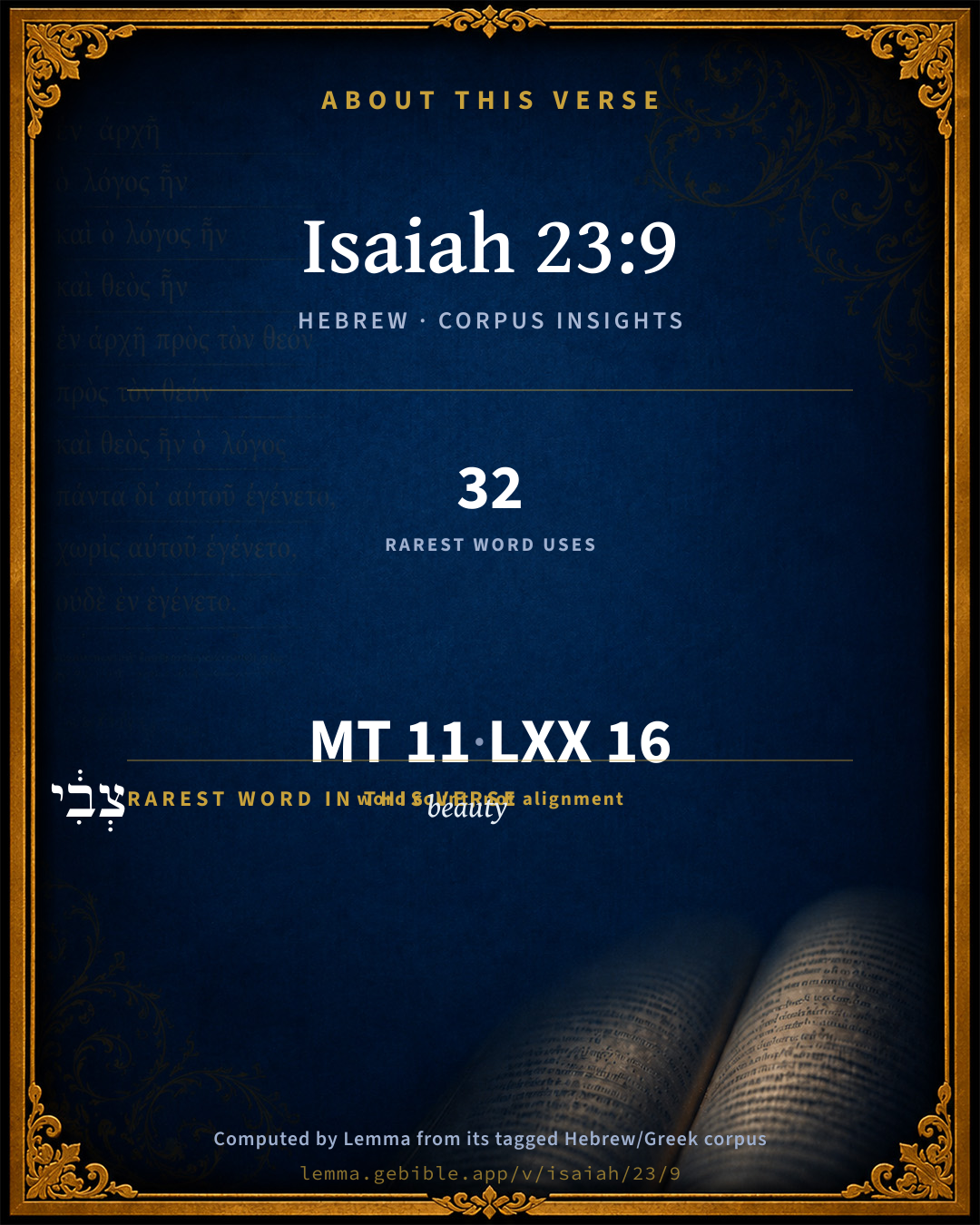
About this verse

These counts appear in no published source. They are computed here, from the morphology-tagged text and Lemma’s own curated glosses. What Lemma adds →

11
words
10
distinct lemmas
Prophets
section

Shared distinctive vocabulary

צְבִ֔י beauty H6643 occurs in 32 verses of the Hebrew Bible. Also found in:

Grammatical profile

  • 4 verbs
  • 7 nouns

Verb forms

  • יְעָצָ֑הּ Qal · Perfect
  • לְחַלֵּל֙ Piel · Infinitive Construct
  • לְהָקֵ֖ל Hiphil · Infinitive Construct
  • נִכְבַּדֵּי Niphal · Participle Active

Repetition

A word recurs within this verse — often emphatic in Hebrew:

Hebrew & Septuagint length

In English translation the verse runs 23 words from the Hebrew and 25 from the Septuagint (LXX English) — closely comparable.

A rough comparison of the two English renderings, which tokenize alike — not a word-level alignment.

Word counts can differ between the Hebrew and the Greek without any difference in meaning — e.g. the Hebrew direct-object marker אֵת has no separate Greek word, and Greek often adds the article ὁ.

In the original languages it is 11 Hebrew tokens and 16 Greek tokens — but the two are counted differently (Hebrew bundles its prefixes and suffixes into one token; the Greek is in lemma form), so that isn’t a like-for-like length.

Cross-references

22

Topical passages linked to Isaiah 23:9 in the Treasury of Scripture Knowledge — connected by theme and wording, ordered by reader-vote popularity; previews shown in the World English Bible.

  • Isaiah 13:11 I will punish the world for [their] evil, and the wicked for their iniquity: and I will cause the arrogance of the proud to cease, and will lay low the haughtiness of the terrible.
  • James 4:6 But he gives more grace. Therefore it says, "God resists the proud, but gives grace to the humble."
  • Job 40:11–12 Pour forth the fury of your anger. Look on everyone who is proud, and bring him low.
  • Isaiah 2:11 The lofty looks of man will be brought low, The haughtiness of men will be bowed down, And Yahweh alone will be exalted in that day.
  • Daniel 4:37 Now I, Nebuchadnezzar, praise and extol and honor the King of heaven; for all his works are truth, and his ways justice; and those who walk in pride he is able to abase.
  • Job 12:21 He pours contempt on princes, And loosens the belt of the strong.
  • Psalms 107:40 He pours contempt on princes, And causes them to wander in a trackless waste.
  • Isaiah 2:17 The loftiness of man shall be bowed down, And the haughtiness of men shall be brought low; And Yahweh alone shall be exalted in that day.
  • Isaiah 5:13 Therefore my people go into captivity for lack of knowledge; Their honorable men are famished, And their multitudes are parched with thirst.
  • Isaiah 5:15–16 So man is brought low, Mankind is humbled, And the eyes of the arrogant ones are humbled;
  • Isaiah 9:15 The elder and the honorable man, he is the head; and the prophet who teaches lies, he is the tail.
  • Isaiah 10:33 Behold, the Lord, Yahweh of Hosts, will lop the boughs with terror: and the high of stature shall be hewn down, and the lofty shall be brought low.
  • Isaiah 14:24 Yahweh of Hosts has sworn, saying, Surely, as I have thought, so shall it happen; and as I have purposed, so shall it stand:
  • Isaiah 14:27 For Yahweh of Hosts has purposed, and who shall annul it? and his hand is stretched out, and who shall turn it back?
  • Isaiah 46:10–11 declaring the end from the beginning, and from ancient times things that are not [yet] done; saying, My counsel shall stand, and I will do all my pleasure;
  • Jeremiah 47:6–7 You sword of Yahweh, how long will it be before you be quiet? put up yourself into your scabbard; rest, and be still.
  • Jeremiah 51:62 and say, Yahweh, you have spoken concerning this place, to cut it off, that none shall dwell therein, neither man nor animal, but that it shall be desolate forever.
  • Malachi 4:1 "For, behold, the day comes, it burns as a furnace; and all the proud, and all who work wickedness, will be stubble; and the day that comes will burn them up," says Yahweh of Hosts, "that it shall leave them neither root nor branch.
  • Acts 4:28 to do whatever your hand and your council foreordained to happen.
  • 1 Corinthians 1:26–29 For you see your calling, brothers, that not many are wise according to the flesh, not many mighty, and not many noble;
  • Ephesians 1:11 in whom also we were assigned an inheritance, having been foreordained according to the purpose of him who works all things after the counsel of his will;
  • Ephesians 3:11 according to the eternal purpose which he purposed in Christ Jesus our Lord;

Cross-references courtesy of OpenBible.info (CC BY 4.0).

Hebrew and Greek witnesses Masoretic Hebrew ↔ Greek Septuagint

The same verse in the two great witnesses to the Old Testament, shown verse-for-verse.

These are two independent witnesses, not word-aligned to each other, and the Septuagint is shown in lemma (dictionary) form.

Hebrew Isaiah 23:9 Masoretic · Westminster Leningrad Codex

יְהוָ֥ה צְבָא֖וֹת יְעָצָ֑הּ לְחַלֵּל֙ גְּא֣וֹן כָּל צְבִ֔י לְהָקֵ֖ל כָּל נִכְבַּדֵּי אָֽרֶץ

Yahweh of hosts has purposed it, to stain the pride of all glory, to bring into contempt all the honorable of the earth.

World English Bible · Public Domain

Greek LXX Isaiah 23:9 Septuagint · lemma form

κύριος σαβαωθ βουλεύω παραλύω πᾶς ὁ ὕβρις ὁ ἔνδοξος καί ἀτιμάζω πᾶς ἔνδοξος ἐπί ὁ γῆ

The Lord of hosts has purposed to bring down all the pride of the glorious ones, and to disgrace every glorious thing on the earth.

LXX2012 (modern English Septuagint) · Public Domain

Hebrew: Westminster Leningrad Codex (CC BY 4.0). Greek: Septuagint (public domain); English from LXX2012 (modern English Septuagint) (Public Domain). How the Septuagint differs from the Hebrew →

Targum (Aramaic paraphrase)

1

The Targum is the ancient Jewish Aramaic paraphrase of the Hebrew Scriptures — an interpretive translation, not the Hebrew text itself. Onkelos (literal) and Pseudo-Jonathan (expansive) render the Torah, and Jonathan the Prophets. Coverage is partial: where no permissively-licensed English translation exists for a verse, only the Aramaic is shown. This is verse-level text, not a word-by-word alignment to the Hebrew.

  1. Targum Jonathan Prophets (Joshua–Malachi)
    יְיָ צְבָאוֹת מִלְכָהּ לְאַפָסָא יְקָר כָּל חֶדְוָתָא לְאַקָלָא כָּל יַקִירֵי אַרְעָא:

    The Lord of hosts is the counsellor against her, to defile the glory of all the objects of rejoicing, and make contemptible all the nobles of the land.

    Targum Jonathan — Aramaic: “Mikraot Gedolot” (public domain). English: “Sefaria Community Translation” (CC0 1.0 (public-domain dedication)); “London "Chaldee Paraphrase," 1871” (public domain). Text via Sefaria.

Commentary

Notes on Isaiah 23:9 from classic Christian and Jewish commentators (each source and its license shown beneath its notes). The classic Christian expositions comment on the surrounding passage and are grouped to its opening verse, so a note may address several verses; the Jewish commentaries on the Tanakh (Rashi and others) are per-verse, so they appear only where the commentator wrote on this verse.

Lemma curates 59 commentaries, every one of them public domain or Creative Commons licensed, each selected and text-cleaned for this edition rather than reprinted as found. About our sources →

Trapp's Complete Commentary

John Trapp

Isa 23:9 The LORD of hosts hath purposed it, to stain the pride of all glory, [and] to bring into contempt all the honourable of the earth.

Ver. 9. The Lord of hosts hath purposed it.] Here the prophet sets forth both who had decreed the downfall of this famous and flourishing city; and why? See Eze 27:5-7.

To stain the pride of all glory.] Ut faedet fastum omnis gloriae; to bring down the height of all haughtiness. This hath God Almighty decreed, and it shall stand. "Let us, therefore, have grace, whereby we may serve him with reverence and godly fear." {Heb 12:28}

John Trapp, A Commentary or Exposition upon All the Books of the Old and New Testament (1647–1656) — public domain. Text from a community e-Sword module.

The Biblical Illustrator

Joseph S. Exell

Isa_23:9

The Lord of hosts hath purposed it, to stain the pride of all glory

God abases pride

In this message there is a revelation of the Divine method in dealing with men and nations.

For here the Divine purpose is to show how stained is all human pride, and how contemptible are those whose honour comes from men only. What God brings about is a gradual uncovering of things, a discovering of their true character, and therefore the manifestation of the utter unsoundness and instability of anything not based on the:Divine will. (B. Blake, B. D.)

God exalts the humble and abases the proud

A philosopher, being asked how God was employed, gave for answer, In exalting the humble and abasing the proud. The reply was good, and agreeable to Scripture. (R. Macculloch.)

The great sin of pride

Other sins are violations of the law of God, this acteth in direct opposition to His very existence and sovereignty; it not only despiseth His commandment, but it arraigneth the dispensations of His providence and grace, and proves the fruitful source of all other transgressions. (R. Macculloch.)

The Biblical Illustrator, edited by Joseph S. Exell (c. 1880s–1900s) — public domain. Text from a community e-Sword module.

Jamieson, Fausset & Brown

Robert Jamieson, A. R. Fausset & David Brown

Whoever be the instruments in overthrowing haughty sinners, God, who has all hosts at His command, is the First Cause (Isa 10:5-7).

stain--rather, "to profane"; as in Exo 31:14, the Sabbath, and other objects of religious reverence; so here, "the pride of all glory" may refer to the Tyrian temple of Hercules, the oldest in the world, according to ARRIAN (Isa 2:16); the prophet of the true God would naturally single out for notice the idol of Tyre [G. V. SMITH]. It may, however, be a general proposition; the destruction of Tyre will exhibit to all how God mars the luster of whatever is haughty (Isa 2:11).

Jamieson, Fausset & Brown — Commentary Critical and Explanatory on the Whole Bible (1871) — public domain (CC PDM 1.0). Text via the HelloAO Bible API.

Ellicott's Commentary for English Readers

(9) The Lord of hosts hath purposed . . .—This is the prophet’s answer. The kings of Assyria were but instruments in the hand of Jehovah Sabaoth, working out what He had planned.

To stain the pride . . .—The primary meaning of the verb is to pollute or desecrate, possibly in reference to the destruction of the temples of Tyre, such e.g. as that of Melkarth, which was reported to be one of the most ancient in the world.

A Bible Commentary for English Readers, edited by Charles John Ellicott (1878–1897) — public domain. Text from a community e-Sword module.

The Cambridge Bible for Schools and Colleges

gen. ed. J. J. S. Perowne

9. Jehovah has purposed it in accordance with a fixed principle of His government.

to stain (render to desecrate) the pride of all glory] The thought is the same as in ch. Isa_2:12 ff. For this use of the verb “desecrate,” cf. Eze_28:7.

The Cambridge Bible for Schools and Colleges (gen. ed. J. J. S. Perowne; Cambridge University Press, 1878–1918) — public domain. Text from a community e-Sword module.

John Gill's Exposition

The Lord of hosts hath purposed it,.... To destroy Tyre; who is wonderful in counsel, capable of forming a wise scheme, and able to put it in execution; being the Lord of armies in heaven and in earth: and his end in it was,

to stain the pride of all glory; Tyre being proud of its riches, the extent of its commerce, and the multitude of its inhabitants, God was resolved, who sets himself against the proud, to abase them; to pollute the glorious things they were proud of; to deal with them as with polluted things; to trample upon them:

and to bring into contempt all the honourable of the earth: or, "to make light all the heavy ones of the earth" (d); all such, who are top heavy with riches and honour, God can, and sometimes does, make as light as feathers, which the wind carries away, and they fall into contempt and disgrace with their fellow creatures; and the Lord's thus dealing with Tyre was not merely on their account, to stain their pride and glory, and disgrace their honourable ones; but for the sake of others also, that the great ones of the earth might see and learn, by this instance of Tyre, how displeasing to the Lord is the sin of pride; what a poor, vain, and perishing thing, worldly honour and glory is; and what poor, weak, feeble creatures, the princes and potentates of the earth are, when the Lord takes them in hand.

(d) .

John Gill's Exposition of the Whole Bible (1746–1763) — public domain (CC PDM 1.0). Text via the HelloAO Bible API.

Albert Barnes' Notes on the Bible

The Lord of hosts hath purposed it - (see the note at Isa 1:9). It is not by human counsel that it has been done. Whoever is the instrument, yet the overthrow of wicked, proud, and vicious cities and nations is to be traced to the God who rules in the empires and kingdoms of the earth (see the notes at Isa 10:5-7).

To stain, the pride of all glory - Margin, ‘Pollute.’ The Hebrew word (חלל chalēl) means properly to bore, or pierce through; to open, make common Lev 19:29; then to profane, defile, pollute, as, e. g., the sanctuary Lev 19:8; Lev 21:9, the Sabbath Exo 31:14, the name of God Lev 18:21; Lev 19:12. Here it means that the destruction of Tyre would show that God could easily level it all with the dust. The destruction of Tyre would show this in reference to all human glory, because:

(1) it was one of the most ancient cities;

(2) it was one of the most magnificent;

(3) it was one: of the most strong, secure, and inaccessible;

(4) it was the one of most commercial importante, most distinguished in the view of nations; and

(5) its example would be the most striking and impressive.

God often selects the most distinguished and important cities and people to make them examples to others, and to show the ease with which he can bring all down to the earth.

To bring into contempt ... - To bring their plans and purposes into contempt, and to show how unimportant and how foolish are their schemes in the sight of a holy God.

Albert Barnes' Notes on the Bible (1834–1885) — public domain. Text from a community e-Sword/MySword module.

Matthew Poole's English Annotations

The Lord of hosts hath purposed it; this is the Lord’s own doing; therefore do not doubt it, nor wonder at it. God’s design is by this one example to abate and abase the pride of all the potentates of the earth, that they may see and know what weak and wretched creatures they are, when God leaves them, and sets himself against them.

Matthew Poole's English Annotations on the Holy Bible (1683–1685) — public domain. Text from a community e-Sword/MySword module.

The Pulpit Commentary

The Lord of hosts hath purposed it; rather, hath counseled it. The word is the same as that used in the opening clause of ver. 8. God has conceived the thought of destroying Tyre, for the reasons which the prophet proceeds to specify:

1. To stain the pride of all glory; or, of all beauty. Not that "glory" or "beauty" are displeasing to him, or provoke his envy, as the heathen thought (Herod., 7:10, but that those who "pride" themselves on their glory and beauty offend him.

2. To bring into contempt all the honorable of the earth; i.e. to render contemptible those whom the world honors, though they do not deserve honor.

Ver. 9. The fall of Tyre a warning against pride in the glories of civilization and art.

In destroying Tyre, God, we are told, "purposed to stain the pride of all glory." The word translated "glory" also signifies "beauty"; (Isa_4:2 Eze_7:20) and the "glory" for which Tyro was renowned consisted, not in military reputation or governmental ability, but in wealth, commerce, and the production of beautiful objects, as garments, bowls, metal castings, and ether works of art. It was on the perfection to which she had brought the arts which aim at embodying the beautiful, that Tyre especially prided herself. Her boast was, "I am of perfect beauty". (Eze_27:3) By her fate we are taught

I THAT THE CULT OF THE BEAUTIFUL HAS ITS ESPECIAL DANGERS TO OUR MORAL NATURE. Artistic work seems to emanate so entirely from a man himself, to be so purely his own absolute creation, that it naturally raises in him an admiration of himself and an exalted conception of his own powers. How shall he not be proud of faculties that enable him to produce works which send a thrill of delight through crowds, and are recognized as possessions for all time! Again, the beautiful is so charming, so attractive, that it is apt to seem sufficient for a man, and so to absorb all his attention, and shut out all thought of higher and nobler things. In our own time the cult is actually preached as a sufficient religion, and men are asked what more they can possibly desire than to feast the eye perpetually on beautiful objects beautiful buildings, beautiful furniture, beautiful clothes, pictures, statues, statuettes, harmonious colors, delicate textures, soft and subdued light, graceful forms, pleasing contrasts. A weak and effeminate race is produced by such a training; the robuster virtues are uncared for; men become lapped in a luxurious sensualism, and need a warning voice, like that of the prophet, to wake them from their delightful dream to life"s stern realities.

II THAT THE EXCLUSIVE CULT OF THE BEAUTIFUL PROVOKES GOD"S ANGER AND JEALOUSY. Type is not accused of crimes. She is not a "bloody city," like Nineveh (Nah_3:1); she is not "full of lies and robbery." Her punishment does not come upon her "because of the violence" that is in her, nor for extreme arrogancy, nor for hypocrisy. Her sin seems to be in her luxury, in her softness, in her "perfect beauty". (Eze_27:11) She is rich, she is comely, she has things of beauty all about her, and she is content. She wants no more. The beautiful and the enjoyable satisfy her. But God is angered thereby. He will not have even the beautiful, though it is a shadow of himself, shut him out from the first place in men"s thoughts. He will vindicate his own honor. He will suffer no rival near his throne. If men are so wrapt up in anything as to forget him, he will remind them of himself by some terrible judgment, which can be ascribed to none but him (vers. 8-11).

God"s constant work of humbling pride.

"Jehovah Sabaoth hath devised it, to desecrate the pride of all glory." It is possible that reference may be intended to the desecration of the Tyrian temple of Hercules, which is said to have been the oldest in the world. But the reference may be general, and any actual case would but illustrate the general truth. "God did not bring these calamities upon Tyre in a way of sovereignty, to show an arbitrary and irresistible power; but he did it to punish the Tyrians for their pride. Many other sins, no doubt, reigned among them idolatry, sensuality, and oppression; but the sin of pride is fastened upon as that which was the particular ground of God"s controversy with Tyre, for he resists the proud. Let the ruin of Tyre be a warning to all places and persons to take heed of pride; for it proclaims to all the world that he who exalts himself shall be abased." Thomson, in "The Land and the Book," forcibly describes the present condition of humbled, ruined Tyre: "It (an insignificant village) is all that remains of her. But weep not for Tyre; this very silence and repose are most eloquent and emphatic on themes of the last importance to the Christian faith. There is nothing here of that which led Joshua to call it "the strong city" more than three thousand years ago; (Jos_19:29) nothing of that mighty metropolis which baffled the proud Nebuchadnezzar and all his power for thirteen years, until every head in his army was bald, and every shoulder peeled in the hard service against Tyrus; (Eze_29:18) nothing in this wretched roadstead and. empty markets to remind one of the times when merry mariners did sing in her markets; no visible trace of those towering ramparts which so long resisted the efforts of the great Alexander; all have vanished like a troubled dream. As she now is and has long been, Tyre is God"s witness; but great, powerful, and populous, she would be the infidel"s boast." The point to be illustrated is that God will be sure to deal with individuals and with nations, for the humbling and crushing of pride. He will do so because

I PRIDE INVOLVES PERIL TO A MAN"S OWN CHARACTER. There can be no healthy growth where it is present. The passive virtues, which are so specially commended in Christianity, cannot dwell with pride, which is so closely allied with satisfaction in self and the despising of others. Pride is a worm at the loot of the tree of character.

II PRIDE DESTROYS THE COMFORTABLENESS OF A MAN"S RELATIONS WITH HIS FELLOW-MEN. The proud man tries to keep away from his fellows. And his fellows are glad enough to keep away from him. It is inconceivably miserable for a "man to be placed alone in the midst of the earth.

III PRIDE SPOILS A MAN"S RELATIONS WITH GOD. They are founded on the proper humility of the submissive and dependent creature. For man the universal law is, "Humble yourselves under the mighty hand of God, that he may exalt you in due time," or else you certainly must, as Tyre, be humbled. R.T.

The Pulpit Commentary (1880–1919), ed. H.D.M. Spence-Jones & Joseph S. Exell — public domain. Text from a community e-Sword module.

John Wesley's Explanatory Notes

The Lord - This is the Lord's own doing. To stain - God's design is by this example to abase the pride of all the potentates of the earth.

John Wesley, Explanatory Notes Upon the Whole Bible (1754–1765) — public domain. Text via the GEBible commentary corpus.

J. A. Alexander on Isaiah

Joseph Addison Alexander

“Jehovah of Hosts hath purposed it, to profane the elevation of all beauty, to degrade all the honored of the earth.” This is the answer to the question in v. 8. Not only in poetry, but in animated prose, the writers of all languages ask questions to be answered by themselves. The word translated profane means strictly to desecrate that which is reckoned holy, but is here used to express the making common of that which was distinguished by magnificence or beauty.

Joseph Addison Alexander, The Prophecies of Isaiah (1846–1847; New York: Scribner, 1870–1878) — public domain. Text from a community e-Sword module.

Rashi

Rabbi Shlomo Yitzchaki (Rashi)

every position every strong position.

Rashi on the Tanakh — English translations: “The Judaica Press complete Tanach with Rashi, translated by A. J. Rosenberg” (CC BY 4.0); “Pentateuch with Rashi's commentary by M. Rosenbaum and A.M. Silbermann, 1929-1934” (public domain); “The Metsudah Tanach series, Lakewood, N.J” (CC BY 4.0); and “The Book of Joshua, Metsudah Publications, 1997” (CC BY 4.0). Text via Sefaria.

Ibn Ezra

Rabbi Abraham ibn Ezra

The Lord of hosts, etc. The Lord, who is the King of hosts has decided this.

Ibn Ezra on the Tanakh — English translations: “Sefaria Community Translation” (CC0 1.0 (public-domain dedication)); “Yalkut, Sifsei Chachomim Chumash, Metsudah Publications, 2009” (CC BY 4.0); and “Commentary of Ibn Ezra on Isaiah - trans. by M. Friedlander, 1873” (public domain). Text via Sefaria.

Lesson kit

Teaching starters — assembled from the data on this page, not authored interpretation. Every prompt links to the verse data it draws on. Edit before teaching.

Isaiah, in the Prophets, opens this verse with 11 words (10 distinct Hebrew lemmas). Its most distinctive word is tsᵉbîy (“beauty”). A historical commentator’s framing appears above. Read the whole chapter for the surrounding context.

Discussion questions

  1. The word tsᵉbîy carries the sense “beauty.” How does it shape the verse?
  2. How does Deuteronomy 12:15, which shares the word «beauty», read alongside this verse?
  3. What does the repetition of “all” (2× in this one verse) do in this verse?
  4. The translations on this page render this verse differently — a whole-verse word diff, not a word-by-word alignment. What might account for the different wordings?
  5. «יְעָצָ֑הּ» is a Qal Perfect verb. How does that grammatical form shape the action described?
  6. Compare how Trapp's Complete Commentary and The Biblical Illustrator read this verse. Where do they agree or differ?

Things to notice

Reading settings

Reading text

Shown beneath each verse's original-language words.

Old Testament
Old Testament edition

Read the OT as the Masoretic Hebrew (MT) or the Greek Septuagint (LXX).

English shown for the Greek Septuagint (in the Hebrew ↔ Greek comparison).

Comparing translations? Open the Compare panel on any verse page to stack up to four side by side.