
Jeremiah 50:45

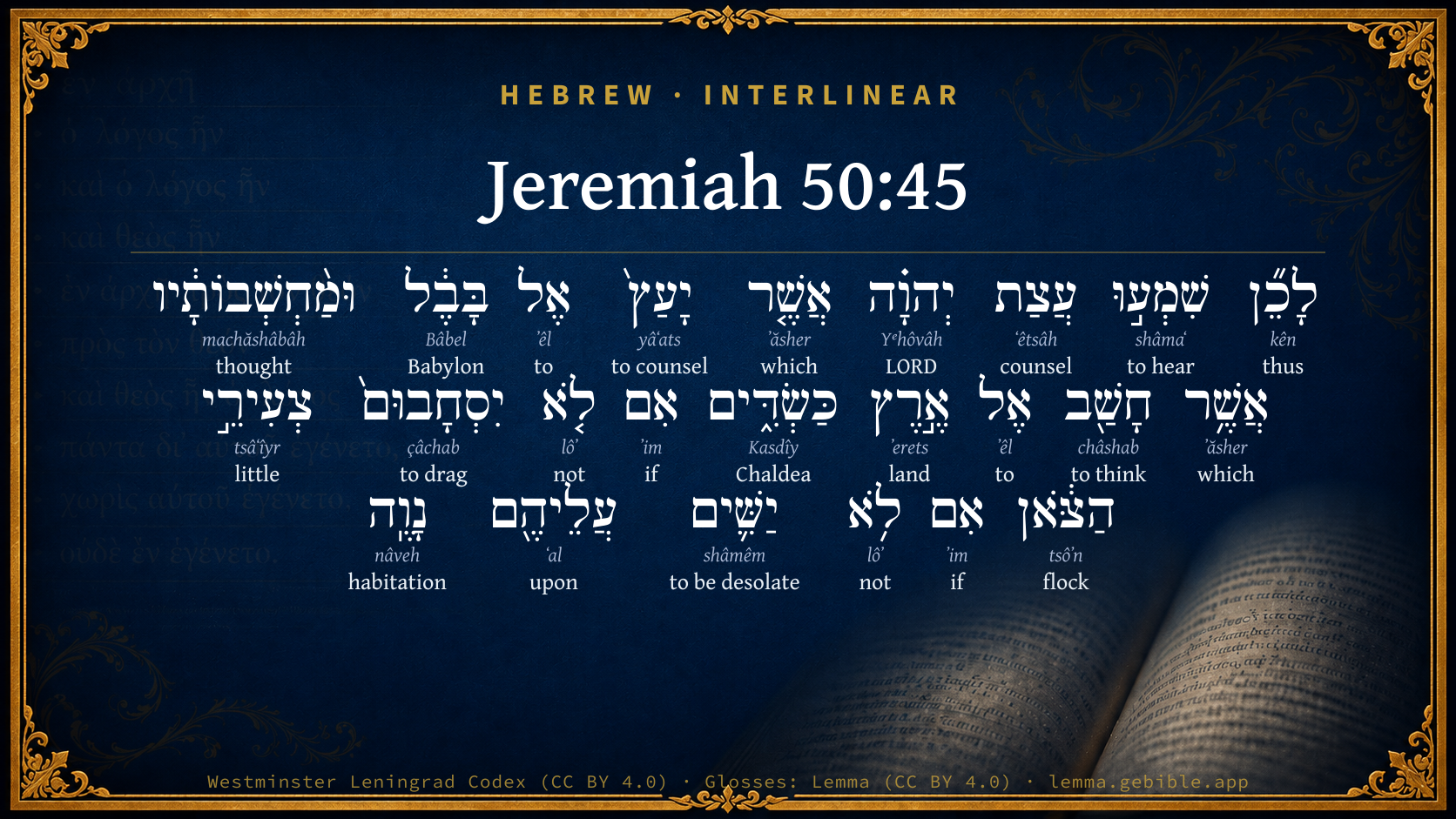
Hebrew (Westminster Leningrad Codex) Jeremiah 50:45 appears in the Hebrew Old Testament. The text above is from the Westminster Leningrad Codex. Each word links to its Strong’s number, a concise gloss, and parsing drawn from the Open Scriptures Hebrew Bible morphology. Click any word for its full Brown-Driver-Briggs (BDB) entry.
Download image
Cite this verse

Jeremiah 50:45 (World English Bible). Public Domain. Lemma interlinear Bible study tool, https://lemma.gebible.app/v/jeremiah/50/45.

Show BibTeX & RIS
BibTeX
RIS
English Translation
Therefore hear the counsel of Yahweh, that he has taken against Babylon; and his purposes, that he has purposed against the land of the Chaldeans: Surely they shall drag them away, [even] the little ones of the flock; surely he shall make their habitation desolate over them.
World English Bible · Public Domain
Download a study sheet

One document with this verse’s original text, its word-by-word gloss line, the meaning frame, cross-references with their text, attributed commentary, and full source and license credits — printable, and it pastes into notes with its structure intact.

This verse Autodidact and up

Study sheet (.html) Plain text (.txt)

A passage Seminary Student

Up to 50 verses in one chapter. A passage sheet keeps up to 6 commentary sources and 12 cross-references per verse, in the order this page ranks them, and says so on the sheet whenever that leaves anything out. Ask for a single verse and you get the Autodidact verse sheet above.

Everything on this page stays free to read, with no account — the sheet is a download of what is already on screen, not access to it.

Want to remove ads? Support Godless Engineer
Compare translations 3

The same verse in 3 English versions, stacked beneath the original-language interlinear above. Click any original word for its lexicon entry.

Each is an independent rendering of the whole verse — the interlinear is not word-aligned to these translations.

Highlighted words mark where these versions differ — a whole-verse word diff, not a word-by-word alignment.

  • World English Bible Public Domain
    Therefore hear the counsel of Yahweh, that he has taken against Babylon; and his purposes, that he has purposed against the land of the Chaldeans: Surely they shall drag them away, [even] the little ones of the flock; surely he shall make their habitation desolate over them.
  • King James Version Public Domain
    Therefore hear ye the counsel of the LORD, that he hath taken against Babylon; and his purposes, that he hath purposed against the land of the Chaldeans: Surely the least of the flock shall draw them out: surely he shall make their habitation desolate with them.
  • unfoldingWord Literal Text CC BY-SA 4.0
    So listen to the plans that Yahweh has decided against Babylon, the plans that he has planned against the land of the Chaldeans. They will certainly be dragged away, even the smallest flock. Their pasturelands will be turned into ruined places.

unfoldingWord Literal Text — © unfoldingWord, licensed CC BY-SA 4.0. Word-aligned USFM3 via Door43 (git.door43.org/unfoldingWord/en_ult).

Versions to compare (up to 4)

3 of 4 selected

Show all 18 translations

Every available English version of this verse, each an independent rendering of the whole verse.

  • World English Bible Public Domain
    Therefore hear the counsel of Yahweh, that he has taken against Babylon; and his purposes, that he has purposed against the land of the Chaldeans: Surely they shall drag them away, [even] the little ones of the flock; surely he shall make their habitation desolate over them.
  • Berean Standard Bible Public Domain
    Therefore hear the plans that the LORD has drawn up against Babylon and the strategies He has devised against the land of the Chaldeans: Surely the little ones of the flock will be dragged away; certainly their pasture will be made desolate because of them.
  • Majority Standard Bible Public Domain
    Therefore hear the plans that the LORD has drawn up against Babylon and the strategies He has devised against the land of the Chaldeans: Surely the little ones of the flock will be dragged away; certainly their pasture will be made desolate because of them.
  • King James Version Public Domain
    Therefore hear ye the counsel of the LORD, that he hath taken against Babylon; and his purposes, that he hath purposed against the land of the Chaldeans: Surely the least of the flock shall draw them out: surely he shall make their habitation desolate with them.
  • American Standard Version (1901) Public Domain
    Therefore hear ye the counsel of Jehovah, that he hath taken against Babylon; and his purposes, that he hath purposed against the land of the Chaldeans: Surely they shall drag them away, `even' the little ones of the flock; surely he shall make their habitation desolate over them.
  • Revised Version (1885) Public Domain
    Therefore hear ye the counsel of the LORD, that he hath taken against Babylon; and his purposes, that he hath purposed against the land of the Chaldeans: Surely they shall drag them away, even the little ones of the flock; surely he shall make their habitation desolate with them.
  • Geneva Bible (1599) Public Domain
    Therefore heare the counsell of the Lord that hee hath deuised against Babel, and his purpose that hee hath conceiued against the lande of the Caldeans: surely the least of the flocke shall drawe them out: surely he shall make their habitation desolate with them.
  • Douay-Rheims (1899) Public Domain
    Therefore hear ye the counsel of the Lord, which he hath taken against Babylon: and his thoughts which he hath thought against the land of the Chaldeans: surely the little ones of the flocks shall pull them down, of a truth their habitation shall be destroyed with them.
  • Young's Literal Translation Public Domain
    Therefore, hear ye the counsel of Jehovah, That He counselled concerning Babylon, And His devices that He hath devised Concerning the land of the Chaldeans; Drag them out do not little ones of the flock, Doth He not make desolate over them the habitation?
  • Literal Standard Version CC BY-SA 4.0
    Therefore, hear the counsel of YHWH, || That He counseled concerning Babylon, || And His plans that He has devised || Concerning the land of the Chaldeans; Do little ones of the flock not drag them out, || Does He not make the habitation desolate over them?
  • Unlocked Literal Bible CC BY-SA 4.0
    So listen to the plans that Yahweh has decided against Babylon, the plans that he has planned against the land of the Chaldeans. They will certainly be dragged away, even the smallest flock. Their pasturelands will be turned into ruined places.
  • unfoldingWord Literal Text CC BY-SA 4.0
    So listen to the plans that Yahweh has decided against Babylon, the plans that he has planned against the land of the Chaldeans. They will certainly be dragged away, even the smallest flock. Their pasturelands will be turned into ruined places.
  • Darby Bible Public Domain
    Therefore hear the counsel of Jehovah, which he hath taken against Babylon, and his purposes which he hath purposed against the land of the Chaldeans: The little ones of the flock shall certainly draw them away; he shall certainly make their habitation desolate for them.
  • World Messianic Bible Public Domain
    Therefore hear the counsel of the LORD that he has taken against Babylon; and his purposes that he has purposed against the land of the Kasdim: Surely they will drag them away, even the little ones of the flock. Surely he will make their habitation desolate over them.
  • Webster's Bible Public Domain
    Therefore hear ye the counsel of the LORD, that he hath taken against Babylon; and his purposes, that he hath purposed against the land of the Chaldeans: Surely the least of the flock shall draw them out: surely he shall make their habitation desolate with them.
  • Free Bible Version CC BY-SA 4.0
    So listen to what the Lord has planned to do to Babylon and the country of Babylonia: Their children will be dragged away like lambs from the flock, and because of them their pasture will become a wasteland.
  • Bible in Basic English Public Domain
    So give ear to the decision of the Lord which he has made against Babylon, and to his purposes designed against the land of the Chaldaeans; Truly, they will be pulled away by the smallest of the flock; truly, he will make waste their fields with them.
  • JPS Tanakh (1917) Public Domain
    Therefore hear ye the counsel of the LORD, that He hath taken against Babylon, and His purposes, that He hath purposed against the land of the Chaldeans: surely the least of the flock shall drag them away, surely their habitation shall be appalled at them.

Literal Standard Version (2020), Covenant Press — licensed CC BY-SA 4.0. Text via the HelloAO Bible API (eBible.org). Unlocked Literal Bible (unfoldingWord) — licensed CC BY-SA 4.0. Text via the HelloAO Bible API (eBible.org). unfoldingWord Literal Text — © unfoldingWord, licensed CC BY-SA 4.0. Word-aligned USFM3 via Door43 (git.door43.org/unfoldingWord/en_ult). Free Bible Version, Dr. Jonathan Gallagher — licensed CC BY-SA 4.0. Text via the HelloAO Bible API (eBible.org).

Word by word

More ways to search: Search by grammar → Find every occurrence → Compare this word →

Practice this passage: Drill this verse → Learn its vocabulary →

יִסְחָבוּם֙
çâchab
H5498
“to drag · them”
Verb, Qal, Imperfect, 3rd Person, Masculine, Plural + Suffix, Personal, 3rd Person, Masculine, Plural
Part of Speech
Verb
Stem
Qal
Form
Imperfect
Person
3rd Person
Gender
Masculine
Number
Plural
Full BDB Definition

Origin: a primitive root

TWOT: 1482

(Qal) to drag
  1. לָכֵ֞ן kên H3651 “to/for · thus” Preposition + Adverb
  2. שִׁמְע֣וּ shâmaʻ H8085 “hear” Verb, Qal, Imperative, 2nd Person, Masculine, Plural
  3. עֲצַת ʻêtsâh H6098 “counsel of” Noun, Common, Feminine, Singular, Construct
  4. יְהוָ֗ה Yᵉhôvâh H3068 “LORD” Noun, Proper
  5. אֲשֶׁ֤ר ʼăsher H834 “which” Particle, Relative
  6. יָעַץ֙ yâʻats H3289 “to counsel” Verb, Qal, Perfect, 3rd Person, Masculine, Singular
  7. אֶל ʼêl H413 “to” Preposition
  8. בָּבֶ֔ל Bâbel H894 “Babylon” Noun, Proper
  9. וּמַ֨חְשְׁבוֹתָ֔יו machăshâbâh H4284 “and · thoughts · his” Conjunction + Noun, Common, Feminine, Plural, Construct + Suffix, Personal, 3rd Person, Masculine, Singular
  10. אֲשֶׁ֥ר ʼăsher H834 “which” Particle, Relative
  11. חָשַׁ֖ב châshab H2803 “to think” Verb, Qal, Perfect, 3rd Person, Masculine, Singular
  12. אֶל ʼêl H413 “to” Preposition
  13. אֶ֣רֶץ ʼerets H776 “land of” Noun, Common, Both, Singular, Construct
  14. כַּשְׂדִּ֑ים Kasdîy H3778 “Chaldea” Noun, Proper
  15. אִם ʼim H518 “if” Conjunction
  16. לֹ֤א lôʼ H3808 “not” Particle, Negative
  17. צְעִירֵ֣י tsâʻîyr H6810 “little of” Adjective, Adjective, Masculine, Plural, Construct
  18. הַצֹּ֔אן tsôʼn H6629 “the · flock” Particle, Definite Article + Noun, Common, Both, Singular, Absolute
  19. אִם ʼim H518 “if” Conjunction
  20. לֹ֥א lôʼ H3808 “not” Particle, Negative
  21. יַשִּׁ֛ים shâmêm H8074 “to be desolate” Verb, Hiphil, Imperfect, 3rd Person, Masculine, Singular
  22. עֲלֵיהֶ֖ם ʻal H5921 “upon · them” Preposition + Suffix, Personal, 3rd Person, Masculine, Plural
  23. נָוֶֽה nâveh H5116 “habitation” Noun, Common, Both, Singular, Absolute

About this verse

These counts appear in no published source. They are computed here, from the morphology-tagged text and Lemma’s own curated glosses. What Lemma adds →

24
words
20
distinct lemmas
Prophets
section

Notable vocabulary

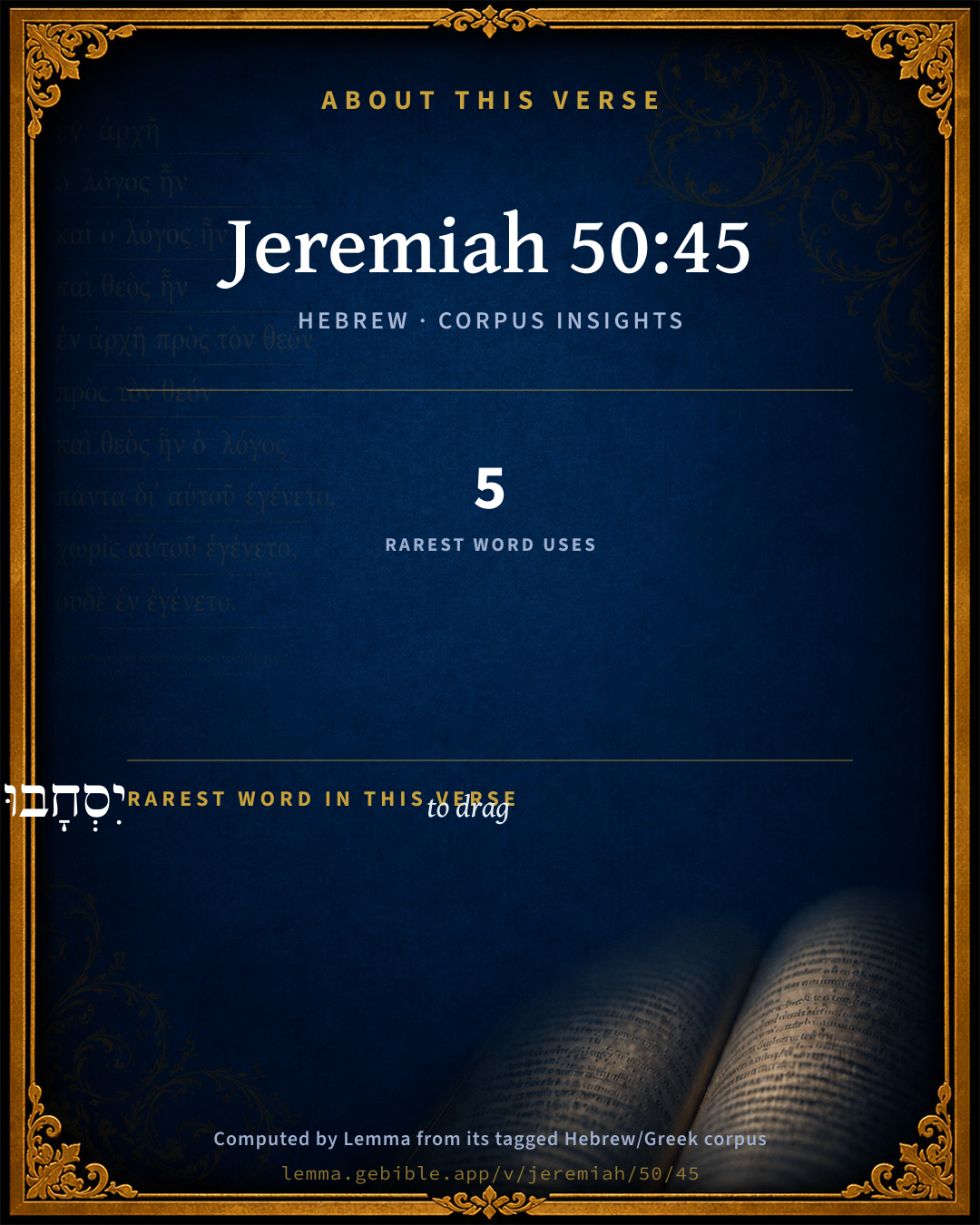
The rarest word here is יִסְחָבוּם֙ to drag H5498 — appearing just 5 times in the whole Hebrew Bible.

Shared distinctive vocabulary

יִסְחָבוּם֙ to drag H5498 occurs in 5 verses of the Hebrew Bible. Also found in:

Grammatical profile

  • 5 verbs
  • 8 nouns
  • 1 adjective
  • 3 prepositions
  • 2 conjunctions
  • 1 adverb
  • 4 particles

Verb forms

  • שִׁמְע֣וּ Qal · Imperative
  • יָעַץ֙ Qal · Perfect
  • חָשַׁ֖ב Qal · Perfect
  • יִסְחָבוּם֙ Qal · Imperfect
  • יַשִּׁ֛ים Hiphil · Imperfect

Repetition

Words recur within this verse — often emphatic in Hebrew:

  • אֲשֶׁ֤ר which H834 ×2
  • אֶל to H413 ×2
  • אִם if H518 ×2
  • לֹ֤א not H3808 ×2

Cross-references

9

Topical passages linked to Jeremiah 50:45 in the Treasury of Scripture Knowledge — connected by theme and wording, ordered by reader-vote popularity; previews shown in the World English Bible.

  • Jeremiah 49:20 Therefore hear the counsel of Yahweh, that he has taken against Edom; and his purposes, that he has purposed against the inhabitants of Teman: Surely they shall drag them away, [even] the little ones of the flock; surely he shall make their habitation desolate over them.
  • Jeremiah 51:10–11 Yahweh has brought forth our righteousness: come, and let us declare in Zion the work of Yahweh our God.
  • Psalms 33:10–11 Yahweh brings the counsel of the nations to nothing. He makes the thoughts of the peoples to be of no effect.
  • Isaiah 14:24–27 Yahweh of Hosts has sworn, saying, Surely, as I have thought, so shall it happen; and as I have purposed, so shall it stand:
  • Isaiah 46:10–11 declaring the end from the beginning, and from ancient times things that are not [yet] done; saying, My counsel shall stand, and I will do all my pleasure;
  • Jeremiah 37:10 For though you had struck the whole army of the Chaldeans who fight against you, and there remained but wounded men among them, yes would they rise up every man in his tent, and burn this city with fire.
  • Acts 4:28 to do whatever your hand and your council foreordained to happen.
  • Ephesians 1:11 in whom also we were assigned an inheritance, having been foreordained according to the purpose of him who works all things after the counsel of his will;
  • Revelation 17:16–17 The ten horns which you saw, and the beast, these will hate the prostitute, and will make her desolate, and will make her naked, and will eat her flesh, and will burn her utterly with fire.

Cross-references courtesy of OpenBible.info (CC BY 4.0).

Hebrew and Greek witnesses Masoretic Hebrew ↔ Greek Septuagint

The same verse in the two great witnesses to the Old Testament, shown verse-for-verse.

These are two independent witnesses, not word-aligned to each other, and the Septuagint is shown in lemma (dictionary) form.

Hebrew Jeremiah 50:45 Masoretic · Westminster Leningrad Codex

לָכֵ֞ן שִׁמְע֣וּ עֲצַת יְהוָ֗ה אֲשֶׁ֤ר יָעַץ֙ אֶל בָּבֶ֔ל וּמַ֨חְשְׁבוֹתָ֔יו אֲשֶׁ֥ר חָשַׁ֖ב אֶל אֶ֣רֶץ כַּשְׂדִּ֑ים אִם לֹ֤א יִסְחָבוּם֙ צְעִירֵ֣י הַצֹּ֔אן אִם לֹ֥א יַשִּׁ֛ים עֲלֵיהֶ֖ם נָוֶֽה

Therefore hear the counsel of Yahweh, that he has taken against Babylon; and his purposes, that he has purposed against the land of the Chaldeans: Surely they shall drag them away, [even] the little ones of the flock; surely he shall make their habitation desolate over them.

World English Bible · Public Domain

Greek LXX Structure differs

In the Septuagint, Jeremiah is about an eighth shorter than the Hebrew and arranges its material differently — the Oracles Against the Nations (Hebrew chapters 46–51) appear in the middle of the Greek book, after 25:13. Because the chapter and verse boundaries do not line up, a verse-for-verse comparison with the Hebrew is not shown.

A verse-for-verse comparison isn’t shown here because the chapters and verses don’t line up. Switch to the LXX edition with the MT / LXX toggle above to read the Greek directly.

Hebrew: Westminster Leningrad Codex (CC BY 4.0). Greek: Septuagint (public domain); English from a public-domain English Septuagint. How the Septuagint differs from the Hebrew →

Targum (Aramaic paraphrase)

1

The Targum is the ancient Jewish Aramaic paraphrase of the Hebrew Scriptures — an interpretive translation, not the Hebrew text itself. Onkelos (literal) and Pseudo-Jonathan (expansive) render the Torah, and Jonathan the Prophets. Coverage is partial: where no permissively-licensed English translation exists for a verse, only the Aramaic is shown. This is verse-level text, not a word-by-word alignment to the Hebrew.

  1. Targum Jonathan Prophets (Joshua–Malachi)
    בְּכֵן שְׁמָעוּ מַלְכָּא דַייָ דִי מְלַךְ עַל בָּבֶל וּמַחֲשַׁבְתֵּיהּ דַחֲשֵׁיב עַל יַתְבֵי אַרְעָא כַּסְדָאֵי אִם לָא יִגְרְרוּן וְיִקְטְלוּן תַּקִיפֵי עַמָא אִם לָא יִצְדוּן עֲלֵיהוֹן מְדוֹרֵיהוֹן:

    (no public-domain English translation for this verse)

    Targum Jonathan — Aramaic: “Mikraot Gedolot” (public domain). English: “Sefaria Community Translation” (CC0 1.0 (public-domain dedication)); “London "Chaldee Paraphrase," 1871” (public domain). Text via Sefaria.

Commentary

Notes on Jeremiah 50:45 from classic Christian and Jewish commentators (each source and its license shown beneath its notes). The classic Christian expositions comment on the surrounding passage and are grouped to its opening verse, so a note may address several verses; the Jewish commentaries on the Tanakh (Rashi and others) are per-verse, so they appear only where the commentator wrote on this verse.

Lemma curates 59 commentaries, every one of them public domain or Creative Commons licensed, each selected and text-cleaned for this edition rather than reprinted as found. About our sources →

Trapp's Complete Commentary

John Trapp

Jer 50:45 Therefore hear ye the counsel of the LORD, that he hath taken against Babylon; and his purposes, that he hath purposed against the land of the Chaldeans: Surely the least of the flock shall draw them out: surely he shall make [their] habitation desolate with them.

Ver. 45. See on Jer 49:20.

John Trapp, A Commentary or Exposition upon All the Books of the Old and New Testament (1647–1656) — public domain. Text from a community e-Sword module.

John Calvin's Commentaries

The Prophet confirms his previous doctrine, and uses an oath, for he had already spoken sufficiently at large of the destruction of Babylon, and his words might seem otherwise superfluous, because the subject had been explained with abundant clearness. But he introduces God here as making an oath, for the particles, “if not,” אם לא, am la, show the sentence to be elliptical; and we know that this form of swearing is common in Scripture. Then God swears, that the Babylonians were already given up to destruction, so that even the least of the flock would be superior to them.

But it is not without reason that the Prophet speaks here of the counsel of God and of his thoughts; for we know that men through their own vanity are held suspended or in doubt, so that they do not firmly acquiesce in God’s word, at least they vacillate so as to have no stability of faith. As, then, men think in themselves that possibly a thing may happen otherwise than according to the words of the prophets, Jeremiah does here meet such thoughts, and bids men to hear the counsel of God and his thoughts. It is, indeed, a mode of speaking transferred from men, when he speaks of the thoughts of God; for we know that God does not deliberate on what he is about to do, as the case is with men. But this manner of speaking so frequently occurs, that it ought to be familiar to us. However this may be, he intimates that God did not in vain announce terror when speaking of Babylon, but that the irrevocable decree was declared which God had formed. Hence he says, that he had already taken counsel, so that men need not deliberate any more, nor call into question his fixed decree, nor dispute concerning his thoughts. There is, then, no reason for men to revolve things in themselves, and to adopt different views; because events must be, he says, as I have predicted; God then has commanded me to announce this prophecy as brought forth from his counsel, which can by no means be changed. This is the reason why he mentions God’s counsel and thoughts.

He adds, If they shall not draw them forth; some read, “cast them out.” But סחב, sacheb, means to draw; and there is no doubt but that the Prophet denotes by this verb contempt and reproach; as carcasses are drawn through the mud, or a dead dog is drawn and cast into a river; so now, he says, Draw forth the Babylonians shall the least of the flock But how can these things agree together, that there was to be the choicest leader, and that yet the least of the flock would be the conquerors? God intimates, that though he would endow Cyrus with warlike valor, yet if it pleased him, there would be means by which he could destroy the Babylonians, were he to send sheep or lambs as their enemies. He means, in a word, that the Babylonians would be unwarlike, when God deprived them of their courage.

If they will not upset over them their tabernacle Some read as though the verb were שום, shum, “If they will not set,” etc.; others derive the word from ישם, ishem; but it comes rather from שמם, shemem; If, then, they will not upset over them their tabernacle, that is, when the Babylonians shall be laid prostrate, even their houses shall fall and overwhelm them. In short, God sets forth here a final ruin, from which the Babylonians could never be restored; for it is an evidence of hopeless despair, when houses are upset, so that their masters are buried in their ruins. It follows, —

John Calvin's Commentaries (1540-1563) — public domain. Text from the Calvin Translation Society English edition (1840s-50s) via the Christian Classics Ethereal Library (ccel.org). Calvin's coverage is partial (roughly two-thirds of the Bible); uncommented books and verses are honest gaps, never fabricated. The 19th-century editor's footnotes and remarks are omitted so the notes are faithfully Calvin's own voice.

John Gill's Exposition

Therefore hear ye the counsel of the Lord that he hath taken against Babylon,.... The same is said in Jer 49:20; only, instead of Edom, Babylon is here put, and in the next clause:

and his purposes that he hath purposed against the land of the Chaldeans; instead of the inhabitants of Teman, the land of the Chaldeans:

surely the least of the flock shall draw them out; the weakest and most feeble in the army of Cyrus should be more than a match for any in Babylon, and should draw them out, and devour them, as dogs and wolves the sheep out of the flock:

surely he shall make their habitation desolate with them; See Gill on Jer 49:20.

John Gill's Exposition of the Whole Bible (1746–1763) — public domain (CC PDM 1.0). Text via the HelloAO Bible API.

Matthew Poole's English Annotations

See Poole "Jer 49:19", where we have applied unto Edom all that is here spoken against Babylon.

Matthew Poole's English Annotations on the Holy Bible (1683–1685) — public domain. Text from a community e-Sword/MySword module.

unfoldingWord translationNotes

Door43 World Missions Community

General Information:

These verses are almost identical to Jeremiah 49:20 and Jeremiah 49:21. See how you translated those verses.

the plans that Yahweh has decided against Babylon, the plans that he has planned against the land of the Chaldeans

These two phrases have the same meaning and are used together for emphasis. AT: "the plans that Yahweh has decided for the people of Babylon and the Chaldeans" (See: Parallelism)

They will certainly be dragged away, even the smallest flock

This continues speaking of Yahweh punishing the people of Babylon as if he would come like a lion and attack the sheep. This can be stated in active form. AT: "He will drag them away, even the smallest flock" (See: Metaphor and Active or Passive)

even the smallest flock

Here the youngest and weakest people of Babylon are spoken of as if they were the smallest flock of sheep. AT: "even the youngest and weakest" (See: Metaphor)

Their pasturelands will be turned into ruined places

Here the land of Babylonia is spoken of as if it were pasturelands for flocks. This can be stated in active form. AT: "He will turn their pasturelands into ruined places" or "He will completely destroy the people who live there" (See: Metaphor and Active or Passive)

At the sound of conquered Babylon the earth shakes

This phrase compares the fall of the once powerful nation of Babylon to the extremely loud noise of an earthquake. AT: "The fall of Babylon will sound like a mighty earthquake" (See: Metaphor)

distress

pain or unhappiness

their shout of distress

"their shout of pain"

translationWords

Yahweh

Babylon

Chaldea

flocks

ruin

earth

nation

unfoldingWord translationNotes — © Distant Shores Media and the Door43 World Missions Community, licensed CC BY-SA 4.0. Source: git.door43.org/Door43/en_tn.

Rashi

Rabbi Shlomo Yitzchaki (Rashi)

the young of the flock Persia, the youngest of the sons of Japheth.

Rashi on the Tanakh — English translations: “The Judaica Press complete Tanach with Rashi, translated by A. J. Rosenberg” (CC BY 4.0); “Pentateuch with Rashi's commentary by M. Rosenbaum and A.M. Silbermann, 1929-1934” (public domain); “The Metsudah Tanach series, Lakewood, N.J” (CC BY 4.0); and “The Book of Joshua, Metsudah Publications, 1997” (CC BY 4.0). Text via Sefaria.

Lesson kit

Teaching starters — assembled from the data on this page, not authored interpretation. Every prompt links to the verse data it draws on. Edit before teaching.

Jeremiah, in the Prophets, opens this verse with 24 words (20 distinct Hebrew lemmas). Its most distinctive word is çâchab (“to drag”). A historical commentator’s framing appears above. Read the whole chapter for the surrounding context.

Discussion questions

  1. How does “to drag” (çâchab) shape what this verse is saying?
  2. How does 2 Samuel 17:13, which shares the word «to drag», read alongside this verse?
  3. What does the repetition of “which” (2× in this one verse) do in this verse?
  4. These translations render this verse differently. What is at stake in choosing one wording over another?
  5. «שִׁמְע֣וּ» is a Qal Imperative verb. How does that grammatical form shape the action described?
  6. Compare how Trapp's Complete Commentary and John Calvin's Commentaries read this verse. Where do they agree or differ?

Things to notice

Reading settings

Reading text

Shown beneath each verse's original-language words.

Old Testament
Old Testament edition

Read the OT as the Masoretic Hebrew (MT) or the Greek Septuagint (LXX).

English shown for the Greek Septuagint (in the Hebrew ↔ Greek comparison).

Comparing translations? Open the Compare panel on any verse page to stack up to four side by side.