
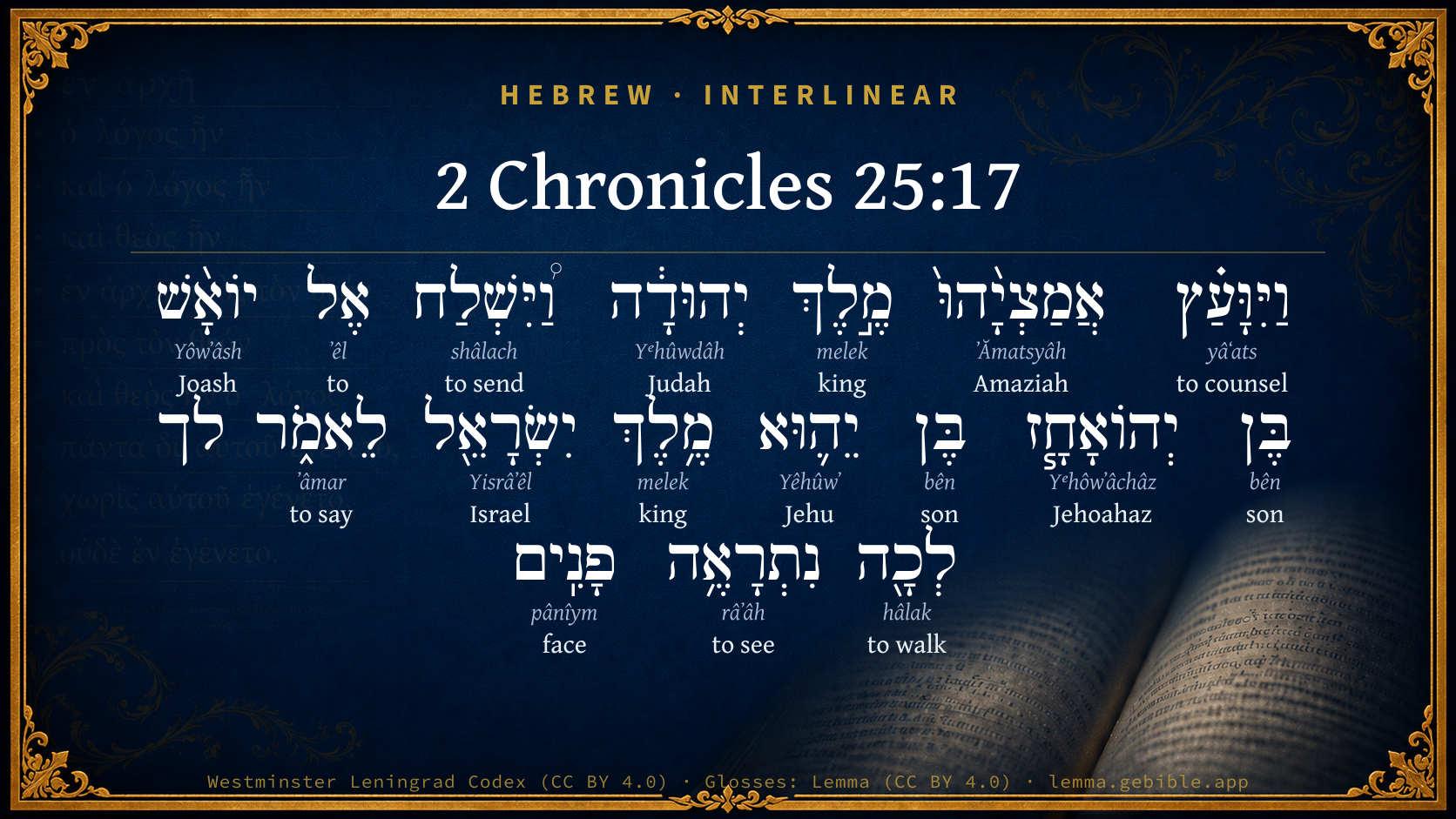
2 Chronicles 25:17

Hebrew (Westminster Leningrad Codex) 2 Chronicles 25:17 appears in the Hebrew Old Testament. The text above is from the Westminster Leningrad Codex. Each word links to its Strong’s number, a concise gloss, and parsing drawn from the Open Scriptures Hebrew Bible morphology. Click any word for its full Brown-Driver-Briggs (BDB) entry.
Download image
Cite this verse

2 Chronicles 25:17 (World English Bible). Public Domain. Lemma interlinear Bible study tool, https://lemma.gebible.app/v/2-chronicles/25/17.

Show BibTeX & RIS
BibTeX
RIS
English Translation
Then Amaziah king of Judah took advice, and sent to Joash, the son of Jehoahaz the son of Jehu, king of Israel, saying, Come, let us look one another in the face.
World English Bible · Public Domain
Download a study sheet

One document with this verse’s original text, its word-by-word gloss line, the meaning frame, cross-references with their text, attributed commentary, and full source and license credits — printable, and it pastes into notes with its structure intact.

This verse Autodidact and up

Study sheet (.html) Plain text (.txt)

A passage Seminary Student

Up to 50 verses in one chapter. A passage sheet keeps up to 6 commentary sources and 12 cross-references per verse, in the order this page ranks them, and says so on the sheet whenever that leaves anything out. Ask for a single verse and you get the Autodidact verse sheet above.

Everything on this page stays free to read, with no account — the sheet is a download of what is already on screen, not access to it.

Want to remove ads? Support Godless Engineer
Compare translations 3

The same verse in 3 English versions, stacked beneath the original-language interlinear above. Click any original word for its lexicon entry.

Each is an independent rendering of the whole verse — the interlinear is not word-aligned to these translations.

Highlighted words mark where these versions differ — a whole-verse word diff, not a word-by-word alignment.

  • World English Bible Public Domain
    Then Amaziah king of Judah took advice, and sent to Joash, the son of Jehoahaz the son of Jehu, king of Israel, saying, Come, let us look one another in the face.
  • King James Version Public Domain
    Then Amaziah king of Judah took advice, and sent to Joash, the son of Jehoahaz, the son of Jehu, king of Israel, saying, Come, let us see one another in the face.
  • unfoldingWord Literal Text CC BY-SA 4.0
    And Amaziah, the king of Judah, took counsel and sent to Joash, the son of Jehoahaz, the son of Jehu, the king of Israel, saying, “Come, let us meet each other face to face.”

unfoldingWord Literal Text — © unfoldingWord, licensed CC BY-SA 4.0. Word-aligned USFM3 via Door43 (git.door43.org/unfoldingWord/en_ult).

Versions to compare (up to 4)

3 of 4 selected

Show all 18 translations

Every available English version of this verse, each an independent rendering of the whole verse.

  • World English Bible Public Domain
    Then Amaziah king of Judah took advice, and sent to Joash, the son of Jehoahaz the son of Jehu, king of Israel, saying, Come, let us look one another in the face.
  • Berean Standard Bible Public Domain
    Then Amaziah king of Judah took counsel and sent word to the king of Israel Jehoash son of Jehoahaz, the son of Jehu. “Come, let us meet face to face,” he said.
  • Majority Standard Bible Public Domain
    Then Amaziah king of Judah took counsel and sent word to the king of Israel Jehoash son of Jehoahaz, the son of Jehu. “Come, let us meet face to face,” he said.
  • King James Version Public Domain
    Then Amaziah king of Judah took advice, and sent to Joash, the son of Jehoahaz, the son of Jehu, king of Israel, saying, Come, let us see one another in the face.
  • American Standard Version (1901) Public Domain
    Then Amaziah king of Judah took advice, and sent to Joash, the son of Jehoahaz the son of Jehu, king of Israel, saying, Come, let us look one another in the face.
  • Revised Version (1885) Public Domain
    Then Amaziah king of Judah took advice, and sent to Joash, the son of Jehoahaz the son of Jehu, king of Israel, saying, Come, let us look one another in the face.
  • Geneva Bible (1599) Public Domain
    Then Amaziah King of Iudah tooke counsell, and sent to Ioash the sonne of Iehoahaz, the sonne of Iehu King of Israel, saying, Come, let vs see one another in the face.
  • Douay-Rheims (1899) Public Domain
    Then Amasias king of Juda taking very bad counsel, sent to Joas the son of Joachaz the son of Jehu, king of Israel, saying: Come, let us see one another.
  • Young's Literal Translation Public Domain
    And Amaziah king of Judah taketh counsel, and sendeth unto Joash son of Jehoahaz, son of Jehu, king of Israel, saying,
  • Literal Standard Version CC BY-SA 4.0
    And Amaziah king of Judah takes counsel, and sends to Joash son of Jehoahaz, son of Jehu, king of Israel, saying,
  • Unlocked Literal Bible CC BY-SA 4.0
    Then Amaziah king of Judah consulted with advisors and sent messengers to Jehoash son of Jehoahaz son of Jehu, king of Israel, saying, “Come, let us meet each other face to face in battle.”
  • unfoldingWord Literal Text CC BY-SA 4.0
    And Amaziah, the king of Judah, took counsel and sent to Joash, the son of Jehoahaz, the son of Jehu, the king of Israel, saying, “Come, let us meet each other face to face.”
  • Darby Bible Public Domain
    And Amaziah king of Judah took counsel, and sent to Joash the son of Jehoahaz, the son of Jehu, king of Israel, saying, Come, let us look one another in the face.
  • World Messianic Bible Public Domain
    Then Amaziah king of Judah consulted his advisers, and sent to Joash, the son of Jehoahaz, the son of Jehu, king of Israel, saying, “Come! Let’s look one another in the face.”
  • Webster's Bible Public Domain
    Then Amaziah king of Judah took advice, and sent to Joash, the son of Jehoahaz, the son of Jehu, king of Israel, saying, Come, let us see one another in the face.
  • Free Bible Version CC BY-SA 4.0
    Then Amaziah, king of Judah, took advice from his counselors and sent a message to the king of Israel, Joash, son of Jehoahaz, son of Jehu. “Come and face me in battle,” he challenged.
  • Bible in Basic English Public Domain
    Then Amaziah, king of Judah, acting on the suggestion of his servants, sent to Joash, the son of Jehoahaz, the son of Jehu, king of Israel, saying, Come, let us have a meeting face to face.
  • JPS Tanakh (1917) Public Domain
    Then Amaziah king of Judah took advice, and sent to Joash, the son of Jehoahaz the son of Jehu, king of Israel, saying: 'Come, let us look one another in the face.'

Literal Standard Version (2020), Covenant Press — licensed CC BY-SA 4.0. Text via the HelloAO Bible API (eBible.org). Unlocked Literal Bible (unfoldingWord) — licensed CC BY-SA 4.0. Text via the HelloAO Bible API (eBible.org). unfoldingWord Literal Text — © unfoldingWord, licensed CC BY-SA 4.0. Word-aligned USFM3 via Door43 (git.door43.org/unfoldingWord/en_ult). Free Bible Version, Dr. Jonathan Gallagher — licensed CC BY-SA 4.0. Text via the HelloAO Bible API (eBible.org).

Word by word

More ways to search: Search by grammar → Find every occurrence → Compare this word →

Practice this passage: Drill this verse → Learn its vocabulary →

יְהוֹאָחָ֧ז
Yᵉhôwʼâchâz
H3059
“Jehoahaz”
Noun, Proper
Part of Speech
Noun
Type
Proper
Full BDB Definition

Origin: from H3068 and H270

TWOT: None

Jehoahaz = "Jehovah has seized" - a king of Judah and son of Josiah - a king of the northern kingdom of Israel and son of Jehu - a king of Judah and son of Jehoram (Ahaziah)
  1. וַיִּוָּעַ֗ץ yâʻats H3289 “and · to counsel” Conjunction + Verb, Niphal, Sequential Imperfect, 3rd Person, Masculine, Singular
  2. אֲמַצְיָ֨הוּ֙ ʼĂmatsyâh H558 “Amaziah” Noun, Proper
  3. מֶ֣לֶךְ melek H4428 “king of” Noun, Common, Masculine, Singular, Construct
  4. יְהוּדָ֔ה Yᵉhûwdâh H3063 “Judah” Noun, Proper
  5. וַ֠יִּשְׁלַח shâlach H7971 “and · to send” Conjunction + Verb, Qal, Sequential Imperfect, 3rd Person, Masculine, Singular
  6. אֶל ʼêl H413 “to” Preposition
  7. יוֹאָ֨שׁ Yôwʼâsh H3101 “Joash” Noun, Proper
  8. בֶּן bên H1121 “son of” Noun, Common, Masculine, Singular, Construct
  9. בֶּן bên H1121 “son of” Noun, Common, Masculine, Singular, Construct
  10. יֵה֛וּא Yêhûwʼ H3058 “Jehu” Noun, Proper
  11. מֶ֥לֶךְ melek H4428 “king of” Noun, Common, Masculine, Singular, Construct
  12. יִשְׂרָאֵ֖ל Yisrâʼêl H3478 “Israel” Noun, Proper
  13. לֵאמֹ֑ר ʼâmar H559 “to say” Preposition + Verb, Qal, Infinitive Construct
  14. לְכָ֖ה hâlak H1980 “walk” Verb, Qal, Imperative, 2nd Person, Masculine, Singular + Suffix, h
  15. נִתְרָאֶ֥ה râʼâh H7200 “to see” Verb, Hithpael, Cohortative, 1st Person, Common, Plural
  16. פָנִֽים pânîym H6440 “face(s)” Noun, Common, Both, Plural, Absolute

About this verse

These counts appear in no published source. They are computed here, from the morphology-tagged text and Lemma’s own curated glosses. What Lemma adds →

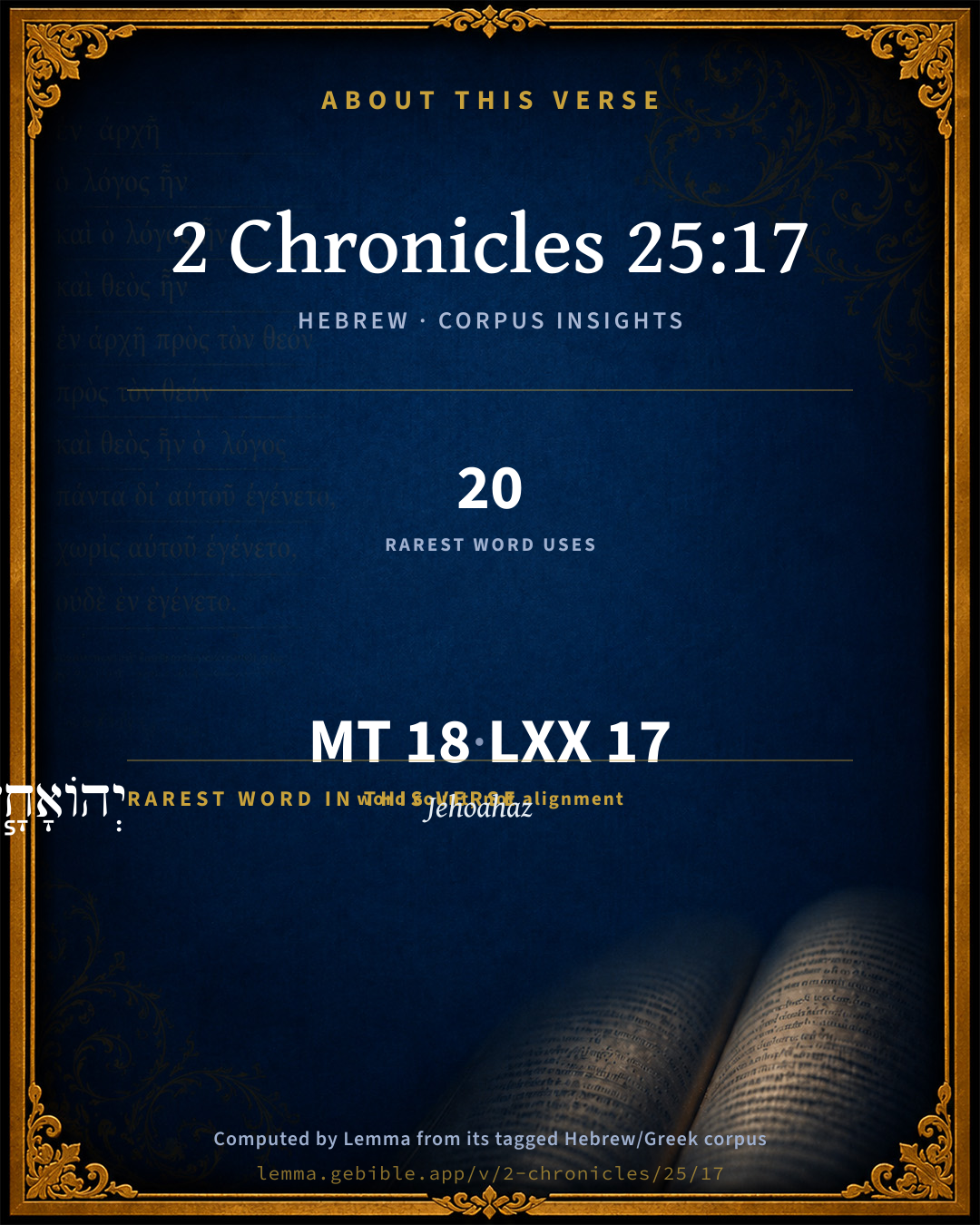
18
words
15
distinct lemmas
Historical
section

Notable vocabulary

The rarest word here is יְהוֹאָחָ֧ז Jehoahaz H3059 — appearing just 20 times in the whole Hebrew Bible.

Shared distinctive vocabulary

יְהוֹאָחָ֧ז Jehoahaz H3059 occurs in 19 verses of the Hebrew Bible. Also found in:

Grammatical profile

  • 6 verbs
  • 11 nouns
  • 1 preposition

Verb forms

  • וַיִּוָּעַ֗ץ Niphal · Sequential Imperfect
  • וַ֠יִּשְׁלַח Qal · Sequential Imperfect
  • לֵאמֹ֑ר Qal · Infinitive Construct
  • לך Qal · Imperative
  • לְכָ֖ה Qal · Imperative
  • נִתְרָאֶ֥ה Hithpael · Cohortative

Repetition

Words recur within this verse — often emphatic in Hebrew:

  • מֶ֣לֶךְ king H4428 ×2
  • בֶּן son H1121 ×2

Hebrew & Septuagint length

In English translation the verse runs 32 words from the Hebrew and 31 from the Septuagint (LXX English) — closely comparable.

A rough comparison of the two English renderings, which tokenize alike — not a word-level alignment.

Word counts can differ between the Hebrew and the Greek without any difference in meaning — e.g. the Hebrew direct-object marker אֵת has no separate Greek word, and Greek often adds the article ὁ.

In the original languages it is 18 Hebrew tokens and 17 Greek tokens — but the two are counted differently (Hebrew bundles its prefixes and suffixes into one token; the Greek is in lemma form), so that isn’t a like-for-like length.

Cross-references

4

Topical passages linked to 2 Chronicles 25:17 in the Treasury of Scripture Knowledge — connected by theme and wording, ordered by reader-vote popularity; previews shown in the World English Bible.

  • 2 Kings 14:8–14 Then Amaziah sent messengers to Jehoash, the son of Jehoahaz son of Jehu, king of Israel, saying, Come, let us look one another in the face.
  • 2 Samuel 2:14 Abner said to Joab, Please let the young men arise and play before us. Joab said, Let them arise.
  • 2 Chronicles 25:13 But the men of the army whom Amaziah sent back, that they should not go with him to battle, fell on the cities of Judah, from Samaria even to Beth Horon, and struck of them three thousand, and took much spoil.
  • Proverbs 20:3 It is an honor for a man to keep aloof from strife; But every fool will be quarreling.

Cross-references courtesy of OpenBible.info (CC BY 4.0).

Hebrew and Greek witnesses Masoretic Hebrew ↔ Greek Septuagint

The same verse in the two great witnesses to the Old Testament, shown verse-for-verse.

These are two independent witnesses, not word-aligned to each other, and the Septuagint is shown in lemma (dictionary) form.

Hebrew 2 Chronicles 25:17 Masoretic · Westminster Leningrad Codex

וַיִּוָּעַ֗ץ אֲמַצְיָ֨הוּ֙ מֶ֣לֶךְ יְהוּדָ֔ה וַ֠יִּשְׁלַח אֶל יוֹאָ֨שׁ בֶּן יְהוֹאָחָ֧ז בֶּן יֵה֛וּא מֶ֥לֶךְ יִשְׂרָאֵ֖ל לֵאמֹ֑ר לך לְכָ֖ה נִתְרָאֶ֥ה פָנִֽים

Then Amaziah king of Judah took advice, and sent to Joash, the son of Jehoahaz the son of Jehu, king of Israel, saying, Come, let us look one another in the face.

World English Bible · Public Domain

Greek LXX 2 Chronicles 25:17 Septuagint · lemma form

καί βουλεύω αμασιας καί ἀποστέλλω πρός ιωας υἱός ιωαχαζ υἱός ιου βασιλεύς ἰσραήλ λέγω δεῦρο ὁράω πρόσωπον

And Amasias king of Juda took counsel, and sent to Joas, son of Joachaz, son of Jeu, king of Israel, saying, Come, and let us look one another in the face.

LXX2012 (modern English Septuagint) · Public Domain

Hebrew: Westminster Leningrad Codex (CC BY 4.0). Greek: Septuagint (public domain); English from LXX2012 (modern English Septuagint) (Public Domain). How the Septuagint differs from the Hebrew →

Commentary

Notes on 2 Chronicles 25:17 from classic Christian and Jewish commentators (each source and its license shown beneath its notes). The classic Christian expositions comment on the surrounding passage and are grouped to its opening verse, so a note may address several verses; the Jewish commentaries on the Tanakh (Rashi and others) are per-verse, so they appear only where the commentator wrote on this verse.

Lemma curates 59 commentaries, every one of them public domain or Creative Commons licensed, each selected and text-cleaned for this edition rather than reprinted as found. About our sources →

Matthew Henry's Commentary

We have here this degenerate prince mortified by his neighbour and murdered by his own subjects.

I. Never was proud prince more thoroughly mortified than Amaziah was by Joash king of Israel.

1. This part of the story (which was as fully related Kg2 14:8, etc., as it is here) - embracing the foolish challenge which Amaziah sent to Joash (Ch2 25:17), his haughty scornful answer to it (Ch2 25:18), with the friendly advice he gave him to sit still and know when he was well off, (Ch2 25:19), - his wilfully persisting in his challenge (Ch2 25:20, Ch2 25:21), the defeat that was given him (Ch2 25:22), and the calamity he brought upon himself and his city thereby (Ch2 25:23, Ch2 25:24), - verifies two of Solomon's proverbs: - (1.) That a man's pride will bring him low, Pro 29:23. It goes before his destruction; not only procures it meritoriously, but is often the immediate occasion of it. He that exalteth himself shall be abased. (2.) That he that goes forth hastily to strive will probably not know what to do in the end thereof, when his neighbour has put him to shame, Pro 25:8. He that is fond of contention may have enough of it sooner than he thinks of.

2. But there are two passages in this story which we had not before in the Kings. (1.) That Amaziah took advice before he challenged the king of Israel, Ch2 25:17. But of whom? Not of the prophet - he was not made of the king's counsel; but of his statesmen that would flatter him and bid him go up and prosper. It is good to take advice, but then it must be of those that are fit to advise us. Those that will not take advice from the word of God, which would guide them aright, will justly be left to the bad advice of those that will counsel them to their destruction. Let those be made fools that will not be made wise. (2.) Amaziah's imprudence is here made the punishment of his impiety (Ch2 25:20): It was of the Lord; he left him to himself to act thus foolishly, that he and his people might be delivered into the hands of their enemies, because they had forsaken God and sought after the gods of Edom. Those that will not persuaded to do well for their souls will justly be given up to their own counsels to do ill for themselves even in their outward affairs.

II. Never was poor prince more violently pursued by his own subjects. From the time that he departed from the Lord (so it may be read, Ch2 25:27) the hearts of his subjects departed from him, and they began to form a design against him in Jerusalem. It is probable they were exasperated against him more for his rashly engaging in a war against Israel than for his worshipping the gods of Edom. But at length the ferment grew so high, and he perceived the plot to be laid so deeply, that he thought fit to quit his royal city and flee to Lachish, either as a private place where he might be hid or as a strong place where he might be guarded; but they sent after him thither, and slew him there. By this the putting of him to death seems to have been done deliberately, and to have been the act, not of a disgusted servant or two, but of a considerable body that durst avow it. How unrighteous soever they were herein, God was righteous.

Matthew Henry's Commentary on the Whole Bible (1708–1710) — public domain (CC PDM 1.0). Text via the HelloAO Bible API.

Jamieson, Fausset & Brown

Robert Jamieson, A. R. Fausset & David Brown

HE PROVOKES JOASH TO HIS OVERTHROW. (Ch2 25:17)

Then Amaziah . . . sent to Joash . . . Come, let us see one another in the face--(See on Kg2 14:8-20).

Next: 2 Chronicles Chapter 26

Jamieson, Fausset & Brown — Commentary Critical and Explanatory on the Whole Bible (1871) — public domain (CC PDM 1.0). Text via the HelloAO Bible API.

Ellicott's Commentary for English Readers

AMAZIAH CHALLENGES JOASH OF ISRAEL TO BATTLE, AND SUFFERS DISASTROUS DEFEAT (2Ch_25:17-24). (Comp. 2Ki_14:8-14.)

(17) Then Amaziah . . . took advice.—And Amaziah took counsel (2Ch_10:6). Different from the counsel which the prophet would have tendered him (2Ch_25:16).

And sent to Joash.—See 2Ki_14:8 : “Sent messengers.” The rest of the verse is the same in both passages.

Let us see.—Let us look one another in the face; as combatants do.

A Bible Commentary for English Readers, edited by Charles John Ellicott (1878–1897) — public domain. Text from a community e-Sword module.

Trapp's Complete Commentary

John Trapp

2Ch 25:17 Then Amaziah king of Judah took advice, and sent to Joash, the son of Jehoahaz, the son of Jehu, king of Israel, saying, Come, let us see one another in the face.

Ver. 17. Then Amaziah … took advice.] But wanted good counsellors, or else he was too much wedded to his own will: as was Xerxes about his expedition against Greece, to his own ruin.

John Trapp, A Commentary or Exposition upon All the Books of the Old and New Testament (1647–1656) — public domain. Text from a community e-Sword module.

Joseph Benson's Commentary

2Ch 25:17. Then Amaziah took advice — About the injury which the Israelites had done to his people, and how he should repair it. He took advice — But with whom? Not with the prophet, but with his flattering statesmen. It is good to take advice: but it should be of them who are fit to advise us. But of this and the following verses, see notes on 2Ki 14:8-20.

Joseph Benson's Commentary on the Old and New Testaments (1811–1818) — public domain. Text from a community e-Sword module.

Geneva Bible (1599)

Geneva Bible translators

That is, let us try the matter hand to hand: for he was offended, that the army of the Israelites, whom he had in wages, and dismissed by the counsel of the Prophet, had destroyed certain of the cities of Judah.

Geneva Bible (1599) marginal notes — public domain. Text via Bolls.life.

The Cambridge Bible for Schools and Colleges

gen. ed. J. J. S. Perowne

17–24 (= 2Ki_14:8-14). Amaziah Conquered by Joash

17. took advice] Took counsel with a view to demanding satisfaction from Joash for the ravages of the Israelite mercenaries (2Ch_25:13). The sequel suggests that Joash refused to give satisfaction.

let us see one another in the face] R.V. let us look one another in the face. The proposal may be either to fight or (better) to discuss Amaziah’s claims, the two kings meeting as equals. The latter is probably the right alternative, for the answer of Joash draws a scoffing parallel between Amaziah’s proposition and a thorn’s proposal of alliance with a cedar. Had Amaziah’s words been a challenge to fight, Joash’s answer would rather have taken the form in Jdg_9:15, “The thorn said, Fire shall come out of the thorn and devour the cedars of Lebanon,” etc.

The Cambridge Bible for Schools and Colleges (gen. ed. J. J. S. Perowne; Cambridge University Press, 1878–1918) — public domain. Text from a community e-Sword module.

John Gill's Exposition

But Amaziah would not hear,.... What the king of Israel advised him to, not to meddle to his hurt:

for it came of God, that he might deliver them into the hand of their enemies; Amaziah and his army into the hands of Joash and his; this was the will of God, and was brought about by his providence; and that it might be, Amaziah was given up to blindness and hardness of heart, as a punishment of his idolatry:

because they sought after the gods of Edom; he and his nobles, and many of the people following his example; from hence to the end of the chapter the same things are recorded as in Kg2 14:11, see the notes there; see Gill on Kg2 14:11, Kg2 14:12, Kg2 14:13, Kg2 14:14, Kg2 14:15, Kg2 14:16, Kg2 14:17, Kg2 14:18, Kg2 14:19, Kg2 14:20

Next: 2 Chronicles Chapter 26

John Gill's Exposition of the Whole Bible (1746–1763) — public domain (CC PDM 1.0). Text via the HelloAO Bible API.

Haydock's Catholic Bible Commentary

Another, and fight. He supposed Joas had connived at his subjects’ invasion, (v. 13.; H. See 4 K. xiv. 8.; C.) and he now required all Israel to submit to him. Josephus) T.

George Leo Haydock (1774–1849), Haydock's Catholic Family Bible and Commentary, 1859 edition — public domain. Excludes Psalms (Douay-Rheims chapter numbering differs from Protestant) and Deuterocanonical books (Catholic canon only).

Matthew Poole's English Annotations

Amaziah took advice, i.e. about the injury which the Israelites had done to his people, 2Ch 25:13, and how he should repair it. But of this and the following verses See Poole "2Ki 14:8", &c.

Matthew Poole's English Annotations on the Holy Bible (1683–1685) — public domain. Text from a community e-Sword/MySword module.

The Pulpit Commentary

Took advice; i.e. took counsel; as in foregoing verse, "Art thou made king"s counsellor?" and as in same verse, "counselled" should read instead of "determined," The verb (xy), in kal, niph., and once only in hithp., occurs just eighty times, always in this sense, and almost always so rendered in the Authorized Version, Let us see one another in the face. A refined analogy to this expression, with all its speaking significance, occurs in 2Sa_2:13; and, perhaps yet more remarkably, a strange some balance between vers. 14, 15, 17 of that chapter and our vers. 21, 22 may be noticed.

Vers. 17-24.

Human presumption.

In the correspondence between these two kings and the action which ensued we have a very striking illustration of the evil of human presumption.

I IT MAY BE BEGOTTEN OF A SLIGHT SUCCESS. "Thou hast smitten the Edomites and thy heart lifteth thee up to boast" (ver. 19). Some men are soon inflated; even a little "knowledge puffeth up." And a very slight achievement, in art, or in song, or in speech, or in manufacture, is enough to fill them with vanity, to cause them to "think more highly of themselves than they ought to think," to make them presume upon an ability which they are far from possessing. Complacency is an element which soon rises to the surface in human nature; it takes a very slight touch to stir it.

II IT MAY BEGET A SINFUL SCORNFULNESS. On this occasion the presumption of Amaziah provoked the contemptuous answer of Joash (ver. 18). There is something very unbeautiful and unbecoming in human scorn. Derision is a rather frequent action, and those who employ it take great pride in it. But we may be sure that it is offensive in the sight of the Lord of love. We may pity, we may condemn, we may reproach one another, rightly and faithfully. But to pour out on one another the spittle of our scorn, this is an unworthy, an ungodly, a blameful thing. Joash no doubt felt a keen satisfaction in his reference to the cedar and the thistle, and sent his message with enjoyment; but the Father of spirits would be grieved to see one of his children thus treating another with withering contempt. Scorn may be a pleasant thing, but it is a sinful thing.

III IT SUFFERS A HUMILIATING DEFEAT, (Vers. 21, 22.) Failure and humiliation are the inevitable end of human presumption. It is certain in time to undertake some task too great for its strength, to go up to a battle against a foe which it cannot fight and we know what will be the issue. Whatever the field may be whether political, commercial, literary, ecclesiastical, social the man of presumptuous spirit is on his way to an ignominious defeat. He will attempt the leap which he cannot make, and he will come down heavily to the ground.

IV IT ENDURES OTHER PENALTIES BESIDES. In the case of Joash it meant, beside defeat, captivity, the violation of the capital, and the spoliation of the temple, the miseries of remorse as he pondered in his palace. How senselessly he had brought this calamity on himself (see ver. 15)! Presumption is sure to result in adversity of more kinds than one. It ends in the bitter mortification of defeat, of conscious overthrow and dishonour; it usually ends (as here) in loss, either of property, or of reputation, or of friendship perhaps of all of these at the same time. It frequently brings down upon a man the severe reproaches of those who have been injured along with the principal offender. For guilt of this kind commonly involves misery to many beside the criminal. It is Jerusalem, and even Judah, as well as Amaziah, on whom the blow comes down.

1. Let us know ourselves well, lest we make an egregious and fatalmistake.

2. Let us ask God to reveal our feebleness to our own eyes. C.

Vers. 17-24.

The battle of Beth-shemesh; or, the downfall of a boaster.

I THE OBJECT OF THE BATTLE.

1. The object of its promoter, Amaziah.

(1) Perhaps revenge; to punish the Israelitish sovereign for the sins of his subjects (ver. 13) a principle of action on which man cannot always with safety proceed, though God may. Revenge, sweet to the natural heart, (Jer_20:10) was forbidden under the Law, (Lev_19:17, Lev_19:18) and is absolutely inconsistent with the gospel. (Rom_12:19) "Men revenge themselves out of weakness because they are offended, because they are too much influenced by self-love." This was seemingly the case with Amaziah. "A great soul overlooks and despises injuries; a soul enlightened by grace and faith leaves the judgment and revenge of them to God" (Cruden).

(2) Possibly ambition; in the hope of reducing the northern kingdom to subjection. In this hope (Josephus, "Ant.," 9:9. 2) he was probably confirmed by his previous success over the Edomites (ver. 14). Ambition, easily excited in the breasts of the weak, is always difficult to allay even by the wills of the strong. Wherever it exists, it is like the horse-leech"s two daughters, which cry, "Give, give!" like the grave and the barren womb, the dry earth and the fire, which never say, "It is enough". (Pro_30:15, Pro_30:16) It commonly proves too imperious even for men of iron will, while weaklings like Amaziah it blows to destruction with a slight puff.

2. The object of its Director, God. If Amaziah had an aim in seeking a pitched battle with Joash King of Israel, so had Jehovah an aim in allowing him and Joash to try conclusions on the field of war. If Amaziah meant to punish Joash, Jehovah meant to punish Amaziah: which of the two, the King of Judah or the King of kings, was the more likely to succeed in accomplishing his object, it required no prophet to foretell. So in mundane affairs, generally, "man proposes," but "God disposes." Men, as free agents, are allowed to scheme and plan as they please, while God worketh all things according to the counsel of his will Man often fails in his purposes, Jehovah never (Job_23:13; Psa_115:3; Isa_46:10, Dan_4:35; Eph_1:11)

II THE PRELIMINARIES TO THE BATTLE.

1. Amaziahs challenge to Joash.

(1) Deliberately offered. He acted neither in a hurry nor on his own responsibility, but at leisure and after consultation with his privy councillors and field-marshals. This only made the matter worse. It shows what wretched advisers the king had, and how set the king"s heart was upon the war. Jehoshaphat had been too late in calling in Jehovah to the council of war at Samaria; (2Ch_18:4) Amaziah neglected calling him in at all. The last persons a king or parliament should apply to for advice when deliberating on the question of peace or war, are the idlers about court and the officers in a barracks.

(2) Arrogantly expressed. Euphemistically phrased, "Come, let us look one another in the face," meaning "Come, let us measure strength," or "cross swords with one another;" this is one of those hypocritical formulas with which the world tries to hide from itself the wickedness of its evil deeds. Amaziah"s politely worded message was an insolent challenge to the King of Israel to meet him on the field of war.

(3) Fittingly answered. Amaziah"s insolence had silenced the prophet (ver. 16); he was now to find that Jonah would not so meekly submit to his impertinence. It may be proper for good men not to render railing for railing, (1Pe_3:9) but it is not to be lamented when vainglorious boasters are set down and fools answered. according to their folly. (Pro_26:5)

2. Joashs response to Amaziah. This, which Josephus says was delivered in writing, contained two things.

(1) A parable or fable (ver. 18), not unlike that of Jotham to the Shechemites. (Jud_1:9:8, etc.) It is not necessary to understand thethistle or thorn as pointing to Amaziah, in comparison with whom Joash claimed to be a tall cedar, though possibly this may have exactly expressed Joash"s estimate of the relative greatness of their royal persons; or to suppose that Amaziah had solicited a daughter of Joash in marriage for his son and been refused, and that out of this sprang his present warlike attitude towards Israel; or to find in the wild beast in Lebanon which trod down the thistle an allusion to the northern warriors who, should hostilities break out, would overrun and trample down the land of Judah. It is sufficient to learn what the fable was designed to teach.

(2) The interpretation. This consisted of three parts:

(a) A contemptuous rebuke. Amaziah, lifted up with pride and ambition, was stepping beyond his natural and legitimate sphere. He had conquered the Edomites, and now aspired to measure swords with the Israelites. It was pure self-conceit that lay at the bottom of his arrogance a home-truth Amaziah might have digested with profit.

(b) A condescending admonition. Amaziah had better stay at home. To be addressed by Joash as a wilful child might be by a wise and prudent father, must have been galling to the untamed spirit of Amaziah.

(c) A comminatory prediction. Amaziah was meddling to his hurt, "provoking calamity" that he should fall, even he and Judah with him. Joash probably knew that Amaziah had rashly entered upon a campaign he had neither resources nor courage to sustain. Fas est ab hoste doceri; but Amaziah would not hear.

III THE SCENE OF THE BATTLE. Beth-shemesh. (Jos_15:10)

1. The meaning of the term. "The house of the sun." Probably the site of an ancient temple to the sun-god. The Egyptian On, or Heliopolis, i.e. "the city of the sun," is probably for the same reason styled Beth-shemesh. (Jer_43:13)

1. The situation of the place. On the southern border of Dan, and within the territory of Judah, about three miles west of Jerusalem, represented by the modern Arabian village Ain Seines, or "sun-well," near the Wady-es-Surar, north of which stretches a level plain suitable for a battle (Robinson, "Bib. Res.," vol. 3. p. 17; Thomson, "The Land and the Book," p. 535). Many fragments of old wall-foundations still are visible about the locality, and the modern village appears to have been built out of old materials.

2. The historical associations of the spot. It was one of the cities given to the Levites by the tribe of Judah. (Jos_21:16) The ark of the covenant long stood there. (1Sa_6:12) One of the officers who purveyed for Solomon"s court resided there. (1Ki_4:9) It afterwards was taken by the Philistines. (2Ch_28:18)

IV THE RESULTS OF THE BATTLE.

1. The defeat of Judah. Joash and Amaziah "looked each other in the face." Their armies collided at the spot above described. The issue was a total rout for Judah (ver. 22).

2. The capture of Amaziah. Joash took him prisoner of war at Bethshemesh. Amaziah"s thoughts at this moment would be pleasant company for him! Whether Joash exulted over him, taunting him with his bravery, and reminding him of the fate of the poor briar who aspired to mate with the cedar, is not recorded; to Joash"s credit it should be stated that Amaziah was not put to death, or even consigned to a prison, as he deserved and might have expected, but was allowed to live and even continue on his throne (ver. 25).

3. The destruction of a part of the wall of Jerusalem. Approaching the metropolis of Judah with its prisoner-king, Joash, not so much perhaps with a view to obtain a triumphal gateway (Thenius), or restrain its inhabitants from reprisals in the shape of warlike operations (Bertheau), as simply to mark the capital as a conquered city (Bahr), caused about four hundred cubits of the wall to be broken down, from the gate of Ephraim to the corner gate, i.e. about half of the north wall. The gate of Ephraim, called also the gate of Benjamin (Jer_37:13 Jer_38:7; Zec_14:10) because the way to Ephraim lay through Benjamin, was most likely situated at or near the present-day gate of Damascus, the modern Bab-el-Amud, or, Gate of the Column, m the second wall, while the corner gate, called also the first gate, (Zec_14:10) was apparently at the other end of the wall from that at which the tower of Hananeel stood, (Jer_31:38) i.e. at the north-west angle where the wall turned southwards.

4. The despoliation of the temple and the palace. The pillaging of the former was not complete, but extended solely to the carrying off of the gold, silver, and vessels found in that part of the sacred building which was under the care of Obed-Edom and his sons, (1Ch_26:15) viz. in the house of Asuppim, or, "house of collections or provisions" (Neh_12:25) building used for the storing of the temple goods, situated in the neighbourhood of the southern door of the temple in the external court" (Keil). The plundering of the latter does not appear to have been restrained. All the treasures of the king"s house fell a prey to the royal spoliator.

1. The taking of hostages. These were required in consequence of Amaziah"s liberation, as a security for his good behaviour, and were most likely drawn from the principal families.

2. The return to Samaria. Joash acted with becoming moderation. Though he might have killed, he spared Amaziah, and even restored him to his throne. Whereas he might have broken down the entire city wall, he overthrew only a part of it. Instead of plundering the whole temple, he ravaged merely one of its external buildings. Judah and Jerusalem he might have annexed to his empire, but he forbore. Having properly chastised his royal brother, he returned to Samaria.

LESSONS.

1. A man may wear a crown and yet be a fool witness Amaziah.

2. "Pride goeth before destruction, and a haughty spirit before a fall.

3. "He that girdeth on his armour should not boast as he that putteth it off.

4. The hand that lets slip the clogs of war deserves to be devoured bythem.

5. Clemency becomes a conqueror, and is an ornament of kings. W.

The Pulpit Commentary (1880–1919), ed. H.D.M. Spence-Jones & Joseph S. Exell — public domain. Text from a community e-Sword module.

John Wesley's Explanatory Notes

Advice - About the injury which the Israelites had done to his people, and how he should repair it. He took advice. But with whom? Not with the prophet, but with his flattering statesmen. It is good to take advice: but it should be of them who are fit to advise us.

John Wesley, Explanatory Notes Upon the Whole Bible (1754–1765) — public domain. Text via the GEBible commentary corpus.

unfoldingWord translationNotes

Door43 World Missions Community

Jehoash ... Jehoahaz

These are names of men. (See: How to Translate Names)

meet each other face to face

This idiom means they would both be there in person, rather than communicating through messages or other people. AT: "meet each other in person" (See: Idiom)

translationWords

send

messenger

Jehu

kingdom of Israel

unfoldingWord translationNotes — © Distant Shores Media and the Door43 World Missions Community, licensed CC BY-SA 4.0. Source: git.door43.org/Door43/en_tn.

Rashi

Rabbi Shlomo Yitzchaki (Rashi)

Come, let us confront each other to show our might on horses with spears.

Rashi on the Tanakh — English translations: “The Judaica Press complete Tanach with Rashi, translated by A. J. Rosenberg” (CC BY 4.0); “Pentateuch with Rashi's commentary by M. Rosenbaum and A.M. Silbermann, 1929-1934” (public domain); “The Metsudah Tanach series, Lakewood, N.J” (CC BY 4.0); and “The Book of Joshua, Metsudah Publications, 1997” (CC BY 4.0). Text via Sefaria.

Lesson kit

Teaching starters — assembled from the data on this page, not authored interpretation. Every prompt links to the verse data it draws on. Edit before teaching.

2 Chronicles, in the Historical, opens this verse with 18 words (15 distinct Hebrew lemmas). Its most distinctive word is Yᵉhôwʼâchâz (“Jehoahaz”). A historical commentator’s framing appears above. Read the whole chapter for the surrounding context.

Discussion questions

  1. The word Yᵉhôwʼâchâz carries the sense “Jehoahaz.” How does it shape the verse?
  2. How does 2 Kings 10:35, which shares the word «Jehoahaz», read alongside this verse?
  3. What does the repetition of “king” (2× in this one verse) do in this verse?
  4. These translations render this verse differently. What is at stake in choosing one wording over another?
  5. «וַיִּוָּעַ֗ץ» is a Niphal Sequential Imperfect verb. How does that grammatical form shape the action described?
  6. Compare how Matthew Henry's Commentary and Jamieson, Fausset & Brown read this verse. Where do they agree or differ?

Things to notice

Reading settings

Reading text

Shown beneath each verse's original-language words.

Old Testament
Old Testament edition

Read the OT as the Masoretic Hebrew (MT) or the Greek Septuagint (LXX).

English shown for the Greek Septuagint (in the Hebrew ↔ Greek comparison).

Comparing translations? Open the Compare panel on any verse page to stack up to four side by side.