Ezra 4:5

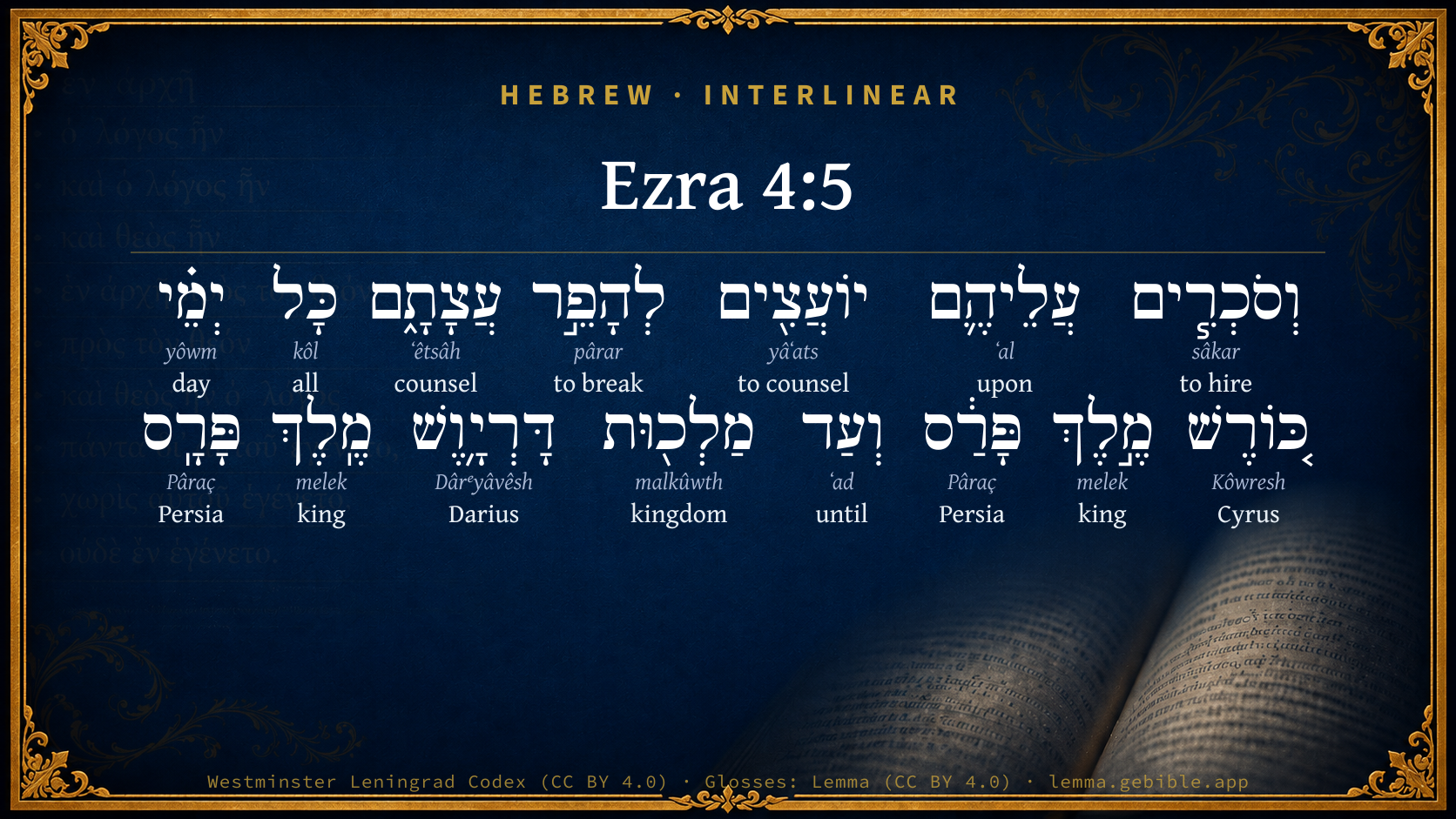
Hebrew (Westminster Leningrad Codex) Ezra 4:5 appears in the Hebrew Old Testament. The text above is from the Westminster Leningrad Codex. Each word links to its Strong’s number, a concise gloss, and parsing drawn from the Open Scriptures Hebrew Bible morphology. Click any word for its full Brown-Driver-Briggs (BDB) entry.
Download image
Cite this verse

Ezra 4:5 (World English Bible). Public Domain. Lemma interlinear Bible study tool, https://lemma.gebible.app/v/ezra/4/5.

Show BibTeX & RIS
BibTeX
RIS
English Translation
and hired counselors against them, to frustrate their purpose, all the days of Cyrus king of Persia, even until the reign of Darius king of Persia.
World English Bible · Public Domain
Highlights
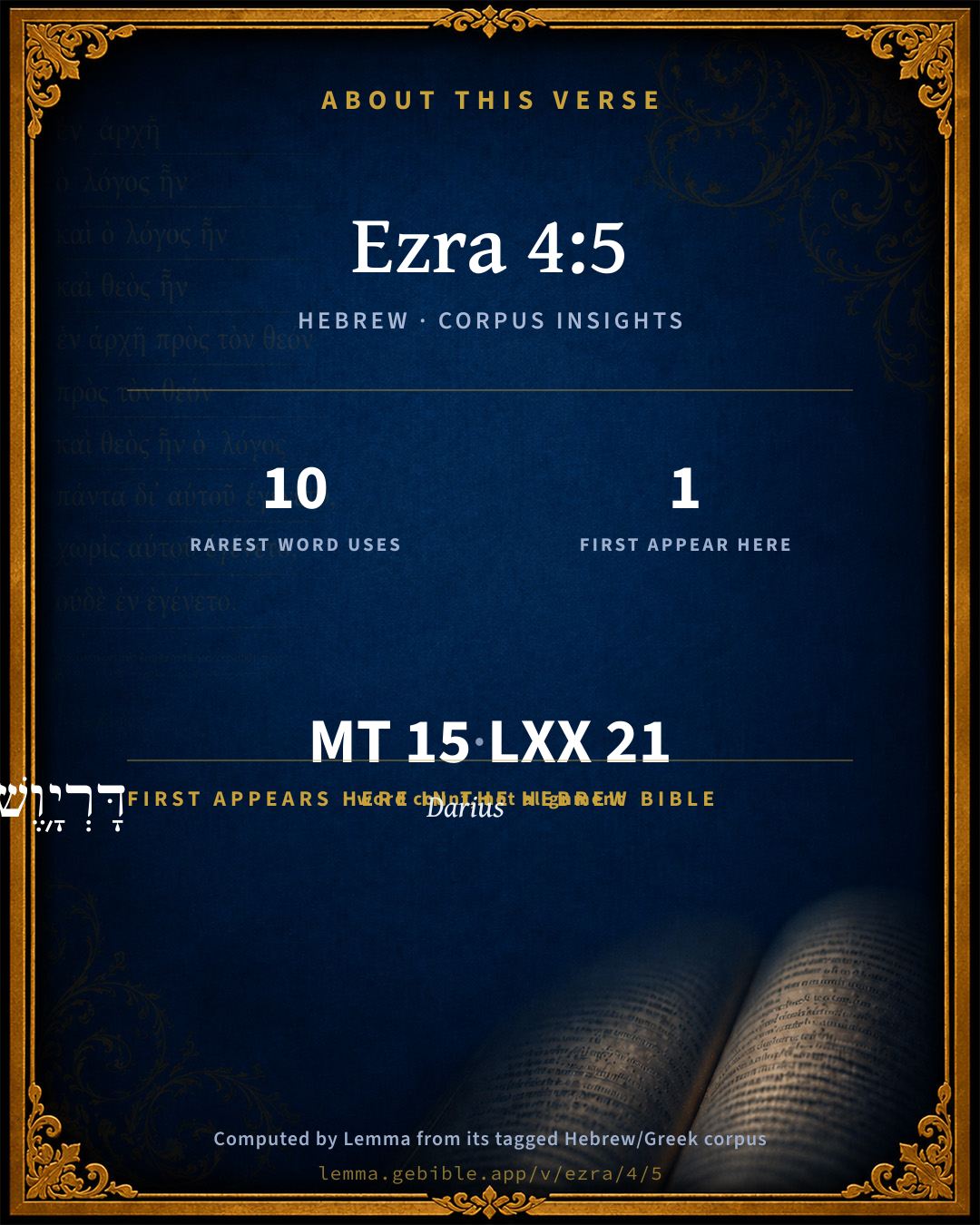
  • 1 first appearance in the Hebrew Bible
Full analysis ↓
Download a study sheet

One document with this verse’s original text, its word-by-word gloss line, the meaning frame, cross-references with their text, attributed commentary, and full source and license credits — printable, and it pastes into notes with its structure intact.

This verse Autodidact and up

Study sheet (.html) Plain text (.txt)

A passage Seminary Student

Up to 50 verses in one chapter. A passage sheet keeps up to 6 commentary sources and 12 cross-references per verse, in the order this page ranks them, and says so on the sheet whenever that leaves anything out. Ask for a single verse and you get the Autodidact verse sheet above.

Everything on this page stays free to read, with no account — the sheet is a download of what is already on screen, not access to it.

Want to remove ads? Support Godless Engineer
Compare translations 3

The same verse in 3 English versions, stacked beneath the original-language interlinear above. Click any original word for its lexicon entry.

Each is an independent rendering of the whole verse — the interlinear is not word-aligned to these translations.

Highlighted words mark where these versions differ — a whole-verse word diff, not a word-by-word alignment.

  • World English Bible Public Domain
    and hired counselors against them, to frustrate their purpose, all the days of Cyrus king of Persia, even until the reign of Darius king of Persia.
  • King James Version Public Domain
    And hired counsellors against them, to frustrate their purpose, all the days of Cyrus king of Persia, even until the reign of Darius king of Persia.
  • unfoldingWord Literal Text CC BY-SA 4.0
    and hiring counselors against them to frustrate their plans all the days of Cyrus, the king of Persia, and until the reign of Darius, the king of Persia.

unfoldingWord Literal Text — © unfoldingWord, licensed CC BY-SA 4.0. Word-aligned USFM3 via Door43 (git.door43.org/unfoldingWord/en_ult).

Versions to compare (up to 4)

3 of 4 selected

Show all 18 translations

Every available English version of this verse, each an independent rendering of the whole verse.

  • World English Bible Public Domain
    and hired counselors against them, to frustrate their purpose, all the days of Cyrus king of Persia, even until the reign of Darius king of Persia.
  • Berean Standard Bible Public Domain
    They hired counselors against them to frustrate their plans throughout the reign of Cyrus king of Persia and down to the reign of Darius king of Persia.
  • Majority Standard Bible Public Domain
    They hired counselors against them to frustrate their plans throughout the reign of Cyrus king of Persia and down to the reign of Darius king of Persia.
  • King James Version Public Domain
    And hired counsellors against them, to frustrate their purpose, all the days of Cyrus king of Persia, even until the reign of Darius king of Persia.
  • American Standard Version (1901) Public Domain
    and hired counsellors against them, to frustrate their purpose, all the days of Cyrus king of Persia, even until the reign of Darius king of Persia.
  • Revised Version (1885) Public Domain
    and hired counsellors against them, to frustrate their purpose, all the days of Cyrus king of Persia, even until the reign of Darius king of Persia.
  • Geneva Bible (1599) Public Domain
    And they hired counsellers against them, to hinder their deuise, all the dayes of Cyrus King of Persia, euen vntill the reigne of Darius King of Persia.
  • Douay-Rheims (1899) Public Domain
    And they hired counsellors against them, to frustrate their design all the days of Cyrus king of Persia, even until the reign of Darius king of the Persians.
  • Young's Literal Translation Public Domain
    and are hiring against them counsellors to make void their counsel all the days of Cyrus king of Persia, even till the reign of Darius king of Persia.
  • Literal Standard Version CC BY-SA 4.0
    and are hiring against them counselors to make void their counsel all the days of Cyrus king of Persia, even until the reign of Darius king of Persia.
  • Unlocked Literal Bible CC BY-SA 4.0
    They also bribed counselors to frustrate their plans. They did this during all of Cyrus' days and into the reign of Darius king of Persia.
  • unfoldingWord Literal Text CC BY-SA 4.0
    and hiring counselors against them to frustrate their plans all the days of Cyrus, the king of Persia, and until the reign of Darius, the king of Persia.
  • Darby Bible Public Domain
    and they hired counsellors against them, to frustrate their purpose, all the days of Cyrus king of Persia, even until the reign of Darius king of Persia.
  • World Messianic Bible Public Domain
    They hired counselors against them to frustrate their purpose all the days of Cyrus king of Persia, even until the reign of Darius king of Persia.
  • Webster's Bible Public Domain
    And hired counselors against them, to frustrate their purpose, all the days of Cyrus king of Persia, even until the reign of Darius king of Persia.
  • Free Bible Version CC BY-SA 4.0
    They bribed officials to oppose them and to obstruct their plans. This continued during the whole reign of Cyrus king of Persia up until the reign of Darius king of Persia.
  • Bible in Basic English Public Domain
    And they gave payment to men who made designs against them and kept them from effecting their purpose, all through the time of Cyrus, king of Persia, till Darius became king.
  • JPS Tanakh (1917) Public Domain
    and hired counsellors against them, to frustrate their purpose, all the days of Cyrus king of Persia, even until the reign of Darius king of Persia.

Literal Standard Version (2020), Covenant Press — licensed CC BY-SA 4.0. Text via the HelloAO Bible API (eBible.org). Unlocked Literal Bible (unfoldingWord) — licensed CC BY-SA 4.0. Text via the HelloAO Bible API (eBible.org). unfoldingWord Literal Text — © unfoldingWord, licensed CC BY-SA 4.0. Word-aligned USFM3 via Door43 (git.door43.org/unfoldingWord/en_ult). Free Bible Version, Dr. Jonathan Gallagher — licensed CC BY-SA 4.0. Text via the HelloAO Bible API (eBible.org).

Word by word

More ways to search: Search by grammar → Find every occurrence → Compare this word →

Practice this passage: Drill this verse → Learn its vocabulary →

דָּרְיָ֥וֶשׁ
Dârᵉyâvêsh
H1867
“Darius”
Noun, Proper
Part of Speech
Noun
Type
Proper
Full BDB Definition

Origin: of Persian origin

TWOT: None

Darius = "lord" - Darius the Mede, the son of Ahasuerus, king of the Chaldeans, who succeeded to the Babylonian kingdom on the death of Belshazzar; probably the same as " Astyages" the last king of the Medes (538 BC) - Darius, the son of Hystaspes, the founder of the Perso-Arian dynasty - Darius II or Darius III - Darius II, Nothus (Ochus) was king of Persia during the time of Nehemiah (424/3-405/4 BC). Darius II is the most probable because he is mentioned by Nehemiah and ruled during the time of Nehemiah - Darius III, Codomannus was king of Persia during its last years at the time of Alexander the Great and was his opponent
  1. וְסֹכְרִ֧ים sâkar H7936 “and · hiring” Conjunction + Verb, Qal, Participle Active, Masculine, Plural, Absolute
  2. עֲלֵיהֶ֛ם ʻal H5921 “upon · them” Preposition + Suffix, Personal, 3rd Person, Masculine, Plural
  3. יוֹעֲצִ֖ים yâʻats H3289 “counseling” Verb, Qal, Participle Active, Masculine, Plural, Absolute
  4. לְהָפֵ֣ר pârar H6565 “to break” Preposition + Verb, Hiphil, Infinitive Construct
  5. עֲצָתָ֑ם ʻêtsâh H6098 “counsel · their” Noun, Common, Feminine, Singular, Construct + Suffix, Personal, 3rd Person, Masculine, Plural
  6. כָּל kôl H3605 “all of” Noun, Common, Masculine, Singular, Construct
  7. יְמֵ֗י yôwm H3117 “days of” Noun, Common, Masculine, Plural, Construct
  8. כּ֚וֹרֶשׁ Kôwresh H3566 “Cyrus” Noun, Proper
  9. מֶ֣לֶךְ melek H4428 “king of” Noun, Common, Masculine, Singular, Construct
  10. פָּרַ֔ס Pâraç H6539 “Persia” Noun, Proper
  11. וְעַד ʻad H5704 “and · until” Conjunction + Preposition
  12. מַלְכ֖וּת malkûwth H4438 “kingdom of” Noun, Common, Feminine, Singular, Construct
  13. מֶֽלֶךְ melek H4428 “king of” Noun, Common, Masculine, Singular, Construct
  14. פָּרָֽס Pâraç H6539 “Persia” Noun, Proper

About this verse

These counts appear in no published source. They are computed here, from the morphology-tagged text and Lemma’s own curated glosses. What Lemma adds →

15
words
13
distinct lemmas
Historical
section

Notable vocabulary

The rarest word here is דָּרְיָ֥וֶשׁ Darius H1867 — appearing just 10 times in the whole Hebrew Bible.

First appearance in Scripture

This word makes its first canonical appearance in the Hebrew Bible here:

  • דָּרְיָ֥וֶשׁ Darius H1867

Shared distinctive vocabulary

דָּרְיָ֥וֶשׁ Darius H1867 occurs in 10 verses of the Hebrew Bible. Also found in:

Grammatical profile

  • 3 verbs
  • 10 nouns
  • 2 prepositions

Verb forms

  • וְסֹכְרִ֧ים Qal · Participle Active
  • יוֹעֲצִ֖ים Qal · Participle Active
  • לְהָפֵ֣ר Hiphil · Infinitive Construct

Repetition

Words recur within this verse — often emphatic in Hebrew:

  • מֶ֣לֶךְ king H4428 ×2
  • פָּרַ֔ס Persia H6539 ×2

Hebrew & Septuagint length

In English translation the verse runs 26 words from the Hebrew and 30 from the Septuagint (LXX English) — closely comparable.

A rough comparison of the two English renderings, which tokenize alike — not a word-level alignment.

Word counts can differ between the Hebrew and the Greek without any difference in meaning — e.g. the Hebrew direct-object marker אֵת has no separate Greek word, and Greek often adds the article ὁ.

In the original languages it is 15 Hebrew tokens and 21 Greek tokens — but the two are counted differently (Hebrew bundles its prefixes and suffixes into one token; the Greek is in lemma form), so that isn’t a like-for-like length.

Cross-references

5

Topical passages linked to Ezra 4:5 in the Treasury of Scripture Knowledge — connected by theme and wording, ordered by reader-vote popularity; previews shown in the World English Bible.

  • Nahum 1:11 There is one gone forth out of you, who devises evil against Yahweh, who counsels wickedness.
  • Ezra 5:5–6:18 But the eye of their God was on the elders of the Jews, and they did not make them cease, until the matter should come to Darius, and then answer should be returned by letter concerning it.
  • Psalms 2:1–2 Why do the nations rage, And the peoples plot a vain thing?
  • Acts 24:1–27 After five days, the high priest, Ananias, came down with certain elders and an orator, one Tertullus. They informed the governor against Paul.
  • Ezra 4:24 Then ceased the work of the house of God which is at Jerusalem; and it ceased until the second year of the reign of Darius king of Persia.

Cross-references courtesy of OpenBible.info (CC BY 4.0).

Hebrew and Greek witnesses Masoretic Hebrew ↔ Greek Septuagint

The same verse in the two great witnesses to the Old Testament, shown verse-for-verse.

These are two independent witnesses, not word-aligned to each other, and the Septuagint is shown in lemma (dictionary) form.

Hebrew Ezra 4:5 Masoretic · Westminster Leningrad Codex

וְסֹכְרִ֧ים עֲלֵיהֶ֛ם יוֹעֲצִ֖ים לְהָפֵ֣ר עֲצָתָ֑ם כָּל יְמֵ֗י כּ֚וֹרֶשׁ מֶ֣לֶךְ פָּרַ֔ס וְעַד מַלְכ֖וּת דָּרְיָ֥וֶשׁ מֶֽלֶךְ פָּרָֽס

and hired counselors against them, to frustrate their purpose, all the days of Cyrus king of Persia, even until the reign of Darius king of Persia.

World English Bible · Public Domain

Greek LXX Ezra 4:5 Septuagint · lemma form

καί μισθόω ἐπί αὐτός βουλεύω ὁ διασκεδάζω βουλή αὐτός πᾶς ὁ ἡμέρα κῦρος βασιλεύς πέρσης καί ἕως βασιλεία δαρεῖος βασιλεύς πέρσης

and continued hiring persons against them, plotting to frustrate their counsel, all the days of Cyrus king of the Persians, and until the reign of Darius king of the Persians.

LXX2012 (modern English Septuagint) · Public Domain

In the Septuagint this is one book — Esdras B (2 Esdras): Ezra is chapters 1–10, Nehemiah 11–23.

Hebrew: Westminster Leningrad Codex (CC BY 4.0). Greek: Septuagint (public domain); English from LXX2012 (modern English Septuagint) (Public Domain). How the Septuagint differs from the Hebrew →

Commentary

Notes on Ezra 4:5 from classic Christian and Jewish commentators (each source and its license shown beneath its notes). The classic Christian expositions comment on the surrounding passage and are grouped to its opening verse, so a note may address several verses; the Jewish commentaries on the Tanakh (Rashi and others) are per-verse, so they appear only where the commentator wrote on this verse.

Lemma curates 59 commentaries, every one of them public domain or Creative Commons licensed, each selected and text-cleaned for this edition rather than reprinted as found. About our sources →

Trapp's Complete Commentary

John Trapp

Ezr 4:5 And hired counsellors against them, to frustrate their purpose, all the days of Cyrus king of Persia, even until the reign of Darius king of Persia.

Ver. 5. And hired counsellors against them] But good counsellors would not have been hired, either to bolster out a bad cause, or to outface a good; to justify the wicked for a reward, or to take away the righteousness of the righteous from him. There is a notable instance of this in Papinian, a Pagan counsellor. Thou mayest (said he to Antoninus, the fratricide) command my neck to the block, but not my tongue to the bar. I prize not my life to the pleading of an ill cause. These sordida poscinummia in the text were none such. Some think they were courtiers and counsellors to the king; such as by whom the king was even bought and sold, as Aurelian, the good emperor was, who might know nothing but as his counsellors informed him. This made Alphonsus, king of Aragon, say, that kings were herein most miserable, that whereas they abounded with all things else, the truth of matters they could seldom come by.

All the days of Cyrus king of Persia] Who, warring abroad, committed the government of his kingdom to his son Cambyses, a light and lewd lowly, easily prevailed with to hinder so good a work.

Even until the reign of Darius] i.e. Of Darius Nothus, say some, the son of Artaxerxes Longimanus, {named Ezr 4:7} the father of Artaxerxes Mnemon. But they do better, in my opinion, that understand the text of Darius Hystaspis, who succeeded Cambyses, and married his sister; seeking to ingratiate with the people by ratifying whatsoever Cyrus had decreed, and this of the temple among the rest, see Ezr 6:1.

John Trapp, A Commentary or Exposition upon All the Books of the Old and New Testament (1647–1656) — public domain. Text from a community e-Sword module.

Joseph Benson's Commentary

Ezr 4:5. And hired counsellors against them — Bribed some of the king’s council, in order that by their artifices, and interests in his court, they might give some stop to the work, and frustrate the purpose of the Jews. All the days of Cyrus king of Persia — For though Cyrus still favoured the Jews, yet he was then diverted by his wars, and his son Cambyses was left his viceroy, who was a wicked prince, and an enemy to the Jews. Even until the reign of Darius — The son of Hystaspis, who, having killed the magi, (that, after Cambyses, had possessed themselves of the kingdom,) was made king; and marrying Atossa, the daughter of Cyrus, and loving her very much, confirmed the decree of Cyrus, and followed his steps, that he might stand the safer himself.

Joseph Benson's Commentary on the Old and New Testaments (1811–1818) — public domain. Text from a community e-Sword module.

Whedon's Commentary on the Bible

Daniel D. Whedon

5. Hired counsellors against them — This is to be understood of such men as Bishlam and his companions, (Ezr_4:7,) who were commissioned and employed by the enemies of Judah to work with the officers of the Persian empire, and obtain their help to hinder the building of the temple.

To frustrate their purpose — Namely, the purpose of the Jews to rebuild the house of God at Jerusalem. These counsellors probably prevailed on the governors of the neighbouring provinces to hinder the Jews from obtaining the material necessary for their work. This would greatly weaken and trouble the returned exiles, especially if the governor of Phoenicia had been prevailed on to oppose their obtaining cedar wood from Lebanon.

All the days of Cyrus — Who reigned, according to Herodotus, twenty-nine years. During his reign they obtained no reversal of his edict to have the temple rebuilt, but he was probably so much engaged in wars that the matter was left largely in the hands of the governors of the neighbouring provinces.

Until the reign of Darius — In his second year, Ezr_4:24. This Darius was the son of Hystaspes, famous in Persian history for his assassination of Smerdis the Magian, who had usurped the throne of Cyrus, assuming to be Cyrus’s son. See note on Ezr_4:24. Between Cyrus and this Darius two other kings reigned over Persia. The first was Cambyses, Cyrus’s son, (the Ahasuerus of the next verse,) who succeeded his father, and reigned seven years. The other was Gomates, one of the Magi, who took advantage of Cambyses’s absence to usurp the throne, and reigned seven months. So from the first year of Cyrus to the second of Darius was a period of thirty-eight years, during which hardly any thing was done towards rebuilding the temple except the laying of its foundation.

Ezr_4:6-23. These verses are regarded by a number of recent critics as an interpolation, consisting of a document belonging to the times of Nehemiah and Artaxerxes Longimanus, when, it is assumed, the Jews made an attempt to rebuild the walls and city of Jerusalem, but were made to cease, as herein described. The arguments by which this position is maintained are ingenious and plausible, but by no means conclusive. 1. It is said that Ahasuerus (Ezr_4:6) is the Scripture name of Xerxes, who was the son and successor of Darius Hystaspes; and that Artaxerxes (Ezr_4:7) is in this same book (Ezr_7:1) the name of Artaxerxes Longimanus, the son and successor of Xerxes. But it does not follow from this that Cambyses, and Smerdis the Magian, may not also have been known to the Jews under the names, respectively, of Ahasuerus and Artaxerxes. 2. It is urged that nothing is said in this document about the temple, but the Jews are charged with rebuilding the walls of the city. Comp. Ezr_4:12-13; Ezr_4:16. Now, as Nehemiah, in the twentieth year of Artaxerxes Longimanus, is informed that the walls of Jerusalem are broken down, and the gates burned with fire, (Neh_1:3,) it is assumed that in the earlier part of the reign of that king the Jews were rebuilding the city of Jerusalem, and were complained of in this letter to the king, and by his decree, as given in Ezr_4:21-22, the work was forcibly stopped, and the walls and gates, newly built, were again demolished. So this section, Ezr_4:6-23, belongs, chronologically, at the beginning of the Book of Nehemiah. But all this is at best a very doubtful hypothesis, and too easily set aside to be of any force. The fact that in this letter the enemies of the Jews do not mention the temple, but represent that the walls of the city are being rebuilt, is in perfect keeping with the inimical and crafty designs of those enemies. We naturally expect them to misrepresent the Jews before the king, and their letter contains just truth enough to blind the king, and prevent him from understanding all the facts in the case, for he would not be likely to inquire whether the Jews were building the foundations and walls of the city, or only of the temple. Further, it is hardly supposable that if Artaxerxes Longimanus had written the letter in Ezr_4:17-22, he would so soon afterwards have shown Ezra such favours and such authority as is recorded in chapter vii, favours of such a character as caused Ezra to class him among those who even helped to complete the temple. See note on Ezr_6:14. Nor would the same king have been likely, a few years later, to have commissioned Nehemiah to go and rebuild the walls of Jerusalem. 3. It is also claimed by some that after the mention of Darius in Ezr_4:5, the writer goes forward to record the success of these enemies of Judah, subsequent to the times of Darius. But, on the contrary, it is much more evident, both from the words of Ezr_4:5 and Ezr_4:24, that in Ezr_4:6-23 the writer describes what took place between the time of Cyrus and the second year of Darius. The emphatic statement of Ezr_4:24, “Then ceased the work of the house of God,” can only refer to the statement immediately preceding, that upon receiving the king’s letter the enemies of Judah “went up in haste to Jerusalem… and made them to cease by force and power.”

Daniel D. Whedon (gen. ed.), Commentary on the Old and New Testaments (1874–1909) — public domain. Text from a community e-Sword module.

Tyndale Open Study Notes

Tyndale Open Resources

4:5 The people paid a heavy price for their uncompromising commitment to holiness. • King Cyrus reigned until 530 BC. Darius (Darius I) took the throne of Persia in 521 BC. Work on the Temple resumed in 520 BC and was finished in 515 BC (see 6:15).

Tyndale Open Study Notes — © Tyndale Open Resources, licensed CC BY-SA 4.0. Text via the HelloAO Bible API.

Geneva Bible (1599)

Geneva Bible translators

They bribed the governors under the king to hinder their work: Thus they that halt, cannot abide that God should be purely served.

Geneva Bible (1599) marginal notes — public domain. Text via Bolls.life.

Adam Clarke's Commentary

Verse 5. Hired counsellors] They found means to corrupt some of the principal officers of the Persian court, so that the orders of Cyrus were not executed; or at least so slowly as to make them nearly ineffectual.

Until the reign of Darius] This was probably Darius the son of Hystaspes.

Adam Clarke's Commentary on the Bible (1810–1826) — public domain. Text from a community e-Sword/MySword module.

Ellicott's Commentary for English Readers

(5) And hired counsellors against them.—They adopted a systematic course of employing paid agents at the court: continued for eight years, till B.C. 529. Cambyses, his son, succeeded Cyrus; he died B.C. 522; then followed the pseudo-Smerdis, a usurper, whose short reign Darius did not reckon, but dated his own reign from B.C. 522. A comparison of dates shows that this was the first Darius, the son of Hystaspes.

A Bible Commentary for English Readers, edited by Charles John Ellicott (1878–1897) — public domain. Text from a community e-Sword module.

The Cambridge Bible for Schools and Colleges

gen. ed. J. J. S. Perowne

5. This verse describes one effectual method of opposition, ‘hired counsellors against them’. This will not necessarily imply that bribes were given to the king’s ministers referred to elsewhere (Ezr_7:28, Ezr_8:25) as ‘his counsellors’. We should in that case have had the word more definitely expressed as ‘the counsellors’ or ‘the king’s counsellors’.

It rather means that ‘the people of the land’ paid officials (probably connected with the satrapy of Syria) to make unfavourable reports at the king’s Court respecting ‘the people of Judah’.

hired] Cf. the application of Samaritan money within the Jewish community, Neh_6:12-13. The word used with special reference to Balaam in Deu_23:4; Neh_13:2.

to frustrate their purpose] i.e. to render fruitless their cherished scheme of rebuilding the Temple. ‘Frustrate’ = ‘break’, Ezr_9:14. ‘Purpose’ = ‘counsel’ Ezr_10:3; Ezr_10:8; Neh_4:15. The two words occur together Psa_33:10 ‘The Lord bringeth the counsel of the nations to nought’.

all the days of Cyrus, &c.] Cyrus died in 529.

even until the reign of Darius king of Persia] Cyrus was succeeded by Cambyses, who died in 522. Pseudo-Smerdis then reigned for 7 months, and was succeeded by Darius Hystaspes 522. (Upon the disputed question of chronology raised in this verse, see the note on Ezr_4:7.) Darius, Darayavus, ‘the Preserver’ (Herod. VI. 98 translates ἑρξείης) gave order and system to the Persian Empire, of which he was the second founder. Darius consolidated the successes of Cyrus. Like Augustus following upon Julius Cæsar, he gave, as a statesman, system and cohesion to the Empire, which he had inherited from his predecessor’s military genius.

The Cambridge Bible for Schools and Colleges (gen. ed. J. J. S. Perowne; Cambridge University Press, 1878–1918) — public domain. Text from a community e-Sword module.

John Gill's Exposition

And in the reign of Ahasuerus, in the beginning of his reign,.... According to Jarchi, this was Ahasuerus the husband of Esther; but, as most think (d), was Cambyses, the son and successor of Cyrus; so Josephus (e); who was an enemy to the Egyptians; and, fearing the Jews might take part with them, was no friend to them; their enemies therefore took the advantage of the death of Cyrus, and the first opportunity after Cambyses reigned in his own right:

and wrote they unto him an accusation against the inhabitants of Judah and Jerusalem; full of hatred and enmity, spite and malice, charging them as a turbulent, disobedient, and rebellious people.

(d) Spanhem. Introduct. Chron. ad Hist. Eccl. p. 54. & Universal History, Vol. 5. p. 203. Prideaux, p. 175. (e) Ut supra, (Antiqu. l. 11. c. 4.) sect. 4, 6. Vid. R. David Ganz. Tzemach David, par. 2. fol. 8. 2. So Dr. Lightfoot, Works, vol. 1. p. 139.

John Gill's Exposition of the Whole Bible (1746–1763) — public domain (CC PDM 1.0). Text via the HelloAO Bible API.

Albert Barnes' Notes on the Bible

Hired counselors - Rather, “bribed” officials at the Persian court to interpose delays and create difficulties, in order to hinder the work.

Darius - i. e., Darius, the son of Hystaspes

Albert Barnes' Notes on the Bible (1834–1885) — public domain. Text from a community e-Sword/MySword module.

Haydock's Catholic Bible Commentary

Counsellors; ministers of the king, (Calmet) or governors of the provinces. (Tirinus) --- Cyrus, who was ignorant of their machination, (Josephus) being engaged in war with the Scythians. We may easily conceive what ill-disposed ministers may do, against the inclinations of their prince. (Calmet) --- Darius, son of Hystaspes, who succeeded the false Smerdis, after five months’ usurpation. (Calmet)

George Leo Haydock (1774–1849), Haydock's Catholic Family Bible and Commentary, 1859 edition — public domain. Excludes Psalms (Douay-Rheims chapter numbering differs from Protestant) and Deuterocanonical books (Catholic canon only).

Matthew Poole's English Annotations

Hired counsellors against them; who by their artifices and interests in the Persian court should give some stop to their work.

All the days of Cyrus king of Persia; for though Cyrus still favoured the Jews, yet he was then diverted by his wars, and his son Cambyses was left his viceroy, who was a very wicked prince, and an enemy to the Jews and their religion.

Even until the reign of Darius, Heb. and until, &c., i.e. not only in the reign of Cyrus, but also of Cambyses, and of the magician, after whom was this Darius; of whom see Ezr 5; 6.

Matthew Poole's English Annotations on the Holy Bible (1683–1685) — public domain. Text from a community e-Sword/MySword module.

The Pulpit Commentary

And hired counsellors against them. It is always possible at an Oriental court to bribe some of the royal favourites, and induce them to use their influence with the monarch for the furtherance, or hindrance, of any work that is being proceeded with in any part of the country. The Samaritans now had recourse to this system, and employed it with great success for a considerable period. All the days of Cyrus. i.e. "all the remaining days," from B.C. 537 to B.C. 529, when Cyrus died, and was succeeded by his son Cambyses. Even until the reign of Darius. It is implied that the reign of Darius did not immediately follow on that of Cyrus. Profane history tells us of two intermediate kings, via, Cambyses, son of Cyrus, who reigned from B.C. 529 to B.C. 522, and Smerdis, or Bardes, a usurper, who occupied the throne for about ton months in the years B.C. 522, 521. Darius became king in this last-named year, but seems to have counted his reign from the date of the decease of Cambyses.

The Pulpit Commentary (1880–1919), ed. H.D.M. Spence-Jones & Joseph S. Exell — public domain. Text from a community e-Sword module.

John Wesley's Explanatory Notes

Cyrus - For though Cyrus still favoured the Jews, yet he was then diverted by his wars, and his son Cambyses was left his vice- roy, who was a wicked prince, and an enemy to the Jews. Until - Hebrew. and until, &c. not only in the reign of Cyrus but also of Cambyses, and of the magician, after whom was Darius.

John Wesley, Explanatory Notes Upon the Whole Bible (1754–1765) — public domain. Text via the GEBible commentary corpus.

Keil & Delitzsch

C. F. Keil & F. Delitzsch

And they hired counsellors against them, to frustrate their purpose (of building the temple). וסכרים still depends on the ויהי of Ezr 4:4. סכר is a later orthography of שׂכר, to hire, to bribe. Whether by the hiring of יועציט we are to understand the corruption of royal counsellors or ministers, or the appointment of legal agents to act against the Jewish community at the Persian court, and to endeavour to obtain an inhibition against the erection of the temple, does not appear. Thus much only is evident from the text, that the adversaries succeeded in frustrating the continuance of the building "all the days of Koresh," i.e., the yet remaining five years of Cyrus, who was for the space of seven years sole ruler of Babylon; while the machinations against the building, begun immediately after the laying of its foundations in the second year of the return, had the effect, in the beginning of the third year of Cyrus (judging from Dan 10:2), of putting a stop to the work until the reign of Darius, - in all, fourteen years, viz., five years of Cyrus, seven and a half of Cambyses, seven months of the Pseudo-Smerdis, and one year of Darius (till the second year of his reign).

Keil & Delitzsch — Biblical Commentary on the Old Testament (1861–1891) — public domain (CC PDM 1.0). Text via the HelloAO Bible API. (Old Testament only.)

Rashi

Rabbi Shlomo Yitzchaki (Rashi)

And they would hire Heb. וְסֹכְרִים. This is written with a “sammech,” but its meaning is as though it was written with a “sin,” [meaning] that they would hire advisors to disrupt the work.

all the days of the reign of Cyrus and the reign of Ahasuerus, who reigned after Cyrus, until the second year of Darius, who reigned after Ahasuerus, the work was stopped.

Rashi on the Tanakh — English translations: “The Judaica Press complete Tanach with Rashi, translated by A. J. Rosenberg” (CC BY 4.0); “Pentateuch with Rashi's commentary by M. Rosenbaum and A.M. Silbermann, 1929-1934” (public domain); “The Metsudah Tanach series, Lakewood, N.J” (CC BY 4.0); and “The Book of Joshua, Metsudah Publications, 1997” (CC BY 4.0). Text via Sefaria.

Lesson kit

Teaching starters — assembled from the data on this page, not authored interpretation. Every prompt links to the verse data it draws on. Edit before teaching.

Ezra, in the Historical, opens this verse with 15 words (13 distinct Hebrew lemmas). Its most distinctive word is Dârᵉyâvêsh (“Darius”). A historical commentator’s framing appears above. Read the whole chapter for the surrounding context.

Discussion questions

  1. How does “Darius” (Dârᵉyâvêsh) shape what this verse is saying?
  2. This is the first place “Darius” appears in Scripture (first appears here). What does its debut here establish?
  3. How does Nehemiah 12:22, which shares the word «Darius», read alongside this verse?
  4. What does the repetition of “king” (2× in this one verse) do in this verse?
  5. These translations render this verse differently. What is at stake in choosing one wording over another?
  6. «וְסֹכְרִ֧ים» is a Qal Participle Active verb. How does that grammatical form shape the action described?
  7. Compare how Trapp's Complete Commentary and Joseph Benson's Commentary read this verse. Where do they agree or differ?

Things to notice

Reading settings

Reading text

Shown beneath each verse's original-language words.

Old Testament
Old Testament edition

Read the OT as the Masoretic Hebrew (MT) or the Greek Septuagint (LXX).

English shown for the Greek Septuagint (in the Hebrew ↔ Greek comparison).

Comparing translations? Open the Compare panel on any verse page to stack up to four side by side.