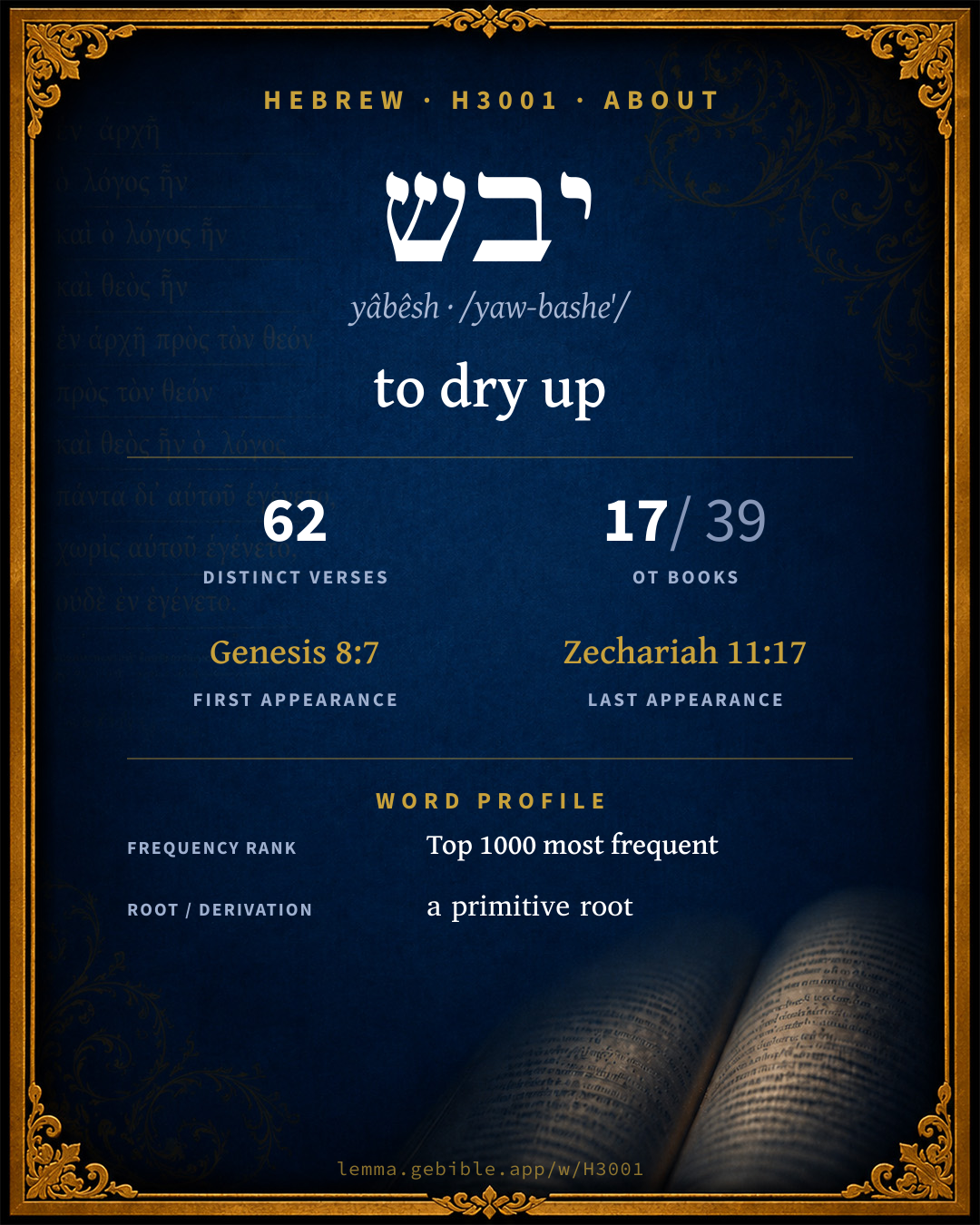
יָבֵשׁ
to dry up
‘to dry up’ is one of 2 main senses fuller range ↓
Full lexicon entry — Brown-Driver-Briggs (BDB)
From Brown-Driver-Briggs (BDB)
Where this word appears
See every Qal verb in the Hebrew Bible →
Grammar key — what these labels mean
Part of speech
- Verb
- An action or state-of-being word.
Stem
- Hiphil
- The causative active stem (“he caused / brought about”). Here: ‘dry up water’
- Qal
- The basic, simple active stem — the plain form of the verb (“he wrote”). Here: ‘be dry’
- Piel
- An intensive or resultative active stem. Here: ‘make dry’
- Niphal
- Usually the simple passive or reflexive of the Qal (“he was written”).
Form
- Perfect
- A completed action or state — Hebrew marks aspect (completeness) more than strict tense (“he wrote”).
- Imperfect
- An incomplete, ongoing, or future action (“he will / would write”).
- Sequential Perfect
- A perfect with prefixed waw continuing a preceding imperfect or command (waw-consecutive perfect).
- Sequential Imperfect
- An imperfect with prefixed waw — the standard past-narrative form (waw-consecutive imperfect).
- Infinitive Absolute
- An unbound verbal noun, often intensifying or standing in for a finite verb.
- Infinitive Construct
- A bound verbal noun, frequently with prepositions (“to write / in writing”).
Person
- 3rd Person
- The one spoken about (“he / she / it / they”).
- 1st Person
- The speaker (“I / we”).
- 2nd Person
- The one addressed (“you”).
Gender
- Masculine
- Grammatically masculine.
- Feminine
- Grammatically feminine.
- Common
- Either gender — not distinguished for this form.
Number
- Singular
- One.
- Plural
- More than one (in Hebrew, generally three or more).
36 distinct verses where H3001 appears in the Qal stem, across 14 books. Filtered view — show all forms. Click any verse to open its interlinear word-by-word view. Verse text shown in the World English Bible for context — . Each verse’s Hebrew form is shown with its reference; the English is not keyword-highlighted, since the data carries no word-level English alignment. Use “Compare translations” on any verse to read it across multiple English versions. This concordance covers the Hebrew Bible; Septuagint (Greek Old Testament) occurrences are not indexed here.
Genesis 2 verses
Joshua 2 verses
- Joshua 9:5 יָבֵ֖שׁ Qal pf 3ms and old and patched shoes on their feet, and old garments on them; and all the bread of their provision was dry and was become moldy.
- Joshua 9:12 יָבֵ֔שׁ Qal pf 3ms This our bread we took hot for our provision out of our houses on the day we came forth to go to you; but now, behold, it is dry, and is become moldy:
1 Kings 2 verses
- 1 Kings 13:4 וַ/תִּיבַ֤שׁ conj + Qal wimpf 3fs It happened, when the king heard the saying of the man of God, which he cried against the altar in Bethel, that Jeroboam put forth his hand from the altar, saying, Lay hold on him. His hand, which he put forth against him, dried up, so that he could not draw it back again to him.
- 1 Kings 17:7 וַ/יִּיבַ֣שׁ conj + Qal wimpf 3ms It happened after a while, that the brook dried up, because there was no rain in the land.
Job 4 verses
- Job 8:12 יִיבָֽשׁ Qal impf 3ms While it is yet in its greenness, not cut down, It withers before any other reed.
- Job 12:15 וְ/יִבָ֑שׁוּ conj + Qal impf 3mp Behold, he withholds the waters, and they dry up; Again, he sends them out, and they overturn the earth.
- Job 14:11 וְ/יָבֵֽשׁ conj + Qal wpf 3ms As the waters fail from the sea, And the river wastes and dries up,
- Job 18:16 יִבָ֑שׁוּ Qal impf 3mp His roots shall be dried up beneath, Above shall his branch be cut off.
Psalms 5 verses
- Psalms 22:15 יָ֘בֵ֤שׁ Qal pf 3ms My strength is dried up like a potsherd. My tongue sticks to the roof of my mouth. You have brought me into the dust of death.
- Psalms 90:6 וְ/יָבֵֽשׁ conj + Qal wpf 3ms In the morning it sprouts and springs up. By evening, it is withered and dry.
- Psalms 102:4 וַ/יִּבַ֣שׁ conj + Qal wimpf 3ms My heart is blighted like grass, and withered, For I forget to eat my bread.
- Psalms 102:11 אִיבָֽשׁ Qal impf 1cs My days are like a long shadow. I have withered like grass.
- Psalms 129:6 יָבֵֽשׁ Qal pf 3ms Let them be as the grass on the housetops, Which withers before it grows up;
Isaiah 6 verses
- Isaiah 15:6 יָבֵ֤שׁ Qal pf 3ms For the waters of Nimrim shall be desolate; for the grass is withered away, the tender grass fails, there is no green thing.
- Isaiah 19:7 יִיבַ֥שׁ Qal impf 3ms The meadows by the Nile, by the brink of the Nile, and all the sown fields of the Nile, shall become dry, be driven away, and be no more.
- Isaiah 27:11 בִּ/יבֹ֤שׁ prep + Qal inf.cs When the boughs of it are withered, they shall be broken off; the women shall come, and set them on fire; for it is a people of no understanding: therefore he who made them will not have compassion on them, and he who formed them will show them no favor.
- Isaiah 40:7 יָבֵ֤שׁ Qal pf 3ms The grass withers, the flower fades, because the breath of Yahweh blows on it; surely the people is grass.
- Isaiah 40:8 יָבֵ֥שׁ Qal pf 3ms The grass withers, the flower fades; but the word of our God shall stand forever.
- Isaiah 40:24 וַ/יִּבָ֔שׁוּ conj + Qal wimpf 3mp Yes, they have not been planted; yes, they have not been sown; yes, their stock has not taken root in the earth: moreover he blows on them, and they wither, and the whirlwind takes them away as stubble.
Jeremiah 3 verses
- Jeremiah 12:4 יִיבָ֑שׁ Qal impf 3ms How long shall the land mourn, and the herbs of the whole country wither? for the wickedness of those who dwell therein, the animals are consumed, and the birds; because they said, He shall not see our latter end.
- Jeremiah 23:10 יָבְשׁ֖וּ Qal pf 3cp For the land is full of adulterers; for because of swearing the land mourns; the pastures of the wilderness are dried up. Their course is evil, and their might is not right;
- Jeremiah 50:38 וְ/יָבֵ֑שׁוּ conj + Qal wpf 3cp A drought is on her waters, and they shall be dried up; for it is a land of engraved images, and they are mad over idols.
Lamentations 1 verse
Ezekiel 4 verses
- Ezekiel 17:9 וְ/יָבֵ֗שׁ תִּיבָ֔שׁ conj + Qal wpf 3ms Qal impf 3fs Say you, Thus says the Lord Yahweh: Shall it prosper? shall he not pull up the roots of it, and cut off the fruit of it, that it may wither; that all its fresh springing leaves may wither? and not by a strong arm or much people can it be raised from the roots of it.
- Ezekiel 17:10 תִּיבַ֣שׁ יָבֹ֔שׁ תִּיבָֽשׁ Qal impf 3fs Qal inf.abs Qal impf 3fs Yes, behold, being planted, shall it prosper? shall it not utterly wither, when the east wind touches it? it shall wither in the beds where it grew.
- Ezekiel 19:12 הוֹבִ֣ישׁ וְ/יָבֵ֛שׁוּ Hiphil pf 3ms conj + Qal pf 3cp But it was plucked up in fury, it was cast down to the ground, and the east wind dried up its fruit: its strong rods were broken off and withered; the fire consumed them.
- Ezekiel 37:11 יָבְשׁ֧וּ Qal pf 3cp Then he said to me, Son of man, these bones are the whole house of Israel: behold, they say, Our bones are dried up, and our hope is lost; we are clean cut off.
Hosea 1 verse
Joel 2 verses
- Joel 1:12 הוֹבִ֔ישָׁה יָבֵ֔שׁוּ הֹבִ֥ישׁ Hiphil pf 3fs Qal pf 3cp Hiphil pf 3ms The vine has dried up, and the fig tree withered; the pomegranate tree, the palm tree also, and the apple tree, Even all of the trees of the field are withered; For joy has withered away from the sons of men.
- Joel 1:20 יָֽבְשׁוּ֙ Qal pf 3cp Yes, the animals of the field pant to you, For the water brooks have dried up, And the fire has devoured the pastures of the wilderness.
Amos 2 verses
- Amos 1:2 וְ/יָבֵ֖שׁ conj + Qal pf 3ms He said: "Yahweh will roar from Zion, And utter his voice from Jerusalem; And the pastures of the shepherds will mourn, And the top of Carmel will wither."
- Amos 4:7 תִּיבָֽשׁ Qal impf 3fs "I also have withheld the rain from you, When there were yet three months to the harvest; And I caused it to rain on one city, And caused it not to rain on another city. One place was rained on, And the piece where it didn't rain withered.
Jonah 1 verse
Zechariah 1 verse
About this entry
At a glance — auto-summarized from this page’s data, not written by a person. Every figure links to its source below. This summary describes the numbers; it doesn’t interpret them.
The Hebrew word יבש centers on the idea of “to dry up.” Where the King James Version says “dried up,” newer translations reach for “dries up” (unfoldingWord Literal Text); the renderings breakdown has the detail. The Hebrew Bible uses it across 62 verses — moderately common. First canonically at Genesis 8:7, it enters the text early. Its meaning spans more than one sense — see its full sense range. For the data behind this summary, explore the sense tree and the renderings breakdown below.
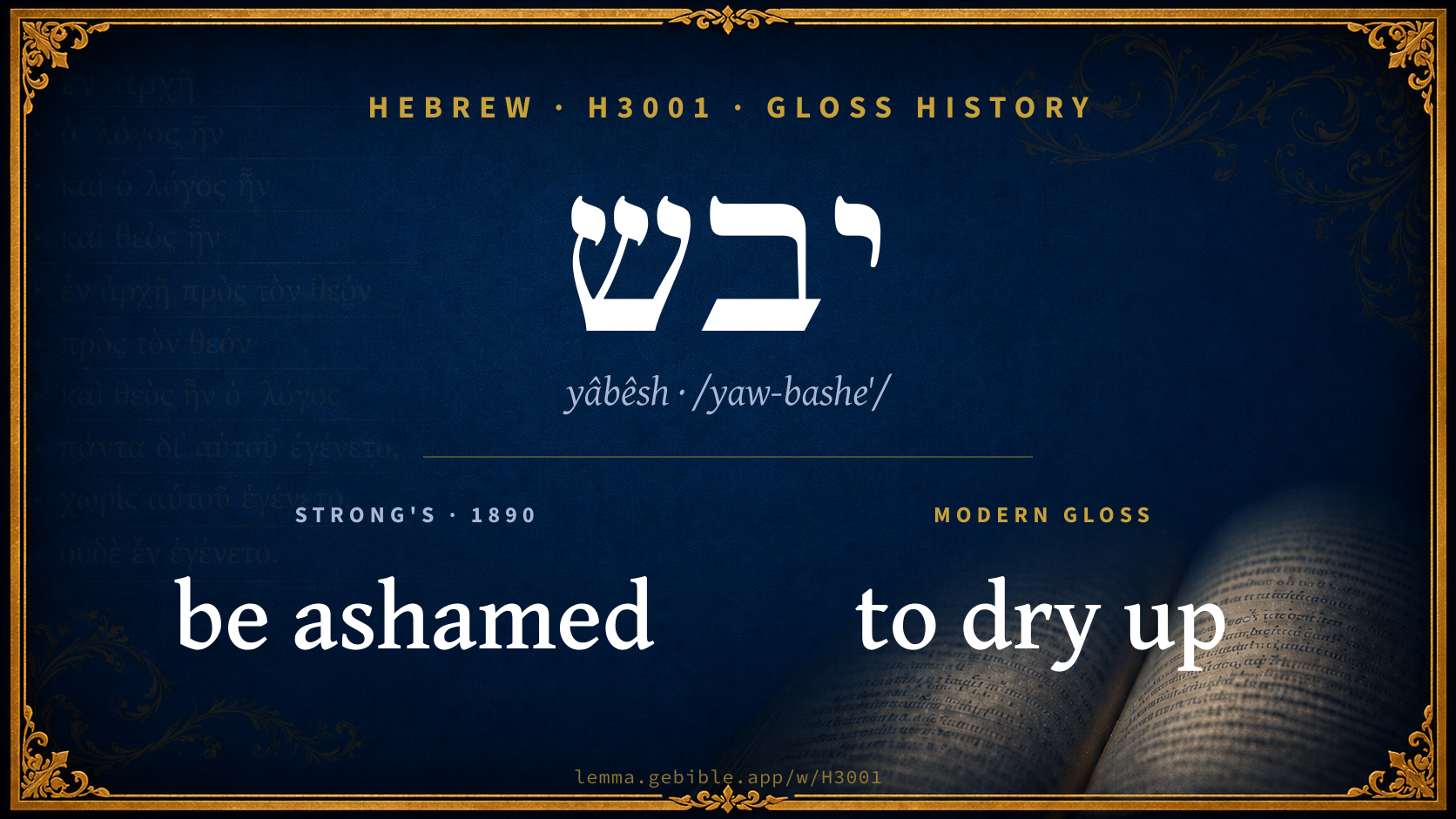
Gloss history
Strong's 1890 vs modern scholarship
About this word
Strong's H3001 catalogs a Hebrew word from the Hebrew Old Testament.
These counts are not copied from any lexicon or concordance. They are computed here, from the morphology-tagged Hebrew Old Testament. What Lemma adds →
- 62
- distinct verses
- The word appears in 62 distinct verses.
- 17 / 39
- OT books
- The word appears in 17 of 39 Old Testament books.
- #542
- by frequency
- Top 1000 most frequent Hebrew words (rank 542 of 8,640 Hebrew words by occurrence).
View all 62 occurrences in the concordance →
By section of the Old Testament
By traditional corpus
Conventional, traditional groupings — biblical authorship is debated, so this is a traditional corpus grouping, not an authorship claim. Each share is this word’s portion of its verses in that division of the Hebrew canon. Each figure is a share of the word’s 62 distinct verses.
- Prophets (Nevi'im) 47 verses · 76%
- Writings (Ketuvim) 13 verses · 21%
- Torah (Pentateuch) 2 verses · 3%
How translations render this word
Counts come from each version’s own published word-to-Strong’s tagging or interlinear alignment — an approximate guide to how each version renders this word, not a word-level alignment the data otherwise carries. Because each total is that version’s own tagged count, the per-version totals vary from one another and need not match the appearance or distinct-verse counts above. These counts may also differ from a printed concordance because Lemma counts each distinctly tagged rendering and does not collapse phrase taggings into a single head-word total. This is a fixed set of word-tagged versions (KJV, ASV, BSB, ULT) and does not change with the reading translation you choose elsewhere. Each version’s license is shown beside its name below (and on Sources).
BDB lists this Strong’s number as 3 distinct words (homographs). Each count above pools all of them and is not split by sense — see the Senses section below. A low-frequency rendering may belong to a different one of those words, not the primary meaning.
- King James Version†: Dried up 6×, Is confounded 6×, Withereth 5×
- American Standard Version†: Is put to shame 6×, Dried up 5×, Withereth 5×
- Berean Standard Bible†: Dried up 5×, Withers 5×, Will wither 4×
- unfoldingWord Literal Text†: Dries up 7×, Dried up 6×, Has dried up 4×
King James Version Public Domain
Renders H3001 across 78† tagged occurrences — most commonly:
Plus other, less common renderings. Plus 31 renderings that appear only once — usually multi-word phrases or single function words the recovered tagging swept in, not distinct renderings.
American Standard Version Public Domain
Renders H3001 across 78† tagged occurrences — most commonly:
Plus other, less common renderings. Plus 37 renderings that appear only once — usually multi-word phrases or single function words the recovered tagging swept in, not distinct renderings.
Berean Standard Bible Public Domain
Renders H3001 across 59† tagged occurrences — most commonly:
Plus 23 renderings that appear only once — usually multi-word phrases or single function words the recovered tagging swept in, not distinct renderings. Not rendered by a distinct English word in 2 further occurrences.
unfoldingWord Literal Text CC BY-SA 4.0
Renders H3001 across 68† tagged occurrences — most commonly:
Plus other, less common renderings. Plus 19 renderings that appear only once — usually multi-word phrases or single function words the recovered tagging swept in, not distinct renderings.
17 senses and sub-senses in the full BDB
Hebrew verbs can shift meaning by stem (binyan): Qal is the basic action, Niphal is often passive or reflexive, Piel often intensifies or makes it factitive, and Hiphil is typically causative. The senses below are grouped under the stem BDB assigns to each.
What do BDB’s symbols mean?
BDB uses these scholarly abbreviations:
| Symbol | Meaning |
|---|---|
| 𝔊 | the Septuagint (the ancient Greek translation, LXX) |
| 𝔙 | the Vulgate (the Latin translation) |
| 𝔖 | the Syriac version (the Peshitta) |
| 𝔗 | the Targum (the Aramaic translation) |
| ψ | the Psalms |
| √ | root (the underlying root or stem) |
| ‖ | parallel passage (a synonymous or contrasted parallel) |
| † | the dagger: every passage where the word occurs is cited |
The 17 senses and sub-senses the full Brown-Driver-Briggs lexicon distinguishes for this word, in lexicon order (not ranked by frequency), with BDB’s own verbatim wording and sub-sense lettering. Shown in Hebrew script with BDB’s own scholarly abbreviations. The condensed entry is in the Lexicon Entry tab. See also the Forms in the corpus table below.
יבש I be dry, dried up, withered (NH id. (rare), 𝔗 יְבֵישׁ, chiefly Pa. Ithp., Syriac ܢܺܒܶܫ
Qal
- Pf. 2 ms. יָבֵשׁ Jos 9:5 + 8 times; וְיָבֵשׁ consec. Is 19:5 + 4 times; 3 fs. יָֽבְשָׁה Gn 8:14; 3 pl. יָֽבְשׁוּ Je 23:10 + 2 times; יָבֵ֑שׁוּ 50:38 + 2 times; Impf. 3 ms. יִבַשׁ Is 19:7; יִיבָ֑שׁ Je 12:4 Jb 8:12; וַיִּיבַשׁ 1 K 17:7; וַיִּיבָ֑שׁ Jon 4:7; 3 fs. תִּיבַשׁ Ez 17:10; תִּיבָ֑שׁ v 10 + 3 times, etc.; Inf. cstr. (בִּ)יבשׁ Is 27:11; יְבשֶׁת Gn 8:7; abs. יָבוֹשׁ Zc 11:17; יָבשׁ Ez 17:10;— e.g. Joshua 9:5
- 1. be dry, dried up without moisture:
- a. of bread Jos 9:5, 12 (JE). e.g. Joshua 9:5
- b. of ground lacking rain Am 4:7, cf. Am 1:2 (of Carmel at utterance of י׳’s voice), Je 23:10. e.g. Amos 4:7
- c. of earth after the flood Gn 8:14 (P), cf. חָרֵב. e.g. Genesis 8:14
- d. of grass, herbage, trees and crops (already implied in b) = wither Is 15:6; 19:7; 27:11 Je 12:4 Jb 8:12 Jo 1:12 Jon 4:7; in sim. of shortness of life ψ 90:6; 102:12; 129:6, v. also Is 40:7, 8 (in these two ‖ נָבֵל); of heart under fig. of grass ψ 102:5; of Judah under fig. of vine Ez 17:9(×2), 10(×3), cf. 19:12; of princes under fig. of tree Is 40:24; of roots of Ephr. under fig. of tree Ho 9:16, so of roots of wicked Jb 18:16. e.g. Isaiah 15:6
- e. of hand, arm, dry up, wither, as judgment from י׳, 1 K 13:4 Zc 11:17(×2); in distress יָבֵשׁ כַּחֶרֶשׁ כֹּחִי ψ 22:16 my strength is dried up like the potsherd; of skin La 4:8, and (fig.) of bones Ez 37:11. e.g. 1 Kings 13:4
- 2. be dried up: of water Gn 8:7 (J), Is 19:5 1 K 17:7 Je 50:38 Jo 1:20 Jb 12:15; 14:11. e.g. Genesis 8:7
Piel
- make dry, dry up, only Impf. 3 ms. sf. וַיַּבְּשֵׁהוּ Na 1:4 and hath made it dry (י׳, the sea); 3 fs. תְּיַבֵּשׁ Jb 15:30 the flame shall dry up his branches (fig. of wicked); fig. תְּיַבֶּשׁ־נָּ֑רֶם Pr 17:22 a broken spirit maketh dry (the) bones. e.g. Nahum 1:4
Hiphil
- Pf. 3 ms. הוֹבִישׁ Jos 2:10 + 3 times + Jo 1:10 (v. infr.); חֹבִישׁ Ez 19:12 + 2 times Jo (v. infr.); 3 fs. הוֹבִישָׁה Jo 1:12 (v. infr.); 2 ms. הוֹבַשְׁתָּ ψ 74:15; 1 s. הוֹבַשְׁתִּי Ez 17:24; וְהוֹבַשְׁתִּ֫י Je 51:36; 3 pl. וְהֹבִישׁוּ consec. Zc 10:11; Impf. 1 s. אוֹבִישׁ Is 42:15(×2); 44:27;—dry up, make dry: e.g. Joshua 2:10
- 1. dry up water, י׳ subj., Jos 2:10; 4:23(×2); 5:1 (all D), Je 51:36 (‖ הֶחֱרִיב), Is 42:15; 44:27 (חֳרָבִי in ‖ cl.), ψ 74:15. e.g. Joshua 2:10
- 2. make dry, wither: herbage, trees, crops, etc., of י׳, Is 42:15 (‖ החריב); obj. Babylon under fig. of tree Ez 17:24; of east wind’s drying up Judah’s fruit Ez 19:12. e.g. Isaiah 42:15
- 3. exhibit dryness: of river-deeps laid bare Zc 10:11.—In like manner might be taken Jo 1:10, 12(×2), 17, if from יבשׁ; but the sense would be difficult, especially in v 10, 12, and הֹבִישׁוּ v 11 must be from בּוֹשׁ, to which all these cases in Jo may be consistently assigned; v. בּוֹשׁ. e.g. Zechariah 10:11
יבש II verb. or pt. dry, dried, so, ms. abs. Na 1
- 1. dried, lit. only עֲנָבִים יְבֵשִׁים Nu 6:3 dried grapes (P; opp. ע׳ לַחִים); fig. נַפְשֵׁנוּ יְבֵשָׁה 11:6 (JE) our soul (i.e. our appetite) is dried up, viz. for want of fresh, juicy meat. e.g. Numbers 6:3
- 2. dry, of chaff, קַשׁ Na 1:10 in sim. of Ninevites under impending judgment; cf. in fig. of Job, Jb 13:25; of tree Ez 17:24 (fig. of Davidic house; opp. עֵץ לָ֑ה), 21:3 (in prediction of Judah’s devastation by Babylon, opp. id.); Is 56:3 fig. of eunuch; of the bones in Ezek.’s vision Ez 37:2, 4. e.g. Nahum 1:10
יבש III loc. et pers.
- 1. n.pr.loc. יָבֵשׁ גִּלְעָד Jabesh of Gilead, 𝔊 Ιαβ(ε)ις Γαλααδ, exact site uknown, Ju 21:8, 9, 10, 12, 14 2 S 21:12; 1 Ch 10:11 (𝔊L Ιαβις τῆς Γαλααδ); יָבֵישׁ גִּלְעָד 1 S 11:1, 9; 31:11 2 S 2:4, 5 (in these three 𝔊L Ιαβις τῆς Γαλαατίδιτος); יָבֵישׁ 1 S 11:1, 3, 5, 9, 10; יָבֵשׁ 1 Ch 10:12; יָבֵ֑ישָׁה v 12; ‖ יָבֵ֫שָׁה 1 S 31:12, 13. e.g. Judges 21:8
- 2. n.pr.m. יָבֵשׁ father of Shallum 2 K 15:10, 13, 14. e.g. 2 Kings 15:10
Senses from the full Brown-Driver-Briggs lexicon (Brown, Driver, Briggs; Oxford 1906 — public domain), digitized via Sefaria, supplemented by the OpenScriptures HebrewLexicon (CC BY 4.0). Full attribution on Sources.
Word origin
I. vb. be dry, dried up, withered (NH id. (rare), 𝔗 יְבֵישׁ, chiefly Pa. Ithp., Syriac ܢܺܒܶܫ; Sab. Palm. deriv.; Arabic يَبِسَ; Ethiopic የብሰ )—
II. adj.verb. or pt. dry, dried, so, ms. abs. Na 1:10 + 4 times; fs. יְבֵשָׁה Nu 11:6; mpl. (וִ)יבֵשִׁים Nu 6:3; fpl. יְבֵשׁוֹת Ez 37:2, 4;—
— Brown-Driver-Briggs (Oxford 1906, public domain), digitized via Sefaria, supplemented by the OpenScriptures HebrewLexicon (CC BY 4.0). See Sources.
Origin: a primitive root
Jastrow Dictionary
A second Hebrew/Aramaic lexicon for comparison, covering Aramaic and post-biblical (Talmudic, Targumic, Midrashic) usage that the biblical-Hebrew BDB does not. Matched by lemma rather than by Strong’s number, so a lemma may carry more than one Jastrow headword (shown separately below), and the entries cover usage well beyond the Bible.
יָבֵשׁ I
- parched, dry, withered, opp. לח moist, green. Dem. II, 3 לח וי׳ fresh or dried fruits. Ib. 5 בי׳ שלשת קבין wholesale dealing in dried fruits means three Kab. Y. ib. II, end, 23ᵃ נתנו שיעור לי׳ for dried fruit they make quantity the standard; a. fr.—Pl. יְבֵשִׁים, יְבֵשִׁין; יְבֵי׳. Sabb. IV, 1. Pes. II, 6; a. fr.—Fem. יְבֵשָׁה, יְבֵי׳. Ukts. I, 2; a. fr.—Tosef. Ter. VII, 16 נעשית י׳ the date became dry (so as to be called יְבֵּישָׁה).—Pl. יְבֵשׁוֹת, יְבֵי׳. T’bul Yom III, 6 תמרים י׳, opp. רטובות; a. fr.
יָבֵשׁ
- Targ. Josh. IX, 5; 12. Targ. Job. XIII, 25 (ed. Wil. יְבֵשׁ); a. e.—Pl. יְבֵשִׁין, יְבֵשַׁיָּא, יְבֵי׳. Targ. Ez. XXXVII, 2; 4.—Fem. יְבֶשְׁתָּא, יְבֶישְׁ׳. Gitt. 69ᵇ. Bets. 33ᵃ; a. e.—[V. יַבַּשְׁתָּא.]
יָבֵשׁ II
- preced.) to be dry, to wither. Bets. 26ᵇ מוקצה שי׳ stored fruits (v. מוקצה) which were dry (on Friday), though the owner did not find it out until the Sabbath day; Y. ib. I, beg. 60ᵃ
- to dry up. Gen. R. s. 33 עתיד … וליַיבֵּשׁ וכ׳ in the future a righteous man (Elijah) will come and lay the world dry (through want of rain).
יְבֵשׁ
- Targ. O. Gen. VIII, 14 יְבֵישַׁת ed. Berl. (oth. ed. יַבִּישַׁת).—Y. Taan. III, 66ᵈ יַבְשַׁת ידיה his hand withered. Gitt. 69ᵇ כי היכי דיביש הדא ידא וכ׳ (read דיְבִישַׁת) as this hand (of the dead man) is withered, so may the milt of … dry (shrink to its normal size); a. e.
- to dry. Targ. Josh. II, 10.—Targ. Prov. XVII, 22; a. e.—Gitt. l. c. ונְיַיבְּשִׁינְהוּ בטולא and let him dry them (the leeches) in the shade; a. e.
- to be dried up, withered. Targ. Ps. CII, 5 Ms. (missing in ed.). Targ. Y. Gen. VIII, 14; a. e.—Targ. Job XXXVIII, 11 Ms. (ed. תשוי).—Gitt. l. c. נִיַּיבֵּשׁ ההיא טוחלא, v. supra.
A Dictionary of the Targumim, the Talmud Babli and Yerushalmi, and the Midrashic Literature (Marcus Jastrow; London, Luzac, 1903) — Public Domain. Digitized via Sefaria. Digitized via Sefaria. Full attribution on Sources.
Forms in the corpus
The 58 distinct written forms H3001 takes in the Hebrew Bible, most frequent first — each parse links to that stem’s occurrences in the concordance. Hebrew forms include their vowel points and cantillation, so a single lemma takes many written forms.
Same root — word family
Other BDB entries built from the same root as H3001, grouped by Strong’s listed origin. These share a root / origin per the lexicon — not necessarily a shared meaning. Each links to that word’s own entry.
Derived from this word
Compare all same-root words → They share a root, not necessarily a meaning.
Septuagint verse parallels
This word appears in 55 verses that also exist in the Greek Old Testament (Septuagint), out of the 62 Hebrew verses it occurs in. You can read those verses in Greek by switching the Old Testament edition to the Septuagint.
Read these verses in the Septuagint
- Genesis 8:7
- Joshua 2:10
- 2 Samuel 19:5
- 1 Kings 13:4
- Job 8:12
- Psalms 90:6
- Proverbs 17:22
- Isaiah 15:6
- Jeremiah 6:15
- Lamentations 4:8
- Ezekiel 17:9
- Hosea 2:5
This is a verse-level parallel only — the same verses exist in both the Hebrew and Greek Old Testaments. No word-level Hebrew↔Greek correspondence is claimed: the data carries no such alignment, so no Greek word is shown as this Hebrew word’s translation. Coverage is not total — the Septuagint omits the deuterocanon and renumbers the Psalms, so some Hebrew verses have no direct Greek parallel.