
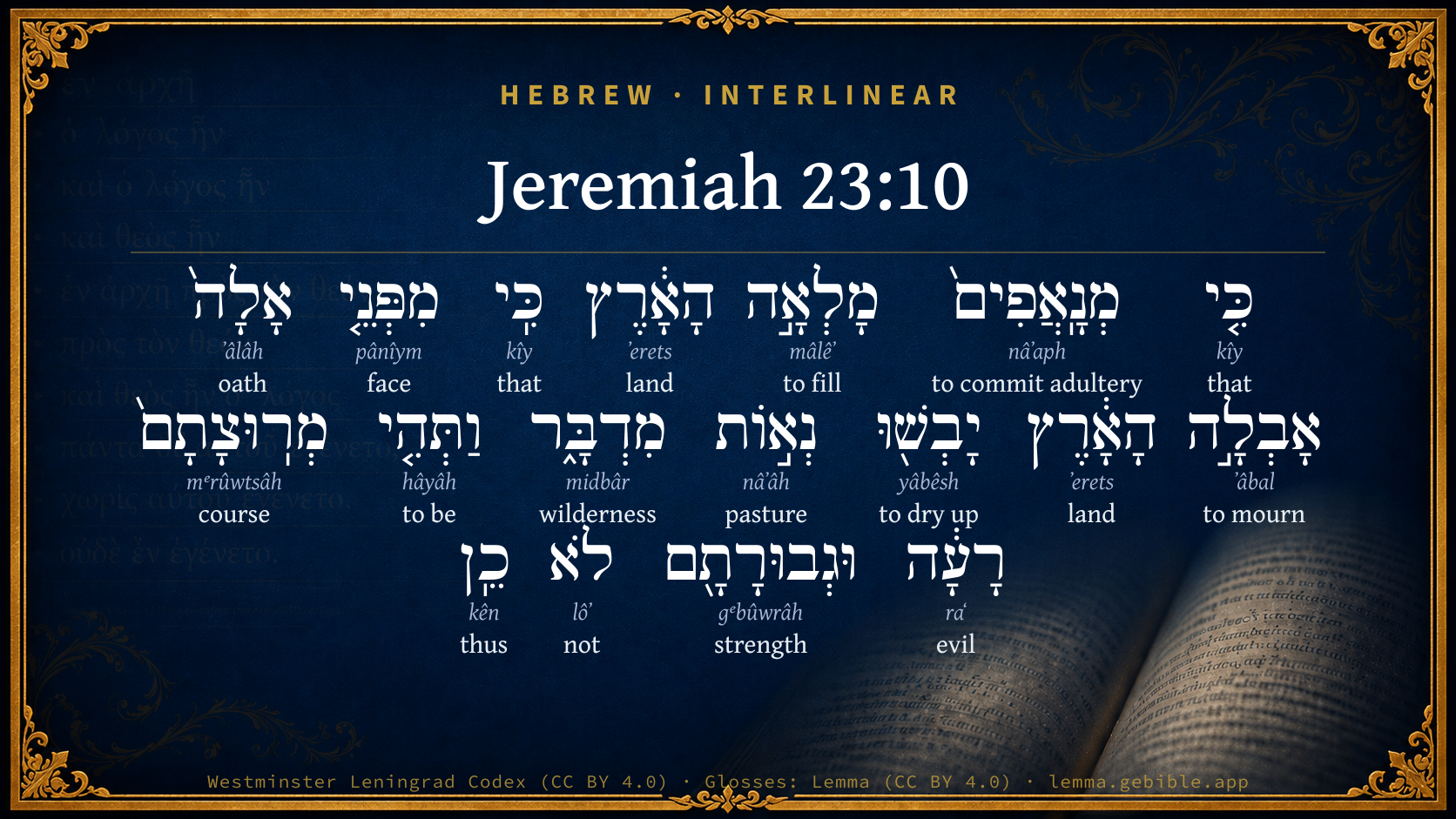
Jeremiah 23:10

Hebrew (Westminster Leningrad Codex) Jeremiah 23:10 appears in the Hebrew Old Testament. The text above is from the Westminster Leningrad Codex. Each word links to its Strong’s number, a concise gloss, and parsing drawn from the Open Scriptures Hebrew Bible morphology. Click any word for its full Brown-Driver-Briggs (BDB) entry.
Download image
Cite this verse

Jeremiah 23:10 (World English Bible). Public Domain. Lemma interlinear Bible study tool, https://lemma.gebible.app/v/jeremiah/23/10.

Show BibTeX & RIS
BibTeX
RIS
English Translation
For the land is full of adulterers; for because of swearing the land mourns; the pastures of the wilderness are dried up. Their course is evil, and their might is not right;
World English Bible · Public Domain
Download a study sheet

One document with this verse’s original text, its word-by-word gloss line, the meaning frame, cross-references with their text, attributed commentary, and full source and license credits — printable, and it pastes into notes with its structure intact.

This verse Autodidact and up

Study sheet (.html) Plain text (.txt)

A passage Seminary Student

Up to 50 verses in one chapter. A passage sheet keeps up to 6 commentary sources and 12 cross-references per verse, in the order this page ranks them, and says so on the sheet whenever that leaves anything out. Ask for a single verse and you get the Autodidact verse sheet above.

Everything on this page stays free to read, with no account — the sheet is a download of what is already on screen, not access to it.

Want to remove ads? Support Godless Engineer
Compare translations 3

The same verse in 3 English versions, stacked beneath the original-language interlinear above. Click any original word for its lexicon entry.

Each is an independent rendering of the whole verse — the interlinear is not word-aligned to these translations.

Highlighted words mark where these versions differ — a whole-verse word diff, not a word-by-word alignment.

  • World English Bible Public Domain
    For the land is full of adulterers; for because of swearing the land mourns; the pastures of the wilderness are dried up. Their course is evil, and their might is not right;
  • King James Version Public Domain
    For the land is full of adulterers; for because of swearing the land mourneth; the pleasant places of the wilderness are dried up, and their course is evil, and their force is not right.
  • unfoldingWord Literal Text CC BY-SA 4.0
    For the land is full of adulterers, for because of the face of a curse the land mourns, the pastures of the wilderness have dried up. Their course is evil, and their might not right. q1

unfoldingWord Literal Text — © unfoldingWord, licensed CC BY-SA 4.0. Word-aligned USFM3 via Door43 (git.door43.org/unfoldingWord/en_ult).

Versions to compare (up to 4)

3 of 4 selected

Show all 18 translations

Every available English version of this verse, each an independent rendering of the whole verse.

  • World English Bible Public Domain
    For the land is full of adulterers; for because of swearing the land mourns; the pastures of the wilderness are dried up. Their course is evil, and their might is not right;
  • Berean Standard Bible Public Domain
    For the land is full of adulterers—because of the curse, the land mourns and the pastures of the wilderness have dried up—their course is evil and their power is misused.
  • Majority Standard Bible Public Domain
    For the land is full of adulterers—because of the curse, the land mourns and the pastures of the wilderness have dried up—their course is evil and their power is misused.
  • King James Version Public Domain
    For the land is full of adulterers; for because of swearing the land mourneth; the pleasant places of the wilderness are dried up, and their course is evil, and their force is not right.
  • American Standard Version (1901) Public Domain
    For the land is full of adulterers; for because of swearing the land mourneth; the pastures of the wilderness are dried up. And their course is evil, and their might is not right;
  • Revised Version (1885) Public Domain
    For the land is full of adulterers; for because of swearing the land mourneth; the pastures of the wilderness are dried up; and their course is evil, and their force is not right.
  • Geneva Bible (1599) Public Domain
    For the lande is full of adulterers, and because of othes the lande mourneth, the pleasant places of the wildernesse are dried vp, and their course is euill, and their force is not right.
  • Douay-Rheims (1899) Public Domain
    Because the land is full of adulterers, because the land hath mourned by reason of cursing, the fields of the desert are dried up: and their course is become evil, and their strength unlike.
  • Young's Literal Translation Public Domain
    For of adulterers hath the land been full, For because of these hath the land mourned, Dried up hath been the pleasant places of the wilderness, And their course is evil, and their might -- not right.
  • Literal Standard Version CC BY-SA 4.0
    For the land has been full of adulterers, || For the land has mourned because of these, || The pleasant places of the wilderness have dried up, || And their course is evil, and their might—not right.
  • Unlocked Literal Bible CC BY-SA 4.0
    For the land is full of adulterers. Because of these the land is dried up. The meadows in the wilderness dry up. These prophets' paths are wicked; their power is not used in a right manner.
  • unfoldingWord Literal Text CC BY-SA 4.0
    For the land is full of adulterers, for because of the face of a curse the land mourns, the pastures of the wilderness have dried up. Their course is evil, and their might not right. q1
  • Darby Bible Public Domain
    For the land is full of adulterers; for because of execration the land mourneth. The pastures of the wilderness are dried up; for their course is evil, and their force is not right.
  • World Messianic Bible Public Domain
    “For the land is full of adulterers; for because of the curse the land mourns. The pastures of the wilderness have dried up. Their course is evil, and their might is not right;
  • Webster's Bible Public Domain
    For the land is full of adulterers; for because of swearing the land mourneth; the pleasant places of the wilderness are dried up, and their course is evil, and their force is not right.
  • Free Bible Version CC BY-SA 4.0
    For the country is full of people committing adultery so it's under a curse. The land mourns and the desert pastures have dried up. The people live evil lives, using their energy to do wrong.
  • Bible in Basic English Public Domain
    For the land is full of men who are untrue to their wives; because of the curse the land is full of grief; the green fields of the waste land have become dry; and they are quick to do evil, their strength is for what is not right.
  • JPS Tanakh (1917) Public Domain
    For the land is full of adulterers; for because of swearing the land mourneth, the pastures of the wilderness are dried up; and their course is evil, and their force is not right.

Literal Standard Version (2020), Covenant Press — licensed CC BY-SA 4.0. Text via the HelloAO Bible API (eBible.org). Unlocked Literal Bible (unfoldingWord) — licensed CC BY-SA 4.0. Text via the HelloAO Bible API (eBible.org). unfoldingWord Literal Text — © unfoldingWord, licensed CC BY-SA 4.0. Word-aligned USFM3 via Door43 (git.door43.org/unfoldingWord/en_ult). Free Bible Version, Dr. Jonathan Gallagher — licensed CC BY-SA 4.0. Text via the HelloAO Bible API (eBible.org).

Word by word

More ways to search: Search by grammar → Find every occurrence → Compare this word →

Practice this passage: Drill this verse → Learn its vocabulary →

מְרֽוּצָתָם֙
mᵉrûwtsâh
H4794
“course · their”
Noun, Common, Feminine, Singular, Construct + Suffix, Personal, 3rd Person, Masculine, Plural
Part of Speech
Noun
Type
Common
Gender
Feminine
Number
Singular
State
Construct
Full BDB Definition

Origin: from H4793

TWOT: 2137b

running, course (of life) - running, mode or style of running - course (of life)
  1. כִּ֤י kîy H3588 “that” Conjunction
  2. מְנָֽאֲפִים֙ nâʼaph H5003 “committing adultery” Verb, Piel, Participle Active, Masculine, Plural, Absolute
  3. מָלְאָ֣ה mâlêʼ H4390 “to fill” Verb, Qal, Perfect, 3rd Person, Feminine, Singular
  4. הָאָ֔רֶץ ʼerets H776 “the · land” Particle, Definite Article + Noun, Common, Both, Singular, Absolute
  5. כִּֽי kîy H3588 “that” Conjunction
  6. מִפְּנֵ֤י pânîym H6440 “from · face(s) of” Preposition + Noun, Common, Both, Plural, Construct
  7. אָלָה֙ ʼâlâh H423 “oath” Noun, Common, Feminine, Singular, Absolute
  8. אָבְלָ֣ה ʼâbal H56 “to mourn” Verb, Qal, Perfect, 3rd Person, Feminine, Singular
  9. הָאָ֔רֶץ ʼerets H776 “the · land” Particle, Definite Article + Noun, Common, Both, Singular, Absolute
  10. יָבְשׁ֖וּ yâbêsh H3001 “to dry up” Verb, Qal, Perfect, 3rd Person, Common, Plural
  11. נְא֣וֹת nâʼâh H4999 “pastures of” Noun, Common, Feminine, Plural, Construct
  12. מִדְבָּ֑ר midbâr H4057 “wilderness” Noun, Common, Masculine, Singular, Absolute
  13. וַתְּהִ֤י hâyâh H1961 “and · to be” Conjunction + Verb, Qal, Sequential Imperfect, 3rd Person, Feminine, Singular
  14. רָעָ֔ה raʻ H7451 “evil” Adjective, Adjective, Feminine, Singular, Absolute
  15. וּגְבוּרָתָ֖ם gᵉbûwrâh H1369 “and · strength · their” Conjunction + Noun, Common, Feminine, Singular, Construct + Suffix, Personal, 3rd Person, Masculine, Plural
  16. לֹא lôʼ H3808 “not” Particle, Negative
  17. כֵֽן kên H3651 “thus” Adjective, Adjective, Masculine, Singular, Absolute

About this verse

These counts appear in no published source. They are computed here, from the morphology-tagged text and Lemma’s own curated glosses. What Lemma adds →

18
words
16
distinct lemmas
Prophets
section

Notable vocabulary

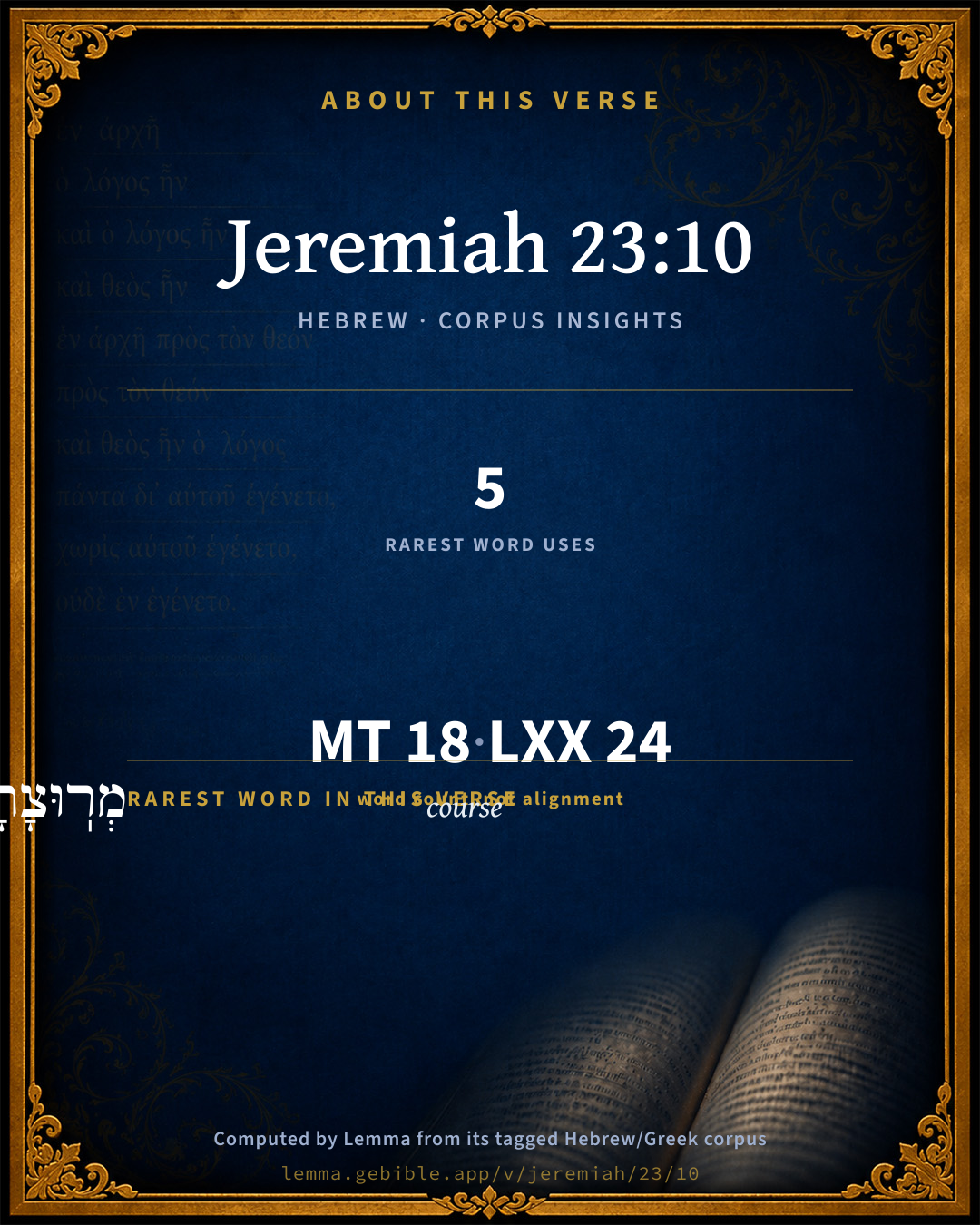
The rarest word here is מְרֽוּצָתָם֙ course H4794 — appearing just 5 times in the whole Hebrew Bible.

Shared distinctive vocabulary

מְרֽוּצָתָם֙ course H4794 occurs in 3 verses of the Hebrew Bible. Also found in:

Grammatical profile

  • 5 verbs
  • 8 nouns
  • 2 adjectives
  • 2 conjunctions
  • 1 particle

Verb forms

  • מְנָֽאֲפִים֙ Piel · Participle Active
  • מָלְאָ֣ה Qal · Perfect
  • אָבְלָ֣ה Qal · Perfect
  • יָבְשׁ֖וּ Qal · Perfect
  • וַתְּהִ֤י Qal · Sequential Imperfect

Repetition

Words recur within this verse — often emphatic in Hebrew:

  • הָאָ֔רֶץ land H776 ×2
  • כִּ֤י that H3588 ×2

Hebrew & Septuagint length

In the original languages it is 18 Hebrew tokens and 24 Greek tokens — but the two are counted differently (Hebrew bundles its prefixes and suffixes into one token; the Greek is in lemma form), so that isn’t a like-for-like length.

Cross-references

19

Topical passages linked to Jeremiah 23:10 in the Treasury of Scripture Knowledge — connected by theme and wording, ordered by reader-vote popularity; previews shown in the World English Bible.

  • Psalms 107:34 And a fruitful land into a salt waste, For the wickedness of those who dwell in it.
  • Hosea 4:2–3 There is cursing, lying, murder, stealing, and committing adultery; They break boundaries, and bloodshed causes bloodshed.
  • Jeremiah 5:7–8 How can I pardon you? your children have forsaken me, and sworn by them that are no gods: when I had fed them to the full, they committed adultery, and assembled themselves in troops at the prostitutes' houses.
  • Jeremiah 9:2 Oh that I had in the wilderness a lodging-place of wayfaring men; that I might leave my people, and go from them! for they are all adulterers, an assembly of treacherous men.
  • Jeremiah 9:10 For the mountains will I take up a weeping and wailing, and for the pastures of the wilderness a lamentation, because they are burned up, so that none passes through; neither can men hear the voice of the cattle; both the birds of the sky and the animals are fled, they are gone.
  • Malachi 3:5 I will come near to you to judgment; and I will be a swift witness against the sorcerers, and against the adulterers, and against the perjurers, and against those who oppress the hireling in his wages, the widow, and the fatherless, and who deprive the foreigner of justice, and don't fear me," says Yahweh of Hosts.
  • Isaiah 24:6 Therefore has the curse devoured the earth, and those who dwell therein are found guilty: therefore the inhabitants of the earth are burned, and few men left.
  • Ezekiel 22:9–11 Slanderous men have been in you to shed blood; and in you they have eaten on the mountains: in the midst of you they have committed lewdness.
  • Jeremiah 7:9 Will you steal, murder, and commit adultery, and swear falsely, and burn incense to Baal, and walk after other gods that you have not known,
  • Jeremiah 12:3–4 But you, Yahweh, know me; you see me, and try my heart toward you: pull them out like sheep for the slaughter, and prepare them for the day of slaughter.
  • Jeremiah 14:2 Judah mourns, and the gates of it languish, they sit in black on the ground; and the cry of Jerusalem is gone up.
  • Lamentations 1:2–4 She weeps sore in the night, and her tears are on her cheeks; Among all her lovers she has none to comfort her: All her friends have dealt treacherously with her; they are become her enemies.
  • Joel 1:10 The field is laid waste. The land mourns, for the grain is destroyed, The new wine has dried up, And the oil languishes.
  • Zechariah 5:3–4 Then he said to me, "This is the curse that goes out over the surface of the whole land; for everyone who steals shall be cut off according to it on the one side; and everyone who swears falsely shall be cut off according to it on the other side.
  • 1 Corinthians 6:9–10 Or don't you know that the unrighteous will not inherit the Kingdom of God? Don't be deceived. Neither the sexually immoral, nor idolaters, nor adulterers, nor male prostitutes, nor homosexuals,
  • Galatians 5:19–21 Now the works of the flesh are obvious, which are: adultery, sexual immorality, uncleanness, lustfulness,
  • 1 Timothy 1:10 for the sexually immoral, for homosexuals, for slave-traders, for liars, for perjurers, and for any other thing contrary to the sound doctrine;
  • Hebrews 13:4 Let marriage be held in honor among all, and let the bed be undefiled: but God will judge the sexually immoral and adulterers.
  • James 4:4 You adulterers and adulteresses, don't you know that friendship with the world is enmity with God? Whoever therefore wants to be a friend of the world makes himself an enemy of God.

Cross-references courtesy of OpenBible.info (CC BY 4.0).

Hebrew and Greek witnesses Masoretic Hebrew ↔ Greek Septuagint

The same verse in the two great witnesses to the Old Testament, shown verse-for-verse.

These are two independent witnesses, not word-aligned to each other, and the Septuagint is shown in lemma (dictionary) form.

Hebrew Jeremiah 23:10 Masoretic · Westminster Leningrad Codex

כִּ֤י מְנָֽאֲפִים֙ מָלְאָ֣ה הָאָ֔רֶץ כִּֽי מִפְּנֵ֤י אָלָה֙ אָבְלָ֣ה הָאָ֔רֶץ יָבְשׁ֖וּ נְא֣וֹת מִדְבָּ֑ר וַתְּהִ֤י מְרֽוּצָתָם֙ רָעָ֔ה וּגְבוּרָתָ֖ם לֹא כֵֽן

For the land is full of adulterers; for because of swearing the land mourns; the pastures of the wilderness are dried up. Their course is evil, and their might is not right;

World English Bible · Public Domain

Greek LXX Structure differs

In the Septuagint, Jeremiah is about an eighth shorter than the Hebrew and arranges its material differently — the Oracles Against the Nations (Hebrew chapters 46–51) appear in the middle of the Greek book, after 25:13. Because the chapter and verse boundaries do not line up, a verse-for-verse comparison with the Hebrew is not shown.

A verse-for-verse comparison isn’t shown here because the chapters and verses don’t line up. Switch to the LXX edition with the MT / LXX toggle above to read the Greek directly.

On this verse, The Cambridge Bible for Schools and Colleges discusses the Septuagint’s reading. Read the note in Commentary ↓

Hebrew: Westminster Leningrad Codex (CC BY 4.0). Greek: Septuagint (public domain); English from a public-domain English Septuagint. How the Septuagint differs from the Hebrew →

Targum (Aramaic paraphrase)

1

The Targum is the ancient Jewish Aramaic paraphrase of the Hebrew Scriptures — an interpretive translation, not the Hebrew text itself. Onkelos (literal) and Pseudo-Jonathan (expansive) render the Torah, and Jonathan the Prophets. Coverage is partial: where no permissively-licensed English translation exists for a verse, only the Aramaic is shown. This is verse-level text, not a word-by-word alignment to the Hebrew.

  1. Targum Jonathan Prophets (Joshua–Malachi)
    אֲרֵי זַנָאִין אִתְמְלִיאַת אַרְעָא אֲרֵי מִן קֳדָם מוֹמֵי דִשְׁקַר חֲרוֹבַת אַרְעָא יְבִישׁוּ דִידָוַת מַדְבְּרָא וְעַל דְמַסְגָן בִּרְעוּת נַפְשֵׁיהוֹן בִּישְׁתָּא תֵּיתֵי עֲלֵיהוֹן וְגִבְּרֵהוֹן לָא יַצְלְחוּן:

    (no public-domain English translation for this verse)

    Targum Jonathan — Aramaic: “Mikraot Gedolot” (public domain). English: “Sefaria Community Translation” (CC0 1.0 (public-domain dedication)); “London "Chaldee Paraphrase," 1871” (public domain). Text via Sefaria.

Commentary

Notes on Jeremiah 23:10 from classic Christian and Jewish commentators (each source and its license shown beneath its notes). The classic Christian expositions comment on the surrounding passage and are grouped to its opening verse, so a note may address several verses; the Jewish commentaries on the Tanakh (Rashi and others) are per-verse, so they appear only where the commentator wrote on this verse.

Lemma curates 59 commentaries, every one of them public domain or Creative Commons licensed, each selected and text-cleaned for this edition rather than reprinted as found. About our sources →

Trapp's Complete Commentary

John Trapp

Jer 23:10 For the land is full of adulterers; for because of swearing the land mourneth; the pleasant places of the wilderness are dried up, and their course is evil, and their force [is] not right.

Ver. 10. For the land is full of adulterers.] It is even become a great brothel house, as sometimes Cyprus was, and as Rome is now said to be:

“ Tota est iam Roma lupanar. ”

“Now Rome is entirely a brothel.”

For because of swearing (or cursing) the land mourneth.] Swearers and cursers, then, are public enemies, traitors to the State. The Jews observe that Beershaba signifies, The well of oath; and Beersaba, The well of plenty. Sure we are that for oaths the land mourneth; of which there is such store, as if men, by an easy mistake of the point, used to draw and drop them, as it were, out of the well of plenty.

And the pleasant places.] Or, Pastures, or habitations, which, being dried up, seem to mourn, and yet the inhabitants are without all sense of sorrow.

And their course is evil.] Naught all over, as we say.

And their force is not right.] Not rightly employed; they are not valiant for the truth, but violent for wrong doing.

John Trapp, A Commentary or Exposition upon All the Books of the Old and New Testament (1647–1656) — public domain. Text from a community e-Sword module.

Joseph Benson's Commentary

Jer 23:10. For the land is full of adulterers — Under this term, which properly respects those who violate the marriage-bed, persons offending by any species of uncleanness are comprehended, as also such as by fraud and falsehood circumvented others, and tempted them to join in the commission of those illicit actions which implied breach of faith and duty toward God. Because of swearing the land mourneth — By swearing here, it seems, is not only meant false swearing, or perjury, but also profane and idle swearing, or taking the name of God in vain. Compare this verse with Hos 4:2. The Hebrew word, אלה, signifies indifferently swearing or cursing. The Jewish forms of adjuration, used in their courts of justice for the discovery of the truth, had usually an imprecation joined to them; and the prophet’s words here may import, that men ventured to forswear themselves, and incur the imprecation implied in an oath, rather than discover the truth in cases wherein they were called upon to be witnesses. The land is said to mourn when it is afflicted with drought, barrenness, or any other uncommon calamity. And the swearing here spoken of is represented by the prophet as one of those crying sins for which God had visited the nation with these and other severe judgments. And the sins here mentioned, which abounded so much among the people, were in a great measure owing to the bad example and corrupt doctrine of the priests and prophets. See Jer 23:11-15. The pleasant places, or the pastures, of the wilderness — Or, of the plain, as the words may be properly rendered; are dried up — The wrath of God is extended to all places, whether more or less inhabited. See note on Jer 12:4. And their course is evil, &c. — This seems to be intended of the prophets and priests, to whom this discourse is chiefly directed, (see Jer 23:9-11,) and it implies that they not only erred in single acts, but that the whole course of their actions was evil, and particularly their power, rule, and government. For they both made use of ill arts to establish their authority over the people, and they employed it, not for the bettering, but rather for the corrupting of their manners.

Joseph Benson's Commentary on the Old and New Testaments (1811–1818) — public domain. Text from a community e-Sword module.

Tyndale Open Study Notes

Tyndale Open Resources

23:10 People everywhere engaged in adultery. They thought that the ritual sex of Baal worship would guarantee good crops, but instead it brought the curse of a crop-destroying drought upon the people of Judah.

Tyndale Open Study Notes — © Tyndale Open Resources, licensed CC BY-SA 4.0. Text via the HelloAO Bible API.

Geneva Bible (1599)

Geneva Bible translators

They run headlong to wickedness, and seek vain help.

Geneva Bible (1599) marginal notes — public domain. Text via Bolls.life.

Jamieson, Fausset & Brown

Robert Jamieson, A. R. Fausset & David Brown

adulterers--spiritual, that is, forsakers of God, Israel's true Husband (Isa 54:5) for idols, at the instigation of the false "prophets" (Jer 23:9, Jer 23:15). Literal adultery and fornication, the usual concomitants of idolatry, are also meant.

swearing--MAURER, &c., translate, "Because of the curse (of God on it), the land mourneth" (Deu 27:15-26; Deu. 28:15-68; Isa 24:6). More than usual notoriety had been given to the curses of the law, by the finding and reading of it in Josiah's time (Kg2 22:11, &c.). But Hos 4:2-3, favors English Version (compare Jer 12:4). A drought was sent by God on the pastures ("pleasant places," oases) in the desert, on account of the "profaneness" of the priests, prophets, and people (Jer 23:11).

course . . . evil--They (both prophets and people) rush into wickedness (Jer 23:21; Isa 59:7).

force . . . not right--Their powers are used not on the side of rectitude, but on that of falsehood.

Jamieson, Fausset & Brown — Commentary Critical and Explanatory on the Whole Bible (1871) — public domain (CC PDM 1.0). Text via the HelloAO Bible API.

Adam Clarke's Commentary

Verse 10. The land is full of adulterers] Of idolaters. Of persons who break their faith to ME, as an impure wife does to her husband.

The pleasant places of the wilderness are dried up] He speaks here, most probably, in reference to dearth. Profane oaths, false swearing, evil courses, violence, c., had provoked God to send this among other judgments see Jer 23:19.

Adam Clarke's Commentary on the Bible (1810–1826) — public domain. Text from a community e-Sword/MySword module.

John Calvin's Commentaries

Jeremiah now assigns the reason why he was so much horrified by the insensibility which he observed in the prophets. If things were in good order, or if, at least, they were tolerable, the prophets would have more calmly addressed the Jews; for what need is there to make a great ado when men willingly follow what God commands? When, therefore, we have to do with meek and modest men, vehemence is foolish; and they who thus bestir themselves, and seek, through great ambition, to shew very fervid zeal when there is no need, are nothing but apes; but when things are in disorder and confusion, then vehemence is wanted. Jeremiah now declares that things were so extremely out of order, that the prophets could not have been silent, except they were like logs of wood.

These two things, then, ought to be connected together, — that the prophets were dumb, — and that they were dumb when there was the greatest necessity for speaking; for they saw the land filled with adulteries. Though he names adulterers, he yet condemns the crime. As then the land was polluted by adulteries and perjuries, as they all gave themselves up to do evil, it was by no means to be tolerated that the prophets should not be indignant, as though things were well ordered and peaceable.

We hence see how much God abhors sloth in the ministers of his word, in those whom he appoints as teachers in his Church, while they connive at wickedness, and heedlessly pass by adulteries, and fornications, and perjuries, and frauds, and other kinds of wrongs; for if there were even the least particle of religion in their hearts, they would certainly have been moved, and could not have been for a moment silent. For if that zeal ought to be in all God’s children, which was in the Psalmist,

“The zeal of thine house has consumed me, and the reproaches of them who reproached thee have fallen upon me,” (Psalm 69:10,)

how inexcusable must be the indifference of prophets, when they see God’s name exposed to mockery, and when they see every kind of wickedness prevailing? We now see not only what the Prophet teaches in this passage, but also the usefulness of his doctrine and how it ought to be applied. Let us then learn, that the more liberty men take in sinning, and the more audaciously their impiety and contempt of God break out, the more sharply ought prophets and faithful teachers to reprove and condemn them; and that it is the time of fighting, when the world thus presumptuously and furiously rise up against God.

The Prophet mentions some kinds of evil, and yet does not enumerate all kinds; but under adulteries and perjuries he includes also other crimes. As to the word אלה, ale, it properly means swearing; but as cursing often accompanies it, some render it here “execration.” But I rather think that what is meant is perjury, and that swearing here is taken in a bad sense, signifying swearing falsely in the name of God.

Mourned, he says, has the land, and dried up have the pastures of the desert Here the Prophet strikingly shews how shameful was that torpor of which he speaks, for the land itself cried out, and not only the land which was cultivated and had on it many men, but also the very mountains and their recesses. He says that the land was in mourning, because God shewed his judgments everywhere by rendering the fields barren, and by other means which he used as punishments. And it is a very striking mode of speaking, when the Prophet mentions the mourning of the land, as though it assumed the character of a mourner, when it saw God angry on account of the wickedness of men. It is, indeed, a kind of personification, though he does not introduce the land as speaking; but he describes mourning as it appeared in the sterility of the land, and also in hails and storms, in unseasonable rains, in droughts, and in other calamities.

Whenever then God raises his hand to punish men for their sins, if they themselves perceive it not, the very land, which is without sense and feeling, ought to fill them with shame for their madness; for mourning appears in the very land, as though it knew that God was displeased with it. When, therefore, men sleep in their sins, and thus disregard God’s vengeance, how monstrous must be their torpor! And if this be intolerable in the common people, what can be said of the prophets, who ought to proclaim such words as these, — “Cursed is he who has transgressed the precepts of this law” — “cursed is he who has corrupted the worship of God” — or, “who hath dealt unjustly with his neighbor,” — and whatever else the law contains? (Deuteronomy 27:26; Deuteronomy 28:47, 58.) We now then perceive how emphatical are the words when the Prophet says, Mourned has the land And he amplifies the same thing by saying, Dried up have the beautiful places of the desert; as though he had said, that God’s judgments were seen in the remotest places, not only in the plains, where the greater number of men dwelt, did the land mourn; but if any one ascended the mountains, where shepherds only with their flocks were to be found, even there the wrath of God was visible; and the very mountains cried out that God was angry; and yet men still deluded themselves, who, at the same time were expounders of the law, who were the mouth of God, and to whom he had committed the office of reproving; but they were dumb! We now understand what these words contain, and what is to be learnt from them.

He adds, that their course was evil, and that their strength was not right By course he no doubt means their doings and all their actions, and also the aid which they proposed to themselves; for our life is called a course, because God has not created us that we may lie down in one place, but he has set before us an end for which we are to live. Therefore, by course, the Scripture means all our doings, and the very end for which we are to live. He then says, that all their strength had been perverted; that is, that they had applied all their powers to do evil. It then hence appears that, except the prophets had been perfidious, they would have thought it full time to cry out, when men provoked God with so much audacity in their wicked courses. It follows —

John Calvin's Commentaries (1540-1563) — public domain. Text from the Calvin Translation Society English edition (1840s-50s) via the Christian Classics Ethereal Library (ccel.org). Calvin's coverage is partial (roughly two-thirds of the Bible); uncommented books and verses are honest gaps, never fabricated. The 19th-century editor's footnotes and remarks are omitted so the notes are faithfully Calvin's own voice.

Ellicott's Commentary for English Readers

(10) The land is full of adulterers.—The context shows that the words must be taken literally, and not of the spiritual adultery of the worship of other Gods. The false prophets and their followers were personally profligates, like those of 2Pe_2:14. (Comp. Jer_5:7-8; Jer_29:23.)

Because of swearing.—Better, because of the curse—i.e., that which comes from Jehovah on account of the wickedness of the people.

The land mourneth.—This, and the “drying up” of the “pleasant places” or “pastures,” refers apparently to the drought described in Jer_12:4; Jer_14:2, or to some similar visitation.

Their course.—Literally, their running—i.e., their way or mode of life.

Their force is not right.—Literally, their might or their valour: that in which they exulted was might, not right.

A Bible Commentary for English Readers, edited by Charles John Ellicott (1878–1897) — public domain. Text from a community e-Sword module.

The Cambridge Bible for Schools and Colleges

gen. ed. J. J. S. Perowne

10. Of the two clauses containing the words “the land,” the first is probably a corruption of the second, as accidentally repeated by a copyist, or as a gloss on a blurred text, suggested perhaps by Jer_23:14. It is not found in LXX, while Gi. would further omit “the pastures … dried up.”

adulterers] either literally, or in the secondary sense of idolatry. Cp. Jer_3:8 f.

swearing] better, with mg. the curse, viz. the drought described in the next clause, if this last be not (so Gi.) an insertion, suggested perhaps by Jer_12:4. The LXX, however, without any change in the Heb. consonants, vocalised the word as these things.

course] lit. running.

The Cambridge Bible for Schools and Colleges (gen. ed. J. J. S. Perowne; Cambridge University Press, 1878–1918) — public domain. Text from a community e-Sword module.

John Gill's Exposition

For the land is full of adulterers,.... Of such as were guilty of corporeal adultery, and of spiritual adultery, which is idolatry. Now, though in this, and in the following verses, the prophet describes the men of his generation, both ecclesiastics and laics; yet also so as to have regard to the Jews in the times of Christ, to which this prophecy has respect; between whom there was a great resemblance; adulteries were so frequent in Christ's time, that the Jews left off the use of the bitter waters (n); and our Lord sometimes calls the generation in which he lived an adulterous one, Mat 12:39;

for because of swearing the land mourneth; because of false swearing and cursing; because of the oaths and imprecations of men; or because of the curse of God, for the sins of men, the land was desert or desolate, as the Targum; it became barren and unfruitful, the land of Judea; just as the earth was cursed for the sin of man originally; though it seems rather to signify perjury or false swearing, which, and adultery, were the reigning vices of the age; see Mat 5:33;

the pleasant places of the wilderness are dried up; or the pastures of the wilderness, where cattle used to feed, were dried up for want of rain, and so were unfruitful, and produced no grass for the beasts of the field:

and yet their course is evil; the course of their ministry or prophesying was bad; and the course of their lives and conversations was one continued series of iniquity; the race they ran, both prophet and people, was a wicked one; they ran and made haste to commit sin; though a professing people, their conversation was according to "the course of this world", Eph 2:2; and not according to the rule of God's word:

and their force is not right; or, "is not so" (o); as it ought to be, or employed in the manner it should: the power and authority of the prophets over the people was not used, as it might have been, for the preserving of the people from sin; nor their courage and valour shown for truth, as it ought to have been; and they used their power to hurt and oppress, and not to relieve and help: so the Pharisees in Christ's time laid heavy burdens on others, but would not move them themselves; and, through a pretence of devotion, devoured widows' houses, Mat 23:4. So some render the words here, "and their violence is not right" (p); their rapine and oppression were very unjust; so that, besides adultery and swearing, they are charged with violence in particular, and with a wicked course of life in general.

(n) Misn. Sota, c. 9. sect. 9. (o) "non sic", Montanus; "dissimilis", V. L. (p) "violentia eorum". So the margin of our Bible.

John Gill's Exposition of the Whole Bible (1746–1763) — public domain (CC PDM 1.0). Text via the HelloAO Bible API.

Albert Barnes' Notes on the Bible

Because of swearing - Rather, because of the curse denounced against sin Jer 11:3. The mourning probably refers to the drought Jer 12:4.

The pleasant places - “Pastures.”

Their course - Their mode of life.

Their force is not right - “Their heroism,” that on which they pride themselves as mighty men, “is not right,” is wrong (see Jer 8:6 note).

Albert Barnes' Notes on the Bible (1834–1885) — public domain. Text from a community e-Sword/MySword module.

Haydock's Catholic Bible Commentary

Adulterers; impostors or idolaters. --- Cursing of the Lord, or the abuse of his sacred name. (Calmet) --- Unlike. Hebrew, "not right." (Haydock)

George Leo Haydock (1774–1849), Haydock's Catholic Family Bible and Commentary, 1859 edition — public domain. Excludes Psalms (Douay-Rheims chapter numbering differs from Protestant) and Deuterocanonical books (Catholic canon only).

Matthew Poole's English Annotations

Under that term

adulterers all species of uncleanness are comprehended.

Because of swearing the land mourneth; by false swearing, or by idle and profane swearing, the land is brought to ruin. The word signifies also a curse or cursing. Many good interpreters judge that the more genuine sense and true translation of this text were, for because of the curse (that is, the curse of God) the land is brought to that misery which is coming upon it.

The pleasant places of the wilderness are dried up; the pastures of the wilderness, or of the plain, for so the word is rendered, Isa 63:13; Lam 4:19. The wrath of God was extended to all places, whether more or less inhabited.

Their course is evil, and their force is not right; the prophets did not only err in single acts, but the whole course of their actions was naught, and particularly their power, rule, and government was not right. If any say, What were the prophets concerned in the people’s wickedness?

Answ. They were profane as well as the people, as we shall find, Jer 23:11; but besides this, the people were thus vile through their connivance; they did not warn the people of their sins, but soothed them up in their wicked courses, and so were the cause of the people’s wickedness, who had not been so vile but for them.

Matthew Poole's English Annotations on the Holy Bible (1683–1685) — public domain. Text from a community e-Sword/MySword module.

Whedon's Commentary on the Bible

Daniel D. Whedon

10. Adulterers — Taken literally as a specimen-aspect of the prevalent immorality.

Because of swearing — Rather, because of the curse.

Mourneth — Literally, withereth.

Their force is not right — That is, their prowess is on the side of wrong.

Daniel D. Whedon (gen. ed.), Commentary on the Old and New Testaments (1874–1909) — public domain. Text from a community e-Sword module.

The Pulpit Commentary

The land is full of adulterers. The false prophets connive at flagrant immoralities, one of which is mentioned as a typical sin. As to the nature of the adultery, see note on Jer_5:7. Because of swearing; rather, because of the curse; the curse, namely, with which God punishes the guilty earth. (comp. Zec_5:3 Dan_9:11; and especially Isa_24:6, where in the original there is a paronomasia very similar to that here) The land mourneth; a figurative expression, suggested partly by the assonance of the word for "curse." Drought is what is meant. (comp. Jer_12:4 Jer_14:1, Jer_14:2) The pleasant places of the wilderness; rather, the pastures of the prairie-land ("wilderness" suggests ideas very alien to the context). Their course; literally, their running. (comp. Jer_8:6) The subject is "the inhabitants of the land." Their force is not right; rather, their might (or, heroism) is untruth. They are "mighty men" only in telling untruths. (comp. Jer_9:3 Isa_5:22)

The Pulpit Commentary (1880–1919), ed. H.D.M. Spence-Jones & Joseph S. Exell — public domain. Text from a community e-Sword module.

John Wesley's Explanatory Notes

Adulterers - Under this term all species of uncleanness are comprehended. Swearing - By false-swearing, or by idle and profane swearing. The pleasant places - The wrath of God was extended to all places whether more or less inhabited. Their courses - The prophets did not only err in single acts, but the whole course of their actions was evil, and particularly their power, rule and government, was not right.

John Wesley, Explanatory Notes Upon the Whole Bible (1754–1765) — public domain. Text via the GEBible commentary corpus.

Rashi

Rabbi Shlomo Yitzchaki (Rashi)

because of oaths False oaths.

mourns i.e., is destroyed.

their eagerness (course in French,) their course, their running. But Jonathan renders it as an expression of desire.

not right Not according to the law.

Rashi on the Tanakh — English translations: “The Judaica Press complete Tanach with Rashi, translated by A. J. Rosenberg” (CC BY 4.0); “Pentateuch with Rashi's commentary by M. Rosenbaum and A.M. Silbermann, 1929-1934” (public domain); “The Metsudah Tanach series, Lakewood, N.J” (CC BY 4.0); and “The Book of Joshua, Metsudah Publications, 1997” (CC BY 4.0). Text via Sefaria.

Lesson kit

Teaching starters — assembled from the data on this page, not authored interpretation. Every prompt links to the verse data it draws on. Edit before teaching.

Jeremiah, in the Prophets, opens this verse with 18 words (16 distinct Hebrew lemmas). Its most distinctive word is mᵉrûwtsâh (“course”). A historical commentator’s framing appears above. Read the whole chapter for the surrounding context.

Discussion questions

  1. The word mᵉrûwtsâh carries the sense “course.” How does it shape the verse?
  2. How does 2 Samuel 18:27, which shares the word «course», read alongside this verse?
  3. What does the repetition of “land” (2× in this one verse) do in this verse?
  4. The translations on this page render this verse differently — a whole-verse word diff, not a word-by-word alignment. What might account for the different wordings?
  5. «מְנָֽאֲפִים֙» is a Piel Participle Active verb. How does that grammatical form shape the action described?
  6. Compare how Trapp's Complete Commentary and Joseph Benson's Commentary read this verse. Where do they agree or differ?

Things to notice

Reading settings

Reading text

Shown beneath each verse's original-language words.

Old Testament
Old Testament edition

Read the OT as the Masoretic Hebrew (MT) or the Greek Septuagint (LXX).

English shown for the Greek Septuagint (in the Hebrew ↔ Greek comparison).

Comparing translations? Open the Compare panel on any verse page to stack up to four side by side.