Nahum 1:4

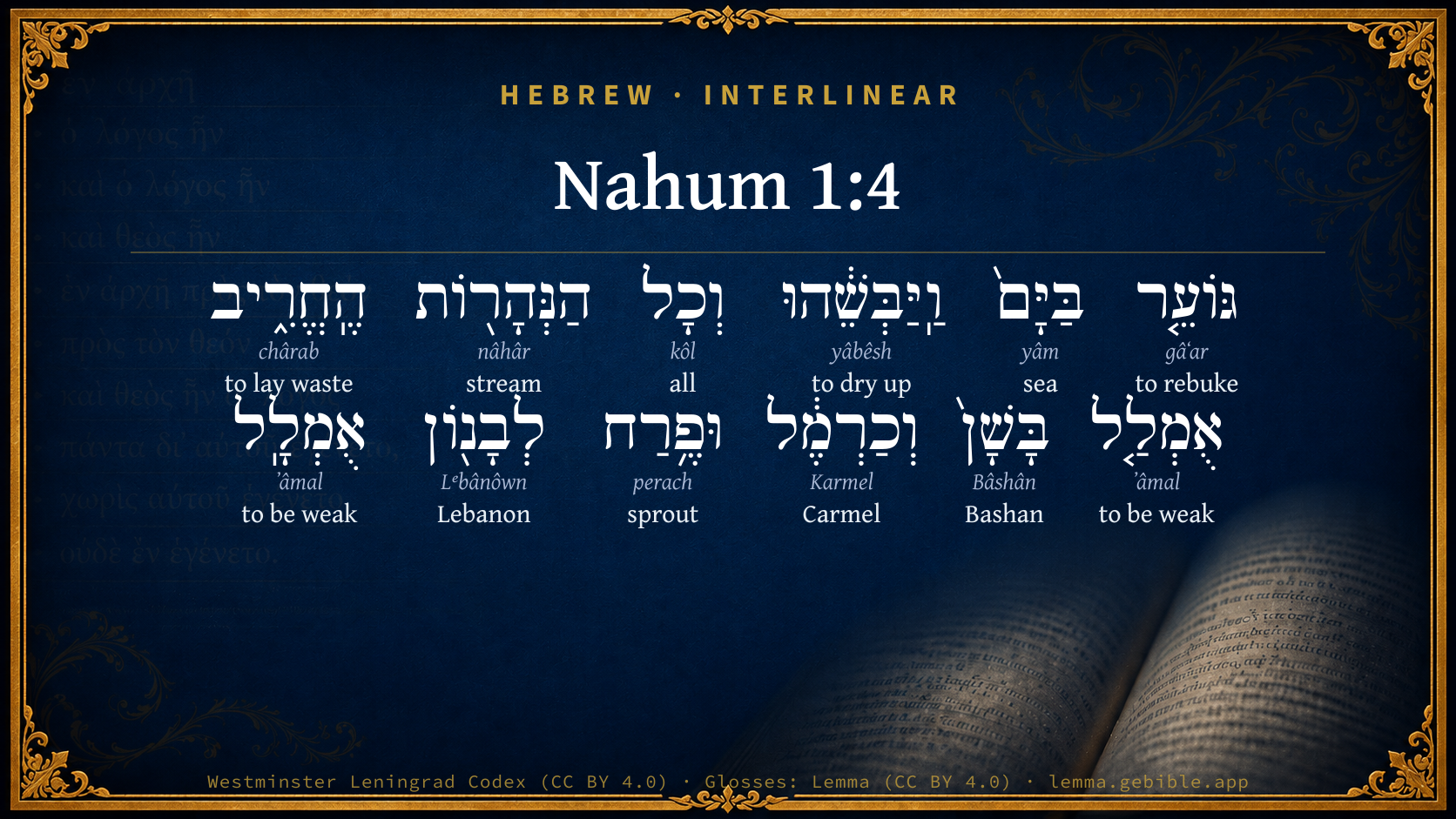
Hebrew (Westminster Leningrad Codex) Nahum 1:4 appears in the Hebrew Old Testament. The text above is from the Westminster Leningrad Codex. Each word links to its Strong’s number, a concise gloss, and parsing drawn from the Open Scriptures Hebrew Bible morphology. Click any word for its full Brown-Driver-Briggs (BDB) entry.
Download image
Cite this verse

Nahum 1:4 (World English Bible). Public Domain. Lemma interlinear Bible study tool, https://lemma.gebible.app/v/nahum/1/4.

Show BibTeX & RIS
BibTeX
RIS
English Translation
He rebukes the sea, and makes it dry, and dries up all the rivers. Bashan languishes, and Carmel; and the flower of Lebanon languishes.
World English Bible · Public Domain
Download a study sheet

One document with this verse’s original text, its word-by-word gloss line, the meaning frame, cross-references with their text, attributed commentary, and full source and license credits — printable, and it pastes into notes with its structure intact.

This verse Autodidact and up

Study sheet (.html) Plain text (.txt)

A passage Seminary Student

Up to 50 verses in one chapter. A passage sheet keeps up to 6 commentary sources and 12 cross-references per verse, in the order this page ranks them, and says so on the sheet whenever that leaves anything out. Ask for a single verse and you get the Autodidact verse sheet above.

Everything on this page stays free to read, with no account — the sheet is a download of what is already on screen, not access to it.

Want to remove ads? Support Godless Engineer
Compare translations 3

The same verse in 3 English versions, stacked beneath the original-language interlinear above. Click any original word for its lexicon entry.

Each is an independent rendering of the whole verse — the interlinear is not word-aligned to these translations.

Highlighted words mark where these versions differ — a whole-verse word diff, not a word-by-word alignment.

  • World English Bible Public Domain
    He rebukes the sea, and makes it dry, and dries up all the rivers. Bashan languishes, and Carmel; and the flower of Lebanon languishes.
  • King James Version Public Domain
    He rebuketh the sea, and maketh it dry, and drieth up all the rivers: Bashan languisheth, and Carmel, and the flower of Lebanon languisheth.
  • unfoldingWord Literal Text CC BY-SA 4.0
    He rebukes the sea and makes it dry, and all the rivers he dries up. Bashan withers, also Carmel; and the flowers of Lebanon wither.

unfoldingWord Literal Text — © unfoldingWord, licensed CC BY-SA 4.0. Word-aligned USFM3 via Door43 (git.door43.org/unfoldingWord/en_ult).

Versions to compare (up to 4)

3 of 4 selected

Show all 18 translations

Every available English version of this verse, each an independent rendering of the whole verse.

  • World English Bible Public Domain
    He rebukes the sea, and makes it dry, and dries up all the rivers. Bashan languishes, and Carmel; and the flower of Lebanon languishes.
  • Berean Standard Bible Public Domain
    He rebukes the sea and dries it up; He makes all the rivers run dry. Bashan and Carmel wither, and the flower of Lebanon wilts.
  • Majority Standard Bible Public Domain
    He rebukes the sea and dries it up; He makes all the rivers run dry. Bashan and Carmel wither, and the flower of Lebanon wilts.
  • King James Version Public Domain
    He rebuketh the sea, and maketh it dry, and drieth up all the rivers: Bashan languisheth, and Carmel, and the flower of Lebanon languisheth.
  • American Standard Version (1901) Public Domain
    He rebuketh the sea, and maketh it dry, and drieth up all the rivers: Bashan languisheth, and Carmel; and the flower of Lebanon languisheth.
  • Revised Version (1885) Public Domain
    He rebuketh the sea, and maketh it dry, and drieth up all the rivers: Bashan languisheth, and Carmel, and the flower of Lebanon languisheth.
  • Geneva Bible (1599) Public Domain
    He rebuketh the sea, and dryeth it, and he dryeth vp all the riuers: Bashan is wasted and Carmel, and the floure of Lebanon is wasted.
  • Douay-Rheims (1899) Public Domain
    He rebuketh the sea, and drieth it up: and bringeth all the rivers to be a desert. Basan languisheth and Carmel: and the dower of Libanus fadeth away.
  • Young's Literal Translation Public Domain
    He is pushing against a sea, and drieth it up, Yea, all the floods He hath made dry, Languishing `are' Bashan and Carmel, Yea, the flower of Lebanon `is' languishing.
  • Literal Standard Version CC BY-SA 4.0
    He is pushing against a sea, and dries it up, || Indeed, He has made all the floods dry, || Bashan and Carmel [are] languishing, || Indeed, the flower of Lebanon [is] languishing.
  • Unlocked Literal Bible CC BY-SA 4.0
    He rebukes the sea and makes it dry; he dries up all the rivers. Bashan is weak, and Carmel also; the flowers of Lebanon are weak.
  • unfoldingWord Literal Text CC BY-SA 4.0
    He rebukes the sea and makes it dry, and all the rivers he dries up. Bashan withers, also Carmel; and the flowers of Lebanon wither.
  • Darby Bible Public Domain
    He rebuketh the sea, and maketh it dry, and drieth up all the rivers: Bashan languisheth, and Carmel, and the flower of Lebanon languisheth.
  • World Messianic Bible Public Domain
    He rebukes the sea and makes it dry, and dries up all the rivers. Bashan and Carmel languish. The flower of Lebanon languishes.
  • Webster's Bible Public Domain
    He rebuketh the sea, and maketh it dry, and drieth up all the rivers: Bashan languisheth, and Carmel, and the flower of Lebanon languisheth.
  • Free Bible Version CC BY-SA 4.0
    He commands the sea and makes it dry; he dries up all the rivers. Bashan and Carmel wither; the blossom of Lebanon fades.
  • Bible in Basic English Public Domain
    He says sharp words to the sea and makes it dry, drying up all the rivers: Bashan is feeble, and Carmel, and the flower of Lebanon is without strength.
  • JPS Tanakh (1917) Public Domain
    He rebuketh the sea, and maketh it dry, and drieth up all the rivers; Bashan languisheth, and Carmel, and the flower of Lebanon languisheth.

Literal Standard Version (2020), Covenant Press — licensed CC BY-SA 4.0. Text via the HelloAO Bible API (eBible.org). Unlocked Literal Bible (unfoldingWord) — licensed CC BY-SA 4.0. Text via the HelloAO Bible API (eBible.org). unfoldingWord Literal Text — © unfoldingWord, licensed CC BY-SA 4.0. Word-aligned USFM3 via Door43 (git.door43.org/unfoldingWord/en_ult). Free Bible Version, Dr. Jonathan Gallagher — licensed CC BY-SA 4.0. Text via the HelloAO Bible API (eBible.org).

Word by word

More ways to search: Search by grammar → Find every occurrence → Compare this word →

Practice this passage: Drill this verse → Learn its vocabulary →

גּוֹעֵ֤ר
gâʻar
H1605
“rebuking”
Verb, Qal, Participle Active, Masculine, Singular, Absolute
Part of Speech
Verb
Stem
Qal
Form
Participle Active
Gender
Masculine
Number
Singular
State
Absolute
Full BDB Definition

Origin: a primitive root

TWOT: 370

(Qal) to rebuke, reprove, corrupt
  1. בַּיָּם֙ yâm H3220 “in/at the · sea” Preposition, Determined + Noun, Common, Masculine, Singular, Absolute
  2. וַֽיַּבְּשֵׁ֔הוּ yâbêsh H3001 “and · to dry up · him” Conjunction + Verb, Piel, Sequential Imperfect, 3rd Person, Masculine, Singular + Suffix, Personal, 3rd Person, Masculine, Singular
  3. וְכָל kôl H3605 “and · all of” Conjunction + Noun, Common, Masculine, Singular, Construct
  4. הַנְּהָר֖וֹת nâhâr H5104 “the · streams” Particle, Definite Article + Noun, Common, Masculine, Plural, Absolute
  5. הֶֽחֱרִ֑יב chârab H2717 “to lay waste” Verb, Hiphil, Perfect, 3rd Person, Masculine, Singular
  6. אֻמְלַ֤ל ʼâmal H535 “to be weak” Verb, Pulal, Perfect, 3rd Person, Masculine, Singular
  7. בָּשָׁן֙ Bâshân H1316 “Bashan” Noun, Proper
  8. וְכַרְמֶ֔ל Karmel H3760 “and · Carmel” Conjunction + Noun, Proper
  9. וּפֶ֥רַח perach H6525 “and · sprout of” Conjunction + Noun, Common, Masculine, Singular, Construct
  10. לְבָנ֖וֹן Lᵉbânôwn H3844 “Lebanon” Noun, Proper
  11. אֻמְלָֽל ʼâmal H535 “to be weak” Verb, Pulal, Perfect, 3rd Person, Masculine, Singular

About this verse

These counts appear in no published source. They are computed here, from the morphology-tagged text and Lemma’s own curated glosses. What Lemma adds →

12
words
11
distinct lemmas
Prophets
section

Notable vocabulary

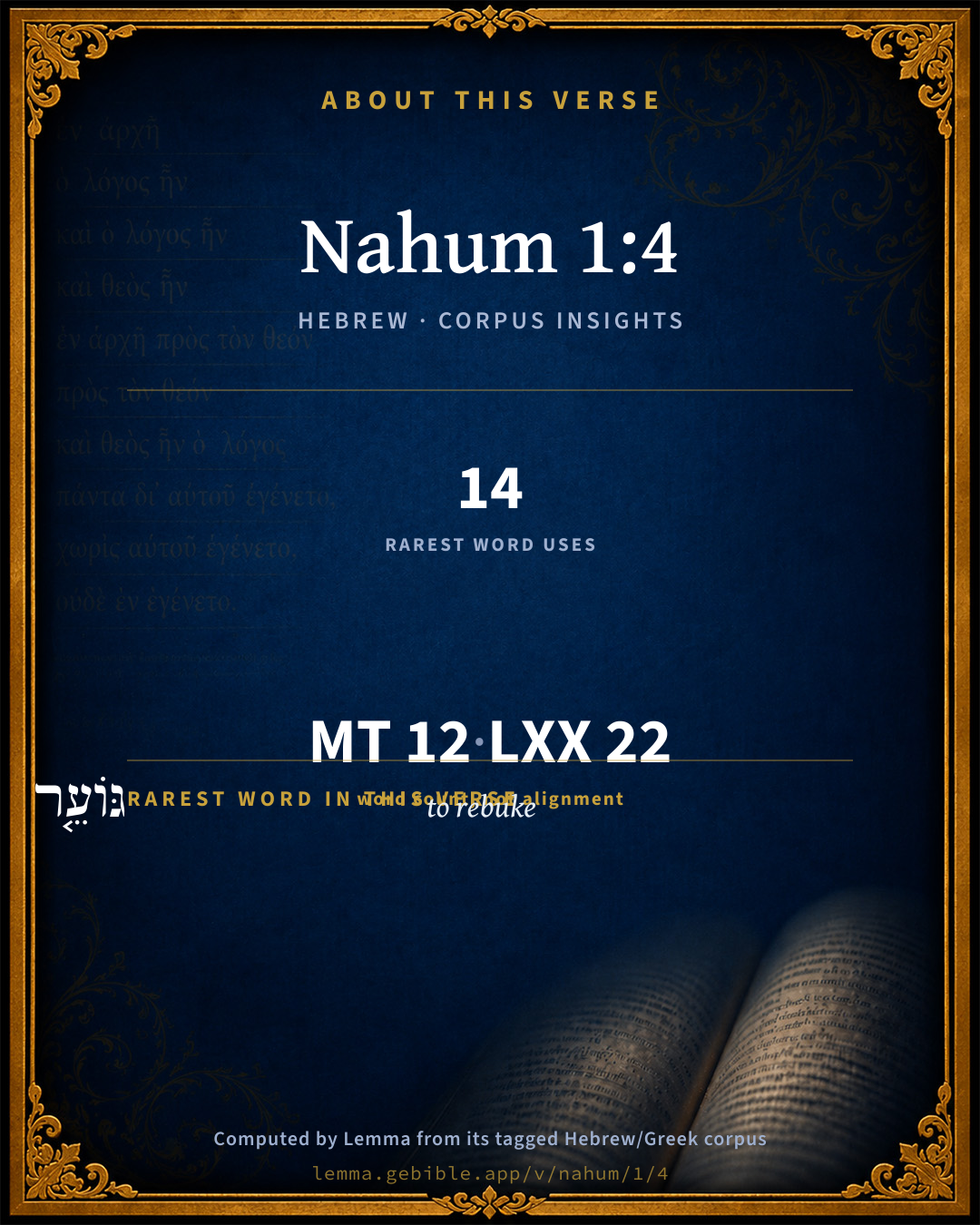
The rarest word here is גּוֹעֵ֤ר to rebuke H1605 — appearing just 14 times in the whole Hebrew Bible.

Shared distinctive vocabulary

גּוֹעֵ֤ר to rebuke H1605 occurs in 13 verses of the Hebrew Bible. Also found in:

Grammatical profile

  • 5 verbs
  • 7 nouns

Verb forms

  • גּוֹעֵ֤ר Qal · Participle Active
  • וַֽיַּבְּשֵׁ֔הוּ Piel · Sequential Imperfect
  • הֶֽחֱרִ֑יב Hiphil · Perfect
  • אֻמְלַ֤ל Pulal · Perfect
  • אֻמְלָֽל Pulal · Perfect

Repetition

A word recurs within this verse — often emphatic in Hebrew:

  • אֻמְלַ֤ל to be weak H535 ×2

Hebrew & Septuagint length

In English translation the verse runs 24 words from the Hebrew and 32 from the Septuagint (LXX English) — closely comparable.

A rough comparison of the two English renderings, which tokenize alike — not a word-level alignment.

Word counts can differ between the Hebrew and the Greek without any difference in meaning — e.g. the Hebrew direct-object marker אֵת has no separate Greek word, and Greek often adds the article ὁ.

In the original languages it is 12 Hebrew tokens and 22 Greek tokens — but the two are counted differently (Hebrew bundles its prefixes and suffixes into one token; the Greek is in lemma form), so that isn’t a like-for-like length.

Cross-references

16

Topical passages linked to Nahum 1:4 in the Treasury of Scripture Knowledge — connected by theme and wording, ordered by reader-vote popularity; previews shown in the World English Bible.

  • Psalms 106:9 He rebuked the Red Sea also, and it was dried up; So he led them through the depths, as through a desert.
  • Isaiah 33:9 The land mourns and languishes; Lebanon is confounded and withers away; Sharon is like a desert; and Bashan and Carmel shake off [their leaves].
  • Joshua 3:13–15 It shall come to pass, when the soles of the feet of the priests who bear the ark of Yahweh, the Lord of all the earth, shall rest in the waters of the Jordan, that the waters of the Jordan shall be cut off, even the waters that come down from above; and they shall stand in one heap.
  • Psalms 74:15 You opened up spring and stream. You dried up mighty rivers.
  • Psalms 104:7 At your rebuke they fled. At the voice of your thunder they hurried away.
  • Psalms 114:3 The sea saw it, and fled. The Jordan was driven back.
  • Psalms 114:5 What was it, you sea, that you fled? You Jordan, that you turned back?
  • Isaiah 19:5–10 The waters shall fail from the sea, and the river shall be wasted and become dry.
  • Isaiah 44:27 who says to the deep, Be dry, and I will dry up your rivers;
  • Isaiah 50:2–3 Why, when I came, was there no man? when I called, was there none to answer? Is my hand shortened at all, that it can't redeem? or have I no power to deliver? Behold, at my rebuke I dry up the sea, I make the rivers a wilderness: their fish stink, because there is no water, and die for thirst.
  • Isaiah 51:10 Isn't it you who dried up the sea, the waters of the great deep; who made the depths of the sea a way for the redeemed to pass over?
  • Amos 1:2 He said: "Yahweh will roar from Zion, And utter his voice from Jerusalem; And the pastures of the shepherds will mourn, And the top of Carmel will wither."
  • Amos 5:8 Seek him who made the Pleiades and Orion, And turns the shadow of death into the morning, And makes the day dark with night; Who calls for the waters of the sea, And pours them out on the surface of the earth, Yahweh is his name,
  • Matthew 8:26 He said to them, "Why are you fearful, oh you of little faith?" Then he got up, rebuked the wind and the sea, and there was a great calm.
  • Job 38:11 And said, 'Here you may come, but no further; Here shall your proud waves be stayed?'
  • Ezekiel 30:12 I will make the rivers dry, and will sell the land into the hand of evil men; and I will make the land desolate, and all that is therein, by the hand of strangers: I, Yahweh, have spoken it.

Cross-references courtesy of OpenBible.info (CC BY 4.0).

Hebrew and Greek witnesses Masoretic Hebrew ↔ Greek Septuagint

The same verse in the two great witnesses to the Old Testament, shown verse-for-verse.

These are two independent witnesses, not word-aligned to each other, and the Septuagint is shown in lemma (dictionary) form.

Hebrew Nahum 1:4 Masoretic · Westminster Leningrad Codex

גּוֹעֵ֤ר בַּיָּם֙ וַֽיַּבְּשֵׁ֔הוּ וְכָל הַנְּהָר֖וֹת הֶֽחֱרִ֑יב אֻמְלַ֤ל בָּשָׁן֙ וְכַרְמֶ֔ל וּפֶ֥רַח לְבָנ֖וֹן אֻמְלָֽל

He rebukes the sea, and makes it dry, and dries up all the rivers. Bashan languishes, and Carmel; and the flower of Lebanon languishes.

World English Bible · Public Domain

Greek LXX Nahum 1:4 Septuagint · lemma form

ἀποεἰλέω θάλασσα καί ξηραίνω αὐτός καί πᾶς ὁ ποταμός ἐκἐρημόω ὀλιγόω ὁ βασανῖτις καί ὁ κάρμηλος καί ὁ ἐκἀνθέω ὁ λίβανος ἐκλείπω

He threatens the sea, and dries it up, and exhausts all the rivers: the land of Basan, and Carmel are brought low, and the flourishing trees of Libanus have come to nothing.

LXX2012 (modern English Septuagint) · Public Domain

On this verse, The Pulpit Commentary discusses the Septuagint’s reading. Read the note in Commentary ↓

Hebrew: Westminster Leningrad Codex (CC BY 4.0). Greek: Septuagint (public domain); English from LXX2012 (modern English Septuagint) (Public Domain). How the Septuagint differs from the Hebrew →

Targum (Aramaic paraphrase)

1

The Targum is the ancient Jewish Aramaic paraphrase of the Hebrew Scriptures — an interpretive translation, not the Hebrew text itself. Onkelos (literal) and Pseudo-Jonathan (expansive) render the Torah, and Jonathan the Prophets. Coverage is partial: where no permissively-licensed English translation exists for a verse, only the Aramaic is shown. This is verse-level text, not a word-by-word alignment to the Hebrew.

  1. Targum Jonathan Prophets (Joshua–Malachi)
    דִנְזִיף בְּיַמָא וּמְיַבֵּשׁ לֵיהּ וְכָל נְהַרְוָתָא מַחֲרֵיב צְדֵי מַתְנָן וְכַרְמֵלָא וְאִילָנֵי לִבְנָן נְתָרוּ:

    (no public-domain English translation for this verse)

    Targum Jonathan — Aramaic: “Mikraot Gedolot” (public domain). English: “Sefaria Community Translation” (CC0 1.0 (public-domain dedication)); “London "Chaldee Paraphrase," 1871” (public domain). Text via Sefaria.

Commentary

Notes on Nahum 1:4 from classic Christian and Jewish commentators (each source and its license shown beneath its notes). The classic Christian expositions comment on the surrounding passage and are grouped to its opening verse, so a note may address several verses; the Jewish commentaries on the Tanakh (Rashi and others) are per-verse, so they appear only where the commentator wrote on this verse.

Lemma curates 59 commentaries, every one of them public domain or Creative Commons licensed, each selected and text-cleaned for this edition rather than reprinted as found. About our sources →

Trapp's Complete Commentary

John Trapp

Nah 1:4 He rebuketh the sea, and maketh it dry, and drieth up all the rivers: Bashan languisheth, and Carmel, and the flower of Lebanon languisheth.

Ver. 4. He rebuketh the sea, and maketh it dry] He had showed what wonders God can do in the air; now he telleth what he doeth in the water and in the earth. And it is well observed by an interpreter (Tarnov.), that when the prophets speak of God, they do for the most part imitate the expressions of Moses, that most severe lawgiver, and allude to his history; to show that by the law is the knowledge of sin, Rom 3:20, without which the stony hearts of men melt not, that the promise of the gospel may relish sweetly with them, Psa 19:10-11. The word here rendered he rebuketh, importeth that God rateth and rattleth the sea, verborum pedumque strepitu, with such a voice and other noise, as causeth fright and flight. "The sea saw it, and fled: Jordan was driven back. What ailed thee, O thou sea, that thou fleddest?" Psa 114:3; Psa 114:5. "The waters saw thee, O God, the waters saw thee; they were afraid: the depths also were troubled," Psa 77:16 : see Exo 14:21 Psa 78:14; Psa 66:6; Psa 136:16; Psa 106:9. This is not in the power of any man to do; though Xerxes vainly attempted something, when he wasted two million men over the Hellespont, and, for battering his bridge of boats, caused it to be beaten with three hundred stripes, and cast a pair of fetters into it, to make it his prisoner. But to how small purpose all this, together with his digging through Isthmus, his drinking up rivers with his army, and the like, it well appeared, when he was forced to flee back out of Greece in a poor fisher’s boat, which being over loaded, had sunk all if the Persians, by the casting away themselves, had not saved the life of their king. The story of Canute the Dane, sometime king of England, is well known. He was told by a court parasite that all things in his dominions were at his beck and command. Canute, to confute him, caused a chair to be set on the seashore; wherein being set, he said to the sea flowing fast toward him, Thou belongest to me, and the land upon which I now sit is mine own, neither is there any whosoever that obeys me not shall escape unpunished. I command thee, therefore, thou sea, that thou come up no higher into my land; nor presumest once to wet thy master’s legs or garments. But the sea, keeping his ordinary course, without duty or reverence, washed both his legs and gown. He then leaping back said, Let all the inhabitants of the world know, that the power of kings is frivolous and vain; neither is there any mortal man worthy the name of a king, but he to whose beck heaven, earth, and sea, by his laws eternally are obedient. Neither did Canute after this time wear a crown; but set it upon the crucifix, according to the superstition of those times; thereby acknowledging it to be a royalty proper to Christ alone to rebuke the surges of the sea, and to say unto them, Peace, and be still, Luk 8:24 Mar 4:39.

And drieth up all the rivers] As he did Jordan, Jos 3:15-17 2Ki 2:7-8; 2Ki 2:13-14 Chereth, 1Ki 17:7; the great river Euphrates, Rev 16:12. {See Trapp on "Rev 16:12"} See also Plin. Nat. Hist. 1. 2, cap. 85, 103.

Bashan languisheth, and Carmel, and the flower of Lebanon languisheth] All the beauty of those fertile and pleasant places fadeth. When the earth beareth fruit and flowers, she is said to yield her strength, and to bring forth her increase; as when through drought or otherwise she doth not, she is said to languish and hang the head, see Joe 1:10; Joe 1:12. If the eclipse of the sun cause a drooping in the whole frame of nature, how much more the wrath and vengeance of God!

John Trapp, A Commentary or Exposition upon All the Books of the Old and New Testament (1647–1656) — public domain. Text from a community e-Sword module.

Joseph Benson's Commentary

Nah 1:4-6. He rebuketh the sea, and maketh it dry — The rivers and the sea itself are dried up at his rebuke, as the Red sea and Jordan were of old; and the most pleasant and fruitful countries, such as Bashan, Carmel, and Lebanon, are parched up with drought when he is displeased. The mountains quake at him — See notes on Psa 114:3-8. And the earth is burned at his presence, yea, the world — The brightness of his presence is sufficient to set the whole world on fire, with all that is in it. This is, indeed, a most magnificent description of the omnipotence of God. He walketh, or rideth, amidst the whirlwind, or in the storm; the clouds are but the dust of his feet; the sea is dried up at his word, the mountains are moved, and tremble at his presence; and the whole earth is consumed with the brightness that is before him. Who can stand before his indignation? — Who, or what people, however strong they may think themselves, can withstand the effects of his power when he is angry with them, and is determined to execute his wrath upon them? His fury — Rather, his indignation, or the ardour of his anger; is poured out like fire, &c. — Is as consuming in its effects as fire. And the rocks are thrown down by him — That is, as fire is of sufficient force to dissolve the hardest rocks, so God’s power overthrows all opposition, however strong; and his vengeance, with infinite ease, can humble the most obdurate sinners.

Joseph Benson's Commentary on the Old and New Testaments (1811–1818) — public domain. Text from a community e-Sword module.

Whedon's Commentary on the Bible

Daniel D. Whedon

4, 5. He rebuketh the sea — By the blast of the whirlwind (Nah_1:3) he rebukes the sea, and in terror it dries up (compare Psa_18:15). There may be an allusion to the dividing of the Red Sea (Exo_14:21; compare Psa_106:9), and of the Jordan (Jos_3:17).

Drieth up all the rivers — Either in the same manner or, as the following clauses make probable, by means of drought, which was always considered an expression of the divine wrath (Joe_1:20; 1Ki_17:7). For 4b compare Amo_1:2.

Bashan — See on Amo_4:1.

Carmel — See on Amo_1:2; Amo_9:3.

Flower of Lebanon — See “his smell as Lebanon” (Hos_14:6).

Languisheth — The same word is used in Joe_1:10; Joe_1:12 (see there).

The mountains quake at him — Literally, from him. The power that makes them quake proceeds from Jehovah. The imagery of Nah_1:3 is continued; when the mountains hear the roar of the thunder they tremble in terror (Mic_1:3-4; Jdg_5:4; Hab_3:6).

The hills melt — The thunderstorm is accompanied by heavy rainfall; the water rushes down the hills in such torrents that it looks as if the hills themselves are melting (Mic_1:4; Jdg_5:5).

The earth is burned at his presence — R.V., “upheaved.” The translation of A.V. follows late Jewish authorities; it derives no support from the Old Testament usage of the verb; that of the R.V. also is not without difficulties. Literally, the earth lifts up. To secure the meaning “is upheaved” or “lifts itself up,” the verb form needs to be changed. If that is done the reference will be to the terror produced by the terrible manifestation of Jehovah. The earth seems to start up and tremble when it hears the thunder (Psa_29:8; a different picture is in Amo_9:5).

Some commentators trace the verb to a different root and give to it a different meaning; Nowack renders, “becomes waste”; Marti, “roars.”

The world — The habitable portion of the earth.

All that dwell therein — Man and all other living creatures. A common Old Testament expression (Psa_24:1; Psa_98:7).

Daniel D. Whedon (gen. ed.), Commentary on the Old and New Testaments (1874–1909) — public domain. Text from a community e-Sword module.

Keil & Delitzsch

C. F. Keil & F. Delitzsch

"He threateneth the sea, and drieth it up, and maketh all the rivers dry up. Bashan and Carmel fade, and the blossom of Lebanon fadeth. Nah 1:5. Mountains shake before Him, and the hills melt away; the earth heaveth before Him, and the globe, and all the inhabitants thereon. Nah 1:6. Before His fury who may stand? and who rise up at the burning of His wrath? His burning heat poureth itself out like fire, and the rocks are rent in pieces by Him." In the rebuking of the sea there is an allusion to the drying up of the Red Sea for the Israelites to pass through (cf. Psa 106:9); but it is generalized here, and extended to every sea and river, which the Almighty can smite in His wrath, and cause to dry up. ויּבּשׁהוּ for וייבּשׁהוּ, the vowelless י of the third pers. being fused into one with the first radical sound, as in ויּדּוּ in Lam 3:53 (cf. Ges. 69, Anm. 6, and Ewald 232-3). Bashan, Carmel, and Lebanon are mentioned as very fruitful districts, abounding in a vigorous growth of vegetation and large forests, the productions of which God could suddenly cause to fade and wither in His wrath. Yea more: the mountains tremble and the hills melt away (compare the similar description in Mic 1:4, and the explanation given there). The earth lifts itself, i.e., starts up from its place (cf. Isa 13:13), with everything that dwells upon the surface of the globe. תּשּׂא from נשׂא, used intransitively, "to rise," as in Psa 89:10 and Hos 13:1; not conclamat s. tollit vocem (J. H. Michaelis, Burk, Strauss). תּבל, lit., the fertile globe, always signifies the whole of the habitable earth, ἡ οἰκουμένη; and יושׁבי בהּ, not merely the men (Ewald), but all living creatures (cf. Joe 1:18, Joe 1:20). No one can stand before such divine wrath, which pours out like consuming fire (Deu 4:24), and rends rocks in pieces (Kg1 19:11; Jer 23:29; cf. Jer 10:10; Mal 3:2).

Keil & Delitzsch — Biblical Commentary on the Old Testament (1861–1891) — public domain (CC PDM 1.0). Text via the HelloAO Bible API. (Old Testament only.)

Tyndale Open Study Notes

Tyndale Open Resources

1:4 Like clouds (1:3) and mountains (1:5), oceans and rivers are under God’s sovereign control. The Old Testament prophets often recall God’s actions against the seas and rivers during the Exodus (Exod 15:8-10; 2 Sam 22:16; Pss 66:6; 77:16; Hab 3:15). God’s power over the waters repudiated the mythology of the ancient Canaanites, who believed that the oceans and the rivers were under the control of the sea-god, Yam. • Bashan, situated east of the Sea of Galilee, was known for its rich pastureland, ideal for raising cattle (cp. Mic 7:14). • Carmel, on the Mediterranean coast in central Canaan, was noted for its beauty and fruitfulness (Song 7:5; Jer 50:19). • Lebanon was famed for its great cedars (1 Kgs 5:6-18). Nahum lists these areas to demonstrate that even the most fertile and productive places on earth cannot withstand the power of God’s judgment.

Tyndale Open Study Notes — © Tyndale Open Resources, licensed CC BY-SA 4.0. Text via the HelloAO Bible API.

Jamieson, Fausset & Brown

Robert Jamieson, A. R. Fausset & David Brown

rebuketh the sea--as Jesus did (Mat 8:26), proving Himself God (compare Isa 50:2).

Bashan languisheth--through drought; ordinarily it was a region famed for its rich pasturage (compare Joe 1:10).

flower of Lebanon--its bloom; all that blooms so luxuriantly on Lebanon (Hos 14:7). As Bashan was famed for its pastures, Carmel for its corn fields and vineyards, so Lebanon for its forests (Isa 33:9). There is nothing in the world so blooming that God cannot change it when He is wroth.

Jamieson, Fausset & Brown — Commentary Critical and Explanatory on the Whole Bible (1871) — public domain (CC PDM 1.0). Text via the HelloAO Bible API.

Adam Clarke's Commentary

Verse 4. He rebuketh the sea] The Red Sea, and the rivers: probably an allusion to the passage of the Red Sea and Jordan.

The description of the coming of Jehovah, from the third to the sixth verse, is dreadfully majestic. Na 1:3-6 He is represented as controlling universal nature. The sea and the rivers are dried up, the mountains tremble, the hills melt, and the earth is burnt at his presence. Bashan, Carmel, and Lebanon are withered and languish: streams of fire are poured out, and the rocks are cast down to make him a passage. If then, the seas, the rivers, the mountains, the hills, the rocks, and the earth itself, fail before Jehovah, or flee from his presence, how shall Nineveh and the Assyrian empire stand before him?

Adam Clarke's Commentary on the Bible (1810–1826) — public domain. Text from a community e-Sword/MySword module.

John Calvin's Commentaries

Nahum continues his discourse, — that God, in giving proof of his displeasure, would disturb the sea or make it dry. There may be here an allusion to the history, described by Moses; for the Prophets, in promising God’s assistance to his people, often remind them how God in a miraculous manner brought up their fathers from Egypt. As then the passage through the Red Sea was in high repute among the Jews, it may be that the Prophet alluded to that event, (Exodus 14:22.) But another view seems to me more probable. We indeed know how impetuous an element is that of the sea; and hence in Jeremiah 5, God, intending to set forth his own power, says, that it is in his power to calm the raging of the sea, than which nothing is more impetuous or more violent. In the same manner also is the majesty of God described in Job 28. The meaning of this place, I think, is the same, — that God by his chiding makes the sea dry, and that he can dry up the rivers That the prophet connects rivers with the sea, confirms what I have just said, — that the passage through the Red Sea is not here referred to; but that the object is to show in general how great is God’s power in governing the whole world.

To the same purpose is what he adds, Bashan shall be weakened, and Carmel, and the branch of Lebanon shall be weakened, or destroyed. By these words he intimates, that there is nothing so magnificent in the world, which God changes not, when he gives proofs of his displeasure; as it is said in Psalm 104,

‘Send forth thy Spirit, and they shall be renewed;’

and again, ‘Take away thy Spirit,’ or remove it, ‘and all things will return to the dust;’ yea, into nothing. So also Nahum says in this place, “As soon as God shows his wrath, the rivers will dry up, the sea itself will become dry, and then the flowers will fade and the grass will wither;” that is, though the earth be wonderfully ornamented and replenished, yet all things will be reduced to solitude and desolation whenever God is angry. And he afterwards adds —

John Calvin's Commentaries (1540-1563) — public domain. Text from the Calvin Translation Society English edition (1840s-50s) via the Christian Classics Ethereal Library (ccel.org). Calvin's coverage is partial (roughly two-thirds of the Bible); uncommented books and verses are honest gaps, never fabricated. The 19th-century editor's footnotes and remarks are omitted so the notes are faithfully Calvin's own voice.

The Cambridge Bible for Schools and Colleges

gen. ed. J. J. S. Perowne

4. He rebuketh the sea] with His voice of thunder; or perhaps the effect of the tempest on the sea in rolling it back and uncovering its bed may be taken as shewing His rebuke, Psa_104:7-9. It is possible that the historical instances of His dividing the Red Sea and the Jordan (Psa_114:3-5) may have led to His “rebuking” the sea and rivers being regarded as a general attribute. Comp. Hab_3:8, “Was the Lord displeased against the rivers … or was thy wrath against the sea?”

and maketh it dry] Psa_18:15, “Then the bed of the waters appeared, the foundations of the world were laid bare, at thy rebuke, O Lord, at the blast of the breath of thy nostrils.” The spelling of Heb. word, “maketh it dry,” has analogies, Lam_3:33; Lam_3:53. Cf. Psa_106:9; Isa_50:2.

Bashan languisheth] Bashan, Lebanon and Carmel were the most splendidly wooded parts of Palestine and covered with the most luxuriant vegetation. Before the hot breath of Jehovah’s anger they languish and wither. The description is scarcely on a line with the former “rebuketh the sea,” though “drieth up the rivers” may form the transition. It was the furious tempest that rolled back the sea, it is the hot wind and drought of the desert under which Bashan languishes and withers up. Both are operations of Jehovah. Nature is alive but not with a life of her own, all her forces are but the personal energies of Jehovah. It is His rebuke, spoken though men may not hear it, before which the sea retreats and its bed is made bare; the hot wind which withers Carmel and Lebanon is His fiery breath. Isa_40:7; Isa_40:24; Amo_1:2.

The Cambridge Bible for Schools and Colleges (gen. ed. J. J. S. Perowne; Cambridge University Press, 1878–1918) — public domain. Text from a community e-Sword module.

John Gill's Exposition

He rebuketh the sea, and maketh it dry,.... As he did the Red sea, when the children of Israel passed through it as on dry land; which shows his power and sovereignty over it; that it is at his command, as a servant at his master's; and since the wind and sea obey him, what is it he cannot do? see Isa 50:2;

and drieth up all the rivers; that is, he can do it if he will; he divided the waters of Jordan, through the midst of which the Israelites passed on dry ground; and will dry up the river Euphrates, to make way for the kings of the east; and as for Tigris, on the banks of which the city of Nineveh stood, of which the inhabitants boasted, and in which they trusted for their security, he could dry up, and make way for the enemy to enter in; or make that their enemy, and overflow them with it, as he did; see Nah 1:8. By the "sea" and "rivers" may be meant the whole Assyrian empire, and many nations and people, as Jarchi and Abarbinel interpret it, of whom it consisted; see Jer 51:36;

Bashan languisheth, and Carmel, and the flower of Lebanon languisheth; when the Lord restrains the heavens from giving rain, then Bashan, famous for its fat pastures and fruitful meadows, and Carmel for its rich grain fields, and Lebanon for its tall shadowy cedars, these, and the glory of all, wither and fade away, being parched and dried up for want of moisture. These were places in the land of Israel, but may be put for like flourishing and fruitful hills and countries in the land of Assyria, which should become desolate; see Psa 107:33.

John Gill's Exposition of the Whole Bible (1746–1763) — public domain (CC PDM 1.0). Text via the HelloAO Bible API.

Albert Barnes' Notes on the Bible

He rebuketh the sea and maketh it dry - Delivering His people, as He did from Pharaoh Psa 106:9, the type of all later oppressors, and of antichrist. “His word is with power; to destroy them at once with one rough word (Wisd. 12:9). The restlessness of the barren and troubled sea is an image of the wicked. “And drieth up all the rivers” Isa 57:20, as He did Jordan. His coming shall be far more terrible than when all the hearts of the inhabitants of the land did melt. “Bashan languisheth and Carmel; and the flower of Lebanon languisheth” Jos 2:11. Bashan was richest in pastures; Carmel, according to its name, in gardens and vineyards; Lebanon, in vines also and fragrant flowers Hos 14:7; Son 4:11, but chiefly in the cedar and cypress; it had its name from the whiteness of the snow, which rests on its summit. These mountains then together are emblems of richness, lasting beauty, fruitfulness, loftiness; yet all, even that which by nature is not, in the variety of seasons, wont to fade, dries up and withers before the rebuke of God. But if these thing are “done in a green tree, what shall be done in the dry?” All freshness, beauty, comeliness, show of outward nature, shall fade as grass; all ornament of men’s outward graces or gifts, all mere show of goodness, shall fall off like a leaf and perish. If the glory of nature perishes before God, how much more the pride of man! Bashan also was the dwelling-place of the race of giants, and near Libanus was Damascus; yet their inhabitants became as dead men and their power shrank to nothing at the word of God.

Albert Barnes' Notes on the Bible (1834–1885) — public domain. Text from a community e-Sword/MySword module.

Haydock's Catholic Bible Commentary

Desert, as at the Red Sea, Psalm cv. 9. --- Languisheth. The most fruitful places produce nothing, when God is angry.

George Leo Haydock (1774–1849), Haydock's Catholic Family Bible and Commentary, 1859 edition — public domain. Excludes Psalms (Douay-Rheims chapter numbering differs from Protestant) and Deuterocanonical books (Catholic canon only).

Matthew Poole's English Annotations

He rebuketh: he once did rebuke, as Exo 14:21; he still can, as a lord rebuketh his servant, or a general rebukes his soldier, by word or look, Isa 1; Isa 2.

The sea; literally understood, or figuratively, it imports still that he can deliver his people, and destroy his adversaries, as of old he did.

And maketh it dry; his word or will doth as speedily do this thing, as it doth proceed from God; he commands, and it is done.

And drieth up all the rivers: so Jordan saw or heard the rebuke of our God, and fled, or was driven back, Jos 3:15,16; Psa 114:3; and what he once did upon Jordan, that he can do on all other rivers: and so are we to understand the words.

Bashan; it lay eastward of Jordan, was the kingdom of Og; it was famous for oaks, Eze 27:6; for cattle also, as bulls, Psa 22:12, and rains, Deu 32:14; and was given to the half tribe of Manasseh.

Languisheth; grows barren, as if under a consumptive languishing, is not longer sufficient to feed the cattle that were wont to feed and grow fat upon it.

Carmel; a very fruitful mountain, either in the confines of Zebulun and Asher northward, Jos 12:22, where Elijah by fire from heaven contended with and convicted the Baalites; or else this Carmel might be that where Nabal dwelt, 1Sa 25:2, famous for its rich pastures; this was more southward than the other, and not far from Hebron.

The flower; whatever flourished and was beautiful, trees, their blossoms, and the flowers which were wont to be the glory of it.

Lebanon; a mountain that runs from the coast of the Phoenician Sea westward, for one hundred and twenty-five miles more or less eastward; and verging toward Arabia, it is the north boundary of Judea, and divides it front Syria; famous for its fruitfulness, as for its height.

Languisheth; loseth its strength and virtue; both the product, and the very soil that produceth too, soon fall into a consumption.

Matthew Poole's English Annotations on the Holy Bible (1683–1685) — public domain. Text from a community e-Sword/MySword module.

The Pulpit Commentary

The great physical changes and convulsions in the world are tokens of God"s wrath on sinful nations. He rebuketh the sea, as at the passage of the Red Sea. (Exo_14:21 Psa_106:9) This is a sign of omnipotence. (comp. Luk_8:24) All the rivers. A generalization from the miracle at the Jordan. (Jos 3; comp. Psa_107:33 Isa_1:2) Septuagint, potamou , "making rivers desolate;" Vulgate, flumina ad desertum deducens. Bashan. (see note on Amo_4:1) Carmel. (see on Amo_1:2) Flower of Lebanon. This district was famous, not only for its cedars, but also for its vines and flowers. (comp. Hos_14:7 Son_4:11) These three regions are mentioned as remarkable for their fertility, and they occur most naturally to the mind of a native of Galilee, as was Nahum. They also geographically are the eastern, western, and northern boundaries of the land. They are used here proverbially to express the truth that God can cause the most luxuriant regions to wither at his word.

The Pulpit Commentary (1880–1919), ed. H.D.M. Spence-Jones & Joseph S. Exell — public domain. Text from a community e-Sword module.

John Wesley's Explanatory Notes

The flower - Whatever flourished thereon; the blossoms, and flowers which were wont to be the glory of it.

John Wesley, Explanatory Notes Upon the Whole Bible (1754–1765) — public domain. Text via the GEBible commentary corpus.

unfoldingWord translationNotes

Door43 World Missions Community

General Information:

Nahum continues to describe Yahweh coming to judge his enemies and to save his people.

Bashan is weak, and Carmel also; the flowers of Lebanon are weak

The word translated as "weak" can also mean "wither" or "dry out." Bashan was known for its good pastureland where people tended sheep and cattle, "Carmel" refers to Mount Carmel, which was known for its tree orchards, and the snow from the mountains in Lebanon kept that place fertile. Since Yahweh dries up all the rivers and causes drought, these fertile places will no longer be fertile. AT: "The fields of Bashan wither, the trees of Mount Carmel die, and the flowers of Lebanon fade" (See: Assumed Knowledge and Implicit Information)

the hills melt

Possible meanings are 1) the earthquake causing the hills to crumble to pieces is spoken of as if the hills were melting or 2) the water from the storms coursing down the hills and causing them to erode is spoken of as if the hills were melting. (See: Metaphor)

the earth collapses

Possible meanings are 1) the mountains and hills collapse or 2) the entire ground begins to move with violent motions.

the world and all people who live in it

Here the word "world" refers to the inhabited places on the earth. The verb for this phrase is understood from the previous phrase. AT: "the world shakes and all the people who live in it collapse" (See: Ellipsis)

translationWords

rebuke

Bashan

Carmel

Lebanon

unfoldingWord translationNotes — © Distant Shores Media and the Door43 World Missions Community, licensed CC BY-SA 4.0. Source: git.door43.org/Door43/en_tn.

Rashi

Rabbi Shlomo Yitzchaki (Rashi)

He rebukes the sea—To be understood [both] according to its apparent meaning, and as a figure describing the nations, who are compared to water, as the matter is stated (Isa. 17:12): “Like the rushing of mighty waters they rush.”

and He has dried up all the rivers—Here he prophesies that the Holy One, blessed be He, is destined to crown Nebuchadnezzar in the days of Jehoiakim, and He will deliver Assyria and all the lands to the sword.

Bashan and Carmel—The good dwelling places.

and the blossoms of the Lebanon are cut off—The Sages of Israel explained this as an allusion to the various types of sweet fruit that Solomon planted in the Temple, which were gold; and as soon as the gentiles entered the Temple, they withered. [from Yoma 21b, 39b]

Rashi on the Tanakh — English translations: “The Judaica Press complete Tanach with Rashi, translated by A. J. Rosenberg” (CC BY 4.0); “Pentateuch with Rashi's commentary by M. Rosenbaum and A.M. Silbermann, 1929-1934” (public domain); “The Metsudah Tanach series, Lakewood, N.J” (CC BY 4.0); and “The Book of Joshua, Metsudah Publications, 1997” (CC BY 4.0). Text via Sefaria.

Lesson kit

Teaching starters — assembled from the data on this page, not authored interpretation. Every prompt links to the verse data it draws on. Edit before teaching.

Nahum, in the Prophets, opens this verse with 12 words (11 distinct Hebrew lemmas). Its most distinctive word is gâʻar (“to rebuke”). A historical commentator’s framing appears above. Read the whole chapter for the surrounding context.

Discussion questions

  1. What does “to rebuke” (gâʻar) contribute to the verse as a whole?
  2. Genesis 37:10 shares the word «to rebuke» with this verse. How do the two illuminate each other?
  3. “to be weak” occurs 2× in this one verse. What is the effect of the repetition?
  4. The translations on this page render this verse differently — a whole-verse word diff, not a word-by-word alignment. What might account for the different wordings?
  5. The verb «גּוֹעֵ֤ר» is Qal Participle Active. How does its form color the action?
  6. Reading how Trapp's Complete Commentary and Joseph Benson's Commentary read this verse, where do the two commentators agree and where do they part?

Things to notice

Reading settings

Reading text

Shown beneath each verse's original-language words.

Old Testament
Old Testament edition

Read the OT as the Masoretic Hebrew (MT) or the Greek Septuagint (LXX).

English shown for the Greek Septuagint (in the Hebrew ↔ Greek comparison).

Comparing translations? Open the Compare panel on any verse page to stack up to four side by side.