

Psalms 129:6

Hebrew (Westminster Leningrad Codex) Psalms 129:6 appears in the Hebrew Old Testament. The text above is from the Westminster Leningrad Codex. Each word links to its Strong’s number, a concise gloss, and parsing drawn from the Open Scriptures Hebrew Bible morphology. Click any word for its full Brown-Driver-Briggs (BDB) entry.
Download image
Cite this verse

Psalms 129:6 (World English Bible). Public Domain. Lemma interlinear Bible study tool, https://lemma.gebible.app/v/psalms/129/6.

Show BibTeX & RIS
BibTeX
RIS
English Translation
Let them be as the grass on the housetops, Which withers before it grows up;
World English Bible · Public Domain
Highlights
  • 1 first appearance in the Hebrew Bible
Full analysis ↓
Download a study sheet

One document with this verse’s original text, its word-by-word gloss line, the meaning frame, cross-references with their text, attributed commentary, and full source and license credits — printable, and it pastes into notes with its structure intact.

This verse Autodidact and up

Study sheet (.html) Plain text (.txt)

A passage Seminary Student

Up to 50 verses in one chapter. A passage sheet keeps up to 6 commentary sources and 12 cross-references per verse, in the order this page ranks them, and says so on the sheet whenever that leaves anything out. Ask for a single verse and you get the Autodidact verse sheet above.

Everything on this page stays free to read, with no account — the sheet is a download of what is already on screen, not access to it.

Want to remove ads? Support Godless Engineer
Compare translations 3

The same verse in 3 English versions, stacked beneath the original-language interlinear above. Click any original word for its lexicon entry.

Each is an independent rendering of the whole verse — the interlinear is not word-aligned to these translations.

Highlighted words mark where these versions differ — a whole-verse word diff, not a word-by-word alignment.

  • World English Bible Public Domain
    Let them be as the grass on the housetops, Which withers before it grows up;
  • King James Version Public Domain
    Let them be as the grass upon the housetops, which withereth afore it groweth up:
  • unfoldingWord Literal Text CC BY-SA 4.0
    Let them be like grass of the rooftops, that before one pulls out, it dries up,

unfoldingWord Literal Text — © unfoldingWord, licensed CC BY-SA 4.0. Word-aligned USFM3 via Door43 (git.door43.org/unfoldingWord/en_ult).

Versions to compare (up to 4)

3 of 4 selected

Show all 18 translations

Every available English version of this verse, each an independent rendering of the whole verse.

  • World English Bible Public Domain
    Let them be as the grass on the housetops, Which withers before it grows up;
  • Berean Standard Bible Public Domain
    May they be like grass on the rooftops, which withers before it can grow,
  • Majority Standard Bible Public Domain
    May they be like grass on the rooftops, which withers before it can grow,
  • King James Version Public Domain
    Let them be as the grass upon the housetops, which withereth afore it groweth up:
  • American Standard Version (1901) Public Domain
    Let them be as the grass upon the housetops, Which withereth before it groweth up;
  • Revised Version (1885) Public Domain
    Let them be as the grass upon the housetops, which withereth afore it groweth up:
  • Geneva Bible (1599) Public Domain
    They shalbe as the grasse on the house tops, which withereth afore it commeth forth.
  • Douay-Rheims (1899) Public Domain
    And mayest thou see thy children's children, peace upon Israel.
  • Young's Literal Translation Public Domain
    They are as grass of the roofs, That before it was drawn out withereth,
  • Literal Standard Version CC BY-SA 4.0
    They are as grass of the roofs, || That withers before it was drawn out,
  • Unlocked Literal Bible CC BY-SA 4.0
    May they be like the grass on the housetops that withers before it grows up,
  • unfoldingWord Literal Text CC BY-SA 4.0
    Let them be like grass of the rooftops, that before one pulls out, it dries up,
  • Darby Bible Public Domain
    Let them be as the grass upon the house-tops, which withereth before it is plucked up,
  • World Messianic Bible Public Domain
    Let them be as the grass on the housetops, which withers before it grows up,
  • Webster's Bible Public Domain
    Let them be as the grass upon the house-tops, which withereth before it groweth up:
  • Free Bible Version CC BY-SA 4.0
    May they be like grass that grows on a roof that withers before it can be harvested,
  • Bible in Basic English Public Domain
    Let them be like the grass on the house-tops, which is dry before it comes to full growth.
  • JPS Tanakh (1917) Public Domain
    Let them be as the grass upon the housetops, which withereth afore it springeth up;

Literal Standard Version (2020), Covenant Press — licensed CC BY-SA 4.0. Text via the HelloAO Bible API (eBible.org). Unlocked Literal Bible (unfoldingWord) — licensed CC BY-SA 4.0. Text via the HelloAO Bible API (eBible.org). unfoldingWord Literal Text — © unfoldingWord, licensed CC BY-SA 4.0. Word-aligned USFM3 via Door43 (git.door43.org/unfoldingWord/en_ult). Free Bible Version, Dr. Jonathan Gallagher — licensed CC BY-SA 4.0. Text via the HelloAO Bible API (eBible.org).

Word by word

More ways to search: Search by grammar → Find every occurrence → Compare this word →

Practice this passage: Drill this verse → Learn its vocabulary →

About this verse

These counts appear in no published source. They are computed here, from the morphology-tagged text and Lemma’s own curated glosses. What Lemma adds →

6
words
6
distinct lemmas
Wisdom
section

Notable vocabulary

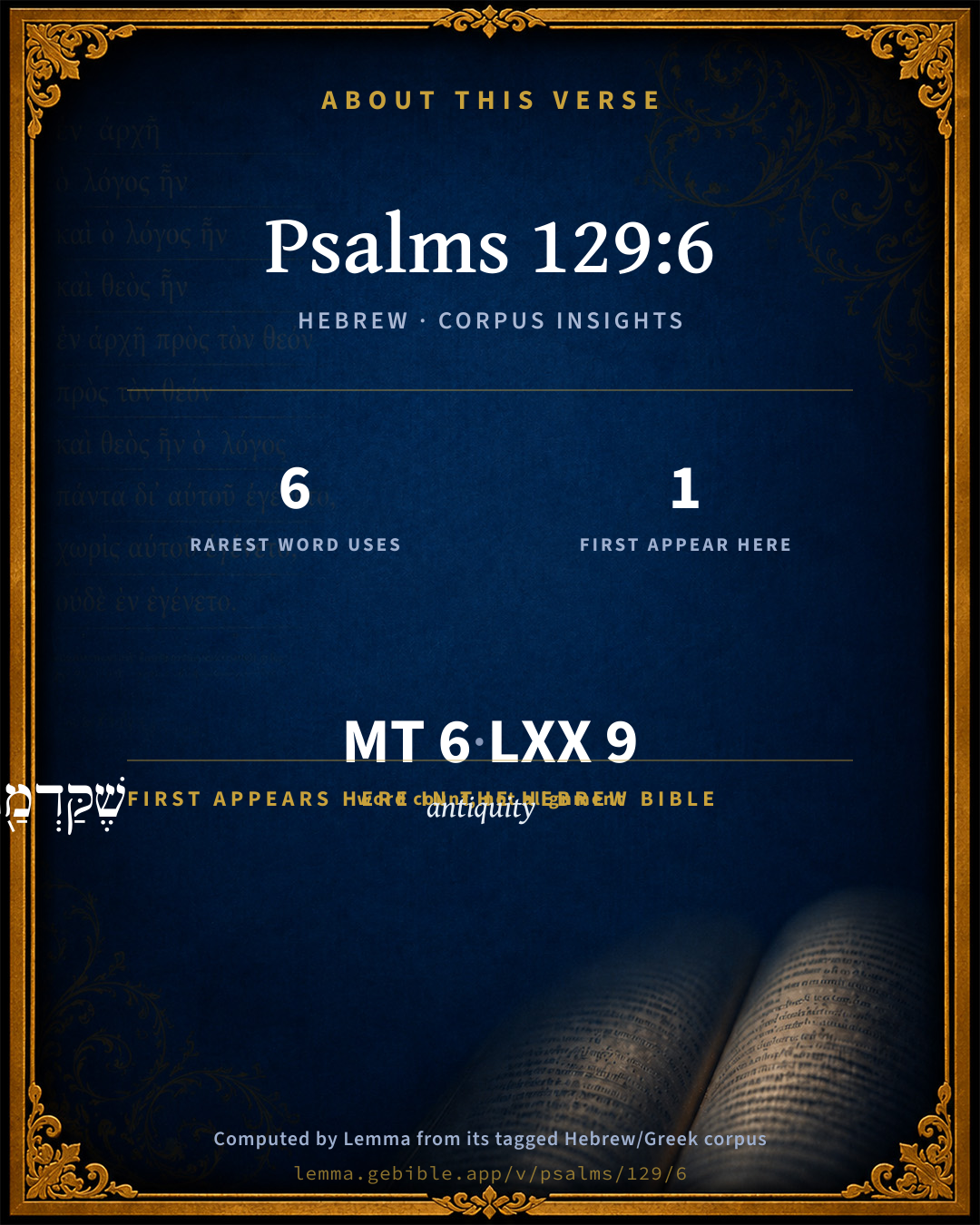
The rarest word here is שֶׁקַּדְמַ֖ת antiquity H6927 — appearing just 6 times in the whole Hebrew Bible.

First appearance in Scripture

This word makes its first canonical appearance in the Hebrew Bible here:

  • שֶׁקַּדְמַ֖ת antiquity H6927

Shared distinctive vocabulary

שֶׁקַּדְמַ֖ת antiquity H6927 occurs in 4 verses of the Hebrew Bible. Also found in:

Grammatical profile

  • 3 verbs
  • 3 nouns

Verb forms

  • יִ֭הְיוּ Qal · Imperfect
  • שָׁלַ֣ף Qal · Perfect
  • יָבֵֽשׁ Qal · Perfect

Hebrew & Septuagint length

In English translation the verse runs 15 words from the Hebrew and 16 from the Septuagint (LXX English) — closely comparable.

A rough comparison of the two English renderings, which tokenize alike — not a word-level alignment.

Word counts can differ between the Hebrew and the Greek without any difference in meaning — e.g. the Hebrew direct-object marker אֵת has no separate Greek word, and Greek often adds the article ὁ.

In the original languages it is 6 Hebrew tokens and 9 Greek tokens — but the two are counted differently (Hebrew bundles its prefixes and suffixes into one token; the Greek is in lemma form), so that isn’t a like-for-like length.

Cross-references

6

Topical passages linked to Psalms 129:6 in the Treasury of Scripture Knowledge — connected by theme and wording, ordered by reader-vote popularity; previews shown in the World English Bible.

  • Psalms 37:2 For they shall soon be cut down like the grass, And wither like the green herb.
  • 2 Kings 19:26 Therefore their inhabitants were of small power, they were dismayed and confounded; they were as the grass of the field, and as the green herb, as the grass on the housetops, and as grain blasted before it is grown up.
  • Psalms 92:7 Though the wicked spring up as the grass, And all the evil-doers flourish, They will be destroyed forever.
  • Isaiah 37:27 Therefore their inhabitants were of small power, they were dismayed and confounded; they were as the grass of the field, and as the green herb, as the grass on the housetops, and as a field [of grain] before it is grown up.
  • Jeremiah 17:5–6 Thus says Yahweh: Cursed is the man who trusts in man, and makes flesh his arm, and whose heart departs from Yahweh.
  • Matthew 13:6 When the sun had risen, they were scorched. Because they had no root, they withered away.

Cross-references courtesy of OpenBible.info (CC BY 4.0).

Hebrew and Greek witnesses Masoretic Hebrew ↔ Greek Septuagint

The same verse in the two great witnesses to the Old Testament, shown verse-for-verse.

You’re reading Greek Psalm 128 (Hebrew Psalm 129). The Septuagint counts the superscription, so verse numbers can differ from the Hebrew — chapter-level alignment, not verse-by-verse. Numbering follows Rahlfs.

These are two independent witnesses, not word-aligned to each other, and the Septuagint is shown in lemma (dictionary) form.

Hebrew Psalms 129:6 Masoretic · Westminster Leningrad Codex

יִ֭הְיוּ כַּחֲצִ֣יר גַּגּ֑וֹת שֶׁקַּדְמַ֖ת שָׁלַ֣ף יָבֵֽשׁ

Let them be as the grass on the housetops, Which withers before it grows up;

World English Bible · Public Domain

Greek LXX Greek Psalm 128:6 Septuagint · lemma form

γίγνομαι ὡς χόρτος δῶμα ὅς πρό ὁ ἐκσπάω ξηραίνω

Let them be as the grass of the housetops, which withers before it is plucked up.

LXX2012 (modern English Septuagint) · Public Domain

On this verse, Keil & Delitzsch discusses the Septuagint’s reading. Read the note in Commentary ↓

Hebrew: Westminster Leningrad Codex (CC BY 4.0). Greek: Septuagint (public domain); English from LXX2012 (modern English Septuagint) (Public Domain). How the Septuagint differs from the Hebrew →

Commentary

Notes on Psalms 129:6 from classic Christian and Jewish commentators (each source and its license shown beneath its notes). The classic Christian expositions comment on the surrounding passage and are grouped to its opening verse, so a note may address several verses; the Jewish commentaries on the Tanakh (Rashi and others) are per-verse, so they appear only where the commentator wrote on this verse.

Lemma curates 59 commentaries, every one of them public domain or Creative Commons licensed, each selected and text-cleaned for this edition rather than reprinted as found. About our sources →

Trapp's Complete Commentary

John Trapp

Psa 129:6 Let them be as the grass [upon] the housetops, which withereth afore it groweth up:

Ver. 6. Let them be as the grass, &c.] They are cursed with a witness whom the Holy Ghost thus curseth in such an emphatic manner, in such exquisite terms.

John Trapp, A Commentary or Exposition upon All the Books of the Old and New Testament (1647–1656) — public domain. Text from a community e-Sword module.

The Biblical Illustrator

Joseph S. Exell

Psa_129:6

Let them be as the grass upon the housetops.

The unholy life

Such a life is--

I. Transient (verse 6). Wickedness is inimical to longevity. What are all-the possessions, pleasures, the pomps, and grandeurs of unholy men l Mere fading flowers of the field.

II. Useless (verse 7). Ungodly men may leave behind them their worldly possessions that may become useful to others; but what they leave behind them morally in the way of sound teaching and life-example is worth nothing; nay, it is worse than worthless.

III. Unblessed (verse 8). Who can bless the memory of the wicked, the memory of those who have lived lives entirely selfish, sensual, secular, utterly regardless of the interests and rights of others? They can only be cursed. (David Thomas, D. D.)

Unstable prosperity

In the East, the houses have generally flat roofs. These are covered with a kind of compost or cement. This should obstruct all vegetation; but if chipped and broken up in any part, grass seeds carried there by the wind take root and grow. The plant springs up rapidly, from the thinness of the soil, and from its warm exposure. From its elevated situation it is seen at a distance, and makes a goodly show. But the same causes make the plant feeble and shrivelled, and it withers before it reaches maturity. Who would covet such prosperity as this? It is not the tall, majestic tree, which has withstood the winds and storms of centuries. It is as grass; not even as grass sown in the humble valley, full of moisture, and rich in beauty: it is as grass on the housetop, which dies before the ears are fully formed. Their prosperity has no stability: its roots are not deep in the Divine blessing. (N. McMichael.)

An emblem of Israel blest by the Lord

is a wide field of thickly-growing corn stirred by gentle breezes under a ripening sun. As the labourers, humming or shouting snatches of cheery song, bind the sheaves, and carry load after load away, they receive friendly salutations from people passing by. Nearly two hundred years before this psalm was produced, Isaiah sketched the pride, impotence and ruin of Israels foes. They that hate Zion are as the grass on the housetops, and as corn blasted before it be grown up (Isa_37:27). The flat roof of an Eastern dwelling is no more the place for vegetation than Jerusalem is a proper field for Gentile and Samaritan ploughers; but so long as there are winds to blow particles of earth into crevices and corners, dews and showers to moisten the drifted dust, and birds of the air to sow seeds, the best cemented housetop is not proof against the appearance of straggling and struggling blades. The enemies of Israel shall be as the grass upon the housetops, which withereth afore it groweth up, which for want of nourishment at the roots dries and dies before it can be pulled: wherewith the mower filleth not his hand; nor he that bindeth sheaves his bosom. Let who will express approbation of the salutations interchanged by Mohammedans when they meet, so long as they do not speak of them as if they originated with Turks and Moors. Such greetings are the remnant, in many countries, of a beautiful primitive custom. The Book of Ruth supplies a delightful glimpse of a harvest field thirteen hundred years before the Christian era (Rth_2:4). The thought is ridiculous of housetop harvesting occasioning such benedictions. Equally out of question is it for the Churchs adversaries to be blessed by God or man. (E. J. Robinson.)

The Biblical Illustrator, edited by Joseph S. Exell (c. 1880s–1900s) — public domain. Text from a community e-Sword module.

Keil & Delitzsch

C. F. Keil & F. Delitzsch

The poet illustrates the fate that overtakes them by means of a picture borrowed from Isaiah and worked up (Psa 37:27): they become like "grass of the housetops," etc. שׁ is a relative to יבשׁ (quod exarescit), and קדמת, priusquam, is Hebraized after מן־קדמת דּנה in Dan 6:11, or מקּדמת דּנה in Ezr 5:11. שׁלף elsewhere has the signification "to draw forth" of a sword, shoe, or arrow, which is followed by the lxx, Theodotion, and the Quinta: πρὸ τοῦ ἐκσπασθῆναι, before it is plucked. But side by side with the ἐκσπασθῆναι of the lxx we also find the reading exanthee'sai; and in this sense Jerome renders (statim ut) viruerit, Symmachus ἐκκαυλῆσαι (to shoot into a stalk), Aquila ἀνέθαλεν, the Sexta ἐκστερεῶσαι (to attain to full solidity). The Targum paraphrases שׁלף in both senses: to shoot up and to pluck off. The former signification, after which Venema interprets: antequam se evaginet vel evaginetur, i.e., antequam e vaginulis suis se evolvat et succrescat, is also advocated by Parchon, Kimchi, and Aben-Ezra. In the same sense von Ortenberg conjectures שׁחלף. Since the grass of the house-tops or roofs, if one wishes to pull it up, can be pulled up just as well when it is withered as when it is green, and since it is the most natural thing to take חציר as the subject to שׁלף, we decide in favour of the intransitive signification, "to put itself forth, to develope, shoot forth into ear." The roof-grass withers before it has put forth ears of blossoms, just because it has no deep root, and therefore cannot stand against the heat of the sun.

(Note: So, too, Geiger in the Deutsche Morgenlndische Zeitschrift, xiv. 278f., according to whom Arab. slf (šlf) occurs in Saadia and Abu-Said in the signification "to be in the first maturity, to blossom," - a sense שׁלף may also have here; cf. the Talmudic שׁלופפי used of unripe dates that are still in blossom.)

The poet pursues the figure of the grass of the house-tops still further. The encompassing lap or bosom (κόλπος) is called elsewhere חצן (Isa 49:22; Neh 5:13); here it is חצן, like the Arabic ḥiḍn (diminutive ḥoḍein), of the same root with מחוז, a creek, in Psa 107:30. The enemies of Israel are as grass upon the house-tops, which is not garnered in; their life closes with sure destruction, the germ of which they (without any need for any rooting out) carry within themselves. The observation of Knapp, that any Western poet would have left off with Psa 129:6, is based upon the error that Psa 129:7-8 are an idle embellishment. The greeting addressed to the reapers in Psa 129:8 is taken from life; it is not denied even to heathen reapers. Similarly Boaz (Rut 2:4) greets them with "Jahve be with you," and receivers the counter-salutation, "Jahve bless thee." Here it is the passers-by who call out to those who are harvesting: The blessing (בּרכּת) of Jahve happen to you (אליכם,

(Note: Here and there עליכם is found as an error of the copyist. The Hebrew Psalter, Basel 1547, 12mo, notes it as a various reading.)

as in the Aaronitish blessing), and (since "we bless you in the name of Jahve" would be a purposeless excess of politeness in the mouth of the same speakers) receive in their turn the counter-salutation: We bless you in the name of Jahve. As a contrast it follows that there is before the righteous a garnering in of that which they have sown amidst the exchange of joyful benedictory greetings.

Keil & Delitzsch — Biblical Commentary on the Old Testament (1861–1891) — public domain (CC PDM 1.0). Text via the HelloAO Bible API. (Old Testament only.)

J. A. Alexander on Psalms

Joseph Addison Alexander

6. (Psa 129:6) They shall be like the grass of the house-tops, which, before one pulls (it) withers. The flat roofs of the oriental houses being often covered with earth, grass and weeds readily spring up, but having no depth of root soon wither. Compare my note on Isa 37:27, from which place the figure is here borrowed. The common version (afore it groweth up) is founded on Jerome's (statim ut viruerit). The other is. supported by the Septuagint nd Vulgate (priusquam evellatur), and by the usage of the verb in the sense of drawing (a sword), drawing off (a shoe), etc.

Joseph Addison Alexander, The Psalms Translated and Explained (1850) — public domain. Text from a community e-Sword module.

Tyndale Open Study Notes

Tyndale Open Resources

129:6-8 Grass on a rooftop had shallow roots and would scorch easily. A crop was ignored by the harvester when the yield was low. The enemies who had sown hurt among God’s people would gain little.

Tyndale Open Study Notes — © Tyndale Open Resources, licensed CC BY-SA 4.0. Text via the HelloAO Bible API.

Geneva Bible (1599)

Geneva Bible translators

The enemies that lift themselves most high, and as it were approach near to the Sun, are consumed with the heat of God’s wrath, because they are not grounded in godly humility.

Geneva Bible (1599) marginal notes — public domain. Text via Bolls.life.

Adam Clarke's Commentary

Verse 6. As the grass upon the housetops] As in the east the roofs of the houses were flat, seeds of various kinds falling upon them would naturally vegetate, though in an imperfect way; and, because of the want of proper nourishment, would necessarily dry and wither away. If grass, the mower cannot make hay of it; if corn, the reaper cannot make a sheaf of it. Let the Babylonians be like such herbage-good for nothing, and come to nothing.

Withereth afore it groweth up] Before שלק shalak, it is unsheathed; i.e., before it ears, or comes to seed.

Adam Clarke's Commentary on the Bible (1810–1826) — public domain. Text from a community e-Sword/MySword module.

Ellicott's Commentary for English Readers

(6) Which withereth afore it groweth up.—This clause, with its Aramaic colouring, probably contains a textual error. The context seems certainly to require the meaning “before it is plucked up,” and many scholars get this meaning out of the Hebrew verb used elsewhere of “plucking off a shoe” and “drawing a sword.” They give, which is no doubt legitimate, an impersonal sense to the active verb, “which withereth before one pulls it up.” The LXX. (received text), the Vulg., Theodotion, and the Quinta favour this rendering. On the other hand, the image of grass withering before it comes to maturity is exactly what we should expect here, growing as it does without soil (comp. the “seed on the rock” in the parable of the sower), and suggests a more complete and sudden destruction of the enemies, who perish before the abortive plans of evil can be carried out. The rendering of the Authorised Version is therefore to be retained, and is actually supported by Aquila, Symmachus, the Sexta, and in various readings of the LXX. A thatched cottage in our country might present the picture suggested by the verse, but it was much more familiar where the housetops were flat and plastered with a composition of mortar, tar, ashes, and sand, which, unless carefully rolled, would naturally become covered with weeds. Indeed, in many cases, especially on the poorest sort of houses, the roof would be little better than hard mud. For similar allusions comp. 2Ki_19:26 and Isa_37:27.

A Bible Commentary for English Readers, edited by Charles John Ellicott (1878–1897) — public domain. Text from a community e-Sword module.

The Cambridge Bible for Schools and Colleges

gen. ed. J. J. S. Perowne

6. as the grass upon the housetops] Cp. Isa_37:27. Grass or corn springs up quickly on the flat roofs of oriental houses, but having no depth of soil (Mat_13:5 f.) it withers prematurely away, and yields no joyous harvest.

afore it groweth up] Lit. before it has unsheathed, put out its flower-stalk and given promise of fruit. So let Zion’s enemies perish before they can mature their plots. The rendering of P.B.V., afore it be plucked up, is that of some MSS of the LXX, and the Vulg. (‘priusquam evellatur’), but though possible, is less suitable.

The Cambridge Bible for Schools and Colleges (gen. ed. J. J. S. Perowne; Cambridge University Press, 1878–1918) — public domain. Text from a community e-Sword module.

John Gill's Exposition

Let them be as the grass upon the housetops,.... The tops of the houses in Judea were flat, and so grass grew upon them, being covered with plaster of terrace; though it was but small and weak, and being on high was exposed to the scorching sun, and soon withered (b); and Menochius says (c) he saw such roofs in the island of Corsica, flat, and having earth upon them, smoothed and pressed, on which grass grew of its own accord; but being burnt up in summertime by the sun, soon withered, as here said. But what Olaus Magnus (d) relates is somewhat extraordinary; that, in the northern Gothic countries, they feed their cattle on the tops of houses, especially in a time of siege; he describes their houses as built of stone, high and large, and covered with rafters of fir and bark of birch; upon which is laid grass earth, cut out of the fields foursquare, and sowed with barley or oats, so that their roofs look like green meadows; and that what is sown, and the grass that grows thereon, might not wither before plucked up, they very constantly and diligently water it; but in the eastern countries, which are hot, and have but little rain, grass could not retain its verdure long, as follows;

which withereth afore it groweth up; to any height, the usual height of grass: or, "before it is plucked up", as the Septuagint, Vulgate Latin, and Arabic versions; and so Jarchi. And this was their usual way of gathering in their corn; and which continues to this day, as Mr. Maundrell (e) affirms, who was an eyewitness to it in many places; where they plucked it up by handfuls from the roots, leaving the most fruitful fields as naked as if nothing had grown on them; and this they did for the sake of the straw, which was generally very short, and necessary for the sustenance of cattle; to which he thinks there is here a manifest allusion; but not corn, but grass, is here spoken of. The Targum is,

"before it flourisheth, an east wind cometh, blows upon it, and it is withered;''

and to the same purpose the Syriac version,

"which when the wind comes upon it, it fades and withers.''

This expresses the high and elevated state and condition of wicked men, the pride and haughtiness of their hearts; yet their weakness and frailty, and the danger they are exposed unto, through the wrath and vengeance of God upon them; when they consume and wither away like grass on the housetops, and never come to the happiness they are hoping and wishing for; see Isa 37:27.

(b) See Shaw's Travels, p. 210, 211. (c) De Republica Heb. l. 7. c. 5. p. 666. (d) De Ritu Gent. Septent. l. 9. c. 12. (e) Journey from Aleppo to Jerusalem, p. 144. Ed. 7.

John Gill's Exposition of the Whole Bible (1746–1763) — public domain (CC PDM 1.0). Text via the HelloAO Bible API.

Albert Barnes' Notes on the Bible

Let them be as the grass upon the housetops - The housetops, or roofs of houses, covered with sand or earth, in which seeds of grass may germinate and begin to grow, but where, as there is no depth of earth, and as the heat of the sun there would be intense, it would soon wither away. See the notes at Isa 37:27.

Which withereth afore it groweth up - This, even if it has any meaning, is not the meaning of the original. The idea in the Hebrew is - and it is so rendered in the Septuagint, the Latin Vulgate, and by Luther - “which before (one) pulls it, withers.” Grass would wither or dry up, of course, if it were pulled up or cut down, but the grass here spoken of withers even before this is done. It has no depth of earth to sustain it; having sprouted, and begun to grow, it soon dies - a perfect image of feebleness and desolation; of hopes begun only to be disappointed. “This morning” (says Dr. Thomson, “Land and the Book,” vol. ii., p. 574) “I saw a striking illustration of this most expressive figure. To obtain a good view of the Tyropean, my guide took me to the top of a house on the brow of Zion, and the grass which had grown over the roof during the rainy season was now entirely withered and perfectly dry.”

Albert Barnes' Notes on the Bible (1834–1885) — public domain. Text from a community e-Sword/MySword module.

Matthew Poole's English Annotations

The house-tops there were flat, and therefore more capable of grass or green corn growing between the stones than ours are.

Which withereth afore it groweth up; which having no deep root, never comes to maturity. And so all their designs shall be abortive, and never come to perfection.

Matthew Poole's English Annotations on the Holy Bible (1683–1685) — public domain. Text from a community e-Sword/MySword module.

The Treasury of David

Charles H. Spurgeon

Ver. 6. Let them be as the grass upon the housetops, which withereth afore it groweth up. Grass on the housetop is soon up and soon down. It sprouts in the heat, finds enough nutriment to send up a green blade, and then it dies away before it reaches maturity, because it has neither earth nor moisture sufficient for its proper development. Before it grows up it dies; it needs not to be plucked up, for it hastens to decay of itself. Such is and such ought to be the lot of the enemies of God's people. Transient is their prosperity; speedy is their destruction. The height of their position, as it hastens their progress, so it hurries their doom. Had they been lower in station they had perhaps been longer in being. "Soon ripe, soon rotten", is an old proverb. Soon plotting and soon rotting, is a version of the old adage which will suit in this place. We have seen grass on the rustic thatch of our own country cottages which will serve for an illustration almost as well as that which comes up so readily on the flat roofs and domes of eastern habitations. The idea isthey make speed to success, and equal speed to failure. Persecutors are all sound and fury, flash and flame; but they speedily vanishmore speedily than is common to men. Grass in the field withers, but not so speedily as grass on the housetops. Without a mower the tufts of verdure perish from the roofs, and so do opposers pass away by other deaths than fall to tile common lot of men; they are gone, and none is the worse. If they are missed at all, their absence is never regretted. Grass on the housetop is a nonentity in the world: the house is not impoverished when the last blade is dried up: and, even so, the opposers of Christ pass away, and none lament them. One of the fathers said of the apostate emperor Julian, "That little cloud will soon be gone"; and so it was. Every sceptical system of philosophy has much the same history; and the like may be said of each heresy. Poor, rootless things, they are and are not: they come and go, even though no one rises against them. Evil carries the seeds of dissolution within itself. So let it be.

Ver. 6. Let them be as the grass upon the housetops. They are rightly compared to grass on the housetops; for more contemptuously the Holy Ghost could not speak of them. For this grass is such, that it soon withereth away before the sickle be put into it. Yea, no man thinketh it worthy to be cut down, no man regardeth it, every man suffereth it to brag for a while, and to show itself unto men from the housetops as though it were something when it is nothing. So the wicked persecutors in the world, which are taken to be mighty and terrible according to the outward show, are of all men most contemptible. For Christians do not once think of plucking them up or cutting them down; they persecute them not, they revenge not their own injuries, but suffer them to increase, to brag and glory as much as they list. For they know that they cannot abide the violence of a vehement wind. Yea, though all things be in quietness, yet as grass upon the housetops, by little and little, withereth away through the heat of the sun, so tyrannies upon small occasions do perish and soon vanish away. The faithful, therefore, in suffering do prevail, and overcome; but the wicked in doing are overthrown, and miserably perish, as all the histories of all times and ages do plainly witness. Martin Luther.

Ver. 6. Like grass upon the housetops. The flat roofs of the Eastern houses "are plastered with a composition of mortar, tar, ashes, and sand", in the crevices of which grass often springs. The houses of the poor in the country were formed of a plaster of mud and straw, where the grass would grow still more freely: as all the images are taken from country life, it is doubtless to country dwellings that the poet refers. J. J. Stewart Perowne.

Ver. 6. Like grass upon the housetops. The enemies of Zion may have an elevated position in the nation, they may seem to promise growth, but having no root in themselves, like the hearers on the stony ground, give no promise of fruit. Their profession dies away and leaves no benefit to the church, as it claims no blessing from others. William Wilson (1783-1873), in "The Book of Psalms, with an Exposition."

Ver. 6. Grass upon the housetops. In the morning the master of the house laid in a stock of earth, which was carried up, and spread evenly on the top of the house, which is flat. The whole roof is thus formed of mere earth, laid on and rolled hard and flat. On the top of every house is a large stone roller, for the purpose of hardening and flattening this layer of rude soil, so that the rain may not penetrate; but upon this surface, as may be supposed, grass and weeds grow freely, but never come to maturity. It is to such grass the Psalmist alludes as useless and bad. William Jowett, in "Christian Researches in Syria and the Holy Land", 1825.

Ver. 6-9. The wicked flourishing and perishing.

1. Eminent in position.

2. Envied in prosperity.

3. Evanescent in duration.

4. Empty as to solidity.

5. Excepted from blessing.

Psalms 129:7*

Charles H. Spurgeon's The Treasury of David (1869–1885) — public domain. Psalms only. Text from a community e-Sword/MySword module.

Whedon's Commentary on the Bible

Daniel D. Whedon

6. Grass upon the housetops—Which never comes to maturity for want of root and moisture, and hence is proverbially worthless. “To obtain a good view of the Tyropean my guide took me to the housetop on the brow of Zion, and the grass which had grown over the roof during the rainy season was now entirely withered and perfectly dry.”—Thomson. Roofs of houses in Palestine are nearly flat, sloping slightly toward the centre, and covered with small stones and earth. “Grass, and even wild flowers, are apt to grow upon them in winter, and as their roots cannot sink deep into the hard soil, a few days of warm sunshine suffice to dry them up.”—Van Lennep.

Daniel D. Whedon (gen. ed.), Commentary on the Old and New Testaments (1874–1909) — public domain. Text from a community e-Sword module.

The Pulpit Commentary

Let them be as the grass upon the housetops; literally, they shall be as the grass of housetops. The flat roofs of Oriental houses are usually covered in early spring with a crop of bright-green grass. But the scorching rays of the sun soon burn this up, and it becomes dry and withered. (see "The Land and the Book," p. 682; and comp. Isa_37:27) Which withereth afore it groweth up; literally, before it is unsheathed; i.e. before the blossom has left the sheath in which it is formed.

A new figure of the grass.

Jowett says, "At Anata, the Anathoth of Scripture, I observed that the roofs of some of the houses were partially covered with grass a circumstance which I noticed also in several other places. As the roofs of the common dwellings are flat, and, instead of being built of stone or wood, are coated with plaster or hardened earth, a slight crop of grass frequently springs up in that situation. Such vegetation, however, having no soil into which it can strike its roots, and being exposed to a scorching sun, rarely attains to any great height or continues long. It is a feeble, stunted product, and soon withers away. Hence the sacred writers sometimes allude to the grass of the house-top as an emblem of weakness, frailty, and certain destruction". (Isa_37:27) The meaning of vers. 7, 8 is this There will be no reapers of such worthless grass as this; there will be nothing to elicit the utterance of those common formulas of benediction with which passers-by were wont to greet harvesters. It is better to associate these verses with the short-lived enmity of the Samaritans to the returned exiles, than with the more systematic dealing of an empire like Babylon.

I THE ENMITY OF THE SAMARITANS WAS SHOWY. After rain, the grass on the house-top springs up in a very showy and boastful way, as if it were going to do great things. And so the Samaritans vaunted much and taunted much, and at first seemed to accomplish much; for they put cords on the restoring work of the exiles, and stopped the building of the temple, and prevented the building of the wall.

II THE ENMITY OF THE SAMARITANS WAS SHORT-LIVED. It was met with patience. Presently the energy of an Ezra and a Nehemiah, like an east wind or a scorching sun, hopelessly cut down the blades. Persecutors of God"s people are never given a "long tether." God"s people may always pray, "Come quickly.

III THE ENMITY OF THE SAMARITANS BROUGHT THEM NO GOOD. It only spoiled permanently their relations with Israel, and put them out of favor with Persia. The mower never filled his hand with any harvest of the grass that grew on that housetop. The harvest of all enmities to God"s people is never anything else than "a heap in a time of desperate sorrow." Goodness is a harvest reaped from good. R.T.

The Pulpit Commentary (1880–1919), ed. H.D.M. Spence-Jones & Joseph S. Exell — public domain. Text from a community e-Sword module.

John Wesley's Explanatory Notes

House-tops - Which there were flat. Which - Having no deep root, never comes to maturity. And so all their designs shall be abortive.

John Wesley, Explanatory Notes Upon the Whole Bible (1754–1765) — public domain. Text via the GEBible commentary corpus.

unfoldingWord translationNotes

Door43 World Missions Community

May they be like the grass ... bundles of grain together

The psalmist speaks of his enemies dying and being few in number. They are compare to the little bit of grass that grows on the roof of a house and withers and is not enough to cut or bundle. AT: "May they die and may there be so few of them that they would be like the grass ... bundles of grain together" (See: Simile)

the blessing of Yahweh be on you

"Yahweh bless you"

translationWords

reap

bless

name

unfoldingWord translationNotes — © Distant Shores Media and the Door43 World Missions Community, licensed CC BY-SA 4.0. Source: git.door43.org/Door43/en_tn.

Rashi

Rabbi Shlomo Yitzchaki (Rashi)

which, before it is plucked, withers Which, before they pluck it and uproot it from its place, is withered.

Rashi on the Tanakh — English translations: “The Judaica Press complete Tanach with Rashi, translated by A. J. Rosenberg” (CC BY 4.0); “Pentateuch with Rashi's commentary by M. Rosenbaum and A.M. Silbermann, 1929-1934” (public domain); “The Metsudah Tanach series, Lakewood, N.J” (CC BY 4.0); and “The Book of Joshua, Metsudah Publications, 1997” (CC BY 4.0). Text via Sefaria.

Lesson kit

Teaching starters — assembled from the data on this page, not authored interpretation. Every prompt links to the verse data it draws on. Edit before teaching.

Psalms, in the Wisdom, opens this verse with 6 words (6 distinct Hebrew lemmas). Its most distinctive word is qadmâh (“antiquity”). A historical commentator’s framing appears above. Read the whole chapter for the surrounding context.

Discussion questions

  1. How does “antiquity” (qadmâh) shape what this verse is saying?
  2. The word “antiquity” first appears here in Scripture. What is being introduced at this debut?
  3. Isaiah 23:7 shares the word «antiquity» with this verse. How do the two illuminate each other?
  4. These translations render this verse differently; the difference is in the English rendering, not the original. What questions does that raise?
  5. The verb «יִ֭הְיוּ» is Qal Imperfect. How does its form color the action?
  6. Reading how Trapp's Complete Commentary and The Biblical Illustrator read this verse, where do the two commentators agree and where do they part?

Things to notice

Reading settings

Reading text

Shown beneath each verse's original-language words.

Old Testament
Old Testament edition

Read the OT as the Masoretic Hebrew (MT) or the Greek Septuagint (LXX).

English shown for the Greek Septuagint (in the Hebrew ↔ Greek comparison).

Comparing translations? Open the Compare panel on any verse page to stack up to four side by side.