
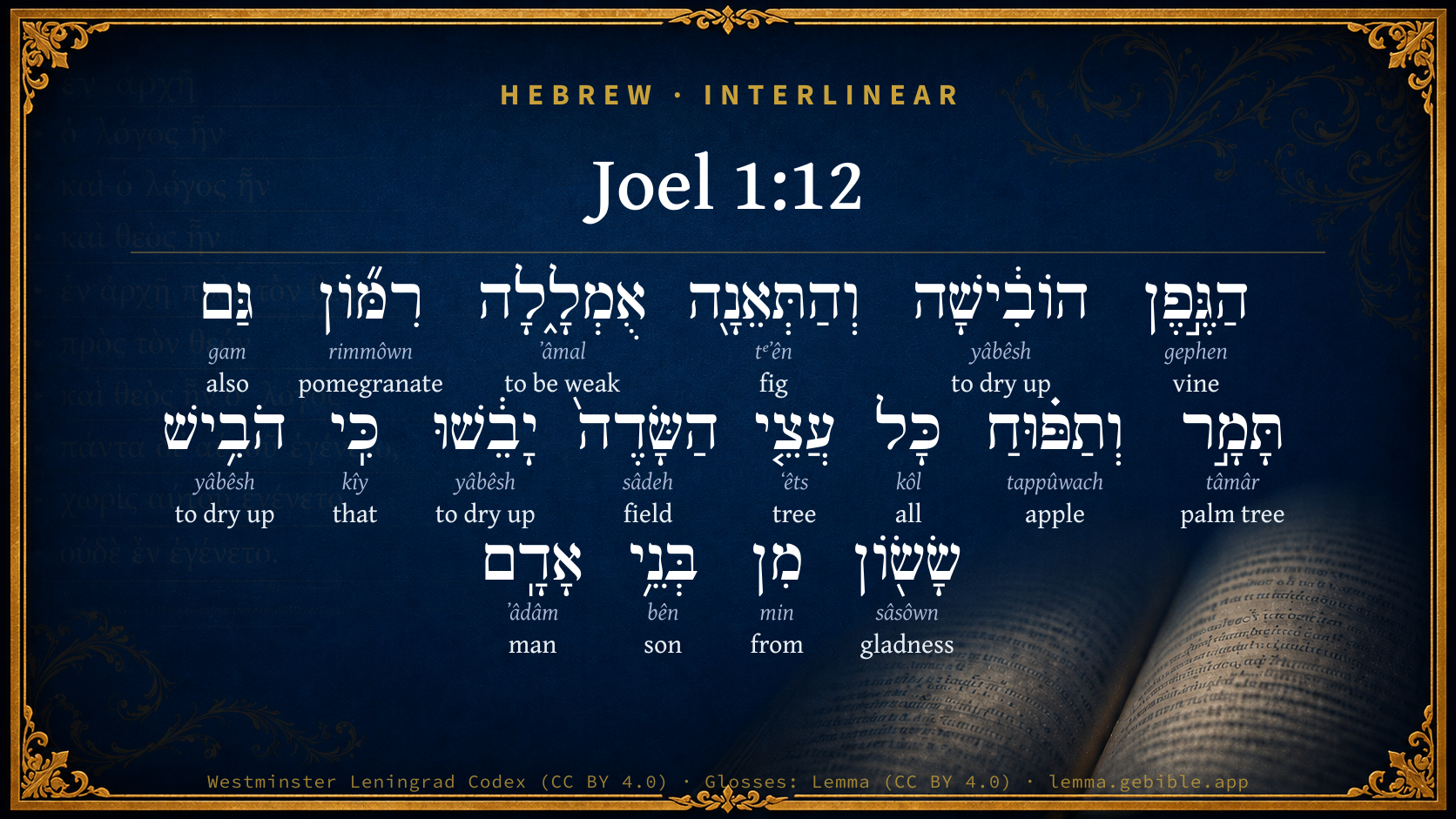
Joel 1:12

Hebrew (Westminster Leningrad Codex) Joel 1:12 appears in the Hebrew Old Testament. The text above is from the Westminster Leningrad Codex. Each word links to its Strong’s number, a concise gloss, and parsing drawn from the Open Scriptures Hebrew Bible morphology. Click any word for its full Brown-Driver-Briggs (BDB) entry.
Download image
Cite this verse

Joel 1:12 (World English Bible). Public Domain. Lemma interlinear Bible study tool, https://lemma.gebible.app/v/joel/1/12.

Show BibTeX & RIS
BibTeX
RIS
English Translation
The vine has dried up, and the fig tree withered; the pomegranate tree, the palm tree also, and the apple tree, Even all of the trees of the field are withered; For joy has withered away from the sons of men.
World English Bible · Public Domain
Download a study sheet

One document with this verse’s original text, its word-by-word gloss line, the meaning frame, cross-references with their text, attributed commentary, and full source and license credits — printable, and it pastes into notes with its structure intact.

This verse Autodidact and up

Study sheet (.html) Plain text (.txt)

A passage Seminary Student

Up to 50 verses in one chapter. A passage sheet keeps up to 6 commentary sources and 12 cross-references per verse, in the order this page ranks them, and says so on the sheet whenever that leaves anything out. Ask for a single verse and you get the Autodidact verse sheet above.

Everything on this page stays free to read, with no account — the sheet is a download of what is already on screen, not access to it.

Want to remove ads? Support Godless Engineer
Compare translations 3

The same verse in 3 English versions, stacked beneath the original-language interlinear above. Click any original word for its lexicon entry.

Each is an independent rendering of the whole verse — the interlinear is not word-aligned to these translations.

Highlighted words mark where these versions differ — a whole-verse word diff, not a word-by-word alignment.

  • World English Bible Public Domain
    The vine has dried up, and the fig tree withered; the pomegranate tree, the palm tree also, and the apple tree, Even all of the trees of the field are withered; For joy has withered away from the sons of men.
  • King James Version Public Domain
    The vine is dried up, and the fig tree languisheth; the pomegranate tree, the palm tree also, and the apple tree, even all the trees of the field, are withered: because joy is withered away from the sons of men.
  • unfoldingWord Literal Text CC BY-SA 4.0
    The vine has dried up and the fig tree has been made weak. The pomegranate tree, also the palm tree and the apple tree, all of the trees of the field have dried up. So joy has dried up from the sons of man.

unfoldingWord Literal Text — © unfoldingWord, licensed CC BY-SA 4.0. Word-aligned USFM3 via Door43 (git.door43.org/unfoldingWord/en_ult).

Versions to compare (up to 4)

3 of 4 selected

Show all 18 translations

Every available English version of this verse, each an independent rendering of the whole verse.

  • World English Bible Public Domain
    The vine has dried up, and the fig tree withered; the pomegranate tree, the palm tree also, and the apple tree, Even all of the trees of the field are withered; For joy has withered away from the sons of men.
  • Berean Standard Bible Public Domain
    The grapevine is dried up, and the fig tree is withered; the pomegranate, palm, and apple—all the trees of the orchard—are withered. Surely the joy of mankind has dried up.
  • Majority Standard Bible Public Domain
    The grapevine is dried up, and the fig tree is withered; the pomegranate, palm, and apple—all the trees of the orchard—are withered. Surely the joy of mankind has dried up.
  • King James Version Public Domain
    The vine is dried up, and the fig tree languisheth; the pomegranate tree, the palm tree also, and the apple tree, even all the trees of the field, are withered: because joy is withered away from the sons of men.
  • American Standard Version (1901) Public Domain
    The vine is withered, and the fig-tree languisheth; the pomegranate-tree, the palm-tree also, and the apple-tree, even all the trees of the field are withered: for joy is withered away from the sons of men.
  • Revised Version (1885) Public Domain
    The vine is withered, and the fig tree languisheth; the pomegranate tree, the palm tree also, and the apple tree, even all the trees of the field are withered: for joy is withered away from the sons of men.
  • Geneva Bible (1599) Public Domain
    The vine is dried vp, and the figge tree is decayed: the pomegranate tree and the palme tree, and the apple tree, euen all the trees of the fielde are withered: surely the ioy is withered away from the sonnes of men.
  • Douay-Rheims (1899) Public Domain
    The vineyard is confounded, and the fig tree hath languished: the pomegranate tree, and the palm tree, and the apple tree, and all the trees of the field are withered: because joy is withdrawn from the children of men.
  • Young's Literal Translation Public Domain
    The vine hath been dried up, And the fig-tree doth languish, Pomegranate, also palm, and apple-tree, All trees of the field have withered, For dried up hath been joy from the sons of men.
  • Literal Standard Version CC BY-SA 4.0
    The vine has been dried up, || And the fig tree languishes, || Pomegranate, also palm, and apple-tree, || All trees of the field have withered, || For joy has been dried up from the sons of men.
  • Unlocked Literal Bible CC BY-SA 4.0
    The vines have withered and the fig trees have dried up, the pomegranate trees, also the palm trees, and the apple trees— all the trees of the field have withered. For joy has withered away from the descendants of mankind.
  • unfoldingWord Literal Text CC BY-SA 4.0
    The vine has dried up and the fig tree has been made weak. The pomegranate tree, also the palm tree and the apple tree, all of the trees of the field have dried up. So joy has dried up from the sons of man.
  • Darby Bible Public Domain
    The vine is dried up, and the fig-tree languisheth; the pomegranate-tree, the palm also and the apple-tree; all the trees of the field are withered, yea, joy is withered away from the children of men.
  • World Messianic Bible Public Domain
    The vine has dried up, and the fig tree withered— the pomegranate tree, the palm tree also, and the apple tree, even all of the trees of the field are withered; for joy has withered away from the sons of men.
  • Webster's Bible Public Domain
    The vine is dried up, and the fig-tree languisheth; the pomegranate-tree, the palm-tree also, and the apple-tree, even all the trees of the field, are withered: because joy is withered away from the sons of men.
  • Free Bible Version CC BY-SA 4.0
    The vines are shriveled, the fig trees are withered; the pomegranate, the palm, and the apricot trees—all the fruit trees have dried up, and at the same time the people's happiness has also dried up.
  • Bible in Basic English Public Domain
    The vine has become dry and the fig-tree is feeble; the pomegranate and the palm-tree and the apple-tree, even all the trees of the field, are dry: because joy has gone from the sons of men.
  • JPS Tanakh (1917) Public Domain
    The vine is withered, and the fig-tree languisheth; the pomegranate-tree, the palm-tree also, and the apple-tree, even all the trees of the field, are withered; for joy is withered away from the sons of men.

Literal Standard Version (2020), Covenant Press — licensed CC BY-SA 4.0. Text via the HelloAO Bible API (eBible.org). Unlocked Literal Bible (unfoldingWord) — licensed CC BY-SA 4.0. Text via the HelloAO Bible API (eBible.org). unfoldingWord Literal Text — © unfoldingWord, licensed CC BY-SA 4.0. Word-aligned USFM3 via Door43 (git.door43.org/unfoldingWord/en_ult). Free Bible Version, Dr. Jonathan Gallagher — licensed CC BY-SA 4.0. Text via the HelloAO Bible API (eBible.org).

Word by word

More ways to search: Search by grammar → Find every occurrence → Compare this word →

Practice this passage: Drill this verse → Learn its vocabulary →

וְתַפּ֗וּחַ
tappûwach
H8598
“and · apple”
Conjunction + Noun, Common, Masculine, Singular, Absolute
Part of Speech
Conjunction + Noun
Type
Common
Gender
Masculine
Number
Singular
State
Absolute
Full BDB Definition

Origin: from H5301

TWOT: 1390c

apple, apple tree - apple tree - apples
  1. הַגֶּ֣פֶן gephen H1612 “the · vine” Particle, Definite Article + Noun, Common, Both, Singular, Absolute
  2. הוֹבִ֔ישָׁה yâbêsh H3001 “to dry up” Verb, Hiphil, Perfect, 3rd Person, Feminine, Singular
  3. וְהַתְּאֵנָ֖ה tᵉʼên H8384 “and · the · fig” Conjunction + Particle, Definite Article + Noun, Common, Feminine, Singular, Absolute
  4. אֻמְלָ֑לָה ʼâmal H535 “to be weak” Verb, Pulal, Perfect, 3rd Person, Feminine, Singular
  5. רִמּ֞וֹן rimmôwn H7416 “pomegranate” Noun, Common, Masculine, Singular, Absolute
  6. גַּם gam H1571 “also” Particle, Accusative
  7. תָּמָ֣ר tâmâr H8558 “palm tree” Noun, Common, Masculine, Singular, Absolute
  8. כָּל kôl H3605 “all of” Noun, Common, Masculine, Singular, Construct
  9. עֲצֵ֤י ʻêts H6086 “trees of” Noun, Common, Masculine, Plural, Construct
  10. הַשָּׂדֶה֙ sâdeh H7704 “the · field” Particle, Definite Article + Noun, Common, Masculine, Singular, Absolute
  11. יָבֵ֔שׁוּ yâbêsh H3001 “to dry up” Verb, Qal, Perfect, 3rd Person, Common, Plural
  12. כִּֽי kîy H3588 “that” Conjunction
  13. הֹבִ֥ישׁ yâbêsh H3001 “to dry up” Verb, Hiphil, Perfect, 3rd Person, Masculine, Singular
  14. שָׂשׂ֖וֹן sâsôwn H8342 “gladness” Noun, Common, Masculine, Singular, Absolute
  15. מִן min H4480 “from” Preposition
  16. בְּנֵ֥י bên H1121 “sons of” Noun, Common, Masculine, Plural, Construct
  17. אָדָֽם ʼâdâm H120 “man” Noun, Common, Masculine, Singular, Absolute

About this verse

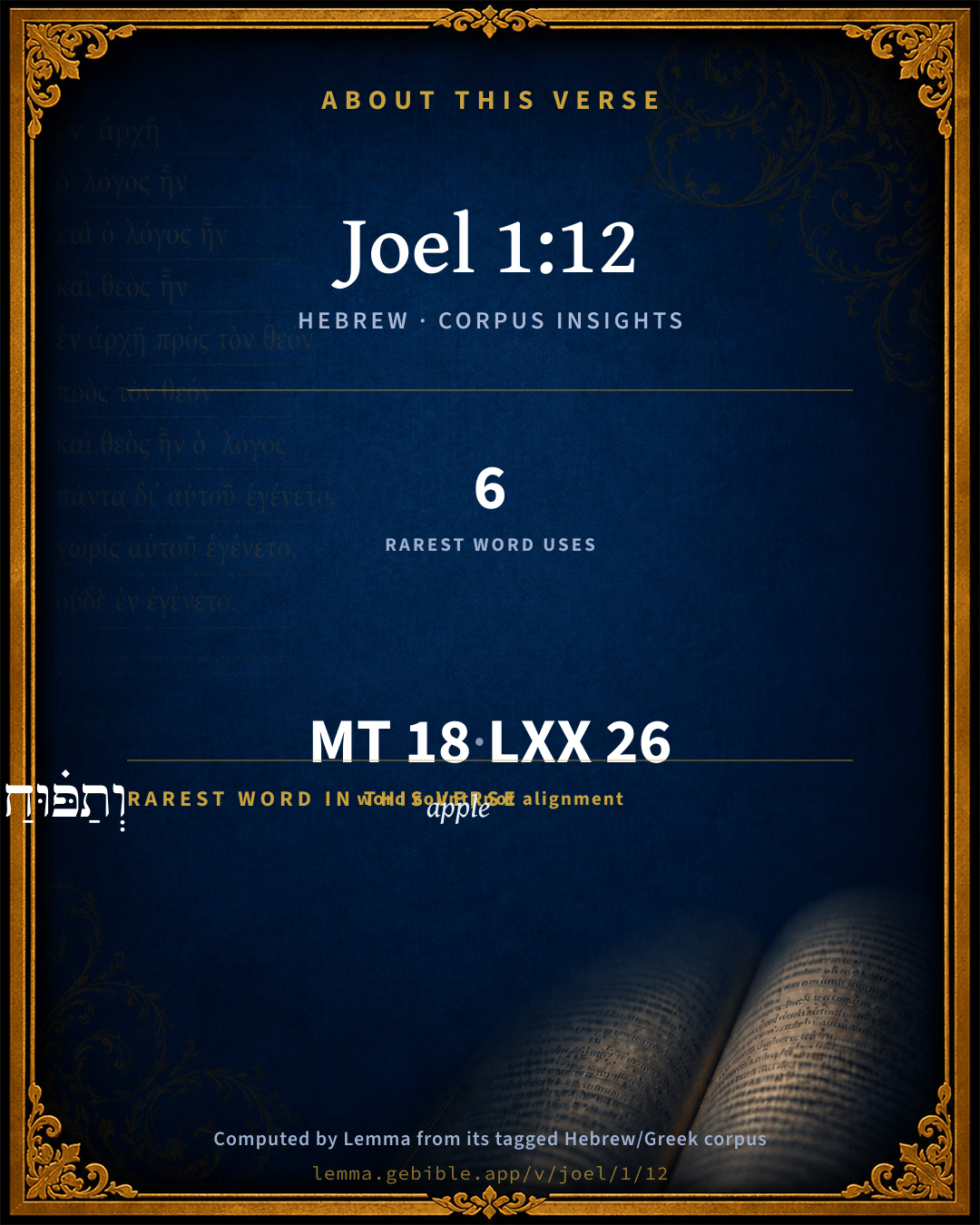
These counts appear in no published source. They are computed here, from the morphology-tagged text and Lemma’s own curated glosses. What Lemma adds →

18
words
16
distinct lemmas
Prophets
section

Notable vocabulary

The rarest word here is וְתַפּ֗וּחַ apple H8598 — appearing just 6 times in the whole Hebrew Bible.

Shared distinctive vocabulary

וְתַפּ֗וּחַ apple H8598 occurs in 6 verses of the Hebrew Bible. Also found in:

Grammatical profile

  • 4 verbs
  • 11 nouns
  • 1 preposition
  • 1 conjunction
  • 1 particle

Verb forms

  • הוֹבִ֔ישָׁה Hiphil · Perfect
  • אֻמְלָ֑לָה Pulal · Perfect
  • יָבֵ֔שׁוּ Qal · Perfect
  • הֹבִ֥ישׁ Hiphil · Perfect

Repetition

A word recurs within this verse — often emphatic in Hebrew:

  • הוֹבִ֔ישָׁה to dry up H3001 ×3

Hebrew & Septuagint length

In English translation the verse runs 41 words from the Hebrew and 36 from the Septuagint (LXX English) — closely comparable.

A rough comparison of the two English renderings, which tokenize alike — not a word-level alignment.

Word counts can differ between the Hebrew and the Greek without any difference in meaning — e.g. the Hebrew direct-object marker אֵת has no separate Greek word, and Greek often adds the article ὁ.

In the original languages it is 18 Hebrew tokens and 26 Greek tokens — but the two are counted differently (Hebrew bundles its prefixes and suffixes into one token; the Greek is in lemma form), so that isn’t a like-for-like length.

Cross-references

16

Topical passages linked to Joel 1:12 in the Treasury of Scripture Knowledge — connected by theme and wording, ordered by reader-vote popularity; previews shown in the World English Bible.

  • Isaiah 16:10 Gladness is taken away, and joy out of the fruitful field; and in the vineyards there shall be no singing, neither joyful noise: nobody shall tread out wine in the presses; I have made the [vintage] shout to cease.
  • Isaiah 24:11 There is a crying in the streets because of the wine; all joy is darkened, the mirth of the land is gone.
  • Song of Solomon 2:3 As the apple tree among the trees of the wood, So is my beloved among the sons. I sat down under his shadow with great delight, His fruit was sweet to my taste.
  • Hosea 9:1–2 Don't rejoice, Israel, to jubilation like the nations; For you were unfaithful to your God. You love the wages of a prostitute at every grain threshing floor.
  • Joel 1:10 The field is laid waste. The land mourns, for the grain is destroyed, The new wine has dried up, And the oil languishes.
  • Joel 1:16 Isn't the food cut off before our eyes; Joy and gladness from the house of our God?
  • Habakkuk 3:17–18 For though the fig tree doesn't flourish, Nor fruit be in the vines; The labor of the olive fails, The fields yield no food; The flocks are cut off from the fold, And there is no herd in the stalls:
  • Numbers 13:23 They came to the valley of Eshcol, and cut down from there a branch with one cluster of grapes, and they bore it on a staff between two; [they brought] also of the pomegranates, and of the figs.
  • Psalms 4:7 You have put gladness in my heart, More than when their grain and their new wine are increased.
  • Psalms 92:12 The righteous shall flourish like the palm tree. He will grow like a cedar in Lebanon.
  • Song of Solomon 4:13 Your shoots are an orchard of pomegranates, with precious fruits: Henna with spikenard plants,
  • Song of Solomon 7:7–9 This, your stature, is like a palm tree, Your breasts like its fruit.
  • Isaiah 9:3 You have multiplied the nation, you have increased their joy: they joy before you according to the joy in harvest, as men rejoice when they divide the spoil.
  • Jeremiah 48:3 The sound of a cry from Horonaim, desolation and great destruction!
  • Jeremiah 48:33 Gladness and joy is taken away from the fruitful field and from the land of Moab; and I have caused wine to cease from the wine presses: none shall tread with shouting; the shouting shall be no shouting.
  • Haggai 2:19 Is the seed yet in the barn? Yes, the vine, the fig tree, the pomegranate, and the olive tree haven't brought forth. From this day will I bless you.'"

Cross-references courtesy of OpenBible.info (CC BY 4.0).

Hebrew and Greek witnesses Masoretic Hebrew ↔ Greek Septuagint

The same verse in the two great witnesses to the Old Testament, shown verse-for-verse.

These are two independent witnesses, not word-aligned to each other, and the Septuagint is shown in lemma (dictionary) form.

Hebrew Joel 1:12 Masoretic · Westminster Leningrad Codex

הַגֶּ֣פֶן הוֹבִ֔ישָׁה וְהַתְּאֵנָ֖ה אֻמְלָ֑לָה רִמּ֞וֹן גַּם תָּמָ֣ר וְתַפּ֗וּחַ כָּל עֲצֵ֤י הַשָּׂדֶה֙ יָבֵ֔שׁוּ כִּֽי הֹבִ֥ישׁ שָׂשׂ֖וֹן מִן בְּנֵ֥י אָדָֽם

The vine has dried up, and the fig tree withered; the pomegranate tree, the palm tree also, and the apple tree, Even all of the trees of the field are withered; For joy has withered away from the sons of men.

World English Bible · Public Domain

Greek LXX Joel 1:12 Septuagint · lemma form

ὁ ἄμπελος ξηραίνω καί ὁ συκῆ ὀλιγόω ῥόα καί φοῖνιξ καί μῆλον καί πᾶς ὁ ξύλον ὁ ἀγρός ξηραίνω ὅτι αἰσχύνω χαρά ὁ υἱός ὁ ἄνθρωπος

The vine is dried up, and the fig-trees are become few; the pomegranate, and palm tree, and apple, and all trees of the field are dried up: for the sons of men have have abolished joy.

LXX2012 (modern English Septuagint) · Public Domain

Hebrew: Westminster Leningrad Codex (CC BY 4.0). Greek: Septuagint (public domain); English from LXX2012 (modern English Septuagint) (Public Domain). How the Septuagint differs from the Hebrew →

Targum (Aramaic paraphrase)

1

The Targum is the ancient Jewish Aramaic paraphrase of the Hebrew Scriptures — an interpretive translation, not the Hebrew text itself. Onkelos (literal) and Pseudo-Jonathan (expansive) render the Torah, and Jonathan the Prophets. Coverage is partial: where no permissively-licensed English translation exists for a verse, only the Aramaic is shown. This is verse-level text, not a word-by-word alignment to the Hebrew.

  1. Targum Jonathan Prophets (Joshua–Malachi)
    גוּפְנַיָא יְבִישׁוּ וְתֵינַיָא נְתַרוּ רִמוֹנִין אַף דִקְלִין וְחַזוּר כָּל אִילָנֵי חַקְלָא יְבִישׁוּ אֲרֵי פַסְקַת חֶדְוָתָא מִבְּנֵי אֱנָשָׁא:

    (no public-domain English translation for this verse)

    Targum Jonathan — Aramaic: “Mikraot Gedolot” (public domain). English: “Sefaria Community Translation” (CC0 1.0 (public-domain dedication)); “London "Chaldee Paraphrase," 1871” (public domain). Text via Sefaria.

Commentary

Notes on Joel 1:12 from classic Christian and Jewish commentators (each source and its license shown beneath its notes). The classic Christian expositions comment on the surrounding passage and are grouped to its opening verse, so a note may address several verses; the Jewish commentaries on the Tanakh (Rashi and others) are per-verse, so they appear only where the commentator wrote on this verse.

Lemma curates 59 commentaries, every one of them public domain or Creative Commons licensed, each selected and text-cleaned for this edition rather than reprinted as found. About our sources →

The Cambridge Bible for Schools and Colleges

gen. ed. J. J. S. Perowne

12. is dried up] Better, sheweth shame, as Joe_1:10.

the pomegranate] Num_13:23; Num_20:5; Deu_8:8; 1Sa_14:2; Hag_2:19; Son_4:3; Son_4:13; Son_6:7; Son_6:11; Son_7:12; Son_8:2. A tree abundant in Palestine, and highly prized on account of its fruit. The fruit when ripe is of a bright red colour, as large as an orange and crowned with the calyx. The name pomegranate is derived from the Latin, “grained apple,” from the bright red pips contained in the fruit. The expressed juice of the fruit makes a cooling drink, and it is also sometimes fermented into a light wine (Son_8:2).

the palm tree] once, no doubt, with its tall, branchless stems and huge spreading leaves, the glory of most of the warmer parts of Palestine, the maritime plains, and the Jordan valley, but now comparatively rare. See Jdg_4:5; Son_7:7-8; Psa_92:13. Pliny (H. N. xiii. 4) says, Judaea inclyta est palmis; and Tacitus (Hist. Joe_1:6), Palmetis (Judaeis) proceritas et decor. Jericho is called the “City of palm-trees,” Deu_34:3; Jdg_1:16; Jdg_3:13; 2Ch_28:15. Jericho was celebrated in antiquity for its palm-groves, the semi-tropical warmth of the Arábah—here 600 feet below the level of the sea—favouring their growth. A beautiful spring, called the ‘Ain es-Sultan, or Elisha’s Spring, gushes forth in the plain, at about a mile from the foot of the hills which lead up into the high land of Judah: this must have been near the site of the ancient city, and Josephus (B. J. iv. 8, 3) speaks with admiration of the beautiful park of palms and other rare trees, which the stream watered. Comp. Herodis palmeta pinguia, Hor. Ep. ii. 2. 184. See an interesting collection of notices respecting the palm-groves of Jericho in Schürer, Hist. of N. T. Times, § 15. Palms also flourished at Engedi, on the W. shore of the Dead Sea (Sir_24:14).

the apple tree] Son_2:3; Son_8:5; cf. apples Son_2:5; Son_7:8; Pro_25:11. It has been doubted whether tappûaḥ is really the apple; and Tristram (N. H. B. p. 334 f.; D. B.2 s.v.) adduces grounds tending to shew that is was more probably the apricot. But the corresponding Arabic word (tuffâḥ) certainly means the apple; and though it is true that the Syrian apple is much inferior in flavour to the European apple, it has nevertheless been long esteemed in the East as a grateful and refreshing fruit, and valued in sickness on account of its restorative properties (W. R. Smith, in the Journ. of Phil. XV. 1885, p. 65 f., with quotations from Arabic authorities; and G. E. Post, in Clark’s Bible Dictionary).

even all the trees of the field] The trees most prized for their fruits are mentioned first; but in the end all alike are included as suffering in the visitation.

are dried up] The reference might be to the hard and dried appearance of the trees produced by the ravages of the locusts; but from Joe_1:17-20 it appears that the country was at the same time suffering from a protracted drought.

yea, joy is dried up] better, with a pregnant construction, “sheweth shame (and is vanished) from the sons of men.” The joy meant is that of which, directly or indirectly, the fruits of the earth, especially the harvest and the vintage, are the occasion: cf. Psa_4:7; Psa_104:15; Isa_9:3; Isa_16:10.—The word rendered shew shame in Joe_1:10 and Joe_1:12 (twice) is exactly the same as that so rendered in Joe_1:11; and this is the more natural and obvious rendering of the word: it might, however, also just mean shew dryness (though elsewhere, where the same form is derived from the root to be dry, it has a causative force to make dry, and in Joe_1:12 this idea is expressed by the usual form for be dried up), and there may at least be a play upon this possible sense of the word.

The Cambridge Bible for Schools and Colleges (gen. ed. J. J. S. Perowne; Cambridge University Press, 1878–1918) — public domain. Text from a community e-Sword module.

Trapp's Complete Commentary

John Trapp

Joe 1:12 The vine is dried up, and the fig tree languisheth; the pomegranate tree, the palm tree also, and the apple tree, [even] all the trees of the field, are withered: because joy is withered away from the sons of men.

Ver. 12. The vine is dried up, and the fig tree lanquisheth] God cutteth you short of all things both for necessity and delight; and this is so much inculcated and iterated that you may not slight it as a common occurrence; but be deeply affected with it, as a sore affliction. Verba toties repetita viva sunt, vera sunt, sana sunt, plana sunt (Aug.). Let no man think that this is a superfluous tautology, or an idle repetition of the same thing. For, in sacred Scripture there is not a tittle in vain; there is not an apex whereon there hangs not a mountain of sense, as the Rabbis use to say. By one and the same thing repeated, memory is helped, affection is excited, and matters of moment are better minded, Php 3:1. Besides, Repetitio confirmatio est, saith Ambrose, The repeating of a matter implieth, 1. The infallible truth of it; 2. The inexpressible excellency of it; 3. The profitable use of it; 4. The absolute necessity of it. Aut faciendum, aut patiendum. Either to do or to endure.

John Trapp, A Commentary or Exposition upon All the Books of the Old and New Testament (1647–1656) — public domain. Text from a community e-Sword module.

Tyndale Open Study Notes

Tyndale Open Resources

1:12 Drought had intensified the devastation of the locust plague; everything had withered and dried up (see also 1:19-20). Spiritually, the people’s joy had dried up along with the fruit trees.

Tyndale Open Study Notes — © Tyndale Open Resources, licensed CC BY-SA 4.0. Text via the HelloAO Bible API.

Jamieson, Fausset & Brown

Robert Jamieson, A. R. Fausset & David Brown

pomegranate--a tree straight in the stem growing twenty feet high; the fruit is of the size of an orange, with blood-red colored pulp.

palm tree--The dates of Palestine were famous. The palm is the symbol of Judea on coins under the Roman emperor Vespasian. It often grows a hundred feet high.

apple tree--The Hebrew is generic, including the orange, lemon, and pear tree.

joy is withered away--such as is felt in the harvest and the vintage seasons (Psa 4:7; Isa 9:3).

Jamieson, Fausset & Brown — Commentary Critical and Explanatory on the Whole Bible (1871) — public domain (CC PDM 1.0). Text via the HelloAO Bible API.

Adam Clarke's Commentary

Verse 12. The vine is dried up] Dr. Shaw observes that in Barbary, in the month of June, the locusts collect themselves into compact bodies a furlong or more square, and march on, eating up every thing that is green or juicy, and letting nothing escape them, whether vegetables or trees.

They destroy the pomegranate, the palm, the apple, (תפוח tappuach, the citron tree,) the vine, the fig, and every tree of the field. See Clarke on Joe 2:2.

Adam Clarke's Commentary on the Bible (1810–1826) — public domain. Text from a community e-Sword/MySword module.

John Calvin's Commentaries

The Prophet now concludes his subjects which was, that as God executed judgments so severe on the people, it was a wonder that they remained stupefied, when thus reduces to extremities. The vine, he says, has dried up, and every kind of fruit; he adds the fig-tree, afterwards the רמון remun, the pomegranate, (for so they render it,) the palm, the apple-tree, and all trees. And this sterility was a clear sign of God’s wrath; and it would have been so regarded, had not men either wholly deceived themselves, or had become hardened against all punishments. Now this αναὶσθησὶα (insensibility) is as it were the very summit of evils; that is, when men feel not their own calamities, or at least understand not that they are inflicted by the hand of God. Let us now proceed —

John Calvin's Commentaries (1540-1563) — public domain. Text from the Calvin Translation Society English edition (1840s-50s) via the Christian Classics Ethereal Library (ccel.org). Calvin's coverage is partial (roughly two-thirds of the Bible); uncommented books and verses are honest gaps, never fabricated. The 19th-century editor's footnotes and remarks are omitted so the notes are faithfully Calvin's own voice.

Ellicott's Commentary for English Readers

(12) The vine is dried up.—The ravages produced by the locusts and the drought are universal. There seems to be a method in the enumeration of the trees. The vine is the favourite term for the chosen people; the fig-tree has its life prolonged at the intercession of the “dresser of the vineyard,” in our Lord’s parable (Luk_13:8); the tall and stately pomegranate is of such importance as to give its name to the idol Rimmon; yea, and the palm-tree, even that is gone; the apple also, including the lemon, citron, &c.—all joy is vanished.

A Bible Commentary for English Readers, edited by Charles John Ellicott (1878–1897) — public domain. Text from a community e-Sword module.

John Gill's Exposition

The vine is dried up,.... Withered away, stripped of its leaves and fruits, and its sap and moisture gone: or, "is ashamed" (t); to see itself in this condition, and not answer the expectation of its proprietor and dresser:

and the fig tree languisheth; sickens and dies, through the bite of the locusts:

the pomegranate tree: whose fruit is delicious, and of which wine was made: the palm tree also; which bears dates:

and the apple tree; that looks so beautiful, when either in bloom, or laden with fruit, and whose fruit is very grateful to the palate; so that both what were for common use and necessary food, and what were for delight and pleasure, were destroyed by these noisome creatures:

even all the trees of the field are withered; for locusts not only devour the leaves and fruits of trees, but hurt the trees themselves; burn them up by touching them, and cause them to wither away and die, both by the saliva and dung, which they leave upon them, as Bochart, from various authors, has proved:

because joy is withered away from the sons of men; this is not given as a reason of the above trees dried up and withered, but of the lamentation of the vinedressers and husbandmen: or else the particle is merely expletive, or may be rendered, "therefore", or "truly", or "surely" (u), "joy is withered", or "ashamed"; it blushes to appear, as it used to do at the time of harvest; but now there was no harvest, and so no joy expressed, as usually was at such times; see Isa 9:3.

(t) "confusa est", V. L. "pudefacta est", Cocceius; "pudet", Drusius. (u) "ideo", Grotius; "imo", Piscator; "sane", Mercer.

John Gill's Exposition of the Whole Bible (1746–1763) — public domain (CC PDM 1.0). Text via the HelloAO Bible API.

Albert Barnes' Notes on the Bible

Because joy is withered away - o: “There are four sorts of joy, a joy in iniquity, a joy in vanity, a joy of charity, a joy of felicity. Of the first we read, “Who rejoice to do evil, and delight in the forwardness of the wicked Pro 2:14. Of the second, “They take the timbrel and harp, and rejoice at the sound of the organ” Job 21:12. Of the third, “Let the saints be joyful in glory” Psa 149:5. Of the fourth, “Blessed are they that dwell in Thy house; they will be still praising Thee” Psa 84:4. The joy of charity and the joy of felicity “wither from the sons of men,” when the virtues aforesaid failing, there being neither knowledge of the truth nor love of virtue, no reward succeedeth, either in this life or that to come.”

Having thus pictured the coming woe, he calls all to repentance and mourning, and those first, who were to call others. God Himself appointed these afflictive means, and here He “gives to the priest a model for penitence and a way of entreating mercy.” : “He invites the priests first to repentance through whose negligence chiefly the practice of holiness, the strictness of discipline, the form of doctrine, the whole aspect of the Church was sunk in irreverence. Whence the people also perished, hurrying along the various haunts of sin. Whence Jeremiah says, “The kings of the earth and all the inhabitants of the world would not have believed that the adversary and the enemy should have entered into the gates of Jerusalem. For the sins of her prophets and the iniquities of her priests that have shed the blood of the just in the midst of her, they have wandered as blind men in the streets, they have polluted themselves with blood Lam 4:13-14.

Albert Barnes' Notes on the Bible (1834–1885) — public domain. Text from a community e-Sword/MySword module.

Haydock's Catholic Bible Commentary

Withered. The bite of locusts corrupts the juice of plants.

George Leo Haydock (1774–1849), Haydock's Catholic Family Bible and Commentary, 1859 edition — public domain. Excludes Psalms (Douay-Rheims chapter numbering differs from Protestant) and Deuterocanonical books (Catholic canon only).

Matthew Poole's English Annotations

The vine is dried up: see Joe 1:10,

The fig tree; a tree well known, and the fruit of it was usually a great advantage and benefit to the people of those countries.

The pomegranate tree; a pleasant tree, as appears Son 4:13; 7:12; and its fruit lovely, therefore fit for ornaments about the pillars of the temple. These in the common drought and by locusts have lost their beauty, and fail the hopes of him that planted them.

The palm tree; of great beauty in the height and uniformity of its growth, and that doth rise under the weight which would depress it, Psa 92:12; with these Ezekiel’s temple was adorned, Eze 40:16,22,26; with the branches of these triumphant shows were also made; but these are withered and dry.

The apple tree; the fruit whereof was very useful, and did ordinarily well recompense the care of the planter, but now, as other trees, fail them.

All the trees of the field; none so hardy and able to bear unkind seasons, but are now destroyed by the judgments of God in drought and locusts.

Are withered; not as in autumn, when the leaf falleth, but, because the root fails, is either dead or dying.

Because; or therefore, or surely, for the particle here used is oftentimes assertive, not causal.

Joy is withered away from the sons of men; all mirth and liveliness of men is blasted with this dismal blast upon their labours and hopes; they cannot rejoice who foresee they shall be, nay, are already, pinched with want and famine.

Matthew Poole's English Annotations on the Holy Bible (1683–1685) — public domain. Text from a community e-Sword/MySword module.

The Pulpit Commentary

The withering of joy.

The description given by the prophet of the devastation and misery caused by the horrible plague of locusts is so graphic and so frightful, that the very strong language in which the effect produced upon the inhabitants of the land is portrayed cannot be deemed exaggerated. The husbandmen are covered with shame, and joy is withered in all hearts.

I JOY IS NATURAL TO MAN, AND IS THE APPOINTMENT OF A BENEVOLENT CREATOR. It is occasioned by the plentiful produce of the earth, by the possession of health and by circumstances of comfort, by the solace of human affection. Joy is a motive to activity, and diffuses itself from heart to heart, and raises the tone of society. A joyless life man was not designed to leach.

II THE VISITATION OF CALAMITY MAY WITHER JOY. It is a plant of great beauty, but also of great delicacy. Exposed to the fierce winds of adversity, this fair plant withers and decays. Such is the constitution of the world, and such the changeable. ness of life, that this event does sometimes occur, as in the circumstances described in this passage by the Prophet Joel.

III EVEN THE WITHERING OF JOY MAY BE SANCTIFIED AND OVERRULED FOR GOOD BY TRUE RELIGION. It may lead the afflicted to seek consolation and happiness in a higher than any earthly source. Especially does the gospel of Christ, by revealing unto us as our Saviour "a Man of sorrows," teach us that there are joys of benevolence and self-sacrifice which are preferable to all delights of sense, to all enrichments of worldly prosperity. T.

The Pulpit Commentary (1880–1919), ed. H.D.M. Spence-Jones & Joseph S. Exell — public domain. Text from a community e-Sword module.

Rashi

Rabbi Shlomo Yitzchaki (Rashi)

The vines have dried up, and the fig trees have been cut off Heb. הוֹבִישָׁה, it was cut off, its produce terminated.

has dried up Heb. הֹבִיש, like יָבֵש

Rashi on the Tanakh — English translations: “The Judaica Press complete Tanach with Rashi, translated by A. J. Rosenberg” (CC BY 4.0); “Pentateuch with Rashi's commentary by M. Rosenbaum and A.M. Silbermann, 1929-1934” (public domain); “The Metsudah Tanach series, Lakewood, N.J” (CC BY 4.0); and “The Book of Joshua, Metsudah Publications, 1997” (CC BY 4.0). Text via Sefaria.

Lesson kit

Teaching starters — assembled from the data on this page, not authored interpretation. Every prompt links to the verse data it draws on. Edit before teaching.

Joel, in the Prophets, opens this verse with 18 words (16 distinct Hebrew lemmas). Its most distinctive word is tappûwach (“apple”). A historical commentator’s framing appears above. Read the whole chapter for the surrounding context.

Discussion questions

  1. What does “apple” (tappûwach) contribute to the verse as a whole?
  2. Proverbs 25:11 shares the word «apple» with this verse. How do the two illuminate each other?
  3. “to dry up” occurs 3× in this one verse. What is the effect of the repetition?
  4. These translations render this verse differently; the difference is in the English rendering, not the original. What questions does that raise?
  5. The verb «הוֹבִ֔ישָׁה» is Hiphil Perfect. How does its form color the action?
  6. Reading how The Cambridge Bible for Schools and Colleges and Trapp's Complete Commentary read this verse, where do the two commentators agree and where do they part?

Things to notice

Reading settings

Reading text

Shown beneath each verse's original-language words.

Old Testament
Old Testament edition

Read the OT as the Masoretic Hebrew (MT) or the Greek Septuagint (LXX).

English shown for the Greek Septuagint (in the Hebrew ↔ Greek comparison).

Comparing translations? Open the Compare panel on any verse page to stack up to four side by side.