
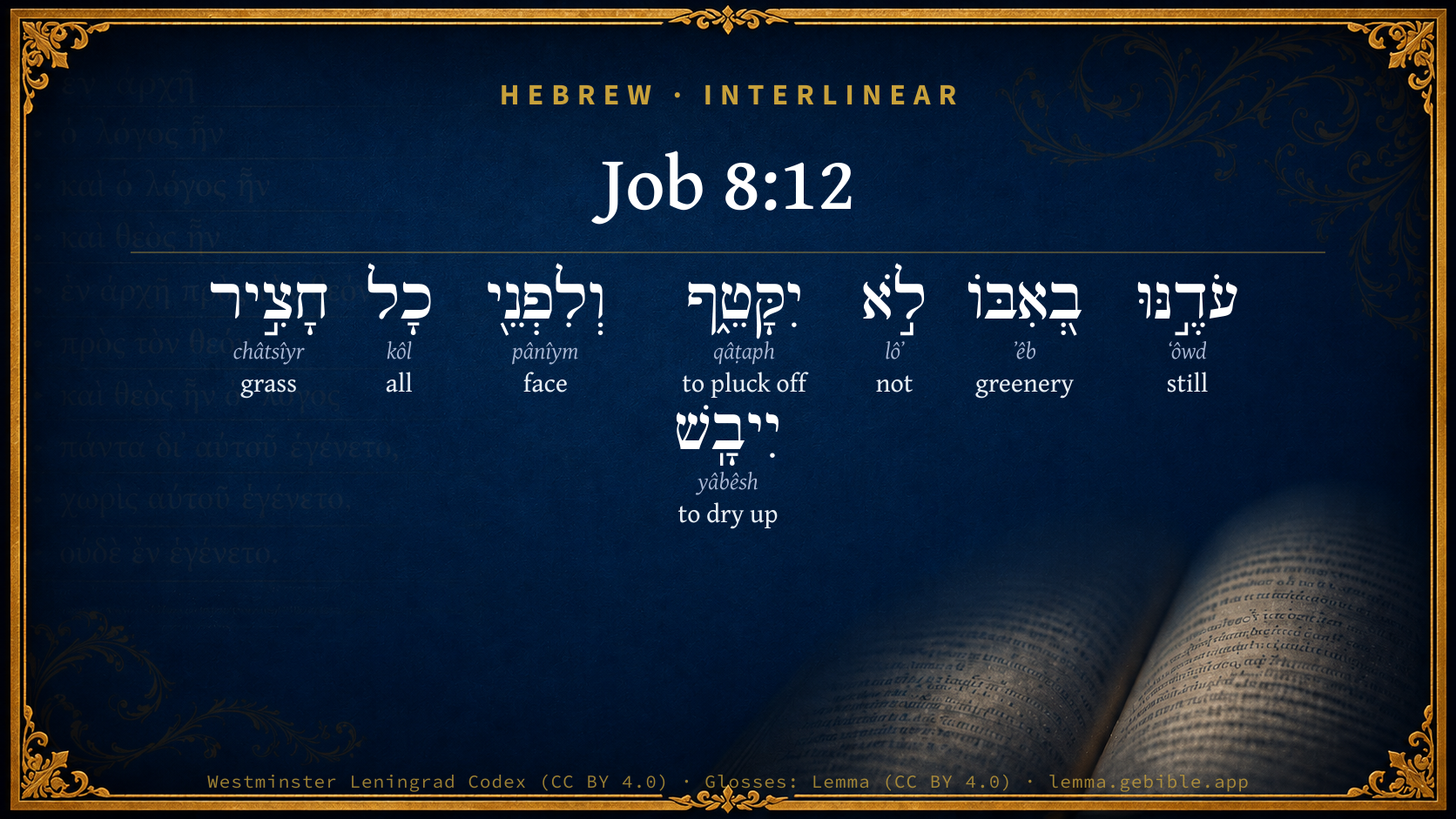
Job 8:12

Hebrew (Westminster Leningrad Codex) Job 8:12 appears in the Hebrew Old Testament. The text above is from the Westminster Leningrad Codex. Each word links to its Strong’s number, a concise gloss, and parsing drawn from the Open Scriptures Hebrew Bible morphology. Click any word for its full Brown-Driver-Briggs (BDB) entry.
Download image
Cite this verse

Job 8:12 (World English Bible). Public Domain. Lemma interlinear Bible study tool, https://lemma.gebible.app/v/job/8/12.

Show BibTeX & RIS
BibTeX
RIS
English Translation
While it is yet in its greenness, not cut down, It withers before any other reed.
World English Bible · Public Domain
Highlights Full analysis ↓
Download a study sheet

One document with this verse’s original text, its word-by-word gloss line, the meaning frame, cross-references with their text, attributed commentary, and full source and license credits — printable, and it pastes into notes with its structure intact.

This verse Autodidact and up

Study sheet (.html) Plain text (.txt)

A passage Seminary Student

Up to 50 verses in one chapter. A passage sheet keeps up to 6 commentary sources and 12 cross-references per verse, in the order this page ranks them, and says so on the sheet whenever that leaves anything out. Ask for a single verse and you get the Autodidact verse sheet above.

Everything on this page stays free to read, with no account — the sheet is a download of what is already on screen, not access to it.

Want to remove ads? Support Godless Engineer
Compare translations 3

The same verse in 3 English versions, stacked beneath the original-language interlinear above. Click any original word for its lexicon entry.

Each is an independent rendering of the whole verse — the interlinear is not word-aligned to these translations.

Highlighted words mark where these versions differ — a whole-verse word diff, not a word-by-word alignment.

  • World English Bible Public Domain
    While it is yet in its greenness, not cut down, It withers before any other reed.
  • King James Version Public Domain
    Whilst it is yet in his greenness, and not cut down, it withereth before any other herb.
  • unfoldingWord Literal Text CC BY-SA 4.0
    It still in its greenness, it is not cut down, but it withers before any plant.

unfoldingWord Literal Text — © unfoldingWord, licensed CC BY-SA 4.0. Word-aligned USFM3 via Door43 (git.door43.org/unfoldingWord/en_ult).

Versions to compare (up to 4)

3 of 4 selected

Show all 18 translations

Every available English version of this verse, each an independent rendering of the whole verse.

  • World English Bible Public Domain
    While it is yet in its greenness, not cut down, It withers before any other reed.
  • Berean Standard Bible Public Domain
    While the shoots are still uncut, they dry up quicker than grass.
  • Majority Standard Bible Public Domain
    While the shoots are still uncut, they dry up more quickly than grass.
  • King James Version Public Domain
    Whilst it is yet in his greenness, and not cut down, it withereth before any other herb.
  • American Standard Version (1901) Public Domain
    Whilst it is yet in its greenness, `and' not cut down, It withereth before any `other' herb.
  • Revised Version (1885) Public Domain
    Whilst it is yet in its greenness, and not cut down, it withereth before any other herb.
  • Geneva Bible (1599) Public Domain
    Though it were in greene and not cutte downe, yet shall it wither before any other herbe.
  • Douay-Rheims (1899) Public Domain
    When it is yet in flower, and is not plucked up with the hand, it withereth before all herbs.
  • Young's Literal Translation Public Domain
    While it `is' in its budding -- uncropt, Even before any herb it withereth.
  • Literal Standard Version CC BY-SA 4.0
    While it [is] in its budding—uncropped, || Even before any herb it withers.
  • Unlocked Literal Bible CC BY-SA 4.0
    While they are still green and not cut down, they wither before any other plant.
  • unfoldingWord Literal Text CC BY-SA 4.0
    It still in its greenness, it is not cut down, but it withers before any plant.
  • Darby Bible Public Domain
    Whilst it is yet in its greenness [and] not cut down, it withereth before any [other] grass.
  • World Messianic Bible Public Domain
    While it is yet in its greenness, not cut down, it withers before any other reed.
  • Webster's Bible Public Domain
    Whilst it is yet in its greenness, and not cut down, it withereth before any other herb.
  • Free Bible Version CC BY-SA 4.0
    Even without being cut, while they are still flowering, they wither faster than grass.
  • Bible in Basic English Public Domain
    When it is still green, without being cut down, it becomes dry and dead before any other plant.
  • JPS Tanakh (1917) Public Domain
    Whilst it is yet in its greenness, and not cut down, it withereth before any other herb.

Literal Standard Version (2020), Covenant Press — licensed CC BY-SA 4.0. Text via the HelloAO Bible API (eBible.org). Unlocked Literal Bible (unfoldingWord) — licensed CC BY-SA 4.0. Text via the HelloAO Bible API (eBible.org). unfoldingWord Literal Text — © unfoldingWord, licensed CC BY-SA 4.0. Word-aligned USFM3 via Door43 (git.door43.org/unfoldingWord/en_ult). Free Bible Version, Dr. Jonathan Gallagher — licensed CC BY-SA 4.0. Text via the HelloAO Bible API (eBible.org).

Word by word

More ways to search: Search by grammar → Find every occurrence → Compare this word →

Practice this passage: Drill this verse → Learn its vocabulary →

About this verse

These counts appear in no published source. They are computed here, from the morphology-tagged text and Lemma’s own curated glosses. What Lemma adds →

8
words
8
distinct lemmas
Wisdom
section

Notable vocabulary

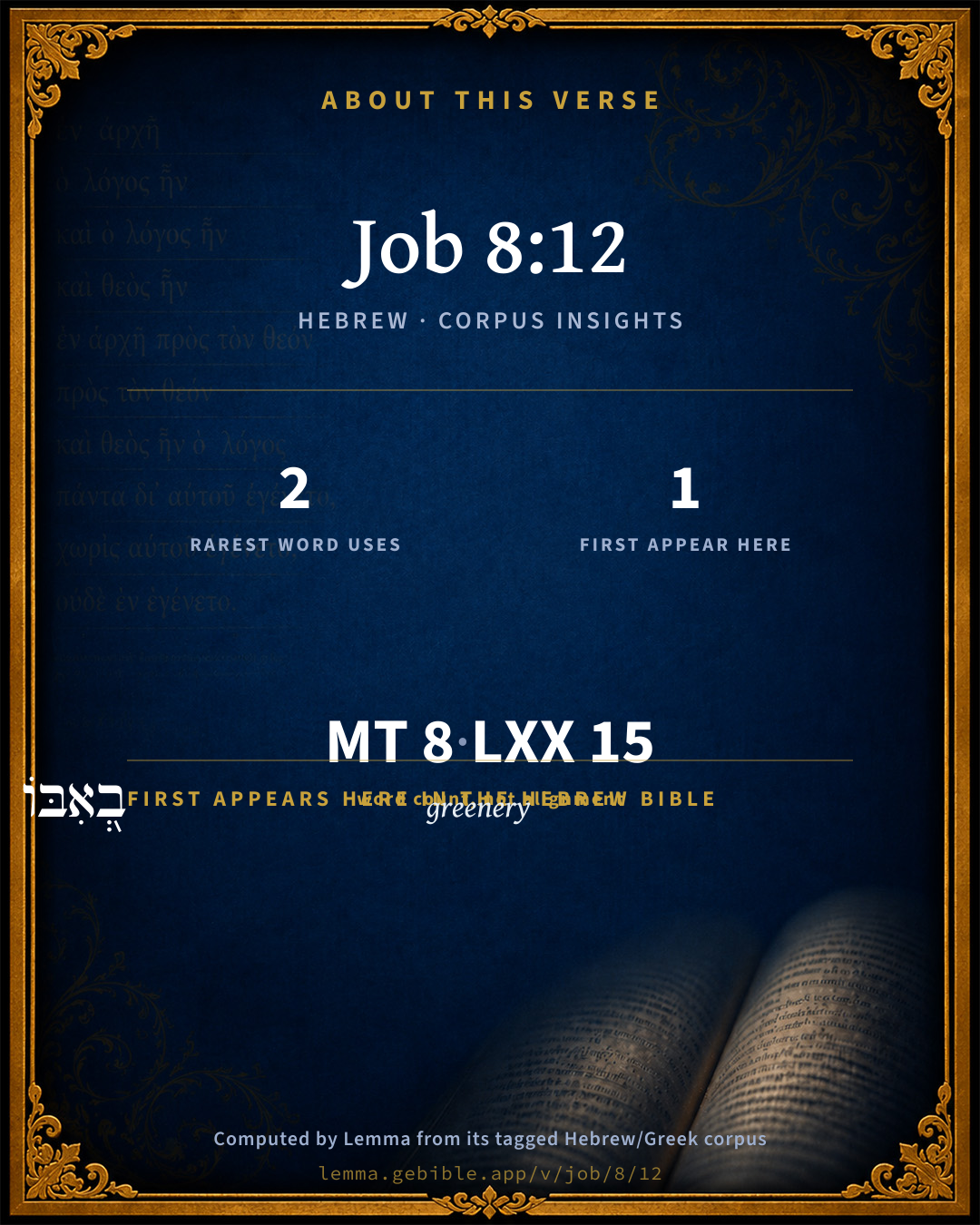
The rarest word here is בְ֭אִבּוֹ greenery H3 — appearing just 2 times in the whole Hebrew Bible.

First appearance in Scripture

This word makes its first canonical appearance in the Hebrew Bible here:

  • בְ֭אִבּוֹ greenery H3

Shared distinctive vocabulary

בְ֭אִבּוֹ greenery H3 occurs in 2 verses of the Hebrew Bible. Also found in:

Grammatical profile

  • 2 verbs
  • 4 nouns
  • 1 adverb
  • 1 particle

Verb forms

  • יִקָּטֵ֑ף Niphal · Imperfect
  • יִיבָֽשׁ Qal · Imperfect

Hebrew & Septuagint length

In English translation the verse runs 16 words from the Hebrew and 25 from the Septuagint (LXX English) — the Septuagint runs noticeably longer here. See the side-by-side →

A rough comparison of the two English renderings, which tokenize alike — not a word-level alignment.

Word counts can differ between the Hebrew and the Greek without any difference in meaning — e.g. the Hebrew direct-object marker אֵת has no separate Greek word, and Greek often adds the article ὁ.

In the original languages it is 8 Hebrew tokens and 15 Greek tokens — but the two are counted differently (Hebrew bundles its prefixes and suffixes into one token; the Greek is in lemma form), so that isn’t a like-for-like length.

Cross-references

5

Topical passages linked to Job 8:12 in the Treasury of Scripture Knowledge — connected by theme and wording, ordered by reader-vote popularity; previews shown in the World English Bible.

  • Jeremiah 17:6 For he shall be like the heath in the desert, and shall not see when good comes, but shall inhabit the parched places in the wilderness, a salt land and not inhabited.
  • Psalms 129:6–7 Let them be as the grass on the housetops, Which withers before it grows up;
  • Matthew 13:20 What was sown on the rocky places, this is he who hears the word, and immediately with joy receives it;
  • James 1:10–11 and the rich, in that he is made humble, because like the flower in the grass, he will pass away.
  • 1 Peter 1:24 For, "All flesh is like grass, And all of man's glory like the flower in the grass. The grass withers, and its flower falls;

Cross-references courtesy of OpenBible.info (CC BY 4.0).

Hebrew and Greek witnesses Masoretic Hebrew ↔ Greek Septuagint

The same verse in the two great witnesses to the Old Testament, shown verse-for-verse.

Here the Septuagint runs noticeably longer than the Hebrew — LXX2012 (modern English Septuagint) 25 words vs World English Bible 16. A rough length comparison of the two English translations, not a word-level alignment — read both below.

These are two independent witnesses, not word-aligned to each other, and the Septuagint is shown in lemma (dictionary) form.

Hebrew Job 8:12 Masoretic · Westminster Leningrad Codex

עֹדֶ֣נּוּ בְ֭אִבּוֹ לֹ֣א יִקָּטֵ֑ף וְלִפְנֵ֖י כָל חָצִ֣יר יִיבָֽשׁ

While it is yet in its greenness, not cut down, It withers before any other reed.

World English Bible · Public Domain

Greek LXX Job 8:12 Septuagint · lemma form

ἔτι εἰμί ἐπί ῥίζα καί οὐ μή θερίζω πρό ὁ πίνω πᾶς βοτάνη οὐ ξηραίνω

When it is yet on the root, and though it has not been cut down, does not any herb wither before it has received moisture?

LXX2012 (modern English Septuagint) · Public Domain

Hebrew: Westminster Leningrad Codex (CC BY 4.0). Greek: Septuagint (public domain); English from LXX2012 (modern English Septuagint) (Public Domain). How the Septuagint differs from the Hebrew →

Commentary

Notes on Job 8:12 from classic Christian and Jewish commentators (each source and its license shown beneath its notes). The classic Christian expositions comment on the surrounding passage and are grouped to its opening verse, so a note may address several verses; the Jewish commentaries on the Tanakh (Rashi and others) are per-verse, so they appear only where the commentator wrote on this verse.

Lemma curates 59 commentaries, every one of them public domain or Creative Commons licensed, each selected and text-cleaned for this edition rather than reprinted as found. About our sources →

Trapp's Complete Commentary

John Trapp

Job 8:12 Whilst it [is] yet in his greenness, [and] not cut down, it withereth before any [other] herb.

Ver. 12. Whilst it is yet in his greenness, &c.] And so withereth not through age, as being but in its shooting up.

And not cut down] Or, cropped off, either by the hands of men or teeth of beasts.

It withereth] For want of water, without store whereof it cannot live. The hypocrite is a sensualist, Jdg 18:19 Job 21:11 Hos 4:11; he liveth in such miry places as cannot be healed by the waters of the sanctuary, Eze 47:11. He saith, as the vine and the olive in Jotham’s parable, I cannot leave my wine, my fat and sweet sins; take away my liquor, you take away my life. He serveth not the Lord Jesus Christ (whatever he pretendeth), but his own belly, Rom 16:17-18. He followeth Christ for the loaves only.

Before any other herb] That is, of less show, but better rooting. These retain their verdure, and look on, as it were, to see the rush wither: so David did by Doeg, Psa 52:5-6; Psa 52:8.

John Trapp, A Commentary or Exposition upon All the Books of the Old and New Testament (1647–1656) — public domain. Text from a community e-Sword module.

Tyndale Open Study Notes

Tyndale Open Resources

8:12-13 To forget God does not mean to have a lapse of memory but to act as if God did not exist (see Pss 10:4; 14:1; Zeph 1:12) or cannot see (see Job 22:13-17; Ps 94:7).

Tyndale Open Study Notes — © Tyndale Open Resources, licensed CC BY-SA 4.0. Text via the HelloAO Bible API.

Jamieson, Fausset & Brown

Robert Jamieson, A. R. Fausset & David Brown

not cut down--Before it has ripened for the scythe, it withers more suddenly than any herb, having no self-sustaining power, once that the moisture is gone, which other herbs do not need in the same degree. So ruin seizes on the godless in the zenith of prosperity, more suddenly than on others who appear less firmly seated in their possessions [UMBREIT] (Psa 112:10).

Jamieson, Fausset & Brown — Commentary Critical and Explanatory on the Whole Bible (1871) — public domain (CC PDM 1.0). Text via the HelloAO Bible API.

Adam Clarke's Commentary

Verse 12. Whilst it is yet in his greenness] We do not know enough of the natural history of this plant to be able to discern the strength of this allusion; but we learn from it that, although this plant be very succulent, and grow to a great size, yet it is short-lived, and speedily withers; and this we may suppose to be in the dry season, or on the retreat of the waters of the Nile. However, Soon RIPE, soon ROTTEN, is a maxim in horticulture.

Adam Clarke's Commentary on the Bible (1810–1826) — public domain. Text from a community e-Sword/MySword module.

The Cambridge Bible for Schools and Colleges

gen. ed. J. J. S. Perowne

12. and not cut down] lit. and not to be cut down (or, plucked, ch. Job_30:4), that is, in its full luxuriance, not ripe nor ready for cutting, and therefore with no trace of withering or decay in it. In this state of full freshness, when water is withdrawn from it, it sinks and collapses, withering sooner than any herb.

The Cambridge Bible for Schools and Colleges (gen. ed. J. J. S. Perowne; Cambridge University Press, 1878–1918) — public domain. Text from a community e-Sword module.

John Gill's Exposition

So are the paths of all that forget God,.... Who forget that there is a God; he is not in all, and scarce in any of their thoughts, and they live without him in the world; who forget the works of God, of creation and providence, in which there is a glorious display of his being and perfections; who forget the benefits and blessings of his goodness they are every day partakers of, and are not thankful for them; and who forget the word, worship, and ordinances of God, and follow after and observe lying vanities, idols, and the works of men's hands, and worship them, being unmindful of the rock of their salvation: now such men, as well as the hypocrites in the next clause, are like bulrushes and flags, or sedge, being unfruitful, useless, and unprofitable; and, for their sensuality and worldly mindedness, standing in the mire and clay of an unregenerate state, and of carnal and worldly lusts; and though, especially the latter, may carry their heads high in a profession of religion, and make a fair show in the flesh while it is a time of outward prosperity with them, but when tribulation arises on the account of religion, they are presently offended, and apostatize; being destitute of the true grace of God, and having the root of the matter in them, they wither of themselves; they soon drop their profession in the view of all good men, comparable to herbs and green grass, which abide in their verdure, when the other are gone and are seen no more:

and the hypocrite's hope shall perish; who are either the same with those before described, who, being in prosperous circumstances, forget the God of their mercies they make a profession of, like Jeshurun of old, or different persons, as Bar Tzemach thinks, the former designing open profane sinners, these secret ones, under the appearance of good men: an "hypocrite" is one whose inside is not as his outside, as the Jews say; who is outwardly righteous, but inwardly wicked; has a form of godliness, but not the power of it; a name to live, but dead; that makes a show of religion and devotion, attending the worship and ordinances of God in an external way, as if he had great delight in him and them, when his heart is removed far from him: and such have their "hope", for the present, of being in the favour of God, and of future happiness, which is founded on their outward prosperity their esteem among men, and more especially their external righteousness, and profession of religion; but this will "perish", even both the ground of their hope, the riches and righteousness, which come to nothing, and the hope that is built thereupon sinks into despair; if not in life, as it sometimes does, yet always at death, see Job 11:20; Bildad seems to have Job in view here, whom he esteemed an hypocrite.

John Gill's Exposition of the Whole Bible (1746–1763) — public domain (CC PDM 1.0). Text via the HelloAO Bible API.

Albert Barnes' Notes on the Bible

Whilst it is yet in his greenness - That is, while it seems to be in its vigor.

And is not cut down - Even when it is not cut down. If suffered to stand by itself, and if undisturbed, it will wither away. The application of this is obvious and beautiful. Such plants have no self sustaining power. They are dependent on moisture for their support. If that is withheld, they droop and die. So with the prosperous sinner and the hypocrite. His piety, compared with that which is genuine, is like the spongy texture of the paper-reed compared with the solid oak. He is sustained in his professed religion by outward prosperity, as the rush is nourished by moisture; and the moment his prosperity is withdrawn, his religion droops and dies like the flag without water.

Albert Barnes' Notes on the Bible (1834–1885) — public domain. Text from a community e-Sword/MySword module.

Haydock's Catholic Bible Commentary

Herbs, for want of moisture. (Calmet) --- Sic transit gloria mundi. (Haydock) --- The prophets often compare the prosperity of the wicked to grass, (Psalm xxxvi. 2., and James i. 10.) and Baldad ranks Job with them.

George Leo Haydock (1774–1849), Haydock's Catholic Family Bible and Commentary, 1859 edition — public domain. Excludes Psalms (Douay-Rheims chapter numbering differs from Protestant) and Deuterocanonical books (Catholic canon only).

Matthew Poole's English Annotations

Yet in his greenness; whereby it promiseth long continuance.

Not cut down; though no man cut it down, it withereth of itself, and will save a man the labour of cutting or plucking it up. It gives not a man so much warning that he can cut it down in time, as other green herbs do, but suddenly withereth.

Before any other herb, i.e. sooner than other herbs, or in their presence, or they surviving; in which sense it seems to be said that Ishmael died in the presence of his brethren, Gen 25:18; the rest of the herbs looking upon it, and admiring this sudden change. For actions of sense and understanding are oft ascribed to lifeless creatures, both in Scripture and other authors.

Matthew Poole's English Annotations on the Holy Bible (1683–1685) — public domain. Text from a community e-Sword/MySword module.

Whedon's Commentary on the Bible

Daniel D. Whedon

12. It withereth — Our translators have disregarded the (in this case) important ו: while yet it is in its greenness, it is uncut, (and) THEN, sooner than all (other) grass, it drieth up. The passage strikingly illustrates the estate of the hypocrite — the man who forgets God. The tall and graceful plant need not be cut down that it may suddenly die. Take from it the moisture of the marsh, and it withers. Thus with one who assumes to be what he is not. False and characterless he stands. He has no life of God in the soul. Withdraw the grace of God, and his nakedness stands self-confessed. He withers before he dies. Few are the exceptions to the law that the character of men is known to their fellows before they are cut down. The scene of the first three verses of this poem is evidently the Nile. The hot sun dries up the marsh water, and the plants perish. Still not far away rolls the majestic river, sometimes, as we have seen, called the ocean. In like manner the sinner perishes in the morass, not far from the river of life.

Daniel D. Whedon (gen. ed.), Commentary on the Old and New Testaments (1874–1909) — public domain. Text from a community e-Sword module.

The Pulpit Commentary

Whilst it is yet in his greenness, and not out down. It grows and flourishes in a rich greenness up to a certain point; no one touches it; but the water fails from the root, and it fades, collapses, and is gone. It withereth before any other herb. The ground may be all green around it with ordinary grass and other herbs, since they only need a little moisture the water-plant will collapse unless it has its full supply.

The Pulpit Commentary (1880–1919), ed. H.D.M. Spence-Jones & Joseph S. Exell — public domain. Text from a community e-Sword module.

John Wesley's Explanatory Notes

Greenness - Whereby it promises long continuance. Tho' no man cut it down, it withers of itself, sooner than other herbs.

John Wesley, Explanatory Notes Upon the Whole Bible (1754–1765) — public domain. Text via the GEBible commentary corpus.

Rashi

Rabbi Shlomo Yitzchaki (Rashi)

in its greenness In its moisture and with its produce.

will not be plucked Heb. יקטף, will not be broken or pulled off; like (Deut. 23:26), “you may pluck (וקטפת) ears.”

but before any other grass it will dry up Before any other grass [does], it will dry up when the water evaporates and the marsh dries up.

Rashi on the Tanakh — English translations: “The Judaica Press complete Tanach with Rashi, translated by A. J. Rosenberg” (CC BY 4.0); “Pentateuch with Rashi's commentary by M. Rosenbaum and A.M. Silbermann, 1929-1934” (public domain); “The Metsudah Tanach series, Lakewood, N.J” (CC BY 4.0); and “The Book of Joshua, Metsudah Publications, 1997” (CC BY 4.0). Text via Sefaria.

Lesson kit

Teaching starters — assembled from the data on this page, not authored interpretation. Every prompt links to the verse data it draws on. Edit before teaching.

Job, in the Wisdom, opens this verse with 8 words (8 distinct Hebrew lemmas). Its most distinctive word is ʼêb (“greenery”). The Greek Septuagint runs longer here. A historical commentator’s framing appears above. Read the whole chapter for the surrounding context.

Discussion questions

  1. What does “greenery” (ʼêb) contribute to the verse as a whole?
  2. The word “greenery” first appears here in Scripture. What is being introduced at this debut?
  3. Song of Solomon 6:11 shares the word «greenery» with this verse. How do the two illuminate each other?
  4. Compared with the Hebrew, the Septuagint runs longer here. What questions does that raise?
  5. These translations render this verse differently. What is at stake in choosing one wording over another?
  6. The verb «יִקָּטֵ֑ף» is Niphal Imperfect. How does its form color the action?
  7. Reading how Trapp's Complete Commentary and Tyndale Open Study Notes read this verse, where do the two commentators agree and where do they part?

Things to notice

Reading settings

Reading text

Shown beneath each verse's original-language words.

Old Testament
Old Testament edition

Read the OT as the Masoretic Hebrew (MT) or the Greek Septuagint (LXX).

English shown for the Greek Septuagint (in the Hebrew ↔ Greek comparison).

Comparing translations? Open the Compare panel on any verse page to stack up to four side by side.