
Isaiah 40:7

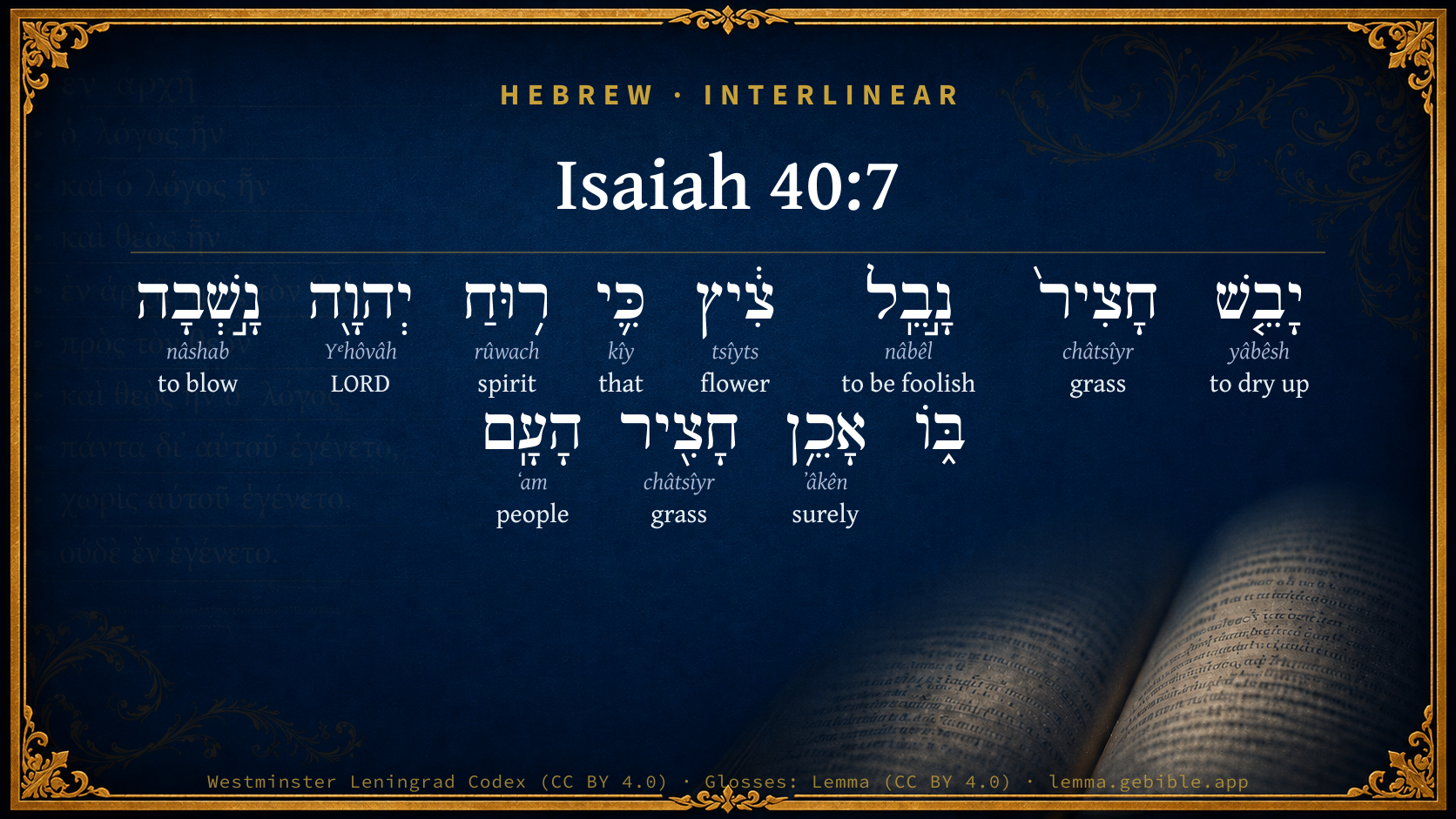
Hebrew (Westminster Leningrad Codex) Isaiah 40:7 appears in the Hebrew Old Testament. The text above is from the Westminster Leningrad Codex. Each word links to its Strong’s number, a concise gloss, and parsing drawn from the Open Scriptures Hebrew Bible morphology. Click any word for its full Brown-Driver-Briggs (BDB) entry.
Download image
Cite this verse

Isaiah 40:7 (World English Bible). Public Domain. Lemma interlinear Bible study tool, https://lemma.gebible.app/v/isaiah/40/7.

Show BibTeX & RIS
BibTeX
RIS
English Translation
The grass withers, the flower fades, because the breath of Yahweh blows on it; surely the people is grass.
World English Bible · Public Domain
Download a study sheet

One document with this verse’s original text, its word-by-word gloss line, the meaning frame, cross-references with their text, attributed commentary, and full source and license credits — printable, and it pastes into notes with its structure intact.

This verse Autodidact and up

Study sheet (.html) Plain text (.txt)

A passage Seminary Student

Up to 50 verses in one chapter. A passage sheet keeps up to 6 commentary sources and 12 cross-references per verse, in the order this page ranks them, and says so on the sheet whenever that leaves anything out. Ask for a single verse and you get the Autodidact verse sheet above.

Everything on this page stays free to read, with no account — the sheet is a download of what is already on screen, not access to it.

Want to remove ads? Support Godless Engineer
Compare translations 3

The same verse in 3 English versions, stacked beneath the original-language interlinear above. Click any original word for its lexicon entry.

Each is an independent rendering of the whole verse — the interlinear is not word-aligned to these translations.

Highlighted words mark where these versions differ — a whole-verse word diff, not a word-by-word alignment.

  • World English Bible Public Domain
    The grass withers, the flower fades, because the breath of Yahweh blows on it; surely the people is grass.
  • King James Version Public Domain
    The grass withereth, the flower fadeth: because the spirit of the LORD bloweth upon it: surely the people is grass.
  • unfoldingWord Literal Text CC BY-SA 4.0
    The grass dries up, the flower withers, for the breath of Yahweh blows on it; surely the people grass.

unfoldingWord Literal Text — © unfoldingWord, licensed CC BY-SA 4.0. Word-aligned USFM3 via Door43 (git.door43.org/unfoldingWord/en_ult).

Versions to compare (up to 4)

3 of 4 selected

Show all 18 translations

Every available English version of this verse, each an independent rendering of the whole verse.

  • World English Bible Public Domain
    The grass withers, the flower fades, because the breath of Yahweh blows on it; surely the people is grass.
  • Berean Standard Bible Public Domain
    The grass withers and the flowers fall when the breath of the LORD blows on them; indeed, the people are grass.
  • Majority Standard Bible Public Domain
    The grass withers and the flowers fall when the breath of the LORD blows on them; indeed, the people are grass.
  • King James Version Public Domain
    The grass withereth, the flower fadeth: because the spirit of the LORD bloweth upon it: surely the people is grass.
  • American Standard Version (1901) Public Domain
    The grass withereth, the flower fadeth, because the breath of Jehovah bloweth upon it; surely the people is grass.
  • Revised Version (1885) Public Domain
    The grass withereth, the flower fadeth; because the breath of the LORD bloweth upon it: surely the people is grass.
  • Geneva Bible (1599) Public Domain
    The grasse withereth, the floure fadeth, because the Spirite of the Lord bloweth vpon it: surely the people is grasse.
  • Douay-Rheims (1899) Public Domain
    The grass is withered, and the dower is fallen, because the spirit of the Lord hath blown upon it. Indeed the people is grass:
  • Young's Literal Translation Public Domain
    Withered hath grass, faded the flower, For the Spirit of Jehovah blew upon it, Surely the people `is' grass;
  • Literal Standard Version CC BY-SA 4.0
    Grass has withered, the flower faded, || For the Spirit of YHWH blew on it, || Surely the people [is] grass;
  • Unlocked Literal Bible CC BY-SA 4.0
    The grass withers and the flower wilts when the breath of Yahweh blows on it; surely humanity is grass.
  • unfoldingWord Literal Text CC BY-SA 4.0
    The grass dries up, the flower withers, for the breath of Yahweh blows on it; surely the people grass.
  • Darby Bible Public Domain
    The grass withereth, the flower fadeth, for the breath of Jehovah bloweth upon it: surely the people is grass.
  • World Messianic Bible Public Domain
    The grass withers, the flower fades, because the LORD’s breath blows on it. Surely the people are like grass.
  • Webster's Bible Public Domain
    The grass withereth, the flower fadeth: because the spirit of the LORD bloweth upon it: surely the people is grass.
  • Free Bible Version CC BY-SA 4.0
    The grass wilts and the flower fades when the Lord breathes on them. Yes, the people are grass!
  • Bible in Basic English Public Domain
    The grass becomes dry, the flower is dead; because the breath of the Lord goes over it: truly the people is grass.
  • JPS Tanakh (1917) Public Domain
    The grass withereth, the flower fadeth; because the breath of the LORD bloweth upon it — surely the people is grass.

Literal Standard Version (2020), Covenant Press — licensed CC BY-SA 4.0. Text via the HelloAO Bible API (eBible.org). Unlocked Literal Bible (unfoldingWord) — licensed CC BY-SA 4.0. Text via the HelloAO Bible API (eBible.org). unfoldingWord Literal Text — © unfoldingWord, licensed CC BY-SA 4.0. Word-aligned USFM3 via Door43 (git.door43.org/unfoldingWord/en_ult). Free Bible Version, Dr. Jonathan Gallagher — licensed CC BY-SA 4.0. Text via the HelloAO Bible API (eBible.org).

Word by word

More ways to search: Search by grammar → Find every occurrence → Compare this word →

Practice this passage: Drill this verse → Learn its vocabulary →

נָ֣שְׁבָה
nâshab
H5380
“to blow”
Verb, Qal, Perfect, 3rd Person, Feminine, Singular
Part of Speech
Verb
Stem
Qal
Form
Perfect
Person
3rd Person
Gender
Feminine
Number
Singular
Full BDB Definition

Origin: a primitive root

TWOT: 1426

to blow - (Qal) to blow - (Hiphil) - to cause to blow - to disperse, to drive away
  1. יָבֵ֤שׁ yâbêsh H3001 “to dry up” Verb, Qal, Perfect, 3rd Person, Masculine, Singular
  2. חָצִיר֙ châtsîyr H2682 “grass” Noun, Common, Masculine, Singular, Absolute
  3. נָ֣בֵֽל nâbêl H5034 “to be foolish” Verb, Qal, Perfect, 3rd Person, Masculine, Singular
  4. צִ֔יץ tsîyts H6731 “flower” Noun, Common, Masculine, Singular, Absolute
  5. כִּ֛י kîy H3588 “that” Conjunction
  6. ר֥וּחַ rûwach H7307 “spirit of” Noun, Common, Both, Singular, Construct
  7. יְהוָ֖ה Yᵉhôvâh H3068 “LORD” Noun, Proper
  8. אָכֵ֥ן ʼâkên H403 “surely” Adverb
  9. חָצִ֖יר châtsîyr H2682 “grass” Noun, Common, Masculine, Singular, Absolute
  10. הָעָֽם ʻam H5971 “the · people” Particle, Definite Article + Noun, Common, Masculine, Singular, Absolute

About this verse

These counts appear in no published source. They are computed here, from the morphology-tagged text and Lemma’s own curated glosses. What Lemma adds →

12
words
10
distinct lemmas
Prophets
section

Notable vocabulary

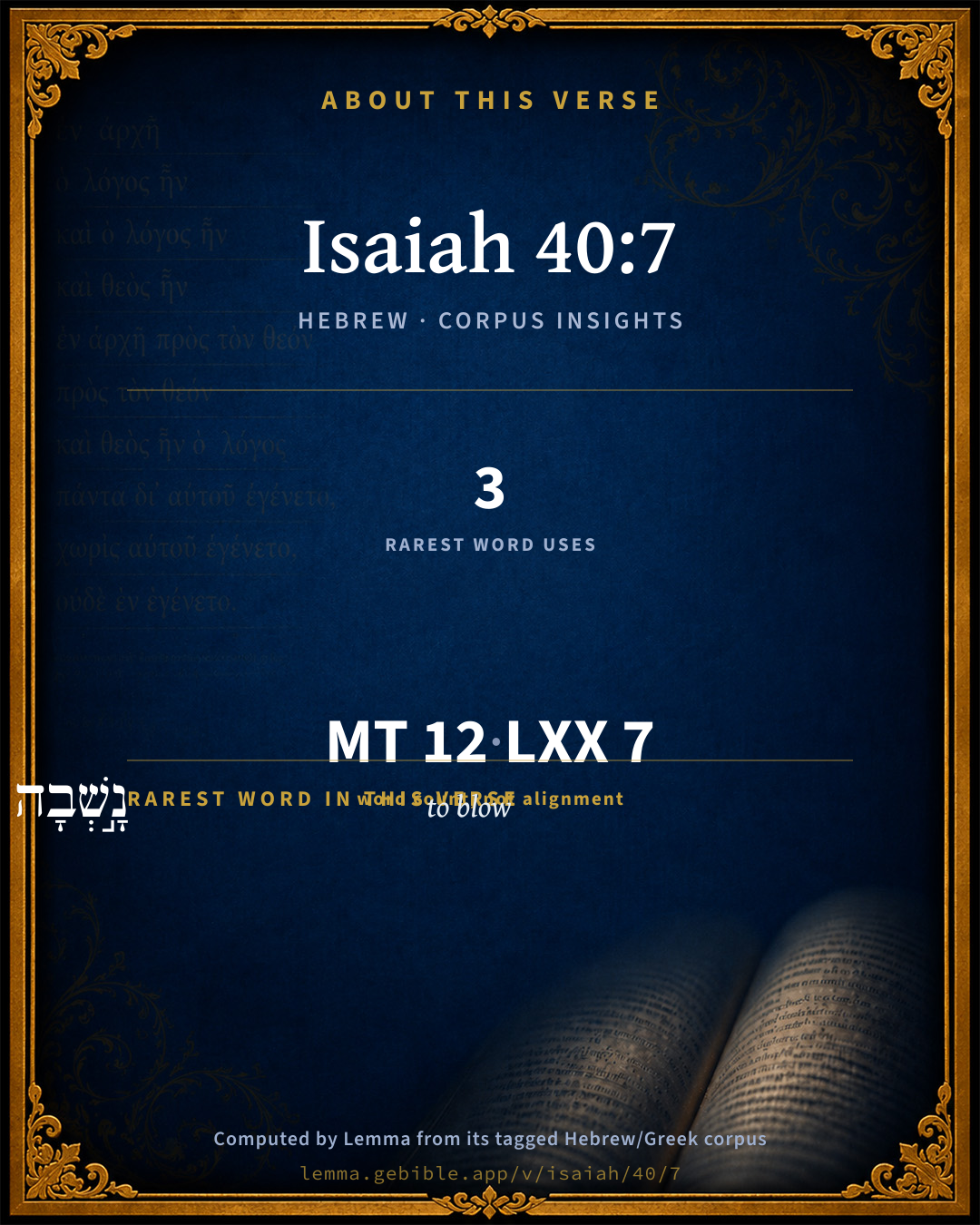
The rarest word here is נָ֣שְׁבָה to blow H5380 — appearing just 3 times in the whole Hebrew Bible.

Shared distinctive vocabulary

נָ֣שְׁבָה to blow H5380 occurs in 3 verses of the Hebrew Bible. Also found in:

Grammatical profile

  • 3 verbs
  • 6 nouns
  • 1 preposition
  • 1 conjunction
  • 1 adverb

Verb forms

  • יָבֵ֤שׁ Qal · Perfect
  • נָ֣בֵֽל Qal · Perfect
  • נָ֣שְׁבָה Qal · Perfect

Repetition

A word recurs within this verse — often emphatic in Hebrew:

  • חָצִיר֙ grass H2682 ×2

Hebrew & Septuagint length

In the original languages it is 12 Hebrew tokens and 7 Greek tokens — but the two are counted differently (Hebrew bundles its prefixes and suffixes into one token; the Greek is in lemma form), so that isn’t a like-for-like length.

Cross-references

1

Topical passages linked to Isaiah 40:7 in the Treasury of Scripture Knowledge — connected by theme and wording, ordered by reader-vote popularity; previews shown in the World English Bible.

  • Job 41:21 His breath kindles coals. A flame goes forth from his mouth.

Cross-references courtesy of OpenBible.info (CC BY 4.0).

Hebrew and Greek witnesses Masoretic Hebrew ↔ Greek Septuagint

The same verse in the two great witnesses to the Old Testament, shown verse-for-verse.

These are two independent witnesses, not word-aligned to each other, and the Septuagint is shown in lemma (dictionary) form.

Hebrew Isaiah 40:7 Masoretic · Westminster Leningrad Codex

יָבֵ֤שׁ חָצִיר֙ נָ֣בֵֽל צִ֔יץ כִּ֛י ר֥וּחַ יְהוָ֖ה נָ֣שְׁבָה בּ֑וֹ אָכֵ֥ן חָצִ֖יר הָעָֽם

The grass withers, the flower fades, because the breath of Yahweh blows on it; surely the people is grass.

World English Bible · Public Domain

Greek LXX Isaiah 40:7 Septuagint · lemma form

ξηραίνω ὁ χόρτος καί ὁ ἄνθος ἐκπίπτω

No English rendering of this Greek verse — the small residue in the structurally divergent books.

On this verse, The Cambridge Bible for Schools and Colleges discusses the Septuagint’s reading. Read the note in Commentary ↓

Hebrew: Westminster Leningrad Codex (CC BY 4.0). Greek: Septuagint (public domain); English from a public-domain English Septuagint. How the Septuagint differs from the Hebrew →

Targum (Aramaic paraphrase)

1

The Targum is the ancient Jewish Aramaic paraphrase of the Hebrew Scriptures — an interpretive translation, not the Hebrew text itself. Onkelos (literal) and Pseudo-Jonathan (expansive) render the Torah, and Jonathan the Prophets. Coverage is partial: where no permissively-licensed English translation exists for a verse, only the Aramaic is shown. This is verse-level text, not a word-by-word alignment to the Hebrew.

  1. Targum Jonathan Prophets (Joshua–Malachi)
    יָבֵשׁ עִשְׂבָּא נְתַר נִצֵיהּ אֲרֵי רוּחָא מִן קֳדָם יְיָ נְשָׁבַת בֵּיהּ בְּכֵן כְּעִשְׂבָּא חֲשִׁיבִין רַשִׁיעַיָא בְּעַמָא:

    The grass withereth, its flower fadeth: because the spirit of the Lord bloweth upon it: surely the wicked among a people are considered like grass.

    Targum Jonathan — Aramaic: “Mikraot Gedolot” (public domain). English: “Sefaria Community Translation” (CC0 1.0 (public-domain dedication)); “London "Chaldee Paraphrase," 1871” (public domain). Text via Sefaria.

Commentary

Notes on Isaiah 40:7 from classic Christian and Jewish commentators (each source and its license shown beneath its notes). The classic Christian expositions comment on the surrounding passage and are grouped to its opening verse, so a note may address several verses; the Jewish commentaries on the Tanakh (Rashi and others) are per-verse, so they appear only where the commentator wrote on this verse.

Lemma curates 59 commentaries, every one of them public domain or Creative Commons licensed, each selected and text-cleaned for this edition rather than reprinted as found. About our sources →

The Cambridge Bible for Schools and Colleges

gen. ed. J. J. S. Perowne

7. the spirit of the Lord] Better as R.V. the breath of the LORD, i.e. the wind (Psa_103:16), specially the scorching east-wind (Hos_13:15) or Sirocco, which blows chiefly in the spring, blighting the fresh vegetation (see Smith, Hist. Geog. of Palestine, pp. 67 ff.).

surely the people is grass] “The people,” used absolutely, must apparently mean “humanity”; although there are no strict parallels to this sense. To understand it of Israel is opposed to the prophet’s general teaching and misrepresents his meaning here. It is not Israel, but the enemies of Israel, whose perishableness he is concerned to assert. The words at best are a flat repetition of Isa_40:6 and should probably be removed as a marginal gloss. The LXX., indeed, omits all from because in Isa_40:7 to fadeth in Isa_40:8 : but this proves nothing, as it is evidently an oversight caused by the homœoteleuton. The resumption of the leading thought is a very effective introduction to the contrasted idea in the end of Isa_40:8.

The Cambridge Bible for Schools and Colleges (gen. ed. J. J. S. Perowne; Cambridge University Press, 1878–1918) — public domain. Text from a community e-Sword module.

Trapp's Complete Commentary

John Trapp

Isa 40:7 The grass withereth, the flower fadeth: because the spirit of the LORD bloweth upon it: surely the people [is] grass.

Ver. 7. Because the Spirit of the Lord bloweth upon it.] Or, when the breath of the Lord bloweth upon it. God can easily blow men to destruction, dissipate them as so many vile dust heaps. {Job 4:9; Job 34:14-15 Psa 104:29 Dan 2:34-35 Zec 4:6}

Surely the people is grass.] Have we not heard; have we not seen from the beginning; doth not every day’s experience seal to it, that all flesh is grass? yea, hath not God oft heard our attestations? We shake our heads, we confess it is true, &c., and yet we lay it not rightly to heart, though so deeply assevered and assured us.

John Trapp, A Commentary or Exposition upon All the Books of the Old and New Testament (1647–1656) — public domain. Text from a community e-Sword module.

Tyndale Open Study Notes

Tyndale Open Resources

40:7 The breath of the Lord refers to God’s spoken words of judgment (see 4:4).

Tyndale Open Study Notes — © Tyndale Open Resources, licensed CC BY-SA 4.0. Text via the HelloAO Bible API.

Geneva Bible (1599)

Geneva Bible translators

The spirit of God shall discover the vanity in all that seem to have any excellency of themselves.

Geneva Bible (1599) marginal notes — public domain. Text via Bolls.life.

Jamieson, Fausset & Brown

Robert Jamieson, A. R. Fausset & David Brown

spirit of the Lord--rather, "wind of Jehovah" (Psa 103:16). The withering east wind of those countries sent by Jehovah (Jon 4:8).

the people--rather, "this people" [LOWTH], which may refer to the Babylonians [ROSENMULLER]; but better, mankind in general, as in Isa 42:5, so Isa 40:6, "all flesh"; this whole race, that is, man.

Jamieson, Fausset & Brown — Commentary Critical and Explanatory on the Whole Bible (1871) — public domain (CC PDM 1.0). Text via the HelloAO Bible API.

Adam Clarke's Commentary

Verse 7. The grass withereth] The whole of this verse is wanting in three of Kennicott's and five of De Rossi's MSS., and in a very correct and ancient MS. of my own, and also in the Septuagint and Arabic.

Surely the people - "Verily this people"] So the Syriac; who perhaps read העם הזה haam hazzeh.

Because the spirit of the Lord - "When the wind of JEHOVAH"] רוח יהוה ruach Jehovah, a wind of JEHOVAH, is a Hebraism, meaning no more than a strong wind. It is well known that a hot wind in the east destroys every green thing. Compare Ps 103:16. Two MSS. omit the word יהוה Yehovah, Jehovah.

Adam Clarke's Commentary on the Bible (1810–1826) — public domain. Text from a community e-Sword/MySword module.

Ellicott's Commentary for English Readers

(7) The spirit of the Lord bloweth upon it.—Better, the breath, or the wind of Jehovah, as we are still in the region of the parable, and the agency is destructive, and not quickening. A “wind of Jehovah” would be a mighty storm-blast, tearing up the grass and hurling it to destruction. The image of the fading flower reminds us of the well-known Homeric simile, “As are the generations of leaves, so are those of men.” (Comp. Psa_103:15-16.)

The word of our God . . .—Primarily the prophetic word revealing the will of God, but including all manifestations of His being (Psa_119:41; Psa_119:65; Psa_119:89; Joh_1:1).

A Bible Commentary for English Readers, edited by Charles John Ellicott (1878–1897) — public domain. Text from a community e-Sword module.

John Gill's Exposition

The grass withereth, the flower fadeth,.... And so does man, and all his glory and goodliness:

because the Spirit of the Lord bloweth upon it: alluding to some impetuous and blasting wind blowing upon herbs and flowers, to the withering and fading of them; see Psa 103:15, legal ordinances ceased upon the pouring forth of the Spirit. The external excellencies of men, or their outward advantages, perish at the breath of God, at the blast of his nostrils, when taken away by death; and at conversion the Spirit of the Lord blows a blast upon all the goodliness of man; the operations of the Spirit are compared to wind, Joh 3:8, which, like that, are free, and, as he pleases, are invisible and imperceptible, land powerful and efficacious, and these cause a withering in men's goodness; the Spirit of God shows that their holiness is not true holiness; that their righteousness has only the appearance of one before men; and their religion and godliness a mere form; and their good works, "splendida peccata", shining sins; that those are insufficient to justify and save, and bring to heaven; upon which they fade away and die in their esteem, who now reckon them but loss and dung, Phi 3:6, "surely the people is grass"; the people of the Jews, with all their external advantages; yea, all people, with all the excellencies of human nature, or considered in their best estate, possessed of all that is reckoned good and great, being but mere natural men. The Targum restrains this to the ungodly, as it does the former verse, rendering it,

"as grass the wicked among the people are esteemed;''

as it does the former, thus,

"the wicked are as grass, and their strength as the stubble of the field.''

So Kimchi interprets them of the nations that come with Gog and Magog; and Jarchi of the princes of the kingdoms; but very wrongly, since it is true of all flesh, or of all mankind.

John Gill's Exposition of the Whole Bible (1746–1763) — public domain (CC PDM 1.0). Text via the HelloAO Bible API.

Albert Barnes' Notes on the Bible

The grass withereth - Soon withers. Its beauty is soon gone.

The flower fadeth - Soon fades; or fades when the wind of Yahweh passes over it. So is also with man. He loses his vigor, and dies at once when Yahweh takes away his strength and beauty.

Because the spirit of the Lord bloweth upon it - This should be rendered, undoubtedly, ‘When the wind of Yahweh bloweth upon it.’ The word ‘spirit’ here does not suit the connection, and does not express the idea of the prophet. The word רוח rûach means, properly, “breath” - a breathing, or blowing; and is often used indeed to denote spirit, soul, life. But it often means a breath of wind; a breeze; air in motion Job 41:8; Jer 2:24; Jer 14:6. It is applied to the cool breeze which springs up in the evening (Gen 3:8; compare Son 2:17; Son 4:6). It sometimes means a strong and violent wind Gen 8:1; Isa 7:2; Isa 41:16; and also a tempest, or hurricane Job 1:19; Job 30:15; Isa 27:8. The ‘wind of Yahweh’ means that which Yahweh sends, or causes; and the expression here refers, doubtless, to the hot or poisonous east winds which blow in Oriental countries, and which wither and dry up everything before them (compare Jon 4:8).

Surely the people is grass - Lowth reads this, ‘this people;’ referring to the Jewish nation. So the Syriac. Perhaps it refers to the people of Babylon (so Rosenmuller), and means that mighty people would fade away like grass. But the more probable interpretation is that which regards it as referring to all people, and of course including the Jews and the Babylonians. The sense, according to this view, is, ‘all nations shall fade away. All human power shall cease. But the promise of Yahweh shall survive. It shall be unchanging amidst all revolutions; it shall survive all the fluctuations which shall take place among people. It may, therefore, be trusted with unwavering reliance.’ To produce that reliance was the object of the proclamation. On this passage, descriptive of the state of man, the reader will at once be reminded of the beautiful language of Shakespeare:

This is the state of man! Today he puts forth

The tender leaves of hope: to-morrow blossoms,

And bears his blushing honors thick upon him;

The third day comes a frost, a killing frost,

And when he thinks, good easy man, full surely

His greatness is a-ripening, nips his root,

And then he falls -

- Never to hope again.

Hen. VIII, Act. ii. Sc. 2.

In the following passage from Tasso, the same image is adopted:

The gentle budding rose (quoth he) behold,

That first scant peeping forth with virgin beams,

Half ope, half shut, her beauties doth up-fold

In their dear leaves, and less seen fairer seems,

And after spreads them forth more broad and bold,

Then languishes and dies in last extremes.

So in the passing of a day doth pass

The bud and blossom of the life of man,

Nor e’er doth flourish more, but, like the grass

Cut down, becometh withered, pale, and wan.

Fairfax, Edit. Windsor, 1817.

Albert Barnes' Notes on the Bible (1834–1885) — public domain. Text from a community e-Sword/MySword module.

Matthew Poole's English Annotations

The Spirit of the Lord; or, the breath, &c, as this word is rendered, Psa 147:18; the wind, as it frequently signifies, which hath this effect upon grass and flowers, Psa 103:16; Jam 1:11.

The people; the same which he called flesh, and said they were grass, Isa 40:6; which, that he might prove, in this verse he first declares the frail nature of grass and flowers, and then he applies this to the people. Or, this people; the Jews no less than the Gentiles; for here is an article in the Hebrew text, which is frequently emphatical and restrictive.

Matthew Poole's English Annotations on the Holy Bible (1683–1685) — public domain. Text from a community e-Sword/MySword module.

The Pulpit Commentary

The flower fadeth: because the Spirit of the Lord bloweth upon it. When the hot winds, which God sends, blow in spring-time, the flowers fade; when a destroying breath from him (see Isa_30:33) passes over the generations of men, they perish. Surely the people is grass. Either a mere repetition of "all flesh is grass" (ver. 6) with an asseveration, or an intimation that "the people" of Israel is not exempt from the lot of mankind in general, but shares it.

Vers. 7, 8. The imperishable.

"The grass withereth," etc. The soul of man is immortal, and the Word that is to feed it is immortal too.

I THE DECAY OF NATURE. "The grass withereth that which feeds the dying race of creatures upon earth. "The flower fadeth that which regales the physical senses of man. Each generation learns this great lesson, and it is interwoven into poem and song in every literature.

II THE SYMBOLISM OF NATURE. These pictures of decay are to teach us how frail is the earthly life of man: "He cometh up and is cut down like a flower" "All flesh is as grass, and all the glory of man as the flower thereof." So that his best life, his soul, will demand the greater care; that must be rooted in the everlasting. The inspiring of the human is a pensive enough consideration at times; we can only be comforted by the faith which, uniting us with Christ, enables us to say, "Though the outward man perishes, the inward man is renewed day by day.

III THE ETERNITY OF TRUTH. "The Word of our God shall stand for ever." It is blessed to be able to say our God," because that implies not only reconciliation, but interest in his kingdom, and that kingdom is an everlasting kingdom. There is the written Word, and that lives and is translated into almost every language and dialect on the earth. There is that Word as it lives and breathes in the regenerated hearts and histories of the saints of God. There is the eternal Word himself, the Logos, the Lord Christ, the Inspirer of all truth in all the ages, the Alpha and the Omega, the Beginning and the End, the Lord God Almighty. W.M.S.

The Pulpit Commentary (1880–1919), ed. H.D.M. Spence-Jones & Joseph S. Exell — public domain. Text from a community e-Sword module.

J. A. Alexander on Isaiah

Joseph Addison Alexander

“Dried is the grass, faded the flower; for the breath of Jehovah has blown upon it. Surely the people is grass.” The present form usually given to the verbs conveys the sense correctly as a general proposition, but not in its original shape as a description of what has actually happened, and may be expected to occur again.

Joseph Addison Alexander, The Prophecies of Isaiah (1846–1847; New York: Scribner, 1870–1878) — public domain. Text from a community e-Sword module.

Rashi

Rabbi Shlomo Yitzchaki (Rashi)

shall wilt Heb. נָבֵל, wilt.

Rashi on the Tanakh — English translations: “The Judaica Press complete Tanach with Rashi, translated by A. J. Rosenberg” (CC BY 4.0); “Pentateuch with Rashi's commentary by M. Rosenbaum and A.M. Silbermann, 1929-1934” (public domain); “The Metsudah Tanach series, Lakewood, N.J” (CC BY 4.0); and “The Book of Joshua, Metsudah Publications, 1997” (CC BY 4.0). Text via Sefaria.

Ibn Ezra

Rabbi Abraham ibn Ezra

חציר Grass. The fresh grass; the word has the same meaning in Arabic.

נשבה Bloweth. Comp. וישב and he drove away (Gen. 15:11), though of a different conjugation.

כחציר═חציר Like grass. העם All people. כל עם = הָעָם all people; all individuals included in the term עם people.

Ibn Ezra on the Tanakh — English translations: “Sefaria Community Translation” (CC0 1.0 (public-domain dedication)); “Yalkut, Sifsei Chachomim Chumash, Metsudah Publications, 2009” (CC BY 4.0); and “Commentary of Ibn Ezra on Isaiah - trans. by M. Friedlander, 1873” (public domain). Text via Sefaria.

Lesson kit

Teaching starters — assembled from the data on this page, not authored interpretation. Every prompt links to the verse data it draws on. Edit before teaching.

Isaiah, in the Prophets, opens this verse with 12 words (10 distinct Hebrew lemmas). Its most distinctive word is nâshab (“to blow”). A historical commentator’s framing appears above. Read the whole chapter for the surrounding context.

Discussion questions

  1. What does “to blow” (nâshab) contribute to the verse as a whole?
  2. Genesis 15:11 shares the word «to blow» with this verse. How do the two illuminate each other?
  3. “grass” occurs 2× in this one verse. What is the effect of the repetition?
  4. These translations render this verse differently; the difference is in the English rendering, not the original. What questions does that raise?
  5. The verb «יָבֵ֤שׁ» is Qal Perfect. How does its form color the action?
  6. Reading how The Cambridge Bible for Schools and Colleges and Trapp's Complete Commentary read this verse, where do the two commentators agree and where do they part?

Things to notice

Reading settings

Reading text

Shown beneath each verse's original-language words.

Old Testament
Old Testament edition

Read the OT as the Masoretic Hebrew (MT) or the Greek Septuagint (LXX).

English shown for the Greek Septuagint (in the Hebrew ↔ Greek comparison).

Comparing translations? Open the Compare panel on any verse page to stack up to four side by side.