
Nahum 1:10

Hebrew (Westminster Leningrad Codex) Nahum 1:10 appears in the Hebrew Old Testament. The text above is from the Westminster Leningrad Codex. Each word links to its Strong’s number, a concise gloss, and parsing drawn from the Open Scriptures Hebrew Bible morphology. Click any word for its full Brown-Driver-Briggs (BDB) entry.
Download image
Cite this verse

Nahum 1:10 (World English Bible). Public Domain. Lemma interlinear Bible study tool, https://lemma.gebible.app/v/nahum/1/10.

Show BibTeX & RIS
BibTeX
RIS
English Translation
For entangled like thorns, and drunken as with their drink, they are consumed utterly like dry stubble.
World English Bible · Public Domain
Download a study sheet

One document with this verse’s original text, its word-by-word gloss line, the meaning frame, cross-references with their text, attributed commentary, and full source and license credits — printable, and it pastes into notes with its structure intact.

This verse Autodidact and up

Study sheet (.html) Plain text (.txt)

A passage Seminary Student

Up to 50 verses in one chapter. A passage sheet keeps up to 6 commentary sources and 12 cross-references per verse, in the order this page ranks them, and says so on the sheet whenever that leaves anything out. Ask for a single verse and you get the Autodidact verse sheet above.

Everything on this page stays free to read, with no account — the sheet is a download of what is already on screen, not access to it.

Want to remove ads? Support Godless Engineer
Compare translations 3

The same verse in 3 English versions, stacked beneath the original-language interlinear above. Click any original word for its lexicon entry.

Each is an independent rendering of the whole verse — the interlinear is not word-aligned to these translations.

Highlighted words mark where these versions differ — a whole-verse word diff, not a word-by-word alignment.

  • World English Bible Public Domain
    For entangled like thorns, and drunken as with their drink, they are consumed utterly like dry stubble.
  • King James Version Public Domain
    For while they be folden together as thorns, and while they are drunken as drunkards, they shall be devoured as stubble fully dry.
  • unfoldingWord Literal Text CC BY-SA 4.0
    For like tangled thorn-bushes and like their drink being drunk, they are devoured—like dried stubble—fully.

unfoldingWord Literal Text — © unfoldingWord, licensed CC BY-SA 4.0. Word-aligned USFM3 via Door43 (git.door43.org/unfoldingWord/en_ult).

Versions to compare (up to 4)

3 of 4 selected

Show all 18 translations

Every available English version of this verse, each an independent rendering of the whole verse.

  • World English Bible Public Domain
    For entangled like thorns, and drunken as with their drink, they are consumed utterly like dry stubble.
  • Berean Standard Bible Public Domain
    For they will be entangled as with thorns and consumed like the drink of a drunkard—like stubble that is fully dry.
  • Majority Standard Bible Public Domain
    For they will be entangled as with thorns and consumed like the drink of a drunkard—like stubble that is fully dry.
  • King James Version Public Domain
    For while they be folden together as thorns, and while they are drunken as drunkards, they shall be devoured as stubble fully dry.
  • American Standard Version (1901) Public Domain
    For entangled like thorns, and drunken as with their drink, they are consumed utterly as dry stubble.
  • Revised Version (1885) Public Domain
    For though they be like tangled thorns, told be drenched as it were in their drink, they shall be devoured utterly as dry stubble.
  • Geneva Bible (1599) Public Domain
    For he shall come as vnto thornes folden one in another, and as vnto drunkards in their drunkennesse: they shall be deuoured as stubble fully dryed.
  • Douay-Rheims (1899) Public Domain
    For as thorns embrace one another: so while they are feasting and drinking together, they shall be consumed as stubble that is fully dry.
  • Young's Literal Translation Public Domain
    For while princes `are' perplexed, And with their drink are drunken, They have been consumed as stubble fully dried.
  • Literal Standard Version CC BY-SA 4.0
    For while princes [are] perplexed, || And with their drink are drunken, || They have been consumed as stubble fully dried.
  • Unlocked Literal Bible CC BY-SA 4.0
    For they will become tangled up like thornbushes; they will be saturated in their own drink; they will be completely devoured by fire like dry stubble.
  • unfoldingWord Literal Text CC BY-SA 4.0
    For like tangled thorn-bushes and like their drink being drunk, they are devoured—like dried stubble—fully.
  • Darby Bible Public Domain
    Though they be tangled together [as] thorns, and be as drenched from their drink, they shall be devoured as dry stubble, completely.
  • World Messianic Bible Public Domain
    For entangled like thorns, and drunken as with their drink, they are consumed utterly like dry stubble.
  • Webster's Bible Public Domain
    For while they are folded together as thorns, and while they are drunken as drunkards, they shall be devoured as stubble fully dry.
  • Free Bible Version CC BY-SA 4.0
    They entangle themselves like people caught in thorn bushes; they are like drunks full of drink. They will be completely burned up like dry straw.
  • Bible in Basic English Public Domain
    For though they are like twisted thorns, and are overcome as with drink, they will come to destruction like stems of grass fully dry.
  • JPS Tanakh (1917) Public Domain
    For though they be like tangled thorns, and be drunken according to their drink, they shall be devoured as stubble fully dry.

Literal Standard Version (2020), Covenant Press — licensed CC BY-SA 4.0. Text via the HelloAO Bible API (eBible.org). Unlocked Literal Bible (unfoldingWord) — licensed CC BY-SA 4.0. Text via the HelloAO Bible API (eBible.org). unfoldingWord Literal Text — © unfoldingWord, licensed CC BY-SA 4.0. Word-aligned USFM3 via Door43 (git.door43.org/unfoldingWord/en_ult). Free Bible Version, Dr. Jonathan Gallagher — licensed CC BY-SA 4.0. Text via the HelloAO Bible API (eBible.org).

Word by word

More ways to search: Search by grammar → Find every occurrence → Compare this word →

Practice this passage: Drill this verse → Learn its vocabulary →

סְבֻכִ֔ים
çâbak
H5440
“interweaved”
Verb, Qal, Participle Passive, Masculine, Plural, Absolute
Part of Speech
Verb
Stem
Qal
Form
Participle Passive
Gender
Masculine
Number
Plural
State
Absolute
Full BDB Definition

Origin: a primitive root

TWOT: 1457

to interweave - (Qal) - to interweave - interwoven (participle) - (Pual) to be interwoven
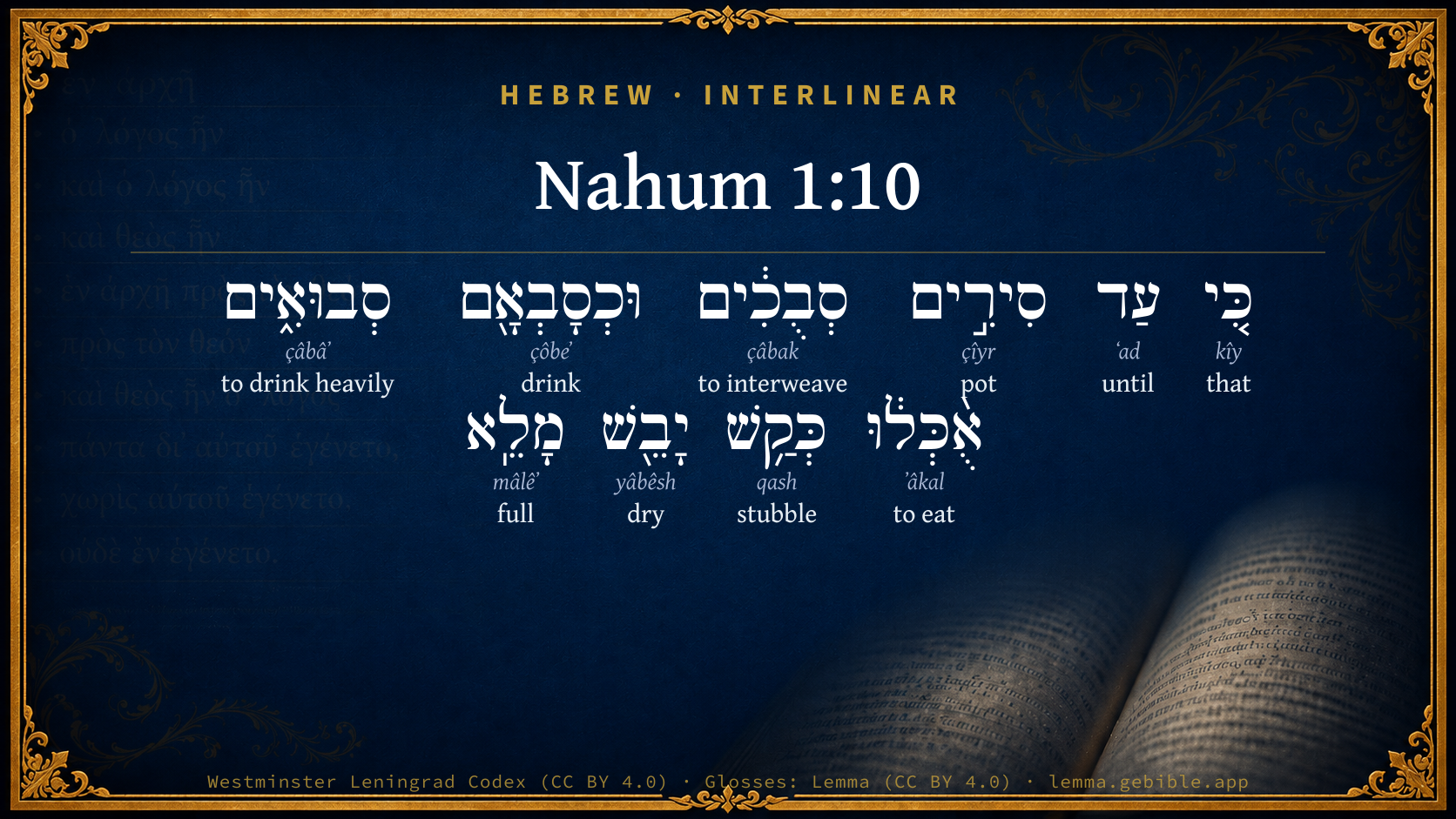
  1. כִּ֚י kîy H3588 “that” Conjunction
  2. עַד ʻad H5704 “until” Preposition
  3. סִירִ֣ים çîyr H5518 “pots” Noun, Common, Feminine, Plural, Absolute
  4. וּכְסָבְאָ֖ם çôbeʼ H5435 “and · like/as · drink · their” Conjunction + Preposition + Noun, Common, Masculine, Singular, Construct + Suffix, Personal, 3rd Person, Masculine, Plural
  5. סְבוּאִ֑ים çâbâʼ H5433 “drunk heavily” Verb, Qal, Participle Passive, Masculine, Plural, Absolute
  6. אֻ֨כְּל֔וּ ʼâkal H398 “to eat” Verb, Qal Passive, Perfect, 3rd Person, Common, Plural
  7. כְּקַ֥שׁ qash H7179 “like/as · stubble” Preposition + Noun, Common, Masculine, Singular, Absolute
  8. יָבֵ֖שׁ yâbêsh H3002 “dry” Adjective, Adjective, Masculine, Singular, Absolute
  9. מָלֵֽא mâlêʼ H4392 “full” Adjective, Adjective, Masculine, Singular, Absolute

About this verse

These counts appear in no published source. They are computed here, from the morphology-tagged text and Lemma’s own curated glosses. What Lemma adds →

10
words
10
distinct lemmas
Prophets
section

Notable vocabulary

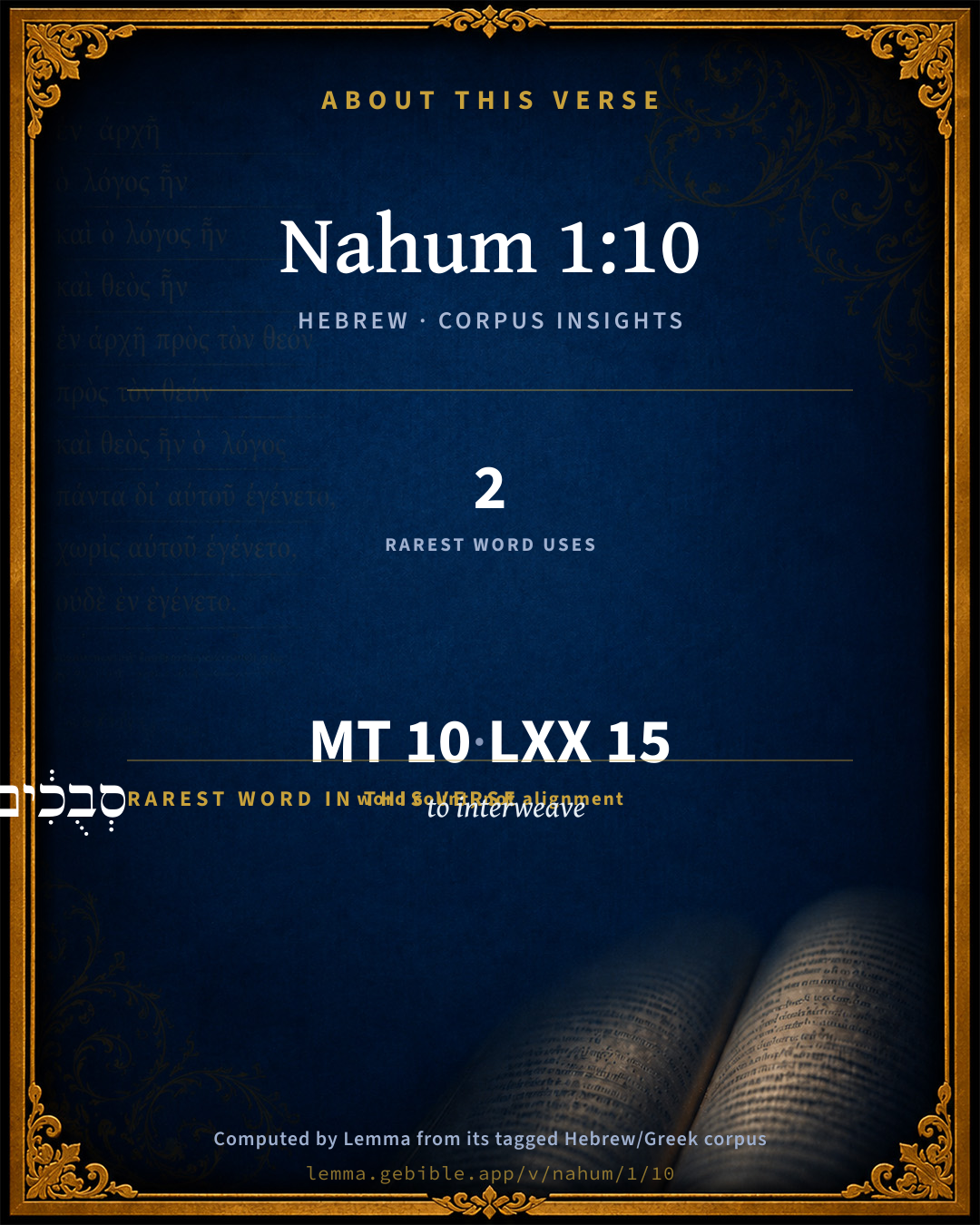
The rarest word here is סְבֻכִ֔ים to interweave H5440 — appearing just 2 times in the whole Hebrew Bible.

Shared distinctive vocabulary

סְבֻכִ֔ים to interweave H5440 occurs in 2 verses of the Hebrew Bible. Also found in:

Grammatical profile

  • 3 verbs
  • 3 nouns
  • 2 adjectives
  • 1 preposition
  • 1 conjunction

Verb forms

  • סְבֻכִ֔ים Qal · Participle Passive
  • סְבוּאִ֑ים Qal · Participle Passive
  • אֻ֨כְּל֔וּ Qal Passive · Perfect

Hebrew & Septuagint length

In English translation the verse runs 17 words from the Hebrew and 23 from the Septuagint (LXX English) — closely comparable.

A rough comparison of the two English renderings, which tokenize alike — not a word-level alignment.

Word counts can differ between the Hebrew and the Greek without any difference in meaning — e.g. the Hebrew direct-object marker אֵת has no separate Greek word, and Greek often adds the article ὁ.

In the original languages it is 10 Hebrew tokens and 15 Greek tokens — but the two are counted differently (Hebrew bundles its prefixes and suffixes into one token; the Greek is in lemma form), so that isn’t a like-for-like length.

Cross-references

14

Topical passages linked to Nahum 1:10 in the Treasury of Scripture Knowledge — connected by theme and wording, ordered by reader-vote popularity; previews shown in the World English Bible.

  • Micah 7:4 The best of them is like a brier. The most upright is worse than a thorn hedge. The day of your watchmen, Even your visitation, has come; Now is the time of their confusion.
  • Isaiah 5:24 Therefore as the tongue of fire devours the stubble, And as the dry grass sinks down in the flame, So their root shall be as rottenness, And their blossom shall go up as dust; Because they have rejected the law of Yahweh of Hosts, And despised the word of the Holy One of Israel.
  • Nahum 3:11 You also will be drunken. You will be hidden. You also will seek a stronghold because of the enemy.
  • Malachi 4:1 "For, behold, the day comes, it burns as a furnace; and all the proud, and all who work wickedness, will be stubble; and the day that comes will burn them up," says Yahweh of Hosts, "that it shall leave them neither root nor branch.
  • 2 Samuel 23:6–7 But the ungodly shall be all of them as thorns to be thrust away, Because they can't be taken with the hand
  • Isaiah 9:18 For wickedness burns as the fire; it devours the briers and thorns; yes, it kindles in the thickets of the forest, and they roll upward in a column of smoke.
  • Jeremiah 51:57 I will make drunk her princes and her wise men, her governors and her deputies, and her mighty men; and they shall sleep a perpetual sleep, and not wake up, says the King, whose name is Yahweh of Hosts.
  • Psalms 68:2 As smoke is driven away, So drive them away. As wax melts before the fire, So let the wicked perish at the presence of God.
  • Isaiah 10:17–19 The light of Israel will be for a fire, and his Holy One for a flame; and it will burn and devour his thorns and his briers in one day.
  • Isaiah 27:4 Wrath is not in me: would that the briers and thorns were against me in battle! I would march on them, I would burn them together.
  • Jeremiah 51:39 When they are heated, I will make their feast, and I will make them drunken, that they may rejoice, and sleep a perpetual sleep, and not wake, says Yahweh.
  • 1 Thessalonians 5:2–3 For you yourselves know well that the day of the Lord comes like a thief in the night.
  • 1 Samuel 25:36 Abigail came to Nabal; and, behold, he held a feast in his house, like the feast of a king; and Nabal's heart was merry within him, for he was very drunken: therefore she told him nothing, less or more, until the morning light.
  • 2 Samuel 13:28 Absalom commanded his servants, saying, Mark you now, when Amnon's heart is merry with wine; and when I tell you, Smite Amnon, then kill him; don't be afraid; haven't I commanded you? be courageous, and be valiant.

Cross-references courtesy of OpenBible.info (CC BY 4.0).

Hebrew and Greek witnesses Masoretic Hebrew ↔ Greek Septuagint

The same verse in the two great witnesses to the Old Testament, shown verse-for-verse.

These are two independent witnesses, not word-aligned to each other, and the Septuagint is shown in lemma (dictionary) form.

Hebrew Nahum 1:10 Masoretic · Westminster Leningrad Codex

כִּ֚י עַד סִירִ֣ים סְבֻכִ֔ים וּכְסָבְאָ֖ם סְבוּאִ֑ים אֻ֨כְּל֔וּ כְּקַ֥שׁ יָבֵ֖שׁ מָלֵֽא

For entangled like thorns, and drunken as with their drink, they are consumed utterly like dry stubble.

World English Bible · Public Domain

Greek LXX Nahum 1:10 Septuagint · lemma form

ὅτι ἕως θεμέλιον αὐτός χερσόω καί ὡς σμῖλαξ περιπλέκω βιβρώσκω καί ὡς καλάμη ξηρασία μεστός

For the enemy shall be laid bare even to the foundation, and shall be devoured as twisted yew, and as stubble fully dry.

LXX2012 (modern English Septuagint) · Public Domain

On this verse, The Pulpit Commentary discusses the Septuagint’s reading. Read the note in Commentary ↓

Hebrew: Westminster Leningrad Codex (CC BY 4.0). Greek: Septuagint (public domain); English from LXX2012 (modern English Septuagint) (Public Domain). How the Septuagint differs from the Hebrew →

Targum (Aramaic paraphrase)

1

The Targum is the ancient Jewish Aramaic paraphrase of the Hebrew Scriptures — an interpretive translation, not the Hebrew text itself. Onkelos (literal) and Pseudo-Jonathan (expansive) render the Torah, and Jonathan the Prophets. Coverage is partial: where no permissively-licensed English translation exists for a verse, only the Aramaic is shown. This is verse-level text, not a word-by-word alignment to the Hebrew.

  1. Targum Jonathan Prophets (Joshua–Malachi)
    אֲרֵי שִׁלְטוֹנֵי עַמְמַיָא דְבָזוּ יַת בֵּית יִשְׂרָאֵל וּכְמָא דְטָעַן בְּחַמְרָא אַטְעִיאוּנוּן שֵׁיצֵיאוּנוּן כְּמָא דִמְשַׁצְיָא אֶשְׁתָּא בְּקַשָׁא יְבֵישָׁא סַגִי:

    (no public-domain English translation for this verse)

    Targum Jonathan — Aramaic: “Mikraot Gedolot” (public domain). English: “Sefaria Community Translation” (CC0 1.0 (public-domain dedication)); “London "Chaldee Paraphrase," 1871” (public domain). Text via Sefaria.

Commentary

Notes on Nahum 1:10 from classic Christian and Jewish commentators (each source and its license shown beneath its notes). The classic Christian expositions comment on the surrounding passage and are grouped to its opening verse, so a note may address several verses; the Jewish commentaries on the Tanakh (Rashi and others) are per-verse, so they appear only where the commentator wrote on this verse.

Lemma curates 59 commentaries, every one of them public domain or Creative Commons licensed, each selected and text-cleaned for this edition rather than reprinted as found. About our sources →

The Cambridge Bible for Schools and Colleges

gen. ed. J. J. S. Perowne

10. Nah_1:10 can hardly have been handed down in its original state. It may be rendered much as R.V.: for though (they be like) thorns tangled together and drenched as with their drink, they shall be consumed as stubble fully dry. The Ninevites are compared to a tangled thorn hedge soaked with moisture and thus inaccessible to fire, yet the fire of Jehovah shall consume them as suddenly and completely as if they were the driest stubble. For the sense of though, even to prep. ‘ad cf. Num_8:4; 1Sa_2:5; Hag_2:19; Job_25:5, and for the sense as with cf. Isa_1:25 &c. Of course the words might mean wet or wetted like their drink. It has been usually supposed that in the words “their drink” the prophet refers to the excess and debauchery of the Assyrian court. But a witticism of this sort is altogether improbable. The text is no doubt corrupt. For “drenched as with their drink” Sept. gives “like tangled yew,” or some such plant. The general sense of the text may be conjectured to have been, that though the Ninevites from their strong defences were as unassailable and able to inflict injury as a tangled thorn hedge, they would become the prey of the fire. See a similar comparison to a thorn hedge, Mic_7:4; and on the comparison of enemies or the wicked to thorns, 2Sa_23:6-7; Eze_2:6.

The Cambridge Bible for Schools and Colleges (gen. ed. J. J. S. Perowne; Cambridge University Press, 1878–1918) — public domain. Text from a community e-Sword module.

Trapp's Complete Commentary

John Trapp

Nah 1:10 For while [they be] folden together [as] thorns, and while they are drunken [as] drunkards, they shall be devoured as stubble fully dry.

Ver. 10. For while they be folden together as thorns] And so can hardly be handled without hurt, God will burn them together in the same place, 2Sa 23:7, as a man puts thorns folden, and that cannot easily be sundered, all together into the fire, where they make a sudden blaze and are extinct. So will God deal with the Ninevites, notwithstanding their carnal combinations and confederacies.

And while they are drunken as drunkards] Who are very quarrelsome, bragging and braving; but may be easily dealt with, and pushed down with one finger.

As stubble fully dry] That hath long lain a sunning, and so is very combustible. The wicked are oft compared to stubble, because good for nothing but the fire; and when fully dry, when ripe for ruin, they shall be fully devoured, as some read the words. Ecquem vero mihi dabis rhetorem, &c., as one saith of another text. But what gallant rhetoric is here! well might God say, Hos 12:10, "I have spoken also by the prophets and used similitudes," &c. (see the note there); here we have three in a breath, and all little enough to work on the hearts of the wicked, who are loth to believe the truth and certainty of God’s threats; but rather bless themselves when God curseth, Deu 29:19.

John Trapp, A Commentary or Exposition upon All the Books of the Old and New Testament (1647–1656) — public domain. Text from a community e-Sword module.

Geneva Bible (1599)

Geneva Bible translators

Although the Assyrians think themselves like thorns that prick on all sides, yet the Lord will set fire on them, and as drunken men are not able to stand against any force, so they shall be nothing able to resist him.

Geneva Bible (1599) marginal notes — public domain. Text via Bolls.life.

Jamieson, Fausset & Brown

Robert Jamieson, A. R. Fausset & David Brown

while they are folden together as thorns--literally, "to the same degree as thorns" (compare Ch1 4:27, Margin). As thorns, so folded together and entangled that they cannot be loosed asunder without trouble, are thrown by the husbandmen all in a mass into the fire, so the Assyrians shall all be given together to destruction. Compare Sa2 23:6-7, where also "thorns" are the image of the wicked. As this image represents the speediness of their destruction in a mass, so that of "drunkards," their rushing as it were of their own accord into it; for drunkards fall down without any one pushing them [KIMCHI]. CALVIN explains, Although ye be dangerous to touch as thorns (that is, full of rage and violence), yet the Lord can easily consume you. But "although" will hardly apply to the next clause. English Version and KIMCHI, therefore, are to be preferred. The comparison to drunkards is appropriate. For drunkards, though exulting and bold, are weak and easily thrown down by even a finger touching them. So the insolent self-confidence of the Assyrians shall precipitate their overthrow by God. The Hebrew is "soaked," or "drunken as with their own wine." Their drunken revelries are perhaps alluded to, during which the foe (according to DIODORUS SICULUS [2]) broke into their city, and Sardanapalus burned his palace; though the main and ultimate destruction of Nineveh referred to by Nahum was long subsequent to that under Sardanapalus.

Jamieson, Fausset & Brown — Commentary Critical and Explanatory on the Whole Bible (1871) — public domain (CC PDM 1.0). Text via the HelloAO Bible API.

Adam Clarke's Commentary

Verse 10. While they be folden together] However united their counsels may be, they shall be as drunken men-perplexed and unsteady in all their resolutions; and before God's judgments they shall be as dry thorns before a devouring fire.

Adam Clarke's Commentary on the Bible (1810–1826) — public domain. Text from a community e-Sword/MySword module.

John Calvin's Commentaries

He goes on with this same subject, — that Gods when he pleases to exercise his power, can, with no difficulty, consume his enemies: for the similitude, which is here added, means this, — that nothing is safe from God’s vengeance; for by perplexed thorns he understands things difficult to be handled. When thorns are entangled, we dare not, with the ends of our fingers, to touch their extreme parts; for wherever we put our hands, thorns meet and prick us. As then pricking from entangled thorns make us afraid, so none of us dare to come nigh them. Hence the Prophet says, they who are as entangled thorns; that is “However thorny ye may be, however full of poison, full of fury, full of wickedness, full of frauds, full of cruelty, ye may be, still the Lord can with one fire consume you, and consume you without any difficulty.” They were then as entangled thorns.

And then, as drunken by their own drinking. If we read so, the meaning is, — God or God’s wrath will come upon you as on drunker men; who, though they exult in their own intemperance, are yet enervated, and are not fit for fighting, for they have weakened their strength by extreme drinking. There seems indeed to be much vigor in a drunken man, for he swaggers immoderately and foams out much rage; but yet he may be cast down by a finger; and even a child can easily overcome a drunken person. It is therefore an apt similitude, — that God would manage the Assyrians as the drunken are wont to be managed; for the more audacity there is in drunken men, the easier they are brought under; for as they perceive no danger, and are, as it were, stupefied, so they run headlong with greater impetuosity. “In like manners” he says, “extreme satiety will be the cause of your ruin, when I shall attack you. Ye are indeed very violent; but all this your fury is altogether drunkenness: Come, he says, to you shall the vengeance of God as to those drunken with their own drinking

Some render the last words, “To the drunken according to their drinking;” and this sense also is admissible; but as the Prophet’s meaning is still the same, I do not contend about words. Others indeed give to the Prophet’s words a different sense: but I doubt not but that he derides here that haughtiness by which the Assyrians were swollen, and compares it to drunkenness; as though he said, “Ye are indeed more than enough inflated and hence all tremble at your strength; but this your excess rather debilitates and weakens your powers. When God then shall undertake to destroy you as drunken men, your insolence will avail you nothing; but, on the contrary, it will be the cause of your ruin as ye offer yourselves of your own accord; and the Lord will easily cast you down, as when one, by pushing a drunken man, immediately throws him on the ground.”

And these comparisons ought to be carefully observed by us: for when there seems to be no probability of our enemies being destroyed, God can with one spark easily consume them. How so? for as fire consumes thorns entangled together, which no man dares to touch, so God can with one spark destroy all the wicked, however united together they may be. And the other comparison affords us also no small consolation; for when our enemies are insolent, and throw out high swelling words, and seem to frighten and to shake the whole world with their threatening, their excess is like drunkenness; there is no strength within; they are frantic but not strong, as is the case with all drunken men.

And he says, They shall be devoured as stubble of full dryness מלא, mela, means not only to be full, but also to be perfect or complete. Others render the words, “As stubble full of dryness,” but the sense is the same. He therefore intimates, that there would be nothing to prevent God from consuming the enemies of his Church; for he would make dry their whole vigor, so that they would differ nothing from stubble, and that very dry, which is in such a state, that it will easily take fire. It follows —

John Calvin's Commentaries (1540-1563) — public domain. Text from the Calvin Translation Society English edition (1840s-50s) via the Christian Classics Ethereal Library (ccel.org). Calvin's coverage is partial (roughly two-thirds of the Bible); uncommented books and verses are honest gaps, never fabricated. The 19th-century editor's footnotes and remarks are omitted so the notes are faithfully Calvin's own voice.

Ellicott's Commentary for English Readers

(10) For while.—Better, For they shall be even as bundles of thorn fagots, and even while steeped in their drink they shall be burnt up like stubble fully dry. Dry thorn cuttings were commonly used as fuel. (See Psa_58:9; Psa_118:12; Ecc_7:6.) The verse compares the victims of Jehovah’s wrath, first, to a compact bundle of thorn fagots; secondly, to a material equally combustible, the dry straw and stubble of the threshing-floor. With regard to the words “while steeped in their drink,” it may be remarked that in the final siege of Nineveh a great defeat of its forces was effected by a surprise while the king and his captains were sunk in revelry (Diod. Sic. ii. 26). Benhadad, king of Syria, and Belshazzar, king of Babylon, were overcome under similar circumstances (1Ki_1:16; Dan_5:1-30). Feasting and revelry may have gone on in Sennacherib’s camp at the moment when the sudden visitation of the “angel of the Lord” was impending; but on this point we have no information. The introduction of this detail adds to the metaphor a certain grim humour. Soaked in wine though the enemy be, he shall surely burn like driest fuel in the day of Jehovah’s fiery wrath. The opening clause of the verse is beset with difficulties, both grammatical and lexical. Kleinert renders “For in thorns they shall be entangled,” &c.; Ewald and Hitzig, “For even though they be compact as a wickerwork of thorns,” &c.

A Bible Commentary for English Readers, edited by Charles John Ellicott (1878–1897) — public domain. Text from a community e-Sword module.

John Gill's Exposition

For while they be folden together as thorns,.... Like them, useless and unprofitable, harmful and pernicious, fit only for burning, and, being bundled together, are prepared for it; and which is not only expressive of the bad qualities of the Ninevites, and of the danger they were in, and what they deserved; but of the certainty of their ruin, no more being able to save themselves from it, than a bundle of thorns from the devouring fire:

and while they are drunken as drunkards; dead drunk, no more able to help themselves than a drunken man that is fallen; or who were as easily thrown down as a drunken man is with the least touch; though there is no need to have recourse to a figurative sense, since the Ninevites were actually drunk when they were attacked by their enemy, as the historian relates (i); that the king of Assyria being elated with his fortune, and thinking himself secure, feasted his army, and gave them large quantities of wine; and while the whole army were indulging themselves, the enemy, having notice of their negligence and drunkenness by deserters, fell upon them unawares in the night, when disordered and unprepared, and made a great slaughter among them, and forced the rest into the city, and in a little time took it:

they shall be devoured as stubble fully dry; as easily, and as inevitably and irrecoverably.

(i) Diodor. Sicul. l. 2. p. 112.

John Gill's Exposition of the Whole Bible (1746–1763) — public domain (CC PDM 1.0). Text via the HelloAO Bible API.

Albert Barnes' Notes on the Bible

For while they be leiden together as thorns - that is, as confused, intertwined, sharp, piercing, hard to be touched, rending and tearing whosoever would interfere with its tangled ways, and seemingly compact together and strong; “and while they are drunken as their drink” , not “drinkers” only but literally, “drunken,” swallowed up, as it were, by their drink which they had swallowed, mastered, overcome, powerless, “they shall be derogated as stubble fully dry” , rapidly, in an instant, with an empty crackling sound, unresisting, as having nothing in them which can resist. Historically, the great defeat of the Assyrians, before the capture of Nineveh, took place while its king, flushed with success, was giving himself to listlessness; and having distributed to his soldiers victims, and abundance of wine, and other necessaries for banqueting, the whole army was negligent and drunken.”

In like way Babylon was taken amid the feasting of Belshazzar Dan. 5:1-30; Benhadad was smitten, while “drinking himself drunk in the pavilions, he and the kings, the thirty and two kings that helped him” 1Ki 20:16. And so it may well be meant here too, that Sennacherib’s army, secure of their prey, were sunk in revelry, already swallowed up by wine, before they were swallowed up by the pestilence, on the night when the Angel of the Lord went out to smite them, and, from the sleep of revelry, they slept the sleep from which they shall not awake until the Judgment Day. God chooses the last moment of the triumph of the wicked, when he is flushed by his success, the last of the helplessness of the righteous, when his hope can be in the Lord alone, to exchange their lots. “The righteous is delivered out of trouble, and the wicked comes in his stead” Pro 11:8. Spiritually , “the false fullness of the rich of this world, is real leanness; the greenness of such grass (for all flesh is grass) is real dryness. Marvelous words, “fully dry.” For what is dryness but emptiness?” They are perfected, but in dryness, and so perfectly prepared to be burned up. “The thorns had, as far as in them lay, choked the good seed, and hated the Seed-corn, and now are found, like stubble, void of all seed, fitted only to be burned with fire. For those who feast themselves “without fear is reserved the blackness of darkness forever” Jud 1:12-13.

Albert Barnes' Notes on the Bible (1834–1885) — public domain. Text from a community e-Sword/MySword module.

Haydock's Catholic Bible Commentary

Dry. The Assyrians, feasting in the hopes that they would speedily become masters of Jerusalem, were cut off in one night. (Worthington) --- God’s enemies cannot escape; as when a thorn bush has taken fire, all must perish, Psalm lvii. 10., and Isaias ix. 18. (Calmet)

George Leo Haydock (1774–1849), Haydock's Catholic Family Bible and Commentary, 1859 edition — public domain. Excludes Psalms (Douay-Rheims chapter numbering differs from Protestant) and Deuterocanonical books (Catholic canon only).

Matthew Poole's English Annotations

This gives us account how this desolation shall be effected.

While they be folded together as thorns; they should be like thorns easily burnt, and like thorns folden together, which burn together, and help to destroy each other, or are all together cast into the fire.

While they are drunken as drunkards; as men drunken, and unable to help themselves, are easily destroyed, so shall the Assyrians be; or, drunk with pleasures and pride, they shall be surprised, and ruined, and easily overthrown.

They shall be devoured as stubble fully dry: this fully expresseth the speedy, irresistible, and total destruction that the anger of God will bring upon them; as the fire burns up all the dried stubble, so shall the wrath of God destroy the enemies of Israel and of Israel’s God.

Matthew Poole's English Annotations on the Holy Bible (1683–1685) — public domain. Text from a community e-Sword/MySword module.

The Pulpit Commentary

While they be folden together as thorns. The clause is conditional: "Though they be interwined as thorns." Though the Assyrians present an impenetrable front, which seems to defy attack. (For the comparison of a hostile army to briers and thorns, see Isa_10:17 Isa_27:4; Henderson.) And while they are drunken as drunkards; and though they be drunken with their drink, regarding themselves as invincible, and drenched with wine, and given up to luxury and excess. There may be an allusion to the legend current concerning the destruction of Nineveh. Diodorus (Isa_2:2-6) relates that, after the enemy had been thrice repulsed, the King of Nineveh was so elated that he gave himself up to festivity, and allowed all his army to indulge in the utmost licence, and that it was while they were occupied in drunkenness and feasting they were surprised by the Medes under Cyaxares, and their city taken. An account of such a feast, accompanied with sketehes from the monuments, is given in Bonomi, "Nineveh and its Discoveries," p. 187, etc. We may compare the fate of Belshazzar. (Dan_5:1, etc.) They shall be devoured as stubble fully dry; like worthless refuse, fit only for burning. (Isa_5:24 Joe_2:5 Oba_1:18) The LXX renders this verse differently, "Because to its foundation it shall be dried up (cerswyhsetai : redigentur in vepres, Jerome), and as bind weed (smilax) intertwined it shall be devoured, and as stubble fully dry."

The Pulpit Commentary (1880–1919), ed. H.D.M. Spence-Jones & Joseph S. Exell — public domain. Text from a community e-Sword module.

John Wesley's Explanatory Notes

As thorns - They shall be like thorns easily burnt, and like thorns folded together which burn together, and help to destroy each other. As drunkards - As men drunken, and unable to help themselves, so the Assyrians drunk with pleasure and pride, shall be surprised, and easily overthrown.

John Wesley, Explanatory Notes Upon the Whole Bible (1754–1765) — public domain. Text via the GEBible commentary corpus.

Rashi

Rabbi Shlomo Yitzchaki (Rashi)

For, while the thorns are entangled—I.e., their destruction will come upon them suddenly, and they will not descend from their honor gradually, but while the thorns and the briers are [yet] entangled; i.e., strongly rooted.

and the drunkards are drinking—While they are at their feasts and in their joy. Some interpret כִּי עַד סִירִים as an expression of הֲסָרָה, removal.

they are consumed like dry stubble, fully ripe—Whose ripening has become full and complete, and it has dried out.

fully ripe Heb. מָלֵא; asovir, to be filled, in O.F And so (Exod. 22:28): “Your ripe fruits (מְלֵאָתְךָ)”; (Deut. 22:9) “The ripe fruit (הַמְלֵאָה) of the seed.”

Rashi on the Tanakh — English translations: “The Judaica Press complete Tanach with Rashi, translated by A. J. Rosenberg” (CC BY 4.0); “Pentateuch with Rashi's commentary by M. Rosenbaum and A.M. Silbermann, 1929-1934” (public domain); “The Metsudah Tanach series, Lakewood, N.J” (CC BY 4.0); and “The Book of Joshua, Metsudah Publications, 1997” (CC BY 4.0). Text via Sefaria.

Lesson kit

Teaching starters — assembled from the data on this page, not authored interpretation. Every prompt links to the verse data it draws on. Edit before teaching.

Nahum, in the Prophets, opens this verse with 10 words (10 distinct Hebrew lemmas). Its most distinctive word is çâbak (“to interweave”). A historical commentator’s framing appears above. Read the whole chapter for the surrounding context.

Discussion questions

  1. What does “to interweave” (çâbak) contribute to the verse as a whole?
  2. How does Job 8:17, which shares the word «to interweave», read alongside this verse?
  3. These translations render this verse differently; the difference is in the English rendering, not the original. What questions does that raise?
  4. «סְבֻכִ֔ים» is a Qal Participle Passive verb. How does that grammatical form shape the action described?
  5. Compare how The Cambridge Bible for Schools and Colleges and Trapp's Complete Commentary read this verse. Where do they agree or differ?

Things to notice

Reading settings

Reading text

Shown beneath each verse's original-language words.

Old Testament
Old Testament edition

Read the OT as the Masoretic Hebrew (MT) or the Greek Septuagint (LXX).

English shown for the Greek Septuagint (in the Hebrew ↔ Greek comparison).

Comparing translations? Open the Compare panel on any verse page to stack up to four side by side.