Isaiah 42:15

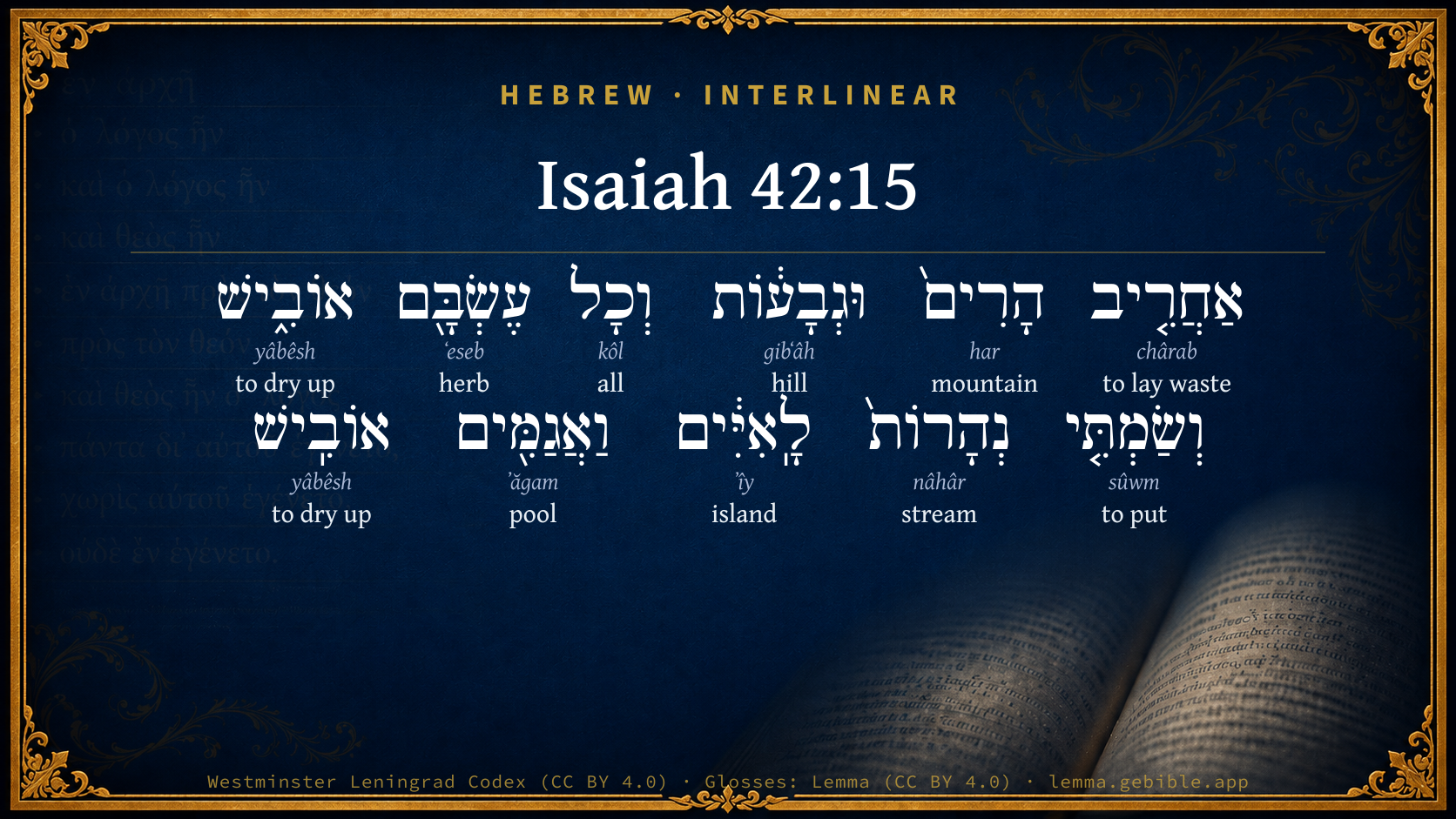
Hebrew (Westminster Leningrad Codex) Isaiah 42:15 appears in the Hebrew Old Testament. The text above is from the Westminster Leningrad Codex. Each word links to its Strong’s number, a concise gloss, and parsing drawn from the Open Scriptures Hebrew Bible morphology. Click any word for its full Brown-Driver-Briggs (BDB) entry.
Download image
Cite this verse

Isaiah 42:15 (World English Bible). Public Domain. Lemma interlinear Bible study tool, https://lemma.gebible.app/v/isaiah/42/15.

Show BibTeX & RIS
BibTeX
RIS
English Translation
I will lay waste mountains and hills, and dry up all their herbs; and I will make the rivers islands, and will dry up the pools.
World English Bible · Public Domain
Download a study sheet

One document with this verse’s original text, its word-by-word gloss line, the meaning frame, cross-references with their text, attributed commentary, and full source and license credits — printable, and it pastes into notes with its structure intact.

This verse Autodidact and up

Study sheet (.html) Plain text (.txt)

A passage Seminary Student

Up to 50 verses in one chapter. A passage sheet keeps up to 6 commentary sources and 12 cross-references per verse, in the order this page ranks them, and says so on the sheet whenever that leaves anything out. Ask for a single verse and you get the Autodidact verse sheet above.

Everything on this page stays free to read, with no account — the sheet is a download of what is already on screen, not access to it.

Want to remove ads? Support Godless Engineer
Compare translations 3

The same verse in 3 English versions, stacked beneath the original-language interlinear above. Click any original word for its lexicon entry.

Each is an independent rendering of the whole verse — the interlinear is not word-aligned to these translations.

Highlighted words mark where these versions differ — a whole-verse word diff, not a word-by-word alignment.

  • World English Bible Public Domain
    I will lay waste mountains and hills, and dry up all their herbs; and I will make the rivers islands, and will dry up the pools.
  • King James Version Public Domain
    I will make waste mountains and hills, and dry up all their herbs; and I will make the rivers islands, and I will dry up the pools.
  • unfoldingWord Literal Text CC BY-SA 4.0
    I will desolate mountains and hills, and I will dry up all of their vegetation, and I will make rivers into coastlands, and I will dry up the marshes.

unfoldingWord Literal Text — © unfoldingWord, licensed CC BY-SA 4.0. Word-aligned USFM3 via Door43 (git.door43.org/unfoldingWord/en_ult).

Versions to compare (up to 4)

3 of 4 selected

Show all 18 translations

Every available English version of this verse, each an independent rendering of the whole verse.

  • World English Bible Public Domain
    I will lay waste mountains and hills, and dry up all their herbs; and I will make the rivers islands, and will dry up the pools.
  • Berean Standard Bible Public Domain
    I will lay waste the mountains and hills and dry up all their vegetation. I will turn the rivers into dry land and drain the marshes.
  • Majority Standard Bible Public Domain
    I will lay waste the mountains and hills and dry up all their vegetation. I will turn the rivers into dry land and drain the marshes.
  • King James Version Public Domain
    I will make waste mountains and hills, and dry up all their herbs; and I will make the rivers islands, and I will dry up the pools.
  • American Standard Version (1901) Public Domain
    I will lay waste mountains and hills, and dry up all their herbs; and I will make the rivers islands, and will dry up the pools.
  • Revised Version (1885) Public Domain
    I will make waste mountains and hills, and dry up all their herbs; and I will make the rivers islands, and will dry up the pools.
  • Geneva Bible (1599) Public Domain
    I will make waste mountaines, and hilles, and drie vp all their herbes, and I will make the floods ylands, and I will drie vp the pooles.
  • Douay-Rheims (1899) Public Domain
    I will lay waste the mountains and hills, and will make all their grass to wither: and I will turn rivers into islands, and will dry up the standing pools.
  • Young's Literal Translation Public Domain
    I make waste mountains and hills, And all their herbs I dry up, And I have made rivers become isles, And ponds I dry up.
  • Literal Standard Version CC BY-SA 4.0
    I make desolate mountains and hills, || And I dry up all their herbs, || And I have made rivers become islands, || And I dry up ponds.
  • Unlocked Literal Bible CC BY-SA 4.0
    I will lay waste mountains and hills and dry up all their vegetation; and I will turn the rivers into islands and will dry up the marshes.
  • unfoldingWord Literal Text CC BY-SA 4.0
    I will desolate mountains and hills, and I will dry up all of their vegetation, and I will make rivers into coastlands, and I will dry up the marshes.
  • Darby Bible Public Domain
    I will lay waste mountains and hills, and dry up all their herbs; and I will make the rivers islands, and I will dry up the pools.
  • World Messianic Bible Public Domain
    I will destroy mountains and hills, and dry up all their herbs. I will make the rivers islands, and will dry up the pools.
  • Webster's Bible Public Domain
    I will make waste mountains and hills, and dry up all their herbs; and I will make the rivers to be islands, and I will dry up the pools.
  • Free Bible Version CC BY-SA 4.0
    I will dry up the mountains and the hills, and make all their greenery wither. I will turn rivers into islands and dry up the pools.
  • Bible in Basic English Public Domain
    I will make waste mountains and hills, drying up all their plants; and I will make rivers dry, and pools dry land.
  • JPS Tanakh (1917) Public Domain
    I will make waste mountains and hills, and dry up all their herbs; and I will make the rivers islands, and will dry up the pools.

Literal Standard Version (2020), Covenant Press — licensed CC BY-SA 4.0. Text via the HelloAO Bible API (eBible.org). Unlocked Literal Bible (unfoldingWord) — licensed CC BY-SA 4.0. Text via the HelloAO Bible API (eBible.org). unfoldingWord Literal Text — © unfoldingWord, licensed CC BY-SA 4.0. Word-aligned USFM3 via Door43 (git.door43.org/unfoldingWord/en_ult). Free Bible Version, Dr. Jonathan Gallagher — licensed CC BY-SA 4.0. Text via the HelloAO Bible API (eBible.org).

Word by word

More ways to search: Search by grammar → Find every occurrence → Compare this word →

Practice this passage: Drill this verse → Learn its vocabulary →

וַאֲגַמִּ֖ים
ʼăgam
H98
“and · pools”
Conjunction + Noun, Common, Masculine, Plural, Absolute
Part of Speech
Conjunction + Noun
Type
Common
Gender
Masculine
Number
Plural
State
Absolute
Full BDB Definition

Origin: from an unused root (meaning to collect as water)

TWOT: 18a

pool, troubled pool - troubled or muddy (gloomy) pools, marshes - any pool, pond - swamp reeds, reeds, rush(es)
  1. אַחֲרִ֤יב chârab H2717 “to lay waste” Verb, Hiphil, Imperfect, 1st Person, Common, Singular
  2. הָרִים֙ har H2022 “mountains” Noun, Common, Masculine, Plural, Absolute
  3. וּגְבָע֔וֹת gibʻâh H1389 “and · hills” Conjunction + Noun, Common, Feminine, Plural, Absolute
  4. וְכָל kôl H3605 “and · all of” Conjunction + Noun, Common, Masculine, Singular, Construct
  5. עֶשְׂבָּ֖ם ʻeseb H6212 “herb · their” Noun, Common, Masculine, Singular, Construct + Suffix, Personal, 3rd Person, Masculine, Plural
  6. אוֹבִ֑ישׁ yâbêsh H3001 “to dry up” Verb, Hiphil, Imperfect, 1st Person, Common, Singular
  7. וְשַׂמְתִּ֤י sûwm H7760 “and · to put” Conjunction + Verb, Qal, Sequential Perfect, 1st Person, Common, Singular
  8. נְהָרוֹת֙ nâhâr H5104 “streams” Noun, Common, Masculine, Plural, Absolute
  9. לָֽאִיִּ֔ים ʼîy H339 “to/for the · islands” Preposition, Determined + Noun, Common, Masculine, Plural, Absolute
  10. אוֹבִֽישׁ yâbêsh H3001 “to dry up” Verb, Hiphil, Imperfect, 1st Person, Common, Singular

About this verse

These counts appear in no published source. They are computed here, from the morphology-tagged text and Lemma’s own curated glosses. What Lemma adds →

11
words
10
distinct lemmas
Prophets
section

Notable vocabulary

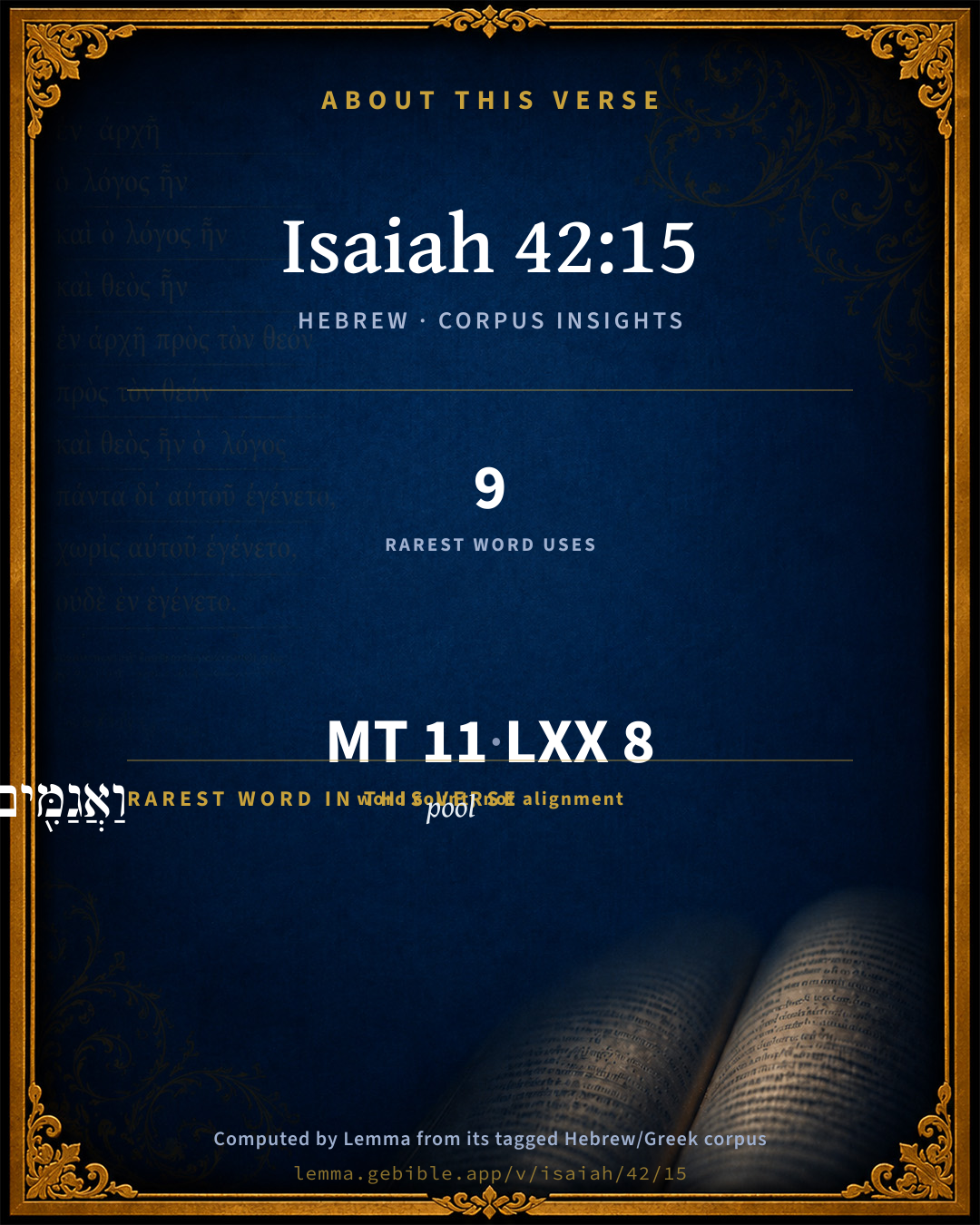
The rarest word here is וַאֲגַמִּ֖ים pool H98 — appearing just 9 times in the whole Hebrew Bible.

Shared distinctive vocabulary

וַאֲגַמִּ֖ים pool H98 occurs in 9 verses of the Hebrew Bible. Also found in:

Grammatical profile

  • 4 verbs
  • 7 nouns

Verb forms

  • אַחֲרִ֤יב Hiphil · Imperfect
  • אוֹבִ֑ישׁ Hiphil · Imperfect
  • וְשַׂמְתִּ֤י Qal · Sequential Perfect
  • אוֹבִֽישׁ Hiphil · Imperfect

Repetition

A word recurs within this verse — often emphatic in Hebrew:

  • אוֹבִ֑ישׁ to dry up H3001 ×2

Hebrew & Septuagint length

In English translation the verse runs 26 words from the Hebrew and 26 from the Septuagint (LXX English) — the same length.

A rough comparison of the two English renderings, which tokenize alike — not a word-level alignment.

Word counts can differ between the Hebrew and the Greek without any difference in meaning — e.g. the Hebrew direct-object marker אֵת has no separate Greek word, and Greek often adds the article ὁ.

In the original languages it is 11 Hebrew tokens and 8 Greek tokens — but the two are counted differently (Hebrew bundles its prefixes and suffixes into one token; the Greek is in lemma form), so that isn’t a like-for-like length.

Cross-references

20

Topical passages linked to Isaiah 42:15 in the Treasury of Scripture Knowledge — connected by theme and wording, ordered by reader-vote popularity; previews shown in the World English Bible.

  • Isaiah 50:2 Why, when I came, was there no man? when I called, was there none to answer? Is my hand shortened at all, that it can't redeem? or have I no power to deliver? Behold, at my rebuke I dry up the sea, I make the rivers a wilderness: their fish stink, because there is no water, and die for thirst.
  • Nahum 1:4–6 He rebukes the sea, and makes it dry, and dries up all the rivers. Bashan languishes, and Carmel; and the flower of Lebanon languishes.
  • Isaiah 44:27 who says to the deep, Be dry, and I will dry up your rivers;
  • Isaiah 2:12–16 For there will be a day of Yahweh of Hosts for all that is proud and haughty, And for all that is lifted up; And it shall be brought low:
  • Revelation 20:11 I saw a great white throne, and him who sat on it, from whose face the earth and the heaven fled away. There was found no place for them.
  • Psalms 18:7 Then the earth shook and trembled. The foundations also of the mountains quaked and were shaken, Because he was angry.
  • Psalms 107:33–34 He turns rivers into a desert, Water springs into a thirsty ground,
  • Psalms 114:3–7 The sea saw it, and fled. The Jordan was driven back.
  • Isaiah 11:15–16 Yahweh will utterly destroy the tongue of the Egyptian sea; and with his scorching wind will he wave his hand over the River, and will strike it into seven streams, and cause men to march over in sandals.
  • Isaiah 49:11 I will make all my mountains a way, and my highways shall be exalted.
  • Jeremiah 4:24 I saw the mountains, and, behold, they trembled, and all the hills moved back and forth.
  • Ezekiel 38:20 so that the fish of the sea, and the birds of the sky, and the animals of the field, and all creeping things who creep on the earth, and all the men who are on the surface of the earth, shall shake at my presence, and the mountains shall be thrown down, and the steep places shall fall, and every wall shall fall to the ground.
  • Habakkuk 3:6–10 He stood, and shook the earth. He looked, and made the nations tremble. The ancient mountains were crumbled. The age-old hills collapsed. His ways are eternal.
  • Haggai 2:6 For this is what Yahweh of Hosts says: 'Yet once, it is a little while, and I will shake the heavens, the earth, the sea, and the dry land;
  • Zechariah 10:11 He will pass through the sea of affliction, And will strike the waves in the sea, And all the depths of the Nile will dry up; And the pride of Assyria will be brought down, And the scepter of Egypt will depart.
  • Revelation 6:12–17 I saw when he opened the sixth seal, and there was a great earthquake. The sun became black as sackcloth made of hair, and the whole moon became as blood.
  • Revelation 8:7–12 The first sounded, and there followed hail and fire, mixed with blood, and they were thrown to the earth. One third of the earth was burnt up, and one third of the trees were burnt up, and all green grass was burnt up.
  • Revelation 11:13 In that day there was a great earthquake, and a tenth of the city fell. Seven thousand people were killed in the earthquake, and the rest were terrified, and gave glory to the God of heaven.
  • Revelation 16:12 The sixth poured out his bowl on the great river, the Euphrates. Its water was dried up, that the way might be made ready for the kings that come from the sunrise.
  • Revelation 16:18 There were lightnings, sounds, and thunders; and there was a great earthquake, such as was not since there were men on the earth, so great an earthquake, so mighty.

Cross-references courtesy of OpenBible.info (CC BY 4.0).

Hebrew and Greek witnesses Masoretic Hebrew ↔ Greek Septuagint

The same verse in the two great witnesses to the Old Testament, shown verse-for-verse.

These are two independent witnesses, not word-aligned to each other, and the Septuagint is shown in lemma (dictionary) form.

Hebrew Isaiah 42:15 Masoretic · Westminster Leningrad Codex

אַחֲרִ֤יב הָרִים֙ וּגְבָע֔וֹת וְכָל עֶשְׂבָּ֖ם אוֹבִ֑ישׁ וְשַׂמְתִּ֤י נְהָרוֹת֙ לָֽאִיִּ֔ים וַאֲגַמִּ֖ים אוֹבִֽישׁ

I will lay waste mountains and hills, and dry up all their herbs; and I will make the rivers islands, and will dry up the pools.

World English Bible · Public Domain

Greek LXX Isaiah 42:15 Septuagint · lemma form

καί τίθημι ποταμός εἰς νήσος καί ἕλος ξηραίνω

I will make desolate mountains and hills, and will dry up all their grass; and I will make the rivers islands, and dry up the pools.

LXX2012 (modern English Septuagint) · Public Domain

Hebrew: Westminster Leningrad Codex (CC BY 4.0). Greek: Septuagint (public domain); English from LXX2012 (modern English Septuagint) (Public Domain). How the Septuagint differs from the Hebrew →

Targum (Aramaic paraphrase)

1

The Targum is the ancient Jewish Aramaic paraphrase of the Hebrew Scriptures — an interpretive translation, not the Hebrew text itself. Onkelos (literal) and Pseudo-Jonathan (expansive) render the Torah, and Jonathan the Prophets. Coverage is partial: where no permissively-licensed English translation exists for a verse, only the Aramaic is shown. This is verse-level text, not a word-by-word alignment to the Hebrew.

  1. Targum Jonathan Prophets (Joshua–Malachi)
    אַחֲרִיב טוּרִין וְרָמָן וְכָל עִסְבֵּיהוֹן אֲיַבֵּשׁ וַאֲשַׁוֵי נַהֲרִין לְנַגְוָן וַאֲגַמִין אֲיַבֵּשׁ:

    I will make waste mountains and hills, and dry up all their herbs; and I will make the rivers islands, and I will dry up the pools.

    Targum Jonathan — Aramaic: “Mikraot Gedolot” (public domain). English: “Sefaria Community Translation” (CC0 1.0 (public-domain dedication)); “London "Chaldee Paraphrase," 1871” (public domain). Text via Sefaria.

Commentary

Notes on Isaiah 42:15 from classic Christian and Jewish commentators (each source and its license shown beneath its notes). The classic Christian expositions comment on the surrounding passage and are grouped to its opening verse, so a note may address several verses; the Jewish commentaries on the Tanakh (Rashi and others) are per-verse, so they appear only where the commentator wrote on this verse.

Lemma curates 59 commentaries, every one of them public domain or Creative Commons licensed, each selected and text-cleaned for this edition rather than reprinted as found. About our sources →

Trapp's Complete Commentary

John Trapp

Isa 42:15 I will make waste mountains and hills, and dry up all their herbs; and I will make the rivers islands, and I will dry up the pools.

Ver. 15. I will make waste mountains and hills.] I will rather invert the order of nature, and mingle heaven and earth together, than my Church shall want seasonable help. I will also remove all obstacles by sending fire upon the earth, {Luk 12:49} and bring every high thought into a holy obedience. {2Co 10:5}

John Trapp, A Commentary or Exposition upon All the Books of the Old and New Testament (1647–1656) — public domain. Text from a community e-Sword module.

Jamieson, Fausset & Brown

Robert Jamieson, A. R. Fausset & David Brown

I will destroy all My foes.

mountains--in Palestine usually planted with vines and olives in terraces, up to their tops.

islands--rather, "dry lands." God will destroy His foes, the heathen, and their idols, and "dry up" the fountains of their oracles, their doctrines and institutions, the symbol of which is water, and their schools which promoted idolatry [VITRINGA].

Jamieson, Fausset & Brown — Commentary Critical and Explanatory on the Whole Bible (1871) — public domain (CC PDM 1.0). Text via the HelloAO Bible API.

Adam Clarke's Commentary

Verse 15. I will make the rivers islands - "I will make the rivers dry deserts"] Instead of איים iyim, islands, read ציים tsiim; a very probable conjecture of Houbigant.

Adam Clarke's Commentary on the Bible (1810–1826) — public domain. Text from a community e-Sword/MySword module.

Ellicott's Commentary for English Readers

(15) I will make waste mountains . . .—The whole description is symbolic, and points to the subjugation of the heathen nations, the “rivers” and “pools” probably representing the kingdoms of the Tigris and Euphrates (Isa_8:7). All this seems a purely destructive work, but through it all mercy and truth are working, and a way is being opened for the return of Israel, in painting which, as elsewhere, the literal melts into the spiritual, as in a dissolving view. (See Note on Isa_40:4.) “These things” include the whole work of judgment and of mercy.

A Bible Commentary for English Readers, edited by Charles John Ellicott (1878–1897) — public domain. Text from a community e-Sword module.

The Cambridge Bible for Schools and Colleges

gen. ed. J. J. S. Perowne

15. Jehovah’s breath of anger will make the fairest and best watered regions an arid waste. Cf. ch. Isa_40:7; Isa_40:24, and note the contrasted image in Isa_41:18 f. For herbs, read herbage. The word islands is used in a peculiar sense, of dry land as opposed to water.

The Cambridge Bible for Schools and Colleges (gen. ed. J. J. S. Perowne; Cambridge University Press, 1878–1918) — public domain. Text from a community e-Sword module.

John Gill's Exposition

I will make waste mountains and hills,.... Kingdoms, greater and lesser; kings and governors, as Jarchi interprets it; and so Kimchi understands it of the kings of the nations; by them are meant the emperors of Rome, and their governors under them, that set themselves against Christ and his Gospel, but were overcome by him; these mountains and hills became a plain before him: "every mountain and island were moved out of their places, and the kings of the earth, and the great men, &c. hid themselves in the dens, and in the rocks of the mountains, and called upon them to fall on them, and hide them from the wrath of the Lamb", Rev 6:14,

and dry up all their herbs; the common people, and common soldiers that were with them, and on their side; comparable, for smallness, weakness, and number, to the grass of the mountains and hills:

and I will make the rivers islands, and dry up the pools; extirpate all the remains of idolatry, rivers and fountains being sacred with the Heathens, as mountains and hills were places where sacrifices were offered to idols. Unless by it rather should be meant, that the Lord would remove all impediments out of the way of his people, or which were obstacles of their conversion; just as he dried up the waters of the Red sea and Jordan, to make way for the people of Israel; to which the allusion may be, and which agrees with the following words.

John Gill's Exposition of the Whole Bible (1746–1763) — public domain (CC PDM 1.0). Text via the HelloAO Bible API.

Albert Barnes' Notes on the Bible

I will make waste mountains - This verse denotes the utter desolation which God would bring upon his foes in his anger. The meaning of this part of the verse is, that he would spread desolation over the hills and mountains that were well watered and laid out in gardens and orchards. It was common to plant vineyards on the sides of hills and mountains; and indeed most of the mountains of Palestine and adjacent regions were cultivated nearly to the top. They were favorable to the culture of the vine and the olive; and by making terraces, the greater portion of the hills were thus rescued for purposes of agriculture. Yet an enemy or warrior marching through a land would seek to spread desolation through all its cultivated parts, and lay waste all its fields. God, therefore, represents himself as a conqueror, laying waste the cultivated portions of the country of his foes.

And dry up all their herbs - He would destroy all the grain and fruits on which they were depending for support.

And I will make the rivers islands - Or rather, dry land, or deserts. I will, in the heat of my anger, dry up the streams, so that the bottoms of those streams shall be dry land. The word rendered here ‘islands,’ from אי 'ı̂y, properly denotes dry land, habitable ground, as opposed to water, the sea, rivers, etc., and the signification ‘islands’ is a secondary signification.

And I will dry up the pools - The pools on which they have been dependent for water for their flocks and herds. The sense of the whole passage is, I will bring to desolation those who worship idols, and the idols themselves. I will produce an entire change among them, as great as if I were to spread desolation over their cultivated hills, and to dry up all their streams. The reference is probably to the great changes which God would make in the pagan world. All that flourished on Pagan ground; all that was nurtured by idolatry; all their temples, fanes, altars, shrines, should be overturned and demolished; and in all these things great and permanent changes would be produced. The time would have come when God could no longer bear with the growing abominations of the pagan nations, and when he would go forth as a conqueror to subdue all to himself.

Albert Barnes' Notes on the Bible (1834–1885) — public domain. Text from a community e-Sword/MySword module.

Haydock's Catholic Bible Commentary

Pools. Cyrus deluged the country about Babylon, chap. xiii., and xxi. 1. (Haydock) --- The proud and covetous, who expected Christ to give them kingdoms, were deceived. He came to teach humility, and to grant eternal rewards. (Worthington)

George Leo Haydock (1774–1849), Haydock's Catholic Family Bible and Commentary, 1859 edition — public domain. Excludes Psalms (Douay-Rheims chapter numbering differs from Protestant) and Deuterocanonical books (Catholic canon only).

Matthew Poole's English Annotations

I will make waste mountains and hills; not dry and barren ones, for these were waste already, but such as are clothed with grass and herbs, as the following words imply; which is to be understood metaphorically, of God’s destroying his most lofty and flourishing enemies, who are oft compared in Scripture unto mountains and hills.

I will dry up the pools; I will remove all impediments out of the way; which is expressed in the prophetical dialect, by drying up Euphrates, that the way of the kings of the east might be prepared, Rev 16:12. He seems to allude to that which God did in drying up first the Red Sea, and then Jordan, to give his people passage into Canaan. And this exposition is confirmed by the following verse.

Matthew Poole's English Annotations on the Holy Bible (1683–1685) — public domain. Text from a community e-Sword/MySword module.

Whedon's Commentary on the Bible

Daniel D. Whedon

15. Waste mountains and hills — Extreme execution of threats against sinners under figures of utter desolation wrought upon comely landscapes.

Islands — Dry land as opposed to water. — Gesenius.

Daniel D. Whedon (gen. ed.), Commentary on the Old and New Testaments (1874–1909) — public domain. Text from a community e-Sword module.

The Pulpit Commentary

I will make waste mountains and hills. The result of God"s "stirring up his jealousy," and giving a free vent to his feelings, will be the destruction of the great and mighty ones of the earth. (comp. Isa_2:14) These are probably, in this place, the Babylonian kings and nobles. Dry up all their herbs; i.e. turn Babylonia, temporarily, into a desert. Make the rivers islands, and dry up the pools. Invert the established order of things turn the rivers into dry land, and empty the reservoirs. There is, perhaps, some allusion to those dealings with the river-beds, which the Greek historians ascribe to Cyrus (Herod., 1:189, 191; Xen., "Cyrop.," 7:5, and which are not disproved by the fact that the one native account of the capture of Babylon by Cyrus, which has come down to us, makes no mention of them.

The Pulpit Commentary (1880–1919), ed. H.D.M. Spence-Jones & Joseph S. Exell — public domain. Text from a community e-Sword module.

John Wesley's Explanatory Notes

Hills - My most lofty and flourishing enemies. Dry up - I will remove all impediments out of the way.

John Wesley, Explanatory Notes Upon the Whole Bible (1754–1765) — public domain. Text via the GEBible commentary corpus.

Keil & Delitzsch

C. F. Keil & F. Delitzsch

The delivery takes place, and the whole world of nature undergoes a metamorphosis, which is subservient to the great work of the future. "I make waste mountains and hills, and all their herbage I dry up, and change streams into islands, and lakes I dry up." Here is another example of Isaiah's favourite palindromy, as Nitzsch calls this return to a word that has been used before, or linking on the close of a period of its commencement. Jehovah's panting in labour is His almighty fiery breath, which turns mountains and hills into heaps of ruins, scorches up the vegetation, condenses streams into islands, and dries up the lakes; that is to say, turns the strange land, in which Israel has been held captive, into a desert, and at the same time removes all the hindrances to His people's return, thus changing the present condition of the world into one of the very opposite kind, which displays His righteousness in wrath and love.

Keil & Delitzsch — Biblical Commentary on the Old Testament (1861–1891) — public domain (CC PDM 1.0). Text via the HelloAO Bible API. (Old Testament only.)

J. A. Alexander on Isaiah

Joseph Addison Alexander

“I will lay waste mountains and hills, and all their herbage will I dry up; and I will turn (literally place) streams to islands and pools (or lakes) will I dry up.” Having described the effect and the cause of the great future change, He now describes the change itself, under the common form of a complete revolution in the face of nature, sometimes with special reference to the heavens (Isa 13:10) sometimes (as here and in Isa 35:6-7) to the earth. The verse probably contains an allusion to the ancient cultivation of the hills of Palestine, by means of terraces, many of which are still in existence.

Joseph Addison Alexander, The Prophecies of Isaiah (1846–1847; New York: Scribner, 1870–1878) — public domain. Text from a community e-Sword module.

Rashi

Rabbi Shlomo Yitzchaki (Rashi)

I will destroy mountains and hills I will slay kings and rulers.

and all their grass All their followers.

I will dry out Heb. אוֹבִישׁ. This is an expression of drying, used in reference to wet things, e. g., grass and rivers.

Rashi on the Tanakh — English translations: “The Judaica Press complete Tanach with Rashi, translated by A. J. Rosenberg” (CC BY 4.0); “Pentateuch with Rashi's commentary by M. Rosenbaum and A.M. Silbermann, 1929-1934” (public domain); “The Metsudah Tanach series, Lakewood, N.J” (CC BY 4.0); and “The Book of Joshua, Metsudah Publications, 1997” (CC BY 4.0). Text via Sefaria.

Ibn Ezra

Rabbi Abraham ibn Ezra

I will make waste, etc. How can they think thus? Do they not see, that I lay waste mountains and hills, and dry up all their herbs, and make rivers into islands, that people can dwell therein.

Ibn Ezra on the Tanakh — English translations: “Sefaria Community Translation” (CC0 1.0 (public-domain dedication)); “Yalkut, Sifsei Chachomim Chumash, Metsudah Publications, 2009” (CC BY 4.0); and “Commentary of Ibn Ezra on Isaiah - trans. by M. Friedlander, 1873” (public domain). Text via Sefaria.

Lesson kit

Teaching starters — assembled from the data on this page, not authored interpretation. Every prompt links to the verse data it draws on. Edit before teaching.

Isaiah, in the Prophets, opens this verse with 11 words (10 distinct Hebrew lemmas). Its most distinctive word is ʼăgam (“pool”). A historical commentator’s framing appears above. Read the whole chapter for the surrounding context.

Discussion questions

  1. What does “pool” (ʼăgam) contribute to the verse as a whole?
  2. How does Exodus 7:19, which shares the word «pool», read alongside this verse?
  3. What does the repetition of “to dry up” (2× in this one verse) do in this verse?
  4. The translations on this page render this verse differently — a whole-verse word diff, not a word-by-word alignment. What might account for the different wordings?
  5. «אַחֲרִ֤יב» is a Hiphil Imperfect verb. How does that grammatical form shape the action described?
  6. Compare how Trapp's Complete Commentary and Jamieson, Fausset & Brown read this verse. Where do they agree or differ?

Things to notice

Reading settings

Reading text

Shown beneath each verse's original-language words.

Old Testament
Old Testament edition

Read the OT as the Masoretic Hebrew (MT) or the Greek Septuagint (LXX).

English shown for the Greek Septuagint (in the Hebrew ↔ Greek comparison).

Comparing translations? Open the Compare panel on any verse page to stack up to four side by side.