Jeremiah 51:36

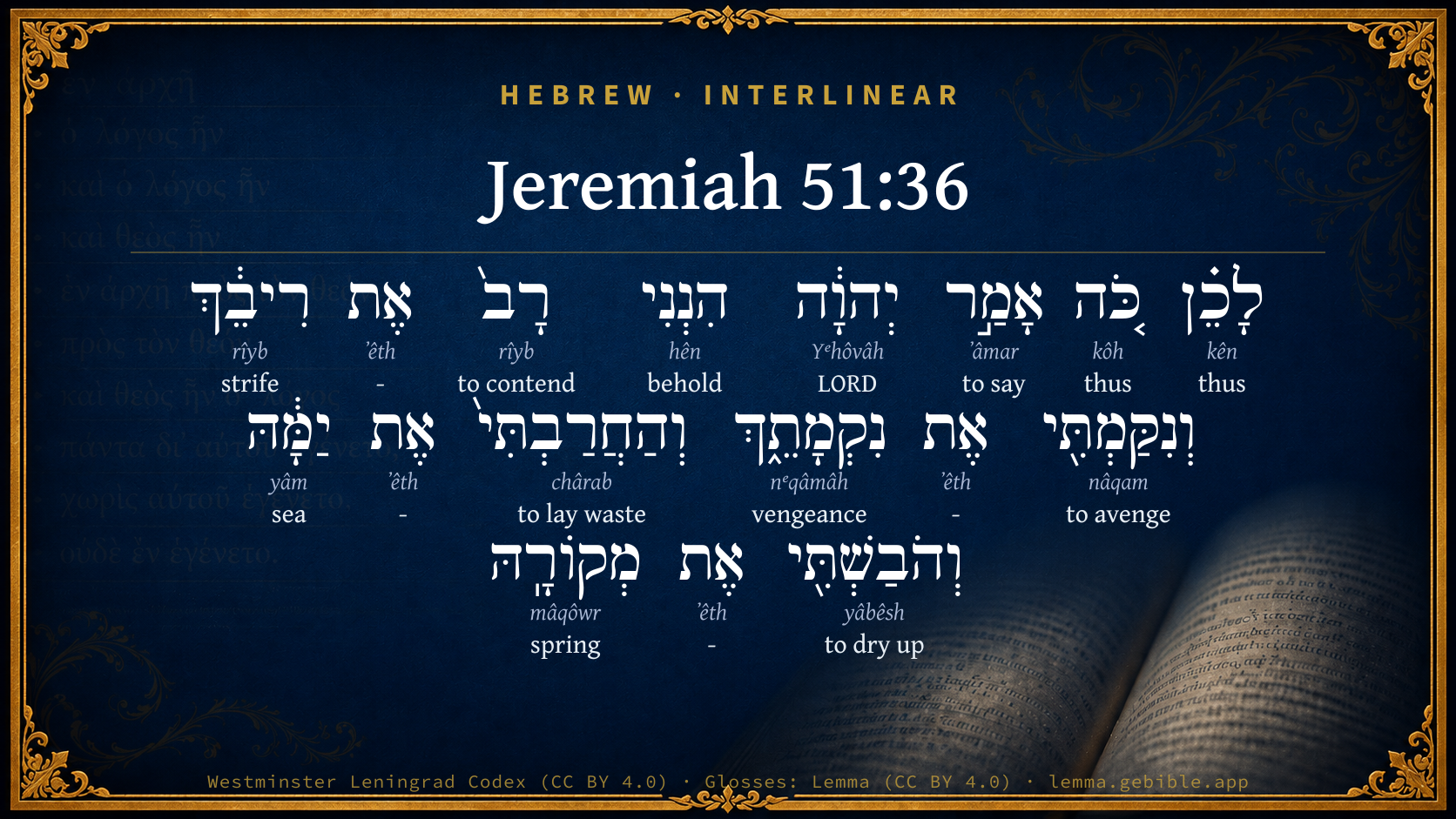
Hebrew (Westminster Leningrad Codex) Jeremiah 51:36 appears in the Hebrew Old Testament. The text above is from the Westminster Leningrad Codex. Each word links to its Strong’s number, a concise gloss, and parsing drawn from the Open Scriptures Hebrew Bible morphology. Click any word for its full Brown-Driver-Briggs (BDB) entry.
Download image
Cite this verse

Jeremiah 51:36 (World English Bible). Public Domain. Lemma interlinear Bible study tool, https://lemma.gebible.app/v/jeremiah/51/36.

Show BibTeX & RIS
BibTeX
RIS
English Translation
Therefore thus says Yahweh: Behold, I will plead your cause, and take vengeance for you; and I will dry up her sea, and make her fountain dry.
World English Bible · Public Domain
Download a study sheet

One document with this verse’s original text, its word-by-word gloss line, the meaning frame, cross-references with their text, attributed commentary, and full source and license credits — printable, and it pastes into notes with its structure intact.

This verse Autodidact and up

Study sheet (.html) Plain text (.txt)

A passage Seminary Student

Up to 50 verses in one chapter. A passage sheet keeps up to 6 commentary sources and 12 cross-references per verse, in the order this page ranks them, and says so on the sheet whenever that leaves anything out. Ask for a single verse and you get the Autodidact verse sheet above.

Everything on this page stays free to read, with no account — the sheet is a download of what is already on screen, not access to it.

Want to remove ads? Support Godless Engineer
Compare translations 3

The same verse in 3 English versions, stacked beneath the original-language interlinear above. Click any original word for its lexicon entry.

Each is an independent rendering of the whole verse — the interlinear is not word-aligned to these translations.

Highlighted words mark where these versions differ — a whole-verse word diff, not a word-by-word alignment.

  • World English Bible Public Domain
    Therefore thus says Yahweh: Behold, I will plead your cause, and take vengeance for you; and I will dry up her sea, and make her fountain dry.
  • King James Version Public Domain
    Therefore thus saith the LORD; Behold, I will plead thy cause, and take vengeance for thee; and I will dry up her sea, and make her springs dry.
  • unfoldingWord Literal Text CC BY-SA 4.0
    Therefore Yahweh says this: See, I am about to plead your case and bring about vengeance for you. For I will dry up Babylon’s waters and make her springs run dry.

unfoldingWord Literal Text — © unfoldingWord, licensed CC BY-SA 4.0. Word-aligned USFM3 via Door43 (git.door43.org/unfoldingWord/en_ult).

Versions to compare (up to 4)

3 of 4 selected

Show all 18 translations

Every available English version of this verse, each an independent rendering of the whole verse.

  • World English Bible Public Domain
    Therefore thus says Yahweh: Behold, I will plead your cause, and take vengeance for you; and I will dry up her sea, and make her fountain dry.
  • Berean Standard Bible Public Domain
    Therefore this is what the LORD says: “Behold, I will plead your case and take vengeance on your behalf; I will dry up her sea and make her springs run dry.
  • Majority Standard Bible Public Domain
    Therefore this is what the LORD says: “Behold, I will plead your case and take vengeance on your behalf; I will dry up her sea and make her springs run dry.
  • King James Version Public Domain
    Therefore thus saith the LORD; Behold, I will plead thy cause, and take vengeance for thee; and I will dry up her sea, and make her springs dry.
  • American Standard Version (1901) Public Domain
    Therefore thus saith Jehovah: Behold, I will plead thy cause, and take vengeance for thee; and I will dry up her sea, and make her fountain dry.
  • Revised Version (1885) Public Domain
    Therefore thus saith the LORD: Behold, I will plead thy cause, and take vengeance for thee; and I will dry up her sea, and make her fountain dry.
  • Geneva Bible (1599) Public Domain
    Therefore thus sayth the Lord, Beholde, I will maintayne thy cause, and take vengeance for thee, and I will drie vp the sea, and drie vp her springes.
  • Douay-Rheims (1899) Public Domain
    Therefore thus saith the Lord: Behold I will judge thy cause, and will take vengeance for thee, and I will make her sea desolate, and will dry up her spring.
  • Young's Literal Translation Public Domain
    Therefore, thus said Jehovah: Lo, I am pleading thy cause, And I have avenged thy vengeance, And dried up its sea, and made its fountains dry.
  • Literal Standard Version CC BY-SA 4.0
    Therefore, thus said YHWH: Behold, I am pleading your cause, || And I have avenged your vengeance, || And dried up her sea, and made her fountains dry.
  • Unlocked Literal Bible CC BY-SA 4.0
    Therefore Yahweh says this: See, I am about to plead your case and bring about vengeance for you. For I will dry up Babylon's waters and make her springs run dry.
  • unfoldingWord Literal Text CC BY-SA 4.0
    Therefore Yahweh says this: See, I am about to plead your case and bring about vengeance for you. For I will dry up Babylon’s waters and make her springs run dry.
  • Darby Bible Public Domain
    Therefore thus saith Jehovah: Behold, I will plead thy cause, and take vengeance for thee; and I will dry up her sea, and make her spring dry.
  • World Messianic Bible Public Domain
    Therefore the LORD says: “Behold, I will plead your cause, and take vengeance for you. I will dry up her sea, and make her fountain dry.
  • Webster's Bible Public Domain
    Therefore thus saith the LORD; Behold, I will plead thy cause, and take vengeance for thee; and I will dry up her sea, and make her springs dry.
  • Free Bible Version CC BY-SA 4.0
    This is what the Lord says: Watch as I present your case for you and make your enemies pay for what they did to you. I'm going to dry up her river and her springs.
  • Bible in Basic English Public Domain
    For this reason the Lord has said: See, I will give support to your cause, and take payment for what you have undergone; I will make her sea dry, and her fountain without water.
  • JPS Tanakh (1917) Public Domain
    Therefore thus saith the LORD: Behold, I will plead thy cause, and take vengeance for thee; and I will dry up her sea, and make her fountain dry.

Literal Standard Version (2020), Covenant Press — licensed CC BY-SA 4.0. Text via the HelloAO Bible API (eBible.org). Unlocked Literal Bible (unfoldingWord) — licensed CC BY-SA 4.0. Text via the HelloAO Bible API (eBible.org). unfoldingWord Literal Text — © unfoldingWord, licensed CC BY-SA 4.0. Word-aligned USFM3 via Door43 (git.door43.org/unfoldingWord/en_ult). Free Bible Version, Dr. Jonathan Gallagher — licensed CC BY-SA 4.0. Text via the HelloAO Bible API (eBible.org).

Word by word

More ways to search: Search by grammar → Find every occurrence → Compare this word →

Practice this passage: Drill this verse → Learn its vocabulary →

מְקוֹרָֽהּ
mâqôwr
H4726
“spring · her”
Noun, Common, Masculine, Singular, Construct + Suffix, Personal, 3rd Person, Feminine, Singular
Part of Speech
Noun
Type
Common
Gender
Masculine
Number
Singular
State
Construct
Full BDB Definition

Origin: from H6979

TWOT: 2004a

spring, fountain - spring - of source of life, joy, purification (figuratively) - of the eye (figuratively) - source (of menstruous blood) - flow (of blood after child birth)
  1. לָכֵ֗ן kên H3651 “to/for · thus” Preposition + Adverb
  2. כֹּ֚ה kôh H3541 “thus” Adverb
  3. אָמַ֣ר ʼâmar H559 “to say” Verb, Qal, Perfect, 3rd Person, Masculine, Singular
  4. יְהוָ֔ה Yᵉhôvâh H3068 “LORD” Noun, Proper
  5. הִנְנִי hên H2005 “behold · me” Particle, Demonstrative + Suffix, Personal, 1st Person, Common, Singular
  6. רָב֙ rîyb H7378 “contending” Verb, Qal, Participle Active, Masculine, Singular, Absolute
  7. אֶת ʼêth H853 “-” Particle, Direct Object
  8. רִיבֵ֔ךְ rîyb H7379 “strife · your” Noun, Common, Both, Singular, Construct + Suffix, Personal, 2nd Person, Feminine, Singular
  9. וְנִקַּמְתִּ֖י nâqam H5358 “and · to avenge” Conjunction + Verb, Piel, Sequential Perfect, 1st Person, Common, Singular
  10. אֶת ʼêth H853 “-” Particle, Direct Object
  11. נִקְמָתֵ֑ךְ nᵉqâmâh H5360 “vengeance · your” Noun, Common, Feminine, Singular, Construct + Suffix, Personal, 2nd Person, Feminine, Singular
  12. וְהַחֲרַבְתִּי֙ chârab H2717 “and · to lay waste” Conjunction + Verb, Hiphil, Sequential Perfect, 1st Person, Common, Singular
  13. אֶת ʼêth H853 “-” Particle, Direct Object
  14. יַמָּ֔הּ yâm H3220 “sea · her” Noun, Common, Masculine, Singular, Construct + Suffix, Personal, 3rd Person, Feminine, Singular
  15. וְהֹבַשְׁתִּ֖י yâbêsh H3001 “and · to dry up” Conjunction + Verb, Hiphil, Sequential Perfect, 1st Person, Common, Singular
  16. אֶת ʼêth H853 “-” Particle, Direct Object

About this verse

These counts appear in no published source. They are computed here, from the morphology-tagged text and Lemma’s own curated glosses. What Lemma adds →

17
words
14
distinct lemmas
Prophets
section

Notable vocabulary

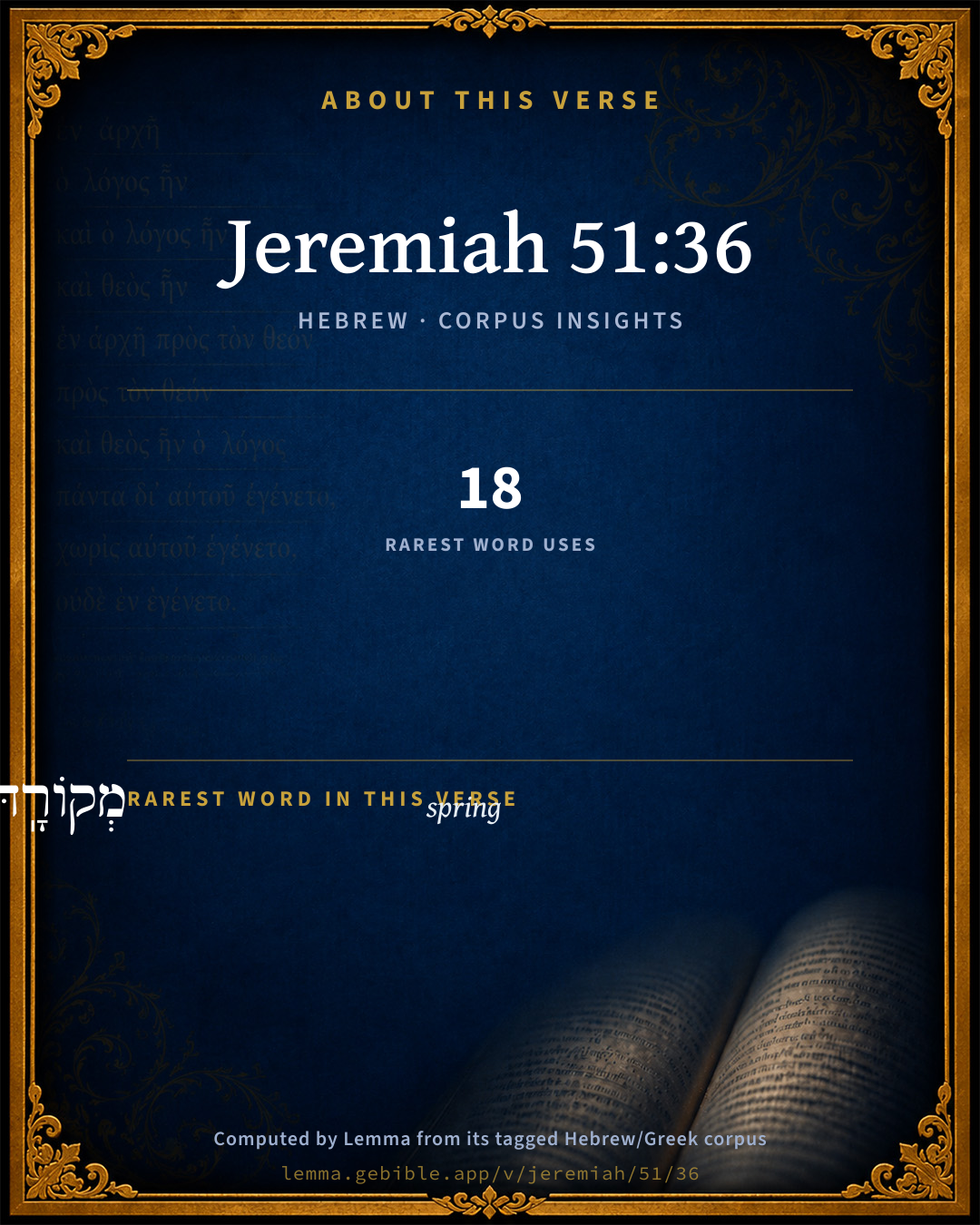
The rarest word here is מְקוֹרָֽהּ spring H4726 — appearing just 18 times in the whole Hebrew Bible.

Shared distinctive vocabulary

מְקוֹרָֽהּ spring H4726 occurs in 17 verses of the Hebrew Bible. Also found in:

Grammatical profile

  • 5 verbs
  • 5 nouns
  • 2 adverbs
  • 5 particles

Verb forms

  • אָמַ֣ר Qal · Perfect
  • רָב֙ Qal · Participle Active
  • וְנִקַּמְתִּ֖י Piel · Sequential Perfect
  • וְהַחֲרַבְתִּי֙ Hiphil · Sequential Perfect
  • וְהֹבַשְׁתִּ֖י Hiphil · Sequential Perfect

Cross-references

20

Topical passages linked to Jeremiah 51:36 in the Treasury of Scripture Knowledge — connected by theme and wording, ordered by reader-vote popularity; previews shown in the World English Bible.

  • Jeremiah 50:38 A drought is on her waters, and they shall be dried up; for it is a land of engraved images, and they are mad over idols.
  • Romans 12:19 Don't seek revenge yourselves, beloved, but give place to God's wrath. For it is written, "Vengeance belongs to me; I will repay, says the Lord."
  • Psalms 140:12 I know that Yahweh will maintain the cause of the afflicted, And justice for the needy.
  • Deuteronomy 32:35 Vengeance is mine, and recompense, At the time when their foot shall slide: For the day of their calamity is at hand, The things that are to come on them shall make haste.
  • Deuteronomy 32:43 Rejoice, you nations, [with] his people: For he will avenge the blood of his servants, Will render vengeance to his adversaries, Will make expiation for his land, for his people.
  • Isaiah 44:27 who says to the deep, Be dry, and I will dry up your rivers;
  • Hebrews 10:30–31 For we know him who said, "Vengeance belongs to me," says the Lord, "I will repay." Again, "The Lord will judge his people."
  • Psalms 94:1–3 Yahweh, you God to whom vengeance belongs, You God to whom vengeance belongs, shine forth.
  • Psalms 107:33 He turns rivers into a desert, Water springs into a thirsty ground,
  • Proverbs 22:23 For Yahweh will plead their case, And plunder the life of those who plunder them.
  • Proverbs 23:11 For their Defender is strong. He will plead their case against you.
  • Isaiah 43:14 Thus says Yahweh, your Redeemer, the Holy One of Israel: For your sake I have sent to Babylon, and I will bring down all of them as fugitives, even the Chaldeans, in the ships of their rejoicing.
  • Isaiah 47:6–9 I was angry with my people, I profaned my inheritance, and gave them into your hand: you did show them no mercy; on the aged have you very heavily laid your yoke.
  • Isaiah 49:25–26 But thus says Yahweh, Even the captives of the mighty shall be taken away, and the prey of the terrible shall be delivered; for I will contend with him who contends with you, and I will save your children.
  • Jeremiah 50:33–34 Thus says Yahweh of hosts: The children of Israel and the children of Judah are oppressed together; and all who took them captive hold them fast; they refuse to let them go.
  • Jeremiah 51:6 Flee out of the midst of Babylon, and save every man his life; don't be cut off in her iniquity: for it is the time of Yahweh's vengeance; he will render to her a recompense.
  • Micah 7:8–10 Don't rejoice against me, my enemy. When I fall, I will arise. When I sit in darkness, Yahweh will be a light to me.
  • Habakkuk 2:8–17 Because you have plundered many nations, all the remnant of the peoples will plunder you, because of men's blood, and for the violence done to the land, to the city and to all who dwell in it.
  • Revelation 16:12 The sixth poured out his bowl on the great river, the Euphrates. Its water was dried up, that the way might be made ready for the kings that come from the sunrise.
  • Revelation 19:1–3 After these things I heard something like a loud voice of a great multitude in heaven, saying, "Hallelujah! Salvation, power, and glory belong to our God:

Cross-references courtesy of OpenBible.info (CC BY 4.0).

Hebrew and Greek witnesses Masoretic Hebrew ↔ Greek Septuagint

The same verse in the two great witnesses to the Old Testament, shown verse-for-verse.

These are two independent witnesses, not word-aligned to each other, and the Septuagint is shown in lemma (dictionary) form.

Hebrew Jeremiah 51:36 Masoretic · Westminster Leningrad Codex

לָכֵ֗ן כֹּ֚ה אָמַ֣ר יְהוָ֔ה הִנְנִי רָב֙ אֶת רִיבֵ֔ךְ וְנִקַּמְתִּ֖י אֶת נִקְמָתֵ֑ךְ וְהַחֲרַבְתִּי֙ אֶת יַמָּ֔הּ וְהֹבַשְׁתִּ֖י אֶת מְקוֹרָֽהּ

Therefore thus says Yahweh: Behold, I will plead your cause, and take vengeance for you; and I will dry up her sea, and make her fountain dry.

World English Bible · Public Domain

Greek LXX Structure differs

In the Septuagint, Jeremiah is about an eighth shorter than the Hebrew and arranges its material differently — the Oracles Against the Nations (Hebrew chapters 46–51) appear in the middle of the Greek book, after 25:13. Because the chapter and verse boundaries do not line up, a verse-for-verse comparison with the Hebrew is not shown.

A verse-for-verse comparison isn’t shown here because the chapters and verses don’t line up. Switch to the LXX edition with the MT / LXX toggle above to read the Greek directly.

Hebrew: Westminster Leningrad Codex (CC BY 4.0). Greek: Septuagint (public domain); English from a public-domain English Septuagint. How the Septuagint differs from the Hebrew →

Targum (Aramaic paraphrase)

1

The Targum is the ancient Jewish Aramaic paraphrase of the Hebrew Scriptures — an interpretive translation, not the Hebrew text itself. Onkelos (literal) and Pseudo-Jonathan (expansive) render the Torah, and Jonathan the Prophets. Coverage is partial: where no permissively-licensed English translation exists for a verse, only the Aramaic is shown. This is verse-level text, not a word-by-word alignment to the Hebrew.

  1. Targum Jonathan Prophets (Joshua–Malachi)
    בְּכֵן כִדְנַן אֲמַר יְיָ הָא אֲנָא דָאִין יַת דִינִיךְ וּמִתְפְּרַע יַת פּוּרְעֲנוּתִיךְ וְאַחְרִיב יַת יַמָהּ וְאוֹבִישׁ יַת מַבּוּעָהָא:

    (no public-domain English translation for this verse)

    Targum Jonathan — Aramaic: “Mikraot Gedolot” (public domain). English: “Sefaria Community Translation” (CC0 1.0 (public-domain dedication)); “London "Chaldee Paraphrase," 1871” (public domain). Text via Sefaria.

Commentary

Notes on Jeremiah 51:36 from classic Christian and Jewish commentators (each source and its license shown beneath its notes). The classic Christian expositions comment on the surrounding passage and are grouped to its opening verse, so a note may address several verses; the Jewish commentaries on the Tanakh (Rashi and others) are per-verse, so they appear only where the commentator wrote on this verse.

Lemma curates 59 commentaries, every one of them public domain or Creative Commons licensed, each selected and text-cleaned for this edition rather than reprinted as found. About our sources →

Trapp's Complete Commentary

John Trapp

Jer 51:36 Therefore thus saith the LORD; Behold, I will plead thy cause, and take vengeance for thee; and I will dry up her sea, and make her springs dry.

Ver. 36. Behold, I will plead thy cause.] Not so much verbally as really. Here is a present answer to Israel’s cry.

John Trapp, A Commentary or Exposition upon All the Books of the Old and New Testament (1647–1656) — public domain. Text from a community e-Sword module.

Joseph Benson's Commentary

Jer 51:36-39. Thus saith the Lord, I will plead thy cause — This is, as it were, God’s answer to the prayers and imprecations of the Jewish people, mentioned in the two foregoing verses. I will dry up her sea, and make her springs dry — This some think is spoken figuratively, meaning, I will exhaust her multitudes of people, and dry up all those sources from whence she derived her immense wealth and power. But this was literally fulfilled in Cyrus’s draining the river, and thereby gaining an entrance into the city. All great waters are called seas in the Hebrew language. And Babylon shall become heaps — See note on Jer 50:39-40. They shall roar together like lions, &c. — This is either expressive of their grief and anguish of mind, or else the prophet describes the revels and riotous noise which they made upon the night of that public festival in which the city was taken: see below. In their heat I will make their feasts — Or, I will supply them with drink, as Blaney renders משׁתיהם, observing, that all the ancient versions give the word that sense, and that it agrees with the use of it, Dan 1:8; Dan 1:10; Dan 1:16. And I will make them drunken — I will suffer them to give a loose to joy in their feasts, and to be intoxicated with wine: God is frequently said in Scripture to do those things which he permits to be done. Or the words may be taken figuratively, as signifying, While they are feasting I will prepare for them another cup to drink, namely, that of my fury and indignation. History informs us that Babylon was taken at a time when the Babylonians were so engaged in feasting and revelling, and so intoxicated with liquor, that the gates leading down to the river, which used to be shut every night, were left open, which gave a free passage to Cyrus and his army into the city. That they may rejoice and sleep a perpetual sleep — That, in the midst of their jollity and security, they may sleep the sleep of death.

Joseph Benson's Commentary on the Old and New Testaments (1811–1818) — public domain. Text from a community e-Sword module.

Tyndale Open Study Notes

Tyndale Open Resources

51:36 I will be your lawyer: In response to the people’s request (51:35), the Lord would prosecute Babylon for its brutal sins.

Tyndale Open Study Notes — © Tyndale Open Resources, licensed CC BY-SA 4.0. Text via the HelloAO Bible API.

Geneva Bible (1599)

Geneva Bible translators

Thus the Lord esteemed the injury done to his Church, as done to himself, because their cause is his.

Geneva Bible (1599) marginal notes — public domain. Text via Bolls.life.

Jamieson, Fausset & Brown

Robert Jamieson, A. R. Fausset & David Brown

plead . . . cause-- (Jer 50:34).

sea--the Euphrates (Jer 51:13; Jer 50:38). Compare Isa 19:5, "sea," that is, the Nile (Isa 21:1).

Jamieson, Fausset & Brown — Commentary Critical and Explanatory on the Whole Bible (1871) — public domain (CC PDM 1.0). Text via the HelloAO Bible API.

Adam Clarke's Commentary

Verse 36. I will dry up her sea] Exhaust all her treasures.

Adam Clarke's Commentary on the Bible (1810–1826) — public domain. Text from a community e-Sword/MySword module.

John Calvin's Commentaries

Then follows a clearer explanation, when God promises that he would be the avenger of his chosen people, and that whatever the Jews had suffered would be rendered to Babylon: Therefore thus saith Jehovah, Behold, I will litigate thy quarrel. By this passage we are taught to present our complaints to God, if we wish him to undertake our cause; for when we are silent, he will in his turn rest, as he considers us unworthy of being helped. But if we cry to him, he will doubtless hear us. Then we must remember the order of things, for the Prophet says on the one hand, Let Jerusalem cry, let the daughter of Sion say; and on the other hand he says, Therefore God will come and hear the cry of his people.

He says, first, Behold, I will plead thy cause, and then, I will vindicate or avenge thy vengeance. These are hard words to Latin ears; but yet they contain more force and power than if we were to follow the elegance of the Latin tongue. It is then better to retain the genuine terms than to study neatness too much.

In short, God promises to be the defender of his people, and by using the demonstrative particle, he doubtless removes every doubt, as though the thing was now present. We know that more than seventy years had elapsed since God had spoken thus; for as it has been already stated, it was not after the taking of the city that Jeremiah prophesied against the Chaldeans: but though God suspended his judgment and vengeance for seventy years after the destruction of the city, yet this was said, Behold, I, as though he brought the faithful to witness the event; and this was done for the sake of certainty.

Now, we hence learn, that though God humbles his people, and suffers them even to be overwhelmed with extreme miseries, he will at length become the avenger of all the wrongs which they may have endured; for what has been said of the destruction of the people has a reference to us; nay, what is here said, has not been left on record except for our benefit. And further, let us learn, as I have before reminded you, to prepare our minds for patience whenever God seems to forsake us. Let us, at the same time exercise ourselves constantly in prayer, and God will hear our groans and complaints, and regard our tears.

It is afterwards added, I will make dry her sea; for Babylon, as it has been already stated, was surrounded by the streams of the Euphrates; and there was no easy access to it. The Prophet then compares the fortifications of Babylon to a sea and a fountain. For who would have thought that the Euphrates could be dried up, which is so large a river, and has none equal to it in all Europe? Even the Danube does not come up to the largeness of that river. Who then would have thought it possible that such a river could be made dry, which was like a sea, and its fountain inexhaustible? God then intimates by these words, that such was his power, that all obstacles would vanish away, and that he was resolved at the same time to execute his judgment on the Babylonians. It afterwards follows, —

John Calvin's Commentaries (1540-1563) — public domain. Text from the Calvin Translation Society English edition (1840s-50s) via the Christian Classics Ethereal Library (ccel.org). Calvin's coverage is partial (roughly two-thirds of the Bible); uncommented books and verses are honest gaps, never fabricated. The 19th-century editor's footnotes and remarks are omitted so the notes are faithfully Calvin's own voice.

Ellicott's Commentary for English Readers

(36) I will dry up her sea . . .—The nouns have been variously interpreted, some commentators referring it to the “sea” of confluent nations, and finding the wealth of Babylon in the “springs” that fed its greatness; others to the Euphrates, or to the sea-like alluvial plain, intersected by canals and streams in which the city stood, often flooded by the river, so that it became as an actual sea (Herod. i. 184), or specially to the large lake described in the Note on Jer_51:32. So in Isa_21:1 Babylon is described as “the desert of the sea.” The Hebrew word for “springs” is in the singular, her reservoir. Probably the literal and figurative meanings run into one another, and the “drying up” describes the exhaustion of the power of which the “sea” was the symbol. In Rev_16:12 we have apparently an allusive reference to the language of this prediction.

A Bible Commentary for English Readers, edited by Charles John Ellicott (1878–1897) — public domain. Text from a community e-Sword module.

The Cambridge Bible for Schools and Colleges

gen. ed. J. J. S. Perowne

36. Jehovah replies favourably to the demand for vengeance on Babylon.

her sea … her fountain] either the Euphrates (cp. the word “sea” as applied to the river Nile in Isa_18:2; Isa_19:5; Nah_3:8) or, better, the great lake or reservoir, four hundred and twenty furlongs in circumference, made by queen Nitocris (Herod. I. 185), or that constructed by Nebuchadnezzar (see Records of the Past, 2nd series, III. 116).

The Cambridge Bible for Schools and Colleges (gen. ed. J. J. S. Perowne; Cambridge University Press, 1878–1918) — public domain. Text from a community e-Sword module.

John Gill's Exposition

They shall roar together like lions,.... Some understand this of the Medes and Persians, and the shouts they made at the attacking and taking of Babylon; but this does not so well agree with that, which seems to have been done in a secret and silent manner; rather according to the context the Chaldeans are meant, who are represented as roaring, not through fear of the enemy, and distress by him; for such a roaring would not be fitly compared to the roaring of a lion; but either this is expressive of their roaring and revelling at their feast afterwards mentioned, and at which time their city was taken; or else of the high spirits and rage they were in, and the fierceness and readiness they showed to give battle to Cyrus, when he first came with his army against them; and they did unite together, and met him, and roared like lions at him, and fought with him; but being overcome, their courage cooled; they retired to their city, and dared not appear more; See Gill on Jer 51:30;

they shall yell as lions' whelps. Jarchi and other Rabbins interpret the word of the braying of an ass; it signifies to "shake"; and the Vulgate Latin version renders it, "they shall shake their hair"; as lions do their manes; and young lions their shaggy hair; and as blustering bravadoes shake theirs; and so might the Babylonians behave in such a swaggering way when the Medes and Persians first attacked them.

John Gill's Exposition of the Whole Bible (1746–1763) — public domain (CC PDM 1.0). Text via the HelloAO Bible API.

Albert Barnes' Notes on the Bible

Her sea - Probably the great lake dug by Nitocris to receive the waters of the Euphrates.

Her springs - Her reservoir; the whole system of canals dug Jer 51:13. The wealth of Babylonia depended upon irrigation.

Albert Barnes' Notes on the Bible (1834–1885) — public domain. Text from a community e-Sword/MySword module.

Haydock's Catholic Bible Commentary

Spring; commerce, the source of her riches; or rather the waters shall be brought out of their usual channels. For many ages (Calmet) the Euphrates has been lost in sands, and reaches not the Persian Gulf. (Pliny, [Natural History?] vii. 27.) (Cellar. iii. 16.)

George Leo Haydock (1774–1849), Haydock's Catholic Family Bible and Commentary, 1859 edition — public domain. Excludes Psalms (Douay-Rheims chapter numbering differs from Protestant) and Deuterocanonical books (Catholic canon only).

Matthew Poole's English Annotations

Men had need take heed how they give cause of appeals to God against them, especially the appeals of such as are a people that have a covenant relation to God. God in those cases ordinarily showeth himself a swift witness and judge, and gives a speedy judgment in such causes.

Behold, saith God,

I will plead thy cause, not with words, but actually with my judicial dispensations, therefore it is expounded by taking vengeance. The vengeance which God threateneth is expressed metaphorically under the notion of

drying up her sea, and making her springs dry, which signifies the depriving her of all necessaries, not only of the abundance of her men, riches, treasures, but of her springs. Thus I had rather expound it, than as referring to the particular stratagem by which Cyrus took Babylon, viz, by drying up in some measure the river Euphrates, that is, turning it into other channels.

Matthew Poole's English Annotations on the Holy Bible (1683–1685) — public domain. Text from a community e-Sword/MySword module.

Whedon's Commentary on the Bible

Daniel D. Whedon

36. Her sea — The Euphrates river. The distinction between seas and rivers was by no means so clearly drawn in ancient times as now. Hence Jonah speaks of a nahar (river) in the sea. Springs, in this passage, are the smaller streams which water and fertilize the country. Indeed, the literal import of the original is, her digging, and so it very exactly suits the artificial canals dug for this purpose.

Daniel D. Whedon (gen. ed.), Commentary on the Old and New Testaments (1874–1909) — public domain. Text from a community e-Sword module.

The Pulpit Commentary

Her sea; i.e. the Euphrates, (comp. Isa_21:1) or perhaps the lake dug by Nitocris to receive the waters of the Euphrates, Herod., 1:185 (Payne Smith). Comp. on "the reeds," ver. 32. Her springs, rather, her reservoirs. There are no springs, remarks Dr. Payne Smith, in the flat alluvial soil of Babylonia. The Hebrew word makor is used here collectively for the whole system of canals and reservoirs for the storing of the water.

Making the springs dry.

I MAN"S EFFORT TO SUPPLY HIS NEED. There are the springs breaking forth among the hills and inviting men freely to use them. But there are also the wells men dig for themselves. Men must have water, yet they cannot always go and live by the natural springs, and so where they have to live they dig wells, and wonderfully do they succeed oftentimes in getting what they want. Water comes apparently in exhaustless abundance. Thus it is with the natural resources which man strives to obtain for himself. They open out before him far larger than any present wants. And thus when man sees all this within his reach, he naturally devises great undertakings on the strength of such great resources.

II THE SELFISH USE OF HIS SUCCESS. It not unfrequently happens that the man who digs a well for himself does it at the expense of others, making their wells to run dry. The thing may be done unintentionally, or almost on a commonly accepted principle of every one looking out for himself; still it is to be looked on as pure selfishness. The resources of Babylon were increased by diminishing the resources of other peoples, This is a point to be always looked at in estimating men of large resources, namely, how far those resources have been gained by leaving others without resource at all or with but a scanty one.

III GOD"S REMOVAL OF HIS RESOURCES. "I will make her springs dry." God can dry up all humanly provided wells. We must not boast ourselves of their number, their depth, or the ease with which they keep to a certain level in spite of all drains upon them. Powerful nations, proud of their history and their achievements, need to remember this Divine interference. Men, looking hack on a long course of individual success, need to remember the same. One can imagine a city in a time of siege, thoroughly provisioned, knowing exactly how much it had for food, and not troubling itself at all about drink, seeing that it had a deep well, the waters of which showed hardly any difference even in the driest summer. Yet all at once that well may fail, and, however large the other supplies, thirst will compel surrender. God dries up all wells that have been dug in covetousness and injustice.

IV THE IMPLICATION OF OTHER ENDURING RESOURCES. "With thee is the fountain of life," says the psalmist. (Psa_36:9) We must look, not to the wells of our own digging, but to the springs from the everlasting hills. Especially we must catch the spirit of Ps 87. There the psalmist praises Zion, and finishes up by saying, "All my springs are in thee." Let our springs be in the holy and abiding mount of God. Y. (Heb_12:22)

The Pulpit Commentary (1880–1919), ed. H.D.M. Spence-Jones & Joseph S. Exell — public domain. Text from a community e-Sword module.

John Wesley's Explanatory Notes

Dry up - Alluding to what Cyrus did.

John Wesley, Explanatory Notes Upon the Whole Bible (1754–1765) — public domain. Text via the GEBible commentary corpus.

unfoldingWord translationNotes

Door43 World Missions Community

General Information:

This begins Yahweh's reply to Jerusalem's request in verses 34 and 35.

I am about to plead your case and bring about vengeance

Yahweh defending his people is spoken of as if he were a lawyer pleading their case in court. AT: "I will be like your lawyer to defend you and I will bring about vengeance" (See: Metaphor)

heaps of rubble

buildings that have become piles of rock

den of jackals

home for wild dogs

a horror

something that terrifies everyone who looks at it

hissing

a sound people make to show that they dislike something very much

there are no inhabitants

"no one lives"

translationWords

Yahweh

plea

avenge

water

unfoldingWord translationNotes — © Distant Shores Media and the Door43 World Missions Community, licensed CC BY-SA 4.0. Source: git.door43.org/Door43/en_tn.

Lesson kit

Teaching starters — assembled from the data on this page, not authored interpretation. Every prompt links to the verse data it draws on. Edit before teaching.

Jeremiah, in the Prophets, opens this verse with 17 words (14 distinct Hebrew lemmas). Its most distinctive word is mâqôwr (“spring”). A historical commentator’s framing appears above. Read the whole chapter for the surrounding context.

Discussion questions

  1. The word mâqôwr carries the sense “spring.” How does it shape the verse?
  2. Leviticus 12:7 shares the word «spring» with this verse. How do the two illuminate each other?
  3. These translations render this verse differently. What is at stake in choosing one wording over another?
  4. The verb «אָמַ֣ר» is Qal Perfect. How does its form color the action?
  5. Reading how Trapp's Complete Commentary and Joseph Benson's Commentary read this verse, where do the two commentators agree and where do they part?

Things to notice

Reading settings

Reading text

Shown beneath each verse's original-language words.

Old Testament
Old Testament edition

Read the OT as the Masoretic Hebrew (MT) or the Greek Septuagint (LXX).

English shown for the Greek Septuagint (in the Hebrew ↔ Greek comparison).

Comparing translations? Open the Compare panel on any verse page to stack up to four side by side.