
Isaiah 27:11

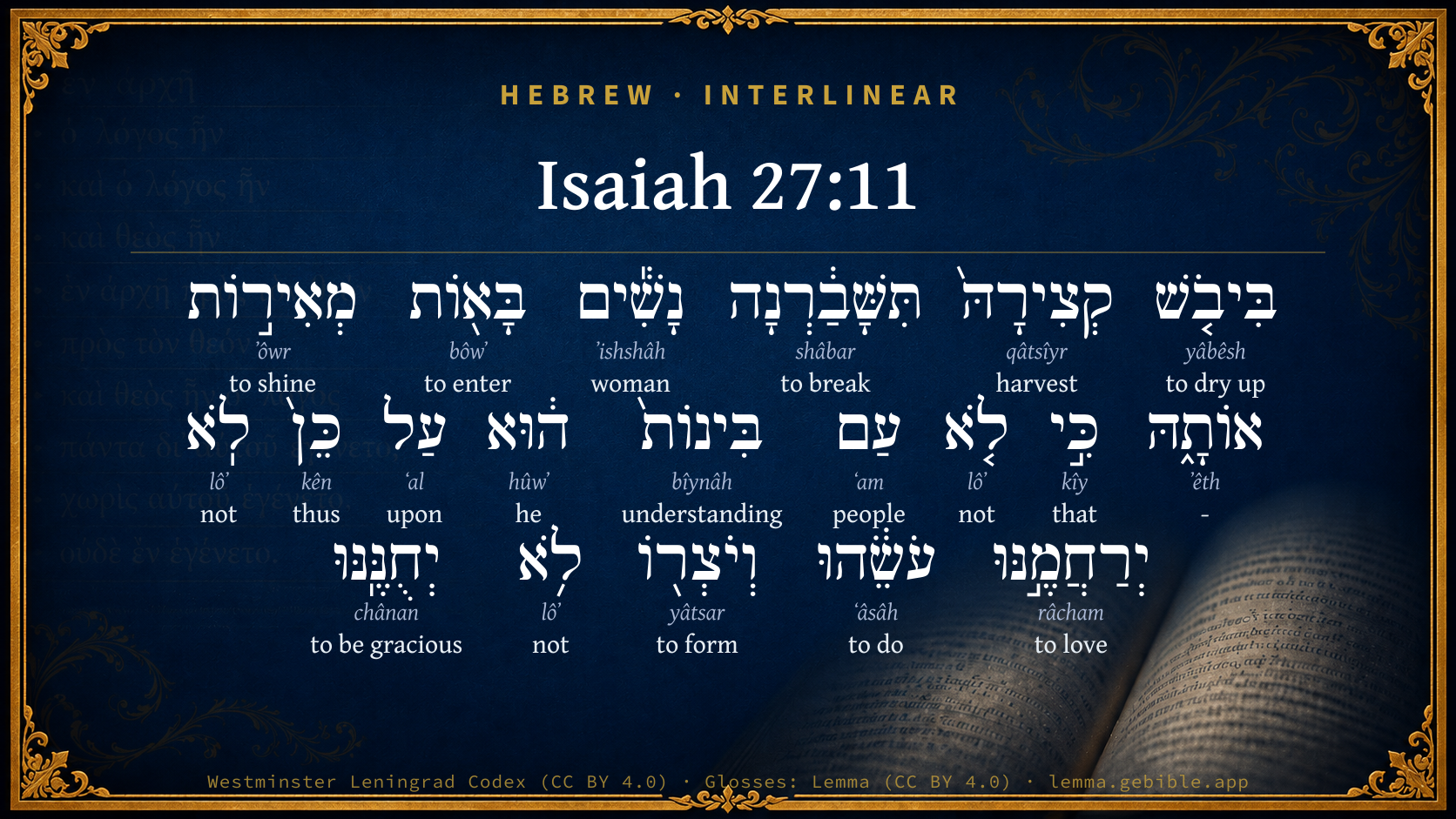
Hebrew (Westminster Leningrad Codex) Isaiah 27:11 appears in the Hebrew Old Testament. The text above is from the Westminster Leningrad Codex. Each word links to its Strong’s number, a concise gloss, and parsing drawn from the Open Scriptures Hebrew Bible morphology. Click any word for its full Brown-Driver-Briggs (BDB) entry.
Download image
Cite this verse

Isaiah 27:11 (World English Bible). Public Domain. Lemma interlinear Bible study tool, https://lemma.gebible.app/v/isaiah/27/11.

Show BibTeX & RIS
BibTeX
RIS
English Translation
When the boughs of it are withered, they shall be broken off; the women shall come, and set them on fire; for it is a people of no understanding: therefore he who made them will not have compassion on them, and he who formed them will show them no favor.
World English Bible · Public Domain
Download a study sheet

One document with this verse’s original text, its word-by-word gloss line, the meaning frame, cross-references with their text, attributed commentary, and full source and license credits — printable, and it pastes into notes with its structure intact.

This verse Autodidact and up

Study sheet (.html) Plain text (.txt)

A passage Seminary Student

Up to 50 verses in one chapter. A passage sheet keeps up to 6 commentary sources and 12 cross-references per verse, in the order this page ranks them, and says so on the sheet whenever that leaves anything out. Ask for a single verse and you get the Autodidact verse sheet above.

Everything on this page stays free to read, with no account — the sheet is a download of what is already on screen, not access to it.

Want to remove ads? Support Godless Engineer
Compare translations 3

The same verse in 3 English versions, stacked beneath the original-language interlinear above. Click any original word for its lexicon entry.

Each is an independent rendering of the whole verse — the interlinear is not word-aligned to these translations.

Highlighted words mark where these versions differ — a whole-verse word diff, not a word-by-word alignment.

  • World English Bible Public Domain
    When the boughs of it are withered, they shall be broken off; the women shall come, and set them on fire; for it is a people of no understanding: therefore he who made them will not have compassion on them, and he who formed them will show them no favor.
  • King James Version Public Domain
    When the boughs thereof are withered, they shall be broken off: the women come, and set them on fire: for it is a people of no understanding: therefore he that made them will not have mercy on them, and he that formed them will shew them no favour.
  • unfoldingWord Literal Text CC BY-SA 4.0
    When its boughs dry up, they will be broken. Women will be coming, they will be kindling it. For it not a people of understanding. Therefore its maker does not pity it, and its fashioner does not favor it.

unfoldingWord Literal Text — © unfoldingWord, licensed CC BY-SA 4.0. Word-aligned USFM3 via Door43 (git.door43.org/unfoldingWord/en_ult).

Versions to compare (up to 4)

3 of 4 selected

Show all 18 translations

Every available English version of this verse, each an independent rendering of the whole verse.

  • World English Bible Public Domain
    When the boughs of it are withered, they shall be broken off; the women shall come, and set them on fire; for it is a people of no understanding: therefore he who made them will not have compassion on them, and he who formed them will show them no favor.
  • Berean Standard Bible Public Domain
    When its limbs are dry, they are broken off. Women come and use them for kindling; for this is a people without understanding. Therefore their Maker has no compassion on them, and their Creator shows them no favor.
  • Majority Standard Bible Public Domain
    When its limbs are dry, they are broken off. Women come and use them for kindling; for this is a people without understanding. Therefore their Maker has no compassion on them, and their Creator shows them no favor.
  • King James Version Public Domain
    When the boughs thereof are withered, they shall be broken off: the women come, and set them on fire: for it is a people of no understanding: therefore he that made them will not have mercy on them, and he that formed them will shew them no favour.
  • American Standard Version (1901) Public Domain
    When the boughs thereof are withered, they shall be broken off; the women shall come, and set them on fire; for it is a people of no understanding: therefore he that made them will not have compassion upon them, and he that formed them will show them no favor.
  • Revised Version (1885) Public Domain
    When the boughs thereof are withered, they shall be broken off; the women shall come, and set them on fire: for it is a people of no understanding; therefore he that made them will not have compassion upon them, and he that formed them will shew them no favour.
  • Geneva Bible (1599) Public Domain
    When the boughes of it are drie, they shalbe broken: the women come, and set them on fire: for it is a people of none vnderstading: therefore hee that made them, shall not haue compassion of them, and he that formed them, shall haue no mercie on them.
  • Douay-Rheims (1899) Public Domain
    Its harvest shall be destroyed with drought, women shall come and teach it: for it is not a wise people, therefore he that made it, shall not have mercy on it: and he that formed it, shall not spare it.
  • Young's Literal Translation Public Domain
    In the withering of its branch it is broken off, Women are coming in setting it on fire, For it `is' not a people of understanding, Therefore pity it not doth its Maker, And its Former doth not favour it.
  • Literal Standard Version CC BY-SA 4.0
    In the withering of its branch it is broken off, || Women are coming in [and] setting it on fire, || For it [is] not a people of understanding, || Therefore its Maker does not pity it, || And its Former does not favor it.
  • Unlocked Literal Bible CC BY-SA 4.0
    When the boughs are withered, they will be broken off. Women will come and make fires with them, for this is not a people of understanding. Therefore their Maker will not have compassion on them, and he who made them will not be merciful to them.
  • unfoldingWord Literal Text CC BY-SA 4.0
    When its boughs dry up, they will be broken. Women will be coming, they will be kindling it. For it not a people of understanding. Therefore its maker does not pity it, and its fashioner does not favor it.
  • Darby Bible Public Domain
    When its branches are withered they shall be broken off; women shall come [and] set them on fire. For it is a people of no intelligence; therefore he that made them will not have mercy on them, and he who formed them will shew them no favour.
  • World Messianic Bible Public Domain
    When its boughs are withered, they will be broken off. The women will come and set them on fire, for they are a people of no understanding. Therefore he who made them will not have compassion on them, and he who formed them will show them no favor.
  • Webster's Bible Public Domain
    When its boughs are withered, they shall be broken off: the women come and set them on fire: for it is a people of no understanding: therefore he that made them will not have mercy on them, and he that formed them will show them no favor.
  • Free Bible Version CC BY-SA 4.0
    Their dry branches are broken off and used by women to make fires. This is a people that doesn't have any sense, so their Maker won't feel sorry for them, and their Creator won't help them.
  • Bible in Basic English Public Domain
    When its branches are dry they will be broken off; the women will come and put fire to them: for it is a foolish people; for this cause he who made them will have no mercy on them, and he whose work they are will not have pity on them.
  • JPS Tanakh (1917) Public Domain
    When the boughs thereof are withered, they shall be broken off; the women shall come, and set them on fire; for it is a people of no understanding; therefore He that made them will not have compassion upon them, and He that formed them will not be gracious unto them.

Literal Standard Version (2020), Covenant Press — licensed CC BY-SA 4.0. Text via the HelloAO Bible API (eBible.org). Unlocked Literal Bible (unfoldingWord) — licensed CC BY-SA 4.0. Text via the HelloAO Bible API (eBible.org). unfoldingWord Literal Text — © unfoldingWord, licensed CC BY-SA 4.0. Word-aligned USFM3 via Door43 (git.door43.org/unfoldingWord/en_ult). Free Bible Version, Dr. Jonathan Gallagher — licensed CC BY-SA 4.0. Text via the HelloAO Bible API (eBible.org).

Word by word

More ways to search: Search by grammar → Find every occurrence → Compare this word →

Practice this passage: Drill this verse → Learn its vocabulary →

בִּינוֹת֙
bîynâh
H998
“understanding”
Noun, Common, Feminine, Plural, Absolute
Part of Speech
Noun
Type
Common
Gender
Feminine
Number
Plural
State
Absolute
Full BDB Definition

Origin: from H995

TWOT: 239b

understanding, discernment - act - faculty - object - personified
  1. בִּיבֹ֤שׁ yâbêsh H3001 “in/at · to dry up” Preposition + Verb, Qal, Infinitive Construct
  2. קְצִירָהּ֙ qâtsîyr H7105 “harvest · her” Noun, Common, Masculine, Singular, Construct + Suffix, Personal, 3rd Person, Feminine, Singular
  3. תִּשָּׁבַ֔רְנָה shâbar H7665 “to break” Verb, Niphal, Imperfect, 3rd Person, Feminine, Plural
  4. נָשִׁ֕ים ʼishshâh H802 “women” Noun, Common, Feminine, Plural, Absolute
  5. בָּא֖וֹת bôwʼ H935 “entering” Verb, Qal, Participle Active, Feminine, Plural, Absolute
  6. מְאִיר֣וֹת ʼôwr H215 “shining” Verb, Hiphil, Participle Active, Feminine, Plural, Absolute
  7. אוֹתָ֑הּ ʼêth H853 “- · her” Particle, Direct Object + Suffix, Personal, 3rd Person, Feminine, Singular
  8. כִּ֣י kîy H3588 “that” Conjunction
  9. לֹ֤א lôʼ H3808 “not” Particle, Negative
  10. עַם ʻam H5971 “people of” Noun, Common, Masculine, Singular, Construct
  11. ה֔וּא hûwʼ H1931 “he” Pronoun, Personal, 3rd Person, Masculine, Singular
  12. עַל ʻal H5921 “upon” Preposition
  13. כֵּן֙ kên H3651 “thus” Particle, Demonstrative
  14. לֹֽא lôʼ H3808 “not” Particle, Negative
  15. יְרַחֲמֶ֣נּוּ râcham H7355 “to love · him” Verb, Piel, Imperfect, 3rd Person, Masculine, Singular + Suffix, Personal, 3rd Person, Masculine, Singular
  16. עֹשֵׂ֔הוּ ʻâsâh H6213 “doing · him” Verb, Qal, Participle Active, Masculine, Singular, Construct + Suffix, Personal, 3rd Person, Masculine, Singular
  17. וְיֹצְר֖וֹ yâtsar H3335 “and · forming · him” Conjunction + Verb, Qal, Participle Active, Masculine, Singular, Construct + Suffix, Personal, 3rd Person, Masculine, Singular
  18. לֹ֥א lôʼ H3808 “not” Particle, Negative
  19. יְחֻנֶּֽנּוּ chânan H2603 “to be gracious · him” Verb, Qal, Imperfect, 3rd Person, Masculine, Singular + Suffix, Personal, 3rd Person, Masculine, Singular

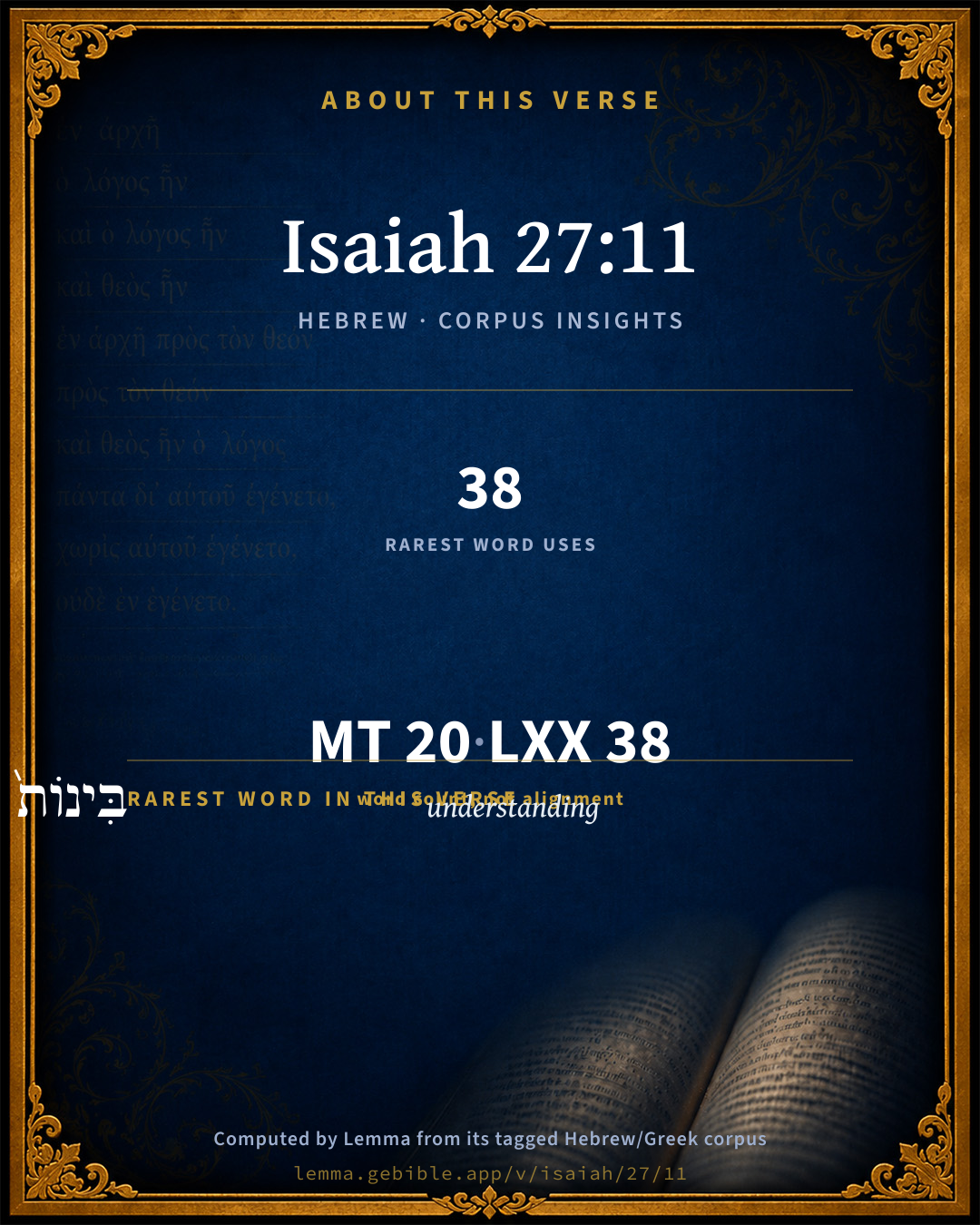
About this verse

These counts appear in no published source. They are computed here, from the morphology-tagged text and Lemma’s own curated glosses. What Lemma adds →

20
words
18
distinct lemmas
Prophets
section

Shared distinctive vocabulary

בִּינוֹת֙ understanding H998 occurs in 38 verses of the Hebrew Bible. Also found in:

Grammatical profile

  • 8 verbs
  • 4 nouns
  • 1 pronoun
  • 1 preposition
  • 1 conjunction
  • 5 particles

Verb forms

  • בִּיבֹ֤שׁ Qal · Infinitive Construct
  • תִּשָּׁבַ֔רְנָה Niphal · Imperfect
  • בָּא֖וֹת Qal · Participle Active
  • מְאִיר֣וֹת Hiphil · Participle Active
  • יְרַחֲמֶ֣נּוּ Piel · Imperfect
  • עֹשֵׂ֔הוּ Qal · Participle Active
  • וְיֹצְר֖וֹ Qal · Participle Active
  • יְחֻנֶּֽנּוּ Qal · Imperfect

Repetition

A word recurs within this verse — often emphatic in Hebrew:

Hebrew & Septuagint length

In English translation the verse runs 50 words from the Hebrew and 57 from the Septuagint (LXX English) — closely comparable.

A rough comparison of the two English renderings, which tokenize alike — not a word-level alignment.

Word counts can differ between the Hebrew and the Greek without any difference in meaning — e.g. the Hebrew direct-object marker אֵת has no separate Greek word, and Greek often adds the article ὁ.

In the original languages it is 20 Hebrew tokens and 38 Greek tokens — but the two are counted differently (Hebrew bundles its prefixes and suffixes into one token; the Greek is in lemma form), so that isn’t a like-for-like length.

Cross-references

31

Topical passages linked to Isaiah 27:11 in the Treasury of Scripture Knowledge — connected by theme and wording, ordered by reader-vote popularity; previews shown in the World English Bible.

  • Isaiah 1:3 The ox knows his owner, And the donkey his master's crib; But Israel doesn't know, My people don't consider.
  • Isaiah 43:1 But now thus says Yahweh who created you, Jacob, and he who formed you, Israel: Don't be afraid, for I have redeemed you; I have called you by your name, you are mine.
  • Isaiah 43:7 everyone who is called by my name, and whom I have created for my glory, whom I have formed, yes, whom I have made.
  • Isaiah 44:24 Thus says Yahweh, your Redeemer, and he who formed you from the womb: I am Yahweh, who makes all things; who stretches forth the heavens alone; who spreads abroad the earth (who is with me?);
  • Jeremiah 8:7 Yes, the stork in the sky knows her appointed times; and the turtle-dove and the swallow and the crane observe the time of their coming; but my people don't know Yahweh's law.
  • Jeremiah 4:22 For my people are foolish, they don't know me; they are foolish children, and they have no understanding; they are wise to do evil, but to do good they have no knowledge.
  • Ezekiel 9:10 As for me also, my eye shall not spare, neither will I have pity, but I will bring their way on their head.
  • Matthew 3:10 "Even now the axe lies at the root of the trees. Therefore, every tree that doesn't bring forth good fruit is cut down, and cast into the fire.
  • John 15:6 If a man doesn't remain in me, he is thrown out as a branch, and is withered; and they gather them, throw them into the fire, and they are burned.
  • Genesis 6:6–7 Yahweh was sorry that he had made man on the earth, and it grieved him in his heart.
  • Deuteronomy 4:6 Keep therefore and do them; for this is your wisdom and your understanding in the sight of the peoples, who shall hear all these statutes, and say, Surely this great nation is a wise and understanding people.
  • Deuteronomy 32:18–25 Of the Rock that became your father, you are unmindful, Have forgotten God who gave you birth.
  • Deuteronomy 32:28–29 For they are a nation void of counsel, There is no understanding in them.
  • 2 Chronicles 36:16–17 but they mocked the messengers of God, and despised his words, and scoffed at his prophets, until the wrath of Yahweh arose against his people, until there was no remedy.
  • Psalms 80:15–16 The stock which your right hand planted, The branch that you made strong for yourself.
  • Psalms 106:40 Therefore Yahweh burned with anger against his people. He abhorred his inheritance.
  • Isaiah 9:17 Therefore the Lord will not rejoice over their young men, neither will he have compassion on their fatherless and widows; for everyone is profane and an evil-doer, and every mouth speaks folly. For all this his anger is not turned away, but his hand is stretched out still.
  • Isaiah 44:2 Thus says Yahweh who made you, and formed you from the womb, who will help you: Don't be afraid, Jacob my servant; and you, Jeshurun, whom I have chosen.
  • Isaiah 44:18–21 They don't know, neither do they consider: for he has shut their eyes, that they can't see; and their hearts, that they can't understand.
  • Jeremiah 5:4–5 Then I said, Surely these are poor; they are foolish; for they don't know the way of Yahweh, nor the law of their God:
  • Jeremiah 5:21–22 Hear now this, foolish people, and without understanding; who have eyes, and don't see; who have ears, and don't hear:
  • Ezekiel 15:2–8 Son of man, what is the vine tree more than any tree, the vine-branch which is among the trees of the forest?
  • Ezekiel 20:47 and tell the forest of the South, Hear the word of Yahweh: Thus says the Lord Yahweh, Behold, I will kindle a fire in you, and it shall devour every green tree in you, and every dry tree: the flaming flame shall not be quenched, and all faces from the south to the north shall be burnt thereby.
  • Hosea 4:6 My people are destroyed for lack of knowledge. Because you have rejected knowledge, I will also reject you, That you may be no priest to me. Because you have your God's law, I will also forget your children.
  • Matthew 13:15 For this people's heart has grown callous, Their ears are dull of hearing, They have closed their eyes; Or else perhaps they might perceive with their eyes, Hear with their ears, Understand with their heart, And should turn again; And I would heal them.'
  • Matthew 13:19 When anyone hears the word of the Kingdom, and doesn't understand it, the evil one comes, and snatches away that which has been sown in his heart. This is what was sown by the roadside.
  • Romans 1:31 without understanding, covenant-breakers, without natural affection, unforgiving, unmerciful;
  • 1 Thessalonians 2:16 forbidding us to speak to the Gentiles that they may be saved; to fill up their sins always. But wrath has come on them to the uttermost.
  • 2 Thessalonians 1:8–9 giving vengeance to those who don't know God, and to those who don't obey the Gospel of our Lord Jesus,
  • James 2:13 For judgment is without mercy to him who has shown no mercy. Mercy triumphs over judgment.
  • Romans 1:28 Even as they refused to have God in their knowledge, God gave them up to a reprobate mind, to do those things which are not fitting;

Cross-references courtesy of OpenBible.info (CC BY 4.0).

Hebrew and Greek witnesses Masoretic Hebrew ↔ Greek Septuagint

The same verse in the two great witnesses to the Old Testament, shown verse-for-verse.

These are two independent witnesses, not word-aligned to each other, and the Septuagint is shown in lemma (dictionary) form.

Hebrew Isaiah 27:11 Masoretic · Westminster Leningrad Codex

בִּיבֹ֤שׁ קְצִירָהּ֙ תִּשָּׁבַ֔רְנָה נָשִׁ֕ים בָּא֖וֹת מְאִיר֣וֹת אוֹתָ֑הּ כִּ֣י לֹ֤א עַם בִּינוֹת֙ ה֔וּא עַל כֵּן֙ לֹֽא יְרַחֲמֶ֣נּוּ עֹשֵׂ֔הוּ וְיֹצְר֖וֹ לֹ֥א יְחֻנֶּֽנּוּ

When the boughs of it are withered, they shall be broken off; the women shall come, and set them on fire; for it is a people of no understanding: therefore he who made them will not have compassion on them, and he who formed them will show them no favor.

World English Bible · Public Domain

Greek LXX Isaiah 27:11 Septuagint · lemma form

καί μετά χρόνος οὐ εἰμί ἐν αὐτός πᾶς χλωρός διά ὁ ξηραίνω γυνή ἔρχομαι ἀπό θεά δεῦτε οὐ γάρ λαός εἰμί ἔχω σύνεσις διά οὗτος οὐ μή οἰκτείρω ὁ ποιέω αὐτός οὐδέ ὁ πλάσσω αὐτός οὐ μή ἐλεέω

And after a time there shall be in it no green thing because of the grass being parched. Come hither, you⌃ women that come from a sight; for it is a people of no understanding; therefore he that made them shall have no pity upon them, and he that formed them shall have no mercy upon them.

LXX2012 (modern English Septuagint) · Public Domain

On this verse, Haydock's Catholic Bible Commentary discusses the Septuagint’s reading. Read the note in Commentary ↓

Hebrew: Westminster Leningrad Codex (CC BY 4.0). Greek: Septuagint (public domain); English from LXX2012 (modern English Septuagint) (Public Domain). How the Septuagint differs from the Hebrew →

Targum (Aramaic paraphrase)

1

The Targum is the ancient Jewish Aramaic paraphrase of the Hebrew Scriptures — an interpretive translation, not the Hebrew text itself. Onkelos (literal) and Pseudo-Jonathan (expansive) render the Torah, and Jonathan the Prophets. Coverage is partial: where no permissively-licensed English translation exists for a verse, only the Aramaic is shown. This is verse-level text, not a word-by-word alignment to the Hebrew.

  1. Targum Jonathan Prophets (Joshua–Malachi)
    יִתְקַצַר חֵילֵיהוֹן וְיִבְהֲתוּן בְּעוֹבְדֵיהוֹן יִתַּבְּרוּן נְשַׁיָא עָלָן לְבֵית דְחַלְתְּהוֹן וּמַלְפָן יַתְהוֹן אֲרֵי לָא עַם סוּכְלְתָן אִינוּן עַל כֵּן לָא יְרַחֵם עֲלֵיהוֹן דְעַבְדִינוּן וּדְבָרָנוּן לָא יָחוּס עֲלֵיהוֹן:

    Their armies shall be cut off; and they shall be confounded on account of their works, which shall be broken: women shall enter the house of their idolatry, and teach them, because they are a people of no understanding: therefore He that made them shall not have mercy on them, and He that created them shall show them no favour.

    Targum Jonathan — Aramaic: “Mikraot Gedolot” (public domain). English: “Sefaria Community Translation” (CC0 1.0 (public-domain dedication)); “London "Chaldee Paraphrase," 1871” (public domain). Text via Sefaria.

Commentary

Notes on Isaiah 27:11 from classic Christian and Jewish commentators (each source and its license shown beneath its notes). The classic Christian expositions comment on the surrounding passage and are grouped to its opening verse, so a note may address several verses; the Jewish commentaries on the Tanakh (Rashi and others) are per-verse, so they appear only where the commentator wrote on this verse.

Lemma curates 59 commentaries, every one of them public domain or Creative Commons licensed, each selected and text-cleaned for this edition rather than reprinted as found. About our sources →

Trapp's Complete Commentary

John Trapp

Isa 27:11 When the boughs thereof are withered, they shall be broken off: the women come, [and] set them on fire: for it [is] a people of no understanding: therefore he that made them will not have mercy on them, and he that formed them will shew them no favour.

Ver. 11. For it is a people of no understanding.] Heb., Not a people of understandings - i.e., non sapiunt nisi plagis emendentur, they will not be wise without whipping; I must therefore handle them the more sharply and severely. Castigat Deus quem amat, etiamsi non amat castigare.

Therefore he that made them.] Deus factor eius et fictor. A fearful sentence! such as should frighten those, many Ignaros that say, God that made us will surely save us.

John Trapp, A Commentary or Exposition upon All the Books of the Old and New Testament (1647–1656) — public domain. Text from a community e-Sword module.

The Biblical Illustrator

Joseph S. Exell

Isa_27:11

It is a people of no understanding

A dreadful denunciation of judgment

I.

THE JUDGMENT DENOUNCER.

1. Great desolation as to their outward state (Isa_27:10, and former part of Isa_27:11).

2. Utter destruction, final ruin. He that made them will not have mercy on them. It is the highest severity, where no Saviour is to be found, where judgment is executed without mercy. And this is amplified by the consideration--

(1) Partly of the inflicter of the judgment. He that made them, They were not to fall into the hands merely of men like themselves, their fellow creatures; but into the hands of the living God.

(2) Partly of kindness formerly received from Him. He that made them; He that formed them; that is, He that created them, gave them their being, or He that not only made them as His creatures, but formed them to be His servants, formed them into a State and into a Church, and so had given them their being, not only a natural one, but a civil and ecclesiastical one:

He that had formerly done so much for them, vouchsafed them such choice mercies, yet now would renounce all kindness to them.

II. THE CAUSE OF THE JUDGMENT TO BE INFLICTED. It is a people of no understanding, a sottish, ignorant people, such as take no notice of anything, know not God, observe not His works, understand not their duty. Other sins, no doubt, they were chargeable with; but the Lord takes notice especially of their ignorance, and it is for that they are here threatened. Hence we take notice, that,--

1. Ignorance of God, His truths or ways, is no security against His judgments (Jer_10:25).

2. The knowledge of the will and ways of God is necessary for them that expect to find favour with God. They that desire God would save them, must labour to know Him. (E. Veal, B. D.)

Spiritual knowledge

I. WHAT IS THAT KNOWLEDGE WE ARE TO SEEK AFTER.

II. DIRECTIONS FOR ATTAINING IT. (E. Veal, B. D.)

Spiritual knowledge necessary

1. Supposing it were certainly defined, how much knowledge, and the knowledge of what truths, were sufficient to salvation; yet no man, that is in a capacity of getting more knowledge, ought to acquiesce in just so much.

2. Men should in their seeking knowledge first study those truths which are most confessedly necessary to salvation before those which are apparently less necessary.

3. Men should labour after such a knowledge of the truth, as that they may be able to give a reason of the hope that is in them.

4. Men should especially give themselves to the study, and labour after the knowledge of the present truths (2Pe_1:12), i.e., those which are the special truths of the times, and ages, and places in which men live.

5. Men should labour for such knowledge as may defend them from the errors of the times and places in which they live.

6. Men should seek especially for such knowledge, and study such truths, as have the greatest influence upon practice.

7. Every man should labour to get as much spiritual knowledge as he can, by the means of the knowledge he hath gotten, and as he can get without the neglect of other necessary duties. (E. Veal, B. D.)

Mans forfeiture of the love of his Creator

I. THE RELATION OF A CREATOR STRONGLY ENGAGES GOD TO PUT FORTH ACTS OF LOVE AND FAVOUR TOWARDS HIS CREATURE. This is clear from the strength of the antithesis in these words, He that made them will not save them: where, for the advantage of the expression, it is redoubled, He that formed them will show them no favour. As if He should have, it may seem strange to you that your Creator, which very name speaks nothing but bowels of love and tenderness, should utterly confound and destroy you. Yet thus it must be; though the relation make it strange, yet your sins will make it true. The strength of this obligement appears in these two considerations.

1. It is natural; and natural obligements, as well as natural operations, are always the strongest.

2. God put this obligement upon Himself; therefore it must needs be a great and a strong one: and this is clear, because the relation of a Creator is, in order of nature, antecedent to the being of the creature; which not existing, could not oblige God to create it, or assume this relation. There are three engaging things that are implied in the creatures relation to God, that oblige Him to manifest Himself in a way of goodness to it.

(1) The extract or signal of the creatures being, which is from God Himself. It is the nature of every artificer to tender and esteem his own work: and if God should not love His creature, it would reflect some disparagement upon His workmanship, that He should make anything which He could not own. God is not a heathen god, a Saturn, to devour His children. Now the creatures denying its being from God, includes in it two other endearing considerations. It puts a certain likeness between God and the creature. Whatsoever comes from God, by way of creation, is good; and so, by reason of the native agreement that is, between that and the will of God, there naturally does result an act of love: for where there is nothing but goodness on the creatures part, there can be nothing but love on Gods.

(2) The dependence of its being upon God.

(3) The end of the creatures being is Gods glory. Now God, that loves His own glory must needs also respect the instrument that advances it.

II. SIN DISENGAGES AND TAKES OFF GOD FROM ALL THOSE ACTS OF FAVOUR THAT THE RELATION OF A CREATOR ENGAGED HIM TO.

1. It turns that which, in itself, is an obligation of mercy, to be an aggravation of the offence. True it is, to make a creature, to give It being upon a rational ground, is an argument of love. But for a creature to sin against Him from whom it had its whole being; and that a puny creature, the first born of nothing, a piece of creeping clay, one whom, as God created, so He might uncreate with a breath; for such a one to fly in his Creators face, this gives a deeper dye to sin.

2. Sin disengages God from showing love to the creature, by taking away that similitude that is between God and him, which was one cause of that love. The creature, indeed, still retains that resemblance of God that consists in being; but the greatest resemblance that consists in moral perfections, this is totally lost and defaced.

3. Sin discharges God from snowing love to the creature, by taking off the creature from his dependence upon God. It cannot dissolve his natural dependence (Act_17:28). But our moral dependence, which is a filial reliance upon God, this it destroys. For in sin the creature quits his hold of God, and seeks to shift for himself and to find his happiness within the circle of his own endeavours.

4. Sin disengages the love of God to the creature, because it renders the creature useless, as to the end for which it was designed. The soul, by reason of sin, is unable to act spiritually; for sin has disordered the soul, and turned the force and edge of all Its operations against God: so that now it can bring no glory to God by doing, but only by suffering, and being made miserable.

Application--

1. First use is to obviate and take off that usual and common argument that is frequently in the mouths of the ignorant, and in the hearts of the most knowing; that certainly God would never make them to destroy them; and therefore since He has made them, they roundly conclude that He will not destroy them. God formed thee: true; but since thou hast sinned agent so dear a relation, this very thing is an argument that He should destroy thee; God has imprinted His image upon thee, but sin has defaced it. Thou art Gods possession, a creature designed for His use: true; but sin has made thee totally useless. Now the reasons whence men frame these kind of objections may be these two.

(1) A self-love and a proneness to conceive some extraordinary perfection in themselves, which may compound for their misdemeanours.

(2) Our readiness to think that God is not so exceeding jealous of His honour, but He may easily put up the breach of it without the rum of His creature. Nay, we are even apt to doubt whether or no our sins make any breach upon it at all.

2. Second use: This may serve to inform us of the curse, provoking nature of sin. Certainly there is something in it more than ordinary, that should make the great and merciful God take a poor creature, and shake it almost into nothing, to rid His hands of it, to disown and let it fall out of His protection into endless unspeakable woe and misery.

3. Third use: This may inform us under what notion we are to make our addresses to God; not as Creator, for so He is noways suitable to our necessities. He is offended and provoked, and we stand as outlaws and rebels to our Maker. What shall poor sinners do? whither shall they repair? Why there is yet hope: Gods wisdom has reconciled His justice to His mercy, and consequently us to Himself. And now He represents Himself under a more desirable relation, as a reconciled God. And although, under the former relation, He drives us from Him; yet, under this, He tenderly invites us to Him. (R. South, D. D.)

A class of sinners excluded from mercy

I. THE CHARACTERS HERE MENTIONED are described as persons of no understanding. But what is here meant by understanding! No one can suppose that the persons here censured and threatened were idiots or madmen. Had this been their character, they would have been incapable of sin, and consequently undeserving of punishment. The word understanding is obviously used in this passage, as in very many others, to signify spiritual understanding, or a knowledge of religious truth. But some may ask, if all men are naturally without spiritual understanding, and if, as the text asserts, God will not have mercy on such as sustain this character, will it not follow that He can have mercy on none? Though all men are naturally without spiritual under standing, this declaration does not refer to all. It refers to those only who, like the Jews, have long enjoyed, but have abused or neglected means of grace and opportunities of acquiring religious knowledge.

II. THE TERRIBLENESS OF THIS THREATENING. There is something terrible in its very sound. But its meaning is much more terrible. It includes everything, dreadful, everything which man has reason to deprecate. This threatening implies--

1. That God will either deny them the common blessings of His providence, or grant them those blessings in anger, and send a curse with them.

2. That God will either deprive sinners of their religious privileges, means, and opportunities, or withhold His blessing and thus render them useless. Thus He dealt with the Jews. He still sent them messengers and instructions and warnings, but did not send a blessing with them.

3. That God will withhold from such characters the awakening, enlightening, and sanctifying influences of His Spirit.

4. That at the judgment day God will condemn such characters to depart accursed into everlasting fire. There is no medium between mercy and condemnation.

III. IT IS PERFECTLY JUST.

1. Because the persons against whom this threatening is denounced never ask for mercy, never seek the favour of God.

2. These persons have long rejected and abused the offered mercy and grace of God.

3. This threatening is just because the characters to whom it refers must be guilty of many other aggravated offences. They must have been destitute of the fear of God; for to fear Him is the beginning of wisdom. They must have refused to renounce their sins; for to depart from evil is understanding. They must have loved darkness rather than light; for they rejected the latter and chose the former; and the reason was, their deeds were evil. They must have followed and imitated sinners; for this all do who are void of understanding. They must have disobeyed Gods commands; for all who obey them have a good understanding. (E. Payson, D. D.)

The Biblical Illustrator, edited by Joseph S. Exell (c. 1880s–1900s) — public domain. Text from a community e-Sword module.

Tyndale Open Study Notes

Tyndale Open Resources

27:11 The people were outside of God’s covenantal care; they foolishly turned away from him.

Tyndale Open Study Notes — © Tyndale Open Resources, licensed CC BY-SA 4.0. Text via the HelloAO Bible API.

Geneva Bible (1599)

Geneva Bible translators

God shall not have need of mighty enemies: for the very women shall do it to their great shame.

Geneva Bible (1599) marginal notes — public domain. Text via Bolls.life.

Jamieson, Fausset & Brown

Robert Jamieson, A. R. Fausset & David Brown

boughs . . . broken off--so the Jews are called (Rom 11:17, Rom 11:19-20).

set . . . on fire--burn them as fuel; "women" are specified, as probably it was their office to collect fuel and kindle the fire for cooking.

no understanding--as to the ways of God (Deu 32:28-29; Jer 5:21; Hos 4:6).

Jamieson, Fausset & Brown — Commentary Critical and Explanatory on the Whole Bible (1871) — public domain (CC PDM 1.0). Text via the HelloAO Bible API.

Adam Clarke's Commentary

Verse 11. The boughs thereof - "Her boughs"] קציריה ketsireyha, MS. and Vulg.; that is, the boughs of the vineyard, referring still to the subject of the dialogue above.

The scarcity of fuel, especially wood, in most parts of the east is so great, that they supply it with every thing capable of burning; cow-dung dried, roots, parings of fruit, withered stalks of herbs and flowers; see Mt 6:21-30. Vine-twigs are particularly mentioned as used for fuel in dressing their food, by D'Arvieux; La Roque, Palestine, p. 198. Ezekiel says, in his parable of the vine, used figuratively for the people of God, as the vineyard is here: "Shall wood be taken thereof to do any work? or will men take a pin of it to hang any vessel thereon? Behold, it is cast into the fire for fuel;" Eze 15:3-4. "If a man abide not in one," saith our Lord, "he is cast forth as a branch of the vine and is withered; and men gather them, and cast them into the fire, and they are burned;" Joh 15:6. They employed women and children to gather these things, and they laid them up in store for use. The dressing and pruning their vines afforded a good supply of the last sort of fuel; but the prophet says that the vines themselves of the beloved vineyard shall be blasted, withered, and broken, and the women shall come and gather them up, and carry away the whole of them to make their fires for domestic uses. See Harmer's Observations, vol. i., p. 254, &c.

Adam Clarke's Commentary on the Bible (1810–1826) — public domain. Text from a community e-Sword/MySword module.

Ellicott's Commentary for English Readers

(11) When the boughs thereof are withered . . .—The picture of the wasted city receives another touch. Shrubs cover its open spaces (perhaps the prophet thinks of the gardens and parks within the walls of a city like Babylon), and women come, without fear of trespassing, to gather them for firewood.

For it is a people of no understanding.—The words are generic enough, and may be applied, like similar words in Isa_1:3; Jer_8:7; Deu_32:28, to Israel as apostate, or to the world-power, which was the enemy of Israel. In this case, as we have seen, the context turns the scale in favour of the latter reference. So taken, the words are suggestive, as witnessing to the prophet’s belief that the God of Israel was also the Maker and the Former of the nations of the heathen world.

A Bible Commentary for English Readers, edited by Charles John Ellicott (1878–1897) — public domain. Text from a community e-Sword module.

The Cambridge Bible for Schools and Colleges

gen. ed. J. J. S. Perowne

11. women come, and set them on fire] i.e. come thither to gather fuel.

a people of no understanding] (lit. “not a people of discernment”) because it does not perceive that deliverance is delayed solely by its continued impenitence (ch. Isa_44:18).

The Cambridge Bible for Schools and Colleges (gen. ed. J. J. S. Perowne; Cambridge University Press, 1878–1918) — public domain. Text from a community e-Sword module.

John Gill's Exposition

When the boughs thereof are withered, they shall be broken off,.... This city is compared to a tree, whose branches are not only gnawed and consumed by cattle, as in the former verse Isa 27:10; but which, in a hot dry summer, are withered and dried up, and so are easily broken, and are fit for nothing but the fire; hence it follows:

the women come and set them on fire; or "gather" them (f) in order to burn them; as is commonly done with withered branches, Joh 15:6 it may design the burning of the whore of Rome by the kings of the earth; for as antichrist is signified by a woman, so the ten kings that shall hate her, and burn her flesh with fire, may be signified by women; see Rev 17:16. The word here used signifies to illuminate, or give light, which is done when wood is set on fire; hence the Vulgate Latin renders it, "women coming, and teaching it"; and so the Targum,

"women shall come into the house of their gods, and teach them;''

as the woman Jezebel does, Rev 2:20 the former sense is best:

for it is a people of no understanding; or "understandings": that is, the people that inhabit the above city, they are sottish and stupid, have no understanding of God and divine things, of the Scriptures, and the doctrines of them; among whom this maxim obtains, that ignorance is the mother of devotion; they are under a judicial blindness, are given up to strong delusions to believe a lie, Th2 2:10,

therefore he that made them will not have mercy on them; and he that formed them will show them no favour; but his wrath shall be poured out upon them to the uttermost, which will be fulfilled in the seven vials, and in the destruction of Rome, and the everlasting ruin of the worshippers of the man of sin; see Rev 16:1 no argument can be taken from men's being God's creatures and offspring, and from his being the former and maker of them, to their salvation; or because they are so, therefore shall be saved when they are sinful and sottish; for, being like brutes without understanding, they shall perish as they, without mercy.

(f) So Abendana in Miclol Yophi observes, this is the sense some give of the word, taking it to be the same as is used in Cant. v. 1.

John Gill's Exposition of the Whole Bible (1746–1763) — public domain (CC PDM 1.0). Text via the HelloAO Bible API.

Albert Barnes' Notes on the Bible

When the boughs thereof are withered - This is a further description of the desolation which would come upon Babylon. The idea is, that Babylon would be forsaken until the trees should grow and decay, and the branches should fall to be collected for burning. That is, the desolation should be entire, undisturbed, and long continued The idea of the desolation is, therefore, in this verse carried forward, and a new circumstance is introduced to make it more graphic and striking. Lowth, however, supposes that this refers to the vineyard, and to the fact that the vine-twigs are collected in the East from the scarcity of fuel for burning. But it seems to me that the obvious reference is to Babylon, and that it is an image of the great and prolonged desolation that was coming upon that city.

They shall be broken off - That is, by their own weight as they decay, or by the hands of those who come to collect them for fuel.

The women come - Probably it was the office mainly of the women to collect the fuel which might be necessary for culinary purposes. In eastern climates but little is needed; and that is collected of the twigs of vineyards, of withered stubble, straw, hay, dried roots, etc., wherever they can be found.

And set them on fire - That is, to burn them for fuel.

Of no understanding - Of no right views of God and his government - wicked, sinful Pro 6:32; Pro 18:2; Jer 5:21.

Albert Barnes' Notes on the Bible (1834–1885) — public domain. Text from a community e-Sword/MySword module.

Haydock's Catholic Bible Commentary

Women. The princes shall be weak and irresolute. (Calmet) --- Septuagint, "Hither, ye women, coming from the shew. For it is not an intelligent people."

George Leo Haydock (1774–1849), Haydock's Catholic Family Bible and Commentary, 1859 edition — public domain. Excludes Psalms (Douay-Rheims chapter numbering differs from Protestant) and Deuterocanonical books (Catholic canon only).

Matthew Poole's English Annotations

When the boughs thereof are withered; when they shall begin to wither, as they will when they are thus gnawed and cropped by cattle.

They shall be broken off, that there may be no hopes nor possibility of their recovery.

The women; he mentions women, either because it is their usual work in the country to make fires, and to gather fuel for them, or to signify that the men should be generally destroyed.

It is a people of no understanding; they do not understand either me or themselves, either my word or works; they know not the things which concern their own peace and happiness, but, like brute beasts made to be destroyed, they blindly and wilfully go on in those courses which will bring them to certain ruin. He that made them; both as they are creatures, and as they are his people; for this also is expressed by making or forming, as Psa 100:3; 102:18; 149:2. Thus he overthroweth their false and presumptuous conceits, that God would never destroy the work of his own hands, nor the seed of Abraham his friend for ever; and plainly declareth the contrary.

Matthew Poole's English Annotations on the Holy Bible (1683–1685) — public domain. Text from a community e-Sword/MySword module.

The Pulpit Commentary

When the boughs thereof are withered, they shall be broken off. By a sudden introduction of metaphor, the city becomes a tree, the prophet"s thought going back, perhaps, to ver. 6. "Withered boughs" are indications of internal rottenness, and must be "broken off" to give the tree a chance of recovery. Samaria may be viewed as such a "bough," if the "tree" be taken as "the Israel of God" in the wider sense. Otherwise, we must suppose a threat against individual Judaeans. The women come. Weak women are strong enough to break off dead branches; they fall at a touch, and "their end is to be burned". (Heb_6:8) For it is a people of no understanding. It was folly, madness, to turn away from Jehovah, and go after other gods. Only through having "no understanding" could Israel have been so foolish. (comp. Deu_32:28 2Ki_17:15 Jer_4:22) He that made them... he that formed them. (scrap. Isa_43:7) God "hateth nothing that he has made" (Collect for Ash Wednesday). He made all men, but he "made" and "formed" Israel with exceptional care, and exceptional care leads on to exceptional love. Will not have mercy... will show them no favor; i.e. "will not spare." No contradiction of vers. 7, 8 is intended. God will have "measure" and "mercy" in his punishment of Israel, but will not so have mercy as not to punish severely.

The Pulpit Commentary (1880–1919), ed. H.D.M. Spence-Jones & Joseph S. Exell — public domain. Text from a community e-Sword module.

John Wesley's Explanatory Notes

Broken - That there may be no hopes of their recovery. Women - He mentions women, because the men would be destroyed. Not understanding - They know not the things which concerns their peace, but they blindly and wilfully go on in sin. Therefore - Thus he overthrows their conceit that God would never destroy the work of his own hands.

John Wesley, Explanatory Notes Upon the Whole Bible (1754–1765) — public domain. Text via the GEBible commentary corpus.

J. A. Alexander on Isaiah

Joseph Addison Alexander

“In the withering of its boughs (or when its boughs are withered) they shall be broken off women coming and burning them; because it is not a people of understanding, therefore its creator shall not pity it, and its maker shall not have mercy on it.” The destruction of Babylon is still described, but under the figure of a tree, whose branches are withered and cast into the fire. Women are mentioned, not in allusion to the weakness of the instruments by which Babylon was to be destroyed, but because the gathering of firewood in the east is the work of women and children. According to the usage of the Scriptures, not wise here means foolish in the strongest sense, and God’s not pitying and having mercy is equivalent to his being very wroth and taking vengeance.

Joseph Addison Alexander, The Prophecies of Isaiah (1846–1847; New York: Scribner, 1870–1878) — public domain. Text from a community e-Sword module.

Rashi

Rabbi Shlomo Yitzchaki (Rashi)

When its branches dry out The branches of its roots. Comp. (Ps. 80:12) “It sent forth its branches (קְצִירֶיהָ).” Also (Job 14:9): “And produce branches (קָצִיר).” I.e., when the little merit that Edom has for honoring his father, is depleted, then its branches shall be broken.

women shall come and ignite it A people weak as women shall ignite them. Jonathan renders in this manner. מְאִירוֹת means ‘ignite.’ Comp. (Mal. 1:10) “And you shall not light (תָּאִירוּ) My altar in vain.” Dunash too interpreted it in this manner, for since the wood will be dry, it will be easy to ignite. Menahem, however, interpreted it to mean ‘gather.’ Comp. (Song 5:1) “I gathered (אָרִיתִי) my myrrh.” Also (Ps. 80:13): “All passersby gathered from it (וְאָרוּהָ).” (Machbereth Menahem p. 32) Dunash replied, “Does it not say, ‘When its branches dry out’? And with dry grapes, no one gathers fruit.” (Teshuvoth Dunash p. 45)] Likewise, our Sages, who prohibited accepting charity from them because of this reason, for they stated in Baba Bathra ch. 1, (10b,) “Does he not believe, ‘When its branches dry out, they shall be broken?’”

Rashi on the Tanakh — English translations: “The Judaica Press complete Tanach with Rashi, translated by A. J. Rosenberg” (CC BY 4.0); “Pentateuch with Rashi's commentary by M. Rosenbaum and A.M. Silbermann, 1929-1934” (public domain); “The Metsudah Tanach series, Lakewood, N.J” (CC BY 4.0); and “The Book of Joshua, Metsudah Publications, 1997” (CC BY 4.0). Text via Sefaria.

Ibn Ezra

Rabbi Abraham ibn Ezra

קצירה The bough thereof. Comp. בקצירי In my branch (Job. 29:19).

They shall be broken off. The pronoun they refers to פארות the smaller branches, while קציר signifies the large branch.

מאירות Some explain: Collect; comp. אריתי I have gathered (Song 5:1). Even the women that have no strength will break and gather them. Others: Set on fire. The branches will be used as fuel. This is the right explanation. Comp. תאירו ye kindle fire (Mal. 1:10)

Ibn Ezra on the Tanakh — English translations: “Sefaria Community Translation” (CC0 1.0 (public-domain dedication)); “Yalkut, Sifsei Chachomim Chumash, Metsudah Publications, 2009” (CC BY 4.0); and “Commentary of Ibn Ezra on Isaiah - trans. by M. Friedlander, 1873” (public domain). Text via Sefaria.

Lesson kit

Teaching starters — assembled from the data on this page, not authored interpretation. Every prompt links to the verse data it draws on. Edit before teaching.

Isaiah, in the Prophets, opens this verse with 20 words (18 distinct Hebrew lemmas). Its most distinctive word is bîynâh (“understanding”). A historical commentator’s framing appears above. Read the whole chapter for the surrounding context.

Discussion questions

  1. What does “understanding” (bîynâh) contribute to the verse as a whole?
  2. Deuteronomy 4:6 shares the word «understanding» with this verse. How do the two illuminate each other?
  3. “not” occurs 3× in this one verse. What is the effect of the repetition?
  4. These translations render this verse differently; the difference is in the English rendering, not the original. What questions does that raise?
  5. The verb «בִּיבֹ֤שׁ» is Qal Infinitive Construct. How does its form color the action?
  6. Reading how Trapp's Complete Commentary and The Biblical Illustrator read this verse, where do the two commentators agree and where do they part?

Things to notice

Reading settings

Reading text

Shown beneath each verse's original-language words.

Old Testament
Old Testament edition

Read the OT as the Masoretic Hebrew (MT) or the Greek Septuagint (LXX).

English shown for the Greek Septuagint (in the Hebrew ↔ Greek comparison).

Comparing translations? Open the Compare panel on any verse page to stack up to four side by side.