
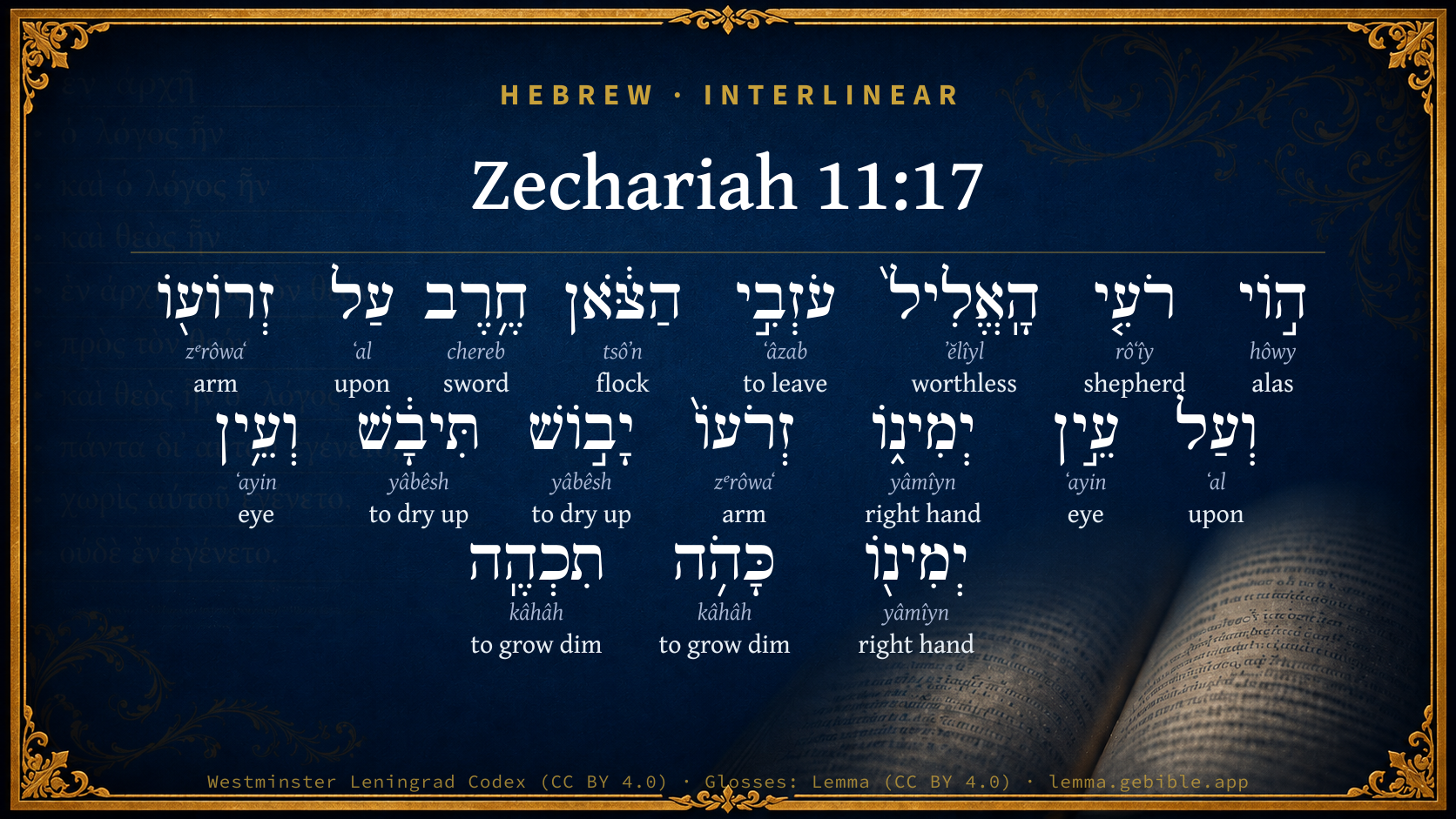
Zechariah 11:17

Hebrew (Westminster Leningrad Codex) Zechariah 11:17 appears in the Hebrew Old Testament. The text above is from the Westminster Leningrad Codex. Each word links to its Strong’s number, a concise gloss, and parsing drawn from the Open Scriptures Hebrew Bible morphology. Click any word for its full Brown-Driver-Briggs (BDB) entry.
Download image
Cite this verse

Zechariah 11:17 (World English Bible). Public Domain. Lemma interlinear Bible study tool, https://lemma.gebible.app/v/zechariah/11/17.

Show BibTeX & RIS
BibTeX
RIS
English Translation
Woe to the worthless shepherd who leaves the flock! The sword will be on his arm, and on his right eye. His arm will be completely withered, and his right eye will be totally blinded!"
World English Bible · Public Domain
Download a study sheet

One document with this verse’s original text, its word-by-word gloss line, the meaning frame, cross-references with their text, attributed commentary, and full source and license credits — printable, and it pastes into notes with its structure intact.

This verse Autodidact and up

Study sheet (.html) Plain text (.txt)

A passage Seminary Student

Up to 50 verses in one chapter. A passage sheet keeps up to 6 commentary sources and 12 cross-references per verse, in the order this page ranks them, and says so on the sheet whenever that leaves anything out. Ask for a single verse and you get the Autodidact verse sheet above.

Everything on this page stays free to read, with no account — the sheet is a download of what is already on screen, not access to it.

Want to remove ads? Support Godless Engineer
Compare translations 3

The same verse in 3 English versions, stacked beneath the original-language interlinear above. Click any original word for its lexicon entry.

Each is an independent rendering of the whole verse — the interlinear is not word-aligned to these translations.

Highlighted words mark where these versions differ — a whole-verse word diff, not a word-by-word alignment.

  • World English Bible Public Domain
    Woe to the worthless shepherd who leaves the flock! The sword will be on his arm, and on his right eye. His arm will be completely withered, and his right eye will be totally blinded!"
  • King James Version Public Domain
    Woe to the idol shepherd that leaveth the flock! the sword shall be upon his arm, and upon his right eye: his arm shall be clean dried up, and his right eye shall be utterly darkened.
  • unfoldingWord Literal Text CC BY-SA 4.0
    Woe to the worthless shepherd who forsakes the flock! May the sword come against his arm and his right eye! May his arm wither away and may his right eye become blind!”

unfoldingWord Literal Text — © unfoldingWord, licensed CC BY-SA 4.0. Word-aligned USFM3 via Door43 (git.door43.org/unfoldingWord/en_ult).

Versions to compare (up to 4)

3 of 4 selected

Show all 18 translations

Every available English version of this verse, each an independent rendering of the whole verse.

  • World English Bible Public Domain
    Woe to the worthless shepherd who leaves the flock! The sword will be on his arm, and on his right eye. His arm will be completely withered, and his right eye will be totally blinded!"
  • Berean Standard Bible Public Domain
    Woe to the worthless shepherd, who deserts the flock! May a sword strike his arm and his right eye! May his arm be completely withered and his right eye utterly blinded!”
  • Majority Standard Bible Public Domain
    Woe to the worthless shepherd, who deserts the flock! May a sword strike his arm and his right eye! May his arm be completely withered and his right eye utterly blinded!”
  • King James Version Public Domain
    Woe to the idol shepherd that leaveth the flock! the sword shall be upon his arm, and upon his right eye: his arm shall be clean dried up, and his right eye shall be utterly darkened.
  • American Standard Version (1901) Public Domain
    Woe to the worthless shepherd that leaveth the flock! the sword shall be upon his arm, and upon his right eye: his arm shall be clean dried up, and his right eye shall be utterly darkened.
  • Revised Version (1885) Public Domain
    Woe to the worthless shepherd that leaveth the flock, the sword shall be upon his arm, and upon his right eye: his arm shall be clean dried up, and his right eye shall be utterly darkened.
  • Geneva Bible (1599) Public Domain
    O idole shepheard that leaueth the flocke: the sword shalbe vpon his arme, and vpon his right eye. His arme shall be cleane dryed vp, and his right eye shall be vtterly darkened.
  • Douay-Rheims (1899) Public Domain
    O shepherd, and idol, that forsaketh the flock: the sword upon his arm and upon his right eye: his arm shall quite wither away, and his right eye shall be utterly darkened.
  • Young's Literal Translation Public Domain
    Wo `to' the worthless shepherd, forsaking the flock, A sword `is' on his arm, and on his right eye, His arm is utterly dried up, And his right eye is very dim!'
  • Literal Standard Version CC BY-SA 4.0
    Woe [to] the worthless shepherd, forsaking the flock, || A sword [is] on his arm, and on his right eye, || His arm is utterly dried up, || And his right eye is very dim!”
  • Unlocked Literal Bible CC BY-SA 4.0
    Woe to the worthless shepherd who forsakes the flock! May the sword come against his arm and his right eye! May his arm wither away and may his right eye become blind!”
  • unfoldingWord Literal Text CC BY-SA 4.0
    Woe to the worthless shepherd who forsakes the flock! May the sword come against his arm and his right eye! May his arm wither away and may his right eye become blind!”
  • Darby Bible Public Domain
    Woe to the worthless shepherd that leaveth the flock! The sword shall be upon his arm, and upon his right eye; his arm shall be clean dried up, and his right eye utterly darkened.
  • World Messianic Bible Public Domain
    Woe to the worthless shepherd who leaves the flock! The sword will strike his arm and his right eye. His arm will be completely withered, and his right eye will be totally blinded!”
  • Webster's Bible Public Domain
    Woe to the idle shepherd that leaveth the flock! the sword shall be upon his arm, and upon his right eye: his arm shall be wholly dried up, and his right eye shall be utterly darkened.
  • Free Bible Version CC BY-SA 4.0
    What disaster is coming to this useless shepherd who abandons the flock! The sword will strike his arm and his right eye. His arm will wither away and his right eye will become completely blind.
  • Bible in Basic English Public Domain
    A curse on the foolish keeper who goes away from the flock! the sword will be on his arm and on his right eye: his arm will become quite dry and his eye will be made completely dark.
  • JPS Tanakh (1917) Public Domain
    Woe to the worthless shepherd that leaveth the flock! The sword shall be upon his arm, and upon his right eye; his arm shall be clean dried up, and his right eye shall be utterly darkened.

Literal Standard Version (2020), Covenant Press — licensed CC BY-SA 4.0. Text via the HelloAO Bible API (eBible.org). Unlocked Literal Bible (unfoldingWord) — licensed CC BY-SA 4.0. Text via the HelloAO Bible API (eBible.org). unfoldingWord Literal Text — © unfoldingWord, licensed CC BY-SA 4.0. Word-aligned USFM3 via Door43 (git.door43.org/unfoldingWord/en_ult). Free Bible Version, Dr. Jonathan Gallagher — licensed CC BY-SA 4.0. Text via the HelloAO Bible API (eBible.org).

Word by word

More ways to search: Search by grammar → Find every occurrence → Compare this word →

Practice this passage: Drill this verse → Learn its vocabulary →

כָּהֹ֥ה
kâhâh
H3543
“to grow dim”
Verb, Qal, Infinitive Absolute
Part of Speech
Verb
Stem
Qal
Form
Infinitive Absolute
Full BDB Definition

Origin: a primitive root

TWOT: 957

to grow weak, grow dim, grow faint, falter, be weak, be dim, be darkened, be restrained, be faint, fail - (Qal) to grow dim, grow faint - (Piel) to faint, grow weak, grow faint
  1. ה֣וֹי hôwy H1945 “alas” Particle, Interjection
  2. רֹעִ֤י rôʻîy H7473 “shepherd” Verb, Qal, Participle Active, Masculine, Singular, Construct
  3. הָֽאֱלִיל֙ ʼĕlîyl H457 “the · worthless” Particle, Definite Article + Noun, Common, Masculine, Singular, Absolute
  4. עֹזְבִ֣י ʻâzab H5800 “leaving” Verb, Qal, Participle Active, Masculine, Singular, Construct
  5. הַצֹּ֔אן tsôʼn H6629 “the · flock” Particle, Definite Article + Noun, Common, Both, Singular, Absolute
  6. חֶ֥רֶב chereb H2719 “sword” Noun, Common, Feminine, Singular, Absolute
  7. עַל ʻal H5921 “upon” Preposition
  8. זְרוֹע֖וֹ zᵉrôwaʻ H2220 “arm · his” Noun, Common, Both, Singular, Construct + Suffix, Personal, 3rd Person, Masculine, Singular
  9. וְעַל ʻal H5921 “and · upon” Conjunction + Preposition
  10. עֵ֣ין ʻayin H5869 “eye of” Noun, Common, Both, Singular, Construct
  11. יְמִינ֑וֹ yâmîyn H3225 “right hand · his” Noun, Common, Feminine, Singular, Construct + Suffix, Personal, 3rd Person, Masculine, Singular
  12. זְרֹעוֹ֙ zᵉrôwaʻ H2220 “arm · his” Noun, Common, Both, Singular, Construct + Suffix, Personal, 3rd Person, Masculine, Singular
  13. יָב֣וֹשׁ yâbêsh H3001 “to dry up” Verb, Qal, Infinitive Absolute
  14. תִּיבָ֔שׁ yâbêsh H3001 “to dry up” Verb, Qal, Imperfect, 3rd Person, Feminine, Singular
  15. וְעֵ֥ין ʻayin H5869 “and · eye of” Conjunction + Noun, Common, Both, Singular, Construct
  16. יְמִינ֖וֹ yâmîyn H3225 “right hand · his” Noun, Common, Feminine, Singular, Construct + Suffix, Personal, 3rd Person, Masculine, Singular
  17. תִכְהֶֽה kâhâh H3543 “to grow dim” Verb, Qal, Imperfect, 3rd Person, Feminine, Singular

About this verse

These counts appear in no published source. They are computed here, from the morphology-tagged text and Lemma’s own curated glosses. What Lemma adds →

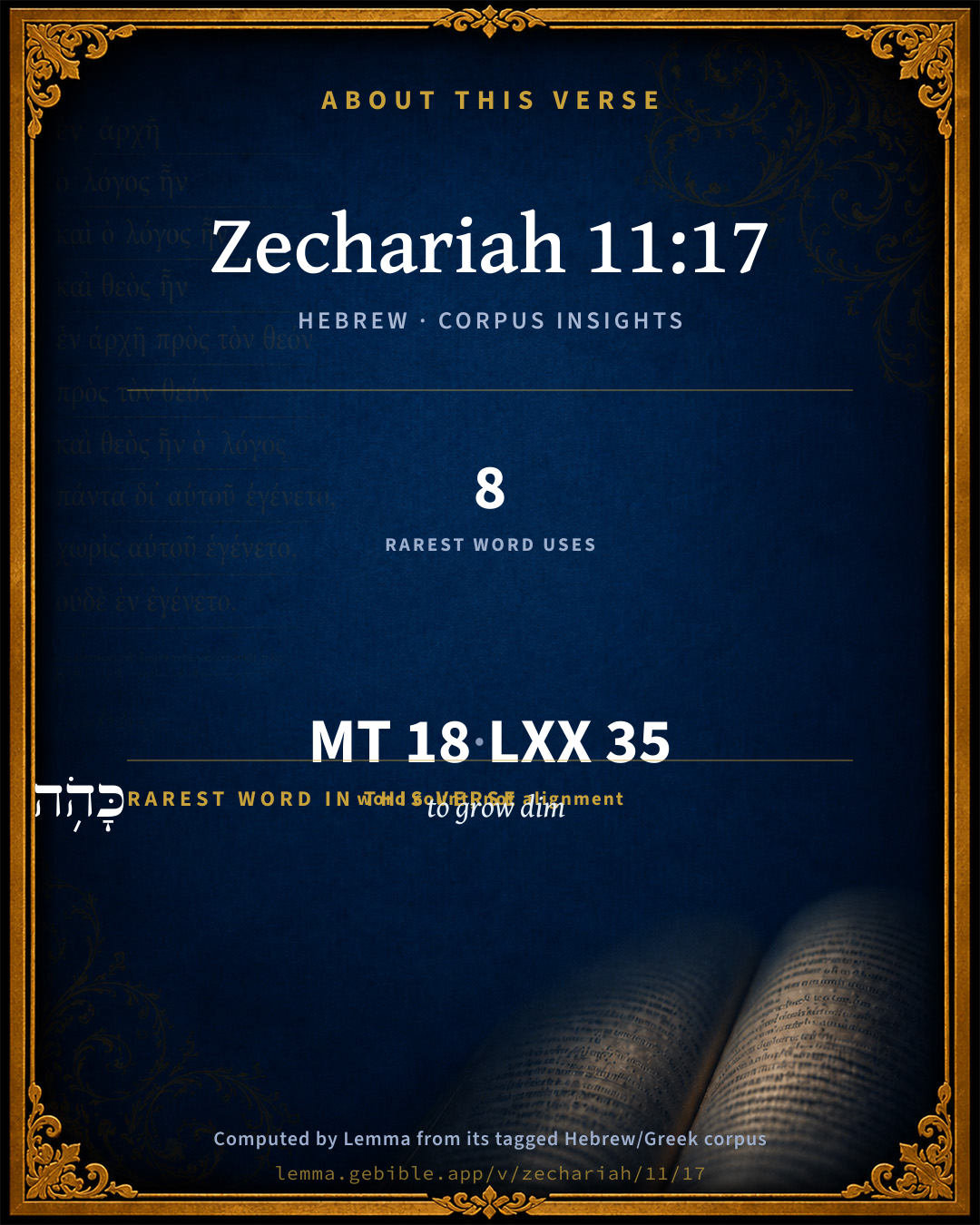
18
words
12
distinct lemmas
Prophets
section

Notable vocabulary

The rarest word here is כָּהֹ֥ה to grow dim H3543 — appearing just 8 times in the whole Hebrew Bible.

Shared distinctive vocabulary

כָּהֹ֥ה to grow dim H3543 occurs in 7 verses of the Hebrew Bible. Also found in:

Grammatical profile

  • 6 verbs
  • 9 nouns
  • 2 prepositions
  • 1 particle

Verb forms

  • רֹעִ֤י Qal · Participle Active
  • עֹזְבִ֣י Qal · Participle Active
  • יָב֣וֹשׁ Qal · Infinitive Absolute
  • תִּיבָ֔שׁ Qal · Imperfect
  • כָּהֹ֥ה Qal · Infinitive Absolute
  • תִכְהֶֽה Qal · Imperfect

Repetition

Words recur within this verse — often emphatic in Hebrew:

  • עַל upon H5921 ×2
  • זְרוֹע֖וֹ arm H2220 ×2
  • עֵ֣ין eye H5869 ×2
  • יְמִינ֑וֹ right hand H3225 ×2
  • יָב֣וֹשׁ to dry up H3001 ×2
  • כָּהֹ֥ה to grow dim H3543 ×2

Hebrew & Septuagint length

In English translation the verse runs 35 words from the Hebrew and 40 from the Septuagint (LXX English) — closely comparable.

A rough comparison of the two English renderings, which tokenize alike — not a word-level alignment.

Word counts can differ between the Hebrew and the Greek without any difference in meaning — e.g. the Hebrew direct-object marker אֵת has no separate Greek word, and Greek often adds the article ὁ.

In the original languages it is 18 Hebrew tokens and 35 Greek tokens — but the two are counted differently (Hebrew bundles its prefixes and suffixes into one token; the Greek is in lemma form), so that isn’t a like-for-like length.

Cross-references

26

Topical passages linked to Zechariah 11:17 in the Treasury of Scripture Knowledge — connected by theme and wording, ordered by reader-vote popularity; previews shown in the World English Bible.

  • Jeremiah 23:1 Woe to the shepherds who destroy and scatter the sheep of my pasture! says Yahweh.
  • Ezekiel 13:3 Thus says the Lord Yahweh, Woe to the foolish prophets, who follow their own spirit, and have seen nothing!
  • 1 Corinthians 8:4 Therefore concerning the eating of things sacrificed to idols, we know that no idol is anything in the world, and that there is no other God but one.
  • Ezekiel 34:2 Son of man, prophesy against the shepherds of Israel, prophesy, and tell them, even to the shepherds, Thus says the Lord Yahweh: Woe to the shepherds of Israel who feed themselves! Shouldn't the shepherds feed the sheep?
  • Isaiah 42:19–20 Who is blind, but my servant? or deaf, as my messenger whom I send? Who is blind as he who is at peace, and blind as Yahweh's servant?
  • Matthew 23:16 "Woe to you, you blind guides, who say, 'Whoever swears by the temple, it is nothing; but whoever swears by the gold of the temple, he is obligated.'
  • 1 Corinthians 10:19–20 What am I saying then? That a thing sacrificed to idols is anything, or that an idol is anything?
  • Isaiah 6:9–10 He said, "Go, and tell this people, 'You hear indeed, But don't understand; And you see indeed, But don't perceive.'
  • Jeremiah 23:32 Behold, I am against those who prophesy lying dreams, says Yahweh, and do tell them, and cause my people to err by their lies, and by their vain boasting: yet I didn't send them, nor commanded them; neither do they profit this people at all, says Yahweh.
  • Jeremiah 50:35–37 A sword is on the Chaldeans, says Yahweh, and on the inhabitants of Babylon, and on her princes, and on her wise men.
  • Amos 8:9–10 "It will happen in that day," says the Lord Yahweh, "That I will cause the sun to go down at noon, And I will darken the earth in the clear day.
  • Ezekiel 30:21–24 Son of man, I have broken the arm of Pharaoh king of Egypt; and, behold, it has not been bound up, to apply [healing] medicines, to put a bandage to bind it, that it be strong to hold the sword.
  • 1 Samuel 2:31 Behold, the days come, that I will cut off your arm, and the arm of your father's house, that there shall not be an old man in your house.
  • 1 Kings 13:4 It happened, when the king heard the saying of the man of God, which he cried against the altar in Bethel, that Jeroboam put forth his hand from the altar, saying, Lay hold on him. His hand, which he put forth against him, dried up, so that he could not draw it back again to him.
  • Isaiah 9:15 The elder and the honorable man, he is the head; and the prophet who teaches lies, he is the tail.
  • Isaiah 29:10 For Yahweh has poured out on you the spirit of deep sleep, and has closed your eyes, the prophets; and your heads, the seers, has he covered.
  • Isaiah 44:10 Who has fashioned a god, or molten an image that is profitable for nothing?
  • Jeremiah 22:1 Thus said Yahweh: Go down to the house of the king of Judah, and speak there this word,
  • Hosea 4:5–7 You will stumble in the day, And the prophet will also stumble with you in the night; And I will destroy your mother.
  • Micah 3:6–7 "Therefore night is over you, with no vision, And it is dark to you, that you may not divine; And the sun will go down on the prophets, And the day will be black over them.
  • Matthew 23:13 "Woe to you, scribes and Pharisees, hypocrites! For you devour widows' houses, and as a pretense you make long prayers. Therefore you will receive greater condemnation.
  • Luke 11:42–52 But woe to you Pharisees! For you tithe mint and rue and every herb, but you bypass justice and the love of God. You ought to have done these, and not to have left the other undone.
  • John 9:39 Jesus said, "I came into this world for judgment, that those who don't see may see; and that those who see may become blind."
  • John 10:12–13 He who is a hired hand, and not a shepherd, who doesn't own the sheep, sees the wolf coming, leaves the sheep, and flees. The wolf snatches the sheep, and scatters them.
  • John 12:40 "He has blinded their eyes and he hardened their heart, Lest they should see with their eyes, And perceive with their heart, And would turn, And I would heal them."
  • Romans 11:7 What then? That which Israel seeks for, that he didn't obtain, but the chosen ones obtained it, and the rest were hardened.

Cross-references courtesy of OpenBible.info (CC BY 4.0).

Hebrew and Greek witnesses Masoretic Hebrew ↔ Greek Septuagint

The same verse in the two great witnesses to the Old Testament, shown verse-for-verse.

These are two independent witnesses, not word-aligned to each other, and the Septuagint is shown in lemma (dictionary) form.

Hebrew Zechariah 11:17 Masoretic · Westminster Leningrad Codex

ה֣וֹי רֹעִ֤י הָֽאֱלִיל֙ עֹזְבִ֣י הַצֹּ֔אן חֶ֥רֶב עַל זְרוֹע֖וֹ וְעַל עֵ֣ין יְמִינ֑וֹ זְרֹעוֹ֙ יָב֣וֹשׁ תִּיבָ֔שׁ וְעֵ֥ין יְמִינ֖וֹ כָּהֹ֥ה תִכְהֶֽה

Woe to the worthless shepherd who leaves the flock! The sword will be on his arm, and on his right eye. His arm will be completely withered, and his right eye will be totally blinded!"

World English Bible · Public Domain

Greek LXX Zechariah 11:17 Septuagint · lemma form

ὦ ὁ ποιμαίνω ὁ μάταιος καί ὁ καταλείπω ὁ πρόβατον μάχαιρα ἐπί ὁ βραχίων αὐτός καί ἐπί ὁ ὀφθαλμός ὁ δεξιός αὐτός ὁ βραχίων αὐτός ξηραίνω ξηραίνω καί ὁ ὀφθαλμός ὁ δεξιός αὐτός ἐκτυφλόω ἐκτυφλόω

Alas for the vain shepherds that have forsaken the sheep! the sword shall be upon the arms of such a one, and upon his right eye: his arm shall be completely withered, and his right eye shall be utterly darkened.

LXX2012 (modern English Septuagint) · Public Domain

On this verse, Haydock's Catholic Bible Commentary discusses the Septuagint’s reading. Read the note in Commentary ↓

Hebrew: Westminster Leningrad Codex (CC BY 4.0). Greek: Septuagint (public domain); English from LXX2012 (modern English Septuagint) (Public Domain). How the Septuagint differs from the Hebrew →

Targum (Aramaic paraphrase)

1

The Targum is the ancient Jewish Aramaic paraphrase of the Hebrew Scriptures — an interpretive translation, not the Hebrew text itself. Onkelos (literal) and Pseudo-Jonathan (expansive) render the Torah, and Jonathan the Prophets. Coverage is partial: where no permissively-licensed English translation exists for a verse, only the Aramaic is shown. This is verse-level text, not a word-by-word alignment to the Hebrew.

  1. Targum Jonathan Prophets (Joshua–Malachi)
    וַי עַל פַּרְנָסָא טִפְּשָׁא דְאִתְפַּקֵיד לֵיהּ עַמָא לְפַרְנָסָא דִי הוּא דָמֵי לְטַבָּחָא דִי סַכִּינֵיהּ בִּידֵיהּ וְעֵינַי עַל שְׁמֵינָתָא לְמִכַּס דַרְעֵיהּ מֵיבַשׁ תִּיבָשׁ וְעֵינֵיהּ דְיַמִינָא מִכְהָא תִּכְהֵי:

    (no public-domain English translation for this verse)

    Targum Jonathan — Aramaic: “Mikraot Gedolot” (public domain). English: “Sefaria Community Translation” (CC0 1.0 (public-domain dedication)); “London "Chaldee Paraphrase," 1871” (public domain). Text via Sefaria.

Commentary

Notes on Zechariah 11:17 from classic Christian and Jewish commentators (each source and its license shown beneath its notes). The classic Christian expositions comment on the surrounding passage and are grouped to its opening verse, so a note may address several verses; the Jewish commentaries on the Tanakh (Rashi and others) are per-verse, so they appear only where the commentator wrote on this verse.

Lemma curates 59 commentaries, every one of them public domain or Creative Commons licensed, each selected and text-cleaned for this edition rather than reprinted as found. About our sources →

Ellicott's Commentary for English Readers

(17) Idol shepherd.—Better, useless shepherd. Though the wicked useless shepherd is allowed for a time to ill-treat and neglect the flock, in the end the judgment of God will fall upon him. (Comp. Dan_7:26; and for the date of the prophecies of Daniel, see Introduction to that book.) Ewald has maintained that the passage Zec_13:7-9 is out of place where it now stands, and that it ought to be transferred to the end of this chapter. There is apparently some truth in this supposition. In particular, the expression “Awake, O sword, against my shepherd” (Zec_13:7) seems to follow naturally after Zec_11:17. The expression “my fellow” (Zec_13:7) would certainly be rather a strong one to be used of a “foolish shepherd;” but still, all shepherds of the people, whether good or bad, are looked upon as God’s ministers and representatives, so that we cannot regard the use of this expression as fatal to Ewald’s theory. The reader is recommended to turn to Zec_13:7-9 (and Notes), and to read that passage in close connection with Zec_11:15-17, and to judge for himself.

A Bible Commentary for English Readers, edited by Charles John Ellicott (1878–1897) — public domain. Text from a community e-Sword module.

Trapp's Complete Commentary

John Trapp

Zec 11:17 Woe to the idol shepherd that leaveth the flock! the sword [shall be] upon his arm, and upon his right eye: his arm shall be clean dried up, and his right eye shall be utterly darkened.

Ver. 17. Woe to the idol shepherd] The Vulgate hath, O pastor et idolum, O thou shepherd and idol; thou that hast the show only and semblance of a shepherd, the name, but not the thing; thou that art the ape of a shepherd, non verus sed vanus, non virus sed pictus et fictus pastor, that art cleped a shepherd, as an idol is a god; but shouldest be called rather a dumb dog, a greedy dog; a shepherd that cannot understand, Isa 56:10-11, a foolish shepherd, as Zec 11:15, an ουτιδανος, one that hath nothing in him of any true worth, but art vain and vile, and of no value, as this word is rendered, Job 13:4; Job 11:17 ( אליל Per agnominationem alludit ad through an alteriteration with אכול Zec 11:15). Vae, vae, vae, tibi. Alas, alas, alas to you, Christ, the great Shepherd of the sheep, will surely pull off thy vizor, wash off thy varnish with rivers of brimstone, brand thee for a hireling,

that leaveth the flock] to shift as it can, among thieves and wolves, Joh 10:13. {See Trap on "Joh 10:13"}

The sword shall be upon his arm, and upon his right eye] i.e. The curse of God shall light upon his power and policy, both which shall be blasted.

His arm shall be clean dried up] As a keck, or stick.

And his right eye shall be utterly darkened] Or, shrivelled up, wrinkled and dusk; as in old bisons. The idle and evil servant had his talent taken from him, and worthily, Mat 25:28. The barren fig tree was cut down from cumbering, Luk 13:7. God will recover his gifts from those that misuse or but disuse them, Hos 2:9. Away they go, as strength went from Samson, wisdom from Solomon: they cry unto God under our abuse, who thereupon gives them the wings of an eagle, and lays aside their owner, as so many broken vessels; causing them to be even forgotten as dead men out of mind, Psa 31:12. This is now especially fulfilled among the Jews, who for a long season have been "without God, without a teaching priest, and without law," 2Ch 15:3.

John Trapp, A Commentary or Exposition upon All the Books of the Old and New Testament (1647–1656) — public domain. Text from a community e-Sword module.

Joseph Benson's Commentary

Zec 11:17. Wo to the idol shepherd — Or the shepherd of nothing, or of no value, as רעי האלילshould be translated; he who calls himself the shepherd, ruler, or teacher of the people, but is in reality nothing less. So רפאי אליל, Job 13:4, signifies physicians of no value. That leaveth the flock — Who taketh no care of the flock, and minds nothing but making his own profit out of them. Such a shepherd is no better than an idol, that is profitable for nothing, (Isa 44:10,) and hath only the outward form and appearance of a shepherd. The sword shall be upon his arm, and upon his right eye — As he has abused his power and his understanding, signified by his arm and his right eye, God shall in his just judgment, deprive him of the use of both those faculties. The sword is put for any instrument of the divine vengeance. As the word חרבhere rendered sword, also means desolation, Blayney renders the clause, Because of his arm is desolation, and because of his right eye: observing, “The purport of the passage is, that since, through the misapplication of his power, and through his negligence in watching over the flock, they are subjected to desolation or the sword; therefore, as of strict justice, he shall be punished with a deprivation at least of those faculties which he so fatally misused.” Some think the right arm and right eye of the people are intended, and observe, that the arm of the Jews was dried up from that time when they were no longer able to bear arms, or to defend themselves; as their right eye has been darkened to the true knowledge of the Scriptures, which they read as with a veil before them.

Joseph Benson's Commentary on the Old and New Testaments (1811–1818) — public domain. Text from a community e-Sword module.

Whedon's Commentary on the Bible

Daniel D. Whedon

17. The present hopeless condition is not to continue forever; Jehovah has sent it as a judgment for the rejection of the good shepherd, but he will again have mercy; the foolish shepherd will be removed.

Woe to the idol shepherd — Better, R.V., “worthless shepherd.” He is doomed.

That leaveth the flock — To destruction (compare Joh_10:12). The succeeding words should be translated as an imprecatory clause, “A sword upon his arm and upon his right eye!” May the arm which should have guarded and protected the flock be cut off, and may the eyes which should have selected good pasture and should have watched against danger be destroyed. That this will happen is affirmed in the rest of the verse. The arm will wither and the eye will lose its sight. The forms of judgment prayed for and threatened in the two clauses do not seem to harmonize. If a sword were used against the arm the result would hardly be a withering of the same. In view of this fact some commentators read, with a slight change in the vocalization of a single consonant, drought — drying up, withering — instead of sword. This change, “drought upon his arm and upon his right eye,” would bring the two clauses into perfect accord. On the other hand, it has been suggested that the two different kinds of punishment are placed together so as to emphasize the “greatness and terrible nature of the judgment.” If Zec_13:7-9, is the original continuation of Zec_11:17 (see introductory remarks on Zec_13:7-9), the present reading, “sword,” is to be retained (compare Zec_13:7).

Daniel D. Whedon (gen. ed.), Commentary on the Old and New Testaments (1874–1909) — public domain. Text from a community e-Sword module.

Tyndale Open Study Notes

Tyndale Open Resources

11:17 This oracle of woe is a poetic curse against the worthless shepherd for abandoning the flock. The arm and right eye represent the physical and mental abilities of the shepherd. The maimed arm and blind eye make the worthless shepherd powerless and end his selfish, opportunistic rule.

Tyndale Open Study Notes — © Tyndale Open Resources, licensed CC BY-SA 4.0. Text via the HelloAO Bible API.

Geneva Bible (1599)

Geneva Bible translators

By the arms he signifieth strength, as he doth wisdom and judgments by the eye: that is, the plague of God shall take away both thy strength and judgment.

Geneva Bible (1599) marginal notes — public domain. Text via Bolls.life.

Jamieson, Fausset & Brown

Robert Jamieson, A. R. Fausset & David Brown

the idol--The Hebrew expresses both vanity and an idol. Compare Isa 14:13; Dan 11:36; Th2 2:4; Rev 13:5-6, as to the idolatrous and blasphemous claims of Antichrist. The "idol shepherd that leaveth the flock" cannot apply to Rome, but to some ruler among the Jews themselves, at first cajoling, then "leaving" them, nay, destroying them (Dan 9:27; Dan 11:30-38). God's sword shall descend on his "arm," the instrument of his tyranny towards the sheep (Th2 2:8); and on his "right eye," wherewith he ought to have watched the sheep (Joh 10:12-13). However, Antichrist shall destroy, rather than "leave the flock." Perhaps, therefore, the reference is to the shepherds who left the flock to Antichrist's rapacity, and who, in just retribution, shall feel his "sword" on their "arm," which ought to have protected the flock but did not, and on their "eye," which had failed duly to watch the sheep from hurt. The blinding of "the right eye" has attached to it the notion of ignominy (Sa1 11:2).

Next: Zechariah Chapter 12

Jamieson, Fausset & Brown — Commentary Critical and Explanatory on the Whole Bible (1871) — public domain (CC PDM 1.0). Text via the HelloAO Bible API.

Adam Clarke's Commentary

Verse 17. Wo to the idol shepherd] רעי האליל roi haelil, "the worthless," or "good for nothing shepherd." The shepherd in name and office, but not performing the work of one. See Joh 10:11.

The sword shall be upon his arm] Punishment shall be executed upon the wicked Jews, and especially their wicked kings and priests. See Zec 11:16.

Arm - the secular power; right eye - the ecclesiastical state.

His arm shall be clean dried up] The secular power shall be broken, and become utterly inefficient.

His right eye shall be utterly darkened] Prophecy shall be restrained; and the whole state, ecclesiastical and civil, shall be so completely eclipsed, that none of their functions shall be performed. This may refer to the worthless and wicked governor mentioned in the preceding verse.

There are several things in this chapter that are very obscure, and we can hardly say what opinion is right; nor is it at all clear whether they refer to a very early or late period of the Jewish history.

Adam Clarke's Commentary on the Bible (1810–1826) — public domain. Text from a community e-Sword/MySword module.

John Calvin's Commentaries

In this verse the Prophet teaches us, that though God would inflict a deserved punishment on the Jews, yet the shepherds themselves would not escape his vengeance; and thus he reminds them, that even in such a confused and depressed state of things, he would still in some degree remember his covenant. He addresses the Shepherds themselves, for he speaks not of one, but of the whole number, as it has already been stated.

Woe to the baseless shepherd, he says; the word אליל, alil, means in Hebrew a thing of nought, and hence idols were called אלילים, alilim, nothings; “Those useless shepherds,” he says, “who forsake the flock.” He again shows by an explicit term, that those whom he called shepherds were not worthy of so honorable a title. He then only concedes the name, for a shepherd who is not solicitous for the safety of his flock, clearly proves that he is really no shepherd. He then denounces on him a punishment, A sword, he says, on his right arm and on his right eye! By the sword he means any kind of punishment, by the arm is to be understood strength, and by the eye prudence. He means, “God will punish thee both in soul and body, for his curse shall be on thy strength and on thine understanding.” Hence he says, Dry up shall his arm. This seems not indeed to correspond with the metaphor of the sword, but it matters not, for the Prophet, as we have said, includes under that word every kind of punishment. Dry up then shall his arm, that is, all its vigor shall cease, so as to become like a piece of decayed wood; and his right eye, the soundness of his mind or his right understanding, shall by contracting be contracted; some read, shall be darkened; but the verb properly signifies, to wrinkle, as it appears from other places, and I can find no better way of expressing its meaning than by saying that the eye would be contracted.

I have briefly explained the object of the Prophet, even that God would so punish the wickedness of the people, as not to allow those shepherds to escape whom he would employ as instruments in executing his vengeance. For though they were under the direction of divine power, we must yet hold this principle, that they had nothing in common with God; for mere ambition, avarice, and cruelty instigated them; and nothing was farther from their purpose than to obey God: but he extorted service from the unwilling and even the ignorant — for what end? that he might render to the ungrateful, the wicked, and the perverse, in their own sinful ways, the reward which they deserved. We then see that the design of God’s vengeance is just; and we also see that the instruments he employs are ungodly: there is therefore no reason for them to think that they shall be unpunished, because they accomplish God’s purpose, for they do not intend any such thing.

We must also bear in mind, that when the extreme rigour of God prevails, there still remains some evidence of his favor, for some seed, though few in number, is still perpetuated; for the Church is never so completely abolished as not to leave any remnants, for whose safety God is pleased to provide when he executes his vengeance, inasmuch as he stretches forth his hand at the same time against the ministers he has employed, because they had cruelly abused their power. So also at this day the milted bishops shall be made to know how precious to God is the safety of his Church; for though almost all the people and almost every individual are worthy of the most tyrannical cruelty, yet we know that some are found in that labyrinth for whom God has a care. Though then they who at this day possess power under the Papacy think themselves innocent, while they are robbers and wolves, they shall yet find that God is a righteous judge, who will visit their abominable cruelty: for the disorder of the Church is not its destruction, as God ever preserves some remnant.

We also see that the whole strength of men depends on the grace of God; and farther, that a sound mind proceeds from his Spirit: for since it is he who takes away from men both their strength and a right judgment, we hence conclude that to give these things is also in his power. Let men then know that in order to possess due courage and strength, they are to rely on the hidden power of God; and let them also know that in order to discern what is useful and profitable, they must be governed by his Spirit; and let those especially who bear rule be assured of this, that when they exercise power in peace, it is God’s singular gift, and that when they rightly govern their subjects, and are endued with sound discretion, it is wholly to be ascribed to an influence from above.

But it may be asked, how can this harmonise — that those who were before useless are deprived of understanding and strength? To this I answer — that it is the same as though the Prophet had said, that the baseness of him who was previously an useless shepherd would be made conspicuous to all. For however deficient they might have been in their office, they yet for a time deceived the simple multitude; nay, we see at this day how the milted bishops and abbots and their whole company by their delusive splendor, dazzle the eyes of most men: they believe that the Pope is the vicar of God, and the rest the successors of the apostles! But the Prophet here testifies, that when the ripened time shall come, their shameful conduct shall be made evident, so that all shall treat them with contempt, and that they shall become an abomination to all. Though then they may be counted wise and held in admiration, or at least in honor, yet Zechariah threatens them with the loss of both; for God’s curse lies on them, on their arms, and on their right eyes. This is the import of the passage. I shall begin the next chapter tomorrow.

John Calvin's Commentaries (1540-1563) — public domain. Text from the Calvin Translation Society English edition (1840s-50s) via the Christian Classics Ethereal Library (ccel.org). Calvin's coverage is partial (roughly two-thirds of the Bible); uncommented books and verses are honest gaps, never fabricated. The 19th-century editor's footnotes and remarks are omitted so the notes are faithfully Calvin's own voice.

The Cambridge Bible for Schools and Colleges

gen. ed. J. J. S. Perowne

17. idol shepherd] Rather, worthless shepherd: lit. shepherd of nothingness, or worthlessness. Comp. “physicians of no value,” Job_13:4.

leaveth the flock] Comp. Joh_10:12.

the sword] To be taken perhaps metaphorically of punishment or visitation: “per gladium quamlibet speciem pœnæ designat.” Calv. The particular kind of punishment then follows, in the withering of the arm and blinding of the eye.

The Second Burden. Chaps. 12–14. Like the First Burden of the Word of Jehovah, this Second extends over three chapters and contains two chief sections or prophecies. Of these the first reaches from Zec_12:1 to Zec_13:6; the second is comprised in the remainder of the Book.

The First Section contains three subdivisions, viz. Jehovah’s protection of His people from their enemies, Zec_12:1-9; their penitent sorrow for sin, Zec_12:10-14; their worthy fruits of repentance, Zec_13:1-6.

The Cambridge Bible for Schools and Colleges (gen. ed. J. J. S. Perowne; Cambridge University Press, 1878–1918) — public domain. Text from a community e-Sword module.

John Gill's Exposition

Woe to the idol shepherd,.... Or, "the shepherd of nothing" (w); that is, no true shepherd, that is good for nothing, for an idol is nothing in the world, Co1 8:4 and who is an idol himself, sits in the temple of God, and is worshipped as if he was God. Th2 2:4 and is an encourager and defender of idolatry:

that leaveth the flock; has no regard to its spiritual concerns; does not feed it, but fleece it, and leaves it to the cruelty and avarice of his creatures under him:

the sword shall be upon his arm; with which he should feed the flock:

and upon his right eye; with which he should watch over it:

his arm shall be clean dried up; his power shall be taken away from him; the antichristian states, which supported him, shall withdraw from him; the ten kings shall hate the whore, strip her naked, eat her flesh, and burn her with fire, Rev 17:16,

and his right eye shall be utterly darkened; not only given up to judicial blindness, which has been always his case; but his kingdom shall be full of darkness, Rev 16:10 his hidden things of darkness shall be exposed; all his crafty schemes will be confounded; and all his wit, cunning, and subtlety, will cease; and everything desirable to him will be taken away from him. His "arm" may denote his secular power, which shall be taken away from him: and his "right eye" his knowledge of the Scriptures, judgment in controversies, and infallibility pretended to by him, which wilt cease, even in the opinion of men. Ben Melech interprets it the eye of his heart or mind; and so Aben Ezra.

(w) "pastori nihili", Junius & Tremellius, Piscator, Drusius, So R. So. Urbin. Ohel Moed, fol. 4. 2.

Next: Zechariah Chapter 12

John Gill's Exposition of the Whole Bible (1746–1763) — public domain (CC PDM 1.0). Text via the HelloAO Bible API.

Albert Barnes' Notes on the Bible

Woe to the idol shepherd - (A shepherd of nothingness, one who hath no quality of a shepherd ;) “who leaveth the flock.” The condemnation of the evil shepherd is complete in the abandonment of the sheep; as our Lord says, “He that is an hireling and not the Shepherd, whose own the sheep are not, seeth the wolf coming and leaveth the sheep and fleeth: and the wolf catcheth them and scattereth the sheep. The hireling fleeth, because he is an hireling and careth not for the sheep” Joh 10:12-13.

Or it may equally be, “Shepherd, thou idol,” including the original meaning of nothingness, such as antichrist will be, (Jerome), “while he calleth himself God, and willeth to be worshiped.” Jerome: “This shepherd shall therefore arise in Israel, because the true Shepherd had said, ‘I will not feed you.’ He is prophesied of by another name in Daniel the prophet Dan. 9, and in the Gospel Mark 13, and in the Epistle of Paul to the Thessalonians 2 Thes 2, as ‘the abomination of desolation,’ who shall sit in the temple of the Lord, and make himself as God. He cometh not to heal but to destroy the flock of Israel. This shepherd the Jews shall receive, whom the ‘Lord Jesus shall slay with the breath of His mouth; and destroy with the brightness of His coming?”’

The sword shall be upon - (against) his arm and right eye His boast shall be of intelligence, and might. The punishment and destruction shall be directed against the instrument of each, the eye and the arm. Jerome: “The eye, whereby he shall boast to behold acutely the mysteries of God, and to see more than all prophets heretofore, so that he shall call himself son of God. But the word of the Lord shall be upon his arm and upon his right eye, so that his strength and all his boast of might shall be dried up, and the knowledge which he promised himself falsely, shall be obscured in everlasting darkness.” (Dionysius: “Above and against the power of antichrist, shall be the virtue and vengeance and sentence of Christ, who shall ‘slay’ him ‘with the breath of His mouth.’ The right arm, the symbol of might, and the right eye which was to direct its aim, should fail together, through the judgment of God against him. He, lately boastful and persecuting shall become blind and powerless, bereit alike of wisdom and strength.

The “right” in Holy Scripture being so often a symbol of what is good, the left of what is evil, it may be also imagined, that (Osorius), “the left eye, that is, the acumen and cunning to devise deadly frauds, will remain uninjured: while the ‘right eye,’ that is, counsel to guard against evil, will be sunk in thick darkness. And so, the more he employs his ability to evil, the more frantically will he bring to bear destruction upon himself:”

Albert Barnes' Notes on the Bible (1834–1885) — public domain. Text from a community e-Sword/MySword module.

Haydock's Catholic Bible Commentary

Shepherd. Septuagint, "ye who feed foolish things, forsaking," &c. (Haydock) --- Hebrew, "shepherd of nothing." --- Darkened. Caligula was slain, and had not sense to know what was for this real interest. His wife and only daughter were murdered. See Josephus, Antiquities xix. 1. (Suetonius) --- His maxim was, "Let them hate, provided they fear;" and he wished the Romans had "all but one neck," that he might cut it off. (Calmet) --- Antichrist, the destroyer, shall perish. (Worthington)

George Leo Haydock (1774–1849), Haydock's Catholic Family Bible and Commentary, 1859 edition — public domain. Excludes Psalms (Douay-Rheims chapter numbering differs from Protestant) and Deuterocanonical books (Catholic canon only).

Matthew Poole's English Annotations

Woe to the idol shepherd! to every one of them that are but the images of shepherds, worthless and useless.

That leaveth, casts off the care of,

the flock, Jer 23:1; Eze 34:2.

The sword, of the enemy, shall be upon his arm, to break his strength, and upon his right eye; blind and befool his counsels.

His arm shall be clean dried up, and his right eye shall be utterly darkened; power and policy shall fail him: such shall be their governors.

Matthew Poole's English Annotations on the Holy Bible (1683–1685) — public domain. Text from a community e-Sword/MySword module.

The Pulpit Commentary

Woe to the idol shepherd! rather, woe to the worthless shepherd! literally, shepherd of vanity, or nothingness, as Job_13:4, "physicians of no value." The LXX, recognizing that no special shepherd is signified, renders, W oi poimainontev ta mataia , "Alas for those who tend vanities!" St. Jerome, expounding the verse of antichrist, "O pastor, et idolum!" That leaveth the flock. Thus Christ speaks of the hireling. (Joh_10:12) The sword shall be upon his arm, etc. The punishment denounced is in accordance with the neglect of the shepherd"s duties. The sword represents the instrument of punishment, whatever it he; the right eye, the severity of the retribution. (1Sa_11:2) The arm that ought to have defended the flock shall be withered up as by catalepsy; the eye that should have watched for their safety shall be blinded. This is the judgment on the foolish shepherd. Ewald thinks that the passage Zec_13:7-9 is out of place there, and belonged originally to the end of the, present chapter.

The Pulpit Commentary (1880–1919), ed. H.D.M. Spence-Jones & Joseph S. Exell — public domain. Text from a community e-Sword module.

John Wesley's Explanatory Notes

The idol shepherd - To them that are but the images of shepherds. That leaveth - Casts off the care of the flock. The sword - Of the enemy, shall break his strength and be-fool his counsels. Dried up - They that have gifts which qualify them to do good, if they do it not, they will be taken away. They that should have been workmen, but were slothful, and would do nothing, will justly have their arm dried up. And they that should have been watchmen, but were drowsy, will justly have their eye blinded.

John Wesley, Explanatory Notes Upon the Whole Bible (1754–1765) — public domain. Text via the GEBible commentary corpus.

unfoldingWord translationNotes

Door43 World Missions Community

May the sword

Here "sword" represents enemies who will attack the shepherd. AT: "May enemies" (See: Metonymy)

come against his arm and his right eye

Here "come against" is an idiom. AT: "strike and wound his right arm and pierce his right eye" (See: Idiom)

his arm

Here "arm" represents the power to fight. (See: Metonymy)

his right eye

A soldier would use his right eye to look around the shield that he held with his left hand. If his right eye was wounded, he would not be able to see to fight in war. (See: Assumed Knowledge and Implicit Information)

his arm wither away

"his arm waste away" or "his arm become completely useless"

translationWords

woe

worthy

shepherd

forsake

flocks

sword

unfoldingWord translationNotes — © Distant Shores Media and the Door43 World Missions Community, licensed CC BY-SA 4.0. Source: git.door43.org/Door43/en_tn.

Rashi

Rabbi Shlomo Yitzchaki (Rashi)

Ho There is reason to cry out concerning this.

worthless shepherd a shepherd of nought. אֶלִיל, is an expression of אַל, naught; he is not a shepherd. [There is also] (in Job 13:4) “worthless physicians.” רֹעִי The “yud” is superfluous; it is instead of a “he,” as “who abandons the flock”; (Deut. 33:16) who dwells (שׁכְנִי) in the bramble”; and (Micha 7:14) “who dwells alone.”

who abandons the flock Who leaves them free for anyone who comes to beat, to slay, and to spoil.

A sword is on his arm and his right eye And that shepherd carries a slaughtering knife in his hand to slaughter the fat and the healthy, upon which he cast his right eye to know who are the wealthy, to spoil and finish their property.

his arm shall wither In the future (as in Ezek. 25:14), “I will wreak My vengeance, etc.” The commentators, however, interpreted this as a reference to Zedekiah, an allusion to (II Kings 25:7), “and they blinded Zedekiah’s eyes.” But it is impossible to reconcile “Behold! I am setting up a shepherd in the land” as referring to Zedekiah, for seventy years had already passed after him.

Rashi on the Tanakh — English translations: “The Judaica Press complete Tanach with Rashi, translated by A. J. Rosenberg” (CC BY 4.0); “Pentateuch with Rashi's commentary by M. Rosenbaum and A.M. Silbermann, 1929-1934” (public domain); “The Metsudah Tanach series, Lakewood, N.J” (CC BY 4.0); and “The Book of Joshua, Metsudah Publications, 1997” (CC BY 4.0). Text via Sefaria.

Lesson kit

Teaching starters — assembled from the data on this page, not authored interpretation. Every prompt links to the verse data it draws on. Edit before teaching.

Zechariah, in the Prophets, opens this verse with 18 words (12 distinct Hebrew lemmas). Its most distinctive word is kâhâh (“to grow dim”). A historical commentator’s framing appears above. Read the whole chapter for the surrounding context.

Discussion questions

  1. The word kâhâh carries the sense “to grow dim.” How does it shape the verse?
  2. How does Genesis 27:1, which shares the word «to grow dim», read alongside this verse?
  3. What does the repetition of “upon” (2× in this one verse) do in this verse?
  4. These translations render this verse differently. What is at stake in choosing one wording over another?
  5. «רֹעִ֤י» is a Qal Participle Active verb. How does that grammatical form shape the action described?
  6. Compare how Ellicott's Commentary for English Readers and Trapp's Complete Commentary read this verse. Where do they agree or differ?

Things to notice

Reading settings

Reading text

Shown beneath each verse's original-language words.

Old Testament
Old Testament edition

Read the OT as the Masoretic Hebrew (MT) or the Greek Septuagint (LXX).

English shown for the Greek Septuagint (in the Hebrew ↔ Greek comparison).

Comparing translations? Open the Compare panel on any verse page to stack up to four side by side.