Jeremiah 50:38

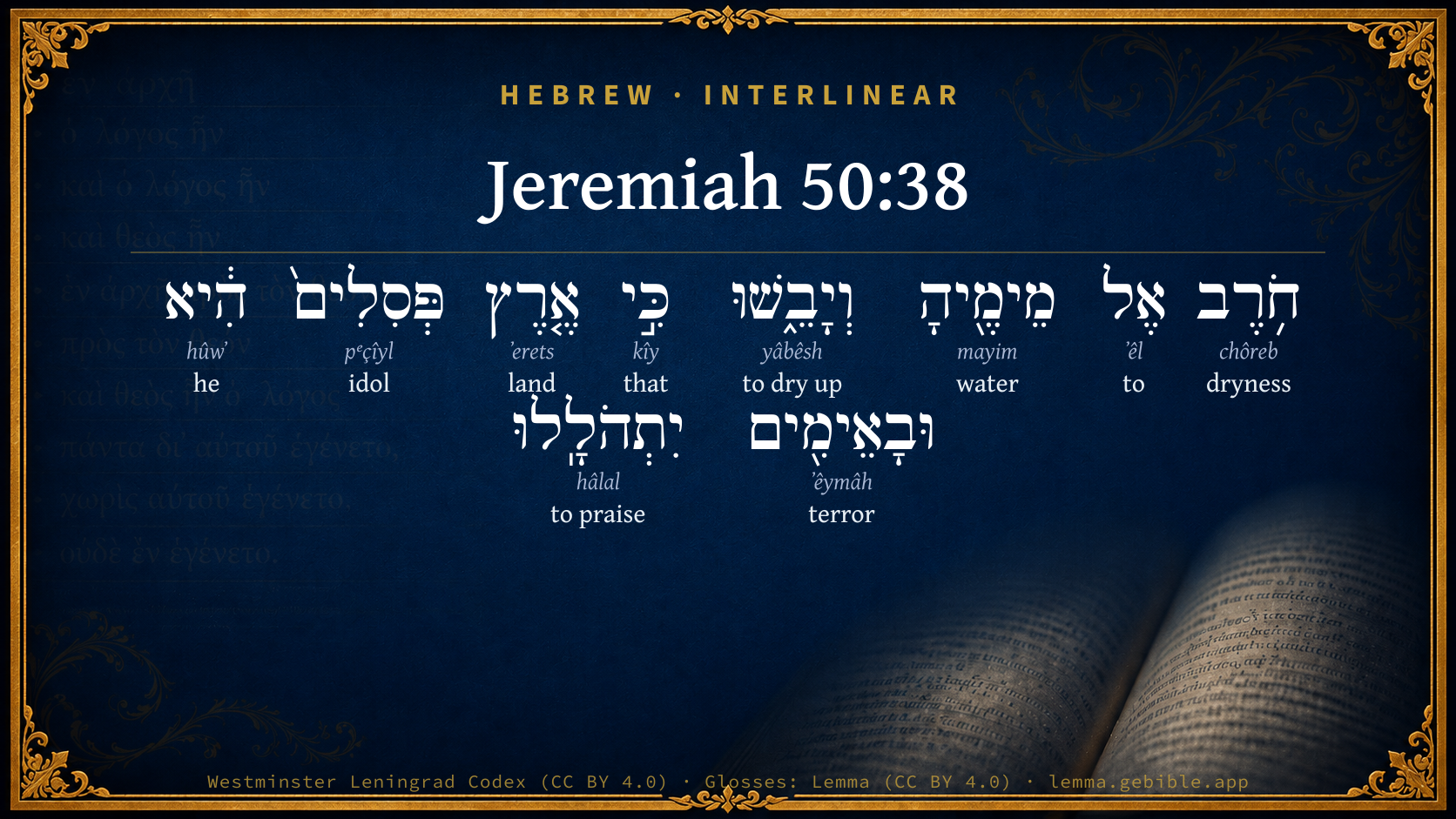
Hebrew (Westminster Leningrad Codex) Jeremiah 50:38 appears in the Hebrew Old Testament. The text above is from the Westminster Leningrad Codex. Each word links to its Strong’s number, a concise gloss, and parsing drawn from the Open Scriptures Hebrew Bible morphology. Click any word for its full Brown-Driver-Briggs (BDB) entry.
Download image
Cite this verse

Jeremiah 50:38 (World English Bible). Public Domain. Lemma interlinear Bible study tool, https://lemma.gebible.app/v/jeremiah/50/38.

Show BibTeX & RIS
BibTeX
RIS
English Translation
A drought is on her waters, and they shall be dried up; for it is a land of engraved images, and they are mad over idols.
World English Bible · Public Domain
Download a study sheet

One document with this verse’s original text, its word-by-word gloss line, the meaning frame, cross-references with their text, attributed commentary, and full source and license credits — printable, and it pastes into notes with its structure intact.

This verse Autodidact and up

Study sheet (.html) Plain text (.txt)

A passage Seminary Student

Up to 50 verses in one chapter. A passage sheet keeps up to 6 commentary sources and 12 cross-references per verse, in the order this page ranks them, and says so on the sheet whenever that leaves anything out. Ask for a single verse and you get the Autodidact verse sheet above.

Everything on this page stays free to read, with no account — the sheet is a download of what is already on screen, not access to it.

Want to remove ads? Support Godless Engineer
Compare translations 3

The same verse in 3 English versions, stacked beneath the original-language interlinear above. Click any original word for its lexicon entry.

Each is an independent rendering of the whole verse — the interlinear is not word-aligned to these translations.

Highlighted words mark where these versions differ — a whole-verse word diff, not a word-by-word alignment.

  • World English Bible Public Domain
    A drought is on her waters, and they shall be dried up; for it is a land of engraved images, and they are mad over idols.
  • King James Version Public Domain
    A drought is upon her waters; and they shall be dried up: for it is the land of graven images, and they are mad upon their idols.
  • unfoldingWord Literal Text CC BY-SA 4.0
    A drought is coming on her waters, so they will become dry. For she is a land of worthless idols, and they act like people made insane by their dreadful idols.

unfoldingWord Literal Text — © unfoldingWord, licensed CC BY-SA 4.0. Word-aligned USFM3 via Door43 (git.door43.org/unfoldingWord/en_ult).

Versions to compare (up to 4)

3 of 4 selected

Show all 18 translations

Every available English version of this verse, each an independent rendering of the whole verse.

  • World English Bible Public Domain
    A drought is on her waters, and they shall be dried up; for it is a land of engraved images, and they are mad over idols.
  • Berean Standard Bible Public Domain
    A drought is upon her waters, and they will be dried up. For it is a land of graven images, and the people go mad over idols.
  • Majority Standard Bible Public Domain
    A drought is upon her waters, and they will be dried up. For it is a land of graven images, and the people go mad over idols.
  • King James Version Public Domain
    A drought is upon her waters; and they shall be dried up: for it is the land of graven images, and they are mad upon their idols.
  • American Standard Version (1901) Public Domain
    A drought is upon her waters, and they shall be dried up; for it is a land of graven images, and they are mad over idols.
  • Revised Version (1885) Public Domain
    A drought is upon her waters, and they shall be dried up: for it is a land of graven images, and they are mad upon idols.
  • Geneva Bible (1599) Public Domain
    A drought is vpon her waters, and they shall be dried vp: for it is the lande of grauen images, and they dote vpon their idoles.
  • Douay-Rheims (1899) Public Domain
    A drought upon her waters, and they shall be dried up: because it is a land of idols, and they glory in monstrous things.
  • Young's Literal Translation Public Domain
    A sword `is' on her waters, and they have been dried up, For it `is' a land of graven images, And in idols they do boast themselves.
  • Literal Standard Version CC BY-SA 4.0
    A sword [is] on her waters, and they have been dried up, || For it [is] a land of carved images, || And they boast themselves in idols.
  • Unlocked Literal Bible CC BY-SA 4.0
    A drought is coming on her waters, so they will become dry. For she is a land of worthless idols, and they act like people made insane by their dreadful idols.
  • unfoldingWord Literal Text CC BY-SA 4.0
    A drought is coming on her waters, so they will become dry. For she is a land of worthless idols, and they act like people made insane by their dreadful idols.
  • Darby Bible Public Domain
    a drought is upon her waters, and they shall be dried up; for it is a land of graven images, and they are mad after frightful idols.
  • World Messianic Bible Public Domain
    A drought is on her waters, and they will be dried up; for it is a land of engraved images, and they are mad over idols.
  • Webster's Bible Public Domain
    A drouth is upon her waters; and they shall be dried up: for it is the land of graven images, and they are mad upon their idols.
  • Free Bible Version CC BY-SA 4.0
    A drought has hit her rivers, and they will dry up. For it's a country full of pagan images. These horrible idols drive their worshipers mad.
  • Bible in Basic English Public Domain
    A sword is on her waters, drying them up; for it is a land of images, and their minds are fixed on false gods.
  • JPS Tanakh (1917) Public Domain
    A drought is upon her waters, and they shall be dried up; for it is a land of graven images, and they are mad upon things of horror.

Literal Standard Version (2020), Covenant Press — licensed CC BY-SA 4.0. Text via the HelloAO Bible API (eBible.org). Unlocked Literal Bible (unfoldingWord) — licensed CC BY-SA 4.0. Text via the HelloAO Bible API (eBible.org). unfoldingWord Literal Text — © unfoldingWord, licensed CC BY-SA 4.0. Word-aligned USFM3 via Door43 (git.door43.org/unfoldingWord/en_ult). Free Bible Version, Dr. Jonathan Gallagher — licensed CC BY-SA 4.0. Text via the HelloAO Bible API (eBible.org).

Word by word

More ways to search: Search by grammar → Find every occurrence → Compare this word →

Practice this passage: Drill this verse → Learn its vocabulary →

About this verse

These counts appear in no published source. They are computed here, from the morphology-tagged text and Lemma’s own curated glosses. What Lemma adds →

10
words
10
distinct lemmas
Prophets
section

Notable vocabulary

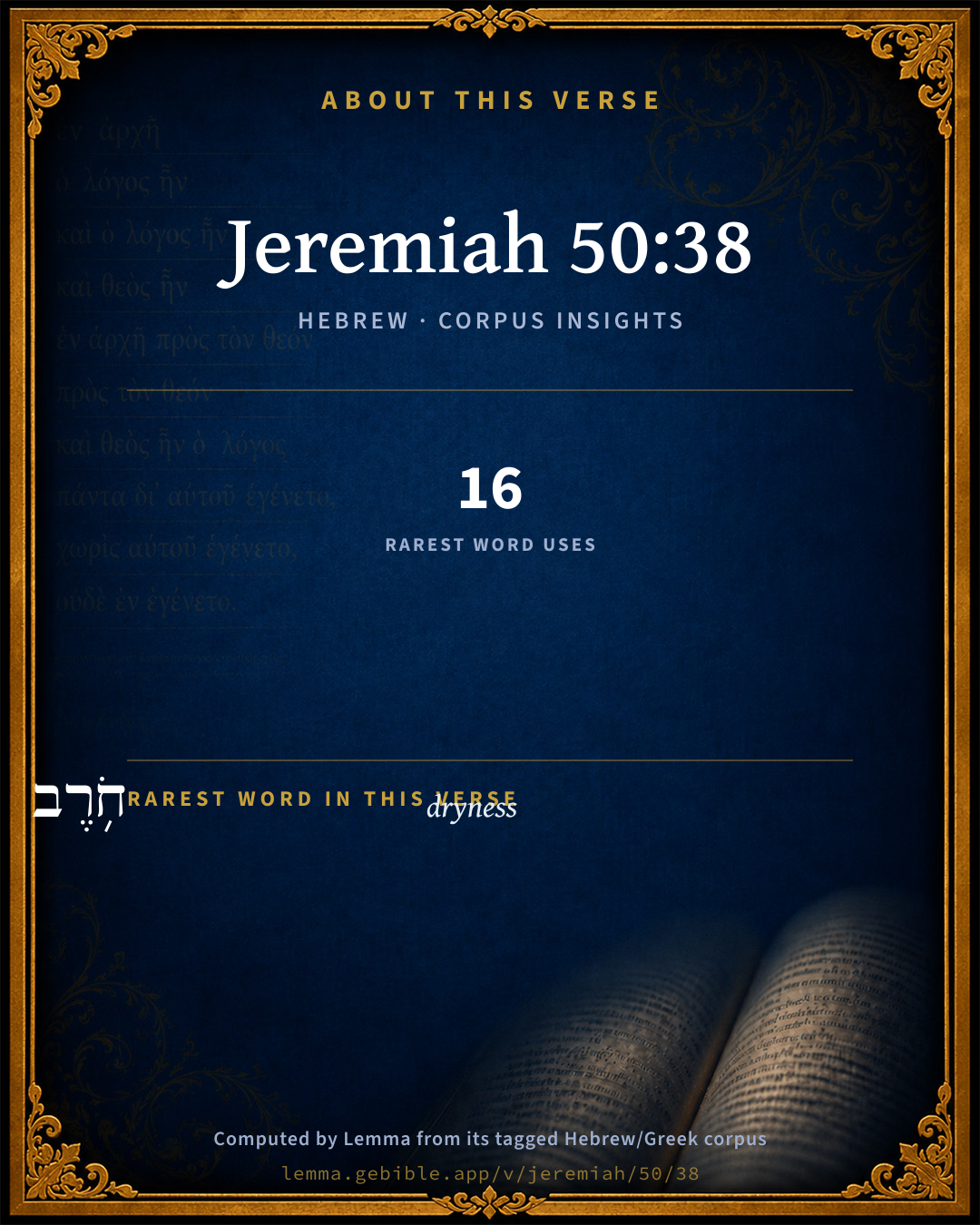
The rarest word here is חֹ֥רֶב dryness H2721 — appearing just 16 times in the whole Hebrew Bible.

Shared distinctive vocabulary

חֹ֥רֶב dryness H2721 occurs in 15 verses of the Hebrew Bible. Also found in:

Grammatical profile

  • 2 verbs
  • 5 nouns
  • 1 pronoun
  • 1 preposition
  • 1 conjunction

Verb forms

  • וְיָבֵ֑שׁוּ Qal · Sequential Perfect
  • יִתְהֹלָֽלוּ Hithpael · Imperfect

Cross-references

17

Topical passages linked to Jeremiah 50:38 in the Treasury of Scripture Knowledge — connected by theme and wording, ordered by reader-vote popularity; previews shown in the World English Bible.

  • Isaiah 44:27 who says to the deep, Be dry, and I will dry up your rivers;
  • Jeremiah 50:2 Declare you among the nations and publish, and set up a standard; publish, and don't conceal: say, Babylon is taken, Bel is disappointed, Merodach is dismayed; her images are disappointed, her idols are dismayed.
  • Revelation 16:12 The sixth poured out his bowl on the great river, the Euphrates. Its water was dried up, that the way might be made ready for the kings that come from the sunrise.
  • Jeremiah 51:47 Therefore, behold, the days come, that I will execute judgment on the engraved images of Babylon; and her whole land shall be confounded; and all her slain shall fall in the midst of her.
  • Jeremiah 51:52 Therefore, behold, the days come, says Yahweh, that I will execute judgment on her engraved images; and through all her land the wounded shall groan.
  • Isaiah 44:25 who frustrates the signs of the liars, and makes diviners mad; who turns wise men backward, and makes their knowledge foolish;
  • Isaiah 46:1–7 Bel bows down, Nebo stoops; their idols are on the animals, and on the cattle: the things that you carried about are made a load, a burden to the weary [animal].
  • Jeremiah 50:12 your mother shall be utterly disappointed; she who bore you shall be confounded: behold, she shall be the least of the nations, a wilderness, a dry land, and a desert.
  • Jeremiah 51:7 Babylon has been a golden cup in Yahweh's hand, who made all the earth drunken: the nations have drunk of her wine; therefore the nations are mad.
  • Jeremiah 51:32–36 and the passages are seized, and the reeds they have burned with fire, and the men of war are frightened.
  • Jeremiah 51:44 I will execute judgment on Bel in Babylon, and I will bring forth out of his mouth that which he has swallowed up; and the nations shall not flow any more to him: yes, the wall of Babylon shall fall.
  • Daniel 3:1–30 Nebuchadnezzar the king made an image of gold, whose height was sixty cubits, and the breadth of it six cubits: he set it up in the plain of Dura, in the province of Babylon.
  • Daniel 5:4 They drank wine, and praised the gods of gold, and of silver, of brass, of iron, of wood, and of stone.
  • Habakkuk 2:18–19 "What value does the engraved image have, that its maker has engraved it; the molten image, even the teacher of lies, that he who fashions its form trusts in it, to make mute idols?
  • Acts 17:16 Now while Paul waited for them at Athens, his spirit was provoked within him as he saw the city full of idols.
  • Revelation 17:5 And on her forehead a name was written, "MYSTERY, BABYLON THE GREAT, THE MOTHER OF THE PROSTITUTES AND OF THE ABOMINATIONS OF THE EARTH."
  • Revelation 17:15–16 He said to me, "The waters which you saw, where the prostitute sits, are peoples, multitudes, nations, and languages.

Cross-references courtesy of OpenBible.info (CC BY 4.0).

Hebrew and Greek witnesses Masoretic Hebrew ↔ Greek Septuagint

The same verse in the two great witnesses to the Old Testament, shown verse-for-verse.

These are two independent witnesses, not word-aligned to each other, and the Septuagint is shown in lemma (dictionary) form.

Hebrew Jeremiah 50:38 Masoretic · Westminster Leningrad Codex

חֹ֥רֶב אֶל מֵימֶ֖יהָ וְיָבֵ֑שׁוּ כִּ֣י אֶ֤רֶץ פְּסִלִים֙ הִ֔יא וּבָאֵימִ֖ים יִתְהֹלָֽלוּ

A drought is on her waters, and they shall be dried up; for it is a land of engraved images, and they are mad over idols.

World English Bible · Public Domain

Greek LXX Structure differs

In the Septuagint, Jeremiah is about an eighth shorter than the Hebrew and arranges its material differently — the Oracles Against the Nations (Hebrew chapters 46–51) appear in the middle of the Greek book, after 25:13. Because the chapter and verse boundaries do not line up, a verse-for-verse comparison with the Hebrew is not shown.

A verse-for-verse comparison isn’t shown here because the chapters and verses don’t line up. Switch to the LXX edition with the MT / LXX toggle above to read the Greek directly.

On this verse, The Cambridge Bible for Schools and Colleges discusses the Septuagint’s reading. Read the note in Commentary ↓

Hebrew: Westminster Leningrad Codex (CC BY 4.0). Greek: Septuagint (public domain); English from a public-domain English Septuagint. How the Septuagint differs from the Hebrew →

Targum (Aramaic paraphrase)

1

The Targum is the ancient Jewish Aramaic paraphrase of the Hebrew Scriptures — an interpretive translation, not the Hebrew text itself. Onkelos (literal) and Pseudo-Jonathan (expansive) render the Torah, and Jonathan the Prophets. Coverage is partial: where no permissively-licensed English translation exists for a verse, only the Aramaic is shown. This is verse-level text, not a word-by-word alignment to the Hebrew.

  1. Targum Jonathan Prophets (Joshua–Malachi)
    שַׁרְבָא בְמוֹהָא וְיִבְשׁוּן אֲרֵי אַרְעָא צַלְמָנַיָא הִיא וּבְטַעֲוָתָא מִשְׁתַּבְּחִין:

    (no public-domain English translation for this verse)

    Targum Jonathan — Aramaic: “Mikraot Gedolot” (public domain). English: “Sefaria Community Translation” (CC0 1.0 (public-domain dedication)); “London "Chaldee Paraphrase," 1871” (public domain). Text via Sefaria.

Commentary

Notes on Jeremiah 50:38 from classic Christian and Jewish commentators (each source and its license shown beneath its notes). The classic Christian expositions comment on the surrounding passage and are grouped to its opening verse, so a note may address several verses; the Jewish commentaries on the Tanakh (Rashi and others) are per-verse, so they appear only where the commentator wrote on this verse.

Lemma curates 59 commentaries, every one of them public domain or Creative Commons licensed, each selected and text-cleaned for this edition rather than reprinted as found. About our sources →

Trapp's Complete Commentary

John Trapp

Jer 50:38 A drought [is] upon her waters; and they shall be dried up: for it [is] the land of graven images, and they are mad upon [their] idols.

Ver. 38. A drought is upon her waters.] Which Cyrus did so drain by many outlets, that without any great difficulty he took the city, assaulting it on two sides. Frontinius saith, {a} that thrice Babylon was taken by this stratagem; (1.) By Semiramis; (2.) By Cyrus; (3.) By Alexander the Great.

And they are mad upon their idols.] {b} Deos terrificos et truces, statues of their kings and worthies, which were of a huge, vast stature. See Dan 3:1.

{a} Lib. iii. c. 7. s. 4.

{b} ειδωλομανεις.

John Trapp, A Commentary or Exposition upon All the Books of the Old and New Testament (1647–1656) — public domain. Text from a community e-Sword module.

Joseph Benson's Commentary

Jer 50:38-40. A drought is upon all her waters — Our translators, after the example of the Vulgate and others, have rendered חרב, a drought, here, whereas they have translated it a sword in the preceding verses, as supposing, it seems, that a sword has nothing to do with waters. But they might very properly have rendered it a sword here also: for this term is used metaphorically, to denote either the instrument of divine vengeance generally, or the operations and effects of war in particular; in either of which senses it may be applied to waters as well as to treasures. And the allusion here is evidently to the stratagem of Cyrus, who drained off the waters of the Euphrates, which ran through the city of Babylon, by means of which his troops, by night, marched along the bed of the river into the heart of the city, and surprised it. For it is the land of graven images, &c. — This vengeance comes upon them, because they have been the great encouragers and supporters of idolatry. It may be remarked, that the executioners of the divine judgments were the Persians, who, in opposition to the Sabians, (whose notions the Chaldeans embraced,) followed the ancient discipline of the magi, or wise men among them, and had neither altars nor images; as is attested by Strabo and Herodotus: see Prideaux’s Connections, p. 177, and Lowth. And they are mad upon their idols —

See note on Isa 57:5. They may well be termed mad who make a god of any creature, and especially those who worship images which their own hands have made. Therefore the wild beasts of the desert, &c. — Blaney renders this clause, Therefore shall wild cats, with jackals dwell, the daughters of the ostrich also shall dwell in her; and refers to Bochart in justification of the propriety of his translation. Compare this passage with the parallel one, Isa 13:19-22, where see the notes.

Joseph Benson's Commentary on the Old and New Testaments (1811–1818) — public domain. Text from a community e-Sword module.

Tyndale Open Study Notes

Tyndale Open Resources

50:38 The Euphrates River ran through the city of Babylon, providing its water supply. The Persians were reputed to have diverted the river during the siege by digging a canal around the city walls and then attacking through the riverbed.

Tyndale Open Study Notes — © Tyndale Open Resources, licensed CC BY-SA 4.0. Text via the HelloAO Bible API.

Geneva Bible (1599)

Geneva Bible translators

For Cyrus did cut the river Euphrates, and divided the course thereof into many streams, so that it might be passed over as though there had been no water: which thing he did by the counsel of two of Belshazzar’s captains, who conspired against their king, because he had gelded the one of them in despite, and slain the son of the other.

Geneva Bible (1599) marginal notes — public domain. Text via Bolls.life.

Jamieson, Fausset & Brown

Robert Jamieson, A. R. Fausset & David Brown

drought--Altering the pointing, this verse will begin as the three previous verses, "A sword." However, all the pointed manuscripts read, "A drought," as English Version. Cyrus turned off the waters of the Euphrates into a new channel and so marched through the dried-up bed into the city (Jer 51:32). Babylonia once was famed for its corn, which often yielded from one to two hundredfold [HERODOTUS]. This was due to its network of water-courses from the Euphrates for irrigation, traces of which [LAYARD] are seen still on all sides, but dry and barren (Isa 44:27).

their idols--literally, "terrors." They are mad after idols that are more calculated to frighten than to attract (Jer 51:44, Jer 51:47, Jer 51:52; Dan 3:1). Mere bugbears with which to frighten children.

Jamieson, Fausset & Brown — Commentary Critical and Explanatory on the Whole Bible (1871) — public domain (CC PDM 1.0). Text via the HelloAO Bible API.

Adam Clarke's Commentary

Verse 38. A drought is upon her waters] May not this refer to the draining of the channel of the Euphrates, by which the army of Cyrus entered the city. See on Jer 50:24. The original is, however, חרב chereb, a sword, as in the preceding verses, which signifies war, or any calamity by which the thing on which it falls is ruined.

Adam Clarke's Commentary on the Bible (1810–1826) — public domain. Text from a community e-Sword/MySword module.

John Calvin's Commentaries

Here the same word is used in a different sense: he had often before used the word חרב, chereb, “sword;” but now by changing only a point, he uses it in the sense of waste, or drought. But as he mentions waters, the Prophet, no doubt, means drought; nor was it without reason that he mentioned this, because the Euphrates, as it is well known, flowed near the city, and it was also divided into many streams, so that there were many islands, as it were, made by the skill and hand of men. Thus the city was in no ordinary way fortified, for it was difficult of access, being on one side surrounded by so large a river: it had also trenches full of water, and it had many channels. But Cyrus, as Xenophon relates, when attempting to take the city, used the same contrivance, and imitated those who had fortified Babylon, but for a different purpose; for he diverted the streams, so that the river might be forded. Thus, then, he dried up that great river, which was like a sea; so that Babylon was taken with no great trouble. Cyrus, indeed, entered in by night, and unexpectedly invaded Babylon, while they were securely feasting, and celebrating a festival, as we find in the book of Daniel. However, the way by which Cyrus contrived to take the city was, by dividing the Euphrates into many streams. Hence it was, that the Prophet, in order that the Jews might see, as it were, with their own eyes, spoke nothing without reason, having not only predicted the slaughter and destruction of the city, but showed also the very way in which it was done, as though the event had been portrayed before them.

The reason is added, because it is the land of carvings, or gravings. God, indeed, took vengeance on Babylon for other things, as it has before appeared; but the Prophet here speaks of carvings, that the Israelites might know that there is no certain salvation anywhere else except in the one true God, who had revealed himself to them. Jeremiah, in short, means, that when any country is destitute of God’s help, though it may excel in arms, in number, in wealth, and in wisdom, yet everything under heaven is of no avail without the blessing and favor of God. He has spoken of princes and of wise men, and he has named chariots, horses, and treasures, — all these have been mentioned for the purpose I have just stated, even to show, that were we supplied with all that may seem necessary to defend us, except God protected us, whatever the world may offer would be all in vain; for we shall at length find, that without God neither arms, nor chariots, nor wisdom nor counsel, nor any other helps, can avail us anything.

It follows, that Chaldea gloried in images The word אימים, aimim, means terrors, and giants are called by this name in Deuteronomy 2:10, because they inspire terror by their aspect. But this name is no doubt applied to images, because they are only bugbears, des epovantailz, as we say in French. As then they are mere scarecrows, which only frighten children, they are called אימים, aimim. And he says, that they gloried in, or doted on them — for הלל, elal, means both, in Hithpael, as it is found here. It means to boast or to elate one’s-self, and also to be mad or to dote. Either sense would not be unsuitable to this place; for the unbelieving gloried in their idols, and at the same time were mad: yet the first meaning seems to me the best, that they gloried in their idols, as it is said in Psalm 47:7,

“Let them perish who trust in images and glory in them.”

Though the verb there is indeed different, yet the meaning is the same.

It was not, indeed, without reason, that the Prophet reproaches the Chaldeans, that they gloried in their idols, because they thereby robbed God of his honor; for what is ascribed to idols is taken away from God. He intimates, in short, that the Chaldeans would be justly punished as guilty of sacrilege, because they had impiously transferred the glory of God to their own idols. And this passage teaches us, that when God is purely worshipped among us, and when true religion flourishes, it will be our best protection. We shall then be more impregnable than if we had all the power and wealth of the world: nothing can hurt us, if we give to God his due honor, and strive to worship him in sincerity and truth. It now follows, —

John Calvin's Commentaries (1540-1563) — public domain. Text from the Calvin Translation Society English edition (1840s-50s) via the Christian Classics Ethereal Library (ccel.org). Calvin's coverage is partial (roughly two-thirds of the Bible); uncommented books and verses are honest gaps, never fabricated. The 19th-century editor's footnotes and remarks are omitted so the notes are faithfully Calvin's own voice.

Ellicott's Commentary for English Readers

(38) A drought is upon her waters.—Better, A sword. The Hebrew word for “drought” has the same consonants as that for “sword,” with different vowel-points. In the original text the form of the two words must have been identical, as the vowel-points were of later introduction. The editors of the present text were probably guided by the thought that the context in this case determined the meaning of the word as meaning “drought,” and not a “sword.” So in Deu_28:22 the text of the Authorised version gives “sword,” and the margin “drought.” There is, however, a certain loss of rhetorical emphasis in the change of the word with which the three previous verses had begun. The “waters” include the canals of Babylon as well as the Euphrates.

They are mad upon their idols.—The word for “idols” means literally “terrors,” or “objects of terror,” as in Psa_88:16; Job_20:25, and this is the only place in which it is used of the objects of worship. In Gen_14:5; Deu_2:10-11 it appears as the name of the Emim, probably as meaning “the terrible, or gigantic ones.” Here it seems used for the colossal figures—winged bulls, human-headed lions, and the like—which were the objects of Babylonian worship. (See note on Jer_49:16.)

A Bible Commentary for English Readers, edited by Charles John Ellicott (1878–1897) — public domain. Text from a community e-Sword module.

The Cambridge Bible for Schools and Colleges

gen. ed. J. J. S. Perowne

38. A drought] The Heb. words for drought and sword (differing by one vowel only, ḥôreb, ḥereb) are sufficiently alike to make it quite possible that here as at the beginning of the two previous verses the latter should be read. In that case sword is thought to be used figuratively in reference to the stratagem by which the water supply of Babylon was cut off by its assailants; though this seems rather a farfetched application of the word. Drought on the contrary will more naturally refer to the drying up of the many canals by which the water of the Euphrates was distributed throughout the whole country for drainage and irrigation as well as for commercial purposes. Cp. Jer_51:13; Psa_137:1.

they are mad upon idols] rather, through idols do they make themselves mad. “Idols,” lit. as mg. terrors, the grotesque objects by which heathen often represent their gods. But there is strong support in the Versions (LXX, Aq., Symm., Syr., Vulg., Targ.) for reading (with different vocalisation) and of idols do they boast themselves (cp. Psa_97:7).

The Cambridge Bible for Schools and Colleges (gen. ed. J. J. S. Perowne; Cambridge University Press, 1878–1918) — public domain. Text from a community e-Sword module.

John Gill's Exposition

A drought is upon her waters, and they shall be dried up,.... Either on the waters of the land of Chaldea in general, from whence should follow barrenness, and so a want of the necessaries of life; hence Kimchi interprets it of a consumption of riches, and all good things; or on the waters of Babylon, the river Euphrates, which ran through it; the channel of which was diverted by Cyrus, and drained and made so dry, that he marched his army up it into the city. Some say Babylon was taken three times, by this stratagem of turning the river Euphrates another way; first by Semiramis; and after Cyrus by Alexander: this may well be applied to the drying up of the river Euphrates, upon the pouring out of the sixth vial, and to the destruction of the antichristian states, signified by the many waters on which the great whore of Babylon or Rome sitteth, Rev 16:12;

for it is the land of graven images; much given to idolatry; had idols of gold, silver, brass, iron, wood, and stone, Dan 5:2;

and they are mad upon their idols; greatly affected, and much devoted to them; superstitiously mad upon them: or, "they gloried in them"; as the Targum, Vulgate Latin version, and others (p); they praised and extolled them as true deities; as Belshazzar and his nobles did the very night Babylon was taken, Dan 5:4; and this their idolatry was one cause of their ruin. The word (q) for "idols" signifies "terrors", or terrible things; because their worshippers stood in fear of them, as Kimchi observes.

(p) "gloriantur", Vulg. Lat. Schmidt, Munster, Tigurine version. (q) "horrendis" vel "terriculamentis", Schmidt, Munster, Calvin; "terricula", Junius & Tremellius.

John Gill's Exposition of the Whole Bible (1746–1763) — public domain (CC PDM 1.0). Text via the HelloAO Bible API.

Albert Barnes' Notes on the Bible

A drought - Rather, “a sword,” i. e., military skill and forethought.

They are mad upon their idols - Omit their. The word for idols, literally terrors Psa 88:16 is used in this one place only of objects of worship. Probably it refers to those montrous forms invented as representations of their deities.

Albert Barnes' Notes on the Bible (1834–1885) — public domain. Text from a community e-Sword/MySword module.

Haydock's Catholic Bible Commentary

Drought. Cyrus almost drained the Euphrates, chap. li. 42., and Isaias xxi. --- Things, fit to terrify children, Baruch vi. 14. (Calmet) --- Protestants, "they are made upon their idols." (Haydock)

George Leo Haydock (1774–1849), Haydock's Catholic Family Bible and Commentary, 1859 edition — public domain. Excludes Psalms (Douay-Rheims chapter numbering differs from Protestant) and Deuterocanonical books (Catholic canon only).

Matthew Poole's English Annotations

A drought is upon her waters, and they shall be dried up: some think that this phrase hath a special reference to Cyrus’s stratagem used in the surprise of Babylon; one part of it was fortified by the great river Euphrates, running on one side, which Cyrus diverted by cutting several channels, till he had drained it so low, that it became passable for his army to go over. Others think that a want of rain is here threatened.

For it is the land of graven images, and they are mad upon their idols: God gives the reason of this judgment, which was their idolatry, and exceeding zeal for it.

Matthew Poole's English Annotations on the Holy Bible (1683–1685) — public domain. Text from a community e-Sword/MySword module.

Whedon's Commentary on the Bible

Daniel D. Whedon

38. A drought — The consonants of the original for “drought” are the same with those for sword in the verse preceding; the only difference is in the vowel pointings of the Masoretes. Hence there are not a few who believe that the true form of this word is sword, and not drought. But the consistency of the MSS. with one another, the general uniformity of the Versions, and the more exact fitness of the sense, vindicate the present reading, even if they do not demonstrate its correctness; and hence it is better to retain it.

Waters — The canals and watercourses constituting the system of irrigation for the Babylonian plain, which system was doubtless at this time, the most perfect on the face of the earth.

Daniel D. Whedon (gen. ed.), Commentary on the Old and New Testaments (1874–1909) — public domain. Text from a community e-Sword module.

The Pulpit Commentary

A drought. The Maasoretic critics, in their prosaic realism, were unable to see how a "sword" could be "upon the waters;" hence they altered khereb into khoreb. But the sword is merely a symbol of the Divine vengeance, and may be interpreted differently according to the exigencies of the context. Render, Sword upon the waters. They are mad upon their idols; rather, through Terrors they befool themselves. "Terrors" is a synonym for the gods of the heathen, which inspired a feeling of awe rather than affection, unlike Jehovah as he revealed himself through the authors of the psalms and prophecies.

The Pulpit Commentary (1880–1919), ed. H.D.M. Spence-Jones & Joseph S. Exell — public domain. Text from a community e-Sword module.

John Wesley's Explanatory Notes

Dried - This phrase has a plain reference to Cyrus's stratagem used in the surprize of Babylon; one part of it was fortified by the great river Euphrates, which Cyrus diverted by cutting several channels, 'till he had drained it so low, that it became passable for his army; others think that a want of rain is here threatened.

John Wesley, Explanatory Notes Upon the Whole Bible (1754–1765) — public domain. Text via the GEBible commentary corpus.

unfoldingWord translationNotes

Door43 World Missions Community

A drought is coming on her waters

"A drought will soon happen that will affect all her waters"

her waters

Here "waters" represent all the sources of water for the Babylonians, especially the river that went through the city.

desert beasts with the jackals

Possible meanings are 1) "wild animals and hyenas" or 2) "wild demons and evil spirits."

jackals

A jackal is a wild dog found in Asia and Africa.

ostriches

very large African birds that run fast but cannot fly. Some versions translate this as "owl."

will live in her

The word "her" refers to Babylon.

For all time, she will no longer be inhabited. From generation to generation, she will not be lived in

These two phrases mean the same thing and emphasize that Babylon will be completely uninhabited. AT: "People will never live there again; it will be uninhabited forever" (See: Doublet)

she will not be lived in

This can be stated in active form. AT: "no one will live in her" (See: Active or Passive)

this is Yahweh's declaration

Yahweh speaks of himself by name to express the certainty of what he is declaring. See how you translated this in Jeremiah 1:8. AT: "this is what Yahweh has declared" or "this is what I, Yahweh, have declared" (See: First, Second, or Third Person)

no one will live there; no person will stay in her

These two phrases mean the same thing and emphasize that Babylon will be completely uninhabited. They can be combined. AT: "no one will ever live there again" (See: Doublet)

translationWords

water

worthy

false god

desert

beast

life

generation

Sodom

Gomorrah

neighbor

unfoldingWord translationNotes — © Distant Shores Media and the Door43 World Missions Community, licensed CC BY-SA 4.0. Source: git.door43.org/Door43/en_tn.

Rashi

Rabbi Shlomo Yitzchaki (Rashi)

and they are mad upon things of horror Heb. יתהללו, they shall become mad. Another interpretation: (Pour vanter in French) in order to boast. And so did Jonathan render: משתבּחין, they boast, [i.e.,] with the gods of the giants that they had.

Rashi on the Tanakh — English translations: “The Judaica Press complete Tanach with Rashi, translated by A. J. Rosenberg” (CC BY 4.0); “Pentateuch with Rashi's commentary by M. Rosenbaum and A.M. Silbermann, 1929-1934” (public domain); “The Metsudah Tanach series, Lakewood, N.J” (CC BY 4.0); and “The Book of Joshua, Metsudah Publications, 1997” (CC BY 4.0). Text via Sefaria.

Lesson kit

Teaching starters — assembled from the data on this page, not authored interpretation. Every prompt links to the verse data it draws on. Edit before teaching.

Jeremiah, in the Prophets, opens this verse with 10 words (10 distinct Hebrew lemmas). Its most distinctive word is chôreb (“dryness”). A historical commentator’s framing appears above. Read the whole chapter for the surrounding context.

Discussion questions

  1. What does “dryness” (chôreb) contribute to the verse as a whole?
  2. How does Genesis 31:40, which shares the word «dryness», read alongside this verse?
  3. These translations render this verse differently; the difference is in the English rendering, not the original. What questions does that raise?
  4. «וְיָבֵ֑שׁוּ» is a Qal Sequential Perfect verb. How does that grammatical form shape the action described?
  5. Compare how Trapp's Complete Commentary and Joseph Benson's Commentary read this verse. Where do they agree or differ?

Things to notice

Reading settings

Reading text

Shown beneath each verse's original-language words.

Old Testament
Old Testament edition

Read the OT as the Masoretic Hebrew (MT) or the Greek Septuagint (LXX).

English shown for the Greek Septuagint (in the Hebrew ↔ Greek comparison).

Comparing translations? Open the Compare panel on any verse page to stack up to four side by side.