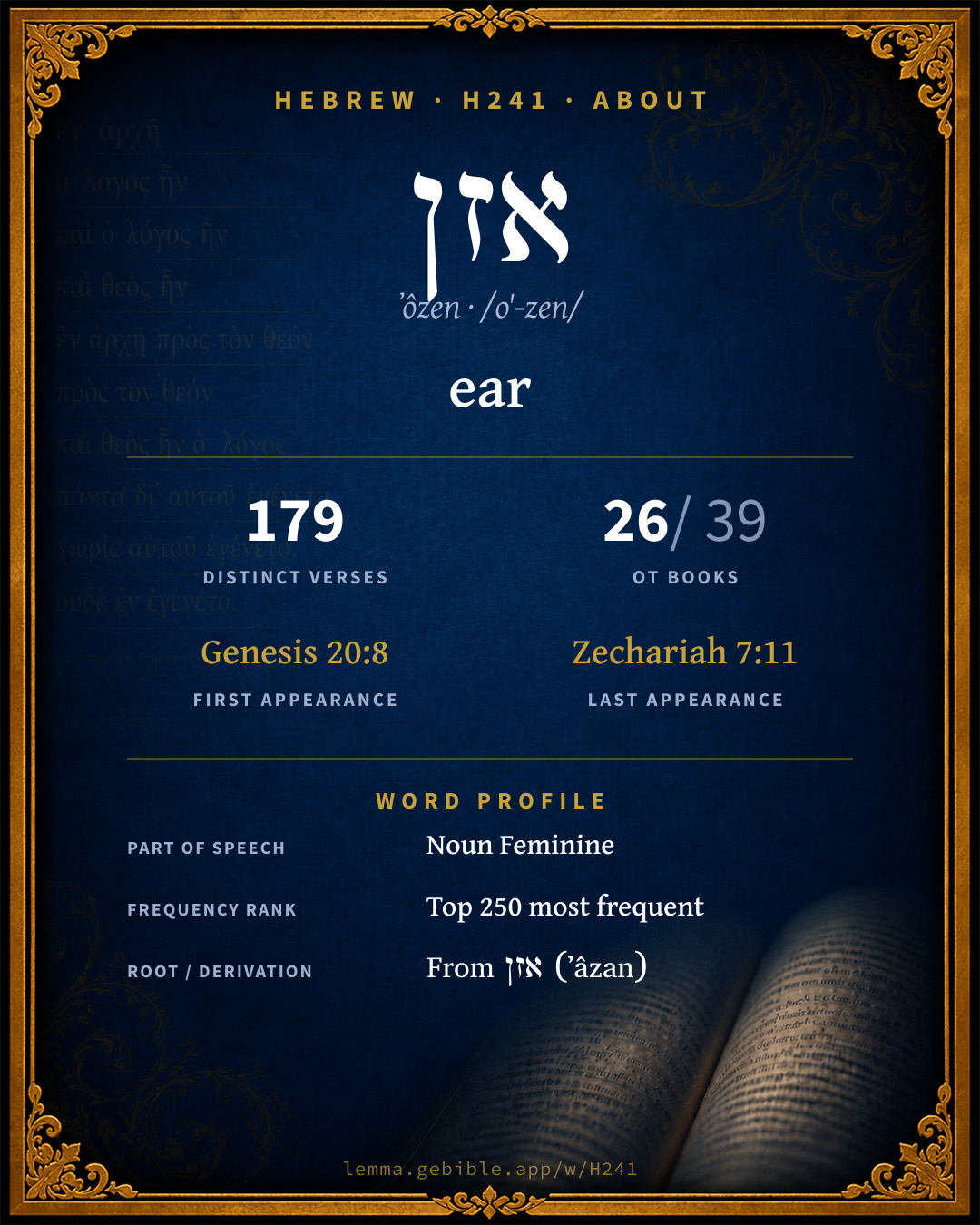
אֹ֫זֶן
ear
‘ear’ is one of 3 main senses fuller range ↓
Full lexicon entry — Brown-Driver-Briggs (BDB)
From Brown-Driver-Briggs (BDB)
Where this word appears
See every Construct-state word in the Hebrew Bible →
Grammar key — what these labels mean
Part of speech
- Noun
- A naming word — a person, place, thing, or idea.
Noun type
- Common
- A common noun — a general class of person, place, or thing (“king,” “city,” “water”), not a specific name.
State
- Construct
- A noun bound to a following noun in a possessive / “of” relationship (the construct chain).
- Absolute
- The independent form of a noun, not bound to a following word.
Gender
- Feminine
- Grammatically feminine.
Number
- Dual
- Exactly two — for natural pairs and some measures of time.
- Singular
- One.
9 verses where H241 appears in the Construct state in the Book of Ezekiel. Filtered view — show all forms. Click any verse to open its interlinear word-by-word view. Verse text shown in the World English Bible for context — . Each verse’s Hebrew form is shown with its reference; the English is not keyword-highlighted, since the data carries no word-level English alignment. Use “Compare translations” on any verse to read it across multiple English versions. This concordance covers the Hebrew Bible; Septuagint (Greek Old Testament) occurrences are not indexed here.
Ezekiel
- Ezekiel 3:10 וּ/בְ/אָזְנֶ֥י/ךָ conj + prep + n c fd cs + sfx pers 2ms Moreover he said to me, Son of man, all my words that I shall speak to you receive in your heart, and hear with your ears.
- Ezekiel 8:18 בְ/אָזְנַ/י֙ prep + n c fd cs + sfx pers 1cs Therefore will I also deal in wrath; my eye shall not spare, neither will I have pity; and though they cry in my ears with a loud voice, yet will I not hear them.
- Ezekiel 9:1 בְ/אָזְנַ֗/י prep + n c fd cs + sfx pers 1cs Then he cried in my ears with a loud voice, saying, Cause you them that have charge over the city to draw near, every man with his destroying weapon in his hand.
- Ezekiel 9:5 בְּ/אָזְנַ֔/י prep + n c fd cs + sfx pers 1cs To the others he said in my hearing, Go you through the city after him, and strike: don't let your eye spare, neither have you pity;
- Ezekiel 10:13 בְּ/אָזְנָֽ/י prep + n c fd cs + sfx pers 1cs As for the wheels, they were called in my hearing, the whirling [wheels].
- Ezekiel 16:12 אָזְנָ֑יִ/ךְ n c fd cs + sfx pers 2fs I put a ring on your nose, and ear-rings in your ears, and a beautiful crown on your head.
- Ezekiel 23:25 וְ/אָזְנַ֨יִ/ךְ֙ conj + n c fd cs + sfx pers 2fs I will set my jealousy against you, and they shall deal with you in fury; they shall take away your nose and your ears; and your residue shall fall by the sword: they shall take your sons and your daughters; and your residue shall be devoured by the fire.
- Ezekiel 40:4 וּ/בְ/אָזְנֶ֨י/ךָ conj + prep + n c fd cs + sfx pers 2ms The man said to me, Son of man, see with your eyes, and hear with your ears, and set your heart on all that I shall show you; for, to the intent that I may show them to you, are you brought here: declare all that you see to the house of Israel.
- Ezekiel 44:5 וּ/בְ/אָזְנֶ֣י/ךָ conj + prep + n c fd cs + sfx pers 2ms Yahweh said to me, Son of man, mark well, and see with your eyes, and hear with your ears all that I tell you concerning all the ordinances of the house of Yahweh, and all the laws of it; and mark well the entrance of the house, with every exit of the sanctuary.
About this entry
At a glance — auto-summarized from this page’s data, not written by a person. Every figure links to its source below. This summary describes the numbers; it doesn’t interpret them.
At its core, אזן (ʼôzen) means “ear.” Scripture first uses it in Genesis 20:8. It appears 179 verses across 26 books of the Hebrew Bible, among its common vocabulary. Not a single-sense word: explore its full sense range. It clusters with אזן, אזן and אזן under a shared root. Each statement above links to its evidence; the full detail follows below.
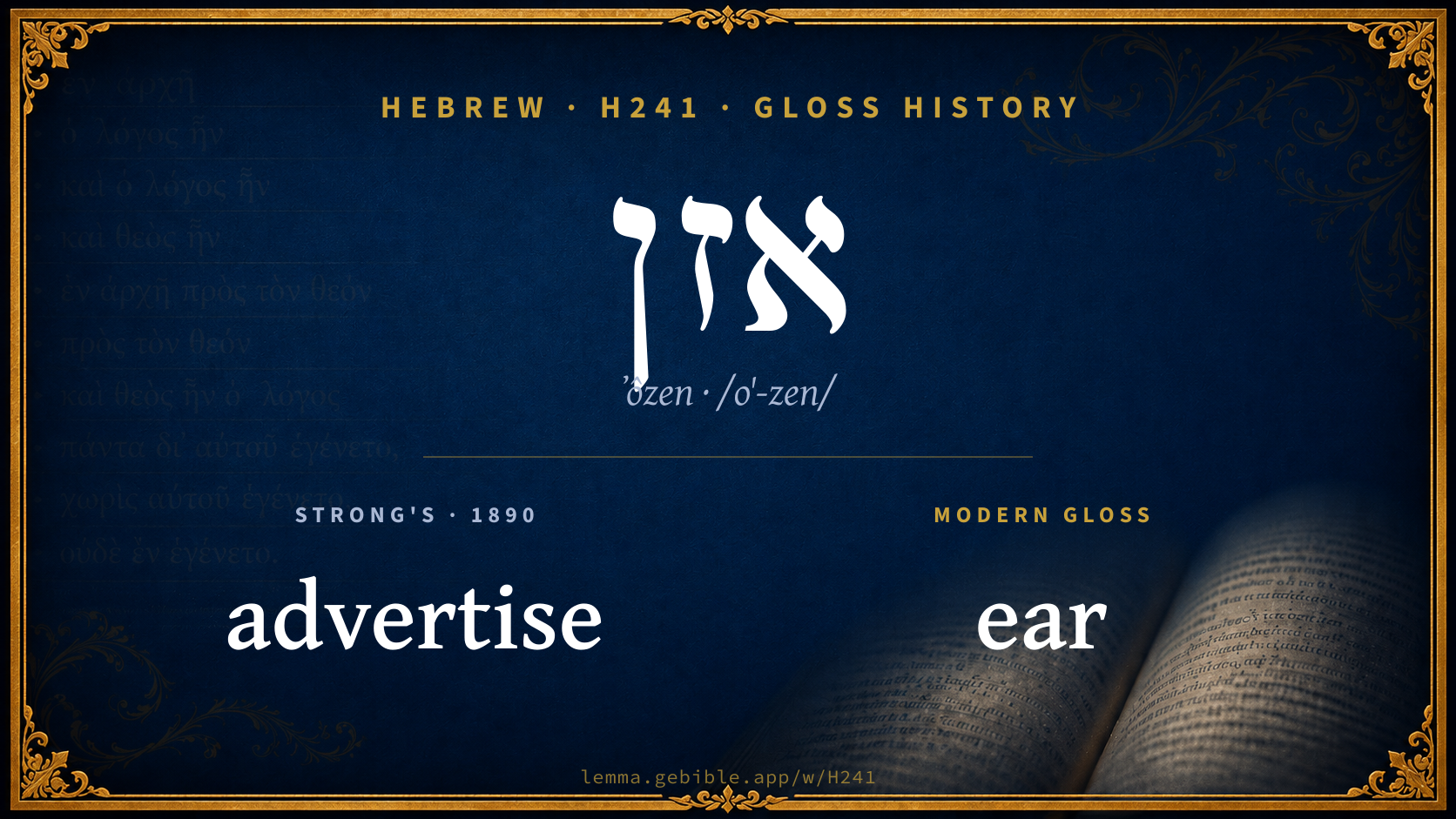
Gloss history
Strong's 1890 vs modern scholarship
About this word
Strong's H241 catalogs a Hebrew word from the Hebrew Old Testament.
These counts are not copied from any lexicon or concordance. They are computed here, from the morphology-tagged Hebrew Old Testament. What Lemma adds →
- 179
- distinct verses
- The word appears in 179 distinct verses.
- 26 / 39
- OT books
- The word appears in 26 of 39 Old Testament books.
- #249
- by frequency
- Top 250 most frequent Hebrew words (rank 249 of 8,640 Hebrew words by occurrence).
View all 179 occurrences in the concordance →
By section of the Old Testament
By traditional corpus
Conventional, traditional groupings — biblical authorship is debated, so this is a traditional corpus grouping, not an authorship claim. Each share is this word’s portion of its verses in that division of the Hebrew canon. Each figure is a share of the word’s 179 distinct verses.
- Prophets (Nevi'im) 85 verses · 47%
- Writings (Ketuvim) 63 verses · 35%
- Torah (Pentateuch) 31 verses · 17%
How translations render this word
Counts come from each version’s own published word-to-Strong’s tagging or interlinear alignment — an approximate guide to how each version renders this word, not a word-level alignment the data otherwise carries. Because each total is that version’s own tagged count, the per-version totals vary from one another and need not match the appearance or distinct-verse counts above. These counts may also differ from a printed concordance because Lemma counts each distinctly tagged rendering and does not collapse phrase taggings into a single head-word total. This is a fixed set of word-tagged versions (KJV, ASV, BSB, ULT) and does not change with the reading translation you choose elsewhere. Each version’s license is shown beside its name below (and on Sources).
- King James Version: Ears 82×, Ear 53×, Audience 7×
- American Standard Version: Ears 69×, Ear 45×, Audience 6×
- Berean Standard Bible: Ears 45×, Ear 35×, Hearing 31×
- unfoldingWord Literal Text: Ear 61×, Ears 58×, Ears of 29×
King James Version Public Domain
Renders H241 across 175 tagged occurrences — most commonly:
Plus 17 renderings that appear only once — usually multi-word phrases or single function words the recovered tagging swept in, not distinct renderings. Not rendered by a distinct English word in 12 further occurrences.
American Standard Version Public Domain
Renders H241 across 176 tagged occurrences — most commonly:
Plus 29 renderings that appear only once — usually multi-word phrases or single function words the recovered tagging swept in, not distinct renderings.
Berean Standard Bible Public Domain
Renders H241 across 151 tagged occurrences — most commonly:
Plus 18 renderings that appear only once — usually multi-word phrases or single function words the recovered tagging swept in, not distinct renderings. Not rendered by a distinct English word in 35 further occurrences.
unfoldingWord Literal Text CC BY-SA 4.0
Renders H241 across 186 tagged occurrences — most commonly:
Plus 16 renderings that appear only once — usually multi-word phrases or single function words the recovered tagging swept in, not distinct renderings.
Senses in the full BDB
What do BDB’s symbols mean?
BDB uses these scholarly abbreviations:
| Symbol | Meaning |
|---|---|
| 𝔊 | the Septuagint (the ancient Greek translation, LXX) |
| 𝔙 | the Vulgate (the Latin translation) |
| 𝔖 | the Syriac version (the Peshitta) |
| 𝔗 | the Targum (the Aramaic translation) |
| ψ | the Psalms |
| √ | root (the underlying root or stem) |
| ‖ | parallel passage (a synonymous or contrasted parallel) |
| † | the dagger: every passage where the word occurs is cited |
The 5 senses and sub-senses the full Brown-Driver-Briggs lexicon distinguishes for this word, in lexicon order (not ranked by frequency), with BDB’s own verbatim wording and sub-sense lettering. Shown in Hebrew script with BDB’s own scholarly abbreviations. The condensed entry is in the Lexicon Entry tab. See also the Forms in the corpus table below.
- 1. ear, as part of body; of human being, as bearing earring Gn 35:4 Ex 32:2, 3 (all JE) Ez 16:12; pierced by a master Ex 21:6 (E) Dt 15:17; touched with blood in consecration (תְּנוּךְ א׳ tip of ear) Lv 8:23, 24; 14:14, 17, 25, 28; cut off by enemy Ez 23:25 (of אָהֳלִיבָה q.v.); ear of dog Pr 26:17 מַחֲזִיק בְּאָזְנֵי־כָ֑לֶב; of sheep Am 3:12 (fragment rescued from lion). e.g. Genesis 35:4
- 2. especially as organ of hearing,
- a. of man Dt 29:3 2 S 22:45 = ψ 18:45, Jb 42:5 Is 30:21; implanted (נטע) by י׳ ψ 94:9; of idols (do not hear) ψ 115:6; 135:17; שָׁמַע בא׳ 2 S 7:22 + 8 times; especially בְּא׳ after vb. of saying = in the ears, in the hearing of Gn 20:8 (E) 23:10, 13, 16 (P) 44:18; 50:4 (J) Dt 5:1; 31:11, 28, 30 + 44 times; cf. Is 5:9 (vb. om.); after noun of utterance, sound 1 S 15:14 Jb 13:17; 15:21; cf. א׳ after verbal noun Ez 24:26 (לְהַשְׁמָעוּת א׳) cf. Is 11:3; הִטָה א׳ incline the ear = give attention ψ 45:11 Pr 22:17 + 9 times; sq. ל ψ 49:5 + 4 times; so הִקְשִׁיב א׳ Is 32:3; Pr 2:2 (sq. ל); הֵבִיא א׳ ל׳ Pr 23:2; as receiving words א׳ תִּקַּח Jb 4:12 cf. Je 9:19; as tingling (צלל) at dreadful news 1 S 3:11 2 K 21:12 Je 19:3; as hearing with satisfaction, triumph ψ 92:12 תִּשְׁמַעְנָה אָזְנָ֑י (‖ וַתַּבֵּט עֵינִי בְּ׳) but Che del.; as intelligent (involving mental process) שָֽׁמְעָה א׳ וַתָּבֶן לָהּ Jb 13:1; א׳ מִלִּין תִּבְחָ֑ן Jb 12:11 cf. 34:3; as unsatisfied Ec 1:8 לֹא תִמָּלֵא א׳ מִשְּׁמֹעַ; as seeking (בקשׁ) knowledge Pr 18:15; as hearing & blessing Jb 29:11; cf. א׳ שֹׁמַעַת Pr 20:12; 25:12 a hearing (responsive, obedient) ear; cf. Pr 15:31 Is 43:8; opp. stopping the ears (wilful ignorance) אֹטֵם א׳ מִן־ Pr 21:13 cf. Is 33:15; also of adder in simile of wicked ψ 58:5 כְּמוֹ פֶתֶן חֵדֵשׁ יַאְטֵם אָוְנוֹ; מֵסִיר א׳ מִן־ Pr 28:9 so עֲרֵלָה א׳ their ear is uncircumcised Je 6:10; הִכְבִּיד א׳ Zc 7:11 cf. Is 48:8 Je 5:21 Ez 12:2; cf. also Is 42:20. e.g. Deuteronomy 29:3
- b. of Yahweh, בְּא׳ י׳ after vb. of utterance Nu 11:18 (J) 14:28 (P) 1 S 8:21 Ez 8:18; after עָלָה 2 K 19:28 = Is 37:29; after בּוֹא ψ 18:7 cf. 2 S 22:7 where vb. om.; so also (after noun without vb.) Nu 11:1 (J) בְּא׳ י׳ 1 Ch 28:8 nearly = in presence of; incline the ear הִטָּה א׳ 2 K 19:16 = Is 37:17 Dn 9:18 ψ 86:1; sq. לְ ψ 17:6; 88:3; 116:2; sq. אֶל־ ψ 31:3; 71:2; 102:3; הִקְשִׁיב א׳ ψ 10:17; א׳ קַשֻּׁבוֹת לְ 2 Ch 6:40; 7:15 ψ 80:2 cf. 130:2; id. sq. אֶל־ Ne 1:6, 11; vb. om. א׳ אֶל־ ψ 34:16; cf. Is 59:1 לֹא כָֽבְדָה א׳; La 3:56 אַל־תַּעְלֵם א׳ ל׳. e.g. Numbers 11:18
- 3. †גָּלָה א׳ open ears of, reveal to, subj. man 1 S 20:2, 12, 13; 22:8(×2), 17 Ru 4:4; subj. י׳ 1 S 9:15 2 S 7:27 1 Ch 17:25; גּ׳ א׳ לַמּוּסָד Jb 36:10, cf. v 15; כָּרָה א׳ ψ 40:7; יָעִירלִי א׳לִשְׁמֹעַ Is 50:4; פָּתַח־לִי א׳ Is 50:5; cf. וְא׳ חֵרְשִׁים תִּפָּתַחְנָה Is 35:5; opp. judicial deafness Mi 7:16 Is 6:10. e.g. 1 Samuel 20:2
Senses from the full Brown-Driver-Briggs lexicon (Brown, Driver, Briggs; Oxford 1906 — public domain), digitized via Sefaria, supplemented by the OpenScriptures HebrewLexicon (CC BY 4.0). Full attribution on Sources.
Word origin
n.f. Ex 29:20 ear (Arabic أُذْن, Aramaic ܐܶܕܢܳܐ, אוּדְנָא, Assyrian uznu, Ethiopic እዝን )—abs. 2 S 22:45 +; cstr. Ex 29:20 +; sf. אָזְנִי 1 S 20:2 +, etc.; du. אָזְנַיִם (נָ֑יִם) Dt 29:3 +; cstr. אָזְנֵי Gn 23:10 +; sf. אָזְנַי (־נָ֑י) Nu 14:28 +; (never with article).—
— Brown-Driver-Briggs (Oxford 1906, public domain), digitized via Sefaria, supplemented by the OpenScriptures HebrewLexicon (CC BY 4.0). See Sources.
Derived from אזן (ʼâzan) (H238) — to hear.
Jastrow Dictionary
A second Hebrew/Aramaic lexicon for comparison, covering Aramaic and post-biblical (Talmudic, Targumic, Midrashic) usage that the biblical-Hebrew BDB does not. Matched by lemma rather than by Strong’s number, so a lemma may carry more than one Jastrow headword (shown separately below), and the entries cover usage well beyond the Bible.
אֲזַן
- Targ. Is. XXXIII, 4, third pers. pl. of אֲזָא, v. אֲזִי
אֹזֶן
- to be pointed, cut, cmp. חז, גז. v. אוּדְנָא)
- 1. ear. B. Kam. 79ᵇ א׳ של מַטָּה human ear, opp. Divine perception. Y. Sabb. I, 3ᵇ top; a. fr.
- 2. handle. Cant. R. beg. ולא הי׳ לה א׳ וכ׳ but had no handle and could not be carried; a. fr.—Du. אָזְנַיִם 1) ears. Lev. R. s. 32, beg. א׳ לדרך the road has ears (be on your guard in speaking); a. fr.—2) handles. Kel. IV, 3, v. גיסטרא; a. fr.
- 3. אָזְנַיִם or בנות א׳ swollen glands of the throat (Rashi). Ab. Zar. 28ᵇ א׳; Y. ib. II, 40ᵈ top; Y. Sabb. XIV, 14ᵈ top בנות א׳.
A Dictionary of the Targumim, the Talmud Babli and Yerushalmi, and the Midrashic Literature (Marcus Jastrow; London, Luzac, 1903) — Public Domain. Digitized via Sefaria. Digitized via Sefaria. Full attribution on Sources.
Forms in the corpus
The 108 distinct written forms H241 takes in the Hebrew Bible, most frequent first — each parse links to that state’s occurrences in the concordance. Hebrew forms include their vowel points and cantillation, so a single lemma takes many written forms.
The 60 most common forms are shown; 48 rarer forms follow in the full concordance.
Same root — word family
Other BDB entries built from the same root as H241, grouped by Strong’s listed origin. These share a root / origin per the lexicon — not necessarily a shared meaning. Each links to that word’s own entry.
Derives from
Shares the same root
Proper names from this root
People and places named from this root — a name, not an additional meaning of the word.
- אזן שארה ʼUzzên Sheʼĕrâh H242 Uzzen Sherah
- אזנות תבור ʼAznôwth Tâbôwr H243 Aznoth Tabor
- אזניה ʼĂzanyâh H245 Azaniah
- יאזניה Yaʼăzanyâh H2970 Jaazaniah
- אזני ʼOznîy H244 Ozni
Compare all same-root words → Showing 4 of 9 — not the complete family. 5 of the same-root words are proper names (people or places). They share a root, not necessarily a meaning.
Septuagint verse parallels
This word appears in 169 verses that also exist in the Greek Old Testament (Septuagint), out of the 179 Hebrew verses it occurs in. You can read those verses in Greek by switching the Old Testament edition to the Septuagint.
Read these verses in the Septuagint
- Genesis 20:8
- Exodus 10:2
- Leviticus 8:23
- Numbers 11:1
- Deuteronomy 5:1
- Joshua 20:4
- Judges 7:3
- Ruth 4:4
- 1 Samuel 3:11
- 2 Samuel 3:19
- 2 Kings 18:26
- 1 Chronicles 17:20
This is a verse-level parallel only — the same verses exist in both the Hebrew and Greek Old Testaments. No word-level Hebrew↔Greek correspondence is claimed: the data carries no such alignment, so no Greek word is shown as this Hebrew word’s translation. Coverage is not total — the Septuagint omits the deuterocanon and renumbers the Psalms, so some Hebrew verses have no direct Greek parallel.