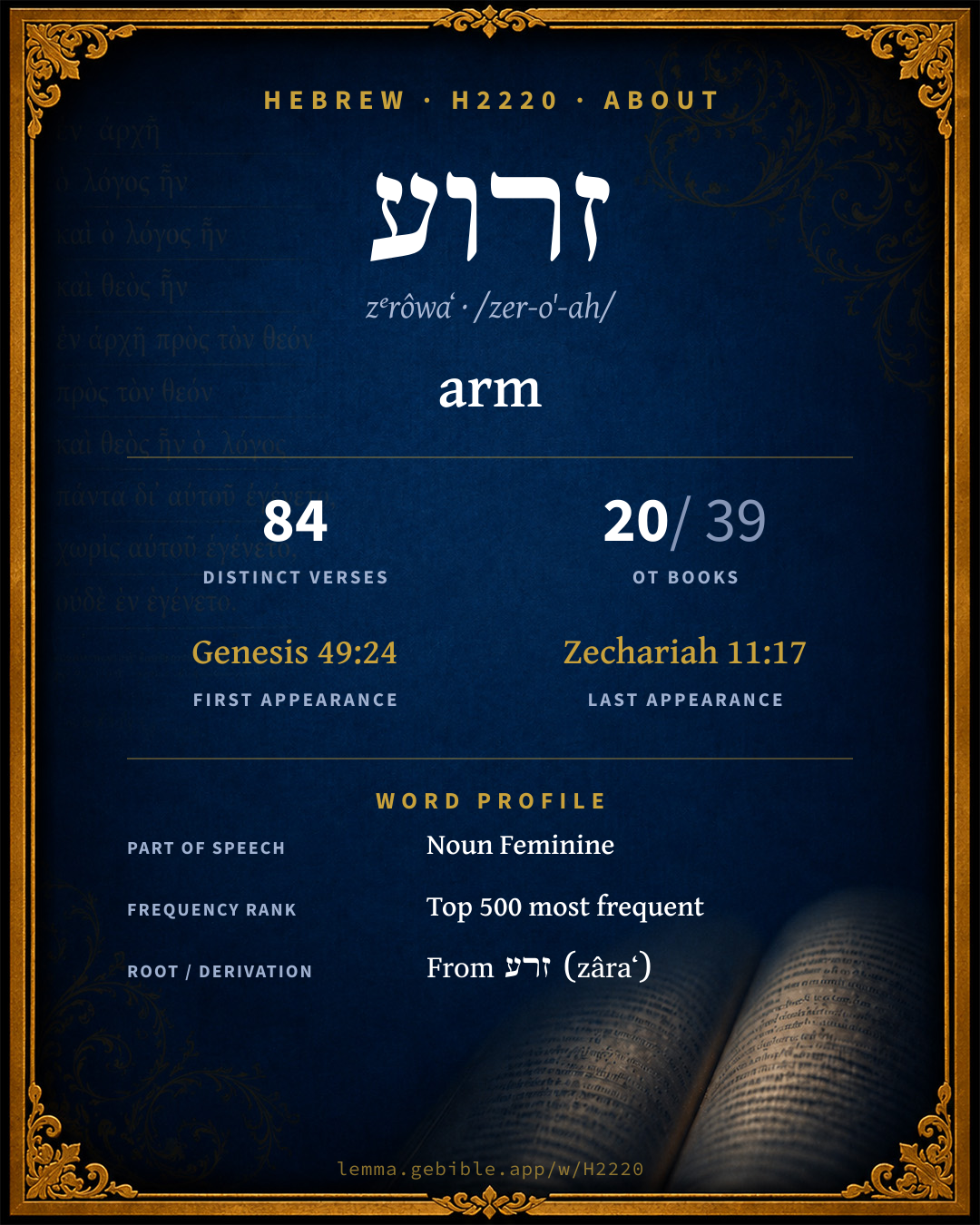
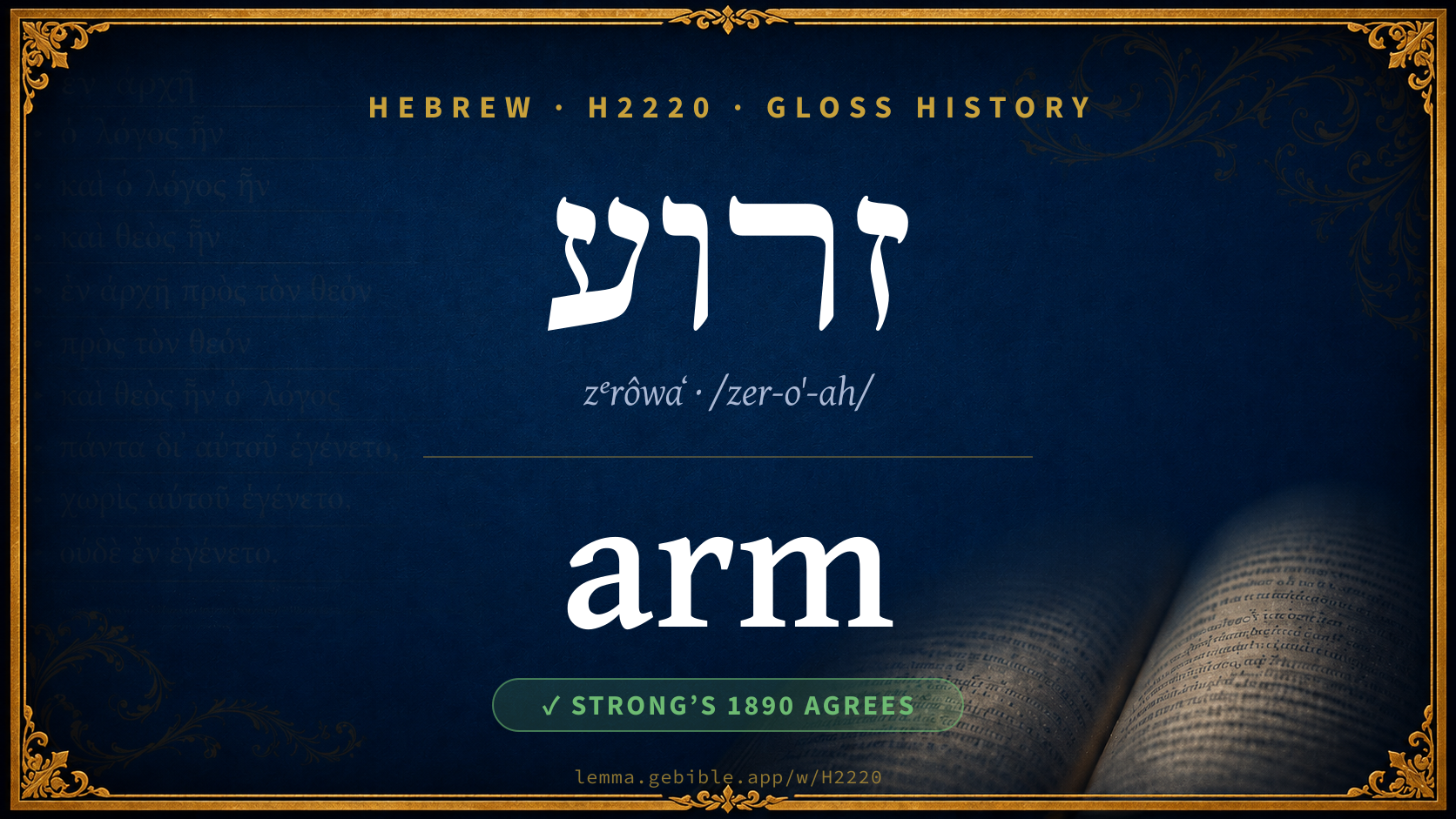
זְרוֹעַ
arm
also: forearm, shoulder, strength fuller range ↓
Full lexicon entry — Brown-Driver-Briggs (BDB)
From Brown-Driver-Briggs (BDB)
Where this word appears
Grammar key — what these labels mean
Part of speech
- Noun
- A naming word — a person, place, thing, or idea.
Noun type
- Common
- A common noun — a general class of person, place, or thing (“king,” “city,” “water”), not a specific name.
State
- Absolute
- The independent form of a noun, not bound to a following word.
- Construct
- A noun bound to a following noun in a possessive / “of” relationship (the construct chain).
Gender
- Both
- Attested as both masculine and feminine.
Number
- Singular
- One.
- Plural
- More than one (in Hebrew, generally three or more).
Every verse where H2220 appears in the Book of Isaiah — 16 distinct verses. Click any verse to open its interlinear word-by-word view. Verse text shown in the World English Bible for context — . Each verse’s Hebrew form is shown with its reference; the English is not keyword-highlighted, since the data carries no word-level English alignment. Use “Compare translations” on any verse to read it across multiple English versions. This concordance covers the Hebrew Bible; Septuagint (Greek Old Testament) occurrences are not indexed here.
Isaiah
- Isaiah 9:20 זְרֹע֖/וֹ n c bs cs + sfx pers 3ms One shall snatch on the right hand, and be hungry; and he shall eat on the left hand, and they shall not be satisfied: they shall eat every man the flesh of his own arm:
- Isaiah 17:5 וּ/זְרֹע֖/וֹ conj + n c bs cs + sfx pers 3ms It shall be as when the harvester gathers the standing grain, and his arm reaps the ears; yes, it shall be as when one gleans ears in the valley of Rephaim.
- Isaiah 30:30 זְרוֹע/וֹ֙ n c bs cs + sfx pers 3ms Yahweh will cause his glorious voice to be heard, and will show the lighting down of his arm, with the indignation of [his] anger, and the flame of a devouring fire, with a blast, and tempest, and hailstones.
- Isaiah 33:2 זְרֹעָ/ם֙ n c bs cs + sfx pers 3mp Yahweh, be gracious to us; we have waited for you: be our arm every morning, our salvation also in the time of trouble.
- Isaiah 40:10 וּ/זְרֹע֖/וֹ conj + n c bs cs + sfx pers 3ms Behold, the Lord Yahweh will come as a mighty one, and his arm will rule for him: Behold, his reward is with him, and his recompense before him.
- Isaiah 40:11 בִּ/זְרֹע/וֹ֙ prep + n c bs cs + sfx pers 3ms He will feed his flock like a shepherd, he will gather the lambs in his arm, and carry them in his bosom, [and] will gently lead those who have their young.
- Isaiah 44:12 בִּ/זְר֣וֹעַ prep + n c bs cs The smith [makes] an axe, and works in the coals, and fashions it with hammers, and works it with his strong arm: yes, he is hungry, and his strength fails; he drinks no water, and is faint.
- Isaiah 48:14 וּ/זְרֹע֖/וֹ conj + n c bs cs + sfx pers 3ms Assemble yourselves, all you, and hear; who among them has declared these things? He whom Yahweh loves shall perform his pleasure on Babylon, and his arm [shall be on] the Chaldeans.
- Isaiah 51:5 וּ/זְרֹעַ֖/י זְרֹעִ֖/י conj + n c bp cs + sfx pers 1cs n c bs cs + sfx pers 1cs My righteousness is near, my salvation is gone forth, and my arms shall judge the peoples; the isles shall wait for me, and on my arm shall they trust.
- Isaiah 51:9 זְר֣וֹעַ n c bs cs Awake, awake, put on strength, arm of Yahweh; awake, as in the days of old, the generations of ancient times. Isn't it you who did cut Rahab in pieces, who pierced the monster?
- Isaiah 52:10 זְר֣וֹעַ n c bs cs Yahweh has made bare his holy arm in the eyes of all the nations; and all the ends of the earth have seen the salvation of our God.
- Isaiah 53:1 וּ/זְר֥וֹעַ conj + n c bs cs Who has believed our message? and to whom has the arm of Yahweh been revealed?
- Isaiah 59:16 זְרֹע֔/וֹ n c bs cs + sfx pers 3ms He saw that there was no man, and wondered that there was no intercessor: therefore his own arm brought salvation to him; and his righteousness, it upheld him.
- Isaiah 62:8 וּ/בִ/זְר֣וֹעַ conj + prep + n c bs cs Yahweh has sworn by his right hand, and by the arm of his strength, Surely I will no more give your grain to be food for your enemies; and foreigners shall not drink your new wine, for which you have labored:
- Isaiah 63:5 זְרֹעִ֔/י n c bs cs + sfx pers 1cs I looked, and there was none to help; and I wondered that there was none to uphold: therefore my own arm brought salvation to me; and my wrath, it upheld me.
- Isaiah 63:12 זְר֖וֹעַ n c bs cs who caused his glorious arm to go at the right hand of Moses? who divided the waters before them, to make himself an everlasting name?
About this entry
At a glance — auto-summarized from this page’s data, not written by a person. Every figure links to its source below. This summary describes the numbers; it doesn’t interpret them.
זרוע (zᵉrôwaʻ) is a Hebrew noun most often rendered “arm.” It also covers “forearm”, “shoulder”, and “strength”, alongside “arm” — see its full sense range. The Hebrew Bible uses it across 84 verses — moderately common. Debuting at Genesis 49:24, it then recurs through the corpus. Related forms include זרע, זרוע and זרע. The sections below give every sense, occurrence, and version rendering.
Gloss history
Strong's 1890 vs modern scholarship
About this word
Strong's H2220 catalogs a Hebrew word from the Hebrew Old Testament.
These counts are not copied from any lexicon or concordance. They are computed here, from the morphology-tagged Hebrew Old Testament. What Lemma adds →
- 84
- distinct verses
- The word appears in 84 distinct verses.
- 20 / 39
- OT books
- The word appears in 20 of 39 Old Testament books.
- #455
- by frequency
- Top 500 most frequent Hebrew words (rank 455 of 8,640 Hebrew words by occurrence).
View all 84 occurrences in the concordance →
By section of the Old Testament
By traditional corpus
Conventional, traditional groupings — biblical authorship is debated, so this is a traditional corpus grouping, not an authorship claim. Each share is this word’s portion of its verses in that division of the Hebrew canon. Each figure is a share of the word’s 84 distinct verses.
- Prophets (Nevi'im) 43 verses · 51%
- Writings (Ketuvim) 28 verses · 33%
- Torah (Pentateuch) 13 verses · 15%
How translations render this word
Counts come from each version’s own published word-to-Strong’s tagging or interlinear alignment — an approximate guide to how each version renders this word, not a word-level alignment the data otherwise carries. Because each total is that version’s own tagged count, the per-version totals vary from one another and need not match the appearance or distinct-verse counts above. These counts may also differ from a printed concordance because Lemma counts each distinctly tagged rendering and does not collapse phrase taggings into a single head-word total. This is a fixed set of word-tagged versions (KJV, ASV, BSB, ULT) and does not change with the reading translation you choose elsewhere. Each version’s license is shown beside its name below (and on Sources).
- King James Version: Arm 43×, Arms 21×, Power 2×
- American Standard Version: Arm 43×, Arms 16×, Forces 3×
- Berean Standard Bible: Arm 45×, Arms 18×, Strength 7×
- unfoldingWord Literal Text: Arm 43×, Arm of 13×, Arms 13×
King James Version Public Domain
Renders H2220 across 91 tagged occurrences — most commonly:
Plus 21 renderings that appear only once — usually multi-word phrases or single function words the recovered tagging swept in, not distinct renderings.
American Standard Version Public Domain
Renders H2220 across 90 tagged occurrences — most commonly:
Plus 26 renderings that appear only once — usually multi-word phrases or single function words the recovered tagging swept in, not distinct renderings.
Berean Standard Bible Public Domain
Renders H2220 across 90 tagged occurrences — most commonly:
Plus 12 renderings that appear only once — usually multi-word phrases or single function words the recovered tagging swept in, not distinct renderings. Not rendered by a distinct English word in 1 further occurrence.
unfoldingWord Literal Text CC BY-SA 4.0
Renders H2220 across 110 tagged occurrences — most commonly:
Plus 15 renderings that appear only once — usually multi-word phrases or single function words the recovered tagging swept in, not distinct renderings.
9 senses and sub-senses in the full BDB
What do BDB’s symbols mean?
BDB uses these scholarly abbreviations:
| Symbol | Meaning |
|---|---|
| 𝔊 | the Septuagint (the ancient Greek translation, LXX) |
| 𝔙 | the Vulgate (the Latin translation) |
| 𝔖 | the Syriac version (the Peshitta) |
| 𝔗 | the Targum (the Aramaic translation) |
| ψ | the Psalms |
| √ | root (the underlying root or stem) |
| ‖ | parallel passage (a synonymous or contrasted parallel) |
| † | the dagger: every passage where the word occurs is cited |
The 9 senses and sub-senses the full Brown-Driver-Briggs lexicon distinguishes for this word, in lexicon order (not ranked by frequency), with BDB’s own verbatim wording and sub-sense lettering. Shown in Hebrew script with BDB’s own scholarly abbreviations. The condensed entry is in the Lexicon Entry tab. See also the Forms in the corpus table below.
- 1. arm,
- a. lit., of a man Ju 15:14; 16:12 2 S 1:10 Is 9:19; 17:5 (prob. acc. instr.), Dt 33:20 Zc 11:17(×2) Ct 8:6 Dn 10:6; Ez 13:20 (del. Co); ז׳ כֹּחוֹ Is 44:12 (of a smith, forging); ז׳ חֲשׂוּפָה Ez 4:7 (of prophet); in fig. of י׳ teaching Ephr. to walk Ho 11:3; זְרֹעֵי יָדָיו Gn 49:24 arms of his hands, i.e. arms that by their strength enable him (Joseph) to draw the bow; וַיַּךְ אֶת־יְהוֹרָם בֵּין זְרֹעָיו 2 K 9:24, i.e. his arms seen from behind, his shoulders. e.g. Judges 15:14
- b. arm as seat of (human) strength ψ 18:35 = 2 S 22:35; ז׳ לֹא עֹז Jb 26:2, כּוֹחַ הַזּ׳ Dn 11:6 cf. v 6; ז׳ לֹא עֹז Jb 26:2; חִזַּקְתִּי ז׳ Ho 7:15 cf. Ez 30:24, 25; also c. שׁבר ψ 10:15; 37:17 Je 48:25 (‖ קֶרֶן), Ez 30:21, 22, 24 cf. v 25; ז׳ רָמָה תִּשָּׁבֵר Jb 38:15.—On Mal 2:3 cf. VB. Especially e.g. Psalms 18:35
- c. Yahweh’s arm as instrument of deliverance and judgment (often Dt Je Is 2 ψ):—ז׳ נְטוּיָה Dt 4:34; 5:15; 26:8 Ez 20:33, 34 ψ 136:12, cf. Dt 7:19; 11:2 1 K 8:42 = 2 Ch 6:32 Je 32:21 (‖ יָד חֲזָקָה), Dt 9:29 2 K 17:36; (of creation) Je 27:5; 32:17 (all ‖ כֹּחַ גָּדוֹל); בִּז׳ נְטוּיָה Ex 6:6 (P, or D’s revision; no ‖); זְ׳ חֲזָקָה Je 21:5 (‖ יָד נְטוּיָה); גְּדֹל זרועך Ex 15:16 (song), גֹּדֶל ז׳ ψ 79:11; זְרוֹעִי תְאַמְּצֶנּוּ ψ 89:22 (‖ יָדִי); בִּזְ׳ ψ 77:16; ז׳ ψ 44:4 (‖ יְמִינְךָ), ז׳ קָדְשׁוֹ ψ 98:1 (‖ יְמִינוֹ), cf. Is 52:10; ז׳ עֻזָּךָ ψ 89:11 cf. Is 62:8 (‖ יְמִינוֹ); לִבְשִׁי־עֹז זְרוֹעַ י׳ Is 51:9; לְךָ ז׳ עִם־גְּבוּרָ֑ה ψ 89:14; ז׳ תִּפְאַרְתּוֹ Is 63:12; as support of weak Is 40:11 (fig. shepherd), cf. זְרֹעֹת עוֹלָם Dt 33:27; נַחַת זְרוֹעוֹ יַרְאֶה Is 30:30 (of lightning stroke, ‖ השׁמיע הוד קולו of thunder); also אִם־זְרוֹעַ כָּאֵל לָךְ Jb 40:9. Hence, e.g. Deuteronomy 4:34
- 2. arm, as symbol of strength:
- a. human 1 S 2:31(×2) (𝔊 read זַרְעֲךָ and זֶרַע, but v. Klo Dr), Ez 22:6; 31:17; וַתְּאַמֵּץ זְרוֹעֹתֶיהָ Pr 31:17; ז׳ בָּשָׂר 2 Ch 32:8; שָׂם בָּשָׂר זְרֹעוֹ Je 17:5 (‖ יִבְטַח בָּאָרָם); cf. ψ 44:4 (‖ חַרְבָּם); אישׁ זרוע Jb 22:8; זְרֹעוֹת יְתֹמִים Jb 22:9 (i.e. strength, resources); הָיוּ זרוע לִבְנֵי־לוֹט ψ 83:9; ז׳ רַבִּים Jb 35:9; זְרֹעַ גְּדוֹלָה Ez 17:9 (for pulling up a tree, in metaph.). e.g. 1 Samuel 2:31
- b. = divine strength ψ 71:18 (‖ גְּבוּרָה), זְרֹעוֹ מֹשְׁלָה לוֹ Is 40:10 (‖ חָזָק); זְרֹעַי עַמִּים יִשְׁפֹּ֑טוּ 51:5 [Str thinks masc. to avoid verbal ending נָה, cf. 49:11]; and help Is 33:2 (‖ יְשׁוּעָה) cf. 59:16; 63:5; see also 53:1. e.g. Psalms 71:18
- 3. Pl. forces, political and military, c. יַעֲמֹ֑דוּ Dn 11:15, 31; v 22 (see Bev). e.g. Daniel 11:15
- 4. Shoulder of animal sacrificed, belonging to priest Nu 6:19 (P) Dt 18:3. e.g. Numbers 6:19
Senses from the full Brown-Driver-Briggs lexicon (Brown, Driver, Briggs; Oxford 1906 — public domain), digitized via Sefaria, supplemented by the OpenScriptures HebrewLexicon (CC BY 4.0). Full attribution on Sources.
Word origin
n.f. Ex 6:6 and (rare) m. Is 51:5, cf. infr. arm, shoulder, strength (NH id.; Assyrian (Tel el Amarna102, 1. 12, etc.) zurû, cf. Jastrow JBL, xi, 1892, 123; Arabic ذِرَاعٌ; Aramaic דְּרָעָא, ܕܪܳܥܳܐ; Ethiopic መዝራዕት )—abs. זְרוֹעַ Ex 6:6 +, זְרֹעַ Dt 7:19 +; cstr. זְרוֹעַ ψ 10:15 +, זְרֹעַ ψ 89:11 +; sf. זְרוֹעִי Je 27:5 ψ 89:2, זְרֹעִי Is 51:5; 63:5; זְרוֹעֲךָ ψ 71:18 +, זְרֹעֲךָ 1 S 2:31 +, etc.; pl. זְרֹעִים Dn 11:31; cstr. זְרֹעֵי Gn 49:24; sf. זְרֹעַי Is 51:5, זְרֹעָיו 2 K 9:24; elsewhere fem. form, cstr. זְרוֹעוֹת ψ 37:17, זְרֹעוֹת Jb 22:9 + 6 times, זְרֹעֹת Dt 33:27; sf. זְרוֹעֹתָ֑י ψ 18:35, זְרֹעֹתָ֑י 2 S 22:35, etc. (In abs. and cstr. sg. more often plene, in pl. and c. sf. more often defect. In one instance where ז׳ is masculine it means a political or military force Dn 11:31).—
— Brown-Driver-Briggs (Oxford 1906, public domain), digitized via Sefaria, supplemented by the OpenScriptures HebrewLexicon (CC BY 4.0). See Sources.
Derived from זרע (zâraʻ) (H2232) — to sow.
Jastrow Dictionary
A second Hebrew/Aramaic lexicon for comparison, covering Aramaic and post-biblical (Talmudic, Targumic, Midrashic) usage that the biblical-Hebrew BDB does not. Matched by lemma rather than by Strong’s number, so a lemma may carry more than one Jastrow headword (shown separately below), and the entries cover usage well beyond the Bible.
זְרוֹעַ
- (b. h.) arm; (with animals) fore-leg, shoulder; strength, force. Ber. 17ᵇ ניזונין בז׳ receive their sustenance from the Lord by dint of their strength (virtue), opp. בצדקה by divine grace. Y. Taan. IV, 69ᵃ top זְרוֹעָן של כל ישראל the arm (defence, protection) of all Israel. Sabb. 56ᵃ נטלו בז׳ they took by force. Lev. R. s. 2 כבא על חבירו בז׳ like one coming against his neighbor with force (confident of victory).—Ḥull. X, 1 הז׳ the law concerning the shoulder as the priest’s share (Deut. XVIII, 3). Ib. 98ᵃ ז׳ בשלה, v. בָּשֵׁל; a. fr.—Pl. זְרוֹעוֹת, constr. זְרוֹעֵי. Sot. 49ᵇ; Tosef. ib. XIV, 3 ז׳ תורה the supports of the Law.—בעלי ז׳ violent men. B. Mets. 118ᵃ; a. e. e.g. Deuteronomy 18:3
זֵרוּעַ
- (= b. h. זֵרוּעַ; זרע) sowing; seed. Targ. O. Lev. XI, 37.—Pl. זֵרוּעִין, זֵי׳. Targ. Is. LXI, 11 זֵרוּעָהָא (ed. Lag. זֵירוּעָהּ sing.). [Y. Sabb. IX, 12ᵃ top; Y. Kil. III, beg. 28ᶜ (ref. to Is. l. c.) זֵירוּעֶיהָ מליא zerûëha is spelt plene (with ו); v. יאנא.]
A Dictionary of the Targumim, the Talmud Babli and Yerushalmi, and the Midrashic Literature (Marcus Jastrow; London, Luzac, 1903) — Public Domain. Digitized via Sefaria. Digitized via Sefaria. Full attribution on Sources.
Forms in the corpus
The 65 distinct written forms H2220 takes in the Hebrew Bible, most frequent first — each parse links to that state’s occurrences in the concordance. Hebrew forms include their vowel points and cantillation, so a single lemma takes many written forms.
The 60 most common forms are shown; 5 rarer forms follow in the full concordance.
Same root — word family
Other BDB entries built from the same root as H2220, grouped by Strong’s listed origin. These share a root / origin per the lexicon — not necessarily a shared meaning. Each links to that word’s own entry.
Derives from
Shares the same root
Derived from this word
Proper names from this root
People and places named from this root — a name, not an additional meaning of the word.
Compare all same-root words → Showing 4 of 9 — not the complete family. 1 of the same-root words is a proper name (a person or place). They share a root, not necessarily a meaning.
Septuagint verse parallels
This word appears in 79 verses that also exist in the Greek Old Testament (Septuagint), out of the 84 Hebrew verses it occurs in. You can read those verses in Greek by switching the Old Testament edition to the Septuagint.
Read these verses in the Septuagint
- Genesis 49:24
- Exodus 6:6
- Numbers 6:19
- Deuteronomy 4:34
- Judges 15:14
- 1 Samuel 2:31
- 2 Samuel 1:10
- 1 Kings 8:42
- 2 Kings 9:24
- 2 Chronicles 6:32
- Job 22:8
- Psalms 37:17
This is a verse-level parallel only — the same verses exist in both the Hebrew and Greek Old Testaments. No word-level Hebrew↔Greek correspondence is claimed: the data carries no such alignment, so no Greek word is shown as this Hebrew word’s translation. Coverage is not total — the Septuagint omits the deuterocanon and renumbers the Psalms, so some Hebrew verses have no direct Greek parallel.