
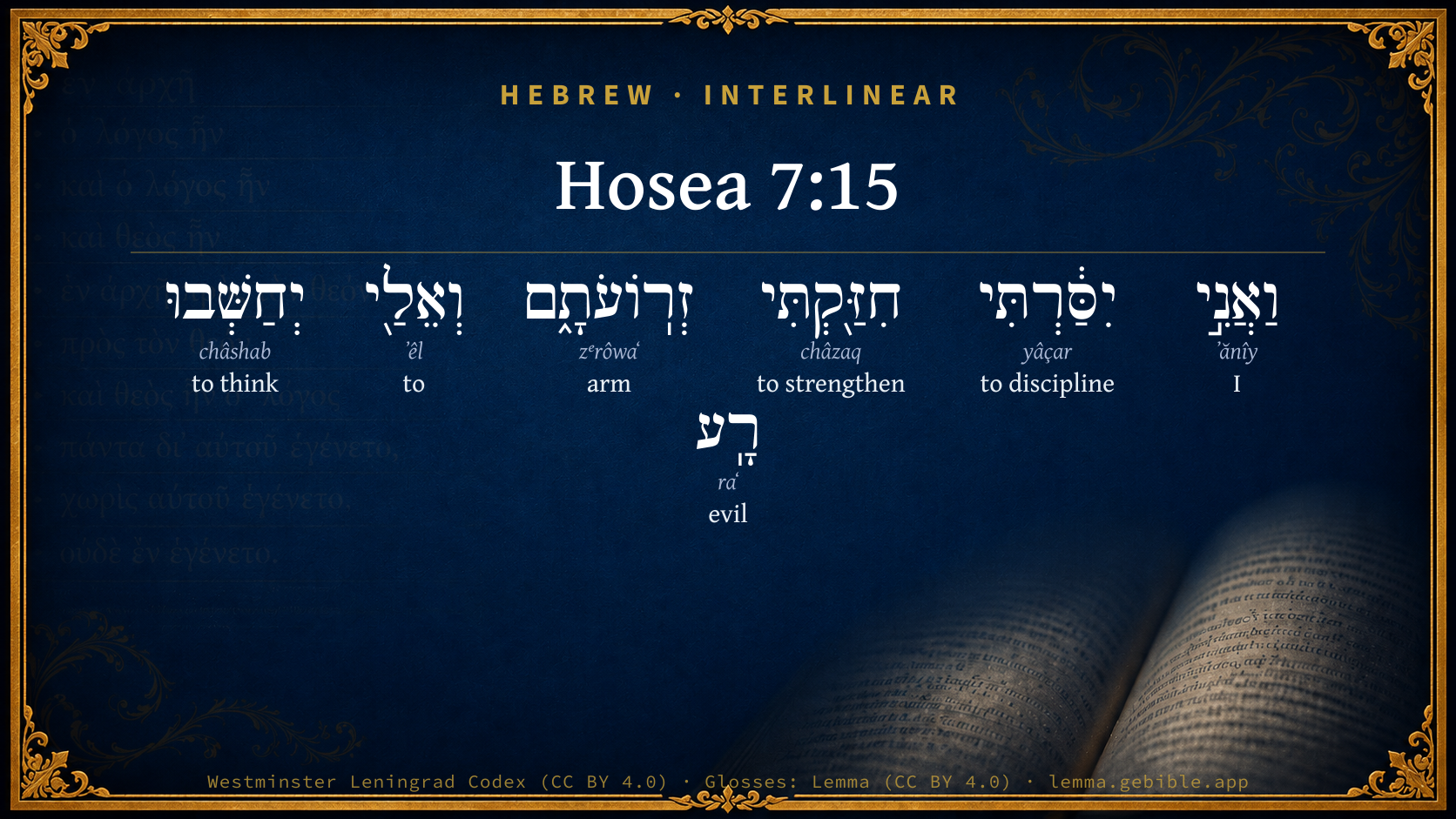
Hosea 7:15

Hebrew (Westminster Leningrad Codex) Hosea 7:15 appears in the Hebrew Old Testament. The text above is from the Westminster Leningrad Codex. Each word links to its Strong’s number, a concise gloss, and parsing drawn from the Open Scriptures Hebrew Bible morphology. Click any word for its full Brown-Driver-Briggs (BDB) entry.
Download image
Cite this verse

Hosea 7:15 (World English Bible). Public Domain. Lemma interlinear Bible study tool, https://lemma.gebible.app/v/hosea/7/15.

Show BibTeX & RIS
BibTeX
RIS
English Translation
Though I have taught and strengthened their arms, Yet they plot evil against me.
World English Bible · Public Domain
Download a study sheet

One document with this verse’s original text, its word-by-word gloss line, the meaning frame, cross-references with their text, attributed commentary, and full source and license credits — printable, and it pastes into notes with its structure intact.

This verse Autodidact and up

Study sheet (.html) Plain text (.txt)

A passage Seminary Student

Up to 50 verses in one chapter. A passage sheet keeps up to 6 commentary sources and 12 cross-references per verse, in the order this page ranks them, and says so on the sheet whenever that leaves anything out. Ask for a single verse and you get the Autodidact verse sheet above.

Everything on this page stays free to read, with no account — the sheet is a download of what is already on screen, not access to it.

Want to remove ads? Support Godless Engineer
Compare translations 3

The same verse in 3 English versions, stacked beneath the original-language interlinear above. Click any original word for its lexicon entry.

Each is an independent rendering of the whole verse — the interlinear is not word-aligned to these translations.

Highlighted words mark where these versions differ — a whole-verse word diff, not a word-by-word alignment.

  • World English Bible Public Domain
    Though I have taught and strengthened their arms, Yet they plot evil against me.
  • King James Version Public Domain
    Though I have bound and strengthened their arms, yet do they imagine mischief against me.
  • unfoldingWord Literal Text CC BY-SA 4.0
    And I, I trained, I strengthened their arms, but against me they plan evil.

unfoldingWord Literal Text — © unfoldingWord, licensed CC BY-SA 4.0. Word-aligned USFM3 via Door43 (git.door43.org/unfoldingWord/en_ult).

Versions to compare (up to 4)

3 of 4 selected

Show all 18 translations

Every available English version of this verse, each an independent rendering of the whole verse.

  • World English Bible Public Domain
    Though I have taught and strengthened their arms, Yet they plot evil against me.
  • Berean Standard Bible Public Domain
    Although I trained and strengthened their arms, they plot evil against Me.
  • Majority Standard Bible Public Domain
    Although I trained and strengthened their arms, they plot evil against Me.
  • King James Version Public Domain
    Though I have bound and strengthened their arms, yet do they imagine mischief against me.
  • American Standard Version (1901) Public Domain
    Though I have taught and strengthened their arms, yet do they devise mischief against me.
  • Revised Version (1885) Public Domain
    Though I have taught and strengthened their arms, yet do they imagine mischief against me.
  • Geneva Bible (1599) Public Domain
    Though I haue boud and strengthened their arme, yet doe they imagine mischiefe against me.
  • Douay-Rheims (1899) Public Domain
    And I have chastised them, and strengthened their arms: and they have imagined evil against me.
  • Young's Literal Translation Public Domain
    And I instructed -- I strengthened their arms, And concerning Me they think evil!
  • Literal Standard Version CC BY-SA 4.0
    And I instructed—I strengthened their arms, || And concerning Me they think evil!
  • Unlocked Literal Bible CC BY-SA 4.0
    Though I trained them and strengthened their arms, they are now plotting evil against me.
  • unfoldingWord Literal Text CC BY-SA 4.0
    And I, I trained, I strengthened their arms, but against me they plan evil.
  • Darby Bible Public Domain
    I have indeed trained, I have strengthened their arms, but they imagine mischief against me.
  • World Messianic Bible Public Domain
    Though I have taught and strengthened their arms, yet they plot evil against me.
  • Webster's Bible Public Domain
    Though I have bound and strengthened their arms, yet do they imagine mischief against me.
  • Free Bible Version CC BY-SA 4.0
    I myself trained them and made them strong, but now they plot evil against me.
  • Bible in Basic English Public Domain
    Though I have given training and strength to their arms, they have evil designs against me.
  • JPS Tanakh (1917) Public Domain
    Though I have trained and strengthened their arms, yet do they devise evil against Me.

Literal Standard Version (2020), Covenant Press — licensed CC BY-SA 4.0. Text via the HelloAO Bible API (eBible.org). Unlocked Literal Bible (unfoldingWord) — licensed CC BY-SA 4.0. Text via the HelloAO Bible API (eBible.org). unfoldingWord Literal Text — © unfoldingWord, licensed CC BY-SA 4.0. Word-aligned USFM3 via Door43 (git.door43.org/unfoldingWord/en_ult). Free Bible Version, Dr. Jonathan Gallagher — licensed CC BY-SA 4.0. Text via the HelloAO Bible API (eBible.org).

Word by word

More ways to search: Search by grammar → Find every occurrence → Compare this word →

Practice this passage: Drill this verse → Learn its vocabulary →

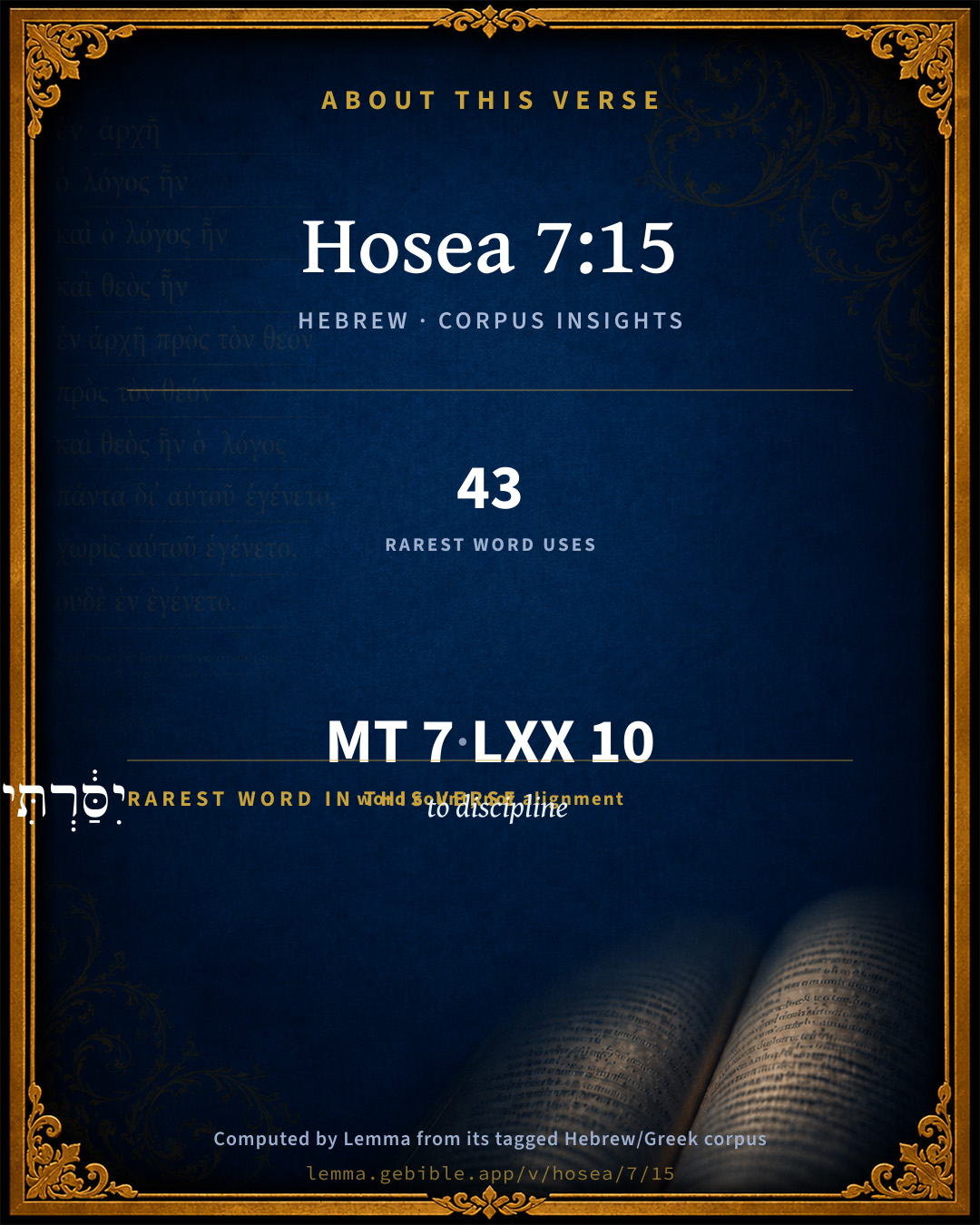
יִסַּ֔רְתִּי
yâçar
H3256
“to discipline”
Verb, Piel, Perfect, 1st Person, Common, Singular
Part of Speech
Verb
Stem
Piel
Form
Perfect
Person
1st Person
Gender
Common
Number
Singular
Full BDB Definition

Origin: a primitive root

TWOT: 877

to chasten, discipline, instruct, admonish - (Qal) - to chasten, admonish - to instruct - to discipline - (Niphal) to let oneself be chastened or corrected or admonished - (Piel) - to discipline, correct - to chasten, chastise - (Hiphil) to chasten - (Nithpael) to teach
  1. וַאֲנִ֣י ʼănîy H589 “and · I” Conjunction + Pronoun, Personal, 1st Person, Common, Singular
  2. חִזַּ֖קְתִּי châzaq H2388 “to strengthen” Verb, Piel, Perfect, 1st Person, Common, Singular
  3. זְרֽוֹעֹתָ֑ם zᵉrôwaʻ H2220 “arms · their” Noun, Common, Both, Plural, Construct + Suffix, Personal, 3rd Person, Masculine, Plural
  4. וְאֵלַ֖י ʼêl H413 “and · to · me” Conjunction + Preposition + Suffix, Personal, 1st Person, Common, Singular
  5. יְחַשְּׁבוּ châshab H2803 “to think” Verb, Piel, Imperfect, 3rd Person, Masculine, Plural
  6. רָֽע raʻ H7451 “evil” Adjective, Adjective, Masculine, Singular, Absolute

About this verse

These counts appear in no published source. They are computed here, from the morphology-tagged text and Lemma’s own curated glosses. What Lemma adds →

7
words
7
distinct lemmas
Prophets
section

Shared distinctive vocabulary

יִסַּ֔רְתִּי to discipline H3256 occurs in 38 verses of the Hebrew Bible. Also found in:

Grammatical profile

  • 3 verbs
  • 1 noun
  • 1 adjective
  • 1 pronoun
  • 1 preposition

Verb forms

  • יִסַּ֔רְתִּי Piel · Perfect
  • חִזַּ֖קְתִּי Piel · Perfect
  • יְחַשְּׁבוּ Piel · Imperfect

Hebrew & Septuagint length

In English translation the verse runs 14 words from the Hebrew and 16 from the Septuagint (LXX English) — closely comparable.

A rough comparison of the two English renderings, which tokenize alike — not a word-level alignment.

Word counts can differ between the Hebrew and the Greek without any difference in meaning — e.g. the Hebrew direct-object marker אֵת has no separate Greek word, and Greek often adds the article ὁ.

In the original languages it is 7 Hebrew tokens and 10 Greek tokens — but the two are counted differently (Hebrew bundles its prefixes and suffixes into one token; the Greek is in lemma form), so that isn’t a like-for-like length.

Cross-references

16

Topical passages linked to Hosea 7:15 in the Treasury of Scripture Knowledge — connected by theme and wording, ordered by reader-vote popularity; previews shown in the World English Bible.

  • Nahum 1:9 What do you plot against Yahweh? He will make a full end. Affliction won't rise up the second time.
  • Psalms 94:12 Blessed is the man whom you discipline, Yah, And teach out of your law;
  • 2 Kings 13:23 But Yahweh was gracious to them, and had compassion on them, and had respect to them, because of his covenant with Abraham, Isaac, and Jacob, and would not destroy them, neither cast he them from his presence as yet.
  • 2 Kings 14:25–27 He restored the border of Israel from the entrance of Hamath to the sea of the Arabah, according to the word of Yahweh, the God of Israel, which he spoke by his servant Jonah the son of Amittai, the prophet, who was of Gath Hepher.
  • Job 5:17 "Behold, happy is the man whom God corrects: Therefore do not despise the chastening of the Almighty.
  • Psalms 2:1 Why do the nations rage, And the peoples plot a vain thing?
  • Psalms 62:3 How long will you assault a man, Would all of you throw him down, Like a leaning wall, like a tottering fence?
  • Psalms 106:43–45 Many times he delivered them, But they were rebellious in their counsel, And were brought low in their iniquity.
  • Proverbs 3:11 My son, don't despise Yahweh's discipline, Neither be weary of his reproof:
  • Jeremiah 17:9 The heart is deceitful above all things, and it is exceedingly corrupt: who can know it?
  • Acts 4:25 who by the mouth of your servant, David, said, 'Why do the nations rage, And the peoples plot a vain thing?
  • Romans 1:21 Because, knowing God, they didn't glorify him as God, neither gave thanks, but became vain in their reasoning, and their senseless heart was darkened.
  • 2 Corinthians 10:5 throwing down imaginations and every high thing that is exalted against the knowledge of God, and bringing every thought into captivity to the obedience of Christ;
  • Hebrews 12:5 and you have forgotten the exhortation which reasons with you as with children, "My son, don't take lightly the chastening of the Lord, Nor faint when you are reproved by him;
  • Revelation 3:19 As many as I love, I reprove and chasten. Be zealous therefore, and repent.
  • 2 Kings 13:5 (Yahweh gave Israel a savior, so that they went out from under the hand of the Syrians; and the children of Israel lived in their tents as before.

Cross-references courtesy of OpenBible.info (CC BY 4.0).

Hebrew and Greek witnesses Masoretic Hebrew ↔ Greek Septuagint

The same verse in the two great witnesses to the Old Testament, shown verse-for-verse.

These are two independent witnesses, not word-aligned to each other, and the Septuagint is shown in lemma (dictionary) form.

Hebrew Hosea 7:15 Masoretic · Westminster Leningrad Codex

וַאֲנִ֣י יִסַּ֔רְתִּי חִזַּ֖קְתִּי זְרֽוֹעֹתָ֑ם וְאֵלַ֖י יְחַשְּׁבוּ רָֽע

Though I have taught and strengthened their arms, Yet they plot evil against me.

World English Bible · Public Domain

Greek LXX Hosea 7:15 Septuagint · lemma form

καΐἐγώ καταἰσχύω ὁ βραχίων αὐτός καί εἰς ἐγώ λογίζομαι πονηρός

They were instructed by me, and I strengthened their arms; and they devised evils against me.

LXX2012 (modern English Septuagint) · Public Domain

On this verse, Trapp's Complete Commentary discusses the Septuagint’s reading. Read the note in Commentary ↓

Hebrew: Westminster Leningrad Codex (CC BY 4.0). Greek: Septuagint (public domain); English from LXX2012 (modern English Septuagint) (Public Domain). How the Septuagint differs from the Hebrew →

Targum (Aramaic paraphrase)

1

The Targum is the ancient Jewish Aramaic paraphrase of the Hebrew Scriptures — an interpretive translation, not the Hebrew text itself. Onkelos (literal) and Pseudo-Jonathan (expansive) render the Torah, and Jonathan the Prophets. Coverage is partial: where no permissively-licensed English translation exists for a verse, only the Aramaic is shown. This is verse-level text, not a word-by-word alignment to the Hebrew.

  1. Targum Jonathan Prophets (Joshua–Malachi)
    וּכְמָא דִי אֲנָא מַיְתֵי עֲלֵיהוֹן יְסוּרִין וּמַתְקֵיף עַל דַרְעֵיהוֹן כֵּן אַף אִינוּן חָשְׁבִן לְאוֹסָפָה קֳדָמַי בִּישָׁן:

    (no public-domain English translation for this verse)

    Targum Jonathan — Aramaic: “Mikraot Gedolot” (public domain). English: “Sefaria Community Translation” (CC0 1.0 (public-domain dedication)); “London "Chaldee Paraphrase," 1871” (public domain). Text via Sefaria.

Commentary

Notes on Hosea 7:15 from classic Christian and Jewish commentators (each source and its license shown beneath its notes). The classic Christian expositions comment on the surrounding passage and are grouped to its opening verse, so a note may address several verses; the Jewish commentaries on the Tanakh (Rashi and others) are per-verse, so they appear only where the commentator wrote on this verse.

Lemma curates 59 commentaries, every one of them public domain or Creative Commons licensed, each selected and text-cleaned for this edition rather than reprinted as found. About our sources →

Trapp's Complete Commentary

John Trapp

Hos 7:15 Though I have bound [and] strengthened their arms, yet do they imagine mischief against me.

Ver. 15. Though I have bound and strengthened their arms] Quum ego erudivi, so Pagnine, Polanus, and others; when I taught them, or chastened them, as Hos 7:12, "and strengthened their arms"; there is no and in the original; it is an asyndeton; to show that God had done both for them, together and at once: he had acted the part both of an instructor and of a surgeon (like as, Rev 3:18, he takes upon him the person both of a rich merchant and a skilful physician); he had done all that could be done to do them good; teaching their hands to war and their fingers to fight, Psa 144:1, binding up their broken arms, {see Eze 30:24} and strengthening their feeble sinews, their hands that hung down, Heb 12:12. After I have scourged them I have re-established them; but what thanks for my labour? what Minerval or pay for my pains? The world’s wages; such as Hercules paid the schoolmaster Linus, whom he knocked on the head, Hoc ictu ceu didactro accepto Linus mortuus est (Buchol.); or as Agricola’s scholars in Germany killed their master with their penknives; or as physicians and surgeons are many times paid by their penurious patients, of whom the poet wittily,

“ Tres medicus facies habet, unam, quando rogatur;

Angelicam, mox est cum iuvat, ipse Deus.

Ast ubi curato poscit sun munera morbo,

Horridus apparet terribilisque Satan. ”

Yet do they imagine mischief against me] All goes against God. {See Trapp on "Hos 7:13"} Here they "imagine mischief" against him, as before they "spake lies against him," Hos 7:13, and acted rebellion against him, Hos 7:14. Thus they spake and did evil things as they could, Jer 3:5; and the reason of all was, they imagined mischief, cogitabant quasi coagitabant, they were men of wicked devices, Pro 12:2, wholly made up of sinful projects and purposes; they plotted and ploughed mischief, and that against God himself (which is horrible); David thought much that his enemies should machinate mischief against him, though but dust and ashes; and threateneth them sore for so doing, Psa 62:3, "How long will ye imagine mischief against a man? ye shall be slain all of you: as a bowing wall shall ye be, and as a tottering fence": he meaneth, ye shall be surely and suddenly ruined. What then will become of those Zamzummims that imagine mischief against the Lord? and such a Lord as hath bound and strengthened their arms, that had been broken by the enemies, and sought their good every way, puniendo, muniendo, malis et bonis afficiendo, &c. If they had slipped into some small offence against him, of infirmity and at unawares, it had been nothing so grievous; but to busy their brains, and bend their wits and studies scientes, volentes, et deliberate consilio, to plot and practise mischief, or (as the Septuagint render it) τα πονηρα, mischiefs against God, (for every transgression and disobedience is contrary to his most pure nature and sacred law, and shall therefore "receive a just recompense of reward," Heb 2:2), so gracious a God, this is detestable ingratitude. This is as if those in the Gospel should have railed against Christ for raising them from the dead; it is like the matchless mischievousness of that monster Michael Balbus, who that night that his prince pardoned and released him got out and slew him (Zonaras in Annul.). Omne peccatum est deicidium, for although wicked men cannot reach God, yet they reach at him; shooting up their darts against heaven (as the Thracians did once in a storm), and saying in effect as Caligula did to his Jupiter, η μ αναειρ η εγω σε! either kill me or I will kill thee (Herodot. Homer).

John Trapp, A Commentary or Exposition upon All the Books of the Old and New Testament (1647–1656) — public domain. Text from a community e-Sword module.

The Biblical Illustrator

Joseph S. Exell

Hos_7:15

Though I have bound and strengthened their arms, yet do they imagine mischief against Me.

Divine dispensations abused

I. Gods dispensations with men are characterised by variety. The events of human life are of a mixed and conflicting character. But all are under the direction of the Great Father. As the soil to be fruitful requires the frosts of winter as well as the sunbeams of spring and summer, man requires trials as well as joys to make his spirit fruitful in good works.

II. Whatever the character of the divine dispensations they are often perverted. They imagine mischief against Me It matters not what the treatment, they continue to rebel. They are like the sterile ground, to which all seasons, all weathers are alike. Observe--

1. The force of the human will. It can oppose the influences of God, and turn what He designs for good to ill. Man is a voluntary agent. This links him to moral government, makes him responsible for his actions, and invests his existence with a momentous solemnity.

2. The depravity of the human heart. This force of will explains not mans rebellion, for regenerate souls and holy angels have it, and they run in the way of the Divine commandments. The reason of the rebellion is the depravity of the human heart, which is desperately wicked. Then open your hearts to the various dispensations of heaven; and be thankful for their variety. (Homilist.)

The Biblical Illustrator, edited by Joseph S. Exell (c. 1880s–1900s) — public domain. Text from a community e-Sword module.

Joseph Benson's Commentary

Hos 7:15-16. Though I have bound, &c. — Though, after bringing them low, I have given them new strength and vigour; yet do they imagine mischief against me — Yet they are continually devising some new idolatrous inventions, whereby they may dishonour me. The word יסרתי, rendered I have bound them, more properly signifies, I have chastised them, and is so rendered by Archbishop Newcome, Bishop Horsley, and others. The general sense of the verse is, Whether I inflict punishment on them, or show them favour, they are still the same, and reject me for their idols. They return, but not to the Most High — Their conversion is only outward, not inward and sincere. When they left the worship of Baal, they turned to the worship of the calves; and now they rest in an external reformation, or some ceremonial observances, and do not come up to true repentance, spiritual worship, or holy obedience. This seems to be the meaning of the clause, according to our translation of it. But the Hebrew text, ישׁובו לא על, is very obscure, and variously rendered by interpreters. Grotius and the Vulgate read, Reversi sunt ut essent absque jugo, They have returned that they might be without yoke, that is, without the restraint of God’s law. Which is thus expounded by Grotius, “Denuo voluerunt esse absque jugo,” They would be again without yoke. The LXX. render it, Απεστραφησαν εις ουδεν, They have been turned away to nothing. Thus also the Syriac, or, as Bishop Horsley interprets it, They fall [have fallen] back into nothingness of condition. On which he remarks as follows: “The situation of the Israelites, as the chosen people of God, was a high degree; a rank of distinction and pre-eminence among the nations of the earth. By their voluntary defection to idolatry, they debased themselves from this exaltation, and returned to the ordinary level of the heathen, so far above which the mercy of God had raised them. As if a man, ennobled by the favour of his sovereign, should renounce his honours, and, of his own choice, mix himself with the lowest dregs of the people. Thus, voluntarily descending from their nobility of condition, the Israelites returned to not high; for so the Hebrew literally sounds.” The bishop observes elsewhere, that the Hebrew words will certainly bear the interpretation given by Grotius and the Vulgate; “and of all that have been proposed,” says he, “it seems the best sense, next after that which I have given in my translation, which is R. Tanchum’s, and in my judgment the best of all. Thus we say in common speech, of a man who by misconduct has lost all esteem and credit in the world, ‘He has brought himself to nothing.’” They are like a deceitful bow — Which seems bent for and aiming at the mark, yet is too weak to carry the shaft to it; or, is false, and instead of directing the arrow straight to the mark, shoots it on one side or the other. Their princes shall fall, &c., for the rage of their tongue — For the dishonour which they have done me by blasphemous speeches; or, shall fall by conspiracies, stirred up and fomented by murmurings and seditious expressions. This shall be their derision in the land of Egypt — Their frequent rebellions and conspiracies against their kings, shall make them the derision of Egypt. Houbigant renders it, For the wantonness of their tongues, they shall be a derision in the land of Egypt. It is probable that many of the ten tribes fled to Egypt when invaded by the Assyrians; and that their blasphemies, and other enormities committed there, brought them under deserved reproach.

Joseph Benson's Commentary on the Old and New Testaments (1811–1818) — public domain. Text from a community e-Sword module.

Whedon's Commentary on the Bible

Daniel D. Whedon

15, 16. Neither judgment nor the divine mercy produced repentance or loyalty to Jehovah.

Bound — Better, R.V., “taught” (Isa_28:26; Pro_31:1); margin, “chastened.” The object, their arms, in Hebrew goes with both verbs; chasten, therefore, gives no suitable sense, “taught” or “trained” is better; perhaps a reference to divine help in war (2Ki_14:27; compare Psa_18:34); or perhaps only a figurative expression for restoration of prosperity. By such help Jehovah expected to win the hearts of the people, but he failed. Symmachus, an early Greek translator, gives a different sense to the passage by reading after the first verb the pronoun, “I chastened them,” that is, by the judgment implied in Hos_7:14; he understands only the second verb as calling attention to the giving of prosperity. Whether Jehovah sent calamity or prosperity the people persisted in rebellion. LXX. omits the first verb; it makes Hos_7:14 refer, by implication, to one method of God’s dealings, chastisement; Hos_7:15 to the other, lovingkindness. In any case the thought expressed remains the same, the complete failure of Jehovah to win the affections of the people.

I — Emphatic in the original: “Though it was I that taught…”

They imagine — R.V., “devise.”

Mischief against me — Not an accurate reproduction of the original. “With regard to me they think,” or, even better, “they keep thinking evil.” Hos_7:13 implies that the people had false conceptions of Jehovah; here the same complaint finds expression. No matter what Jehovah does, the people fail to understand him, they continue to think evil of him. The strongest evidence of the truth of this accusation is their disregard for Jehovah while they appeal to Assyria and Egypt.

They return — Better, turn. While not recognizing fully the hopelessness of their condition, they see enough to be persuaded that they need help; to secure it they turn hither and thither; where they finally decide to seek it is stated in Hos_7:11.

Not to the most High — R.V., “not to him that is on high,” that is, Jehovah (Hos_7:10; compare Hos_11:7). The Hebrew is obscure; a more literal rendering, upward, would express practically the same thought. LXX. and Peshitto apparently transpose two words and read “unto not” — that is, unto that which is not, namely, idols — which would be a good continuation of Hos_7:15. Concerning Jehovah they think evil, therefore to the idols — the Baalim — they turn (compare especially chapter ii). Unto not, which is a peculiar expression, is thought by some to be an intentional substitution for “unto Baal” or “unto Baals” (see on Hos_2:16), which is considered original.

They are like a deceitful bow — A bow which is expected to shoot in one direction but disappoints by sending the arrow in another, and thus fails to accomplish its purpose (Psa_78:57). Israel has proved a painful disappointment to Jehovah (compare Isa_5:1-7). 16b is more closely connected with Hos_8:1-3.

Daniel D. Whedon (gen. ed.), Commentary on the Old and New Testaments (1874–1909) — public domain. Text from a community e-Sword module.

The Preacher's Complete Homiletical Commentary

Joseph S. Exell (gen. ed.)

CRITICAL NOTES.—

Hos_7:15. Bound] Weakened and relaxed, an image from surgery (chastened, marg.). “Instructing the arms, according to the analogy of Psa_18:35, is equivalent to showing where and how strength is to be acquired. The Lord has not contented himself with merely instructing, he has also strengthened their arms and given them power to fight and victory over their foes (cf. 2Ki_14:25-26)” [Keil].

Hos_7:16. Deceitful] Which cannot carry the arrow; too slack or ill-constructed, which the archer fears will miss its aim. Rage] Blasphemy against God. Derision] Egypt, on which they depended, will ridicule them for their boasting and failure (Isa_30:33).

THE UNGRATEFUL RETURN.—Hos_7:15-16

God tried all ways with his people, but of no use. He chastised them in judgment and remembered mercy. He gave them into the hands of enemies; they cried in distress, and he delivered them. Whatever God did, they were still the same. Four words sum up the varied methods of God to restore them; the one result was shameful abuse ending in fresh rebellion.

I. God’s kindness to man. “I have bound and strengthened their arms.” In whatever sense we take the words, the fact of ingratitude remains.

1. God chastised them. Time after time were they afflicted, but God withdraws his displeasure. Men see the greatness of Divine compassion, but never feel all the power of Divine anger. “He being full of compassion, forgave their iniquity, and destroyed them not; yea, many a time turned he his anger away, and did not stir up all his wrath.”

2. God taught them. Taught them to walk by their arms, as parents teach their children (ch. Hos_11:3; Deu_1:31); taught them to war (Psa_18:34); gave them victory over enemies (2Ki_14:25-26); “girded them with strength for battle.” To him they owed all their military skill, strength, and success. All warlike prowess is the gift of God. The Lord is mighty in battle, and “the Holy Spirit is the great Drill-Master of heavenly soldiers.” God taught and instructed Israel by his prophets and providence, by his word and worship, and by a peculiar mode of discipline trained them up for his service and honour.

3. God strengthened them. Weak within and wounded without, like a kind physician he bound up their wounds and healed their sores. He strengthened their arms and relieved them in sickness. God often restores individuals and reinstates nations in prosperity and health, but what thanks has he? “O Israel, thou hast destroyed thyself, but in me is thine help.”

II. Man’s ingratitude to God. Men like Hezekiah render not again according to the benefit done unto them (2Ch_32:25). God intends to do them good, but they hate and forsake him.

1. In wicked thoughts. “Yet do they imagine mischief against me.” Right thoughts of God are essential to right conduct. If we think evil in our hearts, evil will be manifest in our lives. “The thought of foolishness is sin.” Men think lightly of the responsibility of thought, and declare that thoughts can hurt no one. As the thought is the fountain of the act, God counts it as the act, and holds us responsible for it. Bunyan, unlike many professors, was deeply troubled in remembrance of one sinful thought. Yet how men devise wickedness in their hearts! One meditates on objects of lust and avarice; another on schemes of ambition. Some think in envy, and others in malice and revenge “O Jerusalem, wash thine heart from wickedness, that thou mayest be saved. How long shall vain thoughts lodge within thee?”

2. In evil conduct. “They return, but not to the Most High.” The health restored and the life preserved from death should be given to God. God’s kindness should beget loving thoughts and constant gratitude to him. But the conversion of many is feigned and hypocritical; a turning point in life, but not return to God in acknowledgment of his majesty, and dependence upon his word. Man changes from one thing to another: turns “from the sins of youth to the sins of age, from the sins of prosperity to the sins of adversity; but he himself remains unchanged,” says a writer. True turning is upwards, in recognition of God’s presence and holiness. The sinner looks forward and round, but forgets God in thought and conduct. The prodigal must come home. The penitent must return not half way, but entirely up to God. To forsake some sins and indulge in others, to denounce earthly things without devoting ourselves entirely to God, is not genuine conversion nor guarantee of amendment. “If thou wilt return, O Israel, saith the Lord, return unto me.”

3. In blasphemous language. “For the rage of their tongue.” The princes were enraged themselves, and gave vent to their anger against God and his providence to others. The tongue, that unruly member, uttered lies and blasphemy. The nearer destruction approached the more madly princes and politicians contradicted the prediction. “Their tongue is as an arrow shot out; it speaketh deceit.” Thus did Israel and thus do men treat the kindness of God. In evil thought, rebellious conduct, and abusive language do they manifest ingratitude. Mark the fearful gradations of their sin. (a) Surrounded by mercies, they design mischief. (b) Invited to return, they turn further away from God. (c) Then insults were added to ingratitude and rebellion. (d) Finally their language and conduct drew down God’s anger upon them, and were the instruments of their own destruction. To render good for evil is God-like, but to render evil for good is devilish. What should we do with an undutiful, rebellious child nourished up in tender care? Could any virtue atone for this unnatural conduct? Yet God complains. “I have nourished and brought up children, and they have rebelled against me.” Rewarding evil for good is condemned by the heathen, hateful to God, and will bring destruction to the sinner himself and his house. “Whoso rewardeth evil for good, evil shall not depart from his house.”

HOMILETIC HINTS AND OUTLINES

Hos_7:15. Mischief. Sin is essentially mischief; mischievous in its designs and consequences—to God and man. In one sense man can do no hurt to God, but so bold is he in his sins that he tries, by robbing God of his glory and abusing his gifts. “Man would dethrone God if he could” [Pusey].

Subject. Divine dispensations abused. I. God’s dispensations with men are characterized by variety. II. That whatever the character of the Divine dispensations they are often perverted. Observe—First, The force of the human will. Secondly, The depravity of the human heart [The Homilist].

Hos_7:16. A deceitful bow.

1. Misdirected in its aim. Looked more to selfish and sinful things than things of God.

2. Treacherous in its acting. When bent, would suddenly start aside and recover its former position. Not to be depended upon. The bow of Jonathan “turned not back” (2Sa_1:22).

3. Unfit for use. Israel boasted of the bow, and sang the song of the bow, and a deceitful bow is made a type of their own unstedfastness and degenerate condition. God can turn man’s glory into shame, and cast them away as unfit for his purpose in the earth. “They were turned aside like a deceitful bow” (Psa_78:57).

Men’s shortcoming, in the matter of repentance and conversion to God, showeth from their want of straightness in not intending what they pretend to, which is also a great sin: therefore it is added they are like a deceitful bow, that is, as a bow which hath a throw in it does never direct the arrow to the mark, however it seem to aim at it; so, however they pretend true repentance, yet they do not intend it, but only to deceive and flatter God till they might get out of trouble [Hutcheson].

Return. True repentance consists—

1. In decided turning away from evil. Not half turning, nor halting short of God. 2 In decided turning to God. Positive devotion to God, so that he only is served and worshipped. It is not outward reformation, but inward renewal.

ILLUSTRATIONS TO CHAPTER 7

Hos_7:15-16. Ingratitude. At the battle of the Alma, in September, 1854, a wounded Russian was piteously calling for water. Captain Eddington, whose heart was kind and charitable, ran up to him, and stooping, gave him the much-desired beverage. The wounded man revived. The Captain ran forward to join his regiment, when the wretch who had just been restored by his kindness fired and shot him who had been his friend in time of need. So many seek to injure God by returning him evil for good [Biblical Treasury].

The Preacher's Complete Homiletical Commentary (gen. ed. Joseph S. Exell; Funk & Wagnalls, c. 1892) — public domain (pre-1929). A full-Bible homiletical/sermon-outline anthology covering 65 of 66 books (2 John is absent from the source module). Text from a community e-Sword module.

Keil & Delitzsch

C. F. Keil & F. Delitzsch

Yet Jehovah has done still more for Israel. Hos 7:15. "And I have instructed, have strengthened their arms, and they think evil against me. Hos 7:16. They turn, but not upwards: they have become like a false bow. Their princes will fall by the sword, for the defiance of their tongue: this is their derision in the land of Egypt." יסּר here is not to chastise, but to instruct, so that זרועתם (their arms) is to be taken as the object to both verbs. Instructing the arms, according to the analogy of Psa 18:35, is equivalent to showing where and how strength is to be acquired. And the Lord has not contented Himself with merely instructing. He has also strengthened their arms, and given them power to fight, and victory over their foes (cf. Kg2 14:25-26). And yet they think evil of Him; not by speaking lies (Hos 7:13), but by falling away from Him, by their idolatrous calf-worship, by which they rob the Lord of the glory due to Him alone, practically denying His true divinity. This attitude towards the Lord is summed up in two allegorical sentences in Hos 7:16, and the ruin of their princes is foretold. They turn, or turn round, but not upwards (על, an adverb, or a substantive signifying height, as in Hos 11:7; Sa2 23:1, not "the Most High," i.e., God, although turning upwards is actually turning to God). From the fact that with all their turning about they do not turn upwards, they have become like a treacherous bow, the string of which has lost its elasticity, so that the arrows do not hit the mark (cf. Psa 78:57). And thus Israel also fails to reach its destination. Therefore its princes shall fall. The princes are mentioned as the originators of the enmity against God, and all the misery into which they have plunged the people and kingdom. זעם, fury, here defiance or rage. Defiance of tongue the princes showed in the lies which they uttered concerning Jehovah (Hos 7:13), and with which they blasphemed in a daring manner the omnipotence and faithfulness of the Lord. זו stands, according to a dialectical difference in the mode of pronunciation, for זה, not for זאת (Ewald, 183, a). This, namely their falling by the sword, will be for a derision to them in the land of Egypt: not because they will fall in Egypt, or perish by the sword of the Egyptians; but because they put their trust in Egypt, the derision of Egypt will come upon them when they are overthrown (cf. Isa 30:3, Isa 30:5).

Keil & Delitzsch — Biblical Commentary on the Old Testament (1861–1891) — public domain (CC PDM 1.0). Text via the HelloAO Bible API. (Old Testament only.)

Jamieson, Fausset & Brown

Robert Jamieson, A. R. Fausset & David Brown

I . . . bound--when I saw their arms as it were relaxed with various disasters, I bound them so as to strengthen their sinews; image from surgery [CALVIN]. MAURER translates, "I instructed them" to war (Psa 18:34; Psa 144:1), namely, under Jeroboam II (Kg2 14:25). GROTIUS explains, "Whether I chastised them (Margin) or strengthened their arms, they imagined mischief against Me." English Version is best.

Jamieson, Fausset & Brown — Commentary Critical and Explanatory on the Whole Bible (1871) — public domain (CC PDM 1.0). Text via the HelloAO Bible API.

Adam Clarke's Commentary

Verse 15. Though I have bound and strengthened their arms] Whether I dealt with them in judgment or mercy, it was all one; in all circumstances they rebelled against me.

Adam Clarke's Commentary on the Bible (1810–1826) — public domain. Text from a community e-Sword/MySword module.

John Calvin's Commentaries

God again reproaches the Israelites for having in a base manner abused his goodness and forbearance. Some consider the verb יסר, isar, as meaning, “to chastise,” because God had disciplined the Israelites; and, as I have said yesterday, it is often taken in this sense. But as it signifies sometimes “to bind,” it seems a fitter metaphor for this place. I have bound and strengthened their arms; as though God had said, that he had caused their arms not to be enervated. For we know that the strength of the arm depends on the structure of the nerves. Except the bones were bound together by the nerves, a dissolution would immediately follow. Hence God says, I have bound and strengthened their arms; which two things combine for the same end, and the notion of chastising seems not to me to be in any way suitable to the context. The meaning is, that the Israelites had hitherto continued, because God had sustained them by his power. As when one binds up and strengthens a weak or a loosened arm, so God here reminds Israel that he had preserved them in their position. And the Prophet, I have no doubt, alludes here to the many calamities by which the strength of Israel might have been broken, had not a timely remedy been applied by the Lord.

God then compares himself here to a physician or a surgeon, when he says that he had bound the arm of Israel and strengthened it, when it might have been otherwise broken: for they had been often as it were enervated, but the Lord restored them. We now understand the meaning of the Prophet to be, that God had not only by his power sustained the Israelites, but had also performed the office of a surgeon or a physician, when he saw their arms broken, when they were wasted by slaughters in wars, and by other adversities.

Now the Israelites were so far from being grateful to God and mindful of him, that they were even devising evil against him. For after having obtained victories, after having been restored and even replenished with fulness of all blessings, they the more boldly conspired against him; for under this pretence were superstitions established, and then followed the indulgence of all vices; for pride, and cruelty, and ambition, and frauds, prevailed more and more. Since then the Israelites had thus perverted the blessings of God, was not the hope of pardon and salvation justly cut off from them? Now we are reminded in this place, that whenever God heals our evils, and raises us up in adversity and succors us, we ought devoutly to acknowledge his favor, and not to meditate evil against him, when he so kindly extends his hand to us. Let us now proceed —

John Calvin's Commentaries (1540-1563) — public domain. Text from the Calvin Translation Society English edition (1840s-50s) via the Christian Classics Ethereal Library (ccel.org). Calvin's coverage is partial (roughly two-thirds of the Bible); uncommented books and verses are honest gaps, never fabricated. The 19th-century editor's footnotes and remarks are omitted so the notes are faithfully Calvin's own voice.

Ellicott's Commentary for English Readers

(15) Bound.—Should be instructed. God has imparted skill and power to fight their enemies. (Comp. Psa_144:1.) So the grace of the Spirit is often slighted by its recipients.

A Bible Commentary for English Readers, edited by Charles John Ellicott (1878–1897) — public domain. Text from a community e-Sword module.

The Cambridge Bible for Schools and Colleges

gen. ed. J. J. S. Perowne

15. Though I have bound and strengthened their arms] Rather, I indeed have trained and strengthened their arms. The Israelites had had a proof of this not long since when ‘Jehovah saw the affliction of Israel that it was very bitter’, and ‘saved them by the hand of Jeroboam the son of Joash’ (2Ki_14:27).

The Cambridge Bible for Schools and Colleges (gen. ed. J. J. S. Perowne; Cambridge University Press, 1878–1918) — public domain. Text from a community e-Sword module.

John Gill's Exposition

Though I have bound and strengthened their arms,.... As a surgeon sets a broken arm and swathes and binds it, and so restores it to its former strength, or at least to a good degree of strength again, so the Lord dealt with Israel; their arms were broken, and their strength weakened, and they greatly distressed and reduced by the Syrians in the times of Jehoahaz; but they were brought into a better state and condition in the times of Joash and Jeroboam the second; the former retook several cities out of the hands of the Syrians, and the latter restored the border of Israel, and greatly enlarged it; and as all this was done through the blessing of divine Providence, the Lord is said to do it himself. Some render it, "though I have chastised, I have strengthened their arms" (u); though he corrected them for their sins in the times of Jehoahaz, and suffered their arms to be broken by their enemies, for their instruction, and in order to bring them to repentance for their sins; yet he strengthened them again in the following reigns:

yet do they imagine mischief against me; so ungrateful were they, they contrived to do hurt to his prophets that were sent to them in his name, to warn them of their sins and danger, and exhort them to repent, and forsake their idolatrous worship, and other sins; and they sought by all means to dishonour the name of the Lord, by imputing their success in the reigns of Joash and Jeroboam to their idols, and not unto him; and so hardened themselves against him, and in their evil ways.

(u) "castigavi", Junius & Tremellius, Piscator, Vatablus, Cocceius, Tarnovius.

John Gill's Exposition of the Whole Bible (1746–1763) — public domain (CC PDM 1.0). Text via the HelloAO Bible API.

Albert Barnes' Notes on the Bible

Though I have bound - Rather, (as in the E. M) “And I have chastened, I have strenghened their arms, and they imagine mischief against Me.” God had tried all ways with them, but it was all one. He chastened them in love, and in love He strengthened them; He brought the enemy upon them, (as aforetime in the days of the Judges,) and He gave them strength to repel the enemy; as He raised up judges of old, and lately had fulfilled His promise which He had made to Joash through Elisha. But it was all in vain. Whatever God did, Israel was still the same. All only issued in further evil. The prophet sums up in four words all God’s varied methods for their recovery, and then sets over against them the one result, fresh rebellion on the part of His creatures and His people.

They imagine - Or “devise mischief against Me.” The order in the Hebrew is emphatic, “and against Me they devise evil;” i. e., “against Me,” who had thus tried all the resources and methods of divine wisdom to reclaim them, “they devise evil.” These are words of great condescension. For the creature can neither hurt nor profit the Creator. But since God vouchsafed to be their King, He deigned to look upon their rebellions, as so many efforts to injure Him. All God’s creatures are made for His glory, and on earth, chiefly man; and among men, chiefly those whom He had chosen as His people. In that, then, they set themselves to diminish that glory, giving to idols (see Isa 42:8), they, as far as in them lay, “devised evil against” Him. Man would dethrone God, if he could.

Albert Barnes' Notes on the Bible (1834–1885) — public domain. Text from a community e-Sword/MySword module.

Haydock's Catholic Bible Commentary

Arms. I gave them my laws and power to resist the enemy. (Menochius)

George Leo Haydock (1774–1849), Haydock's Catholic Family Bible and Commentary, 1859 edition — public domain. Excludes Psalms (Douay-Rheims chapter numbering differs from Protestant) and Deuterocanonical books (Catholic canon only).

Matthew Poole's English Annotations

Though I; but as for me, or, And I.

Bound; or chastised, as the word will bear; or instructed; either notion will well suit the place. When I had chastised them for their sins, as in Jehoahaz’s time, I strengthened them in Jehoash’s time, and in Jeroboam’s time, and made them stronger than their enemies. Or, I taught them, gave them wisdom and skill to handle their weapons; so David speaks, Psa 18:34, He teacheth my hands to war, and Psa 144:1. But the sense best suits with what he took upon him before, if we retain it as our version hath it, bound as a chirurgeon binds up a weakened member, or, having set a broken one, doth with swathes and bands bind it up; so did God for Ephraim, when the Syrians and other enemies had broken their arms.

And strengthened their arms; as I took care to bind, so I did, what none else could, give strength to them, both courage of mind, and strength of body, and success added to both; so they subdued them that had formerly wasted and spoiled them. What successes Jehoash had, or Jeroboam had, I gave, and they should have owned it, and been thankful; but they imagine mischief against me; they contrived, laid their heads together, and designed what evil they could against me: they imputed their successes to their idols, to their way of worship, and hardened themselves against all thoughts of repentance, and returning to me; and devised mischief against my prophets, and let loose the reins to all impieties. This is their requital for all my love!

Matthew Poole's English Annotations on the Holy Bible (1683–1685) — public domain. Text from a community e-Sword/MySword module.

The Pulpit Commentary

Though I have bound (margin, chastened) and strengthened their arms, yet do they imagine mischief against me. The first clause of this verse is more accurately translated as follows: And yet I have instructed , have strengthened their arms. Here we have another instance of God"s goodness and Israel"s ingratitude. He had done much for them, and would fain have done more; and yet the return they made was devising mischief against him. The arms are the seat and symbol of strength, as the hands and fingers symbolize skill; thus, in reference to the latter the psalmist says, "Blessed be the Lord my Strength, which teacheth my hands to war, and my fingers to fight;" and with regard to the former he says, "He teacheth my hands to war, so that a bow of steel is broken by mine arms." Two benefits are here included in the prophet"s enumeration. He instructed the arms, by which is meant that he showed them how and where to get strength. But this was not all; he not only directed to the source, and taught the secret of acquiring strength, he actually supplied strength, thereby giving them power to contend against and conquer their enemies. At a time when "there was not any shut up, nor any left that is, "neither bond nor free nor helper for Israel... the Lord... saved them by the hand of Jeroboam the son of Joash." Notwithstanding all this, they

(1) acted the part of apostates and rebels against him: they devised mischief against him by their idolatry which denied him the Godhead glory which was his due, and by their rebellion which aimed at depriving him of his kingly power and dignity. The reference of the last clause,

(2) according to Ewald, is to the treaties which Israel entered into with Assyria and Egypt for safety and defense; and

(3) according to Kimchi, to Israel"s false representations of the government and providence of Jehovah: "For they say the good or evil does not come to them from me, but is purely accidental." With respect to rsy, it must be borne in mind that, like jny, it has two meanings, viz. the chastisement of punishment (kolasiv ) and the chastisement of love (paideia ).

Divine dispensations abused.

"Though I have bound and strengthened their arms, yet do they imagine mischief against me." This text has received different translations. "And I have instructed them and strengthened their arms, and yet they think evil against me" (Delitzsch). "Whether I chastised or strengthened their arms, yet they thought evil against me" (Elzas). I accept the latter translation; then the idea is, that God"s treatment of man, whatever its character, afflictive or otherwise, is abused. Observe

I THAT GOD"S DISPENSATIONS WITH MEN ARE CHARACTERIZED BY VARIETY. "I have bound and strengthened," or, "I have chastised and strengthened." The events of human life are of a mixed and conflicting character. There is affliction and health, prosperity and adversity, friendship and bereavement, sorrow and joy, wounding and healing. All these conflicting events are under the direction of the great Father, whose aim in all is to make his children "meet for the inheritance of the saints in light." As the soil to be fruitful requires the frosts of winter as well as the sunbeams of spring and summer, man requires trials as well as joys to make his spirit fruitful in good works. As the loving father has the good of his child at heart whether he chastens him with a rod or presses him to his bosom, so has the Almighty Father in all his dispensations with men, whether the painful or the pleasant. "All these things worketh God oftentimes in man, that he may bring him back from the pit and enlighten him with the light of the living.

II THAT WHATEVER THE CHARACTER OF THE DIVINE DISPENSATIONS, THEY ARE OFTEN PERVERTED. "They imagine mischief against me." It matters not what the treatment, they continue to rebel. They are like the sterile ground to which all seasons, all weathers, are alike. Observe:

1. The force of the human will. It can oppose the influences of God, and turn what he designs for good to in. Man is no passive being. He is not to be acted upon as a machine, not to be coerced either by anathemas or benedictions. He is a voluntary agent. This links him to moral government, makes him responsible for his actions, and invests his existence with a momentous solemnity.

2. The depravity of the human heart. This force of will explains, not man"s rebellion, for regenerate souls and holy angels have it, and they run in the way of the Divine commandments. The reason of the rebellion is the depravity of the human heart, which is desperately wicked.

CONCLUSION. Open your hearts to the various dispensations of Heaven. Be thankful for their variety. One is designed to touch a chord within thee that another cannot reach. The one may strike conviction of sin, another may tune thy heart to gratitude and hope. God, full as kind as he is wise, So tempereth all the favors he will do us, That we his bounties may the better prize, And make his chastisement less bitter to us. One while a scorching indignation burns The flowers and blossoms of our hope away, Which into scarcity our plenty turns, And changeth new-mown grass to parched hay; Anon his fruitful showers and pleasing dews, Commixed with cheerful rays, he sendeth down, And then the barren earth her crops renews, Which with rich harvests hills and valleys crown. For, as to relish joys he sorrow sends, So comfort or temptation still attends. (George Wither.) D.T.

The Pulpit Commentary (1880–1919), ed. H.D.M. Spence-Jones & Joseph S. Exell — public domain. Text from a community e-Sword module.

John Wesley's Explanatory Notes

Bound - As a surgeon binds up a weak member, or a broken one; so did God for Ephraim, when the Syrians and other enemies had broken their arms. Imagine mischief - They devise mischief against my prophets, and let loose the reins to all impieties.

John Wesley, Explanatory Notes Upon the Whole Bible (1754–1765) — public domain. Text via the GEBible commentary corpus.

Rashi

Rabbi Shlomo Yitzchaki (Rashi)

But I chastised them, I strengthened their arms with My fear, through My prophets, to hearken to them with what they were chastising them, and their arms would be strengthened.

Rashi on the Tanakh — English translations: “The Judaica Press complete Tanach with Rashi, translated by A. J. Rosenberg” (CC BY 4.0); “Pentateuch with Rashi's commentary by M. Rosenbaum and A.M. Silbermann, 1929-1934” (public domain); “The Metsudah Tanach series, Lakewood, N.J” (CC BY 4.0); and “The Book of Joshua, Metsudah Publications, 1997” (CC BY 4.0). Text via Sefaria.

Lesson kit

Teaching starters — assembled from the data on this page, not authored interpretation. Every prompt links to the verse data it draws on. Edit before teaching.

Hosea, in the Prophets, opens this verse with 7 words (7 distinct Hebrew lemmas). Its most distinctive word is yâçar (“to discipline”). A historical commentator’s framing appears above. Read the whole chapter for the surrounding context.

Discussion questions

  1. What does “to discipline” (yâçar) contribute to the verse as a whole?
  2. How does Leviticus 26:18, which shares the word «to discipline», read alongside this verse?
  3. These translations render this verse differently. What is at stake in choosing one wording over another?
  4. «יִסַּ֔רְתִּי» is a Piel Perfect verb. How does that grammatical form shape the action described?
  5. Compare how Trapp's Complete Commentary and The Biblical Illustrator read this verse. Where do they agree or differ?

Things to notice

Reading settings

Reading text

Shown beneath each verse's original-language words.

Old Testament
Old Testament edition

Read the OT as the Masoretic Hebrew (MT) or the Greek Septuagint (LXX).

English shown for the Greek Septuagint (in the Hebrew ↔ Greek comparison).

Comparing translations? Open the Compare panel on any verse page to stack up to four side by side.