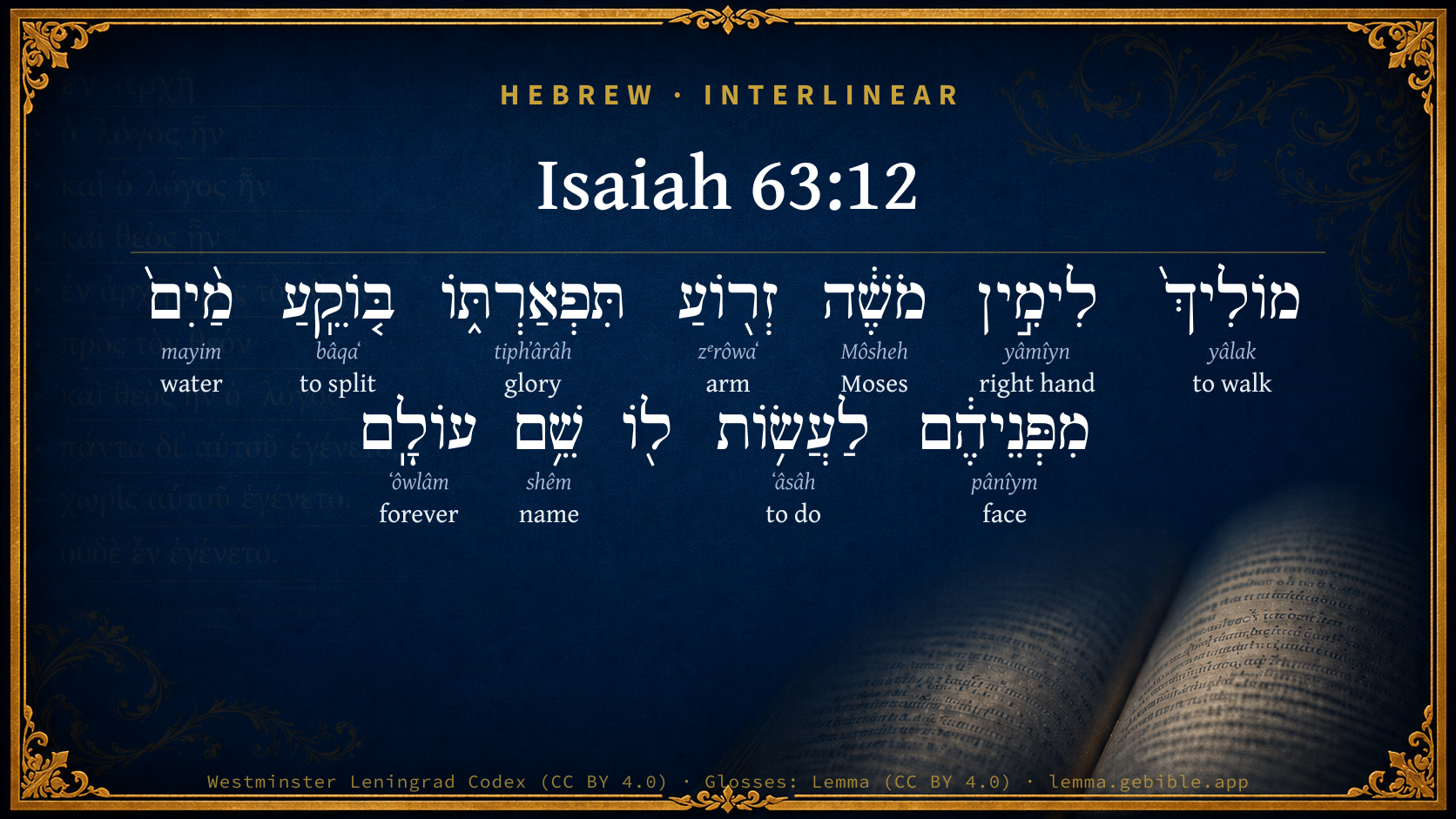
Isaiah 63:12

Hebrew (Westminster Leningrad Codex) Isaiah 63:12 appears in the Hebrew Old Testament. The text above is from the Westminster Leningrad Codex. Each word links to its Strong’s number, a concise gloss, and parsing drawn from the Open Scriptures Hebrew Bible morphology. Click any word for its full Brown-Driver-Briggs (BDB) entry.
Download image
Cite this verse

Isaiah 63:12 (World English Bible). Public Domain. Lemma interlinear Bible study tool, https://lemma.gebible.app/v/isaiah/63/12.

Show BibTeX & RIS
BibTeX
RIS
English Translation
who caused his glorious arm to go at the right hand of Moses? who divided the waters before them, to make himself an everlasting name?
World English Bible · Public Domain
Download a study sheet

One document with this verse’s original text, its word-by-word gloss line, the meaning frame, cross-references with their text, attributed commentary, and full source and license credits — printable, and it pastes into notes with its structure intact.

This verse Autodidact and up

Study sheet (.html) Plain text (.txt)

A passage Seminary Student

Up to 50 verses in one chapter. A passage sheet keeps up to 6 commentary sources and 12 cross-references per verse, in the order this page ranks them, and says so on the sheet whenever that leaves anything out. Ask for a single verse and you get the Autodidact verse sheet above.

Everything on this page stays free to read, with no account — the sheet is a download of what is already on screen, not access to it.

Want to remove ads? Support Godless Engineer
Compare translations 3

The same verse in 3 English versions, stacked beneath the original-language interlinear above. Click any original word for its lexicon entry.

Each is an independent rendering of the whole verse — the interlinear is not word-aligned to these translations.

Highlighted words mark where these versions differ — a whole-verse word diff, not a word-by-word alignment.

  • World English Bible Public Domain
    who caused his glorious arm to go at the right hand of Moses? who divided the waters before them, to make himself an everlasting name?
  • King James Version Public Domain
    That led them by the right hand of Moses with his glorious arm, dividing the water before them, to make himself an everlasting name?
  • unfoldingWord Literal Text CC BY-SA 4.0
    the one having made the arm of his splendor go to the right hand of Moses, the one having divided the waters from their faces, to make for himself name of eternity,

unfoldingWord Literal Text — © unfoldingWord, licensed CC BY-SA 4.0. Word-aligned USFM3 via Door43 (git.door43.org/unfoldingWord/en_ult).

Versions to compare (up to 4)

3 of 4 selected

Show all 18 translations

Every available English version of this verse, each an independent rendering of the whole verse.

  • World English Bible Public Domain
    who caused his glorious arm to go at the right hand of Moses? who divided the waters before them, to make himself an everlasting name?
  • Berean Standard Bible Public Domain
    who sent His glorious arm to lead them by the right hand of Moses, who divided the waters before them to gain for Himself everlasting renown,
  • Majority Standard Bible Public Domain
    who sent His glorious arm to lead them by the right hand of Moses, who divided the waters before them to gain for Himself everlasting renown,
  • King James Version Public Domain
    That led them by the right hand of Moses with his glorious arm, dividing the water before them, to make himself an everlasting name?
  • American Standard Version (1901) Public Domain
    that caused his glorious arm to go at the right hand of Moses? that divided the waters before them, to make himself an everlasting name?
  • Revised Version (1885) Public Domain
    that caused his glorious arm to go at the right hand of Moses? that divided the water before them, to make himself an everlasting name?
  • Geneva Bible (1599) Public Domain
    He led them by the right hand of Moses with his owne glorious arme, deuiding the water before them, to make himselfe an euerlasting Name.
  • Douay-Rheims (1899) Public Domain
    He that brought out Moses by the right hand, by the arm of his majesty: that divided the waters before them, to make himself an everlasting name.
  • Young's Literal Translation Public Domain
    Leading by the right hand of Moses, the arm of His glory, Cleaving waters from before them, To make to Himself a name age-during.
  • Literal Standard Version CC BY-SA 4.0
    Leading by the right hand of Moses, the arm of His glory, || Cleaving waters from before them, || To make to Himself a continuous Name.
  • Unlocked Literal Bible CC BY-SA 4.0
    Where is God, who made his glorious power go with the right hand of Moses, and divided the water before them, to make an everlasting name for himself?
  • unfoldingWord Literal Text CC BY-SA 4.0
    the one having made the arm of his splendor go to the right hand of Moses, the one having divided the waters from their faces, to make for himself name of eternity,
  • Darby Bible Public Domain
    his glorious arm leading them by the right hand of Moses, dividing the waters before them, to make himself an everlasting name,
  • World Messianic Bible Public Domain
    Who caused his glorious arm to be at Moses’ right hand? Who divided the waters before them, to make himself an everlasting name?
  • Webster's Bible Public Domain
    That led them by the right hand of Moses with his glorious arm, dividing the water before them, to make himself an everlasting name?
  • Free Bible Version CC BY-SA 4.0
    Where is the one who lifted Moses' right hand, and who used his amazing power to divide the sea in front of them, giving him such a wonderful, enduring reputation?
  • Bible in Basic English Public Domain
    He who made the arm of his glory go at the right hand of Moses, by whom the waters were parted before them, to make himself an eternal name;
  • JPS Tanakh (1917) Public Domain
    That caused His glorious arm to go at the right hand of Moses? That divided the water before them, to make Himself an everlasting name?

Literal Standard Version (2020), Covenant Press — licensed CC BY-SA 4.0. Text via the HelloAO Bible API (eBible.org). Unlocked Literal Bible (unfoldingWord) — licensed CC BY-SA 4.0. Text via the HelloAO Bible API (eBible.org). unfoldingWord Literal Text — © unfoldingWord, licensed CC BY-SA 4.0. Word-aligned USFM3 via Door43 (git.door43.org/unfoldingWord/en_ult). Free Bible Version, Dr. Jonathan Gallagher — licensed CC BY-SA 4.0. Text via the HelloAO Bible API (eBible.org).

Word by word

More ways to search: Search by grammar → Find every occurrence → Compare this word →

Practice this passage: Drill this verse → Learn its vocabulary →

תִּפְאַרְתּ֑וֹ
tiphʼârâh
H8597
“glory · his”
Noun, Common, Feminine, Singular, Construct + Suffix, Personal, 3rd Person, Masculine, Singular
Part of Speech
Noun
Type
Common
Gender
Feminine
Number
Singular
State
Construct
Full BDB Definition

Origin: from H6286

TWOT: 1726b

beauty, splendour, glory - beauty, finery (of garments, jewels) - glory - of rank, renown - as attribute of God - honour (or nation Israel) - glorying, boasting (of individual)
  1. מוֹלִיךְ֙ yâlak H3212 “walking” Verb, Hiphil, Participle Active, Masculine, Singular, Absolute
  2. לִימִ֣ין yâmîyn H3225 “to/for · right hand of” Preposition + Noun, Common, Feminine, Singular, Construct
  3. מֹשֶׁ֔ה Môsheh H4872 “Moses” Noun, Proper
  4. זְר֖וֹעַ zᵉrôwaʻ H2220 “arm of” Noun, Common, Both, Singular, Construct
  5. בּ֤וֹקֵֽעַ bâqaʻ H1234 “splitting” Verb, Qal, Participle Active, Masculine, Singular, Absolute
  6. מַ֨יִם֙ mayim H4325 “water(s)” Noun, Common, Masculine, Plural, Absolute
  7. מִפְּנֵיהֶ֔ם pânîym H6440 “from · face(s) · their” Preposition + Noun, Common, Both, Plural, Construct + Suffix, Personal, 3rd Person, Masculine, Plural
  8. לַעֲשׂ֥וֹת ʻâsâh H6213 “to do” Preposition + Verb, Qal, Infinitive Construct
  9. שֵׁ֥ם shêm H8034 “name of” Noun, Common, Masculine, Singular, Construct
  10. עוֹלָֽם ʻôwlâm H5769 “forever” Noun, Common, Masculine, Singular, Absolute

About this verse

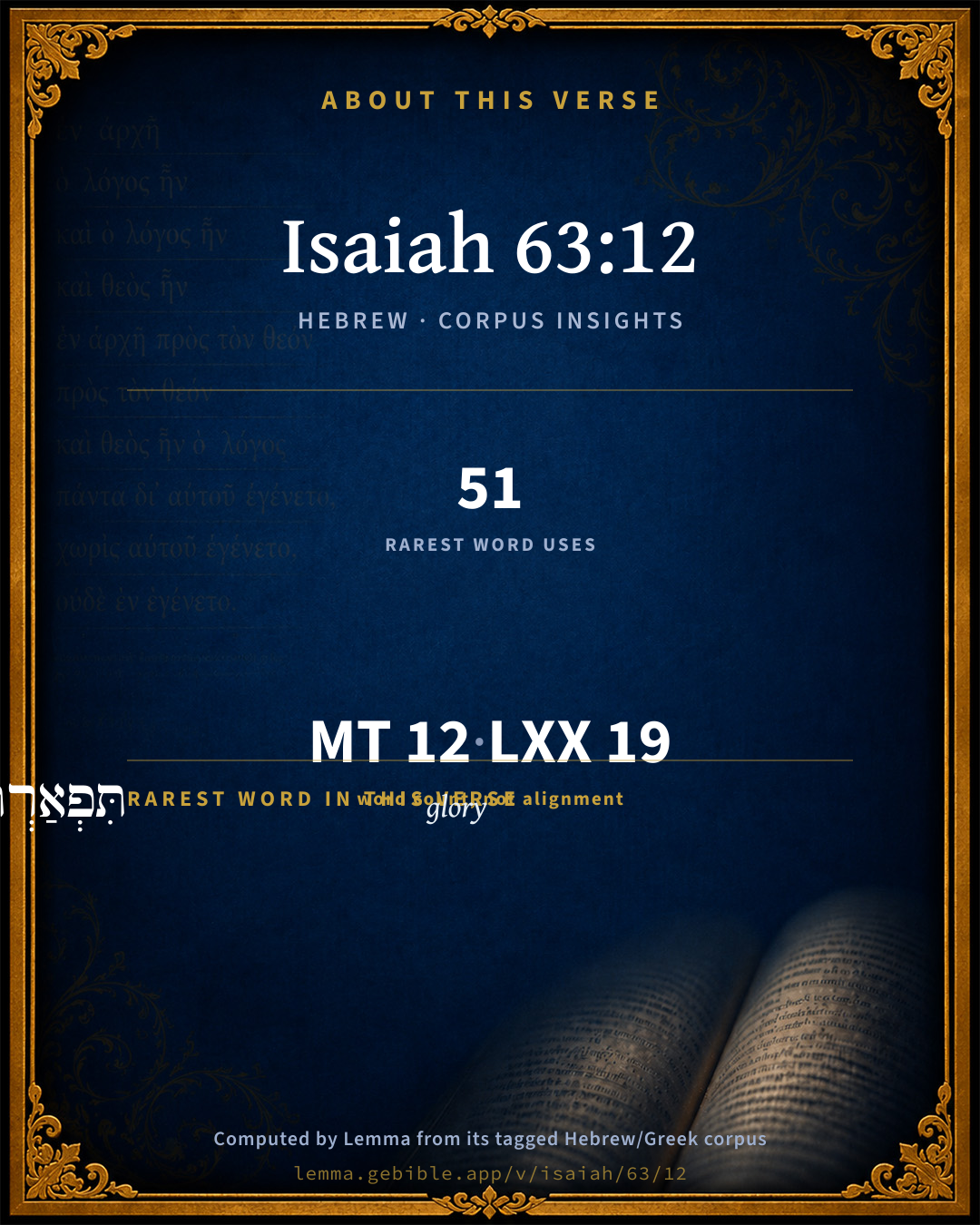
These counts appear in no published source. They are computed here, from the morphology-tagged text and Lemma’s own curated glosses. What Lemma adds →

12
words
11
distinct lemmas
Prophets
section

Shared distinctive vocabulary

תִּפְאַרְתּ֑וֹ glory H8597 occurs in 50 verses of the Hebrew Bible. Also found in:

Grammatical profile

  • 3 verbs
  • 8 nouns
  • 1 preposition

Verb forms

  • מוֹלִיךְ֙ Hiphil · Participle Active
  • בּ֤וֹקֵֽעַ Qal · Participle Active
  • לַעֲשׂ֥וֹת Qal · Infinitive Construct

Hebrew & Septuagint length

In English translation the verse runs 25 words from the Hebrew and 27 from the Septuagint (LXX English) — closely comparable.

A rough comparison of the two English renderings, which tokenize alike — not a word-level alignment.

Word counts can differ between the Hebrew and the Greek without any difference in meaning — e.g. the Hebrew direct-object marker אֵת has no separate Greek word, and Greek often adds the article ὁ.

In the original languages it is 12 Hebrew tokens and 19 Greek tokens — but the two are counted differently (Hebrew bundles its prefixes and suffixes into one token; the Greek is in lemma form), so that isn’t a like-for-like length.

Cross-references

14

Topical passages linked to Isaiah 63:12 in the Treasury of Scripture Knowledge — connected by theme and wording, ordered by reader-vote popularity; previews shown in the World English Bible.

  • Exodus 15:16 Terror and dread falls on them. By the greatness of your arm they are as still as a stone; Until your people pass over, Yahweh, Until the people pass over who you have purchased.
  • Joshua 3:16 that the waters which came down from above stood, and rose up in one heap, a great way off, at Adam, the city that is beside Zarethan; and those that went down toward the sea of the Arabah, even the Salt Sea, were wholly cut off: and the people passed over right against Jericho.
  • Psalms 78:13 He split the sea, and caused them to pass through; He made the waters stand as a heap.
  • Exodus 14:16–17 Lift up your rod, and stretch out your hand over the sea, and divide it: and the children of Israel shall go into the midst of the sea on dry ground.
  • Exodus 14:21–22 Moses stretched out his hand over the sea, and Yahweh caused the sea to go back by a strong east wind all the night, and made the sea dry land, and the waters were divided.
  • Nehemiah 9:11 You divided the sea before them, so that they went through the midst of the sea on the dry land; and their pursuers you did cast into the depths, as a stone into the mighty waters.
  • Psalms 80:1 Hear us, Shepherd of Israel, You who lead Joseph like a flock, You who sit above the cherubim, shine forth.
  • Psalms 114:5–7 What was it, you sea, that you fled? You Jordan, that you turned back?
  • Isaiah 55:13 Instead of the thorn shall come up the fir tree; and instead of the brier shall come up the myrtle tree: and it shall be to Yahweh for a name, for an everlasting sign that shall not be cut off.
  • Exodus 15:6 Your right hand, Yahweh, is glorious in power, Your right hand, Yahweh, dashes the enemy in pieces.
  • Exodus 15:13 "You, in your loving kindness, have led the people that you have redeemed. You have guided them in your strength to your holy habitation.
  • Psalms 136:13–16 To him who divided the Red Sea apart; For his loving kindness endures forever;
  • Isaiah 11:15 Yahweh will utterly destroy the tongue of the Egyptian sea; and with his scorching wind will he wave his hand over the River, and will strike it into seven streams, and cause men to march over in sandals.
  • Romans 9:17 For the Scripture says to Pharaoh, "For this very purpose I caused you to be raised up, that I might show in you my power, and that my name might be published abroad in all the earth."

Cross-references courtesy of OpenBible.info (CC BY 4.0).

Hebrew and Greek witnesses Masoretic Hebrew ↔ Greek Septuagint

The same verse in the two great witnesses to the Old Testament, shown verse-for-verse.

These are two independent witnesses, not word-aligned to each other, and the Septuagint is shown in lemma (dictionary) form.

Hebrew Isaiah 63:12 Masoretic · Westminster Leningrad Codex

מוֹלִיךְ֙ לִימִ֣ין מֹשֶׁ֔ה זְר֖וֹעַ תִּפְאַרְתּ֑וֹ בּ֤וֹקֵֽעַ מַ֨יִם֙ מִפְּנֵיהֶ֔ם לַעֲשׂ֥וֹת ל֖וֹ שֵׁ֥ם עוֹלָֽם

who caused his glorious arm to go at the right hand of Moses? who divided the waters before them, to make himself an everlasting name?

World English Bible · Public Domain

Greek LXX Isaiah 63:12 Septuagint · lemma form

ὁ ἄγω ὁ δεξιός μωυσῆς ὁ βραχίων ὁ δόξα αὐτός καταἰσχύω ὕδωρ ἀπό πρόσωπον αὐτός ποιέω αὐτός ὄνομα αἰώνιος

who led Moses with his right hand, the arm of his glory? he forced the water to separate from before him, to make himself an everlasting name.

LXX2012 (modern English Septuagint) · Public Domain

Hebrew: Westminster Leningrad Codex (CC BY 4.0). Greek: Septuagint (public domain); English from LXX2012 (modern English Septuagint) (Public Domain). How the Septuagint differs from the Hebrew →

Targum (Aramaic paraphrase)

1

The Targum is the ancient Jewish Aramaic paraphrase of the Hebrew Scriptures — an interpretive translation, not the Hebrew text itself. Onkelos (literal) and Pseudo-Jonathan (expansive) render the Torah, and Jonathan the Prophets. Coverage is partial: where no permissively-licensed English translation exists for a verse, only the Aramaic is shown. This is verse-level text, not a word-by-word alignment to the Hebrew.

  1. Targum Jonathan Prophets (Joshua–Malachi)
    דַבֵּר לְיַמִינָא דְמֹשֶׁה דְרַע תּוּשְׁבַּחְתֵּהּ בְּזַע מֵי יַמָא דְסוּף מִן קֳדָמֵיהוֹן לְמֶעְבַּד לֵיהּ שׁוּם עֲלָם:

    That led them by the right hand of Moses, the arm of His glory, dividing the waters of the Red Sea before them, to make Himself an everlasting name?

    Targum Jonathan — Aramaic: “Mikraot Gedolot” (public domain). English: “Sefaria Community Translation” (CC0 1.0 (public-domain dedication)); “London "Chaldee Paraphrase," 1871” (public domain). Text via Sefaria.

Commentary

Notes on Isaiah 63:12 from classic Christian and Jewish commentators (each source and its license shown beneath its notes). The classic Christian expositions comment on the surrounding passage and are grouped to its opening verse, so a note may address several verses; the Jewish commentaries on the Tanakh (Rashi and others) are per-verse, so they appear only where the commentator wrote on this verse.

Lemma curates 59 commentaries, every one of them public domain or Creative Commons licensed, each selected and text-cleaned for this edition rather than reprinted as found. About our sources →

Trapp's Complete Commentary

John Trapp

Isa 63:12 That led [them] by the right hand of Moses with his glorious arm, dividing the water before them, to make himself an everlasting name?

Ver. 12. That led them by the right hand of Moses with his glorious arm.] Or, That made his gallant arm to go at Moses’ right hand.

Dividing the water before them.] So that pseudo Moses - the devil likely - made many overly credulous Jews of Crete believe that he would do for them whom he beguiled into the midst of the sea, to their destruction, 434 AD. {a} Some are of the opinion that this affectionate prayer was purposely penned by the prophet, for the use of those poor Jews, who, after the coming of Christ, and manifestation of the gospel, should see themselves to be rejected by God and his Church, and should now beg to be owned again; Cui sane instituto omnia, magis quam dici queat, conveniunt, saith Hyperius; the ensuing petitions suit very much.

{a} Funccius.

John Trapp, A Commentary or Exposition upon All the Books of the Old and New Testament (1647–1656) — public domain. Text from a community e-Sword module.

The Biblical Illustrator

Joseph S. Exell

Isa_63:12

That led them

God and His people

I.

GOD LEADS HIS PEOPLE BY INSTRUMENTS WHICH HE CHOOSES AND QUALIFIES,

II. HE DEFENDS THEM WITH THE ARM OF HIS POWER.

III. HE REMOVES EVERY DIFFICULTY THAT INTERCEPTS THEIR COURSE.

IV. HE GLORIFIES HIS OWN NAME IN THEIR DELIVERANCE. (J. Lyth, D. D.)

To make Himself an everlasting name

Gods glorious and everlasting name

(with Isa_63:14 : to make Thyself a glorious name ):--Manschief end is to glorify and enjoy God. Gods greatest and highest object is to make to Himself a glorious and an everlasting name. Since God is God it must be so: for He is full of love and kindness to His creatures, and He cannot more fully bless His creatures than by making Himself known to them. Everything that is good, true, holy, excellent, loving, is in God. God may well desire to make to Himself a name--that is to say, to make Himself known--because He is worthy to be known. This knowledge of God is the heaven of the perfect. It is the help of the growing. Men can only get holier and better as they know more of God. It is also the great hope of sinners. If you knew Him better, you would fly to Him. If you understood how gracious He is, you would seek Him. If you could have any idea of His holiness, you would loathe your self-righteousness. If you knew anything of His power, you would not venture to contend with Him. If you knew anything of His grace, you would not hesitate to yield yourself to Him.

I. GODS DESIGN HAS BEEN ACCOMPLISHED. From everlasting He was God most glorious; He existed, but He had as yet no name. For a name is that by which any one is revealed, and until His power called into being the hosts of heaven, God was God alone, and there were none to whom He could be known. Then the angels lifted high His praise in their songs, and bowed low before His throne. In creation His name was manifested and magnified. But our subject is how God has made His name glorious amongst men.

1. The text speaks of God as making to Himself a great and glorious name, in redeeming Israel.

2. As God got to Himself a great name at the Red Sea, He has done much more by the great work of salvation in the gift of Jesus.

3. HIS design has been accomplished in the saints in glory.

II. GODS DESIGN IS BEING ACCOMPLISHED. In many ways the grand work is still going forward. God is carrying out His gracious plan. This purpose is being fulfilled--

1. In sparing the provoking.

2. In turning the rebellious to Himself.

3. In forgiving the guilty.

4. In purifying the unholy.

5. In preserving the tempted.

6. In using weak instruments.

7. In doing great things for His people by sending very wonderful seasons of refreshing and reviving to His Church.

III. GODS DESIGN IS VERY DELIGHTFUL.

1. Because it hides pride from men.

2. Because it opens a great door for sinners.

3. Because it gives comfort to strugglers.

4. Because it sustains in trying times.

5. Because it answers our chiefest prayers. Hallowed be Thy name, etc. (C. H Spurgeon.)

The Biblical Illustrator, edited by Joseph S. Exell (c. 1880s–1900s) — public domain. Text from a community e-Sword module.

Jamieson, Fausset & Brown

Robert Jamieson, A. R. Fausset & David Brown

The right hand of Moses was but the instrument; the arm of God was the real mover (Exo 15:6; Exo 14:21).

dividing the water-- (Neh 9:11; Psa 78:13).

Jamieson, Fausset & Brown — Commentary Critical and Explanatory on the Whole Bible (1871) — public domain (CC PDM 1.0). Text via the HelloAO Bible API.

Ellicott's Commentary for English Readers

(12) With his glorious arm.—Literally, with the arm of His glory, or majesty. This, the arm of the Unseen Guide, is thought of as accompanying the leader of Israel, ready to grasp his hand and support him in time of need.

Dividing the water.—The words may include the passage of the Jordan, but refer primarily to that of the Red Sea. (Comp. Psa_77:16; Psa_106:9.)

A Bible Commentary for English Readers, edited by Charles John Ellicott (1878–1897) — public domain. Text from a community e-Sword module.

The Cambridge Bible for Schools and Colleges

gen. ed. J. J. S. Perowne

12. Render with R.V. That caused his glorious arm to go at the right hand of Moses &c.; accompanying him with its wonder-working power symbolized by the “rod of God” (Exo_17:9). The reference in the latter part of the verse is not, as some have thought, to the bringing forth of water from the rock (ch. Isa_48:21; Exo_17:1-7) but to the passage of the Red Sea.

The Cambridge Bible for Schools and Colleges (gen. ed. J. J. S. Perowne; Cambridge University Press, 1878–1918) — public domain. Text from a community e-Sword module.

John Gill's Exposition

That led them by the right hand of Moses with his glorious arm,.... That is, through the Red sea, as the next clause shows: this was done by the right hand of Moses, and the rod in it, to which Kimchi thinks respect is had; who, by divine order, lifted up his rod, and stretched out his hand over the sea, and divided it, and so led the people through it: but, lest this should be attributed to Moses and his rod, the glorious arm of the Lord is made mention of, which held and guided the right hand of Moses, and from whence came all that power that was exerted on this occasion. Aben Ezra interprets this of the Angel of the Lord, that went before them: it seems to design the arm of omnipotence, which was gloriously displayed, Exo 15:6,

dividing the water before them; the waters of the sea, so that they rose up as a wall on each side them, through which they passed as on dry land: to make himself an everlasting name? or to get himself everlasting honour and glory, as he did on Pharaoh, his chariots, and his horsemen, Exo 14:17 and which wonderful action of his has been and ever will be spoken of to the glory of his name, which was the end he had in view.

John Gill's Exposition of the Whole Bible (1746–1763) — public domain (CC PDM 1.0). Text via the HelloAO Bible API.

Albert Barnes' Notes on the Bible

That led them by the right hand of Moses - (See the notes at Isa 41:10-13; Isa 45:1).

Dividing the water before them - Exo 14:21.

To make himself an everlasting name - He designed to perform a work which, it would be seen, could not be performed by any false god or by any human arm, and to do it in such circumstances, and in such a manner, that it might be seen everywhere that this was the true God (compare the notes at Isa 45:6). The deliverance from Egypt was attended with such amazing miracles, and with such a sudden destruction of his foes, that none but the true God could have performed it. Egypt was at that time the center of all the science, civilization, and art known among mankind; and what occurred there would be known to other lands. God, therefore, in this signal manner, designed to make a public demonstration of his existence and power that shall be known in all lands, and that should never be forgotten.

Albert Barnes' Notes on the Bible (1834–1885) — public domain. Text from a community e-Sword/MySword module.

Matthew Poole's English Annotations

The right land, viz. the strength and power that God gave to Moses, expressed by the right hand, that being usually esteemed the stronger, Psa 16:8; 20:6. Or, the rod in his right hand; by which understand also all the wonders that he did for them in Egypt.

With his glorious arm; or that arm wherewith God gained to himself so much glory, being always present at the assistance of Moses, Deu 4:34; or Moses’s right hand, led by God’s glorious arm, as parents lead their children, that God may have all the glory in the using of his instruments.

Dividing the water; the Red Sea, Exo 14:21, and also Jordan, Jos 3:15,16. To make himself an everlasting name; with reference both to his power and providence, as respecting either his aim and end in doing what he did, or the effect of it when it was done, it got him renown.

Matthew Poole's English Annotations on the Holy Bible (1683–1685) — public domain. Text from a community e-Sword/MySword module.

The Pulpit Commentary

That led them by the right hand of Moses with his glorious arm; rather, that caused his glorious arm to attend at Moses" right hand ready (as Dr. Weir says) to grasp him if he should stumble. Dividing the water before them; literally, cleaving the waters before their face. (comp. Exo_14:21) To make himself an everlasting name. (see Exo_15:11-16) It was one of the main purposes of the entire series of miracles wrought in Egypt, "that God"s Name might be declared throughout all the earth". (Exo_9:16)

Vers. 12-14. The Spirit of God in Moses.

"Where is he that put his Holy Spirit in the midst of them?" The shepherds of the flock are Moses, Aaron, and Miriam; but the chief reference must be to Moses. "God gave Moses his Holy. Spirit, and with him the gift of performing miracles, and leading and teaching the people." The images of these verses may be thus explained. "One might suppose that Israel would have trodden with trembling, uncertain steps, the strange way over the bottom of the sea on which human foot was never set. But it was not so. Rapidly and surely, as the desert horse goes over the flat smooth desert without tottering, so did they march over that strange, perilous road. The image of the cattle descending into the valley is very appropriate for marking the arrival of the Israelites in the promised land after journeying in the desert. The prophet thinks of the herds of nomads that must cross a mountain range or plateau in order to reach regions rich in pasture." The point to which attention may be profitably directed is, that we usually fix our thoughts on the outward revelations given to Moses, and the actual material things which he was required and strengthened to do. And yet there is a secret mystery in Moses which is full of suggestion for us, and makes him a model for us of the Divine dealings with us also. God was in Moses, dwelling in him by his Spirit, the impulse and inspiration of all good, true, wise, and loving things. We may, therefore, illustrate from Moses

I THE SPIRIT OF GOD FOR US; OUR GUARANTEE OF SAFETY.

II THE SPIRIT OF GOD WITH US; OUR CONFIDENCE OF SUFFICIENCY,

III THE SPIRIT OF GOD IN US; OUR INSPIRATION TO ALL GOODNESS.

As materials of illustration the following emblems of the Spirit may be helpful Water: cleansing, fertilizing, refreshing, abundant, freely given. Fire: purifying, illuminating, searching. Wind: independent, powerful, sensible in its effects, reviving. Oil: healing, comforting, illuminating, consecrating. Rain and dew: fertilizing, refreshing, abundant, imperceptible, penetrating. A dove: gentle, meek, innocent, forgiving. A voice: speaking, guiding, warning, teaching. A seal: impressing, securing, authenticating. R.T.

The Pulpit Commentary (1880–1919), ed. H.D.M. Spence-Jones & Joseph S. Exell — public domain. Text from a community e-Sword module.

J. A. Alexander on Isaiah

Joseph Addison Alexander

“Leading them by the right hand of Moses (and) his glorious arm, cleaving the waters from before them, to make for Him an everlasting name?” The sentence and the interrogation are continued from the foregoing verse. The participle with the article there defines or designates the subject as the one bringing up; the participle here without the article simply continues the description. The right hand may be mentioned in allusion to the wielding of the rod by Moses, and the glorious arm may be either his or that of God Himself, which last sense is expressed in the English version by a change of preposition (by the right hand of Moses with his glorious arm). The same ambiguity exists in the last clause, where the everlasting name may be the honor put upon Moses or the glory which redounded to Jehovah Himself, as in Isa 55:13.

Joseph Addison Alexander, The Prophecies of Isaiah (1846–1847; New York: Scribner, 1870–1878) — public domain. Text from a community e-Sword module.

unfoldingWord translationNotes

Door43 World Missions Community

General Information:

The people of Israel continue speaking.

who made his glorious power go with the right hand of Moses

Here "right hand" represents the power of Yahweh through Moses. This means it was God's power that enabled Moses to divide the water of the Reed Sea. (See: Metonymy)

Like a horse running on flat land, they did not stumble

This means that the people of Israel were sure-footed as horses in open country on their travels toward Israel from Egypt. (See: Simile)

translationWords

glory

right hand

eternity

name

water

horse

unfoldingWord translationNotes — © Distant Shores Media and the Door43 World Missions Community, licensed CC BY-SA 4.0. Source: git.door43.org/Door43/en_tn.

Rashi

Rabbi Shlomo Yitzchaki (Rashi)

He led at Moses’ right the arm of His glory The Holy One, blessed be He, led at Moses’ right the arm of His might. Every time he required the aid of the Holy One, blessed be He, His arm was ready at his right.

Rashi on the Tanakh — English translations: “The Judaica Press complete Tanach with Rashi, translated by A. J. Rosenberg” (CC BY 4.0); “Pentateuch with Rashi's commentary by M. Rosenbaum and A.M. Silbermann, 1929-1934” (public domain); “The Metsudah Tanach series, Lakewood, N.J” (CC BY 4.0); and “The Book of Joshua, Metsudah Publications, 1997” (CC BY 4.0). Text via Sefaria.

Ibn Ezra

Rabbi Abraham ibn Ezra

His glorious arm: His angel, that went before the camp of Israel (Ex. 14:19)

Ibn Ezra on the Tanakh — English translations: “Sefaria Community Translation” (CC0 1.0 (public-domain dedication)); “Yalkut, Sifsei Chachomim Chumash, Metsudah Publications, 2009” (CC BY 4.0); and “Commentary of Ibn Ezra on Isaiah - trans. by M. Friedlander, 1873” (public domain). Text via Sefaria.

Lesson kit

Teaching starters — assembled from the data on this page, not authored interpretation. Every prompt links to the verse data it draws on. Edit before teaching.

Isaiah, in the Prophets, opens this verse with 12 words (11 distinct Hebrew lemmas). Its most distinctive word is tiphʼârâh (“glory”). A historical commentator’s framing appears above. Read the whole chapter for the surrounding context.

Discussion questions

  1. The word tiphʼârâh carries the sense “glory.” How does it shape the verse?
  2. How does Exodus 28:2, which shares the word «glory», read alongside this verse?
  3. These translations render this verse differently; the difference is in the English rendering, not the original. What questions does that raise?
  4. «מוֹלִיךְ֙» is a Hiphil Participle Active verb. How does that grammatical form shape the action described?
  5. Compare how Trapp's Complete Commentary and The Biblical Illustrator read this verse. Where do they agree or differ?

Things to notice

Reading settings

Reading text

Shown beneath each verse's original-language words.

Old Testament
Old Testament edition

Read the OT as the Masoretic Hebrew (MT) or the Greek Septuagint (LXX).

English shown for the Greek Septuagint (in the Hebrew ↔ Greek comparison).

Comparing translations? Open the Compare panel on any verse page to stack up to four side by side.