
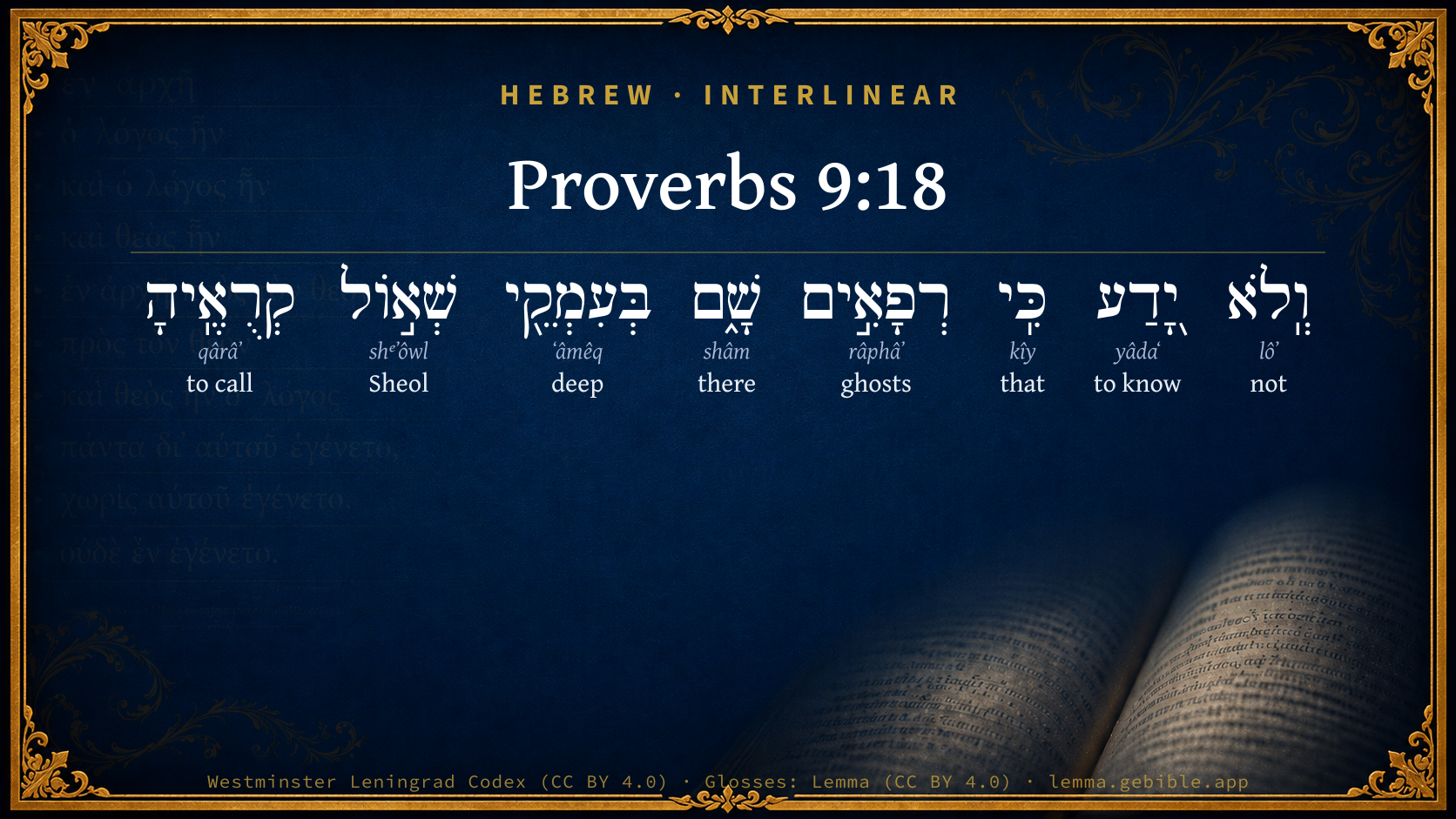
Proverbs 9:18

Hebrew (Westminster Leningrad Codex) Proverbs 9:18 appears in the Hebrew Old Testament. The text above is from the Westminster Leningrad Codex. Each word links to its Strong’s number, a concise gloss, and parsing drawn from the Open Scriptures Hebrew Bible morphology. Click any word for its full Brown-Driver-Briggs (BDB) entry.
Download image
Cite this verse

Proverbs 9:18 (World English Bible). Public Domain. Lemma interlinear Bible study tool, https://lemma.gebible.app/v/proverbs/9/18.

Show BibTeX & RIS
BibTeX
RIS
English Translation
But he doesn't know that the dead are there, That her guests are in the depths of Sheol.
World English Bible · Public Domain
Highlights Full analysis ↓
Download a study sheet

One document with this verse’s original text, its word-by-word gloss line, the meaning frame, cross-references with their text, attributed commentary, and full source and license credits — printable, and it pastes into notes with its structure intact.

This verse Autodidact and up

Study sheet (.html) Plain text (.txt)

A passage Seminary Student

Up to 50 verses in one chapter. A passage sheet keeps up to 6 commentary sources and 12 cross-references per verse, in the order this page ranks them, and says so on the sheet whenever that leaves anything out. Ask for a single verse and you get the Autodidact verse sheet above.

Everything on this page stays free to read, with no account — the sheet is a download of what is already on screen, not access to it.

Want to remove ads? Support Godless Engineer
Compare translations 3

The same verse in 3 English versions, stacked beneath the original-language interlinear above. Click any original word for its lexicon entry.

Each is an independent rendering of the whole verse — the interlinear is not word-aligned to these translations.

Highlighted words mark where these versions differ — a whole-verse word diff, not a word-by-word alignment.

  • World English Bible Public Domain
    But he doesn't know that the dead are there, That her guests are in the depths of Sheol.
  • King James Version Public Domain
    But he knoweth not that the dead are there; and that her guests are in the depths of hell.
  • unfoldingWord Literal Text CC BY-SA 4.0
    But he does not know that the spirits of the dead there; in the depths of Sheol her called ones.

unfoldingWord Literal Text — © unfoldingWord, licensed CC BY-SA 4.0. Word-aligned USFM3 via Door43 (git.door43.org/unfoldingWord/en_ult).

Versions to compare (up to 4)

3 of 4 selected

Show all 18 translations

Every available English version of this verse, each an independent rendering of the whole verse.

  • World English Bible Public Domain
    But he doesn't know that the dead are there, That her guests are in the depths of Sheol.
  • Berean Standard Bible Public Domain
    But they do not know that the dead are there, that her guests are in the depths of Sheol.
  • Majority Standard Bible Public Domain
    But they do not know that the dead are there, that her guests are in the depths of Sheol.
  • King James Version Public Domain
    But he knoweth not that the dead are there; and that her guests are in the depths of hell.
  • American Standard Version (1901) Public Domain
    But he knoweth not that the dead are there; That her guests are in the depths of Sheol.
  • Revised Version (1885) Public Domain
    But he knoweth not that the dead are there; that her guests are in the depths of Sheol.
  • Geneva Bible (1599) Public Domain
    But he knoweth not, that ye dead are there, and that her ghestes are in the depth of hell.
  • Douay-Rheims (1899) Public Domain
    And he did not know that giants are there, and that her guests are in the depths of hell. The Parables of Solomon
  • Young's Literal Translation Public Domain
    And he hath not known that Rephaim `are' there, In deep places of Sheol her invited ones!
  • Literal Standard Version CC BY-SA 4.0
    And he has not known that Rephaim [are] there, || Her invited ones in deep places of Sheol!
  • Unlocked Literal Bible CC BY-SA 4.0
    But he does not know that the dead are there, that her invited guests are in the depths of Sheol.
  • unfoldingWord Literal Text CC BY-SA 4.0
    But he does not know that the spirits of the dead there; in the depths of Sheol her called ones.
  • Darby Bible Public Domain
    But he knoweth not that the dead are there; [that] her guests are in the depths of Sheol.
  • World Messianic Bible Public Domain
    But he doesn’t know that the departed spirits are there, that her guests are in the depths of Sheol.
  • Webster's Bible Public Domain
    But he knoweth not that the dead are there; and that her guests are in the depths of hell.
  • Free Bible Version CC BY-SA 4.0
    But they don't know that the dead are there, that those she's invited are in the depths of the grave.
  • Bible in Basic English Public Domain
    But he does not see that the dead are there, that her guests are in the deep places of the underworld.
  • JPS Tanakh (1917) Public Domain
    But he knoweth not that the shades are there; that her guests are in the depths of the nether-world.

Literal Standard Version (2020), Covenant Press — licensed CC BY-SA 4.0. Text via the HelloAO Bible API (eBible.org). Unlocked Literal Bible (unfoldingWord) — licensed CC BY-SA 4.0. Text via the HelloAO Bible API (eBible.org). unfoldingWord Literal Text — © unfoldingWord, licensed CC BY-SA 4.0. Word-aligned USFM3 via Door43 (git.door43.org/unfoldingWord/en_ult). Free Bible Version, Dr. Jonathan Gallagher — licensed CC BY-SA 4.0. Text via the HelloAO Bible API (eBible.org).

Word by word

More ways to search: Search by grammar → Find every occurrence → Compare this word →

Practice this passage: Drill this verse → Learn its vocabulary →

About this verse

These counts appear in no published source. They are computed here, from the morphology-tagged text and Lemma’s own curated glosses. What Lemma adds →

8
words
8
distinct lemmas
Wisdom
section

Notable vocabulary

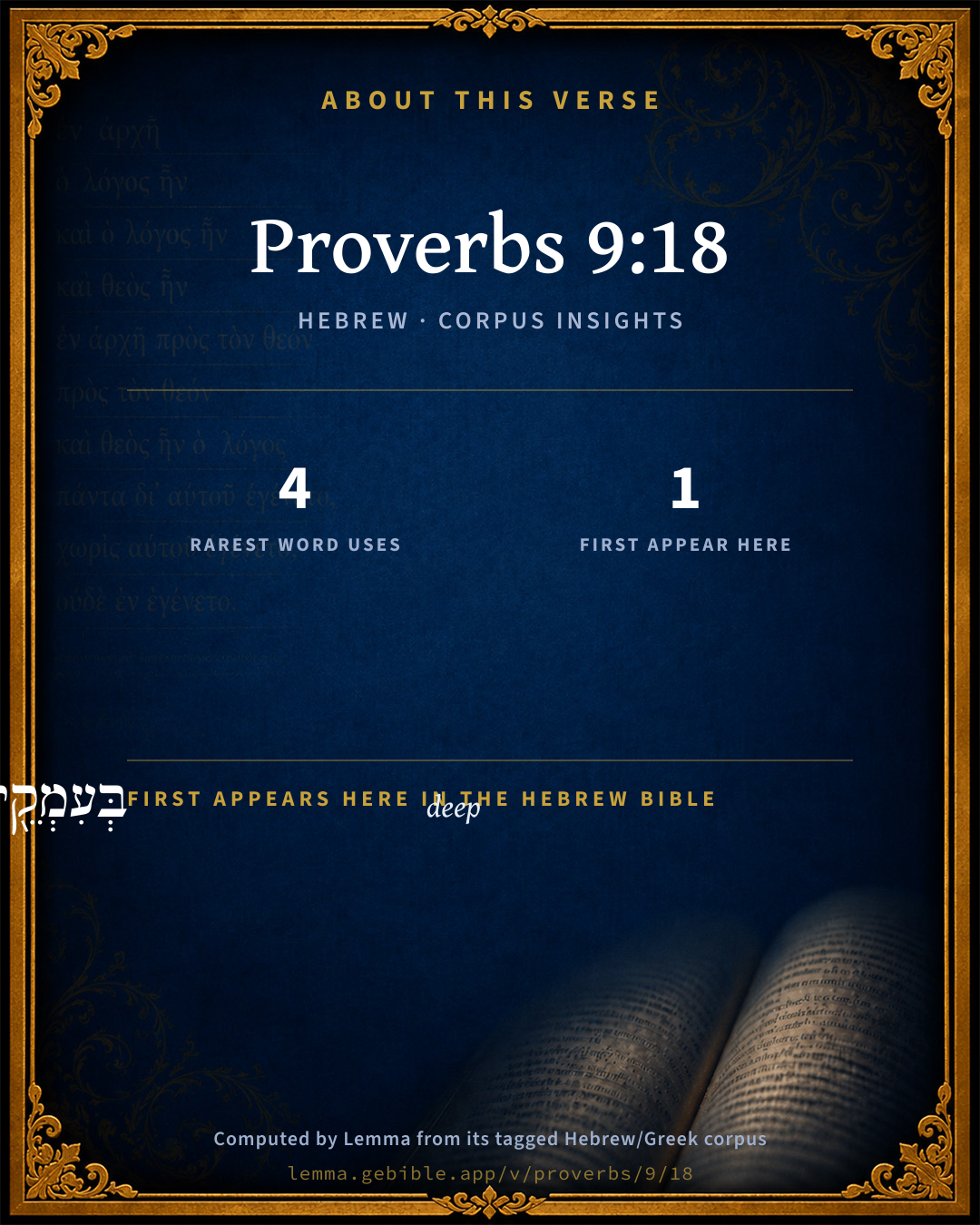
The rarest word here is בְּעִמְקֵ֖י deep H6012 — appearing just 4 times in the whole Hebrew Bible.

First appearance in Scripture

This word makes its first canonical appearance in the Hebrew Bible here:

  • בְּעִמְקֵ֖י deep H6012

Shared distinctive vocabulary

בְּעִמְקֵ֖י deep H6012 occurs in 4 verses of the Hebrew Bible. Also found in:

Grammatical profile

  • 2 verbs
  • 3 nouns
  • 1 conjunction
  • 1 adverb
  • 1 particle

Verb forms

  • יָ֭דַע Qal · Perfect
  • קְרֻאֶֽיהָ Qal · Participle Passive

Hebrew & Septuagint length

In English translation the verse runs 18 words from the Hebrew and 68 from the Septuagint (LXX English) — the Septuagint runs noticeably longer here. See the side-by-side →

A rough comparison of the two English renderings, which tokenize alike — not a word-level alignment.

Word counts can differ between the Hebrew and the Greek without any difference in meaning — e.g. the Hebrew direct-object marker אֵת has no separate Greek word, and Greek often adds the article ὁ.

Cross-references

6

Topical passages linked to Proverbs 9:18 in the Treasury of Scripture Knowledge — connected by theme and wording, ordered by reader-vote popularity; previews shown in the World English Bible.

  • Proverbs 7:27 Her house is the way to Sheol, Going down to the chambers of death.
  • Proverbs 2:18–19 For her house leads down to death, Her paths to the dead.
  • Proverbs 5:5 Her feet go down to death. Her steps lead straight to Sheol.
  • Psalms 82:5 They don't know, neither do they understand. They walk back and forth in darkness. All the foundations of the earth are shaken.
  • Proverbs 1:7 The fear of Yahweh is the beginning of knowledge; But the foolish despise wisdom and instruction.
  • Proverbs 6:26 For a prostitute reduces you to a piece of bread. The adulteress hunts for your precious life.

Cross-references courtesy of OpenBible.info (CC BY 4.0).

Hebrew and Greek witnesses Masoretic Hebrew ↔ Greek Septuagint

The same verse in the two great witnesses to the Old Testament, shown verse-for-verse.

Here the Septuagint runs noticeably longer than the Hebrew — LXX2012 (modern English Septuagint) 68 words vs World English Bible 18. A rough length comparison of the two English translations, not a word-level alignment — read both below.

These are two independent witnesses, not word-aligned to each other, and the Septuagint is shown in lemma (dictionary) form.

Hebrew Proverbs 9:18 Masoretic · Westminster Leningrad Codex

וְֽלֹא יָ֭דַע כִּֽי רְפָאִ֣ים שָׁ֑ם בְּעִמְקֵ֖י שְׁא֣וֹל קְרֻאֶֽיהָ

But he doesn't know that the dead are there, That her guests are in the depths of Sheol.

World English Bible · Public Domain

Greek LXX Proverbs 9:18 Septuagint · lemma form

ὁ δέ οὐ οἶδα ὅτι γηγενής παρά αὐτός ὄλλυμι καί ἐπί πέταυρον ᾅδης συνἀντάω ἀλλά ἀποπηδάω μή ἐνχρονίζω ἐν ὁ τόπος μηδέ ἐπιἵστημι ὁ σός ὄμμα πρός αὐτός οὕτως γάρ διαβαίνω ὕδωρ ἀλλότριος καί ὑπερβαίνω ποταμός ἀλλότριος ἀπό δέ ὕδωρ ἀλλότριος ἀποἔχω καί ἀπό πηγή ἀλλότριος μή πίνω ἵνα πολύς ζάω χρόνος προςτίθημι δέ σύ ἔτος ζωή

But he knows that mighty men die by her, and he falls in with a snare of hell. But hasten away, delay not in the place, neither fix your eye upon her: for thus shall you go through strange water; but do you abstain from strange water, and drink not of a strange fountain, that you may live long, and years of life may be added to you.

LXX2012 (modern English Septuagint) · Public Domain

On this verse, Keil & Delitzsch discusses the Septuagint’s reading. Read the note in Commentary ↓

Hebrew: Westminster Leningrad Codex (CC BY 4.0). Greek: Septuagint (public domain); English from LXX2012 (modern English Septuagint) (Public Domain). How the Septuagint differs from the Hebrew →

Commentary

Notes on Proverbs 9:18 from classic Christian and Jewish commentators (each source and its license shown beneath its notes). The classic Christian expositions comment on the surrounding passage and are grouped to its opening verse, so a note may address several verses; the Jewish commentaries on the Tanakh (Rashi and others) are per-verse, so they appear only where the commentator wrote on this verse.

Lemma curates 59 commentaries, every one of them public domain or Creative Commons licensed, each selected and text-cleaned for this edition rather than reprinted as found. About our sources →

Trapp's Complete Commentary

John Trapp

Pro 9:18 But he knoweth not that the dead [are] there; [and that] her guests [are] in the depths of hell.

Ver. 18. That the dead are there.] {See Trapp on "Pro 2:18"} {See Trapp on "Pro 7:27"}

John Trapp, A Commentary or Exposition upon All the Books of the Old and New Testament (1647–1656) — public domain. Text from a community e-Sword module.

The Biblical Illustrator

Joseph S. Exell

Pro_9:18

Her guests are in the depths of hell.

Whose guests shall we be?

It is through blindness and inconsideration that any man is entangled in the snares of the foolish woman. We are naturally starving creatures, and cannot find happiness within ourselves. As every man must have food to satisfy the natural cravings of hunger, so every soul must have some gratification to the desires of happiness. Wisdom and Folly do each spread a leash for men. The question is, Whose guests shall we be? And did we possess any wisdom, or any true and well-directed self-love, it might be easily decided. The entertainments of Wisdom are soul-quickening provision. They that hear her calls shall eat that which is good, and their souls shall live for ever. The guests of Wisdom are in the heights of heaven. They feast on the hidden manna, and on the fruits of the tree of life. The provisions of the foolish woman are a deadly, though perhaps a slow, poison. Her guests have their portion with the wicked giants who brought on the world a universal deluge, and with the inhabitants of Sodom and Gomorrah, who are set forth for an example, suffering the vengeance of eternal fire. Let us consider where Joseph now is, and what blessings are come upon the crown of the head of him who so bravely resisted temptations the most alluring and the most threatening. Let us, on the other hand, remember Sodom and Gomorrah. (G. Lawson.)

.

The Biblical Illustrator, edited by Joseph S. Exell (c. 1880s–1900s) — public domain. Text from a community e-Sword module.

Keil & Delitzsch

C. F. Keil & F. Delitzsch

He goes within:

18 And he knows not that the dead are there;

In the depths of Hades, her guests.

How near to one another the house of the adulteress and Hades are, so that a man passes through the one into the other, is already stated in Pro 2:18; Pro 7:27. Here, in the concluding words of the introduction to the Book of Proverbs, addressed to youth, and for the most part containing warning against sinful pleasure, these two further declarations are advanced: the company assembled in the house of lewdness consists of רפאים, i.e., (cf. p. 83) the old, worn-out, who are only in appearance living, who have gone down to the seeming life of the shadowy existence of the kingdom of the dead; her (כסילות) invited ones (cf. Pro 7:26, her slaughtered ones) are in the depths of Hades (not in the valleys, as Umbreit, Lwenstein, and Ewald translate, but in the depths, Aquila, Symmachus, Theodotion, ἐπὶ τοῖς βαθέσι; for עמקי is not only plur. to עמק, but also per metaplasmum to עמק, Pro 25:3, as אמרי to אמר), thus in שׁאול תּחתּית (Deu 32:22); they have forsaken the fellowship of the life and of the love of God, and have sunk into the deepest destruction. The house of infamy into which Folly allures does not only lead to hell, it is hell itself; and they who permit themselves to be thus befooled are like wandering corpses, and already on this side of death are in the realm of wrath and of the curse.

(Note: The lxx has considerable additions introduced after Pro 9:18, as also after Pro 9:12, of which we shall elsewhere speak.)

Keil & Delitzsch — Biblical Commentary on the Old Testament (1861–1891) — public domain (CC PDM 1.0). Text via the HelloAO Bible API. (Old Testament only.)

Tyndale Open Study Notes

Tyndale Open Resources

9:18 Folly’s dinner guests end up in the depths of the grave, in contrast to the reward for Wisdom’s guests (see 9:6).

Tyndale Open Study Notes — © Tyndale Open Resources, licensed CC BY-SA 4.0. Text via the HelloAO Bible API.

Jamieson, Fausset & Brown

Robert Jamieson, A. R. Fausset & David Brown

(Compare Pro 2:18-19; Pro 7:27).

Next: Proverbs Chapter 10

Jamieson, Fausset & Brown — Commentary Critical and Explanatory on the Whole Bible (1871) — public domain (CC PDM 1.0). Text via the HelloAO Bible API.

Adam Clarke's Commentary

Verse 18. But he knoweth not that the dead are there] See on Pr 2:18. He does not know that it was in this way the first apostates from God and truth walked. רפאים rephaim; γιγαντες, the GIANTS. - Septuagint. The sons of men, the earth-born, to distinguish them from the sons of God, those who were born from above. See Clarke on Ge 6:1, c.

Her guests are in the depths of hell.] Those who have been drawn out of the way of understanding by profligacy have in general lost their lives, if not their souls, by their folly. The Septuagint, Syriac, and Arabic make a long addition to this verse: "But draw thou back, that thou mayest not die in this place neither fix thy eyes upon her; so shalt thou pass by those strange waters. But abstain thou from strange waters, and drink not of another's fountain, that thou mayest live a long time, and that years may be added to thy life." Of this addition there is nothing in the Hebrew, the Chaldee, or the Vulgate, as now printed: but in the editio princeps are the following words: - Qui enim applicabitur illi descendet ad inferos; nam qui abscesserit ab ea salvabitur. These words were in the copy from which my old MS. Bible has been made, as the following version proves: Who forsoth schal ben joyned to hir, schal falle doun on to hell: for whi he that goth awai fro hir, schal be saved. Three of my own MSS. have the same reading.

Adam Clarke's Commentary on the Bible (1810–1826) — public domain. Text from a community e-Sword/MySword module.

Ellicott's Commentary for English Readers

(18) The dead are there.—Comp. on Pro_2:18.

A Bible Commentary for English Readers, edited by Charles John Ellicott (1878–1897) — public domain. Text from a community e-Sword module.

The Cambridge Bible for Schools and Colleges

gen. ed. J. J. S. Perowne

18. the dead] To enter her house is to quit the land of the living, and enter the dark abode of the “shades,” Heb. Rephaim. See Pro_2:18, note.

hell] Heb. Sheol. See Pro_9:5, note, and comp. Pro_2:18, Pro_7:27.

The LXX. after their manner, expand the warning here, and repeat the figure of “waters” and the “fountain,” Pro_5:15-18.

The Cambridge Bible for Schools and Colleges (gen. ed. J. J. S. Perowne; Cambridge University Press, 1878–1918) — public domain. Text from a community e-Sword module.

Albert Barnes' Notes on the Bible

Compare the marginal reference. With this warning the long introduction closes, and the collection of separate proverbs begins. Wisdom and Folly have each spoken; the issues of each have been painted in life-like hues. The learner is left to choose.

Albert Barnes' Notes on the Bible (1834–1885) — public domain. Text from a community e-Sword/MySword module.

Haydock's Catholic Bible Commentary

Giants. Who lived when all flesh had corrupted its ways, (Genesis vi. 12.) and were sentenced to hell, Job xxvi. 5., and Isaias xiv. 9. (Calmet)

George Leo Haydock (1774–1849), Haydock's Catholic Family Bible and Commentary, 1859 edition — public domain. Excludes Psalms (Douay-Rheims chapter numbering differs from Protestant) and Deuterocanonical books (Catholic canon only).

Matthew Poole's English Annotations

Knoweth not, i.e. he doth not consider it seriously, whereby he proveth his folly.

Matthew Poole's English Annotations on the Holy Bible (1683–1685) — public domain. Text from a community e-Sword/MySword module.

Whedon's Commentary on the Bible

Daniel D. Whedon

18. He — The “simple” of the preceding verse.

The dead — רפאים, rephaim, the ghosts, spectres, shades.

Her guests — Her invited ones. The sentiment may be: He who accepts her invitation may be considered as already among the ghosts of the infernal world — “as good as dead.” She invites him, though he knows it not, to his utter ruin.

In the depths of hell — בעמקי שׁאול, (be’himke sheol,) the depths of the under world — the infernal regions. This is a striking picture: a dark den of impurity, haunted by horrible spectres, the shades of the guests invited by the congenial pollutions of the place from the infernal pit. Into such horrors art thou plunging, O young man, whosoever thou art, that givest the rein to thy appetites and passions! Comp. Pro_7:27; Pro_2:18.

Daniel D. Whedon (gen. ed.), Commentary on the Old and New Testaments (1874–1909) — public domain. Text from a community e-Sword module.

The Pulpit Commentary

The deluded youth is supposed to be persuaded by the seductions of Folly and to enter her house. The writer, then, in a few weighty words, shows the terrible result of this evil compliance. But he knoweth not that the dead are there . (see on Pro_2:18 Pro_7:27) There are none "there," in her house, who can be said to be living, they are rephaim, shadowy ghosts of living men, or else demons of the nether world. The Septuagint and Vulgate, with a reference to Gen_6:4, translate ghgeneiv and gigantes. Her guests are in the depths of hell (sheol); Septuagint, "He knows not that giants perish at her side, and he meets with a trap of hell." The terrible warning may profitably be repeated more than once, It is like Christ"s awful saying, three times enunciated, "Where their worm dieth not, and the fire is not quenched". (Mar_9:44, 46, 48) The LXX has another paragraph at the end of this verse, which has no counterpart in the Hebrew: "But start away, delay not in the place, nor put thy name "eye," al. by her; for thus shalt thou pass over (diabhsh ) strange water; but abstain thou from strange water, and of a strange spring drink not, that thou mayest live long, and years of life may be added to thee."

The Pulpit Commentary (1880–1919), ed. H.D.M. Spence-Jones & Joseph S. Exell — public domain. Text from a community e-Sword module.

Scofield Reference Notes

C. I. Scofield

hell

Heb. "Sheol," (See Scofield "Hab 2:5")

The Scofield Reference Bible (1917 edition), notes by C. I. Scofield — public domain. Text from a community e-Sword module.

Lesson kit

Teaching starters — assembled from the data on this page, not authored interpretation. Every prompt links to the verse data it draws on. Edit before teaching.

Proverbs, in the Wisdom, opens this verse with 8 words (8 distinct Hebrew lemmas). Its most distinctive word is ʻâmêq (“deep”). The Greek Septuagint runs longer here. A historical commentator’s framing appears above. Read the whole chapter for the surrounding context.

Discussion questions

  1. How does “deep” (ʻâmêq) shape what this verse is saying?
  2. This is the first place “deep” appears in Scripture (first appears here). What does its debut here establish?
  3. How does Isaiah 33:19, which shares the word «deep», read alongside this verse?
  4. The Septuagint runs longer here than the Hebrew. What might account for the difference?
  5. These translations render this verse differently; the difference is in the English rendering, not the original. What questions does that raise?
  6. «יָ֭דַע» is a Qal Perfect verb. How does that grammatical form shape the action described?
  7. Compare how Trapp's Complete Commentary and The Biblical Illustrator read this verse. Where do they agree or differ?

Things to notice

Reading settings

Reading text

Shown beneath each verse's original-language words.

Old Testament
Old Testament edition

Read the OT as the Masoretic Hebrew (MT) or the Greek Septuagint (LXX).

English shown for the Greek Septuagint (in the Hebrew ↔ Greek comparison).

Comparing translations? Open the Compare panel on any verse page to stack up to four side by side.