
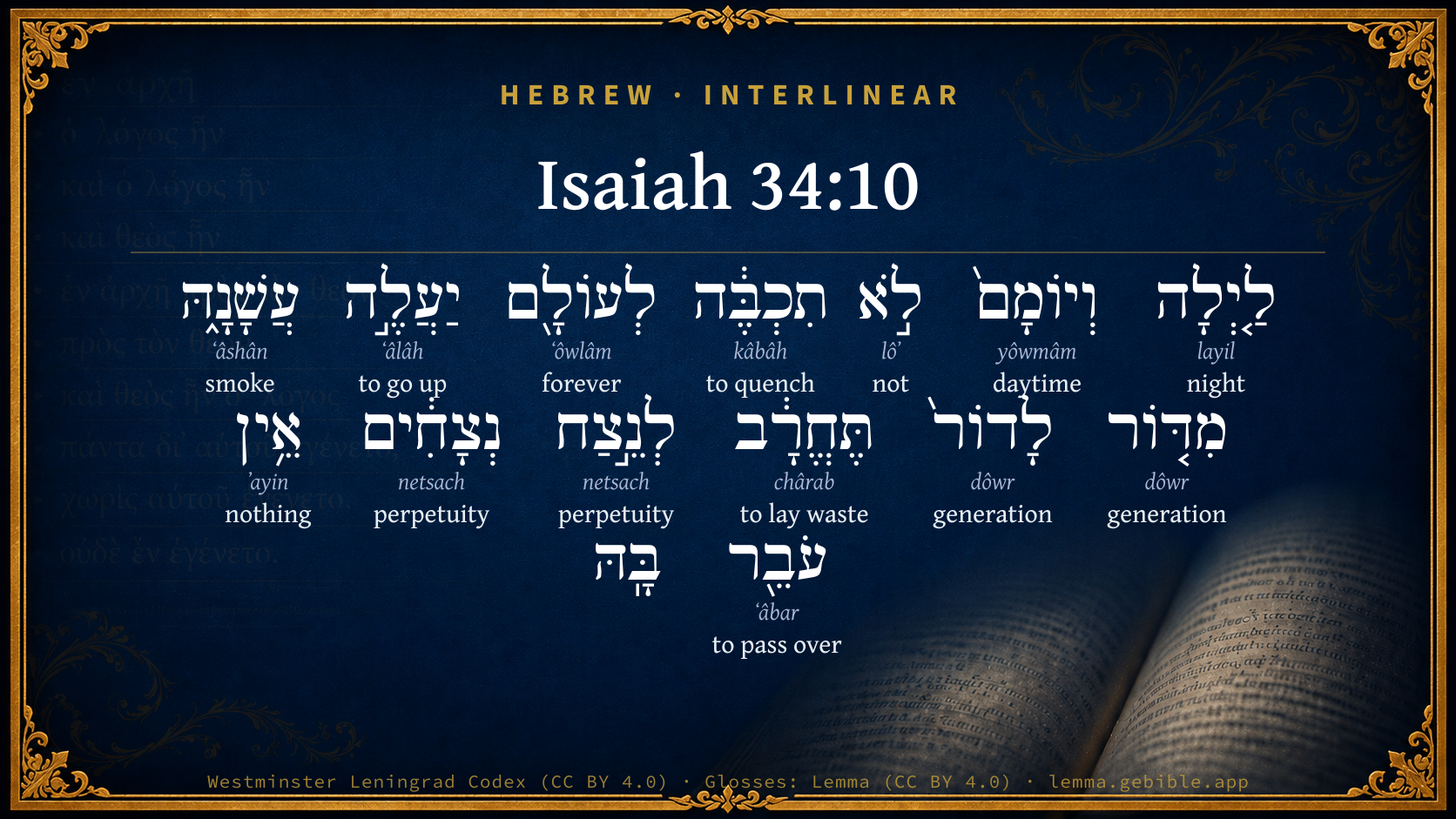
Isaiah 34:10

Hebrew (Westminster Leningrad Codex) Isaiah 34:10 appears in the Hebrew Old Testament. The text above is from the Westminster Leningrad Codex. Each word links to its Strong’s number, a concise gloss, and parsing drawn from the Open Scriptures Hebrew Bible morphology. Click any word for its full Brown-Driver-Briggs (BDB) entry.
Download image
Cite this verse

Isaiah 34:10 (World English Bible). Public Domain. Lemma interlinear Bible study tool, https://lemma.gebible.app/v/isaiah/34/10.

Show BibTeX & RIS
BibTeX
RIS
English Translation
It shall not be quenched night nor day; the smoke of it shall go up for ever; from generation to generation it shall lie waste; none shall pass through it forever and ever.
World English Bible · Public Domain
Download a study sheet

One document with this verse’s original text, its word-by-word gloss line, the meaning frame, cross-references with their text, attributed commentary, and full source and license credits — printable, and it pastes into notes with its structure intact.

This verse Autodidact and up

Study sheet (.html) Plain text (.txt)

A passage Seminary Student

Up to 50 verses in one chapter. A passage sheet keeps up to 6 commentary sources and 12 cross-references per verse, in the order this page ranks them, and says so on the sheet whenever that leaves anything out. Ask for a single verse and you get the Autodidact verse sheet above.

Everything on this page stays free to read, with no account — the sheet is a download of what is already on screen, not access to it.

Want to remove ads? Support Godless Engineer
Compare translations 3

The same verse in 3 English versions, stacked beneath the original-language interlinear above. Click any original word for its lexicon entry.

Each is an independent rendering of the whole verse — the interlinear is not word-aligned to these translations.

Highlighted words mark where these versions differ — a whole-verse word diff, not a word-by-word alignment.

  • World English Bible Public Domain
    It shall not be quenched night nor day; the smoke of it shall go up for ever; from generation to generation it shall lie waste; none shall pass through it forever and ever.
  • King James Version Public Domain
    It shall not be quenched night nor day; the smoke thereof shall go up for ever: from generation to generation it shall lie waste; none shall pass through it for ever and ever.
  • unfoldingWord Literal Text CC BY-SA 4.0
    Night and day it will not extinguish; its smoke will rise forever. From generation to generation it will be desolate; to perpetuity of perpetuities no one will be passing through it.

unfoldingWord Literal Text — © unfoldingWord, licensed CC BY-SA 4.0. Word-aligned USFM3 via Door43 (git.door43.org/unfoldingWord/en_ult).

Versions to compare (up to 4)

3 of 4 selected

Show all 18 translations

Every available English version of this verse, each an independent rendering of the whole verse.

  • World English Bible Public Domain
    It shall not be quenched night nor day; the smoke of it shall go up for ever; from generation to generation it shall lie waste; none shall pass through it forever and ever.
  • Berean Standard Bible Public Domain
    It will not be quenched—day or night. Its smoke will ascend forever. From generation to generation it will lie desolate; no one will ever again pass through it.
  • Majority Standard Bible Public Domain
    It will not be quenched—day or night. Its smoke will ascend forever. From generation to generation it will lie desolate; no one will ever again pass through it.
  • King James Version Public Domain
    It shall not be quenched night nor day; the smoke thereof shall go up for ever: from generation to generation it shall lie waste; none shall pass through it for ever and ever.
  • American Standard Version (1901) Public Domain
    It shall not be quenched night nor day; the smoke thereof shall go up for ever; from generation to generation it shall lie waste; none shall pass through it for ever and ever.
  • Revised Version (1885) Public Domain
    It shall not be quenched night nor day; the smoke thereof shall go up for ever: from generation to generation it shall lie waste; none shall pass through it for ever and ever.
  • Geneva Bible (1599) Public Domain
    It shall not be quenched night nor day: the smoke thereof shall goe vp euermore: it shall be desolate from generation to generation: none shall passe through it for euer.
  • Douay-Rheims (1899) Public Domain
    Night and day it shall not be quenched, the smoke thereof shall go up for ever: from generation to generation it shall lie waste, none shall pass through it for ever and ever.
  • Young's Literal Translation Public Domain
    By night and by day she is not quenched, To the age go up doth her smoke, From generation to generation she is waste, For ever and ever, none is passing into her.
  • Literal Standard Version CC BY-SA 4.0
    She is not quenched by night and by day, || Her smoke goes up for all time, || She is desolate from generation to generation, || Forever and ever, none is passing into her.
  • Unlocked Literal Bible CC BY-SA 4.0
    It will burn night and day; its smoke will rise forever; from generation to generation it will be a wasteland; no one will pass through it forever and ever.
  • unfoldingWord Literal Text CC BY-SA 4.0
    Night and day it will not extinguish; its smoke will rise forever. From generation to generation it will be desolate; to perpetuity of perpetuities no one will be passing through it.
  • Darby Bible Public Domain
    it shall not be quenched night nor day; the smoke thereof shall go up for ever: from generation to generation it shall lie waste; none shall pass through it for ever and ever.
  • World Messianic Bible Public Domain
    It won’t be quenched night or day. Its smoke will go up forever. From generation to generation, it will lie waste. No one will pass through it forever and ever.
  • Webster's Bible Public Domain
    It shall not be quenched night nor day; the smoke of it shall ascend for ever: from generation to generation it shall lie waste; none shall pass through it for ever and ever.
  • Free Bible Version CC BY-SA 4.0
    The fire will burn day and night, and will never go out, its smoke will rise forever. From one generation to the next it will remain desolate—people won't ever go there again.
  • Bible in Basic English Public Domain
    It will not be put out day or night; its smoke will go up for ever: it will be waste from generation to generation; no one will go through it for ever.
  • JPS Tanakh (1917) Public Domain
    It shall not be quenched night nor day, the smoke thereof shall go up for ever; from generation to generation it shall lie waste: none shall pass through it for ever and ever.

Literal Standard Version (2020), Covenant Press — licensed CC BY-SA 4.0. Text via the HelloAO Bible API (eBible.org). Unlocked Literal Bible (unfoldingWord) — licensed CC BY-SA 4.0. Text via the HelloAO Bible API (eBible.org). unfoldingWord Literal Text — © unfoldingWord, licensed CC BY-SA 4.0. Word-aligned USFM3 via Door43 (git.door43.org/unfoldingWord/en_ult). Free Bible Version, Dr. Jonathan Gallagher — licensed CC BY-SA 4.0. Text via the HelloAO Bible API (eBible.org).

Word by word

More ways to search: Search by grammar → Find every occurrence → Compare this word →

Practice this passage: Drill this verse → Learn its vocabulary →

תִכְבֶּ֔ה
kâbâh
H3518
“to quench”
Verb, Qal, Imperfect, 3rd Person, Feminine, Singular
Part of Speech
Verb
Stem
Qal
Form
Imperfect
Person
3rd Person
Gender
Feminine
Number
Singular
Full BDB Definition

Origin: a primitive root

TWOT: 944

to quench, put out, be put out, be quenched, be extinguished - (Qal) to be quenched, be extinguished - (Piel) to quench, extinguish
  1. לַ֤יְלָה layil H3915 “night” Noun, Common, Masculine, Singular, Absolute
  2. וְיוֹמָם֙ yôwmâm H3119 “and · daytime” Conjunction + Adverb
  3. לֹ֣א lôʼ H3808 “not” Particle, Negative
  4. לְעוֹלָ֖ם ʻôwlâm H5769 “to/for · forever” Preposition + Noun, Common, Masculine, Singular, Absolute
  5. יַעֲלֶ֣ה ʻâlâh H5927 “to go up” Verb, Qal, Imperfect, 3rd Person, Masculine, Singular
  6. עֲשָׁנָ֑הּ ʻâshân H6227 “smoke · her” Noun, Common, Masculine, Singular, Construct + Suffix, Personal, 3rd Person, Feminine, Singular
  7. מִדּ֤וֹר dôwr H1755 “from · generation” Preposition + Noun, Common, Masculine, Singular, Absolute
  8. לָדוֹר֙ dôwr H1755 “to/for · generation” Preposition + Noun, Common, Masculine, Singular, Absolute
  9. תֶּחֱרָ֔ב chârab H2717 “to lay waste” Verb, Qal, Imperfect, 3rd Person, Feminine, Singular
  10. לְנֵ֣צַח netsach H5331 “to/for · perpetuity of” Preposition + Noun, Common, Masculine, Singular, Construct
  11. נְצָחִ֔ים netsach H5331 “perpetuity” Noun, Common, Masculine, Plural, Absolute
  12. אֵ֥ין ʼayin H369 “nothing” Particle, Negative
  13. עֹבֵ֖ר ʻâbar H5674 “passing over” Verb, Qal, Participle Active, Masculine, Singular, Absolute

About this verse

These counts appear in no published source. They are computed here, from the morphology-tagged text and Lemma’s own curated glosses. What Lemma adds →

15
words
12
distinct lemmas
Prophets
section

Notable vocabulary

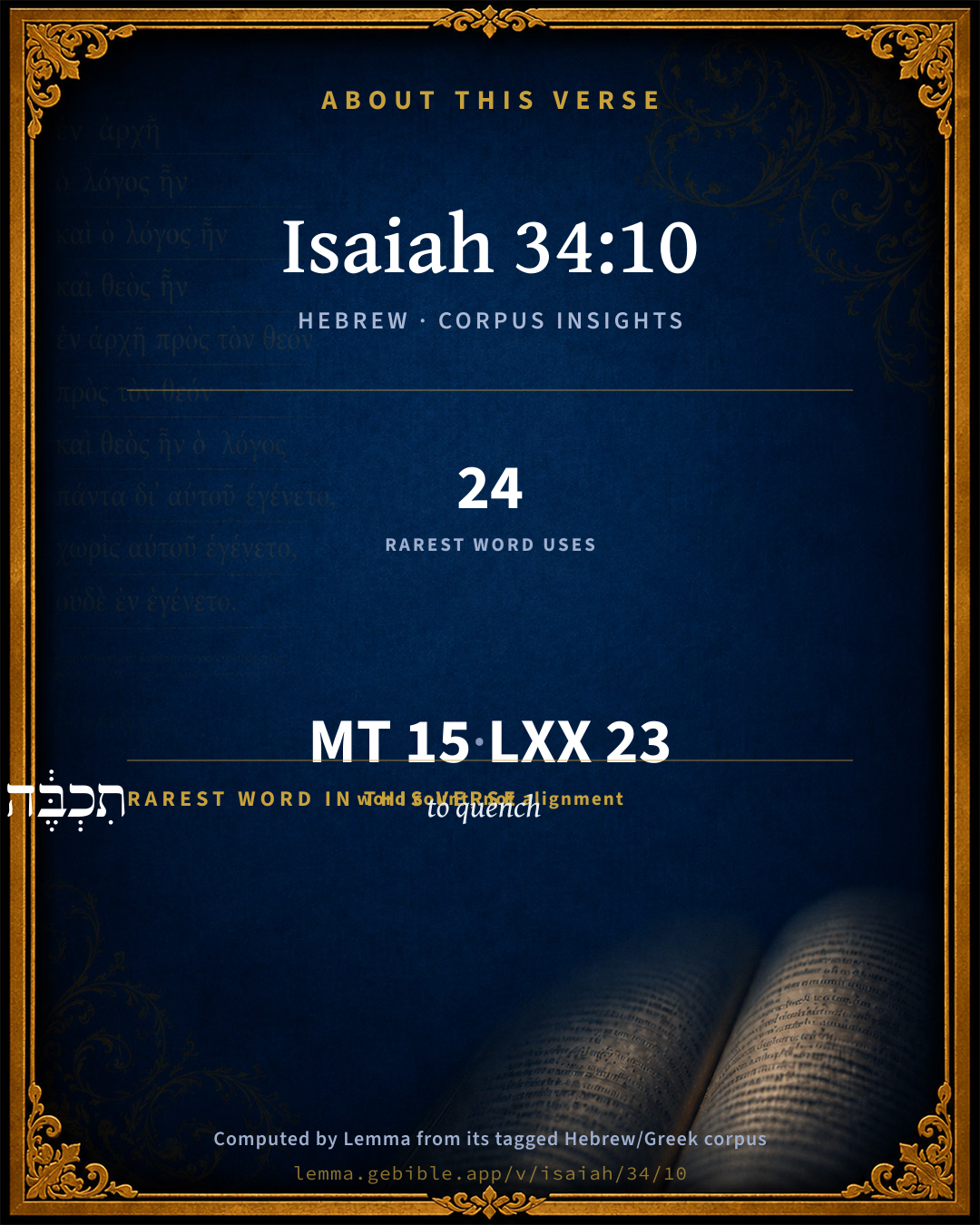
The rarest word here is תִכְבֶּ֔ה to quench H3518 — appearing just 24 times in the whole Hebrew Bible.

Shared distinctive vocabulary

תִכְבֶּ֔ה to quench H3518 occurs in 24 verses of the Hebrew Bible. Also found in:

Grammatical profile

  • 4 verbs
  • 7 nouns
  • 1 preposition
  • 1 adverb
  • 2 particles

Verb forms

  • תִכְבֶּ֔ה Qal · Imperfect
  • יַעֲלֶ֣ה Qal · Imperfect
  • תֶּחֱרָ֔ב Qal · Imperfect
  • עֹבֵ֖ר Qal · Participle Active

Repetition

Words recur within this verse — often emphatic in Hebrew:

  • מִדּ֤וֹר generation H1755 ×2
  • לְנֵ֣צַח perpetuity H5331 ×2

Hebrew & Septuagint length

In English translation the verse runs 33 words from the Hebrew and 20 from the Septuagint (LXX English) — the Septuagint runs noticeably shorter here. See the side-by-side →

A rough comparison of the two English renderings, which tokenize alike — not a word-level alignment.

Word counts can differ between the Hebrew and the Greek without any difference in meaning — e.g. the Hebrew direct-object marker אֵת has no separate Greek word, and Greek often adds the article ὁ.

In the original languages it is 15 Hebrew tokens and 23 Greek tokens — but the two are counted differently (Hebrew bundles its prefixes and suffixes into one token; the Greek is in lemma form), so that isn’t a like-for-like length.

Cross-references

12

Topical passages linked to Isaiah 34:10 in the Treasury of Scripture Knowledge — connected by theme and wording, ordered by reader-vote popularity; previews shown in the World English Bible.

  • Revelation 19:3 A second said, "Hallelujah! Her smoke goes up forever and ever."
  • Isaiah 13:20 It shall never be inhabited, neither shall it be lived in from generation to generation: neither shall the Arabian pitch tent there; neither shall shepherds make their flocks to lie down there.
  • Isaiah 66:24 They shall go forth, and look on the dead bodies of the men who have transgressed against me: for their worm shall not die, neither shall their fire be quenched; and they shall be an abhorring to all flesh.
  • Malachi 1:3–4 but Esau I hated, and made his mountains a desolation, and gave his heritage to the jackals of the wilderness."
  • Isaiah 1:31 The strong will be like tinder, And his work like a spark. They will both burn together, And no one will quench them."
  • Ezekiel 29:11 No foot of man shall pass through it, nor foot of animal shall pass through it, neither shall it be inhabited forty years.
  • Revelation 14:10–11 he also will drink of the wine of the wrath of God, which is prepared unmixed in the cup of his anger. He will be tormented with fire and sulfur in the presence of the holy angels, and in the presence of the Lamb.
  • Revelation 18:18 and cried out as they looked at the smoke of her burning, saying, 'What is like the great city?'
  • Isaiah 24:1 Behold, Yahweh makes the earth empty, and makes it waste, and turns it upside down, and scatters abroad the inhabitants of it.
  • Jeremiah 7:20 Therefore thus says the Lord Yahweh: Behold, my anger and my wrath shall be poured out on this place, on man, and on animal, and on the trees of the field, and on the fruit of the ground; and it shall burn, and shall not be quenched.
  • Ezekiel 20:47–48 and tell the forest of the South, Hear the word of Yahweh: Thus says the Lord Yahweh, Behold, I will kindle a fire in you, and it shall devour every green tree in you, and every dry tree: the flaming flame shall not be quenched, and all faces from the south to the north shall be burnt thereby.
  • Mark 9:43–48 If your hand causes you to stumble, cut it off. It is better for you to enter into life maimed, rather than having your two hands to go into Gehenna, into the unquenchable fire,

Cross-references courtesy of OpenBible.info (CC BY 4.0).

Hebrew and Greek witnesses Masoretic Hebrew ↔ Greek Septuagint

The same verse in the two great witnesses to the Old Testament, shown verse-for-verse.

Here the Septuagint runs noticeably shorter than the Hebrew — LXX2012 (modern English Septuagint) 20 words vs World English Bible 33. A rough length comparison of the two English translations, not a word-level alignment — read both below.

These are two independent witnesses, not word-aligned to each other, and the Septuagint is shown in lemma (dictionary) form.

Hebrew Isaiah 34:10 Masoretic · Westminster Leningrad Codex

לַ֤יְלָה וְיוֹמָם֙ לֹ֣א תִכְבֶּ֔ה לְעוֹלָ֖ם יַעֲלֶ֣ה עֲשָׁנָ֑הּ מִדּ֤וֹר לָדוֹר֙ תֶּחֱרָ֔ב לְנֵ֣צַח נְצָחִ֔ים אֵ֥ין עֹבֵ֖ר בָּֽהּ

It shall not be quenched night nor day; the smoke of it shall go up for ever; from generation to generation it shall lie waste; none shall pass through it forever and ever.

World English Bible · Public Domain

Greek LXX Isaiah 34:10 Septuagint · lemma form

νύξ καί ἡμέρα καί οὐ σβέννυμι εἰς ὁ αἰών χρόνος καί ἀναβαίνω ὁ καπνός αὐτός ἄνω εἰς γενεά ἐρημόω καί εἰς χρόνος πολύς

and it shall never be quenched, and her smoke shall go up: it shall be made desolate throughout her generations,

LXX2012 (modern English Septuagint) · Public Domain

Hebrew: Westminster Leningrad Codex (CC BY 4.0). Greek: Septuagint (public domain); English from LXX2012 (modern English Septuagint) (Public Domain). How the Septuagint differs from the Hebrew →

Targum (Aramaic paraphrase)

1

The Targum is the ancient Jewish Aramaic paraphrase of the Hebrew Scriptures — an interpretive translation, not the Hebrew text itself. Onkelos (literal) and Pseudo-Jonathan (expansive) render the Torah, and Jonathan the Prophets. Coverage is partial: where no permissively-licensed English translation exists for a verse, only the Aramaic is shown. This is verse-level text, not a word-by-word alignment to the Hebrew.

  1. Targum Jonathan Prophets (Joshua–Malachi)
    לֵילֵי וִימָם לָא תִטְפֵי לַעֲלָם יִסַק תְּנָנָהּ מִדָר לְדָר תֶּחֱרוֹב לַעֲלָם עַלְמַיָא לֵית דִי עָדֵי בָּהּ:

    By night and by day it shall not be extinguished; her smoke shall ascend for ever: from generation to generation she shall lie waste; none shall pass through her to everlasting ages.

    Targum Jonathan — Aramaic: “Mikraot Gedolot” (public domain). English: “Sefaria Community Translation” (CC0 1.0 (public-domain dedication)); “London "Chaldee Paraphrase," 1871” (public domain). Text via Sefaria.

Commentary

Notes on Isaiah 34:10 from classic Christian and Jewish commentators (each source and its license shown beneath its notes). The classic Christian expositions comment on the surrounding passage and are grouped to its opening verse, so a note may address several verses; the Jewish commentaries on the Tanakh (Rashi and others) are per-verse, so they appear only where the commentator wrote on this verse.

Lemma curates 59 commentaries, every one of them public domain or Creative Commons licensed, each selected and text-cleaned for this edition rather than reprinted as found. About our sources →

Trapp's Complete Commentary

John Trapp

Isa 34:10 It shall not be quenched night nor day; the smoke thereof shall go up for ever: from generation to generation it shall lie waste; none shall pass through it for ever and ever.

Ver. 10. It shall not be quenched night nor day; the smoke of it shall go up for ever.] See Rev 14:11; Rev 18:18; Rev 19:3. And observe how John the divine picks out the choicest passages of the Old Testament, and polishes therewith his Revelation.

None shall pass through it for ever,] i.e., Incolendi animo, to dwell there; passengers did pass through it, and wondered at God’s dreadful judgments thereon. {Jer 49:17}

John Trapp, A Commentary or Exposition upon All the Books of the Old and New Testament (1647–1656) — public domain. Text from a community e-Sword module.

Tyndale Open Study Notes

Tyndale Open Resources

34:10 See also Rev 14:11; 19:3.

Tyndale Open Study Notes — © Tyndale Open Resources, licensed CC BY-SA 4.0. Text via the HelloAO Bible API.

Jamieson, Fausset & Brown

Robert Jamieson, A. R. Fausset & David Brown

It--The burning pitch, &c. (Isa 34:9).

smoke . . . for ever-- (Rev 14:11; Rev 18:18; Rev 19:3).

generation to generation-- (Mal 1:4).

none . . . pass through--Edom's original offense was: they would not let Israel pass through their land in peace to Canaan: God recompenses them in kind, no traveller shall pass through Edom. VOLNEY, the infidel, was forced to confirm the truth of this prophecy: "From the reports of the Arabs, southeast of the Dead Sea, within three days' journey are upwards of thirty ruined towns, absolutely deserted."

Jamieson, Fausset & Brown — Commentary Critical and Explanatory on the Whole Bible (1871) — public domain (CC PDM 1.0). Text via the HelloAO Bible API.

John Gill's Exposition

It shall not be quenched night nor day,.... It will be long burning, and shall not be extinguished until it is utterly consumed. The burning of Rome will continue long, especially the smoke of it; the kings of the earth, and others, are represented as standing and looking at it, and lamenting for it, Rev 18:9,

the smoke thereof shall go up for ever; this very phrase is what will be used by the saints in their "allelujahs", at the burning of Rome, Rev 19:3 with which compare Rev 14:11,

from generation to generation it shall lie waste; the land shall be no more manured and cultivated, nor the city rebuilt; when Babylon is once fallen, it shall never be raised up again, but always remain desolate, Rev 18:2,

none shall pass through it for ever and ever; no inhabitant in it, nor traveller through it; it will be so horrible and terrible, as none will care to dwell there, yea, not so much as to travel through it; see Jer 49:18.

John Gill's Exposition of the Whole Bible (1746–1763) — public domain (CC PDM 1.0). Text via the HelloAO Bible API.

Albert Barnes' Notes on the Bible

It shall not be quenched night nor day - That is, the burning brimstone and pitch Isa 34:9, the emblem of perpetual and entire desolation, shall not be extinguished.

The smoke thereof shall go up for ever - Every river and rivulet is Supposed to be heated pitch, and every particle of dust sulphur, and a 1 on fire, sending up from an extended region dense columns of smoke to heaven. No idea of ruin could be more sublime; no idea of the vengeance of God more terrible. This image has been copied by John to describe the future woes of the wicked Rev 14:11, and of mystical Babylon Rev 18:9, Rev 18:18; Rev 19:2-3.

From generation to generation it shall lie waste - Full confirmation of this may be seen in the travels of Seetsen, of Burckhardt, of Volney, of Irby, and Mangles, extracts of which have been collected and arranged by Keith (Evidences of Prophecy, pp. 135-168). Thus Volney says, ‘From the reports of the Arabs as of Bakir, and the inhabitants of Gaza, who frequently go to Maan and Karak, on the road of the pilgrims, there are to the southeast of the lake Asphaltites (Dead Sea), within three days’ journey, upward of thirty ruined towns, absolutely deserted. Several of them have large edifices, with columns that may have belonged to the ancient temples, or at least to Greek churches. The Arabs sometimes make use of them to fold cattle in; but, in general, avoid them on account of the enormous scorpions with which they swarm.’ (Volney’s Travels, vol. ii. pp. 344-346.) It is remarkable that an infidel, as Volney was, should in this, as in numerous other instances, have given a minute confirmation of the ancient prophecies.

Seetsen says (Travels, p. 46), that he was told, that, ‘at the distance of two days and a half from Hebron he would final considerable ruins of the ancient city of Abde, and that for all the rest of the journey be would see no place of habitation; he would meet only with a few tribes of wandering Arabs.’ Burckhardt has given the following description on of the eastern boundary of Edom, and of the adjoining part of Arabia Petrea: ‘It might with truth be called Petrea, not only on account of its rocky mountains, but also of the elevated plain already described (that is, Shera (Seir), the territory of the Edomites, Travels, pp. 410, 435), ‘which is so much covered with stones, especially flints, that it may with great propriety be called a stony desert, although susceptible of culture; in many places it is grown over with wild herbs, and must once have been thickly inhabited, for the traces of many towns and villages are met with on both sides of the Hadj road between Maan and Akaba, as well as between Mean and the plains of Houran, in which direction also are many springs.

At present all this country is a desert, and Maan is the only inhabited place in it.’ (Burckhardt’s Travels, p. 436.) Of the remains of ancient cities still exposed to view in different places throughout Idumea, Burckhardt describes the ruins of a large town, of which nothing remains but broken walls anti heaps of stones; the ruins of several villages in its vicinity (p. 418); the ruins of an ancient city, consisting of large heaps of hewn blocks of siliceous stone; and the extensive ruins of Arindela, an ancient town of Palestina Terria (p. 441). ‘The following ruined places are situated in Djebal Shera (Mount Seir), to the south and southwest of Wady Musa - Kalaat Beni Madha, Djerba, Basta, Eyl, Ferdakh, Anyk, Bir el Beytar, Shemakh, and Syk’ (p. 444). Burckhardt also gives a most interesting description of the ruins of the ancient Petra which he discovered, the ancient capital of Edom, but which is too long to be transcribed here (see his Travels, pp. 422-432; compare the note at Isa 16:1).

None shall pass through it forever and ever - That is, it shall not be a country through which caravans shall pass; there shrill be no roads, and it shall not be deemed safe to travel through it. It will be recollected that the original source of all their calamities, and the cause of all the judgments that came upon them, was the fact that they would not let the children of Israel pass peaceably through their land on their way to Canaan (see the Introduction to the chapter). As a punishment for this, God now says that their land shall not be passed through; it shall not be a thoroughfare; there shall be no travelers in it. God usually directs his punishment of individuals and of nations in the line of their offences, and thus his judgments become commonly a recompence in kind. Thus in 2Sa 22:26-27, it is said:

With the merciful, thou wilt show thyself merciful;

And with the upright man thou wilt show thyself upright.

With the pure thou wilt show thyself pure;

And with the froward thou wilt show thyself unsavory.

In accordance with this prediction that no one should pass through Edom, Volney (Travels, vol. ii. p. 344) says, ‘The country has not been visited by any traveler, but it well merits Such an attention.’ Thus Burckhardt (Travels, p. 421) says, after he had entered, on the northeast, the territories of the Edomites, that he ‘was without protection in the midst of a desert where no traveler had ever before been seen. It was then,’ he adds, ‘that for the first time he had ever felt fear during his travels in the desert, and his route thither was the most dangerous he had ever traveled’ (p. 400). ‘Seetsen, on a piece of paper pasted against the wall, notified his having penetrated the country in a direct line between the Dead Sea and Mount Sinai (through Idumea), a route never before accomplished.’ (Burckhardt’s Syria, p. 553.) Burckhardt had determined to attempt to pass the same way as being the shortest way to Jerusalem; but he was repeatedly told it was impossible; and the difficulty of the journey is illustrated in the Travels of Captains Irby and Mangles. They offered five hundred piastres to an Arab tribe if they would conduct them to Wady Musa, but nothing would induce them to consent. ‘They said they would not go if we would give them five thousand piastres, observing that money was of no use to a man if he lost his life’ (p. 349). So strikingly has this prediction been fulfilled.

Albert Barnes' Notes on the Bible (1834–1885) — public domain. Text from a community e-Sword/MySword module.

Matthew Poole's English Annotations

It shall be irrecoverably ruined, and shall remain as a spectacle of God’s vengeance to all succeeding ages.

Matthew Poole's English Annotations on the Holy Bible (1683–1685) — public domain. Text from a community e-Sword/MySword module.

The Pulpit Commentary

None shall pass through it forever and ever. There was a literal fulfillment of the prophecies against Edom to a considerable extent. Malachi, writing three hundred years after Isaiah, says that the "mountains and the heritage of Esau were laid waste for the dragons of the wilderness"; (Mal_1:3) and he makes the Edomites themselves exclaim, "We are impoverished, but we will return and build the desolate places". (Mal_1:4) A certain amount of recovery must have followed; and in the Maccabee period Edom appears once more as an adversary of Israel, and an adversary of some importance. (RAPC 1Ma 5:3, 65) Gradually, however, she had to yield to the superior power of Judaea, and was even ruled by viceroys, whom the Maccabee princes nominated. One of these, Antipater, was the father of Herod the Great. From his time Idumea languished until, in the seventh century after Christ, it was overrun dud conquered by the Mohammedan Arabs, who completed its ruin. It is now, and has been for above a thousand years, one of the most desolate tracts upon the earth"s surface.

The Pulpit Commentary (1880–1919), ed. H.D.M. Spence-Jones & Joseph S. Exell — public domain. Text from a community e-Sword module.

John Wesley's Explanatory Notes

For ever - It shall remain as a spectacle of God's vengeance to all succeeding ages.

John Wesley, Explanatory Notes Upon the Whole Bible (1754–1765) — public domain. Text via the GEBible commentary corpus.

J. A. Alexander on Isaiah

Joseph Addison Alexander

“Day and night it shall not be quenched; forever shall its smoke go up; from generation to generation shall it lie waste, forever and ever, there shall be no one passing through it.” The remarkable gradation and accumulation of terms denoting perpetuity can scarcely be expressed in a translation. This is especially the case with the last and highest of the series. A striking parallel to this verse is found in the statement (Gen 19:28) that when Abraham looked toward Sodom and Gomorrah, the smoke of the country went up as the smoke of a furnace. These sublime and fearful images are copied in the book of Revelation (Rev 14:10-11). Keith, in his Evidences of Prophecy, has collected some remarkable illustrations of this passage from the incidental statements of modern travelers with respect to what was once the land of Edom. Thus Volney speaks of thirty deserted towns within three days’ journey; Seetzen, of a wide tract utterly without a place of habitation, and of his own route through it as one never before attempted; Burckhardt, of the passage as declared by the people of the nearest inhabited districts to be impossible, in accordance with which notion he was unable to procure guides at any price. These are striking coincidences, and as illustrations of the prophecy important, but are not to be insisted on as constituting its direct fulfillment, for in that case the passage of these very travelers through the country would falsify the prediction which they are cited to confirm. The truth of the prophecy in this clause is really no more suspended on such facts, than that of the first clause and of the preceding verse upon the actual existence of bituminous streams and a sulphurous soil throughout the ancient Idumea. The whole is a magnificent prophetic picture, the fidelity of which, so far as it relates to ancient Edom, is notoriously attested by its desolation for a course of ages.

Joseph Addison Alexander, The Prophecies of Isaiah (1846–1847; New York: Scribner, 1870–1878) — public domain. Text from a community e-Sword module.

Rashi

Rabbi Shlomo Yitzchaki (Rashi)

from generation to generation From that generation until the last generation. Another explanation is that this is Moses’ curse (Ex. 17:16): “The Lord has a war against Amalek from generation to generation.” From Moses’ generation to Saul’s generation, and from there to Mordecai’s generation, and from there to the generation of the King Messiah.

Rashi on the Tanakh — English translations: “The Judaica Press complete Tanach with Rashi, translated by A. J. Rosenberg” (CC BY 4.0); “Pentateuch with Rashi's commentary by M. Rosenbaum and A.M. Silbermann, 1929-1934” (public domain); “The Metsudah Tanach series, Lakewood, N.J” (CC BY 4.0); and “The Book of Joshua, Metsudah Publications, 1997” (CC BY 4.0). Text via Sefaria.

Ibn Ezra

Rabbi Abraham ibn Ezra

It shall not be quenched. The fire thereof shall not be quenched.

לנצח נצחים For ever and ever. For periods without end.

Ibn Ezra on the Tanakh — English translations: “Sefaria Community Translation” (CC0 1.0 (public-domain dedication)); “Yalkut, Sifsei Chachomim Chumash, Metsudah Publications, 2009” (CC BY 4.0); and “Commentary of Ibn Ezra on Isaiah - trans. by M. Friedlander, 1873” (public domain). Text via Sefaria.

Lesson kit

Teaching starters — assembled from the data on this page, not authored interpretation. Every prompt links to the verse data it draws on. Edit before teaching.

Isaiah, in the Prophets, opens this verse with 15 words (12 distinct Hebrew lemmas). Its most distinctive word is kâbâh (“to quench”). The Greek Septuagint runs shorter here. A historical commentator’s framing appears above. Read the whole chapter for the surrounding context.

Discussion questions

  1. What does “to quench” (kâbâh) contribute to the verse as a whole?
  2. How does Leviticus 6:12, which shares the word «to quench», read alongside this verse?
  3. What does the repetition of “generation” (2× in this one verse) do in this verse?
  4. The Septuagint runs shorter here than the Hebrew. What might account for the difference?
  5. These translations render this verse differently. What is at stake in choosing one wording over another?
  6. «תִכְבֶּ֔ה» is a Qal Imperfect verb. How does that grammatical form shape the action described?
  7. Compare how Trapp's Complete Commentary and Tyndale Open Study Notes read this verse. Where do they agree or differ?

Things to notice

Reading settings

Reading text

Shown beneath each verse's original-language words.

Old Testament
Old Testament edition

Read the OT as the Masoretic Hebrew (MT) or the Greek Septuagint (LXX).

English shown for the Greek Septuagint (in the Hebrew ↔ Greek comparison).

Comparing translations? Open the Compare panel on any verse page to stack up to four side by side.