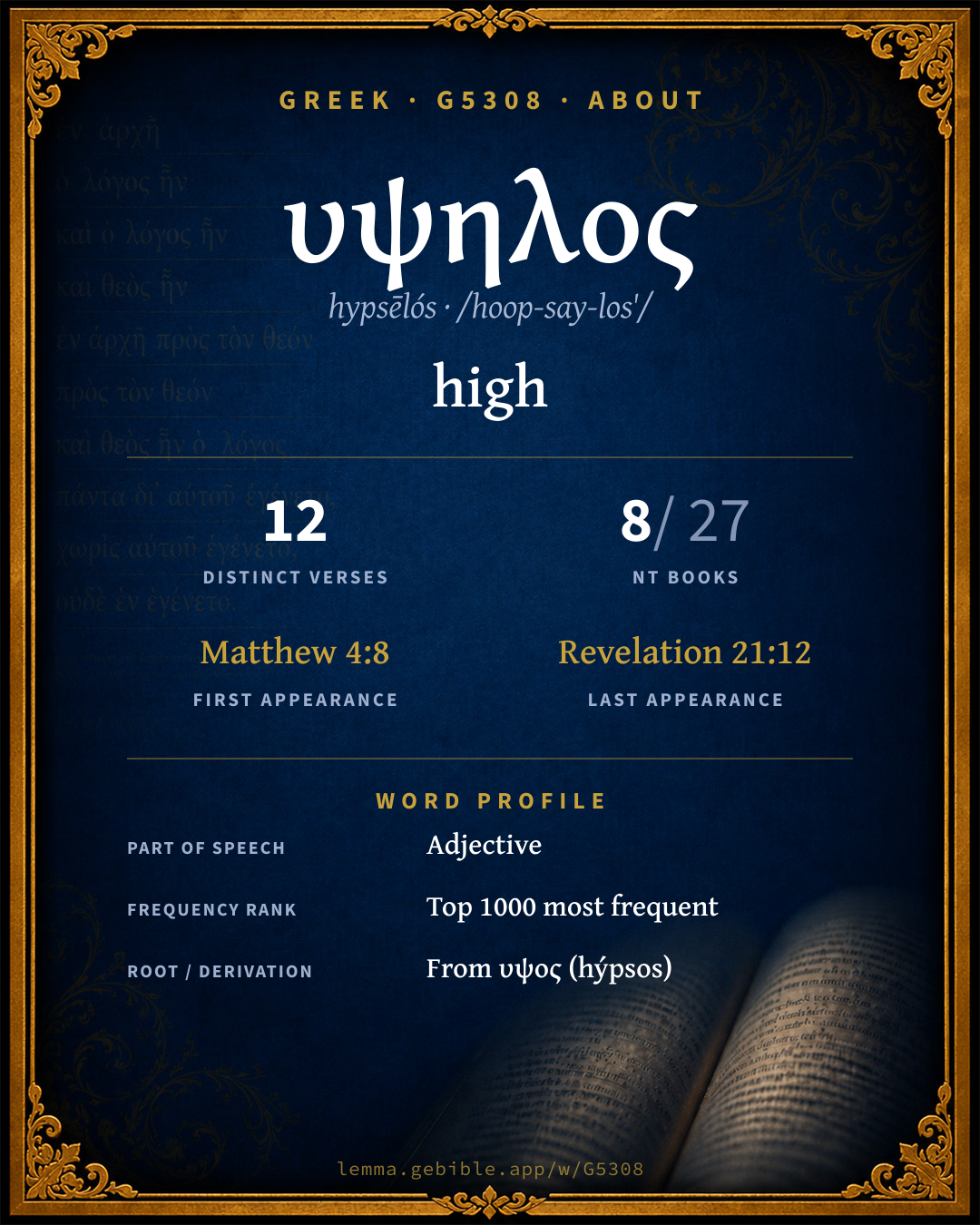
ὑψηλός
high
‘high’ is one of 2 main senses fuller range ↓
Full lexicon entry — Thayer's Greek Lexicon
From Thayer's Greek Lexicon
Where this word appears
See every Accusative-case word in the Greek New Testament →
Grammar key — what these labels mean
Part of speech
- Adjective
- A word that describes or qualifies a noun.
Case
- Accusative
- The case of the direct object and of extent.
- Dative
- The case of the indirect object, means, or location — “to / for / with / in.”
- Genitive
- The case of source, possession, or “of” — answers “whose / from what.”
- Nominative
- The case of the subject (and the predicate nominative).
Gender
- Neuter
- Grammatically neuter.
- Masculine
- Grammatically masculine.
Number
- Singular
- One.
- Plural
- More than one.
Degree
- Comparative
- Expresses a greater degree (“greater,” “more”).
Grammatical forms
- Adjective, Accusative, Singular, Neuter 5 times (42%)
- Adjective, Accusative, Plural, Neuter 3 times (25%)
- Adjective, Dative, Plural, Neuter 1 time (8%)
- Adjective, Genitive, Singular, Masculine 1 time (8%)
- Adjective, Nominative, Singular, Masculine, Comparative 1 time (8%)
- Adjective, Nominative, Singular, Neuter 1 time (8%)
Parsed forms decoded from the imported morphology (Robinson–Tischendorf, public domain), counted across 12 parsed occurrences — not distinct verses.
Every verse where G5308 appears — 12 distinct verses across 8 books. Click any verse to open its interlinear word-by-word view. Verse text shown in the World English Bible for context — . Each verse’s Greek form is shown with its reference; the English is not keyword-highlighted, since the data carries no word-level English alignment. Use “Compare translations” on any verse to read it across multiple English versions. This concordance covers the Greek New Testament; Septuagint (Greek Old Testament) occurrences of this word are not indexed here.
Matthew 2 verses
- Matthew 4:8 ὑψηλὸν adj acc sg neut Again, the devil took him to an exceedingly high mountain, and showed him all the kingdoms of the world, and their glory.
- Matthew 17:1 ὑψηλὸν adj acc sg neut After six days, Jesus took with him Peter, James, and John his brother, and brought them up into a high mountain by themselves.
Mark 1 verse
Luke 1 verse
Acts 1 verse
Romans 2 verses
- Romans 11:20 ὑψηλὰ adj acc pl neut True; by their unbelief they were broken off, and you stand by your faith. Don't be conceited, but fear;
- Romans 12:16 ὑψηλὰ adj acc pl neut Be of the same mind one toward another. Don't set your mind on high things, but associate with the humble. Don't be wise in your own conceits.
1 Timothy 1 verse
Hebrews 2 verses
- Hebrews 1:3 ὑψηλοῖς adj dat pl neut His Son is the radiance of his glory, the very image of his substance, and upholding all things by the word of his power, when he had by himself made purification for our sins, sat down on the right hand of the Majesty on high;
- Hebrews 7:26 ὑψηλότερος adj nom sg masc comp For such a high priest was fitting for us: holy, guiltless, undefiled, separated from sinners, and made higher than the heavens;
Revelation 2 verses
- Revelation 21:10 ὑψηλόν adj acc sg neut He carried me away in the Spirit to a great and high mountain, and showed me the holy city, Jerusalem, coming down out of heaven from God,
- Revelation 21:12 ὑψηλόν adj acc sg neut having a great and high wall; having twelve gates, and at the gates twelve angels; and names written on them, which are the names of the twelve tribes of the children of Israel.
About this entry
At a glance — auto-summarized from this page’s data, not written by a person. Every figure links to its source below. This summary describes the numbers; it doesn’t interpret them.
υψηλος (hypsēlós) is a Greek adjective most often rendered “high.” It first appears in Matthew 4:8. Spanning 12 verses in 8 books, it ranks among the uncommon words of the Greek New Testament. Its lexical range runs to 2 senses. Related forms include υψος, υψιστος and υψοω. The sections below give every sense, occurrence, and version rendering.
Gloss history
Strong's 1890 vs modern scholarship
About this word
Strong's G5308 catalogs a Greek word from the Greek New Testament.
These counts are not copied from any lexicon or concordance. They are computed here, from the morphology-tagged Greek New Testament. What Lemma adds →
- 12
- distinct verses
- The word appears in 12 distinct verses.
- 8 / 27
- NT books
- The word appears in 8 of 27 New Testament books.
- #904
- by frequency
- Top 1000 most frequent Greek words (rank 904 of 5,347 Greek words by occurrence).
View all 12 occurrences in the concordance →
By section of the New Testament
By traditional corpus
Conventional, traditional groupings — biblical authorship is debated, so this is a traditional corpus grouping, not an authorship claim. Some books belong to more than one corpus (Luke is in both the Gospels and the Lukan corpus, and so on), so these shares overlap and need not total 100%. Each figure is a share of the word’s 12 distinct verses.
- Gospels 4 verses · 33%
- Pauline corpus 3 verses · 25%
- Lukan (Luke–Acts) 2 verses · 17%
- Johannine 2 verses · 17%
- Hebrews 2 verses · 17%
- Revelation 2 verses · 17%
How translations render this word
Counts come from each version’s own published word-to-Strong’s tagging or interlinear alignment — an approximate guide to how each version renders this word, not a word-level alignment the data otherwise carries. Because each total is that version’s own tagged count, the per-version totals vary from one another and need not match the appearance or distinct-verse counts above. These counts may also differ from a printed concordance because Lemma counts each distinctly tagged rendering and does not collapse phrase taggings into a single head-word total. This is a fixed set of word-tagged versions (KJV, ASV, BSB, ULT) and does not change with the reading translation you choose elsewhere. Each version’s license is shown beside its name below (and on Sources).
- King James Version: High 8×
- American Standard Version: High 7×
- Berean Standard Bible: High 6×
- unfoldingWord Literal Text: High 6×
King James Version Public Domain
Renders G5308 across 11 tagged occurrences — most commonly:
Plus 3 renderings that appear only once — usually multi-word phrases or single function words the recovered tagging swept in, not distinct renderings.
American Standard Version Public Domain
Renders G5308 across 10 tagged occurrences — most commonly:
Plus 3 renderings that appear only once — usually multi-word phrases or single function words the recovered tagging swept in, not distinct renderings.
Berean Standard Bible Public Domain
Renders G5308 across 10 tagged occurrences — most commonly:
Plus 4 renderings that appear only once — usually multi-word phrases or single function words the recovered tagging swept in, not distinct renderings. Not rendered by a distinct English word in 1 further occurrence.
unfoldingWord Literal Text CC BY-SA 4.0
Renders G5308 across 11 tagged occurrences — most commonly:
Plus 5 renderings that appear only once — usually multi-word phrases or single function words the recovered tagging swept in, not distinct renderings.
Senses in Thayer's
The 2 senses Thayer's distinguishes for this word, in lexicon order (not ranked by frequency or importance). The full entry — with sub-senses — is in the Lexicon Entry tab.
- high, lofty
- metaph. eminent, exalted
Word origin
Derived from υψος (hýpsos) (G5311) — height.
From G5311 ; lofty (in place or character): - high (-er -ly) (esteemed).
— Strong’s Exhaustive Concordance (1890), public domain.
Forms in the corpus
The 6 distinct written forms G5308 takes in the Greek New Testament, most frequent first — each parse links to that case’s occurrences in the concordance.
| Form | Parsing | Example | Uses |
|---|---|---|---|
| ὑψηλὸν hypsēlòn | Adjective, Accusative, Singular, Neuter | Matthew 4:8 | 4 |
| ὑψηλὰ hypsēlà | Adjective, Accusative, Plural, Neuter | Romans 11:20 | 3 |
| ὑψηλόν hypsēlón | Adjective, Accusative, Singular, Neuter | Revelation 21:10 | 2 |
| ὑψηλοῖς hypsēloîs | Adjective, Dative, Plural, Neuter | Hebrews 1:3 | 1 |
| ὑψηλοῦ hypsēloû | Adjective, Genitive, Singular, Masculine | Acts 13:17 | 1 |
| ὑψηλότερος hypsēlóteros | Adjective, Nominative, Singular, Masculine, Comparative | Hebrews 7:26 | 1 |
Same root — word family
Other Thayer's entries built from the same root as G5308, grouped by Strong’s listed origin. These share a root / origin per the lexicon — not necessarily a shared meaning. Each links to that word’s own entry.
Derives from
Shares the same root
Derived from this word
Compare all same-root words → Showing 4 of 5 — not the complete family. They share a root, not necessarily a meaning.
Septuagint usage
The same Greek word υψηλος appears 186 times in the Greek Old Testament (Septuagint), across 167 verses in 21 books.
- 186
- LXX occurrences
- Tagged occurrences of this Greek word in the Septuagint.
- 167
- verses
- Distinct Septuagint verses containing this word.
- 21 / 39
- OT books
- The word appears in 21 of the 39 Old Testament books.
Sample Septuagint occurrences
- Genesis 7:19 ὑψηλός
- Exodus 6:1 ὑψηλός
- Numbers 33:3 ὑψηλός
- Deuteronomy 3:5 ὑψηλός
- 1 Samuel 2:3 ὑψηλός
- 1 Kings 3:2 ὑψηλός
- 2 Kings 12:4 ὑψηλός
- 2 Chronicles 1:3 ὑψηλός
- Ezra 19:25 ὑψηλός
- Job 5:7 ὑψηλός
- Psalms 17:34 ὑψηλός
- Proverbs 8:2 ὑψηλός
Septuagint occurrences (same lexeme)
Every verse where the same Strong’s number (G5308) appears in the Greek Septuagint — showing the first 50 of 167. Verse text shown in the World English Bible for context; the Greek form is the matched word — the English is not keyword-highlighted.
- Genesis 7:19 ὑψηλός The waters prevailed exceedingly on the earth. All the high mountains that were under the whole sky were covered.
- Genesis 7:20 ὑψηλός The waters prevailed fifteen cubits upward, and the mountains were covered.
- Genesis 12:6 ὑψηλός Abram passed through the land to the place of Shechem, to the oak of Moreh. The Canaanite was then in the land.
- Genesis 22:2 ὑψηλός He said, "Now take your son, your only son, whom you love, even Isaac, and go into the land of Moriah. Offer him there for a burnt offering on one of the mountains which I will tell you of."
- Exodus 6:1 ὑψηλός Yahweh said to Moses, "Now you shall see what I will do to Pharaoh, for by a strong hand he shall let them go, and by a strong hand he shall drive them out of his land."
- Exodus 6:6 ὑψηλός Therefore tell the children of Israel, 'I am Yahweh, and I will bring you out from under the burdens of the Egyptians, and I will rid you out of their bondage, and I will redeem you with an outstretched arm, and with great judgments:
- Exodus 14:8 ὑψηλός Yahweh hardened the heart of Pharaoh king of Egypt, and he pursued after the children of Israel; for the children of Israel went out with a high hand.
- Exodus 32:11 ὑψηλός Moses begged Yahweh his God, and said, "Yahweh, why does your wrath burn hot against your people, that you have brought forth out of the land of Egypt with great power and with a mighty hand?
- Numbers 33:3 ὑψηλός They traveled from Rameses in the first month, on the fifteenth day of the first month; on the next day after the Passover the children of Israel went out with a high hand in the sight of all the Egyptians,
- Deuteronomy 3:5 ὑψηλός All these were cities fortified with high walls, gates, and bars; besides the unwalled towns a great many.
- Deuteronomy 3:24 ὑψηλός Lord Yahweh, you have begun to show your servant your greatness, and your strong hand: for what god is there in heaven or in earth, that can do according to your works, and according to your mighty acts?
- Deuteronomy 4:34 ὑψηλός Or has God tried to go and take him a nation from the midst of [another] nation, by trials, by signs, and by wonders, and by war, and by a mighty hand, and by an outstretched arm, and by great terrors, according to all that Yahweh your God did for you in Egypt before your eyes?
- Deuteronomy 5:15 ὑψηλός You shall remember that you were a servant in the land of Egypt, and Yahweh your God brought you out of there by a mighty hand and by an outstretched arm: therefore Yahweh your God commanded you to keep the Sabbath day.
- Deuteronomy 6:21 ὑψηλός then you shall tell your son, We were Pharaoh's bondservants in Egypt: and Yahweh brought us out of Egypt with a mighty hand;
- Deuteronomy 7:8 ὑψηλός but because Yahweh loves you, and because he would keep the oath which he swore to your fathers, has Yahweh brought you out with a mighty hand, and redeemed you out of the house of bondage, from the hand of Pharaoh king of Egypt.
- Deuteronomy 7:19 ὑψηλός the great trials which your eyes saw, and the signs, and the wonders, and the mighty hand, and the outstretched arm, by which Yahweh your God brought you out: so shall Yahweh your God do to all the peoples of whom you are afraid.
- Deuteronomy 9:26 ὑψηλός I prayed to Yahweh, and said, Lord Yahweh, don't destroy your people and your inheritance, that you have redeemed through your greatness, that you have brought forth out of Egypt with a mighty hand.
- Deuteronomy 9:29 ὑψηλός Yet they are your people and your inheritance, which you brought out by your great power and by your outstretched arm.
- Deuteronomy 11:2 ὑψηλός Know you this day: for I don't speak with your children who have not known, and who have not seen the chastisement of Yahweh your God, his greatness, his mighty hand, and his outstretched arm,
- Deuteronomy 11:30 ὑψηλός Aren't they beyond the Jordan, behind the way of the going down of the sun, in the land of the Canaanites who dwell in the Arabah, over against Gilgal, beside the oaks of Moreh?
- Deuteronomy 12:2 ὑψηλός You shall surely destroy all the places in which the nations that you shall dispossess served their gods, on the high mountains, and on the hills, and under every green tree:
- Deuteronomy 26:8 ὑψηλός and Yahweh brought us forth out of Egypt with a mighty hand, and with an outstretched arm, and with great terror, and with signs, and with wonders;
- Deuteronomy 28:52 ὑψηλός They shall besiege you in all your gates, until your high and fortified walls come down, in which you trusted, throughout all your land; and they shall besiege you in all your gates throughout all your land, which Yahweh your God has given you.
- Deuteronomy 32:27 ὑψηλός Were it not that I feared the provocation of the enemy, Lest their adversaries should judge wrongly, Lest they should say, Our hand is exalted, Yahweh has not done all this.
- 1 Samuel 2:3 ὑψηλός Talk no more so exceeding proudly; Don't let arrogance come out of your mouth; For Yahweh is a God of knowledge, By him actions are weighed.
- 1 Samuel 9:2 ὑψηλός He had a son, whose name was Saul, an impressive young man; and there was not among the children of Israel a better person than he. From his shoulders and upward he was higher than any of the people.
- 1 Kings 3:2 ὑψηλός Only the people sacrificed in the high places, because there was no house built for the name of Yahweh until those days.
- 1 Kings 3:3 ὑψηλός Solomon loved Yahweh, walking in the statutes of David his father: only he sacrificed and burnt incense in the high places.
- 1 Kings 3:4 ὑψηλός The king went to Gibeon to sacrifice there; for that was the great high place: a thousand burnt offerings did Solomon offer on that altar.
- 1 Kings 9:8 ὑψηλός Though this house is so high, yet shall everyone who passes by it be astonished, and shall hiss; and they shall say, Why has Yahweh done thus to this land, and to this house?
- 1 Kings 11:5 ὑψηλός For Solomon went after Ashtoreth the goddess of the Sidonians, and after Milcom the abomination of the Ammonites.
- 1 Kings 12:31 ὑψηλός He made houses of high places, and made priests from among all the people, who were not of the sons of Levi.
- 1 Kings 12:32 ὑψηλός Jeroboam ordained a feast in the eighth month, on the fifteenth day of the month, like the feast that is in Judah, and he went up to the altar; so did he in Bethel, sacrificing to the calves that he had made: and he placed in Bethel the priests of the high places that he had made.
- 1 Kings 13:2 ὑψηλός He cried against the altar by the word of Yahweh, and said, altar, altar, thus says Yahweh: Behold, a son shall be born to the house of David, Josiah by name; and on you shall he sacrifice the priests of the high places who burn incense on you, and men's bones shall they burn on you.
- 1 Kings 13:32 ὑψηλός For the saying which he cried by the word of Yahweh against the altar in Bethel, and against all the houses of the high places which are in the cities of Samaria, shall surely happen.
- 1 Kings 13:33 ὑψηλός After this thing Jeroboam didn't return from his evil way, but made again from among all the people priests of the high places: whoever would, he consecrated him, that there might be priests of the high places.
- 1 Kings 14:3 ὑψηλός Take with you ten loaves, and cakes, and a jar of honey, and go to him: he will tell you what shall become of the child.
- 1 Kings 15:14 ὑψηλός But the high places were not taken away: nevertheless the heart of Asa was perfect with Yahweh all his days.
- 1 Kings 16:28 ὑψηλός So Omri slept with his fathers, and was buried in Samaria; and Ahab his son reigned in his place.
- 1 Kings 22:44 ὑψηλός Jehoshaphat made peace with the king of Israel.
- 2 Kings 12:4 ὑψηλός Jehoash said to the priests, All the money of the holy things that is brought into the house of Yahweh, in current money, the money of the persons for whom each man is rated, and all the money that it comes into any man's heart to bring into the house of Yahweh,
- 2 Kings 14:4 ὑψηλός However the high places were not taken away: the people still sacrificed and burnt incense in the high places.
- 2 Kings 15:4 ὑψηλός However the high places were not taken away: the people still sacrificed and burnt incense in the high places.
- 2 Kings 15:35 ὑψηλός However the high places were not taken away: the people still sacrificed and burned incense in the high places. He built the upper gate of the house of Yahweh.
- 2 Kings 16:4 ὑψηλός He sacrificed and burnt incense in the high places, and on the hills, and under every green tree.
- 2 Kings 17:9 ὑψηλός The children of Israel did secretly things that were not right against Yahweh their God: and they built them high places in all their cities, from the tower of the watchmen to the fortified city;
- 2 Kings 17:10 ὑψηλός and they set them up pillars and Asherim on every high hill, and under every green tree;
- 2 Kings 17:11 ὑψηλός and there they burnt incense in all the high places, as did the nations whom Yahweh carried away before them; and they worked wicked things to provoke Yahweh to anger;
- 2 Kings 17:29 ὑψηλός However every nation made gods of their own, and put them in the houses of the high places which the Samaritans had made, every nation in their cities in which they lived.
- 2 Kings 17:32 ὑψηλός So they feared Yahweh, and made to them from among themselves priests of the high places, who sacrificed for them in the houses of the high places.
These are occurrences of the same Greek lexeme (G5308) in the Septuagint — not a translation of any one Hebrew word. The store carries no word-level Hebrew↔Greek alignment, so no Hebrew original is asserted here. Counts come from the recovered LXX Strong's tagging — high-frequency vocabulary is well covered, while rare or late forms may be untagged — so they reflect tagged occurrences and may slightly undercount.