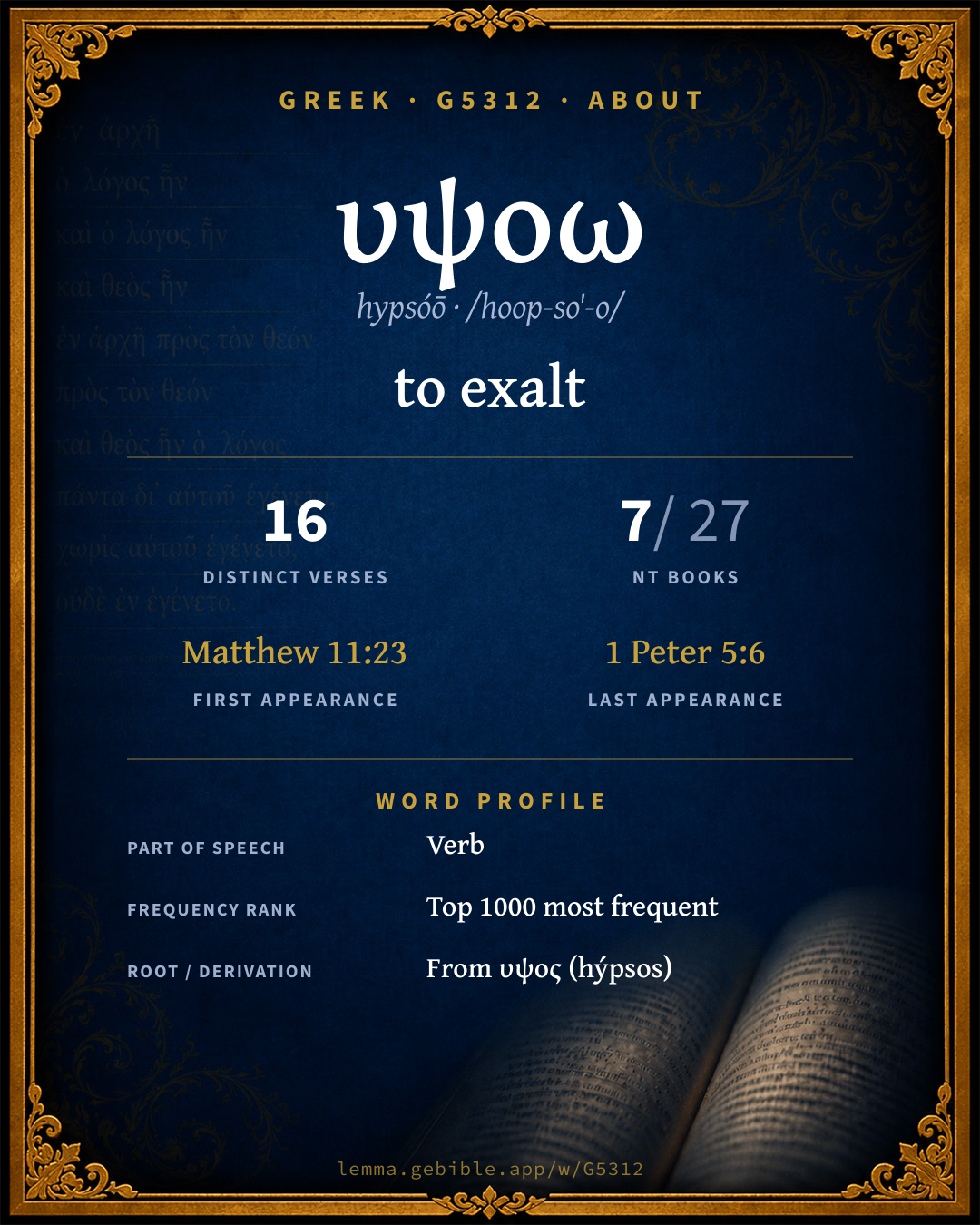
ὑψόω
to exalt
‘to exalt’ is one of 2 main senses fuller range ↓
Full lexicon entry — Thayer's Greek Lexicon
From Thayer's Greek Lexicon
Where this word appears
See every Aorist-tense verb in the Greek New Testament →
Grammar key — what these labels mean
Part of speech
- Verb
- An action or state-of-being word.
Tense
- Aorist
- Action viewed as a simple whole, without regard to duration — often past (perfective aspect).
- Future
- Action expected in future time.
- Present
- Ongoing or general action in present time (imperfective aspect).
Voice
- Active
- The subject performs the action.
- Passive
- The subject receives the action.
Mood
- Indicative
- States a fact or asks a factual question (the mood of reality).
- Infinitive
- A verbal noun (“to write”), unmarked for person or number.
- Participle
- A verbal adjective (“writing,” “having written”).
- Subjunctive
- Expresses probability, purpose, or possibility (the mood of contingency).
Case
- Nominative
- The case of the subject (and the predicate nominative).
Person
- 3rd person
- The one spoken about (“he / she / it / they”).
- 2nd person
- The one addressed (“you”).
- 1st person
- The speaker (“I / we”).
Gender
- Masculine
- Grammatically masculine.
Number
- Singular
- One.
- Plural
- More than one.
Grammatical forms 11 distinct
- Verb, Aorist, Active, Indicative, 3rd person, Singular 4 times (20%)
- Verb, Future, Passive, Indicative, 3rd person, Singular 3 times (15%)
- Verb, Aorist, Passive, Infinitive 2 times (10%)
- Verb, Future, Active, Indicative, 3rd person, Singular 2 times (10%)
- Verb, Future, Passive, Indicative, 2nd person, Singular 2 times (10%)
- Verb, Present, Active, Participle, Nominative, Singular, Masculine 2 times (10%)
- Verb, Aorist, Active, Subjunctive, 2nd person, Plural 1 time (5%)
- Verb, Aorist, Active, Subjunctive, 3rd person, Singular 1 time (5%)
+3 more forms (3 occurrences)
Parsed forms decoded from the imported morphology (Robinson–Tischendorf, public domain), counted across 20 parsed occurrences — not distinct verses.
Every verse where G5312 appears — 16 distinct verses across 7 books. Click any verse to open its interlinear word-by-word view. Verse text shown in the World English Bible for context — . Each verse’s Greek form is shown with its reference; the English is not keyword-highlighted, since the data carries no word-level English alignment. Use “Compare translations” on any verse to read it across multiple English versions. This concordance covers the Greek New Testament; Septuagint (Greek Old Testament) occurrences of this word are not indexed here.
Matthew 2 verses
- Matthew 11:23 ὑψωθήσῃ fut pass ind 2sg You, Capernaum, who are exalted to Heaven, you will go down to Hades. For if the mighty works had been done in Sodom which were done in you, it would have remained until this day.
- Matthew 23:12 ὑψώσει ὑψωθήσεται fut act ind 3sg fut pass ind 3sg Whoever exalts himself will be humbled, and whoever humbles himself will be exalted.
Luke 4 verses
- Luke 1:52 ὕψωσεν aor act ind 3sg He has put down princes from their thrones. And has exalted the lowly.
- Luke 10:15 ὑψωθήσῃ fut pass ind 2sg You, Capernaum, who are exalted to heaven, will be brought down to Hades.
- Luke 14:11 ὑψῶν ὑψωθήσεται pres act ptcp nom sg masc fut pass ind 3sg For everyone who exalts himself will be humbled, and whoever humbles himself will be exalted."
- Luke 18:14 ὑψῶν ὑψωθήσεται pres act ptcp nom sg masc fut pass ind 3sg I tell you, this man went down to his house justified rather than the other; for everyone who exalts himself will be humbled, but he who humbles himself will be exalted."
John 4 verses
- John 3:14 ὕψωσεν ὑψωθῆναι aor act ind 3sg aor pass inf As Moses lifted up the serpent in the wilderness, even so must the Son of Man be lifted up,
- John 8:28 ὑψώσητε aor act subj 2pl Jesus therefore said to them, "When you have lifted up the Son of Man, then you will know that I am he, and I do nothing of myself, but as my Father taught me, I say these things.
- John 12:32 ὑψωθῶ aor pass subj 1sg And I, if I am lifted up from the earth, will draw all people to myself."
- John 12:34 ὑψωθῆναι aor pass inf The multitude answered him, "We have heard out of the law that the Christ remains forever. How do you say, 'The Son of Man must be lifted up?' Who is this Son of Man?"
Acts 3 verses
- Acts 2:33 ὑψωθεὶς aor pass ptcp nom sg masc Being therefore exalted by the right hand of God, and having received from the Father the promise of the Holy Spirit, he has poured out this, which you now see and hear.
- Acts 5:31 ὕψωσεν aor act ind 3sg God exalted him with his right hand to be a Prince and a Savior, to give repentance to Israel, and remission of sins.
- Acts 13:17 ὕψωσεν aor act ind 3sg The God of this people chose our fathers, and exalted the people when they stayed as aliens in the land of Egypt, and with an uplifted arm, he led them out of it.
2 Corinthians 1 verse
James 1 verse
1 Peter 1 verse
About this entry
At a glance — auto-summarized from this page’s data, not written by a person. Every figure links to its source below. This summary describes the numbers; it doesn’t interpret them.
At its core, υψοω (hypsóō) means “to exalt.” It first appears in Matthew 11:23. Spanning 16 verses in 7 books, it ranks among the uncommon words of the Greek New Testament. Its uses concentrate in Luke (25% of all occurrences). Ranging over 2 senses, it is not a single-sense word. Dig into 16-verse concordance and the renderings breakdown below.
Gloss history
Strong's 1890 vs modern scholarship
About this word
Strong's G5312 catalogs a Greek word from the Greek New Testament.
These counts are not copied from any lexicon or concordance. They are computed here, from the morphology-tagged Greek New Testament. What Lemma adds →
- 16
- distinct verses
- The word appears in 16 distinct verses.
- 7 / 27
- NT books
- The word appears in 7 of 27 New Testament books.
- #622
- by frequency
- Top 1000 most frequent Greek words (rank 622 of 5,347 Greek words by occurrence).
View all 16 occurrences in the concordance →
By section of the New Testament
By traditional corpus
Conventional, traditional groupings — biblical authorship is debated, so this is a traditional corpus grouping, not an authorship claim. Some books belong to more than one corpus (Luke is in both the Gospels and the Lukan corpus, and so on), so these shares overlap and need not total 100%. Each figure is a share of the word’s 16 distinct verses.
- Gospels 10 verses · 63%
- Lukan (Luke–Acts) 7 verses · 44%
- Johannine 4 verses · 25%
- General (Catholic) Epistles 2 verses · 13%
- Pauline corpus 1 verse · 6%
How translations render this word
Counts come from each version’s own published word-to-Strong’s tagging or interlinear alignment — an approximate guide to how each version renders this word, not a word-level alignment the data otherwise carries. Because each total is that version’s own tagged count, the per-version totals vary from one another and need not match the appearance or distinct-verse counts above. These counts may also differ from a printed concordance because Lemma counts each distinctly tagged rendering and does not collapse phrase taggings into a single head-word total. This is a fixed set of word-tagged versions (KJV, ASV, BSB, ULT) and does not change with the reading translation you choose elsewhere. Each version’s license is shown beside its name below (and on Sources).
- King James Version: Exalted 4×, Shall be exalted 3×, Art exalted 2×
- American Standard Version: Shall be exalted 3×, Be lifted up 2×, Exalted 2×
- Berean Standard Bible: Exalts 3×, Will be exalted 3×, Be lifted up 2×
- unfoldingWord Literal Text: Will be exalted 3×, Be exalted 2×, Be lifted up 2×
King James Version Public Domain
Renders G5312 across 22 tagged occurrences — most commonly:
Plus 9 renderings that appear only once — usually multi-word phrases or single function words the recovered tagging swept in, not distinct renderings.
American Standard Version Public Domain
Renders G5312 across 21 tagged occurrences — most commonly:
Plus 12 renderings that appear only once — usually multi-word phrases or single function words the recovered tagging swept in, not distinct renderings.
Berean Standard Bible Public Domain
Renders G5312 across 20 tagged occurrences — most commonly:
Plus 8 renderings that appear only once — usually multi-word phrases or single function words the recovered tagging swept in, not distinct renderings.
unfoldingWord Literal Text CC BY-SA 4.0
Renders G5312 across 25 tagged occurrences — most commonly:
Plus 12 renderings that appear only once — usually multi-word phrases or single function words the recovered tagging swept in, not distinct renderings.
Senses in Thayer's
The 2 senses Thayer's distinguishes for this word, in lexicon order (not ranked by frequency or importance). The full entry — with sub-senses — is in the Lexicon Entry tab.
- to lift up on high, to exalt
- metaph.
Word origin
Derived from υψος (hýpsos) (G5311) — height.
From G5311 ; to elevate (literally or figuratively): - exalt lift up.
— Strong’s Exhaustive Concordance (1890), public domain.
Forms in the corpus
The 11 distinct written forms G5312 takes in the Greek New Testament, most frequent first — each parse links to that tense’s occurrences in the concordance.
| Form | Parsing | Example | Uses |
|---|---|---|---|
| ὕψωσεν hýpsōsen | Verb, Aorist, Active, Indicative, 3rd person, Singular | Luke 1:52 | 4 |
| ὑψωθήσεται hypsōthḗsetai | Verb, Future, Passive, Indicative, 3rd person, Singular | Matthew 23:12 | 3 |
| ὑψωθήσῃ hypsōthḗsē | Verb, Future, Passive, Indicative, 2nd person, Singular | Matthew 11:23 | 2 |
| ὑψωθῆναι hypsōthē̂nai | Verb, Aorist, Passive, Infinitive | John 3:14 | 2 |
| ὑψώσει hypsṓsei | Verb, Future, Active, Indicative, 3rd person, Singular | Matthew 23:12 | 2 |
| ὑψῶν hypsō̂n | Verb, Present, Active, Participle, Nominative, Singular, Masculine | Luke 14:11 | 2 |
| ὑψωθεὶς hypsōtheìs | Verb, Aorist, Passive, Participle, Nominative, Singular, Masculine | Acts 2:33 | 1 |
| ὑψωθῆτε hypsōthē̂te | Verb, Aorist, Passive, Subjunctive, 2nd person, Plural | 2 Corinthians 11:7 | 1 |
| ὑψωθῶ hypsōthō̂ | Verb, Aorist, Passive, Subjunctive, 1st person, Singular | John 12:32 | 1 |
| ὑψώσητε hypsṓsēte | Verb, Aorist, Active, Subjunctive, 2nd person, Plural | John 8:28 | 1 |
| ὑψώσῃ hypsṓsē | Verb, Aorist, Active, Subjunctive, 3rd person, Singular | 1 Peter 5:6 | 1 |
Same root — word family
Other Thayer's entries built from the same root as G5312, grouped by Strong’s listed origin. These share a root / origin per the lexicon — not necessarily a shared meaning. Each links to that word’s own entry.
Derives from
Shares the same root
Derived from this word
Compare all same-root words → Showing 4 of 5 — not the complete family. They share a root, not necessarily a meaning.
Septuagint usage
The same Greek word υψοω appears 160 times in the Greek Old Testament (Septuagint), across 157 verses in 24 books.
- 160
- LXX occurrences
- Tagged occurrences of this Greek word in the Septuagint.
- 157
- verses
- Distinct Septuagint verses containing this word.
- 24 / 39
- OT books
- The word appears in 24 of the 39 Old Testament books.
Sample Septuagint occurrences
- Genesis 7:17 ὑψόω
- Exodus 15:2 ὑψόω
- Numbers 14:17 ὑψόω
- Deuteronomy 8:14 ὑψόω
- Joshua 3:7 ὑψόω
- 1 Samuel 2:1 ὑψόω
- 2 Samuel 22:47 ὑψόω
- 1 Kings 16:2 ὑψόω
- 2 Kings 2:13 ὑψόω
- 1 Chronicles 17:17 ὑψόω
- 2 Chronicles 5:13 ὑψόω
- Ezra 3:12 ὑψόω
Septuagint occurrences (same lexeme)
Every verse where the same Strong’s number (G5312) appears in the Greek Septuagint — showing the first 50 of 157. Verse text shown in the World English Bible for context; the Greek form is the matched word — the English is not keyword-highlighted.
- Genesis 7:17 ὑψόω The flood was forty days on the earth. The waters increased, and lifted up the ark, and it was lifted up above the earth.
- Genesis 7:20 ὑψόω The waters prevailed fifteen cubits upward, and the mountains were covered.
- Genesis 7:24 ὑψόω The waters prevailed on the earth one hundred fifty days.
- Genesis 19:13 ὑψόω for we will destroy this place, because the cry of them is grown great before Yahweh. Yahweh has sent us to destroy it."
- Genesis 24:35 ὑψόω Yahweh has blessed my master greatly. He has become great. He has given him flocks and herds, silver and gold, men-servants and maid-servants, and camels and donkeys.
- Genesis 26:13 ὑψόω The man grew great, and grew more and more until he became very great.
- Genesis 39:15 ὑψόω It happened, when he heard that I lifted up my voice and cried, that he left his garment by me, and ran outside."
- Genesis 39:18 ὑψόω and it happened, as I lifted up my voice and cried, that he left his garment by me, and ran outside."
- Genesis 48:19 ὑψόω His father refused, and said, "I know, my son, I know. He also will become a people, and he also will be great. However, his younger brother will be greater than he, and his seed will become a multitude of nations."
- Exodus 15:2 ὑψόω Yah is my strength and song, He has become my salvation: This is my God, and I will praise him; My father's God, and I will exalt him.
- Numbers 14:17 ὑψόω Now please let the power of the Lord be great, according as you have spoken, saying,
- Numbers 24:7 ὑψόω Water shall flow from his buckets, His seed shall be in many waters, His king shall be higher than Agag, His kingdom shall be exalted.
- Numbers 32:35 ὑψόω and Atrothshophan, and Jazer, and Jogbehah,
- Deuteronomy 8:14 ὑψόω then your heart be lifted up, and you forget Yahweh your God, who brought you forth out of the land of Egypt, out of the house of bondage;
- Deuteronomy 17:20 ὑψόω that his heart not be lifted up above his brothers, and that he not turn aside from the commandment, to the right hand, or to the left: to the end that he may prolong his days in his kingdom, he and his children, in the midst of Israel.
- Joshua 3:7 ὑψόω Yahweh said to Joshua, This day will I begin to magnify you in the sight of all Israel, that they may know that, as I was with Moses, so I will be with you.
- 1 Samuel 2:1 ὑψόω Hannah prayed, and said: My heart exults in Yahweh; My horn is exalted in Yahweh; My mouth is enlarged over my enemies; Because I rejoice in your salvation.
- 1 Samuel 2:10 ὑψόω Those who strive with Yahweh shall be broken to pieces; Against them will he thunder in the sky: Yahweh will judge the ends of the earth; He will give strength to his king, Exalt the horn of his anointed.
- 1 Samuel 9:24 ὑψόω The cook took up the thigh, and that which was on it, and set it before Saul. [Samuel] said, Behold, that which has been reserved! set it before you and eat; because to the appointed time has it been kept for you, for I said, I have invited the people. So Saul ate with Samuel that day.
- 1 Samuel 10:23 ὑψόω They ran and fetched him there; and when he stood among the people, he was higher than any of the people from his shoulders and upward.
- 2 Samuel 22:47 ὑψόω Yahweh lives; Blessed be my rock; Exalted be God, the rock of my salvation,
- 2 Samuel 22:49 ὑψόω Who brings me forth from my enemies: Yes, you lift me up above those who rise up against me; You deliver me from the violent man.
- 1 Kings 16:2 ὑψόω Because I exalted you out of the dust, and made you prince over my people Israel, and you have walked in the way of Jeroboam, and have made my people Israel to sin, to provoke me to anger with their sins;
- 2 Kings 2:13 ὑψόω He took up also the mantle of Elijah that fell from him, and went back, and stood by the bank of the Jordan.
- 2 Kings 6:7 ὑψόω He said, Take it up to you. So he put out his hand, and took it.
- 2 Kings 19:22 ὑψόω Whom have you defied and blasphemed? and against whom have you exalted your voice and lifted up your eyes on high? [even] against the Holy One of Israel.
- 2 Kings 25:27 ὑψόω It happened in the seven and thirtieth year of the captivity of Jehoiachin king of Judah, in the twelfth month, on the seven and twentieth day of the month, that Evilmerodach king of Babylon, in the year that he began to reign, did lift up the head of Jehoiachin king of Judah out of prison;
- 1 Chronicles 17:17 ὑψόω This was a small thing in your eyes, God; but you have spoken of your servant's house for a great while to come, and have regarded me according to the estate of a man of high degree, Yahweh God.
- 1 Chronicles 25:5 ὑψόω All these were the sons of Heman the king's seer in the words of God, to lift up the horn. God gave to Heman fourteen sons and three daughters.
- 2 Chronicles 5:13 ὑψόω it happened, when the trumpeters and singers were as one, to make one sound to be heard in praising and thanking Yahweh; and when they lifted up their voice with the trumpets and cymbals and instruments of music, and praised Yahweh, [saying], For he is good; for his loving kindness endures forever; that then the house was filled with a cloud, even the house of Yahweh,
- 2 Chronicles 17:6 ὑψόω His heart was lifted up in the ways of Yahweh: and furthermore he took away the high places and the Asherim out of Judah.
- 2 Chronicles 26:16 ὑψόω But when he was strong, his heart was lifted up, so that he did corruptly, and he trespassed against Yahweh his God; for he went into the temple of Yahweh to burn incense on the altar of incense.
- 2 Chronicles 32:25 ὑψόω But Hezekiah didn't render again according to the benefit done to him; for his heart was lifted up: therefore there was wrath on him, and on Judah and Jerusalem.
- 2 Chronicles 33:14 ὑψόω Now after this he built an outer wall to the city of David, on the west side of Gihon, in the valley, even to the entrance at the fish gate; and he compassed Ophel about [with it], and raised it up to a very great height: and he put valiant captains in all the fortified cities of Judah.
- Ezra 3:12 ὑψόω But many of the priests and Levites and heads of fathers' [houses], the old men who had seen the first house, when the foundation of this house was laid before their eyes, wept with a loud voice; and many shouted aloud for joy:
- Ezra 8:25 ὑψόω and weighed to them the silver, and the gold, and the vessels, even the offering for the house of our God, which the king, and his counselors, and his princes, and all Israel there present, had offered:
- Ezra 9:6 ὑψόω and I said, my God, I am ashamed and blush to lift up my face to you, my God; for our iniquities are increased over our head, and our guiltiness is grown up to the heavens.
- Ezra 9:9 ὑψόω For we are bondservants; yet our God has not forsaken us in our bondage, but has extended loving kindness to us in the sight of the kings of Persia, to give us a reviving, to set up the house of our God, and to repair the ruins of it, and to give us a wall in Judah and in Jerusalem.
- Ezra 10:1 ὑψόω Now while Ezra prayed and made confession, weeping and casting himself down before the house of God, there was gathered together to him out of Israel a very great assembly of men and women and children; for the people wept very sore.
- Ezra 19:5 ὑψόω
- Esther 2:18 ὑψόω Then the king made a great feast to all his princes and his servants, even Esther's feast; and he made a release to the provinces, and gave gifts, according to the bounty of the king.
- Esther 3:1 ὑψόω After these things did king Ahasuerus promote Haman the son of Hammedatha the Agagite, and advanced him, and set his seat above all the princes who were with him.
- Job 8:11 ὑψόω "Can the papyrus grow up without mire? Can the rushes grow without water?
- Job 17:4 ὑψόω For you have hidden their heart from understanding, Therefore shall you not exalt them.
- Job 19:6 ὑψόω Know now that God has subverted me, And has surrounded me with his net.
- Job 36:7 ὑψόω He doesn't withdraw his eyes from the righteous, But with kings on the throne, He sets them forever, and they are exalted.
- Job 39:18 ὑψόω When she lifts up herself on high, She scorns the horse and his rider.
- Job 39:27 ὑψόω Is it at your command that the eagle mounts up, And makes his nest on high?
- Psalms 3:4 ὑψόω I cry to Yahweh with my voice, And he answers me out of his holy hill. Selah.
- Psalms 7:7 ὑψόω Let the congregation of the peoples surround you. Rule over them on high.
These are occurrences of the same Greek lexeme (G5312) in the Septuagint — not a translation of any one Hebrew word. The store carries no word-level Hebrew↔Greek alignment, so no Hebrew original is asserted here. Counts come from the recovered LXX Strong's tagging — high-frequency vocabulary is well covered, while rare or late forms may be untagged — so they reflect tagged occurrences and may slightly undercount.