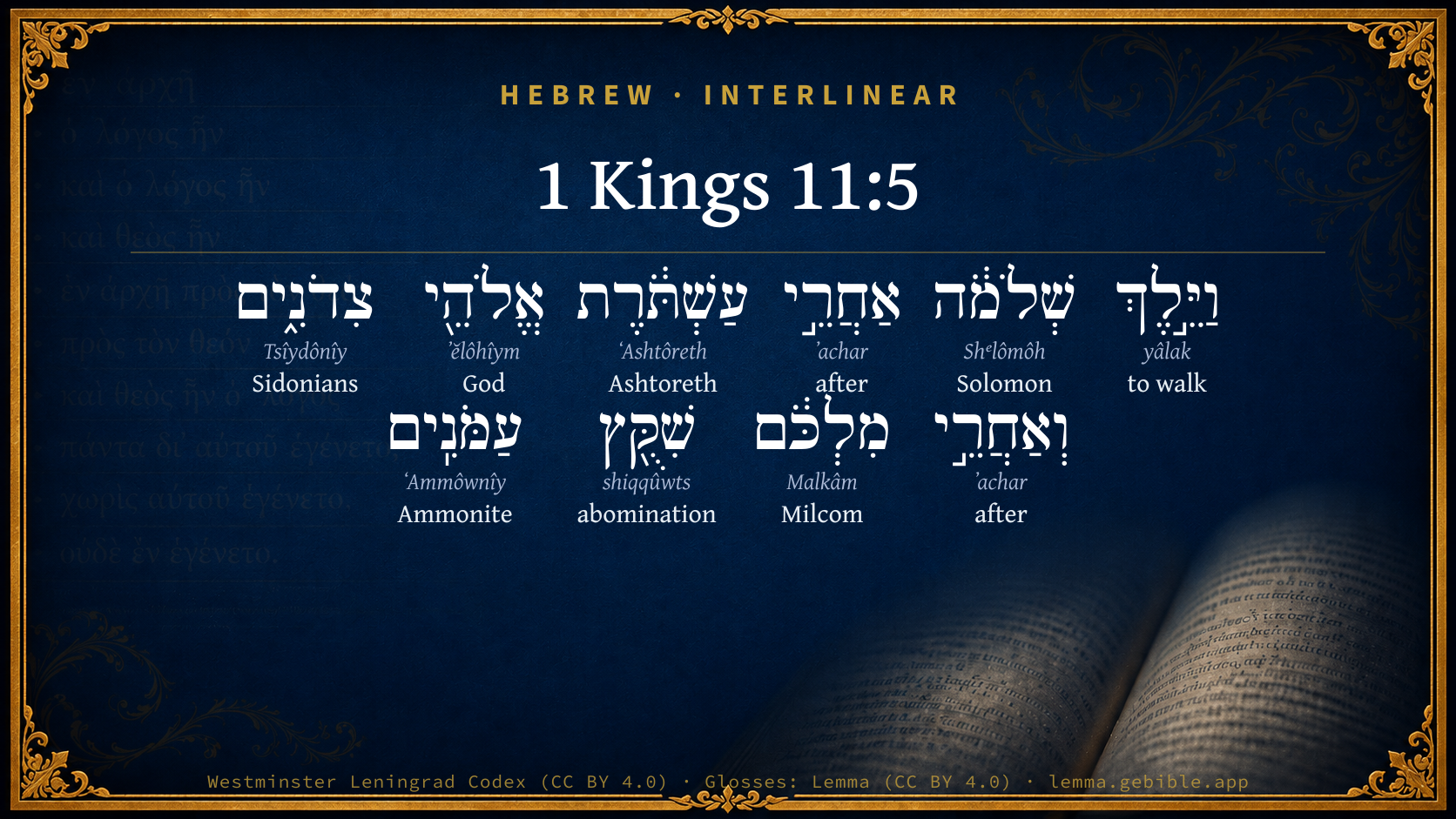
1 Kings 11:5

Hebrew (Westminster Leningrad Codex) 1 Kings 11:5 appears in the Hebrew Old Testament. The text above is from the Westminster Leningrad Codex. Each word links to its Strong’s number, a concise gloss, and parsing drawn from the Open Scriptures Hebrew Bible morphology. Click any word for its full Brown-Driver-Briggs (BDB) entry.
Download image
Cite this verse

1 Kings 11:5 (World English Bible). Public Domain. Lemma interlinear Bible study tool, https://lemma.gebible.app/v/1-kings/11/5.

Show BibTeX & RIS
BibTeX
RIS
English Translation
For Solomon went after Ashtoreth the goddess of the Sidonians, and after Milcom the abomination of the Ammonites.
World English Bible · Public Domain
Highlights Full analysis ↓
Download a study sheet

One document with this verse’s original text, its word-by-word gloss line, the meaning frame, cross-references with their text, attributed commentary, and full source and license credits — printable, and it pastes into notes with its structure intact.

This verse Autodidact and up

Study sheet (.html) Plain text (.txt)

A passage Seminary Student

Up to 50 verses in one chapter. A passage sheet keeps up to 6 commentary sources and 12 cross-references per verse, in the order this page ranks them, and says so on the sheet whenever that leaves anything out. Ask for a single verse and you get the Autodidact verse sheet above.

Everything on this page stays free to read, with no account — the sheet is a download of what is already on screen, not access to it.

Want to remove ads? Support Godless Engineer
Compare translations 3

The same verse in 3 English versions, stacked beneath the original-language interlinear above. Click any original word for its lexicon entry.

Each is an independent rendering of the whole verse — the interlinear is not word-aligned to these translations.

Highlighted words mark where these versions differ — a whole-verse word diff, not a word-by-word alignment.

  • World English Bible Public Domain
    For Solomon went after Ashtoreth the goddess of the Sidonians, and after Milcom the abomination of the Ammonites.
  • King James Version Public Domain
    For Solomon went after Ashtoreth the goddess of the Zidonians, and after Milcom the abomination of the Ammonites.
  • unfoldingWord Literal Text CC BY-SA 4.0
    And Solomon went after Ashtoreth, the goddess of the Sidonians, and after Milcom, the abomination of the Ammonites.

unfoldingWord Literal Text — © unfoldingWord, licensed CC BY-SA 4.0. Word-aligned USFM3 via Door43 (git.door43.org/unfoldingWord/en_ult).

Versions to compare (up to 4)

3 of 4 selected

Show all 18 translations

Every available English version of this verse, each an independent rendering of the whole verse.

  • World English Bible Public Domain
    For Solomon went after Ashtoreth the goddess of the Sidonians, and after Milcom the abomination of the Ammonites.
  • Berean Standard Bible Public Domain
    Solomon followed Ashtoreth the goddess of the Sidonians and Milcom the abomination of the Ammonites.
  • Majority Standard Bible Public Domain
    Solomon followed Ashtoreth the goddess of the Sidonians and Milcom the abomination of the Ammonites.
  • King James Version Public Domain
    For Solomon went after Ashtoreth the goddess of the Zidonians, and after Milcom the abomination of the Ammonites.
  • American Standard Version (1901) Public Domain
    For Solomon went after Ashtoreth the goddess of the Sidonians, and after Milcom the abomination of the Ammonites.
  • Revised Version (1885) Public Domain
    For Solomon went after Ashtoreth the goddess of the Zidonians, and after Milcom the abomination of the Ammonites.
  • Geneva Bible (1599) Public Domain
    For Salomon followed Ashtaroth the god of the Zidonians, and Milcom the abomination of the Ammonites.
  • Douay-Rheims (1899) Public Domain
    But Solomon worshipped Astarthe the goddess of the Sidonians, and Moloch the idol of the ammonites.
  • Young's Literal Translation Public Domain
    And Solomon goeth after Ashtoreth god`dess' of the Zidonians, and after Milcom the abomination of the Ammonites;
  • Literal Standard Version CC BY-SA 4.0
    And Solomon goes after Ashtoreth goddess of the Zidonians, and after Milcom the abomination of the Ammonites;
  • Unlocked Literal Bible CC BY-SA 4.0
    For Solomon followed Ashtoreth, the goddess of the Sidonians, and he followed Molech, the disgusting idol of the Ammonites.
  • unfoldingWord Literal Text CC BY-SA 4.0
    And Solomon went after Ashtoreth, the goddess of the Sidonians, and after Milcom, the abomination of the Ammonites.
  • Darby Bible Public Domain
    And Solomon went after Ashtoreth the goddess of the Zidonians, and after Milcom the abomination of the Ammonites.
  • World Messianic Bible Public Domain
    For Solomon went after Ashtoreth the goddess of the Sidonians, and after Milcom the abomination of the Ammonites.
  • Webster's Bible Public Domain
    For Solomon went after Ashtoreth the goddess of the Zidonians, and after Milcom the abomination of the Ammonites.
  • Free Bible Version CC BY-SA 4.0
    Solomon worshiped Ashtoreth, goddess of the Sidonians, and Molech, the vile god of the Ammonites.
  • Bible in Basic English Public Domain
    For Solomon went after Ashtoreth, the goddess of the Zidonians, and Milcom, the disgusting god of the Ammonites.
  • JPS Tanakh (1917) Public Domain
    For Solomon went after Ashtoreth the goddess of the Zidonians, and after Milcom the detestation of the Ammonites.

Literal Standard Version (2020), Covenant Press — licensed CC BY-SA 4.0. Text via the HelloAO Bible API (eBible.org). Unlocked Literal Bible (unfoldingWord) — licensed CC BY-SA 4.0. Text via the HelloAO Bible API (eBible.org). unfoldingWord Literal Text — © unfoldingWord, licensed CC BY-SA 4.0. Word-aligned USFM3 via Door43 (git.door43.org/unfoldingWord/en_ult). Free Bible Version, Dr. Jonathan Gallagher — licensed CC BY-SA 4.0. Text via the HelloAO Bible API (eBible.org).

Word by word

More ways to search: Search by grammar → Find every occurrence → Compare this word →

Practice this passage: Drill this verse → Learn its vocabulary →

About this verse

These counts appear in no published source. They are computed here, from the morphology-tagged text and Lemma’s own curated glosses. What Lemma adds →

10
words
9
distinct lemmas
Historical
section

Notable vocabulary

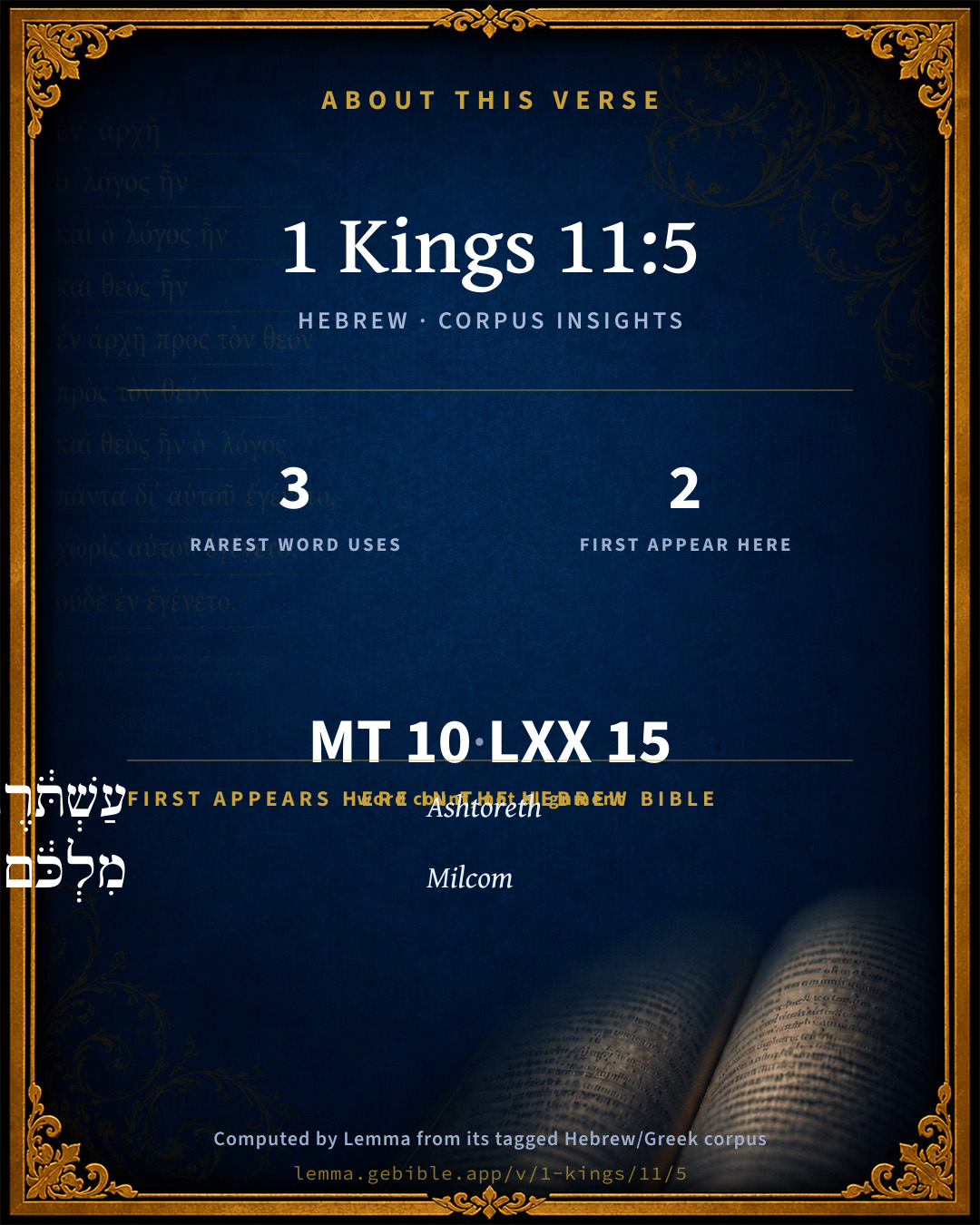
The rarest word here is עַשְׁתֹּ֔רֶת Ashtoreth H6253 — appearing just 3 times in the whole Hebrew Bible.

First appearance in Scripture

These words make their first canonical appearance in the Hebrew Bible here:

  • עַשְׁתֹּ֔רֶת Ashtoreth H6253
  • מִלְכֹּ֔ם Milcom H4445

Shared distinctive vocabulary

עַשְׁתֹּ֔רֶת Ashtoreth H6253 occurs in 3 verses of the Hebrew Bible. Also found in:

Grammatical profile

  • 1 verb
  • 7 nouns
  • 2 prepositions

Verb forms

  • וַיֵּ֣לֶךְ Qal · Sequential Imperfect

Repetition

A word recurs within this verse — often emphatic in Hebrew:

  • אַחֲרֵ֣י after H310 ×2

Hebrew & Septuagint length

In English translation the verse runs 18 words from the Hebrew and 8 from the Septuagint (LXX English) — the Septuagint runs noticeably shorter here. See the side-by-side →

A rough comparison of the two English renderings, which tokenize alike — not a word-level alignment.

Word counts can differ between the Hebrew and the Greek without any difference in meaning — e.g. the Hebrew direct-object marker אֵת has no separate Greek word, and Greek often adds the article ὁ.

In the original languages it is 10 Hebrew tokens and 15 Greek tokens — but the two are counted differently (Hebrew bundles its prefixes and suffixes into one token; the Greek is in lemma form), so that isn’t a like-for-like length.

Cross-references

11

Topical passages linked to 1 Kings 11:5 in the Treasury of Scripture Knowledge — connected by theme and wording, ordered by reader-vote popularity; previews shown in the World English Bible.

  • Judges 2:13 They forsook Yahweh, and served Baal and the Ashtaroth.
  • 1 Kings 11:7 Then did Solomon build a high place for Chemosh the abomination of Moab, on the mountain that is before Jerusalem, and for Molech the abomination of the children of Ammon.
  • 1 Kings 11:33 because that they have forsaken me, and have worshiped Ashtoreth the goddess of the Sidonians, Chemosh the god of Moab, and Milcom the god of the children of Ammon; and they have not walked in my ways, to do that which is right in my eyes, and [to keep] my statutes and my ordinances, as did David his father.
  • 2 Kings 23:13 The high places that were before Jerusalem, which were on the right hand of the mountain of corruption, which Solomon the king of Israel had built for Ashtoreth the abomination of the Sidonians, and for Chemosh the abomination of Moab, and for Milcom the abomination of the children of Ammon, did the king defile.
  • Judges 10:6 The children of Israel again did that which was evil in the sight of Yahweh, and served the Baals, and the Ashtaroth, and the gods of Syria, and the gods of Sidon, and the gods of Moab, and the gods of the children of Ammon, and the gods of the Philistines; and they forsook Yahweh, and didn't serve him.
  • 1 Samuel 7:3–4 Samuel spoke to all the house of Israel, saying, If you do return to Yahweh with all your heart, then put away the foreign gods and the Ashtaroth from among you, and direct your hearts to Yahweh, and serve him only; and he will deliver you out of the hand of the Philistines.
  • Leviticus 18:21 "'You shall not give any of your children to sacrifice to Molech; neither shall you profane the name of your God: I am Yahweh.
  • Leviticus 20:2–5 "Moreover, you shall tell the children of Israel, 'Anyone of the children of Israel, or of the strangers who live as foreigners in Israel, who gives any of his seed to Molech; he shall surely be put to death. The people of the land shall stone him with stones.
  • 1 Samuel 12:10 They cried to Yahweh, and said, We have sinned, because we have forsaken Yahweh, and have served the Baals and the Ashtaroth: but now deliver us out of the hand of our enemies, and we will serve you.
  • Jeremiah 2:10–13 For pass over to the isles of Kittim, and see; and send to Kedar, and consider diligently; and see if there has been such a thing.
  • Zephaniah 1:5 those who worship the host of the sky on the housetops, those who worship and swear by Yahweh and also swear by Malcam,

Cross-references courtesy of OpenBible.info (CC BY 4.0).

Hebrew and Greek witnesses Masoretic Hebrew ↔ Greek Septuagint

The same verse in the two great witnesses to the Old Testament, shown verse-for-verse.

Here the Septuagint runs noticeably shorter than the Hebrew — LXX2012 (modern English Septuagint) 8 words vs World English Bible 18. A rough length comparison of the two English translations, not a word-level alignment — read both below.

These are two independent witnesses, not word-aligned to each other, and the Septuagint is shown in lemma (dictionary) form.

Hebrew 1 Kings 11:5 Masoretic · Westminster Leningrad Codex

וַיֵּ֣לֶךְ שְׁלֹמֹ֔ה אַחֲרֵ֣י עַשְׁתֹּ֔רֶת אֱלֹהֵ֖י צִדֹנִ֑ים וְאַחֲרֵ֣י מִלְכֹּ֔ם שִׁקֻּ֖ץ עַמֹּנִֽים

For Solomon went after Ashtoreth the goddess of the Sidonians, and after Milcom the abomination of the Ammonites.

World English Bible · Public Domain

Greek LXX 1 Kings 11:5 Septuagint · lemma form

τότε οἰκοδομέω σαλωμών ὑψηλός ὁ χαμως εἴδωλον μωαβ καί ὁ βασιλεύς αὐτός εἴδωλον υἱός αμμων

and to Astarte the abomination of the Sidonians.

LXX2012 (modern English Septuagint) · Public Domain

Hebrew: Westminster Leningrad Codex (CC BY 4.0). Greek: Septuagint (public domain); English from LXX2012 (modern English Septuagint) (Public Domain). How the Septuagint differs from the Hebrew →

Targum (Aramaic paraphrase)

1

The Targum is the ancient Jewish Aramaic paraphrase of the Hebrew Scriptures — an interpretive translation, not the Hebrew text itself. Onkelos (literal) and Pseudo-Jonathan (expansive) render the Torah, and Jonathan the Prophets. Coverage is partial: where no permissively-licensed English translation exists for a verse, only the Aramaic is shown. This is verse-level text, not a word-by-word alignment to the Hebrew.

  1. Targum Jonathan Prophets (Joshua–Malachi)
    וַאֲזַל שְׁלֹמֹה בָּתַר עַשְׁתּוֹרֶת טַעֲוַת צִידוֹנָאֵי וּבָתַר מִלְכּוֹם שִׁקוּץ עַמוֹנָאֵי:

    (no public-domain English translation for this verse)

    Targum Jonathan — Aramaic: “Mikraot Gedolot” (public domain). English: “Sefaria Community Translation” (CC0 1.0 (public-domain dedication)); “London "Chaldee Paraphrase," 1871” (public domain). Text via Sefaria.

Commentary

Notes on 1 Kings 11:5 from classic Christian and Jewish commentators (each source and its license shown beneath its notes). The classic Christian expositions comment on the surrounding passage and are grouped to its opening verse, so a note may address several verses; the Jewish commentaries on the Tanakh (Rashi and others) are per-verse, so they appear only where the commentator wrote on this verse.

Lemma curates 59 commentaries, every one of them public domain or Creative Commons licensed, each selected and text-cleaned for this edition rather than reprinted as found. About our sources →

Trapp's Complete Commentary

John Trapp

1Ki 11:5 For Solomon went after Ashtoreth the goddess of the Zidonians, and after Milcom the abomination of the Ammonites.

Ver. 5. For Solomon went after Ashtoreth,] i.e., Venus, as some will have it, or Juno, as others.

And after Milcom,] i.e., Saturn, as it is thought. Hinc patet Solomonem vere coluisse idola, saith A Lapide: hence it appeareth that Solomon did indeed worship idols: yea, Pineda and Salianus say, that he sacrificed his sons to this Milcom or Moloch. But I cannot be of that mind. He gave way, indeed, to those idolatries, and built temples for those dunghill deities, &c., atque ita obnubilabat gloriae multiplices cursus, as Marcellinus saith of Julian, and thereby be much dishonoured and endangered himself; carnal love drowning his zeal to God.

John Trapp, A Commentary or Exposition upon All the Books of the Old and New Testament (1647–1656) — public domain. Text from a community e-Sword module.

Joseph Benson's Commentary

1Ki 11:5-7. Solomon went after Ashtoreth — Called also Astarte. See on Jdg 2:13. And after Milcom — The same, it is thought, with Molech, who is here called an abomination, because highly detested by God. Solomon built a high place for Chemosh — That is, an altar upon a high place, as the manner of the heathen was. Concerning Chemosh, see Num 21:29. In the hill that is before Jerusalem — In the mount of Olives, which was nigh to Jerusalem, as if to confront the temple. From this act this hill was called the mount of corruption, 2Ki 23:13. O sad effects of riches and prosperity on mankind! How insolent do they make them, and how forgetful of God! Wisely did Agar pray, Give me not riches, lest I be full and say, Who is the Lord?

Joseph Benson's Commentary on the Old and New Testaments (1811–1818) — public domain. Text from a community e-Sword module.

Tyndale Open Study Notes

Tyndale Open Resources

11:5 Ashtoreth, the Canaanite goddess of love and war, was widely worshiped in the ancient Near East under names such as Ishtar and Astarte. The cult practices associated with Astarte were transmitted to the Greek world in the worship of the goddess Aphrodite. • Rites in the worship of Molech, the god of the Ammonites, included sacrificing children by fire (11:7; see Lev 20:1-5; 2 Kgs 16:3; 23:5-10; Jer 7:30-33; 19:4-6; 32:35), which the writer properly denounces as detestable.

Tyndale Open Study Notes — © Tyndale Open Resources, licensed CC BY-SA 4.0. Text via the HelloAO Bible API.

Geneva Bible (1599)

Geneva Bible translators

Who was also called Molech, verse 7, read 2 Kings 23:10.

Geneva Bible (1599) marginal notes — public domain. Text via Bolls.life.

Jamieson, Fausset & Brown

Robert Jamieson, A. R. Fausset & David Brown

Ashtoreth--Astarte,

Milcom--Molech,

and Chemosh--He built altars for these three; but, although he is described (Kg1 11:8) as doing the same for "all his strange wives," there is no evidence that they had idols distinct from these; and there is no trace whatever of Egyptian idolatry.

Jamieson, Fausset & Brown — Commentary Critical and Explanatory on the Whole Bible (1871) — public domain (CC PDM 1.0). Text via the HelloAO Bible API.

Ellicott's Commentary for English Readers

(5) Ashtoreth (or, Astarte).—The goddess of the Zidonians, and possibly the Hittites, corresponding to Baal, the great Tyrian god, and representing the receptive and productive, as Baal the active and originative, power in Nature. As usual in all phases of Natureworship, Ashtoreth is variously represented, sometimes by the moon, sometimes by the planet Venus (like the Assyrian Ishtar, which seems a form of the same name)—in either case regarded as “the queen of heaven.” (See Jer_44:17; Jer_44:25). There seems, indeed, some reason to believe that the name itself is derived from a root which is found both in Syriac and Persian, and which became aster in the Greek and astrum in Latin, and has thence passed into modern European languages, signifying a “star,” or luminary of heaven. With this agrees the ancient name, Ashterôth-Karnaîm (or, “the horned Ashteroth”)of a city in Bashan (Gen_14:5; Deu_1:4; Jos_13:12). This place is the first in which the name Ashtoreth is used in the singular number, and expressly limited to the “goddess of the Ziaonians.” In the earlier history we hear not unfrequently of the worship of the “Ashtaroth,” that is, of the “Ashtoreths,” found with the like plural Baalim, as prevalent in Canaan, and adopted by Israel in evil times (see Jdg_2:13; Jdg_10:6; 1Sa_7:3; 1Sa_12:10; 1Sa_31:10); and the worship of the Asherah (rendered “groves” in the Authorised version), may perhaps refer to emblems of Astarte. In these cases, however, it seems not unlikely that the phrase, “Baalim and Ashtaroth,” may be used generally of the gods and goddesses of various kinds of idolatry. The worship of the Tyrian Ashtoreth, as might be supposed from the idea which she was supposed to represent, was one of chartered license and impurity.

Milcom, the abomination of the Ammonites.—The name Milcom (like the Malcham of Jer_49:1; Jer_49:3) is probably only a variety of the well-known Molech, which is actually used for it in 1Ki_11:7. The name “Molech” (though here connected expressly with the Ammonite idolatry) is a general title, signifying only “king” (as Baal signifies “lord”), and might be applied to the supreme god of any idolatrous system. Thus the worship of “Molech,” with its horrible sacrifice of children “passing through the fire,” is forbidden in Lev_18:21; Lev_20:2, evidently as prevailing among the Canaanite races (comp. Psa_106:37-38). Again, we know historically that similar sacrifice of children, by the same horrible rite, was practised by the Carthaginians in times of great national calamity—the god being in that case identified with Saturn, the star of malign influence. By comparison of Jer_7:31; Jer_19:5-6, it is very evident that this human sacrifice to Molech is also called “a burnt-offering to Baal;” and if Molech was the “fire-god,” and Baal the “sun-god,” the two deities might easily be regarded as cognate, if not identical. It is notable that, in this place, while Ashtoreth is mentioned, there is no reference to any worship of the Phœnician Baal as such; possibly the Ammonite Molech-worship may have occupied its place. In any case, as the worship of Ashtoreth was stained with impurity, so the Molech-worship was marked by the other foul pollution of the sacrifice of human blood.

Chemosh, the abomination of the Moabites.—The name Chemosh probably means “the Conqueror,” or “Subjugator,” and indicates a god of battles. He is again and again described as the god of the Moabites who are called “the people of Chemosh” (see Num_21:29; Jer_48:7; Jer_48:13; Jer_48:46); and the Moabite Stone speaks of the slain in war as an offering to Chemosh, and even refers to a deity, “Ashtar-Chemosh,” which looks like a conjunction of Chemosh, like Baal, with Ashtoreth. In Jdg_11:24, Jephthah refers to Chemosh as the god of the Ammonite king, an expression which may indicate a temporary supremacy of Moab over Ammon at that time, through which the name “Chemosh” superseded the name “Milcom” as descriptive of the Supreme Power. In the history, moreover, of the Moabite war against Jehoram (2Ki_3:26-27) it seems that to Chemosh, as to Molech, human sacrifice was offered.

Probably, in actual practice the various worships of the Tyrians and Canaanites, the Ammonites and the Moabites might run into each other. Unlike the awful and exclusive reverence to the Lord Jehovah, the devotion of polytheistic systems readily welcomes strange gods into its Pantheon. Polytheism is also apt to pass into what has been called “Henotheism,” in which, of many gods each is for the moment worshipped, as if he stood alone, and concentrated in himself the whole attributes of deity. The generality and similarity of meaning in the names, Baal (“lord”), Molech (“king”), and Chemosh (“conqueror”), seem to point in this direction. Still, these worships are described as taking, in Jerusalem, distinct forms and habitations, which continued till the days of Josiah (2Ki_23:13), no doubt disused and condemned in days of religious faithfulness, such as those of Jehoshapliat and Hezekiah, but revived, and associated with newer idolatries, in days of apostasy.

A Bible Commentary for English Readers, edited by Charles John Ellicott (1878–1897) — public domain. Text from a community e-Sword module.

The Cambridge Bible for Schools and Colleges

gen. ed. J. J. S. Perowne

5. Ashtoreth the goddess of the Zidonians] Ashtoreth was the chief female divinity of the Phœnicians, as Baal was their chief male deity. As Baal has been identified with the sun, so Ashtoreth has by some been thought to be the moon. Recent investigations have however connected the name of Ashtoreth with the planet Venus, and by some it is thought that the name was applied in some parts of the Phœnician settlements to Venus, in others to the moon. Ashtoreth is identified with the Greek Ἀστάρτη, and the name of an ancient city (Gen_14:5) Ashteroth-Karnaim, i.e. Ashteroth of the two horns, seems to point to the crescent moon. This is accepted by Milton (Par. L. I. 438).

‘Ashtoreth, whom the Phœnicians called

Astartè, queen of heaven, with crescent horns

To whose bright image, nightly by the moon

Sidonian virgins paid their vows and songs.’

The worship of Ashtoreth was very widespread, as might be expected from the wide commercial relations, and distant colonies, of the Phœnicians. Why Ashtoreth is here named ‘goddess’ while the other deities are called ‘abominations’ may be due to the greater intercourse between Sidon and the Holy Land than existed with other countries. The Phœnician workmen at the Temple had perhaps caused the Israelites to become more accustomed to the name and worship of Ashtoreth.

Milcom the abomination of the Ammonites] This is the same divinity who is called below (1Ki_11:7) Molech, and in Zep_1:5 Malcham. Molech was a fire god, and was worshipped with human sacrifices. The root of the word is the same as that of the Hebrew word for ‘king.’ Hence some think ‘their king’ in 2Sa_12:30 means Molech, the god of the Ammonites. There are numerous allusions in the Old Test. to the worship of this god, the phrase most common being ‘to make their children to pass through the fire to Molech.’ See 2Ki_23:10; 2Ki_23:13. Some have explained this not as actual burning of the children to death, but as a passing of them between two fires for an ordeal of purification. But in 2Ch_28:3 it is said of Ahaz, ‘He burnt incense in the valley of the son of Hinnom, and burnt his children in the fire, after the abominations of the nations whom Jehovah had driven out.’ And the actual burning of the children thus offered is alluded to very plainly in Jer_7:31, ‘They have built the high places of Tophet, … to burn their sons and their daughters in the fire.’ The tradition is that the statue of Molech was of brass and the hands so arranged that the victim slipped from them into a fire which burnt underneath. It may be because there were no such sacrifices offered to Ashtoreth, that she is not spoken of as ‘an abomination.’

The Cambridge Bible for Schools and Colleges (gen. ed. J. J. S. Perowne; Cambridge University Press, 1878–1918) — public domain. Text from a community e-Sword module.

John Gill's Exposition

And Solomon went after Ashtoreth the goddess of the Zidonians,.... Enticed by the Zidonian women, or woman, he had, Kg1 11:1. According to the Phoenician histories (i), Solomon married a daughter of Hiram, king of Tyre and Zidon; so Clemens of Alexandria says (k), that Hiram gave his daughter to Solomon; Ashtoreth is Astarte, the same with the Venus of the Greeks, so Suidas (l); and Lucian (m) expressly says, the Sidonians had a temple, said by them to belong to Astarte, which he takes to be the moon; and both Venus and Juno signify the same planet; See Gill on Jdg 2:13.

and after Milcom the abomination of the Amnonites; the same with Molech, Kg1 11:7. See Gill on Lev 18:21. See Gill on Amo 1:13. After this he was drawn by his Ammonitish wife, or wives, Kg1 11:1, though the Jewish writers think he did not worship these idols, but suffered his wives to do it, and connived at it, which was his sin; so Ben Gersom and Abarbinel.

(i) Apud Tatian. contr. Graecos, p. 171. (k) Stromat. l. 1. p. 325. (l) In voce (m) De Dea Syria.

John Gill's Exposition of the Whole Bible (1746–1763) — public domain (CC PDM 1.0). Text via the HelloAO Bible API.

Albert Barnes' Notes on the Bible

Went after - This expression is common in the Pentateuch, and always signifies actual idolatry (see Deu 11:28; Deu 13:2; Deu 28:14, etc.).

For Ashtoreth, or Astarte, the goddess of the Zidonians, see Exo 34:13, note; Deu 16:21, note. On the tomb of a Phoenician king, discovered in 1855, on the site of Sidon, mention is made of a temple of Astarte there, which the monarch built or restored; and his mother is said to have been a priestess of the goddess.

Milcom or Molech 1Ki 11:7 are variants of the term ordinarily used for “king” among the Semitic races of Western Asia, which appears in melkarth (Phoenic.), Abimelech (Hebrew), Andrammelek (Assyrian), Abd-ul-malik (Arabic), etc. On the character and worship of Molech, see Lev 20:2-5 note.

Albert Barnes' Notes on the Bible (1834–1885) — public domain. Text from a community e-Sword/MySword module.

Haydock's Catholic Bible Commentary

Astarthe. Hebrew Hashtoreth, "ewes," is in the plural form, as if to denote many idols. But the moon, or the queen of heaven, (Jeremias vii. 18.) is particularly designated, Judges ii. 12. (Haydock) --- Some explain it of Venus, (Sanctius) or Juno. (Tirinus) --- Moloch. Hebrew Molciom, (their king) "the abomination;" (Haydock) supposed to be the sun, (Sanctius) or saturn. (Tirinus) See 4 Kings xxiii. 10.

George Leo Haydock (1774–1849), Haydock's Catholic Family Bible and Commentary, 1859 edition — public domain. Excludes Psalms (Douay-Rheims chapter numbering differs from Protestant) and Deuterocanonical books (Catholic canon only).

Matthew Poole's English Annotations

Solomon went after Ashtoreth, in manner explained in the former verse. Milcom, called also Molech; of which see Lev 18:21; 2Ki 23:10.

Matthew Poole's English Annotations on the Holy Bible (1683–1685) — public domain. Text from a community e-Sword/MySword module.

Whedon's Commentary on the Bible

Daniel D. Whedon

5. Went after — This expression seems to show that Solomon was actually guilty of idolatry. Compare Deu_11:28; Deu_13:2; Deu_28:14. Yet the exact extent to which he went into idolatry is left uncertain. He probably never so far apostatized as to forget Jehovah, and neglect the ordinary service of the temple.

Ashtoreth — See on Jdg_2:13.

Milcom — Called also Molech, (1Ki_11:7;) and Moloch. Amo_5:26. The fire god of the Ammonites, an abomination, particularly in that he was worshipped by the offering of human sacrifices. See on Lev_18:21.

Some have distinguished Milcom and Molech as two different deities, chiefly because of the difference in the names and because they seem, in 2Ki_23:10; 2Ki_23:13, to have been worshipped at two different places, the Mount of Olives and the Valley of Hinnom. But the similarity of the names, both from the same Hebrews root, (מלכם מלךְ,) is a stronger argument for their identity than the slight difference is for the contrary; and the same idol may have been worshipped in two different places near Jerusalem.

Daniel D. Whedon (gen. ed.), Commentary on the Old and New Testaments (1874–1909) — public domain. Text from a community e-Sword module.

The Pulpit Commentary

For Solomon went after Rawlinson observes that this expression, which is "common in the Pentateuch, always signifies actual idolatry." He cites. Deu_11:28 Deu_13:2 Deu_28:14; but it should be considered that in the two passages last cited the words are added, "and served them." And the true explanation would seem to be that, though "it is not stated that Solomon himself offered sacrifice to these idols," yet "even the building of altars for idols was a participation in idolatry, which was irreconcilable with true fidelity to the Lord" (Keil) Bahr contends that the words "went after Ashtoreth," etc., no more involve personal service than the word "built" in ver. 7 involves personal labour; but both expressions show that he regarded these idolatries not only without disfavour, but with positive approval and practical encouragement. "It is not likely he could be so insensate as to adore such deities, but so far was the uxorious king blinded with affection, that he gave not passage only to the idolatry of his heathenish wives, but furtherance" (Bp. Hall). And the distinction, so far as the sin is concerned, between this and actual idolatry is a fine one. It is not implied, however, that Solomon ever discarded the worship of Jehovah. To the end of his reign he would seem to have offered his solemn sacrifices on the great altar thrice a year. But his heart was elsewhere (ver. 9). Ashtoreth the goddess of the Zidonians trTov jAstarth, probably connected with ajsthr, stella, and star, by some identified with the planet Venus, by others with the moon, is here mentioned for the first time in the singular (Ashtaroth, plural, is found in Gen_14:5; Jud_1:2:13 10:6; 1Sa_7:4 1Sa_12:10, etc.) With Baal, she divided the worship of the Phoenicians, the antiquity of which is evident from Gen_14:5; Num_22:41. It was really an impure cultus of the reproductive powers (see below on 14:23). Interesting proof of the existence of a temple of this goddess at Sidon is supplied by an inscription discovered there in 1855 (see Dict. Bib. 1:123), and after Milcom In Jer_49:13; Amo_1:15, "Malcam," i.e., their king. According to Gesenius, the same as Molech (i.e. , the king) in ver. 7, though Ewald, Movers, Keil regard them as different deities. But it seems more probable that it was the same deity, worshipped (2Ki_23:10, 2Ki_23:13) under different attributes. This is "the first direct historical allusion" to his worship in the Old Testament. A warning against it is found Lev_20:2-5. He was the fire god, as Baal was the sun god, and the sacrifices offered to him were those of children, who would seem to have not only "passed through the fire," but to have been burnt therein. Psa_106:37, Psa_106:38; Jer_7:31 Jer_19:5 Eze_23:39, etc. See Dict. Bib. 2:403 the abomination i.e., the hateful, detestable idol of the Ammonites. It has been suggested (Speaker"s Commentary on Lev_20:2) that the children offered to Molech were children of incest or adultery., and we are reminded that Ammon was the child of incest. It must he remembered, however, that we have no record of Jewish children passing through the fire to Molech before the time of Ahaz (Bahr, Keil).

The Pulpit Commentary (1880–1919), ed. H.D.M. Spence-Jones & Joseph S. Exell — public domain. Text from a community e-Sword module.

John Wesley's Explanatory Notes

Milcom - Called also Moloch.

John Wesley, Explanatory Notes Upon the Whole Bible (1754–1765) — public domain. Text via the GEBible commentary corpus.

Scofield Reference Notes

C. I. Scofield

Ashtoreth

1Ki 11:33. (See Scofield "Jdg 2:13").

The Scofield Reference Bible (1917 edition), notes by C. I. Scofield — public domain. Text from a community e-Sword module.

unfoldingWord translationNotes

Door43 World Missions Community

Ashtoreth ... Molech

These are the names of false gods. (See: How to Translate Names)

Sidonians

This is the name of a people group. (See: How to Translate Names)

he followed Molech

Some version render this as "Milcom." (See: How to Translate Names)

what was evil in the sight of Yahweh

The phrase, "in the sight of" refers to someone's opinion. AT: "what Yahweh considered to be evil" (See: Metaphor)

translationWords

false god

evil

unfoldingWord translationNotes — © Distant Shores Media and the Door43 World Missions Community, licensed CC BY-SA 4.0. Source: git.door43.org/Door43/en_tn.

Lesson kit

Teaching starters — assembled from the data on this page, not authored interpretation. Every prompt links to the verse data it draws on. Edit before teaching.

1 Kings, in the Historical, opens this verse with 10 words (9 distinct Hebrew lemmas). Its most distinctive word is ʻAshtôreth (“Ashtoreth”). The Greek Septuagint runs shorter here. A historical commentator’s framing appears above. Read the whole chapter for the surrounding context.

Discussion questions

  1. What does “Ashtoreth” (ʻAshtôreth) contribute to the verse as a whole?
  2. 2 words here appear for the first time in Scripture. What is being introduced at this debut?
  3. 1 Kings 11:33 shares the word «Ashtoreth» with this verse. How do the two illuminate each other?
  4. “after” occurs 2× in this one verse. What is the effect of the repetition?
  5. Compared with the Hebrew, the Septuagint runs shorter here. What questions does that raise?
  6. The translations on this page render this verse differently — a whole-verse word diff, not a word-by-word alignment. What might account for the different wordings?
  7. The verb «וַיֵּ֣לֶךְ» is Qal Sequential Imperfect. How does its form color the action?
  8. Reading how Trapp's Complete Commentary and Joseph Benson's Commentary read this verse, where do the two commentators agree and where do they part?

Things to notice

Reading settings

Reading text

Shown beneath each verse's original-language words.

Old Testament
Old Testament edition

Read the OT as the Masoretic Hebrew (MT) or the Greek Septuagint (LXX).

English shown for the Greek Septuagint (in the Hebrew ↔ Greek comparison).

Comparing translations? Open the Compare panel on any verse page to stack up to four side by side.