
Romans 12:16

Greek (Tischendorf 8th ed.) Romans 12:16 appears in the Greek New Testament. The text above is from the Tischendorf 8th edition. Each word links to its Strong’s number and a concise gloss. Click any word for its full Thayer’s Greek Lexicon entry.
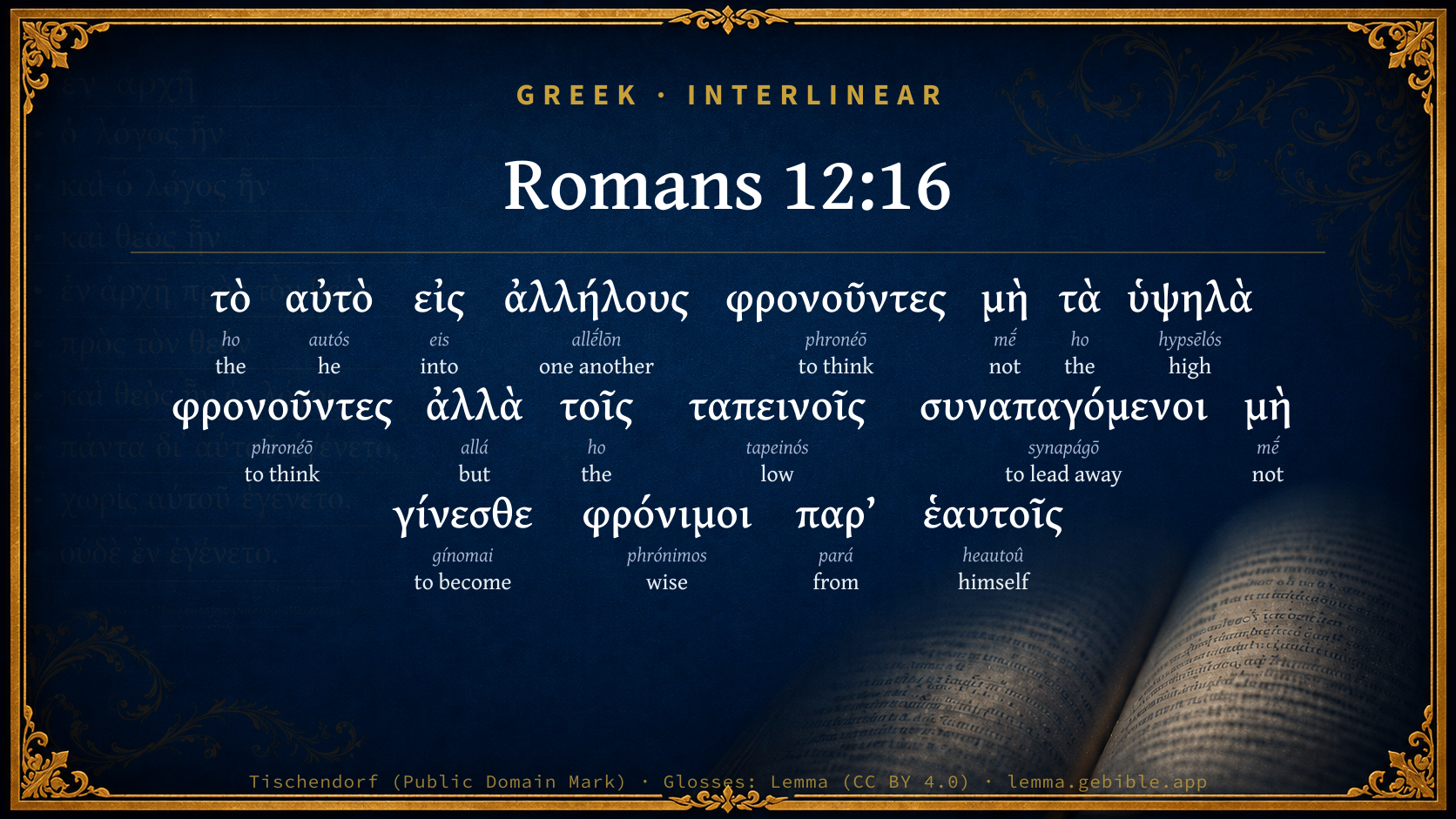
Download image
Cite this verse

Romans 12:16 (World English Bible). Public Domain. Lemma interlinear Bible study tool, https://lemma.gebible.app/v/romans/12/16.

Show BibTeX & RIS
BibTeX
RIS
English Translation
Be of the same mind one toward another. Don't set your mind on high things, but associate with the humble. Don't be wise in your own conceits.
World English Bible · Public Domain
Highlights
  • 1 first appearance in the Greek New Testament
Full analysis ↓
Download a study sheet

One document with this verse’s original text, its word-by-word gloss line, the meaning frame, cross-references with their text, attributed commentary, and full source and license credits — printable, and it pastes into notes with its structure intact.

This verse Autodidact and up

Study sheet (.html) Plain text (.txt)

A passage Seminary Student

Up to 50 verses in one chapter. A passage sheet keeps up to 6 commentary sources and 12 cross-references per verse, in the order this page ranks them, and says so on the sheet whenever that leaves anything out. Ask for a single verse and you get the Autodidact verse sheet above.

Everything on this page stays free to read, with no account — the sheet is a download of what is already on screen, not access to it.

Want to remove ads? Support Godless Engineer
Compare translations 3

The same verse in 3 English versions, stacked beneath the original-language interlinear above. Click any original word for its lexicon entry.

Each is an independent rendering of the whole verse — the interlinear is not word-aligned to these translations.

Highlighted words mark where these versions differ — a whole-verse word diff, not a word-by-word alignment.

  • World English Bible Public Domain
    Be of the same mind one toward another. Don't set your mind on high things, but associate with the humble. Don't be wise in your own conceits.
  • King James Version Public Domain
    Be of the same mind one toward another. Mind not high things, but condescend to men of low estate. Be not wise in your own conceits.
  • unfoldingWord Literal Text CC BY-SA 4.0
    thinking the same thing toward one another, not thinking the high things, but accepting the lowly ones. Do not be wise in yourselves;

unfoldingWord Literal Text — © unfoldingWord, licensed CC BY-SA 4.0. Word-aligned USFM3 via Door43 (git.door43.org/unfoldingWord/en_ult).

Versions to compare (up to 4)

3 of 4 selected

Show all 19 translations

Every available English version of this verse, each an independent rendering of the whole verse.

  • World English Bible Public Domain
    Be of the same mind one toward another. Don't set your mind on high things, but associate with the humble. Don't be wise in your own conceits.
  • Berean Standard Bible Public Domain
    Live in harmony with one another. Do not be proud, but enjoy the company of the lowly. Do not be conceited.
  • Majority Standard Bible Public Domain
    Live in harmony with one another. Do not be proud, but associate with the lowly. Do not be conceited.
  • King James Version Public Domain
    Be of the same mind one toward another. Mind not high things, but condescend to men of low estate. Be not wise in your own conceits.
  • American Standard Version (1901) Public Domain
    Be of the same mind one toward another. Set not your mind on high things, but condescend to things that are lowly. Be not wise in your own conceits.
  • Revised Version (1885) Public Domain
    Be of the same mind one toward another. Set not your mind on high things, but condescend to things that are lowly. Be not wise in your own conceits.
  • Geneva Bible (1599) Public Domain
    Be of like affection one towardes another: be not hie minded: but make your selues equall to them of the lower sort: be not wise in your selues.
  • Douay-Rheims (1899) Public Domain
    Being of one mind one towards another. Not minding high things, but consenting to the humble. Be not wise in your own conceits.
  • Young's Literal Translation Public Domain
    of the same mind one toward another, not minding the high things, but with the lowly going along; become not wise in your own conceit;
  • Literal Standard Version CC BY-SA 4.0
    of the same mind toward one another, not minding the high things, but with the lowly going along; do not become wise in your own conceit;
  • Unlocked Literal Bible CC BY-SA 4.0
    Be of the same mind toward one another. Do not think in proud ways, but accept lowly people. Do not be wise in your own thoughts.
  • unfoldingWord Literal Text CC BY-SA 4.0
    thinking the same thing toward one another, not thinking the high things, but accepting the lowly ones. Do not be wise in yourselves;
  • Darby Bible Public Domain
    Have the same respect one for another, not minding high things, but going along with the lowly: be not wise in your own eyes:
  • World Messianic Bible Public Domain
    Be of the same mind one toward another. Don’t set your mind on high things, but associate with the humble. Don’t be wise in your own conceits.
  • Webster's Bible Public Domain
    Be of the same mind one towards another. Mind not high things, but condescend to men of low estate. Be not wise in your own conceits.
  • Free Bible Version CC BY-SA 4.0
    Think about one another. Don't consider yourself more important than others; live humbly. Don't be conceited.
  • Bible in Basic English Public Domain
    Be in harmony with one another. Do not have a high opinion of yourselves, but be in agreement with common people. Do not give yourselves an air of wisdom.
  • Text-Critical English NT CC BY 4.0
    Be of the same mind toward one another. Do not be haughty, but associate with the lowly. Do not be wise in your own estimation.
  • Tyndale New Testament (1534) Public Domain
    Be of lyke affeccion one towardes another. Be not hye mided: but make youreselves equall to the of the lower sorte. Be not wyse in youre awne opinions.

Literal Standard Version (2020), Covenant Press — licensed CC BY-SA 4.0. Text via the HelloAO Bible API (eBible.org). Unlocked Literal Bible (unfoldingWord) — licensed CC BY-SA 4.0. Text via the HelloAO Bible API (eBible.org). unfoldingWord Literal Text — © unfoldingWord, licensed CC BY-SA 4.0. Word-aligned USFM3 via Door43 (git.door43.org/unfoldingWord/en_ult). Free Bible Version, Dr. Jonathan Gallagher — licensed CC BY-SA 4.0. Text via the HelloAO Bible API (eBible.org).

Word by word

More ways to search: Search by grammar → Find every occurrence → Compare this word →

Practice this passage: Drill this verse → Learn its vocabulary →

συναπαγόμενοι
synapágō
G4879
“to lead away”
Verb, Present, Middle, Participle, Nominative, Plural, Masculine
Part of Speech
Verb
Tense
Present
Voice
Middle
Mood
Participle
Case
Nominative
Number
Plural
Gender
Masculine
Full Thayer's Definition

Origin: from G4862 and G520

TDNT: None

1. to lead away with or together 2. metaph. to be carried away with a. of a thing, i.e. by a thing, so as to experience with others the force of that which carries away b. to yield or submit one's self to lowly things, conditions, employments: not to evade their power
  1. τὸ ho G3588 “the” Article, Accusative, Singular, Neuter
  2. αὐτὸ autós G846 “he” Personal pronoun, Accusative, Singular, Neuter
  3. εἰς eis G1519 “into” Preposition
  4. ἀλλήλους allḗlōn G240 “one another” Reciprocal pronoun, Accusative, Plural, Masculine
  5. φρονοῦντες phronéō G5426 “to think” Verb, Present, Active, Participle, Nominative, Plural, Masculine
  6. μὴ mḗ G3361 “not” Particle, Negative
  7. τὰ ho G3588 “the” Article, Accusative, Plural, Neuter
  8. ὑψηλὰ hypsēlós G5308 “high” Adjective, Accusative, Plural, Neuter
  9. φρονοῦντες phronéō G5426 “to think” Verb, Present, Active, Participle, Nominative, Plural, Masculine
  10. ἀλλὰ allá G235 “but” Conjunction
  11. τοῖς ho G3588 “the” Article, Dative, Plural, Neuter
  12. ταπεινοῖς tapeinós G5011 “low” Adjective, Dative, Plural, Neuter
  13. μὴ mḗ G3361 “not” Particle, Negative
  14. γίνεσθε gínomai G1096 “to become” Verb, Present, Middle or Passive deponent, Imperative, 2nd person, Plural
  15. φρόνιμοι phrónimos G5429 “wise” Adjective, Nominative, Plural, Masculine
  16. παρ’ pará G3844 “from” Preposition
  17. ἑαυτοῖς heautoû G1438 “himself” Reflexive pronoun, 2nd person, Dative, Plural, Masculine

About this verse

These counts appear in no published source. They are computed here, from the morphology-tagged text and Lemma’s own curated glosses. What Lemma adds →

18
words
14
distinct lemmas
Pauline Epistles
section

Notable vocabulary

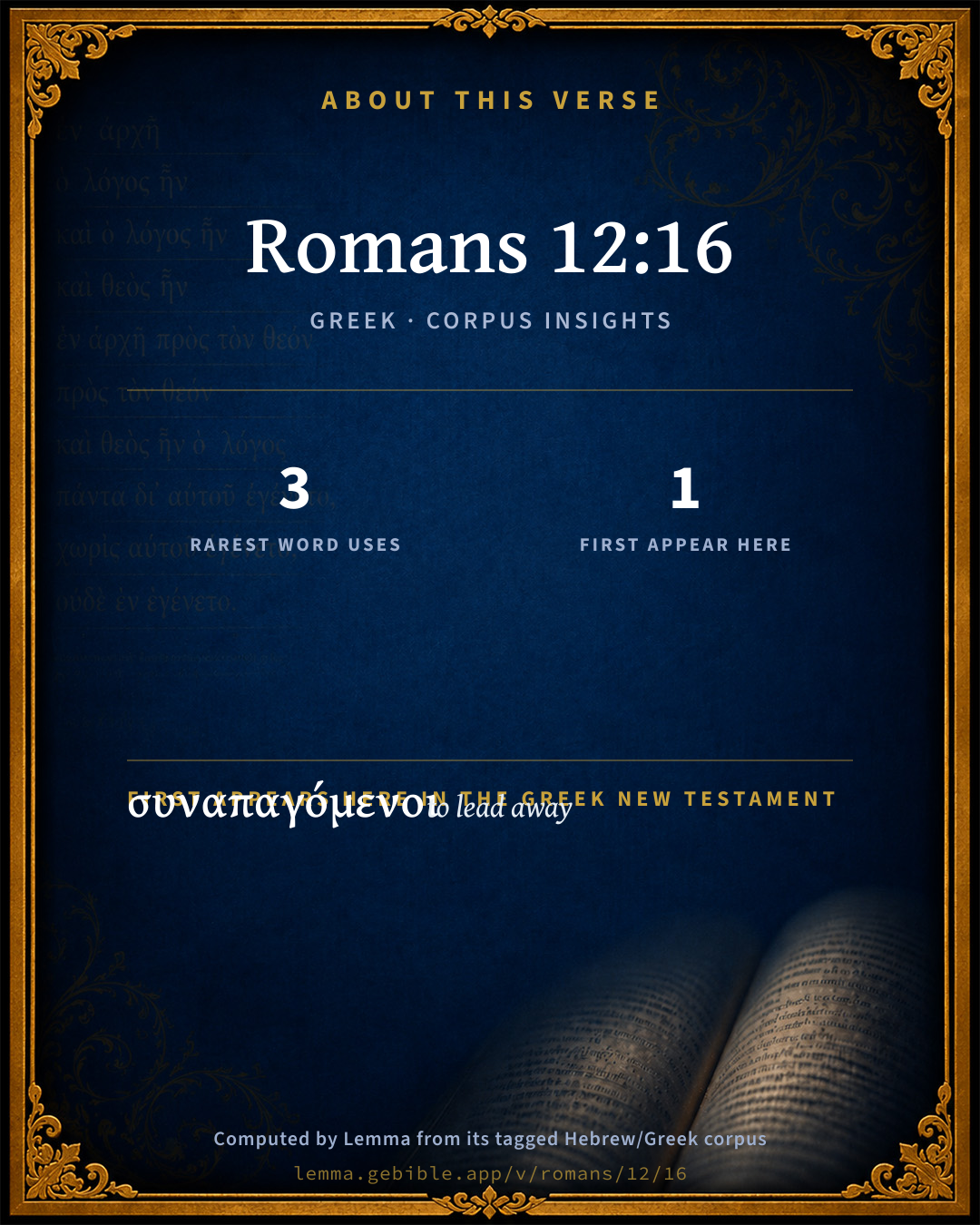
The rarest word here is συναπαγόμενοι to lead away G4879 — appearing just 3 times in the whole Greek New Testament.

First appearance in Scripture

This word makes its first canonical appearance in the Greek New Testament here:

  • συναπαγόμενοι to lead away G4879

Shared distinctive vocabulary

συναπαγόμενοι to lead away G4879 occurs in 3 verses of the Greek New Testament. Also found in:
Repetition

Words recur within this verse:

  • φρονοῦντες to think G5426 ×2
  • τὸ the G3588 ×3
  • μὴ not G3361 ×2

Cross-references

45

Topical passages linked to Romans 12:16 in the Treasury of Scripture Knowledge — connected by theme and wording, ordered by reader-vote popularity; previews shown in the World English Bible.

  • 1 Peter 3:8 Finally, be all like-minded, compassionate, loving as brothers, tenderhearted, courteous,
  • Proverbs 3:7 Don't be wise in your own eyes. Fear Yahweh, and depart from evil.
  • James 3:13–17 Who is wise and understanding among you? Let him show by his good conduct that his deeds are done in gentleness of wisdom.
  • Philippians 2:2–3 make my joy full, by being like-minded, having the same love, being of one accord, of one mind;
  • Romans 12:3 For I say, through the grace that was given me, to every man who is among you, not to think of himself more highly than he ought to think; but to think reasonably, as God has apportioned to each person a measure of faith.
  • Hebrews 13:5 Be free from the love of money, content with such things as you have, for he has said, "I will in no way leave you, neither will I in any way forsake you."
  • 1 Corinthians 3:18 Let no one deceive himself. If anyone thinks that he is wise among you in this world, let him become a fool, that he may become wise.
  • Isaiah 5:21 Woe to those who are wise in their own eyes, And prudent in their own sight!
  • Romans 15:5 Now the God of patience and of encouragement grant you to be of the same mind one with another according to Christ Jesus,
  • 1 Corinthians 8:2 But if anyone thinks that he knows anything, he doesn't yet know as he ought to know.
  • Matthew 18:1–4 In that hour the disciples came to Jesus, saying, "Who then is greatest in the Kingdom of Heaven?"
  • Luke 14:13 But when you make a feast, ask the poor, the maimed, the lame, or the blind;
  • Psalms 131:1–2 Yahweh, my heart isn't haughty, nor my eyes lofty; Nor do I concern myself with great matters, Or things too wonderful for me.
  • Matthew 6:25–26 Therefore, I tell you, don't be anxious for your life: what you will eat, or what you will drink; nor yet for your body, what you will wear. Isn't life more than food, and the body more than clothing?
  • Luke 6:20 He lifted up his eyes to his disciples, and said, "Blessed are you who are poor, For yours is the Kingdom of God.
  • Luke 22:24–27 There arose also a contention among them, which of them was considered to be greatest.
  • 2 Corinthians 13:11 Finally, brothers, rejoice. Be perfected, be comforted, be of the same mind, live in peace, and the God of love and peace will be with you.
  • Philippians 4:11–13 Not that I speak in respect to lack, for I have learned in whatever state I am, to be content in it.
  • Job 31:13–16 "If I have despised the cause of my man-servant Or of my maid-servant, When they contended with me;
  • Proverbs 26:12 Do you see a man wise in his own eyes? There is more hope for a fool than for him.
  • Romans 11:25 For I don't desire, brothers, to have you ignorant of this mystery, so that you won't be wise in your own conceits, that a partial hardening has happened to Israel, until the fullness of the Gentiles has come in,
  • 1 Corinthians 4:10 We are fools for Christ's sake, but you are wise in Christ. We are weak, but you are strong. You have honor, but we have dishonor.
  • 1 Corinthians 6:5 I say this to move you to shame. Isn't there even one wise man among you who would be able to decide between his brothers?
  • 1 Timothy 6:6–9 But godliness with contentment is great gain.
  • Job 36:5 "Behold, God is mighty, and doesn't despise anyone. He is mighty in strength of understanding.
  • Proverbs 19:17 He who has pity on the poor lends to Yahweh; He will reward him.
  • Jeremiah 45:5 Seek you great things for yourself? Don't seek them; for, behold, I will bring evil on all flesh, says Yahweh; but your life will I give to you for a prey in all places where you go.
  • Matthew 11:5 the blind receive their sight, the lame walk, the lepers are cleansed, the deaf hear, the dead are raised up, and the poor have good news preached to them.
  • Matthew 20:21–28 He said to her, "What do you want?" She said to him, "Command that these, my two sons, may sit, one on your right hand, and one on your left hand, in your Kingdom."
  • Luke 4:6–11 The devil said to him, "I will give you all this authority, and their glory, for it has been delivered to me; and I give it to whomever I want.
  • Philippians 3:16 Nevertheless, to the extent that we have already attained, let us walk by the same rule. Let us be of the same mind.
  • 1 Peter 5:3 neither as lording it over the charge allotted to you, but making yourselves examples to the flock.
  • Proverbs 17:5 Whoever mocks the poor reproaches his Maker. He who is glad at calamity shall not be unpunished.
  • Proverbs 19:7 All the relatives of the poor shun him: How much more do his friends avoid him! He pursues them with pleas, but they are gone.
  • Proverbs 19:22 That which makes a man to be desired is his kindness. A poor man is better than a liar.
  • Matthew 26:11 For you always have the poor with you; but you don't always have me.
  • Philippians 4:2 I exhort Euodia, and I exhort Syntyche, to think the same way in the Lord.
  • James 2:5–6 Listen, my beloved brothers. Didn't God choose those who are poor in this world to be rich in faith, and heirs of the Kingdom which he promised to those who love him?
  • Acts 4:32 The multitude of those who believed were of one heart and soul. Not one of them claimed that anything of the things which he possessed was his own, but they had all things in common.
  • 3 John 1:9 I wrote to the assembly, but Diotrephes, who loves to be first among them, doesn't accept what we say.
  • 2 Chronicles 30:12 Also on Judah came the hand of God to give them one heart, to do the commandment of the king and of the princes by the word of Yahweh.
  • Jeremiah 32:39 and I will give them one heart and one way, that they may fear me forever, for the good of them, and of their children after them:
  • Romans 6:2 May it never be! We who died to sin, how could we live in it any longer?
  • 1 Corinthians 1:10 Now I beg you, brothers, through the name of our Lord, Jesus Christ, that you all speak the same thing and that there be no divisions among you, but that you be perfected together in the same mind and in the same judgment.
  • Philippians 1:27 Only let your manner of life be worthy of the Gospel of Christ, that, whether I come and see you or am absent, I may hear of your state, that you stand firm in one spirit, with one soul striving for the faith of the Gospel;

Cross-references courtesy of OpenBible.info (CC BY 4.0).

Commentary

Notes on Romans 12:16 from classic Christian and Jewish commentators (each source and its license shown beneath its notes). The classic Christian expositions comment on the surrounding passage and are grouped to its opening verse, so a note may address several verses; the Jewish commentaries on the Tanakh (Rashi and others) are per-verse, so they appear only where the commentator wrote on this verse.

Lemma curates 59 commentaries, every one of them public domain or Creative Commons licensed, each selected and text-cleaned for this edition rather than reprinted as found. About our sources →

The Biblical Illustrator

Joseph S. Exell

Rom_12:16

Be of the same mind one towards another.

Unity

I. What it implies.

1. One spirit.

2. One aim.

3. One way.

II. How to secure it.

1. Suppress ambition.

2. Be condescending to inferiors.

3. Be modest in the expression of your own opinion. (J. Lyth, D.D.)

Mind not high things

I. What high things?

1. Negatively--not the highest or heavenly things (Col_3:1-2; Mat_6:33).

2. Positively--of this world (Jer_45:5). Great--

(1) Riches (Timothy 6:19);

(2) Honours;

(3) Power and place (Act_5:36);

(4) Employments;

(5) Pleasures.

II. How not mind them? Not so as--

1. To think of them (Psa_1:2).

2. To desire them (Col_3:2; Psa_73:25).

3. To hope for them.

4. To admire them (Luk_21:5-6).

5. To labour after them (Joh_6:27; Mat_6:33).

III. Why not mind them?

1. They are below you.

(1) As ye are rational creatures.

(2) As believing Christians.

2. You have higher things to mind (Php_3:20).

3. Minding of earth and heaven both is inconsistent (Mat_6:24; 1Jn_2:15). Conclusion: Mind not high things.

Consider they are--

1. Uncertain.

2. Inconstant (Pro_23:5).

3. Unsatisfying (Ecc_1:8; Ecc_4:8).

4. Dangerous (1Ti_6:10).

5. Momentary (Luk_12:20). (Bp. Beveridge.)

Mind not high things

I. The import of this prohibition. It forbids--

1. Pride.

2. Assumption.

3. Foolish ambition.

II. Its importance. These evils are--

1. Very offensive to God.

2. A source of misery to ourselves.

3. A cause of serious evil both in the Church and the world. (J. Lyth, D.D.)

Condescend to men of low estate.

Condescension

I. The conduct enjoined. A behaviour--

1. Humble.

2. Affable.

3. Condescending.

II. Its excellencies. It is--

1. Magnanimous.

2. Christlike.

III. Its importance. It is essential to the Christian character.

IV. Its motives. Differences of condition are accidental, temporal, designed to afford opportunity for the development of this spirit. (J. Lyth, D.D.)

Considerateness towards inferiors

Knowing how anxious the troops in Cabul would look for their letters, Captain (afterwards Sir Henry) Lawrence and his wife--because the Government could not afford a post-clerk!--would sit up half the night sorting them, after the multiform duties of revenue collector, engineer, commissariat officer, and paymaster, had been discharged. But this was only one instance out of many of Lawrences exquisite regard for others. (H. A. Page.)

Be not wise in your own conceits.--

I. As to rational wisdom or knowledge.

1. Of natural causes.

(1) You know not the first constitution of them (Job_38:4-6).

(2) Nor Gods present disposal of them (Act_17:28).

(3) Nor their own working and nature.

2. Future events (Jam_4:13-14.)

(1) You know not the causes that must concur to produce them.

(2) Nor whether God will set them on work or no, or hinder them (Jam_4:15; 1Co_4:19).

3. The providences of God (Psa_139:5-6).

(1) To the evil (Psa_73:3; Psa_73:22).

(2) To the good.

4. The intrigues of state (Pro_20:3).

5. The spiritual estate of others (Mat_7:1).

(1) You know not your own condition (1Co_2:11).

(2) There is no way in the world whereby to know others.

6. The interpretation of Scripture (Mar_12:24).

(1) Prophecies (Act_8:30-31).

(2) Mysteries (Rom_11:33).

(3) Difficult places (2Pe_3:15-16).

7. Determination of theological controversies.

8. Be not then wise in your own conceits.

(1) It is a sin (Isa_5:21; Pro_3:7).

(2) You are not wise (Job_11:12).

(3) This will hinder you from true wisdom (Pro_26:12).

But--

(1) Have low thoughts of your own knowledge.

(2) Labour each day to know more--

(a) Of God;

(b) Of Christ (1Co_2:2).

II. As to practical wisdom.

1. Wherein?

(1) We must not conceit ourselves to be saints (1Ti_1:15; Isa_65:5; Luk_18:11).

(2) Nor that we are holier than others.

(3) Nor that we perform duties aright.

(a) Beading the Scripture.

(b) Praying (Jam_4:3).

(c) Hearing (Act_2:37).

(d) Mediation (Php_3:20).

(4) Nor that we exercise graces aright.

(a) Repentance (2Co_7:10). We may repent of some sins, not of all: and our repentance in proportional to none of our sins.

(b) Faith. It may be only historical, or partial (Joh_1:12), or upon wrong grounds--education, not Divine testimony (1Jn_5:10), or, not on Christ only (Php_3:8-9).

(c) Love. We do not love God with all our hearts (Mat_22:37), nor constantly.

(d) Trust. It may be only for spirituals (1Pe_5:7), and not with all our heart (Pro_3:5).

(e) Thankful-nest. Not proportional to our mercies, or not for all things (1Th_5:18).

(f) Charity. It may be from wrong principles (Mat_6:1-34.), or in a wrong manner (Rom_12:8).

2. Why not thus conceited of ourselves?

(1) We know not our own hearts (Jer_17:9).

(2) We are too apt to have too high thoughts of ourselves.

(3) This will keep us from looking after true holiness.

3. Uses: Be not wise in your own conceits.

(1) Many have been mistaken (Mat_7:22).

(2) The less holy you are, the more you are apt to conceit yourselves to be so.

(3) These conceits of holiness are not consistent with true grace (Jam_4:6).

(4) Therefore, so long as you conceit yourselves to be holy, you may conclude yourselves to be sinful.

(5) You shall not be judged by your own conceits, but by the law of God.

4. Directions.

(1) Oft consult your own hearts (Psa_4:4).

(2) Compare your actions with Gods laws.

(3) Still remember what a fearful thing it is to be mistaken in a thing of this weight. (Bp. Beveridge.)

Be not wise in your own conceits

I. The conduct condemned

1. An undue estimate of ones own opinion.

2. The immodest expression of it.

II. Its prevalence. Even among Christian professors.

III. Its origin.

1. Ignorance.

2. Pride.

IV. Its impropriety.

1. It is offensive to others.

2. It destroys unity.

3. It is utterly opposed to the Spirit of Christ.

4. It exposes a man to merited humiliation. (J. Lyth, D.D.)

Be not wise in your own conceits

I. The temper described. The persistent assertions of your own--

1. Opinions.

2. Judgment.

3. Plans.

II. Its folly. It assumes--

1. That you have nothing to learn.

2. That you are incapable of error.

3. That you are wiser than everybody else.

III. Its evil.

1. It offends others.

2. Generates strife.

3. Is inconsistent with the Christian spirit. (J. Lyth, D.D.)

Self wisdom v. Divine wisdom

The text repeats the warning of 11:25, and recalls Pro_3:7. But it is not to be understood of speculative opinion. It refers to the practical prudence which guides men in business and in the ventures and contingencies of life. It might be rendered--Become not prudent by yourselves. The accepted translation is unfortunate, suggesting a sense the word never bears. Note--

I. The special danger Christians are in with respect to this prudence.

1. It is the result of a natural instinct. The general source of it is the tendency to make self the measure and end of everything. The selfish man is short-sighted and self-opiniated; or he gives undue weight to the maxims of earthly prudence.

2. It is confirmed by the general opinion and practice of men. The proverbs of the world are for the most part mercenary; the moralities of heathen philosophy, so far as practical, are but a refined selfishness.

3. The nobler life of man is thereby prevented. In modern times the recognition of the independence of all nations in regard to the highest interests has been wondrously fruitful. For a man or a nation, therefore, to shut out wilfully the consideration of others, and to become prudent, merely for or by itself, is for it to lose its place in the commonwealth of knowledge, civilisation, and true progress.

4. The gravest dangers threaten within the sphere of religion. How common is the error Save yourself as a religious duty. Let us beware lest we have but exchanged the honest competition of the marketplace for a consecrated selfishness baptized with the name of Christ! The Gentile converts were in danger of despising the cast off Jews, and of thinking the grace of God was henceforth to be their own monopoly. Paul warned them against the error (Rom_11:33-36). Because of similar prejudices, missions to the heathen have been obstructed. Only when we rise to the height of this conception of Christianity can it be a perfect salvation for ourselves as individual Christians.

II. How this danger is to be averted.

1. By constant and prayerful study of the Word of God.

2. By considering the examples of holy men, especially of Christ Himself.

3. By remembering that we are all members of the body of Christ, which is His Church. The good of all men is to be sought. Each must labour towards the universal ends of Christs kingdom as a member in particular.

4. By giving heed to the voice of Gods Spirit within us. It led Peter and Paul to wider fields of usefulness. The mind of Christ will ever lead us to deny ourselves, and take up our cross and follow Him. But in so doing we shall discover a Diviner wisdom. In losing our life we shall find it. Seek ye first the kingdom of God, etc. (St. John A. Frere, M.A.)

The Biblical Illustrator, edited by Joseph S. Exell (c. 1880s–1900s) — public domain. Text from a community e-Sword module.

MacLaren's Expositions of Holy Scripture

Alexander MacLaren

Romans

STILL ANOTHER TRIPLET

Rom 12:16.

We have here again the same triple arrangement which has prevailed through a considerable portion of the context. These three exhortations are linked together by a verbal resemblance which can scarcely be preserved in translation. In the two former the same verb is employed: and in the third the word for ‘wise’ is cognate with the verb found in the other two clauses. If we are to seek for any closer connection of thought we may find it first in this-that all the three clauses deal with mental attitudes, whilst the preceding ones dealt with the expression of such; and second in this-that the first of the three is a general precept, and the second and third are warnings against faults which are most likely to interfere with it.

I. We note, the bond of peace.

‘Be of the same mind one toward another.’ It is interesting to notice how frequently the Apostle in many of his letters exhorts to mutual harmonious relations. For instance, in this very Epistle he invokes ‘the God of patience and of comfort’ to grant to the Roman Christians ‘to be of the same mind with one another according to Christ Jesus,’ and to the Corinthians, who had their full share of Greek divisiveness, he writes, ‘Be of the same mind, live in peace,’ and assures them that, if so, ‘the God of love and peace will be with them’; to his beloved Philippians he pours out his heart in beseeching them by ‘the consolation that is in Christ Jesus, and the comfort of love, and the fellowship of the Spirit-’ that they would ‘fulfil his joy, that they be of the same mind, having the same love, being of one accord, of one mind’; whilst to the two women in that Church who were at variance with one another he sends the earnest exhortation ‘to be of the same mind in the Lord,’ and prays one whom we only know by his loving designation of ‘a true yokefellow,’ to help them in what would apparently put a strain upon their Christian principle. For communities and for individuals the cherishing of the spirit of amity and concord is a condition without which there will be little progress in the Christian life.

But it is to be carefully noted that such a spirit may co-exist with great differences about other matters. It is not opposed to wide divergence of opinion, though in our imperfect sanctification it is hard for us to differ and yet to be in concord. We all know the hopelessness of attempting to make half a dozen good men think alike on any of the greater themes of the Christian religion; and if we could succeed in such a vain attempt, there would still be many an unguarded door through which could come the spirit of discord, and the half-dozen might have divergence of heart even whilst they profess identity of opinion. The true hindrances to our having ‘the same mind one toward another’ lie very much deeper in our nature than the region in which we keep our creeds. The self-regard and self-absorption, petulant dislike of fellow-Christians’ peculiarities, the indifference which comes from lack of imaginative sympathy, and which ministers to the ignorance which causes it, and a thousand other weaknesses in Christian character bring about the deplorable alienation which but too plainly marks the relation of Christian communities and of individual Christians to one another in this day. When one thinks of the actual facts in every corner of Christendom, and probes one’s own feelings, the contrast between the apostolic ideal and the Church’s realisation of it presents a contradiction so glaring that one wonders if Christian people at all believe that it is their duty ‘to be of the same mind one toward another.’

The attainment of this spirit of amity and concord ought to be a distinct object of effort, and especially in times like ours, when there is no hostile pressure driving Christian people together, but when our great social differences are free to produce a certain inevitable divergence and to check the flow of our sympathy, and when there are deep clefts of opinion, growing deeper every day, and seeming to part off Christians into camps which have little understanding of, and less sympathy with, one another. Even the strong individualism, which it is the glory of true Christian faith to foster in character, and which some forms of Christian fellowship do distinctly promote, works harm in this matter; and those who pride themselves on belonging to ‘Free churches,’ and standing apart from creed-bound and clergy-led communities, are specially called upon to see to it that they keep this exhortation, and cultivate ‘the unity of the Spirit in the bond of peace.’

It should not be necessary to insist that the closest mutual concord amongst all believers is but an imperfect manifestation, as all manifestations in life of the deepest principles must be, of the true oneness which binds together in the most sacred unity, and should bind together in closest friendship, all partakers of the one life. And assuredly the more that one life flows into our spirits, the less power will all the enemies of Christian concord have over us. It is the Christ in us which makes us kindred with all others in whom He is. It is self, in some form or other, that separates us from the possessors of like precious faith. When the tide is out, the little rock-pools on the shore lie separated by stretches of slimy weeds, but the great sea, when it rushes up, buries the divisions, and unites them all. Our Christian unity is unity in Christ, and the only sure way ‘to be of the same mind one toward another’ is, that ‘the mind which was in Christ Jesus be in us also.’

II. The divisive power of selfish ambition.

‘Set not your mind on high things, but condescend to things that are lowly.’ The contrast here drawn between the high and the lowly makes it probable that the latter as well as the former is to be taken as referring to ‘things’ rather than persons. The margin of the Revised Version gives the literal rendering of the word translated ‘condescend.’ ‘To be carried away with,’ is metaphorically equivalent to surrendering one’s self to; and the two clauses present two sides of one disposition, which seeks not for personal advancement or conspicuous work which may minister to self-gratulation, but contentedly fills the lowly sphere, and ‘the humblest duties on herself doth lay.’ We need not pause to point out that such an ideal is dead against the fashionable maxims of this generation. Personal ambition is glorified as an element in progress, and to a world which believes in such a proverb as ‘devil take the hindmost,’ these two exhortations can only seem fanatical absurdity. And yet, perhaps, if we fairly take into account how the seeking after personal advancement and conspicuous work festers the soul, and how the flower of heart’s-ease grows, as Bunyan’s shepherd-boy found out, in the lowly valley, these exhortations to a quiet performance of lowly duties and a contented filling of lowly spheres, may seem touched with a higher wisdom than is to be found in the arenas where men trample over each other in their pursuit of a fame ‘which appeareth for a little time, and then vanisheth away.’ What a peaceful world it would be, and what peaceful souls they would have, if Christian people really adopted as their own these two simple maxims. They are easy to understand, but how hard they are to follow.

It needs scarcely be noted that the temper condemned here destroys all the concord and amity which the Apostle has been urging in the previous clause. Where every man is eagerly seeking to force himself in front of his neighbour, any community will become a struggling mob; and they who are trying to outrun one another and who grasp at ‘high things,’ will never be ‘of the same mind one toward another.’ But, we may observe that the surest way to keep in check the natural selfish tendency to desire conspicuous things for ourselves is honestly, and with rigid self-control, to let ourselves be carried away by enthusiasm for humble tasks. If we would not disturb our lives and fret our hearts by ambitions that, even when gratified, bring no satisfaction, we must yield ourselves to the impulse of the continuous stream of lowly duties which runs through every life.

But, plainly as this exhortation is needful, it is too heavy a strain to be ever carried out except by the power of Christ formed in the heart. It is in His earthly life that we find the great example of the highest stooping to the lowest duties, and elevating them by taking them upon Himself. He did not ‘strive nor cry, nor cause His voice to be heard in the streets.’ Thirty years of that perfect life were spent in a little village folded away in the Galilean hills, with rude peasants for the only spectators, and the narrow sphere of a carpenter’s shop for its theatre. For the rest, the publicity possible would have been obscurity to an ambitious soul. To speak comforting words to a few weeping hearts; to lay His hands on a few sick folk and heal them; to go about in a despised land doing good, loved indeed by outcasts and sinners, unknown by all the dispensers of renown, and consciously despised by all whom the world honoured-that was the perfect life of the Incarnate God. And that is an example which His followers seem with one consent to set aside in their eager race after distinction and work that may glorify their names. The difficulty of a faithful following of these precepts, and the only means by which that difficulty can be overcome, are touchingly taught us in another of Paul’s Epistles by the accumulation of motives which he brings to bear upon his commandment, when he exhorts by the tender motives of ‘comfort in Christ, consolation of love, fellowship of the Spirit, and tender mercies and compassions, that ye fulfil my joy, being of the same mind, of one accord; doing nothing through faction or vainglory, but in lowliness of mind each counting other better than himself.’ As the pattern for each of us in our narrow sphere, he holds forth the mind that was in Christ Jesus, and the great self-emptying which he shrank not from, ‘but being in the form of God counted it not a prize to be on an equality with God, but, being found in fashion as a man, He humbled Himself, becoming obedient even unto death.’

III. The divisive power of intellectual self-conceit.

In this final clause the Apostle, in some sense, repeats the maxim with which he began the series of special exhortations in this chapter. He there enjoined ‘every one among you not to think of himself more highly than he ought to think’; here he deals with one especial form of such too lofty thinking, viz. intellectual conceit. He is possibly quoting the Book of Proverbs {Pro 3:7}, where we read, ‘Be not wise in thine own eyes,’ which is preceded by, ‘Lean not to thine own understanding; in all thy ways acknowledge Him’; and is followed by, ‘Fear the Lord and depart from evil’; thus pointing to the acknowledgment and fear of the Lord as the great antagonist of such over-estimate of one’s own wisdom as of all other faults of mind and life. It needs not to point out how such a disposition breaks Christian unity of spirit. There is something especially isolating in that form of self-conceit. There are few greater curses in the Church than little coteries of superior persons who cannot feed on ordinary food, whose enlightened intelligence makes them too fastidious to soil their dainty fingers with rough, vulgar work, and whose supercilious criticism of the unenlightened souls that are content to condescend to lowly Christian duties, is like an iceberg that brings down the temperature wherever it floats. That temper indulged in, breaks the unity, reduces to inactivity the work, and puts an end to the progress, of any Christian community in which it is found; and just as its predominance is harmful, so the obedience to the exhortation against it is inseparable from the fulfilling of its sister precepts. To know ourselves for the foolish creatures that we are, is a mighty help to being ‘of the same mind one toward another.’ Who thinks of himself soberly and according to the measure of faith which God hath dealt to him will not hunger after high things, but rather prefer the lowly ones that are on a level with his lowly self.

The exhortations of our text were preceded with injunctions to distribute material help, and to bestow helpful sympathy. The tempers enjoined in our present text are the inward source and fountain of such external bestowments. The rendering of material help and of sympathetic emotion are right and valuable only as they are the outcome of this unanimity and lowliness. It is possible to ‘distribute to the necessity of saints’ in such a way as that the gift pains more than a blow; it is possible to proffer sympathy so that the sensitive heart shrinks from it. It was ‘when the multitude of them that believed were of one heart and one soul’ that it became natural to have all things common. As in the aurora borealis, quivering beams from different centres stream out and at each throb approach each other till they touch and make an arch of light that glorifies the winter’s night, so, if Christian men were ‘of the same mind toward one another,’ did not ‘set their minds on high things, but condescended to things that were lowly, and were not wise in their own conceits,’ the Church of Christ would shine forth in the darkness of a selfish world and would witness to Him who came down ‘from the highest throne in glory’ to the lowliest place in this lowly world, that He might lift us to His own height of glory everlasting.

Alexander MacLaren, Expositions of Holy Scripture (1904–1910) — public domain. Text from a community e-Sword module.

Tyndale Open Study Notes

Tyndale Open Resources

12:16 All three exhortations in this verse use the Greek word phroneō (think). Paul addresses the need for right Christian thinking when it comes to our relationships with other Christians. • Live in harmony: Literally Think the same things. • Don’t be too proud: Literally Don’t think arrogant things.

Tyndale Open Study Notes — © Tyndale Open Resources, licensed CC BY-SA 4.0. Text via the HelloAO Bible API.

Bengel's Gnomon

Johann Albrecht Bengel

Rom 12:16. Τοῖς ταπεινοῖς, to lowly things [Engl. V. “to men of low estate”]) Neuter, for the phrase high things precedes.—συναπαγόμενοι, being [suffering yourselves to be] carried along with) the verb has the force of the middle voice, by which voluntary συγκατάβασις, condescension, is denoted. The proud think, that he, who is humble, is led away, but it is a good thing to be led away in this manner; so it was with David.—μὴ γίνεσθε φρόνιμοι παρʼ ἑαυτοῖς) Pro 3:7, LXX, μὴ ἴσθι φρόνιμος παρὰ σεαυτῷ [comp. Rom 11:25.]

Bengel's Gnomon of the New Testament — English translation (T&T Clark, Edinburgh, 1860) — public domain. Text from a community e-Sword module.

Meyer's Critical & Exegetical Commentary

Heinrich August Wilhelm Meyer

Rom_12:16. These participles are also to be understood imperatively by supplying ἔσεσθε (comp. on Rom_12:9), and not to be joined to Rom_12:15, nor yet to μὴ γίνεσθε φρόν. παρʼ ἑαυτ.

τὸ αὐτὸ εἰς ἀλλ. φρονοῦντες] characterizes the loving harmony, when each, in respect to his neighbour (εἰς, not ἐν as in Rom_15:5), has one and the same thought and endeavour. Comp. generally Rom_15:5; Php_2:2; Php_4:2; 2Co_13:11. According to Fritzsche, τὸ αὐτό refers to what follows, so that modesty is meant as that towards which their mind should be mutually directed. But thus this clause of the discourse would not be independent, which is contrary to the analogy of the rest.

μὴ τὰ ὑψηλὰ φρονοῦντες] not aiming at high things,a warning against ambitious self-seeking. Comp. Rom_11:20; 1Ti_6:7.

τοῖς ταπεινοῖς] is neuter (Fritzsche, Reiche, Köllner, Glöckler, de Wette, Baumgarten-Crusius, Borger, Reithmayr, Philippi, Maier, Bisping, following Beza and Calvin): being drawn onward by the lowly; i.e. instead of following the impulse to high things, rather yielding to that which is humble, to the claims and tasks which are presented to you by the humbler relations of life, entering into this impulse towards the lower strata and spheres of life, which lays claim to you, and following it. The ταπεινά ought to have for the Christian a force of attraction, in virtue of which he yields himself to fellowship with them (συν), and allows himself to be guided by them in the determination of his conduct. Thus the Christian holds intercourse, sympathetically and effectively, in the lower circles, with the poor, sick, persecuted, etc.; thus Paul felt himself compelled to enter into humble situations, to work as a handicraftsman, to suffer need and nakedness, to be weak with the weak, etc. With less probability, on account of the contrast of τὰ ὑψηλά, others have taken τοῖς ταπειν. as masculine,some of them understanding ταπεινός of inferior rank, some of humble disposition, some blending both meaningswith very different definitions of the sense of the whole, e.g. Chrys.: εἰς τὴς ἐκείνων εὐτέλειαν κατάβηθι, συμπεριφέρου, μὴ ἁπλῶς τῷ φρονήματι συνταπεινοῦ, ἀλλὰ καὶ βοήθει καὶ χεῖρα ὀρέγου κ.τ.λ.; similarly Erasmus, Luther, Estius, and others; Grotius (comp. Ewald): modestissimorum exempla sectantes; Rückert (comp. van Hengel): let it please you to remain in fellowship with the lowly; Olshausen: Christianity enjoins intercourse with publicans and sinners in order to gain them for the kingdom of Christ; Hofmann: to be drawn into the host of those who occupy an inferior station and desire nothing else, and, as their equals, disappearing amongst them, to move with them along the way in which they go.

συναπαγ.] has not in itself, nor has it here, the bad sense: to be led astray along with, which it acquires in Gal_2:13, 2Pe_3:17, through the context.

φρόνιμοι παρʼ ἑαυτ.] wise according to your own judgment. Comp. Pro_3:7; Bernhardy, p. 256 f. One must not fall into that conceited self-sufficiency of moral perception, whereby brotherly respect for the perception of others would be excluded. Similar, but not equivalent, is ἐν ἑαυτ., Rom_11:25.

Meyer — Critical and Exegetical Commentary on the New Testament — English translation by Peter Christie, edited by Frederick Crombie (T&T Clark, 1880) — public domain. Text from a community e-Sword module.

Expositor's Greek Testament

ed. W. Robertson Nicoll

Rom 12:16 . τὸ αὐτὸ εἰς ἀλλήλους φρονοῦντες : here the Apostle returns to his own grammar (or disregard of grammar), and holds to it till Rom 12:19 , when he changes to the imperative ( μὴ δότε ) with which he concludes (Rom 12:21 μὴ νικῶ , νίκα ). τὸ αὐτὸ φρονεῖν , Rom 15:5 , is a favourite expression, best explained by reference to Phi 2:2 ; Phi 4:2 , 2Co 13:11 . The idea is that of loving unanimity, and the εἰς ἀλλήλους points to the active manifestation of this temper in all the mutual relations of Christians. “Let each so enter into the feelings and desires of the other as to be of one mind with him” (Gifford). It is a more abstract expression of the Golden Rule, Mat 7:12 . The negatives which follow introduce explanatory clauses: they forbid what would destroy the unanimity of love. μὴ τὰ ὑψηλὰ φρονοῦντες : see on Rom 12:3 above and Rom 11:21 . Selfish ambition in the Church is fatal to perfect mutual consideration, τοῖς ταπεινοῖς συναπαγόμενοι . Elsewhere in the N.T. (seven times) ταπεινὸς is only found in the masculine, and so some would render it here: condescend to men of low estate; let yourself be carried along in the line of their interests, not counting such people beneath you. Cf. Gal 2:13 , 2Pe 3:17 . The bad connotation of συναπάγεσθαι in both these places is due not to itself, but to the context. The contrast with τὰ ὑψηλὰ leads others to take τοῖς ταπεινοῖς as neuter: and so the R.V. has it, condescend to things that are lowly. Certainty on such points must always be personal rather than scientific; the first of the two alternatives impresses me as much more in harmony with the nature of the words used than the other. For the idea cf. Wordsworth’s sonnet addressed to Milton … “and yet thy heart the lowliest duties on herself did lay”. μὴ γίνεσθε φρόνιμοι κ . τ . λ . Pro 3:7 . Be not men of mind in your own conceit. It is difficult to put our judgment into a common stock, and estimate another’s as impartially as our own; but love requires it, and without it there is no such thing as τὸ αὐτὸ εἰς ἀλλήλους φρονεῖν .

The Expositor's Greek Testament, edited by W. Robertson Nicoll (1897–1910) — public domain. Text from a community e-Sword module.

Hodge's Commentary on Romans, Ephesians & First Corinthians

Charles Hodge

Rom_12:16

Be of the same mind one towards another; mind not high things, but condescend to men of low estate. Be not wise in your own conceits. The phrase (τὸ αὐτὸ φρονεῖν) used by the apostle expresses the general idea of concord, unanimity; whether of opinion or feeling depends on the context; see 2Co_13:11; Phi_2:2; Rom_15:5. Here the latter idea is the prominent one. Be of the same mind, i.e. be united in feeling, interests, and object, let there be no discord or disagreement. This idea is then amplified in the following clauses; do not be aspiring, but be humble. Ambition and contempt for lowly persons or pursuits, are the states of mind most inconsistent with that union of heart by which all Christians should be united. Quocirca illud τὸ αυτὸ non intelligo idem quod alii de nobis sentiunt, sed idem quod nos de nobis ipsi sentimus, vel quod alios de nobis sentire postulamus. De Brais. Erasmus and others understand this clause to mean, Think of others as well as you do of yourselves (nemo putet alium se minorem.) But this gives too restricted a sense, and is no better suited to the context than the common interpretation given above. The command is, that we should be united; feeling towards others as we would have them feel towards us.

Mind not high things, i.e. do not aspire after them, do not desire and seek them; see the use of the Greek word here employed in Rom_8:5; Col_3:2, (τὰ ἄνω φρονεῖτε), But condescend to men of low estate. The general idea expressed by these two clauses is obviously this, Be not high-minded, but humble. The precise meaning of the latter clause, however, is a matter of much doubt. The word (συναπάγω) rendered condescend properly means, in the passive or middle voice, to allow ones self to be carried along with others, i.e. influenced by them, as in Gal_2:13, In so much that Barnabas also was (allowed himself to be) carried away with their dissimulation. And 2Pe_3:17, Beware lest ye also, being led away with the error of the wicked, fall from your own steadfastness. With the dative of a person, συναπάγεσθαι means to be carried along with him; with the dative of a thing, it means to be carried along by it. Philipi. If ταπεινοῖς be here taken as masculine, one sense is, allow yourselves to be carried along with the lowly, i.e. to associate with them, and share their condition. If it be taken as neuter, to correspond with the τὰ ὑψηλά in the first clause, then the meaning is, allow yourselves to be carried along together by lowly things: i.e. instead of being concerned about high things, let lowly things occupy and control you. So Calvin: Non arroganter de vobis sentientes sed humilibus vos accommodantes. Vocem humilibus in neutro genere accipio, ut antithesis ita compleatur. Hic ergo damnatur ambitio, et quae sub magnanimitatis nomine se insinuat animi elatio: siquidem praecipua fidelium virtus moderatio est, vel potius submissio, quae honorem semper malit aliis ceder quam praeripere. Most modern commentators concur in this view of the passage. In either way the general sense is the same. The thing forbidden is ambition; the thing enjoined is lowliness of mind.

Be not wise in your own conceit. This precept is intimately connected with the preceding, since ambition and contempt for lowly persons and pursuits generally arise from overweening self-estimation. No species of pride is more insidious or more injurious than the pride of intellect, or a fancied superiority to those around us, which leads to a contempt of their opinions, and a confident reliance upon ourselves. The temper which the gospel requires is that of a little child, docile, diffident, and humble; see Rom_11:25; Pro_3:7; Isa_5:21.

Charles Hodge — Commentary on Romans (1835), First Corinthians (1857), and Ephesians (1856) — public domain. Text from a community e-Sword module.

Geneva Bible (1599)

Geneva Bible translators

Be not puffed up, with opinion of your own wisdom.

There is nothing that doth so much break concord as ambition, when as every man loatheth a base estate, and seeketh ambitiously to be aloft.

Geneva Bible (1599) marginal notes — public domain. Text via Bolls.life.

Jamieson, Fausset & Brown

Robert Jamieson, A. R. Fausset & David Brown

Be--"Being"

of the same mind one toward another--The feeling of the common bond which binds all Christians to each other, whatever diversity of station, cultivation, temperament, or gifts may obtain among them, is the thing here enjoined. This is next taken up in detail.

Mind not--"not minding"

high things--that is, Cherish not ambitious or aspiring purposes and desires. As this springs from selfish severance of our own interests and objects from those of our brethren, so it is quite incompatible with the spirit inculcated in the preceding clause.

but condescend--"condescending"

to men of low estate--or (as some render the words), "inclining unto the things that be lowly." But we prefer the former.

Be not wise in your own conceits--This is just the application of the caution against high-mindedness to the estimate we form of our own mental character.

Jamieson, Fausset & Brown — Commentary Critical and Explanatory on the Whole Bible (1871) — public domain (CC PDM 1.0). Text via the HelloAO Bible API.

Adam Clarke's Commentary

Verse 16. Be of the same mind] Live in a state of continual harmony and concord, and pray for the same good for all which you desire for yourselves.

Mind not high things] Be not ambitious; affect nothing above your station; do not court the rich nor the powerful; do not pass by the poor man to pay your court to the great man; do not affect titles or worldly distinctions; much less sacrifice your conscience for them. The attachment to high things and high men is the vice of little, shallow minds. However, it argues one important fact, that such persons are conscious that they are of no worth and of no consequence in THEMSELVES, and they seek to render themselves observable and to gain a little credit by their endeavours to associate themselves with men of rank and fortune, and if possible to get into honourable employments; and, if this cannot be attained, they affect honourable TITLES.

But condescend to men of low estate.] Be a companion of the humble, and pass through life with as little noise and show as possible. Let the poor, godly man be your chief companion; and learn from his humility and piety to be humble and godly. The term συναπαγομενοι, which we translate condescend, from συν, together, and απαγω, to lead, signifies to be led, carried, or dragged away to prison with another; and points out the state in which the primitive Christians were despised and rejected of men, and often led forth to prison and death. False or man-pleasing professors would endeavour to escape all this disgrace and danger by getting into the favour of the great, the worldly, and the irreligious. There have not been wanting, in all ages of the Church, persons who, losing the savour of Divine things from their own souls by drinking into a worldly spirit, have endeavoured to shun the reproach of the cross by renouncing the company of the godly, speaking evil of the way of life, and perhaps sitting down in the chair of the scorner with apostates like themselves. And yet, strange to tell, these men will keep up a form of godliness! for a decent outside is often necessary to enable them to secure the ends of their ambition.

Be not wise in your own conceits.] Be not puffed up with an opinion of your own consequence; for this will prove that the consequence itself is imaginary. Be not wise, παρ εαυτοις, by yourselves-do not suppose that wisdom and discernment dwell alone with you. Believe that you stand in need both of help and instruction from others.

Adam Clarke's Commentary on the Bible (1810–1826) — public domain. Text from a community e-Sword/MySword module.

John Calvin's Commentaries

16. Not thinking arrogantly of yourselves, etc. The Apostle employs words in Greek more significant, and more suitable to the antithesis, “Not thinking,” he says, “of high things:” by which he means, that it is not the part of a Christian ambitiously to aspire to those things by which he may excel others, nor to assume a lofty appearance, but on the contrary to exercise humility and meekness: for by these we excel before the Lord, and not by pride and contempt of the brethren. A precept is fitly added to the preceding; for nothing tends more to break that unity which has been mentioned, than when we elevate ourselves, and aspire to something higher, so that we may rise to a higher situation. I take the term humble in the neuter gender, to complete the antithesis.

Here then is condemned all ambition and that elation of mind which insinuates itself under the name of magnanimity; for the chief virtue of the faithful is moderation, or rather lowliness of mind, which ever prefers to give honor to others, rather than to take it away from them.

Closely allied to this is what is subjoined: for nothing swells the minds of men so much as a high notion of their own wisdom. His desire then was, that we should lay this aside, hear others, and regard their counsels. Erasmus has rendered φρονίμους, arrogantes — arrogant; but the rendering is strained and frigid; for Paul would in this case repeat the same word without any meaning. However, the most appropriate remedy for curing arrogance is, that man should not be over-wise in his own esteem.

John Calvin's Commentaries (1540-1563) — public domain. Text from the Calvin Translation Society English edition (1840s-50s) via the Christian Classics Ethereal Library (ccel.org). Calvin's coverage is partial (roughly two-thirds of the Bible); uncommented books and verses are honest gaps, never fabricated. The 19th-century editor's footnotes and remarks are omitted so the notes are faithfully Calvin's own voice.

Ellicott's Commentary for English Readers

(16) Be of the same mind . . .—In every Christian community there should be that harmony which proceeds from a common object, common hopes, common desires.

Condescend to men of low estate.—Probably, on the whole, rightly translated in our version; “Let yourselves be carried on in the stream with those who are beneath yourselves in rank and station; mix with them freely; be ready to lend them a helping hand if ever they need, and do this in a simple and kindly way; do not let any social assumptions keep you at a distance.” “Accommodate yourselves,” or “condescend”—of course without any conscious idea or appearance of condescension. Another rendering would be “condescend to lowly things,” in which case the sense would be nearly equivalent to that of Keble’s well-known and beautiful lines—

“The trivial round, the common task,

Will furnish all we ought to ask;

Room to deny ourselves, a road

To bring us daily nearer God.”

The scholar will observe that in this way of taking the passage, the Greek word for “condescend” (sunapagomenoi) has to be a little forced, or at least is not so expressive and natural as in the other. On the other hand, in the Epistles of a writer like St. Paul, it does not by any means follow that because the word for “high” is neuter that for “low estate” must be neuter too.

Be not wise in your own conceits.—Comp. Rom_11:25, and Pro_3:7. Humility is necessary to the Christian not only in his dealings with others, but also to keep his mind open and teachable. He sees his errors, and learns from them.

A Bible Commentary for English Readers, edited by Charles John Ellicott (1878–1897) — public domain. Text from a community e-Sword module.

The Cambridge Bible for Schools and Colleges

gen. ed. J. J. S. Perowne

16. Be of the same mind] Cp. Rom_15:5; 1Pe_3:8.—Lit. Thinking the same thing towards one another; “actuated by a common and well-understood feeling of mutual allowance and kindness.” (Alford.)

Mind not] The verb (on which see on Rom_8:5) is the same as that just rendered “Be of the … mind;” and doubtless refers to it: “Think kindly toward one another; and thereto think not high things.”—The “high things” would be thoughts of personal vanity, or of social, or perhaps also spiritual, pride.

condescend] Lit. being led away with; drawn into sympathy with them.

men of low estate] So probably, better than “low things,” as some render. To sympathize with the humble was the antithesis to the having “the heart haughty and the eyes lofty.” (Psa_131:1)—The “low estate” in view was no doubt specially that of social inferiority; e.g. that of the slave. Wonderful was the work of the Gospel in bringing home this great and sacred duty, and yet without one note of revolutionary bitterness. See 1Ti_6:1-2. It is the Gospel alone which knows the full meaning of Liberté, Fraternité, Égalité.

Be not wise, &c.] Same words as Rom_11:25. Obedience to this precept would be a great help to the fulfilment of those just before and after.

The Cambridge Bible for Schools and Colleges (gen. ed. J. J. S. Perowne; Cambridge University Press, 1878–1918) — public domain. Text from a community e-Sword module.

John Gill's Exposition

Be of the same mind one towards another,.... Which is not to be understood of the sameness of their judgment, or of their agreement in sentiments, espousing the same doctrines, observing the same ordinances, and in the same manner, and attending to the same form of discipline; but of their having the same love, and being of the same accord and affection to one another, entertaining the same good opinion, or a better, of others than of themselves; and so the Syriac version renders the passage, "what ye think of yourselves, think also of your brethren": think of one another, as equally interested in the love of God, redeemed by the blood of Christ, blessed with the same spiritual blessings in him, and called in the same hope of your calling; and do not think of one another, as being one richer or wiser than another, do not value yourselves upon that:

mind not high things; be not highminded, do not think too highly of yourselves, and despise others; meddle not with, nor grasp at things too high for you, that are out of your reach, and beyond your capacity; nor seek great things for yourselves, as riches, honours, &c. nor covet great company:

but condescend to men of low estate; or "to low things"; be content with mean and low things in life, and disdain not to take notice of and converse with, men in a low condition, whether in things temporal or spiritual; who may be poor in this world, be very ignorant and illiterate, as to general knowledge and learning; be men of mean parts and abilities, of very small gifts, and be weak in faith and experience; condescend to their weaknesses, bear their infirmities, and become all things to them for their good, and God's glory: consider the apostle is writing to citizens of Rome, who might be tempted to look upon themselves above others, and to look disdainfully upon others, as citizens too often do on country people, as if they were below them, as persons of low life to them:

be not wise in your own conceits; see Pro 3:7. This is attended with bad consequences, spoils a man's usefulness, prevents his improvement in knowledge, tempts him to reject all counsel and advice given him, and to treat his fellow creatures and Christians with haughtiness and insolence, and exposes him to the scorn and contempt of men: or "be not wise by or with yourselves"; imagining you have all the wisdom, and others have none; or keeping it to yourselves, what wisdom you have communicate it to others; the Ethiopic version reads, "say not, we are wise"; see Job 12:2.

John Gill's Exposition of the Whole Bible (1746–1763) — public domain (CC PDM 1.0). Text via the HelloAO Bible API.

Trapp's Complete Commentary

John Trapp

16 Be of the same mind one toward another. Mind not high things, but condescend to men of low estate. Be not wise in your own conceits.

Ver. 16. Be of the same] This verse had been easy had not interpreters obscured it, as Origen observeth.

John Trapp, A Commentary or Exposition upon All the Books of the Old and New Testament (1647–1656) — public domain. Text from a community e-Sword module.

Albert Barnes' Notes on the Bible

Be of the same mind ... - This passage has been variously interpreted. “Enter into each other’s circumstances, in order to see how you would yourself feel.” Chrysostom. “Be agreed in your opinions and views.” Stuart. “Be united or agreed with each other.” Flatt; compare Phi 2:2; 2Co 13:11. A literal translation of the Greek will give somewhat a different sense, but one evidently correct. “Think of, that is, regard, or seek after the same thing for each other; that is, what you regard or seek for yourself, seek also for your brethren. Do not have divided interests; do not be pursuing different ends and aims; do not indulge counter plans and purposes; and do not seek honors, offices, for yourself which you do not seek for your brethren, so that you may still regard yourselves as brethren on a level, and aim at the same object.” The Syriac has well rendered the passage: “And what you think concerning yourselves, the same also think concerning your brethren; neither think with an elevated or ambitious mind, but accommodate yourselves to those who are of humbler condition;” compare 1Pe 3:8.

Mind not high things - Greek, Not thinking of high things. That is, not seeking them, or aspiring after them. The connection shows that the apostle had in view those things which pertained to worldly offices and honors; wealth, and state, and grandeur. They were not to seek them for themselves; nor were they to court the society or the honors of the people in an elevated rank in life. Christians were commonly of the poorer ranks, and they were to seek their companions and joys there, and not to aspire to the society of the great and the rich; compare Jer 45:5, “And seekest thou great things for thyself? Seek them not;” Luk 12:15.

Condescend - συναπαγομενοι sunapagomenoi. Literally, “being led away by, or being conducted by.” It does not properly mean to condescend, but denotes a yielding, or being guided and led in the thoughts, feelings, plans, by humble objects. Margin, “Be contented with mean things.”

To men of low estate - In the Greek text, the word here is an adjective ταπεινοις tapeinois, and may refer either to “people” or to “things,” either in the masculine or neuter gender. The sentiment is not materially changed whichever interpretation is adopted. It means that Christians should seek the objects of interest and companionship, not among the great, the rich, and the noble, but among the humble and the obscure. They should do it because their Master did it before them; because his friends are most commonly found among those in humble life; because Christianity prompts to benevolence rather than to a fondness for pride and display; and because of the influence on the mind produced by an attempt to imitate the great, to seek the society of the rich, and to mingle with the scenes of gaiety, folly, and ambition.

Be not wise ... - Compare Isa 5:21, “Wo unto them that are wise in their own eyes, and prudent in their own sight.” See the note at Rom 11:25. The meaning is, do not trust in the conceit of your own superior skill and understanding, and refuse to hearken to the counsel of others.

In your own conceits - Greek, “Among yourselves.” Syriac, “In your own opinion.” The direction here accords with that just given, and means that they should not be elated with pride above their brethren; or be headstrong and self-confident. The tendency of religion is to produce a low estimate of our own importance and attainments.

Albert Barnes' Notes on the Bible (1834–1885) — public domain. Text from a community e-Sword/MySword module.

Haydock's Catholic Bible Commentary

Condescending to the humble, in the spirit of charity and sweetness. See Luke ii. 48. (Witham)

George Leo Haydock (1774–1849), Haydock's Catholic Family Bible and Commentary, 1859 edition — public domain. Excludes Psalms (Douay-Rheims chapter numbering differs from Protestant) and Deuterocanonical books (Catholic canon only).

Matthew Poole's English Annotations

Be of the same mind one toward another: this exhortation respects not so much unity in judgment, as in affection: q.d. Bear the same good respect to others, as others bear to thee; let there be a mutual agreement in your desires and good wishes one for another: see Rom 15:5; Phi 2:2; 1Pe 3:8.

Mind not high things; i.e. things above your capacities and callings. Take heed of ambitious aspirings: remember what David said (one every way above you) in Psa 131:1.

Condescend to men of low estate: the word low only is in the Greek; the other words are put in by our translators: and it may be referred, either to things, and so it answers to high things, in the foregoing clause; or it may be referred to persons, according to our translation; and then the sense is, that we should not despise our poor brethren, but stoop to the lowest offices of Christian kindness.

Be not wise in your own conceits; this seems to be taken from Pro 3:7; see Rom 12:3.

Matthew Poole's English Annotations on the Holy Bible (1683–1685) — public domain. Text from a community e-Sword/MySword module.

Whedon's Commentary on the Bible

Daniel D. Whedon

16. Same mind—Same spirit or common feeling.

High things—Literally: Not the lofty things, thinking, but to the humble things, condescending.

Conceits—Thereby becoming opinionated and contentious.

Daniel D. Whedon (gen. ed.), Commentary on the Old and New Testaments (1874–1909) — public domain. Text from a community e-Sword module.

John Wesley's Explanatory Notes

Mind not high things - Desire not riches, honour, or the company of the great.

John Wesley, Explanatory Notes Upon the Whole Bible (1754–1765) — public domain. Text via the GEBible commentary corpus.

Burkitt's Expository Notes on the New Testament

William Burkitt

These words, be ye of the same mind one towards another, are an exhortation to unity among Christians. This is threefold; an unity of the head, or an unity of judgment and opinion; an unity of the heart, or an unity in love and affection; and an unity of the tongue, which is an unity of expression.

Happy we! when in all these respects we are of the same mind one towards another.

Observe next, The hindrances of mutual concord and unity among Christians: and they are two,

1. Price, Mind not high things. 2. Arrogancy, Be not wise in your own conceits.

Mind not high things; that is, mind not preferment, nor riches, nor vain-glory, but be content with and thankful for a middle state and condition in the world; which is far more eligible and desirable than a state of riches, plenty, and abundance, as being less liable to temptations.

And be not wise in your own conceits; that is, entertain humble thoughts of your own knowledge, think it not greater than it is; take heed of an over-weening opinion of your own wisdom, as if you wanted neither divine assistance and guidance, nor yet the advice and counsel of your brethren. Man is naturally a proud creature; but more proud of the endowments of his mind, than of those that adorn his body.

William Burkitt's Expository Notes on the New Testament (1700–1703) — public domain. Text from a community e-Sword module.

Godbey's Commentary on the New Testament

William B. Godbey

16. “Thinking the same thing toward one another,” which only obtains when we all alike have the mind of Christ, carnality having been exterminated by the cleansing blood and the refining fire.” Thinking not high things, but condescending to the humble.” The safe place is down on the bottom, from which there is no falling. Lord, save us from the inflations of pride, vanity and egotism. “Be not wise along with yourselves,” i. e., do not be puffed up and exalted in your own estimation.

William B. Godbey, Commentary on the New Testament (1896–1900) — public domain. Text from a community e-Sword module.

McGarvey & Pendleton's Commentaries

J. W. McGarvey

Be of the same mind one toward another . [A general repetition of the special command just given. Enter into the mind or feeling of your brother, whether in joy or sorrow. In the mental and sentimental sphere keep the Golden Rule with him.] Set not your mind on high things, but condescend to things that are lowly . [ Luk_12:15 . This injunction also has loving concord for its object. Class distinctions, high positions, situations, social eminence, etc., are to be avoided as tending to sever your sympathies, interests and desires from your humble brethren. "The greatest enemy to concord is pride" (Tholuck). Christ was meek, and we should be like the Master. Avoid such things as lead one "to flatter the great, to court the rich, and be servile to the mighty" (Plumer). It is a question whether we should here read "lowly things," or "lowly people." Either reading is correct, and commentators are about equally divided on the point. Meyer, who favors the neuter, reads: "Yielding to that which is humble, to the claims and tasks which are presented to you by the humbler relations of life." He illustrates by Paul's following the trade of tentmaker. Against this, Gifford says: "The adjective tapeinos (lowly) is used in the New Testament frequently of persons, never of things. It is better, therefore, to follow the same usage here, and understand it of lowly persons as in the Authorized Version." But Paul doubtless used the adjective in its fullest sense, combining both persons and things, making it, as it were, a double command; for he wished his readers to do all things needful to keep them in brotherly accord. If we keep in touch with the lowly, we must yield ourselves to be interested in their lowly affairs; and if we keep our hearts warm toward humble things, we will find ourselves in sympathy with humble people. So even if the command be made single, it will either way affect the double result of a double command, and without the double result either command would be insufficient. "Honor all your fellow-Christians, and that alike," says Chalmers, "on the ground of their common and exalted prospects. When on this high level, do not plume yourselves on the insignificant distinctions of your superior wealth or superior earthly consideration of whatever sort." Moreover, let your condescension be invisible; let it be so hid in love that no one, not even yourself, is conscious of its presence, for condescension without love is as spittle without healing-- Joh_9:6 ] Be not wise in your own conceits . [ Pro_3:7 . Setting our hearts on high things as our proper sphere, and despising lowly things as unworthy of our lofty notice, begets in us a false idea of our own importance and wisdom, and a conceited spirit full of pride and vanity. This is the besetting sin of those having large mental endowment--those whom the world counts wise. The culmination of this self-conceit is that spirit which even cavils at God's precepts, and lightly criticizes and rejects his revelation. The proper spirit before God is childlike, teachable ( Mat_18:1-4 ; Mar_10:15 ), and it is better to be wise in the sight of the all-wise God than to be a Solomon in your own foolish estimation. As conceit grows, love ebbs, and all loveless life is profitless ( 1Co_13:1-2 ). We now approach a sphere of duties relating to forbearance in persecution, and life-relations outside the church.]

J. W. McGarvey (with Philip Y. Pendleton), Commentaries on the New Testament (The Fourfold Gospel, 1914; Acts; and the epistles) — public domain. Text from a community e-Sword/MySword module.

The People's New Testament

B. W. Johnson

16. Be of the same mind, etc. Let there be harmony; a spirit of concord. Mind not high things. Do not seek for official or social distinction. Obedience to this would eliminate caste from the church. Condescend to things that are lowly. So reads the Revision. Instead of seeking pre-eminence, we are to walk in lowly spirit like our Savior. Be not wise in your own conceits. Conceited and opinionated as the result.

B. W. Johnson's The People's New Testament with Notes (1889–1891) — public domain. Electronic text from the Christian Classics Ethereal Library (CCEL) ThML edition.

Cambridge Greek Testament for Schools and Colleges

16. τὸ αὐτὸ …, maintain that mutual agreement with each other which is the basis of peace; cf. Rom 15:5; 2Co 13:11; Php 2:2; Php 4:2.

μὴ τὰ ὑψ. A potent source of danger to peace. τὰ ὑψ. φρ. = ὑπερφρονεῖν, Rom 12:3, Rom 11:21; 1Ti 6:17; cf. ὑπερήφανος, Jas 4:6; 1Pe 5:5; here it refers to the estimate of self in comparison with other men; in all other passages of an overweening estimate of self in relation to GOD.

τοῖς ταπεινοῖς, always masc. in N. T. and O. T., exc. Psa 137:6 (where Heb. suggests persons), in contrast with ὕψος, Luk 1:52; Jas 1:9. The antithesis to τὰ ὑψηλὰ. has led some commentators to take it as neut. here. But, against this, is not only biblical use, but the context; masc. gives a better expansion of τὸ αὐτὸ κ.τ.λ., and better suits the verb συναπαγ.

συναπαγόμενοι. No real |[252] to this use is given: Gal 2:13; 2Pe 3:17 pass. Chrys. gives συμπεριφέρου συμπεριέρχου; cf. Field, ad loc[253] = put yourselves on a level with, accommodate yourselves to. S. H. (though preferring the neuter) qu. Tyn. Cov. Genev., ‘make yourselves equal to them of the lower sort.’ Rhem., ‘consenting to the humble.’

[252] | parallel to

[253] ad loc. ad locum

μὴ γίνεσθε φρ. παρ’ ἑ. Pro 3:7; with parallel clause ἐπὶ σῇ σοφίᾳ μὴ ἐπαίρου = avoid self-conceit; cf. Rom 11:25.

Cambridge Greek Testament for Schools and Colleges (Cambridge University Press, 1896; 21 vols, various authors incl. Carr, Maclear, Plummer, Farrar, Lumby, Moule, M. R. James, Simcox) — public domain. Text from a community e-Sword module.

Alford’s Greek Testament

Henry Alford

16.] Having (the participial construction is resumed, as in ver. 9) the same spirit towards one another, i.e. actuated by a common and well-understood feeling of mutual allowance and kindness.

μὴ τὰ ὑψ.] It is a question, whether τοῖς ταπεινοῖς is neuter or masc. Certainly not necessarily neuter, as De W.: the Apostle’s antitheses do not require such minute correspondence as this. The sense then must decide. In τὰ ὑψηλὰ φρονοῦντες, the ὑψηλά are necessarily subjective, the lofty thoughts of the man. But in τοῖς ταπεινοῖς συναπαγόμενοι the adj. is necessarily objective; some outward objects with which the persons exhorted are συναπάγεσθαι. And those outward objects are defined, if I mistake not, by the τὸ αὐτὸ εἰς ἀλλήλους φρονοῦντες. This spirit towards one another is not to be a spirit of haughtiness, but one of community and sympathy, condescending to men of low estate, as E. V. admirably renders it. For συναπ., see reff. and compare Zosimus, Hist. v. 6, cited by Tholuck, καὶ αὐτὴ ἡ Σπάρτη συναπήγετο τῇ κοινῇ τῆς Ἑλλάδος ἁλώσει. The insertion of the seemingly incongruous μὴ γίνεσθε … ἑαυτοῖς is sufficiently accounted for by reference to ch. 11:25, where he had stated this frame of mind as one to be avoided by those whose very place in God’s church was owing to His free mercy. Being uplifted one against another would be a sign of this fault being present and operative.

Henry Alford, The Greek Testament (1849–1861) — public domain. Text from a community e-Sword module.

International Critical Commentary

16. τὸ αὐτὸ … φρονοῦντες, ‘being harmonious in your relations towards one another’: cf. 15:5; 2Co 13:11; Php 2:2; Php 4:2. The great hindrance to this would be having too high an estimation of oneself: hence the Apostle goes on to condemn such pride.

μὴ τὰ ὑψηλὰ φρονοῦντες: cf. 11:20; 1Co 13:5 ‘Love vaunteth not itself, is not puffed up,’ shows how St. Paul is still carrying out the leading idea of the passage.

τοῖς ταπεινοῖς: prob. neuter; ‘allow yourself to be carried along with, give yourself over to, humble tasks:’ ‘consentinge to meke thingis,’ Wic. The verb συναπάγειν means in the active ‘to lead along with one,’ hence in the passive, ‘to be carried away with,’ as by a flood which sweeps everything along with it (Lightfoot on Gal 2:13; cf. 2Pe 3:17), and hence ‘to give oneself up to.’

The neuter seems best to suit the contrast with τὰ ὑψηλά and the meaning of the verb; but elsewhere in the N. T. ταπεινός is always masculine, and so many take it here: ‘make yourselves equall to them of the lower sorte,’ Tyn. Cov. Genev. ‘Consentinge to the humble,’ Rhen. So Chrys.: ‘That is, bring thyself down to their humble condition, ride or walk with them; do not be humbled in mind only, but help them also, and stretch forth thy hand to them.’

μὴ γίνεσθε φρόνιμοι παρʼ ἑαυτοῖς: taken apparently from Pro 3:7 μὴ ἴσθι φρόνιμος παρὰ σεαυτῷ. Cf. Origen non potest veram sapientiam Dei scire, qui suam stultitiam quasi sapientiam colit.

International Critical Commentary — older volumes (1896–1929), various authors — public domain. Text from a community e-Sword module.

Vincent's Word Studies in the New Testament

Marvin R. Vincent

Condescend to men of low estate [τοις ταπεινοις συναπαγομενοι] . Rev., to things that are lowly. Toiv tapeinoiv to the lowly may mean either lowly men or lowly things. The verb literally means being carried off along with; hence yielding or submitting to, and so condescending. Compare Gal 2:13, and see on 2Pe 3:17, in which passages it has a bad sense from the context. According to the original sense, the meaning will be, being led away with lowly things or people; i e. being drawn into sympathy with them. Farrar suggests letting the lowly lead you by the hand. Meyer, who maintains the neuter, explains : "The lowly things ought to have for the Christian a force of attraction, in virtue of which he yields himself to fellowship with them, and allows himself to be guided by them in the determination of his conduct. Thus Paul felt himself compelled to enter into humble situations." On the other hand, Godet, maintaining the masculine, says : "The reference is to the most indigent and ignorant and least influential in the Church. It is to them the believer ought to feel most drawn. The antipathy felt by the apostle to every sort of spiritual aristocracy, to every caste - distinction within the Church, breaks out again in the last word." Condescend is a feeble and inferential rendering, open to construction in a patronizing sense; yet it is not easy to furnish a better in a single word. 65 The idea, then, fully expressed is, "set not your mind on lofty things, but be borne away [απο] from these by the current of your Christian sympathy along with [συν] things which are humble."

In your own conceits [παρ εαυτοις] . Lit., with yourselves; in your own opinion. See ch. Rom 11:25, and compare Act 26:8, "incredible with you," i e., in your judgment.

Marvin R. Vincent, Word Studies in the New Testament (1887–1900) — public domain. Text from a community e-Sword/MySword module.

Lesson kit

Teaching starters — assembled from the data on this page, not authored interpretation. Every prompt links to the verse data it draws on. Edit before teaching.

Romans, in the Pauline Epistles, opens this verse with 18 words (14 distinct Greek lemmas). Its most distinctive word is synapágō (“to lead away”). A historical commentator’s framing appears above. Read the whole chapter for the surrounding context.

Discussion questions

  1. How does “to lead away” (synapágō) shape what this verse is saying?
  2. The word “to lead away” first appears here in Scripture. What is being introduced at this debut?
  3. Galatians 2:13 shares the word «to lead away» with this verse. How do the two illuminate each other?
  4. “to think” occurs 2× in this one verse. What is the effect of the repetition?
  5. The translations on this page render this verse differently — a whole-verse word diff, not a word-by-word alignment. What might account for the different wordings?
  6. Reading how The Biblical Illustrator and MacLaren's Expositions of Holy Scripture read this verse, where do the two commentators agree and where do they part?

Things to notice

  • 1 word makes its first canonical appearance in Scripture here.
  • These translations choose different wording for 18 words in this verse.
  • “to think” occurs 2× in this single verse.
  • 14 distinct Greek lemmas span 18 words in this verse.

Reading settings

Reading text

Shown beneath each verse's original-language words.

Old Testament
Old Testament edition

Read the OT as the Masoretic Hebrew (MT) or the Greek Septuagint (LXX).

English shown for the Greek Septuagint (in the Hebrew ↔ Greek comparison).

Comparing translations? Open the Compare panel on any verse page to stack up to four side by side.