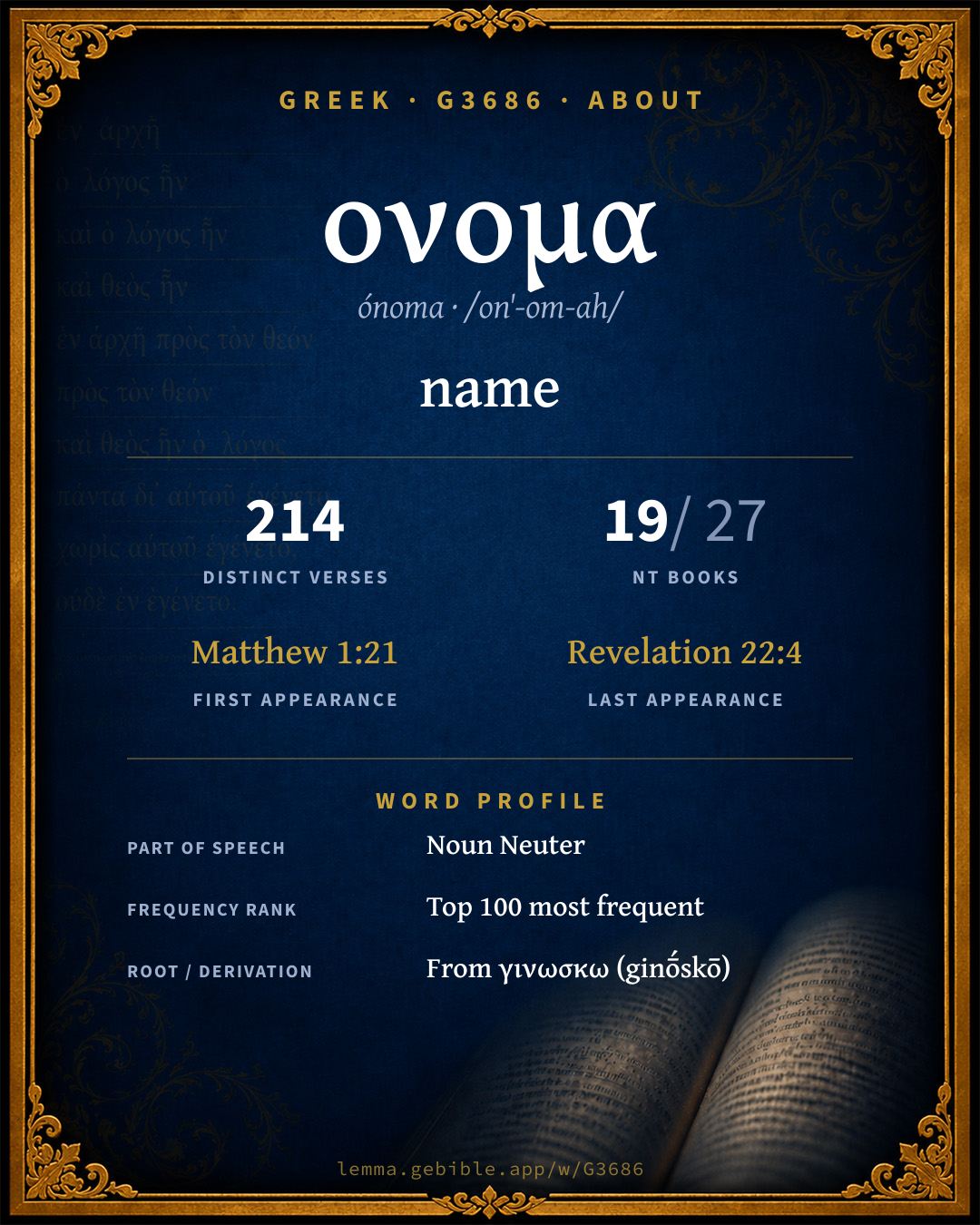
ὄνομα
name
‘name’ is one of 4 main senses fuller range ↓
Full lexicon entry — Thayer's Greek Lexicon
From Thayer's Greek Lexicon
Where this word appears
See every Dative-case word in the Greek New Testament →
Grammar key — what these labels mean
Part of speech
- Noun
- A naming word — a person, place, thing, or idea.
Case
- Dative
- The case of the indirect object, means, or location — “to / for / with / in.”
- Accusative
- The case of the direct object and of extent.
- Nominative
- The case of the subject (and the predicate nominative).
- Genitive
- The case of source, possession, or “of” — answers “whose / from what.”
Gender
- Neuter
- Grammatically neuter.
Number
- Singular
- One.
- Plural
- More than one.
4 verses where G3686 appears in the Accusative case in the Book of Luke. Filtered view — show all forms. Click any verse to open its interlinear word-by-word view. Verse text shown in the World English Bible for context — . Each verse’s Greek form is shown with its reference; the English is not keyword-highlighted, since the data carries no word-level English alignment. Use “Compare translations” on any verse to read it across multiple English versions. This concordance covers the Greek New Testament; Septuagint (Greek Old Testament) occurrences of this word are not indexed here.
Luke
- Luke 1:13 ὄνομα n acc sg neut But the angel said to him, "Don't be afraid, Zacharias, because your request has been heard, and your wife, Elizabeth, will bear you a son, and you shall call his name John.
- Luke 1:31 ὄνομα n acc sg neut Behold, you will conceive in your womb, and bring forth a son, and will call his name 'Jesus.'
- Luke 6:22 ὄνομα n acc sg neut Blessed are you when men shall hate you, and when they shall exclude and mock you, and throw out your name as evil, for the Son of Man's sake.
- Luke 21:17 ὄνομά n acc sg neut You will be hated by all men for my name's sake.
About this entry
At a glance — auto-summarized from this page’s data, not written by a person. Every figure links to its source below. This summary describes the numbers; it doesn’t interpret them.
ονομα (ónoma) is a Greek noun most often rendered “name.” Its lexical range runs to 4 senses. The Greek New Testament uses it across 214 verses — common. Acts dominates its distribution — 59 of 214 verses. Debuting at Matthew 1:21, it then recurs through the corpus. The sections below give every sense, occurrence, and version rendering.
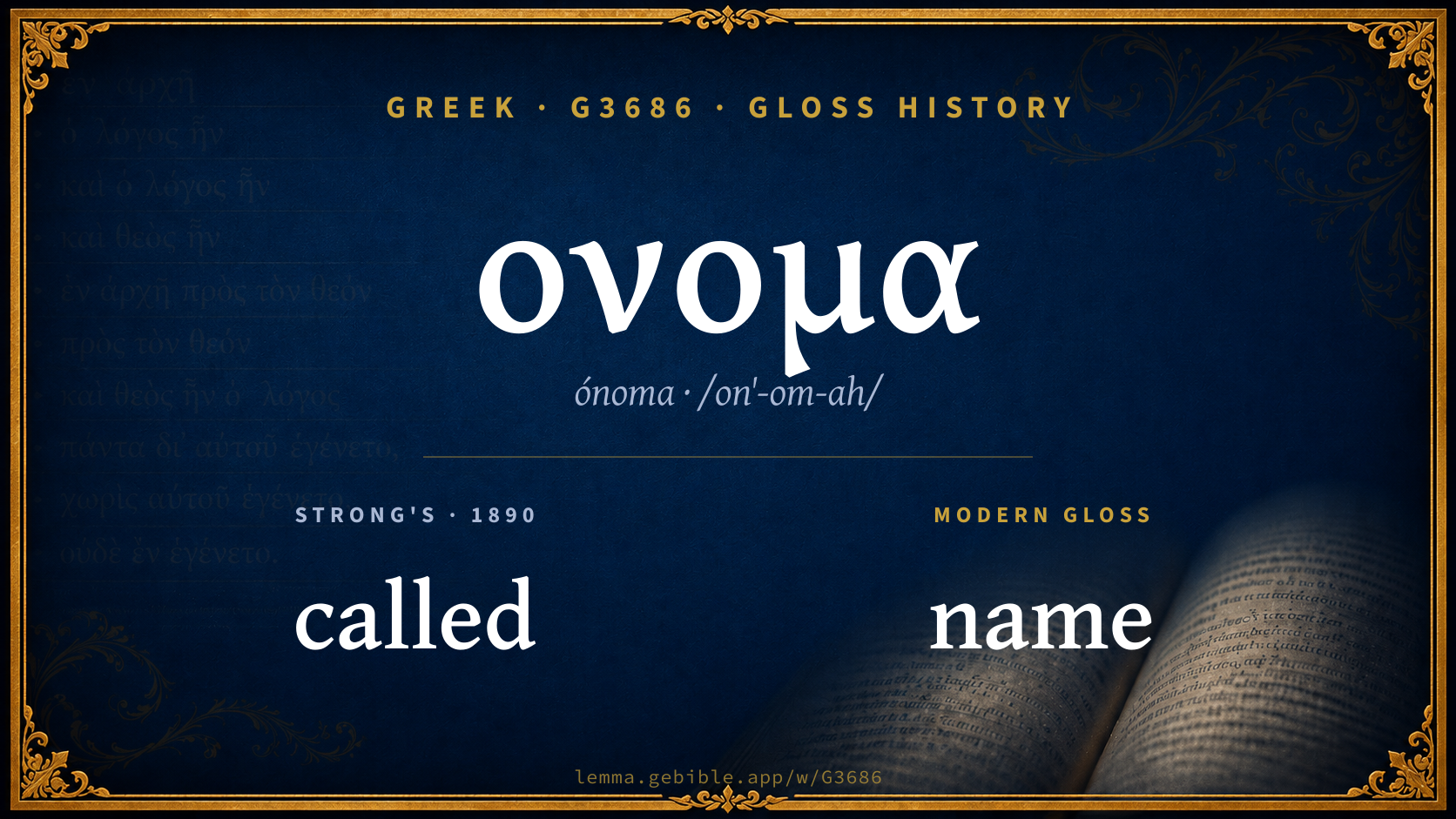
Gloss history
Strong's 1890 vs modern scholarship
About this word
Strong's G3686 catalogs a Greek word from the Greek New Testament.
These counts are not copied from any lexicon or concordance. They are computed here, from the morphology-tagged Greek New Testament. What Lemma adds →
- 214
- distinct verses
- The word appears in 214 distinct verses.
- 19 / 27
- NT books
- The word appears in 19 of 27 New Testament books.
- #71
- by frequency
- Top 100 most frequent Greek words (rank 71 of 5,347 Greek words by occurrence).
View all 214 occurrences in the concordance →
Most concentrated in
- Acts 59 verses 28%
- Luke 32 verses 15%
- Revelation 31 verses 14%
By section of the New Testament
By traditional corpus
Conventional, traditional groupings — biblical authorship is debated, so this is a traditional corpus grouping, not an authorship claim. Some books belong to more than one corpus (Luke is in both the Gospels and the Lukan corpus, and so on), so these shares overlap and need not total 100%. Each figure is a share of the word’s 214 distinct verses.
- Lukan (Luke–Acts) 91 verses · 43%
- Gospels 89 verses · 42%
- Johannine 60 verses · 28%
- Revelation 31 verses · 14%
- Pauline corpus 21 verses · 10%
- General (Catholic) Epistles 10 verses · 5%
- Hebrews 4 verses · 2%
How translations render this word
Counts come from each version’s own published word-to-Strong’s tagging or interlinear alignment — an approximate guide to how each version renders this word, not a word-level alignment the data otherwise carries. Because each total is that version’s own tagged count, the per-version totals vary from one another and need not match the appearance or distinct-verse counts above. These counts may also differ from a printed concordance because Lemma counts each distinctly tagged rendering and does not collapse phrase taggings into a single head-word total. This is a fixed set of word-tagged versions (KJV, ASV, BSB, ULT) and does not change with the reading translation you choose elsewhere. Each version’s license is shown beside its name below (and on Sources).
- King James Version: Name 170×, Named 23×, Names 11×
- American Standard Version: Name 174×, Named 27×, Names 7×
- Berean Standard Bible: Name 162×, Named 34×, Names 11×
- unfoldingWord Literal Text: Name 209×, Names 12×, Named 6×
King James Version Public Domain
Renders G3686 across 221 tagged occurrences — most commonly:
Plus 6 renderings that appear only once — usually multi-word phrases or single function words the recovered tagging swept in, not distinct renderings. Not rendered by a distinct English word in 8 further occurrences.
American Standard Version Public Domain
Renders G3686 across 231 tagged occurrences — most commonly:
Plus 6 renderings that appear only once — usually multi-word phrases or single function words the recovered tagging swept in, not distinct renderings.
Berean Standard Bible Public Domain
Renders G3686 across 214 tagged occurrences — most commonly:
Plus 4 renderings that appear only once — usually multi-word phrases or single function words the recovered tagging swept in, not distinct renderings. Not rendered by a distinct English word in 13 further occurrences.
unfoldingWord Literal Text CC BY-SA 4.0
Renders G3686 across 245 tagged occurrences — most commonly:
Plus 5 renderings that appear only once — usually multi-word phrases or single function words the recovered tagging swept in, not distinct renderings.
Senses in Thayer's
The 4 senses Thayer's distinguishes for this word, in lexicon order (not ranked by frequency or importance). The full entry — with sub-senses — is in the Lexicon Entry tab.
- name: univ. of proper names
- the name is used for everything which the name covers…
- persons reckoned up by name
- the cause or reason named: on this account, because he suffers as a Christian, for this reason
Word origin
Derived from γινωσκω (ginṓskō) (G1097) — to know.
Forms in the corpus
The 9 distinct written forms G3686 takes in the Greek New Testament, most frequent first — each parse links to that case’s occurrences in the concordance.
| Form | Parsing | Example | Uses |
|---|---|---|---|
| ὄνομα ónoma | Noun, Accusative, Singular, Neuter | Matthew 1:21 | 83 |
| ὀνόματι onómati | Noun, Dative, Singular, Neuter | Matthew 7:22 | 73 |
| ὄνομά ónomá | Noun, Accusative, Singular, Neuter | Matthew 10:22 | 23 |
| ὀνόματί onómatí | Noun, Dative, Singular, Neuter | Matthew 18:5 | 21 |
| ὀνόματος onómatos | Noun, Genitive, Singular, Neuter | Acts 3:16 | 14 |
| ὀνόματα onómata | Noun, Accusative, Plural, Neuter | Mark 3:17 | 9 |
| ὀνόματός onómatós | Noun, Genitive, Singular, Neuter | Matthew 19:29 | 3 |
| ὀνομάτων onomátōn | Noun, Genitive, Plural, Neuter | Acts 1:15 | 2 |
| ὀνόματά onómatá | Noun, Nominative, Plural, Neuter | Matthew 10:2 | 1 |
Same root — word family
Other Thayer's entries built from the same root as G3686, grouped by Strong’s listed origin. These share a root / origin per the lexicon — not necessarily a shared meaning. Each links to that word’s own entry.
Derives from
Shares the same root
- γνωμη gnṓmē G1106 mind
- γνωριζω gnōrízō G1107 to make known
- γνωσις gnōsis G1108 knowledge
- γνωστης gnṓstēs G1109 expert
- γνωστος gnōstós G1110 known
- νους noûs G3563 mind
Derived from this word
Compare all same-root words → Showing 4 of 11 — not the complete family. They share a root, not necessarily a meaning.
Septuagint usage
The same Greek word ονομα appears 877 times in the Greek Old Testament (Septuagint), across 782 verses in 34 books.
- 877
- LXX occurrences
- Tagged occurrences of this Greek word in the Septuagint.
- 782
- verses
- Distinct Septuagint verses containing this word.
- 34 / 39
- OT books
- The word appears in 34 of the 39 Old Testament books.
Sample Septuagint occurrences
- Genesis 2:11 ὄνομα
- Exodus 1:1 ὄνομα
- Leviticus 18:21 ὄνομα
- Numbers 1:2 ὄνομα
- Deuteronomy 2:25 ὄνομα
- Joshua 2:1 ὄνομα
- Judges 1:10 ὄνομα
- Ruth 1:2 ὄνομα
- 1 Samuel 1:1 ὄνομα
- 2 Samuel 2:16 ὄνομα
- 1 Kings 1:47 ὄνομα
- 2 Kings 2:24 ὄνομα
Septuagint occurrences (same lexeme)
Every verse where the same Strong’s number (G3686) appears in the Greek Septuagint — showing the first 50 of 782. Verse text shown in the World English Bible for context; the Greek form is the matched word — the English is not keyword-highlighted.
- Genesis 2:11 ὄνομα The name of the first is Pishon: this is the one which flows through the whole land of Havilah, where there is gold;
- Genesis 2:13 ὄνομα The name of the second river is Gihon: the same river that flows through the whole land of Cush.
- Genesis 2:19 ὄνομα Out of the ground Yahweh God formed every animal of the field, and every bird of the sky, and brought them to the man to see what he would call them. Whatever the man called every living creature, that was its name.
- Genesis 2:20 ὄνομα The man gave names to all cattle, and to the birds of the sky, and to every animal of the field; but for man there was not found a helper suitable for him.
- Genesis 3:20 ὄνομα The man called his wife Eve, because she was the mother of all living.
- Genesis 4:17 ὄνομα Cain knew his wife. She conceived, and gave birth to Enoch. He built a city, and called the name of the city, after the name of his son, Enoch.
- Genesis 4:19 ὄνομα Lamech took two wives: the name of the one was Adah, and the name of the other Zillah.
- Genesis 4:21 ὄνομα His brother's name was Jubal, who was the father of all who handle the harp and pipe.
- Genesis 4:25 ὄνομα Adam knew his wife again. She gave birth to a son, and named him Seth. For, she said, "God has appointed me another child instead of Abel, for Cain killed him."
- Genesis 4:26 ὄνομα There was also born a son to Seth, and he named him Enosh. Then men began to call on Yahweh's name.
- Genesis 5:2 ὄνομα He created them male and female, and blessed them, and called their name Adam, in the day when they were created.
- Genesis 5:3 ὄνομα Adam lived one hundred thirty years, and became the father of a son in his own likeness, after his image, and named him Seth.
- Genesis 5:29 ὄνομα and he named him Noah, saying, "This same will comfort us in our work and in the toil of our hands, because of the ground which Yahweh has cursed."
- Genesis 10:25 ὄνομα To Eber were born two sons. The name of the one was Peleg, for in his days was the earth divided. His brother's name was Joktan.
- Genesis 11:4 ὄνομα They said, "Come, let's build us a city, and a tower, whose top reaches to the sky, and let's make us a name; lest we be scattered abroad on the surface of the whole earth."
- Genesis 11:9 ὄνομα Therefore the name of it was called Babel, because Yahweh confused the language of all the earth, there. From there, Yahweh scattered them abroad on the surface of all the earth.
- Genesis 11:29 ὄνομα Abram and Nahor took wives. The name of Abram's wife was Sarai, and the name of Nahor's wife, Milcah, the daughter of Haran who was also the father of Iscah.
- Genesis 12:2 ὄνομα I will make of you a great nation. I will bless you, and make your name great. You will be a blessing.
- Genesis 12:8 ὄνομα He left from there to the mountain on the east of Bethel, and pitched his tent, having Bethel on the west, and Ai on the east. There he built an altar to Yahweh, and called on the name of Yahweh.
- Genesis 13:4 ὄνομα to the place of the altar, which he had made there at the first. There Abram called on the name of Yahweh.
- Genesis 16:1 ὄνομα Now Sarai, Abram's wife, bore him no children. She had a handmaid, an Egyptian, whose name was Hagar.
- Genesis 16:11 ὄνομα The angel of Yahweh said to her, "Behold, you are with child, and will bear a son. You shall call his name Ishmael, because Yahweh has heard your affliction.
- Genesis 16:13 ὄνομα She called the name of Yahweh who spoke to her, "You are a God who sees," for she said, "Have I even stayed alive after seeing him?"
- Genesis 16:15 ὄνομα Hagar bore a son for Abram. Abram called the name of his son, whom Hagar bore, Ishmael.
- Genesis 17:5 ὄνομα Neither will your name any more be called Abram, but your name will be Abraham; for the father of a multitude of nations have I made you.
- Genesis 17:15 ὄνομα God said to Abraham, "As for Sarai your wife, you shall not call her name Sarai, but her name will be Sarah.
- Genesis 17:19 ὄνομα God said, "No, but Sarah, your wife, will bear you a son. You shall call his name Isaac. I will establish my covenant with him for an everlasting covenant for his seed after him.
- Genesis 19:22 ὄνομα Hurry, escape there, for I can't do anything until you get there." Therefore the name of the city was called Zoar.
- Genesis 19:37 ὄνομα The firstborn bore a son, and named him Moab. The same is the father of the Moabites to this day.
- Genesis 19:38 ὄνομα The younger also bore a son, and called his name Ben Ammi. The same is the father of the children of Ammon to this day.
- Genesis 21:3 ὄνομα Abraham called his son who was born to him, whom Sarah bare to him, Isaac.
- Genesis 21:23 ὄνομα Now therefore swear to me here by God that you will not deal falsely with me, nor with my son, nor with my son's son. But according to the kindness that I have done to you, you shall do to me, and to the land in which you have lived as a foreigner."
- Genesis 21:31 ὄνομα Therefore he called that place Beersheba, because they both swore there.
- Genesis 21:33 ὄνομα Abraham planted a tamarisk tree in Beersheba, and called there on the name of Yahweh, the Everlasting God.
- Genesis 22:14 ὄνομα Abraham called the name of that place Yahweh-Jireh. As it is said to this day, "In Yahweh's mountain it will be provided.
- Genesis 22:24 ὄνομα His concubine, whose name was Reumah, also bare Tebah, Gaham, Tahash, and Maacah.
- Genesis 24:29 ὄνομα Rebekah had a brother, and his name was Laban. Laban ran out to the man, to the spring.
- Genesis 25:1 ὄνομα Abraham took another wife, and her name was Keturah.
- Genesis 25:13 ὄνομα These are the names of the sons of Ishmael, by their names, according to the order of their birth: the firstborn of Ishmael, Nebaioth, then Kedar, Adbeel, Mibsam,
- Genesis 25:16 ὄνομα These are the sons of Ishmael, and these are their names, by their villages, and by their encampments: twelve princes, according to their nations.
- Genesis 25:25 ὄνομα The first came out red all over, like a hairy garment. They named him Esau.
- Genesis 25:26 ὄνομα After that, his brother came out, and his hand had hold on Esau's heel. He was named Jacob. Isaac was sixty years old when she bore them.
- Genesis 25:30 ὄνομα Esau said to Jacob, "Please feed me with that same red stew, for I am famished." Therefore his name was called Edom.
- Genesis 26:18 ὄνομα Isaac dug again the wells of water, which they had dug in the days of Abraham his father. For the Philistines had stopped them after the death of Abraham. He called their names after the names by which his father had called them.
- Genesis 26:20 ὄνομα The herdsmen of Gerar argued with Isaac's herdsmen, saying, "The water is ours." He called the name of the well Esek, because they contended with him.
- Genesis 26:21 ὄνομα They dug another well, and they argued over that, also. He called the name of it Sitnah.
- Genesis 26:22 ὄνομα He left that place, and dug another well. They didn't argue over that one. He called it Rehoboth. He said, "For now Yahweh has made room for us, and we will be fruitful in the land."
- Genesis 26:25 ὄνομα He built an altar there, and called on the name of Yahweh, and pitched his tent there. There Isaac's servants dug a well.
- Genesis 26:33 ὄνομα He called it Shibah. Therefore the name of the city is Beersheba to this day.
- Genesis 27:36 ὄνομα He said, "Isn't he rightly named Jacob? For he has supplanted me these two times. He took away my birthright. See, now he has taken away my blessing." He said, "Haven't you reserved a blessing for me?"
These are occurrences of the same Greek lexeme (G3686) in the Septuagint — not a translation of any one Hebrew word. The store carries no word-level Hebrew↔Greek alignment, so no Hebrew original is asserted here. Counts come from the recovered LXX Strong's tagging — high-frequency vocabulary is well covered, while rare or late forms may be untagged — so they reflect tagged occurrences and may slightly undercount.