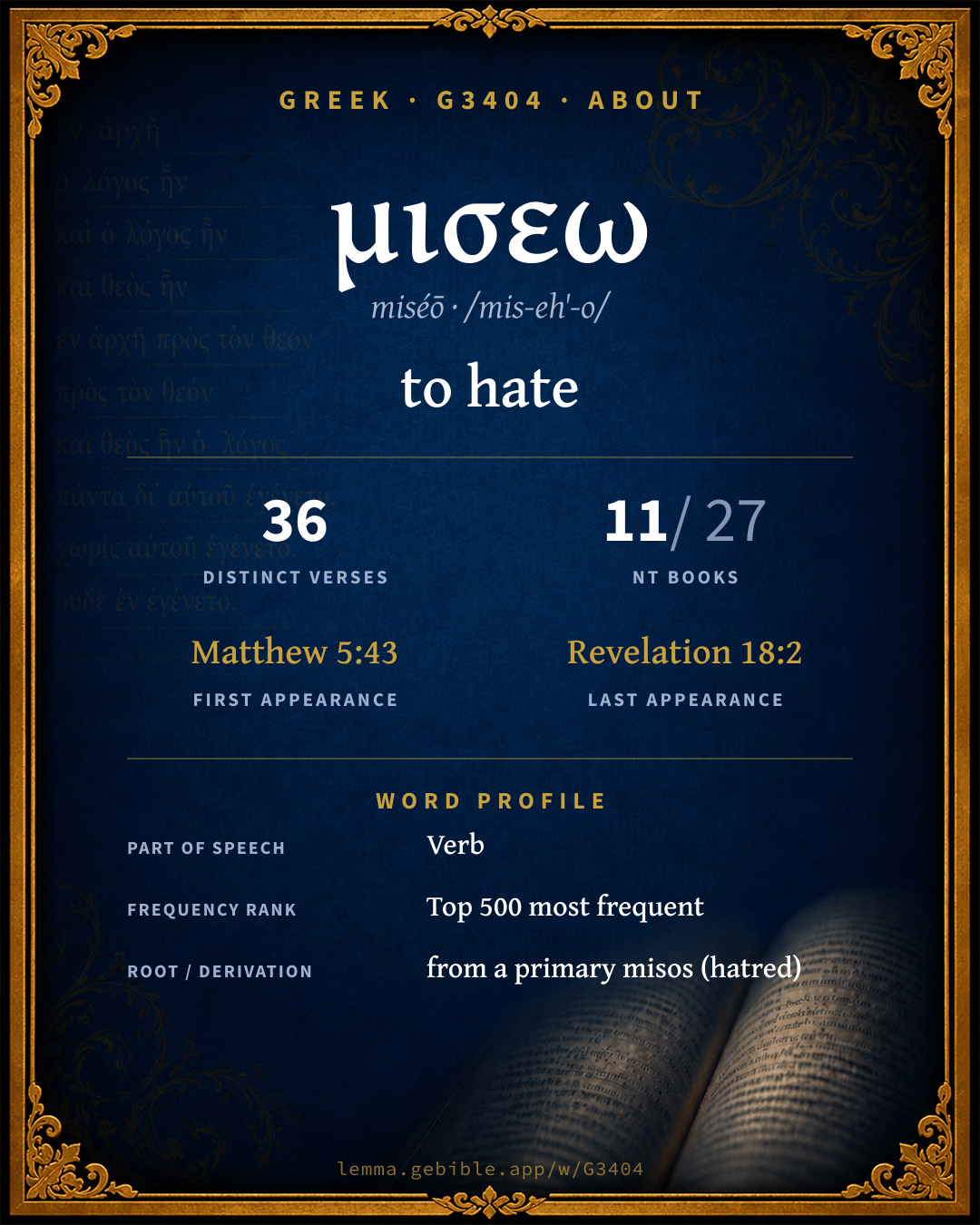
μισέω
to hate
also: pursue with hatred, detest fuller range ↓
Full lexicon entry — Thayer's Greek Lexicon
From Thayer's Greek Lexicon
Where this word appears
See every Present-tense verb in the Greek New Testament →
Grammar key — what these labels mean
Part of speech
- Verb
- An action or state-of-being word.
Tense
- Present
- Ongoing or general action in present time (imperfective aspect).
- Aorist
- Action viewed as a simple whole, without regard to duration — often past (perfective aspect).
- Future
- Action expected in future time.
- Imperfect
- Continuous or repeated action in past time (“was writing”).
- Perfect
- A completed past action with continuing present results.
Voice
- Active
- The subject performs the action.
- Passive
- The subject receives the action.
Mood
- Indicative
- States a fact or asks a factual question (the mood of reality).
- Participle
- A verbal adjective (“writing,” “having written”).
- Subjunctive
- Expresses probability, purpose, or possibility (the mood of contingency).
- Infinitive
- A verbal noun (“to write”), unmarked for person or number.
Case
- Nominative
- The case of the subject (and the predicate nominative).
- Dative
- The case of the indirect object, means, or location — “to / for / with / in.”
- Genitive
- The case of source, possession, or “of” — answers “whose / from what.”
Person
- 3rd person
- The one spoken about (“he / she / it / they”).
- 1st person
- The speaker (“I / we”).
- 2nd person
- The one addressed (“you”).
Gender
- Masculine
- Grammatically masculine.
- Neuter
- Grammatically neuter.
Number
- Singular
- One.
- Plural
- More than one.
6 distinct verses where G3404 appears in the Aorist tense, across 5 books. Filtered view — show all forms. Click any verse to open its interlinear word-by-word view. Verse text shown in the World English Bible for context — . Each verse’s Greek form is shown with its reference; the English is not keyword-highlighted, since the data carries no word-level English alignment. Use “Compare translations” on any verse to read it across multiple English versions. This concordance covers the Greek New Testament; Septuagint (Greek Old Testament) occurrences of this word are not indexed here.
Luke 1 verse
John 2 verses
- John 15:25 ἐμίσησάν aor act ind 3pl But this happened so that the word may be fulfilled which was written in their law, 'They hated me without a cause.'
- John 17:14 ἐμίσησεν aor act ind 3sg I have given them your word. The world hated them, because they are not of the world, even as I am not of the world.
Romans 1 verse
Ephesians 1 verse
Hebrews 1 verse
About this entry
At a glance — auto-summarized from this page’s data, not written by a person. Every figure links to its source below. This summary describes the numbers; it doesn’t interpret them.
μισεω — transliterated miséō — is a Greek verb carrying the sense “to hate.” Older and newer Bibles part ways — “hate” in the King James Version, “hates” (Berean Standard Bible) and “hating” (unfoldingWord Literal Text) in modern versions. See the renderings breakdown. It appears 36 verses across 11 books of the Greek New Testament, among its moderately common vocabulary. More than a quarter of its appearances fall in John. Thayer's distinguishes 2 senses; alongside “to hate” it spans “pursue with hatred” and “detest”. See the sense tree, 36-verse concordance, and the renderings breakdown below.
Gloss history
Strong's 1890 vs modern scholarship
About this word
Strong's G3404 catalogs a Greek word from the Greek New Testament.
These counts are not copied from any lexicon or concordance. They are computed here, from the morphology-tagged Greek New Testament. What Lemma adds →
- 36
- distinct verses
- The word appears in 36 distinct verses.
- 11 / 27
- NT books
- The word appears in 11 of 27 New Testament books.
- #380
- by frequency
- Top 500 most frequent Greek words (rank 380 of 5,347 Greek words by occurrence).
View all 36 occurrences in the concordance →
By section of the New Testament
By traditional corpus
Conventional, traditional groupings — biblical authorship is debated, so this is a traditional corpus grouping, not an authorship claim. Some books belong to more than one corpus (Luke is in both the Gospels and the Lukan corpus, and so on), so these shares overlap and need not total 100%. Each figure is a share of the word’s 36 distinct verses.
- Gospels 22 verses · 61%
- Johannine 17 verses · 47%
- Lukan (Luke–Acts) 7 verses · 19%
- General (Catholic) Epistles 6 verses · 17%
- Pauline corpus 4 verses · 11%
- Revelation 3 verses · 8%
- Hebrews 1 verse · 3%
How translations render this word
Counts come from each version’s own published word-to-Strong’s tagging or interlinear alignment — an approximate guide to how each version renders this word, not a word-level alignment the data otherwise carries. Because each total is that version’s own tagged count, the per-version totals vary from one another and need not match the appearance or distinct-verse counts above. These counts may also differ from a printed concordance because Lemma counts each distinctly tagged rendering and does not collapse phrase taggings into a single head-word total. This is a fixed set of word-tagged versions (KJV, ASV, BSB, ULT) and does not change with the reading translation you choose elsewhere. Each version’s license is shown beside its name below (and on Sources).
- King James Version: Hate 9×, Hated 8×, Hateth 7×
- American Standard Version: Hateth 11×, Hated 9×, Hate 5×
- Berean Standard Bible: Hates 12×, Hated 9×, Hate 8×
- unfoldingWord Literal Text: Hating 9×, Hated 8×, Hates 7×
King James Version Public Domain
Renders G3404 across 42 tagged occurrences — most commonly:
Plus 6 renderings that appear only once — usually multi-word phrases or single function words the recovered tagging swept in, not distinct renderings.
American Standard Version Public Domain
Renders G3404 across 41 tagged occurrences — most commonly:
Plus 7 renderings that appear only once — usually multi-word phrases or single function words the recovered tagging swept in, not distinct renderings.
Berean Standard Bible Public Domain
Renders G3404 across 40 tagged occurrences — most commonly:
Plus 7 renderings that appear only once — usually multi-word phrases or single function words the recovered tagging swept in, not distinct renderings.
unfoldingWord Literal Text CC BY-SA 4.0
Renders G3404 across 41 tagged occurrences — most commonly:
Plus 6 renderings that appear only once — usually multi-word phrases or single function words the recovered tagging swept in, not distinct renderings.
Senses in Thayer's
The 2 senses Thayer's distinguishes for this word, in lexicon order (not ranked by frequency or importance). The full entry — with sub-senses — is in the Lexicon Entry tab.
- to hate, pursue with hatred, detest
- to be hated, detested
Word origin
Origin: from a primary misos (hatred)
From a primary word μῖσος misos ( hatred ); to detest (especially to persecute ); by extension to love less : - hate (-ful).
— Strong’s Exhaustive Concordance (1890), public domain.
Forms in the corpus
The 22 distinct written forms G3404 takes in the Greek New Testament, most frequent first — each parse links to that tense’s occurrences in the concordance.
Septuagint usage
The same Greek word μισεω appears 144 times in the Greek Old Testament (Septuagint), across 136 verses in 23 books.
- 144
- LXX occurrences
- Tagged occurrences of this Greek word in the Septuagint.
- 136
- verses
- Distinct Septuagint verses containing this word.
- 23 / 39
- OT books
- The word appears in 23 of the 39 Old Testament books.
Sample Septuagint occurrences
- Genesis 26:27 μισέω
- Exodus 18:21 μισέω
- Leviticus 19:17 μισέω
- Numbers 10:34 μισέω
- Deuteronomy 1:27 μισέω
- Judges 11:7 μισέω
- 2 Samuel 5:8 μισέω
- 1 Kings 22:8 μισέω
- 2 Chronicles 18:7 μισέω
- Job 34:17 μισέω
- Psalms 5:6 μισέω
- Proverbs 1:22 μισέω
Septuagint occurrences (same lexeme)
Every verse where the same Strong’s number (G3404) appears in the Greek Septuagint — showing the first 50 of 136. Verse text shown in the World English Bible for context; the Greek form is the matched word — the English is not keyword-highlighted.
- Genesis 26:27 μισέω Isaac said to them, "Why have you come to me, since you hate me, and have sent me away from you?"
- Genesis 29:31 μισέω Yahweh saw that Leah was hated, and he opened her womb, but Rachel was barren.
- Genesis 29:33 μισέω She conceived again, and bare a son, and said, "Because Yahweh has heard that I am hated, he has therefore given me this son also." She named him Simeon.
- Genesis 37:4 μισέω His brothers saw that their father loved him more than all his brothers, and they hated him, and couldn't speak peaceably to him.
- Genesis 37:8 μισέω His brothers said to him, "Will you indeed reign over us? Or will you indeed have dominion over us?" They hated him all the more for his dreams and for his words.
- Exodus 18:21 μισέω Moreover you shall provide out of all the people able men, such as fear God: men of truth, hating unjust gain; and place such over them, to be rulers of thousands, rulers of hundreds, rulers of fifties, and rulers of tens.
- Exodus 20:5 μισέω you shall not bow yourself down to them, nor serve them, for I, Yahweh your God, am a jealous God, visiting the iniquity of the fathers on the children, on the third and on the fourth generation of those who hate me,
- Leviticus 19:17 μισέω "'You shall not hate your brother in your heart. You shall surely rebuke your neighbor, and not bear sin because of him.
- Leviticus 26:17 μισέω I will set my face against you, and you will be struck before your enemies. Those who hate you will rule over you; and you will flee when no one pursues you.
- Numbers 10:34 μισέω The cloud of Yahweh was over them by day, when they set forward from the camp.
- Deuteronomy 1:27 μισέω and you murmured in your tents, and said, Because Yahweh hated us, he has brought us forth out of the land of Egypt, to deliver us into the hand of the Amorites, to destroy us.
- Deuteronomy 4:42 μισέω that the manslayer might flee there, who kills his neighbor unawares, and didn't hate him in time past; and that fleeing to one of these cities he might live:
- Deuteronomy 5:9 μισέω you shall not bow down yourself to them, nor serve them; for I, Yahweh, your God, am a jealous God, visiting the iniquity of the fathers on the children, and on the third and on the fourth generation of those who hate me;
- Deuteronomy 7:10 μισέω and repays those who hate him to their face, to destroy them: he will not be slack to him who hates him, he will repay him to his face.
- Deuteronomy 7:15 μισέω Yahweh will take away from you all sickness; and none of the evil diseases of Egypt, which you know, will he put on you, but will lay them on all those who hate you.
- Deuteronomy 9:28 μισέω lest the land whence you brought us out say, Because Yahweh was not able to bring them into the land which he promised to them, and because he hated them, he has brought them out to kill them in the wilderness.
- Deuteronomy 12:31 μισέω You shall not do so to Yahweh your God: for every abomination to Yahweh, which he hates, have they done to their gods; for even their sons and their daughters do they burn in the fire to their gods.
- Deuteronomy 16:22 μισέω Neither shall you set yourself up a pillar; which Yahweh your God hates.
- Deuteronomy 19:4 μισέω This is the case of the manslayer, that shall flee there and live: whoever kills his neighbor unawares, and didn't hate him in time past;
- Deuteronomy 19:6 μισέω lest the avenger of blood pursue the manslayer, while his heart is hot, and overtake him, because the way is long, and strike him mortally; whereas he was not worthy of death, inasmuch as he didn't hate him in time past.
- Deuteronomy 19:11 μισέω But if any man hate his neighbor, and lie in wait for him, and rise up against him, and strike him mortally so that he dies, and he flee into one of these cities;
- Deuteronomy 21:15 μισέω If a man have two wives, the one beloved, and the other hated, and they have borne him children, both the beloved and the hated; and if the firstborn son be hers who was hated;
- Deuteronomy 21:16 μισέω then it shall be, in the day that he causes his sons to inherit that which he has, that he may not make the son of the beloved the firstborn before the son of the hated, who is the firstborn:
- Deuteronomy 21:17 μισέω but he shall acknowledge the firstborn, the son of the hated, by giving him a double portion of all that he has; for he is the beginning of his strength; the right of the firstborn is his.
- Deuteronomy 22:13 μισέω If any man take a wife, and go in to her, and hate her,
- Deuteronomy 22:16 μισέω and the young lady's father shall tell the elders, I gave my daughter to this man to wife, and he hates her;
- Deuteronomy 24:3 μισέω If the latter husband hate her, and write her a bill of divorce, and give it in her hand, and send her out of his house; or if the latter husband die, who took her to be his wife;
- Deuteronomy 30:7 μισέω Yahweh your God will put all these curses on your enemies, and on those who hate you, who persecuted you.
- Deuteronomy 32:41 μισέω If I whet my glittering sword, My hand take hold on judgment; I will render vengeance to my adversaries, Will recompense those who hate me.
- Deuteronomy 32:43 μισέω Rejoice, you nations, [with] his people: For he will avenge the blood of his servants, Will render vengeance to his adversaries, Will make expiation for his land, for his people.
- Deuteronomy 33:11 μισέω Bless, Yahweh, his substance, Accept the work of his hands: Smite through the loins of those who rise up against him, Of those who hate him, that they not rise again.
- Judges 11:7 μισέω Jephthah said to the elders of Gilead, Didn't you hate me, and drive me out of my father's house? and why are you come to me now when you are in distress?
- Judges 14:16 μισέω Samson's wife wept before him, and said, You do but hate me, and don't love me: you have put forth a riddle to the children of my people, and haven't told it me. He said to her, Behold, I haven't told it my father nor my mother, and shall I tell you?
- Judges 15:2 μισέω Her father said, I most assuredly thought that you had utterly hated her; therefore I gave her to your companion: isn't her younger sister more beautiful than she? Please take her, instead.
- 2 Samuel 5:8 μισέω David said on that day, Whoever strikes the Jebusites, let him get up to the watercourse, and [strike] the lame and the blind, who are hated of David's soul. Therefore they say, There are the blind and the lame; he can't come into the house.
- 2 Samuel 13:15 μισέω Then Amnon hated her with exceeding great hatred; for the hatred with which he hated her was greater than the love with which he had loved her. Amnon said to her, Arise, be gone.
- 2 Samuel 13:22 μισέω Absalom spoke to Amnon neither good nor bad; for Absalom hated Amnon, because he had forced his sister Tamar.
- 2 Samuel 18:28 μισέω Ahimaaz called, and said to the king, All is well. He bowed himself before the king with his face to the earth, and said, Blessed be Yahweh your God, who has delivered up the men who lifted up their hand against my lord the king.
- 2 Samuel 19:7 μισέω Now therefore arise, go forth, and speak comfortably to your servants; for I swear by Yahweh, if you don't go forth, there will not stay a man with you this night: and that will be worse to you than all the evil that has happened to you from your youth until now.
- 2 Samuel 22:18 μισέω He delivered me from my strong enemy, From those who hated me; for they were too mighty for me.
- 2 Samuel 22:41 μισέω You have also made my enemies turn their backs to me, That I might cut off those who hate me.
- 1 Kings 22:8 μισέω The king of Israel said to Jehoshaphat, there is yet one man by whom we may inquire of Yahweh, Micaiah the son of Imlah: but I hate him; for he does not prophesy good concerning me, but evil. Jehoshaphat said, "Don't let the king say so."
- 2 Chronicles 18:7 μισέω The king of Israel said to Jehoshaphat, There is yet one man by whom we may inquire of Yahweh: but I hate him; for he never prophesies good concerning me, but always evil: the same is Micaiah the son of Imla. Jehoshaphat said, Don't let the king say so.
- 2 Chronicles 19:2 μισέω Jehu the son of Hanani the seer went out to meet him, and said to king Jehoshaphat, Should you help the wicked, and love those who hate Yahweh? for this thing wrath is on you from before Yahweh.
- Job 34:17 μισέω Shall even one who hates justice govern? Will you condemn him who is righteous and mighty?--
- Psalms 5:6 μισέω You will destroy those who speak lies. Yahweh abhors the blood-thirsty and deceitful man.
- Psalms 10:5 μισέω His ways are prosperous at all times; He is haughty, and your laws are far from his sight: As for all his adversaries, he sneers at them.
- Psalms 17:18 μισέω
- Psalms 17:20 μισέω
- Psalms 17:41 μισέω
These are occurrences of the same Greek lexeme (G3404) in the Septuagint — not a translation of any one Hebrew word. The store carries no word-level Hebrew↔Greek alignment, so no Hebrew original is asserted here. Counts come from the recovered LXX Strong's tagging — high-frequency vocabulary is well covered, while rare or late forms may be untagged — so they reflect tagged occurrences and may slightly undercount.