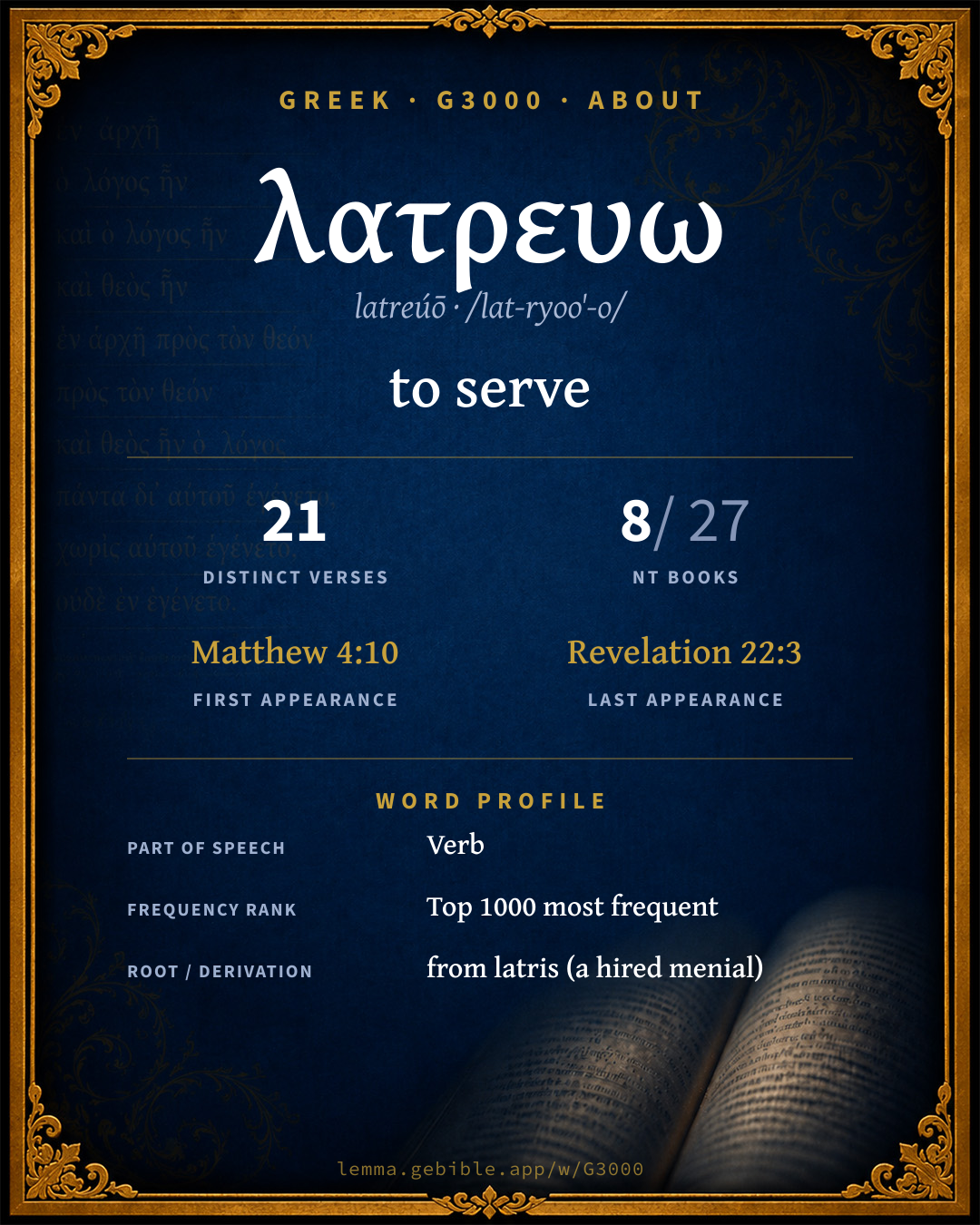
λατρεύω
to serve
‘to serve’ is one of 2 main senses fuller range ↓
Full lexicon entry — Thayer's Greek Lexicon
From Thayer's Greek Lexicon
Where this word appears
See every Present-tense verb in the Greek New Testament →
Grammar key — what these labels mean
Part of speech
- Verb
- An action or state-of-being word.
Tense
- Present
- Ongoing or general action in present time (imperfective aspect).
- Future
- Action expected in future time.
- Aorist
- Action viewed as a simple whole, without regard to duration — often past (perfective aspect).
Voice
- Active
- The subject performs the action.
Mood
- Indicative
- States a fact or asks a factual question (the mood of reality).
- Infinitive
- A verbal noun (“to write”), unmarked for person or number.
- Participle
- A verbal adjective (“writing,” “having written”).
- Subjunctive
- Expresses probability, purpose, or possibility (the mood of contingency).
Case
- Nominative
- The case of the subject (and the predicate nominative).
- Accusative
- The case of the direct object and of extent.
Person
- 1st person
- The speaker (“I / we”).
- 2nd person
- The one addressed (“you”).
- 3rd person
- The one spoken about (“he / she / it / they”).
Gender
- Masculine
- Grammatically masculine.
- Feminine
- Grammatically feminine.
- Neuter
- Grammatically neuter.
Number
- Singular
- One.
- Plural
- More than one.
Grammatical forms 12 distinct
- Verb, Present, Active, Indicative, 1st person, Singular 4 times (19%)
- Verb, Present, Active, Infinitive 3 times (14%)
- Verb, Future, Active, Indicative, 2nd person, Singular 2 times (10%)
- Verb, Future, Active, Indicative, 3rd person, Plural 2 times (10%)
- Verb, Present, Active, Indicative, 3rd person, Plural 2 times (10%)
- Verb, Present, Active, Participle, Nominative, Plural, Masculine 2 times (10%)
- Verb, Aorist, Active, Indicative, 3rd person, Plural 1 time (5%)
- Verb, Present, Active, Participle, Accusative, Plural, Masculine 1 time (5%)
+4 more forms (4 occurrences)
Parsed forms decoded from the imported morphology (Robinson–Tischendorf, public domain), counted across 21 parsed occurrences — not distinct verses.
Every verse where G3000 appears — 21 distinct verses across 8 books. Click any verse to open its interlinear word-by-word view. Verse text shown in the World English Bible for context — . Each verse’s Greek form is shown with its reference; the English is not keyword-highlighted, since the data carries no word-level English alignment. Use “Compare translations” on any verse to read it across multiple English versions. This concordance covers the Greek New Testament; Septuagint (Greek Old Testament) occurrences of this word are not indexed here.
Matthew 1 verse
Luke 3 verses
- Luke 1:74 λατρεύειν pres act inf To grant to us that we, being delivered out of the hand of our enemies, should serve him without fear,
- Luke 2:37 λατρεύουσα pres act ptcp nom sg fem and she had been a widow for about eighty-four years), who didn't depart from the temple, worshipping with fastings and petitions night and day.
- Luke 4:8 λατρεύσεις fut act ind 2sg Jesus answered him, "Get behind me Satan! For it is written, 'You shall worship the Lord your God, and him only shall you serve.'"
Acts 5 verses
- Acts 7:7 λατρεύσουσίν fut act ind 3pl 'I will judge the nation to which they will be in bondage,' said God, 'and after that will they come out, and serve me in this place.'
- Acts 7:42 λατρεύειν pres act inf But God turned, and gave them up to serve the host of the sky, as it is written in the book of the prophets, 'Did you offer to me slain animals and sacrifices Forty years in the wilderness, O house of Israel?
- Acts 24:14 λατρεύω pres act ind 1sg But this I confess to you, that after the Way, which they call a sect, so I serve the God of our fathers, believing all things which are according to the law, and which are written in the prophets;
- Acts 26:7 λατρεῦον pres act ptcp nom sg neut which our twelve tribes, earnestly serving night and day, hope to attain. Concerning this hope I am accused by the Jews, King Agrippa!
- Acts 27:23 λατρεύω pres act ind 1sg For there stood by me this night an angel, belonging to the God whose I am and whom I serve,
Romans 2 verses
- Romans 1:9 λατρεύω pres act ind 1sg For God is my witness, whom I serve in my spirit in the Gospel of his Son, how unceasingly I make mention of you always in my prayers,
- Romans 1:25 ἐλάτρευσαν aor act ind 3pl who exchanged the truth of God for a lie, and worshiped and served the creature rather than the Creator, who is blessed forever. Amen.
Philippians 1 verse
2 Timothy 1 verse
Hebrews 6 verses
- Hebrews 8:5 λατρεύουσιν pres act ind 3pl who serve a copy and shadow of the heavenly things, even as Moses was warned by God when he was about to make the tabernacle, for he said, "See, you shall make everything according to the pattern that was shown to you on the mountain."
- Hebrews 9:9 λατρεύοντα pres act ptcp acc sg masc which is a symbol of the present age, where gifts and sacrifices are offered that are incapable, concerning the conscience, of making the worshipper perfect;
- Hebrews 9:14 λατρεύειν pres act inf how much more will the blood of Christ, who through the eternal Spirit offered himself without blemish to God, cleanse your conscience from dead works to serve the living God?
- Hebrews 10:2 λατρεύοντας pres act ptcp acc pl masc Or else wouldn't they have ceased to be offered, because the worshippers, having been once cleansed, would have had no more consciousness of sins?
- Hebrews 12:28 λατρεύωμεν pres act subj 1pl Therefore, receiving a Kingdom that can't be shaken, let us have grace, through which we serve God acceptably, with reverence and awe,
- Hebrews 13:10 λατρεύοντες pres act ptcp nom pl masc We have an altar from which those who serve the holy tabernacle have no right to eat.
Revelation 2 verses
- Revelation 7:15 λατρεύουσιν pres act ind 3pl Therefore they are before the throne of God, they serve him day and night in his temple. He who sits on the throne will spread his tent over them.
- Revelation 22:3 λατρεύσουσιν fut act ind 3pl There will be no curse any more. The throne of God and of the Lamb will be in it, and his servants serve him.
About this entry
At a glance — auto-summarized from this page’s data, not written by a person. Every figure links to its source below. This summary describes the numbers; it doesn’t interpret them.
The Greek verb λατρευω centers on the idea of “to serve.” First canonically at Matthew 4:10, it enters the text early. It turns up in 21 verses across 8 books, an uncommon footprint. The word gravitates to Hebrews (29%), then Acts and Luke. Lexicons map it across 2 senses. Dig into 21-verse concordance and the renderings breakdown below.
Gloss history
Strong's 1890 vs modern scholarship

About this word
Strong's G3000 catalogs a Greek word from the Greek New Testament.
These counts are not copied from any lexicon or concordance. They are computed here, from the morphology-tagged Greek New Testament. What Lemma adds →
- 21
- distinct verses
- The word appears in 21 distinct verses.
- 8 / 27
- NT books
- The word appears in 8 of 27 New Testament books.
- #607
- by frequency
- Top 1000 most frequent Greek words (rank 607 of 5,347 Greek words by occurrence).
View all 21 occurrences in the concordance →
By section of the New Testament
By traditional corpus
Conventional, traditional groupings — biblical authorship is debated, so this is a traditional corpus grouping, not an authorship claim. Some books belong to more than one corpus (Luke is in both the Gospels and the Lukan corpus, and so on), so these shares overlap and need not total 100%. Each figure is a share of the word’s 21 distinct verses.
- Lukan (Luke–Acts) 8 verses · 38%
- Hebrews 6 verses · 29%
- Gospels 4 verses · 19%
- Pauline corpus 4 verses · 19%
- Johannine 2 verses · 10%
- Revelation 2 verses · 10%
How translations render this word
Counts come from each version’s own published word-to-Strong’s tagging or interlinear alignment — an approximate guide to how each version renders this word, not a word-level alignment the data otherwise carries. Because each total is that version’s own tagged count, the per-version totals vary from one another and need not match the appearance or distinct-verse counts above. These counts may also differ from a printed concordance because Lemma counts each distinctly tagged rendering and does not collapse phrase taggings into a single head-word total. This is a fixed set of word-tagged versions (KJV, ASV, BSB, ULT) and does not change with the reading translation you choose elsewhere. Each version’s license is shown beside its name below (and on Sources).
- King James Version: Serve 5×, I serve 3×, Served 2×
- American Standard Version: Serve 6×, I serve 3×, Shalt thou serve 2×
- Berean Standard Bible: Serve 4×, Worship 4×, I serve 3×
- unfoldingWord Literal Text: Serve 5×, I serve 4×, Serving 4×
King James Version Public Domain
Renders G3000 across 21 tagged occurrences — most commonly:
Plus 7 renderings that appear only once — usually multi-word phrases or single function words the recovered tagging swept in, not distinct renderings.
American Standard Version Public Domain
Renders G3000 across 21 tagged occurrences — most commonly:
Plus 10 renderings that appear only once — usually multi-word phrases or single function words the recovered tagging swept in, not distinct renderings.
Berean Standard Bible Public Domain
Renders G3000 across 21 tagged occurrences — most commonly:
Plus 8 renderings that appear only once — usually multi-word phrases or single function words the recovered tagging swept in, not distinct renderings.
unfoldingWord Literal Text CC BY-SA 4.0
Renders G3000 across 21 tagged occurrences — most commonly:
Plus 6 renderings that appear only once — usually multi-word phrases or single function words the recovered tagging swept in, not distinct renderings.
Senses in Thayer's
The 2 senses Thayer's distinguishes for this word, in lexicon order (not ranked by frequency or importance). The full entry — with sub-senses — is in the Lexicon Entry tab.
- to serve for hire
- to serve, minister to, either to the gods or men and used alike of slaves and freemen
Word origin
Origin: from latris (a hired menial)
From λάτρις latris (a hired menial ); to minister (to God) that is render religious homage : - serve do the service worship (-per).
— Strong’s Exhaustive Concordance (1890), public domain.
Forms in the corpus
The 13 distinct written forms G3000 takes in the Greek New Testament, most frequent first — each parse links to that tense’s occurrences in the concordance.
Same root — word family
Other Thayer's entries built from the same root as G3000, grouped by Strong’s listed origin. These share a root / origin per the lexicon — not necessarily a shared meaning. Each links to that word’s own entry.
Derived from this word
Compare all same-root words → They share a root, not necessarily a meaning.
Septuagint usage
The same Greek word λατρευω appears 87 times in the Greek Old Testament (Septuagint), across 81 verses in 11 books.
- 87
- LXX occurrences
- Tagged occurrences of this Greek word in the Septuagint.
- 81
- verses
- Distinct Septuagint verses containing this word.
- 11 / 39
- OT books
- The word appears in 11 of the 39 Old Testament books.
Sample Septuagint occurrences
- Exodus 3:12 λατρεύω
- Leviticus 18:21 λατρεύω
- Numbers 16:9 λατρεύω
- Deuteronomy 4:19 λατρεύω
- Joshua 22:5 λατρεύω
- Judges 2:11 λατρεύω
- 2 Samuel 15:8 λατρεύω
- 2 Kings 17:12 λατρεύω
- 2 Chronicles 7:19 λατρεύω
- Ezekiel 20:32 λατρεύω
- Daniel 3:12 λατρεύω
Septuagint occurrences (same lexeme)
Every verse where the same Strong’s number (G3000) appears in the Greek Septuagint — showing the first 50 of 81. Verse text shown in the World English Bible for context; the Greek form is the matched word — the English is not keyword-highlighted.
- Exodus 3:12 λατρεύω He said, "Certainly I will be with you. This will be the token to you, that I have sent you: when you have brought forth the people out of Egypt, you shall serve God on this mountain."
- Exodus 4:23 λατρεύω and I have said to you, "Let my son go, that he may serve me;" and you have refused to let him go. Behold, I will kill your son, your firstborn.'"
- Exodus 7:16 λατρεύω You shall tell him, 'Yahweh, the God of the Hebrews, has sent me to you, saying, "Let my people go, that they may serve me in the wilderness:" and, behold, until now you haven't listened.
- Exodus 7:26 λατρεύω
- Exodus 8:16 λατρεύω Yahweh said to Moses, "Tell Aaron, 'Stretch out your rod, and strike the dust of the earth, that it may become lice throughout all the land of Egypt.'"
- Exodus 9:1 λατρεύω Then Yahweh said to Moses, "Go in to Pharaoh, and tell him, 'This is what Yahweh, the God of the Hebrews, says: "Let my people go, that they may serve me.
- Exodus 9:13 λατρεύω Yahweh said to Moses, "Rise up early in the morning, and stand before Pharaoh, and tell him, 'This is what Yahweh, the God of the Hebrews, says: "Let my people go, that they may serve me.
- Exodus 10:3 λατρεύω Moses and Aaron went in to Pharaoh, and said to him, "This is what Yahweh, the God of the Hebrews, says: 'How long will you refuse to humble yourself before me? Let my people go, that they may serve me.
- Exodus 10:7 λατρεύω Pharaoh's servants said to him, "How long will this man be a snare to us? Let the men go, that they may serve Yahweh, their God. Don't you yet know that Egypt is destroyed?"
- Exodus 10:8 λατρεύω Moses and Aaron were brought again to Pharaoh, and he said to them, "Go, serve Yahweh your God; but who are those who will go?"
- Exodus 10:11 λατρεύω Not so! Go now you who are men, and serve Yahweh; for that is what you desire!" They were driven out from Pharaoh's presence.
- Exodus 10:24 λατρεύω Pharaoh called to Moses, and said, "Go, serve Yahweh. Only let your flocks and your herds stay behind. Let your little ones also go with you."
- Exodus 10:26 λατρεύω Our cattle also shall go with us. There shall not a hoof be left behind, for of it we must take to serve Yahweh our God; and we don't know with what we must serve Yahweh, until we come there."
- Exodus 12:31 λατρεύω He called for Moses and Aaron by night, and said, "Rise up, get out from among my people, both you and the children of Israel; and go, serve Yahweh, as you have said!
- Exodus 20:5 λατρεύω you shall not bow yourself down to them, nor serve them, for I, Yahweh your God, am a jealous God, visiting the iniquity of the fathers on the children, on the third and on the fourth generation of those who hate me,
- Exodus 23:24 λατρεύω You shall not bow down to their gods, nor serve them, nor follow their practices, but you shall utterly overthrow them and demolish their pillars.
- Exodus 23:25 λατρεύω You shall serve Yahweh your God, and he will bless your bread and your water, and I will take sickness away from your midst.
- Leviticus 18:21 λατρεύω "'You shall not give any of your children to sacrifice to Molech; neither shall you profane the name of your God: I am Yahweh.
- Numbers 16:9 λατρεύω [seems it but] a small thing to you, that the God of Israel has separated you from the congregation of Israel, to bring you near to himself, to do the service of the tent of Yahweh, and to stand before the congregation to minister to them;
- Deuteronomy 4:19 λατρεύω and lest you lift up your eyes to the sky, and when you see the sun and the moon and the stars, even all the host of the sky, you are drawn away and worship them, and serve them, which Yahweh your God has allotted to all the peoples under the whole sky.
- Deuteronomy 4:28 λατρεύω There you shall serve gods, the work of men's hands, wood and stone, which neither see, nor hear, nor eat, nor smell.
- Deuteronomy 5:9 λατρεύω you shall not bow down yourself to them, nor serve them; for I, Yahweh, your God, am a jealous God, visiting the iniquity of the fathers on the children, and on the third and on the fourth generation of those who hate me;
- Deuteronomy 6:13 λατρεύω You shall fear Yahweh your God; and him shall you serve, and shall swear by his name.
- Deuteronomy 7:4 λατρεύω For he will turn away your son from following me, that they may serve other gods: so will the anger of Yahweh be kindled against you, and he will destroy you quickly.
- Deuteronomy 7:16 λατρεύω You shall consume all the peoples who Yahweh your God shall deliver to you; your eye shall not pity them: neither shall you serve their gods; for that will be a snare to you.
- Deuteronomy 8:19 λατρεύω It shall be, if you shall forget Yahweh your God, and walk after other gods, and serve them, and worship them, I testify against you this day that you shall surely perish.
- Deuteronomy 10:12 λατρεύω Now, Israel, what does Yahweh your God require of you, but to fear Yahweh your God, to walk in all his ways, and to love him, and to serve Yahweh your God with all your heart and with all your soul,
- Deuteronomy 10:20 λατρεύω You shall fear Yahweh your God; him shall you serve; and to him shall you cleave, and by his name shall you swear.
- Deuteronomy 11:13 λατρεύω It shall happen, if you shall listen diligently to my commandments which I command you this day, to love Yahweh your God, and to serve him with all your heart and with all your soul,
- Deuteronomy 11:16 λατρεύω Take heed to yourselves, lest your heart be deceived, and you turn aside, and serve other gods, and worship them;
- Deuteronomy 11:28 λατρεύω and the curse, if you shall not listen to the commandments of Yahweh your God, but turn aside out of the way which I command you this day, to go after other gods, which you have not known.
- Deuteronomy 12:2 λατρεύω You shall surely destroy all the places in which the nations that you shall dispossess served their gods, on the high mountains, and on the hills, and under every green tree:
- Deuteronomy 13:3 λατρεύω you shall not listen to the words of that prophet, or to that dreamer of dreams: for Yahweh your God proves you, to know whether you love Yahweh your God with all your heart and with all your soul.
- Deuteronomy 13:7 λατρεύω of the gods of the peoples who are round about you, near to you, or far off from you, from the one end of the earth even to the other end of the earth;
- Deuteronomy 13:14 λατρεύω then shall you inquire, and make search, and ask diligently; and, behold, if it be truth, and the thing certain, that such abomination is done in the midst of you,
- Deuteronomy 17:3 λατρεύω and has gone and served other gods, and worshiped them, or the sun, or the moon, or any of the host of the sky, which I have not commanded;
- Deuteronomy 28:14 λατρεύω and shall not turn aside from any of the words which I command you this day, to the right hand, or to the left, to go after other gods to serve them.
- Deuteronomy 28:36 λατρεύω Yahweh will bring you, and your king whom you shall set over you, to a nation that you have not known, you nor your fathers; and there shall you serve other gods, wood and stone.
- Deuteronomy 28:47 λατρεύω Because you didn't serve Yahweh your God with joyfulness, and with gladness of heart, by reason of the abundance of all things;
- Deuteronomy 28:48 λατρεύω therefore shall you serve your enemies whom Yahweh shall send against you, in hunger, and in thirst, and in nakedness, and in want of all things: and he shall put a yoke of iron on your neck, until he have destroyed you.
- Deuteronomy 29:17 λατρεύω and you have seen their abominations, and their idols, wood and stone, silver and gold, which were among them);
- Deuteronomy 29:25 λατρεύω Then men shall say, Because they forsook the covenant of Yahweh, the God of their fathers, which he made with them when he brought them forth out of the land of Egypt,
- Deuteronomy 30:17 λατρεύω But if your heart turn away, and you will not hear, but shall be drawn away, and worship other gods, and serve them;
- Deuteronomy 31:20 λατρεύω For when I shall have brought them into the land which I swore to their fathers, flowing with milk and honey, and they shall have eaten and filled themselves, and grown fat; then will they turn to other gods, and serve them, and despise me, and break my covenant.
- Joshua 22:5 λατρεύω Only take diligent heed to do the commandment and the law which Moses the servant of Yahweh commanded you, to love Yahweh your God, and to walk in all his ways, and to keep his commandments, and to cleave to him, and to serve him with all your heart and with all your soul.
- Joshua 22:27 λατρεύω but it shall be a witness between us and you, and between our generations after us, that we may do the service of Yahweh before him with our burnt offerings, and with our sacrifices, and with our peace-offerings; that your children may not tell our children in time to come, You have no portion in Yahweh.
- Joshua 23:7 λατρεύω that you not come among these nations, these that remain among you; neither make mention of the name of their gods, nor cause to swear [by them], neither serve them, nor bow down yourselves to them;
- Joshua 23:16 λατρεύω When you disobey the covenant of Yahweh your God, which he commanded you, and go and serve other gods, and bow down yourselves to them; then will the anger of Yahweh be kindled against you, and you shall perish quickly from off the good land which he has given to you.
- Joshua 24:2 λατρεύω Joshua said to all the people, Thus says Yahweh, the God of Israel, Your fathers lived of old time beyond the River, even Terah, the father of Abraham, and the father of Nahor: and they served other gods.
- Joshua 24:14 λατρεύω Now therefore fear Yahweh, and serve him in sincerity and in truth; and put away the gods which your fathers served beyond the River, and in Egypt; and serve you Yahweh.
These are occurrences of the same Greek lexeme (G3000) in the Septuagint — not a translation of any one Hebrew word. The store carries no word-level Hebrew↔Greek alignment, so no Hebrew original is asserted here. Counts come from the recovered LXX Strong's tagging — high-frequency vocabulary is well covered, while rare or late forms may be untagged — so they reflect tagged occurrences and may slightly undercount.