
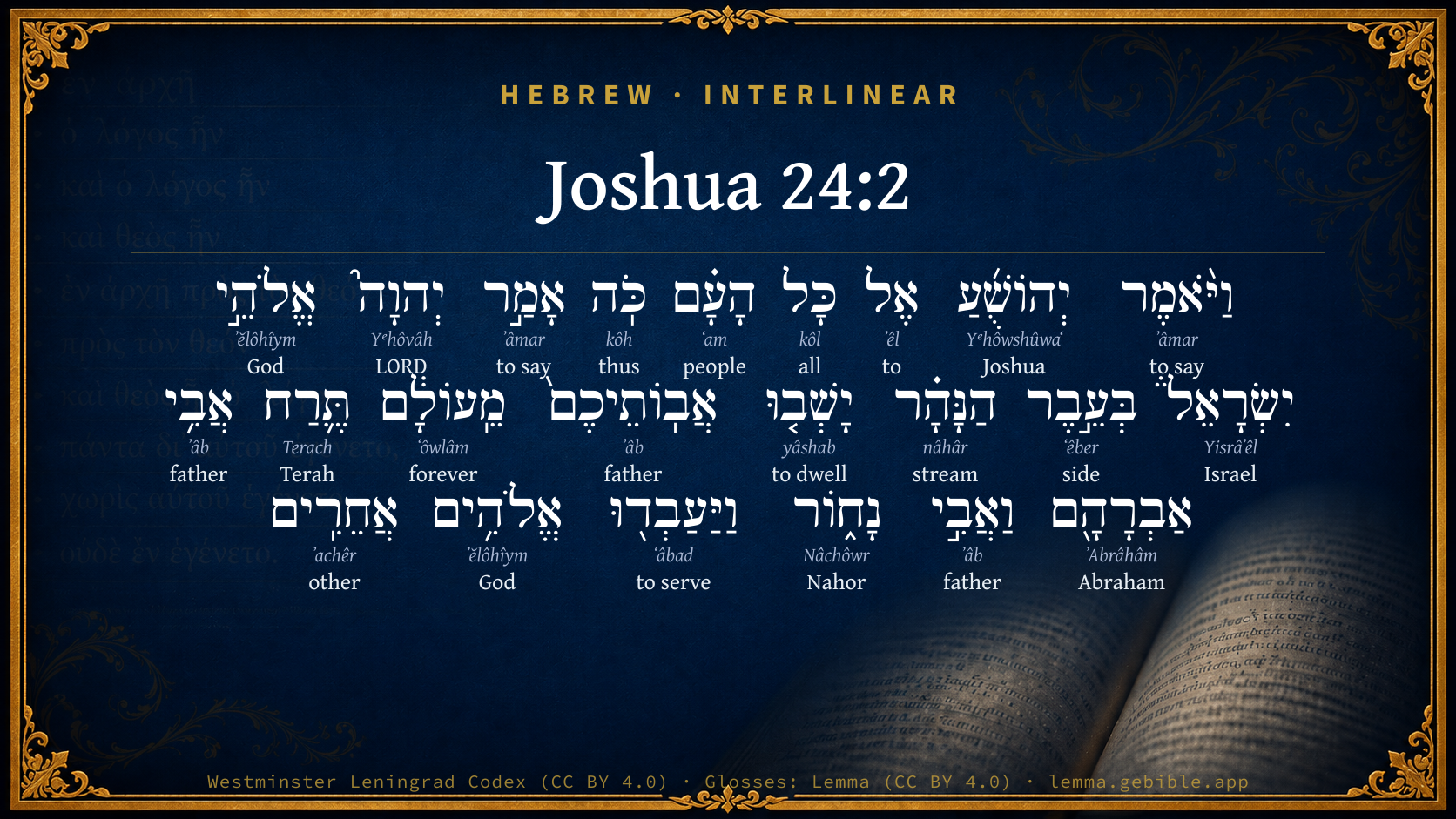
Joshua 24:2

Hebrew (Westminster Leningrad Codex) Joshua 24:2 appears in the Hebrew Old Testament. The text above is from the Westminster Leningrad Codex. Each word links to its Strong’s number, a concise gloss, and parsing drawn from the Open Scriptures Hebrew Bible morphology. Click any word for its full Brown-Driver-Briggs (BDB) entry.
Download image
Cite this verse

Joshua 24:2 (World English Bible). Public Domain. Lemma interlinear Bible study tool, https://lemma.gebible.app/v/joshua/24/2.

Show BibTeX & RIS
BibTeX
RIS
English Translation
Joshua said to all the people, Thus says Yahweh, the God of Israel, Your fathers lived of old time beyond the River, even Terah, the father of Abraham, and the father of Nahor: and they served other gods.
World English Bible · Public Domain
Download a study sheet

One document with this verse’s original text, its word-by-word gloss line, the meaning frame, cross-references with their text, attributed commentary, and full source and license credits — printable, and it pastes into notes with its structure intact.

This verse Autodidact and up

Study sheet (.html) Plain text (.txt)

A passage Seminary Student

Up to 50 verses in one chapter. A passage sheet keeps up to 6 commentary sources and 12 cross-references per verse, in the order this page ranks them, and says so on the sheet whenever that leaves anything out. Ask for a single verse and you get the Autodidact verse sheet above.

Everything on this page stays free to read, with no account — the sheet is a download of what is already on screen, not access to it.

Want to remove ads? Support Godless Engineer
Compare translations 3

The same verse in 3 English versions, stacked beneath the original-language interlinear above. Click any original word for its lexicon entry.

Each is an independent rendering of the whole verse — the interlinear is not word-aligned to these translations.

Highlighted words mark where these versions differ — a whole-verse word diff, not a word-by-word alignment.

  • World English Bible Public Domain
    Joshua said to all the people, Thus says Yahweh, the God of Israel, Your fathers lived of old time beyond the River, even Terah, the father of Abraham, and the father of Nahor: and they served other gods.
  • King James Version Public Domain
    And Joshua said unto all the people, Thus saith the LORD God of Israel, Your fathers dwelt on the other side of the flood in old time, even Terah, the father of Abraham, and the father of Nachor: and they served other gods.
  • unfoldingWord Literal Text CC BY-SA 4.0
    And Joshua said to all of the people, “Thus says Yahweh, the God of Israel: ‘Your fathers dwelled from long ago beyond the river, Terah, the father of Abraham and the father of Nahor. And they served other gods.

unfoldingWord Literal Text — © unfoldingWord, licensed CC BY-SA 4.0. Word-aligned USFM3 via Door43 (git.door43.org/unfoldingWord/en_ult).

Versions to compare (up to 4)

3 of 4 selected

Show all 18 translations

Every available English version of this verse, each an independent rendering of the whole verse.

  • World English Bible Public Domain
    Joshua said to all the people, Thus says Yahweh, the God of Israel, Your fathers lived of old time beyond the River, even Terah, the father of Abraham, and the father of Nahor: and they served other gods.
  • Berean Standard Bible Public Domain
    And Joshua said to all the people, “This is what the LORD, the God of Israel, says: ‘Long ago your fathers, including Terah the father of Abraham and Nahor, lived beyond the Euphrates and worshiped other gods.
  • Majority Standard Bible Public Domain
    And Joshua said to all the people, “This is what the LORD, the God of Israel, says: ‘Long ago your fathers, including Terah the father of Abraham and Nahor, lived beyond the Euphrates and worshiped other gods.
  • King James Version Public Domain
    And Joshua said unto all the people, Thus saith the LORD God of Israel, Your fathers dwelt on the other side of the flood in old time, even Terah, the father of Abraham, and the father of Nachor: and they served other gods.
  • American Standard Version (1901) Public Domain
    And Joshua said unto all the people, Thus saith Jehovah, the God of Israel, Your fathers dwelt of old time beyond the River, even Terah, the father of Abraham, and the father of Nahor: and they served other gods.
  • Revised Version (1885) Public Domain
    And Joshua said unto all the people, Thus saith the LORD, the God of Israel, Your fathers dwelt of old time beyond the River, even Terah, the father of Abraham, and the father of Nahor: and they served other gods.
  • Geneva Bible (1599) Public Domain
    Then Ioshua said vnto all the people, Thus saith the Lord God of Israel, Your fathers dwelt beyond the flood in olde time, euen Terah the father of Abraham, and the father of Nachor, and serued other gods.
  • Douay-Rheims (1899) Public Domain
    And he spoke thus to the people: Thus saith the Lord the God of Israel: Your fathers dwelt of old on the other side of the river, Thare the father of Abraham, and Nachor: and they served strange gods.
  • Young's Literal Translation Public Domain
    And Joshua saith unto all the people, `Thus said Jehovah, God of Israel, Beyond the River have your fathers dwelt of old -- Terah father of Abraham and father of Nachor -- and they serve other gods;
  • Literal Standard Version CC BY-SA 4.0
    And Joshua says to all the people, “Thus said YHWH, God of Israel: Beyond the River your fathers have dwelt of old—Terah father of Abraham and father of Nachor—and they serve other gods;
  • Unlocked Literal Bible CC BY-SA 4.0
    Joshua said to all the people, “This is what Yahweh, the God of Israel, says, 'Your ancestors long ago lived beyond the Euphrates River—Terah, the father of Abraham and the father of Nahor—and they worshiped other gods.
  • unfoldingWord Literal Text CC BY-SA 4.0
    And Joshua said to all of the people, “Thus says Yahweh, the God of Israel: ‘Your fathers dwelled from long ago beyond the river, Terah, the father of Abraham and the father of Nahor. And they served other gods.
  • Darby Bible Public Domain
    And Joshua said unto all the people, Thus saith Jehovah the God of Israel: Your fathers dwelt of old on the other side of the river, Terah, the father of Abraham and the father of Nahor, and they served other gods.
  • World Messianic Bible Public Domain
    Joshua said to all the people, “The LORD, the God of Israel, says, ‘Your fathers lived of old time beyond the River, even Terah, the father of Abraham, and the father of Nahor. They served other gods.
  • Webster's Bible Public Domain
    And Joshua said to all the people, Thus saith the LORD God of Israel, Your fathers dwelt on the other side of the flood in old time, even Terah, the father of Abraham, and the father of Nahor: and they served other gods.
  • Free Bible Version CC BY-SA 4.0
    Joshua said to all the people, “The Lord, the God of Israel, says this: ‘Long, long ago your forefathers, including Terah, the father of Abraham and Nahor, lived beyond the Euphrates River, and they worshiped other gods.
  • Bible in Basic English Public Domain
    And Joshua said to all the people, These are the words of the Lord, the God of Israel: In the past your fathers, Terah, the father of Abraham, and the father of Nahor, were living on the other side of the River: and they were worshipping other gods.
  • JPS Tanakh (1917) Public Domain
    And Joshua said unto all the people: 'Thus saith the LORD, the God of Israel: Your fathers dwelt of old time beyond the River, even Terah, the father of Abraham, and the father of Nahor; and they served other gods.

Literal Standard Version (2020), Covenant Press — licensed CC BY-SA 4.0. Text via the HelloAO Bible API (eBible.org). Unlocked Literal Bible (unfoldingWord) — licensed CC BY-SA 4.0. Text via the HelloAO Bible API (eBible.org). unfoldingWord Literal Text — © unfoldingWord, licensed CC BY-SA 4.0. Word-aligned USFM3 via Door43 (git.door43.org/unfoldingWord/en_ult). Free Bible Version, Dr. Jonathan Gallagher — licensed CC BY-SA 4.0. Text via the HelloAO Bible API (eBible.org).

Word by word

More ways to search: Search by grammar → Find every occurrence → Compare this word →

Practice this passage: Drill this verse → Learn its vocabulary →

תֶּ֛רַח
Terach
H8646
“Terah”
Noun, Proper
Part of Speech
Noun
Type
Proper
Full BDB Definition

Origin: of uncertain derivation

TWOT: None

Tarah = "delay" - the father of Abraham (noun proper masculine) - a station of Israel in the wilderness (noun proper locative)
  1. וַיֹּ֨אמֶר ʼâmar H559 “and · to say” Conjunction + Verb, Qal, Sequential Imperfect, 3rd Person, Masculine, Singular
  2. יְהוֹשֻׁ֜עַ Yᵉhôwshûwaʻ H3091 “Joshua” Noun, Proper
  3. אֶל ʼêl H413 “to” Preposition
  4. כָּל kôl H3605 “all of” Noun, Common, Masculine, Singular, Construct
  5. הָעָ֗ם ʻam H5971 “the · people” Particle, Definite Article + Noun, Common, Masculine, Singular, Absolute
  6. כֹּֽה kôh H3541 “thus” Adverb
  7. אָמַ֣ר ʼâmar H559 “to say” Verb, Qal, Perfect, 3rd Person, Masculine, Singular
  8. יְהוָה֮ Yᵉhôvâh H3068 “LORD” Noun, Proper
  9. אֱלֹהֵ֣י ʼĕlôhîym H430 “God(s) of” Noun, Common, Masculine, Plural, Construct
  10. יִשְׂרָאֵל֒ Yisrâʼêl H3478 “Israel” Noun, Proper
  11. בְּעֵ֣בֶר ʻêber H5676 “in/at · side of” Preposition + Noun, Common, Masculine, Singular, Construct
  12. הַנָּהָ֗ר nâhâr H5104 “the · stream” Particle, Definite Article + Noun, Common, Masculine, Singular, Absolute
  13. יָשְׁב֤וּ yâshab H3427 “to dwell” Verb, Qal, Perfect, 3rd Person, Common, Plural
  14. אֲבֽוֹתֵיכֶם֙ ʼâb H1 “fathers · your” Noun, Common, Masculine, Plural, Construct + Suffix, Personal, 2nd Person, Masculine, Plural
  15. מֵֽעוֹלָ֔ם ʻôwlâm H5769 “from · forever” Preposition + Noun, Common, Masculine, Singular, Absolute
  16. אֲבִ֥י ʼâb H1 “father of” Noun, Common, Masculine, Singular, Construct
  17. אַבְרָהָ֖ם ʼAbrâhâm H85 “Abraham” Noun, Proper
  18. וַאֲבִ֣י ʼâb H1 “and · father of” Conjunction + Noun, Common, Masculine, Singular, Construct
  19. נָח֑וֹר Nâchôwr H5152 “Nahor” Noun, Proper
  20. וַיַּעַבְד֖וּ ʻâbad H5647 “and · to serve” Conjunction + Verb, Qal, Sequential Imperfect, 3rd Person, Masculine, Plural
  21. אֱלֹהִ֥ים ʼĕlôhîym H430 “God(s)” Noun, Common, Masculine, Plural, Absolute
  22. אֲחֵרִֽים ʼachêr H312 “other” Adjective, Adjective, Masculine, Plural, Absolute

About this verse

These counts appear in no published source. They are computed here, from the morphology-tagged text and Lemma’s own curated glosses. What Lemma adds →

23
words
19
distinct lemmas
Historical
section

Notable vocabulary

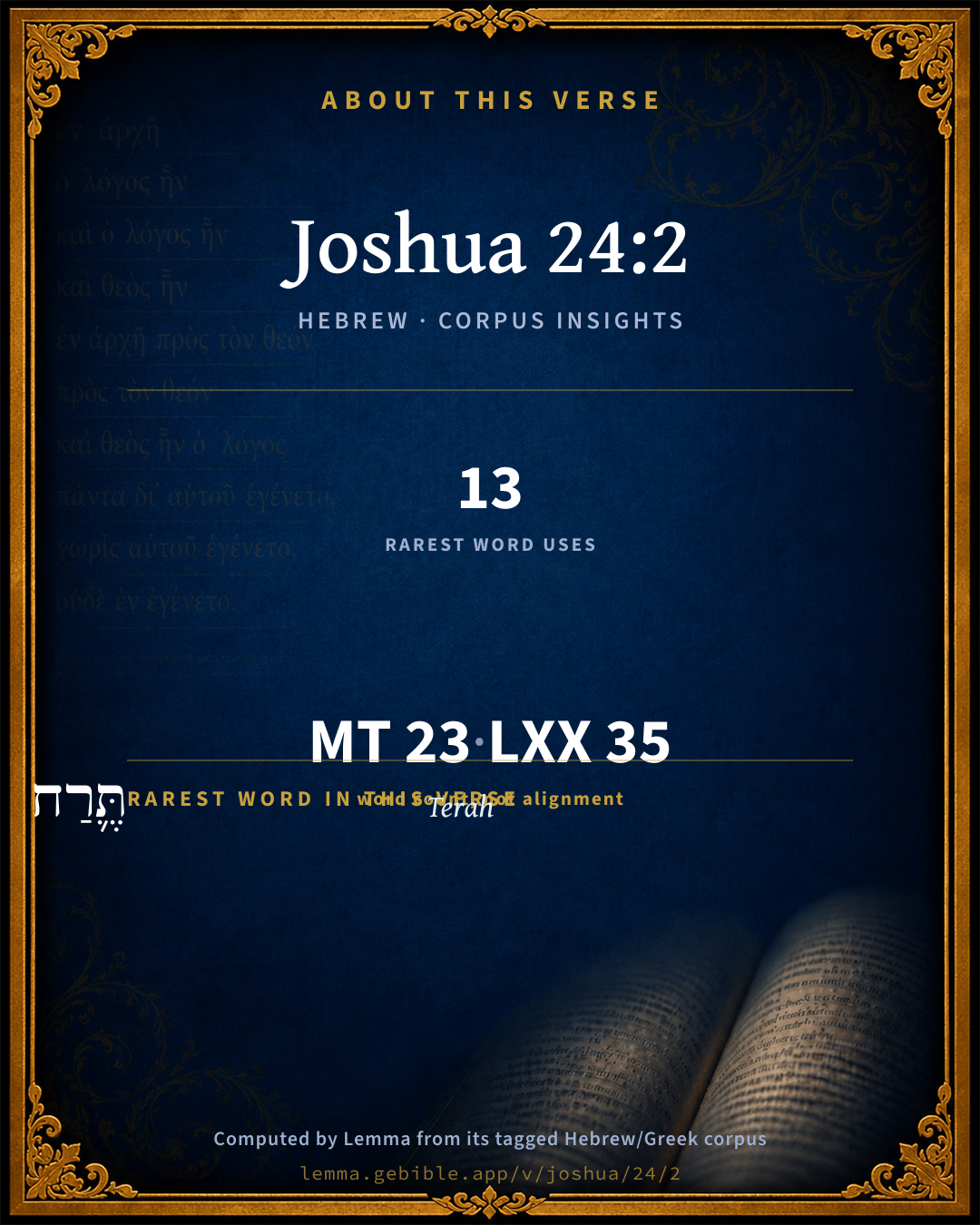
The rarest word here is תֶּ֛רַח Terah H8646 — appearing just 13 times in the whole Hebrew Bible.

Shared distinctive vocabulary

תֶּ֛רַח Terah H8646 occurs in 11 verses of the Hebrew Bible. Also found in:

Grammatical profile

  • 4 verbs
  • 16 nouns
  • 1 adjective
  • 1 preposition
  • 1 adverb

Verb forms

  • וַיֹּ֨אמֶר Qal · Sequential Imperfect
  • אָמַ֣ר Qal · Perfect
  • יָשְׁב֤וּ Qal · Perfect
  • וַיַּעַבְד֖וּ Qal · Sequential Imperfect

Repetition

Words recur within this verse — often emphatic in Hebrew:

  • אֲבֽוֹתֵיכֶם֙ father H1 ×3
  • וַיֹּ֨אמֶר to say H559 ×2
  • אֱלֹהֵ֣י God H430 ×2

Hebrew & Septuagint length

In English translation the verse runs 38 words from the Hebrew and 38 from the Septuagint (LXX English) — the same length.

A rough comparison of the two English renderings, which tokenize alike — not a word-level alignment.

Word counts can differ between the Hebrew and the Greek without any difference in meaning — e.g. the Hebrew direct-object marker אֵת has no separate Greek word, and Greek often adds the article ὁ.

In the original languages it is 23 Hebrew tokens and 35 Greek tokens — but the two are counted differently (Hebrew bundles its prefixes and suffixes into one token; the Greek is in lemma form), so that isn’t a like-for-like length.

Cross-references

10

Topical passages linked to Joshua 24:2 in the Treasury of Scripture Knowledge — connected by theme and wording, ordered by reader-vote popularity; previews shown in the World English Bible.

  • Joshua 24:15 If it seem evil to you to serve Yahweh, choose you this day whom you will serve; whether the gods which your fathers served that were beyond the River, or the gods of the Amorites, in whose land you dwell: but as for me and my house, we will serve Yahweh.
  • Genesis 31:30 Now, you want to be gone, because you sore longed after your father's house, but why have you stolen my gods?"
  • Ezekiel 16:3 and say, Thus says the Lord Yahweh to Jerusalem: Your birth and your birth is of the land of the Canaanite; the Amorite was your father, and your mother was a Hittite.
  • Genesis 31:19 Now Laban had gone to shear his sheep: and Rachel stole the teraphim that were her father's.
  • Genesis 31:32 With whoever you find your gods, he shall not live. Before our relatives, discern what is yours with me, and take it." For Jacob didn't know that Rachel had stolen them.
  • Genesis 31:53 The God of Abraham, and the God of Nahor, the God of their father, judge between us." Then Jacob swore by the fear of his father, Isaac.
  • Genesis 35:4 They gave to Jacob all the foreign gods which were in their hands, and the rings which were in their ears; and Jacob hid them under the oak which was by Shechem.
  • Deuteronomy 26:5 You shall answer and say before Yahweh your God, A Syrian ready to perish was my father; and he went down into Egypt, and sojourned there, few in number; and he became there a nation, great, mighty, and populous.
  • Isaiah 51:2 Look to Abraham your father, and to Sarah who bore you; for when he was but one I called him, and I blessed him, and made him many.
  • Genesis 11:26–12:1 Terah lived seventy years, and became the father of Abram, Nahor, and Haran.

Cross-references courtesy of OpenBible.info (CC BY 4.0).

Hebrew and Greek witnesses Masoretic Hebrew ↔ Greek Septuagint

The same verse in the two great witnesses to the Old Testament, shown verse-for-verse.

These are two independent witnesses, not word-aligned to each other, and the Septuagint is shown in lemma (dictionary) form.

Hebrew Joshua 24:2 Masoretic · Westminster Leningrad Codex

וַיֹּ֨אמֶר יְהוֹשֻׁ֜עַ אֶל כָּל הָעָ֗ם כֹּֽה אָמַ֣ר יְהוָה֮ אֱלֹהֵ֣י יִשְׂרָאֵל֒ בְּעֵ֣בֶר הַנָּהָ֗ר יָשְׁב֤וּ אֲבֽוֹתֵיכֶם֙ מֵֽעוֹלָ֔ם תֶּ֛רַח אֲבִ֥י אַבְרָהָ֖ם וַאֲבִ֣י נָח֑וֹר וַיַּעַבְד֖וּ אֱלֹהִ֥ים אֲחֵרִֽים

Joshua said to all the people, Thus says Yahweh, the God of Israel, Your fathers lived of old time beyond the River, even Terah, the father of Abraham, and the father of Nahor: and they served other gods.

World English Bible · Public Domain

Greek LXX Joshua 24:2 Septuagint · lemma form

καί εἶπον ἰησοῦς πρός πᾶς ὁ λαός ὅδε λέγω κύριος ὁ θεός ἰσραήλ πέραν ὁ ποταμός καταοἰκέω ὁ πατήρ σύ ὁ ἀπό ἀρχή θαρα ὁ πατήρ ἀβραάμ καί ὁ πατήρ ναχωρ καί λατρεύω θεός ἕτερος

And Joshua said to all the people, Thus says the Lord God of Israel, Your fathers at first sojourned beyond the river, even Thara, the father of Abraam and the father of Nachor; and they served other gods.

LXX2012 (modern English Septuagint) · Public Domain

Hebrew: Westminster Leningrad Codex (CC BY 4.0). Greek: Septuagint (public domain); English from LXX2012 (modern English Septuagint) (Public Domain). How the Septuagint differs from the Hebrew →

Targum (Aramaic paraphrase)

1

The Targum is the ancient Jewish Aramaic paraphrase of the Hebrew Scriptures — an interpretive translation, not the Hebrew text itself. Onkelos (literal) and Pseudo-Jonathan (expansive) render the Torah, and Jonathan the Prophets. Coverage is partial: where no permissively-licensed English translation exists for a verse, only the Aramaic is shown. This is verse-level text, not a word-by-word alignment to the Hebrew.

  1. Targum Jonathan Prophets (Joshua–Malachi)
    וַאֲמַר יְהוֹשֻׁעַ לְכָל עַמָא כִּדְנַן אֲמַר יְיָ אֱלָהָא דְיִשְׂרָאֵל בְּעִבַּר פְּרָת יְתַבוּ אֲבָהַתְכוֹן מֵעַלְמָא תֶּרַח אֲבוּהִי דְאַבְרָהָם וַאֲבוּהִי דְנָחוֹר וּפְלָחוּ לְטַעֲוַת עַמְמַיָא:

    (no public-domain English translation for this verse)

    Targum Jonathan — Aramaic: “Mikraot Gedolot” (public domain). English: “Sefaria Community Translation” (CC0 1.0 (public-domain dedication)); “London "Chaldee Paraphrase," 1871” (public domain). Text via Sefaria.

Commentary

Notes on Joshua 24:2 from classic Christian and Jewish commentators (each source and its license shown beneath its notes). The classic Christian expositions comment on the surrounding passage and are grouped to its opening verse, so a note may address several verses; the Jewish commentaries on the Tanakh (Rashi and others) are per-verse, so they appear only where the commentator wrote on this verse.

Lemma curates 59 commentaries, every one of them public domain or Creative Commons licensed, each selected and text-cleaned for this edition rather than reprinted as found. About our sources →

Jamieson, Fausset & Brown

Robert Jamieson, A. R. Fausset & David Brown

RELATES GOD'S BENEFITS. (Jos 24:2-13)

Joshua said unto all the people--His address briefly recapitulated the principal proofs of the divine goodness to Israel from the call of Abraham to their happy establishment in the land of promise; it showed them that they were indebted for their national existence as well as their peculiar privileges, not to any merits of their own, but to the free grace of God.

Your fathers dwelt on the other side of the flood--The Euphrates, namely, at Ur.

Terah, the father of Abraham, and the father of Nachor--(see Gen 11:27). Though Terah had three sons, Nahor only is mentioned with Abraham, as the Israelites were descended from him on the mother's side through Rebekah and her nieces, Leah and Rachel.

served other gods--conjoining, like Laban, the traditional knowledge of the true God with the domestic use of material images (Gen 31:19, Gen 31:34).

Jamieson, Fausset & Brown — Commentary Critical and Explanatory on the Whole Bible (1871) — public domain (CC PDM 1.0). Text via the HelloAO Bible API.

Trapp's Complete Commentary

John Trapp

Jos 24:2 And Joshua said unto all the people, Thus saith the LORD God of Israel, Your fathers dwelt on the other side of the flood in old time, [even] Terah, the father of Abraham, and the father of Nachor: and they served other gods.

Ver. 2. And Joshua said unto all the people.] Besides what he had said to them in the former chapter; so solicitous was he of the public welfare after his decease also. Cicero saith that this was his chiefest care: we are sure it was good Joshua’s.

Your fathers dwelt on the other side of the flood,] i.e., Of the river Euphrates, that ancient river. And this was the ancient manner of speaking to the people, by giving them a historical narrative of what God had done for them and their forefathers, that mercy might enforce to duty; since divine blessings are binders, and men’s offences are increased by their obligations. See the like method made use of by those admirable preachers, David, {Psa 78:1-72} Stephen, {Act 7:2-53} and Paul. {Act 13:17-41}

And they served other gods.] Even Abraham as well as the rest, {a} till God gave him a call out of his own country, till he had "called him to his foot," {Isa 41:2} that is, to follow him and his direction, to obey him without solicitation.

{a} Some of the Rabbis say that Terah got his living by making and selling of images.

John Trapp, A Commentary or Exposition upon All the Books of the Old and New Testament (1647–1656) — public domain. Text from a community e-Sword module.

Joseph Benson's Commentary

Jos 24:2. Joshua said unto all the people — To the elders, by whom it was to be imparted to all the rest, and to as many of the people as came thither. He spake to them in God’s name, and as from him, in the language of a prophet. Thus saith the Lord — Jehovah, the great God, and the God of Israel, whom you are peculiarly bound to hear. This is an argument that he uttered all that follows by the divine inspiration and impulse. Indeed he was no less the prophet than the political head of the nation. Your fathers dwelt on the other side of the flood — Or, the river, namely, Euphrates, so called by way of eminence. They served other gods — That is, both Abraham and Nahor were no less idolaters than the rest of mankind. This is said to prevent their vain boasting in their worthy ancestors, and to assure them that whatsoever good was in, or had been done by their progenitors, was wholly from God’s free grace, and not for their own merit or righteousness.

Joseph Benson's Commentary on the Old and New Testaments (1811–1818) — public domain. Text from a community e-Sword module.

Tyndale Open Study Notes

Tyndale Open Resources

24:2 Terah: See Gen 11:27-32.

Tyndale Open Study Notes — © Tyndale Open Resources, licensed CC BY-SA 4.0. Text via the HelloAO Bible API.

Geneva Bible (1599)

Geneva Bible translators

Euphrates in Mesopotamia, Gen. 11:26.

Geneva Bible (1599) marginal notes — public domain. Text via Bolls.life.

Adam Clarke's Commentary

Verse 2. On the other side of the flood] The river Euphrates.

They served other gods.] Probably Abraham as well as Terah his father was an idolater, till he received the call of God to leave that land. See on Ge 11:31; Ge 12:1. And for the rest of the history referred to here, see the notes on the parallel passages in the margin.

Adam Clarke's Commentary on the Bible (1810–1826) — public domain. Text from a community e-Sword/MySword module.

John Calvin's Commentaries

2. Your fathers dwelt on the other side, etc He begins his address by referring to their gratuitous adoption by which God had anticipated any application on their part, so that they could not boast of any peculiar excellence or merit. For God had bound them to himself by a closer tie, having, while they were no better than others, gathered them together to be his peculiar people, from no respect to anything but his mere good pleasure. Moreover, to make it clearly appear that there was nothing in which they could glory, he leads them back to their origin, and reminds them how their fathers had dwelt in Chaldea, worshipping idols in common with others, and differing in nothing from the great body of their countrymen. Hence it is inferred that Abraham, when he was plunged in idolatry, was raised up, as it were, from the lowest deep.

The Jews, indeed, to give a false dignity to their race, fabulously relate that Abraham became an exile from his country because he refused to acknowledge the Chaldean fire as God. But if we attend to the words of the inspired writer, we shall see that he is no more exempted from the guilt of the popular idolatry than Terah and Nachor. For why is it said that the fathers of the people served strange gods, and that Abraham was rescued from the country, but just to show how the free mercy of God was displayed in their very origin? Had Abraham been unlike the rest of his countrymen, his own piety would distinguish him. The opposite, however, is expressly mentioned to show that he had no peculiar excellence of his own which could diminish the grace bestowed upon him, and that therefore his posterity behooved to acknowledge that when he was lost, he was raised up from death unto life.

It seems almost an incredible and monstrous thing, that while Noah was yet alive, idolatry had not only spread everywhere over the world, but even penetrated into the family of Shem, in which at least, a purer religion ought to have flourished. How insane and indomitable human infatuation is in this respect, is proved by the fact that the holy Patriarch, on whom the divine blessing had been specially bestowed, was unable to curb his posterity, and prevent them from abandoning the true God, and prostituting themselves to superstition.

John Calvin's Commentaries (1540-1563) — public domain. Text from the Calvin Translation Society English edition (1840s-50s) via the Christian Classics Ethereal Library (ccel.org). Calvin's coverage is partial (roughly two-thirds of the Bible); uncommented books and verses are honest gaps, never fabricated. The 19th-century editor's footnotes and remarks are omitted so the notes are faithfully Calvin's own voice.

The Cambridge Bible for Schools and Colleges

gen. ed. J. J. S. Perowne

2. Thus saith the Lord God of Israel] The title is significant. It recurs in Jos_24:23. Joshua recalls to the minds of the people the mercies of God as displayed in five great events:—

(i) The Call of Abraham;

(ii) The Deliverance from Egypt;

(iii) The Defeat of the Amorites on the east of the Jordan, and the frustration of the machinations of Balaam;

(iv) The Passage of the Jordan and Capture of Jericho;

(v) The Victories over all the nations of Canaan.

on the other side of the flood] Or better, on the other side of the river, i.e. the Euphrates, in Ur of the Chaldees, and then in Haran (Gen_11:28; Gen_11:31). “Biçond the flood,” Wyclif.

Terah] The ancestor, through Abram, Nahor, and Haran, of the great families of the Ishmaelites, Israelites, Midianites, Moabites, and Ammonites (Gen_11:24-32). With his son Abram, his daughter-in-law Sarai, and his grandson Lot, he went in a north-westerly direction from Ur “into the land of Canaan; and they came unto Haran, and dwelt there” (Gen_11:31), and at Haran he died at the age of 205 years (Gen_11:32).

and they served other gods] The objects of nature, especially the heavenly bodies, were in those far-back times invested with a “glory” and a “freshness” which has long since “passed away” from the earth. They seemed to be instinct with a divinity which exercised an almost irresistible fascination over their first beholders. The sight of the “sun when it shined, and of the moon walking in brightness,” was a temptation as potent to them as to us it is inconceivable. “Their heart was secretly enticed, and their mouth kissed their hand” (Job_31:26-27). There was also another form of idolatry, though less universal in its influence. “There were giants on the earth in those days;” giants, if not actually, yet by their colossal strength and awful majesty; the Pharaohs and Nimrods, whose form we still trace on the ornaments of Egypt and Assyria in their gigantic proportions, the mighty hunters, the royal priests, the deified men. From the control of these powers, before which all meaner men bowed down, from the long ancestral prepossessions of ‘country and kindred and father’s house,’ the first worshippers of One who was above all alike, had painfully to disentangle themselves.” Stanley’s Jewish Church, Jos_1:15-16. Of the worship of “images,” or “Teraphim,” we have traces in Gen_31:19; Gen_31:30; Gen_31:34. Tradition asserts that Terah was a maker of idols, and that Abraham was persecuted in Ur of the Chaldees for refusing to take part in idolatries.

The Cambridge Bible for Schools and Colleges (gen. ed. J. J. S. Perowne; Cambridge University Press, 1878–1918) — public domain. Text from a community e-Sword module.

John Gill's Exposition

And Joshua said unto all the people,.... Then present, or to all Israel by their representatives:

thus saith the Lord God of Israel; he spoke to them in the name of the Lord, as the prophet did, being himself a prophet, and at this time under a divine impulse, and spirit of prophecy. According to an Arabic writer (w): the Angel of God appeared in the form of a man, and with a loud voice delivered the following, though they are expressed by him in a different manner; perhaps he mean, the Captain of the Lord's host, Jos 15:13; and which is not unlikely:

your fathers dwelt on the other side of the flood in old time; on the offer side the, river Euphrates; so the Targum,"beyond Perat;''i.e. Euphrates; in Mesopotamia and Chaldea; meaning not the remotest of their ancestors, Noah and Shem, but the more near, and who are expressly named:

even Terah the father of Abraham, and the father of Nachor; the Israelites sprung from Terah, in the line of Abraham, on the father's side, and from him in the line of Nachor on the mother's side, Rebekah, Leah, and Rachel, being of Nachor's family:

and they served other gods; besides the true God, strange gods, which were no gods: "idols"; the idols of the people, as the Targum; so did Terah, Abraham, and Nachor; See Gill on Gen 11:26; See Gill on Gen 11:28; See Gill on Gen 12:1.

(w) Abulpharag. Hist. Dynast. p. 35.

John Gill's Exposition of the Whole Bible (1746–1763) — public domain (CC PDM 1.0). Text via the HelloAO Bible API.

Albert Barnes' Notes on the Bible

The other side of the flood - Better “On the other side of the river,” i. e. the Euphrates. See the marginal reference.

They served other gods - Possibly the “images,” or teraphim, which we find their ancestor Laban calling “his gods” (see the marginal reference); and of which it would seem that there were, as Joshua spoke, some secret devotees among the people Jos 24:14, Jos 24:25. It is not stated that Abraham himself was an idolater, though his fathers were. Jewish tradition asserts that Abraham while in Ur of the Chaldees was persecuted for his abhorrence of idolatry, and hence, was called away by God from his native land. The reference in the text to the original state of those who were the forefathers of the nation, is made to show that they were no better than others: God chose them not for their excellences but of His own mere motion.

Albert Barnes' Notes on the Bible (1834–1885) — public domain. Text from a community e-Sword/MySword module.

Haydock's Catholic Bible Commentary

Of the river. The Euphrates. (Challoner) --- Gods. Some think that Abraham himself was in his youth engaged in the worship of idols, (though this is denied by St. Augustine, City of God xvi. 13.; Theodoret, q. 18.; &c.; Worthington) as well as his father, &c., ver. 14., and Genesis xi. 31. Thare was the father of both Abraham and Nachor, (Genesis xi. 26,) unless (Haydock) the grandfather (Menochius) of Abraham was meant, who was also called Nachor, (Haydock) as well as Rebecca’s grandfather, Genesis xxiv. (Worthington)

George Leo Haydock (1774–1849), Haydock's Catholic Family Bible and Commentary, 1859 edition — public domain. Excludes Psalms (Douay-Rheims chapter numbering differs from Protestant) and Deuterocanonical books (Catholic canon only).

Matthew Poole's English Annotations

Unto all the people, i.e. that people which were present, to wit, to the elders, &c., by whom it was to be imparted to all the rest, and to as many of the people as came thither.

The flood, or, the river, to wit, Euphrates, as all agree; so called by way of eminency.

They served other gods, i.e. both Abraham and Nahor were no less idolaters than the rest of mankind. This is said to prevent their vain boasting in their worthy ancestors, and to assure them that whatsoever good was in or had been done by their progenitors, was wholly born God’s free grace, and not for their own merit or righteousness, as the Jews were very apt to conceit.

Matthew Poole's English Annotations on the Holy Bible (1683–1685) — public domain. Text from a community e-Sword/MySword module.

Whedon's Commentary on the Bible

Daniel D. Whedon

2. On the other side of the flood — Rather, the river; that is, the Euphrates. It was Ur in Chaldea, beyond the Euphrates, whence Abraham was called from an idolatrous family. Terah, with Abram his son, removed from Ur westerly to Haran, where he died aged two hundred and five years. Gen_11:29-32. That he was a maker of images is a mere legend.

[They served other gods — “It is not said distinctly of Abraham that he served other gods, on which account we agree with Knobel, who says: Whether, according to our author, Abraham also was originally an idolater, is rather to be denied than affirmed; comp. Gen_31:53. But dangerous even for him were the idolatrous surroundings; wherefore God took him and caused him to wander through Canaan.” — Fay. But a love and reverence for the teraphim seemed rooted in the descendants of Terah. See note on Jos_24:14.]

Daniel D. Whedon (gen. ed.), Commentary on the Old and New Testaments (1874–1909) — public domain. Text from a community e-Sword module.

The Pulpit Commentary

All the people. (see note on Jos_23:2) The Lord God of Israel. Rather, Jehovah, the God of Israel. (see Exo_3:13) Until the vision to Moses, the God of Israel had no distinctive name. After that time Jehovah was the recognised name of the God of Israel, as Chemosh of the Moabites, Milcom of the Ammonites, Baal of the Phoenicians. Our translation, "the Lord," somewhat obscures this. Your fathers dwelt on the other side of the flood. Rather, of the river. Euphrates is meant, on the other side of which (see, however, note on last verse) lay Ur of the Chaldees. It is worthy of notice that there is no evidence of the growth of a myth in the narrative here. We have a simple abstract of the history given us in the Pentateuch, without the slightest addition, and certainly without the invention of any further miraculous details. All this goes to establish the position that we have here a simple unvarnished history of what occurred. The manufacture of prodigies, as every mythical history, down to the biographies of Dominic and Francis, tells us, is a process that cannot stand still. Each successive narrator deems it to be his duty to embellish his narrative with fresh marvels. Compare this with the historical abridgment before us, and we must at least acknowledge that we are in the presence of phenomena of a very different ruder. Professor Goldziher has argued, in his "Mythology among the Hebrews," that Abraham, Sarah, Isaac, and Jacob are solar myths, such as we find in immense abundance in Cox"s "Aryan Mythology." Abraham (father of height)is the nightly sky. Sarah (princess) is the moon. Isaac (he shall laugh) is the smiling sunset or dawn. It would be difficult to find any history which, by an exercise of similar ingenuity, might not be resolved into myths. Napoleon Bonaparte, for instance, might be resolved into the rushing onset of the conqueror who was never defeated. The retreat from Moscow is a solar myth of the most obvious description. The battle of Bull"s Run is clearly so named from the cowardice displayed there by the sons of John Bull. It is remarked by Mr. Tomkins that Ur, the city of the moon god, lends itself most naturally to the fabricator of myths. There is only one objection to the theory, and that is the bricks, still in existence, stamped with the words Urn, which compel us to descend from this delightful cloud land of fancy to the more sober regions of solid and literal fact (see "Studies on the Times of Abraham," pp. 205-207). In old time. Literally, from everlasting, i.e. , from time immemorial, ap archv . The Rabbinic tradition has great probability in it, that Abraham was driven out of his native country for refusing to worship idols. It is difficult to understand his call otherwise. No doubt his great and pure soul had learned to abhor the idolatrous and cruel worship of his countrymen. By inward struggles, perhaps by the vague survival of the simpler and truer faith which has been held to underlie every polytheistic system, he had "reached a purer air," and learned to adore the One True God. His family were led to embrace his doctrines, and they left their native land with him. But Haran, with its star worship, was no resting place for him. So he journeyed on westward, leaving the society of men, and preserving himself from temptation by his nomad life. No wandering Bedouin, as some would have us believe (see Drew, "Scripture Lands," p. 18), but a prince, on equal terms with Abimelech and Pharaoh, and capable of overthrowing the mighty conqueror of Elam. Such an example might well be brought to the memory of his descendants, who were now to be sojourners in the land promised to their father. Guided by conscience alone, with every external influence against him, he had worshipped the true God in that land. No better argument could be offered to his descendants, when settled in that same land, and about to be bereft of that valuable support which they had derived from the life and influence of Joshua.

HOMILIES BY R. GLOVER Vers. 2, 3. Abraham the heathen.

"Your fathers... served other gods," is an incidental statement of the utmost value. It throws a light on Abraham"s antecedents in which we do not always see them, and enhances the significance of his abandonment of home and country, and his clear faith in a living God, in a degree which nothing else does. Observe first of all

I THE FACT THAT ABRAHAM WAS ORIGINALLY A HEATHEN. He was not merely born and bred an idolater, as we might have gathered from the story of Bachel"s teraphim, but was a pagan in exactly the same condition of belief as many in India or in China are today. Some, in later times especially, and indeed in all times, worshipped the true God, but employed an idol to assist their imagination of Him; that is, they simply sought ritualistic and sensuous aids to religious thought and feeling. But Abraham began life far lower down in the religious scale. His fathers served other gods; the deified powers of nature representing little more than the forces and tendencies of life. Primitive tradition had lost any brightness it ever had. The religious sentiment had lost that reverence and habit of attention which soon begins to perceive God and to feel that the God constantly appealing to it is one and the same. The worship of several deities is always a mark of a superstitious ingredient blending with faith. Terah"s family were in this condition. They were not only idolaters but polytheists without Bible or sacrament, promise, or law. Abraham was precisely in the same sort of spiritual circumstances, and had been taught the same sort of religious ideas, and trained in the same superstitions, as are found in all pagan lands today. Yet with advantages so slight, he became the spiritual father of the religious nation of antiquity type of all saintliness, of everything bright in faith and unquestioning in obedience. There is some reason to suppose that a god of vengeance was one of those deities most reverently regarded by his people; and yet he finds and worships a God of love! He, like all of us, had Christ, the light that lighteth every man that cometh into the world. He, unlike most of us, followed the Christ light within him. Following the Divine light, it grew ever clearer, and his vision became stronger to perceive and his heart to follow it. Amongst a multitude of silent deities, One spoke to him through his conscience, with more and more of frequency, and, in the devotee in which He was obeyed, with more and more of clearness, both in the comforts He whispered and the commands He enjoined, till gradually he felt there was but one great God, who governed all, and should receive the homage of all; who was the friendly refuge as well as the omnipotent Creator of men. Gradually his life began to revolve around this unseen Centre, and the outward aspect and inward purpose of his life stood out in palpable difference from that of his fellows. Doubtless he preached his deep conviction, gathered about him some kindred spirits; perhaps had to endure persecution; till at last he got a strong impression borne in upon his conscience that his path of duty and of spiritual wisdom was to leave his native land and seek a new home for what was a new faith amongst men. His coming to Ur of the Chaldees, and then to Canaan, may be compared with the expedition of the Pilgrim fathers. Like them he sought "freedom to worship God," and like them founded a great nation in doing so. In any view of his character, his decision, his devotion, the clearness of his faith, the promptness of his obedience, are marvellous. But they become much more so when we mark the fact that Joshua here brings out, that Abraham began his career in heathen darkness that the father of the faithful began life as a mere pagan. Observe

II SOME LESSONS OF THIS FACT. For evidently it has many. We can only suggest them.

(1) A little grace and a little light go a long way when well used. How little had Abraham to begin with! But, using what he had, it grew more, and was enough to do more for him than light a thousand times as clear does for some of us today. A man who has light upon his next step of duty has really an "abundance of revelation." Do not go in for being omniscient, postponing all obedience until you get light on all truth. Use your little light well whatever it is, and so you will get more.

(2) Obedience is the mode of self enlightenment. "If any man will do God"s will, he shall know God"s doctrine." So says Christ. Doing duty is the way of discovering truth. Since the creation of the world there has been no other. Take this.

(3) All the sacraments are means of grace, not conditions of salvation. The Church has always been tempted to exaggerate the helpful into the essential, until it says, "Extra ecclesiam, nulia salus." Paul, in the Epistle to the Romans, arguing with those who held the sacrament of circumcision essential to salvation, quotes Abraham as reaching all his spirituality and acceptance with God, "not in circumcision, but in uncircumcision," i.e. , not by sacraments, but without them altogether. Sacraments are aids. The mercy that gave them to be such will, in the absence of them through error or inadvertence, use some other way of enriching and enlightening the obedient heart.

(4) However sunk in superstition the heathen may be, they are capable of religion. The difference between the Christian and the heathen in the matter of spiritual advantages is not a difference between having all and having nothing, but between having more and having less. They have the Christian inward light movings of God"s spirit, lessons of God"s providence. God speaks to them, and "wakes their ear in the morning." They lack the testimony of God"s saints, their examples, the revelation of God"s highest law, a clear light on immortality; above all, the light which comes from the life and death of the Son of God light of the knowledge of the glory of God in the face of Jesus Christ." This fuller light would multiply vastly the number of the devout amongst them, and give a higher character to their devotion. But they may be saved, as we are taught explicitly both by Peter and by Paul, by a Saviour they feel and follow, though they do not know the story of His love.

(5) The heathen being thus capable of religion, and our higher advantages being influential to produce it, we ought to extend to them the full light of the Saviour"s glory. Our neglect of Christian missions grows from our despair of heathen men. We ought to think of the millions in heathen darkness as Abraham"s brethren, and capable of appreciating and responding to all that is true and gracious. If we rightly reverence them, we should not eat our morsel of the bread of life alone, but should share it with them. Let us seek to extend the knowledge of the gospel of Christ, and we shall yet behold many an Abraham rising up in heathen lands. G.

The Pulpit Commentary (1880–1919), ed. H.D.M. Spence-Jones & Joseph S. Exell — public domain. Text from a community e-Sword module.

John Wesley's Explanatory Notes

The people - To the elders, by whom it was to be imparted to all the rest, and to as many of the people as came thither. He spake to them in God's name, and as from him, in the language of a prophet, Thus saith the Lord. Jehovah, the great God, and the God of Israel, whom you are peculiarly engaged to hear. The flood - Or, the river, namely, Euphrates, so called by way of eminency. They served - That is, Both Abraham and Nahor were no less idolaters than the rest of mankind. This is said to prevent their vain boasting in their worthy ancestors, and to assure them that whatsoever good was in, or had been done by their progenitors, was wholly from God's free grace, and not for their own merit or righteousness.

John Wesley, Explanatory Notes Upon the Whole Bible (1754–1765) — public domain. Text via the GEBible commentary corpus.

Lesson kit

Teaching starters — assembled from the data on this page, not authored interpretation. Every prompt links to the verse data it draws on. Edit before teaching.

Joshua, in the Historical, opens this verse with 23 words (19 distinct Hebrew lemmas). Its most distinctive word is Terach (“Terah”). A historical commentator’s framing appears above. Read the whole chapter for the surrounding context.

Discussion questions

  1. How does “Terah” (Terach) shape what this verse is saying?
  2. Genesis 11:24 shares the word «Terah» with this verse. How do the two illuminate each other?
  3. “father” occurs 3× in this one verse. What is the effect of the repetition?
  4. These translations render this verse differently; the difference is in the English rendering, not the original. What questions does that raise?
  5. The verb «וַיֹּ֨אמֶר» is Qal Sequential Imperfect. How does its form color the action?
  6. Reading how Jamieson, Fausset & Brown and Trapp's Complete Commentary read this verse, where do the two commentators agree and where do they part?

Things to notice

Reading settings

Reading text

Shown beneath each verse's original-language words.

Old Testament
Old Testament edition

Read the OT as the Masoretic Hebrew (MT) or the Greek Septuagint (LXX).

English shown for the Greek Septuagint (in the Hebrew ↔ Greek comparison).

Comparing translations? Open the Compare panel on any verse page to stack up to four side by side.