2 Peter 1:7

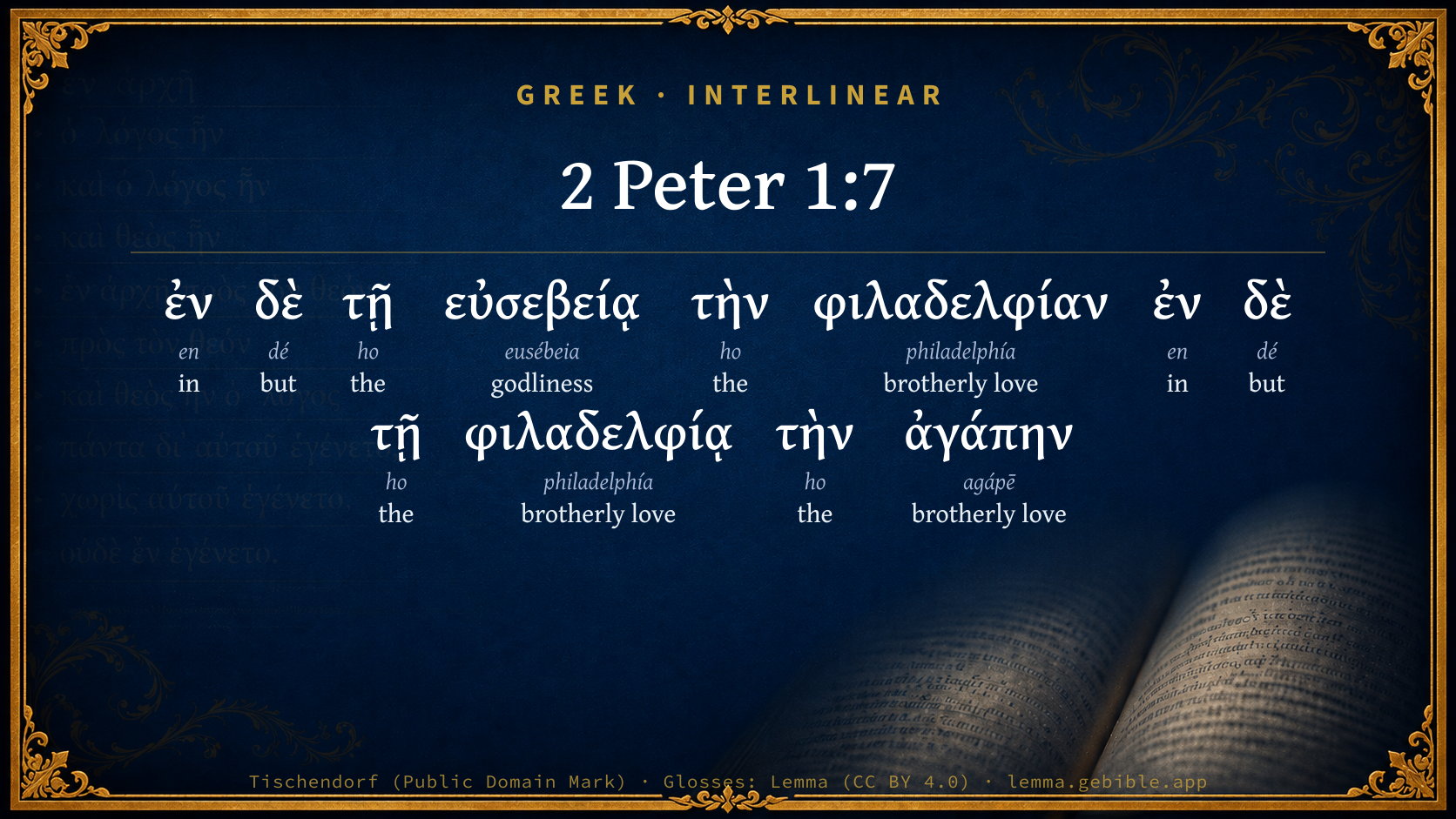
Greek (Tischendorf 8th ed.) 2 Peter 1:7 appears in the Greek New Testament. The text above is from the Tischendorf 8th edition. Each word links to its Strong’s number and a concise gloss. Click any word for its full Thayer’s Greek Lexicon entry.
Download image
Cite this verse

2 Peter 1:7 (World English Bible). Public Domain. Lemma interlinear Bible study tool, https://lemma.gebible.app/v/2-peter/1/7.

Show BibTeX & RIS
BibTeX
RIS
English Translation
and in godliness brotherly affection; and in brotherly affection, love.
World English Bible · Public Domain
Download a study sheet

One document with this verse’s original text, its word-by-word gloss line, the meaning frame, cross-references with their text, attributed commentary, and full source and license credits — printable, and it pastes into notes with its structure intact.

This verse Autodidact and up

Study sheet (.html) Plain text (.txt)

A passage Seminary Student

Up to 50 verses in one chapter. A passage sheet keeps up to 6 commentary sources and 12 cross-references per verse, in the order this page ranks them, and says so on the sheet whenever that leaves anything out. Ask for a single verse and you get the Autodidact verse sheet above.

Everything on this page stays free to read, with no account — the sheet is a download of what is already on screen, not access to it.

Want to remove ads? Support Godless Engineer
Compare translations 3

The same verse in 3 English versions, stacked beneath the original-language interlinear above. Click any original word for its lexicon entry.

Each is an independent rendering of the whole verse — the interlinear is not word-aligned to these translations.

Highlighted words mark where these versions differ — a whole-verse word diff, not a word-by-word alignment.

  • World English Bible Public Domain
    and in godliness brotherly affection; and in brotherly affection, love.
  • King James Version Public Domain
    And to godliness brotherly kindness; and to brotherly kindness charity.
  • unfoldingWord Literal Text CC BY-SA 4.0
    and in godliness, brotherly affection; and in brotherly affection, love.

unfoldingWord Literal Text — © unfoldingWord, licensed CC BY-SA 4.0. Word-aligned USFM3 via Door43 (git.door43.org/unfoldingWord/en_ult).

Versions to compare (up to 4)

3 of 4 selected

Show all 19 translations

Every available English version of this verse, each an independent rendering of the whole verse.

  • World English Bible Public Domain
    and in godliness brotherly affection; and in brotherly affection, love.
  • Berean Standard Bible Public Domain
    and to godliness, brotherly kindness; and to brotherly kindness, love.
  • Majority Standard Bible Public Domain
    and to godliness, brotherly kindness; and to brotherly kindness, love.
  • King James Version Public Domain
    And to godliness brotherly kindness; and to brotherly kindness charity.
  • American Standard Version (1901) Public Domain
    and in `your' godliness brotherly kindness; and in `your' brotherly kindness love.
  • Revised Version (1885) Public Domain
    and in your godliness love of the brethren; and in your love of the brethren love.
  • Geneva Bible (1599) Public Domain
    And with godlines, brotherly kindnes: and with brotherly kindnes, loue.
  • Douay-Rheims (1899) Public Domain
    And in godliness, love of brotherhood; and in love of brotherhood, charity.
  • Young's Literal Translation Public Domain
    and in the piety the brotherly kindness, and in the brotherly kindness the love;
  • Literal Standard Version CC BY-SA 4.0
    and with piety—brotherly kindness, and with brotherly kindness—love;
  • Unlocked Literal Bible CC BY-SA 4.0
    to godliness add brotherly affection; and to brotherly affection add love.
  • unfoldingWord Literal Text CC BY-SA 4.0
    and in godliness, brotherly affection; and in brotherly affection, love.
  • Darby Bible Public Domain
    in godliness brotherly love, in brotherly love love:
  • World Messianic Bible Public Domain
    and in godliness, brotherly affection; and in brotherly affection, love.
  • Webster's Bible Public Domain
    And to godliness brotherly kindness; and to brotherly kindness charity.
  • Free Bible Version CC BY-SA 4.0
    add to reverence, affection for fellow-believers, add to affection for fellow-believers, love.
  • Bible in Basic English Public Domain
    And love of the brothers to fear of God, and to love of the brothers, love itself.
  • Text-Critical English NT CC BY 4.0
    your godliness with brotherly affection, and your brotherly affection with love.
  • Tyndale New Testament (1534) Public Domain
    in godlynes brotherly kyndnes in brotherly kyndnes love.

Literal Standard Version (2020), Covenant Press — licensed CC BY-SA 4.0. Text via the HelloAO Bible API (eBible.org). Unlocked Literal Bible (unfoldingWord) — licensed CC BY-SA 4.0. Text via the HelloAO Bible API (eBible.org). unfoldingWord Literal Text — © unfoldingWord, licensed CC BY-SA 4.0. Word-aligned USFM3 via Door43 (git.door43.org/unfoldingWord/en_ult). Free Bible Version, Dr. Jonathan Gallagher — licensed CC BY-SA 4.0. Text via the HelloAO Bible API (eBible.org).

Word by word

More ways to search: Search by grammar → Find every occurrence → Compare this word →

Practice this passage: Drill this verse → Learn its vocabulary →

About this verse

These counts appear in no published source. They are computed here, from the morphology-tagged text and Lemma’s own curated glosses. What Lemma adds →

12
words
6
distinct lemmas
General Epistles
section

Notable vocabulary

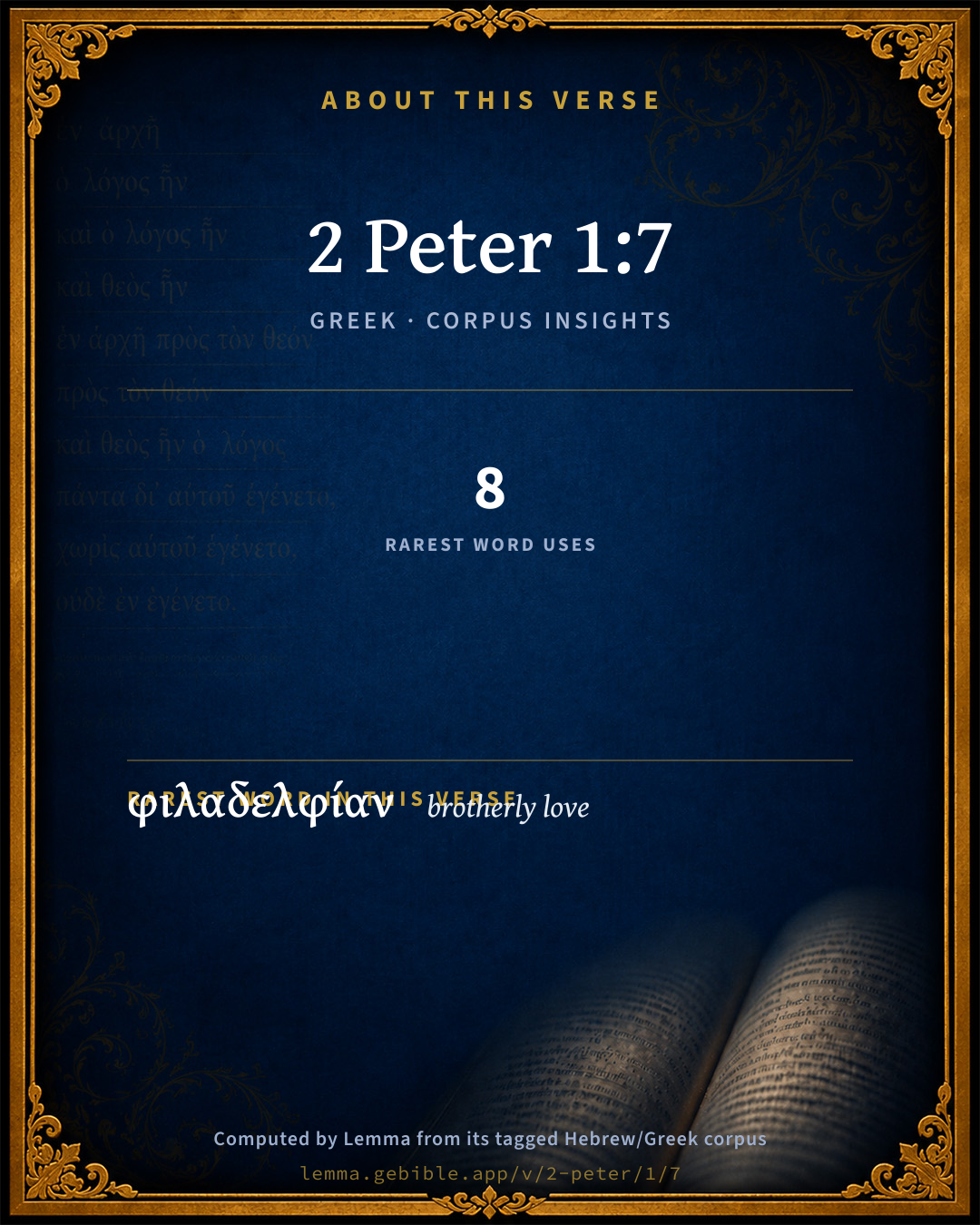
The rarest word here is φιλαδελφίαν brotherly love G5360 — appearing just 8 times in the whole Greek New Testament.

Shared distinctive vocabulary

φιλαδελφίαν brotherly love G5360 occurs in 7 verses of the Greek New Testament. Also found in:

Repetition

Words recur within this verse:

  • φιλαδελφίαν brotherly love G5360 ×2
  • τῇ the G3588 ×4
  • ἐν in G1722 ×2
  • δὲ but G1161 ×2

Cross-references

15

Topical passages linked to 2 Peter 1:7 in the Treasury of Scripture Knowledge — connected by theme and wording, ordered by reader-vote popularity; previews shown in the World English Bible.

  • Hebrews 13:1 Let brotherly love continue.
  • Romans 12:10 In love of the brothers be tenderly affectionate one to another; in honor preferring one another;
  • 1 Thessalonians 3:12 and the Lord make you to increase and abound in love one toward another, and toward all men, even as we also do toward you,
  • Colossians 3:14 Above all these things, walk in love, which is the bond of perfection.
  • John 13:34–35 A new commandment I give to you, that you love one another, just like I have loved you; that you also love one another.
  • 1 Corinthians 13:1–8 If I speak with the languages of men and of angels, but don't have love, I have become sounding brass, or a clanging cymbal.
  • Galatians 6:10 So then, as we have opportunity, let's do what is good toward all men, and especially toward those who are of the household of the faith.
  • 1 Peter 1:22 Seeing you have purified your souls in your obedience to the truth through the Spirit in sincere brotherly affection, love one another from the heart fervently:
  • 1 Peter 2:17 Honor all men. Love the brotherhood. Fear God. Honor the king.
  • 1 John 3:16 By this we know love, because he laid down his life for us. And we ought to lay down our lives for the brothers.
  • 1 John 4:21 This commandment we have from him, that he who loves God should also love his brother.
  • 1 Thessalonians 4:9–10 But concerning brotherly love, you have no need that one write to you. For you yourselves are taught by God to love one another,
  • 1 Peter 3:8 Finally, be all like-minded, compassionate, loving as brothers, tenderhearted, courteous,
  • 1 John 3:14 We know that we have passed out of death into life, because we love the brothers. He who doesn't love his brother remains in death.
  • 1 Thessalonians 5:15 See that no one returns evil for evil to anyone, but always follow after that which is good, for one another, and for all.

Cross-references courtesy of OpenBible.info (CC BY 4.0).

Commentary

Notes on 2 Peter 1:7 from classic Christian and Jewish commentators (each source and its license shown beneath its notes). The classic Christian expositions comment on the surrounding passage and are grouped to its opening verse, so a note may address several verses; the Jewish commentaries on the Tanakh (Rashi and others) are per-verse, so they appear only where the commentator wrote on this verse.

Lemma curates 59 commentaries, every one of them public domain or Creative Commons licensed, each selected and text-cleaned for this edition rather than reprinted as found. About our sources →

Bengel's Gnomon

Johann Albrecht Bengel

2Pe 1:7. Φιλαδελφίαν, brotherly affection) towards the saints who are united with you in God.—τὴν ἀγάπην, love) From brotherly affection is deduced love: 1Pe 1:22.

Bengel's Gnomon of the New Testament — English translation (T&T Clark, Edinburgh, 1860) — public domain. Text from a community e-Sword module.

Meyer's Critical & Exegetical Commentary

Heinrich August Wilhelm Meyer

2Pe_1:7 adds φιλαδελφία and ἀγάπη to the virtues already named. These are to be distinguished thus, that the former applies specially to the Christian brethren, the latter to allwithout distinction; 1Th_3:12 : ἡ ἀγάπη εἰς ἀλλήλους καὶ εἰς πάντας (Gal_6:10); with φιλαδελφία, cf. 1Pe_1:22. While the apostle calls the love which is extended to all ἀγάπη, he gives it to be understood that what he means is not the purely natural well-wishing, but Christian love springing from the Christian spirit. Dietlein, without sufficient reason, thinks that φιλαδελφία is only the opposite of that which is forbidden in the eighth and ninth commandments, whilst the ἀγάπη is the complete antithesis to what is forbidden in the tenth commandment. In this way the conception φιλαδελφία is unjustifiably disregarded,a proceeding to which the language of Scripture gives the less sanction, that where love in all its depth and truth is spoken of, the word φιλεῖν is not unfrequently used; cf. Joh_5:20; Joh_16:27, etc.

Although the different virtues here are not arranged according to definite logical order, yet the way in which they here belong to each other is not to be mistaken. Each of the virtues to be shown forth forms the complement of that which precedes, and thus gives rise to a firmly-linked chain of thought. ἀρετή supplies the complement of πίστις, for faith without virtue is wanting in moral character, and is in itself dead; that of ἀρετή is γνῶσις, for the realizing of the moral volition is conditioned by comprehension of that which is needful in each separate case; that of γνῶσις is ἐγκράτεια, for self-control must not be wanting to volition and comprehension; that of ἐγκράτεια is ὑπομενή, for there are outward as well as inward temptations to be withstood; that of ὑπομονή is εὐσέβεια, for only in trustful love to God has the ὑπομονή firm support; that of εὐσέβεια the φιλαδελφία, for he that loveth not his brother whom he hath seen, how can he love God whom he has not seen? (1Jn_4:20); that of φιλαδελφία the ἀγάπη, for without the latter the former would degenerate into poor narrow-heartedness. Thus, in that the one virtue is the complement of the other, the latter produces the former of itself as its natural outcome; Bengel: praesens quisque gradus subsequentem parit et facilem reddit, subsequens priorem temperat ac perficit.[34]

[34] According to Dietlein, the three first graces, including πίστις, correspond to the first table of the law, the three first petitions of the Lords Prayer, the first article of the Creed, and to faith in the Pauline triad; the three following graces to the first half of the second table of the law, the fourth petition in the Lords Prayer, the second article of the Creed, and the second grace in the Pauline triad; the two last graces to the second half of the second table of the law, the three last petitions of the Lords Prayer, the third article of the Creed, and the third grace of that triad. Certainly there is here a good deal that coincides, but this by no means warrants a consistent parallelism of all the individual points, which can only gain an appearance of correctness by an arbitrary narrowing or extending of the ideas and their applications.It is worthy of remark that the series begins with πίστις and ends with ἀγάκπ; in that, then, ver. 11 points to the future, ἐλπίς is added, so that the well-known triad is here alluded to (Schott).

Meyer — Critical and Exegetical Commentary on the New Testament — English translation by Peter Christie, edited by Frederick Crombie (T&T Clark, 1880) — public domain. Text from a community e-Sword module.

Expositor's Greek Testament

ed. W. Robertson Nicoll

2Pe 1:7 . φιλαδελφίαν : “affection towards the brethren,” i.e. , of the same Christian community. ἀγάπην : probably love towards all, even enemies; not directed by sense and emotion, but by deliberate choice ( cf. Mat 5:44 ). Mayor interprets: “Love to God manifesting itself in love to man and to the whole creation, animate and inanimate”.

The Expositor's Greek Testament, edited by W. Robertson Nicoll (1897–1910) — public domain. Text from a community e-Sword module.

Jamieson, Fausset & Brown

Robert Jamieson, A. R. Fausset & David Brown

"And in your godliness brotherly kindness"; not suffering your godliness to be moroseness, nor a sullen solitary habit of life, but kind, generous, and courteous [ALFORD]. Your natural affection and brotherly kindness are to be sanctified by godliness. "And in your brotherly kindness love," namely, to all men, even to enemies, in thought, word, and deed. From brotherly kindness we are to go forward to love. Compare Th1 3:12, "Love one toward another (brotherly kindness), and toward all men (charity)." So charity completes the choir of graces in Col 3:14. In a retrograde order, he who has love will exercise brotherly kindness; he who has brotherly kindness will feel godliness needful; the godly will mix nothing stoical with his patience; to the patient, temperance is easy; the temperate weighs things well, and so has knowledge; knowledge guards against sudden impulse carrying away its virtue [BENGEL].

Jamieson, Fausset & Brown — Commentary Critical and Explanatory on the Whole Bible (1871) — public domain (CC PDM 1.0). Text via the HelloAO Bible API.

Adam Clarke's Commentary

Verse 7. Brotherly kindness] φιλαδελφιαν. Love of the brotherhood-the strongest attachment to Christ's flock; feeling each as a member of your own body.

Charity] αγαπην. Love to the whole human race, even to your persecutors: love to God and the brethren they had; love to all mankind they must also have. True religion is neither selfish nor insulated; where the love of God is, bigotry cannot exist. Narrow, selfish people, and people of a party, who scarcely have any hope of the salvation of those who do not believe as they believe, and who do not follow with them, have scarcely any religion, though in their own apprehension none is so truly orthodox or religious as themselves.

After αγαπην, love, one MS. adds these words, ενδετηαγαπη τηνπαρακλησιν, and to this love consolation; but this is an idle and useless addition.

Adam Clarke's Commentary on the Bible (1810–1826) — public domain. Text from a community e-Sword/MySword module.

Ellicott's Commentary for English Readers

(7) And to godliness brotherly kindness; and to brotherly kindness charity.—And in your godliness [supply] love of the brethren, and in your love of the brethren, charity. In other words, your godliness must not be selfish and solitary, but social and Christian; for he who loveth God must love his brother also (1Jn_4:20-21). And though “charity begins at home” with “them who are of the household of faith,” it must not end there, but reach out to all men, whether Christians or not. (Comp. 1Th_3:12; Gal_6:10.) The translation “brotherly kindness” is a little to be regretted; it obscures the exact meaning of the Word, and also the fact that the very same word is used in 1Pe_1:22. “Love of the brethren” means love of Christians as such, as members of the same great family, as God’s adopted children. “Charity” means love of men as such, as creatures made in the likeness of God, as souls for which Christ died. The word for “charity” is emphatically Christian love; not mere natural benevolence.

Each in this noble chain of virtues prepares the way for the next, and is supplemented and perfected by it. It begins with faith, and it ends (like St. Paul’s list of virtues, Col_3:12-14) with charity. But we must not insist too strongly upon the order in the series, as being either logically or chronologically necessary. It is a natural order that is here given, but not the only one. These three verses are the First Epistle condensed. Each one of the virtues mentioned here is represented quite distinctly in 1 Peter: virtue, 1Pe_1:13; knowledge, 1Pe_3:15; self-control, 1Pe_1:14; 1Pe_2:11; patience, 1Pe_1:6; 1Pe_2:21; godliness, 1Pe_1:15-16; 1Pe_3:4; love of the brethren, 1Pe_1:22; 1Pe_3:8; charity, 1Pe_4:8. The list of virtues given in the Epistle of Barnabas 2 runs thus:—Faith, fear, patience, long - suffering, temperance, wisdom, prudence, science, knowledge. The very slight amount of similarity affords no ground for supposing that the writer was acquainted with 2 Peter.

A Bible Commentary for English Readers, edited by Charles John Ellicott (1878–1897) — public domain. Text from a community e-Sword module.

The Cambridge Bible for Schools and Colleges

gen. ed. J. J. S. Perowne

7. and to godliness brotherly kindness] Better, perhaps, love of the brethren. See note on 1Pe_1:22. The recurrence of the words may be noted as evidence in favour of identity of authorship.

and to brotherly kindness charity] Better, love. See note on 1Pe_4:8. It is to be regretted, as has been said before, that the varying usage of our translators hinders us from recognising at once the unity of the writers of the New Testament as to the greatness and majesty of “love.”

The Cambridge Bible for Schools and Colleges (gen. ed. J. J. S. Perowne; Cambridge University Press, 1878–1918) — public domain. Text from a community e-Sword module.

John Gill's Exposition

Without which, godliness, or external worship, or a profession of religion, is a vain show; for this is both the evidence of regeneration, and of the truth and power of real godliness; and also the beauty, comfort, and security of Christian society and worship, and without which they cannot be maintained with peace, profit, and honour:

and to brotherly kindness, charity: or "love"; that is, to all men, enemies, as well as to the household of faith; and to God and Christ, to his house, worship, ordinances, people and truths. Charity is more extensive in its objects and acts than brotherly kindness or love. As faith leads the van, charity brings up the rear, and is the greatest of all.

John Gill's Exposition of the Whole Bible (1746–1763) — public domain (CC PDM 1.0). Text via the HelloAO Bible API.

Trapp's Complete Commentary

John Trapp

7 And to godliness brotherly kindness; and to brotherly kindness charity.

Ver. 7. And to godliness, brotherly kindness] Zeal for God should eat us up, but not eat up our love to God’s people. Fire purgeth gold, but burneth it not; the fire of zeal may be warming, comforting, not scalding or scorching. Moses was angry with the people, but prayed for them. Christ was angry with the Pharisees, but grieved also for the hardness of their hearts, Mar 3:5.

And to brotherly kindness, &c.] Love we must all men, but especially the family of faith; as our Saviour loved the young man, but not so as he did Lazarus, Mar 10:21; Joh 11:3.

John Trapp, A Commentary or Exposition upon All the Books of the Old and New Testament (1647–1656) — public domain. Text from a community e-Sword module.

Albert Barnes' Notes on the Bible

And to godliness brotherly kindness - Love to Christians as such. See the Joh 13:34 note; Heb 13:1 note.

And to brotherly kindness charity - Love to all mankind. There is to be a special affection for Christians as of the same family; there is to be a true and warm love, however, for all the race. See the notes at 1 Cor. 13.

Albert Barnes' Notes on the Bible (1834–1885) — public domain. Text from a community e-Sword/MySword module.

Matthew Poole's English Annotations

Brotherly kindness; a love to those that are of the household of faith. This is joined to godliness, to show that it is in vain to pretend to true religion and yet be destitute of brotherly love.

Charity; this is more general than the former, and relates to all men, even our enemies themselves.

Matthew Poole's English Annotations on the Holy Bible (1683–1685) — public domain. Text from a community e-Sword/MySword module.

Whedon's Commentary on the Bible

Daniel D. Whedon

7. Godliness, unguarded, becomes morose and estranged from brethren, and loves its own solitude; therefore, in your godliness furnish brotherly kindness, or rather, brotherly love. And lest this become narrow and bigoted, in your love of the Christian brotherhood, furnish charity, a love that looks out beyond and embraces all mankind. Of these graces, love, then, is the crown. The order is not that of succession, for they all grow together, and are all essential to a full symmetrical Christian character.

Daniel D. Whedon (gen. ed.), Commentary on the Old and New Testaments (1874–1909) — public domain. Text from a community e-Sword module.

The Pulpit Commentary

And to godliness brotherly kindness; and to brotherly kindness charity. The word for "brotherly kindness" (filadelfia) is another link between the two Epistles. (see 1Pe_1:22 1Pe_3:8) "In your godliness," St. Peter says, "ye must develop brotherly kindness, the unfeigned love of the brethren;" for "every one that loveth him that begat, loveth him also that is begotten of him". (1Jn_5:1) And as God is loving unto every man, and "maketh his sun to rise on the evil and on the good," so Christians, who are taught to be followers (imitators) of God, (Eph_5:1) must learn in the exercise of love toward the brethren that larger love which embraces all men in an ever-widening circle. (comp. 1Th_3:12) Thus love, the greatest of all Christian graces, (1Co_13:13) is the climax in St. Peter"s list. Out of faith, the root, spring the seven fair fruits of holiness, of which holy love is the fairest and the sweetest (comp. Ignatius, "Ad Ephes.," 14. jArch mestiv, telov deph). No grace can remain alone; each grace, as it is gradually formed in the soul, tends to develop and strengthen others; all graces meet in that highest grace of charity, without which whosoever liveth is counted dead before God. Bengel says well, "Praeseus quisque gradus subsequentem parit et facilem reddit, subsequens priorem temperat ac perficit."

The Pulpit Commentary (1880–1919), ed. H.D.M. Spence-Jones & Joseph S. Exell — public domain. Text from a community e-Sword module.

John Wesley's Explanatory Notes

And to godliness brotherly kindness - No sullenness, sternness, moroseness: "sour godliness," so called, is of the devil. Of Christian godliness it may always be said, "Mild, sweet, serene, and tender is her mood, Nor grave with sternness, nor with lightness free: Against example resolutely good, Fervent in zeal, and warm in charity." And to brotherly kindness love - The pure and perfect love of God and of all mankind. The apostle here makes an advance upon the preceding article, brotherly kindness, which seems only to relate to the love of Christians toward one another.

John Wesley, Explanatory Notes Upon the Whole Bible (1754–1765) — public domain. Text via the GEBible commentary corpus.

The People's New Testament

B. W. Johnson

7. Brotherly kindness. An active good will towards the saints. Love. The heart element which gives brotherly kindness its power and sweetness.

B. W. Johnson's The People's New Testament with Notes (1889–1891) — public domain. Electronic text from the Christian Classics Ethereal Library (CCEL) ThML edition.

Cambridge Greek Testament for Schools and Colleges

7. φιλαδελφία. It is interesting to see how this word has been transformed in meaning under Christian (and Jewish) influences. To the Greek proper it meant only the affection of a brother for his own actual brother. In a Jewish book (2Ma 15:14) we find the prophet Jeremiah called φιλάδελφος, because he “prays much for the people.” Thus to the Jew, all the nation were beginning to be thought of as brethren. In the N.T. no expression is more familiar to us than “the brethren” applied to those who are united in a common belief. We are reminded of φιλαδελφία and ἀγάπη by the passage 1Jn 4:20 ἐάν τις εἴπῃ Ἀγαπῶ τὸν θεόν, καὶ τὸν ἀδελφὸν αὐτοῦ μισῇ, ψεύστης ἐστίν.

With this list of virtues may be compared (besides 1 Tim. already quoted) Gal 5:22. In the Shepherd of Hermas, written early in the second century, is a genealogical tree of virtues which somewhat resembles ours: Πίστις, Ἐγκράτεια, Ἁπλότης, Ἀκακία, Σεμνότης, Ἐπιστήμη, Ἀγάπη.

Cambridge Greek Testament for Schools and Colleges (Cambridge University Press, 1896; 21 vols, various authors incl. Carr, Maclear, Plummer, Farrar, Lumby, Moule, M. R. James, Simcox) — public domain. Text from a community e-Sword module.

Alford’s Greek Testament

Henry Alford

7.] and in your godliness, brotherly kindness (not suffering your godliness to be moroseness, nor a sullen solitary habit of life, but kind and generous and courteous), and in your brotherly kindness, love (universal kindness of thought, word, and act towards all: a catholic large-heartedness, not confining the spirit of φιλαδελφία to ἀδελφοί only, Mat 5:46, Mat 5:47. So that these two last correspond to the ἀγάπη εἰς ἀλλήλους καὶ εἰς πάντας of 1Th 3:12.

8,

Henry Alford, The Greek Testament (1849–1861) — public domain. Text from a community e-Sword module.

Lesson kit

Teaching starters — assembled from the data on this page, not authored interpretation. Every prompt links to the verse data it draws on. Edit before teaching.

2 Peter, in the General Epistles, opens this verse with 12 words (6 distinct Greek lemmas). Its most distinctive word is philadelphía (“brotherly love”). A historical commentator’s framing appears above. Read the whole chapter for the surrounding context.

Discussion questions

  1. How does “brotherly love” (philadelphía) shape what this verse is saying?
  2. Romans 12:10 shares the word «brotherly love» with this verse. How do the two illuminate each other?
  3. “brotherly love” occurs 2× in this one verse. What is the effect of the repetition?
  4. These translations render this verse differently; the difference is in the English rendering, not the original. What questions does that raise?
  5. Reading how Bengel's Gnomon and Meyer's Critical & Exegetical Commentary read this verse, where do the two commentators agree and where do they part?

Things to notice

  • These translations choose different wording for 4 words in this verse.
  • “brotherly love” occurs 2× in this single verse.
  • 6 distinct Greek lemmas span 12 words in this verse.

Reading settings

Reading text

Shown beneath each verse's original-language words.

Old Testament
Old Testament edition

Read the OT as the Masoretic Hebrew (MT) or the Greek Septuagint (LXX).

English shown for the Greek Septuagint (in the Hebrew ↔ Greek comparison).

Comparing translations? Open the Compare panel on any verse page to stack up to four side by side.