

Ephesians 4:15
Greek (Tischendorf 8th ed.) Ephesians 4:15 appears in the Greek New Testament. The text above is from the Tischendorf 8th edition. Each word links to its Strong’s number and a concise gloss. Click any word for its full Thayer’s Greek Lexicon entry.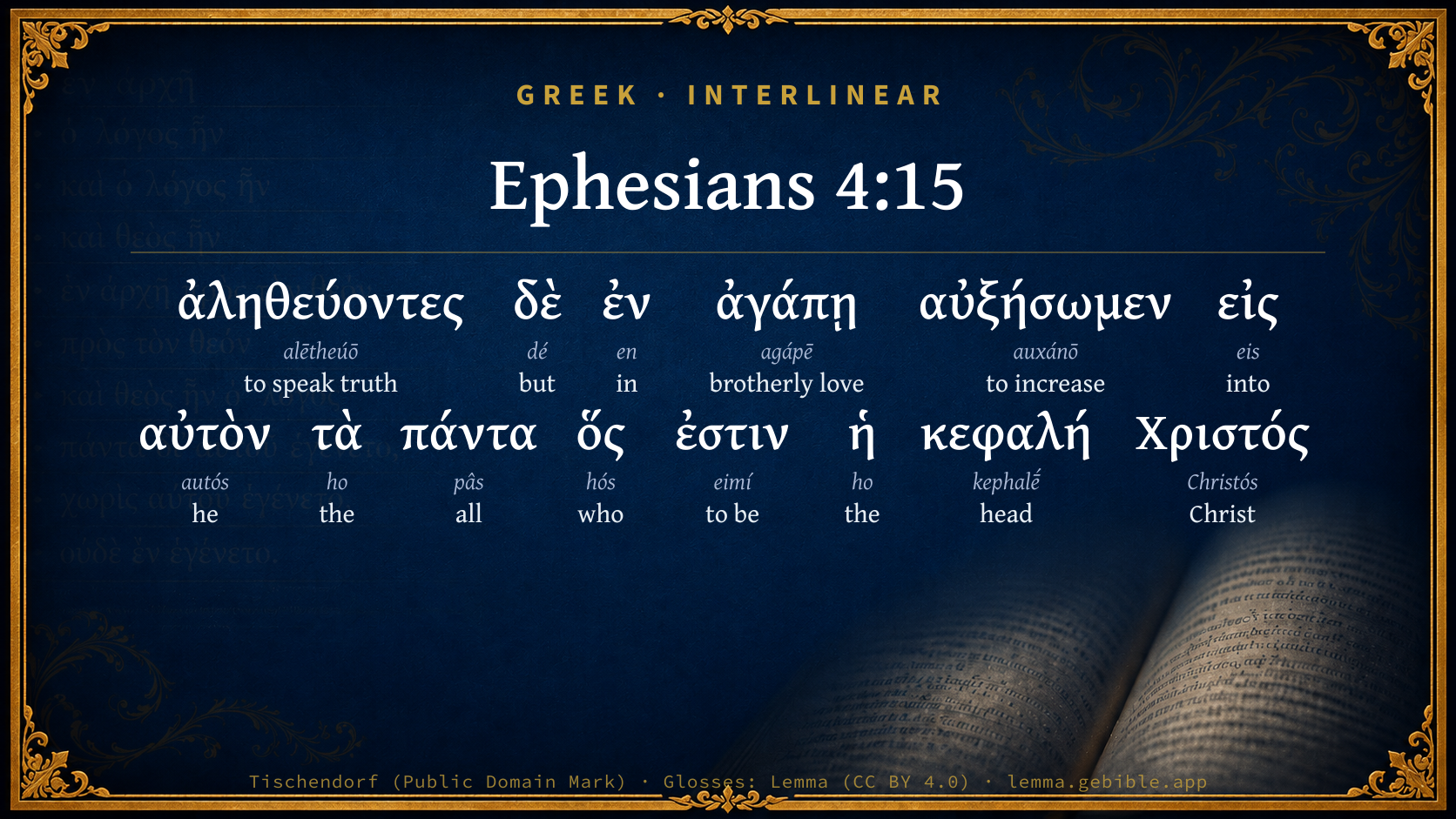
but speaking truth in love, we may grow up in all things into him, who is the head, Christ;
Download a study sheet
One document with this verse’s original text, its word-by-word gloss line, the meaning frame, cross-references with their text, attributed commentary, and full source and license credits — printable, and it pastes into notes with its structure intact.
This verse Autodidact and up
A passage Seminary Student
Up to 50 verses in one chapter. A passage sheet keeps up to 6 commentary sources and 12 cross-references per verse, in the order this page ranks them, and says so on the sheet whenever that leaves anything out. Ask for a single verse and you get the Autodidact verse sheet above.
Everything on this page stays free to read, with no account — the sheet is a download of what is already on screen, not access to it.
Compare translations 3
The same verse in 3 English versions, stacked beneath the original-language interlinear above. Click any original word for its lexicon entry.
Each is an independent rendering of the whole verse — the interlinear is not word-aligned to these translations.
Highlighted words mark where these versions differ — a whole-verse word diff, not a word-by-word alignment.
-
World English Bible Public Domain
but speaking truth in love, we may grow up in all things into him, who is the head, Christ;
-
King James Version Public Domain
But speaking the truth in love, may grow up into him in all things, which is the head, even Christ:
-
unfoldingWord Literal Text CC BY-SA 4.0
Instead, speaking truth in love, let us grow up in all things into him who is the head, Christ,
unfoldingWord Literal Text — © unfoldingWord, licensed CC BY-SA 4.0. Word-aligned USFM3 via Door43 (git.door43.org/unfoldingWord/en_ult).
Show all 19 translations
Every available English version of this verse, each an independent rendering of the whole verse.
-
World English Bible Public Domain
but speaking truth in love, we may grow up in all things into him, who is the head, Christ;
-
Berean Standard Bible Public Domain
Instead, speaking the truth in love, we will in all things grow up into Christ Himself, who is the head.
-
Majority Standard Bible Public Domain
Instead, speaking the truth in love, we will in all things grow up into Christ Himself, who is the head.
-
King James Version Public Domain
But speaking the truth in love, may grow up into him in all things, which is the head, even Christ:
-
American Standard Version (1901) Public Domain
but speaking truth in love, we may grow up in all things into him, who is the head, `even' Christ;
-
Revised Version (1885) Public Domain
but speaking truth in love, may grow up in all things into him, which is the head, even Christ;
-
Geneva Bible (1599) Public Domain
But let vs folowe the truth in loue, and in all things, grow vp into him, which is the head, that is, Christ.
-
Douay-Rheims (1899) Public Domain
But doing the truth in charity, we may in all things grow up in him who is the head, even Christ:
-
Young's Literal Translation Public Domain
and, being true in love, we may increase to Him `in' all things, who is the head -- the Christ;
-
Literal Standard Version CC BY-SA 4.0
and [speaking] truth in love, we may increase to Him [in] all things, who is the head—the Christ;
-
Unlocked Literal Bible CC BY-SA 4.0
Instead, speaking the truth in love, we are to grow up in every way into him who is the head, that is, Christ.
-
unfoldingWord Literal Text CC BY-SA 4.0
Instead, speaking truth in love, let us grow up in all things into him who is the head, Christ,
-
Darby Bible Public Domain
but, holding the truth in love, we may grow up to him in all things, who is the head, the Christ:
-
World Messianic Bible Public Domain
but speaking truth in love, we may grow up in all things into him who is the head, Messiah,
-
Webster's Bible Public Domain
But speaking the truth in love, may grow up into him in all things, who is the head, even Christ:
-
Free Bible Version CC BY-SA 4.0
Instead by speaking the truth in love we ought to grow up in everything into Christ, who is our head.
-
Bible in Basic English Public Domain
But saying true words in love, may come to full growth in him, who is the head, even Christ;
-
Text-Critical English NT CC BY 4.0
Rather, speaking the truth in love, we must grow up in every way into him who is the head, that is, Christ.
-
Tyndale New Testament (1534) Public Domain
But let vs folowe the trueth in loue and in all thynges growe in him which is the heed that ys to saye Christ
Literal Standard Version (2020), Covenant Press — licensed CC BY-SA 4.0. Text via the HelloAO Bible API (eBible.org). Unlocked Literal Bible (unfoldingWord) — licensed CC BY-SA 4.0. Text via the HelloAO Bible API (eBible.org). unfoldingWord Literal Text — © unfoldingWord, licensed CC BY-SA 4.0. Word-aligned USFM3 via Door43 (git.door43.org/unfoldingWord/en_ult). Free Bible Version, Dr. Jonathan Gallagher — licensed CC BY-SA 4.0. Text via the HelloAO Bible API (eBible.org).
Word by word
More ways to search: Search by grammar → Find every occurrence → Compare this word →
Practice this passage: Drill this verse → Learn its vocabulary →
- Appears 2× in the Greek New Testament
- First appears at Galatians 4:16
- Part of Speech
- Verb
- Tense
- Present
- Voice
- Active
- Mood
- Participle
- Case
- Nominative
- Number
- Plural
- Gender
- Masculine
Full Thayer's Definition
- ἀληθεύοντες alētheúō G226 “to speak truth” Verb, Present, Active, Participle, Nominative, Plural, Masculine
- δὲ dé G1161 “but” Conjunction
- ἐν en G1722 “in” Preposition
- ἀγάπῃ agápē G26 “brotherly love” Noun, Dative, Singular, Feminine
- αὐξήσωμεν auxánō G837 “to increase” Verb, Aorist, Active, Subjunctive, 1st person, Plural
- εἰς eis G1519 “into” Preposition
- αὐτὸν autós G846 “he” Personal pronoun, Accusative, Singular, Masculine
- τὰ ho G3588 “the” Article, Accusative, Plural, Neuter
- πάντα pâs G3956 “all” Adjective, Accusative, Plural, Neuter
- ὅς hós G3739 “who” Relative pronoun, Nominative, Singular, Masculine
- ἐστιν eimí G1510 “to be” Verb, Present, Active, Indicative, 3rd person, Singular
- ἡ ho G3588 “the” Article, Nominative, Singular, Feminine
- κεφαλή kephalḗ G2776 “head” Noun, Nominative, Singular, Feminine
- Χριστός Christós G5547 “Christ” Noun, Nominative, Singular, Masculine
About this verse
These counts appear in no published source. They are computed here, from the morphology-tagged text and Lemma’s own curated glosses. What Lemma adds →
- 14
- words
- 13
- distinct lemmas
- Pauline Epistles
- section
Notable vocabulary
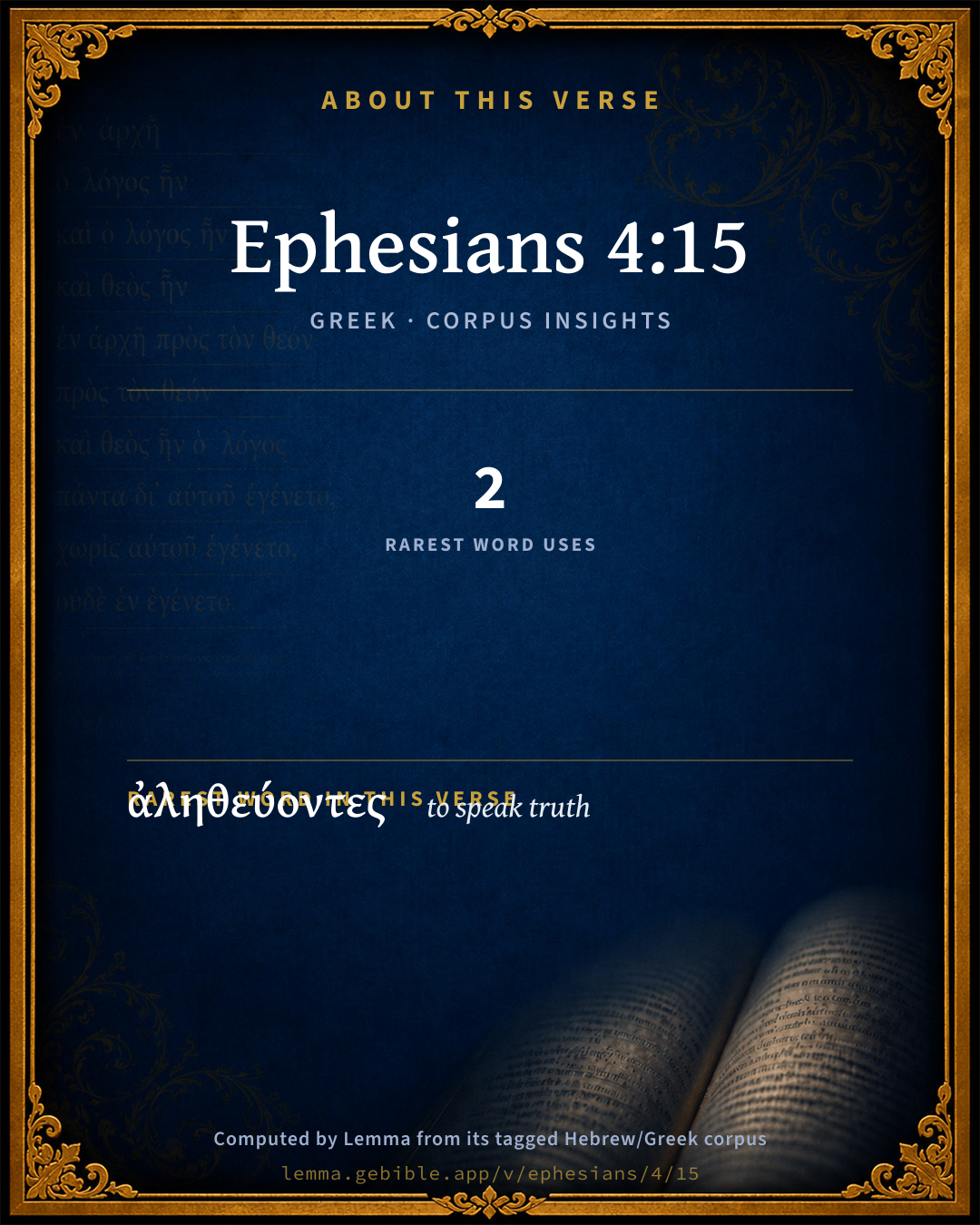
The rarest word here is ἀληθεύοντες to speak truth G226 — appearing just 2 times in the whole Greek New Testament.
Shared distinctive vocabulary
ἀληθεύοντες to speak truth G226 occurs in 2 verses of the Greek New Testament. Also found in:
Repetition
A word recurs within this verse:
- τὰ the G3588 ×2
Cross-references
19Topical passages linked to Ephesians 4:15 in the Treasury of Scripture Knowledge — connected by theme and wording, ordered by reader-vote popularity; previews shown in the World English Bible.
- 1 John 3:18 My little children, let's not love in word only, neither with the tongue only, but in deed and truth.
- Ephesians 4:25 Therefore, putting away falsehood, speak truth each one with his neighbor. For we are members one of another.
- Zechariah 8:16 These are the things that you shall do: speak every man the truth with his neighbor. Execute the judgment of truth and peace in your gates,
- 1 Peter 1:22 Seeing you have purified your souls in your obedience to the truth through the Spirit in sincere brotherly affection, love one another from the heart fervently:
- 2 Peter 3:18 But grow in the grace and knowledge of our Lord and Savior Jesus Christ. To him be the glory both now and forever. Amen.
- 1 Peter 2:2 as newborn babes, long for the pure milk of the Word, that you may grow thereby,
- Romans 12:9 Let love be without hypocrisy. Abhor that which is evil. Cling to that which is good.
- Ephesians 1:22 He put all things in subjection under his feet, and gave him to be head over all things for the assembly,
- Ephesians 2:21 in whom the whole building, fitted together, grows into a holy temple in the Lord;
- Psalms 32:2 Blessed is the man to whom Yahweh doesn't impute iniquity, In whose spirit there is no deceit.
- John 1:47 Jesus saw Nathanael coming to him, and said about him, "Behold, an Israelite indeed, in whom is no deceit!"
- Judges 16:15 She said to him, How can you say, I love you, when your heart is not with me? you have mocked me these three times, and have not told me in which your great strength lies.
- 2 Corinthians 4:2 But we have renounced the hidden things of shame, not walking in craftiness, nor handling the word of God deceitfully; but by the manifestation of the truth commending ourselves to every man's conscience in the sight of God.
- Ephesians 5:23 For the husband is the head of the wife, and Christ also is the head of the assembly, being himself the savior of the body.
- Colossians 1:18–19 He is the head of the body, the assembly, who is the beginning, the firstborn from the dead; that in all things he might have the preeminence.
- Malachi 4:2 But to you who fear my name shall the sun of righteousness arise with healing in its wings. You will go out, and leap like calves of the stall.
- 2 Corinthians 8:8 I speak not by way of commandment, but as proving through the earnestness of others the sincerity also of your love.
- Hosea 14:5–7 I will be like the dew to Israel. He will blossom like the lily, And send down his roots like Lebanon.
- James 2:15–16 And if a brother or sister is naked and in lack of daily food,
Cross-references courtesy of OpenBible.info (CC BY 4.0).
Lesson kit
Teaching starters — assembled from the data on this page, not authored interpretation. Every prompt links to the verse data it draws on. Edit before teaching.
Ephesians, in the Pauline Epistles, opens this verse with 14 words (13 distinct Greek lemmas). Its most distinctive word is alētheúō (“to speak truth”). A historical commentator’s framing appears above. Read the whole chapter for the surrounding context.
Discussion questions
- The word alētheúō carries the sense “to speak truth.” How does it shape the verse?
- Galatians 4:16 shares the word «to speak truth» with this verse. How do the two illuminate each other?
- “the” occurs 2× in this one verse. What is the effect of the repetition?
- These translations render this verse differently. What is at stake in choosing one wording over another?
- Reading how The Biblical Illustrator and Joseph Benson's Commentary read this verse, where do the two commentators agree and where do they part?
Things to notice
- These translations choose different wording for 8 words in this verse.
- “the” occurs 2× in this single verse.
- 13 distinct Greek lemmas span 14 words in this verse.
Commentary
Notes on Ephesians 4:15 from classic Christian and Jewish commentators (each source and its license shown beneath its notes). The classic Christian expositions comment on the surrounding passage and are grouped to its opening verse, so a note may address several verses; the Jewish commentaries on the Tanakh (Rashi and others) are per-verse, so they appear only where the commentator wrote on this verse.
Lemma curates 59 commentaries, every one of them public domain or Creative Commons licensed, each selected and text-cleaned for this edition rather than reprinted as found. About our sources →
The Biblical Illustrator
Joseph S. Exell
The Biblical Illustrator, edited by Joseph S. Exell (c. 1880s–1900s) — public domain. Text from a community e-Sword module.
Joseph Benson's Commentary
Joseph Benson's Commentary on the Old and New Testaments (1811–1818) — public domain. Text from a community e-Sword module.
Bengel's Gnomon
Johann Albrecht Bengel
Bengel's Gnomon of the New Testament — English translation (T&T Clark, Edinburgh, 1860) — public domain. Text from a community e-Sword module.
Meyer's Critical & Exegetical Commentary
Heinrich August Wilhelm Meyer
Meyer — Critical and Exegetical Commentary on the New Testament — English translation by Peter Christie, edited by Frederick Crombie (T&T Clark, 1880) — public domain. Text from a community e-Sword module.
Expositor's Greek Testament
ed. W. Robertson Nicoll
The Expositor's Greek Testament, edited by W. Robertson Nicoll (1897–1910) — public domain. Text from a community e-Sword module.
Hodge's Commentary on Romans, Ephesians & First Corinthians
Charles Hodge
Charles Hodge — Commentary on Romans (1835), First Corinthians (1857), and Ephesians (1856) — public domain. Text from a community e-Sword module.
Geneva Bible (1599)
Geneva Bible translators
Geneva Bible (1599) marginal notes — public domain. Text via Bolls.life.
Jamieson, Fausset & Brown
Robert Jamieson, A. R. Fausset & David Brown
Jamieson, Fausset & Brown — Commentary Critical and Explanatory on the Whole Bible (1871) — public domain (CC PDM 1.0). Text via the HelloAO Bible API.
Adam Clarke's Commentary
Adam Clarke's Commentary on the Bible (1810–1826) — public domain. Text from a community e-Sword/MySword module.
John Calvin's Commentaries
John Calvin's Commentaries (1540-1563) — public domain. Text from the Calvin Translation Society English edition (1840s-50s) via the Christian Classics Ethereal Library (ccel.org). Calvin's coverage is partial (roughly two-thirds of the Bible); uncommented books and verses are honest gaps, never fabricated. The 19th-century editor's footnotes and remarks are omitted so the notes are faithfully Calvin's own voice.
Ellicott's Commentary for English Readers
A Bible Commentary for English Readers, edited by Charles John Ellicott (1878–1897) — public domain. Text from a community e-Sword module.
The Cambridge Bible for Schools and Colleges
gen. ed. J. J. S. Perowne
The Cambridge Bible for Schools and Colleges (gen. ed. J. J. S. Perowne; Cambridge University Press, 1878–1918) — public domain. Text from a community e-Sword module.
John Gill's Exposition
John Gill's Exposition of the Whole Bible (1746–1763) — public domain (CC PDM 1.0). Text via the HelloAO Bible API.
Trapp's Complete Commentary
John Trapp
John Trapp, A Commentary or Exposition upon All the Books of the Old and New Testament (1647–1656) — public domain. Text from a community e-Sword module.
Albert Barnes' Notes on the Bible
Albert Barnes' Notes on the Bible (1834–1885) — public domain. Text from a community e-Sword/MySword module.
Matthew Poole's English Annotations
Matthew Poole's English Annotations on the Holy Bible (1683–1685) — public domain. Text from a community e-Sword/MySword module.
Whedon's Commentary on the Bible
Daniel D. Whedon
Daniel D. Whedon (gen. ed.), Commentary on the Old and New Testaments (1874–1909) — public domain. Text from a community e-Sword module.
The Pulpit Commentary
The Pulpit Commentary (1880–1919), ed. H.D.M. Spence-Jones & Joseph S. Exell — public domain. Text from a community e-Sword module.
John Wesley's Explanatory Notes
John Wesley, Explanatory Notes Upon the Whole Bible (1754–1765) — public domain. Text via the GEBible commentary corpus.
Kretzmann's Popular Commentary
Paul E. Kretzmann
Paul E. Kretzmann, Popular Commentary of the Bible (1921–1924) — public domain. Text from a community e-Sword module.
Burkitt's Expository Notes on the New Testament
William Burkitt
William Burkitt's Expository Notes on the New Testament (1700–1703) — public domain. Text from a community e-Sword module.
The People's New Testament
B. W. Johnson
B. W. Johnson's The People's New Testament with Notes (1889–1891) — public domain. Electronic text from the Christian Classics Ethereal Library (CCEL) ThML edition.
Cambridge Greek Testament for Schools and Colleges
Cambridge Greek Testament for Schools and Colleges (Cambridge University Press, 1896; 21 vols, various authors incl. Carr, Maclear, Plummer, Farrar, Lumby, Moule, M. R. James, Simcox) — public domain. Text from a community e-Sword module.
Alford’s Greek Testament
Henry Alford
Henry Alford, The Greek Testament (1849–1861) — public domain. Text from a community e-Sword module.
International Critical Commentary
International Critical Commentary — older volumes (1896–1929), various authors — public domain. Text from a community e-Sword module.
Vincent's Word Studies in the New Testament
Marvin R. Vincent
Marvin R. Vincent, Word Studies in the New Testament (1887–1900) — public domain. Text from a community e-Sword/MySword module.