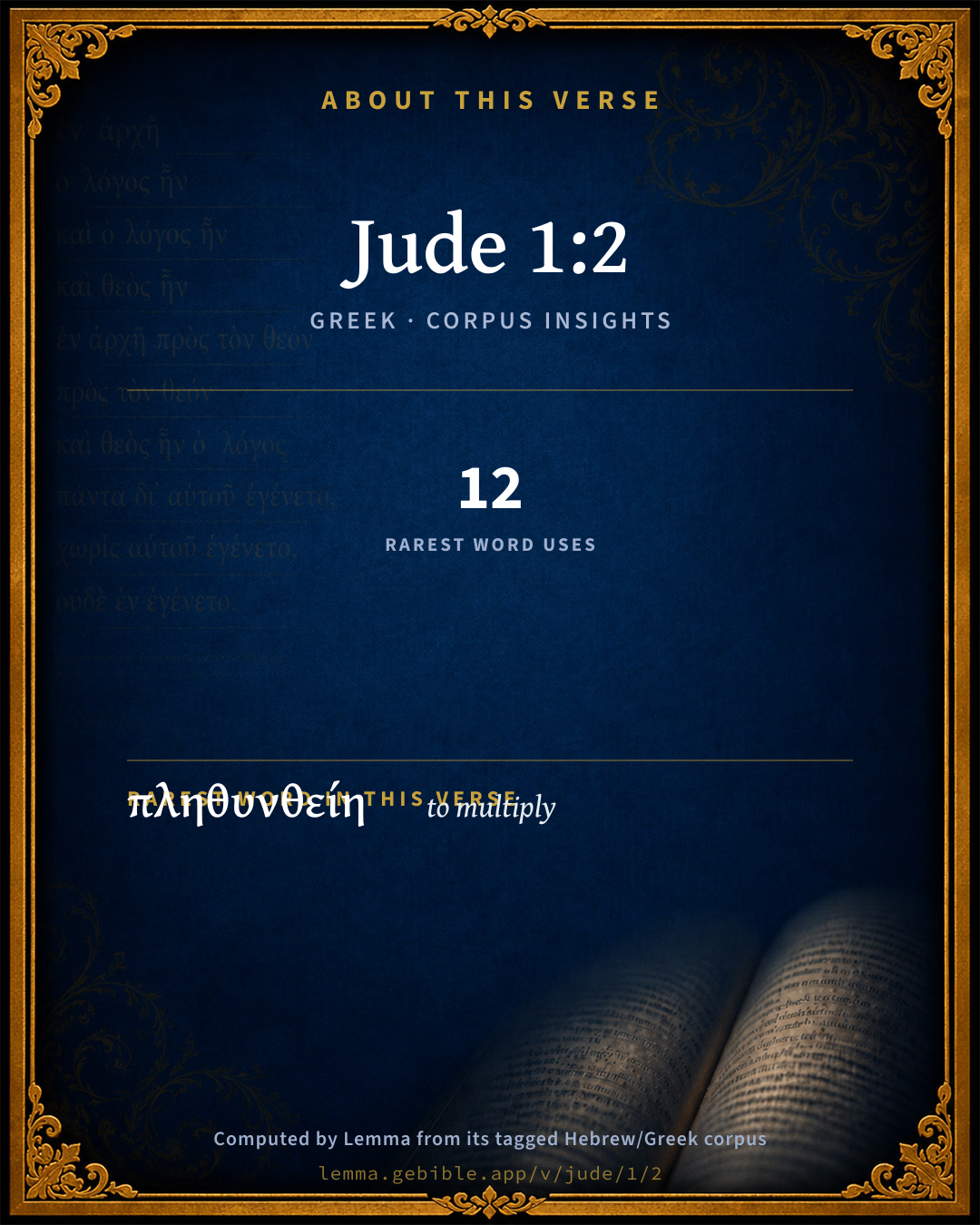
Jude 1:2

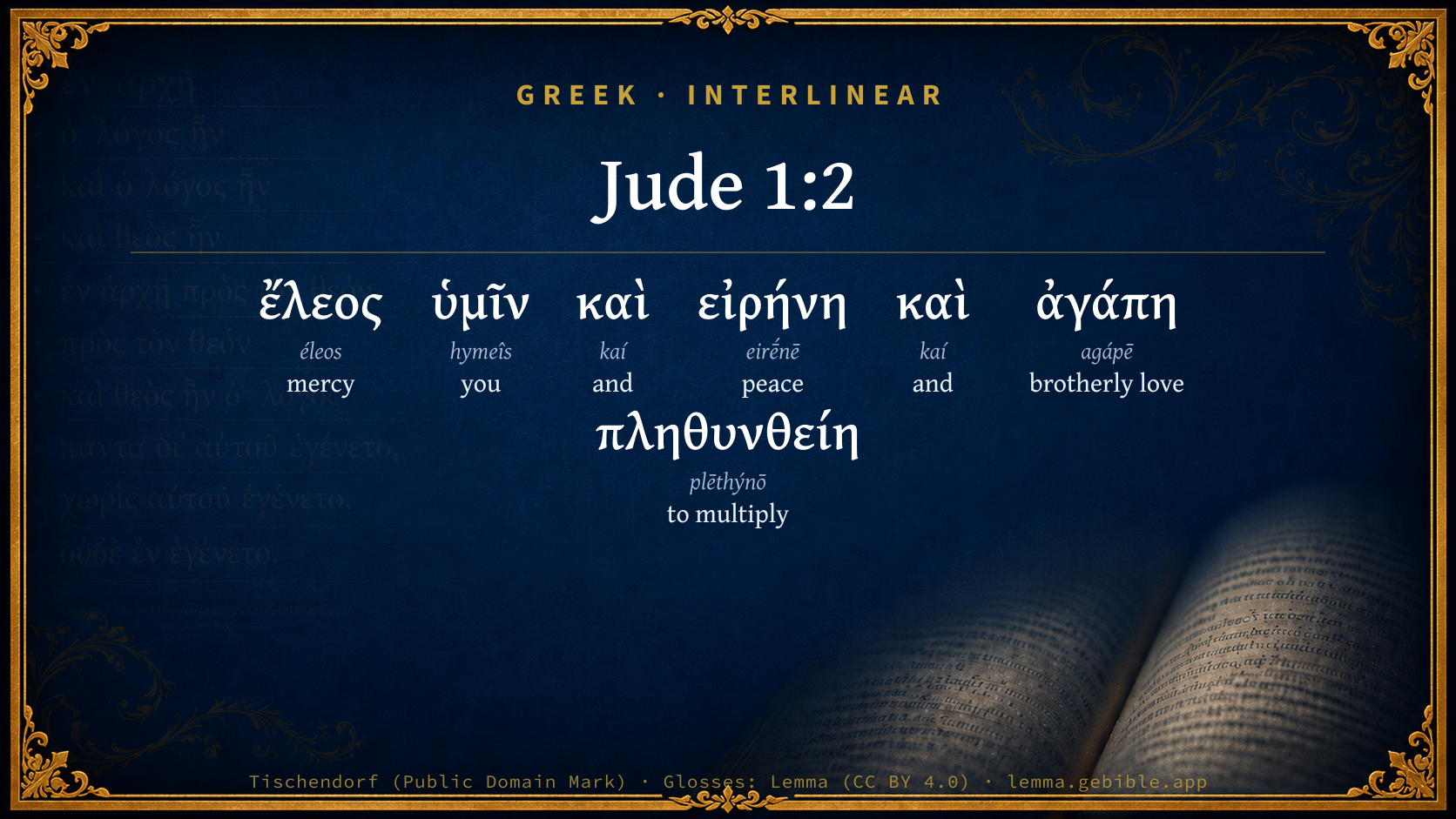
Greek (Tischendorf 8th ed.) Jude 1:2 appears in the Greek New Testament. The text above is from the Tischendorf 8th edition. Each word links to its Strong’s number and a concise gloss. Click any word for its full Thayer’s Greek Lexicon entry.
Download image
Cite this verse

Jude 1:2 (World English Bible). Public Domain. Lemma interlinear Bible study tool, https://lemma.gebible.app/v/jude/1/2.

Show BibTeX & RIS
BibTeX
RIS
English Translation
Mercy to you and peace and love be multiplied.
World English Bible · Public Domain
Download a study sheet

One document with this verse’s original text, its word-by-word gloss line, the meaning frame, cross-references with their text, attributed commentary, and full source and license credits — printable, and it pastes into notes with its structure intact.

This verse Autodidact and up

Study sheet (.html) Plain text (.txt)

A passage Seminary Student

Up to 50 verses in one chapter. A passage sheet keeps up to 6 commentary sources and 12 cross-references per verse, in the order this page ranks them, and says so on the sheet whenever that leaves anything out. Ask for a single verse and you get the Autodidact verse sheet above.

Everything on this page stays free to read, with no account — the sheet is a download of what is already on screen, not access to it.

Want to remove ads? Support Godless Engineer
Compare translations 3

The same verse in 3 English versions, stacked beneath the original-language interlinear above. Click any original word for its lexicon entry.

Each is an independent rendering of the whole verse — the interlinear is not word-aligned to these translations.

Highlighted words mark where these versions differ — a whole-verse word diff, not a word-by-word alignment.

  • World English Bible Public Domain
    Mercy to you and peace and love be multiplied.
  • King James Version Public Domain
    Mercy unto you, and peace, and love, be multiplied.
  • unfoldingWord Literal Text CC BY-SA 4.0
    May mercy and peace and love be multiplied to you.

unfoldingWord Literal Text — © unfoldingWord, licensed CC BY-SA 4.0. Word-aligned USFM3 via Door43 (git.door43.org/unfoldingWord/en_ult).

Versions to compare (up to 4)

3 of 4 selected

Show all 19 translations

Every available English version of this verse, each an independent rendering of the whole verse.

  • World English Bible Public Domain
    Mercy to you and peace and love be multiplied.
  • Berean Standard Bible Public Domain
    Mercy, peace, and love be multiplied to you.
  • Majority Standard Bible Public Domain
    Mercy, peace, and love be multiplied to you.
  • King James Version Public Domain
    Mercy unto you, and peace, and love, be multiplied.
  • American Standard Version (1901) Public Domain
    Mercy unto you and peace and love be multiplied.
  • Revised Version (1885) Public Domain
    Mercy unto you and peace and love be multiplied.
  • Geneva Bible (1599) Public Domain
    Mercie vnto you, and peace and loue be multiplied.
  • Douay-Rheims (1899) Public Domain
    Mercy unto you, and peace, and charity be fulfilled.
  • Young's Literal Translation Public Domain
    kindness to you, and peace, and love, be multiplied!
  • Literal Standard Version CC BY-SA 4.0
    mercy and peace and love be multiplied to you!
  • Unlocked Literal Bible CC BY-SA 4.0
    May mercy and peace and love be multiplied to you.
  • unfoldingWord Literal Text CC BY-SA 4.0
    May mercy and peace and love be multiplied to you.
  • Darby Bible Public Domain
    Mercy to you, and peace, and love be multiplied.
  • World Messianic Bible Public Domain
    May mercy, peace, and love be multiplied to you.
  • Webster's Bible Public Domain
    Mercy to you, and peace, and love, be multiplied.
  • Free Bible Version CC BY-SA 4.0
    May God's mercy, peace, and love increase in your experience!
  • Bible in Basic English Public Domain
    May mercy and peace and love be increased in you.
  • Text-Critical English NT CC BY 4.0
    Mercy, peace, and love be multiplied to you.
  • Tyndale New Testament (1534) Public Domain
    Mercy vnto you and peace and love be multiplied.

Literal Standard Version (2020), Covenant Press — licensed CC BY-SA 4.0. Text via the HelloAO Bible API (eBible.org). Unlocked Literal Bible (unfoldingWord) — licensed CC BY-SA 4.0. Text via the HelloAO Bible API (eBible.org). unfoldingWord Literal Text — © unfoldingWord, licensed CC BY-SA 4.0. Word-aligned USFM3 via Door43 (git.door43.org/unfoldingWord/en_ult). Free Bible Version, Dr. Jonathan Gallagher — licensed CC BY-SA 4.0. Text via the HelloAO Bible API (eBible.org).

Word by word

More ways to search: Search by grammar → Find every occurrence → Compare this word →

Practice this passage: Drill this verse → Learn its vocabulary →

About this verse

These counts appear in no published source. They are computed here, from the morphology-tagged text and Lemma’s own curated glosses. What Lemma adds →

7
words
6
distinct lemmas
General Epistles
section

Notable vocabulary

The rarest word here is πληθυνθείη to multiply G4129 — appearing just 12 times in the whole Greek New Testament.

Shared distinctive vocabulary

πληθυνθείη to multiply G4129 occurs in 11 verses of the Greek New Testament. Also found in:

Repetition

A word recurs within this verse:

Cross-references

4

Topical passages linked to Jude 1:2 in the Treasury of Scripture Knowledge — connected by theme and wording, ordered by reader-vote popularity; previews shown in the World English Bible.

  • 2 Peter 1:2 Grace to you and peace be multiplied in the knowledge of God and of Jesus our Lord,
  • 1 Peter 1:2 according to the foreknowledge of God the Father, in sanctification of the Spirit, that you may obey Jesus Christ and be sprinkled in his blood: Grace to you and peace be multiplied.
  • Revelation 1:4–6 John, to the seven assemblies that are in Asia: Grace to you and peace, from God, who is and who was and who is to come; and from the seven Spirits who are before his throne;
  • Romans 1:7 to all who are in Rome, beloved of God, called to be saints: Grace to you and peace from God our Father and the Lord Jesus Christ.

Cross-references courtesy of OpenBible.info (CC BY 4.0).

Commentary

Notes on Jude 1:2 from classic Christian and Jewish commentators (each source and its license shown beneath its notes). The classic Christian expositions comment on the surrounding passage and are grouped to its opening verse, so a note may address several verses; the Jewish commentaries on the Tanakh (Rashi and others) are per-verse, so they appear only where the commentator wrote on this verse.

Lemma curates 59 commentaries, every one of them public domain or Creative Commons licensed, each selected and text-cleaned for this edition rather than reprinted as found. About our sources →

The Cambridge Bible for Schools and Colleges

gen. ed. J. J. S. Perowne

2. Mercy unto you, and peace, and love, be multiplied] The salutation corresponds with that of 1Pe_1:2; 2Pe_1:2, with the substitution of “mercy” for “grace” (the two are united in 1Ti_1:2; 2Ti_1:2; Tit_1:4), and the addition, as in the latter passages, of “peace.”

The Cambridge Bible for Schools and Colleges (gen. ed. J. J. S. Perowne; Cambridge University Press, 1878–1918) — public domain. Text from a community e-Sword module.

Matthew Poole's English Annotations

Mercy unto you; which is the fountain of reconciliation, and all the grace vouchsafed you: see 1Ti 1:2; 2Ti 1:2; Tit 1:4.

Love; either he means God’s love to them, or their love to God and each other.

Be multiplied; mercy in the effects of it, peace in the sense of it, and either the love of God in the manifestation of it, or their love to God and their neighbours in the degrees and exercise of it.

Matthew Poole's English Annotations on the Holy Bible (1683–1685) — public domain. Text from a community e-Sword/MySword module.

The Biblical Illustrator

Joseph S. Exell

Jud_1:2

Mercy unto you, and peace, and love, be multiplied.

Mercy, peace, and love multiplied

I. Mercy.

1. Pardoning mercy.

2. Sustaining mercy.

3. Preserving mercy.

4. Restraining mercy.

5. Supplying mercy.

6. Restoring and sanctifying mercy.

7. Glorifying mercy.

II. Peace.

1. Internal peace--a holy, tranquil calm.

2. External peace. Christ is the King of peace. Our lives must be peace, our lips will breathe peace.

III. Love.

1. The love of God towards us.

2. The love of ourselves to God. Surely this needs to abound! How cold it is, how poor and deficient!

3. Love to one another. This is the evidence of our love to Him. (Homilist.)

Spiritual blessings best

1. Spiritual blessings are the best blessings we can wish to ourselves and others. It is true, nature is allowed to speak in prayer, but grace must be heard first.

2. Observe the aptness of the requests to the persons for whom he prayeth. Those that are sanctified and called have still need of mercy, peace, and love. They need mercy, because we merit nothing of God, neither before grace received nor afterward. Our obligation to free grace never ceaseth. We need also more peace. There are degrees in assurance as well as faith. There is a temperate confidence, and there are ravishing delights, so that peace needs to be multiplied also. And then love, that being a grace in us, it is always in progress. In heaven only it is complete. Take it for love to God; there we cleave to Him without distraction and weariness or satiety. God in communion is always fresh and new to the blessed spirits. And take it for love to the saints; it is only perfect in heaven, where there is no ignorance, pride, partialities, and factions.

3. Observe the aptness of these requests to the times wherein He prayed, when religion was scandalised by loose Christians, and carnal doctrines were obtruded upon the Church. In times of defection from God, and wrong to the truth, there is great need of mercy, peace, and love. Of mercy, that we may be kept from the snares of Satan. And we need peace and inward consolations, that we may the better digest the misery of the times; and love, that we may be of one mind, and stand together in the defence of the truth.

4. Note the aptness of the blessings to the persons to whom He prayeth. Here are three blessings that do more eminently suit with every person of the Trinity; and I do the rather note it, because I find the apostle elsewhere distinguishing these blessings by their proper fountains, as Rom_1:7. So here is mercy from God the Father, who is called the Father of mercies and the God of all comfort (2Co_1:3), and peace from the Son, for He is our peace (Eph_2:14), and love from the Spirit (Rom_5:5), The love of God is shed abroad in our hearts by the Holy Ghost, which is given to us. Thus you see every person concurreth to our happiness with His distinct blessing.

5. How aptly these blessings are suited among themselves: first mercy, then peace, and then love. (T. Manton.)

Holy arithmetic

A trinity of blessings is often to be met with in Gods Word. It is Gods happiness to crown all His people with goodness. May this trio of blessings be given to each one of us, and be multiplied. Gods gifts always come in company. He is God, and gives as a God. Man, indeed, has limited means, and so must be limited in his gifts.

I. We have a sum in addition. As Christians we must never be content with the measure of our grace. Do not be satisfied to remain dwarf trees, but seek to be growing higher and higher, and at the same time sending your roots deeper and deeper.

1. The first figure in this sum is mercy, and it is a very high number indeed. It stands foremost, for it is the chief of Gods dealings with us, whereby He pities us in our helplessness. We have already received much, but we are to add to it: for He hath not dealt with us after our sins, but favour has been shown to the undeserving, mercy to those who are full of sin. He has shown not only clemency in bestowing pardon, but His bountiful mercy whereby He supplies sufficiently our wants. So that whatever we need let us seek the stream bearing on its tide blessings for our souls to-day.

2. Then add to mercy peace. What a glorious numeral is this! Now are we reconciled to God through the death of His dear Son. The enmity of our hearts has been slain, and it is our delight to be in His company. We want to have more of this peace; how shall we gain it? Only by seeking to hold more communion with our God. If this fair flower is to grow within our hearts the dew of heaven must fall upon it during the hours of calm fellowship with God. We must dwell in Him and He in us.

3. Yet again, there is another figure to add, and it is love. Many have got a little of this treasure; would to God all had more. Love lies smouldering in our hearts. O breath Divine, blow these sparks into burning fires! Grace changes all within us, for while we receive such mercy and enjoy such peace from the hands of our loving Lord we feel we must love in return.

II. Now we come to our surf in multiplication. If I want to increase rapidly let me have the multiplication table, and let it be by compound multiplication too. Mercy, and peace, and love, multiplied by mercy, and peace, and love, which have been multiplied. Is this a hard sum? God can help us to do it if we also help ourselves.

1. The first thing that affords aid is memory. Think of the mercies of yesterday, put them down, then multiply them by the mercies of to-day, and so on and on, meditating upon the favours of years past, and you will find by this mental exercise that the mercy you now enjoy will be multiplied. And memory will refresh you concerning peace too. Recollect the morning of bright joy which followed the nights of sadness. Love, too, must be remembered if it is to be multiplied. Review all the tokens received in the past, all the choice souvenirs.

2. Another help we may have is mutual intercourse. As a boy at school runs to another older and wiser than himself when a sum is hard, and he needs help in doing it, so should Christians endeavour to find counsel and support from intercourse with their fellow-saints.

3. But the very best way is to go to the Master. If the sum is difficult, it may be well to take down the exercise-book and see the examples already worked out. He is plenteous in mercy. Here, then, shall you find a way out of your difficulty. If you cannot multiply, He will do it for you; He is the Prince of Peace, submit yourself to His gentle reign, and peace shall be yours. Dwell in the atmosphere of His love and this grace shall be more and more in you.

III. Now, a sum in practice, and a very short one too. Unto you who have been called, sanctified, and preserved, are these words of exhortation sent. Be merciful, for Blessed are the merciful, for they shall obtain mercy. Be peaceful, for Blessed are the peacemakers, for they shall be called the children of God. Be loving, for love is of God, and every one that loveth is born of God, and knoweth God. (C. H. Spurgeon.)

Mercy:--

1. Mercy can be attributed to God.

(1) As it signifies a promptitude of the will to succour the miserable.

(2) As it signifies Gods actual helping and relieving us in our distresses.

2. God is merciful--

(1) With a preventing mercy.

(2) With a forgiving mercy.

(3) With accepting mercy, taking in good part the desires of the soul when it finds not to perform.

(4) With re-accepting mercy; looking upon a returning prodigal as a son; pitying as a father, not punishing as a judge.

(5) With providing mercy (Psa_23:1-6.).

(6) With directing mercy in our doubts (Psa_73:24).

(7) With sustaining mercy (Psa_94:18).

(8) With quickening; enlivening mercy to any holy duty (Php_4:13).

(9) With restoring mercy; and that not only from sin and miseries, but even by them.

(10) With crowning mercy when He brings us to heaven.

3. The properties of Gods mercy.

(1) Full.

(2) Free.

Lessons:

1. How unbeseeming a sin is pride in any that live upon mercy!

2. The duty of contentment in our greatest wants or smallest receipts.

3. The impiety and folly of those that abuse mercy.

4. Great is the heinousness of sin, that can provoke a God of much mercy, to express much severity.

5. It should be our care to obtain the best and choicest of mercies.

6. How little should any that have this God of mercy for theirs, be dismayed with any misery!

7. It is our duty and dignity to imitate God in showing mercy. (W. Jenkyn, M. A.)

The Biblical Illustrator, edited by Joseph S. Exell (c. 1880s–1900s) — public domain. Text from a community e-Sword module.

Tyndale Open Study Notes

Tyndale Open Resources

1:2 This verse, which is paralleled in the epilogues (20:18), shows the primacy of Judah. This tribe did not figure in the downward cycles of the judges (cp. 15:9-13) after Othniel, the model judge who was linked to Judah through Caleb (Josh 14:6; 15:13, 17).

Tyndale Open Study Notes — © Tyndale Open Resources, licensed CC BY-SA 4.0. Text via the HelloAO Bible API.

Bengel's Gnomon

Johann Albrecht Bengel

Jud 1:2. Ἔλεος, κ.τ.λ., mercy, etc.) in a time of wretchedness. Hence it is that mercy is put in the first place: the mercy of Jesus Christ, Jud 1:21; peace, in the Holy Spirit, comp. Jud 1:20; love, of God, Jud 1:21. Here is a testimony concerning the Holy Trinity.

Bengel's Gnomon of the New Testament — English translation (T&T Clark, Edinburgh, 1860) — public domain. Text from a community e-Sword module.

Expositor's Greek Testament

ed. W. Robertson Nicoll

Jud 1:2 . For the Salutation see my note on χαίρειν , Jas 1:1 , and Hort’s excellent note on 1Pe 1:2 , χάρις … πληθυνθείη . We find ἔλεος and εἰρήνη joined in Gal 6:16 , and with the addition of χάρις in 1Ti 1:2 , 2Ti 1:2 , 2Jn 1:3 . The mercy of God is the ground of peace, which is perfected in the feeling of God’s love towards them. The verb πληθυνθείη occurs in the Salutation both of 1 Peter and 2 Peter and in Dan 6:25 (in the letter of Darius), εἰρήνη ὑμῖν πληθυνθείη , cf. 1Th 3:12 , ὑμᾶς δὲ ὁ κύριος πλεονάσαι καὶ περισσεύσαι τῇ ἀγάπῃ εἰς ἀλλήλους . Ἀγάπη (= the love of God) occurs also in the final salutation of 2 Cor. ἡ χάρις τ . κυρίου Ἰησοῦ καὶ ἡ ἀγάπη τοῦ Θεοῦ , and in Eph. εἰρήνη τοῖς ἀδελφοῖς καὶ ἀγάπη μετὰ πίστεως ἀπὸ Θεοῦ πατρὸς καὶ Κυρίου Ἰ . Χ . Cf. 1Jn 3:1 .), ἰδετε ποταπὴν ἀγάπην δέδωκεν ἡμῖν ὁ πατὴρ ἵνα τέκνα Θεοῦ κληθῶμεν , where Westcott’s n. is “The Divine love is infused into them, so that it is their own, and becomes in them the source of a divine life (Rom 13:10 ). In virtue of this gift they are inspired with a love which is like the love of God, and by this they truly claim the title of children of God as partakers in His nature, 1Jn 4:7 ; 1Jn 4:19 .” The same salutation is used in the letter of the Smyrnaeans ( c . 156 A.D.) giving an account of the martyrdom of Polycarp, ἔλεος καὶ εἰρήνη καὶ ἀγάπη Θεοῦ πατρὸς καὶ Κυρίου ἡμῶν Ἰ . Χ . πληθυνθείη . The thought of ἔλεος and άγάπη recurs again in Jud 1:21 .

The Expositor's Greek Testament, edited by W. Robertson Nicoll (1897–1910) — public domain. Text from a community e-Sword module.

Alford’s Greek Testament

Henry Alford

2.] Address and greeting. Judas, a servant of Jesus Christ (δοῦλος, probably not here in the wider sense, in which all Christians are servants of Christ—but in that special sense in which those were bound to His service who were employed in the preaching and disseminating of His word: see reff.: on the absence of any official designation, see prolegomena), and brother of James (see prolegomena), to the called (in the sense of St. Paul (reff.); effectually drawn by God the Father to the knowledge of the Gospel), beloved in (the phrase is one not elsewhere found, and difficult of interpretation. The meanings “by,” = ὑπό, cf. 2Th 2:13, ἀδελφοὶ ἠγαπημένοι ὑπὸ κυρίου; “on account of,” understanding ἠγαπημένοις “beloved by the writer,” are hardly admissible. The only allowable sense of ἐν seems to be, “in the case of,” “as regards,” understanding of course that the love of the Father is spoken of) God the Father (St. Paul ordinarily in his greetings adds ἡμῶν to θεὸς πατήρ, cf. Rom 1:7; 1Co 1:3; 2Co 1:2; Eph 1:2; Php 1:2; Col 1:2; 2Th 1:1; Phm 1:3. But he has θεὸς πατήρ absolutely in the following places; Gal 1:1, Gal 1:2; Eph 6:23; Php 2:11; 2Th 1:2; 1Ti 1:2; 2Ti 1:2; Tit 1:4; as also St. Peter, 1Pe 1:2; 2Pe 1:17; St. John, 2Jn 1:3. It became more frequently used, as might be expected, in the later days of the canon) and kept for Jesus Christ (reserved, to be His at the day of His coming: the dative is commodi. If the question be asked, kept by whom? the answer must be, by God the Father: though constructionally the words are not connected. Observe the perfect participles, giving the signification “from of old and still”): mercy to you and peace and love be multiplied (all three proceeding from God: God’s mercy, God’s peace, God’s love: see ver. 21. In the somewhat similar passage, Eph 6:23, εἰρήνη τοῖς ἀδελφοῖς κ. ἀγάπη μετὰ πίστεως ἀπὸ θεοῦ πατρὸς κ. κυρίου Ἰησοῦ χριστοῦ, the love and faith are clearly, in themselves, the gift of God: mutual love or love towards God. But the other seems better here).

3,

Henry Alford, The Greek Testament (1849–1861) — public domain. Text from a community e-Sword module.

Jamieson, Fausset & Brown

Robert Jamieson, A. R. Fausset & David Brown

Mercy--in a time of wretchedness. Therefore mercy stands first; the mercy of Christ (Jde 1:21).

peace--in the Holy Ghost (Jde 1:20).

love--of God (Jde 1:21). The three answer to the divine Trinity.

be multiplied--in you and towards you.

Jamieson, Fausset & Brown — Commentary Critical and Explanatory on the Whole Bible (1871) — public domain (CC PDM 1.0). Text via the HelloAO Bible API.

Adam Clarke's Commentary

Verse 2. Mercy unto you] For even the best have no merit, and must receive every blessing and grace in the way of mercy.

Peace] With God and your consciences, love both to God and man, be multiplied-be unboundedly increased.

Adam Clarke's Commentary on the Bible (1810–1826) — public domain. Text from a community e-Sword/MySword module.

John Calvin's Commentaries

2. Mercy to you. Mercy means nearly the same as grace in the salutations of Paul. Were any one to wish for a refined distinction, it may be said that grace is properly the effect of mercy; for there is no other reason why God has embraced us in love, but that he pitied our miseries. Love may be understood as that of God towards men, as well as that of men towards one another. If it be referred to God, the meaning is, that it might increase towards them, and that the assurance of divine love might be daily more confirmed in their hearts. The other meaning is, however, not unsuitable, that God would kindle and confirm in them mutual love.

John Calvin's Commentaries (1540-1563) — public domain. Text from the Calvin Translation Society English edition (1840s-50s) via the Christian Classics Ethereal Library (ccel.org). Calvin's coverage is partial (roughly two-thirds of the Bible); uncommented books and verses are honest gaps, never fabricated. The 19th-century editor's footnotes and remarks are omitted so the notes are faithfully Calvin's own voice.

John Gill's Exposition

Mercy unto you, and peace and love be multiplied. In this salutation the apostle wishes for a multiplication of "mercy", from God the Father, by whom these persons were sanctified: mercy is a perfection in God; and shows itself in a special manner towards the elect, in the covenant of grace, in the provision of Christ as a Saviour, in the mission of him into this world, in redemption by him, in the forgiveness of sin, in regeneration, and in their whole salvation; and the multiplication of it intends an enlarged view and fresh application of it, which they sometimes stand in need of, as under desertions, when they want the sense and manifestation of it to them; and under temptations and afflictions, when they need sympathy and compassion; and when they fall into sin they stand in need of the fresh discoveries and application of pardoning mercy to them. Moreover, herein is wished for a multiplication of "peace" from Christ, in whom these chosen ones were preserved; and may design a fresh and enlarged view of peace being made for them by his blood, and an increase of conscience peace in their own hearts, as the effect of it; and may include peace, and an abundance of it, among themselves, as well as all prosperity, both external, internal, and eternal: likewise in the salutation, "love", and a multiplication of it is wished for from the Spirit of God, by whom they were called; and may be understood of the love with which God loved them; and which may be said to be multiplied, when it is gradually shed abroad in their hearts by the Spirit, and they are by degrees led into it more and more, and the acts of it are drawn out and set before them one after another, and fresh manifestations of it are made unto them; as in afflictive providences, after the hidings of God's face, and under temptations: and it may design the love with which they love God, which may be increased and made to abound more and more.

Mercy unto you, and peace and love be multiplied. In this salutation the apostle wishes for a multiplication of "mercy", from God the Father, by whom these persons were sanctified: mercy is a perfection in God; and shows itself in a special manner towards the elect, in the covenant of grace, in the provision of Christ as a Saviour, in the mission of him into this world, in redemption by him, in the forgiveness of sin, in regeneration, and in their whole salvation; and the multiplication of it intends an enlarged view and fresh application of it, which they sometimes stand in need of, as under desertions, when they want the sense and manifestation of it to them; and under temptations and afflictions, when they need sympathy and compassion; and when they fall into sin they stand in need of the fresh discoveries and application of pardoning mercy to them. Moreover, herein is wished for a multiplication of "peace" from Christ, in whom these chosen ones were preserved; and may design a fresh and enlarged view of peace being made for them by his blood, and an increase of conscience peace in their own hearts, as the effect of it; and may include peace, and an abundance of it, among themselves, as well as all prosperity, both external, internal, and eternal: likewise in the salutation, "love", and a multiplication of it is wished for from the Spirit of God, by whom they were called; and may be understood of the love with which God loved them; and which may be said to be multiplied, when it is gradually shed abroad in their hearts by the Spirit, and they are by degrees led into it more and more, and the acts of it are drawn out and set before them one after another, and fresh manifestations of it are made unto them; as in afflictive providences, after the hidings of God's face, and under temptations: and it may design the love with which they love God, which may be increased and made to abound more and more.

Jude 1:3

jde 1:3

jde 1:3

jde 1:3Beloved, when I gave all diligence to write unto you,.... The apostle calls the persons he writes unto "beloved"; as they were of God, and by him and other saints; and he signifies his diligence in writing to them: and the subject of his writing was,

of the common salvation; which designs either the Gospel, sometimes called salvation, in opposition to the law, which is a ministration of condemnation; and because it is a declaration of salvation, and a means of it; and may be said to be "common", because preached to all, Jews and Gentiles: or Jesus Christ the Saviour himself, who is also sometimes called "salvation", because he was called and appointed to it, and undertook it, and is become the author of it; and may be said to be a "common" Saviour, not of all men, but of all his people; of his whole body, the church, and every member of it, and of all sorts of men, in all nations: or else that spiritual and eternal salvation wrought out by him, which is common, not to all men, for all are not saved with it, but to all the elect of God, and true believers in Christ; the love of God is common to them all alike; the choice of them to eternal salvation is the same; the covenant of grace, the blessings and promises of it, are equally shared by them; and they are bought with the same price of Christ's blood, and are justified by the same righteousness, and are regenerated, sanctified, and called by the same grace, and shall possess the same glory: there is but one way of salvation, and that is not confined to any nation, family, community, or sect among men. The Alexandrian copy and two of Beza's, and the Syriac version, read, "our common salvation"; and two other of Beza's copies and the Vulgate Latin version read, "your common salvation"; the sense is the same: it was

needful for me to write unto you, and exhort you, that ye should earnestly contend for the faith which was once delivered unto the saints; by the "faith" is meant the doctrine of faith, in which sense it is used whenever faith is said to be preached, obeyed, departed, or erred from, or denied, or made shipwreck of, or when exhortations are made to stand fast, and continue in it, or to strive and contend for it, as here; and which is sometimes called the word of faith, the faith of the Gospel, the mystery of faith, or most holy faith, the common faith, and, as here, faith only; and designs the whole scheme of evangelical truths to be believed; such as the doctrine of the Trinity, the deity and sonship of Christ, the divinity and personality of the Spirit; what regards the state and condition of man by nature, as the doctrines of the imputation of Adam's sin to his posterity, the corruption of nature, and the impotence of men to that which is good; what concerns the acts of grace in the Father, Son, and Spirit, towards, and upon the sons of men; as the doctrines of everlasting love, eternal election, the covenant of grace, particular redemption, justification by the imputed righteousness of Christ, pardon and reconciliation by his blood, regeneration and sanctification by the grace of the Spirit, final perseverance, the resurrection of the dead, and the future glory of the saints with Christ. This is said to be "delivered to the saints": it was delivered by God the Father to Christ as Mediator, and by him to his apostles, who may more especially be meant by "the saints", or holy men; who were chosen to be holy, and to whom Christ was made sanctification, and who were sanctified by the Spirit of God; and this faith, being a most holy faith, is fit for holy men, and only proper to be delivered to them, and preached by them; and by them it was delivered to the churches, both by word and writing; and this delivery of it supposes that it is not an invention of men, that it is of God, and a gift of his, and given in trust in order to be kept, held forth, and held fast; and it was but "once" delivered, in opposition to the sundry times and divers manners in which the mind of God was formerly made known; and designs the uniformity, perfection, and continuance of the doctrine of faith; there is no alteration to be made in it, or addition to it; no new revelations are to be expected, it has been delivered all at once: and therefore should be "earnestly contended for"; for could it be lost, another could not be had; and the whole of it is to be contended for; not only the fundamentals, but the lesser matters of faith; and not things essential only, but also what are circumstantial to faith and religion; every truth, ordinance, and duty, and particularly the purity of faith, and its consistency: and this contention includes a care and solicitude for it, to have it, own it, and hold it fast, and adorn it; and for the preservation of it, and for the spread of it, and that it might be transmitted to posterity: and it denotes a conflict, a combat, or a fighting for it, a striving even to an agony: the persons to be contended with on account of it, are such who deny, or depreciate any of the Persons in the Godhead, the assertors of the purity and power of human nature, and the deniers of sovereign, efficacious, and persevering grace: the persons who are to contend with them are all the saints in general, to whom it is delivered; which they may do by bearing an experimental testimony to it, by praying for the continuance and success of it, by standing fast in one spirit in it, and by dying for it; and particularly the ministers of the Gospel, by preaching it boldly, openly, fully, and faithfully, by disputing for it, and writing in the defence of it, and by laying down their lives, when called for: the manner in which this is to be done, is "earnestly", heartily, in good earnest, and without deceit, zealously, and constantly.

John Gill's Exposition of the Whole Bible (1746–1763) — public domain (CC PDM 1.0). Text via the HelloAO Bible API.

Albert Barnes' Notes on the Bible

Mercy unto you, and peace, and love, be multiplied - This is not quite the form of salutation used by the other apostles, but it is one equally expressive of an earnest desire for their welfare. These things are mentioned as the choicest blessings which could be conferred on them: “mercy” - in the pardon of all their sins and acceptance with God; “peace” - with God, with their fellow-men, in their own consciences, and in the prospect of death; and “love” - to God, to the brethren, to all the world. What blessings are there which these do not include?

Albert Barnes' Notes on the Bible (1834–1885) — public domain. Text from a community e-Sword/MySword module.

The Pulpit Commentary

The greeting. This takes the form of a prayer or benediction in three articles. It is rendered in precisely the same terms mercy unto you and peace and love be multiplied in Tyndale, Cranmer, the Genevan, the Authorized Version, and the Revised Version. In Paul"s Epistles the opening salutations usually mention only "grace and peace, and these as proceeding from God the Father and the Lord Jesus Christ. But in the pastoral Epistles (as also in 2Jo) the three blessings, "grace, mercy, and peace, appear, and these as coming from the same twofold source of Father and Son. In the Petrine Epistles we have again the two Pauline blessings of grace and peace, but with the distinctive addition of the "be multiplied." Here, in Jude, we have the characteristic Petrine "be multiplied," but this connected with three blessings, and these somewhat different from those which appear in the Pastoral Epistles peace, and love," instead of "grace and mercy and peace." What the writer desires, therefore, on behalf of the readers is an abounding measure of the three great qualities of grace, which refer respectively to the case of the miserable, the case of the hostile, and the case of the unworthy. Are these regarded as subjective qualities in man, or as objective gifts from God? The former view is favoured by some, who point especially to the closing benediction in the Epistle to the Ephesians (Eph_6:23) as a case in point. But the latter view is sustained by the force of the "beloved" in the previous verse, and the mention of" love" in verse 21, as well as by the general analogy of the inscriptions of Epistles. What Jude prays for, therefore, is not that his readers may be helped to exhibit in large measure a merciful, peaceful, and loving disposition to others, but that they may enjoy in liberal degree the great blessings of God"s mercy, peace, and love bestowed upon themselves.

The Pulpit Commentary (1880–1919), ed. H.D.M. Spence-Jones & Joseph S. Exell — public domain. Text from a community e-Sword module.

Godbey's Commentary on the New Testament

William B. Godbey

2. “Mercy and peace and divine love be multiplied unto you.” Here again we have spiritual mathematics in the prayer of Jude. Conversion is “addition,” adding life to a dead soul and a kingdom to a bankrupt spirit. Sanctification is “subtraction,” eliminating the sin principle out of the heart and making us holy. As sin is taken out to make room for grace, then we reach “multiplication,” in the wonderful incoming floods of the Holy Ghost, inundating our whole being and wafting us away in sea of glory. Now that we have a superabundance on hand, “division” normally follows, distributing the benefactions of salvation to all we meet. How deplorable to see teachers all around us standing in the pulpits, encumbered with the great responsibility of teaching God’s people in the school of Christ, when they themselves have never progressed beyond “addition.” What a contrast with the wisdom of the world, which positively requires a higher grade of scholarship.

William B. Godbey, Commentary on the New Testament (1896–1900) — public domain. Text from a community e-Sword module.

Vincent's Word Studies in the New Testament

Marvin R. Vincent

Love. Peculiar to Jude in salutation.

Marvin R. Vincent, Word Studies in the New Testament (1887–1900) — public domain. Text from a community e-Sword/MySword module.

Lesson kit

Teaching starters — assembled from the data on this page, not authored interpretation. Every prompt links to the verse data it draws on. Edit before teaching.

Jude, in the General Epistles, opens this verse with 7 words (6 distinct Greek lemmas). Its most distinctive word is plēthýnō (“to multiply”). A historical commentator’s framing appears above. Read the whole chapter for the surrounding context.

Discussion questions

  1. The word plēthýnō carries the sense “to multiply.” How does it shape the verse?
  2. How does Matthew 24:12, which shares the word «to multiply», read alongside this verse?
  3. What does the repetition of “and” (2× in this one verse) do in this verse?
  4. These translations render this verse differently; the difference is in the English rendering, not the original. What questions does that raise?
  5. Compare how The Cambridge Bible for Schools and Colleges and Matthew Poole's English Annotations read this verse. Where do they agree or differ?

Things to notice

  • These translations choose different wording for 1 word in this verse.
  • “and” occurs 2× in this single verse.
  • 6 distinct Greek lemmas span 7 words in this verse.

Reading settings

Reading text

Shown beneath each verse's original-language words.

Old Testament
Old Testament edition

Read the OT as the Masoretic Hebrew (MT) or the Greek Septuagint (LXX).

English shown for the Greek Septuagint (in the Hebrew ↔ Greek comparison).

Comparing translations? Open the Compare panel on any verse page to stack up to four side by side.