1 Peter 5:14

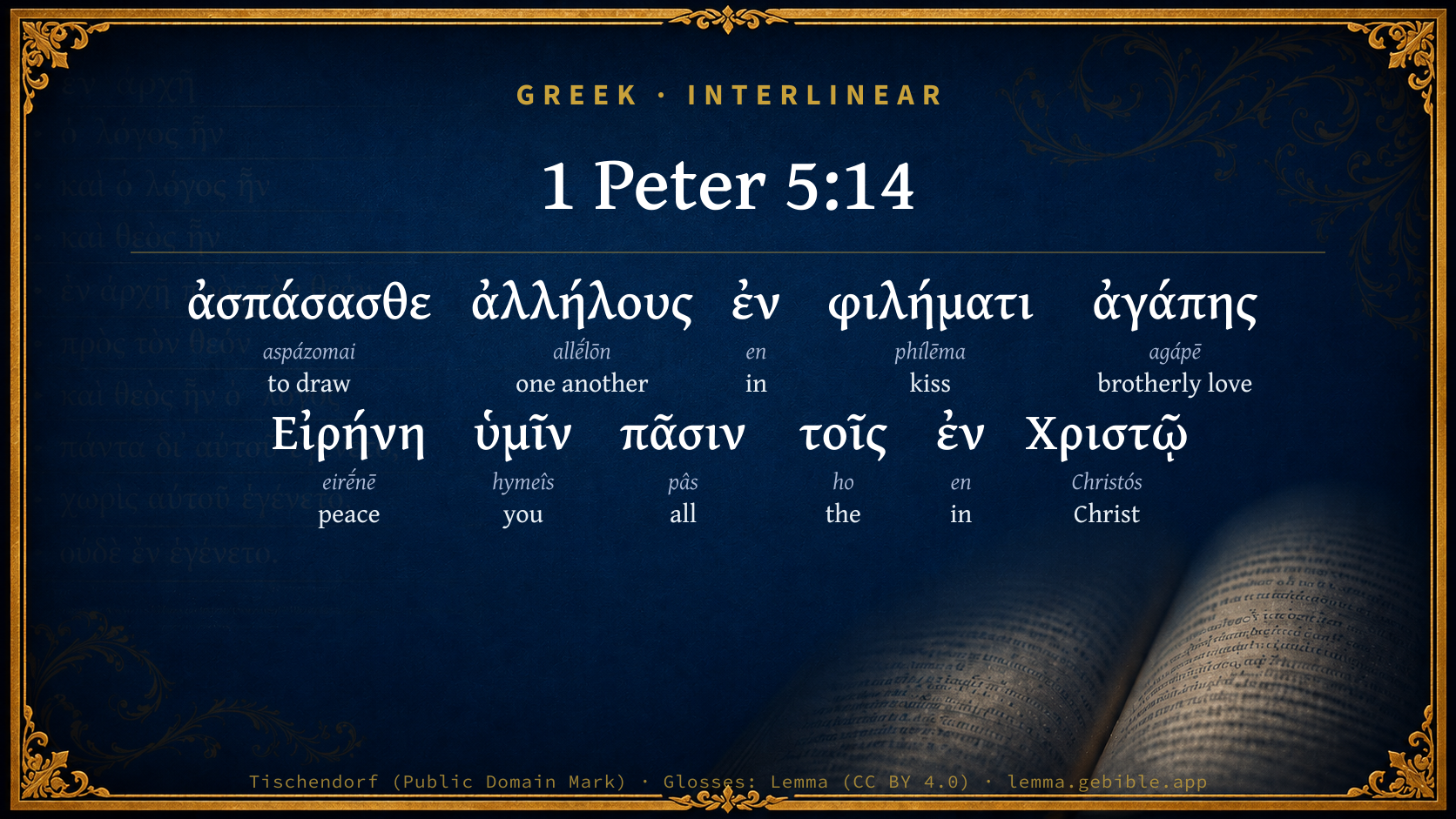
Greek (Tischendorf 8th ed.) 1 Peter 5:14 appears in the Greek New Testament. The text above is from the Tischendorf 8th edition. Each word links to its Strong’s number and a concise gloss. Click any word for its full Thayer’s Greek Lexicon entry.
Download image
Cite this verse

1 Peter 5:14 (World English Bible). Public Domain. Lemma interlinear Bible study tool, https://lemma.gebible.app/v/1-peter/5/14.

Show BibTeX & RIS
BibTeX
RIS
English Translation
Greet one another with a kiss of love. Peace be to you all who are in Christ Jesus. Amen.
World English Bible · Public Domain
Download a study sheet

One document with this verse’s original text, its word-by-word gloss line, the meaning frame, cross-references with their text, attributed commentary, and full source and license credits — printable, and it pastes into notes with its structure intact.

This verse Autodidact and up

Study sheet (.html) Plain text (.txt)

A passage Seminary Student

Up to 50 verses in one chapter. A passage sheet keeps up to 6 commentary sources and 12 cross-references per verse, in the order this page ranks them, and says so on the sheet whenever that leaves anything out. Ask for a single verse and you get the Autodidact verse sheet above.

Everything on this page stays free to read, with no account — the sheet is a download of what is already on screen, not access to it.

Want to remove ads? Support Godless Engineer
Compare translations 3

The same verse in 3 English versions, stacked beneath the original-language interlinear above. Click any original word for its lexicon entry.

Each is an independent rendering of the whole verse — the interlinear is not word-aligned to these translations.

Highlighted words mark where these versions differ — a whole-verse word diff, not a word-by-word alignment.

  • World English Bible Public Domain
    Greet one another with a kiss of love. Peace be to you all who are in Christ Jesus. Amen.
  • King James Version Public Domain
    Greet ye one another with a kiss of charity. Peace be with you all that are in Christ Jesus. Amen.
  • unfoldingWord Literal Text CC BY-SA 4.0
    Greet one another with a kiss of love. Peace to you, all those in Christ.

unfoldingWord Literal Text — © unfoldingWord, licensed CC BY-SA 4.0. Word-aligned USFM3 via Door43 (git.door43.org/unfoldingWord/en_ult).

Versions to compare (up to 4)

3 of 4 selected

Show all 19 translations

Every available English version of this verse, each an independent rendering of the whole verse.

  • World English Bible Public Domain
    Greet one another with a kiss of love. Peace be to you all who are in Christ Jesus. Amen.
  • Berean Standard Bible Public Domain
    Greet one another with a kiss of love. Peace to all of you who are in Christ.
  • Majority Standard Bible Public Domain
    Greet one another with a kiss of love. Peace to all of you who are in Christ Jesus. Amen.
  • King James Version Public Domain
    Greet ye one another with a kiss of charity. Peace be with you all that are in Christ Jesus. Amen.
  • American Standard Version (1901) Public Domain
    Salute one another with a kiss of love. Peace be unto you all that are in Christ.
  • Revised Version (1885) Public Domain
    Salute one another with a kiss of love. Peace be unto you all that are in Christ.
  • Geneva Bible (1599) Public Domain
    Greete yee one another with the kisse of loue. Peace be with you all which are in Christ Iesus, Amen.
  • Douay-Rheims (1899) Public Domain
    Salute one another with a holy kiss. Grace be to all you, who are in Christ Jesus. Amen.
  • Young's Literal Translation Public Domain
    Salute ye one another in a kiss of love; peace to you all who `are' in Christ Jesus! Amen.
  • Literal Standard Version CC BY-SA 4.0
    Greet one another in a kiss of love. Peace to you all who [are] in Christ Jesus! Amen.
  • Unlocked Literal Bible CC BY-SA 4.0
    Greet one another with a kiss of love. May peace be to you all who are in Christ.
  • unfoldingWord Literal Text CC BY-SA 4.0
    Greet one another with a kiss of love. Peace to you, all those in Christ.
  • Darby Bible Public Domain
    Salute one another with a kiss of love. Peace be with you all who [are] in Christ.
  • World Messianic Bible Public Domain
    Greet one another with a kiss of love. Peace be to all of you who are in Messiah Yeshua. Amen.
  • Webster's Bible Public Domain
    Greet ye one another with a kiss of charity. Peace be with you all that are in Christ Jesus. Amen.
  • Free Bible Version CC BY-SA 4.0
    Greet each other with a kiss of love. Peace to all of you who are in Christ.
  • Bible in Basic English Public Domain
    Give one another the kiss of love. Peace be to you all in Christ.
  • Text-Critical English NT CC BY 4.0
    Greet one another with a kiss of love. Peace be with all of you who are in Christ Jesus. Amen.
  • Tyndale New Testament (1534) Public Domain
    Grete ye one another with the kysse of love. Peace be with you all which are in Christ Iesus. Amen.

Literal Standard Version (2020), Covenant Press — licensed CC BY-SA 4.0. Text via the HelloAO Bible API (eBible.org). Unlocked Literal Bible (unfoldingWord) — licensed CC BY-SA 4.0. Text via the HelloAO Bible API (eBible.org). unfoldingWord Literal Text — © unfoldingWord, licensed CC BY-SA 4.0. Word-aligned USFM3 via Door43 (git.door43.org/unfoldingWord/en_ult). Free Bible Version, Dr. Jonathan Gallagher — licensed CC BY-SA 4.0. Text via the HelloAO Bible API (eBible.org).

Word by word

More ways to search: Search by grammar → Find every occurrence → Compare this word →

Practice this passage: Drill this verse → Learn its vocabulary →

About this verse

These counts appear in no published source. They are computed here, from the morphology-tagged text and Lemma’s own curated glosses. What Lemma adds →

11
words
10
distinct lemmas
General Epistles
section

Notable vocabulary

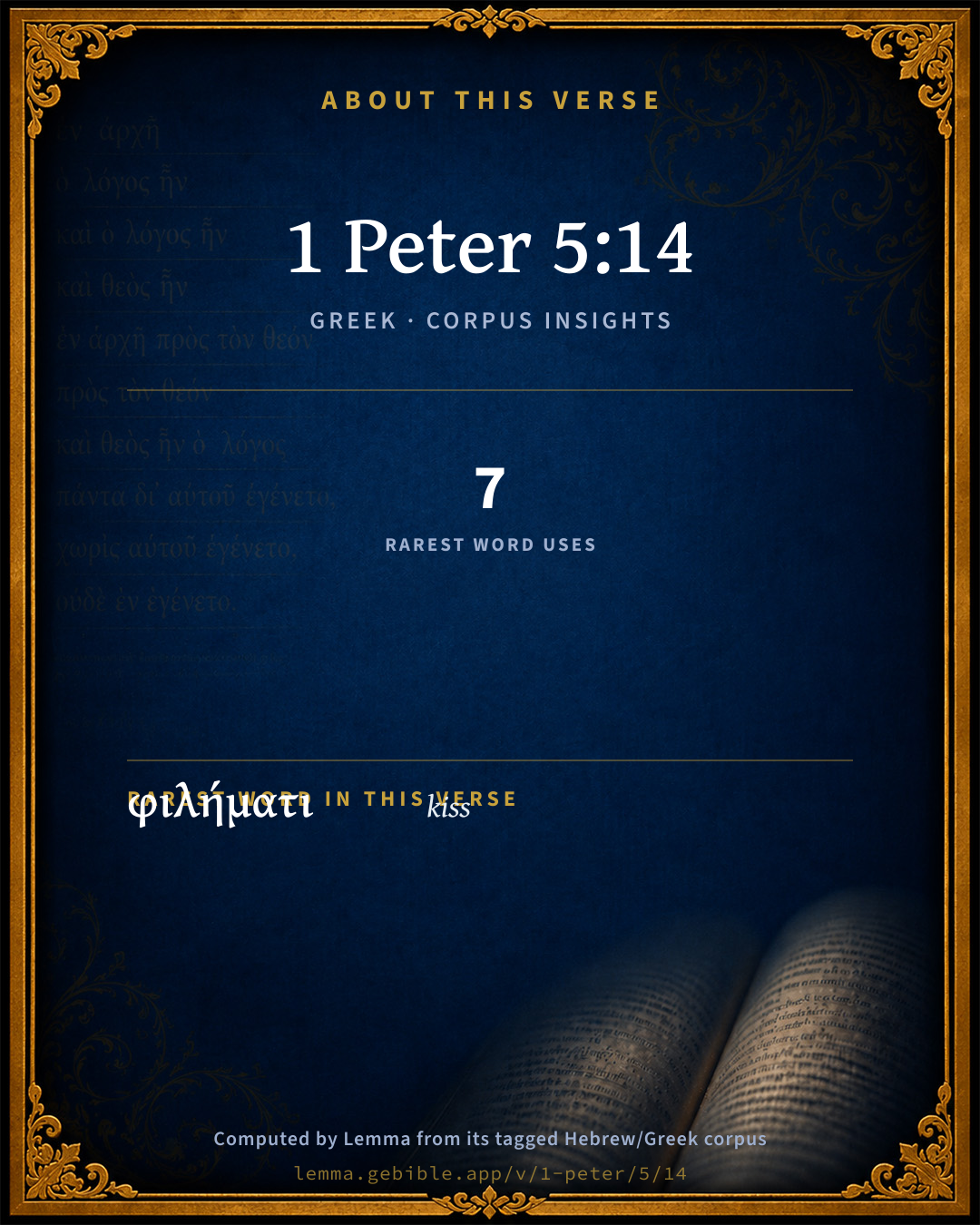
The rarest word here is φιλήματι kiss G5370 — appearing just 7 times in the whole Greek New Testament.

Shared distinctive vocabulary

φιλήματι kiss G5370 occurs in 7 verses of the Greek New Testament. Also found in:

Repetition

A word recurs within this verse:

Cross-references

14

Topical passages linked to 1 Peter 5:14 in the Treasury of Scripture Knowledge — connected by theme and wording, ordered by reader-vote popularity; previews shown in the World English Bible.

  • Romans 16:16 Greet one another with a holy kiss. The assemblies of Christ greet you.
  • Ephesians 6:23 Peace be to the brothers, and love with faith, from God the Father and the Lord Jesus Christ.
  • Romans 8:1 There is therefore now no condemnation to those who are in Christ Jesus, who don't walk according to the flesh, but according to the Spirit.
  • Romans 1:7 to all who are in Rome, beloved of God, called to be saints: Grace to you and peace from God our Father and the Lord Jesus Christ.
  • 1 Corinthians 16:20 All the brothers greet you. Greet one another with a holy kiss.
  • John 14:27 Peace I leave with you. My peace I give to you; not as the world gives, give I to you. Don't let your heart be troubled, neither let it be fearful.
  • 2 Corinthians 13:12 Greet one another with a holy kiss.
  • 1 Thessalonians 5:26 Greet all the brothers with a holy kiss.
  • John 16:33 I have told you these things, that in me you may have peace. In the world you have oppression; but cheer up! I have overcome the world."
  • John 20:19 When therefore it was evening, on that day, the first day of the week, and when the doors were locked where the disciples were assembled, for fear of the Jews, Jesus came and stood in the midst, and said to them, "Peace be to you."
  • John 20:26 After eight days again his disciples were inside, and Thomas was with them. Jesus came, the doors being locked, and stood in the midst, and said, "Peace be to you."
  • 1 Corinthians 1:30 But of him, you are in Christ Jesus, who was made to us wisdom from God, and righteousness and sanctification, and redemption:
  • 2 Corinthians 5:17 Therefore if anyone is in Christ, he is a new creation. The old things have passed away. Behold, all things have become new.
  • 1 Peter 1:2 according to the foreknowledge of God the Father, in sanctification of the Spirit, that you may obey Jesus Christ and be sprinkled in his blood: Grace to you and peace be multiplied.

Cross-references courtesy of OpenBible.info (CC BY 4.0).

Where the printed editions differ

1 variant

Places in this verse where the major printed Greek editions disagree on the wording in a way that affects the translation — a comparison of editions, not a manuscript-by-manuscript collation. The editions are the modern critical texts (Nestlé-Aland 28/27, SBL, Westcott-Hort, Tregelles, Tyndale House) and the traditional texts behind the KJV (the Textus Receptus and the Byzantine/Majority text). It is not a claim about which reading is original.

  1. Extra text
    Ἰησοῦ. ἀμήν.

    “Jesus. Amen.”

    In TRByz Not in NA28NA27TynSBLWHTreg

    Ἰησοῦ. ἀμήν.¶ (Iēsou amēn) 'Jesus. Amen.' is only in traditional manuscripts (TR+Byz)

Textual data: Translators Amalgamated Greek New Testament (STEPBible TAGNT) · CC BY 4.0.

Commentary

Notes on 1 Peter 5:14 from classic Christian and Jewish commentators (each source and its license shown beneath its notes). The classic Christian expositions comment on the surrounding passage and are grouped to its opening verse, so a note may address several verses; the Jewish commentaries on the Tanakh (Rashi and others) are per-verse, so they appear only where the commentator wrote on this verse.

Lemma curates 59 commentaries, every one of them public domain or Creative Commons licensed, each selected and text-cleaned for this edition rather than reprinted as found. About our sources →

Adam Clarke's Commentary

Verse 14. Greet ye one another with a kiss of charity.] See Clarke on Ro 16:16, and on "1Co 16:20". In the above places the kiss is called a holy kiss; here, φιληματιαγαπης, a kiss of LOVE; i.e. as a mark of their love to each other, in order that misunderstandings might be prevented. But ten or twelve MSS., with the Syriac, Arabic, Armenian, and Vulgate, have αγιω, holy; salute one another with a HOLY kiss. The difference is not great.

Peace be with you all] May all prosperity, spiritual and temporal, be with all that are in Christ Jesus - that are truly converted to him, and live in his Spirit obedient to his will.

Amen.] Is wanting, as usual, in some of the principal MSS. and versions.

The subscriptions are, as in other cases, various.

In the VERSIONS:

The end of the First Epistle of the Apostle Peter. - SYRIAC.

The First Catholic Epistle of Peter the apostle is ended. - SYRIAC PHILOXENIAN.

The end of the Epistle of St. Peter; may his supplication preserve us! Amen. Praise be to the Lord of never ending and eternal glory! Amen. - ARABIC.

The First Epistle of Peter is completed; may his intercession be with us! Amen, and Amen. - AETHIOPIC,

Nothing in the COPTIC.

Nothing in the printed VULGATE.

The end of the First Epistle of St. Peter. - COMPLUTENSIAN Polyglott.

The First Epistle of St. Peter is ended. - BIB. VULGAT. Edit. Princ.

In the MANUSCRIPTS:

The First of Peter. - Codex Alexand. and Codex Vatican.

Written from Rome. - A MS. of the twelfth century,

The end of the First Catholic Epistle of Peter, written from Rome. - A MS. of the thirteenth century.

These later subscriptions are of little value, nor do any of them help to ascertain the place where the epistle was written. The word Rome is only the supposed interpretation of the word Babylon, as in 1Pet 5:13, which see.

As the true Church of Christ has generally been in a state of suffering, the epistles of St. Peter have ever been most highly prized by all believers. That which we have just finished is an admirable letter, containing some of the most important maxims and consolations for the Church in the wilderness. No Christian can read it without deriving from it both light and life. Ministers, especially, should study it well, that they may know how to comfort their flocks when in persecution or adversity. He never speaks to good effect in any spiritual case who is not furnished out of the Divine treasury. God's words invite, solicit, and command assent; on them a man may confidently rely. The words of man may be true, but they are not infallible, This is the character of God's word alone.

I SHALL sum up the contents of this chapter in the words of a good commentator: "Because the knowledge and good behaviour of the people depend, in a great measure, upon the kind of instruction which they receive from their teachers, the apostle in this chapter addressed the elders, that is, the bishops, pastors, rulers, and deacons among the brethren of Pontus, c., 1Pet 5:1, exhorting the bishops in particular to feed the flock of God committed to their care faithfully, and to exercise their episcopal office, not as by constraint, but willingly not from the love of gain, but from love to their Master and to the flock, 1Pet 5:2; and not to lord it over God's heritage, but to be patterns of humility and disinterestedness to the people, 1Pet 5:3. This exhortation to bishops to feed Christ's flock was given with much propriety by Peter, who had himself been appointed by Christ to feed his lambs and his sheep. Next, because the faithful performance of the bishop's office was, in that age, attended with great difficulty and danger, the apostle, to encourage the bishops, assured them that; when the chief Shepherd shall appear, they shall receive a crown of glory that fadeth not away, 1Pet 5:4. The distinguished reward which Christ is to bestow on those who have suffered for his sake being a favourite topic with our apostle, he introduces it often in this epistle.

"Having thus exhorted the pastors, the apostle turned his discourse to the people, charging them to be subject to their elders, and to one another; that is, to be of a teachable disposition, and to receive instruction from every one capable of giving it, and to do all the duties which they could to each other, according to their different stations and relations, 1Pet 5:5. But especially to be subject to God, by humbly submitting themselves to the judgments which were coming upon them, that God might exalt them in due time, 1Pet 5:6. Casting all their anxious care on God, because he cared for them, 1Pet 5:7. And to watch against the devil, who went about as a roaring lion, seeking to destroy them by instigating the wicked to persecute them, and drive them into apostasy, 1Pet 5:8. But they were to resist that terrible enemy by steadfastness in the faith, and not to think themselves hardly dealt with when persecuted, knowing that their brethren everywhere were exposed to the same temptations of the devil, 1Pet 5:9. In the meantime, to give them all the assistance in his power, the apostle prayed earnestly to God to stablish and strengthen them, 1Pet 5:10. And ended his prayer with a doxology to God, expressive of his supreme dominion over the universe, and all the things it contains.

"The apostle informed the brethren of Pontus that he had sent this letter to them by Silvanus, whom he praised for his fidelity to Christ, 1Pet 5:12. Then, giving them the salutation of the Church in Babylon, where it seems he was when he wrote this letter, he added the salutation of Mark, whom he called his son, either because he had converted him, or on account of the great attachment which Mark bore to him, 1Pet 5:13. And having desired them to salute one another, he concluded with giving them his apostolical benediction, 1Pet 5:14." See Dr. Macknight.

Finished correcting this epistle for a new edition,

Dec. 31, 1831, - A. C.

Adam Clarke's Commentary on the Bible (1810–1826) — public domain. Text from a community e-Sword/MySword module.

Tyndale Open Study Notes

Tyndale Open Resources

5:14 a kiss of love: See study note on Rom 16:16.

Tyndale Open Study Notes — © Tyndale Open Resources, licensed CC BY-SA 4.0. Text via the HelloAO Bible API.

Bengel's Gnomon

Johann Albrecht Bengel

1Pe 5:14. Ἀγάπης) of sacred love.—εἰρήνη, peace) שלום, that is, I pray for your salvation: farewell.[44]

[44] Bengel, J. A. (1866). Vol. 5: Gnomon of the New Testament (M. E. Bengel & J. C. F. Steudel, Ed.) (W. Fletcher, Trans.) (43–83). Edinburgh: T&T Clark.

Bengel's Gnomon of the New Testament — English translation (T&T Clark, Edinburgh, 1860) — public domain. Text from a community e-Sword module.

Meyer's Critical & Exegetical Commentary

Heinrich August Wilhelm Meyer

1Pe_5:14. ἀσπάσασθε ἀλλήλους ἐν φιλήματι ἀγάπης] Paul uses a similar expression, Rom_16:16; 1Co_16:20; 2Co_13:12; 1Th_5:26. The members of the church are by turns to greet one another (not each other in Peters name) with the kiss of charity, thus testifying to their brotherly love for each other (see Meyer on 1Co_16:20). Instead of the Pauline: ἐν ἁγίῳ φιλ., there is here: ἐν φιλ. ἀγάπης, with the kiss of love, i.e. the kiss, which is the type and expression of Christian brotherly love.

The final benediction is likewise similar to those in the epistles of Paul; only that in these χάρις stands in the place of εἰρήνη (Eph_6:23-24, both occur; cf. too, 3 John 15). By the addition of τοῖς ἐν Χρ., the πάντες are designated according to their nature as such, who live in union with Christ, and to whom, therefore, the benediction here pronounced belongs.

Meyer — Critical and Exegetical Commentary on the New Testament — English translation by Peter Christie, edited by Frederick Crombie (T&T Clark, 1880) — public domain. Text from a community e-Sword module.

Expositor's Greek Testament

ed. W. Robertson Nicoll

1Pe 5:14 . φιλήματι ἀγάπης . So St. Paul concludes 1 Thess. with greet all the brethren with an holy kiss (1Th 5:26 ; cf. 1Co 16:20 ; 2Co 13:12 ; Rom 16:16 ). “Hence,” says Origen, “the custom was handed down to the Churches that after prayers (so Justin Apol., i. 65) the brethren should welcome one another with a kiss.” Chrysostom (on Rom. l.c. ) calls it “the peace by which the Apostle expels all disturbing thought and beginning of smallmindedness … this kiss softens and levels”. But the practice was obviously liable to abuse as Clement of Alexandria shows, “love is judged not in a kiss but in good will. Some do nothing but fill the the Churches with noise of kissing … There is another an impure kiss full of venom pretending to holiness” (Paed., iii. 301 P.). Therefore it was regulated (Apost. Const., ii. 57, 12, men kiss men only) and gradually dwindled. εἰρήνη . The simple Hebrew salutation is proper to Peter’s autograph postscript and links it with the beginning. τοῖς ἐν Χριστῷ , cf. 1Pe 3:16 , 1Pe 5:10 , and the saying, Thus have I spoken to you that in me ye might have peace: in the world ye have tribulation but be of good cheer I have conquered the world (Joh 16:33 ).

The Expositor's Greek Testament, edited by W. Robertson Nicoll (1897–1910) — public domain. Text from a community e-Sword module.

Jamieson, Fausset & Brown

Robert Jamieson, A. R. Fausset & David Brown

kiss of charity-- Rom 16:16, "an holy kiss": the token of love to God and the brethren. Love and holiness are inseparable. Compare the instance, Act 20:37.

Peace--Peter's closing salutation; as Paul's is, "Grace be with you," though he accompanies it with "peace be to the brethren." "Peace" (flowing from salvation) was Christ's own salutation after the resurrection, and from Him Peter derives it.

be with you all that are in Christ Jesus--The oldest manuscripts omit "Jesus." In Eph 6:24, addressed to the same region, the same limitation of the salutation occurs, whence, perhaps, Peter here adopts it. Contrast, "Be with you all," Rom 16:24; Co1 16:23.

Next: 2 Peter Introduction

Jamieson, Fausset & Brown — Commentary Critical and Explanatory on the Whole Bible (1871) — public domain (CC PDM 1.0). Text via the HelloAO Bible API.

John Calvin's Commentaries

Of the kiss of love we have spoken elsewhere. Now he bids this to be the kiss of love, so that the sincerity of the heart might correspond with the external act.

END OF THE FIRST EPISTLE OF PETER

John Calvin's Commentaries (1540-1563) — public domain. Text from the Calvin Translation Society English edition (1840s-50s) via the Christian Classics Ethereal Library (ccel.org). Calvin's coverage is partial (roughly two-thirds of the Bible); uncommented books and verses are honest gaps, never fabricated. The 19th-century editor's footnotes and remarks are omitted so the notes are faithfully Calvin's own voice.

Ellicott's Commentary for English Readers

(14) Kiss of charity.—Not only does he wish them to receive the greetings of the Roman Church, but to display their brotherly love to each other as well. On the kiss of charity, see 1Th_5:26. The “peace” which he wishes to them includes, though it is not limited to, peace amongst themselves.

A Bible Commentary for English Readers, edited by Charles John Ellicott (1878–1897) — public domain. Text from a community e-Sword module.

The Cambridge Bible for Schools and Colleges

gen. ed. J. J. S. Perowne

14. Greet ye one another with a kiss of charity] Rather, a kiss of love. The tense of the Greek verb implies that it was to be done, not as a normal practice of the Church, but as a single act, probably when the Epistle had been read publicly, in token of the unity of feeling among all members of the Church. The practice would seem, from Rom_16:16; 1Co_16:20; 2Co_13:12, to have been common on such occasions in most of the Churches of the Apostolic age. The separation of the sexes when the Church met for worship, which was probably inherited from the Jewish synagogue, was a safeguard against the scandal which the practice might otherwise have occasioned. In the second or third century the “kiss of peace” became a stereotyped rubric in the Liturgies of the Church, the bishops and priests kissing each other on the cheek, and the laity following their example. Later on, in the thirteenth century, when the sexes were no longer separated, the practice was discontinued, but traces of it still survived in the use of the Osculatorium, or kissing token, known as the Pax (sometimes a relic, sometimes an ivory or metal tablet with sacred symbols cut on it), which was passed through the congregation, and kissed by each in turn. (Bingham, Eccl. Ant. xv. 3. Wetzer und Welte, Kirchen-Lexikon, Art. Friedenskuss.)

Peace be with you all that are in Christ Jesus] There is something, perhaps, significant in the fact that while the final benediction of the Apostle of the Gentiles is “Grace be with you all” (Rom_16:24; 1Co_16:23; 2Co_13:14; and in all his Epistles), that of the Apostle of the Circumcision is the old Hebrew “peace,” as in Mat_10:13, in all the fulness of its meaning.

The Cambridge Bible for Schools and Colleges (gen. ed. J. J. S. Perowne; Cambridge University Press, 1878–1918) — public domain. Text from a community e-Sword module.

Trapp's Complete Commentary

John Trapp

14 Greet ye one another with a kiss of charity. Peace be with you all that are in Christ Jesus. Amen.

Ver. 14. With a kiss of charity] So called, because their love to one another was by this symbol or ceremony both evidenced and increased.

John Trapp, A Commentary or Exposition upon All the Books of the Old and New Testament (1647–1656) — public domain. Text from a community e-Sword module.

Albert Barnes' Notes on the Bible

Greet ye one another with a kiss of charity - A kiss of love; a common method of affectionate salutation in the times of the apostles. See the notes at Rom 16:16.

Peace be with you all that are in Christ Jesus - That are true Christians. See the Eph 6:23 note; Phi 4:7 note.

Albert Barnes' Notes on the Bible (1834–1885) — public domain. Text from a community e-Sword/MySword module.

Matthew Poole's English Annotations

Greet ye one another with a kiss of charity: see Rom 16:16; 1Co 16:20; 2Co 13:12.

In Christ Jesus; united to him by faith, and members of him.

Matthew Poole's English Annotations on the Holy Bible (1683–1685) — public domain. Text from a community e-Sword/MySword module.

Whedon's Commentary on the Bible

Daniel D. Whedon

14. A kiss of charity—In token of Christian love, exchanged only between persons of the same sex. See note on Rom_16:16.

Daniel D. Whedon (gen. ed.), Commentary on the Old and New Testaments (1874–1909) — public domain. Text from a community e-Sword module.

The Pulpit Commentary

Greet ye one another with a kiss of charity. St. Paul gives the same direction in four places. (Rom_16:16; 1 Corinthians 2Co_13:12; 1Th_5:26) The practice seems to have been universal in early times; it is mentioned by Justin Martyr, Tertullian, Chrysostom, Augustine, and other ancient writers (see Bingham"s "Antiquities," 15. 3. 3). It is now used only in the Coptic Church of Egypt. Rites and ceremonies may be changed "according to the diversities of countries, times, and men"s manners;" the sacred duty of brotherly love remains unchanged forever. Peace be with you all that are in Christ Jesus. Amen. The most ancient manuscripts omit the word "Jesus" here and the "Amen? St. Paul"s blessing at the end of his Epistles is usually "grace" (in the Epistle to the Ephesians he adds "peace"). St. Peter ends his Epistle with the benediction which he had so often heard from the Savior"s lips. That blessed gift of peace is granted to all who are "in Christ," who is our Peace. (Eph_2:14)

The Pulpit Commentary (1880–1919), ed. H.D.M. Spence-Jones & Joseph S. Exell — public domain. Text from a community e-Sword module.

The People's New Testament

B. W. Johnson

14. Salute one another with a kiss of love. See notes on Rom. 16:16; 1 Cor. 16:20.

B. W. Johnson's The People's New Testament with Notes (1889–1891) — public domain. Electronic text from the Christian Classics Ethereal Library (CCEL) ThML edition.

Cambridge Greek Testament for Schools and Colleges

14. φιλήματι ἀγάπης. “A holy kiss” is ordered as a Christian greeting by St Paul in Rom 16:16; 1Co 16:20; 2Co 13:12; 1Th 5:26. At first it was used as a personal greeting, but in the second century it became part of the Eucharistic service and is referred to by Justin Martyr, Tertullian, Clement of Alexandria, the Apostolic Constitutions, Cyril of Jerusalem and Chrysostom. Afterwards it was used as a greeting in the services for Baptism, Marriage and Ordination.

εἰρήνη was the regular Hebrew greeting. Our Lord instructed His disciples to use it on arriving at a house, and Himself employed it when He appeared to them after the Resurrection. As a farewell greeting however the usual form was “depart in peace,” cf. Act 16:36. St Paul uses it together with χάρις in the opening salutations of all his epistles, but his farewell greeting is usually χάρις. He does however use εἰρήνη in Eph 6:23 and εἰρήνη σοι occurs in 3 Jn 15.

ἐν Χριστῷ is a very favourite phrase of St Paul to denote the position of Christians as members of Christ, and the same idea has already been expressed by St Peter in 1Pe 3:16 and 1Pe 5:10. Such language evidently implies a full belief in the divinity of Christ.

Cambridge Greek Testament for Schools and Colleges (Cambridge University Press, 1896; 21 vols, various authors incl. Carr, Maclear, Plummer, Farrar, Lumby, Moule, M. R. James, Simcox) — public domain. Text from a community e-Sword module.

Alford’s Greek Testament

Henry Alford

14.] Salute one another in (as the medium of salutation) a kiss of love (see on ref. Rom. where, as every where except here, φίλημα ἅγιον is the expression. For a full account of the custom, see Winer, Realw. art. Kuss). Peace be to you all that are in Christ (the concluding blessing of St. Paul is usually χάρις, not εἰρήνη: cf. (Rom 16:24) 1Co 16:23; 2Co 13:13; Gal 6:18; Eph 6:24 (where however εἰρήνη τοῖς ἀδελφοῖς κ.τ.λ. precedes); Php 4:23; Col 4:18; 1Th 5:28; 2Th 3:18; 1Ti 6:21; 2Ti 4:22; Tit 3:15; Phm 1:25 (Heb 13:25). “Formula petita,” says Gerhard, “ex salutatione Christi præsertim post resurrectionem usitata.” The blessing differs also from those in St. Paul, in the limitation implied by ὑμῖν πᾶσιν τοῖς ἐν χριστῷ, whereas St. Paul has ever μετὰ πάντων ὑμῶν. Here it is, “peace to you, I mean, all that are, and in as far as they are, in Christ;” in union and communion with Him. τοῖς ἐν χριστῷ is quite in St. Paul’s manner, cf. reff. See also our ch. 3:16, 5:10).

Henry Alford, The Greek Testament (1849–1861) — public domain. Text from a community e-Sword module.

Vincent's Word Studies in the New Testament

Marvin R. Vincent

Kiss of charity. Compare 1Co 16:20.

Marvin R. Vincent, Word Studies in the New Testament (1887–1900) — public domain. Text from a community e-Sword/MySword module.

Lesson kit

Teaching starters — assembled from the data on this page, not authored interpretation. Every prompt links to the verse data it draws on. Edit before teaching.

1 Peter, in the General Epistles, opens this verse with 11 words (10 distinct Greek lemmas). Its most distinctive word is phílēma (“kiss”). A historical commentator’s framing appears above. Read the whole chapter for the surrounding context.

Discussion questions

  1. What does “kiss” (phílēma) contribute to the verse as a whole?
  2. How does Luke 7:45, which shares the word «kiss», read alongside this verse?
  3. What does the repetition of “in” (2× in this one verse) do in this verse?
  4. These translations render this verse differently; the difference is in the English rendering, not the original. What questions does that raise?
  5. Compare how Adam Clarke's Commentary and Tyndale Open Study Notes read this verse. Where do they agree or differ?

Things to notice

Reading settings

Reading text

Shown beneath each verse's original-language words.

Old Testament
Old Testament edition

Read the OT as the Masoretic Hebrew (MT) or the Greek Septuagint (LXX).

English shown for the Greek Septuagint (in the Hebrew ↔ Greek comparison).

Comparing translations? Open the Compare panel on any verse page to stack up to four side by side.