Ephesians 4:2

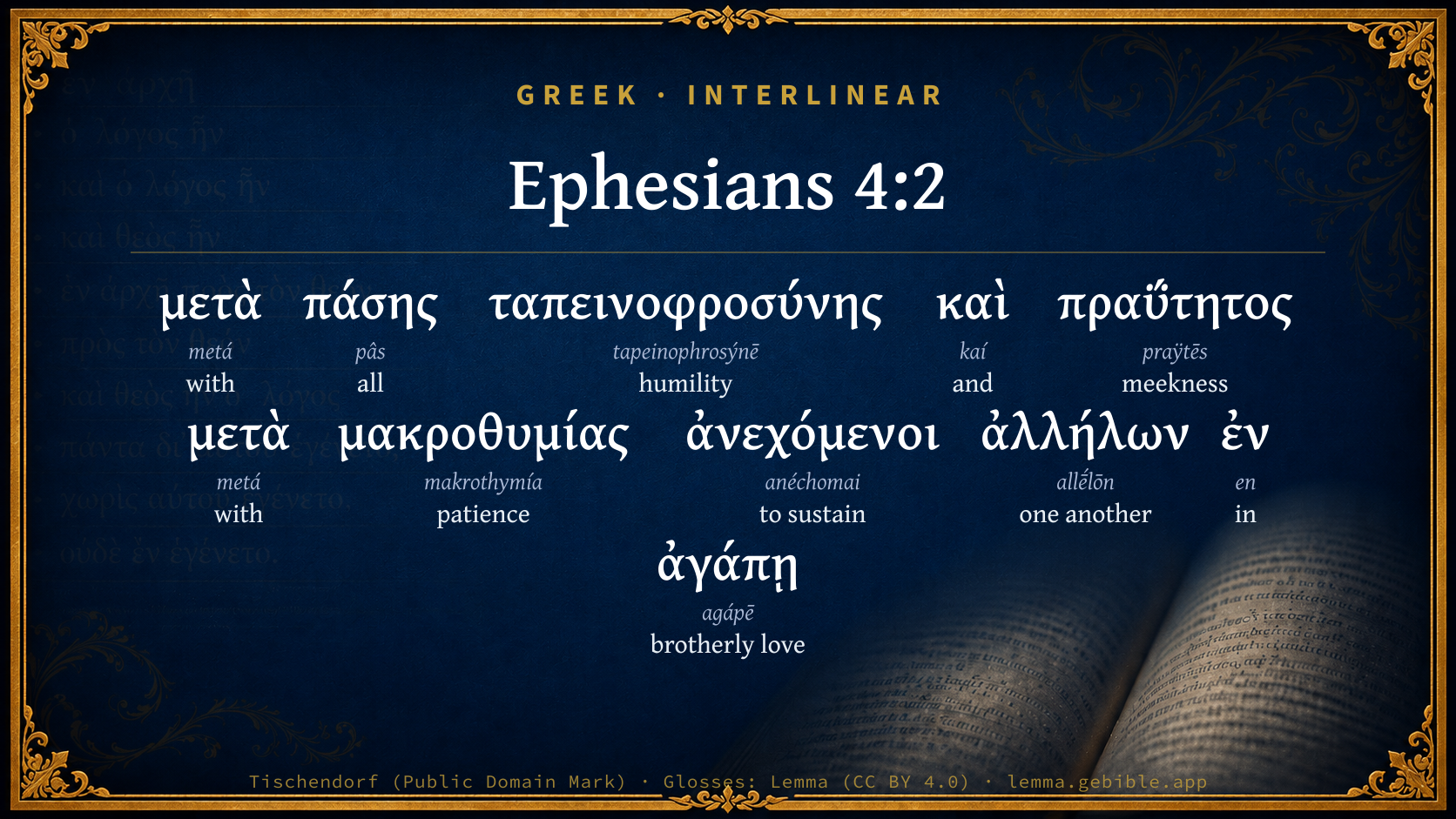
Greek (Tischendorf 8th ed.) Ephesians 4:2 appears in the Greek New Testament. The text above is from the Tischendorf 8th edition. Each word links to its Strong’s number and a concise gloss. Click any word for its full Thayer’s Greek Lexicon entry.
Download image
Cite this verse

Ephesians 4:2 (World English Bible). Public Domain. Lemma interlinear Bible study tool, https://lemma.gebible.app/v/ephesians/4/2.

Show BibTeX & RIS
BibTeX
RIS
English Translation
with all lowliness and humility, with patience, bearing with one another in love;
World English Bible · Public Domain
Download a study sheet

One document with this verse’s original text, its word-by-word gloss line, the meaning frame, cross-references with their text, attributed commentary, and full source and license credits — printable, and it pastes into notes with its structure intact.

This verse Autodidact and up

Study sheet (.html) Plain text (.txt)

A passage Seminary Student

Up to 50 verses in one chapter. A passage sheet keeps up to 6 commentary sources and 12 cross-references per verse, in the order this page ranks them, and says so on the sheet whenever that leaves anything out. Ask for a single verse and you get the Autodidact verse sheet above.

Everything on this page stays free to read, with no account — the sheet is a download of what is already on screen, not access to it.

Want to remove ads? Support Godless Engineer
Compare translations 3

The same verse in 3 English versions, stacked beneath the original-language interlinear above. Click any original word for its lexicon entry.

Each is an independent rendering of the whole verse — the interlinear is not word-aligned to these translations.

Highlighted words mark where these versions differ — a whole-verse word diff, not a word-by-word alignment.

  • World English Bible Public Domain
    with all lowliness and humility, with patience, bearing with one another in love;
  • King James Version Public Domain
    With all lowliness and meekness, with longsuffering, forbearing one another in love;
  • unfoldingWord Literal Text CC BY-SA 4.0
    with all humility and gentleness, with patience, putting up with one another in love,

unfoldingWord Literal Text — © unfoldingWord, licensed CC BY-SA 4.0. Word-aligned USFM3 via Door43 (git.door43.org/unfoldingWord/en_ult).

Versions to compare (up to 4)

3 of 4 selected

Show all 19 translations

Every available English version of this verse, each an independent rendering of the whole verse.

  • World English Bible Public Domain
    with all lowliness and humility, with patience, bearing with one another in love;
  • Berean Standard Bible Public Domain
    with all humility and gentleness, with patience, bearing with one another in love,
  • Majority Standard Bible Public Domain
    with all humility and gentleness, with patience, bearing with one another in love,
  • King James Version Public Domain
    With all lowliness and meekness, with longsuffering, forbearing one another in love;
  • American Standard Version (1901) Public Domain
    with all lowliness and meekness, with longsuffering, forbearing one another in love;
  • Revised Version (1885) Public Domain
    with all lowliness and meekness, with longsuffering, forbearing one another in love;
  • Geneva Bible (1599) Public Domain
    With all humblenesse of minde, and meekenesse, with long suffering, supporting one an other through loue,
  • Douay-Rheims (1899) Public Domain
    With all humility and mildness, with patience, supporting one another in charity.
  • Young's Literal Translation Public Domain
    with all lowliness and meekness, with long-suffering, forbearing one another in love,
  • Literal Standard Version CC BY-SA 4.0
    with all lowliness and meekness, with long-suffering, bearing with one another in love,
  • Unlocked Literal Bible CC BY-SA 4.0
    I urge you to live with great humility and gentleness and patience, putting up with one another in love.
  • unfoldingWord Literal Text CC BY-SA 4.0
    with all humility and gentleness, with patience, putting up with one another in love,
  • Darby Bible Public Domain
    with all lowliness and meekness, with long-suffering, bearing with one another in love;
  • World Messianic Bible Public Domain
    with all lowliness and humility, with patience, bearing with one another in love,
  • Webster's Bible Public Domain
    With all lowliness and meekness, with long-suffering, forbearing one another in love;
  • Free Bible Version CC BY-SA 4.0
    Don't think proudly of yourselves; be gentle and patient, showing tolerance to each other in love.
  • Bible in Basic English Public Domain
    With all gentle and quiet behaviour, taking whatever comes, putting up with one another in love;
  • Text-Critical English NT CC BY 4.0
    with all humility and gentleness, and with patience, bearing with one another in love,
  • Tyndale New Testament (1534) Public Domain
    in all humblenes of mynde and meknes and longe sufferynge forbearinge one another thorowe love

Literal Standard Version (2020), Covenant Press — licensed CC BY-SA 4.0. Text via the HelloAO Bible API (eBible.org). Unlocked Literal Bible (unfoldingWord) — licensed CC BY-SA 4.0. Text via the HelloAO Bible API (eBible.org). unfoldingWord Literal Text — © unfoldingWord, licensed CC BY-SA 4.0. Word-aligned USFM3 via Door43 (git.door43.org/unfoldingWord/en_ult). Free Bible Version, Dr. Jonathan Gallagher — licensed CC BY-SA 4.0. Text via the HelloAO Bible API (eBible.org).

Word by word

More ways to search: Search by grammar → Find every occurrence → Compare this word →

Practice this passage: Drill this verse → Learn its vocabulary →

About this verse

These counts appear in no published source. They are computed here, from the morphology-tagged text and Lemma’s own curated glosses. What Lemma adds →

11
words
10
distinct lemmas
Pauline Epistles
section

Notable vocabulary

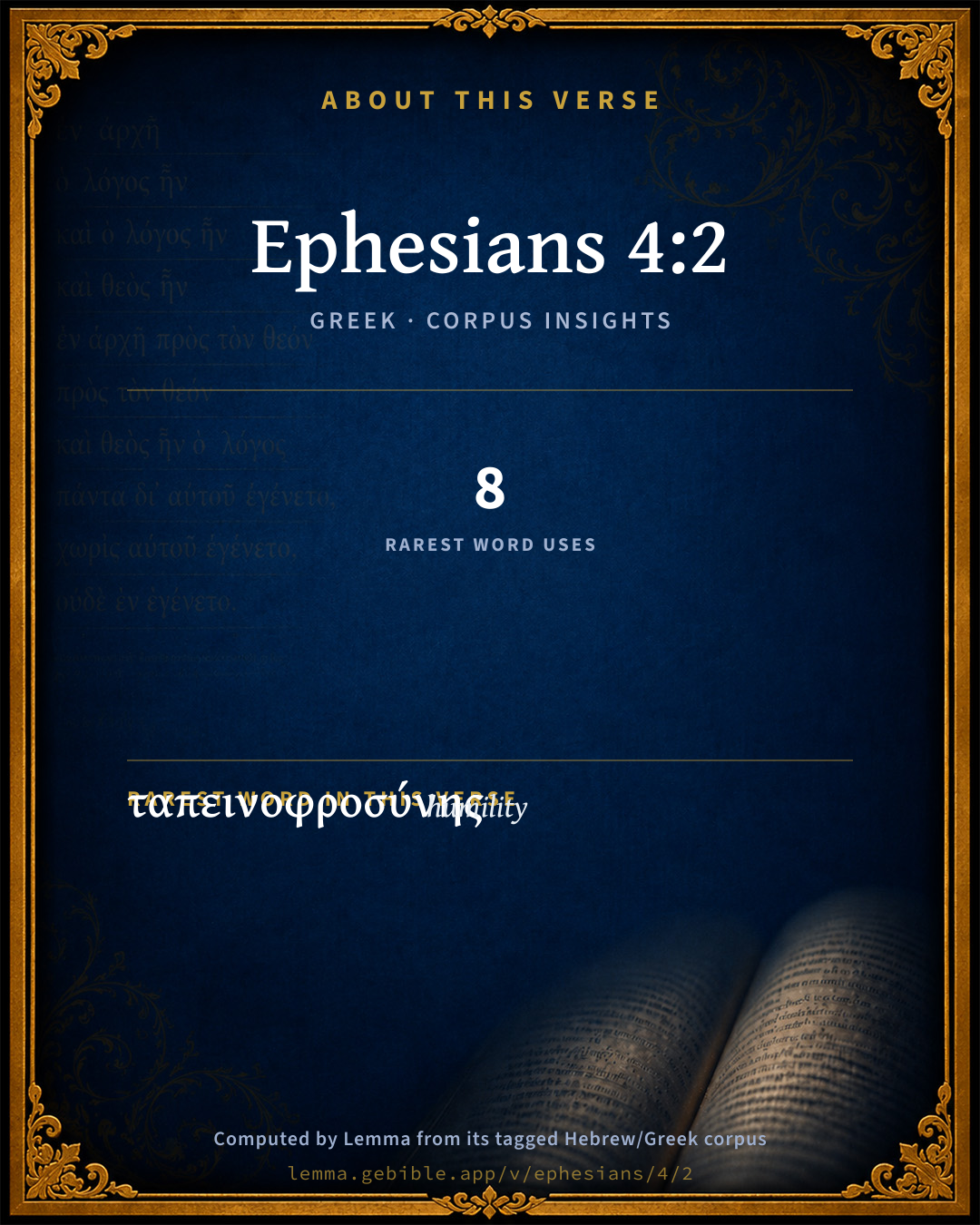
The rarest word here is ταπεινοφροσύνης humility G5012 — appearing just 8 times in the whole Greek New Testament.

Shared distinctive vocabulary

ταπεινοφροσύνης humility G5012 occurs in 8 verses of the Greek New Testament. Also found in:

Repetition

A word recurs within this verse:

  • μετὰ with G3326 ×2

Cross-references

25

Topical passages linked to Ephesians 4:2 in the Treasury of Scripture Knowledge — connected by theme and wording, ordered by reader-vote popularity; previews shown in the World English Bible.

  • Colossians 3:12–13 Put on therefore, as God's chosen ones, holy and beloved, a heart of compassion, kindness, lowliness, humility, and perseverance;
  • 1 Corinthians 13:7 bears all things, believes all things, hopes all things, endures all things.
  • 1 Corinthians 13:4–5 Love is patient and is kind; love doesn't envy. Love doesn't brag, is not proud,
  • Matthew 11:29 Take my yoke upon you, and learn from me, for I am gentle and lowly in heart; and you will find rest for your souls.
  • Romans 15:1 Now we who are strong ought to bear the weaknesses of the weak, and not to please ourselves.
  • Galatians 5:22–23 But the fruit of the Spirit is love, joy, peace, patience, kindness, goodness, faithfulness,
  • 1 Timothy 6:11 But you, man of God, flee these things, and follow after righteousness, godliness, faith, love, patience, and gentleness.
  • Matthew 5:3–5 "Blessed are the poor in spirit, For theirs is the Kingdom of Heaven.
  • Proverbs 3:34 Surely he mocks the mockers, But he gives grace to the humble.
  • Numbers 12:3 Now the man Moses was very humble, above all the men who were on the surface of the earth.
  • 1 Peter 3:15 But sanctify the Lord God in your hearts; and always be ready to give an answer to everyone who asks you a reason concerning the hope that is in you, with humility and fear:
  • Psalms 138:6 For though Yahweh is high, yet he looks after the lowly; But the proud, he knows from afar.
  • Galatians 6:2 Bear one another's burdens, and so fulfill the law of Christ.
  • Ephesians 1:4 even as he chose us in him before the foundation of the world, that we would be holy and without blemish before him in love;
  • 2 Timothy 2:25 in gentleness correcting those who oppose him: perhaps God may give them repentance leading to a full knowledge of the truth,
  • Proverbs 16:19 It is better to be of a lowly spirit with the poor, Than to divide the plunder with the proud.
  • Zephaniah 2:3 Seek Yahweh, all you humble of the land, who have kept his ordinances. Seek righteousness. Seek humility. It may be that you will be hidden in the day of Yahweh's anger.
  • James 3:15–18 This wisdom is not that which comes down from above, but is earthly, sensual, and demonic.
  • Acts 20:19 serving the Lord with all humility, with many tears, and with trials which happened to me by the plots of the Jews;
  • Isaiah 61:1–3 The Spirit of the Lord Yahweh is on me; because Yahweh has anointed me to preach good news to the humble; he has sent me to bind up the broken-hearted, to proclaim liberty to the captives, and the opening [of the prison] to those who are bound;
  • Psalms 45:4 In your majesty ride on victoriously on behalf of truth, humility, and righteousness. Let your right hand display awesome deeds.
  • Isaiah 57:15 For thus says the high and lofty One who inhabits eternity, whose name is Holy: I dwell in the high and holy place, with him also who is of a contrite and humble spirit, to revive the spirit of the humble, and to revive the heart of the contrite.
  • Zechariah 9:9 Rejoice greatly, daughter of Zion! Shout, daughter of Jerusalem! Behold, your king comes to you! He is righteous, and having salvation; Lowly, and riding on a donkey, Even on a colt, the foal of a donkey.
  • Mark 9:19 He answered him, "Unbelieving generation, how long shall I be with you? How long shall I bear with you? Bring him to me."
  • James 1:21 Therefore, putting away all filthiness and overflowing of wickedness, receive with humility the implanted word, which is able to save your souls.

Cross-references courtesy of OpenBible.info (CC BY 4.0).

Commentary

Notes on Ephesians 4:2 from classic Christian and Jewish commentators (each source and its license shown beneath its notes). The classic Christian expositions comment on the surrounding passage and are grouped to its opening verse, so a note may address several verses; the Jewish commentaries on the Tanakh (Rashi and others) are per-verse, so they appear only where the commentator wrote on this verse.

Lemma curates 59 commentaries, every one of them public domain or Creative Commons licensed, each selected and text-cleaned for this edition rather than reprinted as found. About our sources →

Matthew Henry's Commentary

Here the apostle proceeds to more particular exhortations. Two he enlarges upon in this chapter: - To unity an love, purity and holiness, which Christians should very much study. We do not walk worthy of the vocation wherewith we are called if we be not faithful friends to all Christians, and sworn enemies to all sin.

This section contains the exhortation to mutual love, unity, and concord, with the proper means and motives to promote them. Nothing is pressed upon us more earnestly in the scriptures than this. Love is the law of Christ's kingdom, the lesson of his school, the livery of his family. Observe,

I. The means of unity: Lowliness and meekness, long-suffering, and forbearing one another in love, Eph 4:2. By lowliness we are to understand humility, entertaining mean thoughts of ourselves, which is opposed to pride. By meekness, that excellent disposition of soul which makes men unwilling to provoke others, and not easily to be provoked or offended with their infirmities; and it is opposed to angry resentments and peevishness. Long-suffering implies a patient bearing of injuries, without seeking revenge. Forbearing one another in love signifies bearing their infirmities out of a principle of love, and so as not to cease to love them on the account of these. The best Christians have need to bear one with another, and to make the best one of another, to provoke one another's graces and not their passions. We find much in ourselves which it is hard to forgive ourselves; and therefore we must not think it much if we find that in others which we think hard to forgive them, and yet we must forgive them as we forgive ourselves. Now without these things unity cannot be preserved. The first step towards unity is humility; without this there will be no meekness, no patience, or forbearance; and without these no unity. Pride and passion break the peace, and make all the mischief. Humility and meekness restore the peace, and keep it. Only by pride comes contention; only by humility comes love. The more lowly-mindedness the more like-mindedness. We do not walk worthy of the vocation wherewith we are called if we be not meek and lowly of heart: for he by whom we are called, he to whom we are called, was eminent for meekness and lowliness of heart, and has commanded us therein to learn of him.

II. The nature of that unity which the apostle prescribes: it is the unity of the Spirit, Eph 4:3. The seat of Christian unity is in the heart or spirit: it does not lie in one set of thoughts, nor in one form and mode of worship, but in one heart and one soul. This unity of heart and affection may be said to be of the Spirit of God; it is wrought by him, and is one of the fruits of the Spirit. This we should endeavour to keep. Endeavouring is a gospel word. We must do our utmost. If others will quarrel with us, we must take all possible care not to quarrel with them. If others will despise and hate us, we must not despise and hate them. In the bond of peace. Peace is a bond, as it unites persons, and makes them live friendly one with another. A peaceable disposition and conduct bind Christians together, whereas discord and quarrelling disband and disunite their hearts and affections. Many slender twigs, bound together, become strong. The bond of peace is the strength of society. Not that it can be imagined that all good people, and all the members of societies, should be in every thing just of the same length, and the same sentiments, and the same judgment: buy the bond of peace unites them all together, with a non obstante to these. As in a bundle of rods, they may be of different lengths and different strength; but, when they are tied together by one bond, they are stronger than any, even than the thickest and strongest was of itself.

III. The motives proper to promote this Christian unity and concord. The apostle urges several, to persuade us thereto.

1. Consider how many unities there are that are the joy and glory of our Christian profession. There should be one heart; for there is one body, and one spirit, Eph 4:4. Two hearts in one body would be monstrous. If there be but one body, all that belong to that body should have one heart. The Catholic church is one mystical body of Christ, and all good Christians make up but one body, incorporated by one charter, that of the gospel, animated by one Spirit, the same Holy Spirit who by his gifts and graces quickens, enlivens, and governs that body. If we belong to Christ, we are all actuated by one and the same Spirit, and therefore should be one. Even as you are called in one hope of your calling. Hope is here put for its object, the thing hoped for, the heavenly inheritance, to the hope of which we are called. All Christians are called to the same hope of eternal life. There is one Christ that they all hope in, and one heaven that they are all hoping for; and therefore they should be of one heart. One Lord (Eph 4:5), that is, Christ, the head of the church, to whom, by God's appointment, all Christians are immediately subject. One faith, that is, the gospel, containing the doctrine of the Christian faith: or, it is the same grace of faith (faith in Christ) whereby all Christians are saved. One baptism, by which we profess our faith, being baptized in the name of the Father, Son, and Holy Ghost; and so the same sacramental covenant, whereby we engage ourselves to the Lord Christ. One God and Father of all, Eph 4:6. One God, who owns all the true members of the church for his children; for he is the Father of all such by special relation, as he is the Father of all men by creation: and he is above all, by his essence, and with respect to the glorious perfections of his nature, and as he has dominion over all creatures and especially over his church, and through all, by his providence upholding and governing them: and in you all, in all believers, in whom he dwells as in his holy temple, by his Spirit and special grace. If then there be so many ones, it is a pity but there should be one more - one heart, or one soul.

2. Consider the variety of gifts that Christ has bestowed among Christians: But unto every one of us is given grace according to the measure of the gift of Christ. Though the members of Christ's church agree in so many things, yet there are some things wherein they differ: but this should breed no difference of affection among them, since they are all derived from the same bountiful author and designed for the same great ends. Unto every one of us Christians is given grace, some gift of grace, in some kind or degree or other, for the mutual help of one another. Unto every one of us ministers is given grace; to some a greater measure of gifts, to others a less measure. The different gifts of Christ's ministers proved a great occasion of contention among the first Christians: one was for Paul, and another for Apollos. The apostle shows that they had no reason to quarrel about them, but all the reason in the world to agree in the joint use of them, for common edification; because all was given according to the measure of the gift of Christ, in such a measure as seemed best to Christ to bestow upon every one. Observe, All the ministers, and all the members of Christ, owe all the gifts and graces that they are possessed of to him; and this is a good reason why we should love one another, because to every one of us is given grace. All to whom Christ has given grace, and on whom he has bestowed his gifts (though they are of different sizes, different names, and different sentiments, yet), ought to love one another. The apostle takes this occasion to specify some of the gifts which Christ bestowed. And that they were bestowed by Christ he makes appear by those words of David wherein he foretold this concerning him (Psa 68:18), Wherefore he saith (Eph 4:8), that is, the Psalmist saith, When he ascended up on high, he led captivity captive, and gave gifts unto men. David prophesied of the ascension of Christ; and the apostle descants upon it here, and in the three following verses. When he ascended up on high. We may understand the apostle both of the place into which he ascended in his human nature, that is, the highest heavens, and particularly of the state to which he was advanced, he being then highly exalted, and eminently glorified, by his Father. Let us set ourselves to think of the ascension of Jesus Christ: that our blessed Redeemer, having risen from the dead, in gone to heaven, where he sits at the right hand of the Majesty on high, which completed the proof of his being the Son of God. As great conquerors, when they rode in their triumphal chariots, used to be attended with the most illustrious of their captives led in chains, and were wont to scatter their largesses and bounty among the soldiers and other spectators of their triumphs, so Christ, when he ascended into heaven, as a triumphant conqueror, led captivity captive. It is a phrase used in the Old Testament to signify a conquest over enemies, especially over such as formerly had led others captive; see Jdg 5:12. Captivity is here put for captives, and signifies all our spiritual enemies, who brought us into captivity before. He conquered those who had conquered us; such as sin, the devil, and death. Indeed, he triumphed over these on the cross; but the triumph was completed at his ascension, when he became Lord over all, and had the keys of death and hades put into his hands. And he gave gifts unto men: in the psalm it is, He received gifts for men. He received for them, that he might give to them, a large measure of gifts and graces; particularly, he enriched his disciples with the gift of the Holy Ghost. The apostle, thus speaking of the ascension of Christ, takes notice that he descended first, Eph 4:9. As much as if he had said, "When David speaks of Christ's ascension, he intimates the knowledge he had of Christ's humiliation on earth; for, when it is said that he ascended, this implies that he first descended: for what is it but a proof or demonstration of his having done so?" Into the lower parts of the earth; this may refer either to his incarnation, according to that of David, Psa 139:15, My substance was not hidden from thee, when I was made in secret, and curiously wrought in the lowest parts of the earth; or, to his burial, according to that of Psa 63:9, Those that seek my soul to destroy it shall go into the lower parts of the earth. He calls his death (say some of the fathers) his descent into the lower parts of the earth. He descended to the earth in his incarnation. He descended into the earth in his burial. As Jonas was three days and three nights in the whale's belly, so was the Son of man in the heart of the earth. He that descended is the same also that ascended up far above all heavens (Eph 4:10), far above the airy and starry (which are the visible) heavens, into the heaven of heavens; that he might fill all things, all the members of his church, with gifts and graces suitable to their several conditions and stations. Observe, Our Lord humbled himself first, and then he was exalted. He descended first, and then ascended. The apostle next tells us what were Christ's gifts at his ascension: He gave some apostles, etc., Eph 4:11. Indeed he sent forth some of these before his ascension, Mat 10:1-5. But one was then added, Act 1:26. And all of them were more solemnly installed, and publicly confirmed, in their office, by his visibly pouring forth the Holy Ghost in an extraordinary manner and measure upon them. Note, The great gift that Christ gave to the church at his ascension was that of the ministry of peace and reconciliation. The gift of the ministry is the fruit of Christ's ascension. And ministers have their various gifts, which are all given them by the Lord Jesus. The officers which Christ gave to his church were of two sorts - extraordinary ones advanced to a higher office in the church: such were apostles, prophets, and evangelists. The apostles were chief. These Christ immediately called, furnished them with extraordinary gifts and the power of working miracles, and with infallibility in delivering his truth; and, they having been the witnesses of his miracles and doctrine, he sent them forth to spread the gospel and to plant and govern churches. The prophets seem to have been such as expounded the writings of the Old Testament, and foretold things to come. The evangelists were ordained persons (Ti2 1:6), whom the apostles took for their companions in travel (Gal 2:1), and sent them out to settle and establish such churches as the apostles themselves had planted (Act 19:22), and, not being fixed to any particular place, they were to continue till recalled, Ti2 4:9. And then there are ordinary ministers, employed in a lower and narrower sphere; as pastors and teachers. Some take these two names to signify one office, implying the duties of ruling and teaching belonging to it. Others think they design two distinct offices, both ordinary, and of standing use in the church; and then pastors are such as are fixed at the head of particular churches, with design to guide, instruct, and feed them in the manner appointed by Christ; and they are frequently called bishops and elders: and the teachers were those whose work it was also to preach the gospel and to instruct the people by way of exhortation. We see here that it is Christ's prerogative to appoint what officers and offices he pleases in his church. And how rich is the church, that had at first such a variety of officers and has still such a variety of gifts! How kind is Christ to his church! How careful of it and of its edification! When he ascended, he procured the gift of the Holy Ghost; and the gifts of the Holy Ghost are various: some have greater, others have less measures; but all for the good of the body, which brings us to the third argument,

3. Which is taken from Christ's great end and design in giving gifts unto men. The gifts of Christ were intended for the good of his church, and in order to advance his kingdom and interest among men. All these being designed for one common end is a good reason why all Christians should agree in brotherly love, and not envy one another's gifts. All are for the perfecting of the saints (Eph 4:12); that is, according to the import of the original, to bring into an orderly spiritual state and frame those who had been as it were dislocated and disjointed by sin, and then to strengthen, confirm, and advance them therein, that so each, in his proper place and function, might contribute to the good of the whole. - For the work of the ministry, or for the work of dispensation; that is, that they might dispense the doctrines of the gospel, and successfully discharge the several parts of their ministerial function. - For the edifying of the body of Christ; that is, to build up the church, which is Christ's mystical body, by an increase of their graces, and an addition of new members. All are designed to prepare us for heaven: Till we all come, etc., Eph 4:13. The gifts and offices (some of them) which have been spoken of are to continue in the church till the saints be perfected, which will not be till they all come in the unity of the faith (till all true believers meet together, by means of the same precious faith) and of the knowledge of the Son of God, by which we are to understand, not a bare speculative knowledge, or the acknowledging of Christ to be the Son of God and the great Mediator, but such as is attended with appropriation and affection, with all due honour, trust, and obedience. - Unto a perfect man, to our full growth of gifts and graces, free from those childish infirmities that we are subject to in the present world. - Unto the measure of the stature of the fulness of Christ, so as to be Christians of a full maturity and ripeness in all the graces derived from Christ's fulness: or, according to the measure of that stature which is to make up the fulness of Christ, which is to complete his mystical body. Now we shall never come to the perfect man, till we come to the perfect world. There is a fulness in Christ, and a fulness to be derived from him; and a certain stature of that fulness, and a measure of that stature, are assigned in the counsel of God to every believer, and we never come to that measure till we come to heaven. God's children, as long as they are in this world, are growing. Dr Lightfoot understands the apostle as speaking here of Jews and Gentiles knit in the unity of the faith and of the knowledge of the Son of God, so making a perfect man, and the measure of the stature of the fulness of Christ. The apostle further shows, in the following verses, what was God's design in his sacred institutions, and what effect they ought to have upon us. As, (1.) That we henceforth be no more children, etc. (Eph 4:14); that is, that we may be no longer children in knowledge, weak in the faith, and inconstant in our judgments, easily yielding to every temptation, readily complying with every one's humour, and being at every one's back. Children are easily imposed upon. We must take care of this, and of being tossed to and fro, like ships without ballast, and carried about, like clouds in the air, with such doctrines as have no truth nor solidity in them, but nevertheless spread themselves far and wide, and are therefore compared to wind. By the sleight of men; this is a metaphor taken from gamesters, and signifies the mischievous subtlety of seducers: and cunning craftiness, by which is meant their skilfulness in finding ways to seduce and deceive; for it follows, whereby they lie in wait to deceive, as in an ambush, in order to circumvent the weak, and draw them from the truth. Note, Those must be very wicked and ungodly men who set themselves to seduce and deceive others into false doctrines and errors. The apostle describes them here as base men, using a great deal of devilish art and cunning, in order thereunto. The best method we can take to fortify ourselves against such is to study the sacred oracles, and to pray for the illumination and grace of the Spirit of Christ, that we may know the truth as it is in Jesus, and be established in it. (2.) That we should speak the truth in love (Eph 4:15), or follow the truth in love, or be sincere in love to our fellow-christians. While we adhere to the doctrine of Christ, which is the truth, we should live in love one with another. Love is an excellent thing; but we must be careful to preserve truth together with it. Truth is an excellent thing; yet it is requisite that we speak it in love, and not in contention. These two should go together - truth and peace. (3.) That we should grow up into Christ in all things. Into Christ, so as to be more deeply rooted in him. In all things; in knowledge, love, faith, and all the parts of the new man. We should grow up towards maturity, which is opposed to being children. Those are improving Christians who grow up into Christ. The more we grow into an acquaintance with Christ, faith in him, love to him, dependence upon him, the more we shall flourish in every grace. He is the head; and we should thus grow, that we may thereby honour our head. The Christian's growth tends to the glory of Christ. (4.) We should be assisting and helpful one to another, as members of the same body, Eph 4:16. Here the apostle makes a comparison between the natural body and Christ's mystical body, that body of which Christ is the head: and he observes that as there must be communion and mutual communications of the members of the body among themselves, in order to their growth and improvement, so there must be mutual love and unity, together with the proper fruits of these, among Christians, in order to their spiritual improvement and growth in grace. From whom, says he (that is, from Christ their head, who conveys influence and nourishment to every particular member), the whole body of Christians, fitly joined together and compacted (being orderly and firmly united among themselves, every one in his proper place and station), by that which every joint supplies (by the assistance which every one of the parts, thus united, gives to the whole, or by the Spirit, faith, love, sacraments, etc., which, like the veins and arteries in the body, serve to unite Christians to Christ their head, and to one another as fellow-members), according to the effectual working in the measure of every part (that is, say some, according to the power which the Holy Ghost exerts to make God's appointed means effectual for this great end, in such a measure as Christ judges to be sufficient and proper for every member, according to its respective place and office in the body; or, as others, according to the power of Christ, who, as head, influences and enlivens every member; or, according to the effectual working of every member, in communicating to others of what it has received, nourishment is conveyed to all in their proportions, and according to the state and exigence of every part) makes increase of the body, such an increase as is convenient for the body. Observe, Particular Christians receive their gifts and graces from Christ for the sake and benefit of the whole body. Unto the edifying of itself in love. We may understand this two ways: - Either that all the members of the church may attain a greater measure of love to Christ and to one another; or that they are moved to act in the manner mentioned from love to Christ and to one another. Observe, Mutual love among Christians is a great friend to spiritual growth: it is in love that the body edifies itself; whereas a kingdom divided against itself cannot stand.

Matthew Henry's Commentary on the Whole Bible (1708–1710) — public domain (CC PDM 1.0). Text via the HelloAO Bible API.

The Biblical Illustrator

Joseph S. Exell

Eph_4:2

With all lowliness and meekness, with long suffering, forbearing one another in love.

Exhortation to lowliness

These words, after all that has gone before, thrill us like the tones of a trumpet. If it had been left to ourselves to expand the general exhortation into practical details, we should have insisted, perhaps, on the duty of cultivating a magnanimity corresponding to the greatness of our position and the greatness of our hopes. We might have argued that those who have received such a calling should exhibit a certain stateliness of character, a lofty indifference not only to the baser pleasures of life but to power and fame. Or we might have urged that with such a calling Christian men should be inspired with a passionate zeal for heroic tasks and fortitude for martyrdom. This would be to walk worthily of the calling wherewith we were called. But instead of appealing to us in this lofty tone, Paul exhorts us to humility, to meekness, and to long suffering; and this suggests a principle of great value in the discipline of the spiritual life. Religious excitement, originated by direct contact with God, will always enlarge and exalt our conception of Gods greatness, and will deepen our sense of dependence on Him. The heart may be flooded with a shining sea of religious emotion; the imagination may be glowing like the heavens at sunset with purple and golden splendour; but as emotion becomes more intense, and as our conception of the Christian life becomes more and more glorious, the infinite greatness of Gods righteousness and power and grace will inspire us with deeper wonder and awe. We have received unmeasurable blessings, we have been raised to wonderful honours, we are hoping to share with Christ Himself infinite blessedness and glory; but all that we have has come from the eternal thought and purpose and love of God; all that we hope for will be conferred by His grace and the exceeding greatness of His power. The wealth is not ours; it is a Divine gift: the strength is not ours; it is the inspiration of the Divine life: the dignity is not ours; it is conferred on us by the free unpurchased love of God, because we are in Christ. We live in palaces of eternal light and righteousness, and among the principalities and powers of heaven; but our native home was in the dust, and this transfigured, eternal, and glorified life was not achieved by our own strength, it has come to us from God. We are nothing; God is all. Humility, lowliness, is disciplined by prayer, by communion with God, by the vision of Divine and eternal things; by meditation on Gods righteousness and our own sin, on the greatness of God and the limitations of all created life, on the eternal fulness of God and our own dependence on Him; on the blessings which God has made our inheritance in Christ, and the dark destiny which would have been the natural and just result of our indifference to Gods authority and love. (R. W. Dale, LL. D.)

Lowliness and meekness go together

Where there is lowliness there will be meekness, the absense of the disposition to assert personal rights, either in the presence of God or of men. Meekness submits without a struggle to the losses, the sufferings, the dishonour which the providence of God permits to come upon us. It may look with agitation and distress upon the troubles of others, and the miseries of mankind may sometimes disturb the very foundations of faith; but in its own sorrows it finds no reason for distrusting either the Divine righteousness or the Divine goodness. It is conscious of possessing no merit, and therefore in the worst and darkest hours is conscious of suffering no injustice. The same temper will show itself in relation to men. It has no personal claim to defend. It will, therefore, be slow to resent insult and injury. If it resents them at all, the resentment will be a protest against the violation of Divine laws rather than a protest against a refusal to acknowledge its personal rights. There will be no eagerness for great place or high honour, or for the recognition of personal merit; and therefore, if these are withheld, there will be no bitterness or mortification. (R. W. Dale, LL. D.)

Meekness an element of long suffering

Meekness is one of the elements of long suffering. Paul is thinking of the mutual relations of those who are in Christ, and his words imply that there will be large occasions for the exercise of this grace in the conduct and spirit of our Christian brethren. We are not to assume that all those who are honestly loyal to Christ will keep His precepts perfectly, or that in all those who have received the Divine life the baser elements and passions of human nature have been extinguished. Our Christian brethren will sometimes treat us unjustly. They will judge us ignorantly and ungenerously. They will say harsh things about us. They will be inconsiderate and discourteous. They will be wilful, wayward, selfish. They will make us suffer from their arrogance, their ambition, their impatience, their stolid perversity. All this we have to anticipate. Christ bears with their imperfections and their sins; we too have to exercise forbearance. In forbearance, meekness and love are blended. (R. W. Dale, LL. D.)

Advantage of meekness

There is nothing lost by meekness and yielding. Abraham yields over his right of choice: Lot taketh it. And, behold, Lot is crossed in that which he chose: Abraham blessed, in that which was left him! As heaven is taken by violence, so is earth by meekness. And God, the true proprietor, loves no tenants better, nor grants larger leases to any, than the meek. (J. Trapp.)

Long suffering improved

Some years ago, I had in my garden a tree that never bore any fruit. One day, I took my axe in my hand, determined to fell it. My wife met me in the pathway and pleaded for it: Why, the spring is now very close, stay and see whether there may not be some change in it: and if not, then you can cut it down. As I never repented following her advice before I yielded to it now: and what was the consequence? Why, in a few weeks the tree was covered with blossoms, and in a few more it was bending under a load of fruit. Ah, said I, this should teach me. I will learn a lesson from hence not to cut down too soon: that is, not to consider persons incorrigible or abandoned too soon, so as to give up hope for them, and the use of the means of prayer on their behalf. (W. Jay.)

Human forbearance

The Jews would not willingly tread upon the smallest piece of paper in their way; but took it up, for possibly, said they, the name of God may be on it. Though there was a little superstition in that, yet much good may be learnt from it, if we apply it to men. Trample not on any, there may be some work of grace there going on, that thou knowest not of. The name of God may be written upon that soul thou treadest on it may be a soul that Christ thought so much of, as to shed His precious Blood for it: therefore despise it not. (Archbishop Leighton.)

Lowliness is Christlike

The late Rev. Dr. R-- had a somewhat lofty manner of expressing himself. In the course of visiting his parish he called at the cottage of an elderly female, who familiarly invited him to come in by and sit doun. The Doctor, who expected a more respectful salutation, said, in stately tones, intended to check any further attempt at familiarity, Woman, I am a servant of the Lord come to speak with you on the concerns of your soul. Then yell be humble like your Maister, admirably rejoined the cottager. The Doctor felt the reproof deeply, and never again sought to magnify himself at the expense of his office. (C. Rogers, LL. D.)

The meek deflated

A missionary in Jamaica was once questioning the little black boys on the meaning of Mat_5:5, and asked, Who are the meek? A boy answered, Those who give soft answers to rough questions.

Meekness and forbearance

Anthony Blanc, one of Felix Neffs earlier converts, was very earnest in winning souls to Christ. The enemies of the gospel were angry at his success, and used alike scoffs and threats against him. One night, as he was returning home from a religious meeting, he, was followed by a man in a rage, who struck him a violent blow on the head. May God forgive and bless you! was Anthonys quiet and Christian rejoinder. Ah! replied his assailant, furiously, if God does not kill you, Ill do it myself! Some days afterwards Anthony met the same person in a narrow road, where two persons could hardly pass. Now I shall be struck by him again, he said to himself. But he was surprised, on approaching, to see this man, once so bitter towards him, reach out his hand and cry to him, in a tremulous voice, Mr. Blanc, will you forgive me, and let all be over? Thus this disciple of Christ, by gentle and peaceful words, had made a friend of an enemy. (Clerical Library.)

The Biblical Illustrator, edited by Joseph S. Exell (c. 1880s–1900s) — public domain. Text from a community e-Sword module.

Joseph Benson's Commentary

Eph 4:2-3. With all lowliness — Or humility of mind, having mean thoughts of yourselves because of your former sinfulness and guilt, depravity, weakness, and misery, and your unworthiness of that mercy which God hath exercised toward you; and meekness — Maintaining calmness, serenity, and peace of mind, amid the infirmities and indiscretions of your Christian friends, and even amid the affronts and injuries of your enemies; with long-suffering — Toward all men, whether saints or sinners, always possessing your souls in patience, and whatever provocations you receive, never seeking revenge, or yielding to resentment or ill-will toward any. Forbearing — Greek, ανεχομενοι, bearing with; one another in love — That is, out of a principle of love to God, your fellow-Christians, and all men; endeavouring, so far as in you lies, to keep the unity of the Spirit — That mutual union, concord, and harmony, which is the fruit of the Spirit; in the bond of peace — In a peaceable, kind, and affectionate disposition toward one another.

Joseph Benson's Commentary on the Old and New Testaments (1811–1818) — public domain. Text from a community e-Sword module.

Burkitt's Expository Notes on the New Testament

William Burkitt

Having exhorted them to the practice of their general duty, namely, to walk worthy of their holy vocation, in the former verse; in these two verses he presses upon them more special and particular duties, the chief of which is the duty of Christian unity and concord; endeavouring to keep the unity of the Spirit.

The word signifies a diligent, industrious, and united endeavour, to preserve and keep, to support and maintain, to unity of the Spirit; that is, an union of heart and spirit, an unity of faith and doctrine, and unity of judgment and affection, amongst all the professors of Christianity.

Observe, 2. The means by which this duty may be performed, and the unity of the Spirit maintained; namely, in or by the bond of peace: a peacable disposition and temper, a peacable deportment and behaviour, is the bond or ligament which binds Christians together; whereas discord and division cuts that bond asunder.

Observe, 3. The special graces which the apostle recommends unto us, as excellent helps for preserving unity and peace; namely, humility, meekness, mutual forbearance.

1. Humility; With all lowliness Eph 4:2; that is, with all submissiveness of mind, and humble apprehensions of ourselves. What Tertullus said of Festus flatteringly, we may say of humility truly, By thee, O humility, we enjoy great quietness. The humble man is a peaceable man; only by pride cometh contention.

2. Meekness; which consists in a backwardness to provoke others, or to be provoked by others; as lowliness stood in opposition to pride, so meekness here stands in opposition to peevishness: With all lowliness and meekness.

3. Long-suffering and mutual forbearance; when Christians are so far from resenting every wrong, and revenging every injury that is offered to them, that they can bear with one another’s weaknesses, cover each other’s infirmities, pity one another’s failings, and pardon each other’s provocations. And this duty of mutual forbearance ought to proceed from a principle of love to each other; forbearing one another in love.

William Burkitt's Expository Notes on the New Testament (1700–1703) — public domain. Text from a community e-Sword module.

Tyndale Open Study Notes

Tyndale Open Resources

4:2 humble . . . gentle . . . patient: Believers are to be like Christ in how they treat others (see Col 3:12-14; cp. Gal 6:2).

Tyndale Open Study Notes — © Tyndale Open Resources, licensed CC BY-SA 4.0. Text via the HelloAO Bible API.

Bengel's Gnomon

Johann Albrecht Bengel

Eph 4:2. Μετὰ—μετὰ, with—with) To these refer the two following participles, ἀνεχόμενοι, σπουδάζοντες, forbearing, endeavouring diligently, which, being in the nominative, depend on the preceding imperative implied, walk ye. [The man, who is affected, as he ought to be, with a sense of the Divine calling, will be found to be adorned with the virtues mentioned in this passage, 1Pe 3:9; Php 1:27.—V. g.]—πάσης, with all) To be construed also with meekness [πραΰτητος] (as well as with ταπεινοφροσύνης, lowliness), Col 3:12-13.—ταπεινοφροσύνης, lowliness of mind) From a sense of grace, Rom 11:20.—ἐν ἀγάπῃ, in love) In the bond of peace, Eph 4:3, corresponds to this expression. “In love” occurs again, Eph 4:15-16. And here, love is preached [inculcated]: faith, in Eph 4:5; hope, in Eph 4:4.

Bengel's Gnomon of the New Testament — English translation (T&T Clark, Edinburgh, 1860) — public domain. Text from a community e-Sword module.

Meyer's Critical & Exegetical Commentary

Heinrich August Wilhelm Meyer

Eph_4:2. Μετὰ πάσ. ταπεινοφρ. κ. πραότ.] the characteristic dispositions accompanying this περιπατῆσαι; see Winer, p. 337 [E. T. 471], and with regard to πάσης, on Eph_1:8; it belongs to both substantives. On the subject-matter, comp. Mat_11:29; Col_3:12. The opposite of humility: τὰ ὑψηλὰ φρονεῖν, Rom_12:16; Rom_11:20; 1Ti_6:17; δοκεῖν εἶναί τι, Gal_6:3. On the notion of πραότης, gentleness, see Tittmann, Synon. p. 140.

μετὰ μακροθ.] is attached by Calvin, Estius, Zeltner, Calixtus, Baumgarten, Michaelis, Zachariae, Rückert, Holzhausen, Harless, Olshausen, to the following ἀνεχόμενοι. But the very repetition of the preposition, to which appeal is made, most naturally points backwards, so that μετὰ μακροθ. appears as parallel to μετὰ π. ταπεινοφρ. κ. πραότ., inasmuch, namely, as Paul makes the general be followed by the special, and then gives to the latter the elucidation ἀνεχόμενοι κ.τ.λ. Besides, μετὰ μακροθ., if it belonged to ἀνεχόμ., would have an undue emphasis, since without long-suffering the ἀνέχεσθαι ἀλλήλων would not exist at all; Col_3:12 f. Bengel and Matthies, following Theodoret and Oecumenius, have attached the whole μετὰ π. ταπ. κ. πραότ., μετὰ μακροθ. to ἀνεχόμενοι. But in this way we lose the gradual transition from the general ἀξίως περιπατ. τ. κλ. to the special ἀνεχόμ. ἀλλήλ., which under our construction is very naturally brought about.

ἀνεχόμ. ἀλλήλ. ἐν ἀγάπῃ] The reciprocal forbearance in (ethical habit) love (comp. Rom_15:1; Gal_6:2) is the practical expression of the μακροθυμία. Comp. Col_3:13. It consists in the fact that we aliorum infirmitates aequo animo ferimus, nec ob ea, quae nobis in proximo displicent, ab ejus amicitia recedimus, sed personam constanter amamus, etsi vitia in odio habeamus, Calovius. The nominative of the participle (comp. Col_1:10) is put κατὰ τὸ νοούμενον, because the logical subject of ἀξίως περιπατ., Eph_4:1, is ὑμεῖς. See on Eph_3:18; comp. on 2Co_1:7, and Pflugk, ad Eur. Hec. 970. Ignoring this familiar construction, Heinsius, Knatchbull, and Homberg have placed a full stop after Eph_4:1, and then supplied estote to the participlesa course, which would only be admissible if, as in Rom_12:9, this concise, pregnant mode of expression were implied in the context.

ἐν ἀγάπῃ] belongs to the preceding. On the thing itself, comp. 1Co_13:4. Lachmann, Holzhausen, and Olshausen attach it to σπουδάζοντες. The reason given by Olshausen, that, as the μακροθ. is only a form of expression of love, ἐν ἀγάπῃ could not belong to what precedes, would be set aside, even if it were in itself valid, by the correct separation of μετὰ μακροθ. from ἀνεχόμ. And ἀνεχόμ. ἀλλήλ., taken alone, renders the discourse simply abrupt. How harmonious is the structure, when both participial clauses begin with the participle and close with the definitions attached by ἐν, in which definitions there is opened up the whole ethical domain (love and peace) to which the before-named special virtues belong (1 Corinthians 13)!

Meyer — Critical and Exegetical Commentary on the New Testament — English translation by Peter Christie, edited by Frederick Crombie (T&T Clark, 1880) — public domain. Text from a community e-Sword module.

Expositor's Greek Testament

ed. W. Robertson Nicoll

Eph 4:2 . μετὰ πάσης ταπεινοφροσύνης καὶ πρᾳότητος : with all lowliness and meekness . Statement of moral dispositions which should attend their walk; μετά conveying the idea of accompaniment, relation, association , while σύν suggests closer conjunction, fellowship , especially a fellowship which helps . Krüger ( Sprachl. , § 68, 13, 1) puts the distinction thus “ σύν τινι denotes rather coherence , μετά τινος rather coexistence ” ( cf. Win.-Moult., pp. 470, 488). As in the case of πᾶσα σοφία (Eph 1:8 ), πᾶσα ταπεινοφροσύνη can mean only “all lowliness,” “all possible lowliness,” or “ every kind of lowliness,” not summa humilitas . The word ταπεινοφροσύνη is of very rare occurrence in non-biblical Greek, and when it does occur it has the sense of pusillanimity (Epictet., Diss., 3, 24, 56; Joseph., Jewish Wars , iv., 9, 2). It is not used in the OT; but in the NT it denotes one of the passive graces, unrecognised or repudiated in Græco-Roman ethics, which Christianity has glorified the lowliness of mind which springs from a true estimate of ourselves a deep sense of our own moral smallness and demerit ( cf. Act 20:19 ; Phi 2:3 ; Col 3:12 ; 1Pe 5:5 ; Col 2:18 ; Col 2:23 , of a false humility). πρᾳότης , or better πραΰτης (TTrWH) in the later form and without iota subscript; cf. Buttm., Gram. of N. T. Greek , p. 26 (who regards the form πρᾷος as apparently “unknown to the language of the NT”); and Blass, Gram. of N. T. Greek , p. 7 (who thinks there is not sufficient evidence to decide between πραότης and πρᾳότης ). It means more than modestia (Vulg.), mansuetudo , ἀταραξία , gentleness , or equanimity , inasmuch as it has regard to our attitude towards God as well as towards men, and includes more than outward behaviour or natural disposition. It is a grace of the Spirit, the disposition of loving submissiveness in the first place to God and His dealings with us, and, as the consequence of that, of quiet restraint, mildness and patient abnegation of self in face of the provocations of others. It is a moral quality, therefore, with a far wider scope, a larger significance, a deeper and more vital relation to character than was thought of by the philosophers and moralists of the old world, who regarded it only as the opposite of ἀγριότης , savageness (Plato, Symp. , 197 d ), χαλεπότης , harshness (Arist., Hist. Anim. , ix., 1), or ἀποτομία , roughness (Plut., De lib. ed. , 18); cf. Trench, Syn. , pp. 143, etc.; Schmidt, Synon. , 98, 2. μετὰ μακροθυμίας : with long-suffering . This is best taken as an independent clause, which is developed in the following sentence. Some (Theod., Beng., etc.) attach both the μετὰ πάσης ταπ ., etc., and the μετὰ μακρ . to the ἀνεχόμενοι clause. But this gives one long sentence, which obscures the transition from idea to idea and makes the several clauses less distinctive. Others (Calv., Harl., Rück., Ols., etc.) attach the μετὰμακρ . to ἀνεχόμενοι ; but to make it part of that clause takes from the point of the μακροθυμία and disturbs the balance of the clauses, in which we have first the general idea of worthiness of walk, then certain particulars involved in that, and then the further explanation (in the ἀνεχόμενοι clause) of these various particulars or of the one last noticed. The term μακροθυμία means both endurance or constancy in presence of illness and trouble (Col 1:11 ; 2Ti 3:10 ; Heb 6:12 ; Jas 5:10 ), and, as here ( cf. also Rom 2:4 ; Rom 9:2 ; 2Co 6:6 , etc.), the abnegation of revenge in presence of wrong the opposite of ὀργή (Pro 16:32 ), ὀξοθυμία (Jas 1:19 ), etc., and akin to ὑπομονή (2Co 6:4 ; 2Co 6:6 ; Col 1:11 ; 2Ti 3:10 ; Jas 5:10-11 ). The word belongs to later Greek (Plut., Macc., etc.), and the LXX; but in neither has it the exact sense it gets in the NT. ἀνεχόμενοι ἀλλήλων ἐν ἀγάπῃ : forbearing one another in love . Explanation and application of the μακροθυμία . By a natural and familiar irregularity which gives effect to the logic of the statement rather than to the construction the partic. reverts from the acc. to the nom. ( cf. Col 1:10 ; Krüger, Sprachl. , § 56, 9, 4). To attach ἐν ἀγάπῃ (Orig., Lachm., Olsh., etc.) to the following σπουδάζοντες is to make the ἀνεχόμενοι abrupt and bare, and to disturb the harmonious form of the participial sentences. The duty of mutual forbearance is to be practised in love . It was to be a loving forbearance a forbearance having its motive, its inspiration, its life, in love.

The Expositor's Greek Testament, edited by W. Robertson Nicoll (1897–1910) — public domain. Text from a community e-Sword module.

Hodge's Commentary on Romans, Ephesians & First Corinthians

Charles Hodge

Chapter IV

An exhortation to unity, vs. 1-16 an exhortation to holiness and to specific virtues, vs. 17-32.

Ephesians 4:1-16

Analysis

The apostle exhorts his readers to walk worthy of their vocation. Such a walk should be characterized by humility, meekness, long-suffering, and zeal to promote spiritual unity and peace, Eph_4:1-3. The church is one because it is one body, has one Spirit, one hope, one Lord, one faith, one baptism, and one God and Father who is over, through, and in all its members, Eph_4:4-6.

This unity, however, is consistent with great diversity of gifts, which Christ distributes according to his own will, Eph_4:7. This is confirmed by a passage from the Psalms which speaks of the Messiah as giving gifts to men; which passage it is shown must refer to Christ, since it speaks of a divine person ascending to heaven, which necessarily implies a preceding descent to the earth, Eph_4:9-10. The gifts which Christ bestows on his church are the various classes of ministers, apostles, prophets, evangelists, and pastors who are teachers, Eph_4:11. The design of the ministry is the edification of the church, and to bring all its members to unity of faith and knowledge, and to the full stature of Christ; that they should no longer have the instability of children, but be a firm, compact, and growing body in living union with Christ its head, Eph_4:12-16.

Commentary

Eph_4:1-3

Παρακαλῶ οὖν ὑμᾶς ἐγὼ ὁ δέσμιος ἐν Κυρίῳ. The exhortation is a general one; it flows from the preceding doctrines, and is enforced by the authority, and the sufferings of him who gave it. As you are partakers of the redemption purchased by Christ, I therefore beseech you. I the prisoner, not of, but in the Lord, ἐν Κυρίῳ He was a prisoner because he was in the Lord and for his sake. It was as a Christian and in the cause of Christ he suffered bonds. Compare the frequently occurring expressions, συνεργὸς ἐν Χριστῷ, ἀγαπητὸς ἐν Κυρίῳ, δόκιμος ἐν Χριστῷ, ἐκλεκτὸς ἐν Κυρίῳ. He speaks as a prisoner not to excite sympathy, not merely to add weight to his exhortation, but rather as exulting that he was counted worthy to suffer for Christs sake. This is in accordance with the beautiful remark of Theodoret: τοῖς διὰ τὸν Κριστὸν δεσμοῖς ἐναβρύνεται μᾶλλον ἤ βασιλεὺς διαδήματι, he glories in his chains more than a king in his diadem. I, the martyr Paul, the crowned apostle, exhort you, etc. All is thus in keeping with the elevated tone of feeling which marks the preceding passage.

The exhortation is, ἀξίως περιπατῆσαι τῆς κλήσεως ἧς ἐκλήθητε, to walk worthy of the vocation wherewith they were called. That vocation was to sonship; Eph_1:5. This includes three things holiness, exaltation, and unity. They were called to be conformed to the image of Christ, to share in his exaltation and glory, and to constitute one family as all are the children of God. A conversation becoming such a vocation, therefore, should be characterized by holiness, humility, and mutual forbearance, and brotherly love. The apostle, therefore, immediately adds, with all lowliness and meekness. Undeserved honor always produces these effects upon the ingenuous. To be raised from the depths of degradation and misery and made the sons of God, and thus exalted to an inconceivable elevation and dignity, does and must produce humility and meekness. Where these effects are not found, we may conclude the exaltation has not taken place. Lowliness of mind, ταπεινοφροσύνης, includes a low estimate of ones self, founded on the consciousness of guilt and weakness, and a consequent disposition to be low, unnoticed, and unpraised. It stands opposed not only to self-complacency and self-conceit, but also to self-exaltation, and setting ones self up to attract the honor which comes from men. This is taught in Rom_12:16, where τὰ ὑψηλὰ, seeking high things, is opposed to the lowliness of mind here inculcated. There. is a natural connection between humility and meekness, and therefore they are here joined together as in so many other places. Πραότης is softness, mildness, gentleness, which when united with strength, is one of the loveliest attributes of our nature. The blessed Savior says of himself, I am meek (πρᾶος) and lowly in heart, Mat_11:29; and the apostle speaks of the gentleness of Christ, 2Co_10:1. Meekness is that unresisting, uncomplaining disposition of mind, which enables us to bear without irritation or resentment the faults or injuries of others. It is the disposition of which the lamb, dumb before the shearers, is the symbol, and which was one of the most wonderful of all the virtues of the Son of God. The most exalted of all beings was the gentlest.

The third associated virtue which becomes the vocation where with we are called, is long-suffering; μακροθυμία, a disposition which leads to the suppression of anger, 2Co_6:6; Gal_3:22; Col_3:12; to deferring the infliction of punishment, and is therefore often attributed to God, Rom_2:4; Rom_9:22; 1Pe_3:10; and to patient forbearance towards our fellow men, 2Ti_4:2; 1Ti_1:16. It is explained by what follows, forbearing one another in love. Or, rather, the three virtues, humility, meekness, and long-suffering, are all illustrated and manifested in this mutual forbearance. Ἀνέχρς, is to restrain, ἀνέχομαι, to restrain oneself, ἀνεχόμενοι ἀλλήλων ἐν ἀγάπῃ, therefore, means restraining yourselves in reference to each other in love. Let love induce you to be forbearing towards each other.

The construction of the passage adopted by our translators is preferable to either connecting μετὰ μακροθυμίας with ἀνεχόμενοι with long-suffering forbearing, or detaching ἐν ἀγάπῃ from this clause and connecting it with the following one, so as to read ἐν ἀγάπῃ σπουδάζοντες. The participle σπουδάζοντες is of course connected with what precedes. They were to walk worthy of their vocation, forbearing one another, endeavoring to keep the unity of the Spirit. Of the phrase unity of the spirit, there are three interpretations:

1. Ecclesiastical unity, so Grotius: unitatem ecclesiae, quod est corpus spirituale. Instead of that discordance manifested in the church of Corinth, for example, not only in their division into parties, but in the conflict of spirits, or contentions among those endowed with spiritual gifts, the apostle would have the Ephesians manifest in the church that they were animated by one spirit. But this is foreign not only to the simple meaning of the terms, but also to the context.

2. The word spirit is assumed to refer to the human spirit, and the unity of the spirit to mean, concordia animorum, or harmony.

3. The only interpretation in accordance with the ordinary usage of the words and with the context, is that which makes the phrase in question mean that unity of which the Spirit is the author.

Everywhere the indwelling of the Holy Ghost is said to be the principle of unity in the body of Christ. This unity may be promoted or disturbed. The exhortation is that the greatest zeal should be exercised in its preservation; and the means by which it is to be preserved is the bond of peace. That is, that bond which is peace. The peace which results from love, humility, meekness, and mutual forbearance, is essential to the union and communion of the members of Christs body, which is the fruit and evidence of the Spirits presence. As hatred, pride and contention among Christians cause the Spirit to withdraw from them, so love and peace secure his presence. And as his presence is the condition and source of all good, and his absence the source of all evil, the importance of the duty enjoined cannot be overestimated. Our Lord said: Blessed are the peacemakers. Blessed are those who endeavor to preserve among the discordant elements of the church, including as it does men of different nations, manners, names and denominations, that peace which is the condition of the Spirits presence. The apostle labors in this, as in his other epistles, to bring the Jewish and Gentile Christians to this spirit of mutual forbearance, and to convince them that we are all one in Christ Jesus.‹12›

As in Col_3:14, love is said to be the bond of perfectness, many commentators understand the bond of peace in this passage to be love. So Bengel: Vinculum quo pax retinetur est ipse amor. But as the passages are not really parallel, and as in Colossians love is mentioned and here it is not; and as the sense is simple and good without any deviation from the plain meaning of the words, the great majority of interpreters adopt the view given above.

Charles Hodge — Commentary on Romans (1835), First Corinthians (1857), and Ephesians (1856) — public domain. Text from a community e-Sword module.

Geneva Bible (1599)

Geneva Bible translators

Secondly, he commendeth meekness of the mind, which is shown forth by bearing one with another.

See Matt. 18:25.

Geneva Bible (1599) marginal notes — public domain. Text via Bolls.life.

Jamieson, Fausset & Brown

Robert Jamieson, A. R. Fausset & David Brown

lowliness--In classic Greek, the meaning is meanness of spirit: the Gospel has elevated the word to express a Christian grace, namely, the esteeming of ourselves small, inasmuch as we are so; the thinking truly, and because truly, therefore lowlily, of ourselves [TRENCH].

meekness--that spirit in which we accept God's dealings with us without disputing and resisting; and also the accepting patiently of the injuries done us by men, out of the thought that they are permitted by God for the chastening and purifying of His people (Sa2 16:11; compare Gal 6:1; Ti2 2:25; Tit 3:2). It is only the lowly, humble heart that is also meek (Col 3:12). As "lowliness and meekness" answer to "forbearing one another in love" (compare "love," Eph 4:15-16), so "long-suffering" answers to (Eph 4:4) "endeavoring (Greek, 'earnestly' or 'zealously giving diligence') to keep (maintain) the unity of the Spirit (the unity between men of different tempers, which flows from the presence of the Spirit, who is Himself 'one,' Eph 4:4) in (united in) the bond of peace" (the "bond" by which "peace" is maintained, namely, "love," Col 3:14-15 [BENGEL]; or, "peace" itself is the "bond" meant, uniting the members of the Church [ALFORD]).

Jamieson, Fausset & Brown — Commentary Critical and Explanatory on the Whole Bible (1871) — public domain (CC PDM 1.0). Text via the HelloAO Bible API.

Adam Clarke's Commentary

Verse 2. With all lowliness] It is by acting as the apostle here directs that a man walks worthy of this high vocation; ταπεινοφροσυνη signifies subjection or humility of mind.

Meekness] The opposite to anger and irritability of disposition.

Long-suffering] μακροθυμια. Long-mindedness-never permitting a trial or provocation to get to the end of your patience.

Forbearing one another] ανεχομενοι αλληλων. Sustaining one another-helping to support each other in all the miseries and trials of life: or, if the word be taken in the sense of bearing with each other, it may mean that, through the love of God working in our hearts, we should bear with each other's infirmities, ignorance, &c., knowing how much others have been or are still obliged to bear with us.

Adam Clarke's Commentary on the Bible (1810–1826) — public domain. Text from a community e-Sword/MySword module.

John Calvin's Commentaries

2. With all humility. He now descends to particulars, and first of all he mentions humility The reason is, that he was about to enter on the subject of Unity, to which humility is the first step. This again produces meekness, which disposes us to bear with our brethren, and thus to preserve that unity which would otherwise be broken a hundred times in a day. Let us remember, therefore, that, in cultivating brotherly kindness, we must begin with humility. Whence come rudeness, pride, and disdainful language towards brethren? Whence come quarrels, insults, and reproaches? Come they not from this, that every one carries his love of himself, and his regard to his own interests, to excess? By laying aside haughtiness and a desire of pleasing ourselves, we shall become meek and gentle, and acquire that moderation of temper which will overlook and forgive many things in the conduct of our brethren. Let us carefully observe the order and arrangement of these exhortations. It will be to no purpose that we inculcate forbearance till the natural fierceness has been subdued, and mildness acquired; and it will be equally vain to discourse of meekness, till we have begun with humility.

Forbearing one another in love. This agrees with what is elsewhere taught, that “love suffereth long and is kind.” (1 Corinthians 13:4.) Where love is strong and prevalent, we shall perform many acts of mutual forbearance.

John Calvin's Commentaries (1540-1563) — public domain. Text from the Calvin Translation Society English edition (1840s-50s) via the Christian Classics Ethereal Library (ccel.org). Calvin's coverage is partial (roughly two-thirds of the Bible); uncommented books and verses are honest gaps, never fabricated. The 19th-century editor's footnotes and remarks are omitted so the notes are faithfully Calvin's own voice.

Ellicott's Commentary for English Readers

(2) With all lowliness and meekness, with longsuffering.—See Col_3:12, where the same three qualities are dwelt upon, but there introduced by “compassion and kindness.” They seem to correspond almost exactly to the first, third, and fifth beatitudes of the Sermon on the Mount, in which the principle of love is wrought out in various forms (as in the other beatitudes the principle of righteousness): “Blessed are the poor in spirit;” “Blessed are the meek;” “Blessed are the merciful.” The word “lowliness of mind” is used by St. Paul only in the Epistles of the Captivity (Php_2:3; Col_2:18; Col_2:23; Col_3:12) and in the address to the Ephesian presbyters (Act_20:19). It is, indeed, a word new coined in Christian terminology, and even the root from which it comes is mostly used by the heathen moralists in a bad sense (of meanness and slavishness), of which there is still a trace in Col_2:18. “Meekness” is mostly “gentleness”—“the meek and quiet spirit” (1Pe_3:4)—the natural, though not the invariable, fruit of humility, winning souls by its very absence of bitter self-assertion, and so “inheriting the earth.” “Longsuffering” is the manifestation of such meekness, with something of especial effort and struggle, in the bearing of injury.

(2) Eph_4:7-11 pass from the unity of the Church to the diversity of graces and offices in its members, all being gifts of the ascended Lord, and results of that universal mediation which fills all things.

(2) From this general description of the regeneration of the soul out of the death of sin, in the Lord Jesus Christ, St. Paul now passes on to deal with special moral duties (Eph_4:25-30)—the casting out of falsehood, wrath, dishonesty, and impurity, which are the four typical sins forbidden in the four general Commandments of the Second Table—the Ninth, the Sixth, the Eighth, and the Seventh. But he treats all with a marked and striking peculiarity of treatment—in relation to the great principle of unity in Christ, rather than in relation to a man’s own nature or his individual responsibility to God. In this treatment he shows the vivid practical application of the characteristic doctrine of this Epistle.

(2, 3) Forbearing one another in love . . .—The word rendered “endeavouring” is, in the original, a word expressing “earnestness” of thought and exertion to secure a thing not lightly obtained. (See 2Ti_4:9-21; Heb_4:11; 2Pe_1:10.) It shows that St. Paul here passes from the negative aspects of love, summed up in forbearance, to the more positive and energetic enthusiasm for unity and peace. Love is in both aspects, the “uniting bond” of peace. In the parallel passage of Col_3:14, it is “put on over” all else, and is the uniting “bond of perfectness.” In the celebrated thirteenth chapter of the First Epistle to Corinthians (Eph_4:4-7) it is made to include “long-suffering” and “kindness,” and all forms of humility and gentleness. But, if it be real, it must necessarily pass into active energy; if it is to win the final beatitude of “blessing to the peacemakers,” it must “labour for peace,” and “follow after the things which make for peace” (Psa_120:7; Rom_14:19).

The unity of the Spirit is certainly the unity given by the indwelling of the Holy Ghost. This we cannot create, for it is the gift of God; but we can “keep” it: that is, cherish it, guard it, and make it effectual by love; and all experience proves that, if we would so keep it, we need the positive earnestness of exertion against evils without and within.

A Bible Commentary for English Readers, edited by Charles John Ellicott (1878–1897) — public domain. Text from a community e-Sword module.

The Cambridge Bible for Schools and Colleges

gen. ed. J. J. S. Perowne

2. with all lowliness] So, exactly, Act_20:19, in St Paul’s review of his own “walk” at Ephesus; “serving the Lord with all lowliness.”—“With”:—the idea is strictly of accompaniment, attendance. But in view of actual N. T. usage of the preposition this must not be pressed. Lowliness was to characterize them.

Observe the moral lesson here. The first and most characteristic effect of the heights and depths of Divine privilege and spiritual experience just unfolded is to be the sincerest and most unselfish humility.

lowliness] The Gr. word imports an unaffected lowly estimate of self. See Trench’s Synonyms of the N. T., under ταπεινοφροσύνη, πραότης. It is a distinctively Christian grace, viewed as a thing always to be sought and cherished. Pagan ethics, at best, just recognized it as right where necessary, but not as good and happy per se. The Gospel puts its obligation and its blessedness on the same footing for all believers, as all absolutely dependent for all true good upon the mercy of Another.

The corresponding adjective is used (Mat_11:29) by our Lord of Himself. Trench remarks that we have Him there recognizing His entire dependence as Man on the Father. Not moral defect but “creatureliness,” he says, is the thought there. “In His human nature He must be the pattern of all … creaturely dependence.”

Observe the force of the phrase; “all lowliness.” The grace was to have the most unreserved scope and exercise.

meekness] See Trench again, as just above. The Gr. word imports gentle and entire submission under trial, whatever the trial be, in the consciousness that no other attitude can be right for self. Meekness thus rests “on deeper foundations than its own, namely on those which lowliness has laid for it, and it can only continue while it continues to rest on these.” In this respect “it is a grace in advance of lowliness” (Trench).

longsuffering] Grouped with “meekness,” Gal_5:22; Col_3:12. It so far differs from it as not necessarily to import the patience or submission due to a sense that a chastisement is right, but rather patience for whatever good reason; e. g. largeness of view of things, or deep internal peace and joy.—It is used of the Divine patience, Rom_2:4; Rom_9:22; 1Ti_1:16; 1Pe_3:20; 2Pe_3:15.

forbearing one another in love] Here was to be the special motive to “longsuffering,” the family-affection of fellow-members of Christ. It is implied that there were sure to be occasions for such forbearance. Cp. Col_3:13.

The Cambridge Bible for Schools and Colleges (gen. ed. J. J. S. Perowne; Cambridge University Press, 1878–1918) — public domain. Text from a community e-Sword module.

John Gill's Exposition

With all lowliness and meekness,..... In the exercise of humility, which shows itself in believers, in entertaining and expressing the meanest thoughts of themselves, and the best of others; in not envying the gifts and graces of others, but rejoicing at them, and at every increase of them; in a willingness to receive instruction from the meanest saints; in submission to the will of God in all adverse dispensations of Providence; and in ascribing all they have, and are, to the grace of God: and so to behave, is to walk agreeably to their calling of God; and what the consideration of that may engage them to, when they serve the low estate and condition out of which they are called, in which they were before calling: and that in effectual calling they have nothing but what they have received; and that others are called with the same calling that they are: and to walk humbly before God and man, is to walk according to the will of God that calls; and it is walking as Christ walked, who is meek, and lowly; and is agreeable to the blessed Spirit, one of whose fruits is meekness; and is what is very ornamental to the saints, and is well pleasing in the sight of God.

With longsuffering; bearing much and long with the infirmities of each other; without being easily provoked to anger by any ill usage; and not immediately meditating and seeking revenge for every affront given, or injury done; and so to walk, is to walk worthy of the grace of calling, or agreeable to it, to God that calls by his grace, who is longsuffering both with wicked men, and with his own people.

Forbearing one another in love; overlooking the infirmities of one another, forgiving injuries done, sympathizing with, and assisting each other in distressed circumstances, the spring of all which should be love; by that saints should be moved, influenced, and engaged to such a conduct, and which should be so far attended to, as is consistent with love; for so to forbear one another, as to suffer sin to be on each other, without proper, gentle, and faithful rebukes for it, is not to act in love.

John Gill's Exposition of the Whole Bible (1746–1763) — public domain (CC PDM 1.0). Text via the HelloAO Bible API.

Trapp's Complete Commentary

John Trapp

2 With all lowliness and meekness, with longsuffering, forbearing one another in love;

Ver. 2. With all lowliness and meekness] These are virtutes collectaneae, as Bernard calleth them, a pair of twin sisters, never asunder.

John Trapp, A Commentary or Exposition upon All the Books of the Old and New Testament (1647–1656) — public domain. Text from a community e-Sword module.

Albert Barnes' Notes on the Bible

With all lowliness - Humility; see the notes on Act 20:19, where the same Greek word is used; compare also the following places, where the same Greek word occurs: Phi 2:3, “in lowliness of mind, let each esteem other better than themselves;” Col 2:18, “in a voluntary humility;” Col 2:23; Col 3:12; 1Pe 5:5. The word does not elsewhere occur in the New Testament. The idea is, that humility of mind becomes those who are “called” Eph 4:1, and that we walk worthy of that calling when we evince it.

And meekness - see the notes on Mat 5:5. Meekness relates to the manner in which we receive injuries. We are to bear them patiently, and not to retaliate, or seek revenge. The meaning here is, that; we adorn the gospel when we show its power in enabling us to bear injuries without anger or a desire of revenge, or with a mild and forgiving spirit; see 2Co 10:1; Gal 5:23; Gal 6:1; 2Ti 2:25; Tit 3:2; where the same Greek word occurs.

With longsuffering, ... - Bearing patiently with the foibles, faults, and infirmities of others; see the notes on 1Co 13:4. The virtue here required is that which is to be manifested in our manner of receiving the provocations which we meet with from our brethren. No virtue, perhaps, is more frequently demanded in our contact with others. We do not go far with any fellow-traveler on the journey of life, before we find there is great occasion for its exercise. He has a temperament different from our own. He may be sanguine, or choleric, or melancholy; while we may be just the reverse. He has peculiarities of taste, and habits, and disposition, which differ much from ours. He has his own plans and purposes of life, and his own way and time of doing things. He may be naturally irritable, or he may have been so trained that his modes of speech and conduct differ much from ours. Neighbors have occasion to remark this in their neighbors; friends in their friends; kindred in their kindred; one church-member in another.

A husband and wife - such is the imperfection of human nature - can find enough in each other to embitter life, if they choose to magnify imperfections, and to become irritated at trifles; and there is no friendship that may not be marred in this way, if we will allow it. Hence, if we would have life move on smoothly, we must learn to bear and forbear. We must indulge the friend that we love in the little peculiarities of saying and doing things which may be important to him, but which may be of little moment to us. Like children, we must suffer each one to build his play-house in his own way, and not quarrel with him because he does not think our way the best. All usefulness, and all comfort, may be prevented by an unkind, a sour, a crabbed temper of mind - a mind that can bear with no difference of opinion or temperament. A spirit of fault-finding; an unsatisfied temper; a constant irritability; little inequalities in the look, the temper, or the manner; a brow cloudy and dissatisfied - your husband or your wife cannot tell why - will more than neutralize all the good you can do, and render life anything but a blessing.

It is in such gentle and quiet virtues as meekness and forbearance, that the happiness and usefulness of life consist, far more than in brilliant eloquence, in splendid talent, or illustrious deeds, that shall send the name to future times. It is the bubbling spring which flows gently; the little rivulet which glides through the meadow, and which runs along day and night by the farmhouse, that is useful, rather than the swollen flood or the roaring cataract. Niagara excites our wonder; and we stand amazed at the power and greatness of God there, as he “pours it from his hollow hand.” But one Niagara is enough for a continent or a world; while that same world needs thousands and tens of thousands of silver fountains, and gently flowing rivulets, that shall water every farm, and every meadow, and every garden, and that shall flow on, every day and every night, with their gentle and quiet beauty. So with the acts of our lives. It is not by great deeds only, like those of Howard - not by great sufferings only, like those of the martyrs - that good is to be done; it is by the daily and quiet virtues of life - the Christian temper, the meek forbearance, the spirit of forgiveness in the husband, the wife, the father, the mother, the brother, the sister, the friend, the neighbor - that good is to be done; and in this all may be useful.

Albert Barnes' Notes on the Bible (1834–1885) — public domain. Text from a community e-Sword/MySword module.

Matthew Poole's English Annotations

With all lowliness, or humility; submissiveness of mind, whereby we esteem others better than ourselves, Phi 2:3. A virtue peculiar to Christians, unknown to philosophers: see Act 20:19; Col 3:12,13.

And meekness; whereby we are not easily provoked, or offended with the infirmities of others: this is opposed to peevishness, as the former to pride.

With long-suffering; whereby we bear with greater or repeated injuries, 2Co 6:6.

Forbearing one another; or supporting, i.e. bearing with the infirmities, frowardness, or moroseness of others, so as not to cease to love them, and do them good.

In love; not out of any carnal affection, or for our own advantage, but out of love, which is wont to make men patient and long-suffering, 1Co 13:4.

Matthew Poole's English Annotations on the Holy Bible (1683–1685) — public domain. Text from a community e-Sword/MySword module.

Whedon's Commentary on the Bible

Daniel D. Whedon

2. With—It must be specially noted that St. Paul here specifies the virtues conducive to the unity which he is preparing to enforce.

Lowliness—The reverse of the love of “pre-eminence,” imputed by St. John to Diotrephes, (3Jn_1:9,) the greatest of all sources of dissension in Churches. Chrysostom truly says that it is a self-undervaluation, even under consciousness of higher worth. The greater the man, the truer the magnanimity that consents to become nothing in order to common unity.

Trench, Alford, and Eadie very inconsiderately deny this statement of Chrysostom; the last going even so far as to say that such a lowliness would be mere simulation. Not at all. The apostle does not prescribe a false intellectual self-estimate, or a pretended one. He prescribes a temper and a will, which, while truly conscious of an entire superiority in fact existing, is willing, for holy ends, to accept a lowly estimate or “a back seat.”

Meekness, with longsuffering—As lowliness implies a cheerful submission to a lower rank, so meekness implies a serene self-possession under immediate insult or injury, and longsuffering a calm endurance under the pressure of permanent wrong. These are passive virtues, which paganism underrated, and Christianity, if it did not first transmute into virtues, did yet bring out into a new and beautiful lustre. Though passive virtues, they imply in their true nature greater strength of character, and greater real magnanimity, often, than the more showy and turbulent heroisms. Having these virtues in full possession, then forbearing one another will be easy. The forbearing will be the simple manifestation of the three antecedent graces of the heart. And when this forbearing is truly exercised, the true result is what the apostle is here preparing for, divine unity.

Daniel D. Whedon (gen. ed.), Commentary on the Old and New Testaments (1874–1909) — public domain. Text from a community e-Sword module.

The Pulpit Commentary

SOME POINTS OF A WORTHY WALK. With all lowliness and meekness, with long-suffering, forbearing one another in love. He begins his enumeration with passive graces eminently those of Christ. Lowliness or humility may well be gendered by our remembering what we were when God"s grace took hold of us. (Eph_2:1-3) Meekness is the natural expression of a lowly state of mind, opposed to boisterous self-assertion and rude striving with others; it genders a subdued manner and a peace-loving spirit that studies to give the soft answer that turneth away wrath. Long-suffering and loving forbearance are phases of the same state of mind denoting the absence of that irascibility and proneness to take offence which flares up at every provocation or fancied neglect, and strives to maintain self-control on every occasion. It is from such qualities in God that our redemption has come; it is miserable to accept the redemption and not try to attain and exhibit its true spirit. Neglect of this verse has produced untold evil in the Christian Church

Vers. 2-6. Details of a walk worthy of the vocation. This walk demands

I THE PRESERVATION OF SOCIAL CONCORD, THROUGH THE QUIET OR PASSIVE VIRTUES, which, having been very characteristic of Christ, are eminently incumbent on all who bear his Name.

1. Lowliness, arising from a chastened sense of our sin and unworthiness.

2. Meekness, which is in speech what lowliness is in spirit.

3. Long-suffering and forbearance in love; in opposition to hastiness, irascibility, impatience, ill temper, which, though often little thought of, are eminently unworthy of the Christian calling. Christian victories are often gained by meekness and endurance what Milton called "the invincible might of meekness." These graces have reference mainly to the ordinary intercourse of social life; what follows has to do more with the public life of" the Church

II THE PRESERVATION OF ECCLESIASTICAL CONCORD THROUGH THE BOND OF PEACE. The concord to be preserved is the "unity of the Spirit the unity of which the Holy Spirit is the Author; not mere external uniformity, but inward agreement. It is a fact that there is much inward agreement wherever the Spirit of God works. It is our duty to preserve this to keep it from being broken or even appearing as if broken. This unity is to be maintained by the bond which consists of "peace;" by a peace-loving and peace-seeking spirit, that spirit of which Christ said, "Blessed are the peacemakers: for they shall be called the children of God." The danger of breaking the unity of the Spirit is great; readiness to take offence, pride, regardlessness of the welfare of others, forgetfulness of the vast Christian work and warfare committed to us, are temptations to this. On the other hand, the habitual striving after the graces enumerated above, and trying to exercise them habitually, tend to preserve the unity of the Spirit, and to a large extent, too, to preserve external agreement in the government and worship and work of the Church.

III In connection with this subject, the apostle shows WHEREIN THE UNITY OF THE SPIRIT CONSISTS, AND WHEREIN IT IS TO BE PRESERVED. There is a sevenfold unity (see Exposition). That true believers are one in Christ is one of those truths which happily even controversy and sectarianism do not quite obliterate. But a more full, rich, and constant manifestation of this unity would make a great impression on the world; it would remove one of the most common excuses of skepticism; it would tend powerfully both to edify and to extend the cause of Christ; and it would make the fellowship of the Church much more delightful, spreading more of the atmosphere of heaven upon earth.

Graces that promote the harmony of the Church.

lowliness and meekness, with long-suffering, forbearing one another in love." These graces are specially needful in the Church; for their opposites, pride, irascibility, and impatience do much to create heart-burning and division.

I LOWLINESS OF MIND.

1. Its nature. It is that deep humility, as opposed to pride, arrogance, and conceit, which is produced by a right sense of our weakness, ignorance, and dependence, and by a due appreciation of the undeserved glory to which we are called in Christ Jesus. Men are made humble and self-distrustful less by the knowledge that they are weak, ignorant, and mortal, than by the fact that, while striving for a higher end, they are always coming short of it by their mistakes and their follies, and are in constant need of a strength greater than their own. It is thus possible to unite a high aim with a profound humility.

2. Its importance. It is necessary because God requires it; (Mic_6:8) because Christ exemplified it; (Mat_11:29) because God dwells with the humble; (Isa_58:1-5) because it is the way to learn wisdom, (Pro_11:2) to attain grace and holiness (Pro_3:5, Pro_3:6; Jam_4:6) and to preserve unity in the Church. (Jam_4:1) It has many promises made to it. God will respect the humble, (Isa_66:2) he will give them grace, (1Pe_5:6) he will exalt them, (1Pe_5:6) and reward them with all good things. Its importance is specially manifest in Church relations. Believers are not to think of themselves more highly than they ought to think, (Rom_12:3) nor exalt themselves above their degree, (2Co_10:13-15) but to esteem others better than themselves. (Php_2:3) Let believers, therefore, have a humble apprehension of their knowledge, for "knowledge puffeth up"; (1Co_8:1) and humble thoughts of their goodness, for we cannot understand all our errors, and need to be cleansed from our secret faults. (Psa_19:12) Let them "put on humbleness of mind," as the brightest ornament of Christian character. (Col_3:12)

II MEEKNESS. There is a natural connection between meekness and humility, and therefore they are often joined together.

1. Its nature. It is that disposition which does not arraign God and does not avenge itself on man. As regards God, it implies a ready submission to the authority of his Word, (Jam_1:21) and a cheerful resignation to his providence, as opposed to murmuring and fretfulness. (Psa_39:9) As regards man, the meek will have a calm temper under provocations; he will be slow to wrath"; (Jam_1:19) he will give "the soft answer thatturneth away wrath"; (Pro_15:1) he will show that ornament of a meek and quiet spirit which adorns more than rubies. (1Pe_3:4) When joined with strength it. makes one of the most effective characters. It is especially to be esteemed in a religious life. Therefore the apostle says, Let him show out of a good conversation his works with meekness of wisdom". (Jam_3:13) It is with meekness and fear that we are to givea reason of our hope, (1Pe_3:15) and it is in a spirit of meekness we are to recover the erring. (Gal_6:1) It is one of the nine graces of the Spirit. (Gal_5:22)

2. Its importance. See how largely it contributes to the usefulness of Christian life. The meek man has great power with men. See how it contributes to the comfort of life; for it keeps him from the friction of temper that so often detracts from true repose; it brings us nearer and nearer to him who was pre-eminently "meek and lowly of spirit"; (Mat_11:29) and it has the promise of the earth for art inheritance. (Mat_5:5) Let us, therefore, seek meekness. (Zep_2:3)

III LONG-SUFFERING.

1. Its nature. It is the disposition that leads us to suppress our anger (2Co_6:6; Gal_5:22) and is opposed to that irritability often expressively called shortness of temper, which is quick to show resentment. This spirit is of great moment in the Church, where there may be frequent collisions of opinion, or interest, or feeling, and it waits with patience till the passionate or obstinate see their way to more reasonable courses.

2. Its importance. God commands it. (Rom_12:17) He exemplifies it (Mat_5:44; Rom_5:6-8) and his Son has left us a most impressive exhibition of it. (1Pe_2:21-23) We all fail in our duty and need to have due consideration made to our failings. We are above all to bear and. forbear in matters of religious fellowship. (Rom_15:1)

IV THE SPIRIT IN WHICH THIS LONG-SUFFERING IS TO BE EXERCISED. "Forbearing one another in love." Christians are not to resent injuries or retaliate for wrongs done to them, but are to bear with each other"s infirmities, to cover each other"s weaknesses, to pity each other"s frailties, and to forgive the provocations they inflict upon each other. This is to be done, not from a principle of merely worldly courtesy or from contemptuous indifference, but from that love which "suffereth long, and is kind." It is "charity which covereth a multitude of sins," just as surely as "hatred stirreth up strife". (Pro_10:12) It would be impossible to secure the equanimity of life if the principle of forbearance, prompted and guided by love, were not generally exercised the counsel of the apostle in this whole passage pointedly condemns the proud, arrogant, censorious disposition, which tramples, not only on the rules of courtesy, but of Christian affection. We owe to others what they require at our hands. There is much in us they have to allow for, and therefore it becomes us to allow for much in them. Therefore our very manners ought to show true Christian consideration, for the poet has rightly said

And manners are not idle, but the fruit Of loyal nature and of noble mind.

T.C.

The Pulpit Commentary (1880–1919), ed. H.D.M. Spence-Jones & Joseph S. Exell — public domain. Text from a community e-Sword module.

The People's New Testament

B. W. Johnson

2. With all lowliness and meekness. Walk in humility and gentleness of spirit. These are characteristics of walking worthily. Other are long-suffering and forbearance. To take offense easily, and to seek to “pay back” any fancied injuries, are the opposite of these qualities. In love. If the heart is filled with love, the other qualities will be shown forth. Read 1 Corinthians, chapter 13.

B. W. Johnson's The People's New Testament with Notes (1889–1891) — public domain. Electronic text from the Christian Classics Ethereal Library (CCEL) ThML edition.

Cambridge Greek Testament for Schools and Colleges

2. μετἀ πάσης ταπεινοφροσύνης καὶ πραὔτητος. Cf. Col 3:12. The combination irresistibly recalls Mat 11:29, and is perhaps a conscious echo of it. ταπεινοφροσύνη in Act 20:19; Php 2:3; 1Pe 5:5 describes an attitude of mind towards our fellow men. St Paul is here thinking primarily of the conditions of peace among men. But humility has also a God-ward side closely connected with the Divine indwelling, Isa 57:15, which need not be excluded. The two sides pass easily into each other as the Parable of the Pharisee and the Publican shows.

πραὔτητος. ‘Meekness.’ This connotes the opposite of self-assertion. It is humility in action, cf. 2Co 10:1.

μετὰ μακροθυμίας. Gal 5:22; 1Co 13:4. ‘Patience’ under provocation further defined in the next clause.

ἀνεχόμενοι ἀλλήλων. ‘Putting up with one another,’ cf. Col 3:13; Rom 2:4.

ἐν ἀγάπῃ. Cf. on Eph 1:4. Here love provides the condition in which alone true humility, meekness and long-suffering can be developed. Cf. Pro Christo et Ecclesia (p. 65) ‘Except as the expression of love, meekness and humility are not virtues.’

Cambridge Greek Testament for Schools and Colleges (Cambridge University Press, 1896; 21 vols, various authors incl. Carr, Maclear, Plummer, Farrar, Lumby, Moule, M. R. James, Simcox) — public domain. Text from a community e-Sword module.

International Critical Commentary

2. μετὰ πάσης ταπεινοφροσύνης καὶ πρᾳότητος. “With all lowliness and meekness.” μετά is used of accompanying actions or dispositions (see Act 17:11; 2Co 7:15); πάσης belongs to both substantives. What is ταπεινοφροσύνη? Chrysostom says it is ὅταν τις μέγας ὤν ἑαυτὸν ταπεινοῖ; and elsewhere, ὅταν μεγάλα τὶς ἑαυτῷ συνειδώς, μηδὲν μέγα περὶ αὑτοῦ φαντάζηται. Trench says it is rather esteeming ourselves small, inasmuch as we are so, the thinking truly, and therefore lowlily of ourselves; adding that Chrysostom is bringing in pride again under the disguise of humility. In this he is followed by Alford and other English com mentators. Yet surely this is not right. A man may be small, and know himself to be so, and yet not be humble. But every man cannot truly think himself smaller than his fellows; nor can this be the meaning of Php 2:3. If a man is really greater than others in any quality or attainment, moral, intellectual, or spiritual, does the obligation of humility bind him to think falsely that he is less than they? It is no doubt true that the more a man advances in knowledge or in spiritual insight, the higher his ideal becomes, and so the more sensibly he feels how far he comes short of it. This is one aspect of humility, but it is not ταπεινοφρούνη. And St. Paul is speaking of humility as a Christian social virtue. St. Paul declares himself to be not a whit inferior to οἱ ὑπερλίαν ἀπόστολοι, and in the same breath says that he humbled himself; he even exhorts his readers to imitate him, and yet he attributes this very virtue to himself, Act 20:19. And what of our Lord Himself, who was meek and lowly, πρᾷος καὶ ταπεινός, in heart? One who knows himself greater in relation to others, but who is contented to be treated as if he were less, such a one is certainly entitled to be called humble-minded; he exhibits ταπεινοφρούνη. Chrysostom’s definition, then, is far truer than Trench’s; it only errs by limiting the possibility of the virtue to those who are great.

This is a peculiarly Christian virtue. The word occurs in Josephus and Epictetus, but only in a bad sense as = “meanness of spirit.” πρᾳότης is understood by some expositors as meekness toward God and toward men; the spirit “which never rises in in subordination against God, nor in resentment against man” (Eadie); but its use in the N.T. does not justify the introduction of the former idea; compare 1Co 4:21, “Shall I come to you with a rod, or in the spirit of πρ.”? 2Ti 2:25, “correcting in πρ.”; Tit 3:2, “showing all πρ. towards all men.” Resignation toward God and meekness toward man are distinct though allied virtues. The same virtues are mentioned in Col 3:12.

μετὰ μακροθμυίας, “with long-suffering,” connected by some expositors with the following; but ἀνεχόμενοι is already defined by ἐν ἀγάπῃ, which is best connected with that word. The repetition of μετά is rather in favour of than adverse to the parallelism with the preceding, ταπ. and πρᾳ. being taken more closely together as being nearly allied virtues.

μακροθυμία has two senses: steadfastness, especially in enduring suffering, as in Plutarch, “Never ask from God freedom from trouble, but μακροθυμία” (Luc. 32) cf. Jas 5:10; Heb 6:12; but generally in N.T. slowness in avenging wrongs, forbearance, explained, in fact, in the following words. Fritzsche defines it, “Clementia, quâ irae temperans delictum non statim vindices, sed ei qui peccaverit poenitendi locum relinquas” (Rom. i. p. 98). Compare 1Co 13:4, ἡ ἀγάπη μακροθυμεῖ, χρηστεύεται. In his comment on that passage, Chrysostom rather curiously says: μακρόθυμος διὰ τοῦτο λέγεται ἐπειδὴ μακράν τινα καὶ μεγάλην ἔχει ψυχήν.

ἀνεχόμενοι ἀλλήλων ἐν ἀγάπῃ. “Forbearing one another in love.” This mutual forbearance is the expression in action of μακροθυμία It involves bearing with one another’s weaknesses, not ceasing to love our neighbour or friend because of those faults in him which perhaps offend or displease us.

The participles fall into the nominative by a common idiom, ὑμεῖς being the logical subject of ἀξίως περιπατ; cf. ch. 3:18 and Col 1:10. There is no need, then, with some commentators, to supply ἐστέ or γίνεσθε.

International Critical Commentary — older volumes (1896–1929), various authors — public domain. Text from a community e-Sword module.

Vincent's Word Studies in the New Testament

Marvin R. Vincent

Lowiness - meekness. See on Mt 11:29; Mt 5:5.

Long - suffering. See on Jas 5:7.

Forbearing [ανεχομενοι] . See on Luk 9:41.

Marvin R. Vincent, Word Studies in the New Testament (1887–1900) — public domain. Text from a community e-Sword/MySword module.

Lesson kit

Teaching starters — assembled from the data on this page, not authored interpretation. Every prompt links to the verse data it draws on. Edit before teaching.

Ephesians, in the Pauline Epistles, opens this verse with 11 words (10 distinct Greek lemmas). Its most distinctive word is tapeinophrosýnē (“humility”). A historical commentator’s framing appears above. Read the whole chapter for the surrounding context.

Discussion questions

  1. The word tapeinophrosýnē carries the sense “humility.” How does it shape the verse?
  2. Acts 20:19 shares the word «humility» with this verse. How do the two illuminate each other?
  3. “with” occurs 2× in this one verse. What is the effect of the repetition?
  4. These translations render this verse differently; the difference is in the English rendering, not the original. What questions does that raise?
  5. Reading how Matthew Henry's Commentary and The Biblical Illustrator read this verse, where do the two commentators agree and where do they part?

Things to notice

Reading settings

Reading text

Shown beneath each verse's original-language words.

Old Testament
Old Testament edition

Read the OT as the Masoretic Hebrew (MT) or the Greek Septuagint (LXX).

English shown for the Greek Septuagint (in the Hebrew ↔ Greek comparison).

Comparing translations? Open the Compare panel on any verse page to stack up to four side by side.