Colossians 1:8

Greek (Tischendorf 8th ed.) Colossians 1:8 appears in the Greek New Testament. The text above is from the Tischendorf 8th edition. Each word links to its Strong’s number and a concise gloss. Click any word for its full Thayer’s Greek Lexicon entry.
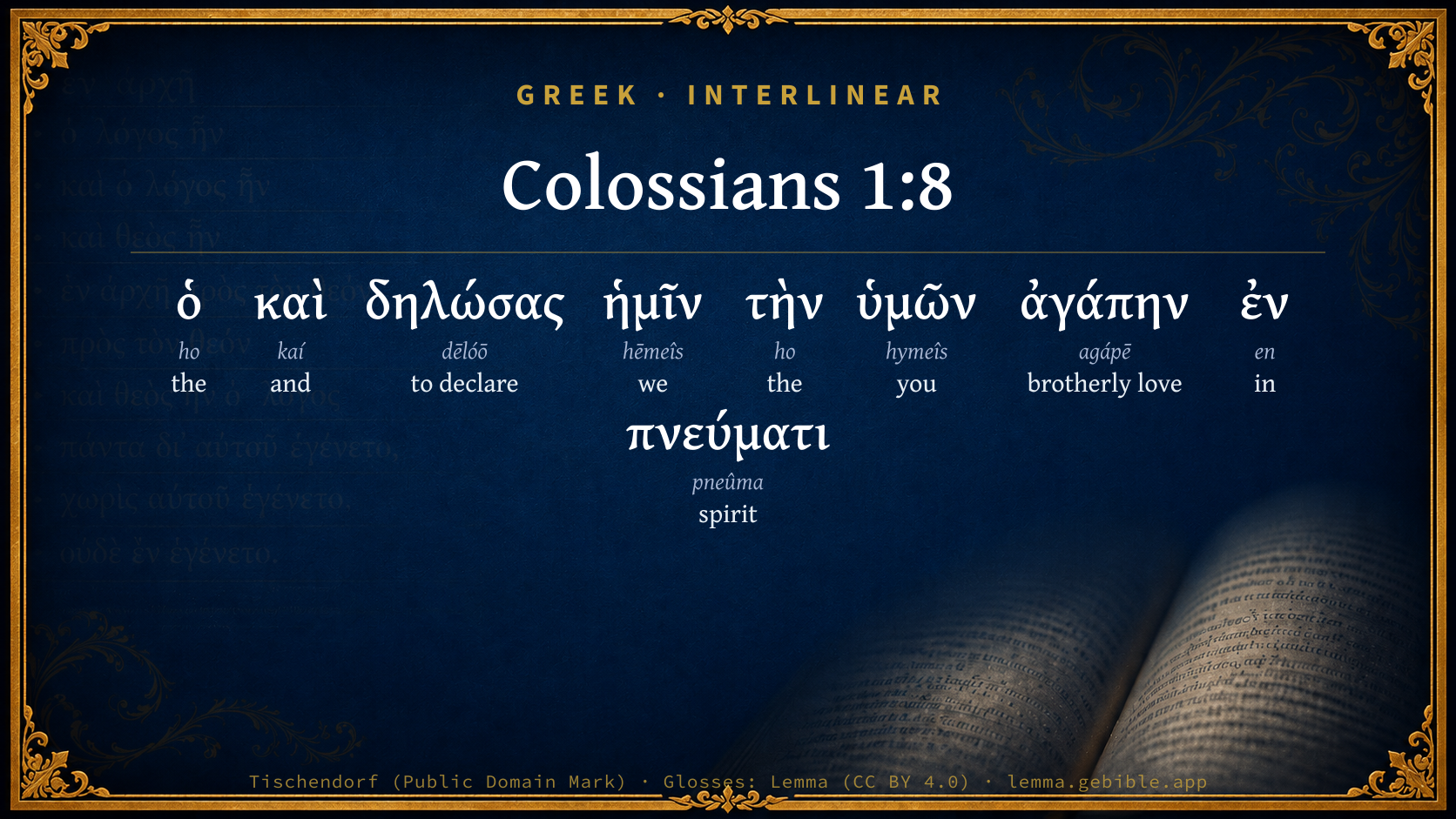
Download image
Cite this verse

Colossians 1:8 (World English Bible). Public Domain. Lemma interlinear Bible study tool, https://lemma.gebible.app/v/colossians/1/8.

Show BibTeX & RIS
BibTeX
RIS
English Translation
who also declared to us your love in the Spirit.
World English Bible · Public Domain
Download a study sheet

One document with this verse’s original text, its word-by-word gloss line, the meaning frame, cross-references with their text, attributed commentary, and full source and license credits — printable, and it pastes into notes with its structure intact.

This verse Autodidact and up

Study sheet (.html) Plain text (.txt)

A passage Seminary Student

Up to 50 verses in one chapter. A passage sheet keeps up to 6 commentary sources and 12 cross-references per verse, in the order this page ranks them, and says so on the sheet whenever that leaves anything out. Ask for a single verse and you get the Autodidact verse sheet above.

Everything on this page stays free to read, with no account — the sheet is a download of what is already on screen, not access to it.

Want to remove ads? Support Godless Engineer
Compare translations 3

The same verse in 3 English versions, stacked beneath the original-language interlinear above. Click any original word for its lexicon entry.

Each is an independent rendering of the whole verse — the interlinear is not word-aligned to these translations.

Highlighted words mark where these versions differ — a whole-verse word diff, not a word-by-word alignment.

  • World English Bible Public Domain
    who also declared to us your love in the Spirit.
  • King James Version Public Domain
    Who also declared unto us your love in the Spirit.
  • unfoldingWord Literal Text CC BY-SA 4.0
    and the one having made known to us your love in the Spirit.

unfoldingWord Literal Text — © unfoldingWord, licensed CC BY-SA 4.0. Word-aligned USFM3 via Door43 (git.door43.org/unfoldingWord/en_ult).

Versions to compare (up to 4)

3 of 4 selected

Show all 19 translations

Every available English version of this verse, each an independent rendering of the whole verse.

  • World English Bible Public Domain
    who also declared to us your love in the Spirit.
  • Berean Standard Bible Public Domain
    and who also informed us of your love in the Spirit.
  • Majority Standard Bible Public Domain
    and who also informed us of your love in the Spirit.
  • King James Version Public Domain
    Who also declared unto us your love in the Spirit.
  • American Standard Version (1901) Public Domain
    who also declared unto us your love in the Spirit.
  • Revised Version (1885) Public Domain
    who also declared unto us your love in the Spirit.
  • Geneva Bible (1599) Public Domain
    Who hath also declared vnto vs your loue in the Spirit.
  • Douay-Rheims (1899) Public Domain
    Who also hath manifested to us your love in the spirit.
  • Young's Literal Translation Public Domain
    who also did declare to us your love in the Spirit.
  • Literal Standard Version CC BY-SA 4.0
    who also declared to us your love in the Spirit.
  • Unlocked Literal Bible CC BY-SA 4.0
    Epaphras has made known to us your love in the Spirit.
  • unfoldingWord Literal Text CC BY-SA 4.0
    and the one having made known to us your love in the Spirit.
  • Darby Bible Public Domain
    who has also manifested to us your love in [the] Spirit.
  • World Messianic Bible Public Domain
    who also declared to us your love in the Spirit.
  • Webster's Bible Public Domain
    Who also declared to us your love in the Spirit.
  • Free Bible Version CC BY-SA 4.0
    He's also made clear to us your love in the Spirit.
  • Bible in Basic English Public Domain
    And who, himself, made clear to us your love in the Spirit.
  • Text-Critical English NT CC BY 4.0
    and who also told us about your love in the Spirit.
  • Tyndale New Testament (1534) Public Domain
    which also declared vnto vs youre love which ye have in the sprete.

Literal Standard Version (2020), Covenant Press — licensed CC BY-SA 4.0. Text via the HelloAO Bible API (eBible.org). Unlocked Literal Bible (unfoldingWord) — licensed CC BY-SA 4.0. Text via the HelloAO Bible API (eBible.org). unfoldingWord Literal Text — © unfoldingWord, licensed CC BY-SA 4.0. Word-aligned USFM3 via Door43 (git.door43.org/unfoldingWord/en_ult). Free Bible Version, Dr. Jonathan Gallagher — licensed CC BY-SA 4.0. Text via the HelloAO Bible API (eBible.org).

Word by word

More ways to search: Search by grammar → Find every occurrence → Compare this word →

Practice this passage: Drill this verse → Learn its vocabulary →

About this verse

These counts appear in no published source. They are computed here, from the morphology-tagged text and Lemma’s own curated glosses. What Lemma adds →

9
words
8
distinct lemmas
Pauline Epistles
section

Notable vocabulary

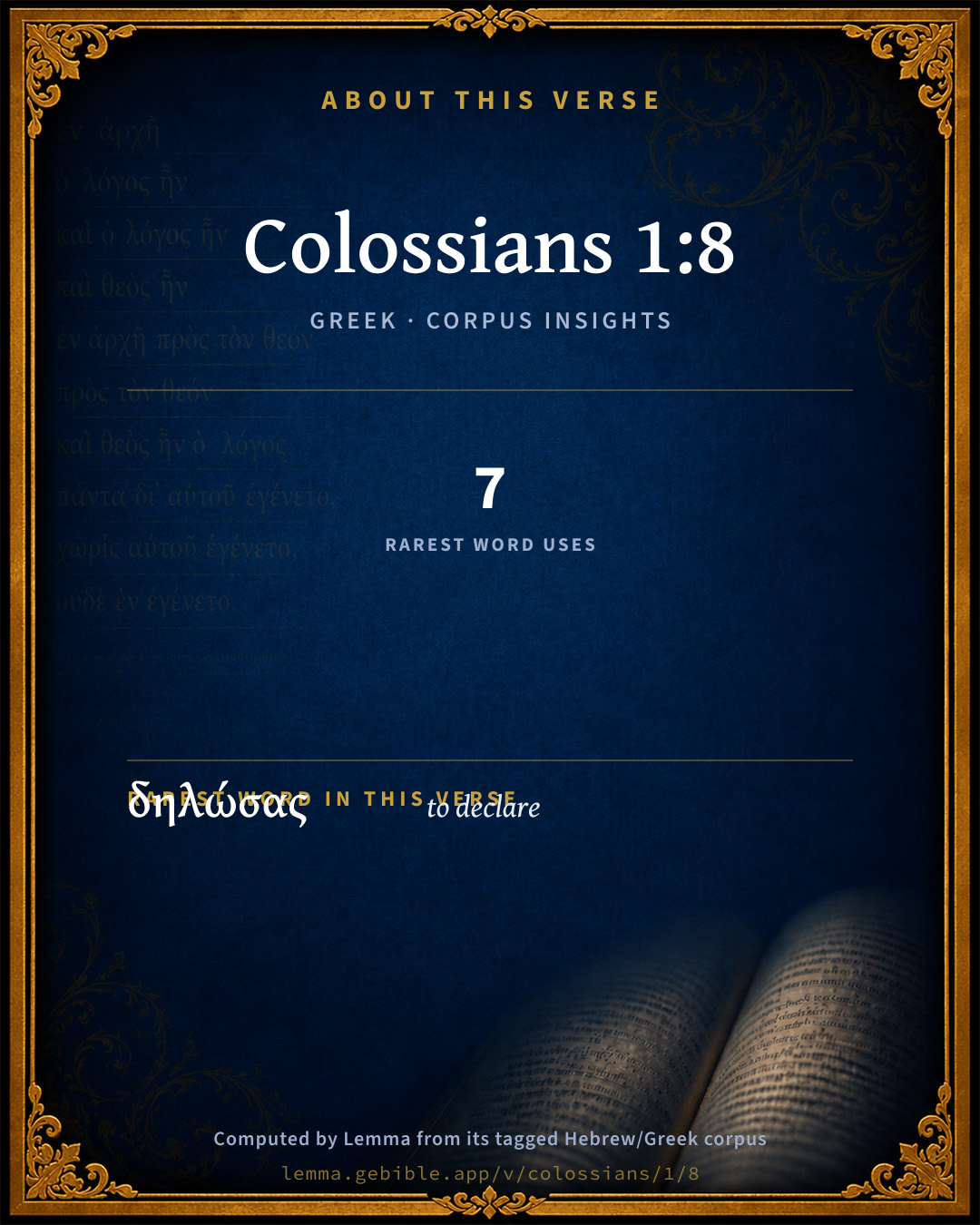
The rarest word here is δηλώσας to declare G1213 — appearing just 7 times in the whole Greek New Testament.

Shared distinctive vocabulary

δηλώσας to declare G1213 occurs in 7 verses of the Greek New Testament. Also found in:

Repetition

A word recurs within this verse:

Cross-references

6

Topical passages linked to Colossians 1:8 in the Treasury of Scripture Knowledge — connected by theme and wording, ordered by reader-vote popularity; previews shown in the World English Bible.

  • Romans 15:30 Now I beg you, brothers, by our Lord Jesus Christ, and by the love of the Spirit, that you strive together with me in your prayers to God for me,
  • 2 Timothy 1:7 For God didn't give us a spirit of fear, but of power, love, and self-control.
  • Romans 5:5 and hope doesn't disappoint us, because God's love has been poured out into our hearts through the Holy Spirit who was given to us.
  • Galatians 5:22 But the fruit of the Spirit is love, joy, peace, patience, kindness, goodness, faithfulness,
  • Colossians 1:4 having heard of your faith in Christ Jesus, and of the love which you have toward all the saints,
  • 1 Peter 1:22 Seeing you have purified your souls in your obedience to the truth through the Spirit in sincere brotherly affection, love one another from the heart fervently:

Cross-references courtesy of OpenBible.info (CC BY 4.0).

Commentary

Notes on Colossians 1:8 from classic Christian and Jewish commentators (each source and its license shown beneath its notes). The classic Christian expositions comment on the surrounding passage and are grouped to its opening verse, so a note may address several verses; the Jewish commentaries on the Tanakh (Rashi and others) are per-verse, so they appear only where the commentator wrote on this verse.

Lemma curates 59 commentaries, every one of them public domain or Creative Commons licensed, each selected and text-cleaned for this edition rather than reprinted as found. About our sources →

The Biblical Illustrator

Joseph S. Exell

Col_1:8

Who also declared unto us your love in the Spirit.

The apostle rejoiced over the fact that the Colossians lived. This affirmation is to be proved.

I. There are various kinds of life--of the plant, animal, man. Man has several lives, that of the animal, since he has a body; that of the intellect, since he thinks; that of the heart, since he loves. It will not be contested that thought is the life of the intellect, for the one separated from the other is nothing: and so with the life of the heart--love. Some will say that it hates also. So it does, for we cannot love a thing without hating its opposite. But the life of the heart is not to hate and to love, because hatred is not the true object of the heart. It is impossible to produce fire without making ashes, but to make ashes is not the end of our labours. Hatred forms the ashes of the fire which love kindles, but it is not on those ashes that the heart lives. The hatred which springs not from love is not the life but the death of the heart; as error is not the life of reason. But the heart has another death which is egotism; which, however, involves hatred, for a man cannot love himself exclusively without hating others.

II. The life of the heart is supreme.

1. The life of the plant is inferior to that of the animal, that of the animal inferior to that of man, that of the body beneath that of the intellect, that of the intellect beneath moral life. Matter and form are far inferior to knowledge, and knowledge cannot be put on a level with love.

2. Then that which constitutes, the value of each of these lives is its relation to a superior life. Matter is of value as it does service to the intellect, and the intellect is degraded when it does not terminate in love. If therefore a man wants the principal life for which he has received all others, and does not love, he is dead.

3. The gospel uniformly gives supremacy to this life of the heart or love.

III. The love of which the apostle speaks is love in the spirit. What is this spirit? spirit in opposition to matter? and is the expression equivalent to spiritual love? Rather Paul means love in the Spirit of God, love which He teaches and inspires. But this does not exclude the former. For our spirit is the better part of us which the Spirit of God has come to set at liberty, that part of our being which holds communion with God. This love, then, is--

1. According to the Holy Spirit.

2. A spiritual love towards the true, just, divine, immortal.

3. And so not

(1) carnal affection, which is death (Rom_8:6);

(2) interested affection;

(3) mere natural affection; although these are consecrated and renovated by the Spirit, after which the creature is loved in and for God.

IV. The object of this love. God supremely and then others, forming one grand unity (Joh_17:23).

V. The greatest example of this love is Christ. In Him we know what love is, but it was manifested in Him that it might be diffused. His disciples are to reflect His love.

VI. This love being life, and animated by the spirit of life, is immortal. VII. Hell is the absence of this love. It is that empty heart which has been violently dissevered from its affections without being united to God, a heart which has need of love, and which finds no object to supply this want. (A. Vinet, D. D.)

Two reasons for love in the Spirit

The first, a general one, which regards the very nature of love: to wit, because the Holy Spirit is the author of it; and also because love flows from spiritual heart, i.e., from a heart regenerated and renewed. Hence observe the dignity of Christian love. For natural love, or predilection, arises from those inclinations which they call natural affections. Worldly love arises either from views of interest or from conformity of manners; carnal, from the appetite for pleasure. To all these something corrupt, sordid, and vicious always adheres. But Christian love arises from the Holy Spirit, and is altogether full of holiness and purity. The other reason why the love of the Colossians is said to be in the spirit is special, and hath respect to Paul himself; for, they had never seen Paul, but had only heard of him through Epaphras and others. Because, therefore, they had loved him whom they never saw in the flesh, they are said to love in the spirit. Therefore the word spirit is taken in the same sense as in 1Co_5:3. Hence observe, that the duty of every good man is, to embrace with spiritual love all good men, although known only by report. That any one may be esteemed worthy of our love, it is sufficient if he be known in respect to his virtue, although he be unknown in person. (Bishop Davenant.)

The Biblical Illustrator, edited by Joseph S. Exell (c. 1880s–1900s) — public domain. Text from a community e-Sword module.

Expositor's Greek Testament

ed. W. Robertson Nicoll

Col 1:8 . τὴν ὑμῶν ἀγάπην may be taken in the general sense of Col 1:4 , though many think it is their love to Paul that is meant; and this is favoured by δηλ . ἡμ ., and perhaps by καὶ ἡμεῖς in Col 1:9 . ἐν πνεύματι is added to show that this love is in the Holy Spirit.

The Expositor's Greek Testament, edited by W. Robertson Nicoll (1897–1910) — public domain. Text from a community e-Sword module.

Geneva Bible (1599)

Geneva Bible translators

Your spiritual love, or your love which cometh from the Spirit.

He declareth his good will towards them, telling them that they must not still remain at one stay but go on further both in the knowledge of the Gospel, and also in the true use of it.

Geneva Bible (1599) marginal notes — public domain. Text via Bolls.life.

Jamieson, Fausset & Brown

Robert Jamieson, A. R. Fausset & David Brown

your love-- (Col 1:4); "to all the saints."

in the Spirit--the sphere or element IN which alone true love is found; as distinguished from the state of those "in the flesh" (Rom 8:9). Yet even they needed to be stirred up to greater love (Col 3:12-14). Love is the first and chief fruit of the Spirit (Gal 5:22).

Jamieson, Fausset & Brown — Commentary Critical and Explanatory on the Whole Bible (1871) — public domain (CC PDM 1.0). Text via the HelloAO Bible API.

Adam Clarke's Commentary

Verse 8. Your love in the Spirit.] So we preached, and so ye believed. The heavenly flame in the heart of this minister communicated itself to those who heard him; it was like priest like people. They enjoyed a spiritual, energetic ministry, and they were a spiritual people; they had a loving spirit, and love through the Spirit of God which dwelt in them. And of this love of theirs in the Spirit, and particularly towards the apostle, Epaphras gave full proof, not only by describing to the apostle the affection they felt for him, but in presenting to him those supplies which their love to him caused them to furnish.

Adam Clarke's Commentary on the Bible (1810–1826) — public domain. Text from a community e-Sword/MySword module.

John Calvin's Commentaries

Love in the Spirit I take to mean, spiritual love, according to the view of Chrysostom, with whom, however, I do not agree in the interpretation of the preceding words. Now, spiritual love is of such a nature as has no view to the world, but is consecrated to the service of piety, and has, as it were, an internal root, while carnal friendships depend on external causes.

John Calvin's Commentaries (1540-1563) — public domain. Text from the Calvin Translation Society English edition (1840s-50s) via the Christian Classics Ethereal Library (ccel.org). Calvin's coverage is partial (roughly two-thirds of the Bible); uncommented books and verses are honest gaps, never fabricated. The 19th-century editor's footnotes and remarks are omitted so the notes are faithfully Calvin's own voice.

Ellicott's Commentary for English Readers

(8) Who also declared unto us.—This refers to news recently brought by Epaphras to St. Paul at Rome. He had been a minister in St. Paul’s stead; he now, like Timothy afterwards, visited him to give account of his deputed work.

Your love in the Spirit.—“In the Spirit” is “in the grace of the Holy Ghost”—the Spirit of love. The love here would seem to be especially love towards St. Paul, a part of the “love towards all the saints” ascribed to them above (Col_1:4).

A Bible Commentary for English Readers, edited by Charles John Ellicott (1878–1897) — public domain. Text from a community e-Sword module.

The Cambridge Bible for Schools and Colleges

gen. ed. J. J. S. Perowne

8. also] “As he preached to you from us, so also he brought back from us to you the tidings, etc.” (Lightfoot.)

your love] See on Col_1:4 above.

in the Spirit] “In” Whom they were (Rom_8:9).—Cp. Rom_15:30, where probably “the love” spoken of is that quickened in the hearts of the saints by the Holy Ghost. (See our note there. Cp. also 2Ti_1:7).—“Love” is the first and ruling ingredient in the “fruit of the Spirit” (Gal_5:22), by Whom “the love of God hath been poured out in our hearts” (Rom_5:5), sure prelude and secret of a regenerate love to others.

The Cambridge Bible for Schools and Colleges (gen. ed. J. J. S. Perowne; Cambridge University Press, 1878–1918) — public domain. Text from a community e-Sword module.

John Gill's Exposition

Who also declared unto us your love in the Spirit. Not only their love to God, and Christ, and to all the saints, which is before mentioned, but their love to the apostle; though they had only heard of him, and of his great capacity for, and faithfulness and usefulness in preaching of the Gospel, which had greatly endeared him to them. This, he says, was in the Spirit; it was spiritual love, to distinguish it from a carnal and worldly one; they loved him for the spiritual grace that was in him, the spiritual gifts bestowed on him, the spiritual service he was engaged in, and the spiritual usefulness he was of: or they loved him in, and with their spirits, with all their hearts, sincerely, and without dissimulation; and though they had never seen him in the flesh, yet being, as it were, present with him in spirit, their affections were knit unto him: or this their love was "in the Holy Spirit", as the Ethiopic version reads it; it was a fruit of the Spirit of God, which he had implanted in their hearts in regeneration, as is also love to God, and likewise to Christ.

Who also declared unto us your love in the Spirit. Not only their love to God, and Christ, and to all the saints, which is before mentioned, but their love to the apostle; though they had only heard of him, and of his great capacity for, and faithfulness and usefulness in preaching of the Gospel, which had greatly endeared him to them. This, he says, was in the Spirit; it was spiritual love, to distinguish it from a carnal and worldly one; they loved him for the spiritual grace that was in him, the spiritual gifts bestowed on him, the spiritual service he was engaged in, and the spiritual usefulness he was of: or they loved him in, and with their spirits, with all their hearts, sincerely, and without dissimulation; and though they had never seen him in the flesh, yet being, as it were, present with him in spirit, their affections were knit unto him: or this their love was "in the Holy Spirit", as the Ethiopic version reads it; it was a fruit of the Spirit of God, which he had implanted in their hearts in regeneration, as is also love to God, and likewise to Christ.

Colossians 1:9

col 1:9

col 1:9

col 1:9For this cause we also,.... Not merely for their love to the apostle, and the rest that were with him; which sense is too much contracted, and carries some appearance of meanness and selfishness; but because of their faith in Christ, their love to all the saints, and the good hope they had of eternal happiness; and because they had heard the Gospel, and truly knew it, and sincerely professed it: therefore,

since the day we heard it, do not cease to pray for you, and to desire; which shows that the apostles prayed without ceasing; not that they were every moment praying, without intermission, but that they were frequent and constant every day at the throne of grace; and as often as they were there, they were mindful of these Colossians, even ever since they heard of their reception of the Gospel, of their profession of it, and of the fruit it brought forth in them; and in their petitions "prayed" and "desired", earnestly and importunately entreated God on their behalf:

that ye might he filled with the knowledge of his will; the will "of God", as the Syriac version reads it, by which is meant, not the secret will of God, according to the counsel of which he does all things in nature, providence, and grace, but his revealed will; and that either as it is signified in the law, which declares the good, and perfect, and acceptable will of God, relating to what he would have done, or avoided by his creatures; or rather, as it is exhibited in the Gospel, which contains the will of God respecting the salvation of his chosen ones; as that it is his will that Christ should obtain eternal redemption for them, to do which he voluntarily substituted himself in their room, came into this world, and has accomplished it; and that all those that are redeemed by Christ should be regenerated by the Spirit; and that whoever sees the Son, and believes in him, should not perish, but have everlasting life; as also, that all those whom he has chosen in Christ, and given to him, and he has redeemed by his blood, and who are sanctified by his Spirit, none of them should be lost, but that they should be all saved with an everlasting salvation. Now the apostle does, not pray that they might have a "knowledge" of this will of God, for some knowledge of it they had already; they had heard of the hope laid up in heaven, in the truth of the word of the Gospel; they had not only had the external, revelation, and had heard the Gospel outwardly preached, but they had known truly the grace of God; and therefore what he asks for is, that they might be "filled" with the knowledge of it; which supposes that they had knowledge, but it was not full and complete; it was imperfect, as is the knowledge of the best of saints in this life; and that they might have a larger measure of it, and such a fulness of it as they were capable of in the present state, and not such an one as the saints will have in heaven, when they shall know even as they are known. He adds,

in all wisdom and spiritual understanding; his meaning is, that they might be led into all the wisdom of God, which is so largely displayed in the revelation of his will concerning the salvation of his people, which is made in the Gospel; which is the manifold wisdom of God, wherein he has abounded in all wisdom and prudence; and contains such a scheme of things, so wisely contrived and formed, that angels desire to look into it; and that they might have a "spiritual understanding" of the mysteries of grace, without which they cannot be discerned to spiritual advantage, nor indeed without the spirit of wisdom and revelation in the knowledge of them: and the Ethiopic version renders it, by "the prudence of the Holy Ghost": who searches the deep things of God, and reveals them to the saints, and improves and increases their spiritual and experimental knowledge of them, which is what is here intended.

John Gill's Exposition of the Whole Bible (1746–1763) — public domain (CC PDM 1.0). Text via the HelloAO Bible API.

Trapp's Complete Commentary

John Trapp

8 Who also declared unto us your love in the Spirit.

Ver. 8. Who also declared unto us] His heart was over joyed with his people’s forwardness, and he could not but impart it to the apostle. It was a pride in Montanus to overly ween his Pepuza and Tymium, two pelting parishes not far from Colosse, and to call them Jerusalem, as if they had been the only churches in the world. But this was a commendable practice of Epaphras to relate to St Paul the good he found in his people, that he by an Epistle might further encourage and quicken them.

John Trapp, A Commentary or Exposition upon All the Books of the Old and New Testament (1647–1656) — public domain. Text from a community e-Sword module.

Albert Barnes' Notes on the Bible

Who also declared unto us your love in the Spirit - The love wrought in you by the Holy Spirit. It was not mere natural affection, but love worked in their hearts by the agency of the Holy Spirit.

Albert Barnes' Notes on the Bible (1834–1885) — public domain. Text from a community e-Sword/MySword module.

Haydock's Catholic Bible Commentary

Your love. Your charity for all men, founded on the love of God. Others understand it of the affection which they had for St. Paul. (St. John Chrysostom)

George Leo Haydock (1774–1849), Haydock's Catholic Family Bible and Commentary, 1859 edition — public domain. Excludes Psalms (Douay-Rheims chapter numbering differs from Protestant) and Deuterocanonical books (Catholic canon only).

Matthew Poole's English Annotations

Having with kindness and delight reported to Paul and Timothy, &c., what a spiritually fervent affection, not moved by carnal considerations, but inwrought by the Spirit, Gal 5:6,22, arising from a renewed heart, 1Ti 1:5; 2Ti 1:7, they had for Christ, for the gospel, the apostle, and all that did love the Lord Jesus in sincerity, Gal 6:10; 1Pe 1:22,23.

Matthew Poole's English Annotations on the Holy Bible (1683–1685) — public domain. Text from a community e-Sword/MySword module.

Whedon's Commentary on the Bible

Daniel D. Whedon

8. Love in the Spirit—Brotherly love, the impartation of the Holy Spirit. Epaphras had been careful to emphasize this side of their character.

Daniel D. Whedon (gen. ed.), Commentary on the Old and New Testaments (1874–1909) — public domain. Text from a community e-Sword module.

The Pulpit Commentary

Who also showed us your love in (the) Spirit (2Co_7:7 2Co_8:7; 1Th_3:6; Php_4:10) i.e. your love to us. Timothy and myself, especially if we read "in our behalf" in ver. 7: so, many interprefers, from Chrysostom to Klopper. Epaphras had conveyed the blessings of the gospel from St. Paul to the Colossians, and they now send back the grateful assurance of their love by the same channel (comp, note on "having heard," ver. 4, and parallel passages). This was a choice fruit of the gospel in them, (comp. Php_4:10, 15-18) and such a reference to it gives a kindly conclusion to the thanksgiving. Ellicott and others understand here brotherly love in general a somewhat pointless repetition of ver. 4. Meyer, reading "on your behalf" in ver. 7. more suitably suggests the Colossians" love to Epaphras in return for his services to them. The Spirit is the ruling element of the Colossians" love (Gal_5:22) Love-in-the-Sprat forms a single compound phrase, like "faith-in-Christ-Jesus" (ver. 4). The one Spirit dwells alike in all the members of Christ"s body, however sundered by place or circumstance, (Eph_4:1-4) and makes them one in love to each other as to him (Joh_13:34, Joh_13:35; 1Jn_3:23, 1Jn_3:24) "Spirit" occurs besides in this Epistle only in Col_2:5 (but see "spiritual," ver. 9), and some find in Col_2:1, 5 the explanation of this phrase (sc. "a love formed in absence, without personal intercourse:" but this is forced, and doubtful in point of grammar)

The Pulpit Commentary (1880–1919), ed. H.D.M. Spence-Jones & Joseph S. Exell — public domain. Text from a community e-Sword module.

John Wesley's Explanatory Notes

Your love in the Spirit - Your love wrought in you by the Spirit.

John Wesley, Explanatory Notes Upon the Whole Bible (1754–1765) — public domain. Text via the GEBible commentary corpus.

The People's New Testament

B. W. Johnson

8. Who also declared to us. He was at the date of the letter attending the apostle at Rome.

B. W. Johnson's The People's New Testament with Notes (1889–1891) — public domain. Electronic text from the Christian Classics Ethereal Library (CCEL) ThML edition.

Cambridge Greek Testament for Schools and Colleges

8. ὁ καὶ δηλώσας. The καὶ not only states a fresh fact about Epaphras but also implies that it was he and no other (qui idem); cf. Mat 10:4, 2Co 1:22.

ἡμῖν. See note on the first ἡμῶν in Col 1:7.

τὴν ὑμῶν ἀγάπην. The order is much less common than τὴν ἀγάπην ὑμῶν and gives ὑμῶν a slight emphasis (cf. Rom 16:19, 2Co 7:7 ter).

Probably their love is to the saints generally, St Paul mentioning it now as the visible result of their acceptance of Epaphras’ teaching, and also taking up once more the thought of Col 1:4, and making it a starting-point from which he begins a fresh exhortation.

ἐν πνεύματι. Not τὴν ἐν πνεύματι. Probably the words ἀγάπην ἐν πνεύματι are regarded as forming one idea; cf. 1Co 10:18 τὸν Ἰσραὴλ κατὰ σάρκα, see Winer, § xx. 2 and J. A. R. on Eph 1:15. But contrast Phm 1:6.

Probably spirit as such, the higher spiritual sphere in which their thoughts and feelings now worked, the sphere in which God revealed His truth to them (Eph 3:5), in which they prayed (Eph 6:18), and in which they were being made a spiritual House (Eph 2:22). Their love was οὐ σαρκική, ἀλλὰ πνευματική Oecumen. (in loco, Migne, CXIX. 16). In any case it is a true statement of theology that such love exercised in the spiritual sphere is ultimately due to the blessed Spirit Himself (Rom 15:30; cf. Westcott on Eph 3:5).

Cambridge Greek Testament for Schools and Colleges (Cambridge University Press, 1896; 21 vols, various authors incl. Carr, Maclear, Plummer, Farrar, Lumby, Moule, M. R. James, Simcox) — public domain. Text from a community e-Sword module.

International Critical Commentary

8. ὁ καὶ δηλώσας ἡμῖν τὴν ὑμῶ ἀγάπην ἐν πνεύματι, viz. their love to St. Paul in particular. This appears clear from ἡμῖν τὴν ὑμῶν, as well as from the subsequent διὰ τοῦτο Καὶ ἡμεῖς. The words may be regarded as a courteous justification of the didactic tone which the apostle adopts, and perhaps also as an indication that Epaphras had not made any complaint of the Colossians. Meyer (reading ὑμῶν) understands love to Epaphras; Ellicott, brotherly love.

ἐν πνεύματι expresses the ground of their love, which was not individual sympathy, personal acquaintance, or the like, but belonged to the sphere of the Holy Spirit’s influence. It was οὐ σαρκική, ἀλλὰ πνευματική, Oecum. Compare ὅσοι οὐχ ἑωράκασι τὸ πρόσωπόν μου ἐν σαρκί (2:7).

International Critical Commentary — older volumes (1896–1929), various authors — public domain. Text from a community e-Sword module.

Vincent's Word Studies in the New Testament

Marvin R. Vincent

Declared [δηλωσας] . Or made manifest. See on 1Co 1:11. In the Spirit. Connect with your love. Compare Gal 5:22.

Marvin R. Vincent, Word Studies in the New Testament (1887–1900) — public domain. Text from a community e-Sword/MySword module.

Lightfoot's Colossians and Philemon

J. B. Lightfoot

8. ὁ καὶ δηλώσας] ‘As he preached to you from us, so also he brought back to us from you the tidings, etc.’

ἐν πνεύματι] to be connected with τὴν ὑμῶν ἀγάπην. ‘The fruit of the Spirit is love,’ Gal. v. 22. For the omission of the article, τὴν ἐν πνεύματι, see the note on ver. 4.

J. B. Lightfoot, St Paul's Epistles to the Colossians and Philemon: a revised text with introductions, notes and dissertations (London: Macmillan, 1875) — public domain. Electronic text from Project Gutenberg (ebook #50857). Covers Colossians and Philemon only (the verse-by-verse notes; introductions and dissertations are omitted); Lightfoot's companion Galatians and Philippians volumes are not included, as the available public-domain scans carry garbled Greek that cannot be faithfully reproduced.

Lesson kit

Teaching starters — assembled from the data on this page, not authored interpretation. Every prompt links to the verse data it draws on. Edit before teaching.

Colossians, in the Pauline Epistles, opens this verse with 9 words (8 distinct Greek lemmas). Its most distinctive word is dēlóō (“to declare”). A historical commentator’s framing appears above. Read the whole chapter for the surrounding context.

Discussion questions

  1. What does “to declare” (dēlóō) contribute to the verse as a whole?
  2. How does 1 Corinthians 1:11, which shares the word «to declare», read alongside this verse?
  3. What does the repetition of “the” (2× in this one verse) do in this verse?
  4. The translations on this page render this verse differently — a whole-verse word diff, not a word-by-word alignment. What might account for the different wordings?
  5. Compare how The Biblical Illustrator and Expositor's Greek Testament read this verse. Where do they agree or differ?

Things to notice

  • These translations choose different wording for 7 words in this verse.
  • “the” occurs 2× in this single verse.
  • 8 distinct Greek lemmas span 9 words in this verse.

Reading settings

Reading text

Shown beneath each verse's original-language words.

Old Testament
Old Testament edition

Read the OT as the Masoretic Hebrew (MT) or the Greek Septuagint (LXX).

English shown for the Greek Septuagint (in the Hebrew ↔ Greek comparison).

Comparing translations? Open the Compare panel on any verse page to stack up to four side by side.