Colossians 3:14

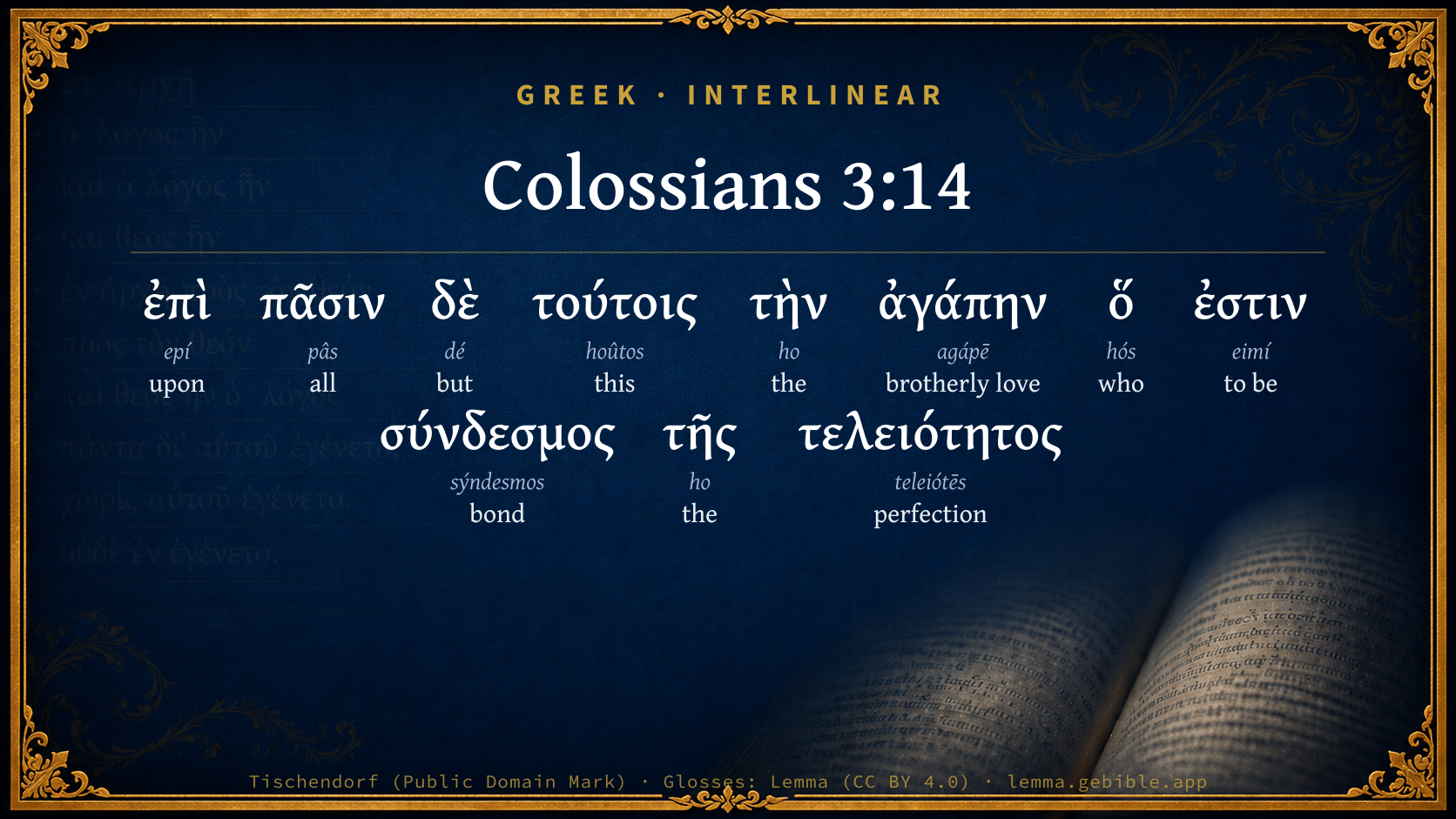
Greek (Tischendorf 8th ed.) Colossians 3:14 appears in the Greek New Testament. The text above is from the Tischendorf 8th edition. Each word links to its Strong’s number and a concise gloss. Click any word for its full Thayer’s Greek Lexicon entry.
Download image
Cite this verse

Colossians 3:14 (World English Bible). Public Domain. Lemma interlinear Bible study tool, https://lemma.gebible.app/v/colossians/3/14.

Show BibTeX & RIS
BibTeX
RIS
English Translation
Above all these things, walk in love, which is the bond of perfection.
World English Bible · Public Domain
Highlights
  • 1 first appearance in the Greek New Testament
Full analysis ↓
Download a study sheet

One document with this verse’s original text, its word-by-word gloss line, the meaning frame, cross-references with their text, attributed commentary, and full source and license credits — printable, and it pastes into notes with its structure intact.

This verse Autodidact and up

Study sheet (.html) Plain text (.txt)

A passage Seminary Student

Up to 50 verses in one chapter. A passage sheet keeps up to 6 commentary sources and 12 cross-references per verse, in the order this page ranks them, and says so on the sheet whenever that leaves anything out. Ask for a single verse and you get the Autodidact verse sheet above.

Everything on this page stays free to read, with no account — the sheet is a download of what is already on screen, not access to it.

Want to remove ads? Support Godless Engineer
Compare translations 3

The same verse in 3 English versions, stacked beneath the original-language interlinear above. Click any original word for its lexicon entry.

Each is an independent rendering of the whole verse — the interlinear is not word-aligned to these translations.

Highlighted words mark where these versions differ — a whole-verse word diff, not a word-by-word alignment.

  • World English Bible Public Domain
    Above all these things, walk in love, which is the bond of perfection.
  • King James Version Public Domain
    And above all these things put on charity, which is the bond of perfectness.
  • unfoldingWord Literal Text CC BY-SA 4.0
    But above all these things, love, which is the bond of perfection.

unfoldingWord Literal Text — © unfoldingWord, licensed CC BY-SA 4.0. Word-aligned USFM3 via Door43 (git.door43.org/unfoldingWord/en_ult).

Versions to compare (up to 4)

3 of 4 selected

Show all 19 translations

Every available English version of this verse, each an independent rendering of the whole verse.

  • World English Bible Public Domain
    Above all these things, walk in love, which is the bond of perfection.
  • Berean Standard Bible Public Domain
    And over all these virtues put on love, which is the bond of perfect unity.
  • Majority Standard Bible Public Domain
    And over all these virtues put on love, which is the bond of perfect unity.
  • King James Version Public Domain
    And above all these things put on charity, which is the bond of perfectness.
  • American Standard Version (1901) Public Domain
    and above all these things `put on' love, which is the bond of perfectness.
  • Revised Version (1885) Public Domain
    and above all these things put on love, which is the bond of perfectness.
  • Geneva Bible (1599) Public Domain
    And aboue all these thinges put on loue, which is the bond of perfectnes.
  • Douay-Rheims (1899) Public Domain
    But above all these things have charity, which is the bond of perfection:
  • Young's Literal Translation Public Domain
    and above all these things, `have' love, which is a bond of the perfection,
  • Literal Standard Version CC BY-SA 4.0
    and above all these things, [have] love, which is a bond of the perfection,
  • Unlocked Literal Bible CC BY-SA 4.0
    Above all these things, have love, which is the bond of perfection.
  • unfoldingWord Literal Text CC BY-SA 4.0
    But above all these things, love, which is the bond of perfection.
  • Darby Bible Public Domain
    And to all these [add] love, which is the bond of perfectness.
  • World Messianic Bible Public Domain
    Above all these things, walk in love, which is the bond of perfection.
  • Webster's Bible Public Domain
    And above all these things put on charity, which is the bond of perfectness.
  • Free Bible Version CC BY-SA 4.0
    Above all, love one another, which is the perfect bond that will hold you together.
  • Bible in Basic English Public Domain
    And more than all, have love; the only way in which you may be completely joined together.
  • Text-Critical English NT CC BY 4.0
    Above all, put on love, which is the bond of perfection.
  • Tyndale New Testament (1534) Public Domain
    Above all these thinges put on love which is the bonde of parfectnes.

Literal Standard Version (2020), Covenant Press — licensed CC BY-SA 4.0. Text via the HelloAO Bible API (eBible.org). Unlocked Literal Bible (unfoldingWord) — licensed CC BY-SA 4.0. Text via the HelloAO Bible API (eBible.org). unfoldingWord Literal Text — © unfoldingWord, licensed CC BY-SA 4.0. Word-aligned USFM3 via Door43 (git.door43.org/unfoldingWord/en_ult). Free Bible Version, Dr. Jonathan Gallagher — licensed CC BY-SA 4.0. Text via the HelloAO Bible API (eBible.org).

Word by word

More ways to search: Search by grammar → Find every occurrence → Compare this word →

Practice this passage: Drill this verse → Learn its vocabulary →

About this verse

These counts appear in no published source. They are computed here, from the morphology-tagged text and Lemma’s own curated glosses. What Lemma adds →

11
words
10
distinct lemmas
Pauline Epistles
section

Notable vocabulary

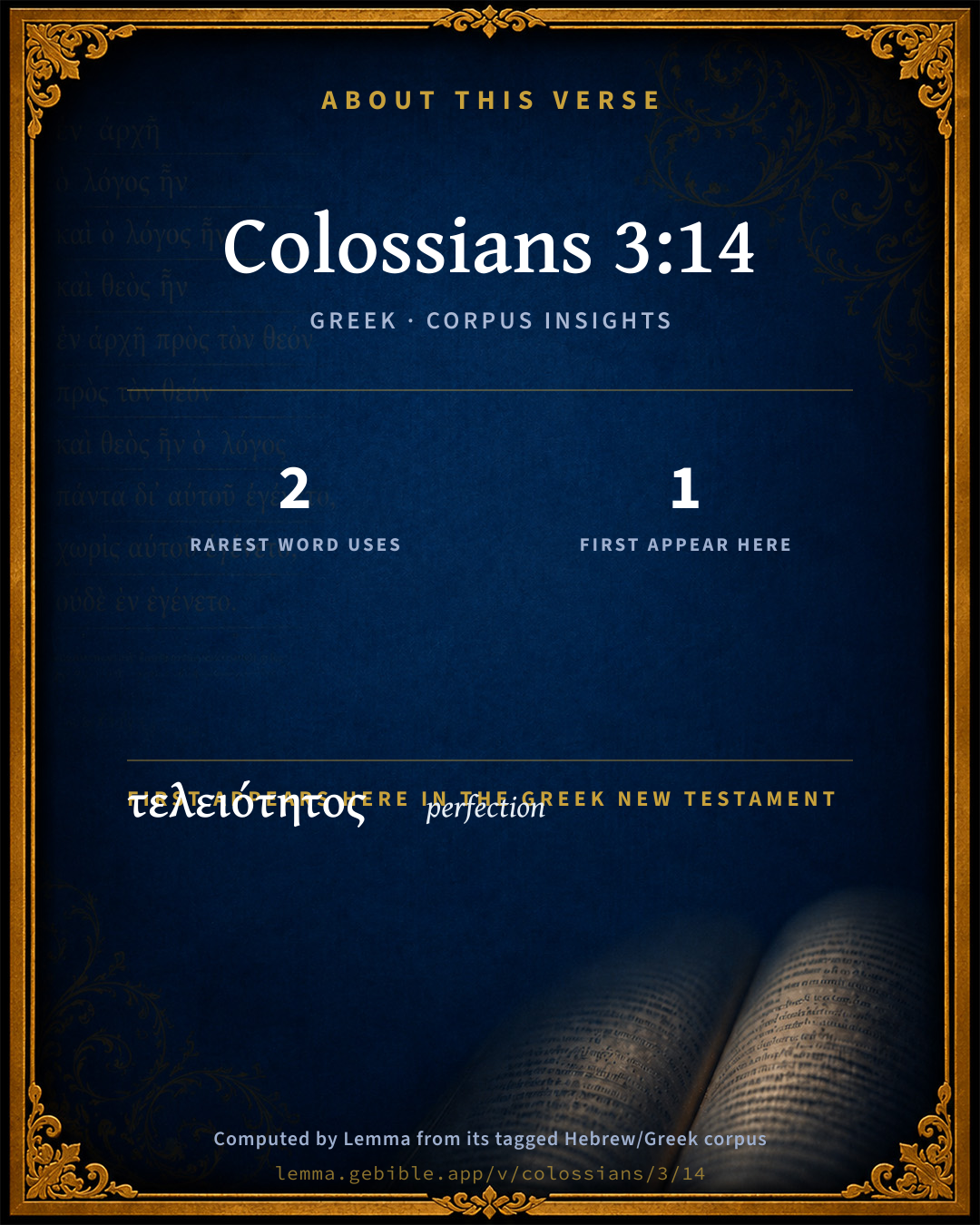
The rarest word here is τελειότητος perfection G5047 — appearing just 2 times in the whole Greek New Testament.

First appearance in Scripture

This word makes its first canonical appearance in the Greek New Testament here:

  • τελειότητος perfection G5047

Shared distinctive vocabulary

τελειότητος perfection G5047 occurs in 2 verses of the Greek New Testament. Also found in:

Repetition

A word recurs within this verse:

Cross-references

17

Topical passages linked to Colossians 3:14 in the Treasury of Scripture Knowledge — connected by theme and wording, ordered by reader-vote popularity; previews shown in the World English Bible.

  • 1 Peter 4:8 And above all things be earnest in your love among yourselves, for love covers a multitude of sins.
  • Ephesians 5:2 Walk in love, even as Christ also loved you, and gave himself up for us, an offering and a sacrifice to God for a sweet-smelling fragrance.
  • 1 Corinthians 13:1–13 If I speak with the languages of men and of angels, but don't have love, I have become sounding brass, or a clanging cymbal.
  • Colossians 2:2 that their hearts may be comforted, they being knit together in love, and gaining all riches of the full assurance of understanding, that they may know the mystery of God, both of the Father and of Christ,
  • John 13:34 A new commandment I give to you, that you love one another, just like I have loved you; that you also love one another.
  • Romans 13:8 Owe no one anything, except to love one another; for he who loves his neighbor has fulfilled the law.
  • Ephesians 4:3 being eager to keep the unity of the Spirit in the bond of peace.
  • 1 John 4:21 This commandment we have from him, that he who loves God should also love his brother.
  • 1 Timothy 1:5 but the end of the charge is love, out of a pure heart and a good conscience and unfeigned faith;
  • John 15:12 "This is my commandment, that you love one another, even as I have loved you.
  • 1 Thessalonians 4:9 But concerning brotherly love, you have no need that one write to you. For you yourselves are taught by God to love one another,
  • 2 Peter 1:7 and in godliness brotherly affection; and in brotherly affection, love.
  • John 17:23 I in them, and you in me, that they may be perfected into one; that the world may know that you sent me, and loved them, even as you loved me.
  • 1 John 4:7–12 Beloved, let us love one another, for love is of God; and everyone who loves is born of God, and knows God.
  • Ephesians 1:4 even as he chose us in him before the foundation of the world, that we would be holy and without blemish before him in love;
  • Hebrews 6:1 Therefore leaving the doctrine of the first principles of Christ, let us press on to perfection--not laying again a foundation of repentance from dead works, of faith toward God,
  • 1 John 3:23 This is his commandment, that we should believe in the name of his Son, Jesus Christ, and love one another, even as he commanded.

Cross-references courtesy of OpenBible.info (CC BY 4.0).

Commentary

Notes on Colossians 3:14 from classic Christian and Jewish commentators (each source and its license shown beneath its notes). The classic Christian expositions comment on the surrounding passage and are grouped to its opening verse, so a note may address several verses; the Jewish commentaries on the Tanakh (Rashi and others) are per-verse, so they appear only where the commentator wrote on this verse.

Lemma curates 59 commentaries, every one of them public domain or Creative Commons licensed, each selected and text-cleaned for this edition rather than reprinted as found. About our sources →

The Biblical Illustrator

Joseph S. Exell

Col_3:14

And above all these things put on charity.

The grace of charity

I. Charity is the greatest of graces in the width and extent of its sphere. Other graces have particular things with which they are more intimately concerned; special parts of life on which they throw the light of their charm; special times in which they actively operate. They are like the winds that blow, the rain that falls, the snow that covers, or the lightning that purifies sometimes. But charity is like the Divine sunlight that shines on always, works always, tempers the winds, warms the rains, dissipates the mists, melts the snow; sometimes seen and felt, sometimes unseen, but never ceasing its influence, and recognizing no earth limits to its sphere. Charity covers the whole life and relationships of the Christian, and 1Co_13:1-13. maps out and distinguishes them.

1. The sphere of a brothers opinions.

2. The sphere of a brothers failings.

3. The sphere of a brothers sorrows.

4. The sphere of a brothers sins.

II. Because of the difficulty with which it is attained. Difficulty is often the test of value. Gold is valued because of the cost and toil of procuring it. Charity is difficult mainly through the separatings of sin. Sin broke up the fellowship of the human family, and filled the world with opposing interests. Charity is to heal these great wounds, temper the opposing relations, and on its own substantial basis to make the human family one again. And, as charity is Gods own nature, we have first to be reconciled to, and come into sympathy with Him.

III. Because IV never faileth. The summer flowers which blossom in beauty fade and fail. Charity is no summer flower born of earth, sunshine, and showers. It is a heaven-born plant; its flowers never fail; it is like the tree of life. (R. Tuck, B. A.)

Gospel charity

There is no grace or duty that is not commanded in Scripture, but this is commanded above all others (1Pe_4:8; 1Co_12:31).

I. The nature of this love. It is the second great duty brought to light by the gospel. There is a natural love which follows on natural relations, and there is a love which arises from society in sin or in pleasure, from a suitableness of humour in conversation, or of design as to political ends, but all these are utter strangers to evangelical love. And therefore, when it was first brought to light by the gospel, the heathen were amazed. See how these Christians love one another. What is this love.

1. It is a fruit of the Spirit (Gal_5:22), as contradistinguished from that which arises from our natural inclination.

2. It is an effect of faith. Faith worketh by love. How: When it respects Gods command requiring this love, His promise accepting it, and His glory where unto it is directed. Self may work by love sometimes, and flesh, interest, and reputation, but not by this love.

3. It is that which knits the souls of believers with an entire affection (Eph_4:16; Psa_16:2).

(1) The whole mystical body of Christ being the adequate object of gospel love, it is indispensably required of us that we love all believers as such. But this is accompanied by some limitations.

(a) In the exercise of it, it will much answer the evidence that persons are interested in the body of Christ. There are some whose opinions and practices will exercise the most extensive charity to judge that they belong to it. Yet, according to our evidence, so is our love to be.

(b) There may be degrees in our love, especially as to delight and valuation, according as we see more or less of the image of Christ upon a believer, this likeness being the formal reason of this love.

(c) Its exercise must be determined by opportunities.

(2) There is required an inclination to all acts of love towards all believers, as opportunity shall serve. If we turn our face away from our brother how dwelleth the love of God in us? If it be in us let it be advantaged by any opportunity, and it will break through difficulties and pleas of flesh and blood.

(3) Christ has provided us with a safe, suitable, and constant object by His institution of particular Churches. Let none, then pretend that they love the brethren in general while their love is not exercised towards those in the same Church society with them.

II. The grounds why this love is so necessary.

1. Because it is the great way whereby we can give testimony to the power of the gospel (Joh_17:21-23). There is no oneness but that whereof love is the bond of perfectness, that will give conviction unto the world that God hath sent Christ, for He alone can give it.

2. We have no evidence that we are disciples without it (Joh_13:34-35).

3. This is that in which the communion of saints principally consists.

(1) The fountain and spring of this communion is our common participation of one Spirit from the one Head, Jesus Christ.

(2) This communion is expressed in the participation of the same ordinances in the same Church.

(3) The life and formal reason of this communion is love. Eph_4:15-16 is the most glorious description of this communion of saints. It begins in love--speaking the truth in love; it ends in love--edifying itself in love; it is carried on by love; it is all love.

III. Cautions against its hindrances.

1. Take heed of a morose disposition. If it does not hinder some fruits of love, yet it sullies the glory of its exercise. Grace is intended to change our natural temper and make the froward meek, and the passionate patient.

2. Take heed of hindrances which may attend your state and condition. Riches and honour encompass with so many circumstances that it is difficult to break through them to familiarity with the meanest members of the Church. The gospel leaves you your providential advantages, but in things which concern your communion it lays all level (Jam_2:1-26.). We all serve one common Master, who for our sakes became poor.

3. Take heed of satisfying yourselves with the duties of love without looking after the entire working of the grace of love. (J. Owen, D. D.)

Charity the bond of perfectness

These words come after an exhortation to the practice of the Christian virtues of mercy, etc.. In addition to these we are to put on charity, which is the bond of perfectness. Not perfect bond, but that which renders perfect. Love is that which unites all the others into a complete whole. Another interpretation is to this effect. As in verse 14, Paul has said in the Church and in Christ there is neither Greek nor Jew, etc., he says here that love is the unifying principle which binds together all the otherwise discordant members of the Church.

I. Love is used of--

1. Benevolence to man.

2. Gods love to us.

3. Our love to God.

4. Brotherly love among Christians.

5. Love in general as a Christian grace without specification of object. Its characteristics are noted in 1Co_13:1-13.

II. Of this love it is taught--

1. That without this all our passions, professions, hopes, are vain and worthless. No amount of orthodoxy, power, natural or supernatural, devotion, almsgiving, Church membership, assiduity in religious duties, is of any avail.

2. That this love is the fruit of faith. It cannot exist without it, and faith without it is dead.

3. It is the bond of perfectness.

(1) It unites all the Christian virtues.

(2) It unites all the members Of Christs body.

4. It is the image of God. It makes us like Christ.

5. It is the beauty and blessedness of heaven. Perfection of the religion of the Bible.

(1) Not ritualism, benevolence, orthodoxy, but

(2) Faith which works by love. (C. Hodge, D. D.)

Love the bond of perfectness

The Christian is here conceived a cleansed and beautifully-robed man, fitted to enter the presence of the great King. He describes the work which we have to do in order to prepare ourselves for the royal audience. There is an inner cleansing of the heart, the thoughts, the secret springs of our being. Mortify, therefore, your members which are upon the earth. There is also a putting off of the old garments of self, pride, and indulgence; the clean spirit cannot do with the foul clothes; and there is the putting on of the new dress--the various garments that compose it are called, bowels of mercies, kindness, humbleness of mind, meekness, long-suffering, and forgiving. These are, as it were, the under-garments; the man is not clothed fit for the presence of the Divine royalty without the robe, worked in graceful colours, made of finest material, hanging in graceful folds, putting the touch of harmony and grace on all the other garments, and being, as it were, the bond of perfectness, finishing off and perfecting the whole dress. That over-covering, all-hallowing robe is charity; in its adornings, and completings, and harmonisings, being the very bond of perfectness to a gracious character. (R. Tuck, B. A.)

Love a perfecting grac

e:--Here is an evident allusion to the zone of the orientalists, which was generally adorned with jewels and ornaments, and which, by adjusting the folds of the drapery, served at once to give a beautiful form to the human figure, and to unite and perfect the whole dress. The use the apostle here makes of the metaphor is apparent: as the zone was a most material part of the dress, combining and perfecting all, and giving symmetry and beauty to the form of the person by whom it was worn; so charity is the best of all the graces, perfecting and combining the whole in beauty and in love. And, like that also, we may remark that it is put on last. Men in general are much mare anxious to hate and to destroy than to love and do good; and even after they seem to have imbibed much of the Christian temper, this sacred bond, this beautiful zone, is long wanting. (R. Hewlett, D. D.)

Love the perfection of the Christian character

Love is the most potent affection of the human heart.

I. It is the prime element in every other grace of the Christian character. It is the soul of every virtue, and the guarantee of a genuine sincerity. Without it all the rest are but glittering sins. It is possible to have all those mentioned in verse 12; but without love they would be meaningless, cold, and dead. Mercy would degenerate into sentimentality, kindness into extravagance, humility into mock depreciation, long-suffering into dull, dogged stupidity.

II. It occupies the most exalted place in Christian character. Above all these things, as the outer garment covers and binds together the rest.

III. Love is the pledge of permanency in the Christian character. As the girdle, or cincture, bound together the loose flowing robes of the ancients, so love is the power that holds together all those graces which together make up perfection. Love is the preservative force in the Christian character. Without it, knowledge would lose its enterprise, mercy and kindness become languid, humility faint, and long-suffering indifferent. Lave binds together in a bond which time cannot injure, the enemy unloose, or death destroy.

IV. The perfection of the Christian character is seen in the practical manifestation of love. Put on charity.

1. Love is indispensable. It is possible to possess many beautiful traits--much that is humane and aimiable--without being a complete Christian: to be very near perfection, and yet lack one thing. Without love all other graces are as sounding brass and a tinkling cymbal

2. Love is susceptible of individual cultivation.

Lessons:

1. The mere profession of Christianity is empty and valueless.

2. Every grace of the Christian character must be diligently exercised.

3. Above and through all other graces love must operate. (G. Barlow.)

Love is over all, and the bond of perfectness, because--

I. It is of greater extent than any other virtue. Mercy and kindness, and humbleness and forgiveness, are separate graces; but love embraces them all, regards generally our neighbour and those in adversity, our friends and enemies, the good and the bad.

II. Without it all other graces are vain and delusive. Mercy without it is weakness; humility, debasement, meekness, cajolery, and deceit; patience, stupidity; forgiveness, hypocrisy; all is inconsistent, heartless, wayward, selfish.

III. It supplies the want or remedies the defect of any other graces and virtues. For we are always falling short in one or other, from indwelling sin, from temptation, from cast of character, from peculiar circumstances. A sweet charitable temper provides the articles of Christian attire in which we are from time to time most defective, supplies their place, hides their imperfections, remedies the ill effects of their absence. (Bishop D. Wilson.)

Love the finish of the Christian character

When the cutler brings his goods to market, he may have the best of steel in the blade and the best of horn in the handle, and every part may be rivetted strongly; but if the blade has not been polished, and if there be no finishing work in the handle, he cannot sell his stock. It is just as good for practical purposes as though it were finished; but people do not want it. They want their blades polished and their handles finished, and they are so used to having goods sand-papered and burnished, that they will not take them unless they are so. There must be art in them. And this is carried so far, that when articles are good for nothing art is put on the outside to make them seem good for something. And men buy things for the sake of their looks. The idea of perfection lies in the direction of the aesthetic; and as much so in social and moral elements as in physical things. Men are not now finished in any respect in their higher relations. I mean even good men. There are hundreds of men that are in the main laying out their life and character in right directions, and on right foundations; but how few men know how to be good variously, systematically, gracefully, genially, sweetly, beautifully. (H. W. Beecher.)

When the apostle speaks so highly of charity, he does not mean to disparage the other graces. They also are most beautiful, considered apart from charity, only charity has such a sun-like excellence, in its presence all star-like beauty, and even moon-like beauty, seem to grow dim and fade away. Compare the diamond with a common wayside stone, and we are not greatly impressed with its superiority; the contrast is too great. Set it in the royal crown; encircle it with pearls; let it compare with other jewels; with ruby, and garnet, and emerald; then the depth of its crystal purity seems so impressive, and the flashing of its light so exquisite. Set charity alongside humbleness, bowels of mercies, long-suffering, or forgiving, then it seems to gather up into itself much of the charm and loveliness of such graces, and stands forth in the centre of them all, the very bond of perfectness. (R. Tuck, B. A.)

The Biblical Illustrator, edited by Joseph S. Exell (c. 1880s–1900s) — public domain. Text from a community e-Sword module.

Joseph Benson's Commentary

Col 3:14-17. And above all these things — As including them all, and indeed being the source from whence they flow; put on charity — Την αγαπην, love, namely, to God, his people, and all mankind; which is the bond of perfectness — Which both contains the whole of Christian perfection, and connects all the parts of it together. And let the peace of God rule in your hearts — Influence and govern all your intentions, affections, and dispositions, nay, and even your thoughts. Or, it then shall rule in your hearts, and that as the reward (so the Greek word implies) of your preceding love and obedience. “Let it fill your hearts,” says Pasor, “with such a joy as victors have when they receive (το βραβειον) the prize in the Olympic games.” Or rather, “let it preside in your hearts, as the master of the games does in those solemnities.” So Beza and Doddridge. To which — To the enjoyment of which inestimable blessing; ye are called — By the gospel; in one body — Not otherwise; that is, in a state of real, vital union with Christ your living Head, and one another. And be ye thankful — For the high honour and great happiness conferred upon you. Let the word of Christ — The gospel which you have received, and, as far as possible, the Holy Scriptures in general; dwell in you — In your minds and hearts, in your memories and affections, being made the matter of your daily meditation: nor let it make a short stay, or an occasional visit, but take up its stated residence in you; richly — In the largest measure, and in the greatest efficacy, so as to enlighten, quicken, and renew; to strengthen and comfort you, yea, so as to fill and govern all your powers; in all wisdom — Use your best endeavours thoroughly to understand it, and wisely to improve it to the best purposes. Teaching one another — Its important truths; and admonishing one another — Concerning its necessary duties; see on chap. Col 1:28; in psalms and hymns, &c. — A very engaging and pleasing way of teaching and admonishing one another, and a way the least, perhaps, liable of all others to give offence; singing with grace in your hearts to the Lord — In an humble, pious, and devout spirit, with a view to please the Lord, and expecting to receive grace from him. And whatsoever ye do in word or deed — With respect to all your discourses and actions; do all in the name of the Lord Jesus — In obedience to his will, and in imitation of his example, as your rule; from a principle of love to him as your motive; with an eye to his glory as your end; relying on the influence of his Spirit as your strength; and in dependance on his merits for acceptance; giving thanks — In your hearts, with your lips, and by your lives; to God, even the Father — That he gives you inclination and power thus to speak and act, and for all the great blessings of grace which you already enjoy, and for the greater blessings of glory which you expect hereafter to receive and possess for ever.

Joseph Benson's Commentary on the Old and New Testaments (1811–1818) — public domain. Text from a community e-Sword module.

The Preacher's Complete Homiletical Commentary

Joseph S. Exell (gen. ed.)

CRITICAL AND EXPLANATORY NOTES

Col_3:14. Above all these things put on charity.—Reminding us of the exalted place which the queenly virtue holds in St. Paul’s triad. As the outermost dress of an Oriental was perhaps that which was most serviceable, so whatever else is put on, “above everything” love must be remembered. Which is the bond of perfectness.—“That in which all the virtues are so bound together that perfection is the result and not one of them is wanting to that perfection” (Grimm).

MAIN HOMILETICS OF Col_3:14

Love the Perfection of the Christian Character.

Love is the commonest and most potent affection of the human heart. It has been the inexhaustible theme of writers in all ages, in poetry and prose. It has been invested with the bewitching drapery of romance, and exhibited as the instrumental cause of the darkest crimes and of the brightest virtues. The world never tires of learning of its adventures, trials, and victories. While it is ever commonplace, it is ever fresh. It is the perennial force in human life—the first to inspire, the longest to endure, the last to perish. But Christian love—love to Jesus Christ, and to all others for His sake—is not a native-born affection. It does not spring spontaneously from the human heart. It is a gift from God. It is the richest fruit of the new spiritual nature implanted in the believer. It is first to be acquired and then diligently cultivated. The apostle has just described the distinctive garments with which the believer is to be adorned—with a heart of tender compassion, with humility, with a gentle, patient, and forgiving spirit. But in addition to all this, and in order to complete the Christian character, he is to be clothed in a robe which is to cover every other garment, and bind it to its place—a robe whose purity and brightness shall shed a lustre over all the rest.

I. That love is the prime element in every other grace of the Christian character.—It is the soul of every virtue and the guarantee of a genuine sincerity. Without love all other graces, according to an old writer, are but glittering sins. There is a great power of affectionateness in the human heart, but no man possesses naturally the spiritual love of God and love of the race. It is a fruit of the Holy Ghost, and comes through that faith which works by love. It is possible to assume all the essentials of the Christian character, enumerated in Col_3:12, and previously commented on; but without love they would be meaningless, cold, and dead. Mercy would degenerate into weak sentimentality; kindness into foolish extravagance; humility into a mock self-depreciation—which is but another form of the proudest egotism; and longsuffering into a dull, dogged stupidity. Love is the grand element in which all other graces move and from which they derive their vitality and value. It is the grace which alone redeems all other from the curse of selfishness, and is, itself, the most unselfish.

II. That love occupies the most exalted place in the Christian character.—“Above all these things.” Not simply in addition to, but over and above all these, put on charity, as the outer garment that covers and binds together all the rest. Other graces are local and limited in their use; love is all-expansive and universal. A philosopher, in a vein of pungent satire, has dilated on the philosophy of clothes; and experience testifies how mightily the world is influenced and instructed by outward appearances. As the dress frequently indicates the rank and importance of the wearer, so the garment of love, worn without ostentation or pride, is the badge by which the Christian is known in the world (Joh_13:35). Love is the presiding queen over all Christian graces, inspiring and harmonising their exercises, and developing them into a living and beauteous unity of character. The apostle fixes the exalted rank of love in 1Co_13:13.

III. That love is the pledge of permanency in the Christian character.—“Which is the bond of perfectness.” As a girdle, or cincture, bound together with firmness and symmetry the loose flowing robes generally worn by the ancients, so love is the power that unites and holds together all those graces and virtues which together make up perfection. Love is the preservative force in the Christian character. Without it knowledge would lose its enterprise, mercy and kindness become languid, humility faint, and longsuffering indifferent. Love binds all excellencies together in a bond which time cannot injure, the enemy unloose, or death destroy. No church, or community of individuals, can exist long without the sustaining power of love. It is not a similarity in taste, intellectual pursuits, in knowledge, or in creed, that can permanently unite human hearts, but the all-potent sympathy of Christian love. Charity never faileth.

IV. That the perfection of the Christian character is seen in the practical manifestation of love.—“Put on charity”

1. Love is indispensable.—It is possible to possess many beautiful traits of character—much that is humane and amiable—without being a complete Christian: to be very near perfection, and yet lack one thing. Without love all other graces are inconsistent, heartless, wayward, selfish. They are but as sounding brass and a tinkling cymbal. Charity is indispensable to give life, force, meaning, truth, permanence to the whole. It supplies the imperfections and defects of other graces and virtues.

2. Love is susceptible of individual cultivation.—It may be “put on.” We may have more if we strive after it and faithfully use what is already possessed. It is a pressing, practical duty which all Christians are bound to attend to. And yet there is no grace which is more constantly suppressed. What a power the Church would become, and how marvellously would the character of the world be changed, if love had a freer scope and was universally exercised. The pretentious coverings of sectarianism and bigotry would vanish, and the whole Church of the redeemed be girt with the ample robe of a seamless unity. To win the love of others we must put it on ourselves.

Lessons.—

1. The mere profession of Christianity is empty and valueless.

2. Every grace of the Christian character must be diligently exercised.

3. Above and through all other graces love must operate.

The Preacher's Complete Homiletical Commentary (gen. ed. Joseph S. Exell; Funk & Wagnalls, c. 1892) — public domain (pre-1929). A full-Bible homiletical/sermon-outline anthology covering 65 of 66 books (2 John is absent from the source module). Text from a community e-Sword module.

Bengel's Gnomon

Johann Albrecht Bengel

Col 3:14. Ἐπὶ, above) Here the climax reaches its highest point; love, superior to all things, 1Pe 4:8.—τὴν ἀγάπην, love) viz. put on.—σύνδεσμος, the bond) Love comprehends the whole range of the virtues (graces), 2Pe 1:7.—τελειότητος, of perfection) תם, τελειότης, Jdg 9:16; Pro 11:3. He who has love, wants nothing: he is not kept bound by the elements of the world. Particular duties are also derived from this source, Col 3:19; Col 3:21.

Bengel's Gnomon of the New Testament — English translation (T&T Clark, Edinburgh, 1860) — public domain. Text from a community e-Sword module.

Meyer's Critical & Exegetical Commentary

Heinrich August Wilhelm Meyer

Col_3:14. In addition to all this, however, put on love, by which Christian perfection is knit. In making τ. ἀγάπην dependent on ἐνδύσασθε, Paul abides by his figure: becoming added (Kühner, II. 1, p. 433) to all those virtues (regarded as garments), love is to be put on like an upper garment embracing all, because love brings it about, that the moral perfection is established in its organic unity as an integral whole. Thus love is the bond of Christian perfection, its συνδετικὸν ὄργανον; without love, all the individual virtues, which belong in themselves to that perfection, would not unite together into that necessary harmonious entirety, in which perfection consists. Not as if the latter were already existent without love (as Schenkel objects to this view), but love is the σύνδεσμος constituting its perfection; apart from, love there is no τελειότης, which has its conditio sine qua non only in the inclusion of its other factors in love; how love accomplishes this, no one has better shown than Paul himself in 1 Corinthians 13.[154] Nor is it as if the genitive would necessarily be a plurality (as Hofmann objects); on the contrary, the τελειότης according to its nature and to the context is a collective idea, with which the conception of a σύνδεσμος well corresponds. It might, moreover, occasion surprise, that love, which is withal the principle and presupposition of the virtues enumerated, is mentioned last, and described as being added; but this was rendered necessary by the figurative representation, because love, from its nature, in so far as it includes in principle the collective virtues and comprehends them in itself, necessarily had assigned to it in the figure of putting on garments the place of the upper garment, so that Paul rightly proceeds in his description from the under garments to the upper one which holds all the others together, and with whose function love corresponds. Accordingly the absolute ἡ ἀγάπη is not to be taken in any other sense than the general and habitual one of Christian brotherly love (Col_1:8, Col_2:2; 1 Corinthians 13; Php_1:9); nor yet in any sort of reference limiting it to special qualities, e.g. as by de Wette: as active, beneficent, perfecting love.

ὅ (see the critical remarks), which, namely love, conceived of as neuter, as in our that is. Comp. on ἐξ οὗ, Col_2:19.

σύνδεσμος τῆς τελειότ.] bond of perfection, i.e. what binds together the Christian moral perfection into the totality of its nature, συνδεσμεύει, Polyb. iii. 42. 8; ξυνδεῖ καὶ ξυμπλέκει, Plat. Polit. p. 309 B. Chrysostom (though mingling with it the foreign figure of the root) aptly says: συγκράτησις τῶν τὴν τελειότητα ποιούντων. Comp. Theophylact: πάντα ἐκεῖνά, φησιν, αὕτη συσφίγγει παροῦσα· ἀπούσης δὲ διαλύονται καὶ ἐλέγχονται ὑπόκρισις ὄντα καὶ οὐδέν. The genitive, which is that of the object, denotes (it is otherwise in Eph_4:3; comp. Act_8:23; LXX. Isa_58:6) that which, is held together by the bond. Comp. Plat. Rep. p. 616 C: εἶναι γὰρ τοῦτο τὸ φῶς ξύνδεσμον τοῦ οὐρανοῦ … πᾶσαν ξυνέχον τὴν περιφοράν, also p. 520 A: τὸν ξύνδεσμον τῆς πόλεως, Polit. p. 310 A: τὸν ξύνδεσμον ἀρετῆς μερῶν φύσεως ἀνομοίων. Taken as the genitive of quality, it would yield the adjective sense: the perfect bond, animos sc. conjungens, Grotius. So also Erasmus, Vatablus, Calovius, Estius, Wolf, Michaelis, Rosenmüller, Flatt, and others. But how arbitrary this would be in itself, and especially in view of the fact that, in the event of τ. τελειότ. being disposed of as an adjective, the more precise definition of σύνδεσμος would have to be gratuitously introduced! Taken as the genitivus causae (Schenkel), it would not correspond with the figure, though it is in substance correct that that, which as a bond envelopes perfection, only thereby brings about its existence (comp. above). According to Huther, the sense is: by mans putting on love he is girt with perfection; whosoever lives in love is perfect. Thus the genitive would have to be conceived as genitive of apposition, which would yield an incongruous analysis of the figure, induced by the opinion that ὅ does not refer to the ἀγάπη itself, but to the ἐνδύσασθαι τὴν ἀγάπην.[155] According to Hofmann (comp. Ellicott), the genitive is meant to be that of the subject, and the τελειότης is to indicate the completeness of the Christian state, of which love is the bond, inasmuch as it binds Christians together among themselves, wherever that completeness exists (Joh_13:35). This is erroneous; for if in some curious fashion the abstract ἡ τελειότης (consequently an aggregate of attributes) were to be the acting subject, which makes use of love as a bond (consequently for the purpose of binding), yet the Christians among themselves could not be conceived as the object of that binding, but only the πάντα ταῦτα in accordance with the immediate context (ἐπὶ πᾶσι δὲ τούτοις). The apostle would have been able to express the tenor of thought forced upon him by Hofmann simply and clearly by some such phrase as ὅ (or ὅς, or ἥτις) ἐστι σύνδεσμος τῶν ἐν Χριστῷ τελείων (comp. Col_1:28). Others take it as the sum of perfection. So Bengel, Zachariae, Usteri, Böhmer, Steiger, de Wette, Olshausen (inasmuch as it comprehends in itselfbears, as it were, bound up in itselfall the individual aspects of the perfect life, all virtues). Comp. on the subject-matter, Rom_13:10. This explanation cannot be justified linguistically (not even by Simplic. Epictet. p. 208, according to which the Pythagoreans termed friendship: σύνδεσμον πασῶν τῶν ἀρετῶν, i.e. the bond which knits all the virtues together), unless we take σύνδεσμος in the sense of a bundle, as Herodian uses it, iv. 12. 11 (πάντα τὸν σύνδεσμον τῶν ἐπιστολῶν), which, however, even apart from the singular form of the conception in itself, would be unsuitable to the context, since love is to be added to all the previously enumerated elements of perfection, and may therefore well be termed the bond that holds them together, but not their bundle, not the sum of them. The word σύνδεσμος itself, which except in our two parallel epistles does not occur in Pauls writings, is too hastily assigned by Holtzmann to the range of language of the Auctor ad Ephesios. As if we had the whole linguistic range of the copious apostle in the few epistles which bear his name! Indeed, even ἐπὶ πᾶσι δὲ τούτοις (comp. Eph_6:16) is alleged to betray the auctor in question.

In opposition to the Catholic use of our passage to support the justificatio operum, it is enough to observe that the entire exhortation has justification as its presupposition (Col_3:12), and concerns the moral life of those who are already justified. Irrelevantly, however, it is urged in the Apol. Conf. Aug. 3, p. 104 f. (comp. Calovius and others), in opposition to the Catholics, that τελειότης is the integritas ecclesiae, and that through love the church is kept in harmony, as Erasmus, Melanchthon, and others also explained it.

[154] Comp. Clem. Cor. I. 49 f.

[155] σύνδεσμος, namely, would apply to the girdle, as Clericus, Ewald, and Schenkel make it do. But to that view the ἐνδύσασθε to be supplied would be contextually less suitable (comp. Eph_6:14); while after what has gone before the reader would most naturally think of love simply as a garment, and not as the girdle, which holds together all individual efforts towards perfection (Ewald). Besides, it would not at all be easy to see why Paul should not have used the definite word ζώνη instead of σύνδεσμος.

Meyer — Critical and Exegetical Commentary on the New Testament — English translation by Peter Christie, edited by Frederick Crombie (T&T Clark, 1880) — public domain. Text from a community e-Sword module.

Expositor's Greek Testament

ed. W. Robertson Nicoll

Col 3:14 . ἐπὶ πᾶσι δὲ τούτοις τὴν ἀγάπην : probably “over all these,” carrying on the metaphor of clothing, not “in addition to all”. These virtues are manifestations of love, but may be conceivably exhibited where love is absent, so that the mention of it is not superfluous. ὅ ἐστιν : probably “that is,” though for criticism of Lightfoot’s examples see Abbott. The relative cannot mean τὸ ἐνδύσασθαι τ . ἀγ ., for love itself is the σύνδ . σύδεσμος τῆς τελειότητος . Generally σύνδ . is explained as that which binds together all the virtues. The genitive is variously interpreted. It has been taken as genitive of the object, but the objection (Luther, Ol., Haupt) that the bond binds the virtues into a unity but does not bind together the unity itself is forcible. It has also been taken as a genitive of quality, “the perfect bond,” which Paul would have said if he had meant it. Ellicott regards it as a subjective genitive, the bond possessed by perfectness; but this seems unlikely. Again, it is explained as the bond which produces perfection in these virtues (Ol.), or as the bond which binds these virtues together and so produces Christian perfection (Sod). If, however, we do not take τελ . as an objective genitive, there is no ground for assuming that the bond is that which binds the virtues together. The function of love as a bond is to bind Christians together, and Haupt explains the word in this way. The genitive he regards as one of apposition, the bond in which perfection consists. When love binds all Christians together, the ideal of Christian perfection is attained. This gives a natural and appropriate sense, and is probably right. The view that σύνδ . is the sum total gives a sense to the word which it does not bear; nor does it suit the context.

The Expositor's Greek Testament, edited by W. Robertson Nicoll (1897–1910) — public domain. Text from a community e-Sword module.

Cambridge Greek Testament for Schools and Colleges

14. ὅ ἐστιν. So ABCGP. ὅς ἐστιν, א*D*. ἥτις, Text. Rec. with אcDbcKL, etc. Cf. Col 2:17. The feminine is so easy that it gives no cause for the others. Of them ὅς is easily explicable as an assimilation to σύνδεσμος, whereas ὅ is so difficult that it would readily be altered.

14. ἐπὶ πᾶσι δὲ τούτοις. It is tempting to interpret ἐπί locally “on all these” (cf. Mat 9:16), and if ἐνδύσασθε, Col 3:12 (see last note), were not so far off this would perhaps be justifiable. But in view of Luk 3:20, προσέθηκεν καὶ τοῦτο ἐπὶ πᾶσιν, and Sir 37:15, καὶ ἐπὶ πᾶσι τούτοις δεήθητι Ὑψίστου (וְעִם כָּל־אֵלֻּה), it probably = “in addition to”; so Blass, Gram. § 43. 3. In any case, of course, a garment put on in addition to others will be over them. P. Ewald, however, apparently interprets the phrase as referring to an additional charge by the Apostle; in addition to what I have said—Love, etc.

τὴν ἀγάπην, Col 1:4, note. This marks a distinct advance on Col 3:12-13. For the virtues enumerated there either refer to separate acts, or to states of mind that have but partial influence on the character. They can, to some degree at least, be exercised while the heart is still but coldly affected towards others (cf. 1Co 13:3). Therefore St Paul here demands active love to others which embraces all our relations towards them; cf. Rom 13:10.

The addition of the article is due, probably, to its greater importance than the virtues mentioned in Col 3:12.

ὅ ἐστιν. See notes on Textual Criticism, as also at Col 1:27, Col 2:17. The neuter cannot refer to the action of “putting on love” (B Weiss), for this as such is not συνδ. τ. τελειότητος, but doubtless refers to ἀλάπην, “the antecedent being viewed under an abstract and generalized aspect” (Ell.; cf. Meyer). Blass’ explanation is hardly different when he says (Gram. p. 77), “This phrase ὅ ἐστι has become as much a stereotyped formula as the equivalent τοῦτʼ ἔστι (τουτέστι).” Cf. Eph 5:5. Barn. XV. 8.

σύνδεσμος, Col 2:19; Act 8:23; Eph 4:3†. In the LXX. it nowhere refers to clothing. Anarthrous, probably as predicate after the verb substantive. The article would have implied “the bond which all recognise as existing,” although they may not know that love is that bond; cf. Middleton, Gr. Art. III. § 3. 2, cf. 5. Compare 2Th 3:17. Perhaps it is followed by the article to exclude the possibility of the τελειότης being a mere quality.

It is hard to determine whether St Paul intended the image to be that of the outer robe or of the girdle. The former, however, whether the στολή of the upper classes or the ἱμάτιον of the traveller (cf. Hastings’ Dict. I. 625), could hardly be said to bind anything together, whereas this is the characteristic of the girdle. This therefore appears to be the more probable. That ζώνη is not used lies in the wish to express the fact of binding.

To interpret σύνδεσμος as = σύνθεσις, bundle, totality (cf. Ign. Trall. 3, σύνδεσμον ἀποστόλων) suits neither N.T. usage nor the context.

τῆς τελειότητος. Heb 6:1†; cf. τέλειος, Col 1:28, Col 4:12.

(1) “Perfection” not “maturity,” for the latter is inconsistent with the image of a bond. (2) Some have supposed that it refers to the perfection of the community. So, it would appear, the early Western scribe who inserted ἑνότητος as a gloss. But we should have expected some hint that St Paul is passing in thought from the individual to the community. Such a hint occurs in Col 3:15 a, and the passage is definitely made in Col 3:15 b. (3) Assuming that the perfection is that of the individual, what is the exact force of the genitive?

(i) It may be the genitive of apposition. So probably Eph 4:3, ἐν τῷ συνδέσμῳ τῆς εἰρήνης. But in our case this would either (a) make love = bond = perfection, i.e. love itself be perfection, which, though true in one aspect (Rom 13:8-10), is suggested by nothing in our context; or (b) it would = love is the bond in which perfection consists; but there is then but little force in “bond,” for we should expect to find a clear intimation of what is bound. In Eph 4:3 this is evidently the community.

(ii) It may be the subjective genitive: “love is the bond which belongs to, is the distinctive feature of perfection” (Ell.); or the genitive of quality, “a perfect bond” (P. Ewald). This is very similar to (i) (b), and the same objection applies.

(iii) It is probably the objective genitive in one of two senses.

(a) τελειότης is a condensed way of expressing the various graces whose state and interrelation are perfect. Love binds them, and maintains them bound, in such a way that lacking it they would cease to have perfection. For such a use of σύνδεσμος cf. Plato, Rep. X. 14, p. 616 c, which Chrysostom seems to have known, διαλύεται γὰρ πάντα ἐκεῖνα (i.e. Col 3:12), ἄν μὴ μετὰ ἀγάπης γίνηται. πάντα ἐκεῖνα αὔτη συσφίγγει· ὅπερ ἂν εἴπῃς ἀγαθὸν, ταύτης ἀπούσης, οὐσέν ἐστιν, ἀγγὰ διαρρεῖ. καὶ ὅν τρόπον ἐπὶ πλοίου, κἄν μεγάλα ᾗ τὰ σκεύη, τὰ σὲ ὑποζώματα μὴ ᾗ. οὐδέν ὄφελος κ.τ.λ. The difficulty however is that it gives to τελειότης a meaning which is, no doubt, possible but strained.

(b) A simple explanation, at first sight, is that perfection is regarded as an abstract quality which love binds on to the virtues. Love is not perfection but its addition makes all perfect. The force of σύν in σύνδεσμος would then be “binding on perfection with the virtues.” Such is the meaning in συνδέω, Heb 13:3†, “as bound with the prisoners. But though this interpretation suits τελειότης better, there seems to be no parallel to this use of σύνδεσμος, which when followed by a genitive of the object is spoken of as exercising its conjunctive force on that object.

On the whole (iii) (a) appears to present the least difficulty (cf. Lightfoot).

Before leaving this verse it is proper to notice that it suggests a curious enquiry as to the language in which St Paul thought.

(1) τελειότης may be expressed in Aramaic by שַׁלְמוּתָא or שְׁלִימוּתָא, which is closely akin to שְׁלָמָא or שְׁלָם, “peace,” and indeed in Syriac often means “peace” (e.g. Pesh. 2Co 13:11, ܘܰܐܠܴܗܳܐ ܕܚܘܟܽܐܵ ܘܰܕܫܰܠܡܘܽܬܴܐ, ὁ θεὸς τῆς ἀγάπης καὶ εἰρήνης).

Hence if St Paul was thinking in Aramaic, “perfection” (in Col 3:14) would readily suggest to him καὶ ἡ εἰρήνη (in Col 3:15).

In this connexion it is at least a curious coincidence, if nothing more, that while in this passage St Paul speaks of “the bond of perfection,” in Eph 4:3 the words are “the bond of peace.”

Compare for this point especially C. Taylor, Sayings of the Jewish Fathers, I. 19.

(2) If, on the other hand, St Paul thought in Greek, τελειότης may possibly have suggested to him the peculiar word of Col 3:15, βραβευέτω. For in the Hexaplaric fragments the Thummim of Urim and Thummim is sometimes represented by τελειότης, either in the plural, Exo 28:30, τοὺς φωτισμοὺς καὶ τὰς τελειότητας (Aq., Sym., Theod.), or the sing., Deu 33:8, τελειότης σου καὶ διδαχή σου (Sym.), and the function of the Urim and Thummim appears to have been precisely that of acting as umpire, i.e. βραβεύειν; cf. 1Sa 14:41, LXX.

Cambridge Greek Testament for Schools and Colleges (Cambridge University Press, 1896; 21 vols, various authors incl. Carr, Maclear, Plummer, Farrar, Lumby, Moule, M. R. James, Simcox) — public domain. Text from a community e-Sword module.

Geneva Bible (1599)

Geneva Bible translators

Which bindeth and knitteth together all the duties that pass from man to man.

Geneva Bible (1599) marginal notes — public domain. Text via Bolls.life.

Jamieson, Fausset & Brown

Robert Jamieson, A. R. Fausset & David Brown

above--rather "over," as in Eph 6:16. Charity, which is the crowning grace, covering the multitude of others' sins (Pe1 4:8), must overlie all the other graces enumerated.

which is--that is, "for it is"; literally, "which thing is."

bond of perfectness--an upper garment which completes and keeps together the rest, which, without it, would be loose and disconnected. Seeming graces, where love is wanting, are mere hypocrisy. Justification by faith is assumed as already having taken place in those whom Paul addresses, Col 3:12, "elect of God, holy . . . beloved," and Col 2:12; so that there is no plea here for Rome's view of justification by works. Love and its works "perfect," that is, manifest the full maturity of faith developed (Mat 5:44, Mat 5:48). Love . . . be ye perfect, &c. (Jam 2:21-22; Jo1 2:5). "If we love one another, God's love is perfected in us" (Rom 13:8; Co1 13:1-13; Ti1 1:5; Jo1 4:12). As to "bond," compare Col 2:2, "knit together in love" (Eph 4:3), "keep the unity of the Spirit in the bond of peace."

Jamieson, Fausset & Brown — Commentary Critical and Explanatory on the Whole Bible (1871) — public domain (CC PDM 1.0). Text via the HelloAO Bible API.

Adam Clarke's Commentary

Verse 14. And above all these things] επι πασι δε τουτοις. Upon all, over all; as the outer garment envelopes all the clothing, so let charity or love invest and encompass all the rest. Even bowels of mercy are to be set in motion by love; from love they derive all their feeling, and all their power and promptitude to action. Let this, therefore, be as the upper garment; the surtout that invests the whole man.

Which is the bond of perfectness.] Love to God and man is not only to cover all, but also to unite and consolidate the whole. It is therefore represented here under the notion of a girdle, by which all the rest of the clothing is bound close about the body. To love God with all the heart, soul, mind, and strength, and one's neighbour as one's self, is the perfection which the new covenant requires, and which the grace and Spirit of Christ work in every sincerely obedient, humble believer; and that very love, which is the fulfilling of the law and the perfection itself which the Gospel requires, is also the bond of that perfection. It is by love to God and man that love is to be preserved. Love begets love; and the more a man loves God and his neighbour, the more he is enabled to do so. Love, while properly exercised, is ever increasing and reproducing itself.

Instead of τελειοτητος, perfection, several reputable MSS., with the Itala, read ενοτητος, unity; but the former is doubtless the genuine reading.

Adam Clarke's Commentary on the Bible (1810–1826) — public domain. Text from a community e-Sword/MySword module.

John Calvin's Commentaries

14. On account of all these things. The rendering that has been given by others, “super omnia haec,” (above all these things,) instead of insuper, (over and above,) is, in my opinion, meagre. It would be more suitable to render it, Before all these things. I have chosen, however, the more ordinary signification of the word ἐπί. For as all the things that he has hitherto enumerated flow from love, he now on good grounds exhorts the Colossians to cherish love among themselves, for the sake of these things — that they may be merciful, gentle, ready to forgive, as though he had said, that they would be such only in the event of their having love. For where love is wanting, all these things are sought for in vain. That he may commend it the more, he calls it the bond of perfection, meaning by this, that the troop of all the virtues is comprehended under it. For this truly is the rule of our whole life, and of all our actions, so that everything that is not regulated according to it is faulty, whatever attractiveness it may otherwise possess. This is the reason why it is called here the bond of perfection; because there is nothing in our life that is well regulated if it be not directed towards it, but everything that we attempt is mere waste.

The Papists, however, act a ridiculous part in abusing this declaration, with the view of maintaining justification by works. “Love,” say they, “is the bond of perfection: now perfection is righteousness; therefore we are justified by love.” The answer is twofold; for Paul here is not reasoning as to the manner in which men are made perfect in the sight of God, but as to the manner in which they may live perfectly among themselves. For the genuine exposition of the passage is this — that other things will be in a desirable state as to our life, if love be exercised among us. When, however, we grant that love is righteousness, they groundlessly and childishly take occasion from this to maintain, that we are justified by love, for where will perfect love be found? We, however, do not say that men are justified by faith alone, on the ground that the observance of the law is not righteousness, but rather on this ground, that as we are all transgressors of the law, we are, in consequence of our being destitute of any righteousness of our own, constrained to borrow righteousness from Christ. There remains nothing, therefore, but the righteousness of faith, because perfect love is nowhere to be found.

John Calvin's Commentaries (1540-1563) — public domain. Text from the Calvin Translation Society English edition (1840s-50s) via the Christian Classics Ethereal Library (ccel.org). Calvin's coverage is partial (roughly two-thirds of the Bible); uncommented books and verses are honest gaps, never fabricated. The 19th-century editor's footnotes and remarks are omitted so the notes are faithfully Calvin's own voice.

Ellicott's Commentary for English Readers

(14) Above all.—Properly, over all—as a bond or cincture to keep all together. Love is the general principle, harmonising all the special graces named above.

The bond of perfectness.—The bond of that harmony of character which is perfection. The phrase is remarkable, apparently suggested by the claim to perfection, set up by the Gnostic teachers. They sought such perfection in knowledge peculiar to the few; St. Paul in the love which is possible to all. For as he elsewhere urges (1Co_8:1),” Knowledge puffs up, charity builds up;” knowledge gains a fancied perfection, charity a real perfection.

A Bible Commentary for English Readers, edited by Charles John Ellicott (1878–1897) — public domain. Text from a community e-Sword module.

The Cambridge Bible for Schools and Colleges

gen. ed. J. J. S. Perowne

14. above all these things] Or, “upon all these things.” Perhaps the words convey both the supreme importance of love, and its relation to other graces as their embracing bond; see just below. “Love is the outer garment” (rather, the girdle?) “which holds the others in their places” (Lightfoot).

put on] The words are supplied from Col_3:12.

charity] Or, love. See on ch. Col_1:4. Love, says Leibnitz, is that which seeks its joy in the good of another.—“Hypocrisy can do Christian actions; charity alone does them christianly” (Quesnel).

which is] The Greek implies that “love” must be thus “put on” because it is, &c.

the bond of perfectness] I.e., the bond, or tie, which makes and secures the “perfectness,” wholeness, fulness, harmony, of the Christian character, both in the individual and in society. Chrysostom, quoted by Lightfoot, says (on this place), “If love is lacking, all other good is nothing; it dissolves.” The man without love is, in effect, the man whose very virtues are selfish; “unto himself.”

“Perfectness:”—see note on ch. Col_1:28.

The Cambridge Bible for Schools and Colleges (gen. ed. J. J. S. Perowne; Cambridge University Press, 1878–1918) — public domain. Text from a community e-Sword module.

John Gill's Exposition

And above all these things,.... Bowels of mercies, kindness, &c.

put on charity, or brotherly love, for without this all is nothing; they will only be done in show and appearance, in mere guise and hypocrisy, if love is wanting; this actuates and exercises all the rest; it is only from this principle that true sympathy, real kindness, undisguised humility, and meekness, patient longsuffering, and forbearance, and hearty forgiveness proceeds: this is greater, and more excellent, than all the other, and adds a glory, lustre, and beauty to them; this is the upper garment that covers all the rest, for so the words may be rendered, "upon all these things put on charity"; whereby a disciple of Christ is visible, and distinguished, and is known to be what he is; this is like a strait and upper garment, keeps close all that is under it, and within it: and it is called

the bond of perfectness; either of the law, and the duties of religion, which it is said to be the fulfilling of; or rather of the saints, for this is the bond of union between them, which knits and cements them together, so that they are perfectly joined together, and are of one mind and one heart: it is the bond of peace among them, of perfect unity and brotherly love; and a most beautiful and pleasant thing it is for brethren to live and dwell together in unity; such are beautiful as Tirzah, comely as Jerusalem among themselves, and terrible to their enemies as an army with banners, being not to be divided or broken by them. The Claromontane exemplar reads, "the bond of unity".

John Gill's Exposition of the Whole Bible (1746–1763) — public domain (CC PDM 1.0). Text via the HelloAO Bible API.

Trapp's Complete Commentary

John Trapp

14 And above all these things put on charity, which is the bond of perfectness.

Ver. 14. Above all these] "Put on love," as the upper garment, the "parti-coloured coat," whereby all God’s children are known (as Joseph, and Tamar, David’s daughter, were), the cognizance of every true Christian, Joh 13:35. {See Trapp on "Joh 13:35"}

The bond of perfectness] Or the couple, the juncture, the tie, συνδεσμος. As the curtains of the tabernacle were joined by loops, so are all true Christians by love.

John Trapp, A Commentary or Exposition upon All the Books of the Old and New Testament (1647–1656) — public domain. Text from a community e-Sword module.

Albert Barnes' Notes on the Bible

And above all these things - Over, or upon all these things; compare the notes at Eph 6:16.

Charity - Love. Notes, 1Co 13:1.

Which is the bond of perfectness - The bond of all perfection; the thing which will unite all other things, and make them complete; compare the parallel place in Eph 4:3. The idea seems to be that love will bind all the other graces fast together, and render the whole system complete. Without love, though there might be other graces and virtues, there would be a want of harmony and compactness in our Christian graces, and this was necessary to unite and complete the whole. There is great beauty in the expression, and it contains most important truth. If it were possible to conceive that the other graces could exist among a Christian people, yet there would be a sad incompleteness, a painful want of harmony and union, if love were not the reigning principle. Nor faith, nor zeal, nor prophecy, nor the power of speaking with the tongue of angels, would answer the purpose. See this sentiment expressed in 1Co 13:1-13, and the effect of love more fully explained in the notes at that chapter.

Albert Barnes' Notes on the Bible (1834–1885) — public domain. Text from a community e-Sword/MySword module.

Haydock's Catholic Bible Commentary

Above all these things have charity, the love of God, and of your neighbour, which is the bond of perfection, the end of all virtues, which unites the hearts of all to God. (Witham)

George Leo Haydock (1774–1849), Haydock's Catholic Family Bible and Commentary, 1859 edition — public domain. Excludes Psalms (Douay-Rheims chapter numbering differs from Protestant) and Deuterocanonical books (Catholic canon only).

Matthew Poole's English Annotations

And above all these things put on charity: that which we render above, as surpassing all, some read upon, or over, and some, for all these things, viz. the graces he exhorted them to be clothed with. Both agree, that mutual Christian love or charity is the chiefest garment the new man can put on, being the livery of Christ’s disciples, Joh 13:35. But in prosecuting the allegory under the former notion, there is some danger of being over fine; and therefore it may be very pertinent to understand the putting on or exercising of charity, for the performance of the other graces and exercises, this being that which sets them on work with reference to their several objects, engaging to sincerity in their actings, without which the motions of the new man are no way acceptable; this links them together, and so is in a sort, as the apostle says elsewhere, a fulfilling of the whole law, Rom 13:8,9; Ga 5:14, with Mat 22:39,40; being the subjects of this hearty and regular affection of love to God and our neighbour, are inclined by it to do good continually, and to avoid the injuring of another in any respect. Not that there is any fulfilling of the law perfectly in this state, as the papists argue impertinently from what follows of charity, that it is

the bond of perfectness, or, by an hypallage or Hebraism, the most perfect bond, therefore we are justified by it, and so by the works of the law before God. For:

1. Love, or charity, itself is not perfect, and so the very best of the new creatures who have put it on, however they may be perfect with a perfection of integrity or parts, yet not with a perfection of maturity or degrees, absolutely, while in this life; See Poole on "Ecc 7:20". See Poole on "Rom 7:18", See Poole on "Rom 7:19". See Poole on "Gal 5:17". See Poole on "Phi 3:12", See Poole on "Phi 3:15". See Poole on "Jam 3:2", &c.

2. Upon supposition that charity in a new creature doth in some sort perfectly fulfil the law, from the time he is endowed with it of God’s grace, and a man hath put it on; he could not by it be justified from the breach of God’s law before, he being a transgressor of it in time past, 1Jo 1:8,10.

3. That perfection of which charity here is said to be the bond, doth most likely respect the integrity and unity of the members of the church, holding the Head, being knit together in one body;

See Poole on "Col 2:2", See Poole on "Col 2:19". See Poole on "Eph 4:16": the Greek word we translate bond here, noting such a collection and colligation of parts whereof a body is composed; and in one Greek copy it is found written, the bond of unity. As a prevailing love to God, and to those who bear his image, for his sake, doth bind up the other graces in every regenerate soul, so it doth the true members of the body of Christ one to another, being the best means for the perfecting of them under Christ their Head, who hath upon that account expressly required mutual love amongst his followers, Joh 15:12; 1Jo 3:23; 4:21; and the cogent reason hereof is, (as above in Joh 4:10,11), God’s loving of us; and then indeed, when we entirely love God and his children, we show our love to be the bond of perfectness in returning love to him and his; when by this reciprocal affection both ends of the band of love do meet and are knit together, we become one with God, and in him, through Christ, as one soul amongst ourselves, walking in love according to his commandment, Act 4:32; Eph 5:2; 1Th 4:9.

Matthew Poole's English Annotations on the Holy Bible (1683–1685) — public domain. Text from a community e-Sword/MySword module.

Whedon's Commentary on the Bible

Daniel D. Whedon

14. Above all… charity—Of this spiritual robing, love is the outer garment. It is the love, literally; the well-known love, often standing as the representative and sum of all the graces of the Christian, but here as a beautiful and important addition.

The bond—The girdle binding together all the other graces into a perfect whole, thus keeping each article of this spiritual dress in its proper place and office. So love is both the supplement and the inspiration of all the rest.

Daniel D. Whedon (gen. ed.), Commentary on the Old and New Testaments (1874–1909) — public domain. Text from a community e-Sword module.

The Pulpit Commentary

And over all these things (put on) love, which (thing) is the bond of perfectness (Col_2:2; Eph_4:2, 3 5:1; Php_2:2 1Co 13; Gal_5:13-15, Gal_5:22; Rom_13:8-10; 2Pe_1:7; 1Jn_4:7-21; Joh_13:34, Joh_13:35) In 1Co

13. "love" is the substance or substratum of the Christian virtues; in Gal_5:22 it is their head and beginning; here it is that which embraces and completes them. They imply love, but it is more than them all together. They lie within its circumference; wanting it, they fall to pieces and are nothing. (For sundesmo) ("bond" or "band"). (Col_2:19) In Eph_4:3 we have the "bond of peace" (see next verse) Love is the bond in the active sense, as that wherewith the constituents of a Christian character or the members of a Church are bound together: peace, in a passive sense, as that wherein the union consists (comp. 1Co_1:10; 2Co_13:11) "Love" (compare "covetousness," ver. 5) is made conspicuous by the Greek definite article being that eminent, essential grace of Christian (Col_1:4, 8 2:2 1Co 13; 1Jn_4:16, etc.) "Perfectness" is genitive of object, not of quality: love unifies the elements of Christian goodness and gives them in itself their "perfectness". (Rom_13:10) (For "perfectness," see note on "perfect". (Col_1:28 Col_4:12) Against Galatian teachers of circumcision, and Corinthian exalters of knowledge, the apostle had magnified the supremacy of love (Gal_5:6; 1Co_8:1-3) and so against the Colossian mysticism and asceticism he sets it forth as the crown of spiritual perfection, the goal of human excellence. (Eph_4:15, Eph_4:16)

Vers. 14, 15.

A threefold cord of grace.

We have here an attractive picture of a loving, peaceful, thankful Christian.

I LOVE. It is compared to the girdle, put on over the other articles of attire, and helping to bind all in their place. Christian love is no mere natural emotion or self interested affection. It is the fruit of the Spirit, whereby God is sincerely loved for his own sake, and one"s neighbour for God"s sake. To love even our fellow Christians because they are God"s children is not always easy, on account of their inconsistencies. But it is eminently a Christian grace (Joh_13:35; 1Jn_5:1) It is called "the bond of perfectness," because:

1. It is the element of all other graces, the sphere in which they are exercised. It is like the golden light in which some summer evening landscape is bathed, or the green grass on which the multicoloured flowers are blooming. Without love, "knowledge puffeth up," gifts are "sounding brass," faith is idle, (Gal_5:6) zeal may be wildfire, mercy weakness, humility pride, and charity ostentation. With love, each of these maybe the Spirit"s fruit. It is thus the bond of perfectness, the distinctive feature of a complete Christian character (Rom_13:8; 1Co_13:8, 1Co_13:13; Gal_5:14)

2. Love is the pledge of all other graces. For if we dwell in love and in (1Jn_4:16) we enjoy increasingly the perfections of God. The outer dress is generally the most valuable part, and a sign that other parts are present and in keeping with it. So the precious girdle of love, visible to all, is a sign that other graces are present and kept in their place by this "bond of perfectness." Cultivate it by charitable judgments, by much forbearance, by seeking to win and refine the less attractive, and to walk in the path marked out for us by Christ (Joh_15:12; Eph_5:2)

II PEACE. This peace is described by a most attractive name, "the peace of Christ", (Joh_14:27) the tranquillity of a trustful child. The term "rule may be understood in two senses.

1. Exert its power to protect.. (see Php_4:7, where God"s peace is likened to a garrison; (Psa_112:7; Isa_26:3) Peace gives strength, and strength peace. (Psa_29:11)

2. Sit as umpire. When in doubt in regard to business speculations, worldlyamusements, etc., we may ask, "Which course will the peace of Christ ruling in my heart approve?" To such peace we are called, but to enjoy it we must allow this peace to rule. We shall then be kept from falling, (Psa_119:165) have peace in conflict (Joh_16:33) and in inaction, (Psa_4:8) through life and in death. (Psa_37:37) Peace is the faithful handmaid of love, which attends it even in the stormier days of life. (Rom_15:13)

III THANKFULNESS. If God"s love is shed abroad and Christ"s peace rules in our hearts, grateful feelings will well up like sparkling streams. And gratitude to God will deepen love and preserve in peace, fostering forbearance, pity, unselfishness, and patience under those trials which a loving Father appoints for our education. E.S.P.

The bond of perfectness.

I NO CHRISTIAN CHARACTER IS PERFECT WITHOUT LOVE. There may be wide knowledge, stainless purity, and fiery zeal. But the character will be broken and unfinished if the golden grace is missing. This has been singularly forgotten by the Church. Anything but Christian charity has been sought after. In the very zeal for other excellences this one has been trampled underfoot.

II LOVE IS THE CROWNING CHRISTIAN GRACE. "Above all these things put on love.

1. Love is the highest pinnacle of the Christian temple. Too often the supremacy has been given to orthodoxy, to negative purity, or to rigorous devotion. It has to be learnt that it is better to be heterodox and to love our brethren, than to be sound in doctrine and selfish in heart. It needs also to be more understood that he who denies himself most for his brother stands higher than he who is simply irreproachable in behaviour.

1. Love is thus supreme

1. because it is of the essential nature of God, who is love;

2. because it is the source of all other graces;

3. because in itself it is better than anything else.

III LOVE BINDS TOGETHER ALL OTHER CHRISTIAN GRACES. Without it the character is not only imperfect, it lacks unity and cohesion. Love is like the keystone of the arch, which beth completes the structure and holds all the other stones together.

1. Love should surround every other grace as the bend surrounds the bundle. Purity, truth, justice, courage, temperance, etc., should all be exercised in love.

2. Love should bring all other graces nearer together. Through love we should realize the relation between generosity and justice, purity and liberty, meekness and courage.

3. Love should make a harmonious whole of the character. The separate sticks become one bundle when tied up together. Love should give unity of spirit and purpose to the whole life.

4. Love should perfect the strength of the Christian character. When all the graces are bound by the bond of love they mutually strengthen one another. Selfishness distracts, divides, and weakens life. The soul that is possessed by love is strong. W.F.A.

The Pulpit Commentary (1880–1919), ed. H.D.M. Spence-Jones & Joseph S. Exell — public domain. Text from a community e-Sword module.

John Wesley's Explanatory Notes

The love of God contains the whole of Christian perfection, and connects all the parts of it together.

John Wesley, Explanatory Notes Upon the Whole Bible (1754–1765) — public domain. Text via the GEBible commentary corpus.

Scofield Reference Notes

C. I. Scofield

perfectness

(See Scofield "Mat 5:48").

The Scofield Reference Bible (1917 edition), notes by C. I. Scofield — public domain. Text from a community e-Sword module.

Burkitt's Expository Notes on the New Testament

William Burkitt

Still our apostle makes use of the former metaphor, comparing the graces of the holy Spirit to garments, which he exhorts Christians to put on; he had mentioned the putting on of mercy, meekness, humility, & c. before; now he advises, to put on charity, or the grace of love, as the upper garment over and above all the rest, comparing it to a bond or ligament, which ties and knits all the members of the church together.

Quest. But what is this grace of charity?

Ans. It is a brotherly affection, which every true Christian chiefly bears to all hs fellow-members, in Christ for grace sake; or a gracious propensity of heart towards our neighbour, whereby we will, and do to our power procure all good for him.

Quest. But why does St. Paul compare charity to an upper garment?

Above all, put on charity.

Because, 1. The upper garment is larger and broader than the rest, so ought charity to extend itself to all persons, and upon all occasions.

2. The upper garment is usually fairer than the rest, so doth charity shine brightest amongst all the graces.

3. The upper garment distinguishes the several orders and degrees of men; thus Christians are known by love as by a livery; it is the bond that Christ’s sincere disciples wear.

Quest. But how is charity the bond of perfectness?

The meaning is, that it is the most perfect bond of union among Christians, it knitteth together all the scattered members of the church, and makes their graces and gifts subservient to the good of one another, so that the church is hereby made a complete intire body, which was lame without it; in this sense, charity is called the bond of perfectness.

William Burkitt's Expository Notes on the New Testament (1700–1703) — public domain. Text from a community e-Sword module.

The People's New Testament

B. W. Johnson

14. Above all these things put on love. If our souls are imbued with love, like that of Christ, it will be easy then to forbear and forgive. The bond of perfectness. All the Christian graces are bound together in love. It is the source of them all.

B. W. Johnson's The People's New Testament with Notes (1889–1891) — public domain. Electronic text from the Christian Classics Ethereal Library (CCEL) ThML edition.

Alford’s Greek Testament

Henry Alford

14.] but (the contrast lies between ταῦτα πάντα, which have been individually mentioned, and ἐπὶ πᾶσι τούτοις, that which must over-lie them as a whole) over (carrying on the image ἐνδύσασθε—see below. Calvin’s ‘propter omnia hæc’ is every way wrong:—‘in addition to,’ as Eadie, al., falls short of the fitness and beauty of the passage, weakening what is really the literal sense into a metaphorical one. The E. V., ‘above all these things,’ looks ambiguous, but by repeating ‘put on,’ it seems as if our translators meant ‘above’ to be taken locally and literally) all these things (put on) love (the article gives a fine and delicate sense here, which we cannot express—ἡ ἀγάπη is not merely love, but ‘the (well-known) love which becomes Christians:’ the nearest rendering would perhaps be ‘Christian love,’ but it expresses too much), which thing (reff.: there is a slight causal force,—‘for it is’) is the bond of perfectness (the idea of an upper garment, or perhaps of a girdle, as Calov. supposed, seems to have been before the Apostle’s mind. This completes and keeps together all the rest, which, without it, are but the scattered elements of completeness: πάντα ἐκεῖνά, φησιν, αὕτη συσφίγγει παροῦσα· ἀπούσης δὲ διαλύονται κ. ἐλέγχονται ὑπόκρισις ὄντα κ. οὐδέν, Thl. Wetst. cites from Simplic. in Epictet., p. 208, καλῶς οἱ Πυθαγόρειοι περισσῶς τῶν ἄλλων ἀρετῶν τὴν φιλίαν ἐτίμων, κ. σύνδεσμον αὐτὴν πασῶν τῶν ἀρετῶν ἔλεγον. The genitive after σύνδεσμος is not the genitive of apposition, as in Eph 4:3, but of that which is held together by the σύνδεσμος, as in Plato, Rep. x. p. 616 c, εἶναι γὰρ τοῦτο τὸ φῶς ξύνδεσμον τοῦ οὐρανοῦ, οἷον τὰ ὑποζώματα τῶν τριήρων, οὕτω πᾶσαν ξυνέχον τὴν περιφοράν. Those who, as some of the Roman Catholic expositors (not Bisping), find here justification by works, must be very hard put to discover support for that doctrine. The whole passage proceeds upon the ground of previous justification by faith: see ch. 2:12, and our ver. 12, ὡς ἐκλ. τ. θ. Some render σύνδεσμος ‘the sum total,’ or inclusive idea, ‘Inbegriff:’ so Bengel, Usteri, De W., Olsh., al.: and it appears to bear this sense in Herodian iv. 12.11, πάντα τὸν σύνδεσμον τῶν ἐπιστολῶν,—but not in the N. T.; and besides, the sense would be logically inconsistent with ἐπὶ πᾶσιν τούτοις, implying that Love does not include, but covers and supplements all the former. Still worse is the wretched adjectival rendering of τῆς τελ. as = τέλειος, ‘the perfect band,’ as Grot., Erasm.-par., Est., al.): and (simply an additional exhortation, not an inference, ‘and so,’ as Beng.; compare Eph 4:3, where peace is the σύνδεσμος. It is exceedingly interesting to observe the same word occurring in the same trains of thought in the two Epistles, but frequently with different application. See the Prolegg. to this Epistle, § iv. 7) let Christ’s peace (the peace which He brings about, which He left as his legacy to us (ref. John), which is emphatically and solely His. This peace, though its immediate and lower reference here is to mutual concord, yet must not on account of the context be limited to that lower side. Its reference is evidently wider, as βραβευέτω shews: see below. It is the whole of Christ’s Peace in all its blessed character and effects) rule (sit umpire—be enthroned as decider of every thing. Cf. Demosth. 3. 6, 7, ἐξὸν ἡμῖν κ. τὰ ἡμέτερʼ αὐτῶν ἀσφαλῶς ἔχειν κ. τὰ τῶν ἄλλων δίκαια βραβεύειν. ib. 1231. 19, τοῦτον τὸν τρόπον ὑμῶν ταῦτα βραβευόντων: and in the later sense of simply to rule, Polyb. ii. 25. 3, ἅπαν τὸ γιγνόμενον ὑπὸ τῶν Γαλατῶν θυμῷ μᾶλλον ἢ λογισμῷ βραβεύεται, al., in Schweigh. Lex. Polyb., also in Jos. and Philo. It is foreing the passage, to introduce the idea of a combat and a prize, as Chrys., &c.: and philologically wrong to render, as Calv., ‘palmam ferat,’ explaining it ‘superior sit omnibus carnis affectibus.’ As much beside the purpose is Grot.’s ‘dijudicet, nempe si quid est inter nos controversum:’ similarly Kypke and Hammond (‘componat omnia vestra cum aliis dissidia’): against this is ἐν ταῖς καρδίαις ὑμῶν, which makes the office of the peace spoken of not adjudicare, but prævenire lites) in your hearts,—to which (with a view to which, as your blessed state of Christian perfection in God—sec Isa 26:3; Isa 57:19: Eph 2:14-17) ye were also (the καί marks the introduction of an additional motive—‘to which, besides my exhortation, ye have this motive: that,’ &c.) called (reff.) in one body (as members of one body—oneness of body being the sphere and element in which that peace of Christ was to be carried on and realized. This reminiscence refers to the whole context from ver. 8, in which the exhortations had been to mutual Christian graces. διὰ τί γὰρ ἄλλο ἐσμὲν ἓν σῶμα, ἢ ἵνα ὡς μέλη ὄντες ἀλλήλων ταύτην τηρῶμεν, κ. μὴ διϊστώμεθα; Thl.): and be thankful (to God, who called you: so the context before and after certainly demands: not ‘one to another,’ as Conyb., which though an allowable sense of εὐχάριστος, breaks the connexion here, which is as Chrys. on ver. 16—παραινέσας εὐχαρίστους εἶναι, καὶ τὴν ὁδὸν δείκνυσι. The ἐκλήθητε was the word which introduced the exhortation—all conduct inconsistent with the ‘calling in one body’ being in fact unthankfulness to God, who called us. Jer., Erasm.-not., Calv., al., render it ‘amiable,’ ‘friendly,’ against which the same objection lies. See Eph 5:4; and ib. 19, 20: where the same class of exhortations occurs).

Henry Alford, The Greek Testament (1849–1861) — public domain. Text from a community e-Sword module.

International Critical Commentary

14. ἐπὶ πᾶσι δὲ τούτοις. “And over all these,” the figure of clothing being retained, as the verb ἐνδύσασθε has still to be carried on.

ὅ ἐστιν. The pronoun is not without difficulty. The illustrations cited by Lightfoot from Ignatius are hardly parallel, Rom_7, ἄρτον Θεοῦ θέλω, ὅ ἐστιν σὰρξ Χριστοῦ: Magn. 10, νέαν ζύμην ὅ ἐστιν Ἰησοῦς Χριστός. In these cases the words following ὅ ἐστιν are an explanation of the words preceding, and ὅ ἐστιν = “idest,” or “by which is to be understood.” So in Mar 12:42, λεπτὰ δύο, ὅ ἐστι κοδράντης; 15:42, παρασκευή, ὅ ἐστι προσάββατον. In none of these cases does ὅ ἐστιν, κ.τ.λ. predicate a property or character of the antecedent. In order that the present instance should be parallel, τ. ἀγάπην and σύνδ. κ.τελ. should change places. Eph 5:5 is nearer, πλεονέκτης, ὅ ἐστιν εἰδωλολάτρης, and Ign. Trall. 7, ἀνακτήσασθε ἑαυτοὺς ἐν πίστει ὅ ἐστιν σὰρξ τοῦ Κυρίου: yet neither are these quite parallel. εἰδωλολάτρης is not, indeed, an explanation of the word πλεονέκτης, but it expresses his true character. Probably the form of expression is to be accounted for by the figure. σύνδεσμος, κ.τ.λ., explains the view taken of ἀγάπην when ἐπὶ πᾶσι τούτοις is applied to it. An alternative is to suppose the antecedent to be τὸ ἐδύσασθαι τὴν ἀγάπην: and so Huther and Soden. But this certainly does not suit the sense so well.

σύνδεσμος τῆς τελειότητος. Love binds the virtues into a harmonious whole, not as if they could exist without it, for It might be called by a different figure—the root of all; but the figure of clothing here adopted required that its relation to the other virtues should be put in a different aspect. πάντα ἐκεῖνα, says Chrysostom, αὕτη συσφίλλει· ὅπερ ἂν εἴπῃς ἀγαθόν,ταύτης ἀπούσης οὐδέν ἐστιν, ἀλλὰ διαρρεῖ, to which Theoph. adds ὑπόκρισις ὄντα.

τῆς τελειότητος. As it is the σύνδεσμος here that makes all perfect, the genitive comes rather under the head of the possessive than of the objective. Lightfoot seems to take the latter view, explaining “the power which unites and holds together all those graces and virtues which together make up perfection.” This not only involves a very questionable meaning of τελειότης, as if = τὰ τήν τελειότητα ποιοῦντα, Chrys., but gives an inadequate representation of the function of ἀγάπη.

Wetstein quotes from Simplicius, in Epict. p. 208 A, a strikingly parallel expression of the Pythagoreans: καλῶς οἱ Πυθαγορεῖοι περισσῶς τῶν ἄλλων ἀρετῶν τὴν φιλίαν ἐτίμων καὶ σύνδεσμον αὐτὴν πασῶν τῶν ἀρετῶν ἔλεγον.

Grotius, Erasmus, Estius and many others take the genitive to be one of quality, “the perfect bond,” which is not only feeble, but leaves σύνδεσμος undefined. Bengel, De Wette, Olshausen, al. understand by σύνδεσμος the “totality,” as in Herodian, iv. 12, 11, πάντα τὸν ς. τῶν ἐπιστολῶν, “the whole bundle of letters.” But there is no instance of σύνδεσμος being used figuratively in this sense; nor does it agree with the context, in which ἀγάπη is represented as put on ἐπὶ πᾶσι, not to say that it would require the article. In Eph 4:3 the gen. after σύνδεσμος is one of apposition.

For τελειότητος D* G d e g and Ambrosiaster have ἐνότητος.

International Critical Commentary — older volumes (1896–1929), various authors — public domain. Text from a community e-Sword module.

Vincent's Word Studies in the New Testament

Marvin R. Vincent

Above all (ejpi pasin). According to the metaphor of the garment. Over all, like an upper garment, put on, etc.

Charity. See on 1Co 13:1.

Bond of perfectness [συνδεσμος της τελειοτητος] . Love embraces and knits together all the virtues. Teleiothv perfectness is a collective idea, a result of combination, to which bond is appropriate. Compare Plato : "But two things cannot be held together without a third; they must have some bond of union. And the fairest bond is that which most completely fuses and is fused into the things which are bound" (" Timaeus, " 31).

Marvin R. Vincent, Word Studies in the New Testament (1887–1900) — public domain. Text from a community e-Sword/MySword module.

Lightfoot's Colossians and Philemon

J. B. Lightfoot

μομφήν] ‘a complaint’. As μέμφεσθαι is ‘to find fault with’, referring most commonly to errors of omission, so μομφή here is regarded as a debt, which needs to be remitted. The rendering of the A. V. ‘a quarrel’ (= querela) is only wrong as being an archaism. The phrase μομφὴν ἔχειν occurs several times in classical Greek, but generally in poetry: e.g. Eur. Orest. 1069, Arist. Pax 664.

καθὼς καὶ κ.τ.λ.] This must not be connected with the preceding words, but treated as an independent sentence, the καθὼς καί being answered by the οὕτως καί. For the presence of καί in both clauses of the comparison see the note on i. 6. The phenomenon is common in the best classical writers, e.g. Xen. Mem. i. 6. 3 ὥσπερ καὶ τῶν ἄλλων ἐργων οἱ διδάσκαλοι ... οὕτω καὶ σύ κ.τ.λ.; see the references in Heindorf on Plato Phædo 64 C, Sophist. 217 B, and Kühner Griech. Gramm. § 524 (II. p. 799).

ὁ Κύριος] This reading, which is better supported than ὁ Χριστός, is also more expressive. It recalls more directly the lesson of the parable which enforces the duty of fellow-servant to fellow-servant; Matt. xviii. 27 σπλαγχνισθὲις δὲ ὁ κύριος τοῦ δούλου ἐκέινου ἀπέλυσεν αὐτὸν καὶ τὸ δάνειον ἀφῆκεν αὐτῷ κ.τ.λ.: comp. below iv. 1 εἰδότες ὅτι καὶ ὑμεῖς ἔχετε κύριον ἐν οὐρανῷ. The reading Χριστὸς perhaps comes from the parallel passage Ephes. iv. 32 χαριζόμενοι ἑαυτοῖς, καθὼς καὶ ὁ Θεὸς ἐν Χριστῷ ἐχαρίσατο ἡμῖν (or ὑμῖν).

οὕτως καὶ ὑμεῖς] sc. χαρίζεσθε ἑαυτοῖς.

14. ἐπὶ πᾶσιν] ‘over and above all these’, comp. Luke iii. 20 προσέθηκεν καὶ τοῦτο ἐπὶ πᾶσιν. In Luke xvi. 26, Ephes. vi. 16, the correct reading is probably ἐν πᾶσιν. Love is the outer garment which holds the others in their places.

J. B. Lightfoot, St Paul's Epistles to the Colossians and Philemon: a revised text with introductions, notes and dissertations (London: Macmillan, 1875) — public domain. Electronic text from Project Gutenberg (ebook #50857). Covers Colossians and Philemon only (the verse-by-verse notes; introductions and dissertations are omitted); Lightfoot's companion Galatians and Philippians volumes are not included, as the available public-domain scans carry garbled Greek that cannot be faithfully reproduced.

Lesson kit

Teaching starters — assembled from the data on this page, not authored interpretation. Every prompt links to the verse data it draws on. Edit before teaching.

Colossians, in the Pauline Epistles, opens this verse with 11 words (10 distinct Greek lemmas). Its most distinctive word is teleiótēs (“perfection”). A historical commentator’s framing appears above. Read the whole chapter for the surrounding context.

Discussion questions

  1. What does “perfection” (teleiótēs) contribute to the verse as a whole?
  2. The word “perfection” first appears here in Scripture. What is being introduced at this debut?
  3. Hebrews 6:1 shares the word «perfection» with this verse. How do the two illuminate each other?
  4. “the” occurs 2× in this one verse. What is the effect of the repetition?
  5. These translations render this verse differently; the difference is in the English rendering, not the original. What questions does that raise?
  6. Reading how The Biblical Illustrator and Joseph Benson's Commentary read this verse, where do the two commentators agree and where do they part?

Things to notice

  • 1 word makes its first canonical appearance in Scripture here.
  • These translations choose different wording for 6 words in this verse.
  • “the” occurs 2× in this single verse.
  • 10 distinct Greek lemmas span 11 words in this verse.

Reading settings

Reading text

Shown beneath each verse's original-language words.

Old Testament
Old Testament edition

Read the OT as the Masoretic Hebrew (MT) or the Greek Septuagint (LXX).

English shown for the Greek Septuagint (in the Hebrew ↔ Greek comparison).

Comparing translations? Open the Compare panel on any verse page to stack up to four side by side.