1 Thessalonians 3:12

Greek (Tischendorf 8th ed.) 1 Thessalonians 3:12 appears in the Greek New Testament. The text above is from the Tischendorf 8th edition. Each word links to its Strong’s number and a concise gloss. Click any word for its full Thayer’s Greek Lexicon entry.

Download image
Cite this verse

1 Thessalonians 3:12 (World English Bible). Public Domain. Lemma interlinear Bible study tool, https://lemma.gebible.app/v/1-thessalonians/3/12.

Show BibTeX & RIS
BibTeX
RIS
English Translation
and the Lord make you to increase and abound in love one toward another, and toward all men, even as we also do toward you,
World English Bible · Public Domain
Download a study sheet

One document with this verse’s original text, its word-by-word gloss line, the meaning frame, cross-references with their text, attributed commentary, and full source and license credits — printable, and it pastes into notes with its structure intact.

This verse Autodidact and up

Study sheet (.html) Plain text (.txt)

A passage Seminary Student

Up to 50 verses in one chapter. A passage sheet keeps up to 6 commentary sources and 12 cross-references per verse, in the order this page ranks them, and says so on the sheet whenever that leaves anything out. Ask for a single verse and you get the Autodidact verse sheet above.

Everything on this page stays free to read, with no account — the sheet is a download of what is already on screen, not access to it.

Want to remove ads? Support Godless Engineer
Compare translations 3

The same verse in 3 English versions, stacked beneath the original-language interlinear above. Click any original word for its lexicon entry.

Each is an independent rendering of the whole verse — the interlinear is not word-aligned to these translations.

Highlighted words mark where these versions differ — a whole-verse word diff, not a word-by-word alignment.

  • World English Bible Public Domain
    and the Lord make you to increase and abound in love one toward another, and toward all men, even as we also do toward you,
  • King James Version Public Domain
    And the Lord make you to increase and abound in love one toward another, and toward all men, even as we do toward you:
  • unfoldingWord Literal Text CC BY-SA 4.0
    Now may the Lord make you increase and abound in love for one another and for all, just as we also toward you,

unfoldingWord Literal Text — © unfoldingWord, licensed CC BY-SA 4.0. Word-aligned USFM3 via Door43 (git.door43.org/unfoldingWord/en_ult).

Versions to compare (up to 4)

3 of 4 selected

Show all 19 translations

Every available English version of this verse, each an independent rendering of the whole verse.

  • World English Bible Public Domain
    and the Lord make you to increase and abound in love one toward another, and toward all men, even as we also do toward you,
  • Berean Standard Bible Public Domain
    And may the Lord cause you to increase and overflow with love for one another and for everyone else, just as our love for you overflows,
  • Majority Standard Bible Public Domain
    And may the Lord cause you to increase and overflow with love for one another and for everyone else, just as our love for you overflows,
  • King James Version Public Domain
    And the Lord make you to increase and abound in love one toward another, and toward all men, even as we do toward you:
  • American Standard Version (1901) Public Domain
    and the Lord make you to increase and abound in love one toward another, and toward all men, even as we also `do' toward you;
  • Revised Version (1885) Public Domain
    and the Lord make you to increase and abound in love one toward another, and toward all men, even as we also do toward you;
  • Geneva Bible (1599) Public Domain
    And the Lord increase you, and make you abound in loue one toward another, and towarde all men, euen as we doe toward you:
  • Douay-Rheims (1899) Public Domain
    And may the Lord multiply you, and make you abound in charity towards one another, and towards all men: as we do also towards you,
  • Young's Literal Translation Public Domain
    and you the Lord cause to increase and to abound in the love to one another, and to all, even as we also to you,
  • Literal Standard Version CC BY-SA 4.0
    and the LORD cause you to increase and to abound in the love to one another, and to all, even as we also to you,
  • Unlocked Literal Bible CC BY-SA 4.0
    May the Lord make you increase and abound in love one for another and toward all people, as we also do for you.
  • unfoldingWord Literal Text CC BY-SA 4.0
    Now may the Lord make you increase and abound in love for one another and for all, just as we also toward you,
  • Darby Bible Public Domain
    But you, may the Lord make to exceed and abound in love toward one another, and toward all, even as we also towards you,
  • World Messianic Bible Public Domain
    May the Lord make you to increase and abound in love toward one another and toward all men, even as we also do toward you,
  • Webster's Bible Public Domain
    And the Lord make you to increase and abound in love one towards another, and towards all men, even as we do towards you:
  • Free Bible Version CC BY-SA 4.0
    May the Lord increase your love so it overflows to one another, and to everyone, just as we love you.
  • Bible in Basic English Public Domain
    And the Lord give you increase of love in fullest measure to one another and to all men, even as our love to you;
  • Text-Critical English NT CC BY 4.0
    May the Lord cause you to increase and abound in your love for one another and for all, just as we abound in our love for you.
  • Tyndale New Testament (1534) Public Domain
    and the lorde increace you and make you flowe ouer in love one towarde another and towarde all men even as we do towarde you

Literal Standard Version (2020), Covenant Press — licensed CC BY-SA 4.0. Text via the HelloAO Bible API (eBible.org). Unlocked Literal Bible (unfoldingWord) — licensed CC BY-SA 4.0. Text via the HelloAO Bible API (eBible.org). unfoldingWord Literal Text — © unfoldingWord, licensed CC BY-SA 4.0. Word-aligned USFM3 via Door43 (git.door43.org/unfoldingWord/en_ult). Free Bible Version, Dr. Jonathan Gallagher — licensed CC BY-SA 4.0. Text via the HelloAO Bible API (eBible.org).

Word by word

More ways to search: Search by grammar → Find every occurrence → Compare this word →

Practice this passage: Drill this verse → Learn its vocabulary →

πλεονάσαι
pleonázō
G4121
“to superabound”
Verb, Aorist, Active, Optative, 3rd person, Singular
Part of Speech
Verb
Tense
Aorist
Voice
Active
Mood
Optative
Person
3rd person
Number
Singular
Full Thayer's Definition

Origin: from G4119

TDNT: 10:23,9

1. to superabound a. of things 1. to exist in abundance 2. to increase 3. be augmented 2. to make to increase: one in a thing
  1. ὑμᾶς hymeîs G5210 “you” Personal pronoun, 2nd person, Accusative, Plural
  2. δὲ dé G1161 “but” Conjunction
  3. ὁ ho G3588 “the” Article, Nominative, Singular, Masculine
  4. κύριος kýrios G2962 “Lord” Noun, Nominative, Singular, Masculine
  5. καὶ kaí G2532 “and” Conjunction
  6. περισσεύσαι perisseúō G4052 “to abound” Verb, Aorist, Active, Optative, 3rd person, Singular
  7. τῇ ho G3588 “the” Article, Dative, Singular, Feminine
  8. ἀγάπῃ agápē G26 “brotherly love” Noun, Dative, Singular, Feminine
  9. εἰς eis G1519 “into” Preposition
  10. ἀλλήλους allḗlōn G240 “one another” Reciprocal pronoun, Accusative, Plural, Masculine
  11. καὶ kaí G2532 “and” Conjunction
  12. εἰς eis G1519 “into” Preposition
  13. πάντας pâs G3956 “all” Adjective, Accusative, Plural, Masculine
  14. καθάπερ katháper G2509 “according as” Adverb
  15. καὶ kaí G2532 “and” Conjunction
  16. ἡμεῖς hēmeîs G2249 “we” Personal pronoun, 1st person, Nominative, Plural
  17. εἰς eis G1519 “into” Preposition
  18. ὑμᾶς hymeîs G5210 “you” Personal pronoun, 2nd person, Accusative, Plural

About this verse

These counts appear in no published source. They are computed here, from the morphology-tagged text and Lemma’s own curated glosses. What Lemma adds →

19
words
13
distinct lemmas
Pauline Epistles
section

Notable vocabulary

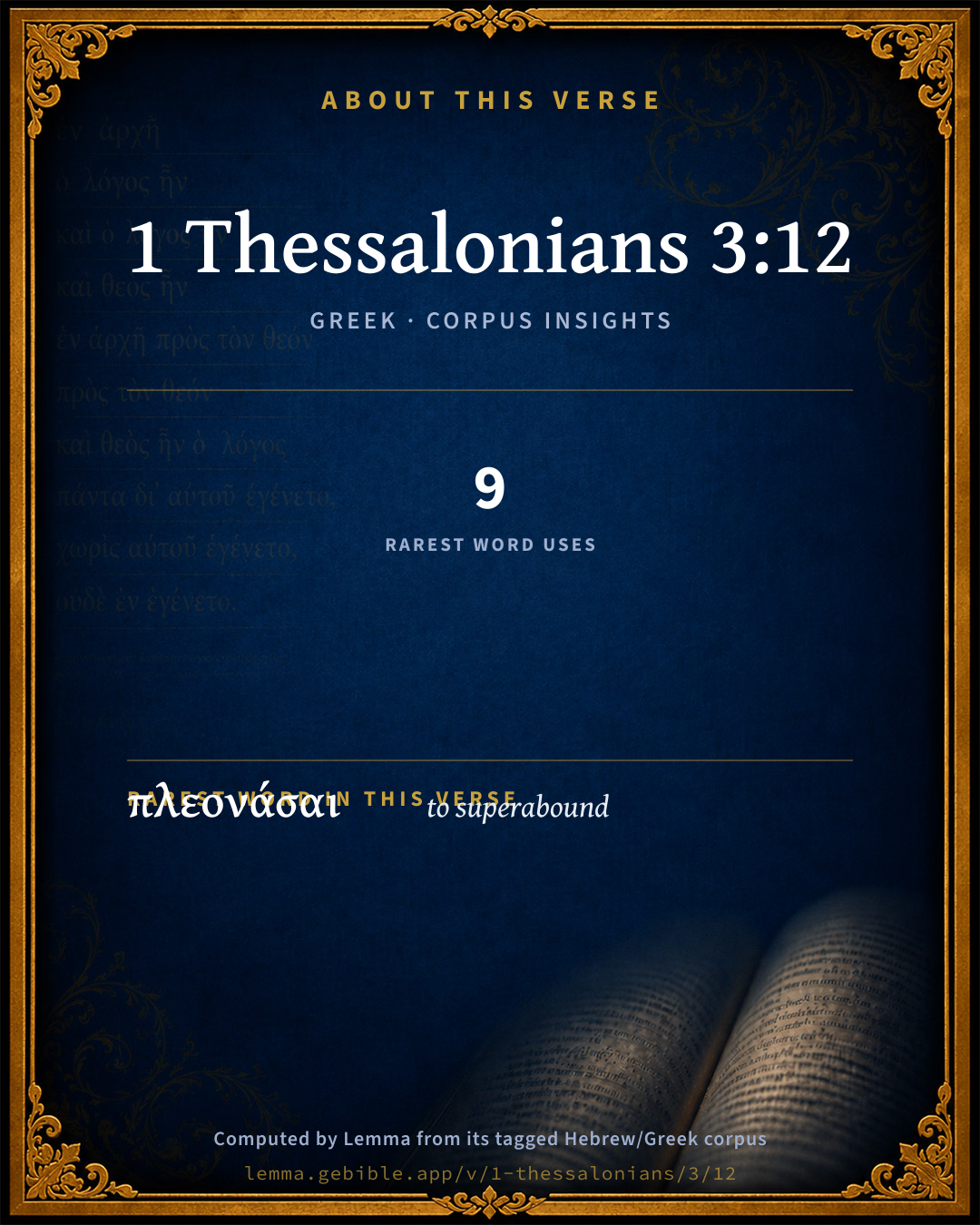
The rarest word here is πλεονάσαι to superabound G4121 — appearing just 9 times in the whole Greek New Testament.

Shared distinctive vocabulary

πλεονάσαι to superabound G4121 occurs in 8 verses of the Greek New Testament. Also found in:

Repetition

Words recur within this verse:

Cross-references

18

Topical passages linked to 1 Thessalonians 3:12 in the Treasury of Scripture Knowledge — connected by theme and wording, ordered by reader-vote popularity; previews shown in the World English Bible.

  • Philippians 1:9 This I pray, that your love may abound yet more and more in knowledge and all discernment;
  • Romans 13:8 Owe no one anything, except to love one another; for he who loves his neighbor has fulfilled the law.
  • Matthew 22:39 A second likewise is this, 'You shall love your neighbor as yourself.'
  • 1 John 4:7–16 Beloved, let us love one another, for love is of God; and everyone who loves is born of God, and knows God.
  • 2 Thessalonians 1:3 We are bound to always give thanks to God for you, brothers, even as it is appropriate, because your faith grows exceedingly, and the love of each and every one of you towards one another abounds;
  • Galatians 5:22 But the fruit of the Spirit is love, joy, peace, patience, kindness, goodness, faithfulness,
  • 1 Thessalonians 5:15 See that no one returns evil for evil to anyone, but always follow after that which is good, for one another, and for all.
  • 1 John 3:11–19 For this is the message which you heard from the beginning, that we should love one another;
  • 1 Thessalonians 4:9–10 But concerning brotherly love, you have no need that one write to you. For you yourselves are taught by God to love one another,
  • Matthew 7:12 Therefore whatever you desire for men to do to you, you shall also do to them; for this is the law and the prophets.
  • Galatians 5:6 For in Christ Jesus neither circumcision amounts to anything, nor uncircumcision, but faith working through love.
  • Galatians 5:13–14 For you, brothers, were called for freedom. Only don't use your freedom for gain to the flesh, but through love be servants to one another.
  • 1 Thessalonians 2:8 Even so, affectionately longing for you, we were well pleased to impart to you, not the Gospel of God only, but also our own souls, because you had become very dear to us.
  • 2 Peter 1:7 and in godliness brotherly affection; and in brotherly affection, love.
  • 2 Peter 3:18 But grow in the grace and knowledge of our Lord and Savior Jesus Christ. To him be the glory both now and forever. Amen.
  • 1 Corinthians 13:1–13 If I speak with the languages of men and of angels, but don't have love, I have become sounding brass, or a clanging cymbal.
  • 1 Thessalonians 4:1 Finally then, brothers, we beg and exhort you in the Lord Jesus, that as you received from us how you ought to walk and to please God, that you abound more and more.
  • James 1:17 Every good gift and every perfect gift is from above, coming down from the Father of lights, with whom can be no variation, nor turning shadow.

Cross-references courtesy of OpenBible.info (CC BY 4.0).

Commentary

Notes on 1 Thessalonians 3:12 from classic Christian and Jewish commentators (each source and its license shown beneath its notes). The classic Christian expositions comment on the surrounding passage and are grouped to its opening verse, so a note may address several verses; the Jewish commentaries on the Tanakh (Rashi and others) are per-verse, so they appear only where the commentator wrote on this verse.

Lemma curates 59 commentaries, every one of them public domain or Creative Commons licensed, each selected and text-cleaned for this edition rather than reprinted as found. About our sources →

The Cambridge Bible for Schools and Colleges

gen. ed. J. J. S. Perowne

12. And the Lord make you to increase and abound in love one towards another] In the Greek order, But you may the Lord make to increase, &c.—“whatever it may please Him to appoint in respect to us and our coming” (Ellicott). 1Th_3:12 is linked with 11, just as 1Th_3:11 with 10, by contrast. The Apostle is thinking now of what the Thessalonians were to each other and might do for each other, in distinction from himself.

“The Lord” is still the “Lord Jesus” of the adjoining verses, the Pattern and Fountain of love. Comp. Joh_13:34; Eph_5:2 (“Walk in love, as the Christ also loved you”). Christ is invoked as the Lord, in His Divine authority and power to grant this prayer (comp. 2Th_3:5).

Increased love would be the best supplement of their “defects of faith” (1Th_3:11), and the basis of the unblameable holiness in which they are to appear at Christ’s coming (1Th_3:13). In “brotherly love” the Thessalonians already excelled (ch. 1Th_4:9-10; comp. 1Th_1:3 and 2Th_1:3); but this is a grace of which there can never be too much. Its “increase” lies in its own growth and enlargement; its “abundance” is the affluence with which it overflows toward others. These synonyms are delicately varied in Rom_5:20 : “where Sin increased (or multiplied), Grace superabounded.”

But this multiplied and overflowing love is not to be confined to the brotherhood: toward one another, and, he adds, toward all. Similarly in ch. 1Th_5:15. For the Thessalonian Church, cruelly persecuted, this wider love was peculiarly necessary, and difficult. It meant loving their enemies, according to Christ’s command (Mat_5:44).

The Apostle has shewn them by his example how to love each other in Christ (see ch. 1Th_2:7-12; 1Th_2:19-20); and remembering this he adds, even as we also toward you. Comp. the appeal of Christ in Joh_13:34 (“even as I loved you”). Paul’s love too was not stationary, but living and growing. This verse has the same turn of expression as 1Th_3:6, “even as we also (long to see) you.”

Faith was the object of the Apostle’s prayer in 1Th_3:10; Love in ver.12; and now 1Th_3:13 crowns both, as it seeks for the Thessalonians, in view of Christ’s coming, a well-assured Hope (comp. ch. 1Th_1:3):—

The Cambridge Bible for Schools and Colleges (gen. ed. J. J. S. Perowne; Cambridge University Press, 1878–1918) — public domain. Text from a community e-Sword module.

The Biblical Illustrator

Joseph S. Exell

1Th_3:12-13

And the Lord make you to increase and abound in love

The effect of love on universal holiness

The grace which is most generally spoken of in the Holy Scriptures as establishing the souls of men is faith.

But there is a sense in which love also establishes the heart; hence the apostle prays that God would make the Thessalonian Christians to abound in love.

I. The influence of love on universal holiness. Love is an extremely powerful principle in the heart of every one that is truly born of God: it is the great wheel which sets the whole machine in motion, and gives a vital energy to every part.

1. It rectifies all the powers of the soul.

2. It enters into every action of the life.

3. It prepares the soul for heavenly communications.

II. The attention due to it under this particular consideration. Love, for its own sake, should be cultivated to the uttermost; but when we consider its vast influence both on our present and eternal welfare, we should strive for it with all our might.

1. Let us seek to abound in it.

2. Let us intreat God to work it in us.

3. Let us be stirred up to this especially from the consideration before us--the Lord Jesus is shortly coming with all His glorified saints to judge the world.

Application:

1. How shall we know whether our love increases? By the difficulties it surmounts, the sacrifices it makes, the victories it gains.

2. What shall we do to get an increase in it? Nothing but love will beget love; nor will anything but a sense of Gods love to us prevail to create in us any real love toward our fellow creatures. (C. Simeon, M. A.)

Christian love

I. The nature of Christian love.

1. Heartfelt.

2. Holy.

II. The source of Christian love.

1. God gives it susceptibility.

2. God maintains it in the heart.

III. The object of Christian love.

1. The whole Christian Church.

2. The whole family of man.

IV. The degree of Christian love.

1. Abundant.

2. Increasing.

V. The effects of Christian love.

1. They are blessed to each other.

2. They are blessed to the Church.

3. They are blessed at the coming of the Lord.

Improvement:

(1) The text leads to inquiry.

(2) The text leads to humiliation.

(3) The text leads to prayer. (W. H. Cooper.)

The abounding of charity

This is the first of St. Pauls formal prayers. Note:

I. The object to whom it is presented.

1. Our Lord is expressly addressed: not as the Mediator only, by whom petitions are made acceptable, but as Himself, the Hearer and Answerer of prayer. Here the Saviour is asked first for a temporal and lower gift, for the prosperous direction of the apostles course and therefore the highest blessing that man can receive.

2. Our Lord is invoked in the unity of the Father, for God Himself our Father, and our Lord Jesus Christ, two persons, are yet one in the verb direct. The very grammar expresses their unsearchable Oneness not only in counsel and act, but in nature and dignity.

3. Here at the outset there is more than a latent reference to the mediatorial Trinity. Who is that Lord who shall stablish the saints before God? It is the Holy Ghost, in the unity of the Father and the Son, but also in His own administrative function as having our holiness in charge.

II. The prayer itself.

1. Pauls first invocation is for charity, that gift of God and grace in man which always has the preeminence. It is the ruling emotion of the regenerate which, assured by its very life of the love of God, goes back directly to Him in devotion, and indirectly in deeds of charity to man. In love, as in an element, the apostle prays that they may grow.

(1) Here at the very threshold of His theology, Paul establishes the true character of love as it rests especially on the fellow elect and as it embraces all men. This distinction bears close analogy to the particular and catholic love of God. But the distinction, however important, belongs to a lower sphere, and has significance only for a season. The two are one in the bond of perfectness; and when the prayer asks for its largest aboundings it leaves all limitation behind: and toward all men.

(2) The specific increase will be seen if we consider the vehement language in which Paul describes it, and the standard he sets up in his own example.

(a) Increase and abound might be interpreted as a compound expression including all that is possible to the hearts capacity. But more closely examined the former signifies the growth of the soul in the sphere of charity, and the latter its aboundings in outward manifestation. Elsewhere love is regarded as growing in us; here, we grow in love, which, like faith, is not only a grace within but an element around the soul. Increase in love means that we may become more and more enlarged in heart as our love is enlarged, growing with its growth. The other term makes the sentiment more intense, and asks that the evidence of our increase may day by day overflow. Not, however, to man only. In the next chapter (1Th_3:9), when the apostle speaks of love to our fellow Christians as taught of God, he calls it philadelphia, a branch of charity never separable from that other love that belongs to God; so here it is regarded as springing from the large effusion of the love of God.

(b) Paul presents his own example as at once a standard, guide, and incentive. He felt himself to be expanding in the habit and exercise of that love which pufieth not up, but edifieth. This is the first instance of a practice of his with which we soon become familiar--the commendation of his own example. Nowhere is his love more vividly exhibited than here. The collective strength of the previous expressions present to us a perfect description of self-forgetting charity. It begins in 1Th_3:5. There is more than human sympathy here. Having had much forgiven, the apostle loved much. But while we are pondering the exhibition, we hear his intercession diverting us from himself: the Lord make you, etc.

2. The connection between this abounding love and unblamable holiness is one of the most important topics in experimental theology.

(1) Love, whether regarded in its unity, or divided into devotion and charity, is the energy of all holiness. We are released from sin by love as the instrument of the Spirit in expelling every impure affection. The soul in which the Divine love is shed abroad in its fullness can give no place to evil desires. By it also we are strengthened into complete obedience: for love is the fulfilling of the law. There is no limit to the increase of this love. St. Paul has chosen two terms that spurn restriction; which teaches us on the one hand that a love perfected in the sense of having reached an impassable limit there cannot be: the love of God can never be spent, nor can mans return of love to God. But it teaches also that there is nothing in the heart that shall resist it. Hence holiness is a state in which mans heart, i.e., man himself, is already established by the power of God.

(2) The idea of confirmation in unblamable holiness before God carries the view forward to that day which is the vanishing point of all the lines of the apostles theology and hope. It is supposed to be brought under the more direct scrutiny of God; it is not created by His coming: neither does death destroy the body of sin, nor the appearing of Christ perfect the love of the saints; but then the eye of Supreme Justice will regard the perfect in love as unblamable in holiness.

(3) The construction of the sentence suggests that at and by the coming of Christ we shall be confirmed in our unchangeable condition of holiness before God. This is not the establishment of an uncertain character; the abounding of love has accomplished that. It is not the establishment in brotherly love; that is a grace which may be supposed to end with time. But it is the establishment of the unblamable holiness of perfect love.

(a) The holiness of perfect love is the permanent character of the saved. Love abideth; and without holiness no man shall see the Lord. Holiness is the consummation of all that religion has to accomplish, and love is the law of heaven as well as of earth. Faith will cease by finding its object; and hope will never be conscious of an object waited for.

(b) This establishment implies the end of probation. Probation vanishes to the individual in death; but to the Church, and mans history generally, only at the coming of Christ. Not till then, but assuredly then, all that belongs to the warfare, suspense and growing victory of religion shall cease. Rest in God shall be the law of heaven; and that rest shall be movement in an orbit around the throne which shall never be purturbed. (W. B. Pope, D. D.)

Missionary love

There is a reflex influence attending acts of obedience to God which goes immediately to advance the doers still further in the ways of godliness. All holy and charitable works are replete with seeds of blessing for the Christians own soul. In the text the grace which is exercised in the actings of obedience becomes a means of still further advancement. The reaction of Christian love is progression in holiness, whether to the individual or the Church. The history of missions furnishes no ordinary proofs of this.

I. The nature of that love in which St. Paul desired his brethren to abound.

1. Its spirituality of intention. This is inferred from its declared origin, The Lord. Carnal minds have their charity, which regards men as body and mind, and, therefore, when it has consulted their physical happiness and intellectual cultivation it has reached its limit. Devout but unenlightened minds have their charity, but it seeks only to win men from vice to forms of godliness. But the charity that is born of God will act in correspondence with the mind of God, who has not failed to provide for physical happiness, mental improvement, and moral amelioration, but only as a consequence of the restoration of the soul to union with Himself. His sacrifice of His Son--the Just for the unjust--was to this end, to bring them to God. In harmony with this will be the intention of His peoples love. It was so in Pauls day. Its care for man was a care for mans soul. And so now Christian missions, while they compensate the physical miseries, mental debasement, and moral perversion of men by humanizing influences, lifting the savage into civilization, it looks upon all this as subordinate to the conversion of the heart to God.

2. Its unrestrictedness of attachment. It suffers no limitation. It leads Gods people to care not only for their brethren, but all mankind. The earliest disciples went everywhere preaching the Word. The Thessalonians were no less active; and besides doing mission work themselves, they succoured other missionaries. Would that this love had never grown cold! But first came dissention, then unhallowed speculation, and afterward superstition. And when superstition had been removed formality supervened. And so at this late era we are but beginning again the evangelization of the world which began in apostolic times.

3. Its progressiveness of operation. Let it live and be in healthy action, and that action will be one of advancing power. This the apostle intimates not only by his prayer, but by instancing his own example. St. Paul was a bright exemplification of the charity that never faileth. His personal intercourse with the Thessalonians had been brief--but how, notwithstanding his labours and trials, he loved them. So it was with his affection for other Churches, it deepened and widened at the same time. And may we not point to many of his followers struggling with discomforts, afflicted with the spectacle of myriads wholly given to idolatry, frequently standing alone as witnesses for the truth, growing only more devoted to the work and attached to their charge. Yea, and when compelled to return to a more congenial climate they labour in the interests of their distant converts, and long to return. And so, according to their ability, is the love of the Churches who support missions.

II. The sanctifying result which St. Paul anticipated from that increase of love which he invoked upon his brethren. Consider this as illustrated in the history of missions.

1. In relation to our individual piety.

(1) It quickens within us the spirit of prayer. One glance at millions lying in their heathen state hastens every child of God to his Fathers feet. The harvest, Christ said, is plenteous, etc. What, then, shall His followers do? Rush at once into the field? No. Pray ye. Nor is this all. From every region we hear the cry, Pray for us that the Word of God may have free course and be glorified. And our souls are stirred within us to respond; and thus it is that an interest in missions keeps us at the throne of grace. And experience soon proves that the spirit of supplication is the very life of the cause.

(2) It brings us into conscious cooperation with God. We are labourers together with God. If the evangelization of the world were a human adventure then our partnership would be with man only; but faith is sensible of Gods presence, and association with God who is holy results in holiness.

(3) It familiarizes our minds with the operations of the Divine Spirit on the souls of men, and promotes self-examination and conveys instruction and consolation.

2. In relation to the piety of the Church which is the aggregate of the holiness of its individual members. As they severally thrive the whole body is strengthened, and society around receives a corresponding complexion. A habit of caring for souls is established; attention is drawn to the spiritual condition of those who are near; home missions spring up, and the fountain which is pouring forth its streams to fertilize some distant wilderness, overflows with living water to bless its native soil. How strikingly this is illustrated in the religious history of our own country! Call to remembrance the condition of England when the great missionary societies were first established. From that day God has blessed us with a reformed country and a revived religion.

(1) The various expedients devised for the support of missions have been the means of this. Missionary meetings, sermons, literature, have given an impetus to the cause of God. In how many of our children the first buddings of Christian emotion have burst under the impression of some missionary tale.

(2) Consciences awakened, and hearts moved to care for the heathen abroad have been impressed with a responsibility towards those at home.

In conclusion, consider the subject in relation to--

1. Ourselves. Here is the antidote to the evils of secularity, luxury, priestcraft, and scepticism.

2. Our society. Our successes should stimulate this love; our failures make an imperative demand upon it.

3. Our Church. Here strength at home will be in proportion to her prosperity abroad.

4. Our country. Missionary extension is its best defence. (J. Harding, M. A.)

The holiness tone

One day when I was with Mr. Hicks, the painter, I saw on his table some high-coloured stones, and I asked him what they were for. He said they were to keep his eye up to tone. When he was working in pigments, insensibly his sense of colour was weakened, and by having a pure colour near him he brought it up again, just as the musician, by his test fork, brings himself up to the right pitch. Now, every day men need to have a sense of the invisible God. A clear conception of the perfect One produces a moral impression; and it does not make any difference how you get it. If you are poetical you get it through the imagination. If you have large veneration you get it through that quality. If you are most easily affected through your emotions, you get it through these elements. If by the intellect, by the imagination, by the affections, or by the moral sentiments you are exalted into the conscious presence of God, then you have obtained that which renders prayer of transcendent value, and which gives tone to your whole nature. But no nature is of such magnitude that it does not need, every day, to be tuned, chorded, borne up to the ideal of a pure and lofty life. (H. W. Beecher.)

The savour of Christian holiness

Now give me a hundred men--not men that are glowing while they sing, and heavenly while they pray, though I would have them so; but men that are, morning, and noon, and night, born of God, and that so carry the savour of Christ that men coming into their presence say, There is a Christian here, as men passing a vintage say, There are grapes here--give me a hundred such men, and I will make the world believe. I do not ask to be shown the grapevine in the woods in June before I will believe it is there. I know that there are grapes near when the air is full of their odour; and the question under such circumstances always is, Where is the vine? and never, What is it that I smell? You are to be a savour of love, and peace, and gentleness, and gratitude, and thanksgiving, so that whenever you go, the essence of the truth that is in you shall go out to men. The most expressible thing in this world is the exquisite delicacy of a Christian grace. There are some excellent essences, like, for instance, the attar of roses, which you must not leave unstopped unless you would have it all exhaled; but the more a Christian grace exhales, the more there is in the bottle.

The Biblical Illustrator, edited by Joseph S. Exell (c. 1880s–1900s) — public domain. Text from a community e-Sword module.

Tyndale Open Study Notes

Tyndale Open Resources

3:12 A characteristic of this church was their love for one another as members of God’s family (4:9; 2 Thes 1:3-4). Paul prays that their love will grow and overflow toward those outside the Christian community (cp. 1 Thes 5:15; Gal 6:10; 2 Tim 2:24; Titus 3:2) even in the face of persecution.

Tyndale Open Study Notes — © Tyndale Open Resources, licensed CC BY-SA 4.0. Text via the HelloAO Bible API.

Bengel's Gnomon

Johann Albrecht Bengel

1Th 3:12. Ὑμᾶς, you) whether we come or not.—πλεονάσαι καὶ περισσεύσαη) On the difference between these two words, comp. 2Co 4:15, note.[12]—καὶ ἡμεῖς, even we) namely, even as we are full of love [towards you].

[12] πλεονάζω has a positive force: περισσεύω, the force of a comparative: The Lord make you full and even abound.—ED.

Bengel's Gnomon of the New Testament — English translation (T&T Clark, Edinburgh, 1860) — public domain. Text from a community e-Sword module.

Meyer's Critical & Exegetical Commentary

Heinrich August Wilhelm Meyer

1Th_3:12. To the wish as regards himself, Paul adds a further wish as regards his readers.[49]

ὙΜᾶς ΔΈ] Bengel puts it well: sive nos viniemus, sive minus.

If Ὁ ΚΎΡΙΟς (see critical note) is genuine, it may grammatically refer either to God or to Christ (although the latter is the more usual); also ἜΜΠΡΟΣΘΕΝ ΤΟῦ ΘΕΟῦ, 1Th_3:13, instead of ΑὐΤΟῦ, is no objection to the reference to God, as the repetition of the name in full shortly after its mention is not rare; comp. 1Th_2:2; Eph_4:12; Eph_4:16; Winer, p. 130 [E. T. 180].

The optatives (not infinitives, as Bretschneider thinks, who without justification supplies δῴη ὙΜῖΝ) ΠΛΕΟΝΆΣΑΙ and ΠΕΡΙΣΣΕΎΣΑΙ are in a transitive sense: but the Lord make you to become rich and abound in love. On πλεονάζειν, comp. LXX. Num_26:54; Ps. 70:21; on ΠΕΡΙΣΣΕΎΕΙΝ, comp. Eph_1:8; 2Co_9:8, etc. Erroneously Theodoret, whom Cornelius a Lapide follows, takes ΠΛΕΟΝΆΣΑΙ by itself, of the external increase of the church: εὔχεται τοίνυν αὐτοὺς καὶ τῷ ἀριθμῷ πλεονάσαι καὶ τῇ ἀγάπῃ περισσεῦσαι, τουτέστι τελείαν αὐτὴν κτήσασθαι, ὥστε μηδὲν ἐλλείπειν αὐτῇ. So also Olshausen and Koch erroneously distinguish ΠΛΕΟΝΆΖΕΙΝ and ΠΕΡΙΣΣΕΎΕΙΝ as cause and effect: to increase, and arising from this increase, abundance. Similarly Fromond. as extensio and intensio charitatis.

εἰς ἀλλήλους] towards fellow-Christians.

ΕἸς ΠΆΝΤΑς] is not an explication of εἰς ἀλλήλους: erga vos invicem et quidem omnes, which Koppe thinks possible, but means toward all men generally. Estius: etiam infideles et vestrae salutis inimicos. Theodoret, without reason, limits it to fellow-Christians of all places; whilst he interprets εἰς ἀλλήλους of fellow-Christians in Thessalonica.

ΚΑΘΆΠΕΡ ΚΑῚ ἩΜΕῖς ΕἸς ὙΜᾶς] sc. τῇ ἀγάπῃ πλεονάζομεν καὶ περισσεύομεν, as we also are rich in love and abound toward you. Only this completion of the ellipsis corresponds to the context, and the objection to it, that πλεονάζειν and ΠΕΡΙΣΣΕΎΕΙΝ is used first in a transitive and then in an intransitive sense, is of no force, as the passage of the one into the other here is so insensible and easy, that no reader could take objection to it. Arbitrary are the completions of Calvin: affecti sumus; Nösselt: animati sumus; Baumgarten-Crusius: ἜΧΟΜΕΝ (?); Pelt and Schott: ΠΟΛΛῊΝ ἈΓΆΠΗΝ ἜΧΟΜΕΝ; Wolf (and so essentially already Musculus): ΠΕΡΙΣΣΕΎΣΑΙ, abundare nos in vos faciat; in which latter case the accusative ἩΜᾶς (as certainly Laurent, Neutestam. Studien, Gotha 1866, p. 188, actually reads, but without justification) must be put in place of the nominative ἡμεῖς. Also, supplying the simple copula sumus (Grotius) is to be rejected, which would suppose a form of speech entirely un-Grecian. Correctly, according to the sense, Theophylact: ἔχετε γὰρ μέτρον καὶ παράδειγμα τῆς ἀγάπης ἡμᾶς.

[49] Entirely erroneously, Piscator begins with this verse the second or exhortative portion of the Epistle.

Meyer — Critical and Exegetical Commentary on the New Testament — English translation by Peter Christie, edited by Frederick Crombie (T&T Clark, 1880) — public domain. Text from a community e-Sword module.

Expositor's Greek Testament

ed. W. Robertson Nicoll

1Th 3:12-13 . The security and purity of the Christian life are rested upon its brotherly love (so Ep. Arist., 229); all breaches or defects of ἁγιωσύνη , it is implied, are due to failures there ( cf. 1Th 4:3 ; 1Th 4:6 ); even sensuality becomes a form of selfishness, on this view, as much as impatience or resentment. This profound ἀγάπη “is an ever-fixed mark That looks on tempests and is never shaken;” it fixes the believing man’s life in the very life of God, by deepening its vital powers of growth; no form of ἁγιωσύνη which sits loose to the endless obligations of this ἀγάπη will stand the strain of this life or the scrutiny of God’s tribunal at the end. ὑμᾶς δὲ , what ever becomes of us. ἁγίων , either ( a ) “saints” (as II., 2Th 1:10 , De Wette, Hofmann, Zimmer, Schmidt, Everling, Kabisch, Findlay, Wohl.), or ( b ) “angels” (Exo 1:9 ; Ps. Sol. 17:49, etc., Hühn, Weiss, Schrader, Titius, Schmiedel, Lueken), or ( c ) both ( cf. 4 Esd. 7:28, 14:9; Bengel, Alford, Wohl., Askwith, Ellicott, Lightfoot, Milligan). The reminiscence of Zec 14:5 (LXX) is almost decisive for ( b ), though Paul may have put another content into the term; πάντων must not be pressed to support ( c ). In any case, the phrase goes closely with παρουσίᾳ . The ἅγιοι are a retinue.

The Expositor's Greek Testament, edited by W. Robertson Nicoll (1897–1910) — public domain. Text from a community e-Sword module.

Cambridge Greek Testament for Schools and Colleges

12. ὑμᾶς δὲ ὁ κύριος πλεονάσαι καὶ περισσεύσαι τῇ ἀγάπῃ εἰς ἀλλήλους καὶ εἰς πάντας. But you may the Lord make to increase and overflow in your love toward one another and toward all. 1Th 3:12 passes from writers to readers with the contrastive δέ. “The Lord,” in St Paul’s general usage—above all, where it directly follows ὁ κύριος ἡμῶν Ἰ. Χ.—means Jesus Christ, not the Father: cf. 1Th 3:8, 1Th 1:6, 1Th 4:15 ff., 1Th 5:27, and the ἡμῖν … εἶς κύριος of 1Co 8:6; Eph 4:5. In 2Th 3:5; 2Th 3:16 “the Lord” is again addressed, quite unreservedly, in prayer: cf. 2Co 12:8; 2Ti 1:16-18; Act 1:24; Act 7:59 f. The Lord Jesus is asked, in effect, to aid the fulfilment of His own command of love (Joh 13:34, &c.) and to perfect in His disciples the grace of which He is the example and channel (see Gal 2:20; Eph 5:2, &c.).

Περισσεύσαι (make abundant) caps πλεονάσαι (make more): cf. the variation in Rom 5:20; 2Co 4:15. Elsewhere in the N.T. the latter verb is always, the former usually, intransitive—the original usage in each case; πλεονάζω (הִרְבָּה) has the active sense in Num 26:54; Ps. 70:21; 1Ma 4:35: cf. the double usage of the Eng. increase, multiply. In 1Th 4:10 the wish is expressed that the Thessalonians may “abound (still) more in love”; in 2Th 1:3 thanks are given because their “love multiplies.” The passages just referred to speak of ἀγάπη εἰς ἀλλήλους, 1Th 4:10 embracing “all the brethren in all Macedonia”; but here, as in 1Th 5:15, καὶ εἰς πάντας is added: cf. Rom 12:16; Rom 12:18; Gal 6:10; 1Ti 2:1; 1Pe 2:17. For the cruelly persecuted Thessalonians this wider love was peculiarly difficult—and necessary; it meant loving their enemies, according to Christ’s command (Mat 5:44).

καθάπερ καὶ ἡμεῖς εἰς ὑμᾶς, as verily we also (do) towards you—i.e. “as we increase and abound in love toward you”; for the Apostles’ love to their flock was not stationary, nor limited; the εὐαγγέλιον of 1Th 3:6 gives it a new impulse. This clause (repeated from 1Th 3:6) rests naturally upon the foregoing verbs, mentally resumed in their intransitive sense; or, after Theodoret, we may supply διετέθημεν, affecti sumus erga vos (Calvin); see also Lightfoot ad loc. In support of this claim of the writers, cf. the statement of 1Th 1:5 b, and the language of 1Th 2:7-12; 1Th 2:17-20: for similar references on St Paul’s part, see 2Th 3:7-9; Php 3:17; Php 4:9; 1Co 4:16; 1Co 11:1; Act 20:35; cf. also the appeal of Jesus in Joh 13:15; Joh 13:34, &c.

Cambridge Greek Testament for Schools and Colleges (Cambridge University Press, 1896; 21 vols, various authors incl. Carr, Maclear, Plummer, Farrar, Lumby, Moule, M. R. James, Simcox) — public domain. Text from a community e-Sword module.

Geneva Bible (1599)

Geneva Bible translators

Another part of the Epistle, wherein he speaketh of the duties of a Christian life. And he showeth that the perfection of a Christian life consisteth in two things, to wit, in charity toward all men, and inward purity of the heart, the accomplishment whereof notwithstanding is deferred to the next coming of Christ, who will then perfect his work by the same grace, wherewith he began it in us.

Geneva Bible (1599) marginal notes — public domain. Text via Bolls.life.

Jamieson, Fausset & Brown

Robert Jamieson, A. R. Fausset & David Brown

The "you" in the Greek is emphatically put first; "But" (so the Greek for "and") what concerns "YOU," whether we come or not, "may the Lord make you to increase and abound in love," &c. The Greek for "increase" has a more positive force; that for "abound" a more comparative force, "make you full (supplying 'that which is lacking,' Th1 3:10) and even abound." "The Lord" may here be the Holy Spirit; so the Three Persons of the Trinity will be appealed to (compare Th1 3:13), as in Th2 3:5. So the Holy Ghost is called "the Lord" (Co2 3:17). "Love" is the fruit of the Spirit (Gal 5:22), and His office is "to stablish in holiness" (Th1 3:13; Pe1 1:2).

Jamieson, Fausset & Brown — Commentary Critical and Explanatory on the Whole Bible (1871) — public domain (CC PDM 1.0). Text via the HelloAO Bible API.

Adam Clarke's Commentary

Verse 12. Make you to increase and abound in love] They had already love to each other, so as to unite them in one Christian body; and he prays that they may have an increase and an abundance of it; that they might feel the same love to each other which he felt for them all.

Adam Clarke's Commentary on the Bible (1810–1826) — public domain. Text from a community e-Sword/MySword module.

John Calvin's Commentaries

12 And the Lord fill you. Here we have another prayer — that in the mean time, while his way is obstructed, the Lord, during his absence, may confirm the Thessalonians in holiness, and fill them with love. And from this again we learn in what the perfection of the Christian life consists — in love and pure holiness of heart, flowing from faith. He recommends love mutually cherished towards each other, and afterwards towards all, for as it is befitting that a commencement should be made with those that are of the household of faith, (Galatians 6:10) so our love ought to go forth to the whole human race. Farther, as the nearer connection must be cherished, so we must not overlook those who are farther removed from us, so as to prevent them from holding their proper place.

He would have the Thessalonians abound in love and be filled with it, because in so far as we make progress in acquaintance with God, the love of the brethren must at the same time increase in us, until it take possession of our whole heart, the corrupt love of self being extirpated. He prays that the love of the Thessalonians may be perfected by God, intimating that its increase, no less than its commencement, was from God alone. Hence it is evident how preposterous a part those act who measure our strength by the precepts of the Divine law. The end of the law is love, says Paul, (1 Timothy 1:5) yet he himself declares that it is a work of God. When, therefore, God marks out our life, he does not look to what we can do, but requires from us what is above our strength, that we may learn to ask from him power to accomplish it. When he says — as we also towards you, he stimulates them by his own example.

John Calvin's Commentaries (1540-1563) — public domain. Text from the Calvin Translation Society English edition (1840s-50s) via the Christian Classics Ethereal Library (ccel.org). Calvin's coverage is partial (roughly two-thirds of the Bible); uncommented books and verses are honest gaps, never fabricated. The 19th-century editor's footnotes and remarks are omitted so the notes are faithfully Calvin's own voice.

Ellicott's Commentary for English Readers

(12) And the Lord make you.—The word you in the Greek is emphatic and stands first. The wish in the previous verse concerned the writers:” But you (whether we come or not) may the Lord make,” &c. By “the Lord” here St. Paul seems to mean not only the Son: the word appears to be an equivalent for the name of God.

Increase and abound.—These words make the readers think first of progress and then of the state to which the progress will bring them—“Multiply you in love until you have enough and to spare of it”—and the same progress is expressed by the objects of the swelling charity: “So that you may not only love one another abundantly, but all mankind—missionary efforts being the supreme work of Christian love—“such loving missionary work” (the writers go on to say) “as ours among you.”

A Bible Commentary for English Readers, edited by Charles John Ellicott (1878–1897) — public domain. Text from a community e-Sword module.

John Gill's Exposition

And the Lord make you to increase,.... That is, the Lord the Spirit; so that the object of prayer, addressed by the apostle, is Father, Son, and Spirit, as in Rev 1:4. The Alexandrian copy reads "God". The Spirit is God, equally with the Father and the Son, and so a fit object of prayer with them, which otherwise he would not be. The request is, that he would cause these saints to increase in number, as the first churches greatly did: and in the gifts of the Spirit, which he divides to men severally as he will; and in his graces, as in faith, in hope, in holiness, in humility, in knowledge, in spiritual joy and strength, an increase in all which is from him:

and abound in love one towards another; for though they were taught of God to love one another, and did do so, and the apostle had had good tidings of their love; yet it was not perfect, there was room for a further exercise of it, by serving each other by it, in things spiritual and temporal; and he had his request, for it did abound in everyone of them towards each other, Th2 1:3

and towards all men; the men of the world, who were without, were not members of the church, nor professors of the Christian religion, but enemies to that, and to Christ, and to them; and yet they were to love them as men, and pray for them, and do them all the good that lay in their power:

even as we do towards you; for the love of the apostle, and those with him, abounded more and more towards these saints, and was so far from being weakened, that it was increased by their absence from them; and they were more abundantly desirous of seeing them, and were even quite impatient until they sent to them, and heard of them.

John Gill's Exposition of the Whole Bible (1746–1763) — public domain (CC PDM 1.0). Text via the HelloAO Bible API.

Trapp's Complete Commentary

John Trapp

12 And the Lord make you to increase and abound in love one toward another, and toward all men, even as we do toward you:

Ver. 12. To increase and abound] By doubling his word, he signifieth a double portion of God’s, grace, which he wisheth unto them; we are sure to receive as much good from God by prayer as we can bring faith to bear away. "Hitherto ye have asked me nothing." Ask, saith Christ, ask enough, open your mouth wide, &c.

John Trapp, A Commentary or Exposition upon All the Books of the Old and New Testament (1647–1656) — public domain. Text from a community e-Sword module.

Albert Barnes' Notes on the Bible

And the Lord make you to increase and abound in love - compare notes, 2Co 9:8. The word “Lord” here probably refers to the Lord Jesus, as this is the name by which he is commonly designated in the New Testament; see the notes on Act 1:24. If this be so, then this is a petition to the Lord Jesus as the fountain of all grace and goodness.

Albert Barnes' Notes on the Bible (1834–1885) — public domain. Text from a community e-Sword/MySword module.

Haydock's Catholic Bible Commentary

And may the Lord multiply you. That is, increase the number of Christians among you. (Witham)

====================

George Leo Haydock (1774–1849), Haydock's Catholic Family Bible and Commentary, 1859 edition — public domain. Excludes Psalms (Douay-Rheims chapter numbering differs from Protestant) and Deuterocanonical books (Catholic canon only).

Matthew Poole's English Annotations

Increase and abound; these two words denote an increasing and overflowing abundance. This is another thing he prays for; the former respected himself, this respected them. He desired to come to them to perfect that which was lacking in their faith, and he prays now for the abounding and increase of their love; not only to love one another, but to increase and abound in it; to increase the habits and abound in the fruits of love. They were under sore persecutions, and their love to one another was more necessary at such a time. And not only to one another, but to extend their love towards all men. Either all men in general; for love is a general duty we owe to all men: Owe no man any thing but to love one another, Rom 13:8; and therefore all our duty to men is comprehended under it. And the apostle requires this love to be added to brotherly kindness, 2Pe 1:7; yea, love is required to enemies, Mat 5:44, though not as enemies, yet as men. Or more particularly, believers; as sometimes all men is taken under that restriction, Tit 2:11.

Even as we do toward you: and he setteth before them his own love to them, both as a pattern and motive hereunto. Though the love of Christ is especially to be looked at, and is proposed often by the apostle Paul as the great argument of love to men, yet he mentions his own love to them here to show the constancy of his affection to them though absent from them, and to show that he persuaded no duty to them but what he practised himself.

Matthew Poole's English Annotations on the Holy Bible (1683–1685) — public domain. Text from a community e-Sword/MySword module.

Whedon's Commentary on the Bible

Daniel D. Whedon

12. Abound in love… toward all—As the central Christian grace, which includes or implies all others.

Daniel D. Whedon (gen. ed.), Commentary on the Old and New Testaments (1874–1909) — public domain. Text from a community e-Sword module.

The Pulpit Commentary

And the Lord. By some referred to the First Person of the blessed Trinity, God our Father (Alford); by others to the Holy Ghost, as the Father and the Lord Jesus Christ are afterwards both mentioned in the prayer; but it is to be referred, according to the prevailing usage in Paul"s Epistle, to the Lord Jesus Christ. Make you; literally, you may the Lord make, putting the emphasis on" you." To increase and abound in love one toward another; toward your fellow-Christians. And toward all men; toward the human race in general. "This is the character of Divine love to comprehend all; whereas human love hath respect to one man and not to another" (Theophylact). Even as we do toward you; that is, as we abound in love toward you. Prayer addressed to Christ.

We have here an instance of prayer addressed to Christ. The apostle prays that Christ may direct his way to the Thessalonians, and make them abound in love. The martyr Stephen breathed out his spirit in a prayer to Christ. And Christians in general are represented as those who in every place call on the Lord Jesus. "There is no foundation," as Bishop Alexander remarks, "for any such statement as that "truly primitive and apostolic prayer is invariably to God through Christ. Christ himself is often in Scripture the direct Object of worship. Now, if Christ be not God, the apostle and early Christians were idolaters. The divinity of Christ is the only ground on which the worship of Christ can be defended.

Vers. 12, 13.

Religious progress.

1. The nature of religious progress. It is an increase in love to our fellow-Christians and to all men.

2. The ultimate end of religious progress. The establishment of our hearts in holiness, and our being presented blameless before the Lord Jesus Christ at his coming.

Vers. 12, 13.

The apostle"s prayer for the progressive sanctification of the Thessalonians and their final perfection at the coming of Christ.

He has just prayed for himself, but whether he is to come to them or not, he has a prayer for their spiritual benefit.

I CONSIDER THE PERSON TO WHOM THE PRAYER IS ADDRESSED, "But you may the Lord enlarge." It is the Lord Jesus, who, "as the Purchaser of the Church with his own blood," has received the fullness of the Spirit for the benefit of his people. It was to the Lord the apostles addressed the unanimous prayer, "Increase our faith.

II THE BLESSING PRAYED FOR. "But you may the Lord enlarge and make to abound in love toward one another, and toward all.

1. The existence of their love is frankly admitted. He had spoken of "their labor of love." He prays now for its increase.

2. Their love was to be an abounding love.

(1) There were defects in their love, as there were defects in their faith, to be supplied from the inexhaustible Source of all love.

(2) The objects of their love were

(a) "one another," those of the household of faith, who were to have the first place in their affections;

(b) but "all men" likewise, as children of a common Father, for as we have opportunity we must do good unto all men, (Gal_6:10) the world itself being the field of our missionary labors. The Apostle Peter adds "love" to "brotherly kindness" in the chain of Christian graces, as if to imply that brotherly kindness might become a narrow, sectarian thing, and therefore the love of man as man is enjoined.

III THE DESIGN AND TENDENCY OF THIS PROGRESSIVE INCREASE. "To the end that he may stablish your hearts unblamable in holiness before our God and Father at the coming of our Lord Jesus Christ with all his saints.

1. This implies that establishment in holiness is necessarily involved in the enlargement of both faith and love.

2. It implies that stability in holiness is the great end of Christian life in a world which shakes believers by fears and temptations and delusions.

3. It implies that without perfect holiness we cannot appear without blame before God.

4. It implies that perfect holiness is reserved for the second coming.

(1) It is not attainable in this life. We are not here "without spot or wrinkle.

(2) It is connected with the redemption of the body.

(3) It is connected with the final glorification of the redeemed; for all the saints are to be associated with the Judge as assessors in the final judgment. (Luk_22:30; Joh_5:28; 1Co_6:3) Therefore let us pray for the increase of faith and love, and live in the blessed hope of the "day of Christ. T.C.

The increase of love.

I THE INCREASE OF LOVE IS THE FIRST ESSENTIAL OF CHRISTIAN PROGRESS. St. Paul sets it first and by itself as the root and secret of the blameless holiness before God which he regards as the great consummation of perfection. The Church has too often disregarded this primary note of progress, preferring growth in knowledge, enlarged activity, and more extended influence in the world. But it needs to be seen that the one measure of spiritual prosperity is the degree in which love abounds. The reasons for this honoring of Christian love are apparent.

1. Love is the most like God of all human experiences. We are nearest to God when we love one another most.

2. Love is the most fruitful grace. It does most good to the world and inspires the best service of God.

3. Love is the foundation of all other graces. It opens the eyes of knowledge, and kindles the ardor of zeal, and inspires the life of faith, and breathes holiness into the soul.

II THIS INCREASE OF LOVE MUST BE IN EXTENT AS WELL AS IN INTENSITY. It is not enough that we have a very warm, passionate devotion if this is confined to a narrow circle. One of the most important features of Christian love, in contradistinction to the natural kindness of persons of an affectionate disposition, is its breadth. It is not led by fancy and confined to the arbitrary selection of a merely human love.

1. It begins with Christ. Though St. Paul does not here express this truth, he implies it. For he is writing to a Christian Church, not to a mixed crowd of men of the world. He assumes devotion to Christ, and seeks for the fruits of it. Now, it is part of the glory of Christianity that it reveals man in his most attractive character when it shows Christ to us. Thus the enthusiasm of humanity is possible, because, first seeing man in Christ, we afterwards learn to see Christ in every man.

1. It expands into love for all Christians. The special characteristic of the brotherly love, so much enforced in the New Testament, is that it flows out to Christians as such, irrespective of personal attractiveness or the reverse. Of course we must have our natural affinities and special friendships. Christ had as much. But we must not confine Christian love to such cases. Indeed,

2. the specially Christian character of love is not seen until this love is bestowed upon those who would not have received it had they not been united to us through Christ.

3. It must extend to all men. Christian love is not confined to the Christian community. The disciple of Christ is the true philanthropist. It is not simply that in the spirit of Christian universalism we are to endeavor to draw all men within the fold of Christ; we are also to love them while they remain outside it. We are to love them as men. From this we may infer that religious exclusiveness is a sin, that Christian people should take interest in all things human in the science, art, business, politics, and social and domestic affairs of the world. The progress of our Christian life may be measured by the cheerful sympathy, breadth, and generosity of our humanity.

III THE INCREASE OF LOVE IS A FRUIT OF DIVINE GRACE. St. Paul prays that the Lord may make the Thessalonians increase and abound in love.

1. Love is only possible where the hard heart of selfishness has been softened. It is the work of God"s Spirit within us to make this change. God also casts out the impurities which deaden genuine love and the aversions which limit it.

2. Love springs up in us by contact with the Divine love. That love must be revealed and shed abroad in our hearts" in order that our love may be stimulated.

3. Nevertheless human influences help the development of Christian love. The apostle referred to his own example: "Even as we do towards you." Christian love is contagious. The study of the lives of men of large-hearted charity is helpful in the overthrowing of our narrow prejudices and the arousing of a broad, strong spirit of loving-kindness. W.F.A.

The Pulpit Commentary (1880–1919), ed. H.D.M. Spence-Jones & Joseph S. Exell — public domain. Text from a community e-Sword module.

Burkitt's Expository Notes on the New Testament

William Burkitt

Still our apostle perseveres in prayer, on the behalf of his beloved Thessalonians; and the particular mercy he prays for, is, their abundant increase in the grace and duty of love, first amongst themselves and their fellow-brethren in Christ, all Christians far and near; next towards all men, heathens and infidels, their bitter and bloody persecutors not excepted.

Where note, The true property of Christian love; it is, 1. A brotherly affection, which every true Christian chiefly bears to all his fellow-members in Christ, for grace sake;

2. A gracious propensity of heart, which a Christian bears for God’s sake to all mankind, whereby he wills, and to his power procures, all good for them.

William Burkitt's Expository Notes on the New Testament (1700–1703) — public domain. Text from a community e-Sword module.

McGarvey & Pendleton's Commentaries

J. W. McGarvey

and the Lord make you to increase and abound in love one toward another, and toward all men, even as we also do toward you ;

J. W. McGarvey (with Philip Y. Pendleton), Commentaries on the New Testament (The Fourfold Gospel, 1914; Acts; and the epistles) — public domain. Text from a community e-Sword/MySword module.

The People's New Testament

B. W. Johnson

12. The Lord make you to increase. Whether he may come or not, his prayer is for their increase in love, the greatest of all graces.

B. W. Johnson's The People's New Testament with Notes (1889–1891) — public domain. Electronic text from the Christian Classics Ethereal Library (CCEL) ThML edition.

Alford’s Greek Testament

Henry Alford

12.] ὑμᾶς δέ—emphatic—‘sive nos veniemus sivo minus,’ Bengel.

ὁ κύριος may refer either to the Father, or to Christ. It is no objection to the former, that τ. θεοῦ κ. πατρ. ἡμ. is repeated below, any more than it is to the latter that τ. κυρ. ἡμ. Ἰ. is so repeated. I should rather understand (still, notwithstanding Ellic.’s note) it of the Father: see 2Co 9:8.

πλεονάσαι] transitive, see reff.: enlarge you—not merely in numbers, as Thdrt., but in yourselves, in richness of gifts and largeness of faith and knowledge—fill up your ὑστερήματα, ver. 10.

περισσεύσαι (reff.), make you to abound.

εἰς πάντας] toward all men, not, as Thdrt., πάντας τοὺς ὁμοπίστους, but as Est., ‘etiam infideles et vestræ salutisinimicos.’

καθ. κ. ἡμεῖς, viz. περισσεύομεν τῇ ἀγάπῃ:—ἔχετε γὰρ μέτρον κ. παράδειγμα τῆς ἀγάπης ἡμᾶς, Thl.

Henry Alford, The Greek Testament (1849–1861) — public domain. Text from a community e-Sword module.

International Critical Commentary

12. ὑμᾶς δὲ ὁ κύριος κτλ. The δε introduces a new point and is here adversative, as the emphatic position of ὑμᾶ makes clear: “and as for you.” “Such is our prayer for ourselves; but you, whether we come or not (Beng.: sive nos veniemus, sive minus), etc.” (Lillie). This second petition, directed to the Lord alone (that is, not θεό (A) but Christ, as DGF, which add Ἰησοῦ, interpret,—Christ who is the indwelling power unto love), has in view the ὑστερήματ (v. 10). The love in which Christ will make them to increase and abound is defined both as φιλαδελφί, a love which though present (4:9-10) needs to abound the more (4:10-12), and as ἀγάπ, love to all men everywhere (5:15, Gal 6:10). As an example of love, he points to himself (1:6, II 3:9; cf. Calv.): “As also (καθάπερ και, v. 6) we increase and abound (sc. the intransitive πλεονάζομεν καὶ περισσεύομεν τῇ ἀγάπῃ and cf. 2Co 9:8) toward you.” They are to love one another as he loves them.

πλεονάζει, common in Lxx, is found in N. T. but once (2Pe 1:8) outside of Paul (cf. II 1:3); it means “increase,” “multiply,” “abound.” The transitive sense here is not infrequent in the Lxx (e. g. Num 26:54, 2Ch 31:5, Psa 49:19, 70:21, Sir. 20:8, (A) 32:1, Jer 37:19). περισσεύει, frequent in N. T. and seven times in Lxx, is virtually synonymous with πλεονάζει The transitive occurs also in 2Co 9:8; cf. 2Co 4:15, Eph 1:8. “Do you see the unchecked madness of love which is indicated by the words? He says πλεονάσα and περισσεύσα instead of αὐξήσα” (Chrys.; cf. II 1:3). εἰ here, as in II 1:3, may be taken closely with ἀγάπῃ, the article being tacitly repeated and the verbs construed with the dative as in 2Co 3:9, Sir. 11:12; or εἰ may be joined with the verbs (cf. πλεονάζειν εἰ Php 4:17; περισσεύειν εἰ Rom 3:7, Rom 3:5:15, 2Co 1:5, etc.), the dative designating the sphere in which they are to increase and abound (cf. περισσεύειν ἐ Rom 15:13, 1Co 15:58, etc.).

International Critical Commentary — older volumes (1896–1929), various authors — public domain. Text from a community e-Sword module.

Lesson kit

Teaching starters — assembled from the data on this page, not authored interpretation. Every prompt links to the verse data it draws on. Edit before teaching.

1 Thessalonians, in the Pauline Epistles, opens this verse with 19 words (13 distinct Greek lemmas). Its most distinctive word is pleonázō (“to superabound”). A historical commentator’s framing appears above. Read the whole chapter for the surrounding context.

Discussion questions

  1. How does “to superabound” (pleonázō) shape what this verse is saying?
  2. How does Romans 5:20, which shares the word «to superabound», read alongside this verse?
  3. What does the repetition of “into” (3× in this one verse) do in this verse?
  4. The translations on this page render this verse differently — a whole-verse word diff, not a word-by-word alignment. What might account for the different wordings?
  5. Compare how The Cambridge Bible for Schools and Colleges and The Biblical Illustrator read this verse. Where do they agree or differ?

Things to notice

  • These translations choose different wording for 7 words in this verse.
  • “into” occurs 3× in this single verse.
  • 13 distinct Greek lemmas span 19 words in this verse.

Reading settings

Reading text

Shown beneath each verse's original-language words.

Old Testament
Old Testament edition

Read the OT as the Masoretic Hebrew (MT) or the Greek Septuagint (LXX).

English shown for the Greek Septuagint (in the Hebrew ↔ Greek comparison).

Comparing translations? Open the Compare panel on any verse page to stack up to four side by side.