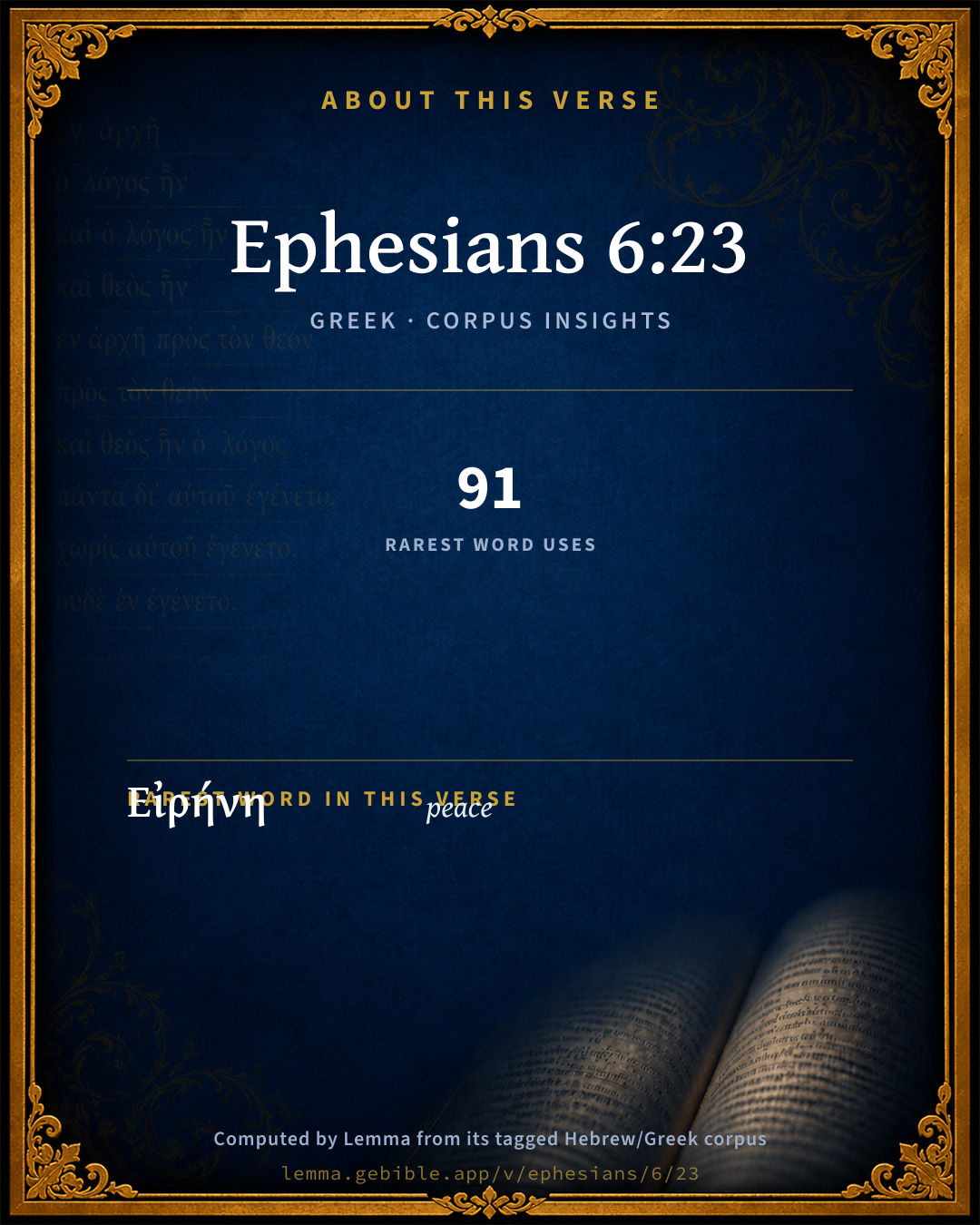
Ephesians 6:23

Greek (Tischendorf 8th ed.) Ephesians 6:23 appears in the Greek New Testament. The text above is from the Tischendorf 8th edition. Each word links to its Strong’s number and a concise gloss. Click any word for its full Thayer’s Greek Lexicon entry.
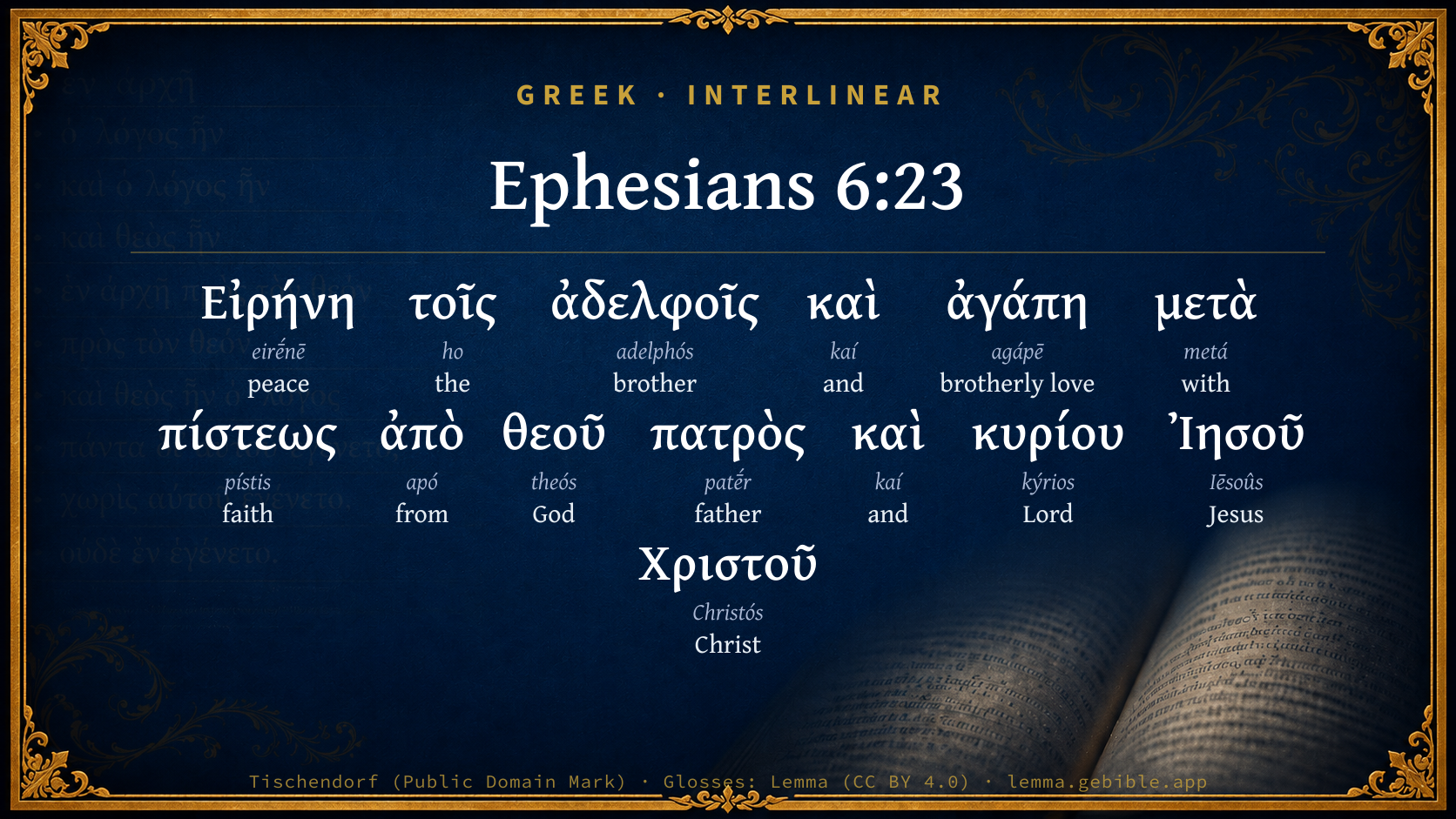
Download image
Cite this verse

Ephesians 6:23 (World English Bible). Public Domain. Lemma interlinear Bible study tool, https://lemma.gebible.app/v/ephesians/6/23.

Show BibTeX & RIS
BibTeX
RIS
English Translation
Peace be to the brothers, and love with faith, from God the Father and the Lord Jesus Christ.
World English Bible · Public Domain
Download a study sheet

One document with this verse’s original text, its word-by-word gloss line, the meaning frame, cross-references with their text, attributed commentary, and full source and license credits — printable, and it pastes into notes with its structure intact.

This verse Autodidact and up

Study sheet (.html) Plain text (.txt)

A passage Seminary Student

Up to 50 verses in one chapter. A passage sheet keeps up to 6 commentary sources and 12 cross-references per verse, in the order this page ranks them, and says so on the sheet whenever that leaves anything out. Ask for a single verse and you get the Autodidact verse sheet above.

Everything on this page stays free to read, with no account — the sheet is a download of what is already on screen, not access to it.

Want to remove ads? Support Godless Engineer
Compare translations 3

The same verse in 3 English versions, stacked beneath the original-language interlinear above. Click any original word for its lexicon entry.

Each is an independent rendering of the whole verse — the interlinear is not word-aligned to these translations.

Highlighted words mark where these versions differ — a whole-verse word diff, not a word-by-word alignment.

  • World English Bible Public Domain
    Peace be to the brothers, and love with faith, from God the Father and the Lord Jesus Christ.
  • King James Version Public Domain
    Peace be to the brethren, and love with faith, from God the Father and the Lord Jesus Christ.
  • unfoldingWord Literal Text CC BY-SA 4.0
    Peace to the brothers, and love with faith from God the Father and the Lord Jesus Christ.

unfoldingWord Literal Text — © unfoldingWord, licensed CC BY-SA 4.0. Word-aligned USFM3 via Door43 (git.door43.org/unfoldingWord/en_ult).

Versions to compare (up to 4)

3 of 4 selected

Show all 19 translations

Every available English version of this verse, each an independent rendering of the whole verse.

  • World English Bible Public Domain
    Peace be to the brothers, and love with faith, from God the Father and the Lord Jesus Christ.
  • Berean Standard Bible Public Domain
    Peace to the brothers and love with faith from God the Father and the Lord Jesus Christ.
  • Majority Standard Bible Public Domain
    Peace to the brothers and love with faith from God the Father and the Lord Jesus Christ.
  • King James Version Public Domain
    Peace be to the brethren, and love with faith, from God the Father and the Lord Jesus Christ.
  • American Standard Version (1901) Public Domain
    Peace be to the brethren, and love with faith, from God the Father and the Lord Jesus Christ.
  • Revised Version (1885) Public Domain
    Peace be to the brethren, and love with faith, from God the Father and the Lord Jesus Christ.
  • Geneva Bible (1599) Public Domain
    Peace be with the brethren, and loue with faith from God the Father, and from the Lord Iesus Christ.
  • Douay-Rheims (1899) Public Domain
    Peace be to the brethren and charity with faith, from God the Father, and the Lord Jesus Christ.
  • Young's Literal Translation Public Domain
    Peace to the brethren, and love, with faith, from God the Father, and the Lord Jesus Christ!
  • Literal Standard Version CC BY-SA 4.0
    Peace to the brothers, and love, with faith, from God the Father, and the Lord Jesus Christ!
  • Unlocked Literal Bible CC BY-SA 4.0
    Peace be to the brothers, and love with faith from God the Father and the Lord Jesus Christ.
  • unfoldingWord Literal Text CC BY-SA 4.0
    Peace to the brothers, and love with faith from God the Father and the Lord Jesus Christ.
  • Darby Bible Public Domain
    Peace to the brethren, and love with faith, from God [the] Father and [the] Lord Jesus Christ.
  • World Messianic Bible Public Domain
    Peace be to the brothers, and love with faith, from God the Father and the Lord Yeshua the Messiah.
  • Webster's Bible Public Domain
    Peace be to the brethren, and love with faith from God the Father and the Lord Jesus Christ.
  • Free Bible Version CC BY-SA 4.0
    Peace to all the Christians there, from God the Father and the Lord Jesus Christ, with love and trust in him.
  • Bible in Basic English Public Domain
    Peace be to the brothers, and love with faith, from God the Father and the Lord Jesus Christ.
  • Text-Critical English NT CC BY 4.0
    Peace be with the brothers, and love with faith, from God the Father and the Lord Jesus Christ.
  • Tyndale New Testament (1534) Public Domain
    Peace be with the brethren and love with fayth from God the father and from the Lorde Iesu Christ.

Literal Standard Version (2020), Covenant Press — licensed CC BY-SA 4.0. Text via the HelloAO Bible API (eBible.org). Unlocked Literal Bible (unfoldingWord) — licensed CC BY-SA 4.0. Text via the HelloAO Bible API (eBible.org). unfoldingWord Literal Text — © unfoldingWord, licensed CC BY-SA 4.0. Word-aligned USFM3 via Door43 (git.door43.org/unfoldingWord/en_ult). Free Bible Version, Dr. Jonathan Gallagher — licensed CC BY-SA 4.0. Text via the HelloAO Bible API (eBible.org).

Word by word

More ways to search: Search by grammar → Find every occurrence → Compare this word →

Practice this passage: Drill this verse → Learn its vocabulary →

Εἰρήνη
eirḗnē
G1515
“peace”
Noun, Nominative, Singular, Feminine
Part of Speech
Noun
Case
Nominative
Number
Singular
Gender
Feminine
Full Thayer's Definition

Origin: probably from a primary verb eiro (to join)

TDNT: 08:40,2

1. a state of national tranquillity a. exemption from the rage and havoc of war 2. peace between individuals, i.e. harmony, concord 3. security, safety, prosperity, felicity, (because peace and harmony make and keep things safe and prosperous) 4. of the Messiah's peace a. the way that leads to peace (salvation) 5. of Christianity, the tranquil state of a soul assured of its salvation through Christ, and so fearing nothing from God and content with its earthly lot, of whatsoever sort that is 6. the blessed state of devout and upright men after death
  1. τοῖς ho G3588 “the” Article, Dative, Plural, Masculine
  2. ἀδελφοῖς adelphós G80 “brother” Noun, Dative, Plural, Masculine
  3. καὶ kaí G2532 “and” Conjunction
  4. ἀγάπη agápē G26 “brotherly love” Noun, Nominative, Singular, Feminine
  5. μετὰ metá G3326 “with” Preposition
  6. πίστεως pístis G4102 “faith” Noun, Genitive, Singular, Feminine
  7. ἀπὸ apó G575 “from” Preposition
  8. θεοῦ theós G2316 “God” Noun, Genitive, Singular, Masculine
  9. πατρὸς patḗr G3962 “father” Noun, Genitive, Singular, Masculine
  10. καὶ kaí G2532 “and” Conjunction
  11. κυρίου kýrios G2962 “Lord” Noun, Genitive, Singular, Masculine
  12. Ἰησοῦ Iēsoûs G2424 “Jesus” Noun, Genitive, Singular, Masculine
  13. Χριστοῦ Christós G5547 “Christ” Noun, Genitive, Singular, Masculine

About this verse

These counts appear in no published source. They are computed here, from the morphology-tagged text and Lemma’s own curated glosses. What Lemma adds →

14
words
13
distinct lemmas
Pauline Epistles
section

Repetition

A word recurs within this verse:

Cross-references

17

Topical passages linked to Ephesians 6:23 in the Treasury of Scripture Knowledge — connected by theme and wording, ordered by reader-vote popularity; previews shown in the World English Bible.

  • Galatians 6:16 As many as walk by this rule, peace and mercy be on them, and on God's Israel.
  • Galatians 5:6 For in Christ Jesus neither circumcision amounts to anything, nor uncircumcision, but faith working through love.
  • 1 Peter 5:14 Greet one another with a kiss of love. Peace be to you all who are in Christ Jesus. Amen.
  • Psalms 122:6–9 Pray for the peace of Jerusalem. Those who love you will prosper.
  • 2 Thessalonians 3:16 Now may the Lord of peace himself give you peace at all times in all ways. The Lord be with you all.
  • 1 Timothy 1:14 The grace of our Lord abounded exceedingly with faith and love which is in Christ Jesus.
  • Genesis 43:23 He said, "Peace be to you. Don't be afraid. Your God, and the God of your father, has given you treasure in your sacks. I received your money." He brought Simeon out to them.
  • 1 Samuel 25:6 and thus shall you tell him who lives [in prosperity], Peace be to you, and peace be to your house, and peace be to all that you have.
  • John 14:27 Peace I leave with you. My peace I give to you; not as the world gives, give I to you. Don't let your heart be troubled, neither let it be fearful.
  • Romans 1:7 to all who are in Rome, beloved of God, called to be saints: Grace to you and peace from God our Father and the Lord Jesus Christ.
  • 1 Corinthians 1:3 Grace to you and peace from God our Father and the Lord Jesus Christ.
  • 1 Thessalonians 5:8 But let us, since we belong to the day, be sober, putting on the breastplate of faith and love, and, for a helmet, the hope of salvation.
  • 2 Thessalonians 1:3 We are bound to always give thanks to God for you, brothers, even as it is appropriate, because your faith grows exceedingly, and the love of each and every one of you towards one another abounds;
  • 1 Timothy 1:3 As I exhorted you to stay at Ephesus when I was going into Macedonia, that you might charge certain men not to teach a different doctrine,
  • Philemon 1:5–7 hearing of your love, and of the faith which you have toward the Lord Jesus, and toward all the saints;
  • Revelation 1:4 John, to the seven assemblies that are in Asia: Grace to you and peace, from God, who is and who was and who is to come; and from the seven Spirits who are before his throne;
  • 1 Timothy 5:8 But if anyone doesn't provide for his own, and especially his own household, he has denied the faith, and is worse than an unbeliever.

Cross-references courtesy of OpenBible.info (CC BY 4.0).

Commentary

Notes on Ephesians 6:23 from classic Christian and Jewish commentators (each source and its license shown beneath its notes). The classic Christian expositions comment on the surrounding passage and are grouped to its opening verse, so a note may address several verses; the Jewish commentaries on the Tanakh (Rashi and others) are per-verse, so they appear only where the commentator wrote on this verse.

Lemma curates 59 commentaries, every one of them public domain or Creative Commons licensed, each selected and text-cleaned for this edition rather than reprinted as found. About our sources →

The Biblical Illustrator

Joseph S. Exell

Eph_6:23

Peace be to the brethren, and love with faith.

Peace, love, and faith

There is no better test of a man than the things that he wishes for the people that he loves most. He desires for them, of course, his own ideal of happiness. What do you desire most for those that are dearest to you? You parents, do you train up your children, for instance, so as to secure, or to do your best to secure, not outward prosperity, but these loftier gifts; and for yourselves, when you are forming your wishes, are these the things that you want most? Set your affections on things above, and remember that whoso has that trinity of graces--peace, love, faith--is rich and blessed, whatsoever else he has or needs. And whoso has them not is miserable and poor. The Christian life in its higher vigour and excellence is rooted in faith. That faith associates to itself, and is inseparably connected with love, and the faith and love together issue in a deep restful tranquillity which nothing can break. Now let us look at these three things as the three greatest blessings that any can bear in their hearts, and wring out of time, sorrow, and change.

I. First, the root of everything is a continuous and growing trust. Remember, that this prayer or wish of my text was spoken in reference to brethren; that is to say, to those who, by the hypothesis, already possessed Christian faith. And Paul wishes for them, and can wish for them, nothing better and more than the increase and continuousness of that which they already possess. The highest blessing that the brethren can receive is the enlargement and the strengthening of their faith. Now we talk so much in Christian teaching about this faith that, I fancy, like a worn sixpence in a mans pocket, its very circulation from hand to hand has worn off the lettering. And many of us, from the very familiarity of the word, have only a dim conception of what it means. It may not be profitless, then, to remind you, first of all, that this faith is neither more nor less than a very familiar thing which you are constantly exercising in reference to one another, that is to say, simple confidence. There is nothing mysterious in it, it is simply the exercise of confidence, the familiar cement that binds all human relationship together, and makes men brotherly and kindred with their kind. Faith is trust, and trust saves a mans soul. Then, remember further, that the faith which is the foundation of everything is essentially the personal trust reposing upon a person, upon Jesus Christ. When you grasp Christ, the living Christ, and not merely the doctrine, for yours, then you have faith. Then, remember still further, that this personal outgoing of confidence, which is the action both of a mans will and of a mans intellect, to the person revealed to us in the great doctrines of the gospel--that this faith, if it is to be worth anything, must be continuous. And, still further, this faith ought to be progressive. Brethren, is it so with us? Let us ask ourselves that; and let us ask very solemnly this other question--If my faith has no growth, how do I know that it has got any life? And so let me remind you, further, that this faith, the personal outgoing of a mans intellect and will to the personal Saviour revealed in the Scriptures as the sacrifice for our sins, and the life of our spirits, which ought to be continuous and progressive, is the foundation of all strength, blessedness, goodness, in a human character; and if we have it we have the germ of all possible excellence and growth, not because of what it is in itself, for in itself it is nothing more than the opening of the heart to the reception of the celestial influences of grace and righteousness that He pours down. And, therefore, this is the thing that a wise man will most desire for himself, and for those that are dearest to him.

II. And now, next, notice how inseparably associated with a true faith is love. The one is effect that never is found without its cause; the other is cause which never but produces its effect. These two are braided together by the apostle, as inseparable in reality and inseparable in thought. And that it is so is plain enough, and there follow from it some practical lessons that I desire to lay upon your hearts and my own. There are, then, here, two principles, or rather two sides of one thought; no faith without love, no love without faith.

III. And now, lastly, these two inseparably associated graces of faith and love bring with them, and lead to, the third--peace. It seems to be but a very modest, sober-tinted wish which the apostle here has for his brethren, that the highest and best thing he can ask for them is only quiet. Very modest by the side of joy and excitement, in their coats of many colours; and yet the deepest and truest blessing that any of us can have--peace. It comes to us by one path, and that is by the path of faith and love. These two bring peace with God, peace in our inmost spirits, the peace of self-annihilation and submission, the peace of obedience, the peace of ceasing from your own works, and entering, therefore, into the rest of God. Trust is peace. There is no tranquillity like that of feeling I am not responsible for this; He is; and I rest myself on Him. Love is peace. There is no rest for our hearts but on the bosom of someone that is dear to us, and in whom we can confide. But ah! brother, every tree in which the dove nestles is felled down sooner or later, and the nest torn to pieces, and the bird flies away. But if we turn ourselves to the undying Christ, the perpetual revelation of the eternal God, then, then our love and our faith will bring us rest. Self-surrender is peace. It is our wills that trouble us. Disturbance comes, not from without, but from within. When the will bows, when I say, Be it then as Thou wilt, when in faith and love I cease to strive, to murmur, to rebel, to repine, and enter into His loving purposes, then there is peace. Obedience is peace. To recognize a great will that is sovereign, and to bow myself to it, not because it is sovereign, but because it is sweet, and sweet because I love it, and love Him whose it is. That is peace. And then, whatever may be outward circumstances, there shall be peace subsisting at the heart of endless agitation; and deep in my soul I may be tranquil, though all about me may be the hurly-burly of the storm. (A. Maclaren, D. D.)

Christian peace

There are depths in the ocean which no tempest ever stirs; they are beyond the reach of all storms which sweep and agitate the surface of the sea. There are heights in the blue sky to which no cloud ever ascends, where no tempest ever rages, where all is perpetual sunshine. Each of these is an emblem of the soul which Jesus visits; to whom He speaks His peace, whose fear He dispels, and whose lamp of hope He trims.

Love and faith

Faith and love are like a pair of compasses. Faith, like one point, fastens on Christ as the centre; and love, like the other, goes the round in all the works of holiness and righteousness.

The Biblical Illustrator, edited by Joseph S. Exell (c. 1880s–1900s) — public domain. Text from a community e-Sword module.

Joseph Benson's Commentary

Eph 6:23-24. Peace be to the brethren — That is, all prosperity in matters temporal and spiritual; and love — To God, one another, and all the saints, arising from God’s love to you; with faith — In God, in Christ, and his gospel, accompanied with every other grace; from God the Father — The original source of all our blessings; and the Lord Jesus Christ — Through whose mediation alone they are communicated to us. Grace — The unmerited favour of God, and those influences of his Spirit, which are the effect thereof; be with all them that love our Lord Jesus in sincerity — Εν αφθαρσια, literally, in incorruption: that is, without any mixture of corrupt affections, or without decay; who continue to love him till grace shall end in glory.

Joseph Benson's Commentary on the Old and New Testaments (1811–1818) — public domain. Text from a community e-Sword module.

The Preacher's Complete Homiletical Commentary

Joseph S. Exell (gen. ed.)

CRITICAL AND EXPLANATORY NOTES

Eph_6:23. Peace, love, and faith.—A worthy triad, and the greatest of these is love.

Eph_6:24. Grace be with all them that love our Lord Jesus Christ in sincerity.—Paul’s favourite word “grace” comes in as “epilogue”—as it was “prologue” (Eph_1:2). Sincerity means incorruptly—to love in a spirit corruption cannot touch.

MAIN HOMILETICS OF THE PARAGRAPH.—Eph_6:23-24

A Suggestive Benediction—

I. Recognises the divine source of all blessing.—“From God the Father and the Lord Jesus Christ” (Eph_6:23). All our blessings are divine, and flow from the inexhaustible fountain of the divine beneficence. “God the Father,” in the eternal counsels of His wisdom and love, “and the Lord Jesus Christ,” who through the eternal Spirit offered Himself as an atonement for human sin—the glorious Trinity of Persons in the Godhead—contribute from their combined perfections the spiritual good that enriches every believing soul. “The God of Christians,” says Pascal, “is not barely the Author of geometrical truths, or of the order of the elements—this is the divinity of the heathen; nor barely the providential Disposer of the lives and fortunes of men, so as to crown His worshippers with a happy series of years—this is the portion of the Jews. But the God of Abraham and of Jacob, the God of Christians, is a God of love and of consolation; a God who fills the heart and the soul where He resides; a God who gives them a deep and inward feeling of their own misery and of His infinite mercy, unites Himself to their spirit, replenishes it with humility and joy, with affiance and love, and renders them incapable of any end but Himself.” The religious character of the Lancashire people was illustrated by an incident that happened towards the close of the cotton famine. The mills in one village had been stopped for months, and the first waggon-load of cotton that arrived seemed to them like the olive branch that told of the abating waters of the deluge. The waggon was met by the women, who hysterically laughed and cried and hugged the cotton bales as if they were dear old friends, and then ended by singing that grand old hymn, “Praise God, from whom all blessings flow.”

II. Implores specific blessings upon Christian brethren.—“Peace be to the brethren, and love with faith” (Eph_6:23). Where there is no love there is no peace, and peace and love without faith are capricious and worthless. Love is the strength of the forbearance and self-suppression so essential to the maintenance of peace. As faith grows and intensifies it opens up new channels in which love can flow. We are to contend for the faith, not that peace may be disturbed, but that it may rest on a firmer and more permanent basis. What greater boon can we desiderate for our brethren than that they may abound in “peace and love with faith”?

III. Greets with expansive generosity all genuine lovers of Christ.—“Grace be with all them that love our Lord Jesus Christ in sincerity. Amen” (Eph_6:24). The overflow of divine grace submerges the barriers of sects and effaces the distinctions of a selfish and pretentious bigotry. Sincere love to Christ opens the heart to the richest endowments of grace, and blends all hearts that glow with a kindred affection. If we love Christ, we love one another, we love His work, His word, and are eager to obey Him in all things He commands. We may not agree in a uniformity of creeds, but we reach a higher union when our hearts are mingled in the capacious alembic of a Christ-like love. The benediction of grace to all who love Jesus is answered and confirmed by an appropriate Amen. “Amen” under the law was answered to the curses, but not to the blessings (Deu_27:15-26). Every particular curse must have an “Amen.” But in the next chapter, where the blessings follow, there is no “Amen” affixed to them (Deu_28:2-12). But it is otherwise in the gospel. To the blessings there is an “Amen,” but not to the curses. If any man love not the Lord Jesus Christ (1Co_16:22)—a fearful curse; but there is no “Amen” to that. “Grace be with all them that love the Lord Jesus Christ in sincerity”: there is an “Amen” to that.

Lessons.—

1. Christianity is freighted with blessings for the race.

2. It has special blessings for present need.

3. It points men to God as the true source of all blessing.

GERM NOTES ON THE VERSES

Eph_6:23. Elements of Religious Comfort.—The apostle prays that, with faith, there may be peace and love.

I. Faith captivates the soul into obedience to the gospel by giving efficacy to its precepts, examples, and doctrines. Where faith operates, love will appear, and peace will follow.

II. Love produces peace.—

1. Inward peace. It extinguishes malice, envy, hatred, wrath, revenge, every unfriendly passion.

2. Social peace.—Christians will be careful not to give offence, either by real injuries or unnecessary differences. They will be slow to take offence.

III. Love brings religious comfort.—Love is comfortable in its immediate feelings and in its pacific influence. It brings comfort to the soul as it is an evidence of godly sincerity. If we would enjoy the comfort, we must maintain the comfort of religion.—Lathrop.

Eph_6:24. The Christian’s Truest Test and Excellence.—Other things may be required to complete the character of the Christian; but without love to Christ there can be no Christian at all. It is the master-spirit which must animate and enliven the whole combination; and in whomsoever this spirit prevails we are entitled and enjoined to welcome that person as a disciple.

I. Consider the love of Christ as a duty we owe to Himself.—

1. Bring to your remembrance His personal excellences.

2. Consider the great and glorious object of all He did and endured—the everlasting happiness of human souls.

II. Consider the love of Christ as a principle which works in ourselves.—

1. It does not destroy natural affections, but teaches us to fix them on proper objects and to give a right direction to their fullest energies.

2. A due sense of the Saviour’s love makes us feel at once that He merits all our best affections in return.

3. It gives delight in meditating on the precepts and promises of God’s word.

4. It helps in all the duties we owe to our fellow-creatures.

5. It animates the soul in the hour of death and the prospect of eternity.—J. Brewster.

Loving Christ in Sincerity.

I. On what account Christ is entitled to our love.—

1. He is a divine person.

2. He was manifest in the flesh. In the man Christ Jesus appeared every virtuous quality which can dignify and adorn human nature.

3. His mediatorial offices entitle Him to our love.

4. He is an object of our love because of His kindness to us.

II. An essential qualification of love to Christ is sincerity.—

1. Our love to Christ must be real, not pretended.

2. Must be universal. It must respect His whole character.

3. Sincere love to Christ is supreme. It gives Him the preference to all earthly interest and connections.

4. It is persevering.

5. It is active.

III. How sincere love to Christ will discover itself.—

1. It will make us careful to please Him.

2. Will be accompanied with humility.

3. We shall be fond of imitating Him.

4. We shall promote His interest and oppose His enemies.

5. We shall do good to His needy brethren and friends.

IV. The benediction connected with this temper.—It is called grace. It comprehends all the blessings the gospel reveals and promises.

1. Justification before God.

2. The presence of the divine Spirit.

3. Free access to the throne of grace.

4. The gift of a happy immortality.—Lathrop.

Love to Christ.—What is it that constitutes Christ’s claim to love and respect? What is it that is to be loved in Christ? Why are we to hold Him dear? There is but one ground for virtuous affection in the universe, but one object worthy of cherished and enduring love in heaven and in earth, and that is—moral goodness. My principle applies to all beings, to the Creator as well as to His creatures. The claim of God to the love of His rational offspring rests on the rectitude and benevolence of His will. It is the moral beauty and grandeur of His character to which alone we are bound to pay homage. The only power which can and ought to be loved is a beneficent and righteous power. The ground of love to Christ is, His spotless purity, His moral perfection, His unrivalled goodness. It is the spirit of His religion, which is the Spirit of God, dwelling in Him without measure. Of consequence, to love Christ is to love the perfection of virtue, of righteousness, of benevolence; and the great excellence of this love is, that by cherishing it we imbibe, we strengthen in our own souls the most illustrious virtue, and through Jesus become like God. I call you to love Jesus that you may bring yourselves into contact and communion with perfect virtue, and may become what you love. I know no sincere, enduring good but the moral excellence which shines forth in Jesus Christ.—Channing.

The Apostolic Benediction.

I. The subjects of the benediction.—“All them that love our Lord Jesus Christ in sincerity.”

1. The object of their love.—“The Lord Jesus Christ.”

2. The character of their love.—They love in sincerity. This proved by the effects it produces.

(1) Love to God’s word.

(2) Prompt obedience to Christ’s precepts.

(3) Brotherly love.

(4) Zeal for God’s house.

II. The nature of the benediction.—

1. The prayer embraces the communication of divine grace.

2. All Christians need the grace of God.

(1) In all trials peculiar to the age in which they live.

(2) In time of temptation and spiritual darkness.

(3) In the discharge of Christian duties.

(4) To sanctify, refine, and make them meet for the inheritance of the saints in light.

Lessons.—

1. Imitate the catholicity of the apostle.

2. Sectarian bigotry and hostility should cease.

3. How perilous the state of those who love not Christ.—Pulpit Themes.

The Preacher's Complete Homiletical Commentary (gen. ed. Joseph S. Exell; Funk & Wagnalls, c. 1892) — public domain (pre-1929). A full-Bible homiletical/sermon-outline anthology covering 65 of 66 books (2 John is absent from the source module). Text from a community e-Sword module.

Lange's Commentary on the Holy Scriptures

2. Twofold salutation to the Church

(Eph_6:23-24)

23Peace be to the brethren, and love with faith, from God the Father and the Lord 24Jesus Christ. Grace be with all them that [those who] love our Lord Jesus Christ in sincerity [incorruption]. Amen, [omit Amen.]65

EXEGETICAL AND CRITICAL

The form of the greeting is altogether unusual; the third person, not the second, is used in spite of the direct address (Eph_6:21-22); instead of ὑμῖν we find in Eph_6:23 : τοῖς ἁδελφοῖς, in the usual position of ὑμῖν after the first word of the salutation, and in Eph_6:24 we read: μετὰ πάντων τῶν ἀηαπώντων instead of ὑμῶν. Thus a general application corresponding with the universal Epistle is strongly marked. Further we find here divided into two salutations what is elsewhere comprised in one. This points emphatically from the actual effects of grace within the Christian heart and life to the ultimate real ground of the same. Finally, the first salutation begins with “peace,” which elsewhere forms the close, and the second with “grace,” which is the usual beginning. See on Eph_1:2. The explanation must accept the sense of the words as used elsewhere, unless other reasons compel a departure from it. In addition this original form supports the originality of this Epistle, its Pauline origin, against the acceptance of a pseudepigraphic work.

Eph_6:23. The first salutation. Peace be to the brethren and love with faith.—Εἰρήνη καὶ ὰγάπη μετὰ πίστεως expresses a wish for two things.66 Grammatically the three substantives stand in different relations to each other: the first two are connected as co-ordinate with καί, the third is joined to them with μετά, which unites more closely than καί and σύν, the latter denoting external connection, while μετά points to an external one, to a belonging together (Winer, p. 353). This has its influence on the explanation of the substantives, which must designate internal, ethical things. The first is “peace,” as the fruit of “grace,” out of which it springs (see all the Pauline salutations) [comp. Romans, p. 57], communicated through “mercy,” as the salutations in Epistles to Timothy conjoin; we must therefore refer it to peace of heart, peace with God, rest of soul. The next, “love,” is something springing out of the “peace,” hence love to the brethren, who with us have become children of Him who is Love; this love too is in the closest union with faith. “Faith is the characteristic of proper love (as Gal_5:6), love is the characteristic of proper faith “(Harless). “There remains, however, a distinction, inasmuch as faith is the ground and beginning, bringing love with it, not the reverse” (Stier). Bengel: Fides præsupponitur ut donum Dei. By “the brethren” we are to understand Christians in general, not those in Asia (Grotius), nor Jewish Christians in particular (Wieseler), nor yet the readers merely (Meyer).67 It is incorrect to take εἰρήνη=concordia (Calvin), ἀγάπη as God’s love (Bengel), or μετά=according to (Meyer). It is arbitrary to introduce here, in accordance with the salutations in the Epistles to Timothy, ἔλεος instead of ἀγάπη (Rueckert), nor is it pertinent either, since “mercy” effects “peace,” and would not occur after the latter.

From God the Father and the Lord Jesus Christ.—Ἀπό denotes the source, as always in the salutations. Paulus conjungit (καί) causam principem (θεοῦ πατρός) cum causa secunda (κυρίου Ἰησοῦ Χριστοῦ). Comp. Eph_1:2; Eph_1:22; Php_2:9.

Eph_6:24. The second salutation. Grace be with all, ἡ χάρις μετὰπὰντων.—Elsewhere (Rom_16:20; Rom_16:24; 1Co_16:23; 2Co_13:13 : Gal_6:18; Php_4:23; 1Th_5:28; 2Th_3:18; Phm_1:25) we find ἡ χάρις τοῦ κυρίου Ἰησοῦ Χριστοῦ; the simple ἡ χαρις only here, Col_4:18; 1 Tim. 6:22; 2Ti_4:22 (where, however, ὁ κύριος μετὰ τοῦ πνεύματός σου precedes); Tit_3:15. Paul, after the wish which is directed to what is subjective and ethical, points to its objective ground. The article (ἡ) marks the grace as that which is well-known to all, of which the Epistle bears testimony. The single limitation to “all” is given by the following characteristic designation:

Those who love our Lord Jesus Christ, τῶν ἀγαπώντων τὸν κύριον ἡμῶν Ἰησοῦν Χριστόν.—Thus Paul gives prominence to what should be the agens in every called and baptized Christian. The twofold salutation, bordering on a parallelism, is thus to be distinguished; the first part points to the inner life of the Christian, the second to the principle on which this life is based, with its immediate effect, love to Christ. In this we find then both an advance and a justification of the explanation of ἀδελφοί. [Meyer and most find here alone the wider reference to all real Christians, corresponding to the Anathema in 1 Cor.—R.] So 1Co_16:22. Comp. Joh_14:21; Joh_14:23. Hence the first wish is not for all members of the church, and the second for genuine disciples (Stier); as if the effect were to be wished for the former, and the efficient cause only for the latter! Wieseler finds a most remarkable reference, in the first, to the Jewish Christians, as especially “brethren” after the flesh, in the second to the Gentile Christians, as though they were not brethren; no reader would have thought of this.

In incorruption, ἐν ἀφθαρσίᾳ (from ἄφθαρτος, incorruptus, corruptioni et interitui non obnoxius, 1Co_9:25; 1Co_15:52; Rom_1:23; 1Ti_1:17; 1Pe_1:4; 1Pe_1:23; 1Pe_3:4), is used here as in 1Co_15:42; 1Co_15:50; 1Co_15:53-54; Rom_2:7; 2Ti_1:10, where the resurrection of the body is spoken of, and is not to be applied differently. Bengel: ἀφθαρσία dicit sanitatem labis expertem et inde fluentem perpetuitatem. The phrase is an adverbial qualification of ἀγαπώπτων, as Tit_3:15 : τοὺς φιλοῦντας ἡμᾶς ἐν πίστει. [So Meyer, Alford, Hodge, and most recent commentators.] Accordingly it is inadmissible to connect it with χάρις (supplying ἔστω) with the explanation that it is=ἐν ἀφθάρτοις, in whom it manifests itself (Harless, Stier and others), still more so, to join it with Χριστόν (Semler), as though the glorified Saviour, and not rather the One in the form of a servant, were the object of the love. It is not=in eternity (Matthies), that would be εἰς αἰῶνα, nor in sincerity [E. V.],68 either of love (Calvin, Calovius and others) or of life (Greek Fathers, Erasmus, Estius), that would be ἐν ἀφθορία (Tit_2:7). Luther renders it well: unverrücht [immovably]; the phrase denoting that the love is one belonging to incorruption, not succumbing to the fluctuations and changes of the world. Bengel, who joins it with χάρις, remarks aptly, however: Congruit cum tota summa epistolæ: et inde redundat etiam ἀφθαρσία in amorem fidelium erga Jesum Christum. [Comp. the terse and lucid note of Ellicott in loco, who, after defending the view not commonly accepted, on grammatical and lexical grounds, adds: “in incorruption, i.e., in a manner and in an element that knows neither change, diminution nor decay. Thus then this significant clause not only defines what the essence of the ἀγάπη is, but indicates that it ought to be perennial, immutable, incorruptible.” “Not a fleeting earthly love, but a spiritual and eternal one” (Alford).—R.] There inheres a mighty earnestness in these closing words, which however may not be spared even with a child; the smallest child can love its mother.

Thus the conclusion returns again to the beginning, and this is the more significant, when one remembers, that Paul, who did not himself write his letters, but always dictated them (Rom_16:22), penned the salutation alone with his own hand, as Col_4:18 : 1Co_16:21; 2Th_3:17, probably also Gal_6:11-18.69 See Laurent, Neutestamentliche Studien, pp. 4–9.

DOCTRINAL AND ETHICAL

1. The Epistle began (Eph_1:2) and now it closes with the greeting: “grace be with you!” This grace, God’s condescending love in Christ, is the ground and the goal of all human effort directed toward salvation. 2. From grace there is first brought about in the heart of the Christian, peace with God through our Lord Jesus Christ, the reconciliation, which drives away the unrest caused by the re-echo in our conscience of the accusing and condemning law, making real rest of soul. Then in and by the side of peace toward God there enters love toward our neighbor; both, peace and love, in the convoy of faith which casts itself upon Christ as Lord. The objective grace works subjectively through faith and peace and love, unfolding and moulding the strength and beauty of the human character in every department of life. Christianity animates and exalts in noble activity the Divine in the human, as a whole and in particular, to a blessed and beatifying permanence. 3. We should not be brethren merely through the external church relation, but prove ourselves such in love to the Lord. This will depend on the healthfulness of our faith, which in spite of external “progress,” hindrances, dangers, influences, proves itself from the beginning to the very close by incorruptible love to the Lord Jesus.

[4. The closing benediction (Eph_6:24). It differs from all other Pauline benedictions; not in what is wished, but in its definition of those for whom it is wished. This definition makes it a fitting close to our Epistle, the leading idea of which is: “the Church in Christ Jesus.” For we thus have a final definition of those who constitute this Church: “those who love the Lord Jesus Christ in incorruption.” Extensively, then, the Church is not bounded by those external limits necessarily established by ecclesiastical organizations, nor by those logical ones as necessarily defined by detailed dogmatic statement, still less by those empirical ones set up by morbid, fanatical or spasmodic religionism. The empire of love is not co-incident with such boundaries. Still this is not the “broad” territory of indifferentism, ignorance, doubt or unbelief, for the definition is intensive also. The love has for its object “the Lord Jesus Christ,” whom Paul loved. And those who love as Paul loved, must apprehend this Object in good measure as Paul apprehended Him. No one can define how far speculative doubt about the Person of Christ leaves scope for a real love to Him as “the Lord Jesus Christ,” but love seeks to know the dear object, and those who seek Him will find Him, here or hereafter, “as He is.” Love is the best preceptor in Christology. Mere sincerity is not enough; the love must, move in a sphere, partake of a character, “perennial, immutable, incorruptible.” That Christ’s grace alone can beget such a love is evident both from the Apostle’s words and human experience. Those who have it are “in Christ,” of His Body, which, in a fuller, higher sense, like the Head, shall live and love “in incorruption,” through the same “grace.”—R.]

HOMILETICAL AND PRACTICAL

Comp. Doctr. Notes.

Rieger: The sum of the whole Epistle was: God in Christ, before the world began in purpose, God in Christ in the accomplishment of our destined Redemption, God in Christ in the saints, appropriation of this salvation provided for us, unto its consummation in glory; hence the benediction at the conclusion concentrates itself upon fellowship with God and His peace and His love. The smallest child in Christ, and he who is the strongest through God’s Spirit in the inner man, can unite on the precious heart-point of love to Jesus. The grace remains immovable, and out of this the love also reaches to something amaranthine, which in the heat of the contest does not fade away.

Heubner: The love to Jesus must abide, must be immovable, whatever fortunes meet us, however the spirit of the age may change; else it is not pure. Sans in amore mori.

Passavant: Here we have an apostolic conclusion. It is a reminder, first, of that peace, which comes down from God’s heaven alone upon our earth, into our hearts; secondly, of that love, which is pure, holy, Divine; thirdly, Paul reminds the Christians of that faith, which, inseparable from love, living and active through it, born of God, alone is pleasing to God, alone gives to God His glory, alone exalts the soul to Him. Fourthly, we are reminded of that grace, through which first and alone there comes to us all true, eternal, blessed good, continuing ours out of pure mercy and unto eternity.—The whole of vital Christianity is contained in love to Jesus. Those then who love this Jesus with their whole heart, so that in this love they look to Him alone, desire Him alone, follow Him alone, deny themselves for Him, willingly bear His cross and their cross after Him, living to Him and dying to Him—those are Christians, are God’s children, His special, His constant and dear objects of regard.

Stier: If any one loves our Lord Jesus Christ, in vain and in wrong would all the churches pronounce the ban against him, nor are formulas of faith valid against him.

Gerlach: The grace which is the cause of our love to Christ, becomes at the same time the reward of our love to Him; all may be hoped from Him, if one loves Him, all feared, if one does not love Him.

Footnotes:

[65] Eph_6:24 [The Rec. inserts ἀμήν, with א.3 D. K. L., most versions and fathers, but, as it is not found in א.1 A. B. F. G. 2 cursives and good minor authorities, it is rejected by Lachmann, Tischendorf, Meyer, Alford, Ellicott and most recent editors, as a liturgical gloss. In regard to such concluding words, the obvious rule is that good authority is sufficient to warrant a rejection, preponderating external evidence being of itself insufficient to establish the genuineness.

The Subscription in the Rec., with K. L., is: πρὸς Ἐφεσίους ἀπὸ Ῥώμης διὰ Τ̔υχικοῦ. B2 has πρὸς Ἐφεσίὸυς ἐγράφη ἀπο Ρώμης א.A. B.1 D.:προς Ἐφεσίους, to which F. adds ἐτελέσθη. Comp. the subscriptions to the Epistle to the Colossians.—R.]

[66][Two, not three, for the term “brethren” presupposes “faith” there already. The form indicates also, that he wishes for them “peace “and “love” in inseparable connection with the already present “faith.” Of course the increase of “love” necessarily implies the increase of faith, but the wish is strictly a double one.—R.]

[67][Meyer, followed by Eadie, Alford and Ellicott, takes “the brethren “here as=“you,” finding in the second benediction a wider reference; Braune, on the other hand, seems to refer to the same persons, viz., all Christians. The former view is the more obvious one, but the latter accounts for the peculiar form of the salutation, and accords with the universal character of the Epistle. Still it lays a great stress upon a form that may have no special significance.—R.]

[68][Alford, with right, urges that this would make the Epistle end with an anticlimax, “by lowering the high standard which it has lifted up throughout to an apparent indifferentism and admitting to the apostolic blessing all those, however otherwise wrong, who are only not hypocrites in their love of Christ.”—R.]

[69][Comp. Galatians, in loco, where the additional notes defend the view that the whole of that Epistle was penned by Paul himself. This opinion includes the presupposition that he rarely did so, strengthening therefore, not weakening, the point Dr. Braune here introduces.—R.]

Lange's Commentary on the Holy Scriptures (Critical, Doctrinal, and Homiletical), ed. John Peter Lange, English translation edited by Philip Schaff (1864–1880) — public domain. Text from a community e-Sword module.

MacLaren's Expositions of Holy Scripture

Alexander MacLaren

EPHESIANS

PEACE, LOVE, AND FAITH

Eph 6:23

The numerous personal greetings usually found at the close of Paul’s letters are entirely absent from this Epistle. All which we have in their place is this entirely general good wish, and the still more general and wider one in the subsequent verse.

There is but one other of the Apostle’s letters similarly devoid of personal messages, viz. the Epistle to the Galatians, and their absence there is sufficiently accounted for by the severe and stern tone of that letter. But it is very difficult to understand how they should not appear in a letter to a church with which the Apostle had such prolonged and cordial relations as he had with the church at Ephesus. And hence the absence of these personal greetings is a strong confirmation of the opinion that this Epistle was not originally addressed to the church at Ephesus, but was a kind of circular intended to go round the various churches in Asia Minor, and only sent first to that at Ephesus. That opinion is further confirmed by the fact known to many of you that in some good ancient manuscripts the words ‘at Ephesus’ are omitted from the first verse of the letter; which thus stands without any specific address.

Be that as it may, this trinity of inward graces is Paul’s highest and best wish for his friends. He has no earthly prosperity to wish for them. His ambition soars higher than that; he desires for them peace, love, faith.

Now, will you take the lesson? There is no better test of a man than the things that he wishes for the people that he loves most. He desires for them, of course, his own ideal of happiness. What do you desire most for those that are dearest to you? You parents, do you train up your children, for instance, so as to secure, or to do your best to secure, not outward prosperity, but these loftier gifts; and for yourselves, when you are forming your wishes, are these the things that you want most? ‘Set your affections on things above,’ and remember that whoso has that trinity of graces, peace, love, faith, is rich and blessed, whatsoever else he has or needs. And whoso has them not is miserable and poor.

But I wish especially to look a little more closely at these three things in themselves and in their relation to one another. I take it that the Apostle is here tracking the stream to its fountain; that he is beginning with effects and working backwards and downwards to causes; so that to get the order of nature and of time we must reverse the order here, and begin where he ends and end where he begins. The Christian life in its higher vigour and excellence is rooted in faith. That faith associates to itself, and is inseparably connected with love, and the faith and love together issue in a deep restful tranquillity which nothing can break.

Now, let us look at these three things as the three greatest blessings that any can bear in their hearts, and wring out of time, sorrow, and change.

I. First, the root of everything is a continuous and growing trust.

Remember that this prayer or wish of my text was spoken in reference to brethren; that is to say, to those who, by the hypothesis, already possessed Christian faith. And Paul wishes for them, and can wish for them, nothing better and more than the increase and continuousness of that which they already possess. The highest blessing that the brethren can receive is the enlargement and the strengthening of their faith.

Now we talk so much in Christian teaching about this ‘faith’ that, I fancy, like a worn sixpence in a man’s pocket, its very circulation from hand to hand has worn off the lettering. And many of us, from the very familiarity of the word, have only a dim conception of what it means. It may not be profitless, then, to remind you, first of all, that this faith is neither more nor less than a very familiar thing which you are constantly exercising in reference to one another-that is to say, simple confidence. You trust your husband, your wife, your child, your parent, your friend, your guide, your lawyer, your doctor, your banker. Take that very same emotion and attitude of the mind by which you put your well-being, in different aspects and provinces, into the hands of men and women round about you; lift the trailing flowers that go all straggling along the ground, and twine them round the pillars of God’s throne, and you get the confidence, the trust, of the praises and glories of which the New Testament is full. There is nothing mysterious in it, it is simply the exercise of confidence, the familiar cement that binds all human relationship together, and makes men brotherly and kindred with their kind. Faith is trust, and trust saves a man’s soul.

Then, remember further that the faith which is the foundation of everything is essentially personal trust reposing upon a person, upon Jesus Christ. You cannot get hold of a man in any other way than by that. The only real bond that binds people together is the personal bond of confidence, manifesting itself in love. And it is no mere doctrine that we present for a man’s faith, but it is the person about whom the doctrine speaks. We say, indeed, that we can only know the person on whom we must trust by the revelation of the truths concerning Him which make the Christian doctrines; but a man may believe the whole of them, and have no faith. And what is the step in advance which is needed in order to turn credence into faith-belief in a doctrine into trust? In one view it is the step from the doctrine to the person. When you grasp Christ, the living Christ, and not merely the doctrine, for yours, then you have faith.

Only remember, my brother, if you say you trust Christ, the question has immediately to be asked: What Christ is it that you are trusting? Is it the Christ that died for your sins on the Cross, or is it a Christ that taught you some great moral truths and set you a lovely example of life and conduct? Which of the two is it? for these two Christs are very different, and the faith that grasps the one is extremely unlike the faith that grasps the other. And so I press upon you this question: What Christ is it to Whom your confidence turns, and for what is it that you are looking to Him? Is it for help and guidance of some vague kind; is it for pattern or example, or is it for the salvation of your sinful souls, by the might of His great sacrifice?

Then, remember still further, that this personal outgoing of confidence, which is the action both of a man’s will and of a man’s intellect, to the person revealed to us in the great doctrines of the Gospel-that this faith, if it is to be worth anything, must be continuous. Paul could desire nothing better for his Ephesian friends than that they should have that which they had-faith; that they should continue to have it, and that it should be perennial and increasing all through their lives. You can no more get present good from past faith than the breath you drew yesterday into your lungs will be sufficient to oxygenate your blood at this moment. As soon as you break the electric contact, the electric light goes out, and no matter how long a man has been living a life of faith, that past life will not in the smallest degree help him at the present moment unless the faith is continuous. Remember this, then, a broken faith is a broken peace; a broken faith is a broken salvation; and so long, and only so long, as you are knit to Jesus Christ by the conscious exercise of a faith realised at the moment, are you in the reception of blessing from Him at the moment.

And, still further, this faith ought to be progressive. So Paul desired it to be with these people. If there is no growth, do you think there is much life? I know I am speaking to plenty of people who call themselves Christians, whose faith is not one inch better to-day than it was when it was born-perhaps a little less rather than more. Oh! the hundreds and thousands of professing Christians, average Christians, that clog and weaken all churches, whose faith has no progressive element in it, and is not a bit stronger by all the discipline of life and by their experience of its power. Brethren! is it so with us? Let us ask ourselves that; and let us ask very solemnly this other question: If my faith has no growth, how do I know that it has got any life?

And so let me remind you further that this faith, the personal outgoing of a man’s intellect and will to the personal Saviour revealed in the Scriptures as the sacrifice for our sins, and the life of our spirits, which ought to be continuous and progressive, is the foundation of all strength, blessedness, goodness, in a human character; and if we have it we have the germ of all possible excellence and growth, not because of what it is in itself, for in itself it is nothing more than the opening of the heart to the reception of the celestial influences of grace and righteousness that He pours down. And, therefore, this is the thing that a wise man will most desire for himself, and for those that are dearest to him.

Depend upon it, whether it is what we want most or not, it is what God wants most for us. He does not care nearly so much that our lives should be joyful as that they should be righteous and full of faith; and He subjects us to many a sorrow and loss and disappointment in order that the life of nature may be broken and the life of faith may be strong. If we rightly understand the relative value of outward and of inward things, we shall be thankful for the storms that drive us nearer to Him; for the darkening earth that may make the pillar of cloud glow at the heart into a pillar of fire, and for all the discipline, painful though it may be, with which God answers the prayer, ‘Lord, increase our faith.’

II. And now, next, notice how inseparably associated with a true faith is love.

The one is effect that never is found without its cause; the other is cause which never but produces its effect. These two are braided together by the Apostle as inseparable in reality and inseparable in thought. And that it is so is plain enough, and there follow from it some practical lessons that I desire to lay upon your hearts and my own.

There are, then, here two principles, or rather two sides of one thought; no faith without love, no love without faith.

No faith is genuine and deep which does not at once produce in the heart where it is lodged an answering love to God. That is clear enough. Faith is, as I have said, the recognition and the reception of the divine love into the heart; and we are so constituted as that if a man once knows and believes in any real sense the love that God has to him, he answers it back again with his love as certainly as an echo which gives back the sound that reaches it.

Our faith is, if I may so say, like a burning-glass, which concentrates the rays of the divine love upon our hearts, and focuses them into a point that kindles our hearts into flame. If we have the confidence that God loves us, in any real depth, we shall answer by the gush of our love to Him.

And so here is a test for men’s faith. You call yourselves Christians. If I were to come to you and ask you, ‘Do you believe in the Lord Jesus Christ?’ most of you would say, ‘Yes!’ Try your faith, my friend, by this test: Does it make you love Him at all? If it does not, it is more words than anything else; and it needs a wonderful deepening before it can have any real power in your hearts. There is no faith worthy the name unless its child, all but as old as itself, be the answer of the heart to Him, pouring itself out in thankful gratitude.

No love without faith; ‘we love Him because He first loved us.’ God must begin, we can only come second. Man’s natural selfishness is only overcome by the clearest demonstration of the love of God to him; and until that love, in its superbest because its lowliest form, the form of the sacrifice on the Cross, has penetrated into a man’s heart through his faith, there will be no love.

So then, dear friends, there is a test for your love. We hear a great deal said nowadays, as there has always been a great deal said, about the essence of all religion consisting in love to God; and about men ‘rejecting the cumbrous dogmas of the New Testament, and falling back upon the great and simple truths, Thou shalt love the Lord thy God with all thy heart, and with all thy soul, and with all thy mind, and with all thy strength; and thy neighbour as thyself,’ and saying ‘that is their religion.’ Well, I venture to say that without the faith of the heart in, not the cumbrous dogmas, but the central fact of the New Testament, that Christ died on the Cross for me, you will never get the old commandment of love to God with heart and soul and strength and mind really kept and carried out; and that if you want men to have their hearts and wills bound into loving fellowship with God, it is only by the path of faith in Him who is the sacrifice for sin that such fellowship is reached. Hence there follows a very plain, practical advice. Do you want your heart’s love to be increased? Learn the way to do it. You cannot work yourselves into a fervour of religious emotion of any valuable kind. A man cannot get to love more by saying, ‘I am determined I will.’ We have no direct control over our affections in that fashion. You cannot make water boil except by one way, and that is by putting plenty of fire under it; and you cannot make your affections melt and flow except by heating them by the contemplation of the truth which is intended to bring them out. That is to say, the more we exercise our minds on the contemplation of Christ’s great love to us, and the more we put forth the energies of our souls in the act of simple self-distrust and reliance upon Him, the more will our love be fervent and strong. You can only increase love by increasing the faith from which it comes. So do you see to it, if you call yourselves Christians, that you try to deepen all your Christian affections by an honest, meditative, prayerful contemplation and grasp of the great love of God in Jesus Christ. And do not wonder if your Christian life be, as it is in so many of us, stunted, not progressive, bringing no blessing to ourselves and little good to anybody else. The explanation is easy enough. You do not look at the Cross of Christ, nor live in the contemplation and reception of His great grace.

III. And now, lastly, these two inseparably associated graces of faith and love bring with them, and lead to, the third-peace.

It seems to be but a very modest, sober-tinted wish which the Apostle here has for his brethren that the highest and best thing he can ask for them is only quiet. Very modest by the side of joy and excitement, in their coats of many colours, and yet the deepest and truest blessing that any of us can have-peace. It comes to us by one path, and that is by the path of faith and love.

These two bring peace with God, peace in our inmost spirits, the peace of self-annihilation and submission, the peace of obedience, the peace of ceasing from our own works, and entering, therefore, into the rest of God. Trust is peace. There is no tranquillity like that of feeling ‘I am not responsible for this: He is; and I rest myself on Him.’

Love is peace. There is no rest for our hearts but on the bosom of some one that is dear to us, and in whom we can confide. But ah, brother! every tree in which the dove nestles is felled down sooner or later, and the nest torn to pieces, and the bird flies away. But if we turn ourselves to the undying Christ, the perpetual revelation of the eternal God, then, then our love and our faith will bring us rest. There will be peace in trusting Him whom we never can trust and be put to shame. There will be peace in loving Him who is more than worthy of and able to repay the deep and perennial love of all hearts.

Self-surrender is peace. It is our wills that trouble us. Disturbance comes, not from without, but from within. When the will bows, when I say, ‘Be it then as Thou wilt,’ when in faith and love I cease to strive, to murmur, to rebel, to repine, and enter into His loving purposes, then there is peace.

Obedience is peace. To recognise a great will that is sovereign, and to bow myself to it, not because it is sovereign, but because it is sweet, and sweet because I love it, and love Him whose it is-that is peace. And then, whatever may be outward circumstances, there shall be ‘peace subsisting at the heart of endless agitation’; and deep in my soul I may be tranquil, though all about me may be the hurly-burly of the storm.

The Christian peace is an armed peace, paradoxical as it appears; and according to the great word of the Apostle, is a sentry which garrisons the beleaguered heart and mind, surrounded by many foes, and keeps them in Christ Jesus.

‘There is no peace, saith my God, to the wicked,’ he is ‘as a troubled sea which cannot rest, whose waters cast up mire and dirt’; but over the wildest commotion one Voice, low, gentle, omnipotent, says: ‘Peace! be still!’ and the heart quiets itself, though there may be a ground swell, and the weather clears. He is your peace, trust Him, love Him, and you cannot but possess the ‘peace of God which passeth understanding.’

Alexander MacLaren, Expositions of Holy Scripture (1904–1910) — public domain. Text from a community e-Sword module.

Tyndale Open Study Notes

Tyndale Open Resources

6:23-24 Peace . . . love . . . faithfulness . . . grace: These qualities, highlighted at the beginning of the letter (1:2, 15), are what Paul most desired for believers. • dear brothers and sisters: Literally brothers. Paul uses this generic term to refer to members of the same family, both male and female. • be eternally upon all who love our Lord Jesus Christ: Or be upon all who love our Lord Jesus Christ eternally.

Tyndale Open Study Notes — © Tyndale Open Resources, licensed CC BY-SA 4.0. Text via the HelloAO Bible API.

Bengel's Gnomon

Johann Albrecht Bengel

Eph 6:23. Εἰρήνη, peace) peace with God and the love of God to us. A recapitulation is contained in this word peace, comp. Jud 1:2.—[107] μετὰ πίστεως, with faith) This is taken for granted, as being the gift of God.

[107] Τοῖς ἀδελφοῖς, to the brethren) In this conclusion he does not say to you, as in Eph 6:21. It was, it seems, an encyclical epistle.—V. g.

Bengel's Gnomon of the New Testament — English translation (T&T Clark, Edinburgh, 1860) — public domain. Text from a community e-Sword module.

Meyer's Critical & Exegetical Commentary

Heinrich August Wilhelm Meyer

Eph_6:23 f. Twofold wish of blessing at the close, in which, however, Paul does not, as in the closing formulae of the other Epistles, directly address the readers (μεθʼ ὑμῶν, μετὰ πάντων ὑμῶν, μετὰ τοῦ πνεύματος ὑμῶν). This variation is to be regarded as merely accidental, and the more so, seeing that he has in fact been just addressing his readers directly, and seeing that a μεθʼ ὑμῶν or the like would simply address the readers, as has so often been done in the Epistle itself, leaving, we may add, the question, who these readers are, in itself wholly undetermined. For what is asserted by Grotius on Eph_6:24 : Now, Ephesios tantum salutat, sed et omnes in Asia Christianos, is not implied in τοῖς ἀδελφοῖςwhich, on the contrary, represents quite the simple ὑμῖν, inasmuch as Paul conceives of the recipients of the Epistle in the third person. According to Wieseler, p. 444 f., the apostle in Eph_6:23 salutes the Jewish Christians (ἀδελφ.), and in Eph_6:24 the Gentile Christians (πάντων) in Ephesus. Improbable in itself, more particularly in this Epistle, which so carefully brings into prominence the unity of the two; and the alleged distinguishing reference would neither be recognisable, nor in keeping with the apostolic wisdom.

εἰρήνη] not concordia, as recommended by Calvin (quia mox fit dilectionis mentio; comp. also Theodoret and Oecumenius), but, as Calvin himself explains: welfare, blessing, שָׁלוֹם, without more precise definition, because it takes the place of the valete (ἔῤῥωσθε, Act_15:29) at the close of our Epistle,[319] and because that special sense is not at all suggested from the contents of the Epistle (comp. on the other hand, 2Co_13:11).

ἀγάπη μετὰ πίστεως] is one object of the wish for blessing, not two. After the general fare well! namely, Paul singles out further the highest moral element, which he wishes for his readers. He does not, however, write καὶ ἀγάπη καὶ πίστις, because with good reason he presupposes faith (in the atonement achieved by Christ) as already present, but has doubtless to wish for them that which, as the constant life of faith, is to be combined with it (1 Corinthians 13; Gal_5:6), Christian brotherly love, consequently love with faith (ἀγάπη has the emphasis, not μετὰ πίστ.). Comp. Plato, Phaed. p. 253 E: κάλλος μετὰ ὑγιείας λαμβάνειν. Bengel and Meier understand the divine love, to which, however, μετὰ πίστ. is unsuitable, although Meier explains it: in conformity with their own faith, partly at variance with linguistic usage,[320] partly importing a thought (their own). The reading ἔλεος (instead of ἈΓΆΠΗ) is to be regarded simply as a glossematic consequence of the explaining it of the divine love, and yet, though found only in codex A, it is held by Rückert to be the true one (comp. Gal_6:16); Paul, he says, wishes to the readers εἰρήνη κ. ἔλεος for the reward (?) of faith.

ἀπὸ Θεοῦ πατρὸς κ. κυρ. Ἰ. Χ.] See on Rom_1:7. Grotius, we may add, rightly observes: conjungit causam principem cum causa secunda.[321] For Christ is exalted on the part of God to the government of the world, and particularly to the Lordship of the church (Eph_1:22; Php_2:9); and His dominion has in God, the Head of Christ (1Co_11:3), not merely its ground (comp. also Eph_1:17), but also its goal (1Co_3:23; 1Co_15:28).

[319] Hence also not to be explained of the peace of reconciliation (Bengel, Matthies, Schenkel, and others), any more here than in the opening salutations of the Epistle, where it takes the place of the epistolary salutem, εὖ πράττειν.

[320] μετά may, it is true, sometimes be approximately as to sense rendered by conformably to, but the analysis in those cases is such as does not suit our passage. See e.g. Dem. Lept. p. 490; Plato, Phaed. p. 66 B, where μετὰ τῶν νόμων and μετὰ τοῦ λόγου is to be explained, in connection with the laws, etc., i.e. with the aid of the same. Comp. also Thucyd. iii. 82. 5, and Krüger in loc. See in general, Bernhardy, p. 255.

[321] The order in the combination of the two causes is inverted in Gal. l.c.: διὰ Ἰησοῦ Χρ. καὶ Θεοῦ πατρός.

Meyer — Critical and Exegetical Commentary on the New Testament — English translation by Peter Christie, edited by Frederick Crombie (T&T Clark, 1880) — public domain. Text from a community e-Sword module.

Expositor's Greek Testament

ed. W. Robertson Nicoll

Eph 6:23-24 . Closing Benediction.

Eph 6:23 . εἰρήνη τοῖς ἀδελφοῖς καὶ ἀγάπη μετὰ πίστεως : peace be to the brethren and love with faith . Paul’s benedictions are usually addressed directly to the reader, μεθʼ ὑμῶν or some similar form being employed. This one is addressed to the brethren in the third person, as is perhaps more appropriate in a circular letter. There is nothing to favour Wieseler’s notion that in the ἀδελφοῖς Jewish Christians are saluted, while the πάντων in Eph 6:24 refers to Gentile Christians. εἰρήνη , not = concord one with another, but = the OT שָׁלו̇ם in salutations or farewells, = “may it be well with the brethren”; with the Christian connotation, however, of well-being as mental peace and good due to reconciliation with God. In his expression of what he would have them enjoy he couples with the blessing of a new mental peace that also of love the Christian grace of love, that is to say, and such love as is associated with faith ( μετὰ πίστεως ). μετά , as distinguished from αύν , expresses the simple idea of accompanying . So here it is not “love and faith,” but, faith being presupposed as making the Christian, it is love which goes with faith, not the Divine love (Beng., etc.), but the brotherly love which shows itself where faith is and by which faith works (Gal 5:6 ). ἀπὸ Θεοῖ πατρὸς καὶ Κυρίου Ἰησοῦ Χριστοῦ : from God the Father and the Lord Jesus Christ . The two-fold source of the blessings desired for the reader God as Father , the Father of Christ Himself, the causa principalis and fons primarius ; Christ as Lord , Head over all with a sovereignty which is founded in God (1Co 11:3 ; Phi 2:9 ; Eph 1:17 ), as causa medians and fons secundarius . The phrase occurs again (though with some variations in the readings) in 2Ti 1:2 ; Tit 1:4 . In the opening salutation it is “God our Father”. Here the relation of God to Christ is more in view, in respect of their joint-bestowal of spiritual blessings.

The Expositor's Greek Testament, edited by W. Robertson Nicoll (1897–1910) — public domain. Text from a community e-Sword module.

Hodge's Commentary on Romans, Ephesians & First Corinthians

Charles Hodge

Eph_6:23

Εἰρήνη τοῖς ἀδελφοῖς, peace be to the brethren. This is the usual form of salutation or benediction. It is not concord, but all the fruits of χάρις or favor of God. Καὶ ἀγάπη μετὰ πίστεως, this does not mean love together with faith, as though two distinct blessings were intended; but rather love united with faith. Faith they had; Pauls prayer was that love might be connected with it. The love intended must be brotherly love. These blessings are sought ἀπὸ θεοῦ πατρὸς καὶ κυρίου Ἰησοῦ Χριστοῦ, from God the Father and the Lord Jesus Christ. The Father and Son are united as objects of worship and the source of spiritual and saving blessing. He from whom Paul sought these blessings, is he to whom those who need them must look in order to obtain them.

Charles Hodge — Commentary on Romans (1835), First Corinthians (1857), and Ephesians (1856) — public domain. Text from a community e-Sword module.

Jamieson, Fausset & Brown

Robert Jamieson, A. R. Fausset & David Brown

love with faith--Faith is presupposed as theirs; he prays that love may accompany it (Gal 5:6).

Jamieson, Fausset & Brown — Commentary Critical and Explanatory on the Whole Bible (1871) — public domain (CC PDM 1.0). Text via the HelloAO Bible API.

Adam Clarke's Commentary

Verse 23. Peace be to the brethren] If the epistle were really sent to the Ephesians, a people with whom the apostle was so intimately acquainted, it is strange that he mentions no person by name. This objection, on which Dr. Paley lays great stress, (see the preface to this epistle,) has not been successfully answered.

Peace] All prosperity, and continual union with God and among yourselves; and love to God and man, the principle of all obedience and union; with faith, continually increasing, and growing stronger and stronger, from God the Father, as the fountain of all our mercies, and the Lord Jesus Christ, through whose sacrifice and mediation they all come.

Adam Clarke's Commentary on the Bible (1810–1826) — public domain. Text from a community e-Sword/MySword module.

John Calvin's Commentaries

23. Peace be to the brethren. I consider the word peace, as in the salutations of the Epistles, to mean prosperity. Yet if the reader shall prefer to view it as signifying harmony, because, immediately afterwards, Paul mentions love, I do not object to that interpretation, or rather, it agrees better with the context. He wishes the Ephesians to be peaceable and quiet among themselves; and this, he presently adds, may be obtained by brotherly love and by agreement in faith From this prayer we learn that faith and love, as well as peace itself, are gifts of God bestowed upon us through Christ, — that they come equally from God the Father and the Lord Jesus Christ.

John Calvin's Commentaries (1540-1563) — public domain. Text from the Calvin Translation Society English edition (1840s-50s) via the Christian Classics Ethereal Library (ccel.org). Calvin's coverage is partial (roughly two-thirds of the Bible); uncommented books and verses are honest gaps, never fabricated. The 19th-century editor's footnotes and remarks are omitted so the notes are faithfully Calvin's own voice.

Ellicott's Commentary for English Readers

(23) Peace be to the brethren . . .—In the conclusion of the Epistle, as at the beginning, St. Paul gives the double benediction, “Peace and grace be with you all.” But it. is impossible not to notice the difference between the generality of the terms here used (“the brethren,” and “all who love the Lord Jesus Christ”) and the personal “you” of all the other Epistles—a difference which would be inexplicable if this Epistle were addressed to the well-known and loved Church of Ephesus alone.

Peace seems especially dwelt upon in the Epistles of the Captivity, of which the Epistle to Philippi contains (in Eph_4:7) the fullest description of the “peace of God which passeth all understanding.” It is naturally connected here with love (as in 2Co_13:11; Col_3:15-16)—a “love with faith,” “making perfect” (as in Gal_5:6) the faith which St. Paul takes for granted as being in them. For peace is first with God, in the thankful receiving of His mercy; from this naturally arises “love with faith” towards Him; and out of this, again, peace and love towards men, in the conviction that, “if God so loved us, we ought also to love one another” (1Jn_4:11). All these are gifts from “God the Father and the Lord Jesus Christ.”

A Bible Commentary for English Readers, edited by Charles John Ellicott (1878–1897) — public domain. Text from a community e-Sword module.

The Cambridge Bible for Schools and Colleges

gen. ed. J. J. S. Perowne

23–24. Benediction

23. Peace] The Apostle returns to his opening benedictory prayer. See on Eph_1:2 and note.—We may remark here that the phrase “Grace and peace,” in apostolic salutations, though no doubt connected with ordinary Greek and Hebrew greetings, is not to be explained by them. Both nouns are surely used in the fulness of their Christian meaning. It is “the grace of our Lord Jesus Christ;” “the peace of God.”

the brethren] The only certain occurrence in this Epistle (see note on Eph_6:10 above) of this word in the plural. In the singular it has occurred once, Eph_6:21. As children of God, Christians are brothers of one another in a sense full of Divine life and love. See Rom_8:29; 1Jn_5:1.

love] The Divine gift of love in all its aspects. He prays that “the love of God may be poured out in their hearts” (Rom_5:5), and that they may “walk in love” (above, ch. Eph_5:2) as its result. For the word “love” in benediction or salutation, cp. 2Co_13:11; Judges 2.

with faith] As if to secure the reality and purity of the experience of love by its co-existence with faith, holy reliance, in God through Christ by the Spirit. Here “faith,” as well as “love” and “peace,” is invoked upon them; it is a “gift of God.” See on Eph_2:8 above.

from God the Father] Cp. Eph_1:2, and notes. There “our Father” is the wording. For the present phrase, cp. 2Ti_1:2; Tit_1:4. The probable reference of the word “Father” in such an invocation (having regard to the far more frequent other form) is to the Father’s Fatherhood as towards the brethren of His Son, rather than directly towards His Son. But the two aspects are eternally and indissolubly united.

and the Lord Jesus Christ] See on Eph_1:2.

The Cambridge Bible for Schools and Colleges (gen. ed. J. J. S. Perowne; Cambridge University Press, 1878–1918) — public domain. Text from a community e-Sword module.

John Gill's Exposition

Peace be to the brethren,.... The members of the church at Ephesus, who stood in a spiritual relation to each other; meaning all prosperity outward and inward, temporal, spiritual, and eternal; especially peace of conscience under the sprinklings of the blood of Christ, and a view of peace made with God by that blood:

and love with faith from God the Father, and the Lord Jesus Christ; that is, an increase of these graces, and of the exercise of them, is wished for; for otherwise these brethren had both these graces, faith and love; see Eph 1:15; which go together; faith works by love, and love discovers faith, and both are imperfect; faith has something lacking in it, and love is apt to grow cold, and need reviving and increasing; and these, and the increase of them, are from God the Father, who is the God of all grace, and from Jesus Christ, in whom all fulness of grace is; and these things are equally desired from the one as from the other, and shows a plurality of persons in the Godhead, and the equality of Christ with the Father; and such a wish expresses the apostle's great love and affection for the brethren, and points out the things they stand in need of; and which, being asked for such, might be expected to be enjoyed.

John Gill's Exposition of the Whole Bible (1746–1763) — public domain (CC PDM 1.0). Text via the HelloAO Bible API.

Trapp's Complete Commentary

John Trapp

23 Peace be to the brethren, and love with faith, from God the Father and the Lord Jesus Christ.

Ver. 23. Peace be to the brethren] These only be the children of peace, Luk 10:10. The wicked are like the troubled sea, Isa 57:20, which may seem sometimes still, but is never so; no more are they. The peace of prosperity they may have, but not of tranquillity. Sinceritas serenitatis mater. Hence it followeth,

John Trapp, A Commentary or Exposition upon All the Books of the Old and New Testament (1647–1656) — public domain. Text from a community e-Sword module.

Albert Barnes' Notes on the Bible

Peace be to the brethren - The Epistle is closed with the usual salutations. The expression “peace to you,” was the common form of salutation in the East (see the Mat 10:13 note; Luk 24:36 note; Rom 15:33 note; compare Gal 6:16; 1Pe 5:14; 3Jo 1:14), and is still the “salam” which is used - the word “salam” meaning “peace.”

And love with faith - Love united with faith; not only desiring that they might have faith, but the faith which worked by love.

From God the Father and the Lord Jesus Christ - The Father and the Son are regarded as equally the author of peace and love; compare notes on 2Co 13:14.

Albert Barnes' Notes on the Bible (1834–1885) — public domain. Text from a community e-Sword/MySword module.

Matthew Poole's English Annotations

He prays for their continuance and increase in these graces, which already were begun in them.

Matthew Poole's English Annotations on the Holy Bible (1683–1685) — public domain. Text from a community e-Sword/MySword module.

The Pulpit Commentary

Vers. 23, 24. CLOSING BENEDICTION.

Peace be to the brethren. There is a double invocation of blessing to the brethren, and to all that love the Lord. "The brethren" must mean the members of the Church addressed, with special reference to the amalgamation in one body of Jews and Gentiles, or to the one family (Eph_3:15) in which they were brethren, Peace is the echo of Eph_1:2, and denotes the apostle"s desire for the continuance among them of the peace with God to which they had been admitted, as well as the prevalence of peace in every sense of the word. And love with faith. "Love" in the widest sense (Eph_3:17, Eph_3:19) the love of Christ to them, their love to Christ, and their love to one another; and love is coupled with faith, because faith is the companion of love, they are in the closest relation to each other. Faith in Christ receives him as he is offered, in all his love and goodness; it sees his loving face, and is changed into the same image. From God the Father and the Lord Jesus Christ. (comp. Eph_1:2)

Vers. 23, 24.

The benediction.

The last drops of the Epistle are of the dew of heaven.

I THE BENEDICTION FOR THE BRETHREN.

1. Its substance.

1. Peace.

2. Love.

3. Faith.

4. Its source. "God the Father and the Lord Jesus Christ.

II THE BENEDICTION FOR THE WHOLE CHURCH. Grace, sum and substance of the Epistle Epistle of grace." With that he began, with that he ends. But the word is much richer after the exposition of the Epistle. It has been connected with two eternities, past and future. And with the infinity of the three-one God, Father, Son, and Holy Ghost, the soul of the reader has been exercised and expanded to its utmost stretch, in trying to comprehend it; but it is incomprehensible. And now, with all this added fullness of meaning, it falls on the head of all that love the Lord Jesus in incorruptibility. This treasure, multiplied, deepened, lengthened, heightened to infinity, I invoke on you, says the apostle, in the Name of God. Blessed privilege of the minister who can do so. Deep responsibility of the people to whom it is done. Great importance of the closing benediction in public service; tendency to think of it as a mere closing form. It contains the very essence of all blessing. Let it be received reverently, pondered seriously, accepted joyously.

Vers. 23, 24.

Double apostolic blessing.

The apostle ends the Epistle by a blessing addressed first to the brethren at Ephesus, and secondly to all true lovers of the Lord Jesus Christ.

I BLESSING TO THE BROTHERHOOD.

1. Peace. This is not mere concord peace to which they were called in one body, but everything that is implied in the favor of God, repose of spirit under the sprinklings of the blood of Christ, a continuous flow of spiritual blessings.

2. Love with faith. That is, a love joined to faith, not love and faith as two distinct blessings. Their faith was an actually existing fact; the apostle desired that love should be there, as at once the characteristic and the discoverer of faith.

3. The full blessing is ascribed to God the Father and the Lord Jesus Christ. All the graces spring from Father and Son in the power of the Holy Spirit; for God the Father is at once the God of peace and the God of love, and Jesus is our very Peace, in whom is fullness of grace and love.

II BLESSING TO ALL TRUE LOVERS OF CHRIST. The Epistle ends, as it begins, with grace and peace. The apostle implores God"s favor upon all who love Christ in sincerity.

1. Christ is worthy of our love. He ought to be the supreme Object of our love, because of the loveliness of his character, because of his boundless love to his people, because of his work as our Mediator.

2. The love of Christ is a test of our religion. He who loves him has found grace in God"s sight, and will stand high in the Divine favor. If we love him not, we are anathema; for we love not God, we love not man, we love not ourselves. If we love him, we have a grace of the Spirit, and we shall value his gospel, his Word, his cause, his people, and we shall delight in his presence.

3. The love must be sincere, free from those elements of decay or change that would work its destruction. It must be without hypocrisy, not in word only, but in deed and in truth.

4. The apostle wishes grace to all such lovers of Christ, so that they might have fresh discoveries of his love, a fuller enjoyment of his person, and a larger supply of all spiritual gifts. Amen. T.C.

The Pulpit Commentary (1880–1919), ed. H.D.M. Spence-Jones & Joseph S. Exell — public domain. Text from a community e-Sword module.

John Wesley's Explanatory Notes

Peace - This verse recapitulates the whole epistle.

John Wesley, Explanatory Notes Upon the Whole Bible (1754–1765) — public domain. Text via the GEBible commentary corpus.

Burkitt's Expository Notes on the New Testament

William Burkitt

Our apostle being now come to the close and conclusion of this excellent epistle, he shuts it up with very fervent and affectionate wishes and prayers for them.

1. He wishes the brethern, the converted christians, in and about Ephesus, peace, peace with God, peace with conscience, peace especially one with another, and all manner of outward prosperity, comprehended in the word peace.

2. Mutual love among themselves.

3. The grace of faith, the fountain of the former; all which he wishes from God the Father, not excluding, but including, the Son and Holy Ghost, and from Jesus Christ the Mediator, through virtue of whose merit and intercession all saving benefits are conveyed unto believers.

St. Paul’s example is instructive to the ministers of Christ in all succeeding ages. Would we have our ministerial endeavours attended with manifest success? we must be much in prayer, in serious and fervent prayer to God, to work those graces in our people, faith, love, and holiness, which we have been by our ministry recommending to their care and practice: that minister who is most prayerful is usually most successful.

William Burkitt's Expository Notes on the New Testament (1700–1703) — public domain. Text from a community e-Sword module.

The People's New Testament

B. W. Johnson

23, 24. As was his custom he closes with a benediction. Compare those of the preceding Epistles.

Note. —Some have urged that the absence of individual salutations is a proof that this letter could not have been addressed to the Ephesians where he was so well acquainted. The same argument might apply to the Corinthian, Galatian and Philippian letters also, and indeed his letters to all the churches which he had founded. It rather implies that his acquaintances were so numerous that he could hardly have space to single out individuals, and sent his personal salutations by the messengers. Besides, there are reasons for the opinion that the Ephesian letter was intended also for other churches of “Asia.”

B. W. Johnson's The People's New Testament with Notes (1889–1891) — public domain. Electronic text from the Christian Classics Ethereal Library (CCEL) ThML edition.

unfoldingWord translationNotes

Door43 World Missions Community

Connecting Statement:

Paul closes his letter to the Ephesian believers with a blessing of peace and grace on all believers who love Christ.

translationWords

peace

brother

love

faith

God the Father

lord

Jesus

grace

die

unfoldingWord translationNotes — © Distant Shores Media and the Door43 World Missions Community, licensed CC BY-SA 4.0. Source: git.door43.org/Door43/en_tn.

Cambridge Greek Testament for Schools and Colleges

23, 24. THE CLOSING BENEDICTION

23. Εἰρήνη. Universal in opening salutations (see Eph 1:2) occurs in the closing paragraph in 2Th 3:16; Gal 6:16; cf. 2Co 13:11; Rom 16:20; 1Pe 5:14; 3Jn 1:14. It is specially appropriate here after Eph 2:14 ff., Eph 4:3, Eph 6:15.

τοῖς ἀδελφοῖς. Here only in the Epistle, and that without a personal pronoun, ct. Gal 6:18.

ἀγάπη. In 1Co 16:24 ἡ ἀγάπη μου μετὰ πάντων ὑμῶν, in 2Co 13:13 ἡ ἀγάπη τοῦ θεοῦ, absolute here only in a closing salutation. Cf. Jud 1:2.

μετὰ πίστεως. ‘Faith’ as much as the love which quickens it (Gal 5:6), and ‘the peace’ which crowns it, is the gift of God (Eph 2:8).

ἀπὸ θεοῦ πατρὸς καὶ κ. Ἰ. Χ. The preposition is not repeated. The two together are one source of spiritual blessing.

Cambridge Greek Testament for Schools and Colleges (Cambridge University Press, 1896; 21 vols, various authors incl. Carr, Maclear, Plummer, Farrar, Lumby, Moule, M. R. James, Simcox) — public domain. Text from a community e-Sword module.

Alford’s Greek Testament

Henry Alford

23.] Peace (need not be further specified, as is done by some:—the Epistle has no special conciliatory view. It is sufficiently described by being peace from God) to the brethren (of the Church or Churches addressed: see Prolegg. to this Epistle, § ii.: not as Wieseler, ἀδελφοῖς to the Jews, and πάντων below to the Gentiles: for least of all in this Epistle would such a distinction be found) and love with faith (faith is perhaps presupposed as being theirs: and he prays that love may always accompany it, see Gal 5:6: or both are invoked on them, see 1Ti 1:14) from God the Father and the Lord Jesus Christ (see note on Rom 1:7).

Henry Alford, The Greek Testament (1849–1861) — public domain. Text from a community e-Sword module.

International Critical Commentary

23. Εἰρήνη τοῖς ἀδελφοῖς, κ.τ.λ. A truly apostolic benediction as to substance, but differing in form from St. Paul’s final benedictions. First, it is in the third person, not the second, τοῖς ἀδελφοῖς instead of ὑμῖν, μετὰ πάντων τῶν ἀγ. instead of μεθʼ ὑμῶν. The whole form, too, is markedly general. This agrees well with the view that the Epistle was addressed to a circle of Churches. Secondly, the benediction is in two parts, not, as elsewhere, one; and, thirdly, χάρις, which elsewhere comes first, here concludes, and εἰρήνη, elsewhere last, is here first. These points all speak for the genuineness of the Epistle, and against the hypothesis of imitation.

ἀγάπη μετὰ πίστεως. πίστις is presupposed, therefore it is not ἀγάπη καὶ π. Love is the characteristic of a true faith.

For ἀγάπη A has ἔλεος, suggested probably by recollection of 1Ti 1:1; 2Ti 1:1.

International Critical Commentary — older volumes (1896–1929), various authors — public domain. Text from a community e-Sword module.

Lesson kit

Teaching starters — assembled from the data on this page, not authored interpretation. Every prompt links to the verse data it draws on. Edit before teaching.

Ephesians, in the Pauline Epistles, opens this verse with 14 words (13 distinct Greek lemmas). Its most distinctive word is eirḗnē (“peace”). A historical commentator’s framing appears above. Read the whole chapter for the surrounding context.

Discussion questions

  1. What does “peace” (eirḗnē) contribute to the verse as a whole?
  2. How does Galatians 6:16, which shares this passage’s theme, read alongside this verse?
  3. What does the repetition of “and” (2× in this one verse) do in this verse?
  4. These translations render this verse differently. What is at stake in choosing one wording over another?
  5. Compare how The Biblical Illustrator and Joseph Benson's Commentary read this verse. Where do they agree or differ?

Things to notice

Reading settings

Reading text

Shown beneath each verse's original-language words.

Old Testament
Old Testament edition

Read the OT as the Masoretic Hebrew (MT) or the Greek Septuagint (LXX).

English shown for the Greek Septuagint (in the Hebrew ↔ Greek comparison).

Comparing translations? Open the Compare panel on any verse page to stack up to four side by side.