
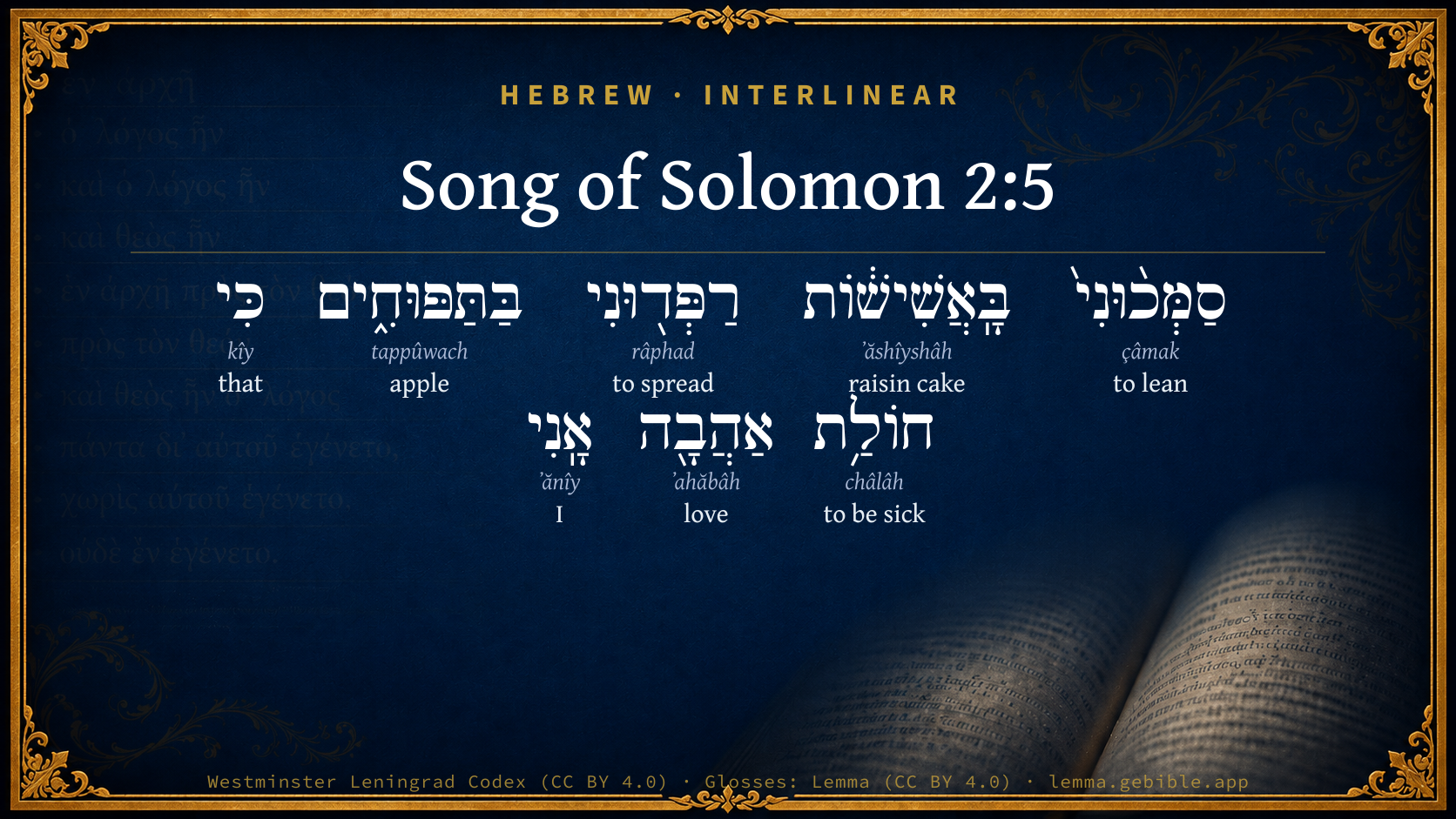
Song of Solomon 2:5

Hebrew (Westminster Leningrad Codex) Song of Solomon 2:5 appears in the Hebrew Old Testament. The text above is from the Westminster Leningrad Codex. Each word links to its Strong’s number, a concise gloss, and parsing drawn from the Open Scriptures Hebrew Bible morphology. Click any word for its full Brown-Driver-Briggs (BDB) entry.
Download image
Cite this verse

Song of Solomon 2:5 (World English Bible). Public Domain. Lemma interlinear Bible study tool, https://lemma.gebible.app/v/song-of-solomon/2/5.

Show BibTeX & RIS
BibTeX
RIS
English Translation
Strengthen me with raisins, Refresh me with apples; For I am faint with love.
World English Bible · Public Domain
Download a study sheet

One document with this verse’s original text, its word-by-word gloss line, the meaning frame, cross-references with their text, attributed commentary, and full source and license credits — printable, and it pastes into notes with its structure intact.

This verse Autodidact and up

Study sheet (.html) Plain text (.txt)

A passage Seminary Student

Up to 50 verses in one chapter. A passage sheet keeps up to 6 commentary sources and 12 cross-references per verse, in the order this page ranks them, and says so on the sheet whenever that leaves anything out. Ask for a single verse and you get the Autodidact verse sheet above.

Everything on this page stays free to read, with no account — the sheet is a download of what is already on screen, not access to it.

Want to remove ads? Support Godless Engineer
Compare translations 3

The same verse in 3 English versions, stacked beneath the original-language interlinear above. Click any original word for its lexicon entry.

Each is an independent rendering of the whole verse — the interlinear is not word-aligned to these translations.

Highlighted words mark where these versions differ — a whole-verse word diff, not a word-by-word alignment.

  • World English Bible Public Domain
    Strengthen me with raisins, Refresh me with apples; For I am faint with love.
  • King James Version Public Domain
    Stay me with flagons, comfort me with apples: for I am sick of love.
  • unfoldingWord Literal Text CC BY-SA 4.0
    Sustain me with raisin cakes; refresh me with apples, for sick with love I!

unfoldingWord Literal Text — © unfoldingWord, licensed CC BY-SA 4.0. Word-aligned USFM3 via Door43 (git.door43.org/unfoldingWord/en_ult).

Versions to compare (up to 4)

3 of 4 selected

Show all 18 translations

Every available English version of this verse, each an independent rendering of the whole verse.

  • World English Bible Public Domain
    Strengthen me with raisins, Refresh me with apples; For I am faint with love.
  • Berean Standard Bible Public Domain
    Sustain me with raisins; refresh me with apples, for I am faint with love.
  • Majority Standard Bible Public Domain
    Sustain me with raisins; refresh me with apples, for I am faint with love.
  • King James Version Public Domain
    Stay me with flagons, comfort me with apples: for I am sick of love.
  • American Standard Version (1901) Public Domain
    Stay ye me with raisins, refresh me with apples; For I am sick from love.
  • Revised Version (1885) Public Domain
    Stay ye me with raisins, comfort me with apples: for I am sick of love.
  • Geneva Bible (1599) Public Domain
    Stay me with flagons, and comfort me with apples: for I am sicke of loue.
  • Douay-Rheims (1899) Public Domain
    Stay me up with flowers, compass me about with apples: because I languish with love.
  • Young's Literal Translation Public Domain
    Sustain me with grape-cakes, Support me with citrons, for I `am' sick with love.
  • Literal Standard Version CC BY-SA 4.0
    Sustain me with grape-cakes, || Support me with citrons, for I [am] sick with love.
  • Unlocked Literal Bible CC BY-SA 4.0
    Revive me with raisin cakes and refresh me with apricots, for I am weak with love.
  • unfoldingWord Literal Text CC BY-SA 4.0
    Sustain me with raisin cakes; refresh me with apples, for sick with love I!
  • Darby Bible Public Domain
    Sustain ye me with raisin-cakes, Refresh me with apples; For I am sick of love.
  • World Messianic Bible Public Domain
    Strengthen me with raisins, refresh me with apples; for I am faint with love.
  • Webster's Bible Public Domain
    Stay me with flagons, comfort me with apples: for I am sick with love.
  • Free Bible Version CC BY-SA 4.0
    Feed me raisins to give me energy, give me apples to revive me, for love has made me weak!
  • Bible in Basic English Public Domain
    Make me strong with wine-cakes, let me be comforted with apples; I am overcome with love.
  • JPS Tanakh (1917) Public Domain
    'Stay ye me with dainties, refresh me with apples; for I am love-sick.'

Literal Standard Version (2020), Covenant Press — licensed CC BY-SA 4.0. Text via the HelloAO Bible API (eBible.org). Unlocked Literal Bible (unfoldingWord) — licensed CC BY-SA 4.0. Text via the HelloAO Bible API (eBible.org). unfoldingWord Literal Text — © unfoldingWord, licensed CC BY-SA 4.0. Word-aligned USFM3 via Door43 (git.door43.org/unfoldingWord/en_ult). Free Bible Version, Dr. Jonathan Gallagher — licensed CC BY-SA 4.0. Text via the HelloAO Bible API (eBible.org).

Word by word

More ways to search: Search by grammar → Find every occurrence → Compare this word →

Practice this passage: Drill this verse → Learn its vocabulary →

רַפְּד֖וּנִי
râphad
H7502
“spread · me”
Verb, Piel, Imperative, 2nd Person, Masculine, Plural + Suffix, Personal, 1st Person, Common, Singular
Part of Speech
Verb
Stem
Piel
Form
Imperative
Person
2nd Person
Gender
Masculine
Number
Plural
Full BDB Definition

Origin: a primitive root

TWOT: 2197

to spread - (Qal) to spread - (Piel) to spread out, support
  1. סַמְּכ֨וּנִי֙ çâmak H5564 “lean · me” Verb, Piel, Imperative, 2nd Person, Masculine, Plural + Suffix, Personal, 1st Person, Common, Singular
  2. בָּֽאֲשִׁישׁ֔וֹת ʼăshîyshâh H809 “in/at the · raisin cakes” Preposition, Determined + Noun, Common, Feminine, Plural, Absolute
  3. בַּתַּפּוּחִ֑ים tappûwach H8598 “in/at the · apples” Preposition, Determined + Noun, Common, Masculine, Plural, Absolute
  4. כִּי kîy H3588 “that” Conjunction
  5. חוֹלַ֥ת châlâh H2470 “being sick” Verb, Qal, Participle Active, Feminine, Singular, Construct
  6. אַהֲבָ֖ה ʼahăbâh H160 “love” Noun, Common, Feminine, Singular, Absolute
  7. אָֽנִי ʼănîy H589 “I” Pronoun, Personal, 1st Person, Common, Singular

About this verse

These counts appear in no published source. They are computed here, from the morphology-tagged text and Lemma’s own curated glosses. What Lemma adds →

8
words
8
distinct lemmas
Wisdom
section

Notable vocabulary

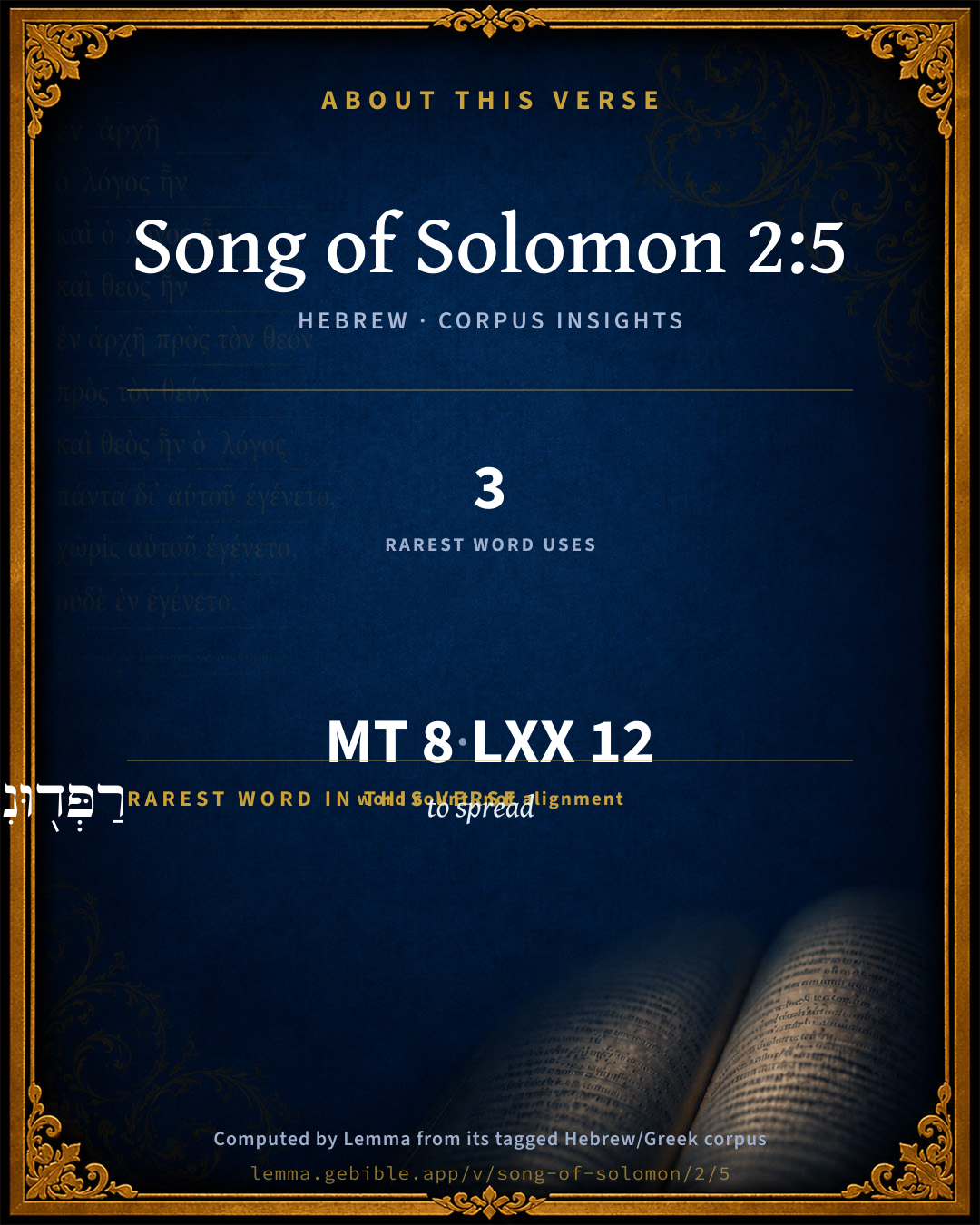
The rarest word here is רַפְּד֖וּנִי to spread H7502 — appearing just 3 times in the whole Hebrew Bible.

Shared distinctive vocabulary

רַפְּד֖וּנִי to spread H7502 occurs in 3 verses of the Hebrew Bible. Also found in:

Grammatical profile

  • 3 verbs
  • 3 nouns
  • 1 pronoun
  • 1 conjunction

Verb forms

  • סַמְּכ֨וּנִי֙ Piel · Imperative
  • רַפְּד֖וּנִי Piel · Imperative
  • חוֹלַ֥ת Qal · Participle Active

Hebrew & Septuagint length

In English translation the verse runs 14 words from the Hebrew and 14 from the Septuagint (LXX English) — the same length.

A rough comparison of the two English renderings, which tokenize alike — not a word-level alignment.

Word counts can differ between the Hebrew and the Greek without any difference in meaning — e.g. the Hebrew direct-object marker אֵת has no separate Greek word, and Greek often adds the article ὁ.

In the original languages it is 8 Hebrew tokens and 12 Greek tokens — but the two are counted differently (Hebrew bundles its prefixes and suffixes into one token; the Greek is in lemma form), so that isn’t a like-for-like length.

Cross-references

14

Topical passages linked to Song of Solomon 2:5 in the Treasury of Scripture Knowledge — connected by theme and wording, ordered by reader-vote popularity; previews shown in the World English Bible.

  • Song of Solomon 5:8 I adjure you, daughters of Jerusalem, If you find my beloved, That you tell him that I am faint with love. Friends
  • 2 Samuel 6:19 He dealt among all the people, even among the whole multitude of Israel, both to men and women, to everyone a cake of bread, and a portion [of flesh], and a cake of raisins. So all the people departed everyone to his house.
  • Hosea 3:1 Yahweh said to me, "Go again, love a woman loved by another, and an adulteress, even as Yahweh loves the children of Israel, though they turn to other gods, and love cakes of raisins."
  • 2 Samuel 13:1–2 It happened after this, that Absalom the son of David had a beautiful sister, whose name was Tamar; and Amnon the son of David loved her.
  • Psalms 4:6–7 Many say, "Who will show us any good?" Yahweh, let the light of your face shine on us.
  • Psalms 42:1–2 As the deer pants for the water brooks, So my soul pants after you, God.
  • Psalms 63:1–3 God, you are my God. I will earnestly seek you. My soul thirsts for you, My flesh longs for you, In a dry and weary land, where there is no water.
  • Psalms 63:8 My soul stays close to you. Your right hand holds me up.
  • Psalms 119:130–131 The entrance of your words gives light. It gives understanding to the simple.
  • Song of Solomon 7:8 I said, "I will climb up into the palm tree. I will take hold of its fruit." Let your breasts be like clusters of the vine, The smell of your breath like apples, Beloved
  • Isaiah 26:8–9 Yes, in the way of your judgments, Yahweh, have we waited for you; to your name, even to your memorial [name], is the desire of our soul.
  • Luke 24:32 They said one to another, "Weren't our hearts burning within us, while he spoke to us along the way, and while he opened the Scriptures to us?"
  • Philippians 1:23 But I am in a dilemma between the two, having the desire to depart and be with Christ, which is far better.
  • 1 Chronicles 16:3 He dealt to everyone of Israel, both man and woman, to every one a loaf of bread, and a portion [of flesh], and a cake of raisins.

Cross-references courtesy of OpenBible.info (CC BY 4.0).

Hebrew and Greek witnesses Masoretic Hebrew ↔ Greek Septuagint

The same verse in the two great witnesses to the Old Testament, shown verse-for-verse.

These are two independent witnesses, not word-aligned to each other, and the Septuagint is shown in lemma (dictionary) form.

Hebrew Song of Solomon 2:5 Masoretic · Westminster Leningrad Codex

סַמְּכ֨וּנִי֙ בָּֽאֲשִׁישׁ֔וֹת רַפְּד֖וּנִי בַּתַּפּוּחִ֑ים כִּי חוֹלַ֥ת אַהֲבָ֖ה אָֽנִי

Strengthen me with raisins, Refresh me with apples; For I am faint with love.

World English Bible · Public Domain

Greek LXX Song of Solomon 2:5 Septuagint · lemma form

στηρίζω ἐγώ ἐν ἄμορος στοιβάζω ἐγώ ἐν μῆλον ὅτι τιτρώσκω ἀγάπη ἐγώ

Strengthen me with perfumes, stay me with apples: for I am wounded with love.

LXX2012 (modern English Septuagint) · Public Domain

On this verse, Ellicott's Commentary for English Readers discusses the Septuagint’s reading. Read the note in Commentary ↓

Hebrew: Westminster Leningrad Codex (CC BY 4.0). Greek: Septuagint (public domain); English from LXX2012 (modern English Septuagint) (Public Domain). How the Septuagint differs from the Hebrew →

Commentary

Notes on Song of Solomon 2:5 from classic Christian and Jewish commentators (each source and its license shown beneath its notes). The classic Christian expositions comment on the surrounding passage and are grouped to its opening verse, so a note may address several verses; the Jewish commentaries on the Tanakh (Rashi and others) are per-verse, so they appear only where the commentator wrote on this verse.

Lemma curates 59 commentaries, every one of them public domain or Creative Commons licensed, each selected and text-cleaned for this edition rather than reprinted as found. About our sources →

Trapp's Complete Commentary

John Trapp

Son 2:5 Stay me with flagons, comfort me with apples: for I [am] sick of love.

Ver. 5. Stay me with flagons.] Not with cups or bowls only, but with flagons, larger measures of that wine that was set before her in Christ’s wine house. "Comfort me with apples," such as fall from Christ’s apple tree, spoken of in the former verse, the precious mellifluous promises, which are sweet, like the apples of the garden of Eden, as the Chaldee here hath it. ‘Bolster me up’ with these; for I am even sinking and swooning with an excess of love, with an exuberance of spiritual joy in God my Saviour, such as I can hardly stand under. Stay me therefore, saith she to the ministers, those pillars to "support the weak," {Gal 2:10} and to "comfort the feeble minded." {1Th 5:14} "Stay me, or sustain me, with flagons, comfort me with apples." Solinus {a} tells of some near the river Ganges that live odore pomorum sylvestrium, by the smell {b} of forest apples, which is somewhat strange.

For I am sick of love.] Surprised with a love qualm, as an honest virgin may be, meeting her love unawares, enjoying him in the fulness of joy, and fearing the loss of his company for a long season. This is timor amicalis, which Lombard {c} thus describeth, Ne offendamus quem diligimus, et ne ab eo separemur, The fear of love is, lest we should offend him whom our soul loveth, and so cause him to withdraw. Hic timor transit in charitatem, saith Gregory, This fear passeth into love, and overwhelms the spirit sometimes. This was it that made Jacob, when he saw nothing but visions of love and mercy, cry out, "How dreadful is this place!" This made that mixture of passions in those good women, that, coming to look for Christ, departed from the grave "with fear and great joy." From this cause it was that Bernard, for a certain time after his conversion, remained as it were deprived of his senses by the excessive consolations he had from God. {d} Cyprian {e} writes to his friend Donatus, that before his conversion he thought it impossible to find such raptures and ravishments as now he did in a Christian course. He begins his epistle thus, Accipe quod sentitur antequam discitur, &c.; Augustine {f} saith the like of himself. What inconceivable and unutterable ecstacies of joy, then, may we well think there is in heaven, where the Lord Christ perpetually, and without intermission, manifesteth the most glorious and visible signs of his presence and seals of his love! He pours forth all plenteous demonstrations of his goodness to his saints, and gives them eyes to see it, minds to conceive it; and then fills them with exceeding fulness of love to him again, so that they swim in pleasure, and are even overwhelmed with joy - a joy too big to enter into them, they must "enter into it." {Mat 25:21} Oh pray! pray with that great apostle that had been in heaven, and seen that which eye never saw, that "the eyes of your understanding being enlightened, you may know the love of Christ, which passeth knowledge, and what is the riches of the glory of his inheritance in the saints." {Eph 1:18; Eph 3:19} A glory fitter to be believed than possible to be discoursed. {g} "An exceeding excessive eternal weight of glory." {2Co 4:17} Such a weight, as if the body were not upheld by the power of God, it were impossible but it should faint under it. How ready are our spirits to expire here, when any extraordinary unexpected comfort befalls us! The Church is "sick of love." Jacob’s heart fainted when he heard of Joseph’s life and honour in Egypt. The Queen of Sheba was astonished at Solomon’s wisdom and magnificence, so that she had no spirit more in her. Viscount Lisley, in Henry VIII’s time, died for joy of an unexpected pardon. What then may we think of those in heaven? And should not we hasten in our affections to that happy place? Oh do but think, saith one, though it far pass the reach of any mortal thought, what an infinite, inexplicable happiness it will be, to look for ever upon the glorious body of Christ, shining with incomprehensible beauty, far above the brightest cherub, and to consider that even every vein of that blessed body bled to bring thee to heaven! Think of it, I say, and then exhale thyself in continual sallies, as it were, of most earnest desires "to be dissolved [αναλυσαι], and to be with Christ, which is far the better." {Php 1:23} As in the meanwhile, let thy soul sweetly converse with him in all his holy ordinances, but especially at his holy table, where he saith unto thee, as once to Thomas, "Reach hither thy hand, and thrust it into my side, and be not faithless, but believing." Let thy soul also there reciprocate and say, "My Lord and my God!" "Whom have I in heaven but thee? and in earth, none in comparison of thee." {Psa 73:25} "Rabboni," "Come quickly."

{a} Poly. Hist., cap. 56.

{b} Smelling salts are applied to the nostrils of those who faint.

{c} Lomb. Sent., lib. iii. distinc. 34. Vide August. Epist., 121, ad Honorat.

{d} Gosr. in Vita Bern.

{e} Epist., lib. i.

{f} Confess, lib. vi. cap. 22.

{g} Verbis exprimi non potest, experimento opus est. - Chrys.

John Trapp, A Commentary or Exposition upon All the Books of the Old and New Testament (1647–1656) — public domain. Text from a community e-Sword module.

The Biblical Illustrator

Joseph S. Exell

Son_2:5

Comfort me with apples.

An apple

The term apple is a conventional one. By the ancients it was applied indiscriminately to every round fleshy fruit. We require to take into account this extended application of the term, in order to understand the metaphorical allusions to the apple in ancient poetry, classical and oriental. The apple occurs several times in the Bible, but there is abundant reason to believe that it is in almost every case a mistranslation of a word which should have been rendered citron, orange, or quince. The East is not the true home of the apple. It is essentially a Western fruit, the product of the cooler air and moister skies of the north temperate zone. The wild crab-apple, from which all the cultivated varieties have sprung, is a native of most of the countries of Europe; and the development of the fruit has engaged the attention of their inhabitants as far back as we can trace. The tree does not grow wild in the East as it does in our hedges and woodlands, and the ancient Jews were altogether ignorant of apples such as we know them. The apple is appropriately associated by popular tradition with the paradisiacal condition of man, for it belongs to an order of plants that was introduced into the world about the human period. Nature in former epochs had run into rank, luxuriant foliage, but she blossomed and fruited when man came upon the scene. There is a profound relation between the efflorescence of the earth and that of the human soul. The fullest significance of flowers and fruits can only be seen in the life of man, for the illustration of which they furnish innumerable expressive images and analogies. The apple belongs not only to the latest, but also to the highest order of plants. This order is the Rosaceoe, which for beauty of colour, grace of form, perfection of structure, and great and manifold utility, takes precedence of all others. Looking at an apple from a morphological point of view, we find that it is an arrested branch. Instead of going on to develop more wood and foliage, a branch terminates in an apple; and in this apple the sap and substance that would have prolonged the branch are concentrated, and hence its enlarged size and capability of expansion. Looking upon an apple thus as an arrested branch, the branch giving up its own individual life in order that the species may he perpetuated by means of blossom, and fruit, and seed, we behold in it, as in a glass, a very striking natural example of the law of self-sacrifice; that law which pervades all nature, and upon which the welfare and stability of nature depend. And it is a most interesting circumstance, that it is in this self-sacrifice of the plant that all its beauty comes out and culminates. The blossom and fruit in which it gives its own life for another life that is to spring from it are the loveliest of all its parts. God crowns this self-denial and blessing of others with all the glory of colour, and grace of form, and sweetness of perfume, and richness of flavour. The flesh of the apple, it may be remarked, has no purpose to serve in the economy of the plant itself. It is merely an excretion of the plant, produced in large measure by cultivation. And surely this capability of developing flesh which certain fruits possess in relation to the wants of man is one of the most interesting subjects of thought. In this respect man is a fellow-worker with God, in dressing and keeping the great garden of nature so that there shall be trees in it good for food and pleasant to the taste. The nature bound fast in fate has been made fluent by the freedom of the human will; and all the hints and outlines suggested by her roots, and fruits, and flowers are worked out and filled in by man in the exercise of this wondrous Divine gift. Passing strange is it that through this same freedom of will, he should, in the higher moral region, instead of being a fellow-worker with God, be less true to his proper end and destiny than the beasts that perish to their several instincts. Why is an apple round? The circular shape is that in which forces and substances are most perfectly balanced--in which there is the greatest economy of material, and the greatest resistance to external circumstances. It is the most stable of all forms, and therefore, characteristic of bodies in repose. The whole heavens and the whole earth are continually aiming at the spherical form; and they fall to reach or retain it because of their want of repose, insisting upon a shortcoming or departure from the spherical. Thus the apple becomes to us a very significant object, when we see in its round form a striking illustration of the same law that is shaping the earth around us, and the heavens above us, and the heart within us. The skin or rind which hems in the apple, and by limiting completes and individualizes it, is also a most significant feature. It varies in thickness, smoothness, quality of texture, and colour in different varieties of apple; but in all it may be said to pass through the different stages of leaf and flower like the plant that bears it. Wonderful is the ministry of the green skin of plants. It changes inorganic into organic matter, and thus furnishes the starting-point of all life. Nowhere else on the face of the earth does this most important process take place. Everything else consumes and destroys; the green skin of plants alone creates and conserves. It is the mediator between the world of death and the world of life. Hence the significance of the green colour which appears so vividly in all young growing plants. We thus see that the little globe of the apple is a microcosm, representing within its miniature sphere the changes and processes which go on in the great world. Life and death, growth and decay, fight their battle on its humble stage. Fermentation and putrefaction, the two great processes under whose familiarity are hid some of the greatest wonders of the physical world, take place within it. It exhibits the characteristics of the vegetable, animal, and mineral kingdoms; it creates organic matter, and it consumes it; and in its motion within its little orbit, from its formation on the bough in summer to its fall to the ground in autumn, it illustrates the action of the mighty laws which bind the universe together. Our greatest philosopher, by his sublime theory of gravitation, connected it with the stars of heaven; and to avery thoughtful mind it suggests far-reaching ideas which shed light upon the mysteries of ore own world. (H. Macmillan, D. D.)

The Biblical Illustrator, edited by Joseph S. Exell (c. 1880s–1900s) — public domain. Text from a community e-Sword module.

Tyndale Open Study Notes

Tyndale Open Resources

2:5-6 The woman’s love is intense, his love overwhelming. • If the Song is an anthology, the couple can be seen as married, and lovemaking is seen as so physically exhausting that she grows faint and calls for the sustenance of raisin cakes and apples. These foods were considered aphrodisiacs in the ancient Near East. • Strengthen me: She now depends on him to revive her with the fruit of the earlier image—he is the apple tree, so he can provide apples for her renewed strength. • His left arm is under my head: He tenderly supports her with his embrace as they lie together (see also 8:3).

Tyndale Open Study Notes — © Tyndale Open Resources, licensed CC BY-SA 4.0. Text via the HelloAO Bible API.

Adam Clarke's Commentary

Verse 5. Stay me with flagons] I believe the original words mean some kind of cordials with which we are unacquainted. The versions in general understand some kind of ointment or perfumes by the first term. I suppose the good man was perfectly sincere who took this for his text, and, after having repeated, Stay me with flagons, comfort me with apples, for I am sick of love sat down, perfectly overwhelmed with his own feelings, and was not able to proceed! But while we admit such a person's sincerity, who can help questioning his judgment?

Adam Clarke's Commentary on the Bible (1810–1826) — public domain. Text from a community e-Sword/MySword module.

Ellicott's Commentary for English Readers

(5) Flagons.—Heb., ashishôth, apparently a dried cake, but of what substance is uncertain. From the margin of Hos_3:1, possibly “grape cakes.” In 2Sa_6:19 it occurs as one of the gifts distributed by David at the removal of the ark, and is rendered by the LXX., a cake from the frying-pan. Here the LXX. have sweet unguents, and the Vulg. flowers. The Authorised Version, flagons, follows a Rabbinical interpretation.

Comfort.—The margin, straw me with apples, follows the LXX.; the Hebrew word occurs in Job_17:3; Authorised Version, “make my bed”—Job_41:30 (Heb. 22). Authorised Version, “spreadeth.” Hence some translate here, “make me a bed of apple-leaves;” but the parallelism is against this, and the root idea in both the words translated “comfort” and “stay” is putting a prop or support under. Metaphorically = refresh or sustain.

A Bible Commentary for English Readers, edited by Charles John Ellicott (1878–1897) — public domain. Text from a community e-Sword module.

The Cambridge Bible for Schools and Colleges

gen. ed. J. J. S. Perowne

5. flagons] The Heb. ’ashîshôth means raisin cakes, cp. Hos_3:1, and is connected possibly with Arab. ’assasa, ‘to found’ or ‘establish,’ and so ‘cakes of pressed fruit.’ The LXX translate ἐν μύροις and the Vulg. floribus, under the impression that the Shulammite calls for restoratives to prevent fainting, just as smelling-salts are used in our day. But that can hardly be the case, as ’ashîshôth would not be suitable for this purpose, nor apples either, though, as we have seen, the sick desire apples for their smell. Her love and longing have brought her into a state of physical weakness, to bear up against which she needs stimulating and sustaining food. This the raisin cakes and apples would supply. The ‘flagons’ of the A.V. is derived from the Rabbinic commentators, cp. Ibn Ezra on this verse, “ashîshôth, vessels of glass full of wine.” But there is no support for it.

sick of love] i.e. weakened and made faint by hope deferred and disappointed longing. Delitzsch’s idea that she is fainting because of excessive delight is less likely. A country girl would scarcely be liable to an excess of weakness demanding restoratives of this kind from such a cause.

The Cambridge Bible for Schools and Colleges (gen. ed. J. J. S. Perowne; Cambridge University Press, 1878–1918) — public domain. Text from a community e-Sword module.

Haydock's Catholic Bible Commentary

Flowers. Hebrew, "bottles." --- Languish. Septuagint, "am wounded." (Haydock) --- Those who enter upon the paths of virtue, are often deprived of consolations. (Calmet) --- They must support themselves by reflecting on the words and sufferings of Christ. (St. Ambrose, psalm cxviii. ser. 5.) (Bossuet)

George Leo Haydock (1774–1849), Haydock's Catholic Family Bible and Commentary, 1859 edition — public domain. Excludes Psalms (Douay-Rheims chapter numbering differs from Protestant) and Deuterocanonical books (Catholic canon only).

Matthew Poole's English Annotations

Stay me; or, support me; keep me from sinking or fainting. The spouse speaks this to her bridemaids, the daughters of Jerusalem, as it is expressed, Son 2:7, or to the servants or friends of the Bridegroom there waiting, and to the Bridegroom himself; as a person ready to faint cries to any or all that are near to him or her for help.

With flagons; with wine, which is a good cordial, Psa 104:15; Pro 31:6,7, and which was there present, Son 2:4. Flagons are here, and 1Ch 16:3, put for flagons of wine, as it is fully expressed, Hos 3:1, or for the wine contained in them, as the cup is put for wine, Luk 22:20, by a common metonymy.

Comfort me with apples; with odoriferous apples, such as pomegranates, or the like, the smell whereof was grateful and useful to persons ready to faint. By these metaphors understand the application of the promises, and the comfortable and quickening influences of the Spirit.

I am sick of love; either,

1. With transports of joy, which sometimes causes a fainting of the spirits, as Gen 45:26; 1Ki 10:5. Or,

2. With grief for his departure from her, of which we read Son 3:1,2, or for fear of it. Or rather,

3. With ardent desire of a stricter union, and clearer discoveries of his love, and perfect and uninterrupted communion with him in glory. That sickness is sometimes the effect of love hath been oft observed by physicians.

Matthew Poole's English Annotations on the Holy Bible (1683–1685) — public domain. Text from a community e-Sword/MySword module.

Whedon's Commentary on the Bible

Daniel D. Whedon

5. Flagons — A difficult word, but, probably, a species of cake, apparently of pressed grapes, — grapecakes. It can hardly be thought that she calls for these “cakes” and “apples” in a literal sense. Her heart fainteth, and Love’s own cordials only can minister to her relief.

Daniel D. Whedon (gen. ed.), Commentary on the Old and New Testaments (1874–1909) — public domain. Text from a community e-Sword module.

The Pulpit Commentary

Stay me with raisins, comfort me with apples: for I am sick of love. Again the intensive form of the verb is chosen. She is almost sinking; she cries out for comfort. The food for which she longs is the grape cakes the grapes sufficiently dried to be pressed together as cakes, which is very refreshing and reviving; not raisins as we know them, but with more of the juice of the grape in them. So date cakes are now offered to travellers in the East. "Refresh me; for I am in a state of deep agitation because of the intensity of my love." Ginsburg thinks the cakes are baked by the fire, the word being derived from a root "to burn." The translation, "flagons of wine," in the Authorized Version, follows the rabbinical exposition, but it is quite unsupported by the critics. Love sickness is common in Eastern countries, more so than with us in the colder hemisphere. Perhaps the appeal of the bride is meant to be general, not immediately directed to the king, as if a kind of exclamation, and it may be connected with the previous idea of the banner. The country maiden is dazzled with the splendour and majesty of the king. She gives up, as it were, in willing resignation of herself, the rivalry with one so great and glorious in the expression of love and praise; she sinks back with delight and ecstasy, calling upon any around to support her, and Solomon himself answers the appeal, and puts his loving arm around her and holds up her head, and gives her the sweetest and tenderest embraces, which renew her strength. We know that in the spiritual life there are such experiences. The intensity of religious feeling is closely connected with physical exhaustion, and when the soul cries for help and longs for comfort, the presence of the Saviour is revealed; the weakness is changed into strength. The apostolic seer in the Apocalypse describes himself as overcome with the glory of the Saviour"s appearance, and being brought back to himself by his voice. (Rev_1:17)

Vers. 5-7. Faint for love.

Keeping to the spiritual, not the historical, interpretation, these verses suggest what is common to all, but confessed here only by the saintly soul.

I CHRIST SHARES IT. He said when on the cross, "I thirst," and that told not alone of his physics thirst, but of that sacred, insatiable, and still unsatisfied thirst for the love of human hearts. He could say, "I am faint for love." And yet he yearns for that love, though much he already possesses, and will more and more. The Passion was but as a picture thrown upon a sheet to make clear and conspicuous to all what else they had not seen. So the sufferings of Christ serve to show not what was once, but what eternally is, in the heart of Christ this yearning for man"s love. The Holy Spirit, the unseen and spiritual Christ, is yet on earth amongst men; and yet, as he pleads with them, is grieved and done despite to, as he was in the days of his flesh. His thirst is not yet satisfied; all the loving invitations of the gospel prove this. It is our joy to believe that the day will dawn when, though now, as ever in the past, faint for man"s love, he will "see of the travail of his soul, and be satisfied." Be it ours to hasten that day!

II THE WORLD ALSO, BUT KNOWS NOT WHAT IT NEEDS. The love of Christ is what the world wants, though it wanders wearily off, as it has done from the beginning, after what it foolishly deems will satisfy its need. All the unrest, the agitation, the seething discontent, the wild rush after this scheme and that, which promise its betterment, all show how great its need, and how yet that need remains unmet. If the Church of Christ on earth were but what its name professes, soon would the weary world see where all its wants would find supply, and turn to him for whose love it is that it faints, and is so wretched and woebegone. It needs that love to be the animating principle of Christian people, in their conversation, conduct, habits, business, and ways; which assuredly it is far enough from being at present, else why is society as it is? why are there "submerged tenths" and "darkest Englands," as we know there are? Is this the outcome of a C hristian civilization? No; only the natural product of a civilization which is everything but Christian. And yet more, the world needs Christ"s love in themselves. For lack of that it is as it is.

III BUT SPECIALLY THE CHRISTIAN SOUL. And the confession of faintness for his love may be true:

1. In a sad sense. If such soul be faint, as many are, incapable of real service, weakly, ineffectual, and impoverished, is not the true and sad cause revealed in this confession? As plants cannot grow without the light and warmth of the sun, so Christian souls cannot prosper that do not come into and "continue in" Christ"s love. But the confession as made here is not in a sad sense, but:

2. In a very blessed one. It is the very presence of his love in the soul that leads to the longing for deeper enjoyment of it. "My soul breaketh for the longing that it hath after thy commandments at all times;" "My soul longeth, yea, even fainteth, for the courts of the Lord;" and Psa_63:1, are all similar expressions. Great saints have all of them known this holy longing, this going out of the soul after God in great vehemency of desire; and blessed, blessed indeed, are they. My soul, be thou of their number! And such revelations of the Lord"s grace often affect the body as well as the soul, causing faintness and overwhelming emotion. (cf. Dan_10:8 Jud_1:6:22 Rev_1:12-18 2Co_12:7, in illustration of this)

3. But in such faintness the soul craves support. This is suggested by the request made (ver. 5), "Stay me with cordials, comfort me with citrons." These were the refreshments she had enjoyed when "under his shadow," and when she ate of the "fruit sweet to her taste" (ver. 3). Translated into their spiritual meaning, they tell of those precious truths and teachings which come from and cluster round the cross of Christ. The soul would drink again of such "cup of salvation," and eat of the fruit of such "tree of life." It was the power of those truths, brought home by the Holy Spirit, that heretofore had quickened and sustained the soul, and hence they are desired again. And they seem to have been partaken of, (cf. Pro_31:6) and the soul to have been thereby brought again to the rich enjoyment of the Divine love. And:

4. It finds what it has so earnestly desired. (Ver. 6) "As in the embraces of my God, Or on my Saviour"s breast.

This sacred enfolding of the soul in the love of God is the meaning of the verse, or, at least, the designed teaching. Think what must have been the joy of the penitent prodigal when, after his weary journey, he found thrown around him, in loving welcome, the arms of his father, against whom he had so sinned; and on his brow the father"s kiss. That rapture of the soul when it is filled with the sense of the Divine love, these are the embraces of God and the fulfilment of the well known words, "He fell on his neck, and kissed him." That part of the parable which tells of the prodigal"s yearning for home, the weary journey, and then the welcome, may be taken as the gospel commentary on these verses. And the soul shall be enfolded in this Divine love; it shall not be taint for it, and ever continue so. For the next verse tells:

5. How the soul is anxious not to be disturbed in its blessed condition until the Lord will. The maiden of the song is represented as addressing a passionate adjuration to her companions, "by the roes and hinds that is, by all beautiful, loving, timid, and easily startled things, as these were that they should not awaken her beloved from his repose until he will. And so the soul that rests in the realization of God"s love would linger therein. "My willing soul would stay In such a frame as this.

And this side of heaven there is no such joy to be realized as this. Alas! how rare it is, or rather, how rarely we find it, though we might if we would! Still, the soul knows that its life is not to be all enjoyment. Service has to be rendered. The disciples would have liked to stay on the Mount of Transfiguration; they said, "It is good to be here;" but the poor lunatic lad down below needed healing, and therefore neither their Lord nor they might linger where they were. Hence, though the soul would rest always in the joy of his realized love, yet it may, probably will, as with Paul, be sent forth to stern duty and patient toil. Therefore it is added, "until he please." "O Love Divine, how sweet thou art! When shall I find my willing heart All taken up by thee? S.C.

The Pulpit Commentary (1880–1919), ed. H.D.M. Spence-Jones & Joseph S. Exell — public domain. Text from a community e-Sword module.

John Wesley's Explanatory Notes

Stay me - Or, support me, keep me from fainting. The spouse speaks this to her bride-maids, the daughters of Jerusalem: or to the bridegroom himself. Flaggons - With wine, which is a good cordial. Apples - With odouriferous apples, the smell whereof was grateful to persons ready to faint. By this understand the application of the promises, and the quickening influences of the Spirit.

John Wesley, Explanatory Notes Upon the Whole Bible (1754–1765) — public domain. Text via the GEBible commentary corpus.

unfoldingWord translationNotes

Door43 World Missions Community

Revive me

"Return my strength" or "Give me energy"

with raisin cakes

"by giving me raisin cakes to eat." Raisin cakes were cakes made of dried grapes pressed together.

refresh me with apricots

"support me by giving me apricots" or "help me by giving me apricots"

for I am weak with love

The woman speaks of feeling weak because her love is so strong as if love were a kind of sickness. AT: "because my love is so strong that I feel feeble" (See: Metaphor)

left hand ... right hand

"left arm ... right arm"

embraces me

"holds me"

translationWords

love

unfoldingWord translationNotes — © Distant Shores Media and the Door43 World Missions Community, licensed CC BY-SA 4.0. Source: git.door43.org/Door43/en_tn.

Rashi

Rabbi Shlomo Yitzchaki (Rashi)

Sustain me now as is the manner of the sick, with flagons of grape wine or with cakes of pure white flour.

spread my bed Spread my bed around me with apples for a good fragrance, in the manner of the sick, for I am sick for his love, for I thirst for Him here in my exile. רְפִידָה is an expression of a couch, like (Job 41:22): “where he lies (יִרְפַּד) is gold upon the mire.”

Rashi on the Tanakh — English translations: “The Judaica Press complete Tanach with Rashi, translated by A. J. Rosenberg” (CC BY 4.0); “Pentateuch with Rashi's commentary by M. Rosenbaum and A.M. Silbermann, 1929-1934” (public domain); “The Metsudah Tanach series, Lakewood, N.J” (CC BY 4.0); and “The Book of Joshua, Metsudah Publications, 1997” (CC BY 4.0). Text via Sefaria.

Lesson kit

Teaching starters — assembled from the data on this page, not authored interpretation. Every prompt links to the verse data it draws on. Edit before teaching.

Song of Solomon, in the Wisdom, opens this verse with 8 words (8 distinct Hebrew lemmas). Its most distinctive word is râphad (“to spread”). A historical commentator’s framing appears above. Read the whole chapter for the surrounding context.

Discussion questions

  1. What does “to spread” (râphad) contribute to the verse as a whole?
  2. Job 17:13 shares the word «to spread» with this verse. How do the two illuminate each other?
  3. These translations render this verse differently. What is at stake in choosing one wording over another?
  4. The verb «סַמְּכ֨וּנִי֙» is Piel Imperative. How does its form color the action?
  5. Reading how Trapp's Complete Commentary and The Biblical Illustrator read this verse, where do the two commentators agree and where do they part?

Things to notice

Reading settings

Reading text

Shown beneath each verse's original-language words.

Old Testament
Old Testament edition

Read the OT as the Masoretic Hebrew (MT) or the Greek Septuagint (LXX).

English shown for the Greek Septuagint (in the Hebrew ↔ Greek comparison).

Comparing translations? Open the Compare panel on any verse page to stack up to four side by side.