2 Timothy 3:10

Greek (Tischendorf 8th ed.) 2 Timothy 3:10 appears in the Greek New Testament. The text above is from the Tischendorf 8th edition. Each word links to its Strong’s number and a concise gloss. Click any word for its full Thayer’s Greek Lexicon entry.
Download image
Cite this verse

2 Timothy 3:10 (World English Bible). Public Domain. Lemma interlinear Bible study tool, https://lemma.gebible.app/v/2-timothy/3/10.

Show BibTeX & RIS
BibTeX
RIS
English Translation
But you did follow my teaching, conduct, purpose, faith, patience, love, steadfastness,
World English Bible · Public Domain
Highlights
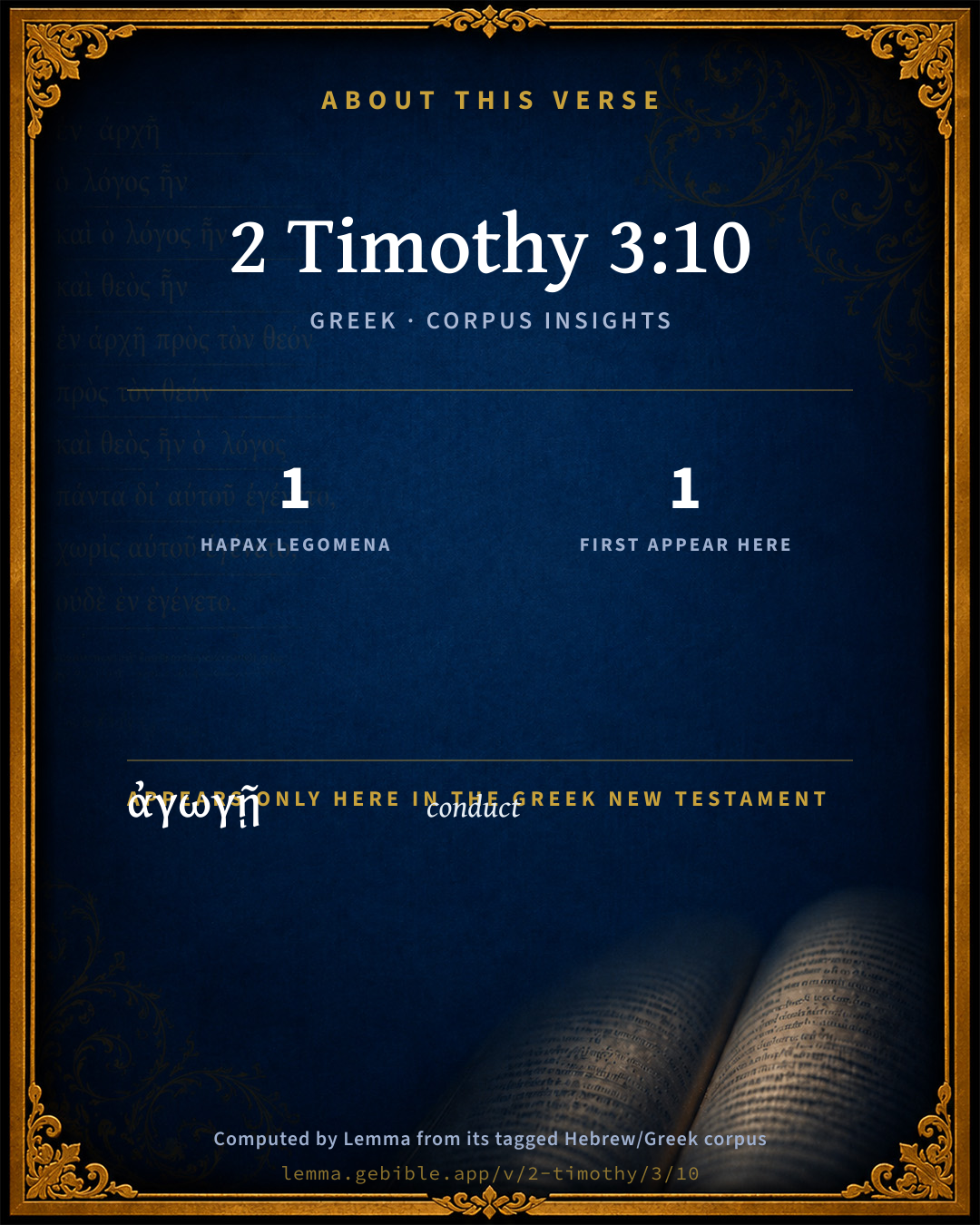
  • 1 hapax legomenon — only here in the Greek New Testament
  • 1 first appearance in the Greek New Testament
Full analysis ↓
Download a study sheet

One document with this verse’s original text, its word-by-word gloss line, the meaning frame, cross-references with their text, attributed commentary, and full source and license credits — printable, and it pastes into notes with its structure intact.

This verse Autodidact and up

Study sheet (.html) Plain text (.txt)

A passage Seminary Student

Up to 50 verses in one chapter. A passage sheet keeps up to 6 commentary sources and 12 cross-references per verse, in the order this page ranks them, and says so on the sheet whenever that leaves anything out. Ask for a single verse and you get the Autodidact verse sheet above.

Everything on this page stays free to read, with no account — the sheet is a download of what is already on screen, not access to it.

Want to remove ads? Support Godless Engineer
Compare translations 3

The same verse in 3 English versions, stacked beneath the original-language interlinear above. Click any original word for its lexicon entry.

Each is an independent rendering of the whole verse — the interlinear is not word-aligned to these translations.

Highlighted words mark where these versions differ — a whole-verse word diff, not a word-by-word alignment.

  • World English Bible Public Domain
    But you did follow my teaching, conduct, purpose, faith, patience, love, steadfastness,
  • King James Version Public Domain
    But thou hast fully known my doctrine, manner of life, purpose, faith, longsuffering, charity, patience,
  • unfoldingWord Literal Text CC BY-SA 4.0
    But you have followed my teaching, conduct, purpose, faith, patience, love, endurance,

unfoldingWord Literal Text — © unfoldingWord, licensed CC BY-SA 4.0. Word-aligned USFM3 via Door43 (git.door43.org/unfoldingWord/en_ult).

Versions to compare (up to 4)

3 of 4 selected

Show all 19 translations

Every available English version of this verse, each an independent rendering of the whole verse.

  • World English Bible Public Domain
    But you did follow my teaching, conduct, purpose, faith, patience, love, steadfastness,
  • Berean Standard Bible Public Domain
    You, however, have observed my teaching, my conduct, my purpose, my faith, my patience, my love, my perseverance,
  • Majority Standard Bible Public Domain
    You, however, have observed my teaching, my conduct, my purpose, my faith, my patience, my love, my perseverance,
  • King James Version Public Domain
    But thou hast fully known my doctrine, manner of life, purpose, faith, longsuffering, charity, patience,
  • American Standard Version (1901) Public Domain
    But thou didst follow my teaching, conduct, purpose, faith, longsuffering, love, patience,
  • Revised Version (1885) Public Domain
    But thou didst follow my teaching, conduct, purpose, faith, longsuffering, love, patience,
  • Geneva Bible (1599) Public Domain
    But thou hast fully knowen my doctrine, maner of liuing, purpose, faith, long suffering, loue, patience,
  • Douay-Rheims (1899) Public Domain
    But thou hast fully known my doctrine, manner of life, purpose, faith, longsuffering, love, patience,
  • Young's Literal Translation Public Domain
    And thou -- thou hast followed after my teaching, manner of life, purpose, faith, long-suffering, love, endurance,
  • Literal Standard Version CC BY-SA 4.0
    And you have followed after my teaching, manner of life, purpose, faith, long-suffering, love, endurance,
  • Unlocked Literal Bible CC BY-SA 4.0
    But as for you, you have followed my teaching, conduct, purpose, faith, longsuffering, love, patience,
  • unfoldingWord Literal Text CC BY-SA 4.0
    But you have followed my teaching, conduct, purpose, faith, patience, love, endurance,
  • Darby Bible Public Domain
    But *thou* hast been thoroughly acquainted with my teaching, conduct, purpose, faith, longsuffering, love, endurance,
  • World Messianic Bible Public Domain
    But you followed my teaching, conduct, purpose, faith, patience, love, steadfastness,
  • Webster's Bible Public Domain
    But thou hast fully known my doctrine, manner of life, purpose, faith, long-suffering, charity, patience,
  • Free Bible Version CC BY-SA 4.0
    But you know all about my teaching and behavior, and my aim in life. You know my trust in God and my love. You know what I've had to endure—
  • Bible in Basic English Public Domain
    But you took as your example my teaching, behaviour, purpose, and faith; my long waiting, my love, my quiet undergoing of trouble;
  • Text-Critical English NT CC BY 4.0
    Yoʋ, however, have closely followed my teaching, conduct, purpose, faith, patience, love, and endurance.
  • Tyndale New Testament (1534) Public Domain
    But thou hast sene the experience of my doctrine fassion of lyuynge purpose fayth longe sufferynge love pacience

Literal Standard Version (2020), Covenant Press — licensed CC BY-SA 4.0. Text via the HelloAO Bible API (eBible.org). Unlocked Literal Bible (unfoldingWord) — licensed CC BY-SA 4.0. Text via the HelloAO Bible API (eBible.org). unfoldingWord Literal Text — © unfoldingWord, licensed CC BY-SA 4.0. Word-aligned USFM3 via Door43 (git.door43.org/unfoldingWord/en_ult). Free Bible Version, Dr. Jonathan Gallagher — licensed CC BY-SA 4.0. Text via the HelloAO Bible API (eBible.org).

Word by word

More ways to search: Search by grammar → Find every occurrence → Compare this word →

Practice this passage: Drill this verse → Learn its vocabulary →

ἀγωγῇ
agōgḗ
G72
“conduct”
Noun, Dative, Singular, Feminine
Part of Speech
Noun
Case
Dative
Number
Singular
Gender
Feminine
Full Thayer's Definition

Origin: reduplicated from G71

TDNT: 03:08,2

1. a leading 2. metaph.: conduct a. a conducting, training, education, discipline b. the life led, way or course of life
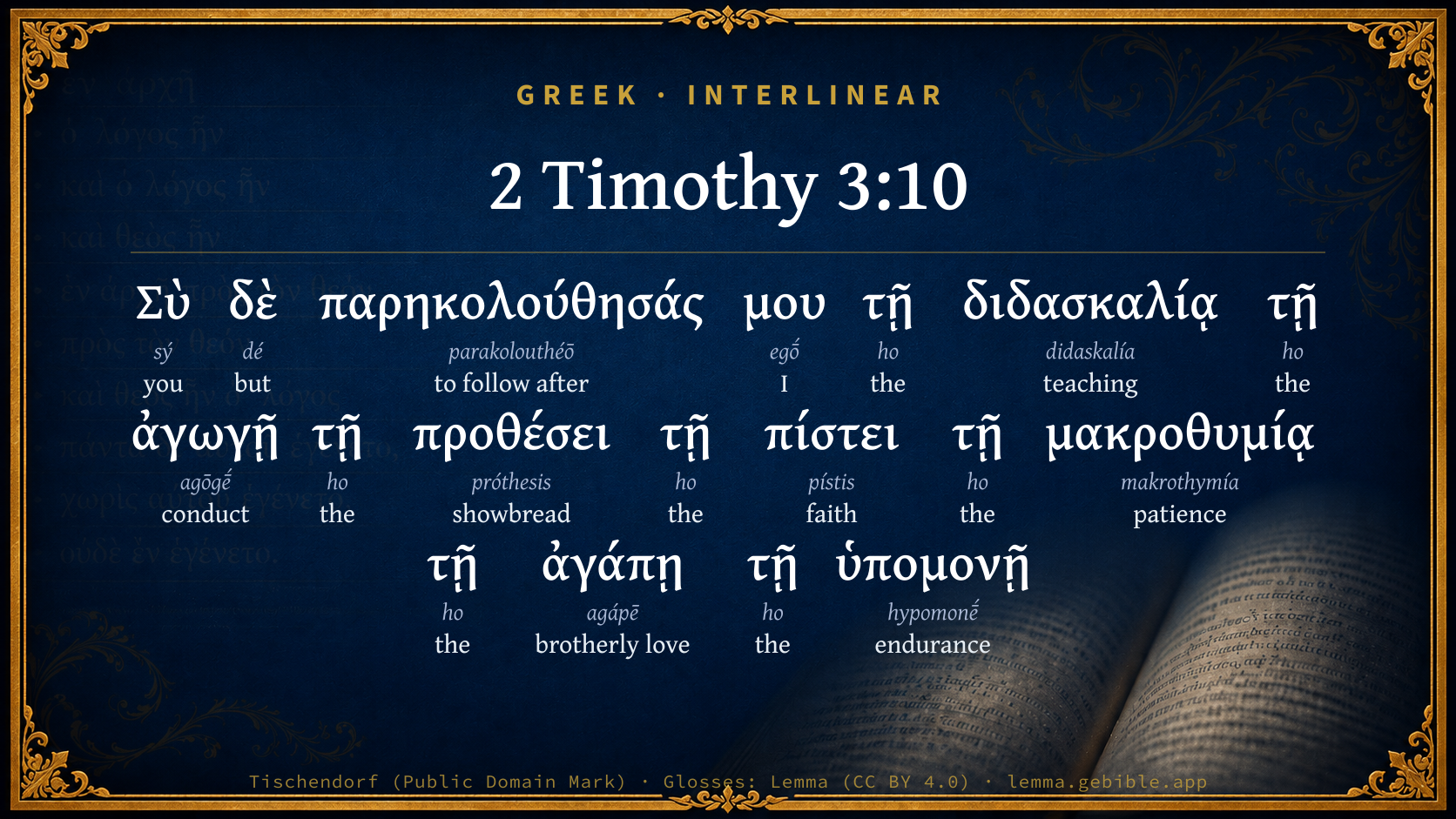
  1. Σὺ sý G4771 “you” Personal pronoun, 2nd person, Nominative, Singular
  2. δὲ dé G1161 “but” Conjunction
  3. παρηκολούθησάς parakolouthéō G3877 “to follow after” Verb, Aorist, Active, Indicative, 2nd person, Singular
  4. μου egṓ G1473 “I” Personal pronoun, 1st person, Genitive, Singular
  5. τῇ ho G3588 “the” Article, Dative, Singular, Feminine
  6. διδασκαλίᾳ didaskalía G1319 “teaching” Noun, Dative, Singular, Feminine
  7. τῇ ho G3588 “the” Article, Dative, Singular, Feminine
  8. τῇ ho G3588 “the” Article, Dative, Singular, Feminine
  9. προθέσει próthesis G4286 “showbread” Noun, Dative, Singular, Feminine
  10. τῇ ho G3588 “the” Article, Dative, Singular, Feminine
  11. πίστει pístis G4102 “faith” Noun, Dative, Singular, Feminine
  12. τῇ ho G3588 “the” Article, Dative, Singular, Feminine
  13. μακροθυμίᾳ makrothymía G3115 “patience” Noun, Dative, Singular, Feminine
  14. τῇ ho G3588 “the” Article, Dative, Singular, Feminine
  15. ἀγάπῃ agápē G26 “brotherly love” Noun, Dative, Singular, Feminine
  16. τῇ ho G3588 “the” Article, Dative, Singular, Feminine
  17. ὑπομονῇ hypomonḗ G5281 “endurance” Noun, Dative, Singular, Feminine

About this verse

These counts appear in no published source. They are computed here, from the morphology-tagged text and Lemma’s own curated glosses. What Lemma adds →

18
words
12
distinct lemmas
Pauline Epistles
section

Notable vocabulary

1 hapax legomenon — a word that appears only here in the entire Greek New Testament:

  • ἀγωγῇ conduct G72

First appearance in Scripture

This word makes its first canonical appearance in the Greek New Testament here:

  • ἀγωγῇ conduct G72

Shared distinctive vocabulary

παρηκολούθησάς to follow after G3877 occurs in 4 verses of the Greek New Testament. Also found in:

Repetition

A word recurs within this verse:

Cross-references

22

Topical passages linked to 2 Timothy 3:10 in the Treasury of Scripture Knowledge — connected by theme and wording, ordered by reader-vote popularity; previews shown in the World English Bible.

  • 1 Timothy 6:11 But you, man of God, flee these things, and follow after righteousness, godliness, faith, love, patience, and gentleness.
  • Titus 2:7 in all things showing yourself an example of good works; in your teaching showing integrity, seriousness, incorruptibility,
  • 2 Peter 1:5–7 Yes, and for this very cause adding on your part all diligence, in your faith supply moral excellence; and in moral excellence, knowledge;
  • Philippians 2:22 But you know the proof of him, that, as a child serves a father, so he served with me in furtherance of the Gospel.
  • 1 Timothy 4:6 If you instruct the brothers of these things, you will be a good servant of Christ Jesus, nourished in the words of the faith, and of the good doctrine which you have followed.
  • Hebrews 13:9 Don't be carried away by various and strange teachings, for it is good that the heart be established by grace, not by food, through which those who were so occupied were not benefited.
  • Acts 11:23 who, when he had come, and had seen the grace of God, was glad. He exhorted them all, that with purpose of heart they should remain near to the Lord.
  • Romans 16:17 Now I beg you, brothers, look out for those who are causing the divisions and occasions of stumbling, contrary to the doctrine which you learned, and turn away from them.
  • 1 Timothy 4:12–13 Let no man despise your youth; but be an example to those who believe, in word, in your way of life, in love, in spirit, in faith, and in purity.
  • Acts 2:42 They continued steadfastly in the apostles' teaching and fellowship, in the breaking of bread, and prayer.
  • Acts 26:4 "Indeed, all the Jews know my way of life from my youth up, which was from the beginning among my own nation and at Jerusalem;
  • 2 Corinthians 6:4–10 but in everything commending ourselves, as servants of God, in great endurance, in afflictions, in hardships, in distresses,
  • 1 Thessalonians 1:5 and that our Gospel came to you not in word only, but also in power, and in the Holy Spirit, and with much assurance. You know what kind of men we showed ourselves to be among you for your sake.
  • 2 Timothy 2:22 Flee from youthful lusts; but pursue righteousness, faith, love, and peace with those who call on the Lord out of a pure heart.
  • 2 Timothy 3:16–17 Every writing inspired by God is profitable for teaching, for reproof, for correction, and for instruction which is in righteousness,
  • 2 Timothy 4:3 For the time will come when they will not listen to the sound doctrine, but, having itching ears, will heap up for themselves teachers after their own lusts;
  • 2 Peter 3:11 Therefore since all these things are thus to be destroyed, what manner of persons ought you to be in holy living and godliness,
  • 2 John 1:9–10 Whoever transgresses and doesn't remain in the teaching of Christ, doesn't have God. He who remains in the teaching, the same has both the Father and the Son.
  • Luke 1:3 it seemed good to me also, having traced the course of all things accurately from the first, to write to you in order, most excellent Theophilus;
  • Acts 20:18 When they had come to him, he said to them, "You yourselves know, from the first day that I set foot in Asia, how I was with you all the time,
  • 2 Corinthians 1:17 When I therefore was thus determined, did I show fickleness? Or the things that I purpose, do I purpose according to the flesh, that with me there should be the "Yes, yes" and the "No, no?"
  • 1 Timothy 1:3 As I exhorted you to stay at Ephesus when I was going into Macedonia, that you might charge certain men not to teach a different doctrine,

Cross-references courtesy of OpenBible.info (CC BY 4.0).

Commentary

Notes on 2 Timothy 3:10 from classic Christian and Jewish commentators (each source and its license shown beneath its notes). The classic Christian expositions comment on the surrounding passage and are grouped to its opening verse, so a note may address several verses; the Jewish commentaries on the Tanakh (Rashi and others) are per-verse, so they appear only where the commentator wrote on this verse.

Lemma curates 59 commentaries, every one of them public domain or Creative Commons licensed, each selected and text-cleaned for this edition rather than reprinted as found. About our sources →

Matthew Henry's Commentary

Here the apostle, to confirm Timothy in that way wherein he walked,

I. Sets before him his own example, which Timothy had been an eye-witness of, having long attended Paul (Ti2 3:10): Thou hast fully known my doctrine. The more fully we know the doctrine of Christ and the apostles, the more closely we shall cleave to it; the reason why many sit loose to it is because they do not fully know it. Christ's apostles had no enemies but those who did not know them, or not know them fully; those who knew them best loved and honoured them the most. Now what is it that Timothy had so fully known in Paul? 1. The doctrine that he preached. Paul kept back nothing from his hearers, but declared to them the whole counsel of God (Act 20:27), so that if it were not their own fault they might fully know it. Timothy had a great advantage in being trained up under such a tutor, and being apprised of the doctrine he preached. 2. He had fully known his conversation: Thou hast fully know my doctrine, and manner of life; his manner of life was of a piece with his doctrine, and did not contradict it. He did not pull down by his living what he built up by his preaching. Those ministers are likely to do good, and leave lasting fruits of their labours, whose manner of life agrees with their doctrine; as, on the contrary, those cannot expect to profit the people at all that preach well and live ill. 3. Timothy fully knew what was the great thing that Paul had in view, both in his preaching and in his conversation: "Thou hast known my purpose, what I drive at, how far it is from any worldly, carnal, secular design, and how sincerely I aim at the glory of God and the good of the souls of men." 4. Timothy fully knew Paul's good character, which he might gather from his doctrine, manner of life, and purpose; for he gave proofs of his faith (that is, of his integrity and fidelity, or his faith in Christ, his faith concerning another world, by which Paul lived), his long-suffering towards the churches to which he preached and over which he presided, his charity towards all men, and his patience. These were graces that Paul was eminent for, and Timothy knew it. 5. He knew that he had suffered ill for doing well (Ti2 3:11): "Thou hast fully known the persecutions and afflictions that came unto me" (he mentions those only which happened to him while Timothy was with him, at Antioch, at Iconium, at Lystra); "and therefore let it be no surprise to thee if thou suffer hard things, it is no more than I have endured before." 6. He knew what care God had taken of him: Notwithstanding out of them all the Lord delivered me; as he never failed his cause, so his God never failed him. Thou hast fully known my afflictions. When we know the afflictions of good people but in part, they are a temptation to us to decline that cause which they suffer for; when we know only the hardships they undergo for Christ, we may be ready to say, "We will renounce that cause that is likely to cost us so dear in the owning of it;" but when we fully know the afflictions, not only how they suffer, but how they are supported and comforted under their sufferings, then, instead of being discouraged, we shall be animated by them, especially considering that we are told before that we must count upon such things (Ti2 3:12): All that will live godly in Christ Jesus shall suffer persecution: not always alike; at that time those who professed the faith of Christ were more exposed to persecution than at other times; but at all times, more or less, those who will live godly in Christ Jesus shall suffer persecution. They must expect to be despised, and that their religion will stand in the way of their preferment; those who will live godly must expect it, especially those who will live godly in Christ Jesus, that is, according to the strict rules of the Christian religion, those who will wear the livery and bear the name of the crucified Redeemer. All who will show their religion in their conversation, who will not only be godly, but live godly, let them expect persecution, especially when they are resolute in it. Observe, (1.) The apostle's life was very exemplary for three things: for his doctrine, which was according to the will of God; for his life, which was agreeable to his doctrine; and for his persecutions and sufferings. (2.) Though his life was a life of great usefulness, yet it was a life of great sufferings; and none, I believe, came nearer to their great Master for eminent services and great sufferings than Paul: he suffered almost in every place; the Holy Ghost witnessed that bonds and afflictions did abide him, Act 20:23. Here he mentions his persecutions and afflictions at Antioch, at Iconium, at Lystra, besides what he suffered elsewhere. (3.) The apostle mentions the Lord's delivering him out of them all, for Timothy's and our encouragement under sufferings. (4.) We have the practice and treatment of true Christians: they live godly in Jesus Christ - this is their practice; and they shall suffer persecution - this is the usage they must expect in this world.

II. He warns Timothy of the fatal end of seducers, as a reason why he should stick closely to the truth as it is in Jesus: But evil men and seducers shall wax worse and worse, etc., Ti2 3:13. Observe, As good men, by the grace of God, grow better and better, so bad men, through the subtlety of Satan and the power of their own corruptions, grow worse and worse. The way of sin is down-hill; for such proceed from bad to worse, deceiving and being deceived. Those who deceive others do but deceive themselves; those who draw others into error run themselves into more and more mistakes, and they will find it so at last, to their cost.

III. He directs him to keep close to a good education, and particularly to what he had learned out of the holy scriptures (Ti2 3:14, Ti2 3:15): Continue thou in the things which thou hast learned. Note, It is not enough to learn that which is good, but we must continue in it, and persevere in it unto the end. Then are we Christ's disciples indeed, Joh 8:31. We should not be any more children, tossed to and fro, and carried about with every wind of doctrine, by the sleight of men and cunning craftiness, whereby they lie in wait to deceive, Eph 4:14. Be not carried about with divers and strange doctrines; for it is a good thing that the heart be established with grace, Heb 13:9. And for this reason we should continue in the things we have learned from the holy scriptures; not that we ought to continue in any errors and mistakes which we may have been led into, in the time of our childhood and youth (for these, upon an impartial enquiry and full conviction, we should forsake); but this makes nothing against our continuing in those things which the holy scriptures plainly assert, and which he that runs may read. If Timothy would adhere to the truth as he had been taught it, this would arm him against the snares and insinuations of seducers. Observe, Timothy must continue in the things which he had learned and had been assured of.

1. It is a great happiness to know the certainty of the things wherein we have been instructed (Luk 1:4); not only to know what the truths are, but to know that they are of undoubted certainty. What we have learned we must labour to be more and more assured of, that, being grounded in the truth, we may be guarded against error, for certainty in religion is of great importance and advantage: Knowing, (1.) "That thou hast had good teachers. Consider of whom thou hast learned them; not of evil men and seducers, but good men, who had themselves experienced the power of the truths they taught thee, and been ready to suffer for them, and thereby would give the fullest evidence of their belief of these truths." (2.) "Knowing especially the firm foundation upon which thou hast built, namely, that of the scripture (Ti2 3:15): That from a child thou hast known the holy scriptures."

2. Those who would acquaint themselves with the things of God, and be assured of them, must know the holy scriptures, for these are the summary of divine revelation.

3. It is a great happiness to know the holy scriptures from our childhood; and children should betimes get the knowledge of the scriptures. The age of children is the learning age; and those who would get true learning must get it out of the scriptures.

4. The scriptures we are to know are the holy scriptures; they come from the holy God, were delivered by holy men, contain holy precepts, treat of holy things, and were designed to make us holy and to lead us in the way of holiness to happiness; being called the holy scriptures, they are by this distinguished from profane writings of all sorts, and from those that only treat morality, and common justice and honesty, but do not meddle with holiness. If we would know the holy scriptures, we must read and search them daily, as the noble Bereans did, Act 17:11. They must not lie by us neglected, and seldom or never looked into. Now here observe,

(1.) What is the excellency of the scripture. It is given by inspiration of God (Ti2 3:16), and therefore is his word. It is a divine revelation, which we may depend upon as infallibly true. The same Spirit that breathed reason into us breathes revelation among us: For the prophecy came not in old time by the will of man, but holy men spoke as they were moved or carried forth by the Holy Ghost, Pe2 1:21. The prophets and apostles did not speak from themselves, but what they received of the Lord that they delivered unto us. That the scripture was given by inspiration of God appears from the majesty of its style, - from the truth, purity, and sublimity, of the doctrines contained in it, - from the harmony of its several parts, - from its power and efficacy on the minds of multitudes that converse with it, - from the accomplishment of many prophecies relating to things beyond all human foresight, - and from the uncontrollable miracles that were wrought in proof of its divine original: God also bearing them witness, both with signs and wonders, and with divers miracles and gifts of the Holy Ghost, according to his own will, Heb 2:4.

(2.) What use it will be of to us. [1.] It is able to make us wise to salvation; that is, it is a sure guide in our way to eternal life. Note, Those are wise indeed who are wise to salvation. The scriptures are able to make us truly wise, wise for our souls and another world. "To make thee wise to salvation through faith." Observe, The scriptures will make us wise to salvation, if they be mixed with faith, and not otherwise, Heb 4:2. For, if we do not believe their truth and goodness, they will do us no good. [2.] It is profitable to us for all the purposes of the Christian life, for doctrine, for reproof, for correction, for instruction in righteousness. It answers all the ends of divine revelation. It instructs us in that which is true, reproves us for that which is amiss, directs us in that which is good. It is of use to all, for we all need to be instructed, corrected, and reproved: it is of special use to ministers, who are to give instruction, correction, and reproof; and whence can they fetch it better than from the scripture? [3.] That the man of God may be perfect, Ti2 3:17. The Christian, the minister, is the man of God. That which finishes a man of God in this world is the scripture. By it we are thoroughly furnished for every good work. There is that in the scripture which suits every case. Whatever duty we have to do, whatever service is required from us, we may find enough in the scriptures to furnish us for it.

(3.) On the whole we here see, [1.] That the scripture has various uses, and answers divers ends and purposes: It is profitable for doctrine, for reproof, for correction of all errors in judgment and practice, and for instruction in righteousness. [2.] The scripture is a perfect rule of faith and practice, and was designed for the man of God, the minister as well as the Christian who is devoted to God, for it is profitable for doctrine, etc. [3.] If we consult the scripture, which was given by inspiration of God, and follow its directions, we shall be made men of God, perfect, and thoroughly furnished to every good work. [4.] There is no occasion for the writings of the philosopher, nor for rabbinical fables, nor popish legends, nor unwritten traditions, to make us perfect men of God, since the scripture answers all these ends and purposes. O that we may love our Bibles more, and keep closer to them than ever! and then shall we find the benefit and advantage designed thereby, and shall at last attain the happiness therein promised and assured to us.

Matthew Henry's Commentary on the Whole Bible (1708–1710) — public domain (CC PDM 1.0). Text via the HelloAO Bible API.

The Biblical Illustrator

Joseph S. Exell

2Ti_3:10-11

But thou hast fully known my doctrine, manner of life.

Apostolic imitation

1. Doctrine.

2. Conversation.

3. Purpose.

4. Faith.

5. Long-suffering.

6. Love.

7. Patience.

8. Persecutions.

9. Afflictions. (T. Hall, B. D.)

Precedents better than precepts

Now since we are more easily led by precedents than by precepts, the apostle propounds his own example for our imitation, wherein we have the lively pattern and portraiture of a faithful pastor, whose office it is not only to preach sound doctrine, but also to practise what he preacheth in his own life, that so he may be able to speak from the heart to the hearts of his people, and may not bring his food as birds do to their young ones--in their beaks, not in their breasts. (T. Hall, B. D.)

The example of superiors powerful

In that Paul propounds his own example for Timothy to consider and follow. That the pious example of the godly must be imitated by us. Younger ministers especially must observe the doctrine and conversation, the pious ways and walking of the elder and graver ministers, and must follow them. Aged Paul propounds his virtues to young Timothy for imitation. Many young men praise the gravity, solidity, wisdom, industry, mortification, and self-denial of ancient ministers, but they do not follow them. They deal by them as the world doth by honesty, they praise it, but they never practise it. As Gideon said to his soldiers (Jdg_7:17), Look upon me, and do likewise; so you that are young and unsettled, rash, and conceited, look upon the doctrine, discipline, hair, habit, ways and works of the holy, and the grave; follow them now you are young, and then you will be good long. Great is the power of the example of superiors. (T. Hall, B. D.)

A copy to write by

God hath set them before us as our copy to write by, and our pattern to live by, and we must answer not only for sinning against the light of the word, but against the light of good example also. It will be one day said, You had such and such to go before you in paths of piety, and yet you would not follow. The faithful are called witnesses (Heb_12:1; Rev_12:1-17.). Now if we walk contrary to their light they will witness against us, as Noah and Lot did against the sinners of their age; but if we walk answerable to their light they will witness for us. Their practice may comfort and confirm us in Gods way; they declare the possibility of obtaining such a grace, and make it thereby the more easy, when we have seen it done before us. If a man have a torch to light him in a dark and dangerous path, how glad is he: the godly shine like lights in the midst of a crooked generation (Php_2:15-16), their life is a commentary on the Scripture. Now since the nature of man is apter to be guided by example then precept, therefore God hath prepared abundance of glorious examples for our imitation, and thus the saints that are now at rest and triumphant in glory, their lives are to be our looking-glasses to dress ourselves by, our compass to sail by, and our pillar of a cloud to walk by. (T. Hall, B. D.)

We must come up to the best patterns

We can have no excuse in these days of light if we come not up to the best patterns, because we have more of the spirit, more light, and more clear manifestation of God than they had. (T. Hall, B. D.)

The best patterns defective

The saints have had their failings, and the best have a great deal of the old Adam in them. They are pillars of cloud for us to walk by, but this cloud hath its dark part, which if we follow we shall fall as they did. There are four sorts of actions which the Scripture tells us were done by saints. (T. Hall, B. D.)

Both doctrines and graces must be good

Our Saviour by the truth of His doctrine proved Himself to be sent of God (Joh_7:16-18; Joh_12:49-50). Paul commands Timothy to keep the pattern of wholesome words (2Ti_2:13), and Titus must be careful in appointing ministers for the Church, to choose such as hold the faithful word (Tit_1:7; Tit_1:9). Moral virtues may be found with a false faith; let not those apples of Sodom deceive you, for as there may be good doctrine where the life is bad, so there may be false doctrine where the life is seemingly good. Look, therefore, in the first place to the doctrine, and in the second place to the virtues which seem to commend it. So doth Paul here; first he tells you his doctrine was sound, and now he comes to declare his graces, and how he lived. (T. Hall, B. D.)

Patience in ministers

A little patience will not do, for we have no little enemies to oppose us--it must be all patience and all strength. This also is a virtue very requisite for a minister, who hath to do with all sorts of men; some are dull, some froward, some weak, some wayward; so that without patience there is no good to be done. It is for pusillanimous spirits to be always murmuring, complaining, and seeking revenge. The weakest creatures are most vindictive. This is an ornament of great worth, not only in the sight of man, but also of God (1Pe_3:4). Without it we are unfit for duty, as the troubled sea unfit for voyage. Without it we double and increase our burthens; like a wild bull in a net, or the untamed heifer, we may gall our necks, but never break the yoke. Without patience no grace is perfect, faith hath but half its strength, and hope is feeble (Jam_1:4). By our patience we please God, displease the devil, rejoice the angels, and many times melt and convert our enemies. By this means we heap coals of conversion or coals of confusion upon their heads (Rom_12:20). This will keep us good in a bad condition, so that a man enjoys himself when he hath nothing else; and though he have nothing, yet is as one that possesseth all things. The consideration of this made Tertullian to cry, Farewell all, so I may but get patience. (T. Hall, B. D.)

Christian consistency

Paul did not pull down by his living what he built up by his preaching. (M. Henry.)

Life an eloquent sermon

Of Donnes romantic career it has been said that his life is more poetical than his poetry. We might without exaggeration adapt this epigram to his preaching, and say that his life was a sermon more eloquent than all his sermons. If, then, I were asked to describe in few words the secret of his power as a preacher, I should say that it was the contrition and the thanksgiving of the penitent acting upon the sensibility of the poet. (Bp. Lightfoot.)

The preaching that tells

There is a legend which tells how a saint once in vision saw a band of Franciscan friars standing round Jesus in heaven. He noticed that the lips of each were crimson. He asked the meaning of this, and to him the Lord said, These are the great preachers of my Cross, for the story of My redeeming love only comes with power over lips that are red with My precious blood. Yes; the preaching that will save preacher and hearers is the preaching that comes from crimson lips. (British Weekly.)

The stimulus of example

The other evening a gentleman told me that he went into the room where his son was taking lessons in singing, and found the tutor urging the boy to sound a certain note. Every time the lad made the attempt, however, he fell short, and his teacher kept saying to him, Higher! higher! but it was all to no purpose until, descending to the tone which the boy was sounding, the musician accompanied him with his own voice, and led him gradually up to that which he desired him to sing; and then he sounded it with ease. (W. M. Taylor, D. D.)

Example is a living law, whose sway

Men more than all the written laws obey.

(Old Poet.)

Example is the school of mankind, and they will learn at no other. (Burke.)

The power of a godly life

Whenever I read Scripture, a thousand atheistical thoughts were injected in my soul … Being in Mr. T, H.s house, a godly and prudent man, his company did me much good … For the universal carnality of professors, with their discouragements, living so short of their principles, did much help forward my atheism, as it made me think that a saint was but a fancy; but truly I thought mine eyes saw something of a saint and New Testament spirit in him, and was something persuaded, by feeling his holiness, his cheerfulness in God, and his deep reach in spiritual mysteries, that there was a God, and a holiness attainable. (Life of James Fraser of Brea.)

Cassock and character

I like that remark of Whitfields, when some one of a bad character wondered how he could preach without a cassock. Ah, he said, I can preach without a cassock, but I cannot preach without a character. (C. H. Spurgeon.)

Pauls path of suffering

The path of suffering of the apostle Paul a revelation--

1. Of the power of sin which pursued him.

2. Of the greater power of faith which sustained him.

3. Of the omnipotence of the Lord who delivered him out of all. (Van Oosterzee.)

Commands should be enforced by example

During the siege of Sebastopol Gordon was one day going the round of the trenches when he heard an angry altercation between a corporal and a sapper. On inquiring the cause, he learnt that the men were instructed to place some gabions on the battery, and that the corporal had ordered the sapper to stand on the parapet, where he would be exposed to the enemys fire, and to place the gabious, while he, perfectly sheltered, handed them up from below. Gordon at once jumped upon the parapet, ordering the corporal to join him, while the sapper handed them the gabions. When the work was done, and done under the fire of the watchful Russian gunners, Gordon turned to the corporal and said, Never order a man to do anything that you are afraid to do yourself.

Wicked men hate the good

All wicked men hate the good, as all wolves do the sheep. (T. Hall, B. D.)

Persecution beneficial

Such shakings make way for Christ (Hag_2:7). The Church, like a quick-set hedge, grows the thicker for cutting, this vine is the better for bleeding, and this torch burns the better for beating. The more Pharaoh oppressed the Israelites the more they increased (Exo_1:12). (T. Hall, B. D.)

Deliverances, to be noted

Not only our dangers, but also our deliverances must be observed and recorded by us. (T. Hall, B. D.)

The Biblical Illustrator, edited by Joseph S. Exell (c. 1880s–1900s) — public domain. Text from a community e-Sword module.

Joseph Benson's Commentary

2Ti 3:10-13. But thou hast a better pattern to follow; for thou hast fully known my doctrine — In all the branches of it; manner of life — My conduct toward God, his people, and all men; purpose — The end and design of my ministry, namely, the glory of God in the salvation of men, and not any honour, interest, or advantage of my own; faith — My fidelity in the discharge of my duty; long-suffering — When treated in the most injurious manner; charity — Or love rather, to all men, saints or sinners, not excepting even mine enemies and persecutors; patience — Under great and long-continued trials; persecutions — From Jews and Gentiles; afflictions — Τοις παθημασιν, sufferings; at Antioch — In Pisidia; at Iconium, at Lystra — See the margin; what persecutions I endured — Timothy being a native of Lystra, and Paul’s disciple and companion when the apostle was stoned in that city, and dragged out of the streets as one dead, he may have been present on that occasion, and even one of those who stood round him when he revived, Act 14:20. But out of them all the Lord delivered me — And therefore be not thou discouraged if thou meetest with similar trials; yea, and all that will live godly — That will conduct themselves by the strict rules of piety prescribed in the gospel of Christ, not turning aside to the right hand or the left, and having the Spirit of Christ, without which we are not his; shall suffer persecution — More or less: there is no exception. Therefore count the cost, reader. Art thou resolved to live godly in Christ Jesus, out of whom there is no godliness? Hence we infer, that either the apostle was mistaken in making this assertion, or those who think they are religious, and are not persecuted in some shape or other, deceive themselves. But evil men and seducers — Though they may escape persecution, are yet in a more wretched state, for they provoke God to give them up to the lusts of their own hearts, and so shall wax worse and worse — More corrupt in heart and life, and more obstinate in their opposition to the gospel and its faithful ministers; deceiving and being deceived — He who has once begun to deceive others, is both the less likely to recover from his own errors, and the more ready to embrace the errors of other men.

Joseph Benson's Commentary on the Old and New Testaments (1811–1818) — public domain. Text from a community e-Sword module.

Whedon's Commentary on the Bible

Daniel D. Whedon

10-17. To the above terrific delineation St. Paul now draws a contrastive picture for and of Timothy himself in that approaching future. Taking the suffering and heroic Paul as his pattern, 10-12, in contrast with these seducers, 13, and in full accordance with his childhood’s training in the Scriptures, 14, 15, which are the inspired guide of his life, 15, 16, he will find himself fully fitted for every demand, for every good work.

2. But as Timothy knows the trueness and purity of Paul, 2Ti_3:10-13.

10. But—Contrastive; introducing a picture antithetic to the above gloomy portraiture.

Thou—Greek, emphatic, both by insertion and position; in antithesis to the errorists above described.

Hast fully known—With thorough study and acquaintance as of a pattern and lesson. Timothy’s acquaintance with Paul’s example as an eyewitness commenced at Lystra, but the report of his previous endurances at Antioch and Iconium, Acts xiv, must have been perfectly known to him at the time. Lystra—The apostle stops his enumeration in precise accordance with the history in Act_14:20-21, where see notes.

Daniel D. Whedon (gen. ed.), Commentary on the Old and New Testaments (1874–1909) — public domain. Text from a community e-Sword module.

The Preacher's Complete Homiletical Commentary

Joseph S. Exell (gen. ed.)

CRITICAL AND EXPLANATORY NOTES

2Ti_3:10. But thou hast fully known.—R.V. “didst follow.” The mental process of investigation and the moral process of imitating the good seem to blend in this expression, as the words following indicate.

2Ti_3:11. What persecutions I endured.—The old man lives over again the life of hardship and glorifies his Deliverer.

2Ti_3:13. Seducers.—R.V. “impostors.” There is “a reference to incantation by howling, and then to the practice of magic generally, and thence to deception and imposture generally” (Ellicott). Shall wax worse and worse.—“Shall make advance toward the worse.” In 2Ti_3:9 the apostle says they shall not advance further without exposure; here he seems to say that after exposure they do not mind to what lengths they go. The Nemesis of deception is self-deception.

MAIN HOMILETICS OF THE PARAGRAPH.—2Ti_3:10-13

Characteristics of a Genuine Teacher.

I. The genuine teacher is known by the character of his doctrine and the integrity of his life (2Ti_3:10).—In contrast with the false teachers the apostle appeals to his own teaching and manner of life. Both were well known and had been tested in trying circumstances. The genuine teacher is not actuated by selfish motives, but by a desire to spread the truth and promote the glory of Christ, and the purity of his aim is evident in the Christian spirit with which he treats his opponents and vilifiers.

II. The genuine teacher is known by his sufferings for the truth.—

1. Suffering for the truth is the lot of the faithful (2Ti_3:11-12). Christianity condemns all other religions and claims to be the only religion; it enjoins precepts directly contrary to the instincts of the natural man, and it predicts that persecutions are sure to overtake its most ardent followers. But it promises help in suffering and a future reward of unspeakable glory. A man must be truly in earnest who embraces Christianity with all its conditions and consequences.

2. From all suffering for the truth God graciously delivers. “But out of them all the Lord delivered me” (2Ti_3:11). If Paul was delivered from trials, unparalleled in their number and severity, the most oppressed servant of Christ need not despair. With this example before us we need not fear whatever persecution and suffering may be entailed in a faithful propagation of the truth.

III. The genuine teacher is known by contrast with the wicked and deceptive charlatanry of false teachers.—“But evil men and seducers shall wax worse and worse, deceiving, and being deceived” (2Ti_3:13). Magical arts were practised at Ephesus; but these were abandoned by all who embraced Christ. The false teachers did not hesitate to use the tricks of the conjuror to deceive the unwary; and as they became more reckless in their methods and more wicked in their lives, they ended by being themselves deceived. As Bengel remarks, “He who has once begun to deceive others is the less easily able to recover himself from error, and the more easily embraces in turn the errors of others.” There is the widest contrast between the showy and tricky charlatanry of false teachers, and the sedate straightforwardness and calmly fervent zeal of the gospel preacher.

Lessons.—

1. The truth forms the character of its advocate.

2. Christianity teaches us how to endure and conquer suffering.

3. The genuine teacher is a living witness for the truth.

GERM NOTES ON THE VERSES

2Ti_3:10-11. Personal Integrity—

I. Is founded on belief in the truth (2Ti_3:10).

II. Is manifested in the life (2Ti_3:10).

III. Is seen in the carrying out of a definite purpose (2Ti_3:10).

IV. Is exemplified in the virtues of the Christian character (2Ti_3:10).

V. Is tested and strengthened by suffering (2Ti_3:11).

VI. Recognises the special help of God in affliction (2Ti_3:11).

2Ti_3:12. The Persecution of Goodness.

I. The text characterises the morality of believers.—They “live godly.”

1. The believer complies with the will of God.

2. Presents his services as an offering to God.

3. Aims at the glory of God.

4. Seeks the enjoyment of God.

II. The text declares the origin of the morality of the believer.—“In Christ Jesus.”

1. Implies union with Christ.

2. Christ frees from condemnation and punishment.

3. Christ furnishes motives to obedience.

III. The text declares the consequence of the morality of the believer.—“Shall suffer persecution.”

1. The world hates godliness.

2. The world is reproved by godliness.—Stewart.

The Preacher's Complete Homiletical Commentary (gen. ed. Joseph S. Exell; Funk & Wagnalls, c. 1892) — public domain (pre-1929). A full-Bible homiletical/sermon-outline anthology covering 65 of 66 books (2 John is absent from the source module). Text from a community e-Sword module.

Lange's Commentary on the Holy Scriptures

VII

Warm praise of Timothy on account of his better disposition, and incitement to continue therein

2Ti_3:10-17

10But thou hast fully known7[followed] my doctrine, manner of life, purpose, faith, long-suffering, charity, patience, 11Persecutions, afflictions, which came upon me at Antioch, at Iconium,8 at Lystra; what persecutions I endured: but out of them all the Lord delivered me. 12Yea, and all that will [desire to] live godly9 [piously] in Christ Jesus shall [will] suffer persecution. 13But evil men and seducers shall wax worse and worse, deceiving and being deceived.10 14But continue thou in the things which thou hast learned and hast been assured of, knowing of whom thou hast learned them; [,] 15And that from a child thou hast known the holy Scriptures, which are able to make thee wise unto salvation 16through faith which is in Christ Jesus. All Scripture is given by inspiration of God,11 and is profitable for doctrine, for reproof,12 for correction, for instruction in righteousness: [,] 17That the man of God may be perfect [complete], thoroughly furnished unto [for] all good works [every good work].

EXEGETICAL AND CRITICAL

2Ti_3:10. But thou, &c., Σὺ δέ. But thou; with these words the Apostle returns to Timothy, not to praise him unnecessarily, but to appeal to Timothy himself, as to a witness, that his teacher and friend had walked an entirely different path from that of those false teachers. The recurrence to the example furnished him by the Apostle (2Ti_3:10-13) serves to introduce also the exhortation to enduring fidelity (2Ti_3:14-17).—Thou hast fully known my doctrine, παρηκολούθη σ α ς (after A. C. F. G.; Tischendorf has, after D. E. I. K., and others, παρηκολούθη κ α ς, as in 1Ti_4:6); either, thou hast attended to my doctrine, &c., as an eye-witness (or in thought), or, Thou hast followed my doctrine, &c., as if it were a pattern. The latter most probably. “The Apostle’s διδασκαλίαι, &c., are regarded as the leaders by which Timothy allowed himself to be directed in the course of his life—guiding stars, as it were, which he followed;” (Huther).—Manner of life, τῇ ἀγωγῇ (comp. Est_2:20); general designation of the rule of conduct pursued by Paul, the ratio vivendi et agendi (Luther: “My way”).—Purpose, τῇ προθέσει (comp. Act_11:23); the decided resolution of the heart to remain true to the high calling of his life.—Faith, long-suffering, charity, patience. There is nothing incongruous in the thought that Timothy also had suffered for the cause of Christ, but under this suffering, true to the example of Paul, had been as little discouraged as to allow himself to be allured into resistance. The mention of the ὑπομονή gives the Apostle occasion for a still more definite communication respecting the circumstances in which this Christian virtue had particularly served his turn.

2Ti_3:11. Persecutions, afflictions, &c. (comp. 2Co_11:24-28; Col_1:24, and other places).—Which came unto me at Antioch, at Iconium, at Lystra (comp. Act_13:50; Act_14:19). The question has been asked, why the Apostle selected just these pages from the journal of the history of his sufferings. The reason is obvious. In those regions Timothy was known from childhood; there had he first met the Apostle; there had he received the first impression of his word and work; and perhaps the lofty spirit of Paul’s faith, which he evinced under these persecutions, had co-operated in the conversion of Timothy. Besides this also, before all, towards the end of his course, the recollection of the first deeds and sufferings of the servant of Christ came forcibly into the foreground.—What persecutions I endured, οἵους διωγμοὺς ὑπήνεγκα; no exclamation (Erasmus, Flatt, Mack, Heydenreich), but a simple relative proposition in proof of his ὑπομονή, but at the same time a transition to the humble glorifying of God.—But out of (them) all the Lord delivered me (comp. 2Ti_4:17-18). Calvin: “Consolatio, quæ temperat afflictionum acerbitatem, quod scil. prosperum finem habent. Ergo perinde hoc valet, ac si dixisset: expertus es, deum mihi nunquam defuisse, ita non est, quod dubites, meo exemplo ipsum sequi.”

2Ti_3:12. yea, and all … suffer persecution. Just as the Apostle desires to avoid the appearance even of regarding his persecutions for the cause of the Lord as anything entirely exceptional, on account of which he might be not a little proud, he adds the observation, to what has already been said, that in the kingdom of God, on the contrary, the rule is of force for all, to enter into glory through suffering, and that therefore Timothy also, if he desired it even, would not be able to avoid this suffering, unless he wished wholly to deny his calling. Although it is not improbable that he utters this prophecy of distress especially in view of the approaching καιροὶ χαλεποί (comp. 2Ti_3:13), his word need not be at all restricted thereto. He proclaims persecution for all that will live godly in Christ Jesus.Θέλοντες used here, with emphasis, of the governing determination to follow after godliness in spite of all hindrances. The words have the sense, all who resolve, who are discreet therein, to live piously, &c. (see Winer, Gramm., p. 541). The Christian life is represented here designedly as a life of godliness, with a side glance at the immoral life and endeavor of the false teachers. But that no other godliness than that which springs forth from the roots of a living faith is here under consideration, is sufficiently clear from the additional clause, in Christ Jesus.

2Ti_3:13. But evil men and seducers, &c. Once again the Apostle comes back to what has been said, 2Ti_3:1-9, as well to refer to one of the immediate causes of the predicted persecutions, 2Ti_3:12, as also to remove from Timothy the possible misconception that he would be able to disarm wholly the enemies of the truth by a godly walk and endurance.—Evil men and seducers, γόητες; here no species of the general genus πονηροὶ ἄνθρωποι, but a more specific designation of these latter, in proof that he speaks expressly of those bad men whom he had described before, and, 2Ti_3:8, had compared with Egyptian magicians. (Upon these Goëtæ generally, see Lechler, “Acts,” p. 103.) It is a very flat explanation to translate the word, without farther signification, only in the sense of deceivers.—Shall wax worse and worse (see upon 2Ti_2:16; 2Ti_3:9).—Deceiving and being deceived, πλανῶντες καὶ πλανώμενοι; occupied continually in deceiving, and in error. He who leads others in the way of error, remains himself, by no possibility, in the right way.

2Ti_3:14. But continue thou, &c. Here also, as in 2Ti_3:10, is Timothy placed, in a complimentary way, over against the false teachers, but at the same time is warned emphatically to continue to walk in the way already struck upon.—But continue thou in the things, εʼν οἷς = ἐν τούτοις,ἅ ἔμαθες (comp. Joh_8:31; Mat_24:13).—Which thou hast learned and hast been assured of. The last word is added, because, without this subjective conviction of the heart, it would not have been possible for Timothy to hold out in the things he had learned, amid so many persecutions. Πιστόω = confirmo, πιστοῦν τινα; to convince any one of anything, to furnish him with authentic knowledge (the Vulgate incorrectly: quæ tibi credita sunt; and Luther: “And to thee is entrusted”). The Apostle will simply state that the thing learned was the possession of Timothy not objectively only, but subjectively also. Still one, but one touching (intime) recollection, he now adds: Knowing of whom thou hast learned them; in other words, Thou knowest that thou hast not learned the truth from an unknown and suspicious quarter, but from a quarter which deserves thy highest confidence. If the Recepta, παρὰ τίνος, be the genuine reading, then we must not, with some interpreters, think of Christ, but of Paul exclusively, as the teacher of Timothy (comp. 2Ti_3:10). If, on the other hand, with Tischendorf and others, we adopt the reading in the plural, παρὰτινων, according to the rule, lectio difficilior præferenda, then this reminder is related to 2Ti_1:5, and recalls to the memory of Timothy the religious instruction of Lois and Eunice, the benefit of which he had received so early, and the power and value of which it was impossible for him now to mistake. In no event, in the meanwhile, are we to think here of the πολλοὶ μάρτυρες (2Ti_2:2).

2Ti_3:15. And that from a child, &c. A second motive, which runs parallel with the first, and concludes with an encomium upon Holy Scripture itself (2Ti_3:16-17). That, ὅτι; not to be understood in the sense of because (Vulg., Luther), but to be conjoined with εἰδώς; “which particle is used to denote not merely knowledge, but also reflection;” (De Wette).—From a child up, ἀπὸ βρέφους (comp. 2Ti_1:5).—Thou hast known the holy Scriptures. [“The word ἱερά, sacred, is to be distinguished from ἅγια, holy, sancta. The former word, ἱερά, expresses the reverence with which these writings were regarded. It bespeaks the sacredness of the Scriptures in the general esteem and veneration of the Jewish and Christian churches; and as separated from all common writings. Cf. Horat., A. P. 2Tim 397: “Secernere sacra profanis;” Wordsworth, in loco.—E. H.] The Holy Scriptures here are exclusively those of the Old Testament, not at all these of the New Testament (upon an alleged citation of Luke in 1Ti_5:18, see upon this place). As memoranda of the especial revelation of God to His chosen people, they are called elsewhere, ἡ γραφή, γραφαὶ ἃγιαι, &c Upon their division at that time, amongst the Jews, see upon Luk_24:44.—Which are able to make thee wise unto salvation.Σοφίσαι, used in a somewhat different sense in 2Pe_1:16 also, is here not to be understood of elementary, mere foundation-laying instruction, but of practical knowledge, penetrating ever deeper and deeper. Δυνάμενα must not be construed as Præteritum (Bengel: quæ poterant), but as Præsens. It signifies not only what the Holy Scriptures did in the youth of Timothy, but also what they are able to accomplish continuously. To make wise unto salvation, εἰς σωτηρίαν, is to make so wise that one becomes actually, for one’s self, a partaker of the Messianic σωτηρία. The Holy Scriptures of the Old Covenant do this indeed, not in a magical-mechanical, but in an ethical-psychological way; and therefore Paul adds, through faith which is in Christ Jesus; i.e., by means of faith, if indeed the faith in Christ Jesus be in thee. The Apostle names an indispensably necessary subjective condition for the right use of the Old Testament, through the absence of which, it is much to be feared that the use of it will not leave behind the wished-for fruit. Not every one can be made wise unto salvation by the writings of the Old Covenant, but only every one who believes in Christ. Faith in Christ is, as it were, a torch, by the light of which we can first read aright and understand the dim colonnades and mysterious inscriptions in the ancient venerable temple of the Old Covenant. [“Observe that the Apostle doth not say that these Scriptures were of themselves sufficient to make Timothy wise to salvation, but only that with ‘faith in Christ Jesus’ they were sufficient for that end;” Whitby, in loco. “Or may not the due appreciation of the Scriptures collectively be more safely relied on as the result and consequence of the belief in Christ …?” S. T. Coleridge.—“Das Ansehen der heiligen Schrift kann nicht den Glauben an Christum begründen, vielmehr muss dieser schon vorausgesetzt werden um der heiligen Schrift ein besonderes Ansehen einzuräumen;” Schleiermacher, Glaubenslehre, § 128.—The two foregoing extracts refer to Canonical Scripture as we recognize it. “Do we receive the Holy Scripture first, as authority in matters to be believed, and therefore Christ? Or do we receive Chrst first, and therefore the Scriptures? The question is not, whether we must know anything of Scripture, whether we must receive any of its statements, whether we must accept its witness for Christ prior or subsequent to faith in Him; but it is, whether we shall receive it as coming, in some special sense, from God, as bearing His mark, as vested with some authority, prior or subsequent to faith in our Lord. Commonly, the order now insisted upon by preachers and apologists for the gospel is, the Holy Scriptures first, and therefore Christ. I believe in the reversal of this order, and maintain, Christ first, and therefore the Scriptures;” Sermon on the “Order in Things to be Believed.”—E. H.]

2Ti_3:16. All Scripture is given by inspiration of God. [“Every portion of Scripture, being inspired (i.e., because it is inspired), is also profitable;” Wordsworth on the place.] Although the article is wanting here, nevertheless, by virtue of the connection, it is not to be doubted a moment that the Apostle is speaking decidedly and exclusively of the γραφή of the Old Covenant, as of a well-completed whole. All Scripture is to be taken in the same sense as πᾶσα οἰκοδομή (Eph_2:21), the whole building; πᾶσα πατρία (Eph_3:15), the whole race; πᾶσα ἀναστροφή (1Pe_1:15), the whole conversation. In no case can the absence of the article in a word so frequently used as γραφή surprise us, since it is employed, in fact, almost as a proper name. The Apostle speaks also of the collection of the Old Testament Scriptures, without excepting any portion either directly or indirectly, although he will not have attributed, naturally, to all the books of this collection an equal value. Had he wished to say only: Each Scripture which is given by God is useful also (De Wette), he would not only have written something very vague and of little importance, but also he would have lost sight of the whole distinction between sacred and profane Scripture, which in this place, least of all, could have been his purpose.—Given by inspiration of God, Θεόπνευστος; first attribute of Scripture, whereupon further, in a breath, the other praise follows, καὶ ὠφέλιμος,κ.τ.λ. Luther incorrectly: All Scripture, given by God, is useful, &c.; Bengel, better: “Θεόπν. est pars, non subjecti, sed prædicati quam enim scripturam dicit Paulus, per se patet.” It is just as arbitrary to leave out καὶ, as it is to translate it here by also (Heinrichs). That an inspired composition was also useful, was intelligible of itself indeed; but it is evidently here the design of the Apostle to give his witness to Scripture by a general commendation, and to direct the attention of Timothy to it for (in view of) the time when Paul would no longer be here. “Etiam post Pauli obitum Timotheus eo magis ad Scripturam alligatur. Non ad sese unum Paulus adstringit Timotheum, sed eum quamlibet adultum in fide filium Scripturas jubet adhibere. Hoc perpendere, debent, qui doctoribus suis, quorum discipline semel innutriti erant, ita se addicunt, ut extra eorum circulum nihil e scriptura deinceps oblatum admittant;” Bengel.—Given by inspiration of God, Θεόπνευστος; to be taken, like ἔμπνευστος, and others, in a passive sense (see Winer, p. 88) = diviniter inspirata, breathed through and inspired by God; so that the Divine Spirit makes up its principle (comp. 2Pe_1:21). For the behoof, further, of the right conception of the matter, the passages of the classical writers, where they make mention of the divine afflatus, are to be compared; e.g., the known word of Cicero, “Nemo vir magnus sine aliquo afflatu divino unquam fuit.” De Nat. Deo, ii. 66, &c., quoted by De Wette upon this place.—And is profitable for doctrine, πρὸς διδασκαλίαν; for theoretical instruction in everything in the sphere of religion, which without it would remain unknown to us.—For reproof, πρὸς ἔλεγχον (or ἐλεγμόν) (comp. Tit_2:15; 1Ti_5:20); for the reproving conviction of all that is unholy and ungodly in man.—For correction, πρὸς ἐπανόρθωσιν (ἅπαξ λεγόμ.) = emendatio; strictly, the placing right again.—For instruction, πρὸς παιδείαν, ad institutionem (comp. Tit_2:12). The Holy Scripture of the Old Testament remains the instruction-book for the new man in Christ Jesus.—In righteousness, τὴν (sc, παιδείαν) ἐν δικαιοσύνῃ; a more precise exhibition of the sphere of life in which the just-named παιδεία moves, namely, that of unfeigned godliness.

2Ti_3:17. That the man of God, &c.; statement not of the aim of Scripture in general, but of the design of the just-named instruction, which indeed is secured only through the Scripture. The man of God (1Ti_6:11); a special description of Timothy (see the place) here, of the Christian generally, as of a man who is born of God through the Holy Ghost, and is affiliated with God. For every Christian who makes the prescribed use of the Scripture, aims at the instruction it imparts, there is the same high goal.—Perfect, ἄρτιος (ἃπαξ λεγόμ.) = τέλειος (Col_1:28); strictly, fitting.—Thoroughly furnished unto all good works (comp. Eph_2:10); in other words: Aptus ad omne bonum opus peragendum. Usually the word ἔργον ἀγαθόν is construed here in an official relation (Bengel: “Genera talium operum enumerantur” 2Ti_3:16); but there is nevertheless no reason for confining the meaning of the Apostle in such narrow limits. He wishes to say, in a wholly general manner, what instruction by the Scripture will secure for every believer, continuous, growing, inward capacity and readiness for the accomplishment of everything pleasing to the Lord.

DOCTRINAL AND ETHICAL

1. Paul, also in this portion of his communication to Timothy, himself an example of a true and conscientious pastor. “Ars artium est regimen animarum.” Saying of Gregory the Great in his cura pastoralis.

2. It is an inestimable privilege, when one feels free, as Paul, to refer not only to his word, but also to his example. This can he only, who, with the same fidelity as the great Apostle, knows how to surrender himself to the principle, that with the preacher even everything must preach.

3. The history of the sufferings and of the deliverance of Paul, is in many respects typical for subsequent ministers of the word.

4. The education of Timothy is a convincing proof of the blessing of family devotion to God Church and school must be inwardly united, if they will work upon the heart for faith and conversion. There is no more effectual agency for the unchristianizing of a State, than the banishment of the Holy Scriptures from the schools, in consideration of in differentists, deists, and Jews, as is the case now, e, g., in Holland [and likely to become the case in the United States. A very serious matter for the Christian people of this country. We are organized under a Constitution which guarantees liberty of conscience. There are some millions of our citizens who are conscientiously opposed to the use of the Bible in the public schools. The Constitution was framed by Protestants; but the unforeseen character of the immigration has demanded, and demands now, an utterly unforeseen application of our organic laws. Positive Christianity cannot therefore be taught in the public schools of the country, under the sanction of the Constitution.—E. H.]

5. There was a time when the Old Testament was placed unhesitatingly side by side with the New, and the theologian confirmed religious truths promiscuously by a number of citations from both, as the jurist appealed to the Corpus Juris. Through the influence of the Schleiermacher-theology, on the other hand, an undervaluation of the Old Testament has come up, which likewise has brought no blessing upon the Church. For the development of modern theology, much will depend upon the relation in which it will place itself to the Scriptures of the Old Covenant. The Apostle gives us here (2Ti_3:15) a valuable hint for the right decision, which is as far removed from an undervaluation, as from an overestimate of it.

6. Upon this statement of the Apostle (2Ti_3:15-17) is founded the churchly doctrine of the perspicuitas ct sufficientia sacræ Scripturæ. What is said here actually of the Old Testament, can be affirmed with far higher propriety of the New; and the Roman Catholic prohibition of the Bible has difficulty in maintaining itself against such convincing testimonies (comp. Joh_5:39; Luk_16:31, and other places). It is worthy of remark, that Paul, in view of death, has likewise given such a testimony concerning Scripture. Certainly it is proof that he, the Apostle of liberty, bowed unqualifiedly and humbly before the well-understood authority of the word of God. It is as if he foresaw the whole calamity which departure from the words of Scripture would one day bring upon the Church of the Lord. A faithful and honest adherence to Scripture is the best Palladium for the Church against rationalism, mysticism, and Romanism.

7. The dogma of the inspiration of Scripture belongs also to those which urgently demand a new treatment and development. [John Sterling, according to the late Archdeacon Hare, “grew to regard an intelligent theory of inspiration, and of the relation of the Bible to the faith which it conveys, as the most pressing want of our Church. That it is a most pressing one, is indeed certain; and such it has long been acknowledged to be by those who meditate on theology.” (Hare, “Mem.,” p. 130.). This is only one voice; but the echoes of it are audible in every quarter. It may be doubted if the subject admit of reduction to dogmatic form. What the authority of the sacred Scripture is, may be readily stated; what its inspiration is, will inevitably be stated under a variety of forms—certainly until men will, by common consent, observe the difference between inspiration and an infallible intelligence in the person inspired. I look, therefore, to an “intelligent theory” rather than to a satisfactory setting forth, under new forms, of the dogma of inspiration.—E. H.] While the notion of a purely mechanical inspiration, according to which the sacred writers were nothing more than scribæ et actuarii Spiritus Sancti, simply without volition, has been properly relinquished as untenable, very little has as yet been done, comparatively, for the development of the conception of Scripture as an organic whole, by which as well the divine as the human side must be distinctly set forth. An article by Richard Rothe, Zur Dogmatik, in the Theologische Studien und Kritiken, 1859 [and published in book form, Zur Dogmatik, 1863], contains valuable hints. Our passage has always been regarded correctly, in this respect, as classical, since what the Apostle here says of the Old Testament is still more emphatically true of the New. We must nevertheless acknowledge that this passage alone is not sufficient to found a theory of inspiration upon, since the relation of human activity to the disposing power of the Spirit of God in the composition of Holy Scripture is not stated in words, and the question, whether we must consider here an inspiration of words, or of things, remains wholly unanswered. A correct theory of inspiration will not rest upon this or the other passage of Scripture, but can truly and vitally result only from a consideration of the object which is the product of Divine inspiration. The Baconian observation—method (induction) carries us farther here, than the atomistic procedure of those who, in their critical zeal, cut up Scripture into a number of pieces, but who, amid this, have no eye for the complete unity of Scripture, and who do not observe the forest, in their preference for particular trees. One can consult farther, upon this disputed point, the dogmatic writings of Twesten, Martensen, Nitzsch, Lange, and others, and also particularly what always remains a significant work, even when one cannot follow in all respects the views of the author: Gaussen, Theopneustie ou inspiration plenière des saintes Écritures, as well as also the weighty letters of Fred. de Rougemont, Christ et ses Témoins, Paris, 1856, 2 vols. Furthermore, the sterling French productions of P. Jalaguyer, Merle d’Aubigné, not to mention others of late years. Among the ablest advocates for the authority and inspiration of Holy Writ against modern unbelief in the Dutch Reformed Church, the name of Isaac da Costa (1860) deserves always to be held in honor. We need also here the “non nova, sed nove” of Vincentius of Lirins.

8. The quadruplex usus of the Sacred Scripture of the Old Covenant, is confirmed by the Apostle’s own example, who, in his writings, often, employs the Old Testament for all these different ends. For doctrine, he makes use, e.g., of the history of Abraham (Gen_15:6), in the discussion of the doctrine of justification, Romans 4. For reproof, as often as he puts to shame his opponents by citations from the Old Testament, e.g., Romans 9-11. For correction, e.g., 1Co_10:1-10. For instruction (comp. Heb_12:7), Rom_15:4. Amongst all the Apostles, no one deserves in a higher degree than Paul the honorable title of a doctor biblicus. The manner and way in which he has considered, employed, and quoted the Old Testament, alone would deserve to constitute the subject-matter of a special inquiry.

9. “Holy Scripture is the treasury and armory of the Christian Church. It meets every need of the children of God. Each irresolute, struggling Christian, powerless in doubt, must lay the blame upon himself if he do not employ this source of strength and of life;” Heubner.

HOMILETICAL AND PRACTICAL

Timothy a pattern of true devotion: (1) To the example of Paul; (2) to the words of Holy Scripture.—Well for the teacher who has a disciple like Timothy, but well also for the scholar who has a leader like Paul.—The path of suffering of the Apostle Paul a revelation: (1) Of the power of sin which pursued him; (2) of the greater power of faith which sustained him; (3) of the omnipotence of the Lord who delivered him out of all.—The way of suffering the way of glory for every disciple of Christ: (1) An old way; (2) a difficult way; (3) a safe way; (4) a blessed way.—Fanaticism and intentional deception are usually most closely connected in false teachers.—“Hold fast that which thou hast learned” (text for confirmation address).—The overestimation and the undervaluation of the Old Testament are both condemned by Paul.—The blessings of a God-fearing education.—The value, the authority, and the right use of Holy Scripture.—The bread of life, by means of which the new man shall grow up.—The effect of the word of truth a convincing proof of its heavenly origin.—The entire pericope (2Ti_3:14-17) pre-eminently adapted for discourses at Bible-celebrations or Reformation-sermons.—The value of the Sacred Scripture especially for the evangelical Church.

Starke: Cramer: If there be many corrupting and evil babblers, there are notwithstanding, here and there, also truthful and good teachers.—Let the former go, follow the latter.—Wilt thou be pious, and have good days only? Thou errest. Consider ! So it has been good for no saint; here do battle, there rest.—Hedinger: If one be persecuted, he must not therefore conclude at once that he is a hypocrite or godless.—To have been led away, does not exculpate, yet has the seducer the greater sin, although both are ruined.—Osiander: He who will teach others rightly, and will himself live rightly, must beforehand learn rightly.—Langii Op.: Let each Christian consider that, by virtue of his baptis mal covenant, he must be a man of God, who does not live unto himself, nor unto the world, but with denial of self and of the world, unto God.—The perfection of a Christian shows itself amid the imperfection therein, that he apply sincerely and continually the received divine power of grace not only for one and for another, but for all good works (Heb_13:21).

Heubner: Are we able to bear witness before God, that we, for Christ’s sake, would suffer persecution? then have we in so far forth abundant consolation (Mat_5:11).—There is no standing still in evil.—Is there a more melancholy spectacle than a man who ever sinks deeper and deeper?—An actual conviction, not a more outwardly received opinion, alone gives courage in preaching.—It is especially the mother’s duty to make the children acquainted with the Bible.—The Bible should be the proper storehouse for the clergy.—Lisco: As the walk, so the reward.—Search the Scripture.—Of the power of the Divine word.—The word of God an indispensable teacher, a severe ruler, and a genuine helper to salvation.—Tholuck: Seven remarkable sermons upon Holy Scripture, as means of grace, according to the leading of this text, in the fourth volume of his “Sermons,” 1843, pp. 48–139.—Van Oosterzee, Sermon on 2Ti_3:14-17. Upon the value and right use of Holy Writ: (1) Its value (2Ti_3:16-17); (a) Its origin; (b) its uses; (c) its power; (2) its use (2Ti_3:14-15; (a) Search the Scriptures early; (b) use them believingly; (c) remain true to them always.

Tholuck: “A Book that has had such a past as the Bible, will have also a future.”

Footnotes:

[7]2Ti_3:10.—[See the exposition. Lachmann reads, παρηκολούθησας; so likewise the Cod. Sin. Wordsworth agrees with Tischendorf, and reads παρηκολούθηκας, perf.—E. H.]

[8]2Ti_3:11.—[The spelling here in the Cod. Sin. is peculiar: ἀντιοχίᾳ,εἰκονίῳ.—E. H.]

[9]2Ti_3:12.—[Cod. Sin., ζῆν εὐσεβῶς, instead of the usual order; so also A., Orig.—E. H.]

[10]2Ti_3:14.—With A. C. F. G., and others, τίνων, instead of τίνος, must be read. Also Lachmann, Tischendorf, Cod. Sin.

[11]2Ti_3:16.—[Vulg., “Omnis Scriptura divinitus inspirata utilis est,” &c. Murdock’s Syriac-English Version: “Al scripture that was written by the Spirit is profitable,” &c. Origen once (quoted by Huther), θεόπνευστος οὖσα, ὠφἐλιμος ἐστι. Bishop Pearson: “All scripture was given,” &c. (“Creed,” Am. ed., p. 490). Wordsworth’s critical note upon this passage is simply amazing. See the place, vol. ii., p. 477. He renders: “Every portion of Scripture being inspired (i.e., because it is inspired), is also profitable,” and makes it apply not only to the Old Testament, but also to all the books of the New Testament, which were written before A. D. 67.—The following, by the late Henry Nelson Coleridge, who edited Samuel Taylor Coleridge’s “Confessions of an Inquiring Spirit,” may interest the reader (pp. 96, 97): “The English version is: ‘All scripture is given by inspiration of God, and is profitable,’ &c. And in this rendering of the original, the English is countenanced by the established version of the Dutch Reformed Church: ‘Alle de Schrift ist van Godt ingeven, en de is mittigh,’ &c. And by Diodati: ‘Tutta la Scrittura è divinamente inspirata, ed util,’ &c. And by Beza: ‘Tota Scriptura divinitus est inspirata, et utilis,’ &c.—The other rendering is supported by the Vulgate: ‘Omnis Scriptura, divinitus inspirata, utilis est ad,’ &c. By Luther: ‘Denn alle Schrift, von Gott eingegeben, ist nütze zur,’ &c. And by Calmet: ‘Toute l’Ecriture, qui est inspirée de Dieu, est utile,’ &c. And by the common Spanish translation: ‘Toda Escritura, divinamente inspirada, es util para enseñar,’ &c. This is also the rendering of the Syriac (Peach.), and the Arabic version, and is followed by Clement of Alexandria, Origen, and most of the Fathers. See the note in Griesbach. Tertullian represents the sense thus: ‘Legimus, Omnen Scripturam, ædificatione habitem, divinitus inspirari,’ De Habit. Mal., c. 3. Origen has it several times, θεόπνευστος οὖσα, ὠφἐλιμός ἐστι, and once as in the received text.”—E. H.]

[12]2Ti_3:16.—[Lachmann reads ἐλεγμόν, after A. C. G., instead of ἔλεγχον; so, too, Sin. The meaning is the same.—E. H.]

Lange's Commentary on the Holy Scriptures (Critical, Doctrinal, and Homiletical), ed. John Peter Lange, English translation edited by Philip Schaff (1864–1880) — public domain. Text from a community e-Sword module.

Bengel's Gnomon

Johann Albrecht Bengel

2Ti 3:10. Σὺ δὲ, but thou) An antithesis: so again after new descriptions of evils, 2Ti 3:14, ch. 2Ti 4:5.—παρηκολούθηκας, thou hast followed out) [fully followed up, traced out and known]. Timothy became the companion of Paul after the persecutions mentioned in this place, Act 13:50; Act 14:5; Act 14:19; Act 16:3. This is therefore a well chosen word to employ here, as in Luk 1:3. So Antiochus concerning his son: “I am persuaded that he, understanding my mind (παρακολουθοῦντα, following up my mode of thinking); 2Ma 9:27.—τῇ ἀγωγῇ) ἀγωγὴ, mode of life, Fr. conduite.—τῇ προθέσει, purpose) His purpose for the future follows close after his (present) mode of life; comp. Act 11:23, note; and long-suffering follows close after faith, as in Heb 6:12: patience follows close after love, as in 2Th 3:5.

Bengel's Gnomon of the New Testament — English translation (T&T Clark, Edinburgh, 1860) — public domain. Text from a community e-Sword module.

Meyer's Critical & Exegetical Commentary

Heinrich August Wilhelm Meyer

2Ti_3:10-11. As a contrast to the heresy, the apostle now describes Timothys former conduct, for the purpose of inciting him to show a like fidelity still.

σὺ δὲ παρηκολούθησας] The verb denotes neither that he was an actual witness (Chrysostom: τούτων σὺ μάρτυς; so, too, Theophylact, Oecumenius, Erasmus, and others;this exposition is unsuitable, since these events, 2Ti_3:11, in the apostles life had taken place before Timothys conversion), nor even that the knowledge was gained through others (Luther: thou hast come to know). Παρακολουθεῖν means follow, either theoretically, as in Luk_1:3 (of intellectual following after, by which the knowledge of a thing is gained, Meyer on the passage), or practically, as in 1Ti_4:6. Here it can only have the latter meaning. Here, however, as in 1Ti_4:6, it is not equivalent to imitari, follow as a pattern (de Wette), for that does not agree with διωγμοῖς (2Ti_3:11), but the apostles διδασκαλία, ἀγωγὴ κ.τ.λ. are regarded as guides by which Timothy is to steer his course through life (so also van Oosterzee, Hofmann, Otto[50]). Wiesinger explains it: thou hast let thyself be moved by my διδασκαλία κ.τ.λ. to join thyself to me. But this explanation unjustifiably limits the παρακολουθεῖν to the act by which Timothy first joined himself to the apostle; further, this notion of joining himself is imported; and finally, it would seem superfluous to enumerate the particular points if they are only to be understood as motives for Timothys joining himself to the apostle.

The aorist says that Timothy followed the apostle before; there is no indication whether he did so later. This earlier period was, of course, the time when he was the apostles ΣΥΝΕΡΓΌς. The perfect would have meant that Timothy continued to do so.

ΜΟΥ Τῇ ΔΙΔΑΣΚΑΛΊᾼ] comp. 1Ti_4:6.

Τῇ ἈΓΩΓῇ] With this and the following words ΜΟΥ is to be supplied. Mack wrongly says that ΜΟΥ is not to be supplied, and that ἈΓΩΓΉ and the terms following do not refer to Paul, but to Timothy: thou hast followed my doctrine in behaviour, etc. Apart from the unnatural construction, this view is decidedly opposed by 2Ti_3:11, for it is quite untenable to suppose that Timothy in the places named suffered persecution just as Paul did.

ἈΓΩΓΉ (ἍΠ. ΛΕΓ.) in classic Greek is both transitive, the guidance, and intransitive, mode of life, ratio vivendi. The latter meaning (see Est_2:20) should here be retained; the word cannot of itself mean guidance of the church, as some interpret it. Luther says well: my manner.

τῇ προθέσει] cf. Act_11:23, the purpose on which the mode of life is founded.

Τῇ ΠΊΣΤΕΙ] not fidelity in office, nor conscientiousness, but faith.

Τῇ ΜΑΚΡΟΘΥΜΊᾼ Κ.Τ.Λ.] The difference between ΜΑΚΡΟΘΥΜΊΑ and ὙΠΟΜΟΝΉ is, that the former is applied to one who is not irritated, the latter to one who is not discouraged.2Ti_3:11. ΤΟῖς ΔΙΩΓΜΟῖς, ΤΟῖς ΠΑΘΉΜΑΣΙΝ] The transition to these is formed by ὙΠΟΜΟΝΉ. The idea of ΔΙΩΓΜΟῖς is expanded by adding ΠΑΘΉΜΑΣΙΝ. The apostle is thinking specially of his persecutions, and his reason is that Timothy shrank to a certain extent from suffering; comp. 2Ti_1:6-8.

ΟἿΆ ΜΟΙ ἘΓΈΝΟΝΤΟ (ἘΓΈΝΕΤΟ)] ΟἿΑ is distinguished from the relative Ἅ, inasmuch as it points to the nature of the ΠΑΘΉΜΑΤΑ; Ἅ would have limited ΠΑΘΉΜΑΣΙΝ to what the apostle had to endure in Antioch, etc.; but ΟἿΑ indicates that he means by ΠΑΘΉΜΑΣΙΝ all sufferings of the same nature as those endured in Antioch, etc. This is the case also with ΟἽΟΥς farther on. The sufferings endured in Antioch, etc., are mentioned because they took place at the time when Timothy was adopted by Paul as his colleague.

In the next words: ΟἽΟΥς ΔΙΩΓΜΟῪς ὙΠΉΝΕΓΚΑ, the verb is emphatic; it was important, when directing Timothy to the example given him, to remind him that the persecutions had been borne undauntedlyand then that the Lord had granted rescue from them all; hence he continues: ΚΑῚ ἘΚ ΠΆΝΤΩΝ ΜΕ ἘΡΎΣΑΤΟ Ὁ ΚΎΡΙΟς. Erasmus, Flatt, Mack, Heydenreich unnecessarily take the sentence: ΟἽΙΥς … ὙΠΉΝΕΓΚΑ, as a touching appeal; Hofmann, both this sentence and the preceding one: ΟἿΆ ΜΟΙ ἘΓΈΝΕΤΟ Κ.Τ.Λ. This would only be an unsuitable interruption of the quiet train of thought.[51]

ὑποφέρειν denotes persevering, stedfast endurance, 1Co_10:13; 1Pe_2:17.

καὶ ἐκ πάντων με κ.τ.λ.] Chrysostom: ἀμφότερα παρακλήσεως, ὅτι καὶ ἐγὼ προθυμίαν παρειχόμην γενναίαν, καὶ οὐκ ἐγκατελείφθην. He mentions his sufferings, and his rescue from them, that he may encourage Timothy to be ready to suffer for Christs sake. It is to be observed that με ἐρύσατο refers not only to rescue from bodily danger, but also to rescue from the danger of being unfaithful to his calling, so that out of his sufferings he had issued without hurt to body or soul; comp. 2Ti_4:17.

[50] Otto: παρακολουθεῖν is to be taken in its most literal sense, not comprobari, amplecti, or even imitari, but follow after. Timothy of his own accord not only followed after his doctrine, but also his sufferings; for that these lay in the path of an apostle was shown clearly enough by events in Antioch, Iconium, and Lystra. Hence, however, he is not to be surprised if he finds on his way the very thing he had willingly followed after.Hofmann explains it: Timothy as scholar followed that in which Paul had preceded him as teacher, so that Christianity taught him what Christianity was.

[51] Hofmann maintains that if the sentences beginning with οἷα and οἵους were to be relative sentences, the apostle would have written: τοῖς διωγμοῖς, οἵους ὑπήνεγκα, τοῖς παθήμασιν, οἷά μοι ἐγένετο; but this would make too wide a separation between the cognate ideas διωγμοῖς and παθήμασιν, and the second sentence: οἷα κ.τ.λ., would be only a weak appendage.The objection, that the relative sentence with διωγμοῖς is quite superfluous, is quite removed if the emphasis be placed on ὑπήνεγκα. Nor can it be said that διωγμούς is unskilfully introduced, since this introduction was necessary, if the apostle wished to express his thought in a relative clause.

Meyer — Critical and Exegetical Commentary on the New Testament — English translation by Peter Christie, edited by Frederick Crombie (T&T Clark, 1880) — public domain. Text from a community e-Sword module.

Expositor's Greek Testament

ed. W. Robertson Nicoll

2Ti 3:10-17 . I am not really uneasy about your steadfastness. You joined me as a disciple from spiritual and moral inducements only. The persecutions you saw me endure you knew to be typical of the conditions of a life of godliness. Stand in the old paths. Knowledge of the Holy Scriptures on which your growing mind was fed is never out of date as an equipment for the man of God.

διδασκαλίᾳ : See note on 1Ti 1:10 .

ἀγωγῇ : conduct (R.V.). The A.V., manner of life has perhaps reference to guiding principles of conduct rather than to the external expression of them, which is meant here.

προθέσει : For πρόθεσις in this sense of human purpose see reff. Here it means what St. Paul had set before himself as the aim of his life. In Rom 8:28 ; Rom 9:11 , Eph 1:11 ; Eph 3:11 , 2Ti 1:9 the word is used of God’s eternal purpose for man.

ὑπομονῇ : See on 1Ti 6:11 .

The Expositor's Greek Testament, edited by W. Robertson Nicoll (1897–1910) — public domain. Text from a community e-Sword module.

Geneva Bible (1599)

Geneva Bible translators

That we be not deceived by such hypocrites, we must set before us the virtues of the holy servants of God, and we must not be afraid of persecution, which they suffered willingly, and which always followeth true godliness. But we must especially hold fast the doctrine of the Apostles, the sum whereof is this, that we are saved through faith in Christ Jesus.

Thou knowest thoroughly, not only what I taught and did, but also how I was minded and disposed.

Geneva Bible (1599) marginal notes — public domain. Text via Bolls.life.

Jamieson, Fausset & Brown

Robert Jamieson, A. R. Fausset & David Brown

fully known--literally, "fully followed up" and traced; namely, with a view to following me as thy pattern, so far as I follow Christ; the same Greek as in Luk 1:3, "having had perfect understanding of all things." His pious mother Eunice and grandmother Lois would recommend him to study fully Paul's Christian course as a pattern. He had not been yet the companion of Paul at the time of the apostle's persecutions in Antioch, Iconium, and Lystra (Act 13:50; Act 14:5, Act 14:19), but is first mentioned as such Act 16:1-3. However, he was "a disciple" already, when introduced to us in Act 16:1-3; and as Paul calls him "my own son in the faith," he must have been converted by the apostle previously; perhaps in the visit to those parts three years before. Hence arose Timothy's knowledge of Paul's persecutions, which were the common talk of the churches in those regions about the time of his conversion. The incidental allusion to them here forms an undesigned coincidence between the history and the Epistle, indicating genuineness [PALEY, Horæ Paulinæ]. A forger of Epistles from the Acts would never allude to Timothy's knowledge of persecutions, when that knowledge is not expressly mentioned in the history, but is only arrived at by indirect inference; also the omission of Derbe here, in the Epistle, is in minute accordance with the fact that in Derbe no persecution is mentioned in the history, though Derbe and Lystra are commonly mentioned together. The reason why he mentions his persecutions before Timothy became his companion, and not those subsequent, was because Timothy was familiar with the latter as an eye-witness and Paul needed not to remind him of them, but the former Timothy had traced up by seeking the information from others, especially as the date and scene of them was the date and scene of his own conversion.

doctrine--"teaching."

manner of life--"conduct," "behavior."

purpose--The Greek is elsewhere usually used of God's "purpose." But here, as in Act 11:23, of Paul's determined "purpose of heart in cleaving unto the Lord." My set aim, or resolution, in my apostolic function, and in every action is, not my selfish gain, but the glory of God in Christ.

long-suffering--towards my adversaries, and the false teachers; towards brethren in bearing their infirmities; towards the unconverted, and the lapsed when penitent (Ti2 4:2; Co2 6:6; Gal 5:22; Eph 4:2; Col 3:12).

charity--love to all men.

patience--"endurance"; patient continuance in well-doing amidst adversities (Ti2 3:11; Rom 2:7).

Jamieson, Fausset & Brown — Commentary Critical and Explanatory on the Whole Bible (1871) — public domain (CC PDM 1.0). Text via the HelloAO Bible API.

Adam Clarke's Commentary

Verse 10. Thou hast fully known my doctrine] And having long had the opportunity of knowing me, the doctrine I preached, my conduct founded on these doctrines, the object I have in view by my preaching, my fidelity to God and to my trust, my long-suffering with those who walked disorderly, and opposed themselves to the truth, and did what they could to lessen my authority and render it suspected, my love to them and to the world in general, and my patience in all my adversities; thou art capable of judging between me and the false teachers, and canst easily discern the difference between their doctrines, conduct, motives, temper, spirit, &c., and mine.

Adam Clarke's Commentary on the Bible (1810–1826) — public domain. Text from a community e-Sword/MySword module.

John Calvin's Commentaries

10 But thou hast followed In order to urge Timothy, he employs this argument also, that he is not an ignorant and untaught soldier, because Paul carried him through a long course of training. Nor does he speak of doctrine only; for those things which he likewise enumerates add much weight, and he gives to us, in this sentence, a very lively picture of a good teacher, as one who does not, by words only, train and instruct his disciples, but, so to speak, opens his very breast to them, that they may know, that whatever he teaches, he teaches sincerely. This is what is implied in the word purpose He likewise adds other proofs of sincere and unfeigned affection, such as faith, mildness, love, patience Such were the early instructions which had been imparted to Timothy in the school of Paul. Yet he does not merely bring to remembrance what he had learned from him, but bears testimony to his former life, that in this manner he may urge him to perseverance; for he praises him as an imitator of his own virtues; as if he had said, “Thou hast been long accustomed to follow my instructions; I ask nothing more than that thou shouldst go on as thou hast begun.” It is his wish, however; that the example of his “faith, love, and patience” should be constantly before the eyes of Timothy; and for that reason he dwells chiefly on his persecutions, which were best known to him.

John Calvin's Commentaries (1540-1563) — public domain. Text from the Calvin Translation Society English edition (1840s-50s) via the Christian Classics Ethereal Library (ccel.org). Calvin's coverage is partial (roughly two-thirds of the Bible); uncommented books and verses are honest gaps, never fabricated. The 19th-century editor's footnotes and remarks are omitted so the notes are faithfully Calvin's own voice.

Ellicott's Commentary for English Readers

(10) But thou hast fully known my doctrine.—Literally, But thou wert a follower of my doctrine; thou followedst as a disciple, and thus hast fully known. The Greek word translated “fully known” (see 1Ti_4:6) denotes a diligently tracing out step by step. See Luk_1:3, where the same word is rendered, in the English version: “having had perfect understanding,” having traced up to their source all the events relating to the foundation of Christianity. Here St. Paul recalls to Timothy’s mind what had been his—St. Paul’s—life, and words, and works. No one knew the history of this life like Timothy, the pupil and the friend, who had been long trained to assist in carrying on his teacher’s work after St. Paul was removed. And this appeal to Timothy’s recollection of the past has two distinct purposes: (1) It was to contrast that life of St. Paul’s, with which the disciple was so well acquainted, with the lives of those false men, of whom Timothy was warned so earnestly, who were poisoning the stream of Christianity at Ephesus; and (2) the memory of the master was to serve as a spur to the disciple, the heroic faith of the old man was to act as an incentive to the young teacher to suffer bravely in his turn.

With this pattern of steady faith and heroic work before his eyes, Timothy would never be able to endure the wretched mock Christianity these new teachers were labouring to introduce into the communities of the believers of Asia; he would at once separate himself and his from these evil influences.

My doctrine.—Or, teaching, in which the leading of a pure self-denying life was inseparably bound up with a belief in the great Christian doctrines. “This hast thou, my pupil from boyhood, known in all its details. Thou hast known how I taught others.”

Manner of life.—“And also how I lived myself:” “my ways which be in Christ,” as he once before phrased it (1Co_4:17), “my conduct.”

Purpose.—“My purpose—from which you know I never swerved—of remaining true to the Gospel of my Lord and to my great life’s mission to the Gentiles.” (See Act_2:23, where the word is used in respect to others’ purpose.)

Faith.—Possibly, trust in God, but better, St. Paul’s faith or belief in the fundamental doctrines of Christianity.

Longsuffering.—Towards his many bitter adversaries, especially those among his own countrymen. In spite of all that long, unwearied, sleepless persecution, which he, the former Pharisee leader, endured at the hands of the Jews, he loved Israel to the end, with a love intense as it was changeless, loved them even to be willing for their sake to give up his eternal hopes. (See Rom_9:3.)

Charity.—My love, which (in his own sunny words) beareth all things, believeth all things, hopeth all things—the love which never faileth. (See 1 Corinthians 13)

Patience.—That characteristic virtue of St. Paul, that “brave patience” which hopefully endured opposition to his favourite schemes, which cheerfully bore the most painful suffering when it came as a consequence of work in his Master’s cause. This concluding word led naturally on to the brief catalogue of persecutions of the next verse.

A Bible Commentary for English Readers, edited by Charles John Ellicott (1878–1897) — public domain. Text from a community e-Sword module.

The Cambridge Bible for Schools and Colleges

gen. ed. J. J. S. Perowne

10. But thou hast fully known my doctrine] The ms. authority on the whole favours the aorist, which suits also the aorists of 2Ti_3:14 and does not assert, as the perfect would, the certainty of Timothy’s settled continuance in ‘following.’ The perfect may have come in from 1Ti_4:6, where it is more appropriate in connexion with the present participle ‘being continuously nourished.’ On the meaning of the word see note there: thou didst closely follow.

my doctrine; manner of life] Again, teaching; cf. 1Ti_1:10. ‘Manner of life’ is a word occurring here only in N.T., a substantive derived from the verb used above ‘led’ 2Ti_3:6 and Rom_8:14, which shews how conduct is the natural derived sense; cf. Gifford’s note ‘all who are moved and guided by the Spirit and follow His guidance.’ The word is classical in the general sense of ‘guidance,’ ‘course,’ ‘training’; and occurs Ar. Eth. N. x. vii. 3, as here.

purpose] In 2Ti_1:9, and wherever else it is used in St Paul’s epistles, refers to God’s purpose and plan of salvation. It occurs four times in N.T. to render’ the shew-bread.’ But in Act_11:23 it is used of Barnabas who ‘exhorted them all that with purpose of heart they would cleave unto the Lord,’ and this is exactly the force here.

faith] In the same general and usual sense as in 2Ti_2:22; 1Ti_6:11, where ‘love’ and ‘brave patience’ also occur; for this last see also note on 2Ti_2:10.

longsuffering] Occurs with ‘brave patience’ or ‘endurance’ in Col_1:11, where Lightfoot distinguishes thus: ‘While “endurance” is the temper which does not easily succumb under suffering, “long-suffering” is the self-restraint which does not hastily retaliate a wrong. The one is opposed to cowardice or despondency, the other to wrath or revenge (Pro_15:18).’ In 1Ti_6:11 this ‘endurance’ is coupled with ‘meekness of heart’ which is rather the opposite of ‘rudeness,’ ‘harshness.’ See 2Ti_2:25, and note.

charity] As throughout N.T., love.

10–17. The appeal for pure life and doctrine in view both of St Paul’s own past and the evil future

The connexion is: ‘You were trained to a life the opposite of all this, in learning to copy me, in learning to rest all upon the Scriptures; see that you live the life.’

The Cambridge Bible for Schools and Colleges (gen. ed. J. J. S. Perowne; Cambridge University Press, 1878–1918) — public domain. Text from a community e-Sword module.

John Gill's Exposition

Persecutions, afflictions, which came unto me at Antioch,.... In Pisidia; where the Jews that contradicted and blasphemed his doctrine, and envied his success, stirred up the chief of the city, both men and women, against him, and Barnabas; who persecuted them and expelled them out, of their coasts, Act 13:45 and also at Iconium; where both Jews and Gentiles made an assault upon them, to use them ill, and stone them, Act 14:5 and likewise at Lystra; where the apostle was stoned, and drawn out of the city, and left for dead, Act 14:19. And these instances are the rather mentioned because they were done in those parts, where Timothy had lived, Act 16:1 and so knew the truth of these things, not only from the apostle's mouth, but from the testimonies of others; and perhaps he might have been a witness to some of them himself;

what persecutions I endured: not only in the above places, but elsewhere; see a detail of them in Co2 11:23,

but out of them all the Lord delivered me; see Co2 1:10 Ti2 4:17, this he says to the glory of the grace and power of God, to whom he ascribes all his deliverances; and for the encouragement of Timothy, and other saints, under sufferings, who may hope and believe that the Lord will deliver them in his own time and way, Psa 34:19.

John Gill's Exposition of the Whole Bible (1746–1763) — public domain (CC PDM 1.0). Text via the HelloAO Bible API.

Trapp's Complete Commentary

John Trapp

10 But thou hast fully known my doctrine, manner of life, purpose, faith, longsuffering, charity, patience,

Ver. 10. But thou hast fully known] παρηκολουθηκας. Or, thou hast exactly trod in my track, followed my footsteps; as Irenaeus did Polycarp’s, as Paraeus did Ursin’s; whence Paulus Melissus,

"- Sacra docente Pareo,

Vividus Ursini spiritus ora movet."

John Trapp, A Commentary or Exposition upon All the Books of the Old and New Testament (1647–1656) — public domain. Text from a community e-Sword module.

Albert Barnes' Notes on the Bible

But thou hast fully known my doctrine ... - Margin, “been a diligent follower of.” The margin is more in accordance with the usual meaning of the Greek word, which means, properly, to accompany side by side; to follow closely; to trace out; to examine Luk 1:3, and to conform to. The meaning here, however, seems to be, that Timothy had an opportunity to follow out; i. e., to examine closely the manner of life of the apostle Paul. He had been so long his companion, that he had had the fullest opportunity of knowing how he had lived and taught, and how he had borne persecutions. The object of this reference to his own life and sufferings is evidently to encourage Timothy to bear persecutions and trials in the same manner; compare 2Ti 3:14. He saw, in the events which began already to develope themselves, that trials must be expected; he knew that all who would live holy lives must suffer persecution; and hence, he sought to prepare the mind of Timothy for the proper endurance of trials, by a reference to his own case. The word “doctrine,” here, refers to his “teaching,” or manner of giving instruction. It does not refer, as the word now does, to the opinions which he held; see the notes at 1Ti 4:16. In regard to the opportunities which Timothy had for knowing the manner of Paul’s life, see the introduction to the Epistle, and Paley, Hor. Paul., “in loc.” Timothy had been the companion of Paul during a considerable portion of the time after his conversion. The “persecutions” referred to here 2Ti 3:11 are those which occurred in the vicinity of Timothy’s native place, and which he would have had a particular opportunity of being acquainted with. This circumstance, and the fact that Paul did not refer to other persecutions in more remote places, is one of the “undesigned coincidences,” of which Paley has made so much in his incomparable little work - Horae Paulinae.

Manner of life - Literally, “leading, guidance;” then, the method in which one is led - his manner of life; compare the notes at 1Th 2:1.

Purpose - Plans, or designs.

Faith - Perhaps fidelity, or faithfulness.

Long-suffering - With the evil passions of others, and their efforts to injure him. See the word explained in the notes at 1Co 13:4.

Charity - see the notes at 1 Cor. 13.

Patience - “A calm temper, which suffers evils without murmuring or discontent.” Webster.

Albert Barnes' Notes on the Bible (1834–1885) — public domain. Text from a community e-Sword/MySword module.

Matthew Poole's English Annotations

But thou hast fully known my doctrine: our translation here seemeth a little strange, for the Greek is: Thou hast diligently followed me in doctrine, ευ δε παρηκολουθηδας μου τη διδασκαλια that is: Thou wert in my company, thou wert a follower of me, and so must know what doctrine I preached; what

manner of life I lived; what my

purpose, whole scope and design, was; what

faith I taught and professed; what

long-suffering I used, both towards my malicious adversaries and my weaker brethren; what

charity or love I showed towards all men, whether friends or foes; what

patience I showed in bearing injuries.

Matthew Poole's English Annotations on the Holy Bible (1683–1685) — public domain. Text from a community e-Sword/MySword module.

The Pulpit Commentary

Didst follow my teaching for hast fully known my doctrine, A.V and T.R.; conduct for manner of life, A.V; love for charity, A.V Didst follow (parhkolouqhsav, which is the R.T. for parhkolouqhkav, in the perfect, which is the T.R.). The evidence for the two readings is nicely balanced. But St. Paul uses the perfect in 1Ti_4:6 (where see note), and it seems highly improbable that he here used theaorist in order to convey a rebuff to Timothy by insinuating that he had once followed, but that he was doing so no longer. The sentence, "thou didst follow," etc., is singularly insipid. The A.V "thou hast fully known" gives the sense fully and clearly. Timothy had fully known St. Paul"s whole career, partly from what he had heard, and partly from what he had been an eyewitness of. My teaching. How different from that of those impostors! Conduct (ajgwgh); here only in the New Testament, but found in the LXX; Est_2:20 (thn ajgwghn aujthv, "her manner of life her behaviour towards Mordecai, where there is nothing to answer to it in the Hebrew text) RAPC 2Ma 4:16 (tav); 6:8; 11:24. Aristotle uses ajgwgh for "conduct," or "mode of life" ("Ethics"), and Polybius (4:74, 14), quoted by Alford, has ajgwgh and ajgwgaiou, "way" or "manner of life." The A.V "manner of life" is a very good rendering. Purpose (proqesin); that which a person sets before him as the end to be attained. Act_11:23 Act_27:13 RAPC 2Ma 3:8; and in Aristotle, Polybius, and others) Used often of God"s eternal purpose, as e.g. ch. 1:9; a); Eph_1:11, etc. In enumerating these and the following," faith, long suffering, charity, and patience," St. Paul doubtless had in view, not self-glorification, which was wholly alien to his earnest, self-denying character, but the mention of those qualities which he saw were most needed by Timothy. Long suffering (th makroqumi) as. 1Ti_1:16, of the long suffering of Jesus Christ towards himself, and elsewhere frequently of human patience and forbearance towards others. Patience (th uJpomonh) This is exercised in the patient endurance of afflictions for Christ"s sake. It is coupled, as here, with makroqumiA, long suffering, in Col_1:11. Vers. 10-12.

The career of the apostle commended as an example to his youthful disciple.

The apostle recalls to Timothy"s mind the facts of his own checkered career. partly to mark the contrast between his life and that of the false teachers, partly to stimulate Timothy to like faithfulness and endurance.

I IT IS GOOD FOR YOUNG MINISTERS TO OBSERVE AND FOLLOW THE WAYS OF THEIR ELDER BRETHREN. "But thou didst follow my teaching, conduct, purpose, faith.

1. They will thus be stimulated to greater effort.

2. They will be guided by wiser counsels.

3. They will be guarded against many mistakes.

4. They will be better able to endure persecutions and trials.

II IT IS ALLOWABLE FOR A CHRISTIAN MINISTER TO SPEAK OF WHAT GOD"S GRACE HAS ENABLED HIM TO DO AND TO SUFFER FOR THE GOSPEL.

1. It glorifies Gods grace. The apostle always made this grace the supreme factor in his success. "By, the grace of God I am what I am; Yet not I, but the grace of God which was in me". (1Co_15:10)

2. It is an encouragement to other ministers to labour with equal self-denial.

III THE METHOD OF THE APOSTLE"S MINISTRY AND LIFE. "My teaching," in allusion less to his doctrine than to his manner of giving instruction; "conduct," or manner of life, in allusion to "my ways which be in Christ"; (1Co_4:17) "purpose," for he remained true to the spiritual objects of his life, and, above all, to his mission to the Gentiles; "faith," in allusion to his belief in the fundamental doctrines of the gospel, linked with "long suffering" toward his bitter adversaries, whom he longed to lead into truth faith and the patience" being necessary to the inheritance of the promises; (Heb_6:12) "love," which seemed never to fail, "believing all things, bearing all things, hoping all things;" linked with "endurance," as before (1Ti_6:11; Tit_2:2) because it is the sustaining element of this endurance; "persecutions, afflictions, which came to me at Antioch," in Pisidia, whence he was expelled by the Jews; "at Iconium," where both Jews and Gentiles made an assault upon him; "at Lystra," where he was stoned and left for dead the three cities being named because of Timothy"s intimate acquaintance with them, the apostle"s sufferings there being the earliest in his missionary life. He gratefully records his deliverance out of all his persecutions by the good hand of the Lord.

IV THE ATTITUDE OF THE WORLD TOWARD GODLINESS. "Yea, and all that would live godly in Christ Jesus shall suffer persecution.

1. The persons thus described.

(1) Those who aim at a godly life who "wish to live godly." This is the highest aim of man in a world with many lofty ideals.

(2) They are not merely godly, but live in all the outward amenities of gospel godliness. "As ye have received Christ Jesus the Lord, so walk ye in him.

(3) This life of godliness finds its source and spring in Jesus Christ. It is "in Christ Jesus.

2. Their lot in this life. "Shall suffer persecution.

(1) This was Christ"s prediction. "If they persecuted me, they will also persecute you". (Joh_15:20)

(2) The world is essentially at war with the kingdom of God. "Because ye are not of the world, therefore the world hateth you". (Joh_15:19)

(3) Better to suffer as Christians than as evil doers. T.C.

The Pulpit Commentary (1880–1919), ed. H.D.M. Spence-Jones & Joseph S. Exell — public domain. Text from a community e-Sword module.

Fairbairn on Ezekiel, Jonah & the Pastoral Epistles

Patrick Fairbairn

Ver. 10. Thou, however, hast closely followed (The received text has παρηκολουθηκάς, the perfect, with D, E, K, L, the great majority of cursives, Chrys., Theod., Damas.; but א, A, C read παρηκολούθησάς; also F, G, the simple verb ἠκολούθησας. Tischendorf now adopts the second, as do also Alford, Ellicott, Huther, chiefly on internal grounds, which are referred to in the text.) my instruction, my manner of life, my purpose, my faith, my long-suffering, my love, my patience, etc. In contrast to the selfish and crafty proceedings of the parties just referred to, the apostle now reminds Timothy of the very different line of conduct he had been made familiar with in the apostle’s own case—what proofs it had afforded of sincere devotion to the truth, self-denial, and all the higher graces of a pure and earnest life. Thou hast closely followed my course, says Paul, in all this, hast gone along with me therein as a sympathizing and approving disciple (see at 1Ti 4:6). The aorist, or indefinite past, is thought by some preferable to the perfect here: not that the reading, as stated in the note, is the better supported, but that it affords a fitter sense, conveying, as it would do, a kind of latent admonition to Timothy to take heed that it was as well with him now in this respect as it was in the past; or, as Alford more strongly puts it, the aorist bears something of reproach with it, virtually implying that Timothy was not the man now he had formerly been. In an earlier part of this epistle the same meaning was extracted from certain things said by the apostle, but without any just grounds, as we endeavoured to show; see at 2Ti 1:3-7. If the aorist were ascertained to be the correct reading, it would still convey no such reproach; it would only indicate that for some reason the apostle thought fit to refer specially to the earlier trials he had undergone, and the spirit he had manifested under them, rather than to those of a later period. Some explanation has been given of it by Paley and others, when tracing the coincidences between this epistle and the narrative in the related chapters of the Acts (Acts 13, 14, 16); the old scenes of persecution and trial which took place at and around Timothy’s earthly home naturally presenting themselves afresh here, and this in the very order in which they occurred: 2Ti 3:11. My persecutions, my sufferings, such as befell me in Antioch, in Iconium, in Lystra; such persecutions as I endured: and out of them all the Lord delivered me. “We have thus the strongest reasons for believing that Timothy was a witness of St. Paul’s injurious treatment; and this, too, at a time of life when the mind receives its deepest impressions from the spectacle of innocent suffering and undaunted courage. And it is far from impossible that the generous and warm-hearted youth was standing in the group of disciples who surrounded the apparently lifeless body of the apostle at the outside of the walls of Lystra” (Howson). We can thus sufficiently account for the peculiar stress laid by the apostle here on matters connected with his first and second mission tour in Asia Minor, and for the reference being couched in the indefinite past, if so be that the aorist is the correct reading. But the other, the perfect, appears to me fully as natural (though the aorist has been retained in the text), because the reference of the apostle is not by any means exclusively to his remote experiences at Antioch, Iconium, and Lystra, but rather to the spirit, temper, and behaviour exhibited by him during the whole of Timothy’s acquaintance with him, but especially so in connection with what may be called the formative period of Timothy’s Christian life and ministerial agency. Commonly as an eye-witness, always in intimate fellowship and sympathy of spirit, Timothy had made common cause with him in all; and could thus judge at how high a moral elevation he stood above the low and worthless impostors against whom he was warning—yea, had himself shared in it.

The article prefixed to the several items in the apostle’s delineation of his course—τῇ διδασκαλίᾳ, τῇ ἀγωγῇ, etc.—individualizes them much in the same manner as our possessive pronoun, and may be said to carry forward the μου, which stands at the beginning: the teaching of me, the conduct, namely, of me = my conduct, and so on.

Patrick Fairbairn — An Exposition of Ezekiel (1851), Jonah (1849), and The Pastoral Epistles (1874) — public domain. Text from a community e-Sword module.

Kretzmann's Popular Commentary

Paul E. Kretzmann

The Special Lessons of Paul’s Afflictions.

v. 10. But thou hast fully known my doctrine, manner of life, purpose, faith, longsuffering, charity, patience,

v. 11. persecutions, afflictions, which came unto me at Antioch, at Iconium, at Lystra, what persecutions I endured; but out of them all the Lord delivered me.

v. 12. Yea, and all that will live godly in Christ Jesus shall suffer persecution.

v. 13. But evil men and seducers shall wax worse and worse, deceiving and being deceived.

The apostle here, by way of contrast to the preceding paragraph, describes the manner of conduct which should characterize all true servants of the Lord: But thou hast carefully followed my doctrine, manner of living, aim, faith, steadfastness, love, patience. Paul commends Timothy for choosing him as an example after which he might model his own life. He had made Paul his type, and he had conformed his life to that type, having thus been approved in the foremost virtues of a Christian teacher. He had preached the Christian doctrine just as it had been transmitted to him by Paul, knowing this doctrine to be the Word of God. He had followed Paul’s manner of living, copying the tact which the great apostle showed in the various situations that confronted him. He had made use of Paul’s example also in his aims and purposes, in the clear-cut manner in which he brought out the object of his office. For that reason he also made use of proper faithfulness, which is the external manifestation of the faith of the heart. With this there was combined long-suffering or steadfastness in working, even where the Lord does not bless the work with immediate visible success. The exercise of this virtue naturally demands a rich fund of love, both toward Christ on the basis of His wonderful redemption and toward one’s neighbors near and far, as people that are included in the salvation of the Lord. And this love, in turn, teaches the right patience, even in the midst of suffering and tribulation, which is always associated with the preaching of the Gospel. With respect to all these virtues Timothy had conformed his conduct to that of his teacher, having followed the example of Paul. This recital reminds the apostle of several occasions upon which he was strongly in need of a number of these virtues: (Thou hast followed) the persecutions, the sufferings, all that happened to me in Antioch, in Iconium, in Lystra, what persecutions I endured; and out of them all the Lord delivered me. It seems that the sufferings of the early years of Paul’s ministry, of his first missionary journey, made an exceptionally deep impression upon him. It was in and near the home of Timothy that these afflictions and tribulations had come upon him, Act 13:45-52; Act 14:1-19. The greatness and intensity of these early sufferings had made an ineffaceable impression upon his memory; he would always think of Antioch, of Iconium, of Lystra as the cities in which he had been taught steadfastness, patience, long-suffering. It is not for the sake of his own praise that Paul makes mention of all these matters, but rather for the sake of voicing his praise and thanksgiving to God, who had delivered him so wonderfully, tearing him out of the midst of all these dangers. See 1Co 10:13. The thought that is implied is this: Timothy had had evidence enough that the Lord had never forsaken His apostle, even in the midst of the greatest perils; therefore he should not hesitate for even one moment to continue as the Lord’s minister. This comforting thought is brought out directly in the next verse: Yes, and all that want to live piously in Christ Jesus will suffer persecution. That is a general truth, which finds its application at all times. In case he should be called upon to bear his measure of tribulation, Timothy was to remember that his was not an unusual, a singular experience. All men that are really disciples, followers of Christ, and are eager to live a life of godliness in Christ, through the power which He imparts, all believers that give evidence of their faith in Christ in a life that accords with the will of God, must bear also the cross of Christ. Their life affording such a strong contrast to that of the unbelievers, the latter naturally feel that they suffer by the comparison, and resent the implication in a corresponding manner. So they give evidence of their disapproval, of their hatred, in various persecutions, in making life as miserable as possible for the Christians. This fact was prophesied by Christ, Joh 16:1-4, and therefore His disciples expect nothing else. They take their cross upon themselves daily and follow Him. At the same time the enemies of Christ persist in their godless behavior: But evil men and seducers make continual progress in evil, deceiving and being deceived. By the exposure of their wickedness, of which the apostle spoke in v. 9, the wickedness is not removed from the world. Such men will rather continue with all the greater energy their attempt to lead others astray. Whenever they find a Christian that is weak in faith, they try to seduce him into misbelief, despair, and other great shame and vice. But by this persistence in their wickedness the enemies of Christ prepare for themselves the greater damnation. In the same measure that they make progress in all vices and continually devise new methods of leading people astray, they themselves sink down into perdition. It is their own fault if they find themselves, in the end, suffering the punishment of hell. Thus also the judgment that will eventually strike wicked men is a source of comfort to the believers.

Paul E. Kretzmann, Popular Commentary of the Bible (1921–1924) — public domain. Text from a community e-Sword module.

Burkitt's Expository Notes on the New Testament

William Burkitt

A special mean is here propounded, how Timothy and his successors may be preserved from the seduction of false teachers, namely, by setting before themselves the example of the great apostle St. Paul; we are more easily led by precedents than by precepts; therefore the apostle propounds his own example as a pattern; Thou hast fully known my doctrine, my manner of life and conversation, my purpose to adhere to, my faith in Christ, my long-suffering and patience in undergoing persecution for him at Antioch, at Iconium, at Lystra, and how God was graciously pleased to deliver me out of all.

Learn hence, 1. That younger ministers ought especially to observe the doctrine and conversation of the elder, the pious way and walking of the graver ministers, and must follow them. Aged Paul propounds his virtues to young Timothy for imitation; Thou hast fully known my doctrine and manner of life; my doctrine to be sound and sincere, my life to be holy and unblameable.

Learn, 2. That it is both lawful and laudable, at sometimes, and upon some occasions, to mention both the graces which God hath wrought in us, and also the sufferings and persecutions which we endure and undergo for him; Thou knowest what persecutions I endured at Antioch, Iconium, and Lystra.

Learn, 3. That always opposition, and often persecution, attends the preaching of the gospel wherever it goes. St. Paul went to Antioch, from Antioch to Iconium, from Iconium to Lystra, preaching the gospel; but pesecution followed him hard at the heels wherever he went. But observe how the goodness of God accompanied him too; Out of them all the Lord delivered me; not only our dangers, but our deliverances also, must be recorded and observed.

Observe, farther, How the apostle argues, from his own persecutions in particular, to all the godly’s persecutions in general; Yea, and all that will live godlily in Christ Jesus, shall suffer persecution;

Mark, Not this or that godly man, but all, every one without exception; the better the men, the sooner persecuted; the devil shoots his arrow at the whitest and fairest mark.

Again, all that will, he doth not say, All that wish well to godliness, but All that will ,all that are absolutely resolved so to do.

And farther, if he will live, if he can or will keep his godliness in his heart, and not discover it in his life, he may escape hatred and persecution: but if he will live religiously, let him look for persecution.

Observe, farther, It is said, He that will live godlily, and not civilly, but living godlily, exposes to the world’s scorn and hatred; In a word, his godliness in Christ Jesus, that is, such godliness as is exerted in the virtue, strength, and power of Christ Jesus particularly.

Godliness in Christ Jesus is real and true godliness; ’tis exact godliness, ’tis an active godliness, ’tis a prevailing godliness, it is a world condemning godliness; such godliness cannot escape the world’s hatred.

Learn, That all those that shew forth the power of religion in an holy conversation, must certainly look for persecution.

William Burkitt's Expository Notes on the New Testament (1700–1703) — public domain. Text from a community e-Sword module.

The People's New Testament

B. W. Johnson

10–13. Thou didst follow my teaching (Revision). Timothy had known his teaching and manner of life, and followed it.

B. W. Johnson's The People's New Testament with Notes (1889–1891) — public domain. Electronic text from the Christian Classics Ethereal Library (CCEL) ThML edition.

unfoldingWord translationNotes

Door43 World Missions Community

you have followed my teaching

Paul speaks of giving close attention to these things as if one were physically following them as they moved. AT: "you have observed my teaching" or "you have payed close attention to my teaching" (See: Metaphor)

my teaching

"what I have taught you to do"

conduct

the way a person lives his life

longsuffering

one person being patient with those people who do things of which he does not approve

Out of them all, the Lord rescued me

Paul speaks of God having stopped him from suffering these hardships and dangers as if God had carried him out of a physical location. (See: Metaphor)

to live in a godly manner in Christ Jesus

"to live godly lives as followers of Jesus"

will be persecuted

This can be stated in active form. AT: "will certainly have to endure persecution" (See: Active or Passive)

impostors

An imposter is a person who wants other people to think he is someone other, usually more important, than who he is.

will go from bad to worse

"will become even more evil"

leading others and themselves astray

Here, to lead someone astray is a metaphor for persuading someone to believe something that is not true. AT: "deceiving themselves and others" or "believing lies and teaching lies" (See: Metaphor)

translationWords

teach

faith

love

patient

persecute

suffer

Antioch

Iconium

Lystra

endure

lord

godly

in Christ

evil

astray

unfoldingWord translationNotes — © Distant Shores Media and the Door43 World Missions Community, licensed CC BY-SA 4.0. Source: git.door43.org/Door43/en_tn.

Cambridge Greek Testament for Schools and Colleges

10–14. TIMOTHY IS COMMENDED FOR HIS LOYALTY AND ENCOURAGED TO ENDURE

10. παρηκολούθησας. So אACG; the rec. text with D2EKLP and nearly all cursives has the perfect παρηκολούθηκας. See exegetical note.

10. σὺ δὲ. But thou; sc. in contrast with the vagaries of the ἑτεροδιδάσκαλοι.

παρηκολούθησας, didst follow. The perfect παρηκολούθηκας which is read by some authorities (see crit. note) would clearly indicate a continual following of St Paul; but the aorist does not exclude this. In the N.T. the aorist is frequently used where the action is not conceived as terminated, and where Classical Greek would prefer the perfect, e.g. Mat 23:2; Mar 3:21.

μου τῇ διδασκαλίᾳ, my doctrine; see note on 1Ti 1:10.

τῇ ἀγωγῇ, conduct, manner of life. Cp. 1Co 4:17 where it is said of Timothy ὂς ὑμᾶς ἀναμνήσει τὰς ὁδούς μου τὰς ἐν Χριστῷ. The word ἀγωγή does not occur elsewhere in the N.T., but is found in Est 2:20 and 2Ma 4:16 &c.

τῇ προθίσει, purpose. This word is always used elsewhere by St Paul for the purposes of God (cp. 2Ti 1:9); with the usage here cp. Act 11:23.

τῇ πίστει, faith, i.e. in the widest sense, indicating his attitude to the Christian revelation generally.

τῇ μακροθυμίᾳ, long-suffering, i.e. not only in respect of the false teachers, but in respect of trouble and affliction of every kind; see note on 1Ti 1:16.

τῇ ἀγάπῃ, love, without which μακροθυμία would be impossible; cp. ἡ ἀγάπη μακροθυμεῖ (1Co 13:4). For the history of the word ἀγάπη see note on 1Ti 1:5.

τῇ ὑπομονῇ, brave patience. See on 1Ti 6:11, where ὑπομονή, as here, follows ἀγάπη in an enumeration of Christian graces, and also note on Tit 2:2. The confident assurance with which the Apostle here claims these graces as his own is in marked contrast with the language of humility which he uses about himself in earlier letters (see on 1Ti 1:15); but it must be remembered that he is here writing within sight of death. There can now be no thought of boasting or pride; but with his eyes fixed on the crown laid up for him at the end of his course (2Ti 4:6-8) he speaks frankly out of his experience to his son in the faith about the graces which a Christian apostle most sorely needs.

Cambridge Greek Testament for Schools and Colleges (Cambridge University Press, 1896; 21 vols, various authors incl. Carr, Maclear, Plummer, Farrar, Lumby, Moule, M. R. James, Simcox) — public domain. Text from a community e-Sword module.

Alford’s Greek Testament

Henry Alford

10-17.] Contrast, by way of reminding and exhortation, of the education, knowledge, and life of Timotheus with the character just drawn of the opponents. But thou followedst (ref. not, as Chrys., Thl., Œc., al., τούτων σὺ μάρτυς,—for some of the undermentioned occurred before the conversion of Timotheus, and of many of them this could not be properly said,—but ‘followedst as thy pattern:’ ‘it was my example in all these things which was set before thee as thy guide—thou wert a follower of me, as I of Christ.’ So Calvin (‘laudat tanquam suarum virtutum imitatorem, ac si diceret, jam pridem assuefactus es ad mea instituta, perge modo qua cœpisti’), Aret., De W., Huther, Wiesinger, all. The aorist is both less obvious and more appropriate than the perfect: this was the example set before him, and the reminiscence, joined to the exhortation of ver. 14, bears something of reproach with it, which is quite in accordance with what we have reason to infer from the general tone of the Epistle. Whereas the perfect would imply that the example had been really ever before him, and followed up to the present moment: and so would weaken the necessity of the exhortation) my teaching, conduct (reff.: and add 2 Macc. 4:16; 6:8; 11:24: τῇ διὰ τῶν ἔργων πολιτείᾳ, Thdrt. All these words are dependent on μου, not to be taken (Mack) as applying to Timotheus, ‘Thou followedst my teaching in thy conduct, &c.,’ which would introduce an unnatural accumulation of encomia on him, and would besides assume that he had been persecuted (cf. τοῖς διωγμοῖς), which there is no reason to suppose), purpose (ref. τοῦτο περὶ προθυμίας καὶ τοῦ παραστήματος τῆς ψυχῆς, Chrys. Ellic. remarks, that in all other passages in St. Paul’s Epistles, πρόθεσις is used with reference to God), faith (ὁποίαν ἔχω περὶ τὸν δεσπότην διάθεσιν, Thdrt.), long-suffering (ὅπως φέρω τὰ τῶν ἀδελφῶν πλημμελήματα, Thdrt.: or perhaps, as Chrys., πῶς οὐδέν με τούτων ἐτάραττε,—his patience in respect of the false teachers and the troubles of the time), love (ὅπερ οὐκ εἶχον οὗτοι, Chrys.), endurance (πῶς φέρω γενναίως τῶν ἐνατίων τὰς προσβολάς, Thdrt.), persecutions (‘to these ὑπομονή furnished the note of transition.’ Huth.), sufferings (not only was I persecuted, but the persecution issued in infliction of suffering), such (sufferings) as befell me in Antioch (of Pisidia), in Iconium, in Lystra (why should these be especially enumerated? Thdrt. assigns as a reason, τοὺς ἄλλους καταλιπὼν τῶν ἐν τῇ Πισιδίᾳ καὶ τῇ Λυκαονίᾳ συμβεβηκότων αὐτῷ κινδύνων ἀνέμνησε. Λυκάων γὰρ ἦν καὶ αὐτὸς πρὸς ὃν ἔγραφε, καὶ ταῦτα τῶν ἄλλων ἦν αὐτῷ γνωριμώτερα. And so Chrys., and many both ancient and modern. It may be so, doubtless: and this reason, though rejected by De W., Huther, Wiesinger, al., seems much better to suit the context and probability, than the other, given by Huther, al., that these persecutions were the first which befell the Apostle in his missionary work among the heathen. It is objected to it, that during the former of these persecutions Timotheus was not with St. Paul. But the answer to that is easy. At the time of his conversion, they were recent, and the talk of the churches in those parts: and thus, especially with our rendering, and the aor. sense of παρηκολούθησας, would be naturally mentioned, as being those sufferings of the Apostle which first excited the young convert’s attention to make them his own pattern of what he too must suffer for the Gospel’s sake. Baur and De Wette regard the exact correspondence with the Acts (13:50; 14:5, 19; 16:3) as a suspicious circumstance. Wiesinger well asks, would they have regarded a discrepancy from the Acts as a mark of genuineness?); what persecutions (there is a zeugmatic construction here—understand, ‘thou sawest; in proposing to thyself a pattern thou hadst before thee …’ (I cannot see how, as Ellic. asserts, this rendering vitiates the construction. Doubtless his rendering, ‘such, persecutions as,’ is legitimate, but it seems to me feeble after the preceding οἷα.) Heydenr., Mack, al, understand these words as an exclamation: οἵους διωγμ. ὑπήνεγκα! I need hardly observe that such an exclamation would be wholly alien from the character and style of the Apostle) I underwent, and out of all the Lord delivered me (ἀμφότερα (both clauses of the sentence) παρακλήσεως· ὅτι καὶ ἐγὼ προθυμίαν παρειχόμην γενναίαν, καὶ (ὅτι) οὐκ ἐγ κατελείφθην. Chrys.).

Henry Alford, The Greek Testament (1849–1861) — public domain. Text from a community e-Sword module.

International Critical Commentary

10. Cf. 1:5, 6. There, the appeal was to his start in life; here, to his start in the Christian life.

παρηκολούθησας is capable of different shades of meaning, to follow in mind, to understand; cf. Epict. i. 9; Marc. Aurel. iii. 1, iv. 9, vii. 4: to imitate; to accompany: here it changes as St. Paul mentions his teaching, his Christian virtues, the events of his life. For the list, cf. 2Co 6:4, 2Co 11:23.

τῇ διδασκ. τῇ ἀγωγῇ, τῇ προθέσει] possibly all in an active sense—my teaching of you, my training of you (cf. Plutarch, περὶ παίδων ἀγωγῆς), my suggestion of tasks for you to perform, cf. Plat. Rep. 413 C, προθεμένοις ἔργα: Crito, 51 E, προτιθέντων ἡμῶν . . . ἃ ἂν κελεύωμεν (v. Expositor, Nov. 1919); but could προθέσει be so used without an explanatory genitive? If not, we must translate—my doctrine (I 4:6), my manner of life (cf. Est 2:20, Est 2:2 Mac 4:16; Pap. Tebt. i. 24:57 μοχθηρὰν ἀγωγήν, M.M. s.v.; Nägeli, p. 34), my own purpose (cf. Act 11:23, Act 11:27:13, Act 11:2 Mac 9:27 παρακολουθοῦντα τῇ ἐμῇ προαιρέσει).

τῇ ὑπομονῇ] cf. Clem. Rom 1:5 of Paul, ὑπομονῆς γενόμενος μέγιστος ὑπογραμμός. “Vivam nobis boni doctoris imaginem depingit nempe qui non oratione modo formet ac instituat suos discipulos sed pectus quoque suum quodammodo illis aperiat ut intelligant ex animo ipsum docere quæ docet” (Calvin).

International Critical Commentary — older volumes (1896–1929), various authors — public domain. Text from a community e-Sword module.

Vincent's Word Studies in the New Testament

Marvin R. Vincent

Hast fully known [παρηκολουθησας] . Better, thou didst follow. See on 1Ti 4:6. o P.

Manner of life [αγωγη] . Or conduct. N. T. o. LXX, mostly 2nd and 3rd Macc.. Often in Class., but mostly in a transitive sense, leading, conducting.

Purpose [προθεσει] . See on Act 11:23; Rom 9:11. In Paul, only of the divine purpose.

Long - suffering, charity, patience. For long - suffering, see on Jas 5:7. For charity rend love, and see on Gal 5:22. For patience, see on 2Pe 1:6; Jas 5:7.

Marvin R. Vincent, Word Studies in the New Testament (1887–1900) — public domain. Text from a community e-Sword/MySword module.

Lesson kit

Teaching starters — assembled from the data on this page, not authored interpretation. Every prompt links to the verse data it draws on. Edit before teaching.

2 Timothy, in the Pauline Epistles, opens this verse with 18 words (12 distinct Greek lemmas). Its most distinctive word is agōgḗ (“conduct”). A historical commentator’s framing appears above. Read the whole chapter for the surrounding context.

Discussion questions

  1. The word agōgḗ carries the sense “conduct.” How does it shape the verse?
  2. This verse holds 1 word here found nowhere else in the Greek New Testament. What might the rare word draw attention to?
  3. The word “conduct” first appears here in Scripture. What is being introduced at this debut?
  4. Mark 16:17 shares the word «to follow after» with this verse. How do the two illuminate each other?
  5. “the” occurs 7× in this one verse. What is the effect of the repetition?
  6. These translations render this verse differently; the difference is in the English rendering, not the original. What questions does that raise?
  7. Reading how Matthew Henry's Commentary and The Biblical Illustrator read this verse, where do the two commentators agree and where do they part?

Things to notice

  • 1 word in this verse appears nowhere else in the Greek New Testament.
  • 1 word makes its first canonical appearance in Scripture here.
  • These translations choose different wording for 17 words in this verse.
  • “the” occurs 7× in this single verse.
  • 12 distinct Greek lemmas span 18 words in this verse.

Reading settings

Reading text

Shown beneath each verse's original-language words.

Old Testament
Old Testament edition

Read the OT as the Masoretic Hebrew (MT) or the Greek Septuagint (LXX).

English shown for the Greek Septuagint (in the Hebrew ↔ Greek comparison).

Comparing translations? Open the Compare panel on any verse page to stack up to four side by side.