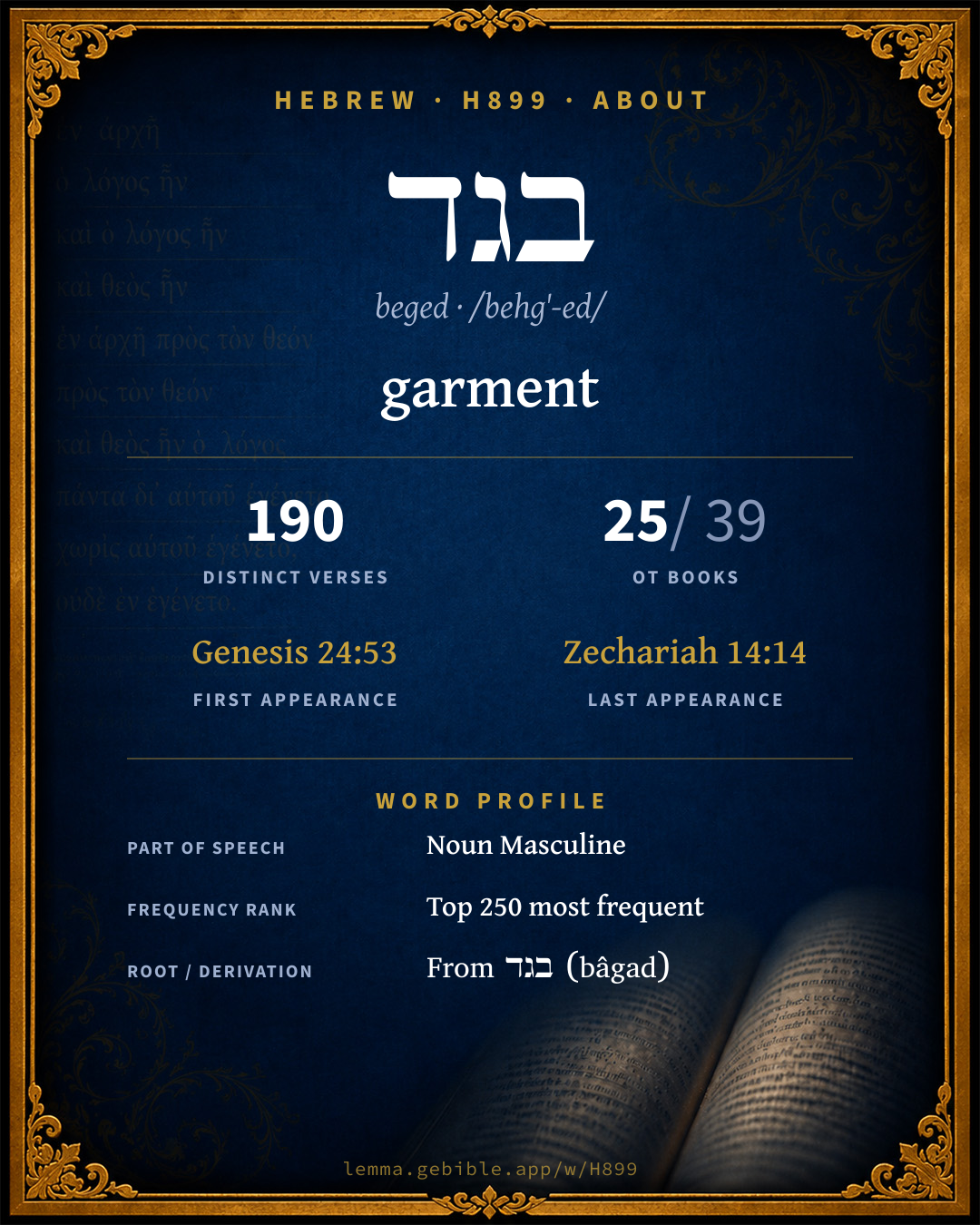
בֶּ֫גֶד
garment
‘garment’ is one of 2 main senses fuller range ↓
Full lexicon entry — Brown-Driver-Briggs (BDB)
From Brown-Driver-Briggs (BDB)
Where this word appears
See every Construct-state word in the Hebrew Bible →
Grammar key — what these labels mean
Part of speech
- Noun
- A naming word — a person, place, thing, or idea.
Noun type
- Common
- A common noun — a general class of person, place, or thing (“king,” “city,” “water”), not a specific name.
State
- Construct
- A noun bound to a following noun in a possessive / “of” relationship (the construct chain).
- Absolute
- The independent form of a noun, not bound to a following word.
Gender
- Masculine
- Grammatically masculine.
Number
- Plural
- More than one (in Hebrew, generally three or more).
- Singular
- One.
19 verses where H899 appears in the Construct state in the Book of Numbers. Filtered view — show all forms. Click any verse to open its interlinear word-by-word view. Verse text shown in the World English Bible for context — . Each verse’s Hebrew form is shown with its reference; the English is not keyword-highlighted, since the data carries no word-level English alignment. Use “Compare translations” on any verse to read it across multiple English versions. This concordance covers the Hebrew Bible; Septuagint (Greek Old Testament) occurrences are not indexed here.
Numbers
- Numbers 4:6 בֶֽגֶד n c ms cs and shall put a covering of sealskin on it, and shall spread over it a cloth all of blue, and shall put in its poles.
- Numbers 4:7 בֶּ֣גֶד n c ms cs On the table of show bread they shall spread a blue cloth, and put on it the dishes, the spoons, the bowls, and the cups with which to pour out; and the continual bread shall be on it.
- Numbers 4:8 בֶּ֚גֶד n c ms cs They shall spread on them a scarlet cloth, and cover the same with a covering of sealskin, and shall put in its poles.
- Numbers 4:9 בֶּ֣גֶד n c ms cs They shall take a blue cloth, and cover the lampstand of the light, and its lamps, and its snuffers, and its snuff dishes, and all its oil vessels, with which they minister to it.
- Numbers 4:11 בֶּ֣גֶד n c ms cs On the golden altar they shall spread a blue cloth, and cover it with a covering of sealskin, and shall put in its poles.
- Numbers 4:12 בֶּ֣גֶד n c ms cs They shall take all the vessels of ministry, with which they minister in the sanctuary, and put them in a blue cloth, and cover them with a covering of sealskin, and shall put them on the frame.
- Numbers 4:13 בֶּ֖גֶד n c ms cs They shall take away the ashes from the altar, and spread a purple cloth on it.
- Numbers 8:7 בִגְדֵי/הֶ֖ם n c mp cs + sfx pers 3mp Thus shall you do to them, to cleanse them: sprinkle the water of cleansing on them, let them shave their whole bodies with a razor, and let them wash their clothes, and cleanse themselves.
- Numbers 8:21 בִּגְדֵי/הֶ֔ם n c mp cs + sfx pers 3mp The Levites purified themselves from sin, and they washed their clothes; and Aaron offered them for a wave offering before Yahweh; and Aaron made atonement for them to cleanse them.
- Numbers 14:6 בִּגְדֵי/הֶֽם n c mp cs + sfx pers 3mp Joshua the son of Nun and Caleb the son of Jephunneh, who were of those who spied out the land, tore their clothes:
- Numbers 15:38 בִגְדֵי/הֶ֖ם n c mp cs + sfx pers 3mp Speak to the children of Israel, and bid those who they make them fringes in the borders of their garments throughout their generations, and that they put on the fringe of each border a cord of blue:
- Numbers 19:7 בְּגָדָ֜י/ו n c mp cs + sfx pers 3ms Then the priest shall wash his clothes, and he shall bathe his flesh in water, and afterward he shall come into the camp, and the priest shall be unclean until the even.
- Numbers 19:8 בְּגָדָי/ו֙ n c mp cs + sfx pers 3ms He who burns her shall wash his clothes in water, and bathe his flesh in water, and shall be unclean until the even.
- Numbers 19:10 בְּגָדָ֔י/ו n c mp cs + sfx pers 3ms He who gathers the ashes of the heifer shall wash his clothes, and be unclean until the even: and it shall be to the children of Israel, and to the stranger who lives as a foreigner among them, for a statute forever.
- Numbers 19:19 בְּגָדָ֛י/ו n c mp cs + sfx pers 3ms and the clean person shall sprinkle on the unclean on the third day, and on the seventh day: and on the seventh day he shall purify him; and he shall wash his clothes, and bathe himself in water, and shall be clean at even.
- Numbers 19:21 בְּגָדָ֔י/ו n c mp cs + sfx pers 3ms It shall be a perpetual statute to them: and he who sprinkles the water for impurity shall wash his clothes, and he who touches the water for impurity shall be unclean until even.
- Numbers 20:26 בְּגָדָ֔י/ו n c mp cs + sfx pers 3ms and strip Aaron of his garments, and put them on Eleazar his son: and Aaron shall be gathered [to his people], and shall die there.
- Numbers 20:28 בְּגָדָ֗י/ו n c mp cs + sfx pers 3ms Moses stripped Aaron of his garments, and put them on Eleazar his son; and Aaron died there on the top of the mountain: and Moses and Eleazar came down from the mountain.
- Numbers 31:24 בִּגְדֵי/כֶ֛ם n c mp cs + sfx pers 2mp You shall wash your clothes on the seventh day, and you shall be clean; and afterward you shall come into the camp.
About this entry
At a glance — auto-summarized from this page’s data, not written by a person. Every figure links to its source below. This summary describes the numbers; it doesn’t interpret them.
At its core, בגד (beged) means “garment.” It first appears in Genesis 24:53. It turns up in 190 verses across 25 books, a common footprint. Not a single-sense word: explore its full sense range. It clusters with בגד, בגדות and בגוד under a shared root. Each statement above links to its evidence; the full detail follows below.
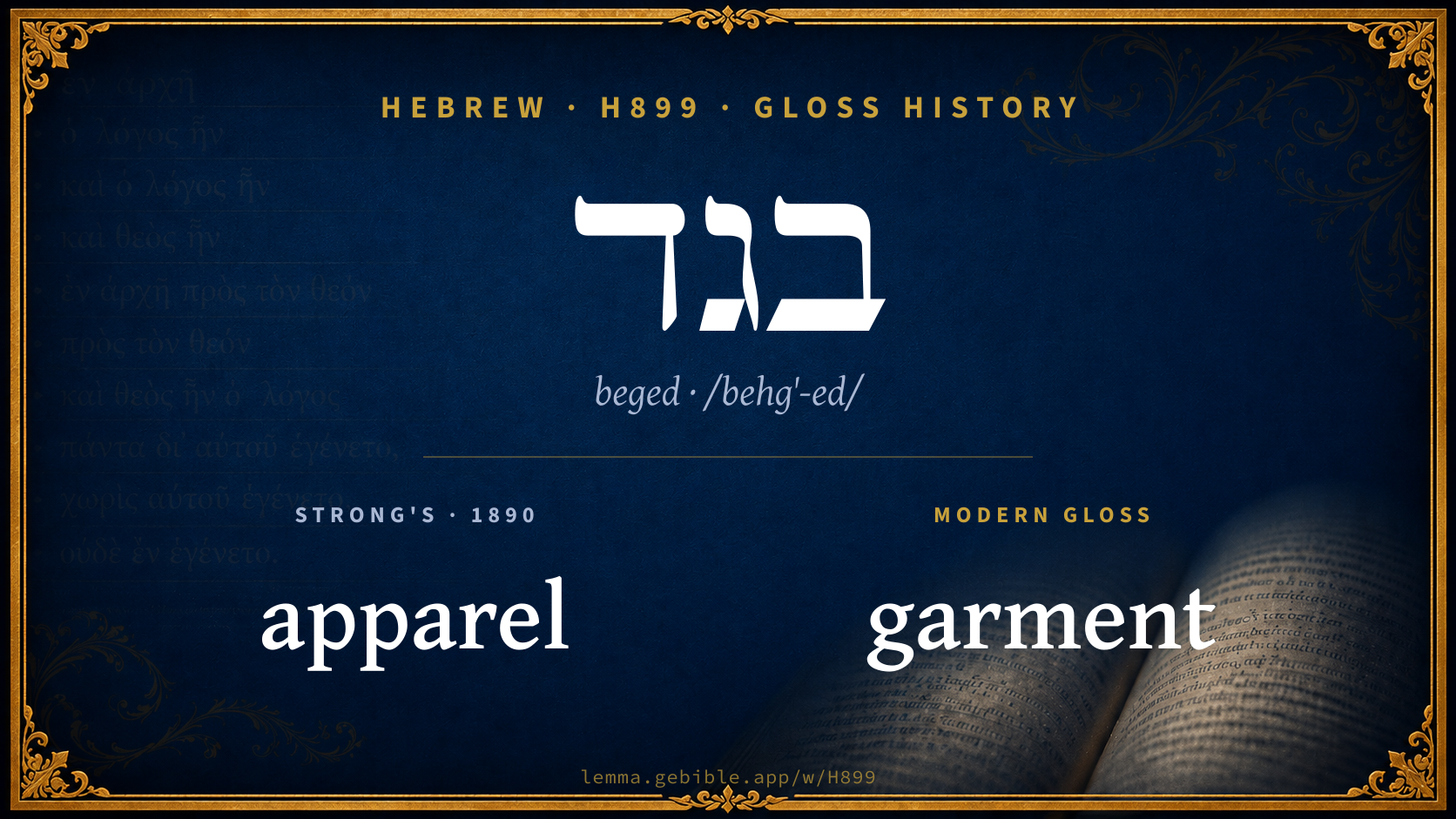
Gloss history
Strong's 1890 vs modern scholarship
About this word
Strong's H899 catalogs a Hebrew word from the Hebrew Old Testament.
These counts are not copied from any lexicon or concordance. They are computed here, from the morphology-tagged Hebrew Old Testament. What Lemma adds →
- 190
- distinct verses
- The word appears in 190 distinct verses.
- 25 / 39
- OT books
- The word appears in 25 of 39 Old Testament books.
- #217
- by frequency
- Top 250 most frequent Hebrew words (rank 217 of 8,640 Hebrew words by occurrence).
View all 190 occurrences in the concordance →
By section of the Old Testament
By traditional corpus
Conventional, traditional groupings — biblical authorship is debated, so this is a traditional corpus grouping, not an authorship claim. Each share is this word’s portion of its verses in that division of the Hebrew canon. Each figure is a share of the word’s 190 distinct verses.
- Torah (Pentateuch) 91 verses · 48%
- Prophets (Nevi'im) 76 verses · 40%
- Writings (Ketuvim) 23 verses · 12%
How translations render this word
Counts come from each version’s own published word-to-Strong’s tagging or interlinear alignment — an approximate guide to how each version renders this word, not a word-level alignment the data otherwise carries. Because each total is that version’s own tagged count, the per-version totals vary from one another and need not match the appearance or distinct-verse counts above. These counts may also differ from a printed concordance because Lemma counts each distinctly tagged rendering and does not collapse phrase taggings into a single head-word total. This is a fixed set of word-tagged versions (KJV, ASV, BSB, ULT) and does not change with the reading translation you choose elsewhere. Each version’s license is shown beside its name below (and on Sources).
BDB lists this Strong’s number as 2 distinct words (homographs). Each count above pools all of them and is not split by sense — see the Senses section below. A low-frequency rendering may belong to a different one of those words, not the primary meaning.
- King James Version†: Clothes 65×, Garments 65×, Garment 30×
- American Standard Version†: Garments 56×, Clothes 55×, Garment 27×
- Berean Standard Bible†: Clothes 73×, Garments 58×, Clothing 16×
- unfoldingWord Literal Text†: Clothes 86×, Garments 30×, Clothing 21×
King James Version Public Domain
Renders H899 across 217† tagged occurrences — most commonly:
Plus 22 renderings that appear only once — usually multi-word phrases or single function words the recovered tagging swept in, not distinct renderings.
American Standard Version Public Domain
Renders H899 across 218† tagged occurrences — most commonly:
Plus other, less common renderings. Plus 36 renderings that appear only once — usually multi-word phrases or single function words the recovered tagging swept in, not distinct renderings.
Berean Standard Bible Public Domain
Renders H899 across 213† tagged occurrences — most commonly:
Plus other, less common renderings. Plus 15 renderings that appear only once — usually multi-word phrases or single function words the recovered tagging swept in, not distinct renderings. Not rendered by a distinct English word in 4 further occurrences.
unfoldingWord Literal Text CC BY-SA 4.0
Renders H899 across 223† tagged occurrences — most commonly:
Plus other, less common renderings. Plus 14 renderings that appear only once — usually multi-word phrases or single function words the recovered tagging swept in, not distinct renderings.
Senses in the full BDB
What do BDB’s symbols mean?
BDB uses these scholarly abbreviations:
| Symbol | Meaning |
|---|---|
| 𝔊 | the Septuagint (the ancient Greek translation, LXX) |
| 𝔙 | the Vulgate (the Latin translation) |
| 𝔖 | the Syriac version (the Peshitta) |
| 𝔗 | the Targum (the Aramaic translation) |
| ψ | the Psalms |
| √ | root (the underlying root or stem) |
| ‖ | parallel passage (a synonymous or contrasted parallel) |
| † | the dagger: every passage where the word occurs is cited |
The 2 senses and sub-senses the full Brown-Driver-Briggs lexicon distinguishes for this word, in lexicon order (not ranked by frequency), with BDB’s own verbatim wording and sub-sense lettering. Shown in Hebrew script with BDB’s own scholarly abbreviations. The condensed entry is in the Lexicon Entry tab. See also the Forms in the corpus table below.
בגד I [m.] treachery, Is 24
בגד II (except Lv 6
- 1. garment, clothing, raiment, robe of any kind, from the filthy clothing of the leper to the holy robes of the high priest, the simplest covering of the poor as well as the costly raiment of the rich and noble, used throughout Heb. Lit.: Gn 24:53 (J), 28:20 (E; 14 times JE), Ex 28:2 + (P 90 times), Dt 24:17 Ju 8:26 + 4 times 1 S 19:13 + 10 times, 1 K 1:1 + 23 times, 2 Ch 18:9 + (Chr 9 times), Est 4:1, 4; Jb 13:28; 22:6; 37:17 ψ 22:19; 45:9; 102:27; 109:19; Pr 6:27; 20:16; 25:20; 27:13 Ec 9:8 Is 2; 24:16; 36:22; 37:1; Is 3; 50:9 + 10 times, Je 12:1 + 3 times, Ez 16:16 + 13 times, Jo 2:13; Am 2:8; Hg 2:12; Zc 3:3, 4, 5; 14:14; מְלֹא בִגְדוֹ his lap-ful 2 K 4:39. e.g. Genesis 24:53
- 2. covering, wrapping, of furniture of tabernacle Nu 4:6–13 (6 times); coverlet of a bed 1 S 19:13. e.g. Numbers 4:6
Senses from the full Brown-Driver-Briggs lexicon (Brown, Driver, Briggs; Oxford 1906 — public domain), digitized via Sefaria, supplemented by the OpenScriptures HebrewLexicon (CC BY 4.0). Full attribution on Sources.
Word origin
I. n.[m.] treachery, Is 24:16; Je 12:1.
II. n.m. (except Lv 6:20 עָלֶיהָ, but Sam. עליו, Ez 42:14; Pr 6:27, cf. Köi, 482) garment, covering—Gn 28:2 + 36 times; sf. בִּגְדוֹ Ez 9:3 + (14 times without dag. lene GesLbg 94); pl. בְּגָדִים Lv 6:4 + 32 times; cstr. בִּגְדֵי Gn 27:15 + 39 times; sf. בְּגָדֶיךָ 1 K 22:20 + 81 times בִּגְדֹתֶיךָ ψ 45:9;—
— Brown-Driver-Briggs (Oxford 1906, public domain), digitized via Sefaria, supplemented by the OpenScriptures HebrewLexicon (CC BY 4.0). See Sources.
Derived from בגד (bâgad) (H898) — to betray.
Jastrow Dictionary
A second Hebrew/Aramaic lexicon for comparison, covering Aramaic and post-biblical (Talmudic, Targumic, Midrashic) usage that the biblical-Hebrew BDB does not. Matched by lemma rather than by Strong’s number, so a lemma may carry more than one Jastrow headword (shown separately below), and the entries cover usage well beyond the Bible.
בָּגַד
- v. infra) to act violently, to rebel, be faithless. Snh. 37ᵃ (allud. to Gen. XXVII, 27) א"ת בְּגָדָיו אלא בּוֹגְדָיו do not read b’gadav (his garments), but bog’dav (his faithless ones). Y. Peah I, 16ᵇ top; Num. R. s. 10, beg.; Cant. R. to V, 16, v. בְּגִידָה.—Mekh. Mishp., N’zikin 3 מאחר שב׳ בה וכ׳ (b’bigdo bah, Ex. XXI, 8) since he &c., treated her contemptuously (opp. to the interpretation of בגדו as his garment, שפירש בגדו עליה he spread his bed-cloth over her). [From Targ. renderings as well as from Agadic interpretations it appears that the primitive meaning of בגד (√בג) is, to tear; also to despise, corresp. to the meanings of √בז; v. Targ. Job VI, 5; Is. XXXIII, 1; Prov. XXI, 18; Snh. 94ᵃ, cit. s. v. בזוזא; Esth. R. to I, 10, cit. s. v. בּוּז; Mekh. l. c.; cmp. also K’thib בג for K’ri בַּז Ezek. XXV, 7.—בֶּגֶד seems to be a piece, web, corresp. in meaning and use to φᾶρος.] e.g. Genesis 27:27
בֶּגֶד
- preced.) web, garment. Men. 40ᵇ היא של ב׳ וכ׳ if (the garment) itself is a web, but its borders are of leather. Ib. the principal element ב׳ בעינן must be a web (in order to require Tsitsith). Mekh. Mishp., N’zikin 3, v. preced. Sabb. 26ᵇ; a. fr.—Pl. בְּגָדִים, constr. בִּגְדֵי. Gen. R. s. 20 ב׳ א"הר Adam’s garments, v. אוֹר II, 3. Yoma 60ᵇ ב׳ לבן the Highpriest’s white garments (for the Day of Atone, Lev. XVI, 4), contrad. to ב׳ זהב gold-embroidered &c. Ib. 68ᵇ; a. fr. e.g. Leviticus 16:4
A Dictionary of the Targumim, the Talmud Babli and Yerushalmi, and the Midrashic Literature (Marcus Jastrow; London, Luzac, 1903) — Public Domain. Digitized via Sefaria. Digitized via Sefaria. Full attribution on Sources.
Forms in the corpus
The 115 distinct written forms H899 takes in the Hebrew Bible, most frequent first — each parse links to that state’s occurrences in the concordance. Hebrew forms include their vowel points and cantillation, so a single lemma takes many written forms.
The 60 most common forms are shown; 55 rarer forms follow in the full concordance.
Same root — word family
Other BDB entries built from the same root as H899, grouped by Strong’s listed origin. These share a root / origin per the lexicon — not necessarily a shared meaning. Each links to that word’s own entry.
Derives from
Shares the same root
Compare all same-root words → They share a root, not necessarily a meaning.
Septuagint verse parallels
This word appears in 184 verses that also exist in the Greek Old Testament (Septuagint), out of the 190 Hebrew verses it occurs in. You can read those verses in Greek by switching the Old Testament edition to the Septuagint.
Read these verses in the Septuagint
- Genesis 24:53
- Exodus 28:2
- Leviticus 6:11
- Numbers 4:6
- Deuteronomy 24:17
- Judges 8:26
- 1 Samuel 19:13
- 2 Samuel 1:2
- 1 Kings 1:1
- 2 Kings 2:12
- 2 Chronicles 18:9
- Ezra 9:3
This is a verse-level parallel only — the same verses exist in both the Hebrew and Greek Old Testaments. No word-level Hebrew↔Greek correspondence is claimed: the data carries no such alignment, so no Greek word is shown as this Hebrew word’s translation. Coverage is not total — the Septuagint omits the deuterocanon and renumbers the Psalms, so some Hebrew verses have no direct Greek parallel.