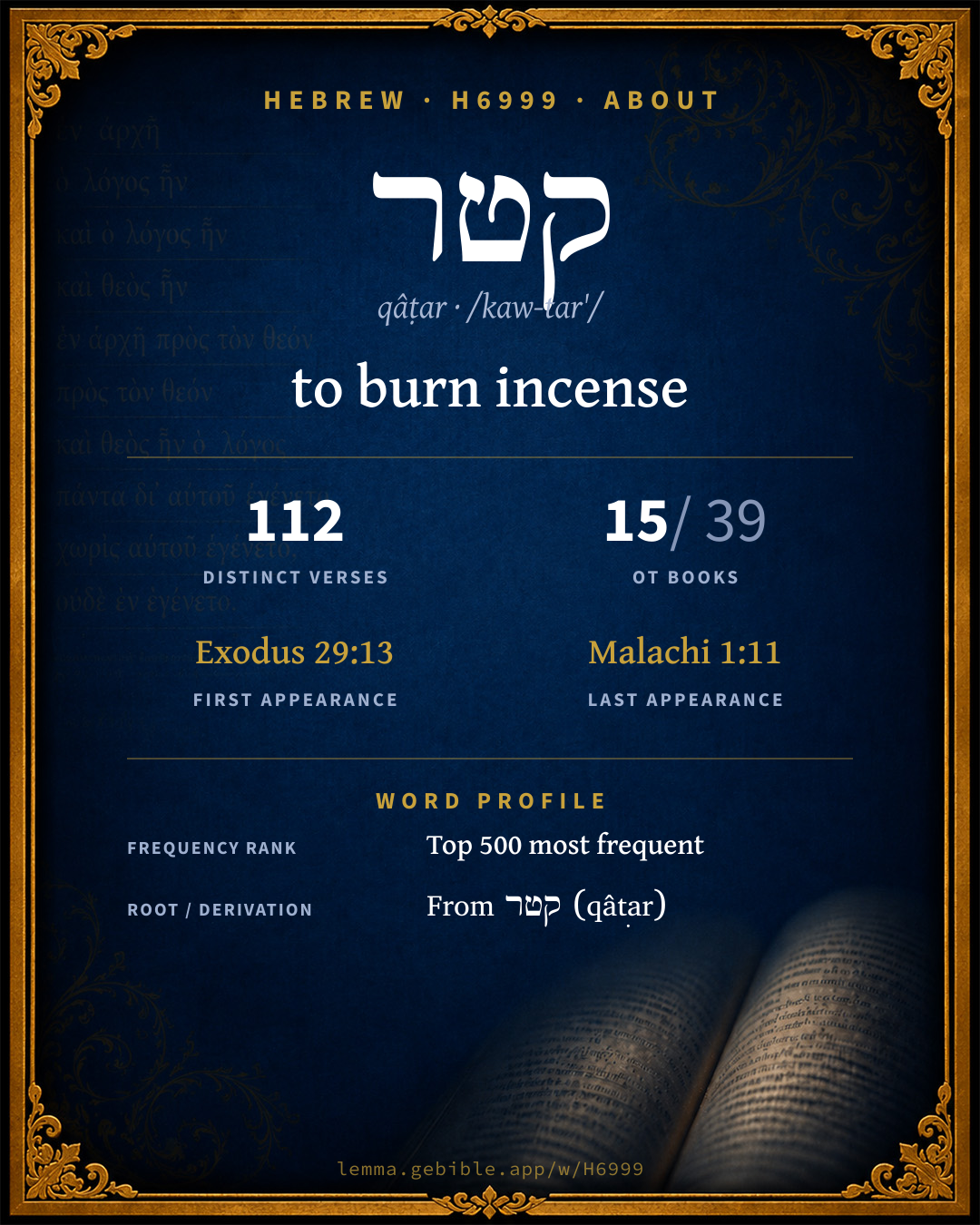
קָטַר
to burn incense
‘to burn incense’ is one of 3 main senses fuller range ↓
Full lexicon entry — Brown-Driver-Briggs (BDB)
From Brown-Driver-Briggs (BDB)
Where this word appears
See every Hiphil verb in the Hebrew Bible →
Grammar key — what these labels mean
Part of speech
- Verb
- An action or state-of-being word.
Noun type
- Common
- A common noun — a general class of person, place, or thing (“king,” “city,” “water”), not a specific name.
Stem
- Hiphil
- The causative active stem (“he caused / brought about”). Here: ‘make sacrifices smoke’
- Piel
- An intensive or resultative active stem.
- Hophal
- The passive counterpart of the Hiphil (“he was caused to…”). Here: ‘be made to smoke as a sacrifice’
- Pual
- The passive counterpart of the Piel.
Form
- Sequential Perfect
- A perfect with prefixed waw continuing a preceding imperfect or command (waw-consecutive perfect).
- Infinitive Construct
- A bound verbal noun, frequently with prepositions (“to write / in writing”).
- Sequential Imperfect
- An imperfect with prefixed waw — the standard past-narrative form (waw-consecutive imperfect).
- Participle Active
- A verbal adjective expressing ongoing or characteristic action (“writing / one who writes”).
- Perfect
- A completed action or state — Hebrew marks aspect (completeness) more than strict tense (“he wrote”).
- Infinitive Absolute
- An unbound verbal noun, often intensifying or standing in for a finite verb.
- Imperfect
- An incomplete, ongoing, or future action (“he will / would write”).
- Participle Passive
- A verbal adjective expressing action received (“written”).
- Jussive
- A third- or second-person volitional form expressing wish or command (“let him write”).
- Imperative
- A direct command (“write!”).
State
- Absolute
- The independent form of a noun, not bound to a following word.
- Construct
- A noun bound to a following noun in a possessive / “of” relationship (the construct chain).
Person
- 3rd Person
- The one spoken about (“he / she / it / they”).
- 2nd Person
- The one addressed (“you”).
Gender
- Masculine
- Grammatically masculine.
- Common
- Either gender — not distinguished for this form.
- Feminine
- Grammatically feminine.
Number
- Singular
- One.
- Plural
- More than one (in Hebrew, generally three or more).
3 verses where H6999 appears in the Hiphil stem in the Book of 1 Samuel. Filtered view — show all forms. Click any verse to open its interlinear word-by-word view. Verse text shown in the World English Bible for context — . Each verse’s Hebrew form is shown with its reference; the English is not keyword-highlighted, since the data carries no word-level English alignment. Use “Compare translations” on any verse to read it across multiple English versions. This concordance covers the Hebrew Bible; Septuagint (Greek Old Testament) occurrences are not indexed here.
1 Samuel
- 1 Samuel 2:15 יַקְטִר֣וּ/ן Hiphil impf 3mp + sfx n Yes, before they burnt the fat, the priest's servant came, and said to the man who sacrificed, Give flesh to roast for the priest; for he will not have boiled flesh of you, but raw.
- 1 Samuel 2:16 קַטֵּ֨ר יַקְטִיר֤וּ/ן Piel inf.abs Hiphil juss 3mp + sfx n If the man said to him, They will surely burn the fat first, and then take as much as your soul desires; then he would say, No, but you shall give it me now: and if not, I will take it by force.
- 1 Samuel 2:28 לְ/הַקְטִ֥יר prep + Hiphil inf.cs and did I choose him out of all the tribes of Israel to be my priest, to go up to my altar, to burn incense, to wear an ephod before me? and did I give to the house of your father all the offerings of the children of Israel made by fire?
About this entry
At a glance — auto-summarized from this page’s data, not written by a person. Every figure links to its source below. This summary describes the numbers; it doesn’t interpret them.
קטר — transliterated qâṭar — is a Hebrew word carrying the sense “to burn incense.” Translators differ — “burn incense” in the King James Version, then “burn” (Berean Standard Bible) and “become smoke” (unfoldingWord Literal Text), as the renderings breakdown shows. With 112 verses in 15 books, it is a common word in the Hebrew Bible. Its uses concentrate in Leviticus (29% of all occurrences). It is not a single-sense word — see its full sense range. See the sense tree, 112-verse concordance, and the renderings breakdown below.
Gloss history
Strong's 1890 vs modern scholarship
About this word
Strong's H6999 catalogs a Hebrew word from the Hebrew Old Testament.
These counts are not copied from any lexicon or concordance. They are computed here, from the morphology-tagged Hebrew Old Testament. What Lemma adds →
- 112
- distinct verses
- The word appears in 112 distinct verses.
- 15 / 39
- OT books
- The word appears in 15 of 39 Old Testament books.
- #372
- by frequency
- Top 500 most frequent Hebrew words (rank 372 of 8,640 Hebrew words by occurrence).
View all 112 occurrences in the concordance →
Most concentrated in
- Leviticus 33 verses 29%
- Jeremiah 21 verses 19%
- 2 Chronicles 15 verses 13%
By section of the Old Testament
By traditional corpus
Conventional, traditional groupings — biblical authorship is debated, so this is a traditional corpus grouping, not an authorship claim. Each share is this word’s portion of its verses in that division of the Hebrew canon. Each figure is a share of the word’s 112 distinct verses.
- Prophets (Nevi'im) 51 verses · 46%
- Torah (Pentateuch) 43 verses · 38%
- Writings (Ketuvim) 18 verses · 16%
How translations render this word
Counts come from each version’s own published word-to-Strong’s tagging or interlinear alignment — an approximate guide to how each version renders this word, not a word-level alignment the data otherwise carries. Because each total is that version’s own tagged count, the per-version totals vary from one another and need not match the appearance or distinct-verse counts above. These counts may also differ from a printed concordance because Lemma counts each distinctly tagged rendering and does not collapse phrase taggings into a single head-word total. This is a fixed set of word-tagged versions (KJV, ASV, BSB, ULT) and does not change with the reading translation you choose elsewhere. Each version’s license is shown beside its name below (and on Sources).
BDB lists this Strong’s number as 3 distinct words (homographs). Each count above pools all of them and is not split by sense — see the Senses section below. A low-frequency rendering may belong to a different one of those words, not the primary meaning.
- King James Version†: Burn incense 19×, Shall burn 14×, Burnt incense 9×
- American Standard Version†: Burn incense 16×, Shall burn 13×, Burnt incense 8×
- Berean Standard Bible†: Burn 15×, Burn incense 12×, Burned incense 11×
- unfoldingWord Literal Text†: Become smoke 27×, And 16×, Shall cause 9×
King James Version Public Domain
Renders H6999 across 116† tagged occurrences — most commonly:
Plus other, less common renderings. Plus 33 renderings that appear only once — usually multi-word phrases or single function words the recovered tagging swept in, not distinct renderings. Not rendered by a distinct English word in 1 further occurrence.
American Standard Version Public Domain
Renders H6999 across 118† tagged occurrences — most commonly:
Plus other, less common renderings. Plus 41 renderings that appear only once — usually multi-word phrases or single function words the recovered tagging swept in, not distinct renderings.
Berean Standard Bible Public Domain
Renders H6999 across 114† tagged occurrences — most commonly:
Plus other, less common renderings. Plus 29 renderings that appear only once — usually multi-word phrases or single function words the recovered tagging swept in, not distinct renderings. Not rendered by a distinct English word in 2 further occurrences.
unfoldingWord Literal Text CC BY-SA 4.0
Renders H6999 across 152† tagged occurrences — most commonly:
Plus other, less common renderings. Plus 39 renderings that appear only once — usually multi-word phrases or single function words the recovered tagging swept in, not distinct renderings.
10 senses and sub-senses in the full BDB
Hebrew verbs can shift meaning by stem (binyan): Qal is the basic action, Niphal is often passive or reflexive, Piel often intensifies or makes it factitive, and Hiphil is typically causative. The senses below are grouped under the stem BDB assigns to each. This entry also uses Pual (the passive of Piel) and Hophal (the passive of Hiphil).
What do BDB’s symbols mean?
BDB uses these scholarly abbreviations:
| Symbol | Meaning |
|---|---|
| 𝔊 | the Septuagint (the ancient Greek translation, LXX) |
| 𝔙 | the Vulgate (the Latin translation) |
| 𝔖 | the Syriac version (the Peshitta) |
| 𝔗 | the Targum (the Aramaic translation) |
| ψ | the Psalms |
| √ | root (the underlying root or stem) |
| ‖ | parallel passage (a synonymous or contrasted parallel) |
| † | the dagger: every passage where the word occurs is cited |
The 10 senses and sub-senses the full Brown-Driver-Briggs lexicon distinguishes for this word, in lexicon order (not ranked by frequency), with BDB’s own verbatim wording and sub-sense lettering. Shown in Hebrew script with BDB’s own scholarly abbreviations. The condensed entry is in the Lexicon Entry tab. See also the Forms in the corpus table below.
קטר I denom. Pi. Hiph. make sacrifices smoke, send them up in smoke (proposes produce קְטֹרֶת, v StaZAW vi (1886), 298 f.)
Piel
- Pf. 3 mpl. קִטְּרוּ Je 19:13 +, קִטַּרְתֶּם Je 44:21, 23; Impf. 3 ms. יְקַטֵּר Hb 1:16 +; 3 mpl. יְקַטֵּר֑וּן Ho 11:2, etc.; Inf. abs. קַטֵּר 1 S 2:16 +; cstr. Je 11:13 +, Pt. pl. מְקַטְּרִים Is 65:3 +, etc.;—make sacrifices smoke, offer them by burning: to י׳, 1 S 2:16 (where prob. read יְקַטְּרוּן [and so v 15] Stal.c. 299): elsewhere to other gods or in illegal worship, Je 44:23; c. acc. קִטֵּר (but see this, infr.) Je 44:21 (here [and al. in some other passages] of incense), תּוֹדָה Am 4:5; place is usually c. ב, e.g. בַּבָּמוֹת 2 K 17:11; 23:5; עוֹד הָעָם מְזַבְּחִים וּמְקַטְּרִים בַּבָּמוֹת 1 K 22:44; 2 K 12:4; 14:4; 15:4, 35 (R), cf. 2 K 16:4 = 2 Ch 28:4 (cf. RSSem. i. 471; 2nd ed. 490); הַבּ׳ אֲשֶׁר קִטְּרוּ שָׁמָּה 2 K 23:8; c. עַל e.g. על הגבעות Ho 4:13, על גג(ו)ת Je 19:13; 32:29, על הלבנים Is 65:3, על ההרים v 7; c. לְ of deity, Ho 11:2; Je 1:16 + 14 times Je (+ 19:13; 32:29 supr.), Hb 1:16; 2 K 22:17; 23:5; 2 Ch 25:14; 28:25; 34:25 Qr (> Kt Hiph.), to the brazen serpent 2 K 18:4. e.g. Jeremiah 19:13
Pual
- Pt. מְקֻטֶּרֶת מֹר וגו׳ Ct 3:6 fumigated with myrrh, etc. (Aq. 𝔙 Schlottm מִקְטֹרֶת). e.g. Song of Solomon 3:6
Hiphil
- Pf. 3 ms. הִקְטִיר Lv 9:10 +; 2 ms. הִקְטַרְתָּ Ex 29:13, 18, 25, etc.; Impf. 3 ms. יַקְטִיר Lv 4:26; 16:25, וַיַּקְטֵר Ex 40:27 +, etc.: Imv. ms. הַקְטֵר 2 K 16:15; Inf. abs. הַקְטֵיר 1 K 9:25; cstr. לְהַקְטִיר Ex 30:20 +; Pt. מַקְטִיר Je 33:18 +, etc. e.g. Leviticus 9:10
- 1. make sacrifices smoke, usually
- a. in worship of י׳: abs. 1 K 12:33; 13:1; 2 Ch 29:11; c. acc. חלב Lv 17:6; Nu 18:17; 1 S 2:15, 16, עלת 2 K 16:13, 15; 2 Ch 13:11, אִשֶּׁה Ex 30:20; Lv 2:11; Nu 18:17, מנחה Je 33:18; רֹאשׁ etc. Lv 8:20 אַזְכָּרָה Lv 2:16; חלבי השׁלמים Lv 6:5; קטרת 1 S 2:28; on 1 K 9:25 v. Klo Benz; place is על מזבח Lv 4:10 + 5 times, הַמִּזְבֵּ֫חָה Ex 29:13, 18, 25 + 23 times Lv, Nu 5:26 (all P); c. הַמִּזְבֵּחַ (acc.) Lv 6:8; בַּבָּמוֹת 1 K 3:3; בגיא בן הִנִּם 2 Ch 28:3. e.g. 1 Kings 12:33
- b. less often in worship of other gods. לאלהיהן (gods of Sol.’s wives) 1 K 11:8, לאלהיו (of Moab) Je 48:35, להם (Baalim) Ho 2:15;—2 Ch 34:25 read Qr Piʿel. e.g. 1 Kings 11:8
- 2. cause incense to smoke, offer incense abs. 2 Ch 2:5; 26:18(×2), 19; c. עַל of altar 2 Ch 26:16; Ex 30:7; 40:27; c. acc. יַקְטִירֶנָּה 30:7, 8, קטרת סמים 30:7; 40:27; 2 Ch 2:3, קטרת תמיד Ex 30:8, הק׳ קטרת Nu 17:5; 2 Ch 29:7. e.g. 2 Chronicles 2:5
- 3. make smoke upon (על) both altars (of burnt-offering and of incense) 1 Ch 6:34, cf. also 23:13. e.g. 1 Chronicles 6:34
Hophal
- be made to smoke as a sacrifice: Impf. 3 fs. תָּקְטָ֑ר Lv 6:15;Pt. מֻקְמָר Mal 1:11 (Ew Ke al.[Ges§ 121 b]; We Now read מ׳ לִשְׁמִי מִנְחָה; but v. מֻקְטָר). e.g. Leviticus 6:15
קטר II incense
קטר III dubious word
Qal
- Pt. pass. pl. חֲצֵרוֹת קְטֻרוֹת Ez 46:22 enclosed courts (cf. interpr. in LevyNHWB, and ܒܳܬܶܐ ܩܛܺܝܪܶܐ PS3589), but read prob. קְטַנּוֹת small, 𝔊 𝔖 Co Toy Berthol Krae. e.g. Ezekiel 46:22
Senses from the full Brown-Driver-Briggs lexicon (Brown, Driver, Briggs; Oxford 1906 — public domain), digitized via Sefaria, supplemented by the OpenScriptures HebrewLexicon (CC BY 4.0). Full attribution on Sources.
Word origin
I. vb.denom. Pi. Hiph. make sacrifices smoke, send them up in smoke (proposes produce קְטֹרֶת, v StaZAW vi (1886), 298 f.);—
I. n.m. incense;—abs. מ׳ Mal 1:11 (Thes Hi MartiKau GASm Köiii, § 307).
II. vb. dubious word; si vera l. appar. = shut in, enclose (𝔗 קְטַר, Syriac ܩܛܰܪ bind, ܩܶܛܪܳܐ chain);—
— Brown-Driver-Briggs (Oxford 1906, public domain), digitized via Sefaria, supplemented by the OpenScriptures HebrewLexicon (CC BY 4.0). See Sources.
Derived from קטר (qâṭar) (H7000) — enclosed.
Jastrow Dictionary
A second Hebrew/Aramaic lexicon for comparison, covering Aramaic and post-biblical (Talmudic, Targumic, Midrashic) usage that the biblical-Hebrew BDB does not. Matched by lemma rather than by Strong’s number, so a lemma may carry more than one Jastrow headword (shown separately below), and the entries cover usage well beyond the Bible.
קָטַר I
- [to circle,] to rise in circles, to smoke. Ker. 6ᵇ דבר שקוֹטֵר ועולה וריחו וכ׳ (not שקיטר) something which circles and rises, and whose savor spreads. Ib. מה לשון קטרת דבר שקוטר ועולה ḳ’ṭoreth means something which circles &c.
- to offer incense (mostly with ref. to idolatrous rites). Tosef. Snh. X, 2 אחד העובד … ואחד המְקַטֵּר וכ׳ whether one worships (an idol), or sacrifices, or offers incense &c.; Ker. 3ᵇ. Ib. מקטר לשד וכ׳ who makes incense rise to a demon in order to exorcise him; Snh. 65ᵃ. Ber. 53ᵃ, v. כֶּשֶׁף. Lev. R. s. 7, v. infra; a. fr.—Part. pass. מְקוּטָּר; f. מְקוּטֶּרֶת perfumed. Pirké d’R. El. ch. XXX (play on קטורה) שהיתה מק׳ מכל וכ׳ she was (through her good deeds) more savory than all kinds of spices; Gen. R. s. 61 שמק׳ מצות וכ׳ she was perfumed with godly deeds and good works (v. קָטַר II).
- same (mostly with ref. to the Lord). [Tosef. Snh. X, 3 והמקטיר, prob. to be read: והמְקַטֵּיר.] Men. 110ᵃ (ref. to Mal. I, 11) אלו … כאילו מַקְטִירִין וכ׳ this refers to the students engaged in the Law; wherever it be, I account it to them as if they were offering incense and bringing sacrifices to my Name. Lev. R. s. 7 (ref. to מקטר קטרת, Ex. XXX, 1) מִתְקַטֵּר בקטרת אין כתיב כאן אלא מְקטֵּר … המזבח היה מַקְטִיר וכ׳ it says not ‘being perfumed with incense’, but ‘perfuming with incense’, the altar gave forth incense of itself. Ber. 7ᵃ פעם … לְהַקְטִיר קטרת וכ׳ once I entered to let incense rise in the Holy of Holies; a. fr. e.g. Malachi 1:11
- to be perfumed, v. supra.
קְטַר
- v. infra.
- to let incense rise. Targ. O. Ex. XXX, 1. Ib. 7 (Y. some ed. Pe.). Targ. O. ib. XL, 27; a. e.
קָטַר II
- v. preced.) to wreathe, tie. Gen. R. s. 61 (play on קטורה) קָטְרָה מצות וכ׳ Ar. (ed. שמקוטרת, v. קָטַר I) she wreathed (made a crown of) godly deeds &c.; Yalk. ib. 109; Yalk. Chr. 1073.—[Gen. R. l. c. מן קטר, a grammatical gloss, v. Yalk. Gen. l. c., and Ar. s. v. קטר 2.]—Part. pass. קָטוּר; f. קְטוּרָה &c. Midd. II, 5 (ref. to קְטֻרוֹת, Ez. XLVI, 22) אין קְטוּרוֹת אלא שאינן מקורות ‘fenced in’ means that they were not roofed; Yalk. Ez. 381. e.g. Ezekiel 46:22
קְטַר ²
- , to tie. Targ. Jud. XV, 4. Targ. Gen. XXXVIII, 28; a. fr.—Part. pass. קְטִיר; f. קְטִירָא, קְטִירַת &c. Targ. Y. ib. XXII, 4 (ed. Amst. קָטֵר, read: קָטִר). Targ. Prov. XXII, 15; a. fr.—Koh. R. to III, 2 [read:] הן דאת קָטֵיר לולבך קְטֹר אלפך when thou tiest thy Lulab, tie thy ship; Gen. R. s. 6, a. e., v. לוּלָבָא. Ber. 16ᵃ, v. גְּנוּנָא. Bekh. 31ᵃ דאתו קטיר, v. תַּכְתַּקָּא. Koh. R. to IX, 10 אייתון … וקַטְרוּ ברגלי get a rope and tie it to my feet. Y. Erub. X, 26ᶜ top קטיר בגמי (not קטר) tied with reed-grass. Y. Gitt. IV, 46ᵃ (we must not help captives to escape) מפני … דלא יהוון קַטְרִינוֹן this law is made for the benefit of the (remaining) captives, that they (the captors) may not chain them; a. fr.—2) (v. קָשַׁר) to gather, be covered. Ber. 59ᵃ, v. עֵיבָא a. עֲנָנָא.
- same. Part. pass. מְקַטַּר, מְקַטְּרָא &c. Targ. Ez. XLVI, 22 מְקַטְּרָן fenced in (v. preced.).—Y. Ned. VI, 39ᵈ top חלבא מקטרא bound (curdled) milk, v. קוֹם.
A Dictionary of the Targumim, the Talmud Babli and Yerushalmi, and the Midrashic Literature (Marcus Jastrow; London, Luzac, 1903) — Public Domain. Digitized via Sefaria. Digitized via Sefaria. Full attribution on Sources.
Forms in the corpus
The 81 distinct written forms H6999 takes in the Hebrew Bible, most frequent first — each parse links to that stem’s occurrences in the concordance. Hebrew forms include their vowel points and cantillation, so a single lemma takes many written forms.
The 60 most common forms are shown; 21 rarer forms follow in the full concordance.
Same root — word family
Other BDB entries built from the same root as H6999, grouped by Strong’s listed origin. These share a root / origin per the lexicon — not necessarily a shared meaning. Each links to that word’s own entry.
Derives from
Shares the same root
Derived from this word
- מקטר miqṭâr H4729 altar
- קטורה qᵉṭôwrâh H6988 incense
- קטר qiṭṭêr H7002 incense
- קטרת qᵉṭôreth H7004 incense
- קיטור qîyṭôwr H7008 thick smoke
Proper names from this root
People and places named from this root — a name, not an additional meaning of the word.
Compare all same-root words → Showing 4 of 10 — not the complete family. 2 of the same-root words are proper names (people or places). They share a root, not necessarily a meaning.
Septuagint verse parallels
This word appears in 106 verses that also exist in the Greek Old Testament (Septuagint), out of the 112 Hebrew verses it occurs in. You can read those verses in Greek by switching the Old Testament edition to the Septuagint.
Read these verses in the Septuagint
- Exodus 29:13
- Leviticus 1:9
- Numbers 5:26
- 1 Samuel 2:15
- 1 Kings 3:3
- 2 Kings 12:3
- 1 Chronicles 6:49
- 2 Chronicles 2:4
- Song of Solomon 3:6
- Isaiah 65:3
- Jeremiah 1:16
- Hosea 2:13
This is a verse-level parallel only — the same verses exist in both the Hebrew and Greek Old Testaments. No word-level Hebrew↔Greek correspondence is claimed: the data carries no such alignment, so no Greek word is shown as this Hebrew word’s translation. Coverage is not total — the Septuagint omits the deuterocanon and renumbers the Psalms, so some Hebrew verses have no direct Greek parallel.