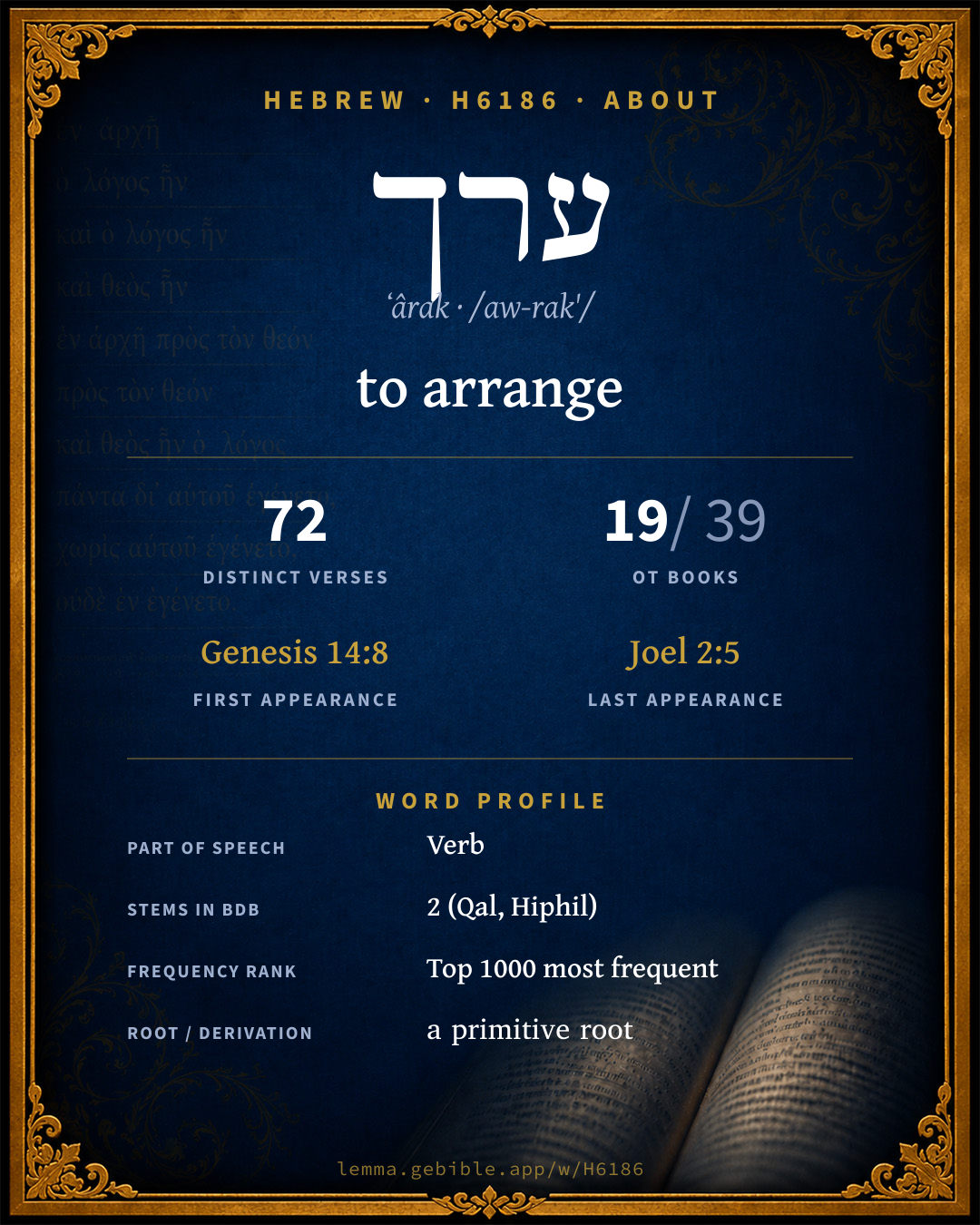
עָרַךְ
to arrange
also: set in array, prepare, order, ordain fuller range ↓
Full lexicon entry — Brown-Driver-Briggs (BDB)
From Brown-Driver-Briggs (BDB)
Where this word appears
See every Qal verb in the Hebrew Bible →
Grammar key — what these labels mean
Part of speech
- Verb
- An action or state-of-being word.
Stem
- Qal
- The basic, simple active stem — the plain form of the verb (“he wrote”). Here: ‘arrange in order’
- Hiphil
- The causative active stem (“he caused / brought about”). Here: ‘value’
Form
- Sequential Imperfect
- An imperfect with prefixed waw — the standard past-narrative form (waw-consecutive imperfect).
- Infinitive Construct
- A bound verbal noun, frequently with prepositions (“to write / in writing”).
- Imperfect
- An incomplete, ongoing, or future action (“he will / would write”).
- Participle Active
- A verbal adjective expressing ongoing or characteristic action (“writing / one who writes”).
- Participle Passive
- A verbal adjective expressing action received (“written”).
- Sequential Perfect
- A perfect with prefixed waw continuing a preceding imperfect or command (waw-consecutive perfect).
- Perfect
- A completed action or state — Hebrew marks aspect (completeness) more than strict tense (“he wrote”).
- Imperative
- A direct command (“write!”).
- Cohortative
- A first-person volitional form expressing wish or resolve (“let me / let us write”).
- Infinitive Absolute
- An unbound verbal noun, often intensifying or standing in for a finite verb.
State
- Construct
- A noun bound to a following noun in a possessive / “of” relationship (the construct chain).
- Absolute
- The independent form of a noun, not bound to a following word.
Person
- 3rd Person
- The one spoken about (“he / she / it / they”).
- 1st Person
- The speaker (“I / we”).
- 2nd Person
- The one addressed (“you”).
Gender
- Masculine
- Grammatically masculine.
- Common
- Either gender — not distinguished for this form.
- Feminine
- Grammatically feminine.
Number
- Plural
- More than one (in Hebrew, generally three or more).
- Singular
- One.
Grammatical forms 30 distinct
- Verb, Qal, Sequential Imperfect, 3rd Person, Masculine, Plural 11 times (14%)
- Verb, Qal, Imperfect, 3rd Person, Masculine, Singular 9 times (12%)
- Verb, Qal, Sequential Imperfect, 3rd Person, Masculine, Singular 8 times (11%)
- Verb, Qal, Infinitive Construct 5 times (7%)
- Verb, Qal, Participle Active, Masculine, Plural, Construct 4 times (5%)
- Verb, Qal, Participle Passive, Masculine, Singular, Absolute 4 times (5%)
- Verb, Qal, Sequential Perfect, 3rd Person, Common, Plural 3 times (4%)
- Verb, Qal, Perfect, 1st Person, Common, Singular 3 times (4%)
+22 more forms (29 occurrences)
Parsed forms decoded from the imported morphology (morphhb / Westminster Leningrad Codex — WLC text public domain, morphhb tagging CC BY 4.0), counted across 76 parsed occurrences — not distinct verses.
Every verse where H6186 appears — 72 distinct verses across 19 books. Click any verse to open its interlinear word-by-word view. Verse text shown in the World English Bible for context — . Each verse’s Hebrew form is shown with its reference; the English is not keyword-highlighted, since the data carries no word-level English alignment. Use “Compare translations” on any verse to read it across multiple English versions. This concordance covers the Hebrew Bible; Septuagint (Greek Old Testament) occurrences are not indexed here.
Genesis 2 verses
- Genesis 14:8 וַ/יַּֽעַרְכ֤וּ conj + Qal wimpf 3mp There went out the king of Sodom, and the king of Gomorrah, and the king of Admah, and the king of Zeboiim, and the king of Bela (the same is Zoar); and they set the battle in array against them in the valley of Siddim;
- Genesis 22:9 וַֽ/יַּעֲרֹ֖ךְ conj + Qal wimpf 3ms They came to the place which God had told him of. Abraham built the altar there, and laid the wood in order, bound Isaac his son, and laid him on the altar, on the wood.
Exodus 3 verses
- Exodus 27:21 יַעֲרֹךְ֩ Qal impf 3ms In the tent of meeting, outside the veil which is before the testimony, Aaron and his sons shall keep it in order from evening to morning before Yahweh: it shall be a statute forever throughout their generations on the behalf of the children of Israel.
- Exodus 40:4 וְ/עָרַכְתָּ֖ conj + Qal wpf 2ms You shall bring in the table, and set in order the things that are on it. You shall bring in the lampstand, and light the lamps of it.
- Exodus 40:23 וַ/יַּעֲרֹ֥ךְ conj + Qal wimpf 3ms He set the bread in order on it before Yahweh, as Yahweh commanded Moses.
Leviticus 10 verses
- Leviticus 1:7 וְ/עָרְכ֥וּ conj + Qal wpf 3cp The sons of Aaron the priest shall put fire on the altar, and lay wood in order on the fire;
- Leviticus 1:8 וְ/עָרְכ֗וּ conj + Qal wpf 3cp and Aaron's sons, the priests, shall lay the pieces, the head, and the fat in order on the wood that is on the fire which is on the altar;
- Leviticus 1:12 וְ/עָרַ֤ךְ conj + Qal wpf 3ms He shall cut it into its pieces, with its head and its fat. The priest shall lay them in order on the wood that is on the fire which is on the altar,
- Leviticus 6:12 וְ/עָרַ֤ךְ conj + Qal wpf 3ms The fire on the altar shall be kept burning on it, it shall not go out; and the priest shall burn wood on it every morning: and he shall lay the burnt offering in order upon it, and shall burn on it the fat of the peace offerings.
- Leviticus 24:3 יַעֲרֹךְ֩ Qal impf 3ms Outside of the veil of the Testimony, in the Tent of Meeting, shall Aaron keep it in order from evening to morning before Yahweh continually: it shall be a statute forever throughout your generations.
- Leviticus 24:4 יַעֲרֹ֖ךְ Qal impf 3ms He shall keep in order the lamps on the pure gold lampstand before Yahweh continually.
- Leviticus 24:8 יַֽעַרְכֶ֛/נּוּ Qal impf 3ms + sfx pers 3ms Every Sabbath day he shall set it in order before Yahweh continually. It is on the behalf of the children of Israel an everlasting covenant.
- Leviticus 27:8 וְ/הֶעֱרִ֥יךְ יַעֲרִיכֶ֖/נּוּ conj + Hiphil wpf 3ms Hiphil impf 3ms + sfx pers 3ms But if he is poorer than your valuation, then he shall be set before the priest, and the priest shall value him; according to the ability of him who vowed shall the priest value him.
- Leviticus 27:12 וְ/הֶעֱרִ֤יךְ conj + Hiphil wpf 3ms and the priest shall value it, whether it is good or bad. As you the priest values it, so shall it be.
- Leviticus 27:14 וְ/הֶעֱרִיכ/וֹ֙ יַעֲרִ֥יךְ conj + Hiphil wpf 3ms + sfx pers 3ms Hiphil impf 3ms "'When a man dedicates his house to be holy to Yahweh, then the priest shall evaluate it, whether it is good or bad: as the priest shall evaluate it, so shall it stand.
Numbers 1 verse
Joshua 1 verse
Judges 4 verses
- Judges 20:20 וַ/יַּעַרְכ֨וּ conj + Qal wimpf 3mp The men of Israel went out to battle against Benjamin; and the men of Israel set the battle in array against them at Gibeah.
- Judges 20:22 לַ/עֲרֹ֣ךְ עָ֥רְכוּ prep + Qal inf.cs Qal pf 3cp The people, the men of Israel, encouraged themselves, and set the battle again in array in the place where they set themselves in array the first day.
- Judges 20:30 וַ/יַּעַרְכ֥וּ conj + Qal wimpf 3mp The children of Israel went up against the children of Benjamin on the third day, and set themselves in array against Gibeah, as at other times.
- Judges 20:33 וַ/יַּעַרְכ֖וּ conj + Qal wimpf 3mp All the men of Israel rose up out of their place, and set themselves in array at Baal Tamar: and the liers-in-wait of Israel broke forth out of their place, even out of Maareh Geba.
1 Samuel 4 verses
- 1 Samuel 4:2 וַ/יַּעַרְכ֨וּ conj + Qal wimpf 3mp The Philistines put themselves in array against Israel: and when they joined battle, Israel was struck before the Philistines; and they killed of the army in the field about four thousand men.
- 1 Samuel 17:2 וַ/יַּעַרְכ֥וּ conj + Qal wimpf 3mp Saul and the men of Israel were gathered together, and encamped in the valley of Elah, and set the battle in array against the Philistines.
- 1 Samuel 17:8 לַ/עֲרֹ֣ךְ prep + Qal inf.cs He stood and cried to the armies of Israel, and said to them, Why are you come out to set your battle in array? am I not a Philistine, and you servants to Saul? choose you a man for you, and let him come down to me.
- 1 Samuel 17:21 וַ/תַּעֲרֹ֤ךְ conj + Qal wimpf 3fs Israel and the Philistines put the battle in array, army against army.
2 Samuel 5 verses
- 2 Samuel 10:8 וַ/יַּעַרְכ֥וּ conj + Qal wimpf 3mp The children of Ammon came out, and put the battle in array at the entrance of the gate: and the Syrians of Zobah and of Rehob, and the men of Tob and Maacah, were by themselves in the field.
- 2 Samuel 10:9 וַֽ/יַּעֲרֹ֖ךְ conj + Qal wimpf 3ms Now when Joab saw that the battle was set against him before and behind, he chose of all the choice men of Israel, and put them in array against the Syrians:
- 2 Samuel 10:10 וַֽ/יַּעֲרֹ֕ךְ conj + Qal wimpf 3ms The rest of the people he committed into the hand of Abishai his brother; and he put them in array against the children of Ammon.
- 2 Samuel 10:17 וַ/יַּעַרְכ֤וּ conj + Qal wimpf 3mp It was told David; and he gathered all Israel together, and passed over the Jordan, and came to Helam. The Syrians set themselves in array against David, and fought with him.
- 2 Samuel 23:5 עֲרוּכָ֤ה Qal ptcp.pass fs Most assuredly my house is not so with God; Yet he has made with me an everlasting covenant, Ordered in all things, and sure: For it is all my salvation, and all [my] desire, Although he doesn't make it grow.
1 Kings 1 verse
2 Kings 1 verse
1 Chronicles 9 verses
- 1 Chronicles 12:8 עֹרְכֵ֥י Qal ptcp.act mp cs Of the Gadites there separated themselves to David to the stronghold in the wilderness, mighty men of valor, men trained for war, that could handle shield and spear; whose faces were like the faces of lions, and they were as swift as the roes on the mountains;
- 1 Chronicles 12:33 עֹרְכֵ֧י Qal ptcp.act mp cs Of Zebulun, such as were able to go out in the host, who could set the battle in array, with all manner of instruments of war, fifty thousand, and who could order [the battle array, and were] not of double heart.
- 1 Chronicles 12:35 עֹרְכֵ֣י Qal ptcp.act mp cs Of the Danites who could set the battle in array, twenty-eight thousand six hundred.
- 1 Chronicles 12:36 לַ/עֲרֹ֥ךְ prep + Qal inf.cs Of Asher, such as were able to go out in the host, who could set the battle in array, forty thousand.
- 1 Chronicles 12:38 עֹדְרֵ֣י Qal ptcp.act mp cs All these being men of war, who could order the battle array, came with a perfect heart to Hebron, to make David king over all Israel: and all the rest also of Israel were of one heart to make David king.
- 1 Chronicles 19:9 וַ/יַּֽעַרְכ֥וּ conj + Qal wimpf 3mp The children of Ammon came out, and put the battle in array at the gate of the city: and the kings who had come were by themselves in the field.
- 1 Chronicles 19:10 וַֽ/יַּעֲרֹ֖ךְ conj + Qal wimpf 3ms Now when Joab saw that the battle was set against him before and behind, he chose of all the choice men of Israel, and put them in array against the Syrians.
- 1 Chronicles 19:11 וַ/יַּ֣עַרְכ֔וּ conj + Qal wimpf 3mp The rest of the people he committed into the hand of Abishai his brother; and they put themselves in array against the children of Ammon.
- 1 Chronicles 19:17 וַֽ/יַּעֲרֹ֖ךְ וַ/יַּעֲרֹ֨ךְ conj + Qal wimpf 3ms conj + Qal wimpf 3ms It was told David; and he gathered all Israel together, and passed over the Jordan, and came on them, and set the battle in array against them. So when David had put the battle in array against the Syrians, they fought with him.
2 Chronicles 2 verses
- 2 Chronicles 13:3 עָרַ֤ךְ Qal pf 3ms Abijah joined battle with an army of valiant men of war, even four hundred thousand chosen men: and Jeroboam set the battle in array against him with eight hundred thousand chosen men, who were mighty men of valor.
- 2 Chronicles 14:10 וַ/יַּֽעַרְכוּ֙ conj + Qal wimpf 3mp Then Asa went out to meet him, and they set the battle in array in the valley of Zephathah at Mareshah.
Job 9 verses
- Job 6:4 יַֽעַרְכֽוּ/נִי Qal impf 3mp + sfx pers 1cs For the arrows of the Almighty are within me, My spirit drinks up their poison. The terrors of God set themselves in array against me.
- Job 13:18 עָרַ֣כְתִּי Qal pf 1cs See now, I have set my cause in order. I know that I am righteous.
- Job 23:4 אֶעֶרְכָ֣ה Qal coh 1cs I would set my cause in order before him, And fill my mouth with arguments.
- Job 28:17 יַעַרְכֶ֣/נָּה Qal impf 3ms + sfx pers 3fs Gold and glass can't equal it, Neither shall it be exchanged for jewels of fine gold.
- Job 28:19 יַ֭עַרְכֶ/נָּה Qal impf 3ms + sfx pers 3fs The topaz of Ethiopia shall not equal it, Neither shall it be valued with pure gold.
- Job 32:14 עָרַ֣ךְ Qal pf 3ms For he has not directed his words against me; Neither will I answer him with your speeches.
- Job 33:5 עֶרְכָ֥/ה Qal impv 2ms + sfx h If you can, answer me; Set your words in order before me, and stand forth.
- Job 36:19 הֲ/יַעֲרֹ֣ךְ ptcl inter + Qal impf 3ms Would your wealth sustain you in distress, Or all the might of your strength?
- Job 37:19 נַ֝עֲרֹ֗ךְ Qal impf 1cp Teach us what we shall tell him; For we can't make our case by reason of darkness.
Psalms 7 verses
- Psalms 5:3 אֶֽעֱרָךְ Qal impf 1cs Yahweh, in the morning you shall hear my voice. In the morning I will lay my requests before you, and will watch expectantly.
- Psalms 23:5 תַּעֲרֹ֬ךְ Qal impf 2ms You prepare a table before me in the presence of my enemies. You anoint my head with oil. My cup runs over.
- Psalms 40:5 עֲרֹ֬ךְ Qal inf.cs Many, Yahweh, my God, are the wonderful works which you have done, And your thoughts which are toward us. They can't be set in order to you; If I would declare and speak of them, they are more than can be numbered.
- Psalms 50:21 וְ/אֶֽעֶרְכָ֣ה conj + Qal coh 1cs You have done these things, and I kept silent. You thought that the "I AM" was just like you. I will rebuke you, and accuse you in front of your eyes.
- Psalms 78:19 לַ/עֲרֹ֥ךְ prep + Qal inf.cs Yes, they spoke against God. They said, "Can God prepare a table in the wilderness?
- Psalms 89:6 יַעֲרֹ֣ךְ Qal impf 3ms For who in the skies can be compared to Yahweh? Who among the sons of the heavenly beings is like Yahweh,
- Psalms 132:17 עָרַ֥כְתִּי Qal pf 1cs There I will make the horn of David to bud. I have ordained a lamp for my anointed.
Proverbs 1 verse
Isaiah 5 verses
- Isaiah 21:5 עָרֹ֧ךְ Qal inf.abs They prepare the table, they set the watch, they eat, they drink: rise up, you princes, anoint the shield.
- Isaiah 30:33 עָר֤וּךְ Qal ptcp.pass ms For a Topheth is prepared of old; yes, for the king it is made ready; he has made it deep and large; the pile of it is fire and much wood; the breath of Yahweh, like a stream of sulfur, does kindle it.
- Isaiah 40:18 תַּ֥עַרְכוּ Qal impf 2mp To whom then will you liken God? or what likeness will you compare to him?
- Isaiah 44:7 וְ/יַעְרְכֶ֨/הָ֙ conj + Qal impf 3ms + sfx pers 3fs Who, as I, shall call, and shall declare it, and set it in order for me, since I established the ancient people? and the things that are coming, and that shall happen, let them declare.
- Isaiah 65:11 הַֽ/עֹרְכִ֤ים ptcl def.art + Qal ptcp.act mp But you who forsake Yahweh, who forget my holy mountain, who prepare a table for Fortune, and who fill up mixed wine to Destiny;
Jeremiah 5 verses
- Jeremiah 6:23 עָר֗וּךְ Qal ptcp.pass ms They lay hold on bow and spear; they are cruel, and have no mercy; their voice roars like the sea, and they ride on horses, everyone set in array, as a man to the battle, against you, daughter of Zion.
- Jeremiah 46:3 עִרְכ֤וּ Qal impv 2mp Prepare you the buckler and shield, and draw near to battle.
- Jeremiah 50:9 וְ/עָ֣רְכוּ conj + Qal wpf 3cp For, behold, I will stir up and cause to come up against Babylon a company of great nations from the north country; and they shall set themselves in array against her; from there she shall be taken: their arrows shall be as of an expert mighty man; none shall return in vain.
- Jeremiah 50:14 עִרְכ֨וּ Qal impv 2mp Set yourselves in array against Babylon round about, all you who bend the bow; shoot at her, spare no arrows: for she has sinned against Yahweh.
- Jeremiah 50:42 עָר֗וּךְ Qal ptcp.pass ms They lay hold on bow and spear; they are cruel, and have no mercy; their voice roars like the sea; and they ride on horses, everyone set in array, as a man to the battle, against you, daughter of Babylon.
Ezekiel 1 verse
Joel 1 verse
About this entry
At a glance — auto-summarized from this page’s data, not written by a person. Every figure links to its source below. This summary describes the numbers; it doesn’t interpret them.
The Hebrew verb ערך centers on the idea of “to arrange.” The King James Version usually renders it “array,” while modern versions prefer “arrayed themselves” (Berean Standard Bible) and “and” (unfoldingWord Literal Text) — see the renderings breakdown. Spanning 72 verses in 19 books, it ranks among the moderately common words of the Hebrew Bible. Debuting at Genesis 14:8, it then recurs through the corpus. As a verb its force shifts by stem, across 2 stems (Qal, Hiphil, and more). Dig into 72-verse concordance and the renderings breakdown below.
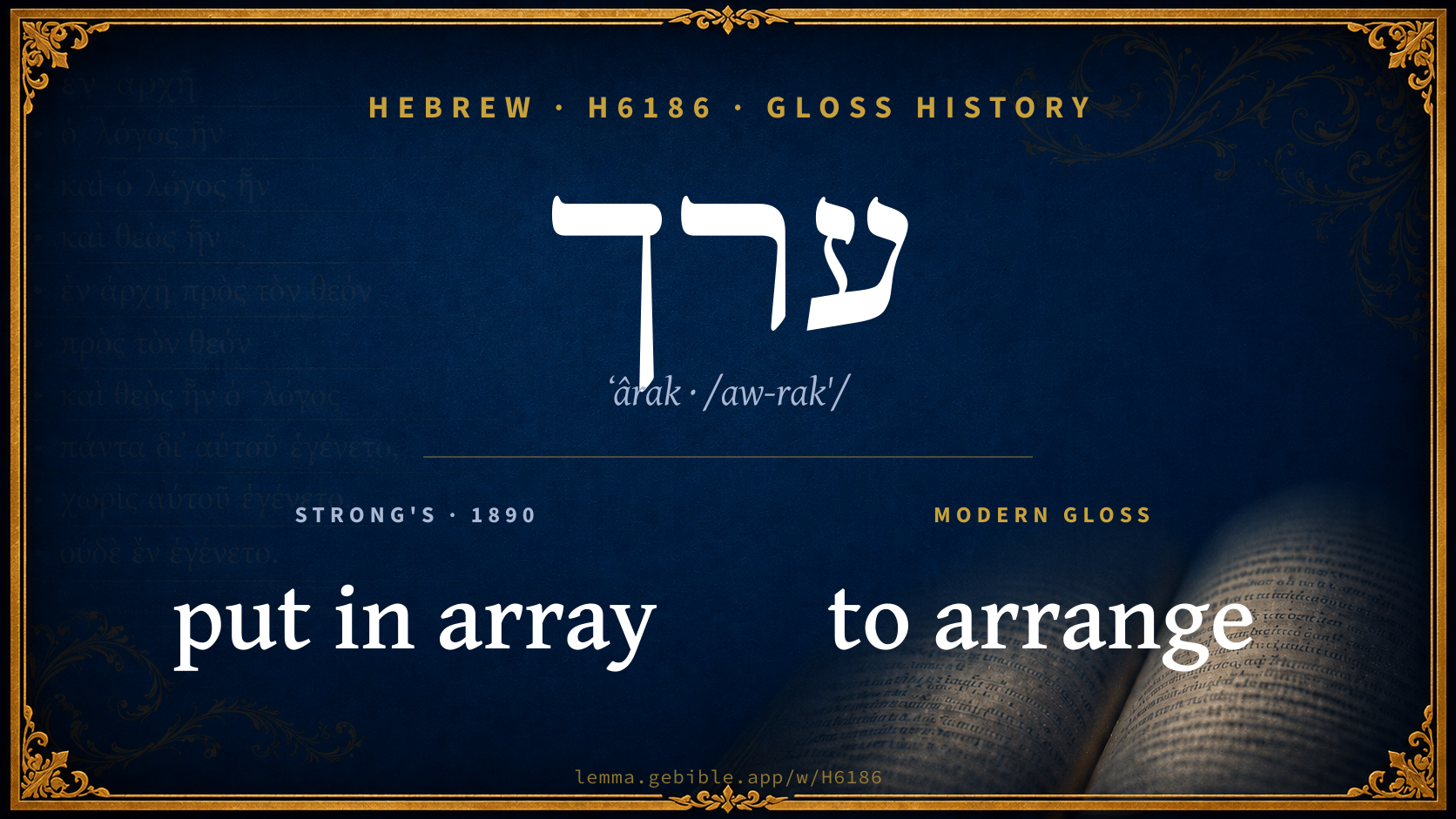
Gloss history
Strong's 1890 vs modern scholarship
About this word
Strong's H6186 catalogs a Hebrew word from the Hebrew Old Testament.
These counts are not copied from any lexicon or concordance. They are computed here, from the morphology-tagged Hebrew Old Testament. What Lemma adds →
- 72
- distinct verses
- The word appears in 72 distinct verses.
- 19 / 39
- OT books
- The word appears in 19 of 39 Old Testament books.
- #523
- by frequency
- Top 1000 most frequent Hebrew words (rank 523 of 8,640 Hebrew words by occurrence).
View all 72 occurrences in the concordance →
Most concentrated in
- Leviticus 10 verses 14%
- 1 Chronicles 9 verses 13%
- Job 9 verses 13%
By section of the Old Testament
By traditional corpus
Conventional, traditional groupings — biblical authorship is debated, so this is a traditional corpus grouping, not an authorship claim. Each share is this word’s portion of its verses in that division of the Hebrew canon. Each figure is a share of the word’s 72 distinct verses.
- Prophets (Nevi'im) 28 verses · 39%
- Writings (Ketuvim) 28 verses · 39%
- Torah (Pentateuch) 16 verses · 22%
How translations render this word
Counts come from each version’s own published word-to-Strong’s tagging or interlinear alignment — an approximate guide to how each version renders this word, not a word-level alignment the data otherwise carries. Because each total is that version’s own tagged count, the per-version totals vary from one another and need not match the appearance or distinct-verse counts above. These counts may also differ from a printed concordance because Lemma counts each distinctly tagged rendering and does not collapse phrase taggings into a single head-word total. This is a fixed set of word-tagged versions (KJV, ASV, BSB, ULT) and does not change with the reading translation you choose elsewhere. Each version’s license is shown beside its name below (and on Sources).
BDB lists this Strong’s number as 2 distinct words (homographs). Each count above pools all of them and is not split by sense — see the Senses section below. A low-frequency rendering may belong to a different one of those words, not the primary meaning.
- King James Version†: Array 9×, Order 9×, Put themselves in array 4×
- American Standard Version†: Array 9×, Order 8×, Could set 3×
- Berean Standard Bible†: Arrayed themselves 6×, Arrayed them 4×, Lined up 4×
- unfoldingWord Literal Text†: And 9×, Arrayed 7×, Arranged 6×
King James Version Public Domain
Renders H6186 across 78† tagged occurrences — most commonly:
Plus 45 renderings that appear only once — usually multi-word phrases or single function words the recovered tagging swept in, not distinct renderings.
American Standard Version Public Domain
Renders H6186 across 79† tagged occurrences — most commonly:
Plus 41 renderings that appear only once — usually multi-word phrases or single function words the recovered tagging swept in, not distinct renderings.
Berean Standard Bible Public Domain
Renders H6186 across 74† tagged occurrences — most commonly:
Plus 46 renderings that appear only once — usually multi-word phrases or single function words the recovered tagging swept in, not distinct renderings. Not rendered by a distinct English word in 1 further occurrence.
unfoldingWord Literal Text CC BY-SA 4.0
Renders H6186 across 92† tagged occurrences — most commonly:
Plus other, less common renderings. Plus 37 renderings that appear only once — usually multi-word phrases or single function words the recovered tagging swept in, not distinct renderings.
11 senses and sub-senses in the full BDB
Hebrew verbs can shift meaning by stem (binyan): Qal is the basic action, Niphal is often passive or reflexive, Piel often intensifies or makes it factitive, and Hiphil is typically causative. The senses below are grouped under the stem BDB assigns to each.
What do BDB’s symbols mean?
BDB uses these scholarly abbreviations:
| Symbol | Meaning |
|---|---|
| 𝔊 | the Septuagint (the ancient Greek translation, LXX) |
| 𝔙 | the Vulgate (the Latin translation) |
| 𝔖 | the Syriac version (the Peshitta) |
| 𝔗 | the Targum (the Aramaic translation) |
| ψ | the Psalms |
| √ | root (the underlying root or stem) |
| ‖ | parallel passage (a synonymous or contrasted parallel) |
| † | the dagger: every passage where the word occurs is cited |
The 11 senses and sub-senses the full Brown-Driver-Briggs lexicon distinguishes for this word, in lexicon order (not ranked by frequency), with BDB’s own verbatim wording and sub-sense lettering. Shown in Hebrew script with BDB’s own scholarly abbreviations. The condensed entry is in the Lexicon Entry tab. See also the Forms in the corpus table below.
ערך I arrange or set in order (NH id.
Qal
- Pf. 3 ms. ע׳ Jb 32:14; 2 Ch 13:3, וְע׳ consec. Lv 1:12; 6:5; עָרַכְתִּי Nu 23:4 +, etc.; Impf. 3 ms. יַעֲרֹךְ Ex 27:21 +, etc.; Imv. עֶרְכָה Jb 33:5, עִרְכוּ Je 46:3; 50:14 (Ges§ 481); Inf. abs. עָרֹךְ Is 21:5; cstr. עֲרךְ Ju 20:22 +; Pt. act. pl. עֹרְכִים Is 65:11, etc.; pass. עָרוּךְ Je 6:23 +, cstr. עֱרוּךְ Jo 2:5 (Ges§ 22.4.2); not in D; e.g. Job 32:14
- 1.
- a. arrange in order, seven altars Nu 23:4, i.e. I have built seven altars in a row (cf. בנה v 1), flax-stalks Jos 2:6 (both JE); especially e.g. Numbers 23:4
- b. set or lay in order, as wood Gn 22:9 (E), 1 K 18:33, cf. Tophet Is 30:33; Lv 1:7; offerings Lv 1:8, 12; 6:5; lamp(s) Ex 27:21; Lv 24:3, 4 (all P), lamp (fig. of dynasty) ψ 132:17; ‘shew’-bread Ex 40:4, 23 (upon [עַל] sacred שֻׁלְחָן; both c. acc. cogn.), Lv 24:8 (P). e.g. Genesis 22:9
- c. in common life (cf. RSSem i. 183 f., 2nd ed. 200 f.), arrange a table (i.e. dishes in order upon it), שֻׁלְחָן Is 21:5 Pr 9:2 (fig. of wisdom), Ez 23:41 (of Jerus. in fig.); ψ 23:5; 78:19 (fig.; subj. God); in idolatr. worship Is 65:11. e.g. Isaiah 21:5
- d. arrange a battle, i.e. draw up in battle order, ע׳ מִלְחָמָה Ju 20:22; 1 S 17:8; 2 S 10:8 = 1 Ch 19:9; 1 Ch 12:37 (van d. H. v 36); 2 Ch 14:9; עֹרְכֵי מִלְחָמָה 1 Ch 12:34, 36 (van d. H. v 33, 35); עֱרוּךְ מ׳ Jo 2:5; + אֵת with, i.e. against Ju 20:20 Gn 14:8, עִם 2 Ch 13:3; + לִקְרַאת 1 S 17:2; 1 Ch 19:17b; ע׳ מַעֲרָכָה לִקְרַאת 1 S 17:21; עָרוּךְ כְּאִישׁ לַמִּלְחָמָה Je 6:23; 50:42; obj. om. Ju 20:22, 33, + לִקְרַאת 1 S 4:2; 2 S 10:9, 10 = 1 Ch 19:10, 11; 2 S 10:17; + אֶל against Ju 20:30; 1 Ch 19:17, + על Je 50:14, לְ against Je 50:9;—Jb 6:4 read יַעַכְרוּנִי Di Bu Du e.g. Judges 20:22
- e. arrange weapons of army in order for battle Je 46:3; 1 Ch 12:9 (van d. H. v 8). e.g. Jeremiah 46:3
- f. arrange words (מִלִּין) Jb 32:14 (+ אֶל against), so (obj. om.) 33:5 (+ לְפָנַי), 37:19 ψ 5:4 (prob.; > of arranging a sacrifice); cf. recount things in order, יַעְרְכֶהָ לִי Is 44:7. e.g. Job 32:14
- g. state in order, set forth a legal case Jb 13:18; 23:4, so prob. (obj. om.) of God ψ 50:21 (+ לְעֵינֶיךָ), and (pass. of בְּרִית) 2 S 23:5 (cf. Dr).—הֲיַעֲרֹךְ שׁועך Jb 36:19 is difficult: Di will he set thy cry (שַׁוְעֲךָ) in order? Bi (for לֹא) הֲיֵעָרֵךְ שׁ׳ לוֹ shall thy cry be set in order unto him? (sense good, although Niph. not found); v. al. in Di e.g. Job 13:18
- 2.
- a. compare (as result of arranging in order): מַה־דְּמוּת תַּע׳־לוֹ Is 40:18 what likeness will ye compare to him? אֵין עֲרֹךְ אֵלֶיךָ ψ 40:6. e.g. Isaiah 40:18
- b. intrans. be comparable, c. לְ, ψ 89:7 (‖ דָּמָה), c. sf. of thing compared Jb 28:17, 19. e.g. Psalms 89:7
ערך II denom.
Hiphil
- value (for taxation), tax (from עֵרֶךְ 2);—Pf. 3 ms. הֶעֱרִיךְ אֶת־הָאָרֶץ 2 K 23:35; in P, וְהֶע׳ consec., c. acc. pers. Lv 27:8, 12 c. sf. v 14; Impf. יַעֲרִיךְ v 14; sf. יַעֲרִכֶנּוּ v 8. e.g. 2 Kings 23:35
Senses from the full Brown-Driver-Briggs lexicon (Brown, Driver, Briggs; Oxford 1906 — public domain), digitized via Sefaria, supplemented by the OpenScriptures HebrewLexicon (CC BY 4.0). Full attribution on Sources.
Word origin
vb. arrange or set in order (NH id.; also roll dough, 𝔗 עֲרַךְ id.; Ph. ערכת CISNo. 132, 4 valuation, Bloch, but dub.; Arabic عَرَكَ iii. contend in battle, مَعْرَكٌ, مَعْرَكَةٌ, battle-ground);—
— Brown-Driver-Briggs (Oxford 1906, public domain), digitized via Sefaria, supplemented by the OpenScriptures HebrewLexicon (CC BY 4.0). See Sources.
Origin: a primitive root
Jastrow Dictionary
A second Hebrew/Aramaic lexicon for comparison, covering Aramaic and post-biblical (Talmudic, Targumic, Midrashic) usage that the biblical-Hebrew BDB does not. Matched by lemma rather than by Strong’s number, so a lemma may carry more than one Jastrow headword (shown separately below), and the entries cover usage well beyond the Bible.
עָרַךְ
- (b. h.) [to connect, join,]
- 1. (b. h.) to range, arrange, place in order. Y. Yoma II, end, 40ᵃ (ref. to Lev. I, 8, a. 12) כהן אחד עוֹרֵךְ וכ׳ one priest places two limbs on the altar &c.; Sifra Vayikra, N’dab., Par. 4, ch. VI. Gen. R. s. 78 יש בי כח לעֲרוֹךְ תפלה (Yalk. ib. 133 לסדר) I have strength to offer prayer; יש בי כח לערוך מלחמה I have strength to give battle. Yalk. l. c. וע׳ מלחמה כנגדו gave him battle. Tanḥ. B’ḥuck. 6 ואֶעֱרוֹךְ לפניכם שלחן I will set a table before you (in the hereafter), v. infra. Ned. 20ᵇ עָרַכְתִּי לו שלחן והפכו I prepared a table for him, but he upset it (euphem. for unnatural gratification); a. e. [In Talm. mostly סדר.]—עוֹרְכֵי הדיינין (= עורכי דין לפני הדיינין) those who arrange arguments before the judges, pleaders, advocates, who advise their clients what to say or not to say before court. Ab. I, 8 אל תעש עצמך כע׳ הד׳ do not make thyself to be like legal advisers, i.e. be careful as judge not to suggest an advice to one of the litigants; Y. B. Bath. IX, 17ᵃ top כעֹרְכֵי; Y. Keth. IV, 29ᵃ bot. אל תעש עצמך כע׳ הד׳ שלא לגלות וכ׳ do not make thyself to be like &c., that is, you must not reveal to an individual his case (how to argue). Bab. Keth. 52ᵇ; 86ᵃ עשינו עצמינו כע׳ ד׳ we have made ourselves to be like &c. (I ought not to have suggested an advice).—Part. pass. עָרוּךְ; f. עְרוּכָה &c. Sabb. 119ᵇ וכשבא לביתו ומצא נר דלוק ושלחן ע׳ וכ׳ when he comes home and finds the lamp lighted, the table set and the couch spread, the good angel says &c.; a. e.—2) (cmp. Syr. ערך, P. Sm. 2990) to work dough (contrad. to לוּשׁ); to roll, shape &c. Pes. III, 4 אחת לשה ואחת עוֹרֶכֶת וכ׳ one woman kneads, another works and shapes the dough, and a third one bakes. Ab. Zar. IV, 9 לא לשין ולא עוֹרְכִין עמו you must not knead nor work and shape dough with him. Neg. II, 4 כעוֹרֶכֶת in the position of a woman working dough; a. fr.—Part. pass. as ab. Erub. 54ᵃ (ref. to ערוכה וכ׳, II Sam. XXIII, 5) אם ע׳ … משתמרת וכ׳ if the Law is worked into thy two hundred and forty-eight limbs, it will be preserved &c. Midr. Till. to Ps. XIV [read:] פת לושה ופת ע׳ kneaded (common) bread and well-worked bread; Yalk. ib. 662 עריכה (corr. acc.). e.g. Leviticus 1:8
- [to place side by side; cmp. נָקַשׁ Hif.] to compare; to value; esp. (v. Lev. XXVII, 2-13) to dedicate the value of a person or of an animal unfit for the altar. Arakh. I, 1 הכל מַעֲרִיכִין ונֶעֱרָכִין all persons are fit to dedicate or to be the subjects of dedication. Ib. נֶעֱרָךְ אבל לא מַעֲרִיךְ may be the subject of dedication, but cannot dedicate (his vow is invalid). Ib. VI, 5 המעריך את עצמו he who dedicates his own value. Tanḥ. l. c. [read:] אתם מעריכין לפני את נפשותיכם … מעריכת גיהנם you value before me your lives, and I shall save you from the range of Gehenna (v. עֲרִיכָה), and set &c. (v. supra); a. fr. e.g. Leviticus 27:2
- to be the subject of valuation, to be valued. Arakh. I, 1, a. fr., v. supra. Ib. II, 1 אין נערכין Var., v. עֵרֶךְ.
עֲרַךְ
- , to work, knead. Targ. Is. XLI, 25 דעָרֵיךְ (h. text ירמס).—Men. 56ᵃ דע׳ הוא ואפה הוא when he himself kneaded and baked; דעריך חבריה וכ׳ when his neighbor kneaded and gave it to him, and he baked. Y. Shebu. VI, 37ᵃ bot. אזלת מֵיעֲרוֹךְ גבי חבירתה she went to knead her bread at her neighbor’s.—Part. pass. עָרִיךְ, pl. עֲרִיכִין Ib.ᵇ top אשכחון … ע׳ גו עיגולא they found the two denars (that were missed) worked into the cake.
- to be worked in. Ib.ᵃ bot. אִיעַרְכוּ גו עיגולא, v. supra.
עֵרֶךְ
- preced.)
- 1. order, arrangement. Ned. 22ᵇ שעֶרְכָּהּ של ארץ ישראל הוא because it (the Book of Joshua) contains the arrangement of the Land of Israel.—Pl. עֲרָכִים, constr. עֶרְכֵי. Cant. R. to VI, 4; Pesik. Vayhi, p. 7ᵃ sq. שש ע׳ המשנה, v. מִשְׁנָה.—ע׳ המלחמה order of battle, arrangements proclaimed before the battle (v. מַעַרְכִים). Y. Sot. VIII, beg. 22ᵇ (ref. to Mish. ib. VIII, 6) אבל בע׳ המ׳ מספקין וכ׳ but in connection with the proclamation of the regulations of battle (the Mishnah says only), ‘they have to supply water &c.’ Ib. אף בע׳ המ׳ כן the same is the case with ordinances of battle (they must be proclaimed in Hebrew). Bab. Sot. 43ᵇ אין חוזרין עליו מע׳ המ׳ they are not entitled to leave the army on that account. Ib. 44ᵇ; Men. 36ᵃ; a. e.
- 2. valuation, assessment, value of a person or animal dedicated to the sanctuary; vow of value. Arakh. 7ᵇ ואמר עֶרְכִּי עלי if he says, I vow my own value. Ib. IV, 1 הע׳ בזמן הע׳ the valuation is regulated by the time of the vow (irrespective of the value at the time of paying the vow); ib. 4 נותן כזמן הע׳ he pays according to the value at the time of the vow. Ib. נותן ע׳ זקן he pays the value of an old man (Lev. XXVII, 7); ע׳ ילד the value of a child (ib. 6); a. fr.—Pl. עֲרָכִים, עֲרָכִין. Ib. II, 1 אין בע׳ וכ׳ (Var. נֶעֱרָכִין, v. עָרַךְ) in vows of value nothing is valued at less than a Selʿa &c.; ib. 7ᵇ כל ע׳ שאתה מעריך וכ׳ all values which you assess shall be no less than &c. Ib. IV, 1 והע׳ בנערך the vows of value are regulated by the condition of the person whose value is vowed. Ib. III, 1 יש בע׳ להקל וכ׳ in the laws regulating the dedication of values there is a lenient and a rigorous side. Ib. 2ᵃ, a. e. כל שישנו בדמים ישנו בע׳ … אינו בע׳ he whose person has a value, can vow the value of a person or an animal, but he whose person has no value cannot. Kerith. 13ᵇ דמין וע׳, v. דָּמִים. Tanḥ. B’ḥuck. 6 פרשת ע׳ the section treating of vows of value. Ib. בזכות הע׳ אני מציל וכ׳ as a reward for your offerings of values, I will save you &c.; a. fr.—ʿĂrakhin, name of a treatise of Mishnah, Tosefta and Talmud Babli, of the Order of Kodashim.—[ערכין, Gitt. 44ᵃ Ar., v. עַרְכִי.] e.g. Leviticus 27:7
A Dictionary of the Targumim, the Talmud Babli and Yerushalmi, and the Midrashic Literature (Marcus Jastrow; London, Luzac, 1903) — Public Domain. Digitized via Sefaria. Digitized via Sefaria. Full attribution on Sources.
Forms in the corpus
The 64 distinct written forms H6186 takes in the Hebrew Bible, most frequent first — each parse links to that stem’s occurrences in the concordance. Hebrew forms include their vowel points and cantillation, so a single lemma takes many written forms.
The 60 most common forms are shown; 4 rarer forms follow in the full concordance.
Same root — word family
Other BDB entries built from the same root as H6186, grouped by Strong’s listed origin. These share a root / origin per the lexicon — not necessarily a shared meaning. Each links to that word’s own entry.
Derived from this word
Compare all same-root words → They share a root, not necessarily a meaning.
Septuagint verse parallels
This word appears in 67 verses that also exist in the Greek Old Testament (Septuagint), out of the 72 Hebrew verses it occurs in. You can read those verses in Greek by switching the Old Testament edition to the Septuagint.
Read these verses in the Septuagint
- Genesis 14:8
- Exodus 27:21
- Leviticus 1:7
- Numbers 23:4
- Joshua 2:6
- Judges 20:20
- 1 Samuel 4:2
- 2 Samuel 10:8
- 1 Kings 18:33
- 2 Kings 23:35
- 1 Chronicles 12:8
- 2 Chronicles 13:3
This is a verse-level parallel only — the same verses exist in both the Hebrew and Greek Old Testaments. No word-level Hebrew↔Greek correspondence is claimed: the data carries no such alignment, so no Greek word is shown as this Hebrew word’s translation. Coverage is not total — the Septuagint omits the deuterocanon and renumbers the Psalms, so some Hebrew verses have no direct Greek parallel.