
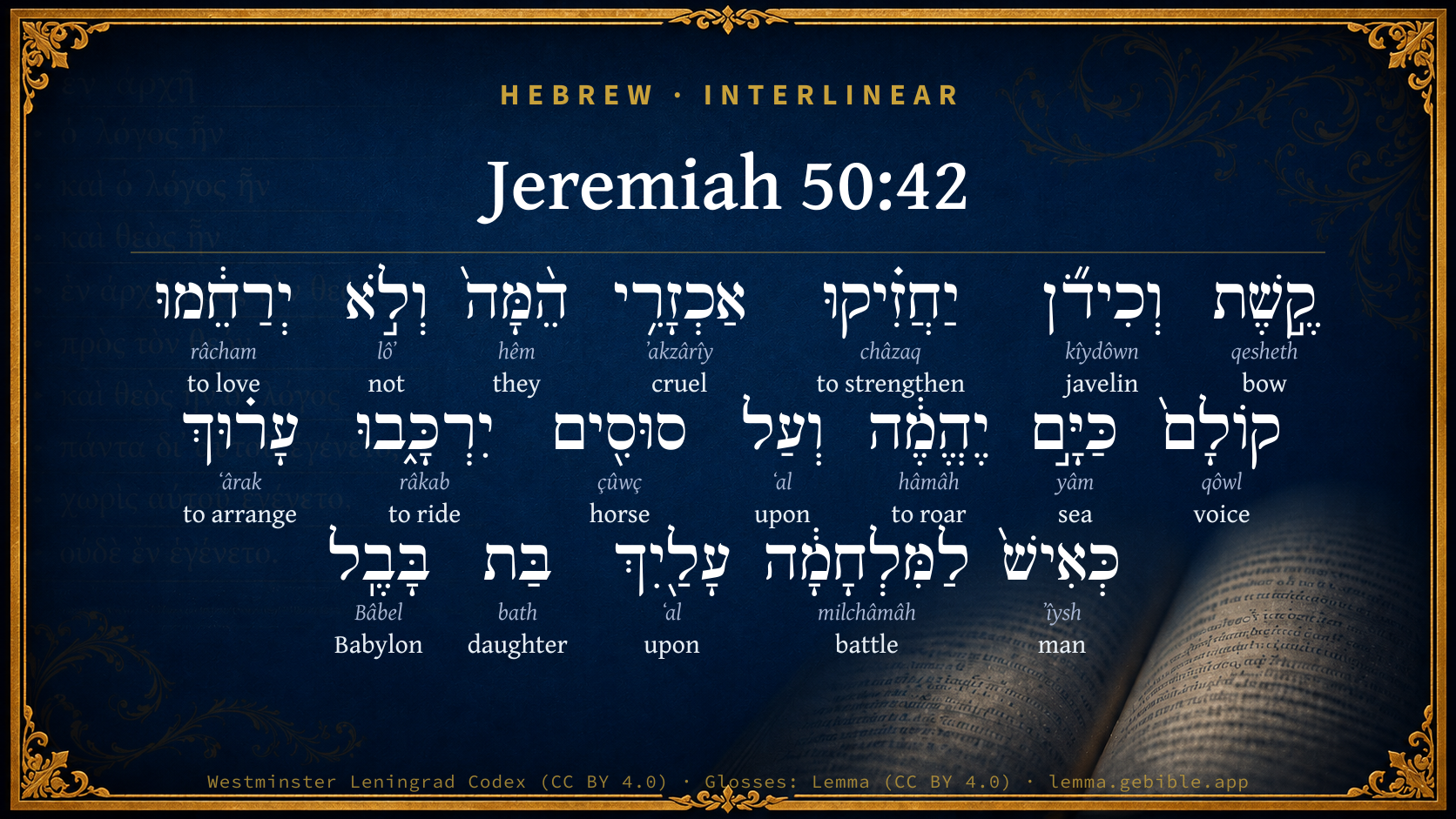
Jeremiah 50:42

Hebrew (Westminster Leningrad Codex) Jeremiah 50:42 appears in the Hebrew Old Testament. The text above is from the Westminster Leningrad Codex. Each word links to its Strong’s number, a concise gloss, and parsing drawn from the Open Scriptures Hebrew Bible morphology. Click any word for its full Brown-Driver-Briggs (BDB) entry.
Download image
Cite this verse

Jeremiah 50:42 (World English Bible). Public Domain. Lemma interlinear Bible study tool, https://lemma.gebible.app/v/jeremiah/50/42.

Show BibTeX & RIS
BibTeX
RIS
English Translation
They lay hold on bow and spear; they are cruel, and have no mercy; their voice roars like the sea; and they ride on horses, everyone set in array, as a man to the battle, against you, daughter of Babylon.
World English Bible · Public Domain
Download a study sheet

One document with this verse’s original text, its word-by-word gloss line, the meaning frame, cross-references with their text, attributed commentary, and full source and license credits — printable, and it pastes into notes with its structure intact.

This verse Autodidact and up

Study sheet (.html) Plain text (.txt)

A passage Seminary Student

Up to 50 verses in one chapter. A passage sheet keeps up to 6 commentary sources and 12 cross-references per verse, in the order this page ranks them, and says so on the sheet whenever that leaves anything out. Ask for a single verse and you get the Autodidact verse sheet above.

Everything on this page stays free to read, with no account — the sheet is a download of what is already on screen, not access to it.

Want to remove ads? Support Godless Engineer
Compare translations 3

The same verse in 3 English versions, stacked beneath the original-language interlinear above. Click any original word for its lexicon entry.

Each is an independent rendering of the whole verse — the interlinear is not word-aligned to these translations.

Highlighted words mark where these versions differ — a whole-verse word diff, not a word-by-word alignment.

  • World English Bible Public Domain
    They lay hold on bow and spear; they are cruel, and have no mercy; their voice roars like the sea; and they ride on horses, everyone set in array, as a man to the battle, against you, daughter of Babylon.
  • King James Version Public Domain
    They shall hold the bow and the lance: they are cruel, and will not shew mercy: their voice shall roar like the sea, and they shall ride upon horses, every one put in array, like a man to the battle, against thee, O daughter of Babylon.
  • unfoldingWord Literal Text CC BY-SA 4.0
    They will pick up bows and spears. They are cruel and have no compassion. Their sound is like the sea roar, and they are riding on horses, set out in order as men for battle, against you, daughter of Babylon.

unfoldingWord Literal Text — © unfoldingWord, licensed CC BY-SA 4.0. Word-aligned USFM3 via Door43 (git.door43.org/unfoldingWord/en_ult).

Versions to compare (up to 4)

3 of 4 selected

Show all 18 translations

Every available English version of this verse, each an independent rendering of the whole verse.

  • World English Bible Public Domain
    They lay hold on bow and spear; they are cruel, and have no mercy; their voice roars like the sea; and they ride on horses, everyone set in array, as a man to the battle, against you, daughter of Babylon.
  • Berean Standard Bible Public Domain
    They grasp the bow and spear; they are cruel and merciless. Their voice roars like the sea, and they ride upon horses, lined up like men in formation against you, O Daughter of Babylon.
  • Majority Standard Bible Public Domain
    They grasp the bow and spear; they are cruel and merciless. Their voice roars like the sea, and they ride upon horses, lined up like men in formation against you, O Daughter of Babylon.
  • King James Version Public Domain
    They shall hold the bow and the lance: they are cruel, and will not shew mercy: their voice shall roar like the sea, and they shall ride upon horses, every one put in array, like a man to the battle, against thee, O daughter of Babylon.
  • American Standard Version (1901) Public Domain
    They lay hold on bow and spear; they are cruel, and have no mercy; their voice roareth like the sea; and they ride upon horses, every one set in array, as a man to the battle, against thee, O daughter of Babylon.
  • Revised Version (1885) Public Domain
    They lay hold on bow and spear; they are cruel, and have no mercy; their voice roareth like the sea, and they ride upon horses; every one set in array, as man to the battle, against thee, O daughter of Babylon.
  • Geneva Bible (1599) Public Domain
    They shall holde the bowe and the buckeler: they are cruell and vnmercifull: their voyce shall roare like the sea, and they shall ride vpon horses, and be put in aray like men to the battell against thee, O daughter of Babel.
  • Douay-Rheims (1899) Public Domain
    They shall take the bow and the shield: they are cruel and unmerciful: their voice shall roar like the sea, and they shall ride upon horses: like a man prepared for battle against thee, O daughter of Babylon.
  • Young's Literal Translation Public Domain
    Bow and halbert they seize, Cruel `are' they, and they have no mercy, Their voice as a sea soundeth, and on horses they ride, Set in array as a man for battle, Against thee, O daughter of Babylon.
  • Literal Standard Version CC BY-SA 4.0
    They seize bow and javelin, || They [are] cruel, and they have no mercy, || Their voice sounds as a sea, and they ride on horses, || Set in array as a man for battle, || Against you, O daughter of Babylon.
  • Unlocked Literal Bible CC BY-SA 4.0
    They will pick up bows and spears. They are cruel and have no compassion. Their sound is like the sea roar, and they are riding on horses, set out in order as men for battle, against you, daughter of Babylon.
  • unfoldingWord Literal Text CC BY-SA 4.0
    They will pick up bows and spears. They are cruel and have no compassion. Their sound is like the sea roar, and they are riding on horses, set out in order as men for battle, against you, daughter of Babylon.
  • Darby Bible Public Domain
    They lay hold of bow and spear; they are cruel, and will not shew mercy; their voice roareth like the sea, and they ride upon horses -- set in array like a man for the battle, against thee, O daughter of Babylon.
  • World Messianic Bible Public Domain
    They take up bow and spear. They are cruel, and have no mercy. Their voice roars like the sea. They ride on horses, everyone set in array, as a man to the battle, against you, daughter of Babylon.
  • Webster's Bible Public Domain
    They shall hold the bow and the lance: they are cruel, and will not show mercy: their voice shall roar like the sea, and they shall ride upon horses, every one put in array, like a man to the battle, against thee, O daughter of Babylon.
  • Free Bible Version CC BY-SA 4.0
    They're carrying bows and javelins. They are cruel and merciless. When they shout it's like the sea roaring. They ride on horses and attack in formation against you, people of Babylon.
  • Bible in Basic English Public Domain
    Bows and spears are in their hands; they are cruel and have no mercy; their voice is like the thunder of the sea, and they go on horses; everyone in his place like men going to the fight, against you, O daughter of Babylon.
  • JPS Tanakh (1917) Public Domain
    They lay hold on bow and spear, they are cruel, and have no compassion; their voice is like the roaring sea, and they ride upon horses; set in array, as a man for war, against thee, O daughter of Babylon.

Literal Standard Version (2020), Covenant Press — licensed CC BY-SA 4.0. Text via the HelloAO Bible API (eBible.org). Unlocked Literal Bible (unfoldingWord) — licensed CC BY-SA 4.0. Text via the HelloAO Bible API (eBible.org). unfoldingWord Literal Text — © unfoldingWord, licensed CC BY-SA 4.0. Word-aligned USFM3 via Door43 (git.door43.org/unfoldingWord/en_ult). Free Bible Version, Dr. Jonathan Gallagher — licensed CC BY-SA 4.0. Text via the HelloAO Bible API (eBible.org).

Word by word

More ways to search: Search by grammar → Find every occurrence → Compare this word →

Practice this passage: Drill this verse → Learn its vocabulary →

אַכְזָרִ֥י
ʼakzârîy
H394
“cruel”
Adjective, Adjective, Masculine, Singular, Absolute
Part of Speech
Adjective
Type
Adjective
Gender
Masculine
Number
Singular
State
Absolute
Full BDB Definition

Origin: from H393

TWOT: 971b

cruel
  1. קֶ֣שֶׁת qesheth H7198 “bow” Noun, Common, Feminine, Singular, Absolute
  2. וְכִידֹ֞ן kîydôwn H3591 “and · javelin” Conjunction + Noun, Common, Masculine, Singular, Absolute
  3. יַחֲזִ֗יקוּ châzaq H2388 “to strengthen” Verb, Hiphil, Imperfect, 3rd Person, Masculine, Plural
  4. הֵ֨מָּה֙ hêm H1992 “they” Pronoun, Personal, 3rd Person, Masculine, Plural
  5. וְלֹ֣א lôʼ H3808 “and · not” Conjunction + Particle, Negative
  6. יְרַחֵ֔מוּ râcham H7355 “to love” Verb, Piel, Imperfect, 3rd Person, Masculine, Plural
  7. קוֹלָם֙ qôwl H6963 “voice · their” Noun, Common, Masculine, Singular, Construct + Suffix, Personal, 3rd Person, Masculine, Plural
  8. כַּיָּ֣ם yâm H3220 “like/as the · sea” Preposition, Determined + Noun, Common, Masculine, Singular, Absolute
  9. יֶהֱמֶ֔ה hâmâh H1993 “to roar” Verb, Qal, Imperfect, 3rd Person, Masculine, Singular
  10. וְעַל ʻal H5921 “and · upon” Conjunction + Preposition
  11. סוּסִ֖ים çûwç H5483 “horses” Noun, Common, Masculine, Plural, Absolute
  12. יִרְכָּ֑בוּ râkab H7392 “to ride” Verb, Qal, Imperfect, 3rd Person, Masculine, Plural
  13. עָר֗וּךְ ʻârak H6186 “arranged” Verb, Qal, Participle Passive, Masculine, Singular, Absolute
  14. כְּאִישׁ֙ ʼîysh H376 “like/as · man” Preposition + Noun, Common, Masculine, Singular, Absolute
  15. לַמִּלְחָמָ֔ה milchâmâh H4421 “to/for the · battle” Preposition, Determined + Noun, Common, Feminine, Singular, Absolute
  16. עָלַ֖יִךְ ʻal H5921 “upon · you” Preposition + Suffix, Personal, 2nd Person, Feminine, Singular
  17. בַּת bath H1323 “daughter of” Noun, Common, Feminine, Singular, Construct
  18. בָּבֶֽל Bâbel H894 “Babylon” Noun, Proper

About this verse

These counts appear in no published source. They are computed here, from the morphology-tagged text and Lemma’s own curated glosses. What Lemma adds →

19
words
18
distinct lemmas
Prophets
section

Notable vocabulary

The rarest word here is אַכְזָרִ֥י cruel H394 — appearing just 8 times in the whole Hebrew Bible.

Shared distinctive vocabulary

אַכְזָרִ֥י cruel H394 occurs in 8 verses of the Hebrew Bible. Also found in:

Grammatical profile

  • 5 verbs
  • 9 nouns
  • 1 adjective
  • 1 pronoun
  • 2 prepositions
  • 1 particle

Verb forms

  • יַחֲזִ֗יקוּ Hiphil · Imperfect
  • יְרַחֵ֔מוּ Piel · Imperfect
  • יֶהֱמֶ֔ה Qal · Imperfect
  • יִרְכָּ֑בוּ Qal · Imperfect
  • עָר֗וּךְ Qal · Participle Passive

Repetition

A word recurs within this verse — often emphatic in Hebrew:

  • וְעַל upon H5921 ×2

Cross-references

17

Topical passages linked to Jeremiah 50:42 in the Treasury of Scripture Knowledge — connected by theme and wording, ordered by reader-vote popularity; previews shown in the World English Bible.

  • Isaiah 5:30 They will roar against them in that day like the roaring of the sea. If one looks to the land, behold, darkness and distress. The light is darkened in its clouds.
  • Isaiah 13:17–18 Behold, I will stir up the Medes against them, who shall not regard silver, and as for gold, they shall not delight in it.
  • Isaiah 47:6 I was angry with my people, I profaned my inheritance, and gave them into your hand: you did show them no mercy; on the aged have you very heavily laid your yoke.
  • Jeremiah 8:16 The snorting of his horses is heard from Dan: at the sound of the neighing of his strong ones the whole land trembles; for they are come, and have devoured the land and all that is in it; the city and those who dwell therein.
  • Jeremiah 47:3 At the noise of the stamping of the hoofs of his strong ones, at the rushing of his chariots, at the rumbling of his wheels, the fathers don't look back to their children for feebleness of hands;
  • Psalms 46:2–3 Therefore we won't be afraid, though the earth changes, Though the mountains are shaken into the heart of the seas;
  • Psalms 46:6 The nations raged. The kingdoms were moved. He lifted his voice, and the earth melted.
  • Psalms 74:20 Honor your covenant, For haunts of violence fill the dark places of the earth.
  • Psalms 137:8–9 Daughter of Babylon, doomed to destruction, He will be happy who rewards you, As you have served us.
  • Isaiah 5:28 Whose arrows are sharp, And all their bows bent. Their horses' hoofs will be like flint, And their wheels like a whirlwind.
  • Isaiah 14:6 who struck the peoples in wrath with a continual stroke, who ruled the nations in anger, with a persecution that none restrained.
  • Jeremiah 6:22–23 Thus says Yahweh, Behold, a people comes from the north country; and a great nation shall be stirred up from the uttermost parts of the earth.
  • Jeremiah 50:14 Set yourselves in array against Babylon round about, all you who bend the bow; shoot at her, spare no arrows: for she has sinned against Yahweh.
  • Habakkuk 1:6–8 For, behold, I raise up the Chaldeans, that bitter and hasty nation, that march through the breadth of the earth, to possess dwelling places that are not theirs.
  • James 2:13 For judgment is without mercy to him who has shown no mercy. Mercy triumphs over judgment.
  • Revelation 16:6 For they poured out the blood of the saints and the prophets, and you have given them blood to drink. They deserve this."
  • Revelation 19:14–18 The armies which are in heaven followed him on white horses, clothed in white, pure, fine linen.

Cross-references courtesy of OpenBible.info (CC BY 4.0).

Hebrew and Greek witnesses Masoretic Hebrew ↔ Greek Septuagint

The same verse in the two great witnesses to the Old Testament, shown verse-for-verse.

These are two independent witnesses, not word-aligned to each other, and the Septuagint is shown in lemma (dictionary) form.

Hebrew Jeremiah 50:42 Masoretic · Westminster Leningrad Codex

קֶ֣שֶׁת וְכִידֹ֞ן יַחֲזִ֗יקוּ אַכְזָרִ֥י הֵ֨מָּה֙ וְלֹ֣א יְרַחֵ֔מוּ קוֹלָם֙ כַּיָּ֣ם יֶהֱמֶ֔ה וְעַל סוּסִ֖ים יִרְכָּ֑בוּ עָר֗וּךְ כְּאִישׁ֙ לַמִּלְחָמָ֔ה עָלַ֖יִךְ בַּת בָּבֶֽל

They lay hold on bow and spear; they are cruel, and have no mercy; their voice roars like the sea; and they ride on horses, everyone set in array, as a man to the battle, against you, daughter of Babylon.

World English Bible · Public Domain

Greek LXX Structure differs

In the Septuagint, Jeremiah is about an eighth shorter than the Hebrew and arranges its material differently — the Oracles Against the Nations (Hebrew chapters 46–51) appear in the middle of the Greek book, after 25:13. Because the chapter and verse boundaries do not line up, a verse-for-verse comparison with the Hebrew is not shown.

A verse-for-verse comparison isn’t shown here because the chapters and verses don’t line up. Switch to the LXX edition with the MT / LXX toggle above to read the Greek directly.

Hebrew: Westminster Leningrad Codex (CC BY 4.0). Greek: Septuagint (public domain); English from a public-domain English Septuagint. How the Septuagint differs from the Hebrew →

Targum (Aramaic paraphrase)

1

The Targum is the ancient Jewish Aramaic paraphrase of the Hebrew Scriptures — an interpretive translation, not the Hebrew text itself. Onkelos (literal) and Pseudo-Jonathan (expansive) render the Torah, and Jonathan the Prophets. Coverage is partial: where no permissively-licensed English translation exists for a verse, only the Aramaic is shown. This is verse-level text, not a word-by-word alignment to the Hebrew.

  1. Targum Jonathan Prophets (Joshua–Malachi)
    קַשְׁתָּא וּתְרֵיסִין אֲחִידָן אַכְזְרָאִין אִינוּן וְלֵית לְהוֹן רַחֲמִין קָלְהוֹן כְּיַמָא בְּאִתְרְגוּשְׁתֵּיהּ וְעַל סוּסְוָתָא רָכְבִין מְסַדְרִין אִינוּן כִּגְבַר עָבֵיד קְרָבִין עֲלָךְ כְּנִשְׁתָּא דְבָבֶל:

    (no public-domain English translation for this verse)

    Targum Jonathan — Aramaic: “Mikraot Gedolot” (public domain). English: “Sefaria Community Translation” (CC0 1.0 (public-domain dedication)); “London "Chaldee Paraphrase," 1871” (public domain). Text via Sefaria.

Commentary

Notes on Jeremiah 50:42 from classic Christian and Jewish commentators (each source and its license shown beneath its notes). The classic Christian expositions comment on the surrounding passage and are grouped to its opening verse, so a note may address several verses; the Jewish commentaries on the Tanakh (Rashi and others) are per-verse, so they appear only where the commentator wrote on this verse.

Lemma curates 59 commentaries, every one of them public domain or Creative Commons licensed, each selected and text-cleaned for this edition rather than reprinted as found. About our sources →

Trapp's Complete Commentary

John Trapp

Jer 50:42 They shall hold the bow and the lance: they [are] cruel, and will not shew mercy: their voice shall roar like the sea, and they shall ride upon horses, [every one] put in array, like a man to the battle, against thee, O daughter of Babylon.

Ver. 42. Against thee, O daughter of Babylon.] In like sort as thou didst once against God’s Israel. {Jer 6:23} Now thou shalt meet with thy match.

John Trapp, A Commentary or Exposition upon All the Books of the Old and New Testament (1647–1656) — public domain. Text from a community e-Sword module.

Jamieson, Fausset & Brown

Robert Jamieson, A. R. Fausset & David Brown

cruel--the character of the Persians, and even of Cyrus, notwithstanding his wish to be thought magnanimous (Isa 13:18).

like a man--So orderly and united is their "array," that the whole army moves to battle as one man [GROTIUS].

Jamieson, Fausset & Brown — Commentary Critical and Explanatory on the Whole Bible (1871) — public domain (CC PDM 1.0). Text via the HelloAO Bible API.

John Calvin's Commentaries

Jeremiah again speaks especially of armor, to intimate that the Babylonians would not be able to sustain the assault of their enemies. He then says that they would be armed with the bow and the shield; and adds, that they would be cruel. It is certain that the Persians were very bloody; for it was a barbarous nation; and where barbarity rules, there is no feeling of mercy. Cyrus indeed wished to appear a magnanimous prince, and not a savage; but it is sufficiently evident that he was very cruel, though Xenophon in his Life speaks of him otherwise; but he is not a true historian, for he tells many false things in favor of Cyrus. But when any one reads all that has been recorded, he will readily find out that Cyrus was a barbarian, who delighted in slaughter and carnage.

As to the Medes, they were given to luxuries, and were not a warlike nation. Darius, however, brought with him many princes, those whom he had overcome in uncultivated countries, and such as also possessed some valor. Though, then, the king of the Medes was effeminate as well as his people, yet he had with him many warlike men. And the same thing is expressed also by Isaiah; and you ought to compare this prophecy with that of Isaiah (Isaiah 13:17) for the two Prophets wholly agree, though Isaiah was dead when Jeremiah uttered this prophecy and wrote it.

He says that their voice would be tumultuous as the sea, or would sound or roar as the sea, when moved by some violent storm. And all these things were said, that the Babylonians might know that all their defenses would Be of no avail, when God should arm the Persians and the Medes for their destruction. For had that war been carried on only by men, the Chaldeans would have never thought that their enemies would be victorious; and doubtless they would have never been so, had not the Lord roused them and determined by their means to execute vengeance on the Chaldeans. He says that they would be prepared as a man for war Interpreters do not seem to me to understand the meaning of the Prophet; for though Jeremiah uses the word “prepared” in the singular number, yet he speaks of the whole people. But how does he say they would be prepared? even like a man Here he sets forth the union of the whole army, for they would all come to battle, like one man attacking his own enemy. It is indeed difficult for the minds of all to be so directed in battle, that they should unitedly attack an enemy and fight as it were with one hand, and that they should not look on one another, and yet make an united assault. This, then, is what the Prophet means when he says, that they would be prepared against the Chaldeans as one man.

He then adds, against thee, daughter of Babylon He intimates that they would be not only sufficiently strong against ordinary enemies, but also against the city itself. For had not this been added, Babylon would have ever been considered as an exception; for it was deemed impregnable on account of the multitude of men, the height and breadth of its walls, its towers, and all other defenses. Now, then, God shows that though Babylon proudly exulted in its forces, and thought itself exempt from every danger, yet the Persians and the Medes would possess sufficient power by which they would easily overcome it. What follows I cannot finish today; it is therefore better to stop here.

John Calvin's Commentaries (1540-1563) — public domain. Text from the Calvin Translation Society English edition (1840s-50s) via the Christian Classics Ethereal Library (ccel.org). Calvin's coverage is partial (roughly two-thirds of the Bible); uncommented books and verses are honest gaps, never fabricated. The 19th-century editor's footnotes and remarks are omitted so the notes are faithfully Calvin's own voice.

John Gill's Exposition

They shall hold the bow and the lance,.... Or "spear". The Targum interprets it, "shields"; as many in Cyrus's army had (t); the one an offensive, the other a defensive weapon; or, if bow and lance, the one is used at a distance, the other when near. The Medes and Persians were well skilled in handling the bow, as once and again observed: this very properly describes the armour of the Persians; which were, as Herodotus (u) says, large bows and short spears; and Xenophon (w) observes, that, besides bows and arrows, they had two javelins or lances, one of which they cast, and the other they held and used in their hands, as they found necessary; and so Cyrus (x), in a speech of his, says that they had breast plates to cover their bodies, and lances or javelins which they could use by throwing or holding, as they pleased:

they are cruel, and will not show mercy: not even to infants, but dash them against the stones, Psa 137:8; see Isa 13:17; and See Gill on Isa 13:17 and See Gill on Isa 13:18; hence "horribilis Medus", in Horace (y):

their voice shall roar like the sea; when there is a tempest on it. This does not design the shout of the soldiers, when beginning the onset in battle, or making an attack upon a city besieged; but the noise of their march, their foot, and horse, and chariots, and the clashing of their army; all which, by reason of their numbers, would be very clamorous and terrible:

and they shall ride upon horses; the Persians had a large cavalry, their country abounding in horses:

everyone put in array like a man to the battle, against thee, O daughter of Babylon; furnished with armour, and put in a proper disposition, all in rank and file, well accoutred, and full of spirit, prepared to engage in battle, with you, O ye inhabitants of Babylon.

(t) Cyropaedia, l. 5. c. 15. (u) Terpsichore, sive l. 5. c. 49. & Polymnia, sive l. 7. c. 61. (w) Cyropaedia, l. 1. c. 5. (x) Ibid. l. 4. c. 16. (y) Carmin. l. 1. Ode 29.

John Gill's Exposition of the Whole Bible (1746–1763) — public domain (CC PDM 1.0). Text via the HelloAO Bible API.

Haydock's Catholic Bible Commentary

Cruel. The Medes will not spare for money, ver. 3., and Isaias xiii. 7.

George Leo Haydock (1774–1849), Haydock's Catholic Family Bible and Commentary, 1859 edition — public domain. Excludes Psalms (Douay-Rheims chapter numbering differs from Protestant) and Deuterocanonical books (Catholic canon only).

Matthew Poole's English Annotations

The bow and the lance were the two usual weapons of soldiers in those countries, Jer 6:23. The Persians were a cruel, bloody people. These phrases signify no more than that the enemies should come upon Babylon in a terrible manner, and prepared to destroy them.

Matthew Poole's English Annotations on the Holy Bible (1683–1685) — public domain. Text from a community e-Sword/MySword module.

Lesson kit

Teaching starters — assembled from the data on this page, not authored interpretation. Every prompt links to the verse data it draws on. Edit before teaching.

Jeremiah, in the Prophets, opens this verse with 19 words (18 distinct Hebrew lemmas). Its most distinctive word is ʼakzârîy (“cruel”). A historical commentator’s framing appears above. Read the whole chapter for the surrounding context.

Discussion questions

  1. How does “cruel” (ʼakzârîy) shape what this verse is saying?
  2. Proverbs 5:9 shares the word «cruel» with this verse. How do the two illuminate each other?
  3. “upon” occurs 2× in this one verse. What is the effect of the repetition?
  4. These translations render this verse differently. What is at stake in choosing one wording over another?
  5. The verb «יַחֲזִ֗יקוּ» is Hiphil Imperfect. How does its form color the action?
  6. Reading how Trapp's Complete Commentary and Jamieson, Fausset & Brown read this verse, where do the two commentators agree and where do they part?

Things to notice

Reading settings

Reading text

Shown beneath each verse's original-language words.

Old Testament
Old Testament edition

Read the OT as the Masoretic Hebrew (MT) or the Greek Septuagint (LXX).

English shown for the Greek Septuagint (in the Hebrew ↔ Greek comparison).

Comparing translations? Open the Compare panel on any verse page to stack up to four side by side.