
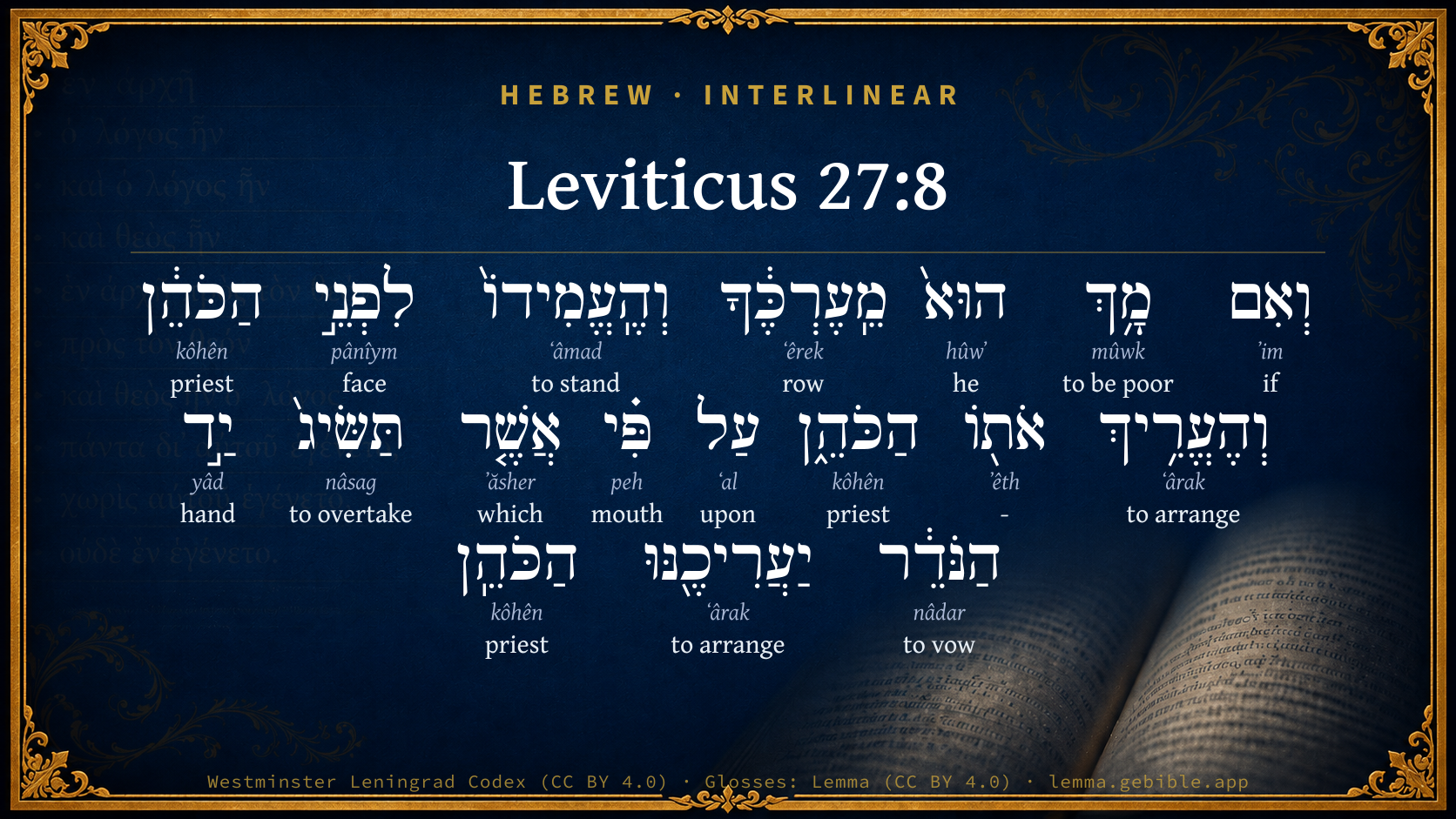
Leviticus 27:8

Hebrew (Westminster Leningrad Codex) Leviticus 27:8 appears in the Hebrew Old Testament. The text above is from the Westminster Leningrad Codex. Each word links to its Strong’s number, a concise gloss, and parsing drawn from the Open Scriptures Hebrew Bible morphology. Click any word for its full Brown-Driver-Briggs (BDB) entry.
Download image
Cite this verse

Leviticus 27:8 (World English Bible). Public Domain. Lemma interlinear Bible study tool, https://lemma.gebible.app/v/leviticus/27/8.

Show BibTeX & RIS
BibTeX
RIS
English Translation
But if he is poorer than your valuation, then he shall be set before the priest, and the priest shall value him; according to the ability of him who vowed shall the priest value him.
World English Bible · Public Domain
Download a study sheet

One document with this verse’s original text, its word-by-word gloss line, the meaning frame, cross-references with their text, attributed commentary, and full source and license credits — printable, and it pastes into notes with its structure intact.

This verse Autodidact and up

Study sheet (.html) Plain text (.txt)

A passage Seminary Student

Up to 50 verses in one chapter. A passage sheet keeps up to 6 commentary sources and 12 cross-references per verse, in the order this page ranks them, and says so on the sheet whenever that leaves anything out. Ask for a single verse and you get the Autodidact verse sheet above.

Everything on this page stays free to read, with no account — the sheet is a download of what is already on screen, not access to it.

Want to remove ads? Support Godless Engineer
Compare translations 3

The same verse in 3 English versions, stacked beneath the original-language interlinear above. Click any original word for its lexicon entry.

Each is an independent rendering of the whole verse — the interlinear is not word-aligned to these translations.

Highlighted words mark where these versions differ — a whole-verse word diff, not a word-by-word alignment.

  • World English Bible Public Domain
    But if he is poorer than your valuation, then he shall be set before the priest, and the priest shall value him; according to the ability of him who vowed shall the priest value him.
  • King James Version Public Domain
    But if he be poorer than thy estimation, then he shall present himself before the priest, and the priest shall value him; according to his ability that vowed shall the priest value him.
  • unfoldingWord Literal Text CC BY-SA 4.0
    And if he is too poor from your valuation, then he shall stand him before the face of the priest, and the priest shall value him. Upon the mouth of what the hand of the one vowing can reach, the priest shall value him.

unfoldingWord Literal Text — © unfoldingWord, licensed CC BY-SA 4.0. Word-aligned USFM3 via Door43 (git.door43.org/unfoldingWord/en_ult).

Versions to compare (up to 4)

3 of 4 selected

Show all 18 translations

Every available English version of this verse, each an independent rendering of the whole verse.

  • World English Bible Public Domain
    But if he is poorer than your valuation, then he shall be set before the priest, and the priest shall value him; according to the ability of him who vowed shall the priest value him.
  • Berean Standard Bible Public Domain
    But if the one making the vow is too poor to pay the valuation, he is to present the person before the priest, who shall set the value according to what the one making the vow can afford.
  • Majority Standard Bible Public Domain
    But if the one making the vow is too poor to pay the valuation, he is to present the person before the priest, who shall set the value according to what the one making the vow can afford.
  • King James Version Public Domain
    But if he be poorer than thy estimation, then he shall present himself before the priest, and the priest shall value him; according to his ability that vowed shall the priest value him.
  • American Standard Version (1901) Public Domain
    But if he be poorer than thy estimation, then he shall be set before the priest, and the priest shall value him; according to the ability of him that vowed shall the priest value him.
  • Revised Version (1885) Public Domain
    But if he be poorer than thy estimation, then he shall be set before the priest, and the priest shall value him; according to the ability of him that vowed shall the priest value him.
  • Geneva Bible (1599) Public Domain
    But if he be poorer then thou hast esteemed him, then shall hee present himselfe before the Priest, and the Priest shall value him, according to the abilitie of him that vowed, so shall the Priest value him.
  • Douay-Rheims (1899) Public Domain
    If he be poor, and not able to pay tile estimation, he shall stand before tile priest: and as much as he shall value him at, and see him able to pay, so much shall he give.
  • Young's Literal Translation Public Domain
    `And if he is poorer than thy valuation, then he hath presented himself before the priest, and the priest hath valued him; according to that which the hand of him who is vowing doth reach doth the priest value him.
  • Literal Standard Version CC BY-SA 4.0
    And if he is poorer than your valuation, then he has presented himself before the priest, and the priest has valued him; according to that which the hand of him who is vowing reaches, the priest values him.
  • Unlocked Literal Bible CC BY-SA 4.0
    But if the person making the vow cannot pay the standard value, then the person being given must be presented to the priest, and the priest will value that person by the amount the one making the vow is able to afford.
  • unfoldingWord Literal Text CC BY-SA 4.0
    And if he is too poor from your valuation, then he shall stand him before the face of the priest, and the priest shall value him. Upon the mouth of what the hand of the one vowing can reach, the priest shall value him.
  • Darby Bible Public Domain
    And if he be poorer than thy valuation, he shall present himself before the priest, and the priest shall value him: according to his means that vowed shall the priest value him.
  • World Messianic Bible Public Domain
    But if he is poorer than your valuation, then he shall be set before the priest, and the priest shall assign a value to him. The priest shall assign a value according to his ability to pay.
  • Webster's Bible Public Domain
    But if he shall be poorer than thy estimation, then he shall present himself before the priest, and the priest shall value him: according to his ability that vowed shall the priest value him.
  • Free Bible Version CC BY-SA 4.0
    However, if when you fulfill your promise you are poorer than the fixed value, you are to present the person before the priest, who will then set the value depending on what you can afford.
  • Bible in Basic English Public Domain
    But if he is poorer than the value which you have put on him, then let him be taken to the priest, and the priest will put a value on him, such as it is possible for him to give.
  • JPS Tanakh (1917) Public Domain
    But if he be too poor for thy valuation, then he shall be set before the priest, and the priest shall value him; according to the means of him that vowed shall the priest value him.

Literal Standard Version (2020), Covenant Press — licensed CC BY-SA 4.0. Text via the HelloAO Bible API (eBible.org). Unlocked Literal Bible (unfoldingWord) — licensed CC BY-SA 4.0. Text via the HelloAO Bible API (eBible.org). unfoldingWord Literal Text — © unfoldingWord, licensed CC BY-SA 4.0. Word-aligned USFM3 via Door43 (git.door43.org/unfoldingWord/en_ult). Free Bible Version, Dr. Jonathan Gallagher — licensed CC BY-SA 4.0. Text via the HelloAO Bible API (eBible.org).

Word by word

More ways to search: Search by grammar → Find every occurrence → Compare this word →

Practice this passage: Drill this verse → Learn its vocabulary →

מָ֥ךְ
mûwk
H4134
“being poor”
Verb, Qal, Participle Active, Masculine, Singular, Absolute
Part of Speech
Verb
Stem
Qal
Form
Participle Active
Gender
Masculine
Number
Singular
State
Absolute
Full BDB Definition

Origin: a primitive root

TWOT: 1159

(Qal) to be low, grow poor, be depressed, be poor
  1. וְאִם ʼim H518 “and · if” Conjunction + Conjunction
  2. הוּא֙ hûwʼ H1931 “he” Pronoun, Personal, 3rd Person, Masculine, Singular
  3. מֵֽעֶרְכֶּ֔ךָ ʻêrek H6187 “from · row · your” Preposition + Noun, Common, Masculine, Singular, Construct + Suffix, Personal, 2nd Person, Masculine, Singular
  4. וְהֶֽעֱמִידוֹ֙ ʻâmad H5975 “and · to stand · him” Conjunction + Verb, Hiphil, Sequential Perfect, 3rd Person, Masculine, Singular + Suffix, Personal, 3rd Person, Masculine, Singular
  5. לִפְנֵ֣י pânîym H6440 “to/for · face(s) of” Preposition + Noun, Common, Both, Plural, Construct
  6. הַכֹּהֵ֔ן kôhên H3548 “the · priest” Particle, Definite Article + Noun, Common, Masculine, Singular, Absolute
  7. וְהֶעֱרִ֥יךְ ʻârak H6186 “and · to arrange” Conjunction + Verb, Hiphil, Sequential Perfect, 3rd Person, Masculine, Singular
  8. אֹת֖וֹ ʼêth H853 “- · him” Particle, Direct Object + Suffix, Personal, 3rd Person, Masculine, Singular
  9. הַכֹּהֵ֑ן kôhên H3548 “the · priest” Particle, Definite Article + Noun, Common, Masculine, Singular, Absolute
  10. עַל ʻal H5921 “upon” Preposition
  11. פִּ֗י peh H6310 “mouth of” Noun, Common, Masculine, Singular, Construct
  12. אֲשֶׁ֤ר ʼăsher H834 “which” Particle, Relative
  13. תַּשִּׂיג֙ nâsag H5381 “to overtake” Verb, Hiphil, Imperfect, 3rd Person, Feminine, Singular
  14. יַ֣ד yâd H3027 “hand of” Noun, Common, Both, Singular, Construct
  15. הַנֹּדֵ֔ר nâdar H5087 “the · vowing” Particle, Definite Article + Verb, Qal, Participle Active, Masculine, Singular, Absolute
  16. יַעֲרִיכֶ֖נּוּ ʻârak H6186 “to arrange · him” Verb, Hiphil, Imperfect, 3rd Person, Masculine, Singular + Suffix, Personal, 3rd Person, Masculine, Singular
  17. הַכֹּהֵֽן kôhên H3548 “the · priest” Particle, Definite Article + Noun, Common, Masculine, Singular, Absolute

About this verse

These counts appear in no published source. They are computed here, from the morphology-tagged text and Lemma’s own curated glosses. What Lemma adds →

18
words
15
distinct lemmas
Pentateuch
section

Notable vocabulary

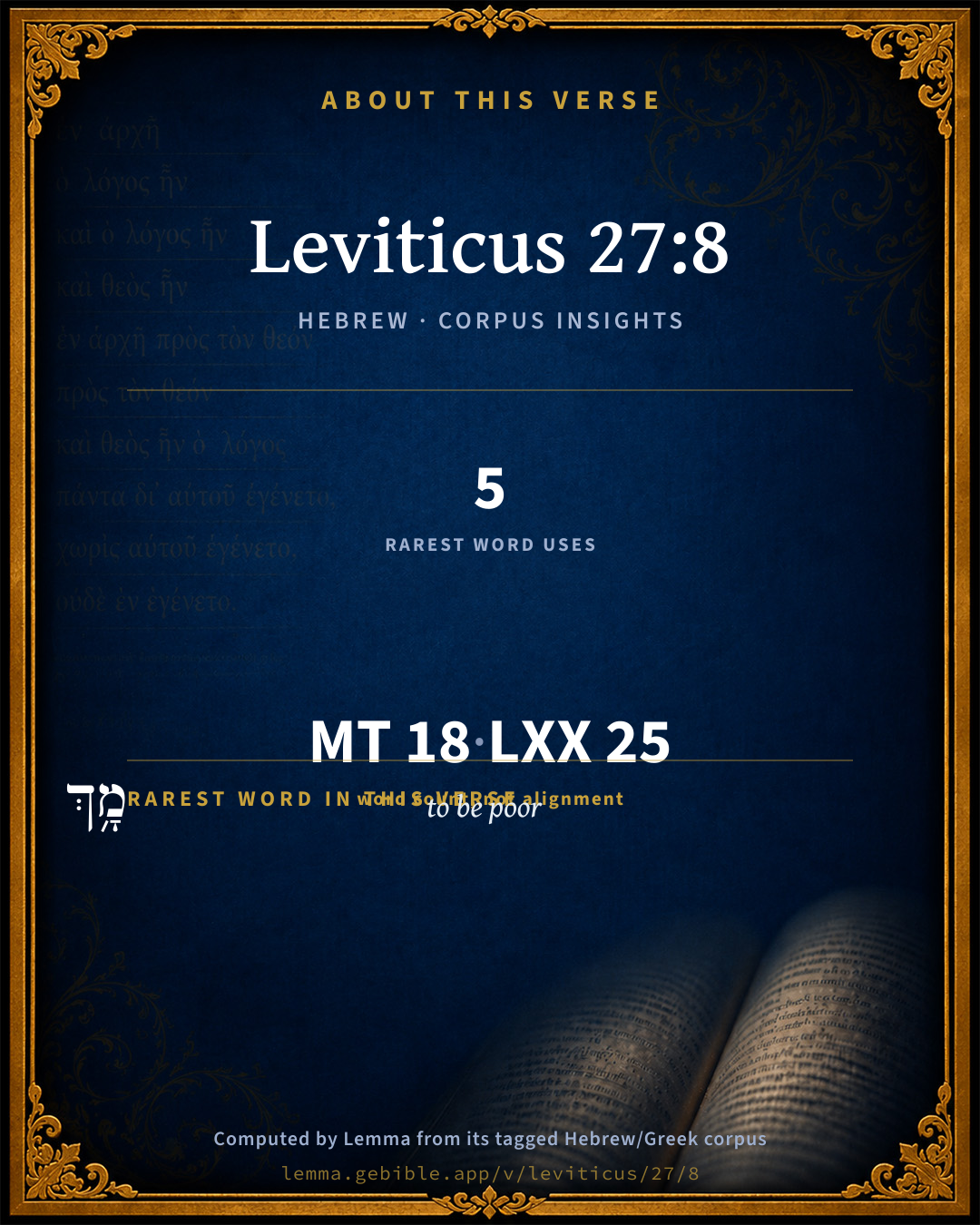
The rarest word here is מָ֥ךְ to be poor H4134 — appearing just 5 times in the whole Hebrew Bible.

Shared distinctive vocabulary

מָ֥ךְ to be poor H4134 occurs in 5 verses of the Hebrew Bible. Also found in:

Grammatical profile

  • 6 verbs
  • 7 nouns
  • 1 pronoun
  • 1 preposition
  • 1 conjunction
  • 2 particles

Verb forms

  • מָ֥ךְ Qal · Participle Active
  • וְהֶֽעֱמִידוֹ֙ Hiphil · Sequential Perfect
  • וְהֶעֱרִ֥יךְ Hiphil · Sequential Perfect
  • תַּשִּׂיג֙ Hiphil · Imperfect
  • הַנֹּדֵ֔ר Qal · Participle Active
  • יַעֲרִיכֶ֖נּוּ Hiphil · Imperfect

Repetition

Words recur within this verse — often emphatic in Hebrew:

  • הַכֹּהֵ֔ן priest H3548 ×3
  • וְהֶעֱרִ֥יךְ to arrange H6186 ×2

Hebrew & Septuagint length

In English translation the verse runs 35 words from the Hebrew and 37 from the Septuagint (LXX English) — closely comparable.

A rough comparison of the two English renderings, which tokenize alike — not a word-level alignment.

Word counts can differ between the Hebrew and the Greek without any difference in meaning — e.g. the Hebrew direct-object marker אֵת has no separate Greek word, and Greek often adds the article ὁ.

In the original languages it is 18 Hebrew tokens and 25 Greek tokens — but the two are counted differently (Hebrew bundles its prefixes and suffixes into one token; the Greek is in lemma form), so that isn’t a like-for-like length.

Cross-references

8

Topical passages linked to Leviticus 27:8 in the Treasury of Scripture Knowledge — connected by theme and wording, ordered by reader-vote popularity; previews shown in the World English Bible.

  • Leviticus 14:21–22 "If he is poor, and can't afford so much, then he shall take one male lamb for a trespass offering to be waved, to make atonement for him, and one tenth of an ephah of fine flour mingled with oil for a meal offering, and a log of oil;
  • Mark 14:7 For you always have the poor with you, and whenever you want to, you can do them good; but you will not always have me.
  • Leviticus 5:7 "'If he can't afford a lamb, then he shall bring his trespass offering for that in which he has sinned, two turtledoves, or two young pigeons, to Yahweh; one for a sin offering, and the other for a burnt offering.
  • Leviticus 5:11 "'But if he can't afford two turtledoves, or two young pigeons, then he shall bring his offering for that in which he has sinned, the tenth part of an ephah of fine flour for a sin offering. He shall put no oil on it, neither shall he put any frankincense on it, for it is a sin offering.
  • Leviticus 12:8 If she cannot afford a lamb, then she shall take two turtledoves, or two young pigeons; the one for a burnt offering, and the other for a sin offering: and the priest shall make atonement for her, and she shall be clean.'"
  • Jeremiah 5:7 How can I pardon you? your children have forsaken me, and sworn by them that are no gods: when I had fed them to the full, they committed adultery, and assembled themselves in troops at the prostitutes' houses.
  • Luke 21:1–4 He looked up, and saw the rich people who were putting their gifts into the treasury.
  • 2 Corinthians 8:12 For if the readiness is there, it is acceptable according to what you have, not according to what you don't have.

Cross-references courtesy of OpenBible.info (CC BY 4.0).

Hebrew and Greek witnesses Masoretic Hebrew ↔ Greek Septuagint

The same verse in the two great witnesses to the Old Testament, shown verse-for-verse.

These are two independent witnesses, not word-aligned to each other, and the Septuagint is shown in lemma (dictionary) form.

Hebrew Leviticus 27:8 Masoretic · Westminster Leningrad Codex

וְאִם מָ֥ךְ הוּא֙ מֵֽעֶרְכֶּ֔ךָ וְהֶֽעֱמִידוֹ֙ לִפְנֵ֣י הַכֹּהֵ֔ן וְהֶעֱרִ֥יךְ אֹת֖וֹ הַכֹּהֵ֑ן עַל פִּ֗י אֲשֶׁ֤ר תַּשִּׂיג֙ יַ֣ד הַנֹּדֵ֔ר יַעֲרִיכֶ֖נּוּ הַכֹּהֵֽן

But if he is poorer than your valuation, then he shall be set before the priest, and the priest shall value him; according to the ability of him who vowed shall the priest value him.

World English Bible · Public Domain

Greek LXX Leviticus 27:8 Septuagint · lemma form

ἐάν δέ ταπεινός εἰμί ὁ τιμή ἵστημι ἐναντίον ὁ ἱερεύς καί τιμάω αὐτός ὁ ἱερεύς καθάπερ ἰσχύω ὁ χείρ ὁ εὔχομαι τιμάω αὐτός ὁ ἱερεύς

And if the man be too poor for the valuation, he shall stand before the priest; and the priest shall value him: according to what the man who has vowed can afford, the priest shall value him.

LXX2012 (modern English Septuagint) · Public Domain

Hebrew: Westminster Leningrad Codex (CC BY 4.0). Greek: Septuagint (public domain); English from LXX2012 (modern English Septuagint) (Public Domain). How the Septuagint differs from the Hebrew →

Targum (Aramaic paraphrase)

2

The Targum is the ancient Jewish Aramaic paraphrase of the Hebrew Scriptures — an interpretive translation, not the Hebrew text itself. Onkelos (literal) and Pseudo-Jonathan (expansive) render the Torah, and Jonathan the Prophets. Coverage is partial: where no permissively-licensed English translation exists for a verse, only the Aramaic is shown. This is verse-level text, not a word-by-word alignment to the Hebrew.

  1. Targum Onkelos Torah (Genesis–Deuteronomy)
    וְאִם מִסְכֵּן הוּא מִפֻּרְסָנֵהּ וִיקִימִנֵהּ קֳדָם כַּהֲנָא וְיִפְרוֹס יָתֵהּ כַּהֲנָא עַל מֵימַר דִי תַדְבֵּק יְדָא דְנוֹדֵרָא יִפְרְסִנֵהּ כַּהֲנָא

    (no public-domain English translation for this verse)

    Targum Onkelos — Aramaic: “Onkelos Genesis” (public domain); “Onkelos Exodus” (public domain); “Onkelos Leviticus” (public domain); “Onkelos Numbers” (public domain); “Onkelos Deuteronomy” (public domain). English: “Sefaria Community Translation” (CC0 1.0 (public-domain dedication)); “J.W. Etheridge. The Targums of Onkelos and Jonathan Ben Uzziel on the Pentateuch. London: Longmans, Green, 1862” (public domain). Text via Sefaria.

  2. Targum Pseudo-Jonathan Torah (Genesis–Deuteronomy)
    וְאִין מִסְכֵּן הוּא מִמֵסַת עֲלוֹיֵיהּ וְיוֹקִמִינֵיהּ קֳדָם כַּהֲנָא וְיַעֲלִינֵיהּ כַּהֲנָא כְּמֵיסַת דְתַדְבֵּיק יַד נוֹדִירָא הֵיכְדֵין יַעֲלִינֵיהּ כַּהֲנָא

    But if he be too poor for (such) a rate of his estimation, he shall stand before the priest; and the priest shall make an estimation for him, according to the ability of his hand, so shall the priest estimate for him.

    Targum Pseudo-Jonathan — Aramaic: “Targum Jonathan on Genesis” (public domain); “Targum Jonathan on Exodus” (public domain); “Targum Jonathan on Leviticus” (public domain); “Targum Jonathan on Numbers” (public domain); “Targum Jonathan on Deuteronomy” (public domain). English: “The Targum of Jonathan ben Uzziel, trans. J. W. Etheridge, London, 1862” (public domain). Text via Sefaria.

Commentary

Notes on Leviticus 27:8 from classic Christian and Jewish commentators (each source and its license shown beneath its notes). The classic Christian expositions comment on the surrounding passage and are grouped to its opening verse, so a note may address several verses; the Jewish commentaries on the Tanakh (Rashi and others) are per-verse, so they appear only where the commentator wrote on this verse.

Lemma curates 59 commentaries, every one of them public domain or Creative Commons licensed, each selected and text-cleaned for this edition rather than reprinted as found. About our sources →

Trapp's Complete Commentary

John Trapp

Lev 27:8 But if he be poorer than thy estimation, then he shall present himself before the priest, and the priest shall value him; according to his ability that vowed shall the priest value him.

Ver. 8. But if he be poorer.] Indulged he shall be, but not exempted. Vows, in things lawful and possible, must be performed, as we can at least. If rashly made, that rashness must be repented of, but the vow, if otherwise lawful, must be kept, without delay or diminution, to the utmost of our power. Men may not play with vows, {Ecc 5:3-4 Psa 76:11} as monkeys with their collars, which they can slip at pleasure. To vow is voluntary, to pay is necessary. And yet what more common in the world than shipmen’s vows? As he in Erasmus, {a} who in a storm promised his saint a picture of wax as big as St Christopher, but when he came to shore, would not give a tallow candle.

{a} Erasm. Colloq.

John Trapp, A Commentary or Exposition upon All the Books of the Old and New Testament (1647–1656) — public domain. Text from a community e-Sword module.

Tyndale Open Study Notes

Tyndale Open Resources

27:8 As in the offering system (see 5:7-13), special consideration was given to the poor person who wanted to contribute to the sanctuary. In such cases, the amount of silver to accompany the pledge was left to the priest’s discretion.

Tyndale Open Study Notes — © Tyndale Open Resources, licensed CC BY-SA 4.0. Text via the HelloAO Bible API.

Geneva Bible (1599)

Geneva Bible translators

If he be not able to pay after thy valuation.

Geneva Bible (1599) marginal notes — public domain. Text via Bolls.life.

Ellicott's Commentary for English Readers

(8) But if he be poorer than thy estimation.—That is, if the person who makes the vow possesses less than the specified legal rates required to redeem it.

Then he shall present himself before the priest.—The man pleading poverty is to appear before the priest, who is to examine into his circumstances, and tax him accordingly. The minimum, however, which he was obliged to pay during the second Temple was one shekel. If anyone neglected paying his vows to the Temple treasury, his goods were seized by the officials. This, however, had to be done in such a manner as not to deprive the man of his means of subsistence. The bailiffs were obliged to leave a mechanic two sets of tools, a husbandman a yoke of oxen, and a donkey driver his donkey. They were bound to leave food sufficient for thirty days, and bedding for twelve months; and they could never seize the man’s sandals or phylacteries, or his wife’s property, or his children’s clothes.

A Bible Commentary for English Readers, edited by Charles John Ellicott (1878–1897) — public domain. Text from a community e-Sword module.

The Cambridge Bible for Schools and Colleges

gen. ed. J. J. S. Perowne

8. The case of the poor person. Cp. ch. Lev_5:11.

The Cambridge Bible for Schools and Colleges (gen. ed. J. J. S. Perowne; Cambridge University Press, 1878–1918) — public domain. Text from a community e-Sword module.

John Gill's Exposition

And if it be a beast whereof men bring an offering to the Lord,.... That is, it such a creature is devoted, which is of that kind which are used in sacrifice to the Lord, such as bullocks, sheep, goats, rams, and lambs:

all that any man giveth of such unto the Lord shall be holy; shall be set apart to sacred uses, and not applied to profane or common uses, but either were for the use of the altar or of the priests; or the price of them for the repair of the sanctuary, according as they were devoted.

John Gill's Exposition of the Whole Bible (1746–1763) — public domain (CC PDM 1.0). Text via the HelloAO Bible API.

Albert Barnes' Notes on the Bible

If he be poorer than thy estimation - Too poor (to pay) thy valuation. Compare Lev 27:7, Lev 27:11.

Albert Barnes' Notes on the Bible (1834–1885) — public domain. Text from a community e-Sword/MySword module.

Haydock's Catholic Bible Commentary

The estimation. Hebrew is pointed improperly, "thy estimation;" for the price was fixed already. The priest had leave to reduce it only in favour of the poor. (Houbigant) See ver. 2, and following.

George Leo Haydock (1774–1849), Haydock's Catholic Family Bible and Commentary, 1859 edition — public domain. Excludes Psalms (Douay-Rheims chapter numbering differs from Protestant) and Deuterocanonical books (Catholic canon only).

Matthew Poole's English Annotations

If he be poorer than thy estimation; if after his vow he be decayed and impoverished, and not able to pay the price which thou, according to the rules here given, requirest of him.

According to his ability; which God also considered in other cases, as Lev 12:8. Compare 2Co 8:12.

Matthew Poole's English Annotations on the Holy Bible (1683–1685) — public domain. Text from a community e-Sword/MySword module.

Whedon's Commentary on the Bible

Daniel D. Whedon

8. If he be poorer than thy estimation — If any man endeavouring to redeem himself from his vow should find the above scale of prices beyond his ability, a special estimate is to be made by the priest adjusted to the ability of the applicant. Thus the lenity of Mosaism appears.

Daniel D. Whedon (gen. ed.), Commentary on the Old and New Testaments (1874–1909) — public domain. Text from a community e-Sword module.

The Pulpit Commentary

A discretion is left with the priest to lower these valuations in ease the man who has made the vow is very poor. According to his ability that vowed shall the priest value him.

The Pulpit Commentary (1880–1919), ed. H.D.M. Spence-Jones & Joseph S. Exell — public domain. Text from a community e-Sword module.

John Wesley's Explanatory Notes

Than thy estimation - If he be not able to pay the price which thou, according to the rules here given, requirest of him.

John Wesley, Explanatory Notes Upon the Whole Bible (1754–1765) — public domain. Text via the GEBible commentary corpus.

Rashi

Rabbi Shlomo Yitzchaki (Rashi)

ואם מך הוא BUT IF HE POOR so that his means are not sufficient to pay this valuation,

והעמידו THEN THEY SHALL PRESENT HIM — the person made the subject of a valuation, לפני הכהן BEFORE THE PRIEST, and the priest shall set a value on him according to the means of him who promised the valuation (Sifra, Bechukotai, Section 3 14).

על פי אשר תשיג ACCORDING TO HIS ABILITY — i. e. according to what he possesses shall he (the priest) assess him (the person who has promised the valuation), leaving him sufficient to live upon: a bed, mattress and cushion and tools necessary for his trade; thus, in respect to the latter, if he was an ass-driver (earning a living by carrying loads) he has to leave him his ass (Arakhin 23b).

Rashi on the Tanakh — English translations: “The Judaica Press complete Tanach with Rashi, translated by A. J. Rosenberg” (CC BY 4.0); “Pentateuch with Rashi's commentary by M. Rosenbaum and A.M. Silbermann, 1929-1934” (public domain); “The Metsudah Tanach series, Lakewood, N.J” (CC BY 4.0); and “The Book of Joshua, Metsudah Publications, 1997” (CC BY 4.0). Text via Sefaria.

Lesson kit

Teaching starters — assembled from the data on this page, not authored interpretation. Every prompt links to the verse data it draws on. Edit before teaching.

Leviticus, in the Pentateuch, opens this verse with 18 words (15 distinct Hebrew lemmas). Its most distinctive word is mûwk (“to be poor”). A historical commentator’s framing appears above. Read the whole chapter for the surrounding context.

Discussion questions

  1. The word mûwk carries the sense “to be poor.” How does it shape the verse?
  2. How does Leviticus 25:25, which shares the word «to be poor», read alongside this verse?
  3. What does the repetition of “priest” (3× in this one verse) do in this verse?
  4. These translations render this verse differently. What is at stake in choosing one wording over another?
  5. «מָ֥ךְ» is a Qal Participle Active verb. How does that grammatical form shape the action described?
  6. Compare how Trapp's Complete Commentary and Tyndale Open Study Notes read this verse. Where do they agree or differ?

Things to notice

Reading settings

Reading text

Shown beneath each verse's original-language words.

Old Testament
Old Testament edition

Read the OT as the Masoretic Hebrew (MT) or the Greek Septuagint (LXX).

English shown for the Greek Septuagint (in the Hebrew ↔ Greek comparison).

Comparing translations? Open the Compare panel on any verse page to stack up to four side by side.