
1 Kings 18:33

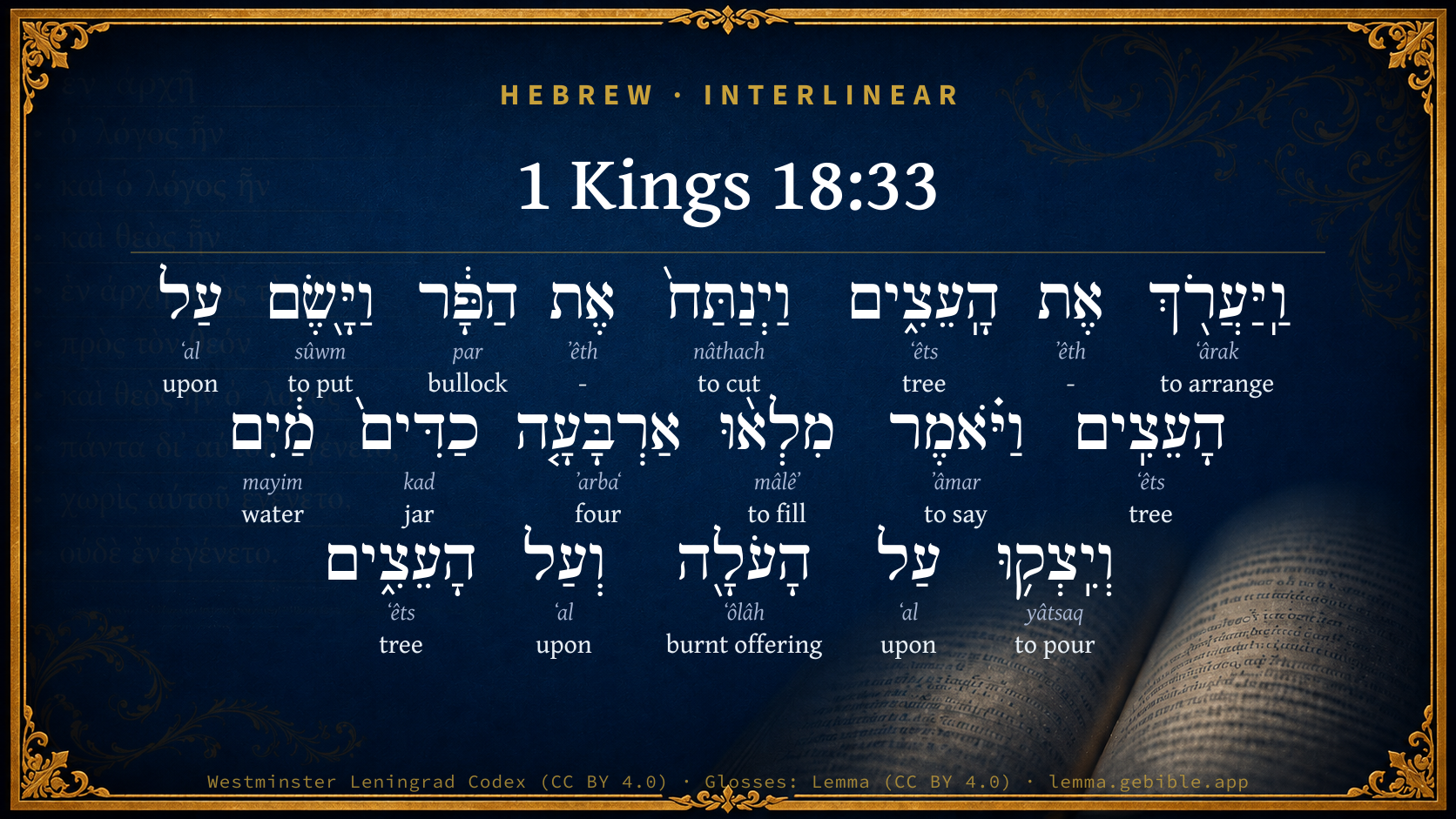
Hebrew (Westminster Leningrad Codex) 1 Kings 18:33 appears in the Hebrew Old Testament. The text above is from the Westminster Leningrad Codex. Each word links to its Strong’s number, a concise gloss, and parsing drawn from the Open Scriptures Hebrew Bible morphology. Click any word for its full Brown-Driver-Briggs (BDB) entry.
Download image
Cite this verse

1 Kings 18:33 (World English Bible). Public Domain. Lemma interlinear Bible study tool, https://lemma.gebible.app/v/1-kings/18/33.

Show BibTeX & RIS
BibTeX
RIS
English Translation
He put the wood in order, and cut the bull in pieces, and laid it on the wood. He said, Fill four jars with water, and pour it on the burnt offering, and on the wood.
World English Bible · Public Domain
Download a study sheet

One document with this verse’s original text, its word-by-word gloss line, the meaning frame, cross-references with their text, attributed commentary, and full source and license credits — printable, and it pastes into notes with its structure intact.

This verse Autodidact and up

Study sheet (.html) Plain text (.txt)

A passage Seminary Student

Up to 50 verses in one chapter. A passage sheet keeps up to 6 commentary sources and 12 cross-references per verse, in the order this page ranks them, and says so on the sheet whenever that leaves anything out. Ask for a single verse and you get the Autodidact verse sheet above.

Everything on this page stays free to read, with no account — the sheet is a download of what is already on screen, not access to it.

Want to remove ads? Support Godless Engineer
Compare translations 3

The same verse in 3 English versions, stacked beneath the original-language interlinear above. Click any original word for its lexicon entry.

Each is an independent rendering of the whole verse — the interlinear is not word-aligned to these translations.

Highlighted words mark where these versions differ — a whole-verse word diff, not a word-by-word alignment.

  • World English Bible Public Domain
    He put the wood in order, and cut the bull in pieces, and laid it on the wood. He said, Fill four jars with water, and pour it on the burnt offering, and on the wood.
  • King James Version Public Domain
    And he put the wood in order, and cut the bullock in pieces, and laid him on the wood, and said, Fill four barrels with water, and pour it on the burnt sacrifice, and on the wood.
  • unfoldingWord Literal Text CC BY-SA 4.0
    And he arranged the wood, and he cut up the bull, and he set on the wood.

unfoldingWord Literal Text — © unfoldingWord, licensed CC BY-SA 4.0. Word-aligned USFM3 via Door43 (git.door43.org/unfoldingWord/en_ult).

Versions to compare (up to 4)

3 of 4 selected

Show all 18 translations

Every available English version of this verse, each an independent rendering of the whole verse.

  • World English Bible Public Domain
    He put the wood in order, and cut the bull in pieces, and laid it on the wood. He said, Fill four jars with water, and pour it on the burnt offering, and on the wood.
  • Berean Standard Bible Public Domain
    Next, he arranged the wood, cut up the bull, placed it on the wood,
  • Majority Standard Bible Public Domain
    Next, he arranged the wood, cut up the bull, placed it on the wood,
  • King James Version Public Domain
    And he put the wood in order, and cut the bullock in pieces, and laid him on the wood, and said, Fill four barrels with water, and pour it on the burnt sacrifice, and on the wood.
  • American Standard Version (1901) Public Domain
    And he put the wood in order, and cut the bullock in pieces, and laid it on the wood. And he said, Fill four jars with water, and pour it on the burnt-offering, and on the wood.
  • Revised Version (1885) Public Domain
    And he put the wood in order, and cut the bullock in pieces, and laid it on the wood. And he said, Fill four barrels with water, and pour it on the burnt offering, and on the wood.
  • Geneva Bible (1599) Public Domain
    And he put the wood in order, and hewed the bullocke in pieces, and layd him on the wood,
  • Douay-Rheims (1899) Public Domain
    And he laid the wood in order, and cut the bullock in pieces, and laid it upon the wood.
  • Young's Literal Translation Public Domain
    And he arrangeth the wood, and cutteth in pieces the bullock, and placeth `it' on the wood, and saith, `Fill ye four pitchers of water, and pour on the burnt-offering, and on the wood;
  • Literal Standard Version CC BY-SA 4.0
    And he arranges the wood, and cuts the bullock in pieces, and places [it] on the wood, and says, “Fill four pitchers of water, and pour [them] on the burnt-offering, and on the wood”;
  • Unlocked Literal Bible CC BY-SA 4.0
    He arranged the wood for a fire, cut the bull in pieces, and laid the pieces of the bull on the wood. He said, “Fill four jars with water and pour it on the burnt offering and on the wood.”
  • unfoldingWord Literal Text CC BY-SA 4.0
    And he arranged the wood, and he cut up the bull, and he set on the wood.
  • Darby Bible Public Domain
    and he put the wood in order, and cut the bullock in pieces, and laid it on the wood. And he said, Fill four pitchers with water, and pour it on the burnt-offering, and on the wood.
  • World Messianic Bible Public Domain
    He put the wood in order, and cut the bull in pieces and laid it on the wood. He said, “Fill four jars with water, and pour it on the burnt offering and on the wood.”
  • Webster's Bible Public Domain
    And he put the wood in order, and cut the bullock in pieces, and laid him on the wood, and said, Fill four barrels with water, and pour it on the burnt-sacrifice, and on the wood.
  • Free Bible Version CC BY-SA 4.0
    He put the wood in place, cut the bull into pieces, and laid it on the wood. Then he told them, “Fill up four large jars with water and pour it over the offering and the wood.”
  • Bible in Basic English Public Domain
    And he put the wood in order, and, cutting up the ox, put it on the wood. Then he said, Get four vessels full of water and put it on the burned offering and on the wood. And he said, Do it a second time, and they did it a second time;
  • JPS Tanakh (1917) Public Domain
    And he put the wood in order, and cut the bullock in pieces, and laid it on the wood.

Literal Standard Version (2020), Covenant Press — licensed CC BY-SA 4.0. Text via the HelloAO Bible API (eBible.org). Unlocked Literal Bible (unfoldingWord) — licensed CC BY-SA 4.0. Text via the HelloAO Bible API (eBible.org). unfoldingWord Literal Text — © unfoldingWord, licensed CC BY-SA 4.0. Word-aligned USFM3 via Door43 (git.door43.org/unfoldingWord/en_ult). Free Bible Version, Dr. Jonathan Gallagher — licensed CC BY-SA 4.0. Text via the HelloAO Bible API (eBible.org).

Word by word

More ways to search: Search by grammar → Find every occurrence → Compare this word →

Practice this passage: Drill this verse → Learn its vocabulary →

וַיְנַתַּח֙
nâthach
H5408
“and · to cut”
Conjunction + Verb, Piel, Sequential Imperfect, 3rd Person, Masculine, Singular
Part of Speech
Conjunction + Verb
Stem
Piel
Form
Sequential Imperfect
Person
3rd Person
Gender
Masculine
Number
Singular
Full BDB Definition

Origin: a primitive root

TWOT: 1441

to cut, cut up, cut in pieces, divide - (Piel) to cut up, cut in pieces, divide by joints
  1. וַֽיַּעֲרֹ֖ךְ ʻârak H6186 “and · to arrange” Conjunction + Verb, Qal, Sequential Imperfect, 3rd Person, Masculine, Singular
  2. אֶת ʼêth H853 “-” Particle, Direct Object
  3. הָֽעֵצִ֑ים ʻêts H6086 “the · trees” Particle, Definite Article + Noun, Common, Masculine, Plural, Absolute
  4. אֶת ʼêth H853 “-” Particle, Direct Object
  5. הַפָּ֔ר par H6499 “the · bullock” Particle, Definite Article + Noun, Common, Masculine, Singular, Absolute
  6. וַיָּ֖שֶׂם sûwm H7760 “and · to put” Conjunction + Verb, Qal, Sequential Imperfect, 3rd Person, Masculine, Singular
  7. עַל ʻal H5921 “upon” Preposition
  8. הָעֵצִֽים ʻêts H6086 “the · trees” Particle, Definite Article + Noun, Common, Masculine, Plural, Absolute
  9. וַיֹּ֗אמֶר ʼâmar H559 “and · to say” Conjunction + Verb, Qal, Sequential Imperfect, 3rd Person, Masculine, Singular
  10. מִלְא֨וּ mâlêʼ H4390 “fill” Verb, Qal, Imperative, 2nd Person, Masculine, Plural
  11. אַרְבָּעָ֤ה ʼarbaʻ H702 “four” Adjective, Cardinal number, Masculine, Singular, Absolute
  12. כַדִּים֙ kad H3537 “jars” Noun, Common, Feminine, Plural, Absolute
  13. מַ֔יִם mayim H4325 “water(s)” Noun, Common, Masculine, Plural, Absolute
  14. וְיִֽצְק֥וּ yâtsaq H3332 “and · pour” Conjunction + Verb, Qal, Imperative, 2nd Person, Masculine, Plural
  15. עַל ʻal H5921 “upon” Preposition
  16. הָעֹלָ֖ה ʻôlâh H5930 “the · burnt offering” Particle, Definite Article + Noun, Common, Feminine, Singular, Absolute
  17. וְעַל ʻal H5921 “and · upon” Conjunction + Preposition
  18. הָעֵצִ֑ים ʻêts H6086 “the · trees” Particle, Definite Article + Noun, Common, Masculine, Plural, Absolute

About this verse

These counts appear in no published source. They are computed here, from the morphology-tagged text and Lemma’s own curated glosses. What Lemma adds →

19
words
14
distinct lemmas
Historical
section

Notable vocabulary

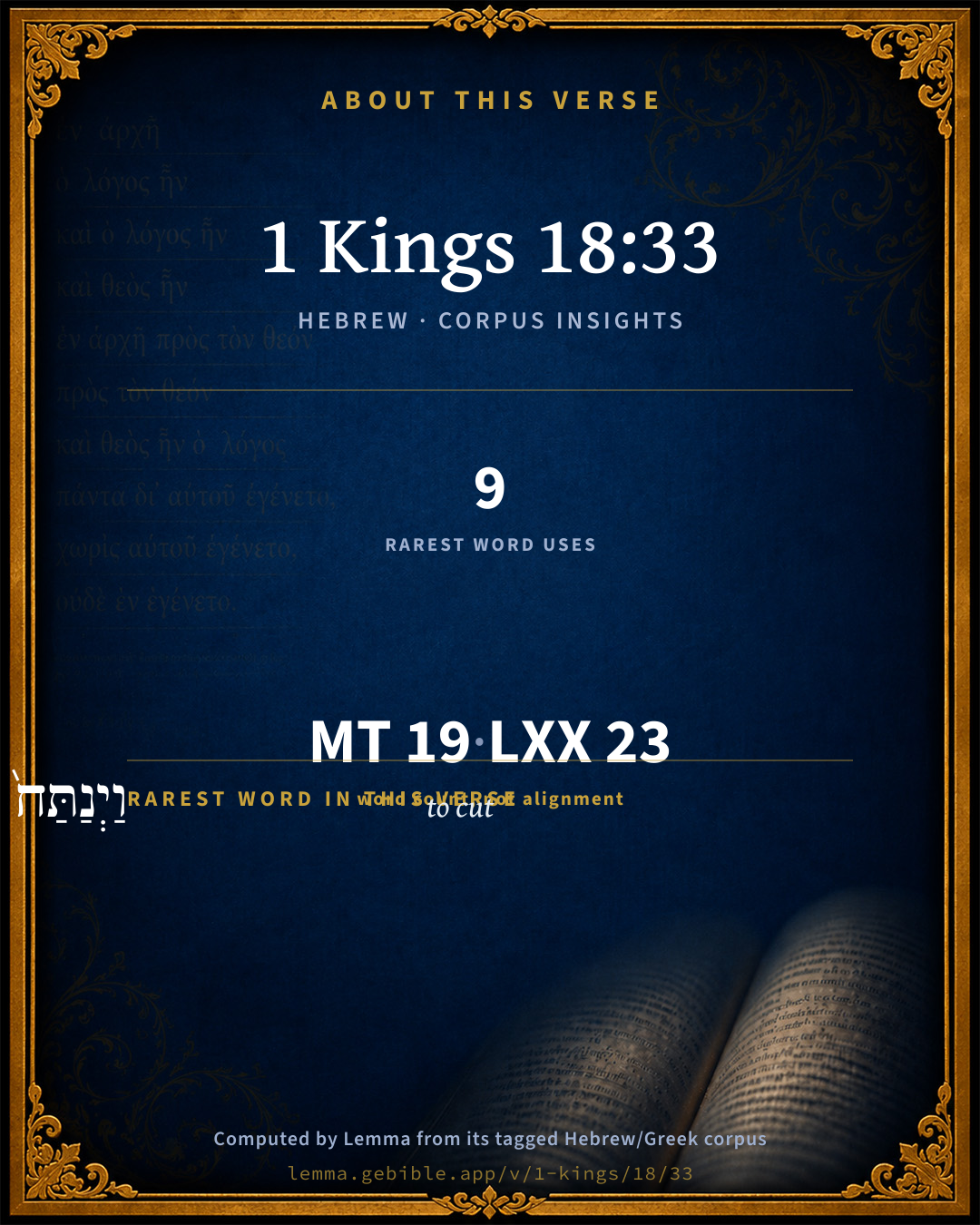
The rarest word here is וַיְנַתַּח֙ to cut H5408 — appearing just 9 times in the whole Hebrew Bible.

Shared distinctive vocabulary

וַיְנַתַּח֙ to cut H5408 occurs in 9 verses of the Hebrew Bible. Also found in:

Grammatical profile

  • 6 verbs
  • 7 nouns
  • 1 adjective
  • 3 prepositions
  • 2 particles

Verb forms

  • וַֽיַּעֲרֹ֖ךְ Qal · Sequential Imperfect
  • וַיְנַתַּח֙ Piel · Sequential Imperfect
  • וַיָּ֖שֶׂם Qal · Sequential Imperfect
  • וַיֹּ֗אמֶר Qal · Sequential Imperfect
  • מִלְא֨וּ Qal · Imperative
  • וְיִֽצְק֥וּ Qal · Imperative

Repetition

Words recur within this verse — often emphatic in Hebrew:

  • הָֽעֵצִ֑ים tree H6086 ×3
  • עַל upon H5921 ×3

Hebrew & Septuagint length

In English translation the verse runs 36 words from the Hebrew and 57 from the Septuagint (LXX English) — the Septuagint runs noticeably longer here. See the side-by-side →

A rough comparison of the two English renderings, which tokenize alike — not a word-level alignment.

Word counts can differ between the Hebrew and the Greek without any difference in meaning — e.g. the Hebrew direct-object marker אֵת has no separate Greek word, and Greek often adds the article ὁ.

In the original languages it is 19 Hebrew tokens and 23 Greek tokens — but the two are counted differently (Hebrew bundles its prefixes and suffixes into one token; the Greek is in lemma form), so that isn’t a like-for-like length.

Cross-references

7

Topical passages linked to 1 Kings 18:33 in the Treasury of Scripture Knowledge — connected by theme and wording, ordered by reader-vote popularity; previews shown in the World English Bible.

  • Genesis 22:9 They came to the place which God had told him of. Abraham built the altar there, and laid the wood in order, bound Isaac his son, and laid him on the altar, on the wood.
  • Leviticus 1:6–8 He shall flay the burnt offering, and cut it into pieces.
  • Judges 6:20 The angel of God said to him, Take the flesh and the unleavened cakes, and lay them on this rock, and pour out the broth. He did so.
  • Daniel 3:19 Then was Nebuchadnezzar full of fury, and the form of his visage was changed against Shadrach, Meshach, and Abednego: [therefore] he spoke, and commanded that they should heat the furnace seven times more than it was wont to be heated.
  • Daniel 3:25 He answered, Look, I see four men loose, walking in the midst of the fire, and they have no hurt; and the aspect of the fourth is like a son of the gods.
  • John 11:39–40 Jesus said, "Take away the stone." Martha, the sister of him who was dead, said to him, "Lord, by this time there is a stench, for he has been dead four days."
  • John 19:33–34 but when they came to Jesus, and saw that he was already dead, they didn't break his legs.

Cross-references courtesy of OpenBible.info (CC BY 4.0).

Hebrew and Greek witnesses Masoretic Hebrew ↔ Greek Septuagint

The same verse in the two great witnesses to the Old Testament, shown verse-for-verse.

Here the Septuagint runs noticeably longer than the Hebrew — LXX2012 (modern English Septuagint) 57 words vs World English Bible 36. A rough length comparison of the two English translations, not a word-level alignment — read both below.

These are two independent witnesses, not word-aligned to each other, and the Septuagint is shown in lemma (dictionary) form.

Hebrew 1 Kings 18:33 Masoretic · Westminster Leningrad Codex

וַֽיַּעֲרֹ֖ךְ אֶת הָֽעֵצִ֑ים וַיְנַתַּח֙ אֶת הַפָּ֔ר וַיָּ֖שֶׂם עַל הָעֵצִֽים וַיֹּ֗אמֶר מִלְא֨וּ אַרְבָּעָ֤ה כַדִּים֙ מַ֔יִם וְיִֽצְק֥וּ עַל הָעֹלָ֖ה וְעַל הָעֵצִ֑ים

He put the wood in order, and cut the bull in pieces, and laid it on the wood. He said, Fill four jars with water, and pour it on the burnt offering, and on the wood.

World English Bible · Public Domain

Greek LXX 1 Kings 18:33 Septuagint · lemma form

καί στοιβάζω ὁ σχίδαξ ἐπί ὁ θυσιαστήριον ὅς ποιέω καί μελίζω ὁ ὁλοκαύτωμα καί ἐπιτίθημι ἐπί ὁ σχίδαξ καί στοιβάζω ἐπί ὁ θυσιαστήριον

And he piled the cleft wood on the altar which he had made, and divided the whole burnt offering, and laid it on the wood, and laid it in order on the altar, and said, Fetch me four pitchers of water, and pour it on the whole burnt offering, and on the wood. And they did so.

LXX2012 (modern English Septuagint) · Public Domain

On this verse, The Cambridge Bible for Schools and Colleges discusses the Septuagint’s reading. Read the note in Commentary ↓

Hebrew: Westminster Leningrad Codex (CC BY 4.0). Greek: Septuagint (public domain); English from LXX2012 (modern English Septuagint) (Public Domain). How the Septuagint differs from the Hebrew →

Targum (Aramaic paraphrase)

1

The Targum is the ancient Jewish Aramaic paraphrase of the Hebrew Scriptures — an interpretive translation, not the Hebrew text itself. Onkelos (literal) and Pseudo-Jonathan (expansive) render the Torah, and Jonathan the Prophets. Coverage is partial: where no permissively-licensed English translation exists for a verse, only the Aramaic is shown. This is verse-level text, not a word-by-word alignment to the Hebrew.

  1. Targum Jonathan Prophets (Joshua–Malachi)
    וְסַדֵר יַת אָעַיָא וַהֲדֵים יַת תּוֹרָא וְשַׁוֵי עַל אָעַיָא:

    (no public-domain English translation for this verse)

    Targum Jonathan — Aramaic: “Mikraot Gedolot” (public domain). English: “Sefaria Community Translation” (CC0 1.0 (public-domain dedication)); “London "Chaldee Paraphrase," 1871” (public domain). Text via Sefaria.

Commentary

Notes on 1 Kings 18:33 from classic Christian and Jewish commentators (each source and its license shown beneath its notes). The classic Christian expositions comment on the surrounding passage and are grouped to its opening verse, so a note may address several verses; the Jewish commentaries on the Tanakh (Rashi and others) are per-verse, so they appear only where the commentator wrote on this verse.

Lemma curates 59 commentaries, every one of them public domain or Creative Commons licensed, each selected and text-cleaned for this edition rather than reprinted as found. About our sources →

Trapp's Complete Commentary

John Trapp

1Ki 18:33 And he put the wood in order, and cut the bullock in pieces, and laid [him] on the wood, and said, Fill four barrels with water, and pour [it] on the burnt sacrifice, and on the wood.

Ver. 33. Fill four barrels with water.] Which was got out of the sea, likely, which was nigh to mount Carmel, {Jer 4:18} in this wonderful drought, whereby the brooks were dried up. This was done that the miracle might be the more manifest, and beyond all exception.

John Trapp, A Commentary or Exposition upon All the Books of the Old and New Testament (1647–1656) — public domain. Text from a community e-Sword module.

Tyndale Open Study Notes

Tyndale Open Resources

18:33-35 Elijah avoided any hint of deception by dousing the offering and the wood with great quantities of water, perhaps taken from the nearby Mediterranean Sea or Kishon River.

Tyndale Open Study Notes — © Tyndale Open Resources, licensed CC BY-SA 4.0. Text via the HelloAO Bible API.

Adam Clarke's Commentary

Verse 33. Fill four barrels] This was done to prevent any kind of suspicion that there was fire concealed under the altar. An ancient writer under the name of Chrysostom, quoted by Calmet, says that he had seen under the altars of the heathens, holes dug in the earth with funnels proceeding from them, and communicating with openings on the tops of the altars. In the former the priests concealed fire, which, communicating through the funnels with the holes, set fire to the wood and consumed the sacrifice; and thus the simple people were led to believe that the sacrifice was consumed by a miraculous fire. Elijah showed that no such knavery could be practiced in the present case. Had there been a concealed fire under the altar, as in the case mentioned above, the water that was thrown on the altar must have extinguished it most effectually. This very precaution has for ever put this miracle beyond the reach of suspicion.

Adam Clarke's Commentary on the Bible (1810–1826) — public domain. Text from a community e-Sword/MySword module.

Ellicott's Commentary for English Readers

(33) Fill four barrels—or pitchers. The filling of these at the time of drought has naturally excited speculation. A ready surmise, by those unacquainted with the country, was that the water was taken from the sea flowing at the base of Carmel; but a glance at the position and the height of the mountain puts this not unnatural surmise out of the question, as difficult, if not impossible. Examination of the locality has discovered a perennial spring in the neighbourhood of the traditional scene of the sacrifice, which is never known to fail in the severest drought. From this, no doubt (as indeed Josephus expressly says), the water was drawn, with, of course, the object of precluding all idea of fraud or contrivance, and bringing out strikingly the consuming fierceness of the fire from heaven, so emphatically described in 1Ki_18:38.

A Bible Commentary for English Readers, edited by Charles John Ellicott (1878–1897) — public domain. Text from a community e-Sword module.

The Cambridge Bible for Schools and Colleges

gen. ed. J. J. S. Perowne

33. and laid him [R.V. it] on the wood, and [R.V. and he] said] The former of these changes is in accordance with modern usage.

on the burnt sacrifice] R.V. burnt-offering. Which latter is the constant rendering of the Hebrew word. At the close of the verse the LXX. adds ‘And they did so.’

The Cambridge Bible for Schools and Colleges (gen. ed. J. J. S. Perowne; Cambridge University Press, 1878–1918) — public domain. Text from a community e-Sword module.

John Gill's Exposition

And the water ran round about the altar,.... There being such a large effusion of it on it;

and he filled the trench also with water; which surrounded the altar, so that it seemed impracticable that any fire should kindle upon it; and this gave full proof and demonstration there could be no collusion in this matter.

John Gill's Exposition of the Whole Bible (1746–1763) — public domain (CC PDM 1.0). Text via the HelloAO Bible API.

Albert Barnes' Notes on the Bible

And he put the wood in order ... - He obeyed, that is, all the injunctions of the Law with respect to the offering of a burned sacrifice (marginal reference). He thus publicly taught that the ordinances of the Law were binding upon the kingdom of Israel.

Barrels - Rather, “pitchers” or “water-jars,” such as the maidens used to carry on their heads (Gen 24:14-20. Compare Jdg 7:16, Jdg 7:19). The flooding the sacrifice and the trench with water would at once do away with any suspicion of fraud, and greatly enhance in the eyes of the people the marvelousness of the miracle. The unfailing spring at the eastern end of Carmel 1Ki 18:19, was capable of furnishing as much water as he needed.

Albert Barnes' Notes on the Bible (1834–1885) — public domain. Text from a community e-Sword/MySword module.

Matthew Poole's English Annotations

Fill four barrels with water; which they could quickly fetch, either from the river Kishon; or if that was dried up, from the sea; both which were at the foot of the mountain. See Jer 46:18.

Pour it on the burnt-sacrifice, and on the wood: this he did, to make the miracle more glorious, and more unquestionable, and so more successful.

Matthew Poole's English Annotations on the Holy Bible (1683–1685) — public domain. Text from a community e-Sword/MySword module.

Whedon's Commentary on the Bible

Daniel D. Whedon

33. Fill four barrels — These barrels were the common water jars which are still used in the East for carrying water, and probably contained from three to five gallons apiece. The original word (כד) is the same as that used 1Ki_17:12, designating the vessel in which the widow kept her meal. It is translated pitcher in Gen_24:14-15, and Jdg_7:16. The object of flooding the bullock and the wood with these vessels of water was manifestly to place the miracle about to be wrought beyond all question.

Daniel D. Whedon (gen. ed.), Commentary on the Old and New Testaments (1874–1909) — public domain. Text from a community e-Sword module.

The Pulpit Commentary

And he put the wood in order, and cut the bullock in pieces, and laid him on the wood Rawlinson says "He obeyed, that is, all the injunctions of the law with respect to the offering of a burnt sacrifice, (see Lev_1:3-9) and adds, "He thus publicly taught that all the ordinances of the law were binding on the kingdom of Israel." But it is very probable that the priests of Baal had done the same things. All sacrifice involved such manual acts. Cf. Gen_22:9, where the same word is used. No doubt the prophet did everything in an orderly and regular way; but the people could hardly learn a lesson of obedience from such elementary acts as these, and the less so as the law provided, that the sacrifice should be offered only "by the priests, the sons of Aaron", (Lev_1:8) and Elijah"s ministrations, consequently, might seem to warrant or condone the ministrations of Jeroboam"s intrusive priesthood.

That they did not lend any real sanction to those irregularities is clear, however, to us. For, in the first place, priests were not to be had, all having long since left the kingdom. In the second place, the higher commission of the prophet embraced within itself the authority for all necessary priestly acts. Cf., 1Sa_16:2. Elijah acted, as Grotius well observes, (jure prophetico, minoribus legibus exsolutus, ut majores servaret) and said, Fill four barrels Heb. Cf. 1Ki_17:12. It designates the ordinary water-pitcher, generally carried then, as now, by women: (Gen_24:14-20; Jud_1:7:16; Ecc_12:6) with water, and pour it on the burnt sacrifice, and on the wood. The water, as already remarked, was doubtless brought from the adjoining spring (though it is clear from ver. 40 that the Kishon was not dry, and Thomson thinks that its sources, and particularly the fountain of Saadieh, furnished the supply). "In such springs the water remains always cool, under the shade of a vaulted roof, and with no hot atmosphere to evaporate it. While all other fountains were dried up, I can well understand that there might have been found here that superabundance of water which Elijah poured so profusely over the altar" (Van de Velde, 1. p. 325).

The Pulpit Commentary (1880–1919), ed. H.D.M. Spence-Jones & Joseph S. Exell — public domain. Text from a community e-Sword module.

John Wesley's Explanatory Notes

With water - This they could quickly fetch, either from the river Kishon; or, if that was dried up, from the sea; both were at the foot of the mountain. This he did to make the miracle more glorious, and more unquestionable.

John Wesley, Explanatory Notes Upon the Whole Bible (1754–1765) — public domain. Text via the GEBible commentary corpus.

unfoldingWord translationNotes

Door43 World Missions Community

He arranged the wood for a fire

"On the altar" where he placed the wood is assumed in this sentence. AT: "He put the wood for a fire on the altar" (See: Ellipsis)

four jars

"4 jars" (See: Numbers)

jars

A jar is a container for water.

trench

See how you translated this in 1 Kings 18:30.

translationWords

fire

cow

burnt offering

unfoldingWord translationNotes — © Distant Shores Media and the Door43 World Missions Community, licensed CC BY-SA 4.0. Source: git.door43.org/Door43/en_tn.

Lesson kit

Teaching starters — assembled from the data on this page, not authored interpretation. Every prompt links to the verse data it draws on. Edit before teaching.

1 Kings, in the Historical, opens this verse with 19 words (14 distinct Hebrew lemmas). Its most distinctive word is nâthach (“to cut”). The Greek Septuagint runs longer here. A historical commentator’s framing appears above. Read the whole chapter for the surrounding context.

Discussion questions

  1. What does “to cut” (nâthach) contribute to the verse as a whole?
  2. Exodus 29:17 shares the word «to cut» with this verse. How do the two illuminate each other?
  3. “tree” occurs 3× in this one verse. What is the effect of the repetition?
  4. Compared with the Hebrew, the Septuagint runs longer here. What questions does that raise?
  5. These translations render this verse differently. What is at stake in choosing one wording over another?
  6. The verb «וַֽיַּעֲרֹ֖ךְ» is Qal Sequential Imperfect. How does its form color the action?
  7. Reading how Trapp's Complete Commentary and Tyndale Open Study Notes read this verse, where do the two commentators agree and where do they part?

Things to notice

Reading settings

Reading text

Shown beneath each verse's original-language words.

Old Testament
Old Testament edition

Read the OT as the Masoretic Hebrew (MT) or the Greek Septuagint (LXX).

English shown for the Greek Septuagint (in the Hebrew ↔ Greek comparison).

Comparing translations? Open the Compare panel on any verse page to stack up to four side by side.