
Judges 20:33

Hebrew (Westminster Leningrad Codex) Judges 20:33 appears in the Hebrew Old Testament. The text above is from the Westminster Leningrad Codex. Each word links to its Strong’s number, a concise gloss, and parsing drawn from the Open Scriptures Hebrew Bible morphology. Click any word for its full Brown-Driver-Briggs (BDB) entry.
Download image
Cite this verse

Judges 20:33 (World English Bible). Public Domain. Lemma interlinear Bible study tool, https://lemma.gebible.app/v/judges/20/33.

Show BibTeX & RIS
BibTeX
RIS
English Translation
All the men of Israel rose up out of their place, and set themselves in array at Baal Tamar: and the liers-in-wait of Israel broke forth out of their place, even out of Maareh Geba.
World English Bible · Public Domain
Highlights
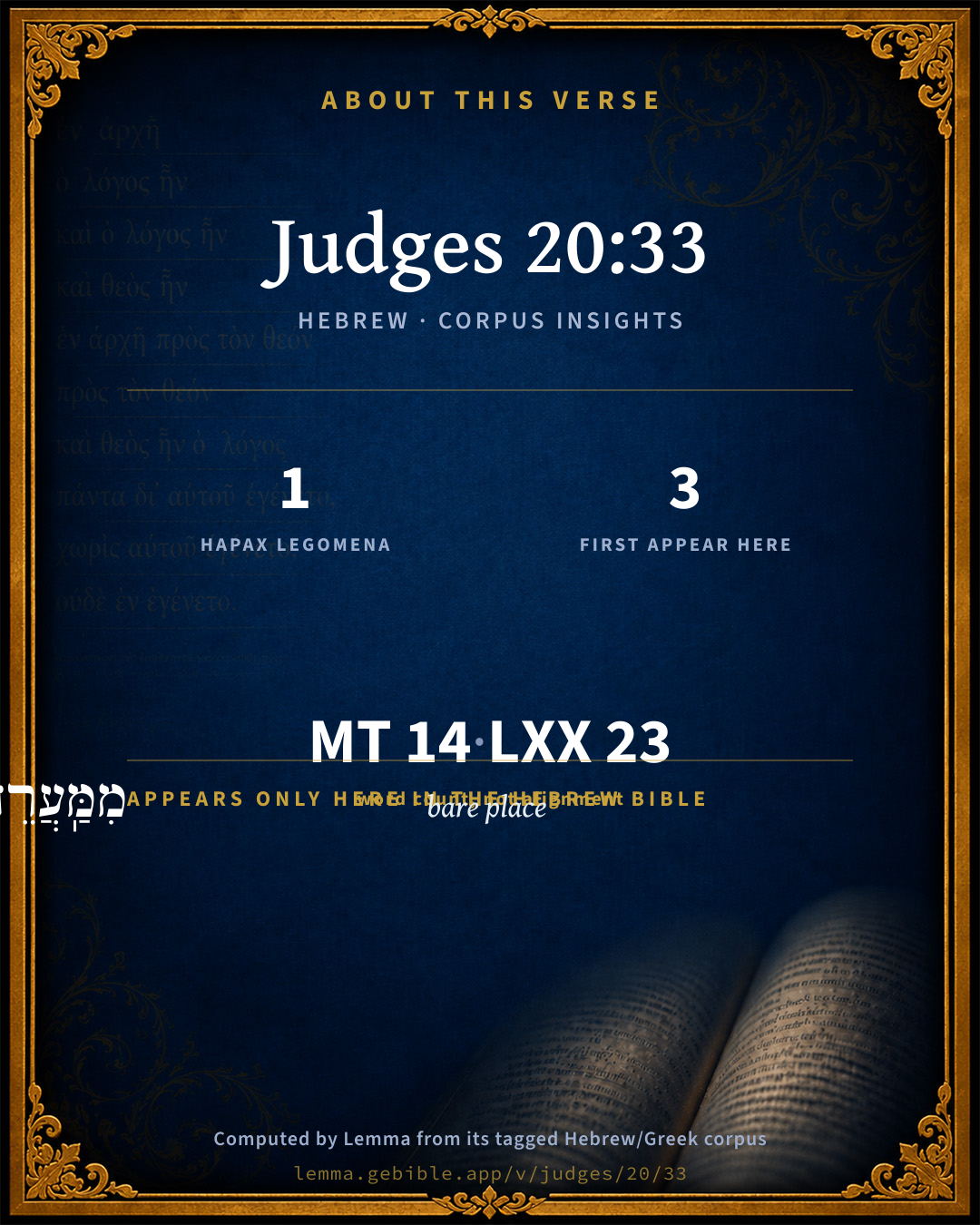
  • 1 hapax legomenon — only here in the Hebrew Bible
  • 3 first appearances in the Hebrew Bible
Full analysis ↓
Download a study sheet

One document with this verse’s original text, its word-by-word gloss line, the meaning frame, cross-references with their text, attributed commentary, and full source and license credits — printable, and it pastes into notes with its structure intact.

This verse Autodidact and up

Study sheet (.html) Plain text (.txt)

A passage Seminary Student

Up to 50 verses in one chapter. A passage sheet keeps up to 6 commentary sources and 12 cross-references per verse, in the order this page ranks them, and says so on the sheet whenever that leaves anything out. Ask for a single verse and you get the Autodidact verse sheet above.

Everything on this page stays free to read, with no account — the sheet is a download of what is already on screen, not access to it.

Want to remove ads? Support Godless Engineer
Compare translations 3

The same verse in 3 English versions, stacked beneath the original-language interlinear above. Click any original word for its lexicon entry.

Each is an independent rendering of the whole verse — the interlinear is not word-aligned to these translations.

Highlighted words mark where these versions differ — a whole-verse word diff, not a word-by-word alignment.

  • World English Bible Public Domain
    All the men of Israel rose up out of their place, and set themselves in array at Baal Tamar: and the liers-in-wait of Israel broke forth out of their place, even out of Maareh Geba.
  • King James Version Public Domain
    And all the men of Israel rose up out of their place, and put themselves in array at Baaltamar: and the liers in wait of Israel came forth out of their places, even out of the meadows of Gibeah.
  • unfoldingWord Literal Text CC BY-SA 4.0
    Then every man of Israel arose from his place, and they arrayed at Baal Tamar. And the ambush of Israel gushed from his place, from Maareh Gibeah.

unfoldingWord Literal Text — © unfoldingWord, licensed CC BY-SA 4.0. Word-aligned USFM3 via Door43 (git.door43.org/unfoldingWord/en_ult).

Versions to compare (up to 4)

3 of 4 selected

Show all 18 translations

Every available English version of this verse, each an independent rendering of the whole verse.

  • World English Bible Public Domain
    All the men of Israel rose up out of their place, and set themselves in array at Baal Tamar: and the liers-in-wait of Israel broke forth out of their place, even out of Maareh Geba.
  • Berean Standard Bible Public Domain
    So all the men of Israel got up from their places and arrayed themselves at Baal-tamar, and the Israelites in ambush charged from their positions west of Gibeah.
  • Majority Standard Bible Public Domain
    So all the men of Israel got up from their places and arrayed themselves at Baal-tamar, and the Israelites in ambush charged from their positions west of Gibeah.
  • King James Version Public Domain
    And all the men of Israel rose up out of their place, and put themselves in array at Baaltamar: and the liers in wait of Israel came forth out of their places, even out of the meadows of Gibeah.
  • American Standard Version (1901) Public Domain
    And all the men of Israel rose up out of their place, and set themselves in array at Baal-tamar: and the liers-in-wait of Israel brake forth out of their place, even out of Maareh-geba.
  • Revised Version (1885) Public Domain
    And all the men of Israel rose up out of their place, and set themselves in array at Baal-tamar: and the liers in wait of Israel brake forth out of their place, even out of Maareh-geba.
  • Geneva Bible (1599) Public Domain
    And all the men of Israel rose vp out of their place, and put themselues in aray at Baal-tamar: and the men that lay in wayte of the Israelites came forth of their place, euen out of the medowes of Gibeah,
  • Douay-Rheims (1899) Public Domain
    Then all the children of Israel rising up out of the places where they were, set their army in battle array, in the place which is called Baalthamar. The ambushes also which were about the city, began by little and little to come forth,
  • Young's Literal Translation Public Domain
    And all the men of Israel have risen from their place, and arrange themselves at Baal-Tamar, and the ambush of Israel is coming forth out of its place, out of the meadow of Gibeah.
  • Literal Standard Version CC BY-SA 4.0
    And all the men of Israel have risen from their place, and arrange themselves at Ba‘al-Tamar, and the ambush of Israel is coming forth out of its place, out of the meadow of Gibeah.
  • Unlocked Literal Bible CC BY-SA 4.0
    All the people of Israel rose up out of their places and formed themselves into lines for battle at Baal Tamar. Then the soldiers of Israel who had been hiding in secret places ran out from their places from Maareh Gibeah.
  • unfoldingWord Literal Text CC BY-SA 4.0
    Then every man of Israel arose from his place, and they arrayed at Baal Tamar. And the ambush of Israel gushed from his place, from Maareh Gibeah.
  • Darby Bible Public Domain
    And all the men of Israel rose up out of their place, and set themselves in array at Ba'al-ta'mar; and the men of Israel who were in ambush rushed out of their place west of Geba.
  • World Messianic Bible Public Domain
    All the men of Israel rose up out of their place and set themselves in array at Baal Tamar. Then the ambushers of Israel broke out of their place, even out of Maareh Geba.
  • Webster's Bible Public Domain
    And all the men of Israel rose out of their place, and put themselves in array at Baal-tamar: and the liers in wait of Israel came forth out of their places, even out of the meadows of Gibeah.
  • Free Bible Version CC BY-SA 4.0
    The main army of Israelites left where they were and took up positions at Baal-tamar, while those in the ambush west of Gibeah charged out to attack from where they had been hiding.
  • Bible in Basic English Public Domain
    So all the men of Israel got up and put themselves in fighting order at Baal-tamar: and those who had been waiting secretly to make a surprise attack came rushing out of their place on the west of Geba.
  • JPS Tanakh (1917) Public Domain
    And all the men of Israel rose up out of their place, and set themselves in array at Baal-tamar; and the liers-in-wait of Israel broke forth out of their place, even out of Maareh-geba.

Literal Standard Version (2020), Covenant Press — licensed CC BY-SA 4.0. Text via the HelloAO Bible API (eBible.org). Unlocked Literal Bible (unfoldingWord) — licensed CC BY-SA 4.0. Text via the HelloAO Bible API (eBible.org). unfoldingWord Literal Text — © unfoldingWord, licensed CC BY-SA 4.0. Word-aligned USFM3 via Door43 (git.door43.org/unfoldingWord/en_ult). Free Bible Version, Dr. Jonathan Gallagher — licensed CC BY-SA 4.0. Text via the HelloAO Bible API (eBible.org).

Word by word

More ways to search: Search by grammar → Find every occurrence → Compare this word →

Practice this passage: Drill this verse → Learn its vocabulary →

מִמַּֽעֲרֵה
maʻăreh
H4629
“from · bare place of”
Preposition + Noun, Common, Masculine, Singular, Construct
Part of Speech
Preposition + Noun
Type
Common
Gender
Masculine
Number
Singular
State
Construct
Full BDB Definition

Origin: from H6168

TWOT: 1692d

bare space, open plain - (TWOT) nakedness
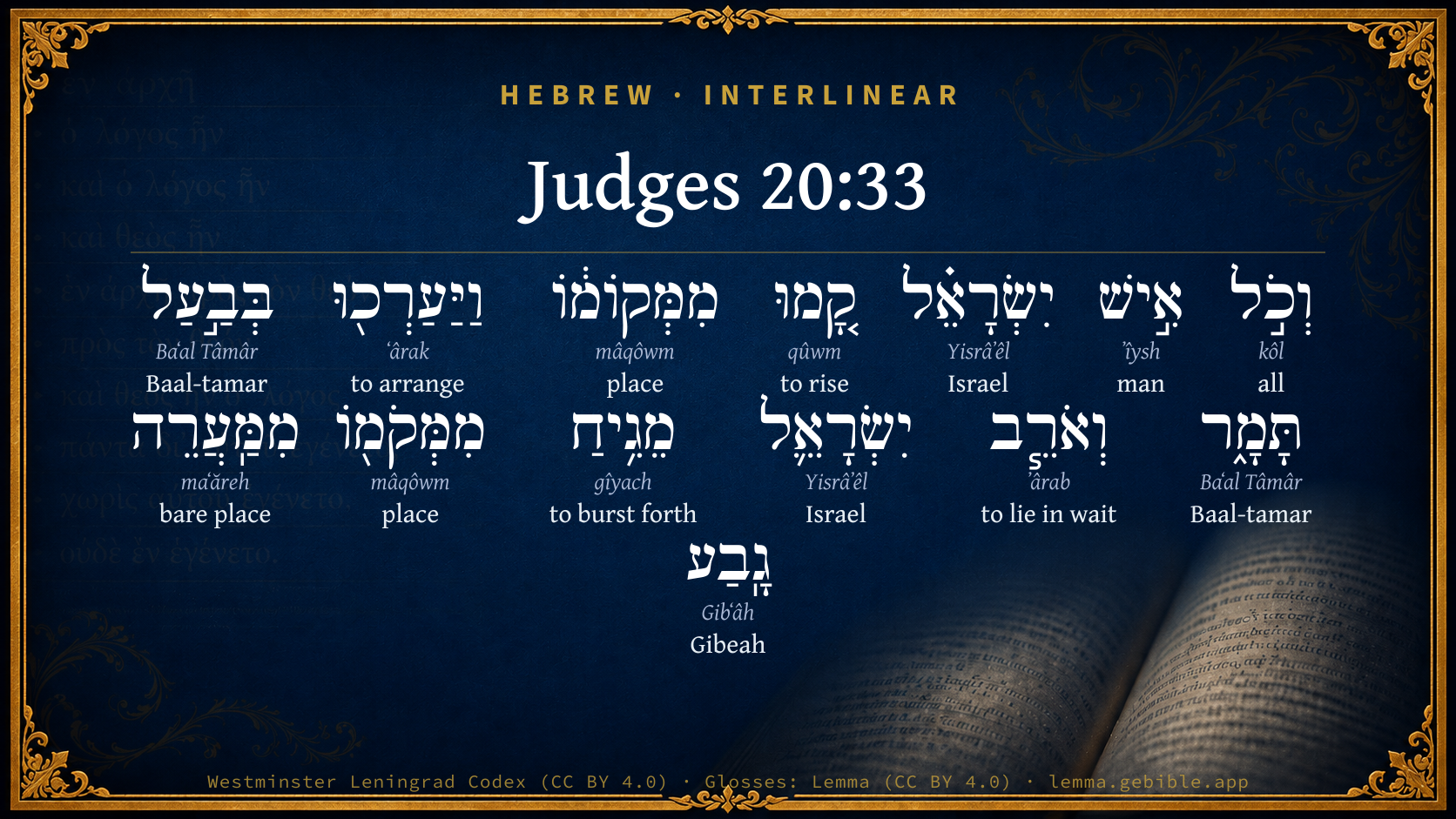
  1. וְכֹ֣ל kôl H3605 “and · all of” Conjunction + Noun, Common, Masculine, Singular, Construct
  2. אִ֣ישׁ ʼîysh H376 “man of” Noun, Common, Masculine, Singular, Construct
  3. יִשְׂרָאֵ֗ל Yisrâʼêl H3478 “Israel” Noun, Proper
  4. קָ֚מוּ qûwm H6965 “to rise” Verb, Qal, Perfect, 3rd Person, Common, Plural
  5. מִמְּקוֹמ֔וֹ mâqôwm H4725 “from · place · his” Preposition + Noun, Common, Masculine, Singular, Construct + Suffix, Personal, 3rd Person, Masculine, Singular
  6. וַיַּעַרְכ֖וּ ʻârak H6186 “and · to arrange” Conjunction + Verb, Qal, Sequential Imperfect, 3rd Person, Masculine, Plural
  7. בְּבַ֣עַל Baʻal Tâmâr H1193 “in/at · Baal-tamar” Preposition + Noun, Proper
  8. תָּמָ֑ר Baʻal Tâmâr H1193 “Baal-tamar” Noun, Proper
  9. וְאֹרֵ֧ב ʼârab H693 “and · lying in wait” Conjunction + Verb, Qal, Participle Active, Masculine, Singular, Construct
  10. יִשְׂרָאֵ֛ל Yisrâʼêl H3478 “Israel” Noun, Proper
  11. מֵגִ֥יחַ gîyach H1518 “bursting forth” Verb, Hiphil, Participle Active, Masculine, Singular, Absolute
  12. מִמְּקֹמ֖וֹ mâqôwm H4725 “from · place · his” Preposition + Noun, Common, Masculine, Singular, Construct + Suffix, Personal, 3rd Person, Masculine, Singular
  13. גָֽבַע Gibʻâh H1390 “Gibeah” Noun, Proper

About this verse

These counts appear in no published source. They are computed here, from the morphology-tagged text and Lemma’s own curated glosses. What Lemma adds →

14
words
11
distinct lemmas
Historical
section

Notable vocabulary

1 hapax legomenon — a word that appears only here in the entire Hebrew Bible:

  • מִמַּֽעֲרֵה bare place H4629

First appearance in Scripture

These words make their first canonical appearance in the Hebrew Bible here:

  • בְּבַ֣עַל Baal-tamar H1193
  • מֵגִ֥יחַ to burst forth H1518
  • מִמַּֽעֲרֵה bare place H4629

Grammatical profile

  • 4 verbs
  • 10 nouns

Verb forms

  • קָ֚מוּ Qal · Perfect
  • וַיַּעַרְכ֖וּ Qal · Sequential Imperfect
  • וְאֹרֵ֧ב Qal · Participle Active
  • מֵגִ֥יחַ Hiphil · Participle Active

Repetition

Words recur within this verse — often emphatic in Hebrew:

  • יִשְׂרָאֵ֗ל Israel H3478 ×2
  • מִמְּקוֹמ֔וֹ place H4725 ×2
  • בְּבַ֣עַל Baal-tamar H1193 ×2

Hebrew & Septuagint length

In English translation the verse runs 35 words from the Hebrew and 28 from the Septuagint (LXX English) — closely comparable.

A rough comparison of the two English renderings, which tokenize alike — not a word-level alignment.

Word counts can differ between the Hebrew and the Greek without any difference in meaning — e.g. the Hebrew direct-object marker אֵת has no separate Greek word, and Greek often adds the article ὁ.

In the original languages it is 14 Hebrew tokens and 23 Greek tokens — but the two are counted differently (Hebrew bundles its prefixes and suffixes into one token; the Greek is in lemma form), so that isn’t a like-for-like length.

Cross-references

1

Topical passages linked to Judges 20:33 in the Treasury of Scripture Knowledge — connected by theme and wording, ordered by reader-vote popularity; previews shown in the World English Bible.

  • Joshua 8:18–22 Yahweh said to Joshua, Stretch out the javelin that is in your hand toward Ai; for I will give it into your hand. Joshua stretched out the javelin that was in his hand toward the city.

Cross-references courtesy of OpenBible.info (CC BY 4.0).

Hebrew and Greek witnesses Masoretic Hebrew ↔ Greek Septuagint

The same verse in the two great witnesses to the Old Testament, shown verse-for-verse.

These are two independent witnesses, not word-aligned to each other, and the Septuagint is shown in lemma (dictionary) form.

Hebrew Judges 20:33 Masoretic · Westminster Leningrad Codex

וְכֹ֣ל אִ֣ישׁ יִשְׂרָאֵ֗ל קָ֚מוּ מִמְּקוֹמ֔וֹ וַיַּעַרְכ֖וּ בְּבַ֣עַל תָּמָ֑ר וְאֹרֵ֧ב יִשְׂרָאֵ֛ל מֵגִ֥יחַ מִמְּקֹמ֖וֹ מִמַּֽעֲרֵה גָֽבַע

All the men of Israel rose up out of their place, and set themselves in array at Baal Tamar: and the liers-in-wait of Israel broke forth out of their place, even out of Maareh Geba.

World English Bible · Public Domain

Greek LXX Judges 20:33 Septuagint · lemma form

καί πᾶς ἀνήρ ἀναἵστημι ἐκ ὁ τόπος αὐτός καί συνἅπτω ἐν βααλθαμαρ καί ὁ ἔνεδρον ἰσραήλ ἐπιἄρχω ἐκ ὁ τόπος αὐτός ἀπό μααραγαβε

And all the men rose up out of their places, and engaged in Baal Thamar; and the liers in wait of Israel advanced from their place from Maraagabe.

LXX2012 (modern English Septuagint) · Public Domain

On this verse, The Cambridge Bible for Schools and Colleges discusses the Septuagint’s reading. Read the note in Commentary ↓

Hebrew: Westminster Leningrad Codex (CC BY 4.0). Greek: Septuagint (public domain); English from LXX2012 (modern English Septuagint) (Public Domain). How the Septuagint differs from the Hebrew →

Targum (Aramaic paraphrase)

1

The Targum is the ancient Jewish Aramaic paraphrase of the Hebrew Scriptures — an interpretive translation, not the Hebrew text itself. Onkelos (literal) and Pseudo-Jonathan (expansive) render the Torah, and Jonathan the Prophets. Coverage is partial: where no permissively-licensed English translation exists for a verse, only the Aramaic is shown. This is verse-level text, not a word-by-word alignment to the Hebrew.

  1. Targum Jonathan Prophets (Joshua–Malachi)
    וְכָל אֱנַשׁ יִשְׂרָאֵל קָמוּ מֵאַתְרֵיהוֹן וְסַדָרוּ קְרָבָא בְּמֵישְׁרֵי יְרִיחוֹ וּכְמָנָא יִשְׂרָאֵל מַגִיחַ מֵאַתְרֵיהּ מִמֵישַׁר גִבְעָתָא:

    (no public-domain English translation for this verse)

    Targum Jonathan — Aramaic: “Mikraot Gedolot” (public domain). English: “Sefaria Community Translation” (CC0 1.0 (public-domain dedication)); “London "Chaldee Paraphrase," 1871” (public domain). Text via Sefaria.

Commentary

Notes on Judges 20:33 from classic Christian and Jewish commentators (each source and its license shown beneath its notes). The classic Christian expositions comment on the surrounding passage and are grouped to its opening verse, so a note may address several verses; the Jewish commentaries on the Tanakh (Rashi and others) are per-verse, so they appear only where the commentator wrote on this verse.

Lemma curates 59 commentaries, every one of them public domain or Creative Commons licensed, each selected and text-cleaned for this edition rather than reprinted as found. About our sources →

The Cambridge Bible for Schools and Colleges

gen. ed. J. J. S. Perowne

33. rose up … set themselves in array] The Israelites had taken up their position opposite Gibeah and then retired northwards (Jdg_20:30-32); now, apparently, after the feigned retreat they take up a second position at a further distance from Gibeah. But this is hardly the natural meaning of the words; rose up implies a new action (e.g. Jdg_20:19) rather than the repetition of a movement which had already begun. It is in fact difficult to fit Jdg_20:33 a into the context. May it then come from the A narrative, and form the sequel of Jdg_20:29? This would give us an allusion to the battle, which otherwise is missing from A: after the ambush was set round Gibeah (Jdg_20:29), the main army of Israel took up its position in Baal-tamar (Jdg_20:33 a). But the language of the verse does not inspire confidence in its originality (lit. the men of Israel rose up from his place!); on the other hand the mention of Baal-tamar may well be ancient. Perhaps we may describe this half-verse as an early addition. See further below.

Baal-tamar] Site unknown, but not far from Gibeah; Eusebius (OS 238, 75) declares that the name was surviving in the locality as Beth-tamar. Baal-tamar = B. of the palm-tree, a rare instance of the god Baal being associated with a tree; cf. Jer_2:27[63]. The palm was a symbol of Ashtoreth rather than of Baal.

[63] See Baudissin, Adonis u. Esmun (1911), p. 176. Winckler interprets differently, Baal is Tamar, i.e. Ishtar-Ashtoreth, the local deity possessing the attributes of god and goddess: Gesch. Israels ii. 98 ff.

brake forth] Elsewhere of the sea or a river, Job_38:8; Job_40:23, Eze_32:2; from the same root comes the name of the fountain at Jerusalem, Gihon the gusher. So here, of the Hers in wait bursting forth from ambush; as applied in this way to warfare the word is used in Aramaic. Cf. the parallel account from A in Jdg_20:37.

Maareh-geba] Supposed to mean the bare or open space of G., but probably a mistake for maarâb legeba, i.e. west of Geba, LXX. cod. A and mss., Vulgate; a late usage, 2Ch_32:30; 2Ch_33:14. Geba is either a mistake for Gibeah (as in Jdg_20:10), or more probably = Jeba‘, N.E. of Gibeah.

The Cambridge Bible for Schools and Colleges (gen. ed. J. J. S. Perowne; Cambridge University Press, 1878–1918) — public domain. Text from a community e-Sword module.

Trapp's Complete Commentary

John Trapp

Jdg 20:33 And all the men of Israel rose up out of their place, and put themselves in array at Baaltamar: and the liers in wait of Israel came forth out of their places, [even] out of the meadows of Gibeah.

Ver. 33. Out of the meadows.] Or, Dens, as Pagnine and others render it.

John Trapp, A Commentary or Exposition upon All the Books of the Old and New Testament (1647–1656) — public domain. Text from a community e-Sword module.

Jamieson, Fausset & Brown

Robert Jamieson, A. R. Fausset & David Brown

Baal-tamar--a palm-grove, where Baal was worshipped. The main army of the confederate tribes was drawn up there.

out of the meadows of Gibeah--Hebrew, "the caves of Gibeah"; a hill in which the ambuscades lay hid.

Jamieson, Fausset & Brown — Commentary Critical and Explanatory on the Whole Bible (1871) — public domain (CC PDM 1.0). Text via the HelloAO Bible API.

Adam Clarke's Commentary

Verse 33. Put themselves in array at Baal-tamar] The Israelites seem to have divided their army into three divisions; one was at Baal-tamar, a second behind the city in ambush, and the third skirmished with the Benjamites before Gibeah.

Adam Clarke's Commentary on the Bible (1810–1826) — public domain. Text from a community e-Sword/MySword module.

Ellicott's Commentary for English Readers

(33) Put themselves in array at Baal-tamar.—This is either a detail added out of place (so that we might almost suppose that there has been some accidental transposition of clauses), or it means that when the Israelites in their pretended rout had got as far as Baal-tamar (“Lord of the Palm”) they saw the appointed smoke-signal of the ambuscade, and at that point rallied against their pursuers. What makes this probable is that Baal-tamar can only have derived its name from some famous, and therefore isolated, palm-tree. Now there was exactly such a palm tree—the well known “Palm of Deborah” (see Note on Jdg_4:5)—“between Ramah and Bethel,” and therefore at a little distance from the spot where the roads branch. The place was still called Bathamar in the days of Eusebius and Jerome. The Chaldee rendering, “in the plains of Jericho” (“the palm city,” Jdg_1:16), is singularly erroneous.

Out of the meadows of Gibeah.—The word maareh, rendered “meadows,” occurs nowhere else. Some derive it from arah, “to strip.” The LXX., not understanding it, render it as a name, Maraagabe, and in Cod. A (following a different reading), “from the west of Gibeah,” as also does the Vulg. Rashi renders it, “because of the stripping of Gibeah,” and Buxtorf, “after the stripping of Gibeah.” It is, however, clear that the words are in apposition to and in explanation of “out of their places:” The Syriac and Arabic understand maareh to mean “a cave” or “caves,” printing it maarah instead of maareh. Similarly the reading “from the west” only involves the change of a single letter (maarab). If the text be left unaltered, the “meadows” may have been concealed from the town by intervening rocks. In Isa_19:7 aroth mean “pastures.”

A Bible Commentary for English Readers, edited by Charles John Ellicott (1878–1897) — public domain. Text from a community e-Sword module.

John Gill's Exposition

And there came against Gibeah ten thousand chosen men out of all Israel,.... Which, according to Ben Gersom, were the liers in wait; and came from the south, as the Targum says:

and the battle was sore; not between those liers in wait, and the Benjaminites, but between those at Baaltamar, and them who set themselves in battle array against them, and they fought stoutly on both sides:

but they knew not that evil was near them; that there was an ambush laid, by which they were in great danger; they knew nothing of the 10,000 men that were now come out against Gibeah, and were between them and that.

John Gill's Exposition of the Whole Bible (1746–1763) — public domain (CC PDM 1.0). Text via the HelloAO Bible API.

Albert Barnes' Notes on the Bible

Baal-tamar is only mentioned here. It took its name from some palm-tree that grew there; perhaps the same as the “palm-tree of Deborah, between Ramah and Bethel” Jdg 4:5, the exact locality here indicated, since “the highway” Jdg 20:31 along which the Israelites enticed the Benjamites to pursue them, leads straight to Ramah, which lay only a mile beyond the point where the two ways branch off.

The meadows of Gibeah - The word rendered “meadow” is only found here. According to its etymology, it ought to mean a “bare open place”, which is particularly unsuitable for an ambush. However, by a change in the vowel-points, without any alteration in the letters, it becomes the common word for “a cavern”.

Albert Barnes' Notes on the Bible (1834–1885) — public domain. Text from a community e-Sword/MySword module.

Haydock's Catholic Bible Commentary

Baalthamar, the plain of Jericho; (Chaldean) or rather a village in the vicinity of Gabaa, which Eusebius calls Besthamar.

George Leo Haydock (1774–1849), Haydock's Catholic Family Bible and Commentary, 1859 edition — public domain. Excludes Psalms (Douay-Rheims chapter numbering differs from Protestant) and Deuterocanonical books (Catholic canon only).

Matthew Poole's English Annotations

Out of their place; where they had disposed themselves, that they might fall upon the Benjamites, when they were drawn forth to a sufficient distance from their city, and when they were pursuing that party, mentioned Jdg 20:30.

Came forth out of their places, to execute what was agreed upon, even to take Gibeah, and burn it, as they actually did, Jdg 20:37.

Matthew Poole's English Annotations on the Holy Bible (1683–1685) — public domain. Text from a community e-Sword/MySword module.

Whedon's Commentary on the Bible

Daniel D. Whedon

33. All the men of Israel rose up out of their place — These were the main forces of the army, while those mentioned in Jdg_20:30 were probably a lesser body of men, several thousand, perhaps, whose object was to draw the Benjamites off from Gibeah. When they fled and the Benjamites pursued them, then this vast army, called all the men of Israel because they comprised the vast majority of the Israelitish warriors, rose up and marched to action.

Baal-tamar — A place near Gibeah, mentioned also by Eusebius, but not now known.

Meadows of Gibeah — Some interpreters, after the Septuagint, take the Hebrew words Maareh gaba as a proper name; others, after the Syriac, render it cave of Geba. These renderings come from the idea that a meadow or plain would be unsuitable for an ambush; but the plain around Gibeah may have afforded numerous hiding places; and then, as Keil well says, “There is no necessity to understand the words as signifying that the treeless country formed the actual hiding-place of the ambush; but that when the men broke from their hiding-place, they came from the treeless land toward the town.”

Daniel D. Whedon (gen. ed.), Commentary on the Old and New Testaments (1874–1909) — public domain. Text from a community e-Sword module.

The Pulpit Commentary

Rose up out of their place. The narrative is singularly obscure and broken, and difficult to follow. But the meaning seems to be, that when the Israelite army had reached Baal-tamar in their flight, they suddenly stopped and formed to give battle to the pursuing Benjamites. And at the same time the liers in wait came out from their ambushment and placed themselves in the rear of the Benjamites on the direct road to Gibeah. Baal-tamar, a place of palm trees. The site has not been identified, but may possibly, or probably, be the same as the palm tree of Deborah, between Ramah and Bethel. (Jud_1:4:5) The meadows of Gibeah, Hebrew, Maareh-Geba, may very likely have been, as the Septuagint takes it, a proper name, denoting some locality outside Gibeah (here called Geba) where the ambush was concealed. The meaning of the word maareh is thought to be a bare tract of ground without trees something like a heath or common. It may have had pits, or deep depressions, where the ambush would be hid both from the city itself and from the high road, or other facilities for concealment.

The Pulpit Commentary (1880–1919), ed. H.D.M. Spence-Jones & Joseph S. Exell — public domain. Text from a community e-Sword module.

Rashi

Rabbi Shlomo Yitzchaki (Rashi)

Baal Tamar. The plain of Yericho.

Poured. Extended themselves, as in "He shall draw the Yardein into his mouth," "You drew me from the womb."

Maareh Gev'ah. From a narrow pass, the "nakedness," nakedness. or exposed overlook of Givas Binyomin; its uncovered part from which it was defenseless against conquest, as in, "You have come to gaze at the nakedness of the land."

Rashi on the Tanakh — English translations: “The Judaica Press complete Tanach with Rashi, translated by A. J. Rosenberg” (CC BY 4.0); “Pentateuch with Rashi's commentary by M. Rosenbaum and A.M. Silbermann, 1929-1934” (public domain); “The Metsudah Tanach series, Lakewood, N.J” (CC BY 4.0); and “The Book of Joshua, Metsudah Publications, 1997” (CC BY 4.0). Text via Sefaria.

Lesson kit

Teaching starters — assembled from the data on this page, not authored interpretation. Every prompt links to the verse data it draws on. Edit before teaching.

Judges, in the Historical, opens this verse with 14 words (11 distinct Hebrew lemmas). Its most distinctive word is maʻăreh (“bare place”). A historical commentator’s framing appears above. Read the whole chapter for the surrounding context.

Discussion questions

  1. The word maʻăreh carries the sense “bare place.” How does it shape the verse?
  2. This verse holds 1 word here found nowhere else in the Hebrew Bible. What might the rare word draw attention to?
  3. 3 words here appear for the first time in Scripture. What is being introduced at this debut?
  4. Joshua 8:18–22 shares this passage’s theme. How do the two illuminate each other?
  5. “Israel” occurs 2× in this one verse. What is the effect of the repetition?
  6. These translations render this verse differently. What is at stake in choosing one wording over another?
  7. The verb «קָ֚מוּ» is Qal Perfect. How does its form color the action?
  8. Reading how The Cambridge Bible for Schools and Colleges and Trapp's Complete Commentary read this verse, where do the two commentators agree and where do they part?

Things to notice

  • 1 word in this verse appears nowhere else in the Hebrew Bible.
  • 3 words make their first canonical appearance in Scripture here.
  • This verse counts 14 Hebrew ↔ 23 Greek words.
  • These translations choose different wording for 30 words in this verse.
  • “Israel” occurs 2× in this single verse.

Reading settings

Reading text

Shown beneath each verse's original-language words.

Old Testament
Old Testament edition

Read the OT as the Masoretic Hebrew (MT) or the Greek Septuagint (LXX).

English shown for the Greek Septuagint (in the Hebrew ↔ Greek comparison).

Comparing translations? Open the Compare panel on any verse page to stack up to four side by side.