
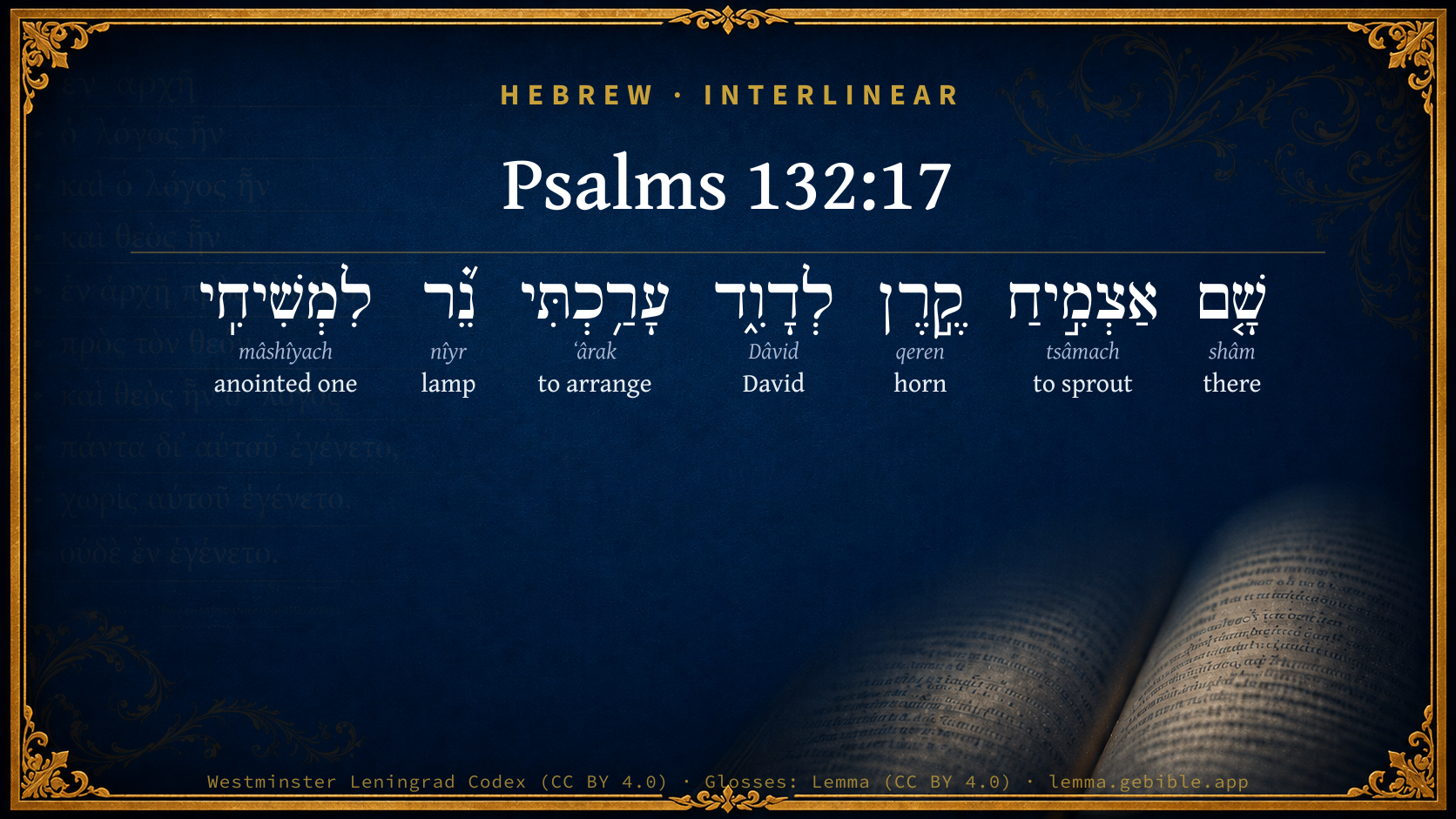
Psalms 132:17

Hebrew (Westminster Leningrad Codex) Psalms 132:17 appears in the Hebrew Old Testament. The text above is from the Westminster Leningrad Codex. Each word links to its Strong’s number, a concise gloss, and parsing drawn from the Open Scriptures Hebrew Bible morphology. Click any word for its full Brown-Driver-Briggs (BDB) entry.
Download image
Cite this verse

Psalms 132:17 (World English Bible). Public Domain. Lemma interlinear Bible study tool, https://lemma.gebible.app/v/psalms/132/17.

Show BibTeX & RIS
BibTeX
RIS
English Translation
There I will make the horn of David to bud. I have ordained a lamp for my anointed.
World English Bible · Public Domain
Download a study sheet

One document with this verse’s original text, its word-by-word gloss line, the meaning frame, cross-references with their text, attributed commentary, and full source and license credits — printable, and it pastes into notes with its structure intact.

This verse Autodidact and up

Study sheet (.html) Plain text (.txt)

A passage Seminary Student

Up to 50 verses in one chapter. A passage sheet keeps up to 6 commentary sources and 12 cross-references per verse, in the order this page ranks them, and says so on the sheet whenever that leaves anything out. Ask for a single verse and you get the Autodidact verse sheet above.

Everything on this page stays free to read, with no account — the sheet is a download of what is already on screen, not access to it.

Want to remove ads? Support Godless Engineer
Compare translations 3

The same verse in 3 English versions, stacked beneath the original-language interlinear above. Click any original word for its lexicon entry.

Each is an independent rendering of the whole verse — the interlinear is not word-aligned to these translations.

Highlighted words mark where these versions differ — a whole-verse word diff, not a word-by-word alignment.

  • World English Bible Public Domain
    There I will make the horn of David to bud. I have ordained a lamp for my anointed.
  • King James Version Public Domain
    There will I make the horn of David to bud: I have ordained a lamp for mine anointed.
  • unfoldingWord Literal Text CC BY-SA 4.0
    There I will make a horn sprout for David; I have arranged a lamp for my anointed one.

unfoldingWord Literal Text — © unfoldingWord, licensed CC BY-SA 4.0. Word-aligned USFM3 via Door43 (git.door43.org/unfoldingWord/en_ult).

Versions to compare (up to 4)

3 of 4 selected

Show all 17 translations

Every available English version of this verse, each an independent rendering of the whole verse.

  • World English Bible Public Domain
    There I will make the horn of David to bud. I have ordained a lamp for my anointed.
  • Berean Standard Bible Public Domain
    There I will make a horn grow for David; I have prepared a lamp for My anointed one.
  • Majority Standard Bible Public Domain
    There I will make a horn grow for David; I have prepared a lamp for My anointed one.
  • King James Version Public Domain
    There will I make the horn of David to bud: I have ordained a lamp for mine anointed.
  • American Standard Version (1901) Public Domain
    There will I make the horn of David to bud: I have ordained a lamp for mine anointed.
  • Revised Version (1885) Public Domain
    There will I make the horn of David to bud: I have ordained a lamp for mine anointed.
  • Geneva Bible (1599) Public Domain
    There will I make the horne of Dauid to bud: for I haue ordeined a light for mine Anoynted.
  • Young's Literal Translation Public Domain
    There I cause to spring up a horn for David, I have arranged a lamp for Mine anointed.
  • Literal Standard Version CC BY-SA 4.0
    There I cause a horn to spring up for David, || I have arranged a lamp for My Anointed.
  • Unlocked Literal Bible CC BY-SA 4.0
    There I will make a horn to sprout for David and set up a lamp for my anointed one.
  • unfoldingWord Literal Text CC BY-SA 4.0
    There I will make a horn sprout for David; I have arranged a lamp for my anointed one.
  • Darby Bible Public Domain
    There will I cause the horn of David to bud forth; I have ordained a lamp for mine anointed.
  • World Messianic Bible Public Domain
    I will make the horn of David to bud there. I have ordained a lamp for my anointed.
  • Webster's Bible Public Domain
    There will I make the horn of David to bud, I have ordained a lamp for my anointed.
  • Free Bible Version CC BY-SA 4.0
    I will make the line of David even more powerful. I have prepared a lamp for my chosen king.
  • Bible in Basic English Public Domain
    There I will make the horn of David fertile: I have made ready a light for my king.
  • JPS Tanakh (1917) Public Domain
    There will I make a horn to shoot up unto David, there have I ordered a lamp for Mine anointed.

Literal Standard Version (2020), Covenant Press — licensed CC BY-SA 4.0. Text via the HelloAO Bible API (eBible.org). Unlocked Literal Bible (unfoldingWord) — licensed CC BY-SA 4.0. Text via the HelloAO Bible API (eBible.org). unfoldingWord Literal Text — © unfoldingWord, licensed CC BY-SA 4.0. Word-aligned USFM3 via Door43 (git.door43.org/unfoldingWord/en_ult). Free Bible Version, Dr. Jonathan Gallagher — licensed CC BY-SA 4.0. Text via the HelloAO Bible API (eBible.org).

Word by word

More ways to search: Search by grammar → Find every occurrence → Compare this word →

Practice this passage: Drill this verse → Learn its vocabulary →

About this verse

These counts appear in no published source. They are computed here, from the morphology-tagged text and Lemma’s own curated glosses. What Lemma adds →

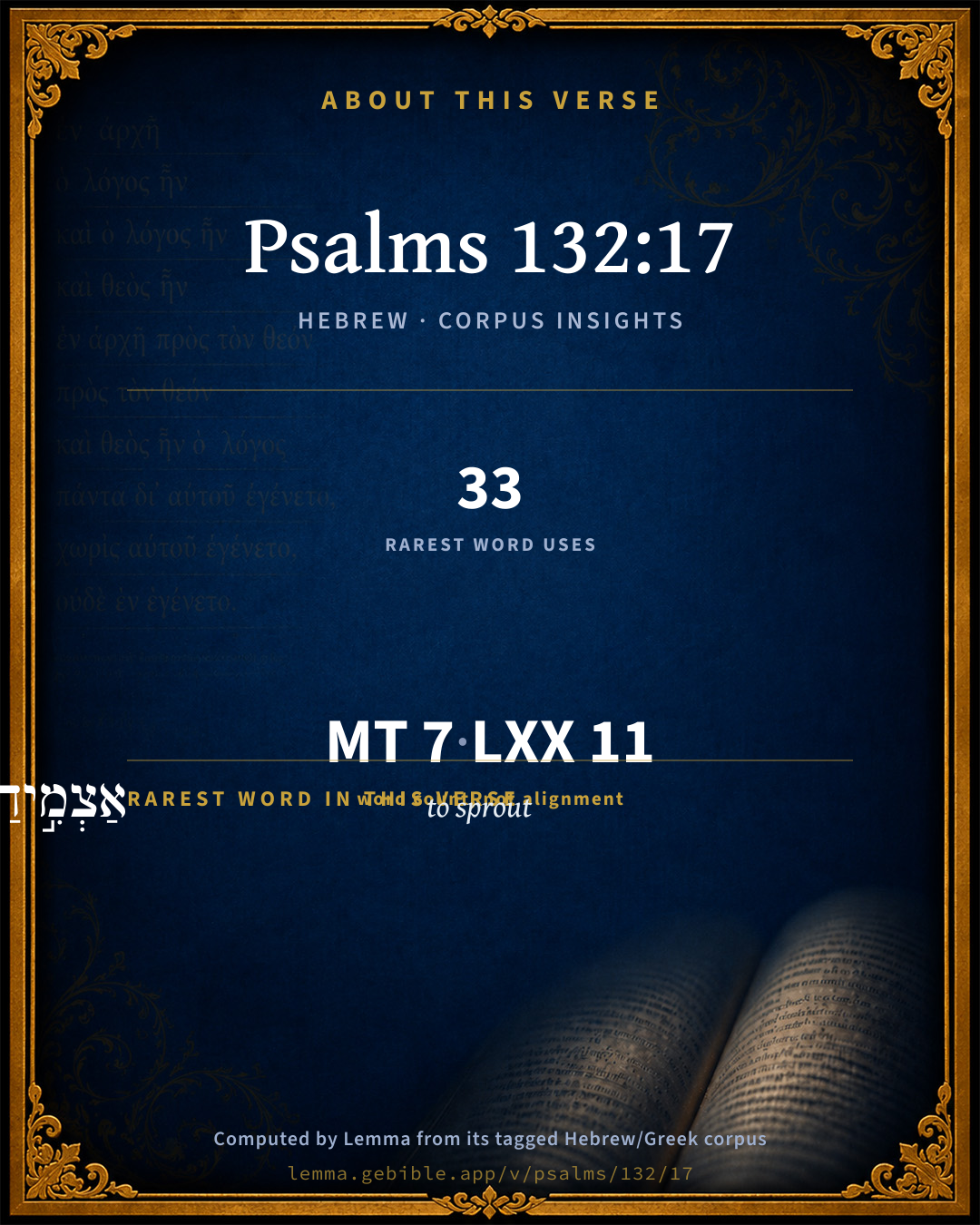
7
words
7
distinct lemmas
Wisdom
section

Shared distinctive vocabulary

אַצְמִ֣יחַ to sprout H6779 occurs in 32 verses of the Hebrew Bible. Also found in:

Grammatical profile

  • 2 verbs
  • 4 nouns
  • 1 adverb

Verb forms

  • אַצְמִ֣יחַ Hiphil · Imperfect
  • עָרַ֥כְתִּי Qal · Perfect

Hebrew & Septuagint length

In English translation the verse runs 18 words from the Hebrew and 19 from the Septuagint (LXX English) — closely comparable.

A rough comparison of the two English renderings, which tokenize alike — not a word-level alignment.

Word counts can differ between the Hebrew and the Greek without any difference in meaning — e.g. the Hebrew direct-object marker אֵת has no separate Greek word, and Greek often adds the article ὁ.

In the original languages it is 7 Hebrew tokens and 11 Greek tokens — but the two are counted differently (Hebrew bundles its prefixes and suffixes into one token; the Greek is in lemma form), so that isn’t a like-for-like length.

Cross-references

9

Topical passages linked to Psalms 132:17 in the Treasury of Scripture Knowledge — connected by theme and wording, ordered by reader-vote popularity; previews shown in the World English Bible.

  • Luke 1:69 And has raised up a horn of salvation for us in the house of his servant David
  • Ezekiel 29:21 In that day will I cause a horn to bud forth to the house of Israel, and I will give you the opening of the mouth in the midst of them; and they shall know that I am Yahweh.
  • 2 Chronicles 21:7 However Yahweh would not destroy the house of David, because of the covenant that he had made with David, and as he promised to give a lamp to him and to his children always.
  • 1 Kings 11:36 To his son will I give one tribe, that David my servant may have a lamp always before me in Jerusalem, the city which I have chosen me to put my name there.
  • 1 Kings 15:4 Nevertheless for David's sake did Yahweh his God give him a lamp in Jerusalem, to set up his son after him, and to establish Jerusalem;
  • Psalms 92:10 But you have exalted my horn like that of the wild ox. I am anointed with fresh oil.
  • 2 Kings 8:19 However Yahweh would not destroy Judah, for David his servant's sake, as he promised him to give to him a lamp for his children always.
  • Psalms 148:14 He has lifted up the horn of his people, The praise of all his saints; Even of the children of Israel, a people near to him. Praise Yah!

Cross-references courtesy of OpenBible.info (CC BY 4.0).

Hebrew and Greek witnesses Masoretic Hebrew ↔ Greek Septuagint

The same verse in the two great witnesses to the Old Testament, shown verse-for-verse.

You’re reading Greek Psalm 131 (Hebrew Psalm 132). The Septuagint counts the superscription, so verse numbers can differ from the Hebrew — chapter-level alignment, not verse-by-verse. Numbering follows Rahlfs.

These are two independent witnesses, not word-aligned to each other, and the Septuagint is shown in lemma (dictionary) form.

Hebrew Psalms 132:17 Masoretic · Westminster Leningrad Codex

שָׁ֤ם אַצְמִ֣יחַ קֶ֣רֶן לְדָוִ֑ד עָרַ֥כְתִּי נֵ֝֗ר לִמְשִׁיחִֽי

There I will make the horn of David to bud. I have ordained a lamp for my anointed.

World English Bible · Public Domain

Greek LXX Greek Psalm 131:17 Septuagint · lemma form

ἐκεῖ ἐκ ἀνατέλλω κέρας ὁ δαυίδ ἑτοιμάζω λύχνος ὁ χριστός ἐγώ

There will I cause to spring up a horn to David: I have prepared a lamp for my anointed.

LXX2012 (modern English Septuagint) · Public Domain

Hebrew: Westminster Leningrad Codex (CC BY 4.0). Greek: Septuagint (public domain); English from LXX2012 (modern English Septuagint) (Public Domain). How the Septuagint differs from the Hebrew →

Commentary

Notes on Psalms 132:17 from classic Christian and Jewish commentators (each source and its license shown beneath its notes). The classic Christian expositions comment on the surrounding passage and are grouped to its opening verse, so a note may address several verses; the Jewish commentaries on the Tanakh (Rashi and others) are per-verse, so they appear only where the commentator wrote on this verse.

Lemma curates 59 commentaries, every one of them public domain or Creative Commons licensed, each selected and text-cleaned for this edition rather than reprinted as found. About our sources →

Trapp's Complete Commentary

John Trapp

Psa 132:17 There will I make the horn of David to bud: I have ordained a lamp for mine anointed.

Ver. 17. There will I make the horn of David to bud] A metaphor from those living creatures, quorum ramosa sunt cornua, which have snags in their heads (as deer have), which are unto them instead of boughs. For "horn," some read beam of David. Confer Luk 1:78.

I have ordained a lamp] i.e. A successor ( - cui lampada tradat), and that a glorious one at length, Christ, who is αυτοφως, light essential, Joh 12:46. Of Ascanius the son of Aeneas, and likewise of Tullus Hostilius, it is reported, that light flames were seen about their heads when they lay in their cradles; and that thereby was foresignified that they should be kings.

John Trapp, A Commentary or Exposition upon All the Books of the Old and New Testament (1647–1656) — public domain. Text from a community e-Sword module.

The Biblical Illustrator

Joseph S. Exell

Psa_132:17

I have ordained a lamp for Mine anointed.

A lamp ordained for Gods anointed

I. Christ as Gods anointed,

1. He is a Redeemer and Saviour of Gods choosing.

2. Called and sent of God.

3. Prophet, Priest, and King of His Church.

4. Thoroughly fitted and furnished for His work, by an unmeasurable effusion of the Holy Spirit.

II. The lamp that God has ordained.

1. This lamp was first set up in the purpose of God from eternity, or in the council of peace, when the whole plan of salvation through Christ was laid.

2. This lamp was first lighted in this louver world, immediately after the fall in paradise; when a dark and dismal night of woe and misery was spreading itself over our first parents, then a gleam of light began to break out in the first promise (Gen_3:15): and afterwards unto Abraham (Gen_22:18).

3. The lamp of the Gospel shone typically and prophetically during all the Old Testament period, before the coming of Christ in the flesh. It shone, as it were, under a veil, and only among the Jews.

4. After the coming of Christ in the flesh, and His resurrection and ascension into heaven, the lamp of Gospel light was brightened, and the light of it was made more general and extensive. The veil of types, ceremonies, and prophecies, was rent, and, by the commandment of the everlasting God, carried unto all nations for the obedience of faith, Christ being given of God for (Act_13:47).

5. Ministers of the Gospel are, as it were, the lamp bearers. They are commissioned by Christ, to preach the Gospel, to teach all nations.

III. The ordination of this lamp.

1. God has ordained the places and parts of the world where it shall be set up and shine (Rom_11:33).

2. As He ordained the places where the lamp shall be set up, so He ordained how long it should shine, before it be lifted to another part of the earth. He ordained how long it should shine among the Jews, viz. until Christ came. He ordained how long it should shine in the Churches of Asia, before He came and removed His candlestick. He has ordained how long the Gospel and a faithful ministry shall stay in any parish or congregation also.

3. He has ordained what souls or persons shall be converted, edified, or built up, by the Gospel: when He sends it unto any nation or congregation of Zion (that is, the place where the Gospel-lamp is set up), it shall be said this man and that man was born there, etc.

4. He ordains by what instrument or minister the Gospel-lamp shall be brought unto a people or particular person. Paul is ordained for the Gentiles, Peter for the Jews, and every one of the apostles and other ministers, led by the ruling hand of the sovereign Lord, to labour in this, or that, or the other spot of His vineyard.

5. He ordains what fruit and success a minister with his lamp shall have, what number of souls shall be edified, and who shall be hardened and blinded by His light. (E. Erskine.)

A lamp for Gods anointed

I. Gods anointed (Psa_45:7).

1. He was chosen to be Gods anointed (Isa_42:1).

2. He was called and sent by God (Isa_42:6).

3. His investiture in His offices (Isa_42:7).

4. Fulness of grace for His great work (Col_1:19).

II. The lamp ordained for Gods anointed.

1. Some of its discoveries.

(1) It shows a trinity of persons in the Godhead (1Jn_5:7).

(2) It reveals the everlasting counsel (2Sa_23:5).

(3) It demonstrates the mystery of the incarnation (2Co_5:19).

(4) It discovers the doctrine of substitution (Psa_89:19).

(5) It shines into the grave, and shows Christs resurrection and ours (Heb_7:25).

(6) Its light shows mans darkness and salvation (Psa_119:104).

2. Some of its properties.

(1) It is a lamp of Divine formation (2Ti_3:16-17).

(2) It is a dazzling brightness that this lamp sheds (Joh_9:39).

(3) It has an assimilating power (Joh_15:3).

(4) It is a profitable lamp (Psa_119:105).

(5) It is a lamp of general use (Luk_2:10).

(6) It is an ancient lamp (Jer_6:16).

(7) It is a durable lamp (Psa_119:89).

III. The reasons why God has ordained it.

1. To the honour of His Son Jesus Christ (Joh_5:39).

2. To perpetuate His name to all ages (Rom_9:17).

3. For the gathering of His people (Isa_55:11). (T. B. Baker, M. A.)

The Biblical Illustrator, edited by Joseph S. Exell (c. 1880s–1900s) — public domain. Text from a community e-Sword module.

Joseph Benson's Commentary

Psa 132:17-18. There — In Jerusalem, the seat of the kingdom, and the only place of my presence and worship in the world; will I make the horn of David to bud — His power and glory to flourish and increase, and to descend to his posterity. I have ordained a lamp for mine anointed — A successor or succession to continue in his family, as this phrase is expounded 1Ki 11:36; 1Ki 15:4; where see the notes; and particularly one eminent and glorious light, namely, the Messiah, who shall descend from him, and revive, and greatly enlarge his kingdom.

His enemies — That have formed designs against him; will I clothe with shame — When they shall see all their designs baffled, and their vain hopes disappointed; but upon himself — Upon him and his posterity, shall his crown flourish — That is, his government shall be established and enlarged, and shall be more and more to his honour. This prediction was to have its full accomplishment in Jesus Christ, whose crown of honour and power shall never fade, nor the flowers of it wither. The crowns of earthly princes continue only for a short time; but Christ’s crown shall endure to all eternity, and the crowns reserved for his faithful subjects are such as fade not away.

Joseph Benson's Commentary on the Old and New Testaments (1811–1818) — public domain. Text from a community e-Sword module.

J. A. Alexander on Psalms

Joseph Addison Alexander

17. (Psa 132:17) There will I make to bud a horn for David; I have trimmed a lamp for mine Anointed. These are common figures in the Scripture for strength and prosperity. See above, on Psa 18:10; Psa 18:28; Psa 89:17; Psa 92:11, and compare 1Sa 2:1, 2Sa 21:17, Eze 29:21. The last clause contains an allusion to the law, which cannot be preserved in any version. The word translated lamp is used to designate the several burners of the golden candlestick (Exo 25:37; Exo 35:14; Exo 37:23; Exo 39:37), and the verb here joined with it is the one applied to the ordering or tending of the sacred lights by the priests (Exo 27:21, Lev 24:3). The meaning of the whole verse is, that the promises of old made to David and to Zion should be yet fulfilled, however dark and inauspicious present appearances.

Joseph Addison Alexander, The Psalms Translated and Explained (1850) — public domain. Text from a community e-Sword module.

Tyndale Open Study Notes

Tyndale Open Resources

132:17 anointed one: The ruler God chose and established (see Pss 1–8) would never cease to provide light for the Lord’s people. This light would burn continually (see 1 Kgs 11:36; 2 Kgs 8:19; cp. John 8:12; Rev 21:23-24).

Tyndale Open Study Notes — © Tyndale Open Resources, licensed CC BY-SA 4.0. Text via the HelloAO Bible API.

Geneva Bible (1599)

Geneva Bible translators

Though his force for a time seemed to be broken, yet he promiseth to restore it.

Geneva Bible (1599) marginal notes — public domain. Text via Bolls.life.

Adam Clarke's Commentary

Verse 17. There will I make the horn of David to bud] There, in the Christian Church, the power and authority of the spiritual David shall appear.

I have ordained a lamp] I have taken care to secure a posterity, to which the promises shall be expressly fulfilled.

Adam Clarke's Commentary on the Bible (1810–1826) — public domain. Text from a community e-Sword/MySword module.

John Calvin's Commentaries

17. There will I make, etc. He reverts to the state of the kingdom, which God had promised to take under his care and protection. It is necessary that we should attend to the peculiar force of the words employed — I will make the horn of David to bud Now there can be no doubt as to the meaning of the term horn, which in Hebrew is very commonly used to signify force or power; but we are to mark that by the horn budding there is an allusion to the humble original of the kingdom, and the singular restorations which it underwent. David was taken from the menial drudgery of the sheepfold, and from the lowly cottage where he dwelt, the youngest son of his father, who was no more than an ordinary shepherd, and was advanced to the throne, and rose by a series of unlooked for successes. Under Jeroboam the kingdom was at an early period so effectually cut down again, that it was only by budding forth from time to time that it maintained itself in a moderate degree of advancement. Afterwards it underwent various shocks, which must have issued in its destruction, had it not still budded anew. And when the people were dispersed in the captivity, what must have become of them, had not God made the broken and trampled horn of David, again to bud? Isaiah accordingly seems to have had this in his eye when he compared Christ to a rod which should spring not from tree in full growth, but from a trunk or stem. (Isaiah 11:1.) To the prophecy now before us Zechariah perhaps refers when he says, “Behold the man whose name is the Branch,” (Zechariah 6:12,) intimating that in this way only could the power and dignity of the kingdom be restored after the dismemberment and ravages to which it had been exposed. In 2 Samuel 23:5, David makes use of the word employed in the verse before us, but in somewhat a different sense, referring to the continual advancement of the kingdom unto further measures of prosperity. Here the inspired penman rather refers to the singular manner in which God would cause the horn of David to revive again, when at any time it might seem broken and withered. The figure of the lamp is much to the same effect, and occurs in many other places of Scripture, being a prophecy very generally in the mouths of the people. The meaning is, that the kingdom, though it underwent occasional obscurations, would never be wholly extinguished under the calamities which overtook it, being as the lamp of God constantly burning, and pointing out safety to the Lord’s people, though not shining to a great distance. At that time all the illumination enjoyed was but the feeble lamp which shone in Jerusalem; now Christ, the sun of righteousness, sheds a full radiance all over the world.

John Calvin's Commentaries (1540-1563) — public domain. Text from the Calvin Translation Society English edition (1840s-50s) via the Christian Classics Ethereal Library (ccel.org). Calvin's coverage is partial (roughly two-thirds of the Bible); uncommented books and verses are honest gaps, never fabricated. The 19th-century editor's footnotes and remarks are omitted so the notes are faithfully Calvin's own voice.

Ellicott's Commentary for English Readers

(17) Horn of David.—The sprouting or growing horn is an image of young, vigorous life. (See Note, Psa_75:5.) The Messianic application of this prediction comes out in Zechariah’s song (Luk_1:69).

I have ordained a lamp.—Or, I have trimmed a lamp; the word used in connection with the sacred lights, under the express charge of Aaron and his sons (Exo_27:21; Lev_24:2-3). But with this distinctly sacerdotal allusion we must also combine the special allusion to the Davidic dynasty, according to the promise (1Ki_11:36): “That David my servant may have a light (or, lamp, as here) always before me in Jerusalem.”

A Bible Commentary for English Readers, edited by Charles John Ellicott (1878–1897) — public domain. Text from a community e-Sword module.

The Cambridge Bible for Schools and Colleges

gen. ed. J. J. S. Perowne

17. There] In Jerusalem.

will I make the horn of David to bud] More exactly, will I make a horn sprout forth for David. The figure may mean simply, that Jehovah will restore the prosperity and victorious might of the house of David (cp. Psa_89:17; Psa_89:24; Eze_29:21). The verb sprout however suggests a reference to the prophecies of Jer_23:5; Jer_33:15; Zec_3:8; Zec_6:12, where tsemach, ‘sprout,’ is used as a title of the Messianic king, while in Dan_7:7-8; Dan_7:24; Dan_8:5, ‘horn’ is a symbol for ‘king,’ so that the words may be intended to have a personal reference and point to the Messianic king. Zacharias appears to have had this passage in mind, Luk_1:69; and the fifteenth of the “eighteen Benedictions” in the Jewish Liturgy incorporates it. “Cause the sprout of David thy servant to sprout forth speedily, and let his horn be exalted in Thy salvation.”

17. I have prepared a lamp for mine anointed] The burning lamp is a natural metaphor for the preservation of the dynasty (Psa_18:28; 1Ki_11:36; 1Ki_15:4; 2Sa_21:17). The use of the verb prepared, as in Exo_27:20-21; Lev_24:2-4, suggests that there may be an allusion here to the lamp kept burning perpetually in the sanctuary. Mine anointed is here David himself (Psa_18:50), rather than his successors.

The Cambridge Bible for Schools and Colleges (gen. ed. J. J. S. Perowne; Cambridge University Press, 1878–1918) — public domain. Text from a community e-Sword module.

Albert Barnes' Notes on the Bible

There will I make thy horn of David to bud - The horn was an emblem of power; and then, of success or prosperity. See the notes at Luk 1:69. The word rendered “to bud” means to grow, or to shoot forth as a plant, or as grass grows; and then it may be applied to anything which shoots forth or grows. The allusion here would seem to be to a horn as it shoots forth on the head of an animal. So David would be endowed with growing strength; would have the means of defending himself against his enemies, and of securing victory. The language had no original reference to the Messiah, but it is not improperly applied to him (as springing from David) in Luk 1:69. On the word horn, see the notes at Psa 75:4. Compare Psa 89:17, Psa 89:24; Psa 92:10; Psa 112:9; Dan 7:8; Dan 8:5.

I have ordained a lamp for mine anointed - Margin, a candle. I have appointed; that is, I have given him that which will always be as a lamp or guide to him; that by which he will see to walk. I have given him true and precious promises, which will be to him as a lamp, a candle, a lantern is to one walking in the night. See Psa 18:28, note; Psa 119:105, note.

Albert Barnes' Notes on the Bible (1834–1885) — public domain. Text from a community e-Sword/MySword module.

Matthew Poole's English Annotations

There; in Jerusalem, the seat of the kingdom, and, which is no small advantage to that family, the only place of my presence and worship in the world.

The horn of David to bud; his power and glory to flourish and increase, and to be propagated to his posterity.

A lamp; a successor or succession to continue for ever in his family, as this phrase is expounded, 1Ki 11:36; 15:4; and particularly one eminent and glorious light, to wit, the Messias, who shall come out of his loins, and revive and vastly enlarge his kingdom.

Matthew Poole's English Annotations on the Holy Bible (1683–1685) — public domain. Text from a community e-Sword/MySword module.

The Treasury of David

Charles H. Spurgeon

Ver. 17. There will I make the horn of David to bud. In Zion David's dynasty shall develop power and glory. In our notes from other authors we have included a description of the growth of the horns of stags, which is the natural fact from which we conceive the expression in the text to be borrowed. As the stag is made noble and strong by the development of his horns, so the house of David shall advance from strength to strength. This was to be by the work of the Lord"there will I make", and therefore it would be sure and solid growth. When God makes us to bud none can cause us to fade. When David's descendants left the Lord and the worship of his house, they declined in all respects, for it was only through the Lord, and in connection will his worship that their horn would bud.

I have ordained a lamp for mine anointed. David's name was to be illustrious, and brilliant as a lamp; it was to continue shining like a lamp in the sanctuary; it was thus to be a comfort to the people, and an enlightenment to the nations. God would not suffer the light of David to go out by the extinction of his race: his holy ordinances had decreed that the house of his servant should remain in the midst of Israel. What a lamp is our Lord Jesus! A light to lighten the Gentiles, and the glory of his people Israel. As the anointed the true Christ, he shall be the light of heaven itself. Oh for grace to receive our illumination and our consolation from Jesus Christ alone.

Ver. 17. There will I make the horn of David to bud, etc. A metaphor taken from those goodly creatures, as stags, and such like; whose chiefest beauty and strength consisteth in their horns, especially when they bud and branch abroad. Thomas Playfere.

Ver. 17. The horn of David. This image of a horn is frequent in the Old Testament...The explanation must be found neither in the horns of the altar on which criminals sought to lay hold, nor in the horns with which they ornamented their helmets; the figure is taken from the horns of the bull, in which the power of this animal resides. It is a natural image among an agricultural people...Just as the strength of the animal is concentrated in its horn, so all the delivering power granted to the family of David for the advantage of the people will be concentrated in the Messiah. F. Godet, in "A Commentary on the Gospel of St. Luke." 1875.

Ver. 17. Make the horn to bud. In the beginning of the month of March the common stag, or red deer, is lurking in the sequestered spots of his forest home, harmless as his mate, and as timorous. Soon a pair of prominences make their appearance on his forehead, covered with a velvety skin. In a few days these little prominences have attained some length, and give the first indication of their true form. Grasp one of these in the hand and it will be found burning hot to the touch, for the blood runs fiercely through the velvety skin, depositing at every touch a minute portion of bony matter. More and more rapidly grow the horns, the carotid arteries enlarging in order to supply a sufficiency of nourishment, and in the short period of ten weeks the enormous mass of bony matter has been completed. Such a process is almost, if not entirely, without parallel in the history of the animal kingdom. J. G. Wood, in "The Illustrated Natural History, "1861.

Ver. 17. The horn. My friend, Mr. Graham, of Damascus, says, concerning the horns worn by eastern women, "This head dress is of dough, tin, silver, or gold, according to the wealth of the different classes. The rank is also indicated by the length of it. The nobler the lady, the longer the horn. Some of them are more than an English yard." I procured at Damascus an ancient gem, representing a man wearing the horn. In the present day, its use is confined to the women. John Wilson, in "The Lands of the Bible, "1847.

Ver. 17. I have ordained a lamp for mine anointed. This clause contains an allusion to the law, which cannot be preserved in any version. The word translated "lamp" is used to designate the several burners of the golden candlestick (Ex 25:37 35:14 37:23 39:87), and the verb here joined with it is the one applied to the ordering or tending of the sacred lights by the priests (Ex 27:21 Le 27:3). The meaning of the whole verse is, that the promise of old made to David and to Zion should be yet fulfilled, however dark and inauspicious present appearances. Joseph Addison Alexander.

Ver. 17. I have ordained a lamp for mine anointed. We remark,

1. The designation given unto Christ by God his Father; he is "mine anointed." Though he be despised and rejected of men; though an unbelieving world see no form or comeliness in him, why he should be desired, yet I own him, and challenge him as mine Anointed, the Prophet, Priest, and King of my church. "I have found David my servant: with my holy oil have I anointed him: with whom my hand shall be established: mine arm also shall strengthen him": Ps 89:20-21.

2. The great means of God's appointment for manifesting the glory of Christ to a lost world; he has provided "a lamp" for his Anointed. The use of a lamp is to give light to people in the darkness of the night; so the word of God, particularly the gospel, is a light shining in a dark place, until the day of glory dawn, when the Lord God and the Lamb will be the light of the ransomed for endless evermore.

3. The authority by which this lamp is lighted and carried through this dark world; it is "ordained" of God; and by his commandment it is that we preach and spread the light of the gospel (Mr 16:15, 20). Ebenezer Erskine, 1680.

Ver. 17. I have ordained a lamp for mine anointed. That is, I have ordained prosperity and blessings for him; blessings upon his person, and especially the blessing of posterity. Children are as a lamp or candle in their father's house, making the name of their ancestors conspicuous; hence in Scripture a Child given to succeed his father is called a lamp. When God by Ahijah the prophet told Jeroboam that God would take the kingdom out of the hand of Solomon's son, and give it unto him, even ten tribes; he yet adds (1Ki 11:86), "And unto his son will I give one tribe, that David my servant may have a light (lamp or candle) alway before me in Jerusalem, the city which I have chosen me to put my name there." And again (1Ki 15:4), when Abijam the son of Rehoboam proved wicked, the text saith, "Nevertheless for David's sake did the Lord his God give him a lamp (or candle) in Jerusalem, to set up his son after him." Joseph Caryl.

Ver. 17-18. God having chosen David's family, he here promises to bless that also with suitable blessings.

1. Growing power: "There (in Zion) will I make the horn of David to bud." The royal dignity should increase more and more, and constant additions be made to the lustre of it. Christ is the "horn of salvation", noting a plentiful and powerful salvation, which God hath raised up and made to bud "in the house of his servant David." David had promised to use his power for God's glory, to cut off the horns of the wicked, and to exalt the horns of the righteous (Ps 75:10); and in recompense for it, God here promises to make his horn to bud; for to them that have power and use it well, more shall be given.

2. Lasting honour: "I have ordained a lamp for mine anointed." Thou wilt "light my candle" (Ps 18:28): that lamp is likely to burn brightly which God ordains. A lamp is a successor; for when a lamp is almost out, another may be lighted by it: it is a succession; for by this means David shall not want a man to stand before God. Christ is the lamp and the light of the world.

3. Complete victory. "His enemies", that have formed designs against him, "will I clothe with shame", when they shall see their designs baffled. Let the enemies of all good governors expect to be clothed with shame, and especially the enemies of the Lord Jesus and his government, who shall rise in the last great day "to everlasting shame and contempt."

4. Universal prosperity: "Upon himself shall his crown flourish", i.e., his government shall be more and more his honour. This was to have its full accomplishment in Christ Jesus, whose crown of honour and power shall never fade, nor the flowers of it wither. The crowns of earthly princes "endure not to all generations" (Pr 27:24); but Christ's crown shall endure to all eternity, and the crowns reserved for his faithful subjects are such as "fade not away." Matthew Henry.

Ver. 17. A Lamp ordained for God's Anointed. Being the Substance of Two Sermons, by Ebenezer Erskine. Works, Vol. 3, pp. 3-41.

Ver. 17-18.

1. The budding horn of growing power.

2. The perpetual lamp of constant brightness.

3. The sordid array of defeated foes.

4. The unfading wreath of glorious sovereignty.

Psalms 132:18*

Charles H. Spurgeon's The Treasury of David (1869–1885) — public domain. Psalms only. Text from a community e-Sword/MySword module.

Whedon's Commentary on the Bible

Daniel D. Whedon

17. Horn—The emblem of power; in symbolic language, of kingly power.

Anointed—A common appellative of David in the Psalms, wherein it occurs nine times, and uniformly applies to him. See on Psa_132:10, and Psa_2:2; Psa_18:50; Psa_20:6.

Ordained a lamp—From a comparison of the text with 1Ki_11:36; 1Ki_15:4; 2Ki_8:19; 2Ch_21:7, it is seen that to ordain “a lamp,” or light, for David, means to decree for him a perpetual dynasty. This clearly strikes into the Messianic sphere, and is fulfilled only in Christ. “Ordain,” has the sense of to prepare, to arrange. God had arranged everything in his plan and covenant for the perpetuity of David’s throne.

Daniel D. Whedon (gen. ed.), Commentary on the Old and New Testaments (1874–1909) — public domain. Text from a community e-Sword module.

The Pulpit Commentary

There will I make the horn of David to bud. The "horn of David" budded most gloriously when "a rod came forth out of the stem of Jesse, and a branch grew out of his roots, and the Spirit of the Lord rested upon him" (Isa_11:1, Isa_11:2) in other words, when Messiah appeared, and re-established the Davidian kingdom, which thenceforth has endured, and will endure for ever. I have ordained a lamp for mine anointed. The metaphor is changed; but the idea is the same. Christ"s coming shed a glory on David"s house, and on the temple, and on David himself, such as had never previously illumined them. David is often promised "a lamp". (1Ki_11:36 1Ki_15:4 2Ki_8:19 2Ch_21:7) In Christ the lamp was given.

The Pulpit Commentary (1880–1919), ed. H.D.M. Spence-Jones & Joseph S. Exell — public domain. Text from a community e-Sword module.

John Wesley's Explanatory Notes

There - In Jerusalem. To bud - His power and glory to flourish. A lamp - A successor to continue forever in his family, as this phrase is expounded 1 Kings xi, 36; xv, 4, and particularly one eminent and glorious light, namely, the Messiah.

John Wesley, Explanatory Notes Upon the Whole Bible (1754–1765) — public domain. Text via the GEBible commentary corpus.

unfoldingWord translationNotes

Door43 World Missions Community

I will make a horn to sprout for David

God speaks of a powerful descendant of David as if he was the powerful horn of an animal. AT: "I will make a descendant of David become king after him" or "I will cause David to have a descendant who will be a powerful king" (See: Metaphor)

set up a lamp for my anointed one

God speaks of causing David's descendants to continue to rule as king as if they were a lamp that would continue to shine. AT: "I will cause my anointed one's descendants to continue to rule as king" (See: Metaphor)

my anointed one

"my chosen king" or "the king I have chosen"

I will clothe his enemies with shame

Shame is spoken of as if it was clothing. This shame would result from losing in war. AT: "I will cause his enemies to be ashamed" or "I will cause his enemies to be defeated and ashamed" (See: Metaphor)

his crown will shine

The crown represents his rule, and greatness is spoken of as shining. AT: "he will be a great king" or "his greatness will shine" (See: Metonymy and Metaphor)

translationWords

horn

lamp

anoint

adversary

shame

crown

unfoldingWord translationNotes — © Distant Shores Media and the Door43 World Missions Community, licensed CC BY-SA 4.0. Source: git.door43.org/Door43/en_tn.

Lesson kit

Teaching starters — assembled from the data on this page, not authored interpretation. Every prompt links to the verse data it draws on. Edit before teaching.

Psalms, in the Wisdom, opens this verse with 7 words (7 distinct Hebrew lemmas). Its most distinctive word is tsâmach (“to sprout”). A historical commentator’s framing appears above. Read the whole chapter for the surrounding context.

Discussion questions

  1. The word tsâmach carries the sense “to sprout.” How does it shape the verse?
  2. Genesis 2:5 shares the word «to sprout» with this verse. How do the two illuminate each other?
  3. The translations on this page render this verse differently — a whole-verse word diff, not a word-by-word alignment. What might account for the different wordings?
  4. The verb «אַצְמִ֣יחַ» is Hiphil Imperfect. How does its form color the action?
  5. Reading how Trapp's Complete Commentary and The Biblical Illustrator read this verse, where do the two commentators agree and where do they part?

Things to notice

Reading settings

Reading text

Shown beneath each verse's original-language words.

Old Testament
Old Testament edition

Read the OT as the Masoretic Hebrew (MT) or the Greek Septuagint (LXX).

English shown for the Greek Septuagint (in the Hebrew ↔ Greek comparison).

Comparing translations? Open the Compare panel on any verse page to stack up to four side by side.